

1. Introduction
This paper presents the first documentation of intonation in St’át'imcets (Lillooet Salish). Intonation is “the use of suprasegmental phonetic features to convey ‘postlexical’ or sentence-level pragmatic meanings in a linguistically structured way” (Ladd Reference Ladd2008: 6). Traditionally, intonation refers to the use of fundamental frequency (F0) or its perceptual correlate, pitch (e.g., Pierrehumbert Reference Pierrehumbert1980: 13).Footnote 1 Intonation, along with duration, intensity/amplitude and segmental articulation constitute prosody.
Languages vary in how intonation signals the meaning or information structure of utterances. Two typologically common uses of intonation are to signal the difference between questions and statements and to mark the focus of a sentence (Ladd Reference Ladd2008). However, as Davis (Reference Davis2012) points out, there are two groups of languages where intonation does not appear to fulfil these functions: African languages such as Northern Soto and Hausa, and the languages of the Northwest Coast Sprachbund.
Based on research examining primarily focus, but also yes/no questions, Davis (Reference Davis2007) makes the generalization that information structure in Salish languages has no prosodic reflexes. This role is filled by syntactic or morphological strategies. However, as Davis points out, while Northwest Coast (NW) languages stand to inform our model of prosody-syntax/semantics interfaces, very little research has been conducted to date.
The documentation and teaching of prosody are often neglected in indigenous languages around the world (Himmelmann Reference Himmelmann, Gippert, Himmelmann and Mosel2006, Gilbert Reference Gilbert and Grant2014) and the documentation of prosody in NW languages is no exception.Footnote 2 Prosody is often not addressed in grammars and when it is, descriptions are most often based on auditory impressions. A small body of research has begun to address the dearth of documentation and analysis of prosody in NW languages. The majority of the acoustic research focuses on Salish languages: Barthmaier (Reference Barthmaier, Gerdts and Matthewson2004) on Okanagan; Bates and Carlson (Reference Bates and Carlson1989), Beck (Reference Beck, Hall and Kleinhenz1999), Beck and Bennett (Reference Beck and Bennett2007), and Cook (Reference Cook2000) on Lushootseed; Benner (Reference Benner2004, Reference Benner2006), Leonard (Reference Leonard2011) and Huijsmans (Reference Huijsmans2015) on SENĆOŦEN; Brown and Thompson (Reference Brown, Thompson, Brown, Kiyota and Peterson2005, Reference Brown and Thompson2013) on Halkomelem; Oberg (Reference Oberg, Jóhannsdóttir and Oberg2007) and Caldecott (Reference Caldecott2009) on St’át'imcets; Caldecott and Czaykowska-Higgins (Reference Caldecott and Czaykowska-Higgins2012, Reference Caldecott and Czaykowska-Higgins2013a, Reference Caldecott and Czaykowska-Higginsb) on Nxaʔamxčín; Jacobs (Reference Jacobs, Jóhannsdóttir and Oberg2007) on Skwxwú7mesh; Koch (Reference Koch2008, Reference Koch, Jannedy and Weirich2010, Reference Koch, Frota, Prieto and Elordieta2011) on Nɬeʔkepmxcín; and Bianco (Reference Bianco1996) and Gerdts and Werle (Reference Gerdts and Werle2014) on Hul'q'umi'num’.Footnote 3 In this spirit, this study examines yes/no questions and declaratives and reports on the results of the first study of intonation in St’át'imcets (Lillooet Salish; Northern Interior Salish).Footnote 4 It tests Davis' generalization by investigating two specific research questions: is nuclear accent rightmost? And are yes/no questions associated with higher pitch, as predicted by the Universality of Intonational Meaning Hypothesis? The study consists of a general examination of overall intonation contours as well as a basic quantitative analysis. The paper is structured as follows: The remainder of section 1 lays out the background of the paper, section 2 presents the experimental methodology, section 3 presents the results, section 4 offers the discussion and section 5 concludes.
1.1 Language background
St’át'imcets is a Northern Interior Salish language, also called Lillooet Salish. The Salish language family is part of the Northwest Coast Sprachbund (Beck Reference Beck2000). It comprises 23 languages spoken (or formerly spoken) in British Columbia, Washington State, Idaho, Montana and part of Oregon. The language family is split into five main branches (van Eijk Reference van Eijk2008).Footnote 5
St’át'imcets is most closely related to Nɬeʔkepmxcín (Thompson) and Secwepemctsín (Shuswap) but also shows some Coast Salish influence from Skwxwú7mesh. St’át'imcets language territory is roughly between Ts'k'wáylacw (Pavilion) in the north, Lil'wat7úl (Mount Currie) in the southwest, and Xáxtsa7 (Port Douglas) in the southeast (van Eijk 1997, Davis Reference Davis2006). FPCC (2014: 50) reports that 2.1% of the population of 6,668 are fluent speakers. Encouragingly, semi-speakers and leaners make up 27.5% of the population.
St’át'imcets has two major dialects: Northern (also called Upper or Fountain), spoken around Lillooet and Southern (also called Lower or Mt. Currie-Douglas), spoken around Mount Currie and the communities north of Harrison Lake.Footnote 6 The Southern dialect may be further divided into two dialects: that spoken around Mount Currie and that spoken around the community of Sqátin (Skookumchuck).
The dialects are mutually intelligible with the following main differences:
i) phonetic: vowel quality, particularly /a/) (van Eijk 1997, Namdaran Reference Namdaran2006)
ii) phonological: retraction before /z, z’/ (van Eijk 1997, Namdaran Reference Namdaran2006)
iii) lexical/morphological: lexical items and contraction of the determiner and nominalizer (van Eijk 1997, Matthewson Reference Matthewson2005, Davis Reference Davis2006)
iv) syntactic: word order (van Eijk 1997, Matthewson Reference Matthewson2005, Davis Reference Davis2006) and the use of conjunctive inflection in nominalized elements (H. Davis p.c.). While both VOS and VSO word order are possible in both dialects, VOS word order is unmarked in the Northern dialect, while VSO is more common in the Southern dialect(s) (Davis Reference Davis and Hinkson1999, Matthewson Reference Matthewson2005).
The stress system of St’át'imcets is documented by van Eijk (1997) and analysed by Roberts (Reference Roberts1993) and Roberts and Shaw (Reference Roberts and Shaw1994) as a binary, trochaic system with right-headed words. Primary stress can fall on the root or affixes/clitics and most often occurs on the penultimate vowel. For example, consider the data in (1).
(1) APA Orthography Gloss
a. čún tsun ‘to order’
b. čún-kaxw tsúnkacw ‘you ordered him’
c. čún-tumuɬ tsúntumulh ‘order us’
d. čùn-tumúɬ-kaxw tsuntumúlhkacw ‘you ordered us’
(Caldecott Reference Caldecott2009: (4))Footnote 7
Phonetic research examining the acoustic correlates of stress in Salish languages is extremely limited. Studies focusing on stress are limited to Watt et al. (Reference Watt, Alford, Cameron-Turley, Gillon, Jacobs, Gessner and Oh2000) on Skwxwú7mesh, Benner (Reference Benner2006) on SENĆOŦEN, and Caldecott (Reference Caldecott2009) on St’át'imcets. A paradigmatic comparison of stressed and unstressed vowels in St’át'imcets indicates that stressed vowels have higher F0, longer duration and higher intensity than unstressed vowels. Syntagmatic comparisons suggest that a greater durational difference between the stressed and unstressed syllables within the foot marks the head foot of the word.
1.2 Autosegmental metrical theory
This preliminary exploration of St’át'imcets intonation is couched in Autosegmental Metrical Theory (AM) (Ladd, Reference Ladd2008), wherein the analysis of intonation as a component of phonological knowledge relies on four tenets: tonal structure is linear, pitch accent is not (lexical) stress, accents are considered pitch targets/level tones, and tone pitches are not absolute, but are affected by other factors.
In AM, intonation comprises “two orthogonal and independently variable aspects”: tune and relative prominence (Ladd Reference Ladd2008: 6). I will consider both in this paper. Tune is the melody or pitch pattern of a phrase, sometimes also called the intonation contour. Tune is made up of pitch accents (high H and low L) defined as localized pitch movements associated with a prominent syllable and boundary or edge tones, associated with the edges of prosodic domains (Ladd Reference Ladd2008). Prosodic domains are grouped into a hierarchy of ever larger units (e.g., Nespor and Vogel Reference Nespor and Vogel1986, Selkirk Reference Selkirk and Goldsmith1995). Tune is associated to the text following phonological rules and conveys different meanings. For example, there is a final rise in pitch associated with yes/no questions in English (Liberman Reference Liberman1975, Pierrehumbert Reference Pierrehumbert1980, Ladd Reference Ladd2008 etc.). This increased pitch associated with question intonation is considered non-arbitrary by the Universality of Intonational Meaning Hypothesis (UIMH). I consider this in more detail in section 1.3.2.
Relative prominence refers to the theory that the heads of prosodic units are correlated with perceptually more salient acoustic correlates than non-heads. At the lexical level, this is the distinction between stressed and unstressed syllables. Heads at the phrasal level are marked by pitch accents. These are usually, but not necessarily, pitch maxima or minima used by the speaker to indicate that the syllable they are associated with is prominent (Bolinger Reference Bolinger1958, Pierrehumbert Reference Pierrehumbert1980, Ladd Reference Ladd2008).
One pitch accent in the phrase is more prominent (phonetically) than others and marks the phonological head of a phrase (Beckman and Edwards Reference Beckman, Edwards and Keating1994). This special prominence is known as nuclear accent or nuclear pitch accent (e.g., Pierrehumbert Reference Pierrehumbert1980, Steele Reference Steele1986).Footnote 8 The definition of this phrase-level prominence varies. For example, in Pierrehumbert's (Reference Pierrehumbert1980) and Beckman and Edwards' (Reference Beckman, Edwards and Keating1994) analyses of English, nuclear accent is the final pitch accent in an intonation contour (phrase) and is associated with the nuclear stress.Footnote 9 In the ToBI annotation framework, the nuclear accent is redefined as “the most prominent accented item in the intermediate phrase” (Beckman et al. Reference Beckman, Hirschberg and Shattuck-Hufnagel2004: 5).
The acoustic correlates of prominence are in many cases not explicitly given, but often refer to (increased) pitch.Footnote 10 Sluijter and van Heuven (Reference Sluijter and van Heuven1996a, Reference Sluijter and van Heuvenb), show that lexical and phrasal headedness (stress vs. accent) have distinctive acoustic correlates. Accented syllables (in English and Dutch) are associated with increased F0, overall intensity, amplitude of voicing and open quotient. In contrast, the correlates of stress are duration, glottal parameters and vowel quality.
The location of nuclear accent has typological implications not only for phonological headedness. Accent has also been argued to be the prosodic reflex of the focused element of a phrase (e.g., Selkirk Reference Selkirk1984; Sluijter and van Heuven Reference Sluijter and van Heuven1996a, b; Zubizarreta Reference Zubizarreta1998).Footnote 11
Two of the most commonly proposed links between prosody and information structure are the tunes associated with interrogatives and the prominences associated with focus. The next section explores these links in more detail.
1.3 Information structure
Krifka (Reference Krifka, Féry, Fanselow and Krifka2007: 1) considers information structure “a phenomenon of information packaging that responds to the immediate communicative needs of the interlocutors”. The proposal that intonation is associated with information structure stems back to Bolinger (Reference Bolinger1958). Two commonly documented functions of intonation with respect to information structure are distinguishing questions from statements and marking focus (Ladd Reference Ladd2008).Footnote 12
However, Davis (Reference Davis2007, Reference Davis2012) proposes that there are “no prosodic reflexes of information structure” in NW languages (2012: 3). This generalization is based primarily on the dissociation of focus and nuclear accent in Nɬeʔkepmxcín (Koch Reference Koch2008, Reference Koch, Frota, Prieto and Elordieta2011), but also the suggestion of the same dissociation and lack of intonation marking of yes/no questions in SENĆOŦEN (Benner Reference Benner2004, Reference Benner2006) and St’át'imcets (Caldecott Reference Caldecott2009) as well as yes/no questions in Skwxwú7mesh (Jacobs Reference Jacobs, Jóhannsdóttir and Oberg2007). Davis (Reference Davis2007) argues that where English uses intonation to mark non-referential and non-exhaustive referential focus, Salish languages use the syntactic strategies of predication and clefting. Benner (Reference Benner2004, Reference Benner2006) suggest that syntactic and morphological strategies reduce the need for prosodic marking such as contrastive stress and an intonational distinction between yes/no questions and declaratives in SENĆOŦEN (2004: 9). In fact, she notes that, “[i]t would seem that when SENĆOŦEN speakers wish to emphasize something, syntax and certain constructions are used, more often than prosody” and that “prosody is not always the best indicator of information structure” in the language (2004: 15). In other words, the use of syntactic and morphological strategies to mark information structure in these languages is associated with a weakness or absence of prosodic correlates.
The next two sections consider focus and interrogativity in more detail.
1.3.1 Nuclear accent and focus
The association between focus and nuclear accent is known as the Stress-Focus Correspondence Principle or Stress-Focus constraint (Reinhart Reference Reinhart1995, Féry and Samek-Lodovici Reference Féry and Samek-Lodovici2006, Hartmann Reference Hartmann, Féry, Fanselow and Krifka2007). Proponents of the above constraints propose that in stress languages such as English, the focused element in a phrase is associated with phonetic prominence. This prominence can be referred to as “accent” (Schwarzschild Reference Schwarzschild1999), the “main stress of the intonational phrase” (Reinhart Reference Reinhart1995), “phrasal stress” (Truckenbrodt Reference Truckenbrodt1999), “sentence accent” (Krifka Reference Krifka, Féry, Fanselow and Krifka2007) or the “highest prosodic prominence” (Féry and Samek-Lodovici Reference Féry and Samek-Lodovici2006).Footnote 13
The association between prosodic prominence and focus has been challenged by evidence from Nɬeʔkepmxcín, the most closely related language to St’át'imcets. Koch (Reference Koch2008, Reference Koch, Frota, Prieto and Elordieta2011) found that, contrary to the Stress-Focus Correspondence Principle, prosodic prominence (nuclear accent) in Nɬeʔkepmxcín is not associated with the focused element, which occurs on the left edge. Rather, nuclear accent consistently occurs on the right edge of the phrase, associated to the rightmost stressed vowel.Footnote 14
To support his claim, Koch presents acoustic evidence that Nɬeʔkepmxcín phrases show a lesser degree of declination than default focus phrases in English, regardless of the location of focus. Recall that in the default focus case in English, the final stressed syllable in a phrase should be the most prominent. Sorensen and Cooper's (Reference Sorensen, Cooper and Cole1979) results (as represented in Pierrehumbert Reference Pierrehumbert1979) show a mean rate of declination of 6.7 Hz/syllable in phrases of eight syllables in English.
However, even though the final stressed syllable may be physically lower in F0 than the initial one, it may be perceived as having higher pitch and thus be more prominent. Pierrehumbert (Reference Pierrehumbert1979) presents evidence from English that in a series of two pitch accents, the second is perceived as equal in pitch to the first when it is approximately 10 Hz lower. In other words, while the second pitch accent is not acoustically more prominent (higher in F0), it is nevertheless perceived as higher. Koch proposes that if Nɬeʔkepmxcín shows similar declination to English default focus it, too, can be analysed as having rightmost nuclear accent.
Koch found the actual rate of declination in Nɬeʔkepmxcín between the leftmost and rightmost stressed syllable to be considerably less than English with the two speakers showing mean declination rates of 3.84 Hz/syllable and 3.15 Hz/syllable. Koch concludes that this, in conjunction with a decreased rate of declination relative to the expected rate, is indicative of a H* (high tone) nuclear accent associated with the rightmost stressed vowel. Unlike English, however, the location of accent does not shift with the phrasal position of the focused element. It is consistently rightmost whether or not the utterance contains a leftmost syntactically-structured focus.
As a result, Koch (Reference Koch2008, Reference Koch, Frota, Prieto and Elordieta2011) challenges the notion that focus and prosody are linked as proposed by the Stress-Focus Principle. Koch (Reference Koch2008, Reference Koch, Frota, Prieto and Elordieta2011) and Davis (Reference Davis2007) propose that focus and intonation are, in fact, divorced cross-linguistically.Footnote 15
Koch (Reference Koch2008: 60) and Davis (Reference Davis2007, Reference Davis2012) hypothesize that this divergence of focus and prosody is likely found in other members of the Salish language family, based on the presence of similar syntactic focus structures.Footnote 16 A preliminary examination of Nxaʔamxčín, another Interior Salish language, suggests that phrases are also right-headed, though a targeted focus-specific analysis was not conducted (Caldecott and Czaykowska-Higgins Reference Caldecott and Czaykowska-Higgins2013b).Footnote 17
Like Koch and Davis, Benner (Reference Benner2004, Reference Benner2006) concludes that contrastive focus in SENĆOŦEN is marked syntactically rather than by focus intonation. However, Benner (Reference Benner2006: 8) claims that, “In SENĆOŦEN, in the unmarked case, the nucleus of the intonation group coincides with the predicate, and thus, occurs at the beginning of the intonation group”. The word in predicative position (at the left edge of the phrase) is emphasized, whether or not that element is focused, though “narrow focus necessarily entails a greater degree of emphasis” (Benner Reference Benner2006: 14).Footnote 18 While Benner presents impressionistic conclusions, Leonard (Reference Leonard2011) presents some acoustic evidence which supports the observation that pitch prominence is leftmost with a subsequent fall.Footnote 19 Beck and Bennett (Reference Beck and Bennett2007) and Jacobs (Reference Jacobs, Jóhannsdóttir and Oberg2007) report that Lushootseed and Skwxwú7mesh also exhibit initial (leftmost) intonational prominence.
Given that St’át'imcets is an Interior Salish language closely related to Nɬeʔkepmxcín and also shows some influence from Coastal Salish, it is an ideal language to consider for a closer analysis of Davis' generalization.
1.3.2 Interrogativity
The second phenomenon examined in this paper is the relationship between intonation and interrogativity. The Universality of Intonational Meaning Hypothesis (UIMH) proposes a non-arbitrary relation between meaning and sound in question intonation (Bolinger Reference Bolinger, Greenberg, Ferguson and Moravcsik1978, Gussenhoven Reference Gussenhoven2002, Chen Reference Chen2005). Under this hypothesis, a biological predisposition associating high pitch with uncertainty or submissiveness has been universally grammaticalized to associate interrogativity with raised pitch.Footnote 20 This is often taken to mean a final pitch rise, as found in languages like English and Dutch (Caspers Reference Caspers1998), but can also be interpreted more broadly as Q = H: Questions have higher pitch (than declaratives) (Haan Reference Haan2002).
While the Strong Universalist interpretation of the UIMH has been criticized as being “so vague[…] that it is virtually impossible to falsify […]” (Ladd Reference Ladd1996: 115), Haan (Reference Haan2002) identifies typological parameters where this universal might be implemented in language-specific ways:
(i) a higher-pitched beginning (e.g., Finnish, Western Arabic)
(ii) a final rise (e.g., English)
(iii) a globally raised register (e.g., Swedish, Chickasaw)
(iv) a raised nuclear accent peak (e.g., Bengali)
(v) less declination (e.g., Danish, French)
Studies of question intonation in Salish languages are limited. Yes/no questions are considered in SENĆOŦEN (Benner Reference Benner2006) and Skwxwú7mesh (Jacobs Reference Jacobs, Jóhannsdóttir and Oberg2007) and the previously mentioned basic analysis in St’át'imcets (Caldecott Reference Caldecott2009). Wh-questions are examined in Oberg (Reference Oberg, Jóhannsdóttir and Oberg2007) and Caldecott and Davis (Reference Caldecott, Davis, Ramakrishnan and Laroche2008) on St’át'imcets and Caldecott and Czaykowska-Higgins (Reference Caldecott and Czaykowska-Higgins2013b) on Nxaʔamxčín.
SENĆOŦEN yes/no questions are reported to show no final pitch rise in yes/no questions. They “[…]end in a falling contour that is indistinguishable from that typically found for a declarative sentence” (Benner Reference Benner2004: 9).Footnote 21 In line with Haan (Reference Haan2002), Benner (Reference Benner2006) speculates that the presence of the question particle /ʔe/ accounts for the lack of prosodic distinction.
Jacobs (Reference Jacobs, Jóhannsdóttir and Oberg2007) finds no final or global pitch rise in Skwxwú7mesh yes/no questions; however, questions started at a lower F0 and ended higher than declaratives.
Oberg (Reference Oberg, Jóhannsdóttir and Oberg2007) shows that in St’át'imcets wh-questions the question word swat ‘who’ differs from other words by a later and higher pitch peak.Footnote 22 Working with LT, one of the speakers who also participated in this study, Oberg found that the pitch peak and location of phrase initial declaratives and yes/no questions did not differ.
1.4 Hypotheses and predictions
This preliminary report on intonation patterns in St’át'imcets examines F0 as it pertains to both relative prominence and tune. The study is situated within the two areas of intonational typology given above: the location of the nuclear accent with respect to focus and the tune associated with yes/no questions as opposed to statements.
The specific research questions addressed are nuclear accent (F0 prominence) consistently associated with the rightmost stressed vowel? and How do yes/no questions differ from declaratives? Do they have a final rise, a higher pitch at the beginning, a globally raised register,Footnote 23 a raised nuclear accent pitch, less declination, or some combination of these properties?
Like Nɬeʔkepmxcín and SENĆOŦEN, St’át'imcets uses syntactic structure (clefting or direct predication) at the left edge to mark focus (Davis and Matthewson Reference Davis and Matthewson1996, Davis Reference Davis2005, Reference Davis2007, Reference Davis2012). The two possible loci for accent in St’át'imcets, then, are the initial stressed vowel (the focused element) and the final stressed vowel, as in Nɬeʔkepmxcín. Following Koch's (Reference Koch2008, Reference Koch, Frota, Prieto and Elordieta2011) results and those of Sorensen and Cooper (Reference Sorensen, Cooper and Cole1979) and Pierrehumbert (Reference Pierrehumbert1979), prominence is defined as high F0. For the rightmost stressed vowel to be considered the most intonationally prominent, the F0 must be no less than 10 Hz lower than that of the initial syllable and declination must be less than 7 Hz/syllable between the initial and final stressed syllables.
In the absence of impressionistic reports of nuclear accent in St’át'imcets and given the preliminary examination of intonation contours in Caldecott (Reference Caldecott2009), the null hypothesis tested is that St’át'imcets, like closely-related Nɬeʔkepmxcín, will have nuclear accent associated with the rightmost stressed syllable. If this is borne out, it supports the decoupling of prosody and focus in Salish languages proposed by Koch (Reference Koch2008) and Davis (Reference Davis2007, Reference Davis2012).
However, if St’át'imcets looks more like SENĆOŦEN, with consistently leftmost highest pitch, this result would not clearly distinguish between a stress-focus analysis and a dissociated one. If the default location for focus in the language is leftmost, and this is also the location for focused elements, there could indeed be a stress-focus association. On the other hand, it could be that SENĆOŦEN has left-headed phrases and coincidentally predicate-aligned focus. This result would require further research to determine whether and how St’át'imcets fits into the prosody-focus typology.
In terms of yes/no questions, the preliminary hypothesis based on auditory impressions and previous results is that St’át'imcets does not mark yes/no questions with a final rise but rather realizes them with increased pitch in one of the other locations proposed by Haan (Reference Haan2002). If it does not, this result challenges the UIHM, or at the very least would require an examination of pitch in other locations. In either case, the results will contribute to the cross-linguistic typology of interrogativity as well as to the discussion of the link between information structure and prosody. Yes/no questions rather than wh-questions are considered because they are the most basic and widely distributed interrogative type (Sadock and Zwicky Reference Sadock, Zwicky and Shopen1985: 179–180) and Ladd indicates that they show “the most convincing cross-linguistic differences” in how languages use prominence (Ladd Reference Ladd2008: 224). Examining the above areas also permits direct comparison with the existing body of research, allowing for both intra-Salish comparison and wider discussion on universals and language-specific implementation.
2. Methodology
This section presents the speakers, experimental design and measurement and analysis.
2.1 Speakers
Three St’át'imcets speakers participated in this experiment: AP, CA and LT. AP and CA are Northern dialect speakers and siblings, while LT is a Southern dialect speaker.
AP At the time of recording, she is a 64-year-old fluent speaker of the Northern dialect. She is the sister of CA (below). Both grew up in Tsal’álh and both of their parents were Northern dialect speakers. AP speaks St’át'imcets when she teaches it three times a week and when she sees elders (on average three times a week). She has upper dentures and no bottom teeth.
CA At the time of recording, CA is a 67-year-old male fluent speaker of the Northern dialect and AP's brother. He uses the language every day in his role as a spiritual leader in the community. He has top and bottom dentures.
LT At the time of recording, LT is a 77-year-old female fluent speaker of the Southern dialect. She lived and spoke the language daily in Mt. Currie until age 25. She continued to use the language to speak to her mother, another Southern dialect speaker, until her mother passed away. She currently uses the language at two weekly conversation classes and has both top and bottom dentures.
2.2 Experimental design
This experiment examined the pitch contours and F0 values and differences between the initial, penultimate and final vowels of yes/no questions and their declarative answers (statements) in St’át'imcets.
The task was a semi-scripted conversation: one speaker read scripted questions presented in English, which he or she translated. The other speaker answered in St’át'imcets based on a photo they saw on a MS PowerPoint slide. AP and CA questioned each other, while the author played the role of second speaker for LT.Footnote 24 Recordings were made in a private home or office using a Marantz 670 PMD recorder and Audiotechnica AT-831b cardioid lavaliere microphones. Tokens were recorded as .wav files using 16-bit linear PCM.
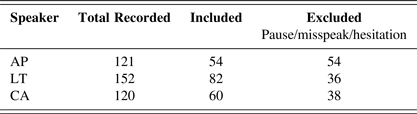
Three scenarios were presented to speakers: going to a farm, going for a hike, and going clothes shopping. Stimuli were questions such as ‘Did s/he see any cows?’ and ‘Did s/he buy three hats?’. Both questions and responses were recorded. A small number of wh-question fillers were included to facilitate the naturalness of the interaction and to avoid speaker fatigue.Footnote 25 Table 1 below presents the total number of tokens recorded and considered for each speaker:Footnote 26
Speakers and numbers of tokens

Tokens were excluded for pauses, misspeaks and hesitations. The number of excluded tokens was high due to the unscripted nature of the responses and natural hesitations and misspeaks in natural speech. While this method of elicitation results in a large number of rejected tokens, it permits for a more natural style of elicitation of the type of data necessary for examining intonation. Higher-level linguistic phenomena such as intonation requires conversational data rather than the traditionally elicited read list or frame sentence elicitation.Footnote 27 The above tokens were considered for the general results and qualitative description of intonation contours.
2.3. Measurement and analysis
Files were uploaded onto an Apple iBook G4 and analysed using Praat 4.5.12 (Boersma and Weenink Reference Boersma and Weenink2007). Vowels were segmented from the initial regular pitch pulse to the final regular pitch pulse. The maximum F0 for each vowel was measured automatically using a Praat script. Pitch settings were determined before running the scripts by examining a random sample of tokens from each speaker, and were set at 40–400 Hz for all speakers. The maximum F0 was initially selected to allow for a delayed pitch peak associated with accent (Gussenhoven Reference Gussenhoven2002, Gordon Reference Gordon and Jun2005, Reference Gordon2008, Oberg Reference Oberg, Jóhannsdóttir and Oberg2007) and supported by a preliminary visual inspection of AP's results that indicated a relatively delayed peak particularly in tokens with a following nasal. However, CA had a strong correlation between pitch reading errors and words with glottal or glottalized stops (i.e., the presence of a preceding and/or following glottalized segment resulted in very creaky voicing and inaccurate pitch measurement by Praat). As the language contains a large number of glottal(ized) stops and because the automatic measurement of all vowels was deemed preferable to a mixture of automatic and manual measurement, CA's tokens were remeasured using a script measuring midpoint F0. This had the effect of considerably reducing the number of mismeasurements, but has the negative effect of rendering CA's measurements not directly comparable to AP's and LT's.Footnote 28 However, no across-speaker statistical comparisons were made.
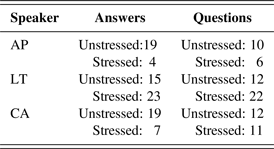
For the quantitative analysis, a subset of the total tokens was considered for two reasons. In order to make coherent generalizations, including basic descriptive statistics, a unified methodology was desirable. As a result, tokens consisting of multiple breath groups and those beginning with an unstressed vowel were excluded.Footnote 29 Table 2 presents the tokens considered for the quantitative analysis, arranged by the metrical properties of the final syllable.
Tokens considered in the quantitative analysis

(“Unstressed” refers to tokens with phrase-final unstressed vowels, and “stressed” to phrases ending in stressed vowels.)
The data above is presented as a function of stress because, as we shall see below, the metrical status of the final syllable affects the intonation contour. Only tokens with a final unstressed syllable were included in the quantitative analysis. The motivations behind this are given in more detail in section 3.1.3.
The numbers of tokens above are not balanced due to the speakers' different syntactic strategies and preferred lexical items, which affected the type of lexical item that occurred in phrase-final position. Most lexical words in St’át'imcets are minimally bisyllabic and due to the trochaic stress system, the final syllable is typically unstressed. As a result, AP and CA have generally more phrase-final words that end in an unstressed vowel. The exceptions are loan words and clothing in particular (e.g., kosó ‘pig’ and kapúh ‘coat’). LT felt more comfortable with the clothes-shopping scenario than either of the ones with animals, which resulted in a high percentage of her questions ending in phrase-final stressed vowels. She also consistently framed her answers using predicate nominalization (e.g., Pála7 ti kapúha s7az's. ‘She bought one coat.’ Lit: ‘The coat she bought was one.’), resulting in most of her answers ending in a phrase-final monosyllabic (stressed) word. See section 3.1.3 for further discussion.
In line with our research questions the initial and final (rightmost) stressed vowels as well as phrase-final unstressed vowels were compared. Accent (prosodic prominence aligned with phonological headedness) is predicted to be either left-aligned with the focused element or right-aligned within the phrase. Thus, the initial and final stressed vowels are considered. The final unstressed vowel is included for the discussion of pitch and interrogativity.
3. Results
The following sections present the results of the experiment. Section 3.1 gives general results while the comparisons of means are given in section 3.2. One of the most common transcription systems for intonation is ToBI (Silverman et al. Reference Silverman, Beckman, Pitrelli, Ostendorf, Wightman, Price, Pierrehumbert and Hirschberg1992). While this exploratory work is not an in-depth ToBI analysis, a few conventions are borrowed from the ToBI framework: the use of % to mark boundary/edge tones and H* to mark nuclear accent.Footnote 30
3.1 General results
The pitch contours presented here represent the intonation patterns of the speakers. They are presented by utterance type, speaker and metrical status of the final syllable.
3.1.1 Statements
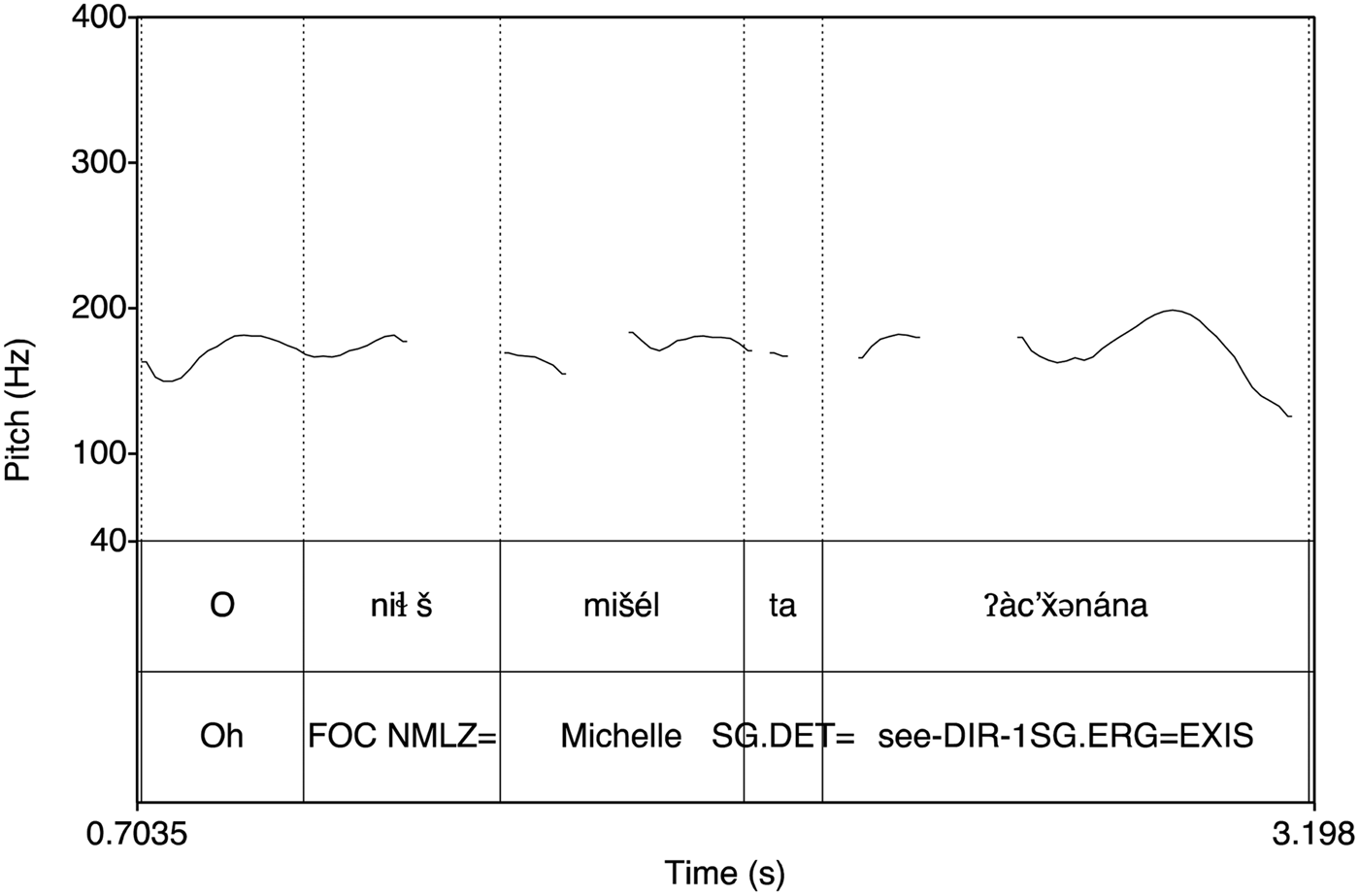
Figure 1 shows a pitch tracing of AP's answer to a wh-question.Footnote 31
AP's pitch contour (Hz): Oh, nilh sMichelle ta ats'xenána. ‘Oh, it's Michelle that I see.’ (Response to ‘Who do you see?’)

In Figure 1, we see that the highest pitch of the phrase is on the final stressed /a/ in the phrase.Footnote 32 Given that prominence (increased F0, higher pitch accents) is defined as the acoustic correlate of nuclear accent and it is the rightmost stressed vowel in the phrase that has the highest F0, nuclear accent can be analysed as being rightmost in the phrase. It is not associated with the focus particle nor with the focused element (Michelle). In the figures below, nuclear accent is marked with H*. Also present is a drop in F0 at the end of the phrase, commonly analysed cross-linguistically as a L% boundary tone.
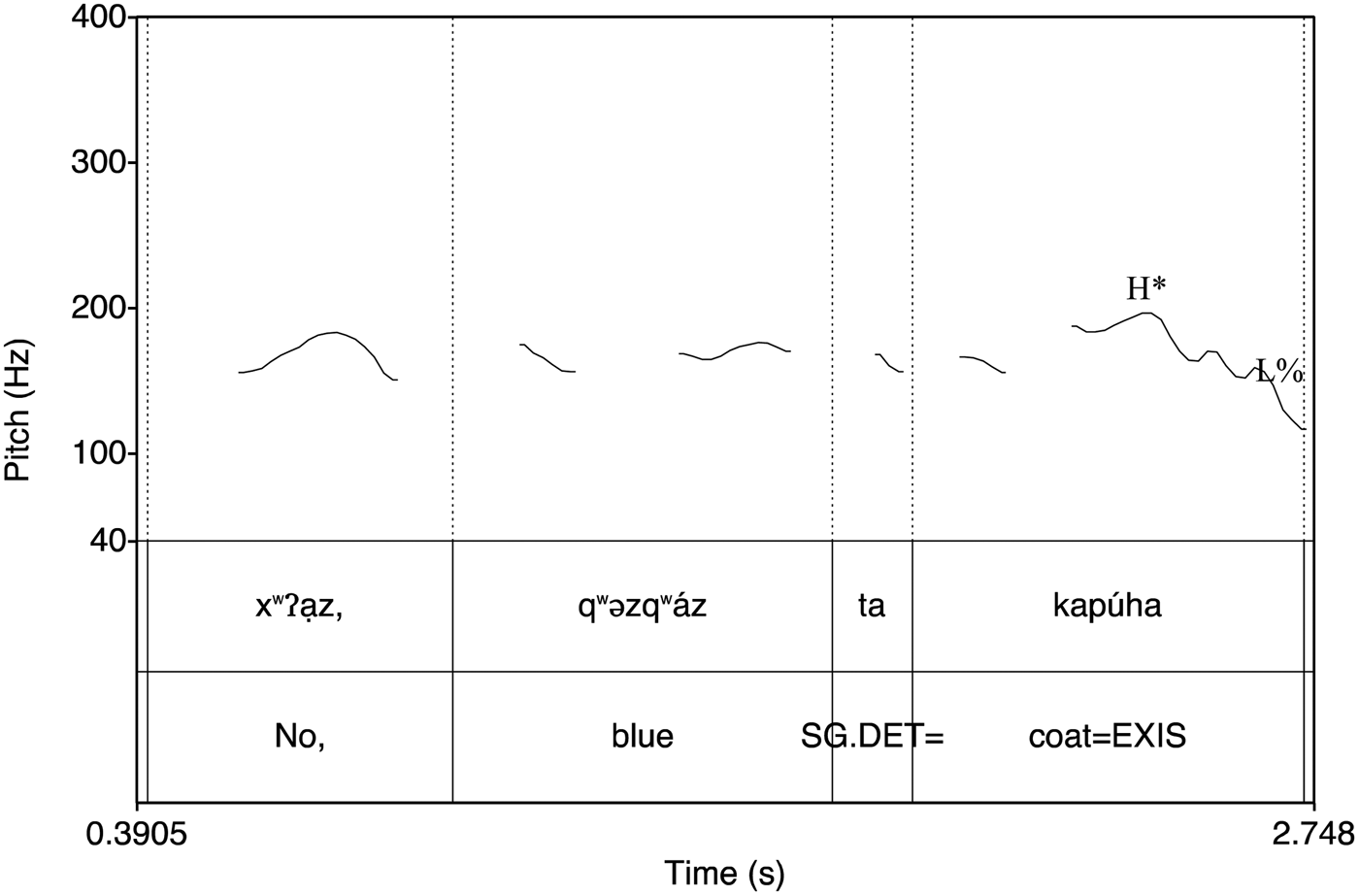
We see the same pattern in a phrase with contrastive focus, as in Figure 2.Footnote 33
AP's pitch contour (Hz): Cw7aoz, qwezqwáz ta kapúha. ‘No, the coat is blue.’

As we can see from the above pitch tracing in Figure 2, the final stressed vowel in the phrase is again the most prominent in spite of its position in the phrase. No declination or deaccenting appears to be present and the focused element is not associated with increased pitch. The L% is associated with the phrase-final unstressed vowel.
CA shows the same pattern. Consider Figures 3 and 4, which depict broad and contrastive focus statements.Footnote 34
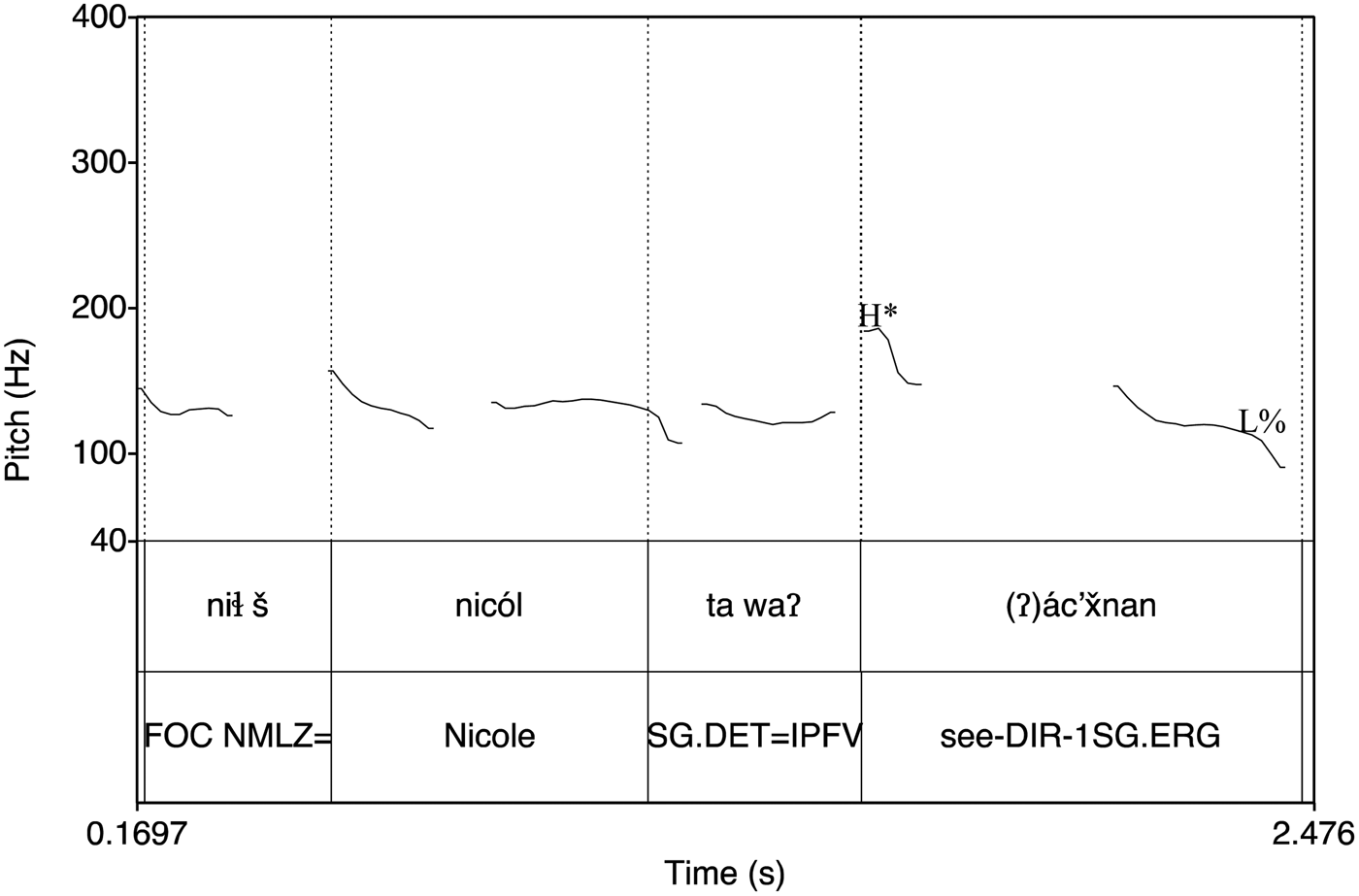
CA's pitch contour (Hz): Nilh sNicole ta wa7 áts'xenan. ‘It's Nicole that I see.’ (Response to ‘Who do you see?’)

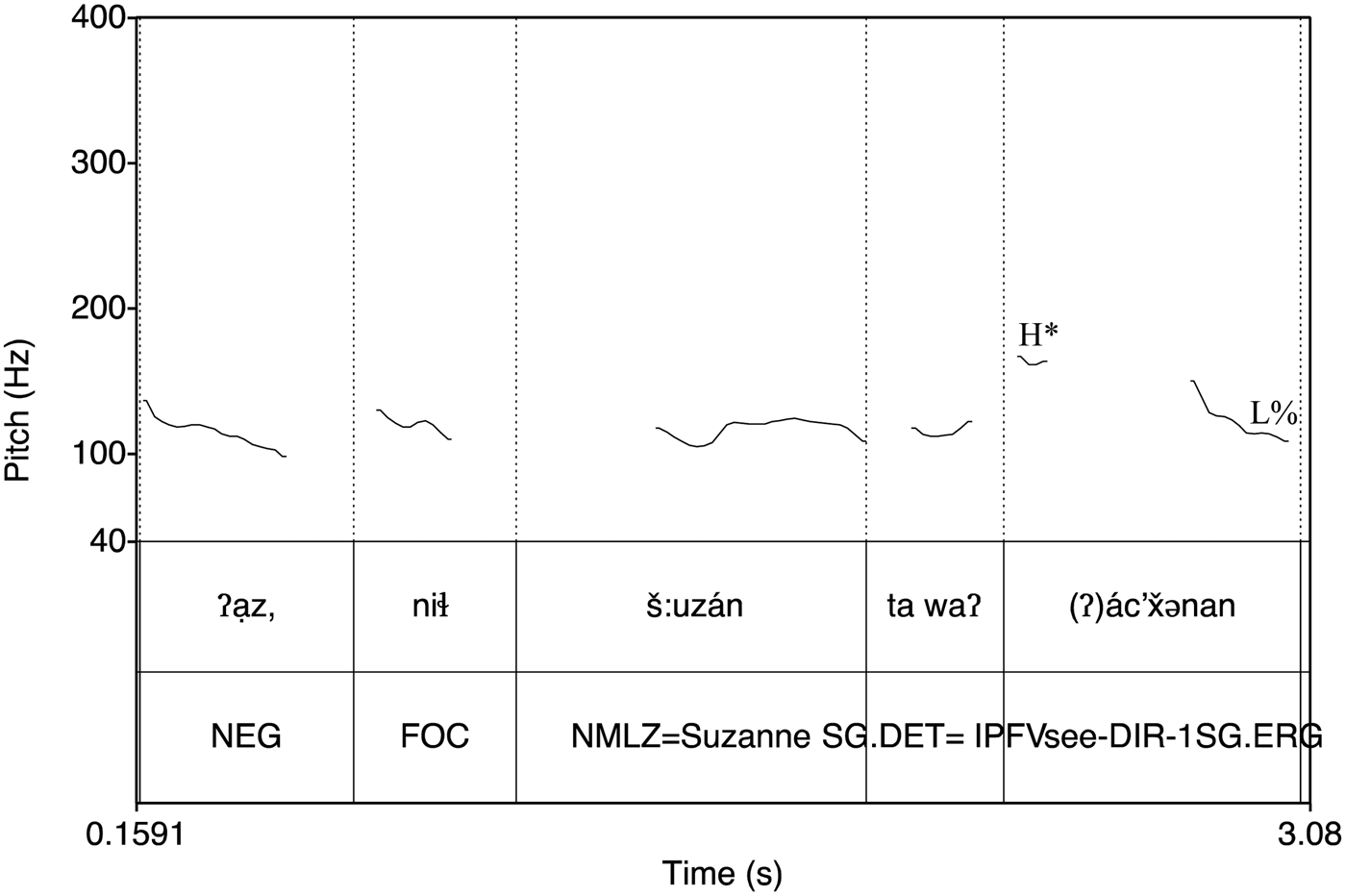
CA's pitch contour (Hz): Cw7aoz, nilh Suzanne ta wa7 áts'xenan. ‘No, it's Suzanne that I see.’

As in Figures 1 and 2 above, the highest F0 in the phrase is associated with the rightmost stressed vowel rather than with the focused element. As with AP, this pattern holds even for answers with contrastive focus, such as the one shown in Figure 4.Footnote 35
In this case of contrastive focus, there is no increased F0 associated with the focused element or the focus particle. As in the previous case, the final stressed vowel in the phrase is associated with the highest pitch. The pitch once again falls across the remaining unstressed vowels.
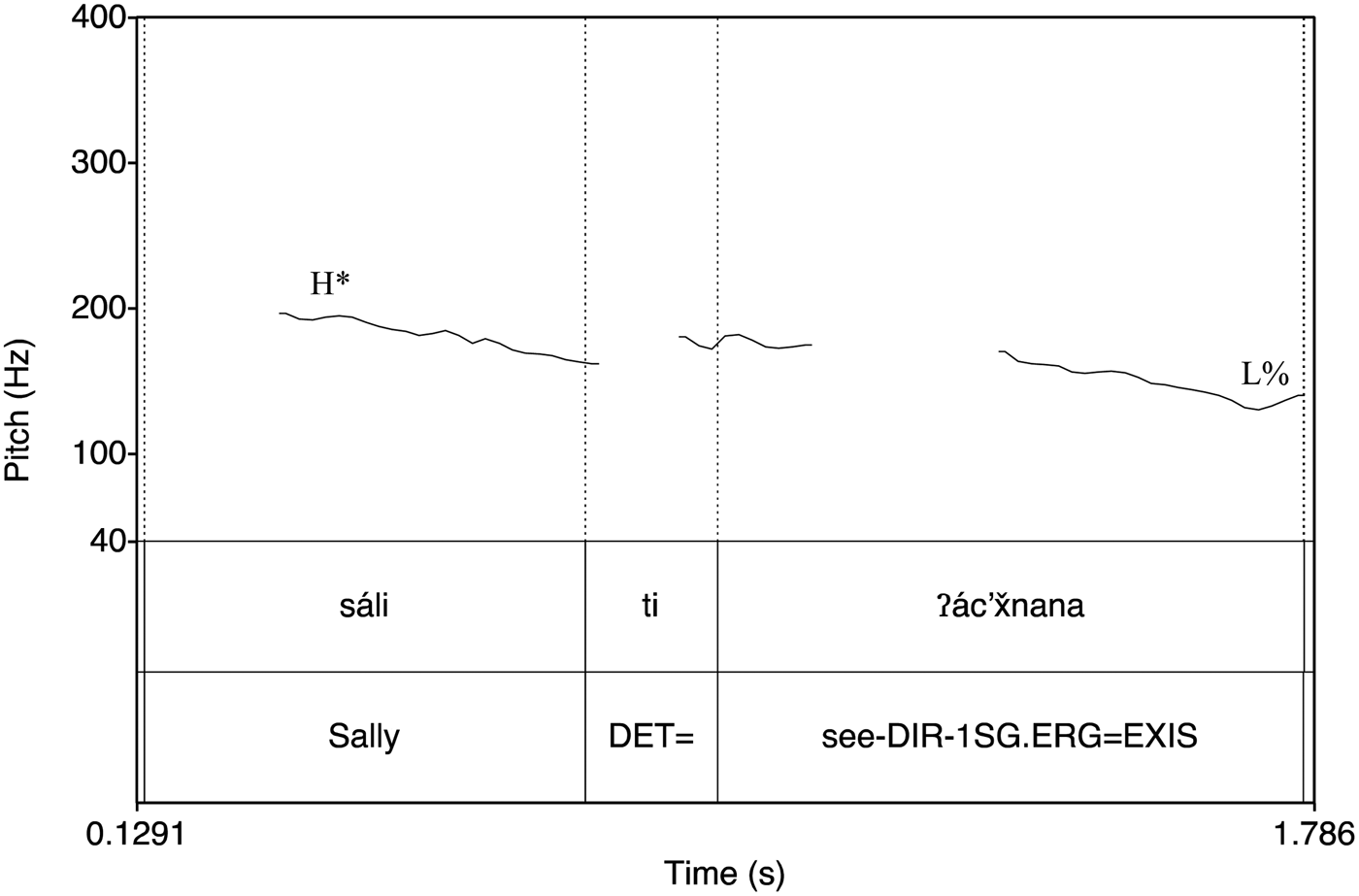
Unlike AP and CA's pattern of rightmost highest F0, LT's rightmost stressed vowel does not have the highest F0 in the phrase. Rather, as shown in Figure 5, it is the initial stressed vowel (the one in the predicate and associated with the focused element) that has the highest F0, though there is not much declination in pitch between the initial and final stressed vowel.Footnote 36
LT's pitch contour (Hz) Sally ti ats'xenána. ‘I see Sally’. (Response to ‘Who do you see?’)

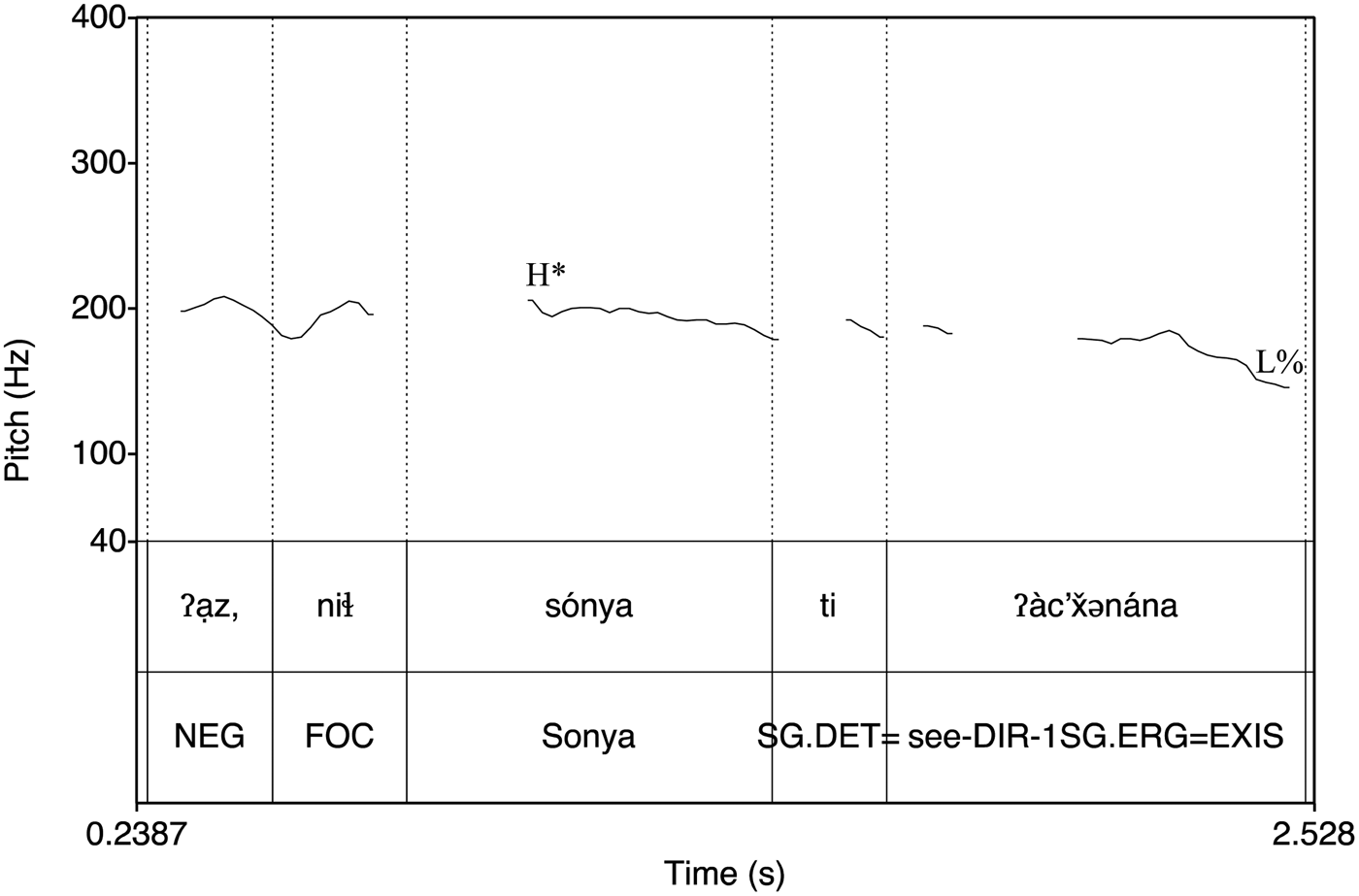
This pattern applies to contrastive focus cases as well, as Figure 6 shows.
LT's pitch contour (Hz): Cw7aoz, nilh Sonya ti ats'xenána. ‘No, it's Sonya that I see.’

LT's intonation pattern looks more like that reported for SENĆOŦEN, where the predicate vowel carries the highest pitch followed by an overall fall.
3.1.2 Yes/no questions
Turning now to the intonation contours of interrogatives, Figures 7–9 show the intonation contours for yes/no questions.
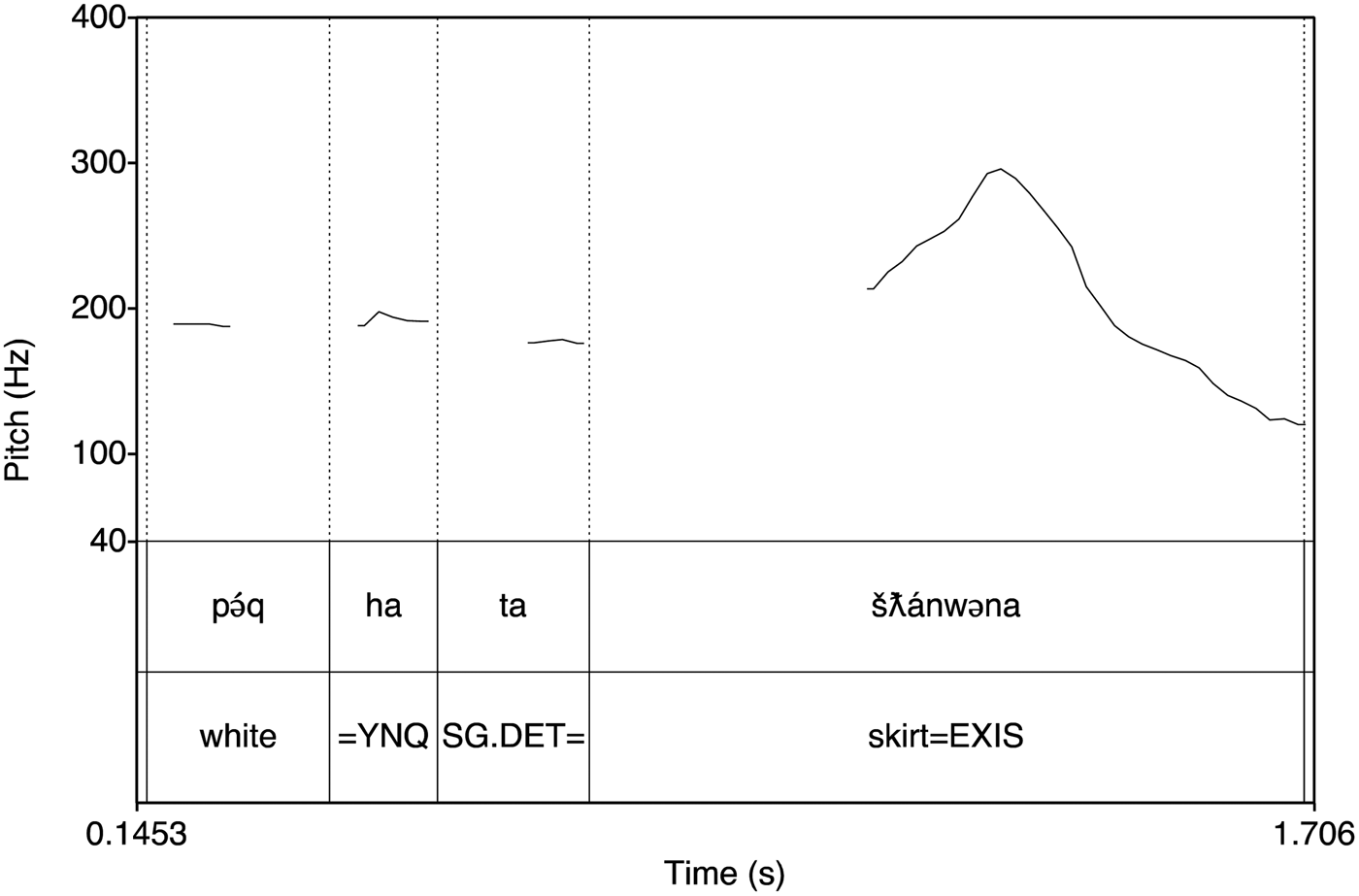
AP's pitch contour (Hz): Peq ha ta st’ánwena. ‘Is the skirt white?’

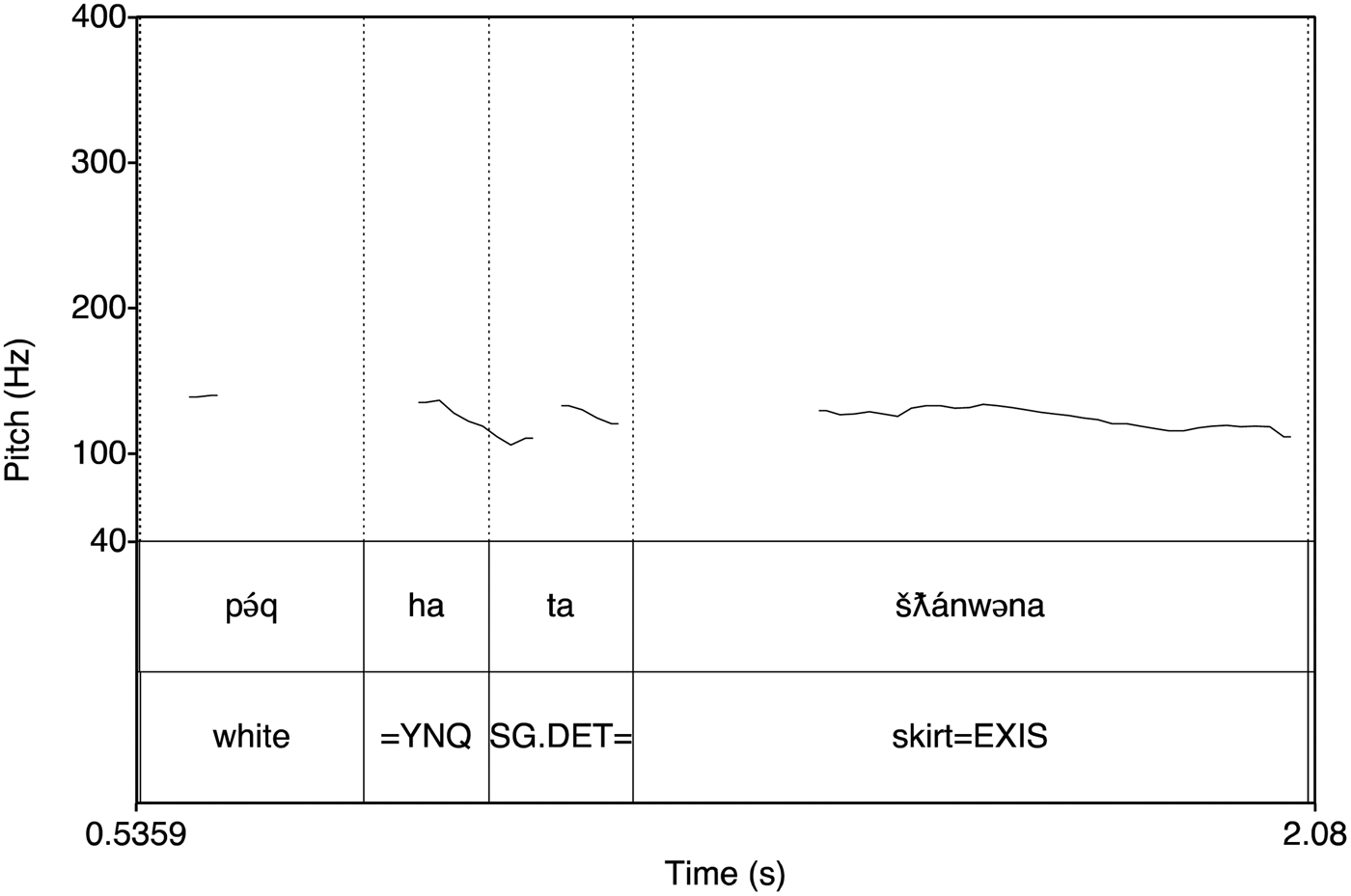
CA's pitch contour (Hz): Peq ha ta st’ánwena? ‘Is the skirt white?’

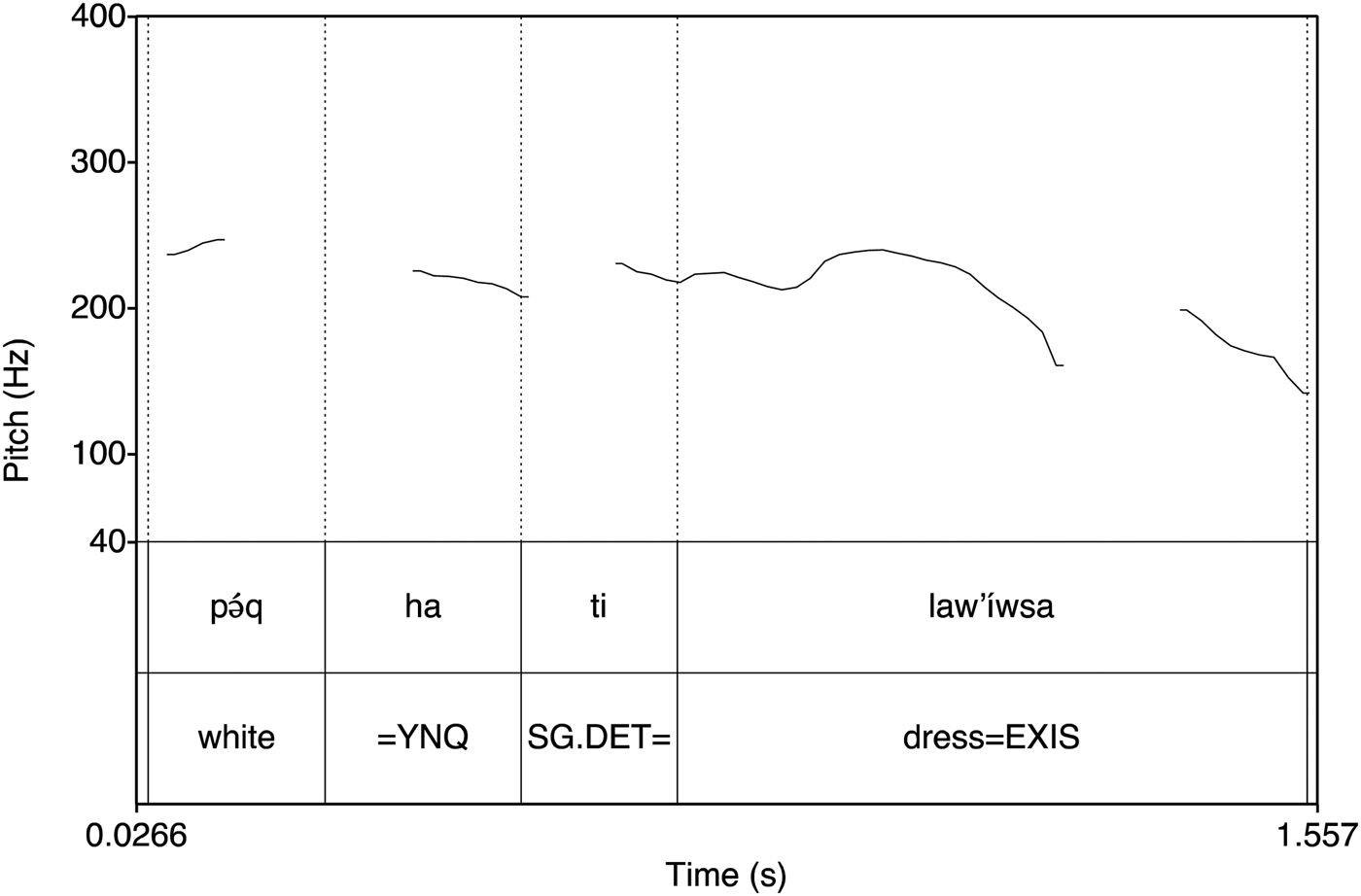
LT's pitch contour (Hz): Peq ha ti law’íwsa? ‘Is the dress white?’

As in the statements, AP's final stressed vowel has the highest pitch in the phrase. While this example shows the extreme end of the F0 values found for questions, all questions were associated with high F0 on the final stressed vowel. This indicates that the location of nuclear accent is the same for yes/no questions and statements. The final unstressed vowels show a drop in pitch, signalling that a L% boundary tone is also present.
CA's yes/no questions have a slightly different pattern from his statements. The pitch contour is relatively flat and as we can see in Figure 8, the rightmost stressed vowel does not carry the highest pitch in the phrase. The declination, however, is minimal. While there is also no large drop in F0 over the final unstressed vowels as we saw in statements, there is no rise, either.
LT's questions show a different pattern again, as shown in Figure 9. Instead of a steady decline in pitch from the initial to the final vowel, both the initial vowel and the final stressed vowel are high. The rightmost stressed vowel is considerably higher than that observed in statements. The low boundary tone is present on the final unstressed vowel.Footnote 37
To summarize, AP and CA show a H* pitch accent associated with the rightmost stressed vowel in statements, while LT shows leftmost prominence. Given our definition of nuclear accent as the most prominent (highest pitch) in the phrase, the Northern speakers demonstrate rightmost nuclear accent. In yes/no questions, AP shows the same overall intonation pattern, while CA's appears flatter and LT's shows a higher rightmost stressed vowel. Whether LT's rightmost stressed vowel satisfies the declination criteria to be considered nuclear accent will be determined in section 3.2.
The next section presents pitch contours for phrases that end in words with final stress.
3.1.3 Phrases with final stress
In the above cases, the final stressed syllable is always followed by at least one unstressed syllable that generally hosts the L% boundary tone. In phrases that end in a stressed syllable, there is no final unstressed vowel available to host the boundary tone. Speakers pursue one of two strategies when faced with such situations: either they compress the two tones onto one syllable or they truncate or delete one of the tones.
The strategies used by St’át'imcets speakers appear to vary. For AP, if the stressed syllable ends in an obstruent or glottalized resonant, she consistently uses truncation (seven of 10 final stressed tokens) deleting the L%. If the phrase-final stressed syllable is open or followed by a resonant compression occurs (as in the remaining three tokens). This first strategy can be seen in Figure 10.
AP's pitch contour (Hz): Kwam ha i tsítsela qmut? ‘Did she get/buy some/the new hats?’

CA has a consistent strategy of truncation. All 18 of his phrase-final stressed tokens contained level tones, though the pattern of the tone depended on the phrase type. All of CA's statements that had finally stressed tokens were syntactic predicate nominalizations. As a result, the final word appears in a separate syntactic clause from the rest of the phrase. An example can be seen in Figure 11.
CA's pitch contour (Hz): Iy, kalhás i slhécwqa skwams. ‘Yes, she got/bought three pants.’

In contrast to the intonation contours of the declaratives in section 3.1.1, the pitch of CA's final stressed vowel approximated that of the initial stressed vowel but was never higher. Any finally-stressed questions ended in a noun and the pitch was usually as high or higher than that of the initial vowel. Consider Figure 12.
CA's pitch contour (Hz): Tecwp ha ku qmut? ‘Did she buy any hats?’

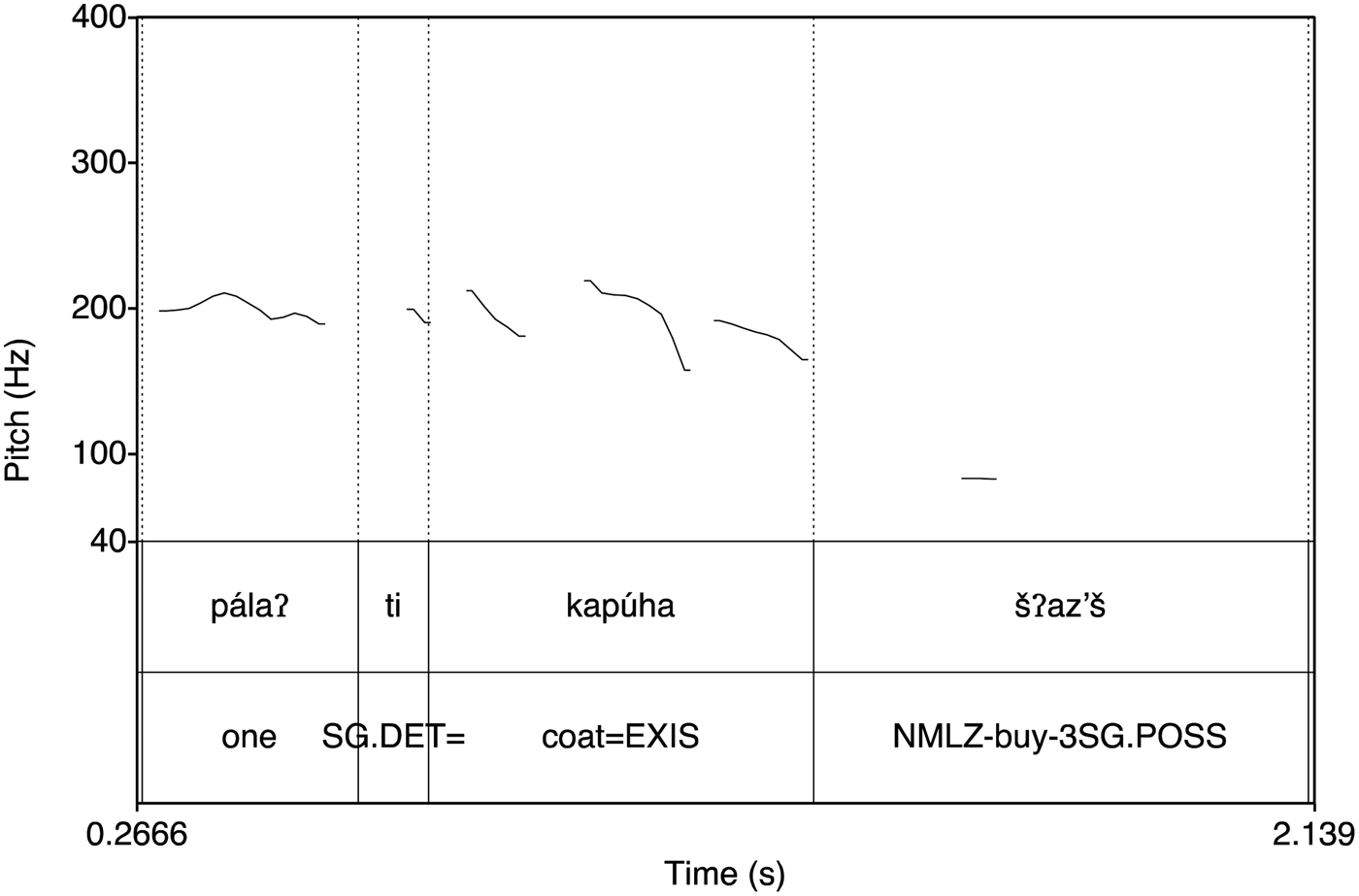
LT shows a similar, but more extreme pattern in her declaratives. Like CA, the strategy used is phrase-dependent and different from that of the declaratives seen previously. Of her 23 declaratives (all of which had the structure of predicate nominalization and ended in the same word), all but six showed only a level low tone. The gentle declination seen in previous declaratives is not present and in some cases, like the one represented in Figure 13, the low tone is very low indeed.
LT's pitch contour (Hz) Pála7 ti kapúha s7az's. ‘She bought one coat.’ (Lit: ‘The coat she bought was one.’)

The pattern for her 22 finally-stressed questions show a fall from a relatively high F0 on the final syllable in all but four cases. An example can be seen in Figure 14.
LT's pitch contour (Hz): Az’ ha ku tsítsel qmut? ‘Did she buy a new hat?’

While CA's and LT's intonation contours for yes/no questions appear to be similar across the two prosodic conditions, those for declaratives were not. Given the complicating factors of the interaction between clause structure and prosody and the possible effect of compression on maximum F0, the quantitative results in the next section focus only on phrases that end with a stressed penultimate vowel and a final unstressed vowel. While this further limits the descriptive adequacy of the study, it is preferable to compare phrases with similar syntactic and metrical structure.
3.2 Quantitative results
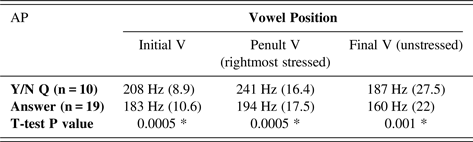
The following tables and figures show the means for vowels in statements and yes/no questions. First, consider AP. Basic means, standard deviation (in parentheses) and the results of a basic paradigmatic t-test (p < 0.05) are given in Table 3. “Initial vowel” marks the first (stressed) vowel in the phrase while the next two vowels come from the final word in the phrase. The penultimate vowel is the final stressed vowel in the phrase and the “final vowel” is the phrase-final unstressed vowel of the final word. The t-test compares vowels in the same position across phrase types.
AP's results comparing F0 means (Hz) of vowels across questions and answers (SD) p < 0.05 * indicates a significant difference

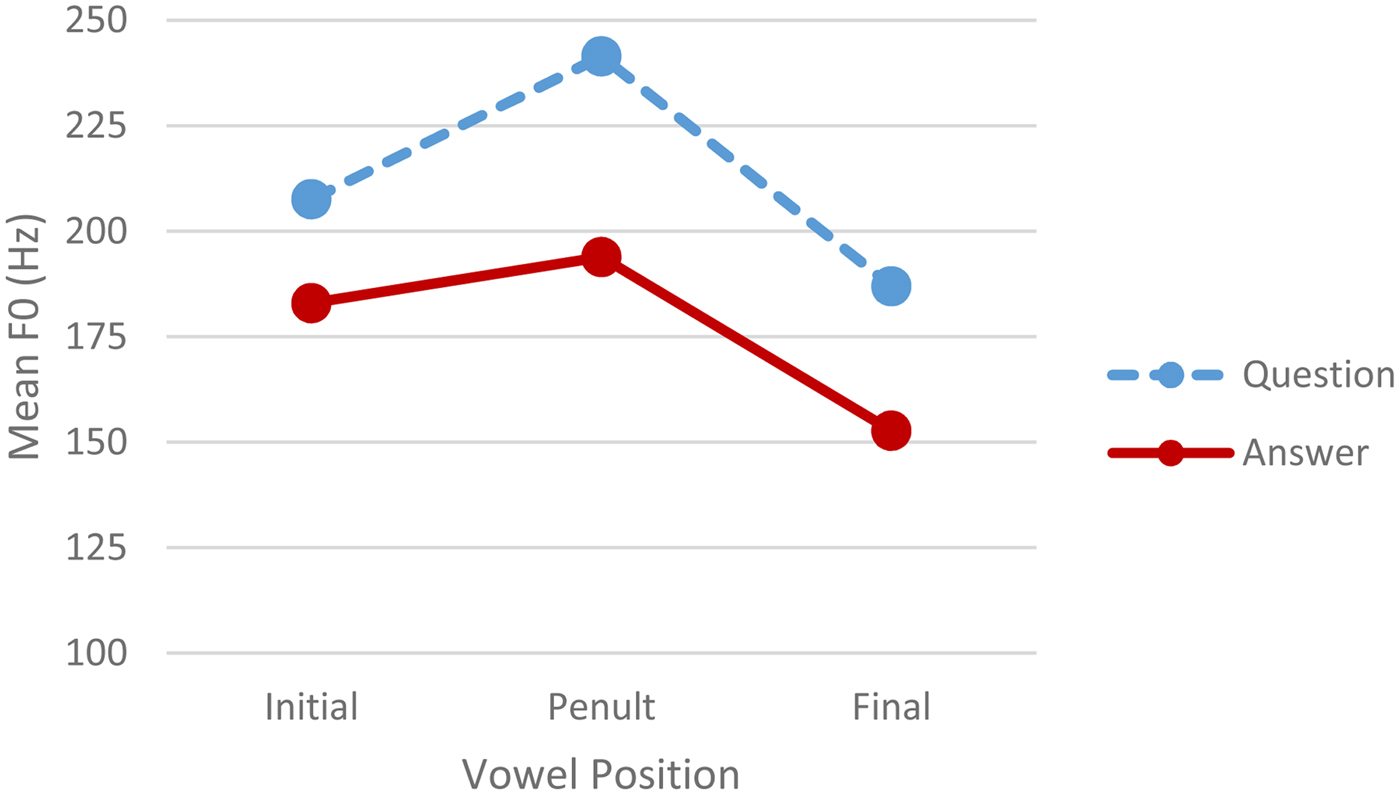
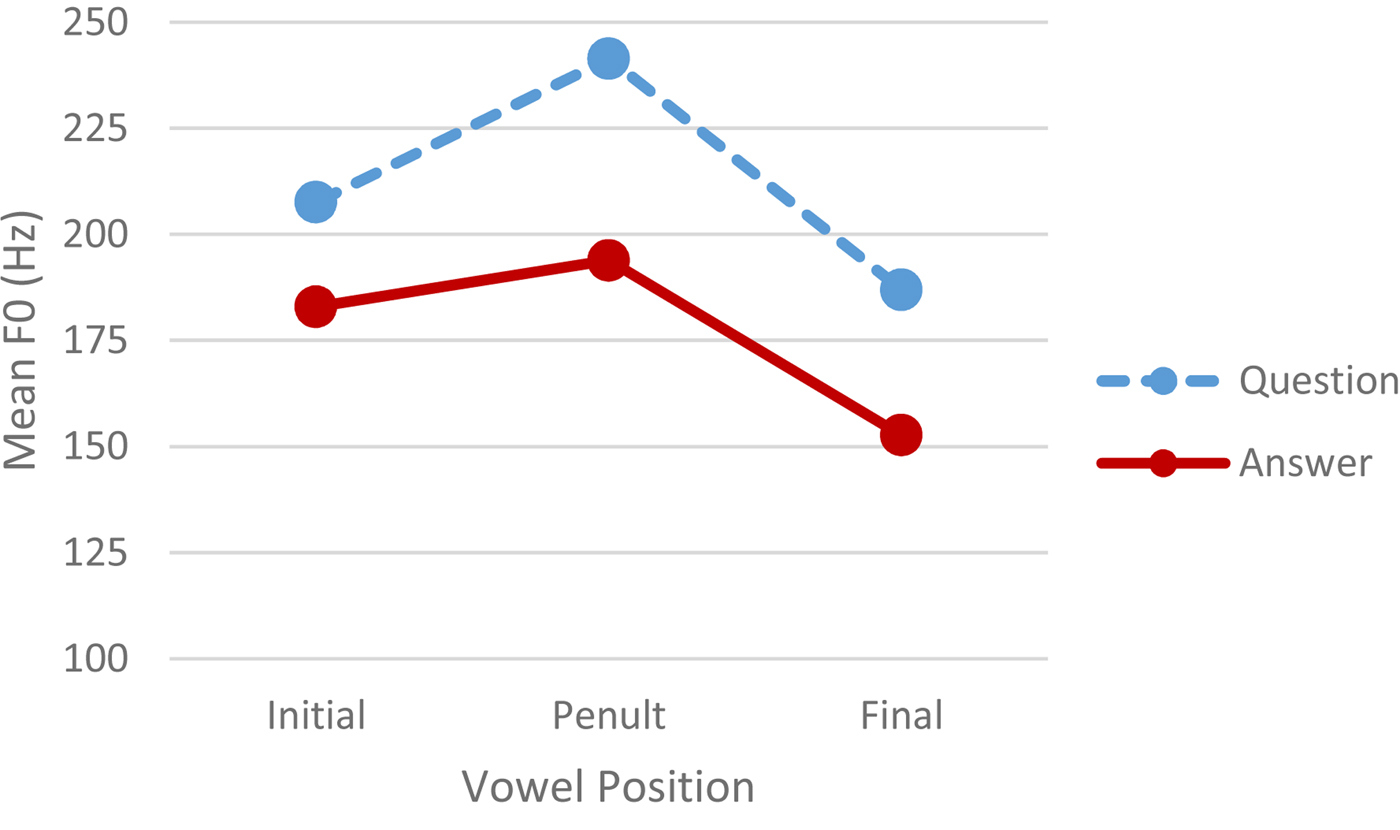
As we can see, the F0 of vowels in yes/no questions is significantly higher than the corresponding vowels in statements. A sort of stylized pitch contour can be constructed by plotting these values, as in Figure 15.
Mean F0 (Hz) of AP's vowels in yes/no questions and statements. Here and below, the initial and penultimate vowel are stressed, while the final vowel is unstressed.

As we can see in Figure 15, AP demonstrates an upshifted register in yes/no questions as compared to statements. Questions start and finish significantly higher than statements, and the nuclear accent is also significantly higher.
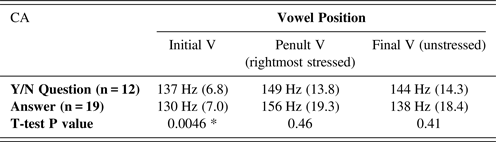
CA shows different results from AP. Only the initial vowel is significantly different in yes/no questions and statements, with the interrogative being higher.
Table 4 shows that while the initial vowel in yes/no questions is significantly higher, it is only by an average of 7 Hz. Apart from this, yes/no questions and answers do not differ significantly in pitch. Consider Figure 16.
Mean F0 (Hz) of CA's vowels in yes/no questions and statements

CA's results comparing F0 means (Hz) of vowels across questions and answers. (SD) p < 0.05

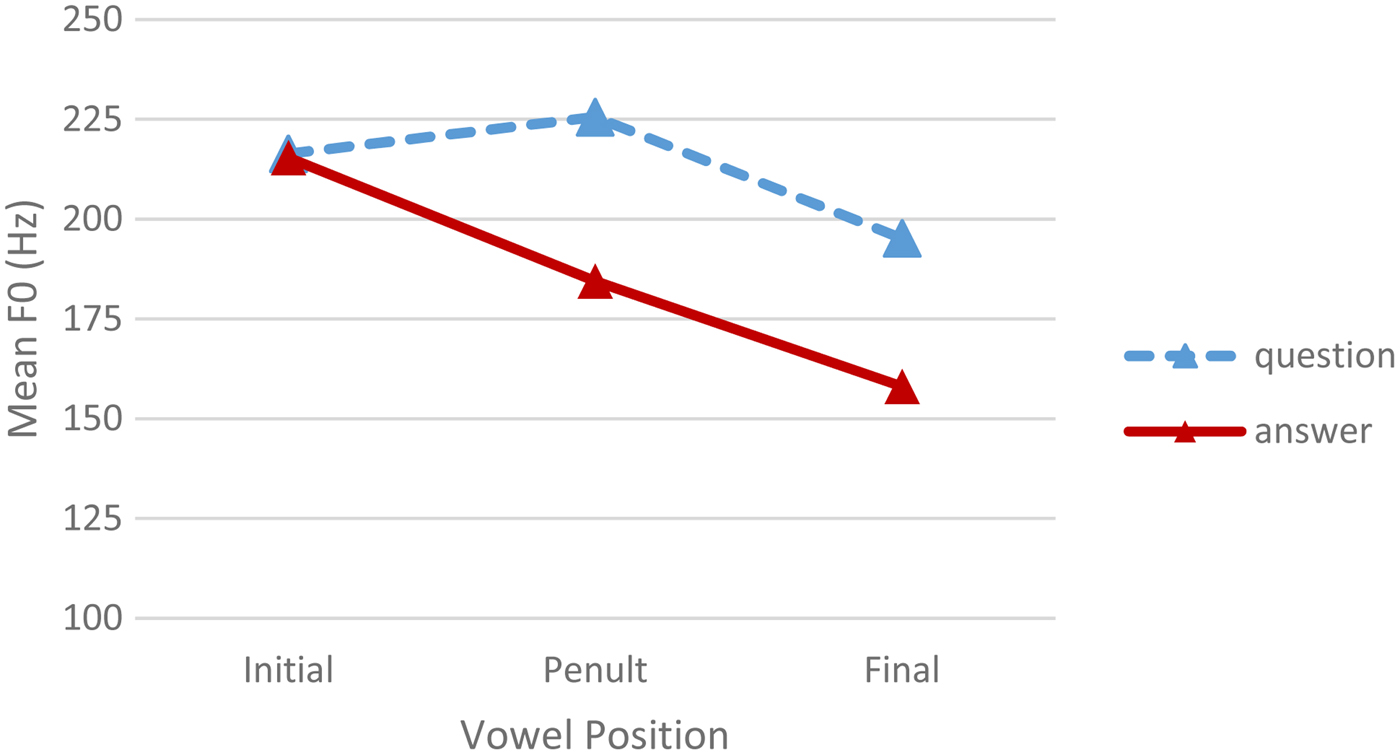
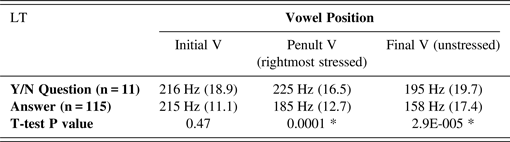
For LT, while both declaratives and yes/no questions begin with a similar mean F0, the rightmost stressed vowel and final vowel show a significant upward shift in pitch. As we can see in Table 5 and Figure 17, the F0 of LT's yes/no question vowels differs dramatically from those in statements. Both the final stressed vowel and final unstressed vowel are significantly higher.
Mean F0 (Hz) of LT's vowels in yes/no questions and statements

LT's results comparing F0 means (Hz) of vowels across questions and answers. (SD) p < 0.05

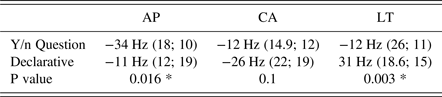
While the above values show interesting paradigmatic comparisons, prominence is a relative measure and so it is crucial to compare values syntagmatically. In addition, calculating the declination between the initial and final stressed vowels in utterances will allow us to compare the values with previous research in Nɬeʔkepmxcín by Koch (Reference Koch2008, Reference Koch, Frota, Prieto and Elordieta2011) and English (Pierrehumbert Reference Pierrehumbert1979). Table 6 gives the average topline declination per utterance from the initial to the final stressed vowel.
Mean declination (Hz) per utterance from initial to final stressed vowel. (Standard deviation followed by N are given in parentheses. p < 0.05)

As we can see, AP and CA have an average rise from initial stressed vowel to final stressed vowel within phrases. For AP, 17 of 19 statements and all 10 of her yes/no questions had higher pitch on the rightmost stressed vowel than on the initial. For CA, 17 of 19 statements and 10 of 12 questions had an increase in F0 from initial to rightmost stressed vowel. However, the difference in rise between yes/no questions and statements is significant only for AP.
For LT, yes/no questions have an average rise in F0 from the initial to final stressed vowel. This rise is clearly significantly higher than in statements. In statements, LT's declination is an average 5.2 Hz/syllable.Footnote 38
4. Discussion
This study presents a first examination of St’át'imcets intonation through the lens of the prosody-information structure interface. Davis' (2007, 2012) generalization that Salish languages demonstrate no prosodic reflexes of information structure is tested by asking two research questions: First, is nuclear accent (as defined by intonational prominence) consistently associated with the rightmost stressed vowel? Second, are yes/no questions associated with higher F0? The overall pitch contour is examined and basic quantitative analyses of the paradigmatic and syntagmatic F0 values of the initial, final stressed and final unstressed vowel are performed.
One of the most important results of this exploratory study is the first documentation of intonation in an endangered indigenous language. It reveals dialect-specific patterns of intonation and contributes to the typology of prosody with respect to focus and interrogativity.
Overall, the broadest generalizations that can be made based on these data are first, that speakers showed F0 prominence on the final stressed vowel, though the relative F0 height was dialect dependent; second, that all speakers had a drop in pitch at the end of the phrase (analysed here as representing a L%); and third, that while all speakers had increased pitch associated with yes/no questions, none signalled yes/no questions with a final rise.
In addressing the first question, nuclear accent was defined as F0 prominence. Examining the intonation contours shows that for Northern speakers, the rightmost stressed vowel had the highest F0 of the phrase, regardless of focus. For the Southern speaker, it was the initial stressed vowel.
Based on Koch (Reference Koch2008, Reference Koch, Frota, Prieto and Elordieta2011), the criteria for assigning nuclear accent to the rightmost stressed vowel were that it be no more than 10 Hz lower than the initial stressed vowel and that the declination between the two be no more than previous reports for English of 6.7 Hz/syllable. Both Northern speakers satisfied this definition for rightmost nuclear accent. The overwhelming majority of statements have an absolute rise (negative declination) from initial to final stressed syllable. This was true in cases of narrow focus as well as broad. There was no exceptional pitch prominence associated with the focused element and no indication of deaccenting. In this respect, Northern speakers demonstrate an intonation contour for declaratives similar to that of Nɬeʔkepmxcín speakers, and support Davis' generalization.
The Southern speaker showed a different pattern, more like that reported for SENĆOŦEN. The initial or leftmost stressed vowel had the highest F0, followed by a fall over the rest of the phrase. Again, this was true of both broad and contrastive focus. At 5.2 Hz/syllable, the rate of declination was lower than that of Koch's (Reference Koch2008) speakers but higher than Sorensen and Cooper's results for English, which has also been analysed as having rightmost nuclear accent (for broad focus). In line with Koch's results, then, even the Southern dialect speaker could be considered to have a prominent rightmost stressed vowel and nuclear accent.
Analysing the Southern results as having rightmost nuclear accent also avoids violating what Davis (Reference Davis2007: 18), citing Krifka (Reference Krifka1998), Kahnemuyipour (Reference Kahnemuyipour2004) and Kratzer and Selkirk (Reference Kratzer and Selkirk2007), calls a prosodic universal: *stress predicate The predicate may not receive the main sentence stress.
On the other hand, the difference in F0 between the rightmost stressed vowel and the initial vowel was greater than in Pierrehumbert's (Reference Pierrehumbert1979) results, suggesting that English speakers might not perceive the final stressed vowel as more prominent than the first. However, it should be noted that Pierrehumbert's stimuli consisted of two prominent syllables separated by a series of non-prominent syllables, while the data considered here often had an intervening prominent syllable as well. Ideally, a perception study with St’át'imcets speakers should be conducted to determine whether and at what point the final stressed syllable is perceived as equally prominent to the initial.
If the Southern speaker's results are analysed as demonstrating rightmost nuclear accent, St’át'imcets supports Davis' generalization that focus and accent are divorced in Salish languages. What remains to be accounted for is the apparently dialect-dependent pattern. As mentioned above, Southern St’át'imcets shows some influence from Coastal Salish, though the dearth of relevant research prohibits drawing any substantive conclusions.
If the Southern dialect is analysed as having leftmost nuclear accent, these results would not conclusively distinguish between the stress-focus and dissociation proposals. Under a stress-focus analysis, both default and narrow focus (and their directly associated prosodic markers) are leftmost. However, it is not possible from these results to rule out phonological headedness and syntactic focus both occurring independently (and coincidentally) at the left edge.
The results of this preliminary study support Davis' generalization that focus and prosody are decoupled in Salish languages. The data from St’át'imcets challenge the accepted association between prosody and focus. However, only a very limited number of tokens from a limited number of speakers are considered.
One of the limiting factors that emerged was the role of metrical structure and clause-type on the overall intonation contour. An investigation into the role of the sonorancy of syllable codas in tune alignment strategies may reveal interesting patterns hinted at by AP's results. An experiment examining the role of clause structure in phonological phrasing and headedness may account for the different intonation patterns associated with phrase-final stressed vowels in cases of predicate nominalization. This would include scenarios with a different verb to rule out local effects of glottalization as an account of LT's results. More research with a larger number of tokens and speakers and controlling for a wider variety of phrase types is necessary before making any conclusive judgements.
While the study was not designed to examine the relation between question focus and prosody, it is interesting to note that the presence of a question particle is typologically correlated with a difference in accent location between yes/no questions and statements (Ladd Reference Ladd2008). In languages like English, which lack yes/no question words, the pattern of focal accentuation is the same across yes/no questions and statements. This correlation is less clear in St’át'imcets. For AP and CA there was no difference in the location of the nuclear accent between interrogatives and statements. For LT, however, the increased prominence associated with the rightmost stressed vowel in yes/no questions could be argued to support the typological generalization. An experiment explicitly testing accent placement and focus in questions is required to examine this generalization in more detail.
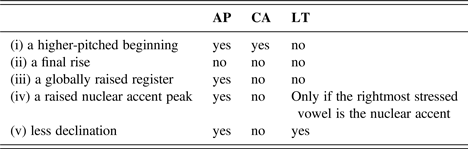
The second research question examines the intonation patterns associated with yes/no questions. The UIMH proposes that there is a universal increase in pitch associated with interrogativity and Haan (Reference Haan2002) outlines five ways in which this instantiated cross-linguistically. St’át'imcets speakers all support the UIMH. While no speaker signals yes/no questions with a final rise, each does have higher pitch somewhere in the phrase. Table 7 shows how each speaker's yes/no questions differ from statements.
Patterns of increased pitch by speaker

AP has a higher global register including significantly higher pitched initial, nuclear and final vowel. CA showed a significant difference only in the initial vowel, with yes/no questions having a slightly, yet perceptibly higher initial vowel.Footnote 39
LT shows a different pattern again. As in Oberg (Reference Oberg, Jóhannsdóttir and Oberg2007), her initial yes/no question and declarative vowels did not differ significantly in F0. The phrases did differ in that the rightmost stressed vowel and final vowel were both significantly higher in yes/no questions, i.e., less declination. This result may also argue in favour of positing rightmost nuclear accent for LT. One of the common strategies for distinguishing yes/no questions from statements is increased pitch on the nuclear accent, and LT does just this.
The increased F0 associated with some part of the interrogative phrase supports the UIMH. Determining exactly where the realization of higher F0 is in terms of the locations identified by Haan (Reference Haan2002) contributes to the typology of question intonation. Like Vietnamese and Danish, St’át'imcets is one of the few languages that does not mark yes/no questions with a final rise. Instead, speakers use strategies found also in Finnish, Chickasaw and Bengali, among others.
Within the Salish family, St’át'imcets differs from both SENĆOŦEN and Skwxwú7mesh. In making a prosodic distinction between yes/no questions and declaratives, St’át'imcets differs from SENĆOŦEN, which reportedly makes no prosodic distinction between the two (Benner Reference Benner2006). The increased F0, or no significant difference associated with the initial vowel differs from Skwxwú7mesh wherein questions start lower but finish higher (Jacobs Reference Jacobs, Jóhannsdóttir and Oberg2007).
The results of the present study support the UIMH and add to the typology of interrogativity. The results, however, do not support the generalization that information structure is not signalled through prosody. Each speaker makes a significant distinction in F0 associated with yes/no interrogativity.
Haan's results also support an “inverse relationship between the strength of acoustic features and the presence of non-acoustic markers of interrogativity” (Haan Reference Haan2002: 215). In other words, the more syntactic/morphological markers of interrogativity such as a question particles or inversion are present in an utterance, the weaker the prosodic correlates.
St’át'imcets, like other Salish languages, marks yes/no questions with a second-position clitic and so would be predicted under Haan's proposal to have weak acoustic correlates to interrogativity. However, in order to determine whether there is a corresponding inverse relation between the presence of this particle and prosody requires more research. Anecdotal evidence from LT supports Haan's proposal, in that declarative questions are marked with a striking final rise in pitch.Footnote 40 What constitutes weak acoustic correlates and how comparable cues to wh-questions and yes/no questions remain to be determined.
The results of this preliminary exploration of St’át'imcets intonation limits Davis' generalization that information structure is not associated with prosody specifically to focus. It is tempting, though, to consider whether Haan's link between the availability of morphological or syntactic strategies and weak or absent prosodic correlates can be applied to both focus and interrogativity. Benner (Reference Benner2006) suggests exactly this to account for SENĆOŦEN. This presents an interesting area for future research.
The biggest limitations of this study are the small number of speakers and tokens. It is difficult to make broad generalizations about the language and to attribute patterns to dialect- or gender-related sources with no more than two speakers in each category.Footnote 41 However, Bird (Reference Bird, Lee and Zee2011) points out that while phonetic studies on NW languages are “fundamentally different” from large-scale phonetic studies, they are equally valid when considered as a series of case studies. Ideally more directed research with more speakers will be conducted.
In terms of tokens, the elicitation method selected resulted in a large number of tokens with pauses or hesitations or misspeaks. Intonation is a discourse-level phenomenon and requires the elicitation of conversational data. Pauses and hesitations are common in natural speech and so it is no surprise that they are present in these data as well. That being said, the elicitation task itself was a challenging one, requiring speakers to translate on the fly for the question portion of the session. The difficulty associated with the task was alleviated somewhat by a practice session, but still had an effect on the resulting data. A different activity-based elicitation technique, such as the Map Task might be used to better effect (see Caldecott and Koch Reference Caldecott and Koch2014 for a discussion of pros and cons of this and other methodologies).
One additional limitation of the study is that only pitch was considered. Intonation makes up only part of prosody. It is possible that accent, focus and interrogativity are signalled by other facets of prosody such as duration, intensity/amplitude, pausing or segment articulation.Footnote 42 A broader study examining other aspects of prosody marking accent and exploring whether focus might be marked by prosodic correlates to phrasing rather than accent would make interesting future research.
5. Conclusion
Davis (Reference Davis2007, Reference Davis2012) proposes that prosody and information structure are not linked in Salish or other languages of the NW Coast. This study presents the first documentation of St’át'imcets intonation and tests this generalization with the frameworks of the focus accent link and the hypothesized universal use of increased pitch to mark interrogativity. These preliminary results indicate that Davis' generalization is substantiated for focus in St’át'imcets but not for interrogativity. St’át'imcets adds to the growing number of languages that challenge the accepted correspondence between focus and prosody. It also is one of the few languages that do not mark yes/no questions through a final rise in pitch while still supporting the UIMH.
Given that prosody informs many other interfaces within our model, including phonetics-phonology (Ohala et al. Reference Ohala, Dunn and Sprouse2004), phonetics-semantics (e.g., Gussenhoven Reference Gussenhoven, Dressler, Prinzhorn and Rennison1994) and phonetics-pragmatics (Wichmann and Blakemore Reference Wichmann and Blakemore2006), research into prosody in Salish languages stands to have a great impact on our understanding of language. However, the documentation and analysis of prosody in these languages is crucially time-sensitive. Like many indigenous languages, NW languages are critically endangered (FPCC 2014). Intonation is best learned and documented from fluent speakers. It cannot be analysed from texts and it is not clear what effect the recording genre has on speakers' intonation. More research is necessary, and soon.
Appendix: Language Teaching Resource
Intonation is the tune or melody of speech. We use it to signal meanings over and above the words we use. For example, when you say “You went to the store”, it means something different from “You went to the store?” even though the words are the same. The difference in melody is what we call pitch or intonation.
One thing we use intonation for is to emphasize the important word or focus of a sentence. If we ask, “Who did Bob kiss?” we can answer, “Bob kissed MARY”. Mary is the important part of the sentence and we can emphasize it using intonation. In English, the emphasis, or high pitch is always on the important word. So, if we changed the question to be “Who kissed Mary?”, the emphasis would go on Bob instead: “BOB kissed Mary.”
In St’át'imcets, intonation works a little differently from English. If you tried to show the important word in a sentence using English intonation, the sentence wouldn't sound right. The high pitch emphasis does not change with the important word. It stays in the same place. In the Northern dialect, the highest pitch is on the last stressed vowel in sentence. Any unstressed vowels after that have a drop in pitch. This is like Nɬeʔkepmxcín. In the Southern dialect, the first word has the highest pitch and then it drops over the rest of the sentence.
Another way speakers of English (and many other languages) use intonation is with questions that can be answered yes or no. These questions in English have a rise in the tune at the end of the sentence. Do you know what I mean? In St’át'imcets there is no rise like in English. The final stressed vowel and any unstressed vowel after that can have higher pitch than statements, but speakers might sound like there is no difference in intonation at all. If you make a yes/no question with English intonation, it will sound a bit strange.
Intonation is very important in language learning. In fact, it is one of the first things babies learn when they learn language. The best way to learn intonation is to listen to fluent speakers, so next time listen for the tune as well as the words.