1. Introduction
As the world becomes more inter-connected through globalization processes, acquiring an L2 (i.e., foreign language, FL) becomes increasingly important for academia, commerce, trade, tourism, and international relations (Crystal, Reference Crystal2003). Global communication today necessitates FL speakers to make decisions outside of their familiar native language (NL) decision-making context (Brouwer, Reference Brouwer2019, Reference Brouwer2021; Del Maschio et al., Reference Del Maschio, Crespi, Peressotti, Abutalebi and Sulpizio2022). Foreign language learning research spans across a variety of disciplines, including linguistics, language pedagogy, education, psychology, neurology, sociology, and anthropology. A growing body of empirical research on L2 acquisition investigating benefits associated with FL learning and bilingualism has experienced an upward trajectory over the last 30 years and particularly in the last 15 years (Baker & Wright, Reference Baker and Wright2017; Guba et al., Reference Guba, Mashaqba, Huneety and AlHajEid2021). Cognitive abilities and benefits, aging and health, employability, academic achievement, communicative and inter-cultural competence, and enhanced creativity were the six primary themes assessed in such studies (Fox et al., Reference Fox, Corretjer and Webb2019). One cognitive benefit FL literacy offers its speakers, according to Keysar et al. (Reference Keysar, Hayakawa and An2012), is a heightened rationality associated with decision-making. Individuals were shown to make fewer biased judgments in their L2 while being more subject to heuristic biases in their L1. The series of systematic effects of the language context on decision-making has been dubbed the foreign language effect (FLE). The FLE has been shown to manifest in a variety of decision-making prospects, including risk-tolerance prospects (e.g., Gao et al., Reference Gao, Zika, Rogers and Thierry2015; Hadjichristidis et al., Reference Hadjichristidis, Geipel and Savadori2015; Hayakawa & Keysar, Reference Hayakawa and Keysar2018; Korn et al., Reference Korn, Ries, Schalk, Oganian and Saalbach2018; Oganian et al., Reference Oganian, Korn and Heekeren2016), monetary prospects (e.g., Costa et al., Reference Costa, Foucart, Arnon, Aparici and Apesteguia2014; Winskel et al., Reference Winskel, Ratitamkul, Brambley, Nagarachinda and Tiencharoen2016), and moral prospects (Brouwer, Reference Brouwer2019; Chan, et al., Reference Chan, Gu, Ng and Tse2016; Costa et al., Reference Costa, Foucart, Arnon, Aparici and Apesteguia2014; Geipel et al., Reference Geipel, Hadjichristidis and Surian2015; Hayakawa et al., Reference Hayakawa, Tannenbaum, Costa, Corey and Keysar2017; Shin & Kim, Reference Shin and Kim2017).
This article studies the effects of FL on risk tolerance for native speakers of Arabic (NSA) who adopt English as a foreign language (EFL). In other words, we aim to explore whether presenting choice information under an EFL condition reduces the negative impacts of cognitive biases, particularly loss aversion and mental accounting biases, on the financial decision-making of NSA. While previous research has explored the FLE among NSA who speak English as an FL in areas such as ethics (e.g., Andrade, Reference Andrade2022; Reference Andrade2023, Barabadi et al., Reference Barabadi, Rahmani Tabar and Booth2021) and health (e.g., Alkhammash et al., Reference Alkhammash, Asiri, Alqarni and Al-Hoorie2022), there is still a lack of understanding regarding the extent to which FLE can be observed in the context of financial decision-making. This inquiry will contribute to defining the boundaries of the FLE phenomenon and examining the potential role of moderating variables. Our research efforts would contribute to improving the general understanding about the FLE and allow in assessing the effect’s generalizability and its possible limitations on decision-making. Ultimately, a deeper understanding of the FLE would also improve people’s daily lives.
2. Review of related literature
2.1. Cognitive biases and dual process theory of thought
The term ‘cognitive biases’ was coined to describe the systematic distortion of perception and interpretation errors that unconsciously impact people’s decisions while processing and interpreting choice information (Kahneman & Tversky, Reference Kahneman and Tversky1972). Cognitive biases are by-products of the brain’s efforts to oversimplify the extremely complex world to which it is constantly exposed. From the perspective of evolutionary psychology, cognitive biases are viewed as function-specific mental short-cuts that have evolved to solve mating, food selection, predator avoidance, and social exchange problems quickly and efficiently (e.g., Kenrick et al., Reference Kenrick, Neuberg, Griskevicius, Becker and Schaller2010). Such short-cuts lessen cognitive strain and promote a quick-and-dirty version of decision-making, which can be advantageous in circumstances where quickness is a better trade-off to accuracy (Tversky & Kahneman, Reference Tversky and Kahneman1974). When speed comes at the expense of accuracy, however, the probability of systematic errors and harmful prejudice, which disadvantage individuals and groups equally, increases.
The dual process theory of thought (Evans, Reference Evans2003; Evans & Stanovich, Reference Evans and Stanovich2013; Osman, Reference Osman2004) has a key role to play in understanding how we make decisions, including biased ones. The thinking model encompasses a variety of theories with different approaches to the processes involved in thought and decision-making. It assumes the existence of two minds within a single brain that underpin all human thinking. The two co-existing processes have variously been termed system 1 versus system 2 (Kahneman & Frederick, Reference Kahneman and Frederick2004; Stanovich, Reference Stanovich2004), intuition versus deliberation (Sloman, Reference Sloman, Sherman, Gawronski and Trope2014), associative versus rule-based thinking (Sloman, Reference Sloman1996), and fast versus slow thinking (Kahneman, Reference Kahneman2011). System 1 can be described as ‘fast, intuitive, automatic, and affective’ and system 2, as ‘deliberate and rational, but also more effortful’ (Kahneman & Frederick, Reference Kahneman, Frederick, Holyoak and Morrison2005, p. 19). Kahneman (Reference Kahneman2011) further explains that.
System 1 operates automatically and quickly, with little or no effort and no sense of voluntary control.
System 2 allocates attention to the effortful mental activities that demand it, including complex computations. The operations of System 2 are often associated with the subjective experience of agency, choice, and concentration (P. 22).
System 1’s near-instantaneous processing and inclination to satisfice rather than maximize in the majority of decision-making scenarios, according to Bless and Fiedler (Reference Bless and Fiedler2014), are contributing factors to humans having cognitive biases and bounded rationalities. However, and despite the fact that cognitive psychology and neuroscience provide strong support for the thinking models (Greene, Reference Greene2009), the dual process theories are still subject to many criticisms. Among these is Melnikoff and Bargh’s (Reference Melnikoff and Bargh2018) claim that dual process theories exhibit the so-called good/bad fallacy.
2.2. The framing effect, loss aversion, and mental accounting
One cognitive bias that influences decision-making is the framing effect. The framing effect is a cognitive bias under the influence of which individuals’ decisions change based on whether options are presented under positive or negative connotations; it is therefore triggered when information presentation and the salience of certain textual features, positive or negative, over others influence message interpretation (Plous, Reference Plous1993). According to Rosch (Reference Rosch1975), each frame is constructed around a cognitive reference point (CRP), a stimulus that other frame components are seen in relation to (p. 532). CRPs may be linguistic or non-linguistic cues that significantly influence the perception and interpretation of stimuli. In fact, Tversky and Kahneman (Reference Tversky and Kahneman1991) argue that the reference level or the status quo affects customer’s choice; hence, changes in the reference point often lead to reversals in preference (1991, p. 1039). The most common CRPs investigated by framing research are numbers, focal colors, and line orientation. Research efforts in this area are still under ample development, however. The FLE literature, for instance, seeks to study the effects of language nativeness, or lack thereof, as a CRP on decision-making. Indeed, the framing bias and its impact on triggering loss aversion and mental accounting biases are central to many FLE investigations.
Loss aversion is a cognitive bias that can be triggered by frame manipulation and can negatively impact people’s risk tolerance. The bias refers to individuals’ tendency to prioritize the avoidance of losses over the acquisition of gains of equal value (Kahneman & Tversky, Reference Kahneman and Tversky1979). Kahneman and Tversky first reported loss aversion after presenting their participants with two frames of the same decision-making problem and noticing that participants’ response to a loss frame was stronger than their response to a gain frame, even when both frames had the same expected value. They termed this effect ‘loss aversion’ to illustrate how, for most people, “losses loom larger than corresponding gains” (Tversky & Kahneman, Reference Tversky and Kahneman1981). Furthermore, while loss aversion has an evolutionary basis and a survival benefit, it can have a detrimental impact on decision-making. Framing information in terms of losses rather than gains, for instance, can dissuade individuals from taking even well-calculated risks, discourage investors from ‘playing the market,’ and inhibit the deployment of innovative yet potentially riskier solutions to complex challenges (Tversky & Kahneman, Reference Tversky and Kahneman1991).
Other cognitive biases triggered by frame manipulation, which can negatively affect people’s risk tolerance, are mental accounting biases. The term ‘mental (psychological) accounting’ refers to the processes through which individuals code, categorize, and assess economic outcomes (Thaler, Reference Thaler1999). It, like many other cognitive processes, can prompt biases and systematic deviations from rational, value-maximizing behavior, and their consequences on decision-making can be quite costly. According to Thaler (Reference Thaler1999), people’s mental accounting abilities deviate from rational accounting because they are easily affected by how economic scenarios are framed; for example, consumers are more likely to favor a $5 discount on a $15 item over a $5 discount on a $125 item. As highlighted earlier, poor mental accounting can have detrimental impacts on decision-making. For example, it can lead to people viewing, allocating, and spending non-cash differently from cash, reacting differently to gaining or losing money depending on how an economic scenario is presented, failing to consider the big picture of their financial situation, and poorly managing ‘windfall gains’ – unexpected income gains from a lottery win, an inheritance, or a supply shortage (Thaler, Reference Thaler1985).
In recent years, a growing body of research has shown that language, particularly FLs, could be used as ‘nudges’ to enhance people’s decisions and lead policy-makers’ interventions (e.g., Costa et al., Reference Costa, Vives and Corey2017). This linguistic phenomenon is referred to as the FLE, and it suggests that FL-literate speakers unconsciously make more rational decisions than their monolingual counterparts by processing their decisions via an FL mental filter. The FLE helps individuals decrease their sensitivity to the negative effects of cognitive biases such as loss aversion and mental accounting biases. The next section provides a brief overview of the FLE and highlights some of its most prominent explanations as reported in the FLE literature.
2.3. The FLE on cognitive biases
The FLE was first reported by Keysar et al. (Reference Keysar, Hayakawa and An2012) to describe the case of a group of bilinguals who responded to a number of decision-making problems under two language conditions, NL and FL conditions, and exhibited a decreased sensitivity to loss aversion under the FL condition. The authors justified their findings by suggesting that the emotional detachment associated with speaking an FL may have lessened the participants’ sensitivity to framing-induced loss aversion. The work by Keysar et al. (Reference Keysar, Hayakawa and An2012), which garnered a great deal of attention and sparked a lot of interest in the domains of psycholinguistics and cognitive psychology, was followed by another significant study by Costa et al. (Reference Costa, Foucart, Arnon, Aparici and Apesteguia2014), which furthered the general understanding of the FLE. Costa et al. (Reference Costa, Foucart, Arnon, Aparici and Apesteguia2014) assessed the effectiveness of the FLE under various cognitive biases and NL–FL combinations. Consistent with Keysar et al.’s (Reference Keysar, Hayakawa and An2012) findings, Costa et al.’s (Reference Costa, Foucart, Arnon, Aparici and Apesteguia2014) participants exhibited a decreased sensitivity to framing-induced loss aversion and mental accounting biases and generally tended to make higher quality decisions under an FL condition than those taken under an NL condition.
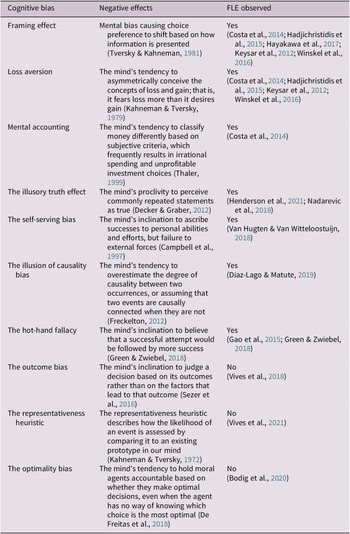
In addition to minimizing the impacts of loss aversion and mental accounting biases on decision-making, subsequent work has shown that the FLE also minimizes the impact of a wide range of cognitive biases, such as the illusory truth effect (Nadarevic et al., Reference Nadarevic, Plier, Thielmann and Darancó2018; Henderson et al., Reference Henderson, Simons and Barr2021), the self-serving bias (Van Hugten & van Witteloostuijn, Reference Van Hugten and Van Witteloostuijn2018), the illusion of causality bias (Díaz-Lago & Matute, Reference Díaz-Lago and Matute2019), and the hot-hand fallacy (Gao et al., Reference Gao, Zika, Rogers and Thierry2015). However, no significant FLEs were identified when cognitive biases such as the outcome bias (Vives et al., Reference Vives, Aparici and Costa2018), representativeness heuristic bias (Vives et al., Reference Vives, Costumero, Ávila and Costa2021), and the moral optimality bias (Bodig et al., Reference Bodig, Toivo and Scheepers2020) were tested under an FL condition (see Table 1).
List of cognitive biases tested by the FLE literature

The FLE has also been investigated between several NL–FL pairings, albeit it has not consistently been shown to be visible across all NL–FL combinations evaluated. In fact, and most notably, researchers failed to detect the FLE between English and German in four replications, between English and Dutch in three replications, between English and Swedish in one replication, between French and Swedish in one replication, and between Swedish and Norwegian in two replications (Circi et al., Reference Circi, Gatti, Russo and Vecchi2021). The lack of FLE can be ascribed to the participants’ NL and FL being linguistically similar. All such languages are members of the same language family: the West Germanic, Indo-European language family (Beekes, Reference Beekes2011). Moreover, they share similarities between their origin, verb conjugation, grammar, alphabet, phonetics (e.g., stress placements, ablaut, and vowel quality), word order, and the three-gender system. Alternatively, the FLE was observed between NL–FL combinations such as English and Spanish, English and French, English and Hebrew, Hebrew and Arabic, Italian and English, Chinese and English, Polish and English, Polish and Spanish, Polish and French, Swedish and French, and Thai and English (Circi et al., Reference Circi, Gatti, Russo and Vecchi2021). However, no replications have yet been attempted between Arabic as an NL and English as an FL. Therefore, the current work seeks to address this gap in the FLE literature.
2.4. Understanding the FLE
2.4.1. Increased cognitive control
The FLE can be comprehended through the previously discussed dual process theory of thought. The lower sensitivity toward cognitive biases that people exhibit while thinking in an FL can be explained by increased cognitive control (Oganian et al., Reference Oganian, Korn and Heekeren2016). According to Kahneman (Reference Kahneman2011), any contextual element that increases cognitive load, such as FL processing, stimulates system 2 activity, lowering intuitive, emotional processing of system 1. As a result, the FLE may be associated with a lower reliance on error-prone system 1 processing and/or a greater reliance on logic-based system 2 processing. Such reliance on controlled, slow, and rule-based thinking allows for more analytical, and hence more rational, decision-making. Some findings, however, contradict this prediction (e.g., Geipel et al., Reference Geipel, Hadjichristidis and Surian2016), demonstrating that thinking in an FL does not necessarily reduce cognitive biases when participants are given emotionally neutral tasks (e.g., Geipel et al., Reference Geipel, Hadjichristidis and Surian2015; Vives et al., Reference Vives, Aparici and Costa2018). Furthermore, the present explanatory theory has been put into question, considering that biases, motivated reasoning, and fallacious reasoning can influence all decision-making, whether unconscious or conscious, heuristic-driven or highly analytical (Greene, Reference Greene2004).
2.4.2. Reduced emotionality associated with FL processing
Another explanation for the FLE is the reduced emotionality associated with FL processing. This point of view is consistent with a large body of research suggesting that an FL is perceived as less emotional than an NL (for a review, see Caldwell-Harris, Reference Caldwell-Harris2015; Pavlenko, Reference Pavlenko2012). The NL versus FL perceived emotionality is modulated by a number of factors, including age of acquisition (AoA), acquisition order, acquisition context, language competency, linguistic dominance, and immersion (Caldwell-Harris, Reference Caldwell-Harris2015; Sheikh & Titone, Reference Sheikh and Titone2016). All such components can either weaken (as in the case of an FL) or strengthen (as in the case of an NL) emotional reaction to semantic information. As a result, the FLE might manifest as a result of a distorted emotional link between words and their morphological, orthographic, and semantic aspects, which has a beneficial impact on decision-making (Circi et al., Reference Circi, Gatti, Russo and Vecchi2021). Coherent to this view is that of Geipel et al. (Reference Geipel, Hadjichristidis and Surian2015), whose research findings have concluded that moral judgments are harsher in people with higher FL proficiency. Costa et al. (Reference Costa, Foucart, Arnon, Aparici and Apesteguia2014) suggest that increasing FL proficiency may increase emotional grounding, thereby eliciting similar emotional responses to those of a native speaker. Moreover, experiments with early bilingual participants (Brouwer, Reference Brouwer2019) showed no FLE. Nonetheless, the lack of the FLE in early bilinguals remains a point of contention (Białek & Fugelsang, Reference Białek and Fugelsang2019; Brouwer, Reference Brouwer2021).
2.4.3. Cultural context
Cultural elements have been factored into the FLE equation. Recent studies have shown that NL–FL similarity could be another relevant factor in observing the FLE (Dylman & Champoux-Larsson, Reference Dylman and Champoux-Larsson2020; Miozzo et al., Reference Miozzo, Navarrete, Ongis, Mello, Girotto and Peressotti2020): When the FL has a significant cultural effect (e.g., the English language in Sweden) or when the NL and FL are linguistically similar (e.g., the Norwegian language and the Swedish language), the FLE does not manifest, despite a significant difference in proficiency between an NL and an FL.
2.5. Our study
FLE research is still in its infancy, and additional empirical studies are needed to better understand its characteristics and the mechanisms that drive it. Comprehensively exploring the implications of this phenomenon in diverse international contexts is also imperative since crucial decisions are made daily in an FL context. The existing literature lacks published studies that specifically examine the FLE between native language of Arabic (NLA) and English as a foreign language (EFL) concerning the framing-induced loss aversion and mental accounting biases. Therefore, the present study endeavors to address this research gap, contributing both to future investigations and offering valuable insights into the implications of the FLE beyond controlled laboratory settings.
The next section develops appropriate methodology to assess the FLE between Arabic as an NL and English as an FL. Study 1 was inspired by the original FLE experiment conducted by Kaysar et al. (Reference Keysar, Hayakawa and An2012), which intended to establish whether an FL reduced participants’ emotionality toward perceived loss. Study 2 was inspired by a later experiment conducted by Costa et al. (Reference Costa, Foucart, Arnon, Aparici and Apesteguia2014) to assess whether thinking in an FL enhances participants’ mental accounting abilities.
3. Study 1: the FLE on loss aversion – the Asian disease problem and the financial crisis problem
Inspired by Keysar et al.’s (Reference Keysar, Hayakawa and An2012) observation regarding the FLE on loss aversion, study 1 attempts to evaluate NSA’s vulnerability to framing-induced loss aversion under two language contexts, NLA and EFL. Detail about the study’s design and methods is provided in the section that follows.
3.1. General method
3.1.1. Participants
A total of 144 participants (μ age: 26.6 years) were randomly recruited for this study from the Hashemite University. The participants were selected based on specific inclusion criteria, such as language proficiency level and language background. All participants acquired Arabic as an NL in early childhood (before the age of six) and English as an FL in academic contexts (μ age of instruction = six years). They all lived and studied in Jordan, spoke Arabic on a daily basis, and did not have any English-speaking parents. Participants who have lived in an English-speaking environment for more than 10 months were excluded. All participants completed a standardized language proficiency test, such as TOEFL, to assess FL proficiency levels (μ score: 102 with an SD of 7.56). NL proficiency levels of participants were not assessed since the primary objective of FLE experiments is to examine how cognitive, emotional, or behavioral processes may differ when individuals use an FL compared with their NL. Additionally, prior to participation, informed consent was obtained from each participant.
3.1.2. Procedure
The present study employed a within-subjects design to examine framing effects within each language condition and a between-subjects design to assess the differences in framing effects between the NL and FL conditions. Put another way, participants were randomly assigned to respond to both the loss and gain frames, within either the NL condition or the FL condition. This random assignment ensured that any observed effects were not influenced by pre-existing participant differences. The study comprised two consecutive sessions (NL and FL sessions) conducted in a university classroom setting. In the first session, participants arrived individually and were seated at a computer connected to the Internet. Participants were provided with a comprehensive explanation of the experimental task requirements and instructions for both NL and FL conditions. Any questions or uncertainties were addressed to ensure a clear understanding. Participants engaged in a series of task trials within their assigned language condition (NL or FL). The task trials involved responding to both loss and gain frames. The order of the loss and gain frames was counterbalanced to minimize order effects. Each task trial was presented on the computer screen, and participants provided their responses using the keyboard or mouse. A designated break was provided between task trials to prevent fatigue or carry-over effects. Participants then returned after a specified time interval, ensuring a consistent delay between sessions for all participants. The second session mirrored the structure of the first session. Participants completed the same task trials, responding to loss and gain frames within their assigned language condition (NL or FL). The order of the task trials was counterbalanced to account for potential order effects. It is also key to mention here that participants were asked to evaluate their comprehension at the end of each task; those who reported difficulty comprehending the FL version of the decision-making problem were eliminated from the analysis (less than 3% of the total number of participants were excluded from the analysis). At the end of the study, participants were provided with a debriefing explaining the purpose of the study, including any potential hypotheses or manipulations. They were also compensated for their participation according to the predetermined compensation plan.
3.1.3. Materials
The participants were presented with a modified version of the Asian disease problem (Kahneman & Tversky, Reference Kahneman, Tversky, Kahneman, Slovic and Tversky1982) and financial crisis problem (Costa et al., Reference Costa, Foucart, Arnon, Aparici and Apesteguia2014). The originally authored-in-English materials were translated into Arabic and back-translated into English by a professional translator to ensure semantic accuracy (Brislin, Reference Brislin1970). The participants were asked to opine on suitable solutions to each problem using only the boxes provided (e.g., A or B). It was stressed that there were no right or wrong responses to the problems, but that the choice had to be personal.
The following are the versions of the Asian disease problem and the financial crisis problem chosen for the present study.
3.1.4. I. The Asian disease problem (Kahneman & Tversky, Reference Kahneman, Tversky, Kahneman, Slovic and Tversky1982)
3.1.4.1. Positively connotated/gain frame
Recently, a dangerous new disease has been going around. Without medicine, 600,000 people will die from it. In order to save these people, two types of medicine are being made. If you choose Medicine A, 200,000 people will be saved. If you choose Medicine B, there is a 33.3% chance that 600,000 people will be saved and a 66.6% chance that no one will be saved. Which medicine do you choose?
-
• Medicine A
-
• Medicine B
3.1.4.2. Negatively connotated/loss frame
Recently, a dangerous new disease has been going around. Without medicine, 600,000 people will die from it. In order to save these people, two types of medicine are being made. If you choose Medicine A, 400,000 people will die. If you choose Medicine B, there is a 66.6% chance that 600,000 people will die and a 33.3% chance that no one will die. Which medicine do you choose?
-
• Medicine A
-
• Medicine B
3.1.5. II. The financial crisis problem (Costa et al., Reference Costa, Foucart, Arnon, Aparici and Apesteguia2014)
3.1.5.1. Positively connotated/gains version
If you choose Action A, 200,000 Jordanian Dinars (JDs) will be saved. If you choose Action B, there is a 33.3% chance that 600,000 JDs will be saved and a 66.6% chance that no money will be saved. Which action do you choose?
-
• Action A
-
• Action B
3.1.5.2. Negatively connotated/loss version
If you choose Action A, 400,000 JDs will be lost. If you choose Action B, there is a 33.3% chance that no money will be lost and a 66.6% chance that 600,000 JDs will be lost. Which action do you choose?
-
• Action A
-
• Action B
3.2. Results
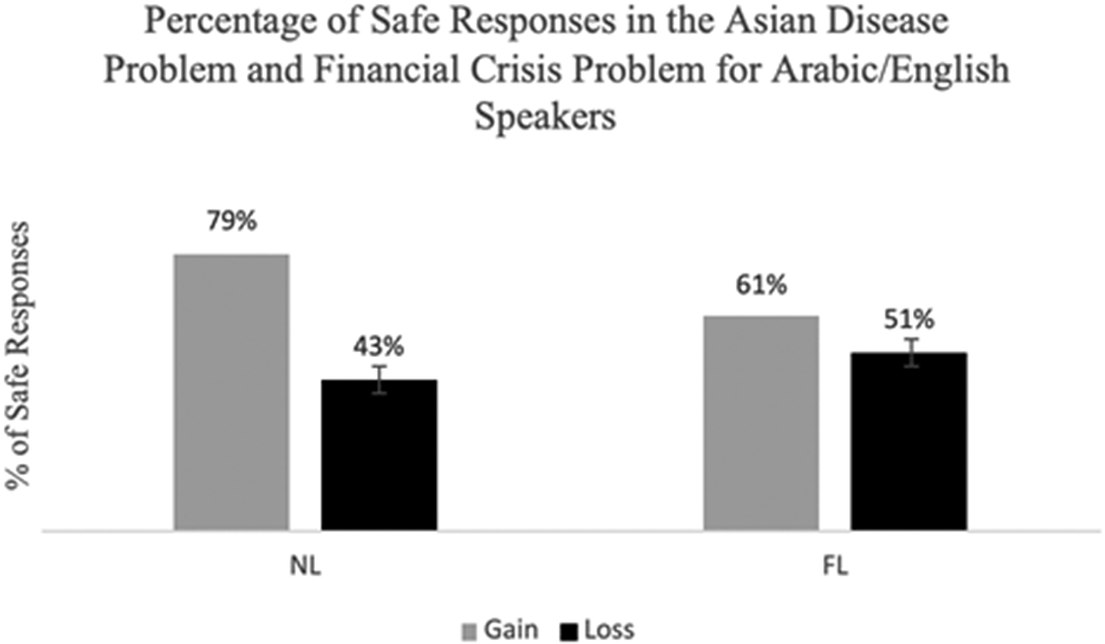
Both problems, designed to assess the loss aversion bias, were analyzed together to examine the effects of framing in the NL and FL conditions. Participants under the NL condition exhibited a significant framing effect, as evident from the results presented in Table 2. Specifically, when presented with the gain version, participants more frequently favored the safe option (A) over the risky option (B). In contrast, when presented with the loss version, they showed a preference for the risky option (B) over the safe option (A).
Percentage of safe (option A) to risky (option B) responses in the Asian disease problem and financial crisis problem for Arabic/English speakers (AD 1, NL condition, N = 73; FL condition, N = 71)

* p = 0.05.
Comparing the patterns observed in the NL responses with the FL responses, we found distinct differences. In frame 1 (F1: gain) of the FL condition, participants preferred the safe option over the risky alternative. However, in frame 2 (F2: loss), participants demonstrated an equal preference for both the safe and risky alternatives, with choices nearly evenly split. However, we did not observe a complete reversal in the distribution of FL responses, regardless of the extent to which problem framing influenced choice preference.
Statistical analyses were conducted to evaluate the significance of framing effects under the NL and FL conditions. In the NL condition, the framing effects reached a significant level of statistical significance (χ2 (1, N = 73) = 24.20, p = 0.001 < 0.05) when comparing the distribution of choices between the gain and loss versions. However, in the FL condition, the significance levels dropped below the threshold of significance (χ2 (1, N = 71) = 1.832, p = 0.175 > 0.05) when examining the same comparison. This suggests that while participants’ responses in the FL condition were still influenced by a subtle framing effect, the level of bias was significantly lower compared with those in the NL condition. Importantly, when examining the impact of both frame and language on participants’ choice preferences, the significant χ2 test results (χ2 (1, N = 144) = 12.494, p = 0.0058 < 0.05) highlight the crucial interplay between language and frame (refer to Table 2 for detailed results).
3.3. Discussion
Study 1 replicates previous findings regarding the influence of FL framing on choice perception and evaluation. When presented with options with identical expected values under an NL condition, decision-making of participants was significantly affected by framing. That is, and in line with the theoretical predictions of prospect theory (Kahneman & Tversky, Reference Kahneman and Tversky1979), individuals demonstrate risk-averse tendencies when decision-making problems are framed in terms of gains and risk-seeking tendencies when the same problems are framed in terms of losses (refer to Fig. 1). However, when the same frames of the same decision-making problems were presented under an FL condition, framing effects were significantly reduced, causing observability of framing effects to fall below statistical significance levels. This, however, does not completely dismiss the potential influence of framing effects on decision-making preferences of participants in the FL condition. Indeed, the primary distinction between the NL and FL conditions appears to be the diminishing divide in participants’ susceptibility to frame manipulation. This divide, which is more evident under the NL conditions, gradually converges toward a state of relative neutrality in the FL condition. Our findings align with those of Keysar et al. (Reference Keysar, Hayakawa and An2012), who similarly reported a reduced prevalence of the framing-induced loss aversion bias in a FL context.
Percentage of safe (option A) to risky (option B) responses in the Asian disease problem and financial crisis problem for Arabic/English speakers (AD 1, NL condition, N = 73; FL condition, N = 71).

4. Study 2: FLE on mental accounting – The discount problem and the ticket lost/money lost problem
4.1. Method
Inspired by Costa et al.’s (Reference Costa, Foucart, Arnon, Aparici and Apesteguia2014) observation regarding the FLE on mental accounting biases, study 2 attempts to evaluate NSA’s vulnerability to framing-induced mental accounting biases under two language contexts, NLA and EFL.
4.1.1. Participants
This experiment included the same 144 students who took part in study 1 (session Arabic session, N = 73; English session, N = 71).
4.1.2. Materials and procedure
The general procedure described in study 1 was followed during this experimental session as well.
4.1.3. I. The discount problem (Tversky & Kahneman, Reference Tversky and Kahneman1981)
4.1.3.1. Frame 1
A woman has bought two tickets to go to the theatre. Each ticket costs 80 JDs. When she arrives at the theatre, she opens her bag and discovers that she has lost the tickets. Do you think she will buy the tickets to enter the theatre?
-
• Yes
-
• No
4.1.3.2. Frame 2
A woman goes to the theatre and wants to buy two tickets that cost 80 JDs each. She arrives at the theatre, opens her bag, and discovers that she has lost the 160 JDs with which she was going to buy the tickets. She could use her credit card. Do you think she will buy the tickets to enter the theatre?
-
• Yes
-
• No
4.1.4. II. The ticket lost/money lost problem (Costa et al., Reference Costa, Foucart, Arnon, Aparici and Apesteguia2014)
4.1.4.1. Frame 1
Imagine that you want to buy a jacket for 125 JDs and a calculator for 15 JDs. The salesman tells you that the calculator you want to buy is on offer for 10 JDs at their other shop, located 20 min drive away. Would you make the trip to the other shop?
-
• Yes
-
• No
4.1.4.2. Frame 2
Imagine that you want to buy a jacket for 15 JDs and a calculator for 125 JDs. The salesman tells you that the calculator you want to buy is on offer for 120 JDs at their other shop, located 20 min drive away. Would you make the trip to the other shop?
-
• Yes
-
• No
4.2. Results
In this study, our aim was to examine whether the use of an FL (English) would lead to a reduction in mental accounting biases amongst NSA. However, the results did not provide evidence of any significant manifestations of mental accounting biases within both language conditions, consequently challenging the presence of any FLEs.
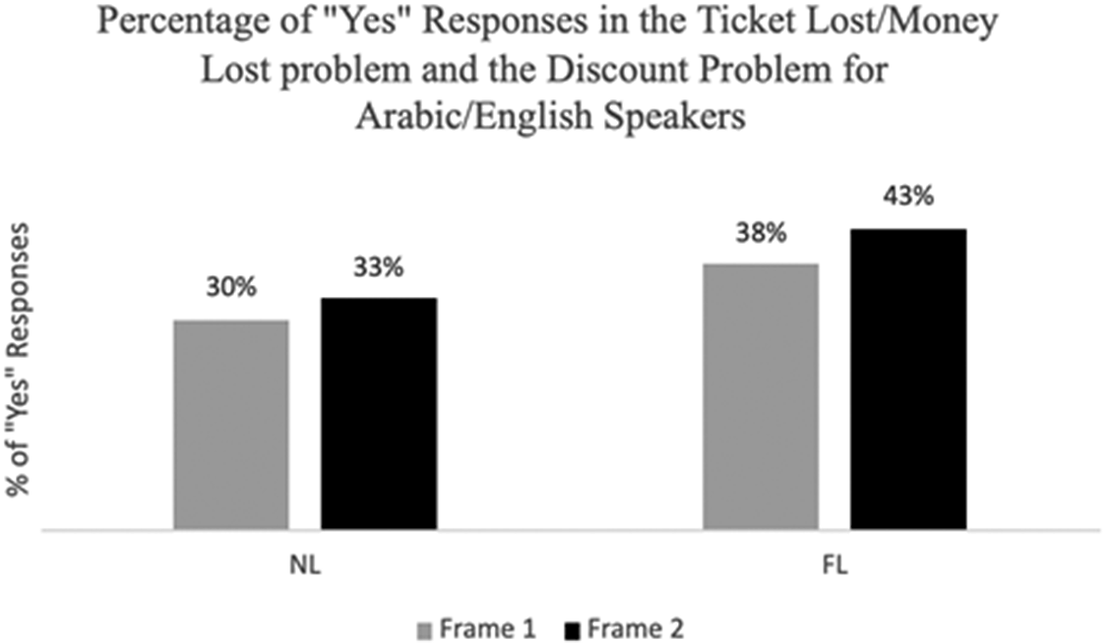
Participants’ responses in both the Arabic and English language conditions patterned similarly, indicating a lack of clear FLE. Specifically, when analyzing the data for mental accounting biases in the Arabic condition, no substantial difference was observed between frame 1 and frame 2 responses (NL condition, χ2 (1, N = 73) = 0.253, p = 0 .614 > 0.05). Similarly, in the English condition, there was no significant distinction between frame 1 and frame 2 responses (FL condition, χ2 (1, N = 71) = 0.716, p = 0.397). These findings suggest that the participants did not exhibit pronounced mental accounting biases, regardless of whether they made decisions in their NL (Arabic) or an FL (English).
The analysis investigating the influence of frame and language on participants’ choice preferences revealed non-significant χ2 test results (χ2 (1, N = 144) = 5.1068, p = 0.164139 > 0.05), indicating a lack of substantial interaction between language and frame effects. These findings, presented in Table 3, suggest that neither frame nor language significantly impacted participants’ decision-making patterns. In the general discussion section of the paper, we delve into various theoretical frameworks aimed at providing explanatory insights for the observed findings (Fig. 2).
Percentage of Yes to No responses in the ticket lost/money lost problem and the discount problem for Arabic/English speakers (AD 1, NL condition, N = 73; FL condition, N = 71)

* p = 0.05.
Percentage of ‘Yes’ responses in the ticket lost/money lost problem and the discount problem for Arabic/English speakers (AD 1, NL condition, N = 73; FL condition, N = 71).

4.3. Discussion
This study aimed to investigate whether the use of an FL (English) would lead to a reduction in mental accounting biases among NSA. However, the results did not yield significant evidence supporting the presence of prominent mental accounting biases in either language condition, thus challenging the notion of FLEs. Interestingly, participants’ responses in both the Arabic and English language conditions exhibited similar patterns, suggesting the absence of distinct FLEs. Specifically, when analyzing the data for mental accounting biases in the Arabic condition, no significant differences were found between responses under frame 1 and frame 2. Likewise, in the English condition, no significant distinctions were observed between responses under frame 1 and frame 2. These findings indicate that participants did not demonstrate notable mental accounting biases, regardless of the language they used for decision-making (Arabic or English). Moreover, an additional analysis exploring the influence of frame and language on participants’ choice preferences yielded non-significant χ2 test results, indicating a lack of substantial interaction between language and frame effects.
5. General discussion
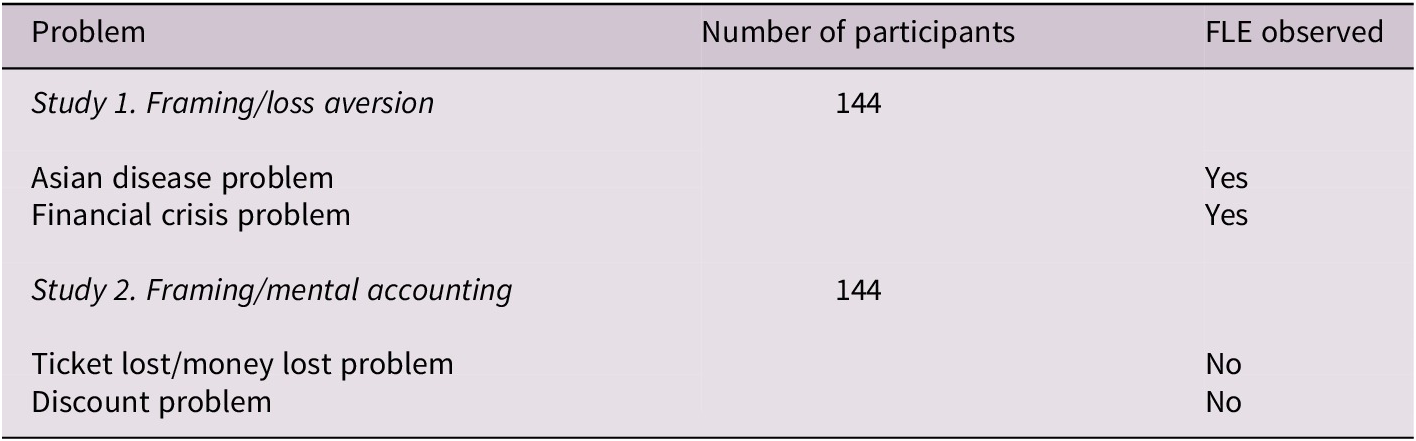
The objective of this study was to assess the extent to which language foreignness, or lack thereof, influences the choice preference of decision-making agents. We sought to determine whether presenting decision-making problems in an FL (English), as opposed to an NL (Arabic), modulated cognitive biases and led to a higher rationality associated with financial decision-making. The earlier discovery by Keysar et al. (Reference Keysar, Hayakawa and An2012) that decision-making is less negatively impacted by loss aversion when choice problems are presented in a foreign language prompted the current investigation. Two experiments were performed to assess the potential reduction in two cognitive biases, namely loss aversion and mental accounting. The first experiment was influenced by the research conducted by Keysar et al. (Reference Keysar, Hayakawa and An2012), which focused on investigating the impact of the FLE on framing-induced loss aversion. The second experiment was inspired by the study conducted by Costa et al. (Reference Costa, Foucart, Arnon, Aparici and Apesteguia2014), which examined the FLE on framing-induced psychological accounting biases (see Table 4). Prior to presenting a preliminary, overarching interpretation of our research findings, we would like to address our efforts to mitigate the impact of confounding variables in our research design and analysis. Additionally, it is crucial to acknowledge the limitations inherent in our FLE experiment.
Summary of the results of the two studies

The research methodology implemented in study 1 and study 2 employed a variety of strategies to reduce the impact of confounding factors, control for individual differences, and increase the accuracy of our research findings. First, we utilized a within-subjects design for examining framing effects within each language condition, which allowed us to control for individual differences and isolate the effects of language and framing. Additionally, we employed a between-subjects design to compare the framing effects between the NL and FL conditions, further reducing the impact of confounding variables. Further, participant selection was based on specific criteria, taking into account language proficiency, background, and exposure, to account for participants’ language acquisition and individual differences. To further ensure sample homogeneity, participants who had substantial exposure to English-speaking environments were deliberately excluded from the study, aligning with established conventions in FLE research (Keysar et al., Reference Keysar, Hayakawa and An2012; Costa et al., Reference Costa, Foucart, Arnon, Aparici and Apesteguia2014). Moreover, random assignment of participants to language conditions ensured that any observed effects were not influenced by pre-existing differences among participants. Furthermore, we counterbalanced the order of the loss and gain frames within each session to minimize potential order effects. This approach helped us maintain consistency and control for any sequencing biases that could have influenced participants’ decision-making patterns. Additionally, to identify and exclude participants who had difficulty understanding the foreign language version of each decision-making problem, comprehension evaluation was conducted. Finally, a debriefing session was administered to enhance participant understanding and reduce biases.
In our analysis section, we address non-independent variables by employing two key approaches. Firstly, we use chi-square tests to evaluate the statistical significance of observed variations in response patterns within each language condition (NLA and FLE). Secondly, we employ chi-square tests to compare framing effects between both the language conditions. By implementing these procedures simultaneously, we are able to determine whether the observed differences in choice preferences or response frequencies within each language condition are statistically significant or simply due to mere chance. They also help us examine how language differentially influences decision-making biases and investigate whether the magnitude or direction of framing effects significantly diverges. The following provides a summary of our research findings.
5.1. FLE on loss aversion bias
In study 1, participants were presented with the original Asian disease problem and the financial crisis problem by Kahneman and Tversky (Reference Kahneman and Tversky1979). The results of the study were simple and straightforward: framing effects were reduced in the foreign language (FL) condition compared with those in the NL condition. When participants encountered the problem in the FL, the presence of the loss aversion bias, which leads to risky choices in a loss frame, was minimized, although not completely eliminated. These findings replicate the findings of Keysar et al. (Reference Keysar, Hayakawa and An2012) and provide evidence that thinking in a foreign language reduces the detrimental impact of the loss aversion cognitive bias on decision-making processes for NSA who use English as an FL.
5.2. FLE on psychological accounting assignment
In study 2, two separate tasks were administered to evaluate biases in psychological accounting of situation outcomes. Interestingly, the results from both problems showed similar response patterns, indicating that problem framing had only a statistically insignificant impact on participants’ choice preferences. This similarity was observed in both the NL and FL contexts. The absence of statistically significant framing effects in the NL condition of study 2, unlike in study 1, raises questions.
There are several potential reasons why participants exhibited minimal framing effects in both language conditions during our FLE experiment. First, the characteristics of our participant sample could have played a role. If they had prior experience or exposure to framing tasks, they may have developed a higher level of awareness or resistance to framing manipulation. Individual differences in cognitive processes and risk preferences might have also contributed to the diminished effects. Additionally, the familiarity of the task and participants’ prior knowledge of the problems could have reduced the salience of the framing manipulation. Furthermore, the high level of FL proficiency of our participants could have influenced the results. As a result, they may have processed the framing information in a similar manner to their NL, reducing the differential impact of language on decision-making biases. However, this explanation is somewhat uncertain given that the loss aversion was significantly reduced under the FL condition in study 1, suggesting that additional factors contributing to the limited framing effects in study 2 might be at play. Another possibility is that the task itself was not sensitive enough to elicit robust framing effects. The specific problems or scenarios used may not have been engaging or impactful enough, and the framing manipulation could have been too subtle. Carefully evaluating these factors can provide a comprehensive understanding of the minimal framing effects observed in our study and contribute to the existing literature on FLEs and decision-making biases.
The findings of study 2 are both similar to and different from previous research on the FLE in mental accounting. Inconsistent with our research findings, Costa et al. (Reference Costa, Foucart, Arnon, Aparici and Apesteguia2014) observed a small FLE observed in the discount problem, indicating that participants made different choices when the problem was presented in an FL. And consistent with our research findings, Costa et al. (Reference Costa, Foucart, Arnon, Aparici and Apesteguia2014) observed no significant FLE in the ticket lost/money lost problem. This indicates that the use of an FL did not have a significant impact on participants’ decision-making in that particular scenario (see Table 4).
To recap, our findings have both theoretical and practical implications. Theoretically, this is one of the first studies to investigate the impact of language choice on financial decision-making among Arabic speakers who speak English as an FL. Findings of our study provide insights into the influence of language on cognitive processes and decision-making biases. Such examining of how individuals make choices in their NL versus an FL helps researchers gain a deeper understanding of the underlying mechanisms and cognitive processes involved in decision-making. This research contributes to the fields of cognitive psychology, linguistics, and behavioral economics by highlighting the role of language in shaping decision-making behavior. Practically, FLE research has implications for cross-cultural communication, education, and marketing. Understanding how language affects decision-making can help in designing effective communication strategies for individuals who speak different languages. It can also inform language learning approaches and curriculum development by considering the cognitive effects of using an FL. Additionally, marketers can leverage the findings to develop targeted advertising and messaging strategies that align with the cognitive biases associated with specific languages.
Finally, the limitations of our FLE experiment should be acknowledged. First, the sample size of 144 participants may be considered relatively small, which could affect the generalizability of the findings to a larger population. A larger sample size would enhance the statistical power and increase confidence in the results. Second, the study primarily focused on participants from the Hashemite University of Jordan, which limits the generalizability of the findings to other cultural contexts or populations with different language backgrounds. Future studies could consider including participants from diverse backgrounds to ensure a more representative sample. Another limitation is the reliance on self-reported language proficiency levels, particularly in the NL condition. Assessing the participants’ NL proficiency levels would have provided a more comprehensive understanding of their language abilities. Further, the within-subjects design employed in the study to test framing effects may have introduced order effects within each language condition. Counterbalancing the order of the loss and gain frames within each language condition helps mitigate this concern, but it is still possible that the order of presentation influenced participants’ responses. Using a between-subjects design or implementing a Latin square design could have further minimized order effects. Finally, the materials used in the study were adaptations of existing problems, which may have introduced variations in the wording or framing compared with the original versions. Although efforts were made to ensure accurate translation and back-translation, subtle differences in language and framing could potentially impact the results.
6. Conclusion
In conclusion, our FLE experiment aimed to investigate the impact of using an FL, specifically English, on decision-making biases, specifically loss aversion bias and mental accounting bias. The findings of the study reveal two important outcomes. Firstly, we observed a significant reduction in loss aversion bias when participants made decisions in the FL (English) compared with their NL (Arabic). This suggests that using an FL can attenuate the influence of loss aversion bias, leading to more rational decision-making. Secondly, we found no significant reduction in mental accounting bias between the two language conditions. Despite the reduced loss aversion bias under the FL condition, participants exhibited similar mental accounting biases in both Arabic and English. This indicates that language proficiency and cognitive processes may differ in their susceptibility to language-induced biases, with mental accounting biases being less affected by the FL context. Overall, our study contributes to the growing body of literature on FLEs and their implications for decision-making biases. It underscores the need for further exploration and understanding of how language influences our cognitive processes and decision outcomes.
Competing interest
The authors declare that they have no known competing financial interests or personal relationships that could have appeared to influence the work reported in this paper.
Data availability statement
The data that support the findings of this study are available at: https://doi.org/10.6084/m9.figshare.23556216.