Throughout her life, Christina Rossetti was an enthusiastic writer and player of word games in verse. When she was seventeen, for instance, she spent the summer of 1848 in Brighton playing bouts-rimés sonnets with her brother, William. Together they timed themselves to see how fast they could write lines of verse to a given set of end rhymes: “emotional devastation in ten minutes or less,” Anne Jamison wittily puts it (145).Footnote 1 Two years later, Rossetti published under her initials instances of different word games – an enigma (“Name any gentleman you spy”) and a charade (“My first is no proof of my second”) – as part of a series of riddling word games in verse by various authors in the Marshall's Ladies Daily Remembrancer: For 1850. They count among Rossetti's first poetic publications. These popular riddling genres, while perhaps less familiar to readers today, were immediately recognizable to Rossetti's contemporaries. In his 1872 riddle anthology, Guess Me, F. D. Planché defines an “Enigma” as a riddle in verse, or “the most ancient form of Riddle . . . often a real poem as well as a question for solution” (3). In the 1891 Cornhill Magazine, the article “Riddles” glosses a “charade” as a riddle that “turns upon the letters or syllables composing a word” (518). By publishing an enigma and a charade in Marshall's Ladies Daily Remembrancer, an inexpensive pocket book for women, Rossetti capitalized on the association of these genres as written by and for middle-class women, a point that I will argue in more detail later.
Jamison and Isobel Armstrong have called Rossetti's “early games of bout rimés . . . fundamental to her [mature] poetry” (Armstrong 352).Footnote 2 So too, I will argue, was Rossetti's early writing of riddle genres. Scholars, however, have rarely discussed Rossetti's work and play with riddles, usually bracketing them off from her serious, mature poetry by consigning Rossetti's riddles to her children's verse, either as a genre that she played with in her youth or that she wrote as an adult for children.Footnote 3 But Rossetti's early enigmas and charades, like her play with bouts-rimés, were more than just a pastime divorced from her major verse; rather, they afforded the materials for much of her mature verse, which shows her to have transfigured the riddles of her youth and her culture into something rich and strange.
Take, for instance, the opening of Rossetti's “From House to Home,” written in 1858, not long after she published her charades in Marshall's:
In his reading of this poem, Jerome McGann points out, “That ‘first’ and that ‘second’ are never actually located or identified in the poem. They remain cryptic words to the end and stand as signs of the poem's own portentous yet, finally, mysterious tale” (“Introduction” 12). Because “From House to Home” circulates signs without referents, McGann reads the poem as exemplifying the “mystery” and “secrecy” that critics now agree characterize much of her oeuvre.
Indeed, more than “From House to Home,” critics now consider Rossetti's “Winter: My Secret” (1857, first pub. 1862) as epitomizing her interest in “mystery” and “secrecy,” leading Armstrong to call “Winter” “almost a summa of her work” (357). This poem playfully teases “you,” often understood as the reader of the poem, with a secret that it may or may not possess and certainly never discloses, instead concluding with “you may guess.” Because it claims to “perhaps” have a secret that it never tells, it is seen as a synecdoche for how frequently Rossetti's verse withholds crucial information, leading her verse to be described as “riddling lyrics,” “enigmatic lyrics,” or more simply, as “enigmatic.”Footnote 4
Settling why Rossetti's poetry is so interested in performing “secrecy” and the “enigmatic” has led to one of the most productive debates in Rossetti studies. For McGann, Rossetti's mystery is religious mystery: “These difficulties arise because such a poem [as “From House to Home”] is keyed to the mysteries of a Christian faith. What is reliable in Rossetti's work is always its religious ground” (“Introduction” 12). Indeed, Rossetti's most influential readers situate her secretive, “enigmatic” poetry in religious contexts. Specifically, her information-withholding verse, represented by “Winter: My Secret,” is understood as exemplifying the Tractarian “Poetics of Reserve” and “Poetics of Analogy,” characterized by mystery, indirection, and withholding.Footnote 5
But while Rossetti's “enigmatic” verse resonates with Tractarian Reserve, reading Rossetti's “From House to Home” alongside her teenage charade for Marshall's, “My first is no proof of my second,” starts to suggest an alternative context for her verse:
Like all charades, each syllable of Rossetti's solution-word is described by clues that are announced by the genre-constituting keywords, “first” (announcing the clue for the first syllable of the solution-word) and “second” (the clue for the second syllable of the solution-word). Then, the clue for the “whole” solution-word is given, closing the poem. The solution of Rossetti's charade is “Candid”: the fact that one “can” do something “is no proof” that one “did” in fact do it; to be “candid” is to “confess” one's “best” and one's “worst.”
These charade-words, “first” and “second” – cues to clues – clearly reemerge in reworked form in “From House to Home.” While McGann is right that “‘first’ and that ‘second’ are never actually located or identified in the poem,” he makes no mention of what those tropes refer to – the genre of the charade and the popular verse culture of riddle writing and reading that they constituted and in which they circulated, which her contemporary readers would have identified. What the above comparison starts to suggest, therefore, is that much of her mature verse should not be understood simply as “enigmatic lyrics,” meaning secretive and withholding, but rather as a reworking of the “enigma” and “charade” genres in order to produce the sense of being “enigmatic.” In other words, the abovementioned critical tradition overlooks the extent to which Rossetti's “enigmatic,” religious verse actually draws on the nineteenth-century popular riddle-in-verse genres of the enigma and the charade.
For that reason, while Rossetti's “enigmatic” verse does indeed resonate with Tractarian Reserve, I argue that her participation in this religious context also emerges from a broader eighteenth- and nineteenth-century popular verse culture of riddle writing by a wide range of women writers for women readers. From this verse culture, Rossetti borrows the riddle’s structures and conventions but eschews its solution: her poetry achieves resolution before a solution can be disclosed. That is to say, Rossetti makes the closed form of the riddle open-ended. In alluding to a solution but never revealing it, her verse establishes expectations in her readers that it then refuses to satisfy. In playing with those expectations, her verse intimates without allowing for intimacy.
Seeing Rossetti's verse in this riddle context reveals a number of overlooked aesthetic and moral concerns. First, by turning the riddles of her culture from closed to open-ended genres, Rossetti explored the now antagonistic relationship between solution and resolution, disclosure and poetic closure, how verse might conclude even as the solutions to her open-ended riddles were anyone's guess. Second, not only does she make her riddles insoluble in order to intimate to her readers a sense of the unknowable beyond, thus performing Tractarian Reserve, but Rossetti also reworked the structures of the riddle to rework Tractarian aesthetics, shifting its characteristic symbolism from poetic content to poetic form. Above all, reading her “enigmatic” verse alongside a popular verse culture of enigma writing and reading helps us better understand the roots and reasons for the characteristic structures of her verse – her fascination with “perhaps . . . or” and her lists of similes, which have so puzzled her critics. These lists of similes are in fact appropriated from the verse culture of enigma writing, which she reworks for religious ends. The implication is that the much-discussed religious content of Rossetti's verse was in fact also grounded in Victorian mass culture. In what follows, I first outline the broader context of a tradition of women's riddle writing and reading by focusing on one of its more sensational moments. I then turn to how Rossetti in her verse reworked that context to re-imagine Tractarian aesthetics. My final section explores how and why Rossetti appropriated the trope of “guessing” from her riddle culture, and specifically why Rossetti was so interested in “guessing” when no solution can be found.
Riddle Cultures, 1750–1900
In October 1816, a number of Regency-era periodicals, including the Ipswich Journal, the Morning Post (London), the Liverpool Mercury, and the Hampshire Telegraph and Sussex Chronicle (Portsmouth), published the following poem that they attributed to the poetess Anna Seward, the “Swan of Lichfield,” who had died seven years earlier in 1809:
As long as a sonnet and in the form of a rebus, this anaphoric poem was entitled “Enigma,” a title that foregrounds the poem's genre as a riddle in verse. It quickly became known, however, as “Miss Seward's Enigma,” for the newspapers claimed that Seward had written it in her will, thus electrifying the enigma with a further charge of mystery and significance. According to these newspapers, Seward's will directed “her Executors to pay 50£ to the person who should discover the true solution” (Ipswich Journal 19 Oct. 1816), a large reward for the reader who could render the rebus by spelling the city.
The response was immediate. Excited readers, attracted by the substantial financial reward and titillated by the thought of solving a dead poetess's last request, started to write in solution after solution to the various newspapers. These solutions came in verse form and offered answers in stanzas that ranged from “Alexandria” to “Jerusalem” to Seward's home of “Lichfield.” Newspapers published (or perhaps manufactured) the sardonic commentaries of pseudonymous respondents, who publicly debated the merits of others’ solutions. For instance, one controversial wag, “The Wise Man of Gotham,” took the enigma challenge to its ironic extreme by writing an elaborate elucidation: “Long Looked for Come at Last; or, The Real Solution.” He argued that “ancient City” was in fact a metaphor for “ancient Thoroughfare” and that the answer to Miss Seward's Enigma was in fact “Mutton Lane” (Morning Post 24 Oct. 1816). The next day, incensed (or just pretending to be incensed) “readers” accused him of having overread the poem, or, as one respondent lamented, of having expressed “forced interpretations” (Morning Post 25 Oct. 1816). In short, many a wit was floored, and many a newspaper's sales rose.
But if you're skeptical of the whole affair, then you've guessed right: “Miss Seward's Enigma” was in fact not Seward's at all. A month later, as the excitement faded, the poem was revealed to have been excerpted from “A Rebus,” a longer poem published in the March 1757 Gentleman's Magazine and attributed to Lord Chesterfield (Seward would have been aged nine at the time).Footnote 6 Moreover, “Seward's” enigma never had a true solution. The sensation-producing ploy sought to capitalize on readers’ fantasies of gaining access to a poetess's last words, her final breath, which would disclose her deathbed secret. It worked. The editors had riddled “Seward's” riddle, framing one form of deception (a riddle) in another (a scam). Call it the original Seward's Folly – only this time, the joke was not on Seward, but on everyone else.
The phenomenon of “Miss Seward's Enigma” was not soon forgotten. In her critical biography, Anna Seward: A Constructed Life, Teresa Barnard notes, “In its own time and for several years afterwards, [Seward's will] was accorded an almost mythical status, with rumors of an ‘enigma’ designed by its author and secreted among the pages, with a supposed substantial reward for solving it” (146).Footnote 7 Sixty years later, the phenomenon was wryly recounted (with some parodic embellishment) in “Enigmas” in the 1876 All the Year Round, the periodical founded by Charles Dickens:
Many enigmas have been put forth with an announcement, that the author would give a prize of a sum of money to any person who would find out the correct solution. . . . There is one which was attributed sometimes to Lord Chesterfield, sometimes to Miss Seward, and for a correct solution of which a thousand pounds was offered. We should be sorry to guarantee either the attribution or the offer. (321)
“Miss Seward's Enigma” had so far entered into popular legend that in the hyperbolic retelling the reward had multiplied twentyfold.Footnote 8
This anecdote delineates one of the more sensational incidents in the explosion of riddle writing and reading that ignited in England in the mid-eighteenth century and burned for one hundred and fifty years. Understanding just how excited nineteenth-century England was for riddling word games may be difficult for us today. Word games like the enigma were more than just the nineteenth-century version of Sudoku. Two centuries ago, as the phenomenon of “Miss Seward's Enigma” suggests, audiences “overread” these riddle poems to the point where riddle writing and reading were not only the most diurnal of periodical verse-forms, but also became, on occasion, cultural events. In the mid-eighteenth century, the neologism “Aenigmatography” – “the making or collecting of enigmas” – and its variants, “Aenigmatographer” and “Aenigmatology,” were all coined (1753 Chambers's Cyclopaedia). By the late 1780s, collections of riddles were being published annually; at least eleven collections of enigmas were published from 1797 to 1800. By the nineteenth century, riddles participated in Christmas rituals where they circulated as gifts and were read during the winter holidays. As the historians of the genre Gregg Hecimovich and Eleanor Cook point out, riddle books, advertised as “innocent merriment,” (Cook, Enigmas and Riddles in Literature 239) appealed to middle-class readerships interested in self-improvement and seeking more legitimate forms of diversion than gin palaces, theatres, and other low forms of recreation.Footnote 9 While riddles-in-verse are most commonly associated with Jane Austen, Lewis Carroll, and Emily Dickinson, the enigma genre was commented on by nineteenth-century authors as diverse as William Wordsworth and George Eliot, who, in deliberating over what might be their value as verse, both troubled and established what we might consider the distinction between “high” and “low” culture.Footnote 10 One could even go so far as to say that alongside the eighteenth- and nineteenth-century ballad revival, another revival was going on: that of the riddle, the oldest of English poetic genres. Indeed, not until 1893 could Chambers's Journal claim, “Luckily for this generation, the tyranny of the English riddle is overpast” (479).
Unlike “Miss Seward's Enigma,” most riddles-in-verse had a solution, which would often be published in a future issue of the periodical or in an answer key at the end of the riddle collection. Frequently, these solutions were simply a word: “Candid.” Occasionally, however, solutions would be more complex, as in the riddles of Charlotte Eliza Capel's 1861 riddle book, Victorian Enigmas; or, Windsor Fireside Researches, where the answers to the enigmas (printed in a key in the back) take the form of double acrostics.Footnote 11 Through the early nineteenth century, solutions were often rendered in verse, so that the “solution” itself might be said to have become a micro-genre of popular verse. For instance, Thomas Holcroft's Wit's Magazine, a short-lived monthly (1783–84) that a twenty-six-year-old William Blake engraved, held enigma-solving competitions in which the prize enigmas of one issue would have their solutions revealed a month later in the next issue. Amateur versifiers, in response to an enigma-as-prompt, wrote in solutions (here: “Coffin”) in a diverse array of verse genres and forms that varied from the couplet (here, by Mr. John Smith) – “ Heavens! to a work of humour who would bring / A Coffin! such an awful, solemn thing!” (199, ll. 1–2) – to the anacreontic (a genre of short verses on wine associated with the sixth-century Greek poet Anacreon) (here, by W. H.):
Just as one poem was the impetus for another, so too was riddle play the vehicle for display: broad writerships and readerships took pleasure in the performative genre of riddles because they afforded them the opportunity to exhibit their wit.
“Miss Seward's Enigma” became a nineteenth-century phenomenon in part because it exploited the central role of the poetess in the popular verse culture of riddle writing and reading. Although many nineteenth-century men wrote riddling word games, reading and writing enigmas were more often considered activities for women. This was because riddle-genres were impressed into the social work of enabling and encouraging women to perform the socially-acceptable and intertwined roles of mother and teacher. Seward herself understood riddles and other word games as gendered female. In a letter to Lady Marianne Carnegie regarding how Erasmus Darwin's love for Elizabeth Pole had emasculated him, Seward laughs at her friend, Darwin: “The poetic philosopher . . . transfers the amusement of his leisure hours, from . . . the composition of odes, and heroic verses, to fabricating riddles and charards [sic]! Thus employed, his mind is somewhat in the same predicament with Hercules's body, when he sat among the women, and handled the distaff” (qtd. in Barnard 118). In other words, for a man to write a riddle and “charard,” rather than a masculine “ode,” was to enervate if not emasculate himself because these genres were considered women's work and play.
Indeed, riddles were so associated with women through the century that the correlation was mocked by parodists. For instance, in 1892, the Cambridge wit Anthony Charles Deane, just finishing Clare College, republished his parody “The Lover's Complaint” in his collection, Frivolous Verses. In his parody, Deane depicts a woman whom he is attempting to woo but cannot because she is so immersed in the fashion for riddle writing that she only speaks in riddles-in-verse. In doing so, Deane mocks the continuing excitement of women for writing and reading riddles and other word games. The epigraph, supposedly a line from an “Evening Paper,” notes, “Asking riddles has become the latest fashionable amusement.” Reading the epigraph alongside the abovementioned contemporary Chambers's Journal starts to suggest the uneven developments of the riddle genre, how one fin-de-siècle journal might see the riddle as becoming passé while another might see the genre as so fashionable among women as to define the gender itself.
The poetess Anna Laetitia Barbauld, perhaps the most prominent and prolific of poetess riddlers, associated riddles with women writers and readers by constructing the genre and the gender as maternal, domestic, and didactic.Footnote 12 Her “Enigma: To the Ladies” (1820s?) exemplifies this in its title and in its solution: “umbrella” or “parasol,” a novel and fashionable female accessory. Barbauld also gendered the genre female in an essay, “On Riddles,” posthumously published in A Legacy for Young Ladies (1825). Like many poetesses, Barbauld framed the riddle as a means for mothers to teach children because solving riddles “give[s] quickness of thought, and a facility of turning about a problem every way, and viewing it in every possible light” (360). “Finding out riddles is the same kind of exercise to the mind which running and leaping and wrestling in sport are to the body,” she avers, since these types of exercise “make [one] alert and active for any thing [one] may be called to perform in labor or war” (359). In so doing, she helped construct the playful verse genre of the riddle as domestic-didactic verse. Riddles were to perform the social work of not only helping make children “active” intellectually, apt for producing future subjects to “labor and war” for the British Empire, but also constructing women as maternal writers for and readers to children.
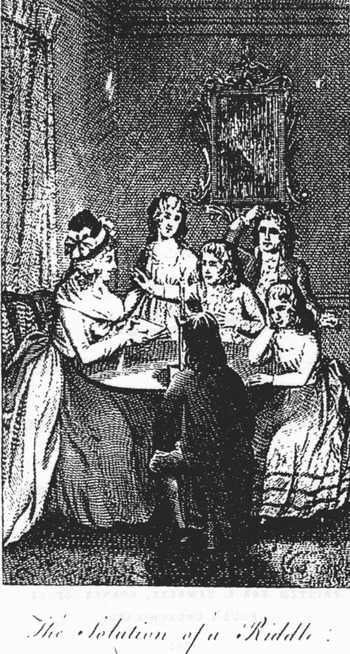
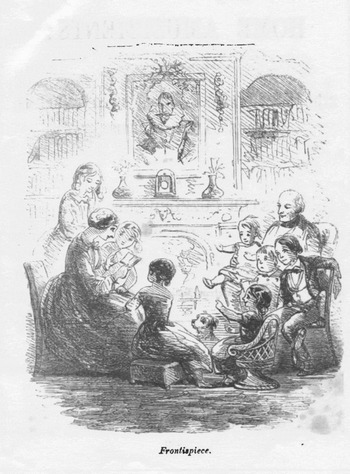
Furthering these associations, the material culture of nineteenth-century book publication marketed riddles by women to women. Keepsake books such as Forget-Me-Not and The Amulet published riddles in highly wrought aesthetic and sentimental formats, printed on high-quality paper alongside expensive engravings. Likewise, the frontispieces of nineteenth-century riddle anthologies helped market riddles to the female readerships that they were in the process of constructing: both A Choice Collection of Riddles, Charades, Rebuses, etc. (1792) and its reprinted version, Home Amusements (1859), foreground women reading riddles to their families in domestic contexts. In the former's engraving entitled “The Solution of a Riddle” (Figure 2), five children in mixed states of excitement and concentration surround a table as their mother reads from a book of riddles. In the latter (Figure 3), an august family that is divided by gender (the girls surround the mother, the boys the father) unites around riddle reading, while the mother reads riddles to her husband and children. In both cases, the mother reads riddles aloud to her family, which coalesces around this domestic, sociable, familial genre.
“The Solution of a Riddle.” Engraving, from Peter Puzzlewell Esq., A choice collection of riddles, charades, rebusses, &c. chiefly original (London: E. Newbery, 1792). Frontispiece.

Engraving, from Peter Puzzlewell, Esq., Home Amusements: A Choice Collection of Riddles, Charades, Rebuses, Conundrums, Parlour Games, Forfeits, Etc. 2nd ed. (London: Griffith and Farran, 1859). Frontispiece.

Even Queen Victoria was invoked to idealize both the genre and the gender as maternal and domestic. In Victorian Enigmas, Capel sought to attribute to Queen Victoria the difficult “Windsor Enigma” in order to capitalize on her popularity: “Some five years ago, a copy . . . was handed me to solve, with these words – ‘A friend at Windsor had this from the palace, said to be written by the Queen for the royal children’” (v). Because Capel suggests that readers “should emulate her Majesty,” her preface continues to align the genre with didacticism, domesticity, and motherhood. It also constructs the identity categories of amateur and professional women writers as maternal-tutelary versifiers in the middle-class home that Richard Brodhead and Mary Loeffelholz call the “domestic-tutelary complex”: a space and agent of privatized social discipline through love and sentimentality (Broadhead, Cultures of Letters 43).
The didactic function of riddles mediated women's literacy. Capel encouraged young women to read riddles in order to acquire “a method of digesting information to its most interesting particulars, and [correcting] the superficial tone acquired by hasty and inattentive reading, which sometimes tends to vain conceit, from ill-grounded knowledge” (vii). In other words, reading enigmas trained girls in analysis at once focused and frivolous, turning superficial readers into “close” readers, disciplining their attention, and sharpening their critical skills. Capel's enigmas were not only to be solved by young women in the form of double acrostics, but also every part of the answer was to be accompanied by brief facts that would then be taught to the female student. For example, if the answer to the first clue was “South Atlantic,” then the student, upon solving it, would be taught that the “South Atlantic” “Is that part of the ocean south of the equator, between the continents of Africa and South America, and extending to the Antarctic Circle” (ix). Capel's riddles ultimately offer young women “a good conversational knowledge . . . such as should be the distinctive mark of every well-educated gentlewoman” (viii). This trivial literacy would enable women to possess merely domestic, social graces, thus affording them the opportunity to be entertaining.
In sum, the playfulness of the riddle, what today would be considered light verse, performed ideological, social work in the eighteenth and nineteenth centuries. Women read and wrote riddles because the genre and the gender were made to seem naturally suited for each other. At once playful and requiring superficial thought, riddles were put to work to help make the drudgery of learning basic literacy palatable without teaching young women to think too much, and to normalize adult women's limited social roles as mothers, home-schoolers, and writers of domestic-tutelary verse.
The Riddle of Rossetti's Lists of Similes
This popular verse culture of women's riddling is an important context for understanding Rossetti's verse. In the enigmas that she wrote in her youth, such as her 1850 “Name any gentleman you spy” (reprinted below), the teenage Rossetti explored not only the signifying possibilities of words, but also the organization of that multiplicity into catalogue form – both of which her mature verse would exploit.
A note in pencil on Rossetti's copy provides the solution to her enigma: “Jack.” “Jack” as in a generic proper name of a “gentleman”; as in a type of fish (amberjack, etc.) that an angler would “catch”; as in a bootjack for pulling off boots; as in a smoke-jack for turning the spit in roasting “meat”; as in “poor Jack,” a name for dried hake; as in a Jack-of-all-Trades; as in a knave in a deck of cards (“game”); and lastly as in a “Jack-out-of-doors,” a homeless person.Footnote 13 Like all enigmas, Rossetti's is structured as a proliferating list of clues. That is to say, like all enigmas, Rossetti's is structured as a list of similes and metaphors, or, better, Rossetti's enigma is structured like a simile: as a list of vehicles (what the solution, “Jack,” is like: i.e., the clues, which are themselves riddles in miniature) with the tenor (the solution, “Jack”) hidden. As scholars have long pointed out, enigmas posit some “hidden likeness of things,” or, as Cook puts it, “A simile asserts openly that X is like Y. The trope of enigma makes simile into a question: What is X like? We might call the figure of enigma a closed or hidden simile” (32). But while a list of clues or similes could threaten to distend the poem, Rossetti closes her list by rounding off her riddle: the poem's end reflects its beginning. The opening reference to a gentleman is inverted by the closing reference to a homeless man in order to suggest that in language class and classification are not fixed but ultimately fluid. Seeming antitheses can in fact be the same thing: “Jack.”
The play of the enigma works, in other words, by exploiting the ambiguity of language, a word's semantic potential as a pun. How many meanings could be contained by one word? How could different clues all refer to the same thing? That her enigma's close refers to homelessness is perhaps unsurprising. By exploring the multiple registers of homonymic meaning, the fact that “Jack” can be at once a fish, a man, and so on, Rossetti's enigma works to “jack” (as in hijack) her reader's cognitive frameworks, subverting the orienting structures that the a priori categories of sameness and difference serve to anchor. In other words, Rossetti makes language seem homeless, deracinated from its traditional associations. What excited the youthful Rossetti about riddles may have been what excited her about writing bouts-rimés: “how readily Christina could utilize the same rhymes for three entirely distinct lines of thought or subject,” as William Rossetti noted (490). Just as one set of rhymes could contain many poems, so too one word could contain many meanings.
The lists of similes that characterize the teenage Rossetti's enigmas (and all enigma poems) are a key for understanding the lists of similes that pervade Rossetti's mature verse from “Goblin Market” (1859, first pub. 1862) to “An Old-World Thicket” (first pub. 1881):
Characteristically, these anaphoric, paratactic lists of vehicles become so excessive that they distend on their own profusion: “the last restraint is gone”; the birds, she concludes, are like “anything . . . and everything.” How should this formal immoderation be understood?
Erik Gray compellingly contextualizes Rossetti's lists of similes as emerging from John Milton and particularly Percy Shelley. But while Gray provides a strong argument that the roots of Rossetti's lists of similes grew out of what might be called high culture, Rossetti's lists also emerged from a popular verse culture of women's riddling. The lists of similes that characterize Rossetti's mature verse are homologous to those that constitute both the popular verse genre of the enigma and the enigmas that she wrote in her youth. To produce her mature verse, Rossetti borrowed the enigma's lists of similes but transfigured them to make them open ended, so that rather than refer to an achievable solution, they would now only intimate one. Rossetti's otherworldly verse was grounded in the diurnal versifying of her day.
For example, her “Mirrors of Life and Death,” as it was first published in the 17 March 1877 Athenæum, mirrors the structure of the enigma because “Mirrors” is entirely a catalogue of vehicles; there is no tenor. Each of its nineteen stanzas begins with a simile introduced with “As,” such as the opening “As the flush of a Morning Sky,—” (Athenæum 350, l. 1). As the poem nears its close, the similes proliferate even more, so that rather than a new simile introduce each new stanza, the new stanzas are composed entirely of similes linked by anaphora:
While the poem intimates that something is “As Spring,” “As Summer,” “As Autumn,” “As Winter,” what that something is remains forever hidden from the reader. We get only half the comparison. This is apt in a poem with “Mirrors” in the title because rather than the poem providing the tenor, it only provides the vehicles or (near) reflections of the tenor.
Because we only get half the simile, Jude Nixon notes that “Mirrors of Life and Death” is a Homeric simile without resolution: “an epic cycle that never experiences consummation (there is no Homeric ‘thus’ or ‘so’ with which the epic simile achieves climax)” (480). But given that “Mirrors of Life and Death” is a series of vehicles with the tenor hidden, the poem is better understood not as an epic simile without resolution, as Nixon names it, but as an enigma without a solution. The homology between the structures of the enigma genre and “Mirrors of Life and Death” suggests that “Mirrors of Life and Death” is both a “reflection” of and a “reflection” on the enigma genres that Rossetti wrote and that circulated prominently in a popular verse culture.
When Rossetti republished the poem in 1881, she began it with a new stanza, which further clued her readers to the genre on which “Mirrors” tropes by referencing the Apostle Paul's First Epistle to the Corinthians 13.12 – “For now we see through a glass, darkly; but then face to face” (Bible 218):
As Cook points out, in the Septuagint and Vulgate, what in English is the word “Darkly” is in Greek and Latin a variation of the word “enigma”: the epistle in “the original Greek uses a form of ‘enigma’ (en ainigmati) and the Vulgate repeats the word in its Latinate form: ‘Videmus nunc per speculum in aenigmate, tunc autem facie ad faciem’” (66). Thus, if the lists of vehicles without a tenor were not enough to hint to contemporary readers that “Mirrors” is riddling the riddle, Rossetti's revision clues readers even further by inserting a semi-secreted reference to the trope of “enigma,” and thus the genre of “enigma.” Moreover, the revised poem's movement from its opening in darkness (“Darkly”) to its closing reference to illumination (“All waiting for the long-awaited light”) performs what Cook calls the “enigma as masterplot” – the movement from obscurity to clarity, riddle to solution – both suggesting further affinities with the enigma genre and referring to the Christian masterplot, in which our darkness is illuminated at the end of days. It is also worth noting that Rossetti here revises Paul's “through a glass” into “as in a glass” so that the original reference to refraction (seeing unclearly through a translucent glass) becomes a simile of reflection (as if seeing unclearly in a mirror). Rossetti does so in part to allude to the structure of the simile, which, Rossetti suggests, are like “mirrors” or likenesses that do not clarify the tenor so much as obscure and riddle it.
The new opening, however, also supplies what was missing from the 1877 version of “Mirrors” – the tenor. In the 1881 version, the vehicles now refer both to the “shadows” of “The mystery of Life, the mystery / Of Death” and to “I see / Darkly” by extending the opening simile of “I see / Darkly as in a glass.” While supplying a tenor for a list of vehicles might seem to distance “Mirrors” from the enigma genre, which hides its tenor, the opposite is in fact the case. By supplying the tenor to “Mirrors,” it is as if Rossetti provided the “solution” to her “enigma” for her baffled readers, who, for four years, might have been in a state similar to how the poem concludes: “All waiting for the long-awaited light” (135). The further irony, of course, is that the newly added tenors, rather than illuminate the poem, only further complicate it. By providing multiple and thus uncertain tenors, one of which is “shadows” of two types of “mystery,” Rossetti reveals only a mise en abîme of uncertain reflections. In Rossetti's verse, closing the simile only leaves the poem more open ended.
Like the 1881 “Mirrors of Life and Death,” Rossetti's poetry most often offers readers a tenor (the stretching of Laura's neck, birds, etc.) out of which chains of vehicles (like a swan, lily, branch, and boat; like blue heaven, green emeralds, red coals; etc.) splay out. These lists of similes, however, are often read by critics as exemplifying Rossetti's poetic failure, unintentional or intentional. For example, Katherine Mayberry argues, “Rossetti often uses simile, particularly a series of similes, to suggest uncertainty or incompletion. . . . [Rossetti's similes] serve, not as an enriching descriptive method, but as a desperate and hopeless means for defining an essence that is not known” (99). More recently, Erik Gray agrees with Mayberry in calling these “self-cancelling metaphors” “self-defeating,” “essentially self-destructive,” a “failure [that] is purposeful.” He “find[s] it impossible to imagine someone who is simultaneously like a swan and a lily and a branch and a boat” (292). His more compelling argument is that her similes produce a paradox: an attempt at representation whose failure signifies at once the “mortal vanity [of metaphor-making]” and “devoted effort and so of the potential transcendence of mortality” (305).
Rather than fail, however, Rossetti's catalogic verse is better understood as successfully re-working the enigma for religious ends. Laura's neck can be “simultaneously like a swan and a lily and a branch and a boat” in the same way that Rossetti's “Jack” can surprisingly be at once a fish, a card, and a spit for roasting meat. The solution is the hidden warrant that enables the tenor to be like all these different vehicles at once, even to be like “anything” and “everything.” In other words, in her catalogues of similes, Rossetti is asking her readers to solve a riddle similar to Lewis Carroll's classic nonsense riddle, “Why is a raven like a writing desk?” She is intimating a connection between seemingly different things while omitting the common ground that affords the connection its logic. The solutions to Rossetti's “riddles,” however, can never be known by the reader. Thus, Gray is absolutely right to “find it impossible to imagine someone who is simultaneously like a swan and a lily and a branch and a boat” (292). But whereas Gray expresses some dismay at this impossible connection, that impossibility, for Rossetti, is precisely the point: we are not meant to know. Rather than reveal the common ground that enables all these connections to coexist, Rossetti omits it in order to use the formal features of her verse to make an argument, one that works by apophasis. Through omission and the unsaid, Rossetti intimates what cannot be said: the divine.
Critics argue that these lists of similes exemplify Rossetti's failure because they assume that Rossetti's goal is to produce a clearer understanding of the phenomenal world, such as a stretched neck or a bird. This assumption, however, is a mistake, for Rossetti is after just the opposite. Rossetti is using relations of what can be sensed to direct her readers’ attentions to what cannot be sensed: she's cluing her readers to the beyond, the unknowable world of the divine that must be taken on faith. By establishing what seems to be an attempt at clarity that ends only in obscurity, Rossetti argues that we see only “Darkly” here in the fallen world in order to intimate the limitations of human knowing and to suggest that only in heaven is revelation possible.
Indeed, Rossetti appropriated her lists of similes from a popular verse culture in order to rework Tractarian Analogy, which is the means, as G. B. Tennyson points out, through which Tractarian poets sought to produce Reserve. Analogy is the assumption that the material world bears a symbolic relationship to the immaterial world of the divine. Thus, Analogy in poetry works through imagery that symbolizes what cannot be seen or known. However, by making a series of sensuous comparisons but leaving their common ground unstated, Rossetti uses poetic structure, rather than poetic image, to intimate the invisible and unknowable. Her lists of similes shift the location of Analogic symbol from the level of poetic content to the level of verse form itself so that form itself becomes, if not symbolic, then the mechanism of the symbolic: the phenomenal world intimates the divine not through what is stated, but through how it is stated. Analogy was never clearer than in the lists of similes that compose Rossetti's verse.
If I am right that Rossetti reworked the riddles of a popular verse culture for religious purposes, then major consequences follow for our understanding of her verse. Critics often assume that Rossetti is a religious poet antagonistic to the materialism of the mid- to late-Victorian age. For instance, in a series of discourse-establishing essays from the 1980s, Jerome McGann reads Rossetti as a religious poet whose uncompromising spiritual absolutism led her to take up an “antithetical position” to her culture and the worldliness, materialism, and sexual exploitation that characterized it. This association of Rossetti's verse with vanitas vanitatum continues today, as Gray argues that for Rossetti, “All earthy activity, including verse-making, may be ‘vanity,’ but it is also the only means to salvation” (305). But by understanding Rossetti's verse as a reworking of the schemes of her riddle culture, Rossetti emerges as poet not entirely antagonistic to popular culture but also immersed in it. For Rossetti, mass culture was the very source of her aesthetic, just as the diurnal verse of the daily newspaper became the means of her otherworldly poetry. Far from turning away from her culture, Rossetti appropriated from and immersed her poetics in its possibilities, reworking the ludic genres of a Victorian popular verse culture for her religious ends.
Rossetti's Guessing Games
While scholars have focused on understanding why Rossetti's poetry is so interested in performing “secrecy,” i.e., the withholding of information from others, what has gone less noticed is that Rossetti's verse is perhaps more frequently interested in performing or requesting “guessing,” i.e., the production of information by others. This mastertrope emerges when we move beyond the exemplary “Winter: My Secret” to consider a broader array of her published and unpublished verse.Footnote 14 Occasionally, as in her poem, “What?” and the pendant poems “Winter: My Secret” and “Sunshine,” her verse directly addresses the reader, asking her or him to “guess” at an insoluble riddle: “Or you may guess,” “Winter: My Secret” closes; “You, guess,” “Sunshine” ends – twin poems that make heavy weather of internal climate change. Most often, however, her characters perform guessing for the reader, as they seek answers for riddles that they cannot solve.Footnote 15 This guessing at a “secret” to solve the “riddle” of the poem is a trope that she borrows from the popular verse culture of women's riddle writing and reading. Indeed, the frequency of Rossetti's poems that both explicitly invoke the metaphor of guessing or perform acts of guessing shows how preoccupied Rossetti was with the riddling trope, particularly in the early and middle decades of her poetic career.
What makes Rossetti's “guesses” so curious, however, is that they neither can nor do result in any sure answer. Her readers cannot solve the riddle despite being asked to do so, nor can her characters solve it; in guessing at the answer, they proffer solution after solution but never choose one, what we might call “guessing without settling.” This is Rossetti's other inversion of the enigma genre: whereas the traditional enigma offers readers lists of clues, Rossetti offers readers lists of solutions. The paradox then is that the vacuum at the center of the poem (the “withheld” “solution”) produces the plenitude of the poem (the stated series of guesses). In Rossetti's verse, this usually results in parallelism, as opposing alternatives are juxtaposed against each other and weighed in the balance, usually structured by her mastertrope, “Perhaps . . . or”; and in parataxis, as the guesses splay out into lists or series of possible solutions that relate to one another in their similarity without following from one another. Formal repetition is Rossetti's means of both restraint and release.
Because her riddles offer solutions while withholding resolution, her enigmas produce an antagonistic relationship between poetic closure and disclosure.Footnote 16 For instance, “Guesses” (1854, never published in Rossetti's lifetime) ends:
Here, Rossetti plays with the tension between an expanding series of alternatives and the end of the poem. The “perhaps . . . or” structure suspends the reader in irresolution between solutions, while the poem closes before revealing the solution: the poem ends, ironically, with “endeth not.” A similar tension appears in “The Queen of Hearts” (1863, first pub. 1866), which describes a card player attempting to understand why her partner always ends up with the eponymous queen: she is therefore “Resolved to fathom these your secret ways” (The Complete Poems 126, l. 6) Such resolution leads her to multiply solutions (“skill, or craft, or luck in you: / Unless, indeed, it be / Natural affinity” (The Complete Poems 127, ll. 26–28)) precisely where they are most antagonistic to the poem's purposes: its establishment of closure. Rossetti self-reflexively sought to draw readers’ attention to this conflict. Revising her first draft of “The Queen of Hearts,” Rossetti replaced “Striving” in line six with “Resolved”: by proliferating alternatives, “Queen of Hearts” seems to want to solve and re-solve the mystery, even as that open-ended set of solutions runs head first into the resolution of the poem through the closure, or artificial “affinity,” of rhyme. Despite the resolution of the rhyme closing the poem – and because of that resolution, which closes the poem before it can reveal the solution – the riddle remains open to anyone's guess: the persona, like the reader, is both suspended in not knowing and incited to go on and on guessing.
Angela Leighton points to Rossetti's mastertrope of “perhaps” to conclude that her verse is characterized by “that trouble of reference, that self-enjoying and mysterious formalism, which constantly undermines the moral commitment of her work” (388). In other words, for Leighton, Rossetti's ambiguous verse is playful, not moral. For me, however, where Rossetti's verse is most playful and ambiguous – i.e., her solutions without resolution – is in fact precisely where it is most moral. In Rossetti's “An Old World Thicket,” a poem fascinated by proliferating alternatives, Rossetti claims that being irresolute among choices is what makes life bearable: “Of possibility, alternative, / Of all that ever made us bear to live” (ll. 127–28). What might seem to exemplify troubling uncertainty or disorienting confusion, Rossetti suggests is better understood, surprisingly, as necessary to life itself.
How might we understand this seemingly hyperbolic claim? To start to answer this question, I close this essay similar to how Rossetti closes her poems: by briefly offering alternative solutions of my own. First, by intimating that poetic ends are really just a sign for endlessness and by suggesting that guesses will keep coming until Revelation, Rossetti's verse makes a religious argument to remind readers of the vanity of human knowing and to point her readers instead to faith in the beyond. Second, Rossetti's fascination with choices rather than choosing offers an alternative to contemporary arguments that insisted that one not dither but decide. In On Compromise (1874), for example, the politician and writer John Morley argued for “the duty of conclusiveness” by complaining,“[P]eople are too willing to look on collections of mutually hostile opinions with the same kind of curiosity which they bestow on a collection of mutually hostile beasts in a menagerie. They have not the least predilection for one rather than another” (101-02). Rossetti's guessing games, however, seek not to arrive at certainty but instead to free thought from certainty.Footnote 17 In the end, then, Rossetti's indulgence in the pleasures of insecurity leaves her readers with only one option: guess.