Hadestown, the 2018 Tony Award-winning Broadway musical written by Anaïs Mitchell and directed by Rachel Chavkin, is one of many creative reinterpretations of the myth of Orpheus and Eurydice. In the ancient Greek legend, Orpheus, a fabulously talented musician, journeys to the Underworld in order to bring his dead wife Eurydice back to life. Moved by Orpheus’s music and love for Eurydice, Hades, God of the Underworld, strikes a deal: Orpheus may leave with Eurydice, but he cannot look back to check if she is following until both have emerged from the Underworld. Orpheus loses faith and looks back at the last minute, dooming Eurydice to the Underworld forever.1
The creative seed for Hadestown was Anaïs Mitchell’s 2006 DIY performance in Vermont that in 2010 became an album of the same name. Mitchell, a singer-songwriter and guitarist from Vermont, is known for her genre-bending, narrative-driven folk-jazz blend. In 2013, Mitchell partnered with Chavkin to refashion the album as a musical. The production brings to life factory labor and a New Orleans traditional music venue, like Preservation Hall, as it builds on the album’s themes of climate change, labor exploitation, and sexual manipulation.
Hadestown raises the stakes of Orpheus’s quest by including social and environmental change, not simply lovers united and then separated forever. Hadestown is set in an underground industrial plant powered by indentured laborers, presided over by neoliberal capitalist Hades. This generates tension between Hades and his wife, the spring goddess Persephone, who is repulsed by Hades’s extractive manufacturing activities. Their rift disrupts the climate of the world above, causing long, bitter starvation winters. In this version of the story, Orpheus is an awkward, impoverished musician who works as a busboy in the New Orleans-style club and periodically receives guidance from Hermes, the messenger god who is the musical’s narrator. Eurydice, an equally impoverished but more pragmatic loner, surprises herself by falling for the dreamy artist. Poverty exacerbated by climate change forces Eurydice to go to Hadestown as a worker, bound to Hades’s factory forever in exchange for food and shelter. While rescuing his lost love, Orpheus tries to reconcile Hades and Persephone, liberate the chorus of indentured Workers, and restore environmental and social harmony. Costuming, acting styles, choreography, social and political themes, and the mix of jazz, rock, gospel, and folk music index the Great Depression as well as the 21st century. Indeed, Hades’s factory town draws upon earlier epochs while resonating with the contemporary conflation of corporate and state power. Orpheus’s passage from the world above to bustling Hadestown below evokes some of the dangers facing asylum seekers on their journeys to the US. Orpheus travels at night along a railroad track, dodging spotlights, and surmounting “The Wall” the Workers of Hadestown are always constructing.
Hadestown frames itself as representing the United States. But despite its multiracial cast, the US’s history of white supremacy is never directly addressed in relation to the play’s main themes of economic inequality and environmental exploitation. That the majority of roles are played by actors of color is intentional. Backstage and Broadway World casting calls for the Broadway production understudies and future replacements in 2018 and 2019 and for a planned 2020 tour (delayed by the coronavirus) all stated, “We welcome performers of all ethnicities, gender identities, and body types” (see Franzen et al. Reference Franzen, Isaacs, Arnold and Tom Kirdahy2018; Hadestown Broadway LLC Reference Grady2019a; Hadestown Broadway LLC Reference Grady2019b; Isaacs et al. Reference Isaacs, Franzen, Arnold and Tom Kirdahy2019; and Isaacs et al. Reference Franzen, Isaacs, Arnold and Tom Kirdahy2020). I assume there was a similar policy for the original casting of the Broadway production, which seems invested in multiracialism. In a Vox interview, casting directors Duncan Stewart and Benton Whitley describe how they considered the different meanings generated by differently racialized bodies. Whitley notes that white actor and musician Chris Sullivan, who played Hermes in the 2016 New York Theatre Workshop production, embodied Hermes differently than does African American actor, dancer, singer, and choreographer André De Shields, who plays Hermes on Broadway. “It tells a very different story, having a middle-aged, white, blue-collar Hermes narrating the story, versus having an African American, regal, otherworldly man in his 70s playing the role” (in Grady Reference Grady2019).
Is Hades white? Or not? The 2015 Backstage posting for a two-week staged reading at NYTW called for male actors, aged 40–69, of white/European descent, yet in 2018, when Hadestown was casting for understudies and future replacements for its Broadway production, the call was amended to “all ethnicities.” Current casting calls for Hadestown do not specify ethnicity. Patrick Page, a middle-aged white man with a powerful bass voice, has played Hades from the 2013 table reading to the 2019 Broadway production. T. Oliver Reid, a black actor, and Timothy Hughes, a white actor who also performs as one of Hadestown’s Workers, are understudies for Hades in the Broadway production. Could it be that initially the creative team tied Hades’s economic power to whiteness but later decided to de-emphasize this?
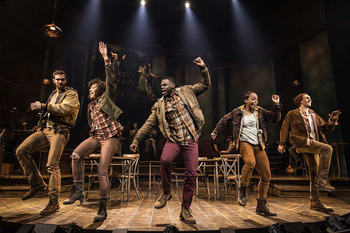
The Workers ensemble in the New Orleans-style club of Hadestown. (Photo by Matthew Murphy)

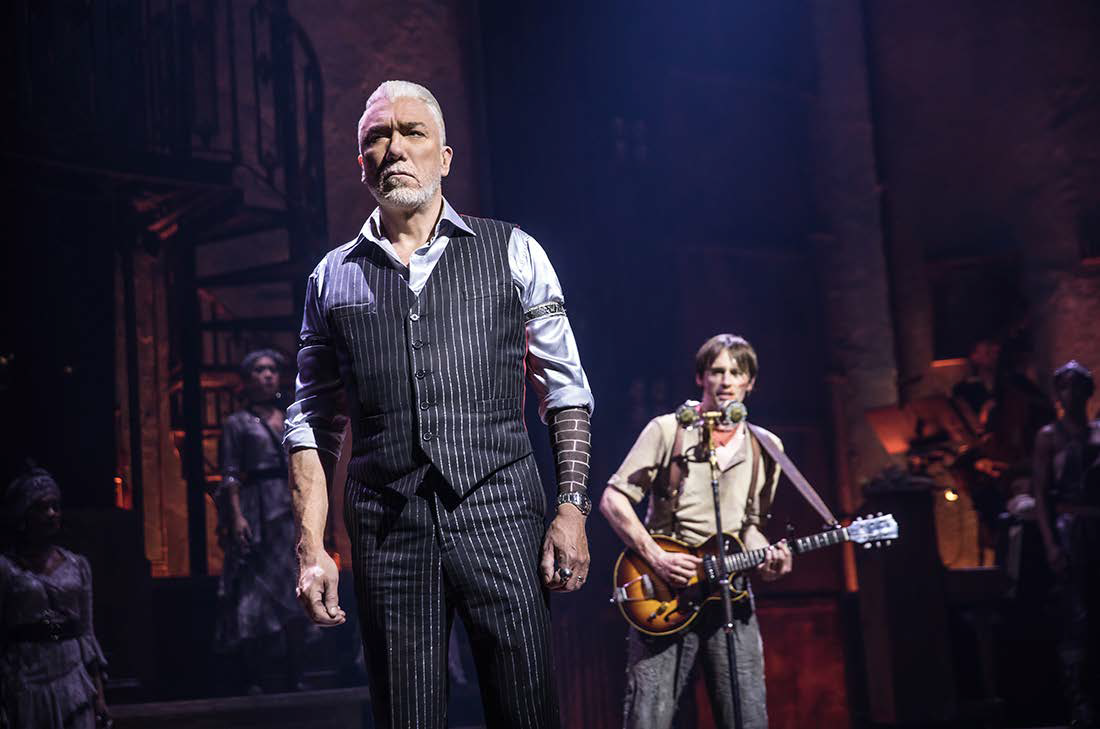
Orpheus (Reeve Carney) sings to remind Hades (Patrick Page), the industrialist boss of the Hadestown underworld, of his capacity for love. (Photo by Matthew Murphy)

On Broadway, Page’s industrialist Hades emanates white authority with a seductive edge. He is dressed in what costume designer Michael Krass describes as a Depression era-inspired, silver-threaded pinstripe suit, the sleeves rolled back to reveal a left forearm tattooed with bricks (in Fierberg Reference Fierberg2019). “Why We Build the Wall,” a Hadestown song written years before Trump’s wall, makes the most of Page’s rich bass. The call-and-response structure shows how Hades coerces his Workers into accepting exploitative labor conditions in the name of freedom and protection from outsiders. As he sings, Hades power postures: he stands center stage at a microphone, his chest thrust, arms at his sides, hands slightly clenched, feet hip distance apart. Directly facing the audience, Hades is an archetypal figure of (white) patriarchal power.
Hadestown’s openness to casting Hades as an actor of any ethnicity lacks a commitment to critiquing historical and contemporary white supremacy. This is not to say that no men of color occupied economic positions of power during the Industrial Age, the Great Depression, or now. But given everything else going on in the production, a person-of-color Hades doesn’t make sense.
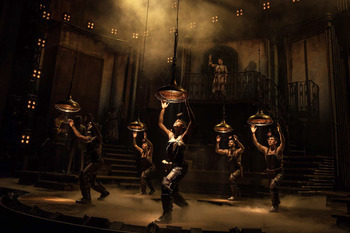
As a mixed-gender, mixed-race ensemble, the Workers add further complexity to the issues of race and class, and to gender. The chorus of Workers is the collective voice of ordinary people. The Workers’ headlamps and the repetitive, stylized digging motions of their choreography bring to mind coal miners or laborers digging the trench for Hades’s wall. The casting calls were for performers of “Any age, all genders, any ethnicity.” In the performance I saw on 14 May 2019, the Workers were two black women, two white women, and a black man. The Workers’ costumes of leather overalls, tool belts, skull caps with goggles, and bands of cloth wrapped around their chests exposing their skin emphasized a shared fleshy vulnerability. Costume designer Michael Krass said, “I felt that the workers ‘down below’ needed to be ungendered, but still sexual” (in Fierberg Reference Fierberg2019). At the same time, spectators see racial and gender identities in the differing skin tones, facial features, and body shapes of the actors.
But does Hadestown have a responsibility to develop a cohesive stance on white supremacy in addition to exploring issues of class, environment, and climate change? Hadestown has an overarching metatheatrical narrative structure, facilitated by Hermes. Speaking about casting for Hermes, Whitley said: “We saw all kinds of men, all ages, all ethnicities. But when André walked out, everyone turned to each other and was like, ‘I think this is the new way we want to tell the story. This is our Hermes’” (in Grady Reference Grady2019). De Shields’s electric Hermes has an otherworldly quality, dressed in a three-piece silver suit with feather details on the sleeves. He stands out in a company of younger men with broader and taller builds, bringing a different kind of energy to the show with his sharp clear voice and precisely expressive hand gestures. Hermes lives in a liminal zone, the messenger god always in between. In Hadestown, Hermes works the railroad station, watching over the people who cross from the world above to the world below. Additionally, Hermes flits between participating in Orpheus’s journey and commenting on it. Hermes frequently addresses the audience directly, acknowledging his role as a narrator in the theatrical telling of the story. Understanding De Shields’s Hermes as informed by the African oral tradition allows for a more complex understanding of Hermes’s relationship to the story. As a storyteller who organizes a multiracial ensemble of performers to collectively craft a tale of resilience and a sustained call for social change, Hermes models an alternative to Orpheus’s individualistic way of speaking truth to power. Orpheus channels the voices of the masses. The magic of Orpheus’s singing is dramatized through the Workers’ vocals, which echo and expand upon Orpheus’s delicate falsetto melodies and lush harmonies. Hermes, more than any other character, consciously and fluidly passes between the two dramaturgical levels of Hadestown: the self-contained love story of Orpheus and Eurydice and the endless repetition of telling that story over and over within the context of the brutal Hadestown underworld.
The Workers Chorus toils in the underworld of Hadestown. (Photo by Matthew Murphy)

Ultimately, Hadestown presents storytelling as a repeated act of hope. At the beginning and end of each performance, Hermes starts and then restarts the story. Orpheus, determined to win back Eurydice, appeals to Hades by singing the story of Hades’s love for Persephone. Orpheus’s persuasive retelling is echoed by the looping narrative structure of the musical, which opens with the coming of spring, marked by Persephone’s leaving by train to return to the world above. Hermes introduces Persephone and the other characters, calling attention to the actors as performers. He tells the audience that the story of Orpheus and Eurydice is “an old tale from way back when / It’s an old song […] And we’re gonna sing it again” (Mitchell Reference Mitchell2019). At the end of the performance, after Orpheus turns around, sending Eurydice back to Hadestown, the opening number reprises. The ensemble of actors, led by Hermes, enact their commitment to “sing it again,” restaging the arrival of Persephone to the club as a fresh beginning. Thus, the story is rebooted for the next performance’s audience. At the end, the cast sings without amplification, going totally live — the performers and the spectators, face-to-face. By telling and retelling an endless cycle, Hadestown wants to persuade audiences that storytelling in itself can give us the strength to overcome differences, love each other, and fight for a better future. That even when we fail, we can, we must, start over.
The audience’s relationship to the presentational storytelling of Hermes and company mirrors Hades’s relationship to Orpheus’s song, inviting the spectators to consider their own access to economic and social power. Of course, this is perhaps unintentionally ironic, given the cost of tickets to a hit Broadway musical. Regardless, Hermes’s cyclical storytelling also stages the impossibility of justly resolving economic and environmental issues. At the same time, Hermes’s very presence, along with the multiracial, multiethnic cast, reminds everyone in the theatre of the material effects of structural racism and the necessity to dismantle it.
Hadestown’s casting gestures towards a desire to portray diversity, yet is finally a missed opportunity. The flexible approach to casting, while inclusive, hampers the production’s ability to take aim specifically at white supremacy. The production does not make clear how class, exploitative labor, and xenophobia are intertwined with white supremacy. Hadestown avoids going beyond a liberal “we’re all in this together” by rendering the Workers as a multicultural ensemble devoid of specific racial, ethnic, cultural, or gendered identities and experiences. It is understandable that in trying to weave together many political themes, Hadestown’s creative team chose to focus on economic inequality and labor exploitation rather than race. However, the presence of a consciously chosen multiracial cast tells spectators to read the power dynamics between gods and mortals, the wealthy and poor, main characters and narrators, as also racialized. But the production does not explore this issue. I wish it had examined if not critiqued Orpheus as a white savior of the multiracial workers or probed more thoroughly the circumstances of people of color struggling to express their worldview within a myth that centers on white characters. Casting a diverse company with an awareness that their perceived races will affect the production’s meaning would have been more powerful than colorblind casting, which Hadestown aspires to. The visually diverse but culturally nonspecific cast results in restaging racial stereotypes and minimizing racial differences in the midst of a time when the United States is examining the history and ongoing conditions of white supremacy.