Introduction
Tens of thousands of people were involved in rescue, recovery and clean-up work following the 11 September 2001 attacks (9/11) on the World Trade Center (WTC) (Centers for Disease Control and Prevention, 2004). Individuals who responded to this disaster included traditional first responders such as police officers, firefighters and emergency medical personnel, as well as non-traditional responders such as construction workers, telecommunications workers, sanitation workers and other volunteers, most of whom had no prior training in disaster response (Herbert et al. Reference Herbert, Moline, Skloot, Metzger, Baron, Luft, Markowitz, Udasin, Harrison, Stein, Todd, Enright, Stellman, Landrigan and Levin2006). In 2002, the Centers for Disease Control and Prevention (CDC) established the WTC Medical Monitoring and Treatment Program (MMTP; now the WTC Health Program, WTC-HP), a regional clinical consortium that provides monitoring and treatment of WTC-related health conditions in WTC responders. The Department of Community and Preventive Medicine of the Icahn School of Medicine at Mount Sinai was designated as the coordinating entity of five consortium institutions. Data obtained in the first monitoring visit 10–61 months after 11 September 2001 from this cohort revealed that 14.4% of responders screened positive for WTC-related post-traumatic stress disorder (PTSD), with higher rates among non-traditional disaster responders such as construction workers (23.0%) than more traditional disaster responders such as police officers (5.9%; Stellman et al. Reference Stellman, Smith, Katz, Sharma, Charney, Herbert, Moline, Luft, Markowitz, Udasin, Harrison, Baron, Landrigan, Levin and Southwick2008).
PTSD is one of the most prevalent and persistent health conditions in WTC responders, even several years after 9/11 (Perrin et al. Reference Perrin, DiGrande, Wheeler, Thorpe, Farfel and Brackbill2007; Stellman et al. Reference Stellman, Smith, Katz, Sharma, Charney, Herbert, Moline, Luft, Markowitz, Udasin, Harrison, Baron, Landrigan, Levin and Southwick2008; Berninger et al. Reference Berninger, Webber, Cohen, Gustave, Lee, Niles, Chiu, Zeig-Owens, Soo, Kelly and Prezant2010; Bowler et al. Reference Bowler, Han, Gocheva, Nakagawa, Alper, DiGrande and Cone2010; Cukor et al. Reference Cukor, Wyka, Jayasinghe, Weathers, Giosan, Leck, Roberts, Spielman, Crane and Difede2011; Soo et al. Reference Soo, Webber, Gustave, Lee, Hall, Cohen, Kelly and Prezant2011; Wisnivesky et al. Reference Wisnivesky, Teitelbaum, Todd, Boffetta, Crane, Dellenbaugh, Harrison, Herbert, Jeon, Kaplan, Levin, Luft, Markowitz, Moline, Pietrzak, Shapiro, Southwick, Stevenson, Udasin, Wallenstein and Landrigan2011; Lucchini et al. Reference Lucchini, Crane, Crowley, Globina, Milek, Boffetta and Landrigan2012; Luft et al. Reference Luft, Schechter, Kotov, Broihier, Reissman, Guerrera, Udasin, Moline, Harrison, Friedman-Jimenez, Pietrzak, Southwick and Bromet2012, Pietrzak et al. Reference Pietrzak, Schechter, Bromet, Katz, Reissman, Ozbay, Sharma, Crane, Harrison, Herbert, Levin, Luft, Moline, Stellman, Udasin, Landrigan and Southwick2012a , Reference Pietrzak, Feder, Singh, Schechter, Bromet, Katz, Reissman, Ozbay, Sharma, Crane, Harrison, Herbert, Levin, Luft, Moline, Stellman, Udasin, Landrigan and Southwick2013a ; Webber et al. Reference Webber, Glaser, Weakley, Soo, Ye, Zeig-Owens, Weiden, Nolan, Aldrich, Kelly and Prezant2013). To date, however, no study has evaluated the structure/clustering or natural course of WTC-related PTSD symptoms in this population. This information is essential to elucidating the dimensionality of WTC-related PTSD symptoms, understanding the developmental progression of heterogeneous PTSD symptom clusters, and informing prevention and treatment strategies for WTC and other disaster responders.
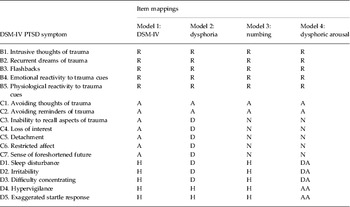
PTSD is a heterogeneous disorder characterized by clusters of relatively disparate re-experiencing, avoidance, numbing and hyperarousal symptoms. A large body of confirmatory factor analytic (CFA) studies conducted over the past 15 years (Yufik & Simms, Reference Yufik and Simms2010; Elhai & Palmieri, Reference Elhai and Palmieri2011) has demonstrated the superiority of two four-factor models of PTSD symptoms relative to the three-factor model described in the Diagnostic and Statistical Manual of Mental Disorders, 4th edition (DSM-IV; APA, 2000). These models include the dysphoria model, which is comprised of separate clusters of re-experiencing, avoidance, dysphoria and hyperarousal symptoms (Simms et al. Reference Simms, Watson and Doebbeling2002), and the emotional numbing model, which is comprised of separate clusters of re-experiencing, avoidance, emotional numbing and hyperarousal symptoms (King et al. Reference King, Leskin, King and Weathers1998). The only difference between these models is that three symptoms – D1 (i.e. difficulty falling or staying asleep), D2 (i.e. irritability or anger outbursts) and D3 (i.e. difficulty concentrating) – are assigned to the dysphoria cluster in the dysphoria model, while they are assigned to the hyperarousal cluster in the emotional numbing model (see Table 1).
Item mappings of DSM-IV, dysphoria, numbing and dysphoric arousal structural models of PTSD symptom dimensionality
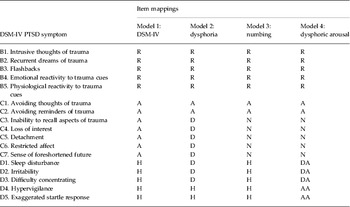
PTSD, Post-traumatic stress disorder; R, re-experiencing; A, avoidance; D, dysphoria; N, numbing; H, hyperarousal; DA, dysphoric arousal; AA, anxious arousal.
Recently, Elhai et al. (Reference Elhai, Biehn, Armour, Klopper, Frueh and Palmieri2011) suggested that one way to reconcile differences between the two four-factor models of PTSD symptom structure is to separate symptoms that comprise the hyperarousal symptom cluster into ‘dysphoric arousal’ (i.e. sleep disturbance, irritability, and concentration difficulties) and ‘anxious arousal’ (i.e. hypervigilance, exaggerated startle) clusters. This separation is based on a theoretical model proposed by Watson (Reference Watson2005), which separates symptoms characterized by restlessness and agitation, such as irritability and sleep difficulties, from more physiological/fear-based panic-like symptoms, such as hypervigilance and exaggerated startle response. A growing number of CFA studies, which have been conducted in nationally representative samples of adults in the USA and Australia (Armour et al. Reference Armour, Carragher and Elhai2013a ), a national clinic-referred youth sample (Elhai et al. Reference Elhai, Layne, Steinberg, Brymer, Briggs, Ostrowski and Pynoos2013), general adult samples of medical patients (Armour et al. Reference Armour, Elhai, Richardson, Ractliffe, Wang and Elklit2012), survivors of domestic violence (Elhai et al. Reference Elhai, Biehn, Armour, Klopper, Frueh and Palmieri2011), natural disaster (Wang et al. Reference Wang, Li, Shi, Zhang, Zhang, Liu and Elhai2011a , Reference Wang, Zhang, Shi, Zhou, Li, Zhang, Liu and Elhai b , Reference Wang, Armour, Li, Dai, Zhu and Yao2013a , Reference Wang, Wang, Li, Cao, Shi and Zhang b ; Armour et al. Reference Armour, Raudzah Ghazali and Elklit2013b , Pietrzak et al. Reference Pietrzak, Tsai, Harpaz-Rotem, Whealin and Southwick2012b , Reference Pietrzak, Van Ness, Fried, Galea and Norris c , Reference Pietrzak, Galea, Southwick and Gelernter2013b ) and a violent riot (Wang et al. Reference Wang, Zhang, Shi, Zhou, Li, Zhang, Liu and Elhai2011b ), military veterans (Armour et al. Reference Armour, Elhai, Richardson, Ractliffe, Wang and Elklit2012; Pietrzak et al. Reference Pietrzak, Tsai, Harpaz-Rotem, Whealin and Southwick2012b ) and drug-dependent individuals (Reddy et al. Reference Reddy, Anderson, Liebschutz and Stein2013), have found that this five-factor model provides a significantly better representation of PTSD symptom structure than the three-factor DSM-IV, and four-factor dysphoria and emotional numbing models.
To date, only two studies of utility workers (Palmieri et al. Reference Palmieri, Weathers, Difede and King2007) and a mixed sample of law enforcement and non-traditional responders (Ruggero et al. Reference Ruggero, Kotov, Callahan, Kilmer, Luft and Bromet2013) who responded to the WTC attack examined the dimensional structure of WTC-related PTSD symptoms. Results of both studies revealed that the dysphoria model provided a better representation of PTSD symptoms compared with alternative models such as the DSM-IV model. The five-factor dysphoric arousal model was not evaluated in either of these studies.
Characterization of the dimensionality of PTSD symptoms has important implications for understanding the structure and clinical presentation of PTSD symptoms in disaster responders, and may help inform etiological models of PTSD. For example, emerging work from our research group suggests that the five-factor model of PTSD symptomatology is differentially associated with neurobiological markers of PTSD (Pietrzak et al. Reference Pietrzak, Galea, Southwick and Gelernter2013b , Reference Pietrzak, Gallezot, Ding, Henry, Potenza, Southwick, Krystal, Carson and Neumeister c , Reference Pietrzak, Henry, Southwick, Krystal and Neumeister d ), suggesting that distinct neurobiological abnormalities may underlie the phenotypic expression of component aspects of this multi-faceted disorder. Understanding of the dimensional structure of PTSD may also inform approaches to the assessment and treatment of this disorder in disaster responders. For example, in some disaster responders, PTSD symptoms may be characterized predominantly by anxious arousal symptoms such as hypervigilance and exaggerated startle, while in others they may be characterized predominantly by emotional numbing symptoms such as detachment and restricted affect. Accordingly, treatments that primarily address particular hyperarousal symptoms (i.e. anxious arousal) may differ from treatments that primarily address emotional numbing symptoms (Leskin et al. Reference Leskin, Kaloupek and Keane1998; Pitman & Delahanty, Reference Pitman and Delahanty2005; Strawn & Geracioti, Reference Strawn and Geracioti2008; Macdonald et al. Reference Macdonald, Monson, Doron-Lamarca, Resick and Palfai2011). Knowledge of the dimensional structure of PTSD symptoms in disaster responders may thus lead to the development of more personalized and targeted approaches to assessment, monitoring and treatment of PTSD that address specific clusters of PTSD symptoms that are most disabling and contribute to the chronicity of this disorder.
In addition to a lack of research on the dimensional structure of PTSD symptoms in disaster responders, little is known about the prospective course of PTSD symptom clusters and their complex functional interrelationships in this population. Studies of the natural course of PTSD in other trauma survivor populations have found that symptoms that characterize this disorder are heterogeneous in nature, and characterized by dynamic and functionally meaningful interrelationships among symptom clusters over time (Creamer et al. Reference Creamer, Burgess and Pattison1992; Schell et al. Reference Schell, Marshall and Jaycox2004; Marshall et al. Reference Marshall, Schell, Glynn and Shetty2006; Solomon et al. Reference Solomon, Horesh and Ein-Dor2009). For example, some researchers have posited that avoidance of trauma-related thoughts and reminders may precede re-experiencing symptoms (Horowitz, Reference Horowitz2001), that re-experiencing symptoms may precede avoidance symptoms (Creamer et al. Reference Creamer, Burgess and Pattison1992), and that emotional numbing symptoms may arise from avoidance symptoms (Keane et al. Reference Keane, Fairbank, Caddell, Zimering, Bender and Figley1985) or from both hyperarousal and avoidance symptoms (Foa et al. Reference Foa, Riggs and Gershuny1995). Empirical studies of young adult survivors of community violence (Schell et al. Reference Schell, Marshall and Jaycox2004), injury (Marshall et al. Reference Marshall, Schell, Glynn and Shetty2006), and war veterans (Solomon et al. Reference Solomon, Horesh and Ein-Dor2009) have directly evaluated these hypotheses by employing autoregressive cross-lagged (ARCL) panel regression analyses of longitudinal data on PTSD symptom clusters. These studies found that hyperarousal is the strongest predictor of subsequent re-experiencing, avoidance and numbing symptoms, thereby underscoring the critical role of this symptom cluster in maintaining the chronicity of PTSD.
We had three aims in the current study: (1) to employ a theory-driven approach to evaluating the dimensional structure of WTC-related PTSD symptoms in police and non-traditional responders; (2) to examine the longitudinal factorial invariance of the best-fitting dimensional model of WTC-related PTSD symptoms; and (3) to assess how PTSD symptom clusters from the best-fitting model interrelated over an average 3, 6 and 8 years since 9/11.
Method
Sample
A total of 10 835 WTC responders, including 4035 police and 6800 non-traditional (e.g. construction and utility worker) responders, completed three visits as part of the WTC-HP. These visits were conducted an average of 3.3 (s.d. = 1.9, range = 0.8–8.0), 5.7 (s.d. = 1.7, range = 3.1–9.0) and 7.9 (s.d. = 1.3, range = 5.3–10.1) years after 11 September 2011. The WTC-HP is a CDC/National Institute for Occupational Safety and Health-funded regional clinical consortium that provides medical and mental health monitoring of WTC responders. This umbrella consortium of clinics that comprise the WTC-HP recruited subjects for participation through outreach efforts that included union meetings, mailings, media articles, and some 50 000 phone calls in multiple languages. Eligibility for the monitoring program required either having worked or volunteered as part of the rescue, recovery, restoration or clean-up in Manhattan south of Canal Street, or the barge-loading piers in Manhattan, or the Staten Island landfill, for at least 24 h between 11 and 30 September 2001, or for more than 80 h between 11 September and 31 December 2001. At 18 months after their first visit, participants were eligible to return for a second visit, with subsequent visits scheduled every 18 months thereafter. Institutional review boards of each affiliated site approved and monitored compliance of study procedures and all participants provided written informed consent.
WTC-related PTSD symptoms
The Posttraumatic Stress Disorder Checklist-Specific Version (PCL-S; Weathers et al. Reference Weathers, Litz, Herman, Huska and Keane1993) is a 17-item self-report instrument based on DSM-IV criteria for PTSD that was used to assess WTC-related PTSD symptoms. An example of a checklist item is: ‘In the past month, how much have you been bothered by repeated, disturbing memories, thoughts or images of the World Trade Center disaster?’ The PCL-S is administered routinely to all WTC responders at each scheduled visit to the WTC-HP.
Data analysis
Preliminary inspection of PCL-S data distributions in police and non-traditional WTC responders revealed the presence of multivariate non-normality at each assessment time point, as evidenced by Mardia coefficients >1.96. Complete data were available for over 90% of participants at each visit, and 98.6% of all surveys included responses to at least 15 of the 17 PCL-S items. CFAs were conducted using Mplus (Muthén & Muthén, Reference Muthén and Muthén2002), which employs robust maximum likelihood estimation with the Satorra and Bentler (S-B) χ 2 scaling correction (Satorra & Bentler, Reference Satorra and Bentler2001). This correction estimates standard errors under conditions of multivariate non-normality and computes other χ 2-dependent fit statistics based on the S-B χ 2 statistic. Full-information methodology has not been developed for analyses using robust χ 2 statistics, so analyses were based on complete cases. In all CFAs, PCL items were specified to load on a single factor, all factors were allowed to correlate, all error covariances were fixed to zero, and all tests were two-tailed. Model fit was evaluated using several fit statistics, including the S-B χ 2, comparative fit index (CFI), Tucker–Lewis index (TLI), root mean square error of approximation (RMSEA), Akaike's Information Criterion (AIC) and the Bayesian Information Criterion (BIC). By convention, higher CFI and TLI values, and lower χ 2 values, RMSEA, AIC and BIC values will be used as indicators of better fit. In CFA studies, fit is determined by empirically defined benchmarks, with CFI and TLI ⩾0.90 indicative of adequate fit and ⩾0.95 indicative of excellent fit, and with RMSEA ⩽0.08 indicative of adequate fit and ⩽0.06 indicative of excellent fit (Hu & Bentler, Reference Hu and Bentler1998, Reference Hu and Bentler1999). To compare the relative fit of nested models, χ 2 difference tests for nested models with a correction factor (given the use of the S-B χ 2 statistic) were computed (i.e. five-factor versus DSM-IV, dysphoria and numbing models; DSM-IV versus numbing models) (Fan & Sivo, Reference Fan and Sivo2009). To compare non-nested models (i.e. DSM-IV versus dysphoria model; numbing versus dysphoria model), we used the BIC (Schwarz, Reference Schwarz1978). Following convention, models with a lower BIC value are indicative of better fit, with a difference of 6–10 indicative of strong support and a difference >10 indicative of very strong support in favor of this model (Raftery, Reference Raftery1995).
Four models of PTSD symptom structure were evaluated. Model 1 was the DSM-IV three-factor model of intercorrelated re-experiencing, avoidance and hyperarousal symptoms. Model 2 was the four-factor dysphoria model of intercorrelated re-experiencing, avoidance, dysphoria and hyperarousal factors (Simms et al. Reference Simms, Watson and Doebbeling2002). Model 3 was the four-factor emotional numbing model of intercorrelated re-experiencing, avoidance, emotional numbing and hyperarousal factors (King et al. Reference King, Leskin, King and Weathers1998). Model 4 was the recently proposed five-factor dysphoric arousal model, which separates D1–D3 and D4–D5 symptoms into distinct dysphoric and anxious arousal factors (Elhai et al. Reference Elhai, Biehn, Armour, Klopper, Frueh and Palmieri2011). Table 1 shows item mappings for each of these models.
We also evaluated the invariance of the best-fitting structural model of PTSD symptoms across the three assessment time points in both police and non-traditional responders. In evaluating longitudinal invariance (unlike evaluating invariance across population subgroups), we freely estimated the covariance between corresponding items' error terms and factors at different times (time 1 with 2, 2 with 3, and 1 with 3). The minimum level of invariance tested was configural invariance, wherein the same factor model was used at all three visits, but no constraints of equality were imposed. The next level of invariance tested was weak metric invariance, wherein corresponding factor loadings were constrained to be equal over time. A further level of invariance tested was strong metric invariance, wherein the constraint of equality intercepts over time was added to the requirements of weak metric invariance. Finally, strict metric invariance imposes yet an additional constraint that corresponding item error variances be equal across time. Because even robust χ 2 statistics can lead to rejection of null hypotheses due to substantively unimportant deviations from model assumptions in large samples, testing of the successive levels of invariance relied on the criterion ΔCFI ⩽0.01.
To evaluate the natural course and functional interrelationships of PTSD symptom clusters of the best-fitting CFA-derived dimensional representation of WTC-related PTSD symptoms, we conducted ARCL panel regression modeling using full information maximum likelihood estimation in Mplus (http://www.statmodel.com). This approach allows one to examine the longitudinal stability of individual PTSD symptom clusters, as well as how severity of PTSD symptom clusters at one time point predicts severity of other PTSD symptom clusters at later time points (Jöreskog, Reference Jöreskog, Nesselroade and Baltes1979; Mayer & Carrol, Reference Mayer and Carrol1987). PTSD symptom clusters were modeled as latent factors in these analyses. As was done for CFAs, model fit was assessed using conventional fit statistics; non-significant paths were removed from the model until the best-fitting model was ascertained (Solomon et al. Reference Solomon, Horesh and Ein-Dor2009).
Results
Demographic and WTC exposure characteristics
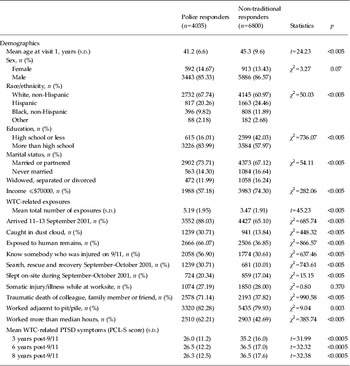
Table 2 shows demographic characteristics of police and non-traditional WTC responder samples. Compared with non-traditional responders, police responders were younger, more likely to be white/non-Hispanic, college or higher educated, married/partnered, and to have income ⩾$70 000/year. They also reported more total WTC-related exposures and greater severity of WTC-related PTSD symptoms at each visit. Sex and proportions of responders who reported having been treated for an injury or illness while working at the WTC site did not differ.
Demographic, exposure and clinical characteristics of police and non-traditional WTC responders

WTC, World Trade Center; s.d., standard deviation; 9/11, WTC disaster of 11 September 2001; PTSD, post-traumatic stress disorder; PCL-S, Posttraumatic Stress Disorder Checklist – Specific Version.
CFAs
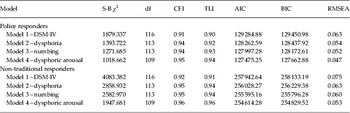
Table 3 shows fit statistics for each of the models evaluated in police and non-traditional responders.
Fit statistics for confirmatory factor analyses of post-traumatic stress disorder symptom structure at baseline visit

S-B, Satorra–Bentler; df, degrees of freedom; CFI, comparative fit index; TLI, Tucker–Lewis index; AIC, Akaike's Information Criterion; BIC, Bayesian Information Criterion; RMSEA, root mean square error of approximation.
In the police responder sample, corrected scaled χ 2 difference tests revealed that the five-factor model fit the baseline PCL-S data significantly better than the DSM-IV [χ 2(df = 7) = 740.05, p < 0.0005], numbing [χ 2(df = 4) = 237.25, p < 0.0005] and dysphoria [χ 2(df = 4) = 319.62, p < 0.0005] models. There was also greater evidence of ‘excellent fit’ for this model according to empirically defined benchmarks (Hu & Bentler, Reference Hu and Bentler1998, Reference Hu and Bentler1999). Comparison of non-nested models revealed very strong support for the dysphoria model fitting better than the DSM-IV (ΔBIC = 1013.06) and numbing (ΔBIC = 265.31) models. Internal consistency analyses suggested excellent reliability for total scores on the PCL-S (Cronbach's α = 0.95), and good reliability for each of the five PTSD symptom clusters that comprise the five-factor model, with Cronbach's α = 0.89 for the re-experiencing cluster, 0.80 for the avoidance cluster, 0.87 for the numbing cluster, 0.85 for the dysphoric arousal cluster, and 0.82 for the anxious arousal cluster.
In the non-traditional responder sample, corrected scaled χ 2 difference tests revealed that the five-factor model fit the baseline PCL-S data significantly better than the DSM-IV [χ 2(df = 7) = 1936.09, p⩽0.0005], numbing [χ 2(df = 4) = 606.97, p < 0.0005] and dysphoria [χ 2(df = 4) = 843.32, p = <0.0005] models. There was also greater evidence of ‘excellent fit’ for this model according to empirically defined benchmarks (Hu & Bentler, Reference Hu and Bentler1998, Reference Hu and Bentler1999). Comparison of non-nested models revealed very strong support for the dysphoria model fitting better than the DSM-IV (ΔBIC1 = 903.81) and numbing (ΔBIC4 = 33.09) models. Internal consistency analyses suggested excellent reliability for total scores on the PCL-S (Cronbach's α = 0.96), and good reliability for each of the five PTSD symptom clusters that comprise the five-factor model, with Cronbach's α = 0.92 for the re-experiencing cluster, 0.85 for the avoidance cluster, 0.90 for the numbing cluster, 0.87 for the dysphoric arousal cluster, and 0.74 for the anxious arousal cluster.
Invariance testing of the five-factor model of PTSD symptoms
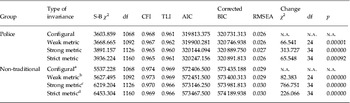
Table 4 shows results of longitudinal factorial invariance testing. Inspection of fit statistics suggested that models with constraints at all four levels of invariance had excellent fit, with CFI values ranging from 0.965 to 0.968 for police, and 0.969 to 0.974 for non-traditional responders. RMSEA values also suggested excellent fit, ranging from 0.026 to 0.027 for police, and 0.029 to 0.030 for non-traditional responders. Testing each step of invariance, each additional level of constraints led to no appreciable change in model fit, with ΔCFI <0.01 in every instance. Online Supplementary Table S1 shows factor loadings of PTSD symptoms that comprise the five-factor model at each of the visits.
Results of longitudinal factorial invariance testing

S-B, Satorra–Bentler; df, degrees of freedom; CFI, comparative fit index; TLI, Tucker–Lewis index; AIC, Akaike's Information Criterion; BIC, Bayesian Information Criterion; RMSEA, root mean square error of approximation; n.a., not applicable.
a Configural variance is based on the fit of a model incorporating all three visits with the same factor structure, but no constraints on loadings, intercepts or error variances. In all longitudinal models, covariances between item error variances at different times are estimated freely, as are covariances among corresponding factors.
b Weak metric variance is configural variance plus a constraint that corresponding loadings be equal across times.
c Strong metric variance is weak metric variance plus a constraint that corresponding intercepts be equal across times.
d Strict metric variance is strong metric variance plus a constraint that corresponding error variances be equal across times.
ARCL panel regression analyses
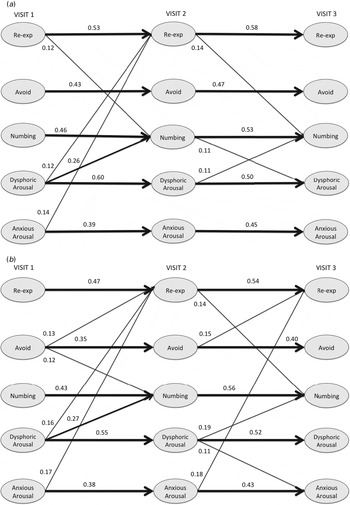
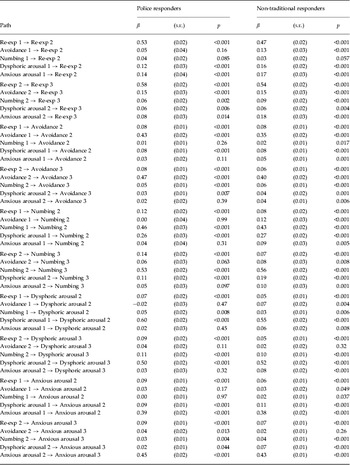
Table 5 and Fig. 1 show results of ARCL panel regression analyses in police and non-traditional responders. The models fit the data well in both police [χ 2(25) = 939.77, p < 0.001, CFI = 0.979, TLI = 0.919, SRMR = 0.035] and non-traditional [χ 2(25) = 1727.93, p < 0.001, CFI = 0.979, TLI = 0.919, SRMR = 0.040] responders. All five PTSD symptom clusters were stable over time, as evidenced by high coefficients across the three assessment time points. With regard to crossed paths among police responders, anxious and dysphoric arousal symptoms at the initial visit were the strongest predictor of re-experiencing symptoms at visit 2, while re-experiencing symptoms were the strongest prospective predictor of numbing symptoms at visits 2 and 3; dysphoric arousal symptoms strongly predicted numbing symptoms at visits 2 and 3, and numbing symptoms at visit 2 predicted dysphoric arousal symptoms at visit 3. A similar pattern of crossed paths was observed among non-traditional responders, with anxious arousal additionally predicting re-experiencing symptoms; avoidance symptoms predicting re-experiencing symptoms at visits 2 and 3, and numbing symptoms at visit 2. While other crossed associations among symptom clusters were significant (see Table 5), they were relatively reduced in magnitude.
Results of autoregressive cross-lagged panel analyses of World Trade Center (WTC)-related post-traumatic stress disorder symptoms at 3, 6 and 8 years after the WTC disaster of 11 September 2001 (9/11). (a) Police responders. (b) Non-traditional responders. Re-exp, Re-experiencing symptoms; Avoid, avoidance symptoms. Values represent standardized regression coefficients (β); only coefficients ⩾75th percentile for crossed paths are shown.

Regression coefficients from autoregressive cross-lagged panel analyses of WTC-related PTSD symptoms at 3, 6 and 8 years post-9/11

WTC, World Trade Center; PTSD, post-traumatic stress disorder; 9/11, WTC disaster of 11 September 2001; β, standardized regression coefficient; s.e., standard error; Re-exp, re-experiencing symptoms; 1, visit 1 (3 years post-9/11); 2, visit 2 (6 years post-9/11); 3, visit 3 (8 years post-9/11).
Discussion and conclusions
In this study, we evaluated the nature and prospective evolution of WTC-related PTSD symptoms over an average of 8 years in a large cohort of police and non-traditional WTC responders. Results revealed that: (1) the five-factor dysphoric arousal model provided the optimal representation of PTSD symptom dimensionality in both groups of WTC responders; (2) this five-factor dimensional structure was invariant over two follow-up assessments conducted over an 8-year period of time; and (3) in both police and non-traditional WTC responders, anxious arousal and avoidance symptoms most strongly predicted re-experiencing symptoms, and dysphoric arousal most strongly predicted emotional numbing symptoms over time.
Results of this study build on a large and growing body of CFA literature supporting a five-factor dysphoric arousal model of the dimensional structure of PTSD that is comprised of re-experiencing, avoidance, numbing, dysphoric arousal and anxious arousal symptom clusters (Wang et al. Reference Wang, Lane, Olfson, Pincus, Wells and Kessler2005, Reference Wang, Li, Shi, Zhang, Zhang, Liu and Elhai2011a , Reference Wang, Zhang, Shi, Zhou, Li, Zhang, Liu and Elhai b , Reference Wang, Armour, Li, Dai, Zhu and Yao2013a ; Elhai et al. Reference Elhai, Biehn, Armour, Klopper, Frueh and Palmieri2011; Armour et al. Reference Armour, Elhai, Richardson, Ractliffe, Wang and Elklit2012, Reference Armour, Carragher and Elhai2013a ; Pietrzak et al. Reference Pietrzak, Tsai, Harpaz-Rotem, Whealin and Southwick2012b , Reference Pietrzak, Van Ness, Fried, Galea and Norris c , Reference Pietrzak, Galea, Southwick and Gelernter2013b ). We extend this work to suggest that this five-factor model optimally characterizes the dimensional structure of PTSD in large prospective cohorts of professional (i.e. police), as well as non-traditional disaster responders (e.g. utility workers). Collectively, these CFA studies provide empirical substantiation of Watson's (Watson, Reference Watson2005) theoretical model in which dysphoric arousal symptoms, which are characterized by restlessness and agitation (e.g. irritability), are seen as conceptually distinct from symptoms that comprise the emotional numbing cluster, which is characterized by a generalized numbing of responsiveness (e.g. anhedonia) (Watson, Reference Watson2005; Elhai et al. Reference Elhai, Biehn, Armour, Klopper, Frueh and Palmieri2011). Further, symptoms that comprise the dysphoric arousal cluster are also conceptually distinct from the two other symptoms that comprise the DSM-IV hyperarousal cluster – hypervigilance and exaggerated startle – which reflect anxious arousal symptoms of physiological fear-based hyperreactivity. Importantly, the substantial body of CFA literature supporting the five-factor ‘dysphoric arousal’ model of PTSD symptom dimensionality in a diverse range of trauma survivors suggests that a theoretically based modification to the four-factor numbing and dysphoria models (Watson, Reference Watson2005; Elhai et al. Reference Elhai, Biehn, Armour, Klopper, Frueh and Palmieri2011) may help reconcile mixed findings that characterize the CFA literature on the dimensional structure of PTSD (Yufik & Simms, Reference Yufik and Simms2010).
Results of ARCL panel regression analyses suggested that the five symptom clusters were stable in severity over time. Anxious arousal and avoidance symptoms were the strongest crossed-path predictors of subsequent re-experiencing symptoms, and dysphoric arousal symptoms were the strongest crossed-path predictors of subsequent emotional numbing symptoms in both groups of WTC responders. These results are consistent with prior work in young adult survivors of community violence (Schell et al. Reference Schell, Marshall and Jaycox2004), injury (Marshall et al. Reference Marshall, Schell, Glynn and Shetty2006), and war veterans (Solomon et al. Reference Solomon, Horesh and Ein-Dor2009), which similarly found that hyperarousal symptoms – encompassing both dysphoric and anxious arousal symptoms – were primary determinants of subsequent re-experiencing and avoidance/numbing symptoms, as well as with results of a study that linked avoidance symptoms to chronicity of re-experiencing symptoms in burn survivors (Lawrence et al. Reference Lawrence, Fauerbach and Munster1996). Results of the current study provide greater specificity regarding the component aspects of hyperarousal symptoms that contribute to the temporal progression of re-experiencing and numbing symptoms. Notably, the finding that anxious arousal symptoms most strongly predicted re-experiencing symptoms in both groups of responders suggests that fear-based panic symptoms – hypervigilance and exaggerated startle – may primarily drive the development of intrusive trauma-related thoughts and memories in disaster responders. Further, that dysphoric arousal symptoms most strongly predicted emotional numbing symptoms suggests that hyperarousal symptoms characterized by restlessness and agitation (e.g. irritability/anger, sleep difficulties) may primarily drive the development of emotional numbing symptoms in disaster responders. Notably, this finding may also, at least in part, reflect the progressive development of depressive symptoms in this cohort. This particular pattern of interrelationships among PTSD symptom clusters accords with results of a prior longitudinal study of adult trauma survivors, which found support for synchronous change (i.e. mutually reinforcing effects of PTSD and depressive symptoms) and depressogenic (i.e. depressive symptoms driving PTSD symptoms) models of symptom interplay (Schindel-Allon et al. Reference Schindel-Allon, Aderka, Shahar, Stein and Gilboa-Schechtman2010). The prominence of hyperarousal in maintaining the chronicity of PTSD symptomatology is also in line with prior work, which found that physiological markers of hyperarousal (i.e. heart rate) predict the development of PTSD (Bryant et al. Reference Bryant, Harvey, Guthrie and Moulds2003), that hyperarousal is the first symptom cluster to develop following exposure to trauma (Bremner et al. Reference Bremner, Southwick, Darnell and Charney1996), and that hyperarousal predicts negative intrusive memories in laboratory paradigms (Nixon et al. Reference Nixon, Nehmy and Seymour2007). Given that subsets of this WTC responder cohort manifested heterogeneous trajectories of PTSD symptoms (Pietrzak et al. Reference Pietrzak, Feder, Singh, Schechter, Bromet, Katz, Reissman, Ozbay, Sharma, Crane, Harrison, Herbert, Levin, Luft, Moline, Stellman, Udasin, Landrigan and Southwick2013a ), additional studies are needed to evaluate how PTSD symptom clusters progress and interrelate over time in these subgroups (e.g. chronic, recovering and delayed-onset trajectories).
These findings have several clinical implications. First, although we used a DSM-IV-based instrument in this study, these results suggest that future revisions to the recently published DSM-5 (APA, 2013) criteria for PTSD, which reorganize symptoms into four clusters, should consider that dysphoric arousal and anxious arousal symptoms may constitute distinct symptom clusters that may be differentially linked to the development of PTSD. Second, given that clinical profiles of trauma-affected individuals may differ based on the five symptom dimensions of PTSD, assessment and monitoring of the nature, severity and temporal progression of symptom clusters that characterize the complex phenotype of PTSD may be helpful in informing the selection and modification of pharmacotherapeutic and/or psychotherapeutic treatments to target symptoms that precipitate and maintain this disorder. Third, these findings underscore the importance of assessing, monitoring and treating dysphoric and anxious arousal symptoms after exposure to trauma, as they may have prognostic utility in predicting the chronicity of PTSD (Schell et al. Reference Schell, Marshall and Jaycox2004; Marshall et al. Reference Marshall, Schell, Glynn and Shetty2006; Solomon et al. Reference Solomon, Horesh and Ein-Dor2009), as well as concomitant functional difficulties (Thompson et al. Reference Thompson, Vasterling, Benotsch, Brailey, Constans, Uddo and Sutker2004; Malta et al. Reference Malta, Wyka, Giosan, Jayasinghe and Difede2009). For example, treatments that target heightened arousal, such as beta-adrenergic blockers (Vaiva et al. Reference Vaiva, Ducrocq, Jezequel, Averland, Lestavel, Brunet and Marmar2003; Hoge et al. Reference Hoge, Worthington, Nagurney, Chang, Kay, Feterowski, Katzman, Goetz, Rosasco, Lasko, Zusman, Pollack, Orr and Pitman2012) and cognitive–behavioral therapies (Rabe et al. Reference Rabe, Dörfel, Zöllner, Maercker and Karl2006; Hinton et al. Reference Hinton, Hofmann, Pollack and Otto2009) may be particularly helpful in treating individuals with highly elevated dysphoric or anxious arousal symptoms after exposure to trauma.
This study has some methodological limitations. First, CFAs were based on a self-report measure of DSM-IV PTSD symptoms. Whether results of CFAs would differ if a DSM-5-based instrument or a clinician interview-based measure of PTSD such as the Clinician-Administered PTSD Scale were to be employed is not clear. Second, because assessment of WTC-related PTSD symptoms occurred an average of 3, 6 and 8 years after 9/11, it is not clear whether a different pattern of results would be observed at earlier time points after trauma exposure (e.g. months). Third, the construct validity of the five-factor model was not examined, as external measures of the unique constructs assessed by the dysphoric arousal and anxious arousal clusters (e.g. mixed anxiety and depressive symptoms; panic symptoms) were not assessed. Further research is needed to examine the natural history and construct validity of re-experiencing, avoidance, numbing, and dysphoric and anxious arousal symptoms, and to evaluate the utility of the five-factor model of PTSD in predicting long-term distress, functioning and treatment outcomes in trauma-exposed individuals. Fourth, it is unclear whether the DSM-IV-based separation of hyperarousal into dysphoric and anxious arousal symptom clusters will apply to the revised DSM-5 criteria for PTSD, which describe a four-factor model that is based largely on the CFA literature on the four-factor numbing and dysphoria models. Although additional CFA studies are needed to determine a five-factor model that will better characterize these revised symptoms, criterion E does contain similar hyperarousal symptoms as in DSM-IV, with the addition of self-destructive or reckless behavior. Thus, it is reasonable to suspect that the separation of dysphoric and anxious arousal symptoms using DSM-5 criteria will provide a better representation of this symptom cluster than a single hyperarousal factor. Importantly, however, given evidence of possible order effects on commonly used PTSD assessment instruments in CFA studies (Marshall et al. Reference Marshall, Schell and Miles2013), additional research is needed to evaluate how such effects might influence structural models of PTSD using DSM-5 criteria.
Despite these limitations, results of this study suggest that a five-factor model of PTSD symptoms that is comprised of separate clusters of re-experiencing, avoidance, numbing, dysphoric arousal and anxious arousal symptoms provides the optimal structural representation of PTSD symptom dimensionality in WTC responders. The results further suggest that hyperarousal symptoms have a prominent role in predicting other symptom clusters of PTSD, with anxious arousal symptoms primarily driving re-experiencing symptoms, and dysphoric arousal symptoms primarily driving emotional numbing symptoms over time. Additional research is needed to evaluate the optimal structural representation of DSM-5 diagnostic criteria for PTSD, assess interrelationships among symptom clusters from the best-fitting DSM-5-based model of PTSD symptom dimensionality over time, and examine the relationship between PTSD symptom clusters and other measures relevant to disaster responders and other trauma-exposed populations, such as health-related quality of life, and family and occupational functioning.
Supplementary material
For supplementary material accompanying this paper visit http://dx.doi.org/10.1017/S0033291713002924.
Acknowledgements
The present study was supported by the Centers for Disease Control and Prevention – National Institute for Occupational Safety and Health Contract no. 200-2011-41919 and grant no. 1U01OH010407-01. Preparation of this report was also supported in part by the Clinical Neurosciences Division of the United States Department of Veterans Affairs National Center for Posttraumatic Stress Disorder and a private donation. These funding sources had no further role in study design, in the collection, analysis and interpretation of data, in the writing of the report, or in the decision to submit the paper for publication. Neither this paper nor the World Trade Center Health Program itself would have been possible without the dedication and work of Dr Stephen Levin in promoting the health and well-being of workers over the course of his career. We can only hope that our own efforts live up to his standards and his memory.
Declaration of Interest
R.H.P. is a scientific consultant to Cogstate, Ltd for work unrelated to this project. B.J.L. has served as a consultant for and has received royalties from Baxter Pharmaceuticals for work unrelated to this project.