Coronavirus disease 2019 (COVID-19) is a serious and fatal disease, and currently, it has no effective treatment.Reference Rothan and Byrareddy1 Furthermore, there is a significant relationship between pre-existing medical conditions (eg, diabetes mellitus [DM], cardiac disorders, etc.) and the disease severity in patients with COVID-19.Reference Javanmardi, Keshavarzi and Akbari2 A mass vaccination of all people against severe acute respiratory syndrome coronavirus-2 (SARS-CoV-2) infection is the best hope for ending this devastating pandemic. However, a growing number of people in the world express vaccine hesitancy.Reference Dubé, Vivion and MacDonald3,Reference Asadi-Pooya, Sahraian and Badv4 In a previous study, we observed that even physicians (neurologists and psychiatrists) had concerns on the issue of the necessity of COVID-19 vaccination in patients with epilepsy; their most important concern was the reliability of the vaccines.Reference Asadi-Pooya, Sahraian and Badv4
It is helpful and necessary to have a good knowledge of the opinions of different groups of people (eg, patients, caregivers, health-care professionals, etc.) on the issue of the necessity of COVID-19 vaccination. This may help policy-makers understand the concerns of the people and to put in place appropriate strategies to provide the best targeted and tailored information to the people to convince them of the necessity of COVID-19 vaccination.
The aim of the current study was to investigate the opinions of patients with epilepsy (compared with other chronic medical/psychiatric conditions or healthy individuals) on their willingness to receiving COVID-19 vaccination. DM and cardiac disorders are commonly recognized to increase the severity of COVID-192 and, therefore, willingness of vaccination may be assumed to be higher among these patient groups. Epilepsy and psychiatric conditions are not associated with COVID-19 severity.Reference Asadi-Pooya, Emami and Akbari5 Here, we hypothesized that COVID-19 vaccine hesitancy is higher among patients with epilepsy or psychiatric conditions compared with that in patients with DM or cardiac disorders. We also investigated the associations between vaccine hesitancy and various factors (eg, demographic [ie, sex, age, education], medical [ie, chronic problems], and psychiatric). This study was performed before the start of the vaccination campaign in Iran, which has started on February 9, 2021.
Methods
We surveyed samples of 5 groups of people in late 2020: a group of the general population from Shiraz (volunteers from a major city in south Iran, random sampling) without a history of any chronic medical or psychiatric problems, patients with epilepsy (easy sampling; consecutively referring to the neurology clinic at Shiraz University of Medical Sciences [SUMS]), patients with DM (consecutively referring to the DM clinic at SUMS), patients with chronic cardiac problems (consecutively referring to the cardiology clinic at SUMS), and patients with psychiatric problems (people with depression or anxiety, consecutively referring to the psychiatry clinic at SUMS). The inclusion criteria were adult people (≥ 18 y) and literacy (> 5 y of education). The exclusion criteria included intellectual disability, unwillingness to participating in the study, and having more than 2 of the known comorbidities (eg, epilepsy, DM, depression, cardiac problems, etc.); however, we did not actively investigate their comorbidities and it was based on self-declaration.
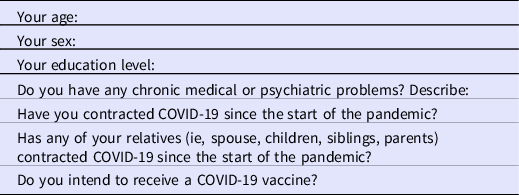
The survey (paper questionnaire) included 4 general questions and 3 COVID-19 specific questions (Table 1).
The survey

Statistical Analysis
Statistical analyses were performed using independent t-test, Fisher exact test, Pearson chi-square test, and Bonferroni correction test. (The Bonferroni correction is a multiple-comparison correction used when several dependent or independent statistical tests are being performed simultaneously.) Variables with a P value < 0.1 in univariate tests were assessed in a logistic regression model. Odds ratio (OR) and 95% confidence interval (CI) were calculated. A P-value (2-sided) less than 0.05 was considered as significant. All the statistical analyses were conducted with Statistical Package for Social Sciences (SPSS) version 25. The Shiraz University of Medical Sciences Review Board approved this study (IR.SUMS.REC.1399.1103). The dataset is confidential and could not be shared.
Results
The total number of the participants was 582 people (108 healthy individuals, 153 patients with epilepsy, 127 patients with DM, 98 people with cardiac problems, and 96 patients with psychiatric disorders [moderate, severe, and extremely severe depression in 74, and moderate, severe and extremely severe anxiety in 80 [58 people had both conditions]). The mean age of the participants was 37 y (standard deviation: 15 y) (all were adults, range: 18 to 97 y). They included 323 female and 259 male participants; the female to male ratios of these 5 groups were not different significantly (P = 0.135). The education level of the groups differed significantly (college education in 72% of healthy people, 43% of those with psychiatric disorders, 35% in patients with DM, 30% in people with epilepsy, and 22% in patients with cardiac disorders; P = 0.0001).
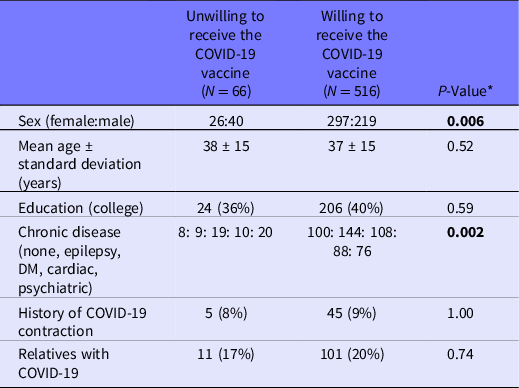
In total, 66 (11.3%) people expressed that they were not willing to receive a COVID-19 vaccine; 7.4% of healthy individuals, 5.8% of patients with epilepsy, 1.5% of patients with DM, 10.2% of people with cardiac problems, and 20.8% of patients with psychiatric disorders had vaccine hesitancy. Table 2 shows the factors associated with COVID-19 vaccine hesitancy in this study. Patients with psychiatric disorders had the highest rate of vaccine hesitancy (P = 0.002). Vaccine hesitancy rates were lower among patients with DM and those with epilepsy compared with that in healthy individuals. Male sex was also associated with vaccine hesitancy (8% in female vs 15% among male participants; P = 0.006).
Factors associated with COVID-19 vaccine hesitancy

* After Bonferroni correction, the corrected P-value is “0.008”. The significant P-values are in bold (male sex and psychiatric comorbidity).
We then analyzed the association between COVID-19 vaccine hesitancy and variables with a P < 0.1 in a binary logistic regression model. The model that was generated by regression analysis was significant (P = 0.0001) and could predict the COVID-19 vaccine hesitancy in 89% of the people. Within this model, psychiatric disorders (OR: 3.15; 95% CI: 1.31-7.60; P = 0.006) and male sex (OR: 2.10; 95% CI: 1.23-3.58; P = 0.010) were significantly independently associated with COVID-19 vaccine hesitancy.
Discussion
In this study, we observed that 1 in 9 participants had COVID-19 vaccine hesitancy. In a study from the United States, this rate was 1 in 3 participants.Reference Reiter, Pennell and Katz6 Cultural and social differences between the 2 countries may explain this discrepancy, at least to some extent. However, vaccine hesitancy is a complex phenomenon depending not only on cultural and social issues, but also on political and personal contexts, among other variables. In a study from the United States, the authors observed that vaccine acceptability was lower among some demographic groups, including those who had lower incomes, had no health insurance, or were conservative in their political leaning.Reference Reiter, Pennell and Katz6
COVID-19 is a serious and fatal disease.Reference Rothan and Byrareddy1 Mass vaccination programs are only successful when there are high rates of acceptance and coverage among all people. As misinformation about COVID-19 spreads across media outlets, it is very important for public health policy-makers to start planning for effective messaging about the vaccine.Reference Malik, McFadden and Elharake7 In this regard, it is important for the authorities to have a good knowledge of the rates of vaccine hesitancy and its associated factors in their corresponding societies and among different populations.Reference Neumann-Böhme, Varghese and Sabat8
While the rates of vaccine hesitancy among patients with DM, epilepsy, or cardiac disorders in the current study were not different from that in healthy individuals, patients with psychiatric disorders (eg, depression or anxiety) had the highest rate of vaccine hesitancy. Previous studies have shown that depression and anxiety are associated with a reduced adherence to the recommended treatments and medical advices.Reference Guo, Ding and Lu9 Addressing depression and anxiety may help improve adherence to the recommended medical advices, including the need for a COVID-19 vaccination. Why male sex is associated with vaccine hesitancy is not clear, and this should be explored in future studies.
Other studies have characterized some other important associated factors with vaccine hesitancy. In a previous study from the United States, the participants were more likely to be willing to get vaccinated if their health-care provider recommended the vaccination.Reference Reiter, Pennell and Katz6 Several health beliefs (eg, perceived severity, perceived vaccine effectiveness, and perceived potential vaccine harms) were also associated with vaccine acceptability.Reference Reiter, Pennell and Katz6 In another study from the United States, 58% of the participants intended to be vaccinated, 32% were not sure, and 11% did not intend to be vaccinated.Reference Fisher, Bloomstone and Walder10 Factors independently associated with vaccine hesitancy included younger age, Black race, lower educational achievement, and not having received the influenza vaccine in the previous year.Reference Fisher, Bloomstone and Walder10
Limitations
Our study has some limitations (eg, not inquiring the reasons for vaccine hesitancy, no information about the type/duration/severity of epilepsy, no active inquiry of psychiatric/somatic comorbidities).
Conclusions
We can conclude that vaccine hesitancy is a global issue. After identification of the risk factors associated with vaccine hesitancy in each society, policy-makers should tackle the modifiable factors (eg, health beliefs and vaccine-specific concerns) appropriately.
Data availability statement
The data used in this study are confidential and will not be shared.
Acknowledgments
Shiraz University of Medical Sciences supported this study. None of the authors listed on the manuscript are employed by a government agency. All are academicians. None of the authors are submitting this manuscript as an official representative or on behalf of the government.
Author contributions
Ali A. Asadi-Pooya: Designed and conceptualized the study; analyzed the data; drafted and revised the manuscript. Others: Data collection, analyzed the data, and revised the manuscript.
Funding statement
This work was supported by Shiraz University of Medical Sciences. The funding source had no involvement in study design; in the collection, analysis, and interpretation of data; in the writing of the report; and in the decision to submit the article for publication.
Conflicti(s) of interest
Ali A. Asadi-Pooya: Honoraria from Cobel Daruo, RaymandRad, Sanofi, and Tekaje; Royalty: Oxford University Press (Book publication). Others: none.