


On June 25, 2013, the U.S. Supreme Court struck down Section 5 of the 1965 Voting Rights Act, which required federal preclearance checks on election laws of states and counties that historically held racist electoral practices. Delivering the majority opinion in Shelby County v. Holder, Roberts claimed that Section 5 violated the “fundamental principle of equal sovereignty” and “impose[d] substantial federalism costs” by “[differentiating] between the States, despite our historic tradition that all the States enjoy equal sovereignty.”Footnote 1
Roberts’ argument ironically reflects the literature on federalism within U.S. politics, which conceptualizes the institution largely in terms of its varying degree of centralization or state authority over time or issue areas, but takes for granted the equality of state authority within this system. U.S. political science scholars of federalism such as Allen (Reference Allen2022), Gerken (Reference Gerken2012), Grumbach (Reference Grumbach2022), and Miller (Reference Miller2023) primarily conceive the institution as unidimensional, with its decentralization having important consequences for the country’s uneven pattern of democracy and democratic citizenship. By contrast, many comparative politics scholars like Conversi (Reference Conversi2007), McGarry (Reference McGarry2004, Reference McGarry2007), and Tarlton (Reference Tarlton1965) view federalism as a multidimensional institution, with the extent of centralization varying across subnational units. Scholars of American democratization do not link this multidimensional theorization of federalism to its impacts on democracy.Footnote 2 The closest this body of literature has come to this theorization of federalism is Gibson’s (Reference Gibson2012) and Mickey’s (Reference Mickey2015) works on “authoritarian enclaves” or “subnational authoritarian regimes” within democracies.
Yet, asymmetric state authority has long existed both in the American constitutional order and political tradition,Footnote 3 with some periods in U.S. history exhibiting stronger federal oversight over a select number of states while leaving others more autonomous in the effort to democratize subnational authoritarian regions.Footnote 4 Under certain conditions, the “substantial federalism costs” of uneven treatment Roberts references are not a cost but a potential benefit to American democracy.
Political scientists like Haggard and Kaufman (Reference Haggard and Kaufman2021), Levitsky and Ziblatt (Reference Levitsky and Ziblatt2018), Przeworski and Limongi (Reference Przeworski and Limongi1997), Roberts et al. (Reference Roberts, Bunce, Pepinsky and Riedl2025), Rustow (Reference Rustow1970), and Wedeen (Reference Wedeen2002) have studied democratization and democratic consolidation. Few institutional accounts within this literature, such as Kaufman et al. (Reference Kaufman, Kelemen and Kolcak2024), consider the significance of federalism in democratization and even fewer that of asymmetric federalism.
The systematic study of federalism’s multiple dimensions enhances our understanding of democratization, and it shifts the literature beyond the dichotomous and incomplete debate over federalism’s positive or negative consequences on democracy. By attending to multidimensional federalism, this paper moves this debate toward a more precise understanding of how different dimensions of federalism might strengthen democracy under historically contingent conditions.
This paper examines how the federal government’s selective, concentrated oversight over Southern states shaped democratization efforts in the United States during the post-Civil War era. I draw from comparative politics’ concept of multidimensional federalism, whereby federalism is characterized by the relationship between the federal government’s power over state governments (i.e., the centralization dimension), as well as how state governments experience federal authority relative to one another (i.e., the symmetric dimension). In Section 1, I concentrate on forming a mid-level theory of asymmetric federalism, describing the conditions under which asymmetry can be beneficial or detrimental to democratization. In doing so, this study provides a new perspective on federalism and Reconstruction. I show how asymmetry enabled a divided and administratively weak federal government to actively promote democratization in the South, and the conditions that allowed for this to occur. While asymmetry facilitated a targeted and thus more effective democratization effort, it also had the cost of overlooking the extension of democratization in other regions.
Section 2 explains the case study and methodological logic. The post-Civil War era in the United States is a particularly fruitful period to build out a mid-level theory of asymmetric federalism’s significance for democratization. While this is an extreme case, it is an era in which Radical Republicans in the federal government were especially willing to impose democratic reforms through centralization, but lacked the state capacity and political feasibility to implement and sustain expansive reforms. Reconstruction was a period of centralized, asymmetric federalism as much of the democratizing efforts were targeted at most Southern states. But, as Reconstruction ended, decentralized, symmetric federalism returned. I study the variation of multidimensional federalism and its relation to democratization between states and across time via examining the development of democratic and undemocratic provisions in Southern and border state constitutions and their multiple revisions.
Sections 3 and 4 provide the empirical core of the paper. Section 3 outlines how some Reconstruction amendments and policies ushered in a new, albeit shaky, asymmetric federalism by enforcing policies in select Southern states. In Section 4, I examine asymmetric federalism's relation to democratization by comparing Southern and border state constitutions during this period, showing how Southern but not border state constitutions became more democratic as a function of asymmetric federalism, before backsliding as symmetric federalism returned.
Ultimately, this study finds democratization occurred in the South during Reconstruction, in part, due to the presence of asymmetric federalism. However, as Reconstruction was dismantled and symmetric federalism returned, democratic progress was quickly hindered. In the face of democratic backsliding, asymmetric federalism may be used as a toolkit of democratization, especially when the democratically committed governing unit lacks the capacity and political feasibility to institute expansive reforms.
1. Theory: multidimensional federalism
The positive relationship between federalism and democracy is a sort of folk wisdom that has long been cultivated in the United States.Footnote 5 Many defenders of federalism associate the institution with democracy because the decentralized nature of American federalism better allows for minority voices to be heard, leading to the proper representation of a pluralist society. For Gerken (Reference Gerken2012), state governments have become “sites of empowerment for racial minorities and dissenters.” For Schickler (Reference Schickler2016), federalism provided the mechanism for meso-level actors to push the Democratic national party toward more progressive policies beginning in the 1930s. Allen (Reference Allen2022), Bulman-Pozen (Reference Bulman-Pozen2012), and Kaufman et al. (Reference Kaufman, Kelemen and Kolcak2024) argue that federalism contains several countervailing sites of political authority (i.e., veto points), thus limiting the dangers of centralized authoritarianism.
Others have identified American federalism as an institution that hinders democracy; Gibson (Reference Gibson2012) and Mickey (Reference Mickey2015) show how federalism allows subnational authoritarianism to thrive within democracies. Grumbach (Reference Grumbach2022), Miller (Reference Miller2023), and Riker (Reference Riker1964) argue the decentralization of American federalism inhibits democracy, allowing elite minorities to gatekeep power at the expense of majority populations and creating a minority tyranny in which “local tyrannies” become “national tyrannies.”Footnote 6 Michener (Reference Michener2018) and Weaver and Prowse (Reference Weaver and Prowse2020) have shown how federalism enables the creation and perpetuation racial and socioeconomic inequalities.
This body of literature has predominantly conceptualized federalism in terms of centralization; across time and issues, the federal government has had varied degrees of authority, which has posed either a danger or benefit to democracy. Invoking the axis of asymmetric federalism from comparative politics scholarship may be a more productive way to examine the institution’s relationship to democratic expansion.
Federalism is “a division of powers between general and regional authorities, each of which, in its own sphere, was co-ordinate with the others and independent of them.”Footnote 7 As comparative politics scholars have long recognized, the extent of state authority might vary between regional units. This is known as asymmetric federalism, and it allows us to conceptualize federalism in multidimensional terms and to explore greater variation than centralization or decentralization.
Comparative politics scholars who have theorized why asymmetric federalism emerges often cite the preservation of national unity (Benz, Reference Benz1999; Conversi, Reference Conversi2007; McGarry, Reference McGarry2004; Reference McGarry2007; Tarlton, Reference Tarlton1965) and the protection of minority groups (Ghai, Reference Ghai2010; Hannum, Reference Hannum2011; Henders, Reference Henders1997) as reasons for its origin. They have begun to examine how asymmetry interacts with party politics (Swenden, Reference Swenden2002), impacts political economies (Agranoff & Ramos Gallarín, Reference Agranoff and Gallarín1997; Congleton, Reference Congleton, Ahmad and Brosio2006), and mitigates between-unit inequalities (Tillin, Reference Tillin, Choudhry, Khosla and Mehta2017). But, the extension of asymmetry to the case of the United States is still largely missing from this literature,Footnote 8 as is analysis of how asymmetry shapes democratization.
The remainder of this section discusses federalism’s different dimensions before developing a mid-level theory on the conditions under which asymmetric federalism may be useful (or harmful) to democratization.
1.1. Dimension 1: centralized/decentralized federalism
The centralization dimension reflects the conventional outlook on federal systems, in which power and autonomy are distributed between the federal government and subnational governments. A federal system that exhibits more centralization showcases a low degree of autonomy of subnational governments while a more decentralized system showcases a high degree of autonomy of subnational governments.Footnote 9 Compared to other countries with federal systems, the United States is highly decentralized in several domains including voting rights.Footnote 10 In practice, the degree of centralization in the United States has historically varied over time.Footnote 11
1.2. Dimension 2: symmetric/asymmetric federalism
The symmetry dimension describes the degree of authority states have relative to each other. As Tarlton (Reference Tarlton1965) describes, “the asymmetrical federal system would be one in which … the diversities in the larger society find political expression through local governments possessed of varying degrees of autonomy and power.”Footnote 12 Asymmetry describes a federalism in which subnational governments experience the federal government differently, with some states experiencing more federal authority than others. All subnational units have some level of constitutionally guaranteed autonomy, but one or more units have “a different, usually enhanced level of autonomy from the rest.”Footnote 13 Oftentimes, asymmetry arises as a “response to a demand for a distinctive degree of autonomy from a mobilization nationalist … or when an independent entity is granted special self-governing privileges in return for joining a state.”Footnote 14 Quebec, Scotland, Wales, and Northern Ireland are examples of how various units enjoy different degrees or forms of authority. Symmetry describes a federal system where subnational governments’ authority in a particular domain is equal across units. Authority granted to one state is granted to all.Footnote 15
The centralization/decentralization dimension is related to asymmetric federalism: if asymmetry guarantees heightened autonomy for some states, this also means that the federal government may have more oversight over a select number of subnational governments. So, both centralization and decentralization are captured within the asymmetry dimension; there is more centralized federal oversight in some states and more decentralized federal presence in other states. Centralization describes the intensity of federal oversight while symmetry captures the distribution of the oversight. Analysis of federalism via this dual existence of symmetry/asymmetry exists in comparative politics scholarship, but is typically not captured in U.S. politics literature.
1.3. Asymmetric federalism and democratization
Democracy is “the continuing responsiveness of the government to the preferences of its citizens, considered as political equals” (Dahl, Reference Dahl1972).Footnote 16 To achieve this, a democratic regime must contain a strong civil society, as well as guarantees of free, fair, and equal elections whereby citizens’ preferences are heard and “in which coercion is comparatively uncommon.”Footnote 17 In democracies, “practically all” adult citizens have the ability to vote and run for and hold office.Footnote 18
“Democratic expansion” is the extension of the rights and processes that increase government responsiveness to citizens, “considered as political equals.” In the United States, democratic expansion has most commonly taken the form of expanding political and civil rights. I primarily concentrate on four broad categories of rights: enfranchisement (e.g., voting rights), access to political opportunities (e.g., running for and holding political office), access to material and public goods (e.g., the ability to purchase, hold, and sell property; access to quality public education), and freedom of movement (e.g., the ability to travel freely within the country). A unit is more democratic when a greater proportion of its citizens have access to these rights.
Democracy requires some level of state capacity and the political support for this expansion of state power. Whether these two conditions are best achieved at the federal or state level, and whether it will be equally true across states, will likely vary. However, the most common pattern in the American politics literature is one in which the federal government has a stronger commitment to democracy than the states, as shown in Einhorn (Reference Einhorn2006), Greenberger and Smith (Reference Greenberger and Smith2025), King (Reference King2017), and Miller (Reference Miller2023). It might also more generally be the case that a national democracy can tolerate undemocratic subregions better than a national authoritarian regime can tolerate democratic ones, though this is not the focus of the paper and future studies ought to more closely examine this dynamic. Where this is the case, some degree of centralization will likely be required to implement widespread, democratizing reforms. This is where much of the American politics literature’s focus on centralization is correct.
But centralization imposes costs, which can constrain the feasibility of top-down support for a democratizing project. Asymmetric federalism may provide the geographically limited centralization necessary to implement democratic reforms while overcoming these costs. In other words, the distribution of federal intervention across jurisdictions (i.e., asymmetry), not just the intensity of the intervention (i.e., centralization), shapes democratization.
Within a federal arrangement, democracy is strengthened when a unit of government that has the interest and will to protect political and civil rights can align its capacity and authority to do so. Democracy heavily depends on the unit of government interested in the project of democratization having the ability to hold and exercise power. In other words, for a democratically committed government unit to enforce democratic institutions and ideals in the face of authoritarian units, it must first have the capacity to enforce democratic rights and laws (i.e., it must have high administrative state capacity).Footnote 19 With a constitutional system riddled with multiple veto points at all levels of government, the United States biases the status quo over change.Footnote 20 So, for democratizing efforts to succeed in the United States, large majorities must be willing and able to form broad coalitions that sustain such efforts.Footnote 21 But, consolidating authority likely involves a shift in existing power arrangements between government units, which may generate opposition among units losing autonomy. This opposition might extend to all political elites losing this autonomy, even if only a subset of these are opposed to democratic ideals and practices, and it can pose particular danger to national unity and the preservation of the democratic coalition. The democratically committed government unit must be able to garner the support of relevant political actors to enforce democratic rights and laws (i.e., the enforcement must be politically feasible).
By enabling a change in state authority that is uneven across states, asymmetric federalism allows federal-level democratic actors to distribute the costs of democratization in a way that is proportional to the violation of democratic ideals; when centralized, symmetric governance is met with active resistance from opponents and allies alike, constraining the federal government's capacity to fully centralize, the use of asymmetric federalism may be a more politically feasible alternative to ensuring the democratization of authoritarian subnational units while maintaining the coalitions necessary for instituting democratic reforms.Footnote 22 Additionally, as McGarry (Reference McGarry2004; Reference McGarry2007) and Conversi (Reference Conversi2007) argue, when national unity is at stake, asymmetric federalism can allow the federal government to be more responsive to public majorities.Footnote 23 The autonomy of Quebec in Canada (Tarlton, Reference Tarlton1965) and Catalonia in Spain (Stepan, Reference Stepan1999), as well as the targeted enforcement of Radical Reconstruction and the 1965 Voting Rights Act in the United States, are common cases of how federal governments have employed asymmetry for the sake of national unity. Asymmetric federalism can be useful for democratization when there exists some subnational units in violation of democratic ideals, and the federal government lacks the capacity to form a broad coalition to institute democratic reforms across all subnational units.
However, asymmetry has downsides. The major pitfall is that the prospect of widespread democratization is intrinsically missed when asymmetry and not symmetry is implemented. Units in violation of democratic ideals, though more along the liberalization dimension of democracy, are left more autonomous via asymmetry and do not undergo the same focused, democratic transformation as others. Asymmetry provides democratically committed units the flexibility to institute democratic reforms—which may have otherwise gone unestablished—in the places that require it the most, but it constrains the expansiveness of democratization.
To summarize, accounts of federalism ought to attend to at least two key features: the centralization dimension and the symmetry dimension. The level and evenness of centralization have varying uses for democracy depending on the capacity of the governing units that want to democratize. Given the lack of state capacity of governing institutions and the limited political feasibility of democratic reforms, there are some federal dimensions that are more beneficial to efforts of democratic expansion compared to others in various contexts.
2. Methodology
The purpose of this paper is not to broadly test how these dimensions of federalism impact democratization. Rather, as a theory-building intervention, I broadly theorize the conditions under which asymmetric federalism can be beneficial during potential moments of democratic expansion. Given that asymmetric federalism uniquely empowers the federal government to implement policy in select jurisdictions, I suspect that asymmetry may be used as a tool to advance democracy in specific jurisdictions that are behind the rest of the country. Conversely, because asymmetry also allows certain jurisdictions to enjoy more autonomy than others, another way asymmetry may be useful is if the guarantee of some autonomy for select jurisdictions is a required compromise to maintain national unity.
While the post-Civil War era in the United States is an extreme case of asymmetry, it is an apt period to generate a mid-level theory of asymmetry given the lack of administrative state capacity but the willingness on the part of Radical Republicans to institute democratic norms in former Confederate states.Footnote 24 By exploring the development of asymmetric and symmetric federalism during the post-Civil War era, this paper shows that asymmetry may be useful when authoritarian actions can be located within certain jurisdictions and not others and state capacity and political feasibility are low, whereas symmetry may be useful when authoritarian actions are located across most jurisdictions and state capacity and political feasibility are high.
In analyzing multidimensional federalism, we examine the developments of fifteen state constitutions in the U.S. South (Alabama, Arkansas, Georgia, Florida, Louisiana, Mississippi, North Carolina, South Carolina, Tennessee, Texas, and Virginia) and border states (Delaware, Kentucky, Maryland, and Missouri) in tandem with the developments in the federal constitution from 1864 to 1908. We exclusively analyze Southern and border state constitutions because while white supremacy and other undemocratic acts certainly existed in states outside Southern and border states,Footnote 25 the continued, high density of slavery on the eve of the Civil War is indicative of the existence of authoritarian political institutions and norms that were unlike that of the rest of the country.Footnote 26 These states also faced similar conditions following the end of the Civil War, in which Black Americans made up a large proportion of the population compared to other states, and therefore had to confront mass extended citizenship and enfranchisement. Moreover, though multiple political parties remained relatively competitive within Southern and border states throughout the time span covered in this article, they would go on to become dominated by the Democratic Party for decades, making them single-party subnational authoritarian units.Footnote 27 Because Southern and border states frequently revised constitutions during this period, with clauses showcasing changes in democratic and undemocratic sentiments depending on shifting levels of state autonomy, state constitutions are apt for observing the development of multidimensional federalism and its relationship with democratization.Footnote 28
The interaction between the federal government and Southern and border state governments in the post-abolition period is a fruitful case as this era exhibited a brief democratizing period in which the constitutional role of the federal government expanded dramatically with the passage of the Reconstruction Amendments and the initiation of Reconstruction efforts targeting most Southern states, thus displaying a centralized, asymmetric federalism. The federal government also harbored democratic sentiments while Southern state governments (in particular, Southern states controlled by Democrats) harbored undemocratic sentiments. However, as Democrats regained power in the South, federalism became more decentralized and symmetric. The years 1864–1908 are selected because 1864 was the first attempted reentry of seceded states into the Union via new state constitutions, and 1908 signaled the first year where all Southern and border states began their eras of disenfranchisement efforts.Footnote 29 Time depicts the dimensions of federalism, particularly how centralization and asymmetry varied over the course of the post-Civil War period.
Contributing to the explanation of the dimensions of federalism is the selection of states during this period. Though some of Reconstruction was symmetric in that they applied to all states, most Reconstruction policies, particularly during Radical Reconstruction, were asymmetric because federal supervision—that is, democratization via policies from a centralized federal government—only took place in a handful of states.Footnote 30 Border states and Tennessee are included because these states were not subject to Reconstruction and were left more autonomous.
The development of Southern and border state constitutions helps to understand how multidimensional federalism affects democratization because Reconstruction required states to rewrite state constitutions under intense federal supervision, and because states often rewrote their constitutions several times shortly after Democrats regained control of the state and Reconstruction ended.Footnote 31 As depicted in Figure 1, each constitutional revision, then, represents the variation of asymmetric federalism within a given state, across time, with constitutional revisions in states undergoing Reconstruction showcasing the tangible results of democratization efforts under centralized, asymmetric federalism compared to states that did not experience asymmetry. The figure also shows the negative impact of decentralized, symmetric federalism on democratization in Reconstruction states during the Redemption and Disenfranchisement Eras. The figure’s illustration of Redemption’s beginning even before Reconstruction ended also depicts the authoritarian orientation of these states.
Asymmetric Federalism Over Time.

In all, the effects of the dimensions of federalism can be observed in three ways. The first is described by the time variation of this study (1864–1908), where overall, Southern and border states initially experienced centralized, asymmetric federalism but more decentralized, symmetric federalism once Reconstruction ended. The second way is shown in the across-state variation in this study; because Reconstruction was, in part, an asymmetric display of federalism in which many policies only applied to most seceded states, Southern states that were subjected to Reconstruction experienced the most centralized federalism while border states and Tennessee who avoided Reconstruction experienced more decentralization (though, not to the extent of pre-Civil War decentralization). Finally, the within-state across-time variation in this study depicts how states somewhat uniquely experienced and fought against the post-abolition efforts of democratization and centralized, asymmetric federalism.
Applying these three levels of analysis to the examination of state constitutional development highlights how asymmetric federalism produced different constitutional provisions that would go on to shape the state of democracy in Southern and border states. As states were exposed to varying levels of centralization as a consequence of asymmetric federalism, we can align these variations with the changes to democratic or antidemocratic constitutional provisions between states across time and within states across time. We broadly search for these provisions that often overlap in the effort to identify as many (un)democratic changes as possible, though overlapping provisions are not counted multiple times in our analysis.
As seen in Appendix Figure A, constitutional provisions are flagged when they meet at least one of the five requirements:
1. It explicitly or implicitly mentions racial segregation and/or slavery (emancipation, discrimination, equal rights, convict labor, interracial marriage, etc.).Footnote 32
2. It explicitly or implicitly mentions voting rights and/or qualifications to participate in any part of government/politics (voting, holding office, serving as a juror, being a witness in a court case, etc.).
3. It explicitly or implicitly mentions the Confederacy and/or the Civil War (war debt, pensions for soldiers/widows, habeas corpus suspensions, etc.).
4. It explicitly or implicitly mentions access to public goods and services (education, transportation, pensions, etc.).
5. It showcases an unusual shift in power to a particular body/level of government (control of elections to localities, acknowledgments of “state’s rights,” etc.).Footnote 33
Importantly, it is essential to acknowledge that racist, undemocratic provisions existed across all states—North, South, and West—during this time. However, the proportion of people disenfranchised in these states was astronomical compared to that of Northern states, and Southern states, with the distinct and pervasive institution of slavery, were far less democratic coming into the Reconstruction Era. This paper focuses on Southern and border states because the federal government's concentration of many Radical Reconstruction policies on the South exhibits the relationship between asymmetric federalism and democratization—a phenomenon that has existed elsewhere throughout U.S. history and in other countries.Footnote 34 Whereas scholarship on Reconstruction has often focused on the broad centralization of federal power during this period, this study reinterprets Reconstruction, shedding light on how this consolidation of power is fundamentally different from descriptions of more federal power.
This decision ought not to be interpreted as a deflection of white supremacy that existed throughout the country. Indeed, in many ways, this asymmetry transformed democratic development not just in the South, but across the country; Paul Herron (Reference Herron2017) notes, “federal control over constitution making in the South helped prepare the nation for acceptance of the Reconstruction Amendments to the US Constitution, which limited the autonomy and sovereignty of all the states, not just those in Dixie.”Footnote 35
3. The road to asymmetry
The post-Civil War period demonstrated an expansion of centralization and a shift toward asymmetric federalism.Footnote 36 Though the strength of the federal government had grown substantially since its founding, pre-Reconstruction federalism generally exhibited decentralization and symmetry. The Reconstruction Era (1864–1877) constituted a promise of a constitutional revolution; the Thirteenth, Fourteenth, and Fifteenth Amendments had the potential to alter the constitutional dynamics between the state and federal governments.Footnote 37 Holding a dominant majority in Congress, Republicans led the country’s efforts to expand democracy, thereby strengthening the federal government and signaling its commitment to democratic sentiments.
These amendments were vital in liberating formerly enslaved Black Americans and securing their roles in civic society as citizens, as well as establishing the possibility of future institutionalization of centralized federal power; the last section in each amendment intentionally gave the then-Republican dominated Congress the power to protect the rights of the people through the power of “appropriate legislation.”Footnote 38 In essence, the Reconstruction Amendments tied dominant federal governance to the security of civil rights and democratization.
But, even with new congressional power via the Reconstruction Amendments, centralized federalism was by no means institutionalized and its legitimacy was always precarious. Executive, judicial, and state officials consistently attempted to subvert centralized federalism.Footnote 39
The progress of democratic expansion during Reconstruction was not linear during this period, nor was it uniform across formerly Confederate states. Historians distinguish two main phases of Reconstruction, each of which was met with pushback from white Americans across the country, especially white Southerners.Footnote 40 The first phase is Presidential Reconstruction (1864–1867), which was initiated by President Abraham Lincoln but mostly carried out by President Andrew Johnson who attempted to reincorporate seceded states into the Union. Under federal orders, state governments rewrote their state constitutions, which needed to acknowledge that the U.S. Constitution was the supreme law of the land, and that the Confederacy was invalid. For Johnson, so long as Southern state governments abided by these requirements, they could rejoin the Union and regain their seats in Congress. These state constitutions were never accepted by the federal government, but they nevertheless exhibit how states reacted to democratizing reforms in the face of a more centralized yet mostly symmetric federal system.
President Johnson’s conception of Reconstruction was very different from what Radical Republicans in Congress envisioned. Known to be sympathetic to former slaveholders, Johnson believed in a limited federal government and strict interpretation of the Constitution; he did not think that the federal government—let alone Congress—had the authority to carry out Reconstruction, thus questioning the legitimacy of centralized federalism and symmetric federalism.Footnote 41 Maintaining that “white men alone must manage the South,” Johnson quickly moved to pardon former Confederate officials, recognize four Southern governments (Arkansas, Louisiana, Tennessee, and Virginia), and resume Southern state elections despite the lack of Black enfranchisement at the time.Footnote 42 Republicans in Congress fought back and rejected the Southern state constitutions, thereby rejecting their readmittance into the Union.
However, even Republicans in the federal government and the electorate were divided over the extent of centralization.Footnote 43 While Radical Republicans in Congress readily pushed for more centralized reforms, such as the potential shift to federal regulation of suffrage, moderate Republicans were more skeptical. Indeed, moderate Republicans “believed that the federal government lacked the authority to ‘interfere with the right of suffrage in the states.’”Footnote 44 Especially for moderate Republicans, fully symmetric Reconstruction reforms were incompatible with their attachment to state sovereignty, so Reconstruction could only occur in a partly asymmetric manner. The federal government, then, only had the capacity to implement democratizing reforms through the means of asymmetric federalism, though even centralized and asymmetric federalism remained in a vulnerable position with disagreement between and within the branches of the federal government.
With the exception of the Freedmen’s Bureau Act, early Reconstruction policies displayed symmetric federalism, with the Thirteenth Amendment and 1866 Civil Rights Act applying to all states. These policies alone were not enough to maintain centralized power, nor were they enough to liberate Black Americans as “the federal government in 1866 was hardly equipped to intervene continuously in local affairs to project the rights of citizens.”Footnote 45 To fully face the issue of subnational authoritarians, the still-growing, still-divided federal government would require asymmetric federalism, allowing them to concentrate their reform efforts on Southern states in a politically feasible way that accommodated limited state capacity.
The end of Andrew Johnson’s presidency marked the beginning of Radical Reconstruction and the highest point of centralized and asymmetric federalism, which lasted until 1877. Republicans still greatly outnumbered Democrats in Congress, allowing for the implementation of the Radical Republican agenda. The passage of the 1867 Habeas Corpus Act, 1867 Reconstruction Acts, and the ratification of the Fourteenth Amendment all worked together to further expand the power of the federal government while concentrating federal oversight in the reformation of Southern state governments.Footnote 46
The Fourteenth Amendment was monumental in signaling a shift toward centralized and asymmetric federalism. It established the concept of birthright citizenship, defining citizenship in a national rather than state-based sense in the Constitution, and it paved a path toward prohibiting states from depriving people of their liberty and guaranteeing equal protection before the law.Footnote 47 Whereas the federal government had once been viewed as the major violator of rights and liberties, the Amendment acknowledged states as entities that could deprive the people of their fundamental freedoms. By empowering Congress to enforce the provisions of the Amendment in Section Five, centralization became even more evident than before, and it left room for Congress to potentially exert asymmetric force on subnational authoritarians in the effort to protect people’s rights and liberties. The amendment also exhibited asymmetric federalism by barring former Confederates from holding elected or appointed office.
And yet, as asymmetric federalism intensified, asymmetry also meant that some states were left autonomous. Tennessee—a former Confederate state—had avoided much of Reconstruction, and Reconstruction only applied to former Confederate states, meaning that much of the democratizing efforts of the period did not extend to border states.Footnote 48 But, these states had similarly established institutions of slavery before the Civil War, and, compared to other regions, they disproportionately disenfranchised a massive proportion of their constituents.
Radical Reconstruction continued for the next 9 years in the form of the expansion of voting rights via the Fifteenth Amendment, the 1870 and 1871 Enforcement Acts, the 1871 Klu Klux Klan (KKK) Act, and the 1875 Civil Rights Act—all of which maintained the expanded power of the federal government, though in a more targeted manner. The Fifteenth Amendment prohibited discrimination on the basis of “race, color, or previous condition of servitude” at the polls, again empowering Congress to enforce the Amendment via legislation.Footnote 49 The Enforcement Acts of 1870 and 1871 authorized the President to appoint individuals to supervise elections in the South and addressed the undemocratic practices of Democrats in Northern cities, where disenfranchisement became increasingly rampant as Black Southerners migrated to the North.Footnote 50 The 1871 KKK Act made specific actions a federal crime, allowing the federal government to prosecute the violent and undemocratic activities of the KKK, which had risen in power since its 1866 founding in Tennessee.Footnote 51 Finally, the 1875 Civil Rights Act banned segregation in public spaces, forming a blueprint as to how federal intervention could occur.Footnote 52
As seen in Figure 2, Presidential Reconstruction was mostly symmetric and centralized, while Radical Reconstruction was overwhelmingly asymmetric and centralized, allowing the federal government to implement more targeted democratic reforms with less internal pushback to centralization. Radical Reconstruction statutes did not apply to Northern states that had fought for the Union, nor did they apply to Tennessee and border states.Footnote 53
Reconstruction Policies and Asymmetric Federalism.

Figure 2 Long description
The table has three columns: Policy Name, Policy Context and Policy Relation to Asymmetric Federalism. Row 1: Freedmen′s Bureau Act (1865), Established the Freedmen′s Bureau, which provided aid to legal refugees and newly freed people, asymmetric. Row 2: Thirteenth Amendment (1865), Abolished slavery and involuntary servitude, except as punishment for a crime, symmetric. Row 3: Civil Rights Act (1866), Defined citizenship, affirmed citizenship rights and equal protection of the laws, symmetric. Row 4: Reconstruction Acts (1867), Established requirements for the re-admittance of former Confederate States to the Union, federal oversight of elections, symmetric. Row 5: Habeas Corpus Act (1867), Empowered courts to issue writs of habeas corpus in cases where people were violating the U. S. Constitution or law, symmetric, invited asymmetry. Row 6: Fourteenth Amendment (1868), Defined citizenship, affirmed citizenship rights and equal protection of the laws, reduced apportionment, banned former Confederates from office, settled Civil War debts, symmetric and asymmetric. Row 7: Fifteenth Amendment (1870), Prohibited discrimination of suffrage on account of race, color, or previous condition of servitude, symmetric. Row 8: Enforcement Act (1870), Prohibited discrimination outlined in the Fifteenth Amendment by state officials, empowered federal courts to hear cases, asymmetric. Row 9: Second Enforcement Act (1871), Allowed for federal supervision of state and local elections, asymmetric. Row 10: Ku Klux Klan Act (1871), Defined KKK′s insurrectionist tactics as federal offenses, asymmetric. Row 11: Amnesty Act (1872), Removed most restrictions against former Confederates, symmetric. Row 12: Civil Rights Act (1875), Established full and equal enjoyment of public accommodations, symmetric. Row 13: Federal Elections Bill (1890), Would have allowed for federally supervised elections for the House of Representatives, symmetric, invited asymmetry.
Taken together, the centralized, largely asymmetric features of Reconstruction had a massive impact on democratization in the United States. The Thirteenth, Fourteenth, and Fifteenth Amendments transformed the Constitution from one that was previously extremely decentralized to one that lent more power to the federal government and authorized asymmetric federalism. Black Americans were recognized as citizens with fundamental rights and freedoms.Footnote 54 Both Black and white Americans’ access to the polls and to politics as a whole expanded greatly. More people were voting than ever before; a higher proportion of the voting-age population was frequently voting, and Black Americans were elected to political offices at all levels of government.Footnote 55 But, as a closer look at the state constitutions will show, centralized, asymmetric federalism and democratization during this era were continually in a precarious state, and the extent of federal oversight was still limited.
4. State constitutions and democratization through asymmetric federalism
During the post-abolition period, Southern and border states experienced constitutional revisions that reflected each state’s democratic developments. As seen in Figure 3, Southern states typically revised their constitutions during Presidential Reconstruction and Radical Reconstruction. They also revised constitutions during Redemption (1869–1877), when Democrats took back control of the respective state government, and often once more during the disenfranchisement era (beginning in 1890).
State Constitutional Changes in Context.

Figure 3 Long description
The table has seven columns: State Name, Post-Civil War Constitution Year, Reconstruction Constitution Year, Redemption Year, Redemption Constitution Year, Disenfranchisement Start Year, Disenfranchisement Method and Exposure to Asymmetry. Row 1: Alabama, 1865, 1868, 1874, 1875, 1901, constitution (1901), medium. Row 2: Arkansas, 1864, 1868, 1874, 1874, 1892, amendment (1892), medium. Row 3: Georgia, 1865, 1868, 1871, 1877, 1908, amendment (1908), medium. Row 4: Florida, 1865, 1868, 1877, 1885, 1889, constitution (1889), high. Row 5: Louisiana, 1868, 1868, 1877, 1879, 1898, constitution (1898), high. Row 6: Mississippi, 1868, 1868, 1876, 1890, 1892, constitution (1892), high. Row 7: North Carolina, 1868, 1868, 1870, 1875, 1900, amendment (1900), medium. Row 8: South Carolina, 1865, 1868, 1877, 1895, 1895, constitution (1895), high. Row 9: Virginia, 1869, 1869, 1870, 1902, 1902, constitution (1902), medium-high. Row 10: Tennessee, 1870, 1870, 1869, 1890, 1892, legislation (1890), low-none. Row 11: Texas, 1866, 1869, 1873, 1876, 1902, legislation (1902), medium. Row 12: West Virginia, 1863, 1872, 1870, 1872, 1904, amendment (1904), medium. Row 13: Delaware, 1897, blank, blank, blank, blank, blank, none. Row 14: Kentucky, 1891, blank, blank, blank, (attempted) 1907, legislation (unsuccessful), none. Row 15: Maryland, 1867, blank, blank, blank, (attempted) 1905, legislation (unsuccessful), none. Row 16: Missouri, 1875, blank, blank, blank, blank, blank, none.
In this section, we trace the development of democratic and undemocratic clauses within state constitutions alongside the development of centralized, asymmetric federalism and the eventual return to symmetry throughout the post-Civil War era, up to the beginning of the disenfranchisement era (with Georgia being the last to initiate disenfranchisement in 1908).
4.1. “Purifying” the electorate
Under the relatively mild centralization and symmetry of Presidential Reconstruction, suffrage clauses in Southern state constitutions did not look very different from those in the past. These clauses were quite short compared to their later versions, and they specified who was considered an eligible elector and what conditions rendered an individual ineligible to vote.
Of the eleven Southern states, eight state constitutions still designated the right to vote to only white male citizens, 21 years of age and older. States also required eligible electors to reside in the state for 1–2 years, and in the district for between 3–6 months. It was customary for states to designate ineligible electors as those serving in the United States military who did not reside in the state, as well as those convicted of “infamous crime.”
Some states went further than these restrictions. In Georgia and Virginia, eligible voters were required to pay all taxes, and in Louisiana, individuals—through legislation from the General Assembly—could obtain the right to vote if they had previously served in the military, paid all taxes, or demonstrated “intellectual fitness.” In Louisiana, South Carolina, and Virginia, voter registration was required. Under symmetric federalism, Southern states were not compelled to make democratic reforms to their state constitutions—not without assistance from the federal government. The lack of sustained, democratic federal oversight over these authoritarian states meant that state governments were still able to severely restrict suffrage.
This dynamic changed during Radical Reconstruction, when asymmetric federalism reached its apex. Under the intense supervision of Radical Republicans in Congress, formerly Confederate states (with the exception of Tennessee) redrafted their state constitutions, which were ratified between 1868 and 1870. Voting became comparatively easier under asymmetric federalism. Universal male suffrage became the constitutional standard in all Southern states, and for a brief moment in history, the legal status of universal male suffrage rights in the South were ahead of much of the country.Footnote 56 Residency requirements were also often lowered. States considered eligible voters as those who resided in the state from 6 months to 1 year before an election (as opposed to 1–2 years in previous constitutions), and those who resided in the district anywhere from 30 days to 6 months before an election (as opposed to 3–6 months in previous constitutions). Several states like Florida and South Carolina included declarations of suffrage, forbidding discrimination at the polls on the basis of race, color, nationality, and previous condition. Some states also continued to disqualify those who were Confederate officials or soldiers, and those who aided the Confederacy during the Civil War. As seen in Figure 4, Alabama specified that ineligible electors included those who were disqualified from voting by the Fourteenth Amendment. Though it seems counterintuitive to characterize these disenfranchising clauses as democratic, they were democratizing as they symbolized the federal commitment to punish and dissuade the insurrectionist behaviors that had occurred in the Confederacy. Under centralized, asymmetric federalism, Southern states produced unprecedented democratizing state constitutions that led to increased voter turnout for Black and white Americans alike.
Alabama Versus Tennessee, Restrictions on Suffrage.

Figure 4 Long description
The table has five columns: State Name, Post-Civil War Constitution, Reconstruction Constitution, Redemption Constitution and Disenfranchisement Constitution. Row 1: Alabama. Post-Civil War Constitution: Non-white males, under 21 years old, non-citizens, less than 1-year state residency, soldiers convicted of high crimes (1865). Reconstruction Constitution: Non-males, under 21 years old, non-citizens and no intent to naturalize, less than 6 months state residency, non-registered voters, convicts of high crimes, Civil War criminals, 14th Amendment disqualified voters, convicts of treason in office, idiots/insane persons (1868). Redemption Constitution: Non-males, under 21 years old, non-citizens, less than 1-year state residency, less than 3 months county residency, non-registered voters, soldiers, convicts of high crimes, idiots/insane persons (1875). Disenfranchisement Constitution: Non-males, under 21 years old, less than 2 years state residency, less than 1-year county residency, less than 3 months ward residency, non-registered voters, persons not of good character, persons who cannot read/write or not in possession of 40 acres of land, convicts of high crimes, idiots/insane persons, convicts of moral crimes, convicts of vagrancy or election fraud (1901). Row 2: Tennessee. Post-Civil War Constitution: Non-males, under 21 years old, non-citizens, less than 1-year state residency, less than 6 months county residency, not providing satisfactory evidence of poll tax or not producing evidence, convicts of infamous crimes (1870). Reconstruction Constitution: Blank. Redemption Constitution: Blank. Disenfranchisement Constitution: Blank. Note: Bolded text denotes changes in restrictions over time.
But, the asymmetric nature of Radical Reconstruction also meant that some states did not experience the same heightened level of centralization as most formerly Confederate states. Turning to examine states that had little to no federal supervision during Reconstruction, border states and Tennessee had state constitutions that were comparably less democratic than those created during Radical Reconstruction in other Southern states. Ratified before the passage of the Fifteenth Amendment, Maryland’s state constitution, like other states throughout the country, still limited suffrage to white males. Delaware, ratifying its constitution later in 1897, contained reading and writing requirements to register to vote. Tennessee, the only formerly Confederate state to avoid Radical Reconstruction, ratified its constitution in 1870 and became the first state to institute the payment of all poll taxes and proof of payment as a requirement for suffrage.Footnote 57
Notably, today, such restrictions (like poll taxes and restrictions on convicted criminals) carry highly racialized connotations as they have been historically used to disproportionately keep Black Americans from exercising their right to vote.Footnote 58 But, these restrictions were not racialized in the same way we perceive them today. Political elites—no matter their political affiliation—during this time believed in the sanctity of the ballot, which was one of the reasons why former Confederates were restricted from suffrage.Footnote 59 These restrictions became both racialized and undemocratic later as Reconstruction ended, during an era of decentralized, symmetric federalism.Footnote 60 The presence of poll taxes in the South largely disappeared during Radical Reconstruction and reappeared following the Redemption Era, with some states like South Carolina and Texas requiring proof of payment of the tax.
Asymmetric federalism was helpful in that most Southern states were subjected to strong, centralized, federal oversight. In an age when the federal government did not have the capacity to institute intense oversight over all states, nor was symmetric centralization politically feasible as allies in Congress were hesitant to impose on state sovereignty, asymmetry allowed the federal government to concentrate its attention on the country’s subnational authoritarians. And, under asymmetry, state constitutions of Radical Reconstruction states became increasingly democratic as individuals’ access to the polls became more widespread than ever before. In comparison, border states and Tennessee which were not subjected to Reconstruction had less democratic state constitutions as poll taxes and educational abilities became requirements for suffrage.
Still, asymmetry was met with resistance in Southern states. Across these subnational authoritarian units, political actors sought to undermine federal authority, staking claims to state sovereignty in order to undermine Reconstruction efforts. Beginning in 1869 and by 1877, all Southern states were redeemed by the undemocratic Democratic Party,Footnote 61 paving the way for the era of disenfranchisement and decentralized, symmetric federalism to begin.
Once Redemption began and symmetric federalism slowly returned, many Southern states, now back under Democratic control, began to redraft their state constitutions. While these constitutions were not as undemocratic as those created during the disenfranchisement era decades later, they included undemocratic clauses that undermined the progress that had been made in Radical Reconstruction constitutions. Referring again to Figure 5, states like Alabama became more restrictive in the residential requirements for eligible electors, lengthening the time of residency and specifying the time of residency at all levels of government down to the city. Many other states like Georgia and Texas tightened their restrictions on convicted criminals; whereas prior to Redemption, it was common for states to restrict individuals who had committed electoral and political fraud from voting, states now expanded these restrictions to any person who had committed a crime.
Qualifications to Hold Political Office by State Constitution.

Figure 5 Long description
The table compares qualifications for political office across four constitutional eras: Post-Civil War, Reconstruction, Redemption and Disenfranchisement. It has five columns and six rows. Columns are labeled: Types of Qualifications, Post-Civil War Constitution, Reconstruction Constitution, Redemption Constitution and Disenfranchisement Constitution. Row 1: ′Must be a white man′ is listed in Post-Civil War for Alabama, Arkansas, Florida, Tennessee, Texas; Reconstruction for Mississippi, North Carolina, South Carolina; Redemption for Arkansas, Texas; Disenfranchisement for Mississippi, South Carolina. Row 2: ′Must be religious′ appears in Post-Civil War for Arkansas, Maryland; Reconstruction for multiple states including Louisiana, Texas, Virginia; Redemption for Arkansas, Florida, Texas; Disenfranchisement for Florida, Louisiana, South Carolina, Virginia. Row 3: ′Must be an eligible elector′ is noted in Reconstruction for Florida, Louisiana; other eras have no states listed. Row 4: ′Disqualified by 14th Amendment′ has no states listed across all eras. Row 5: ′Explicitly prohibited as a qualification′ includes property holder, English-speaker, religious, elector in Post-Civil War for Louisiana, Tennessee, Texas, Delaware, Maryland; Reconstruction for Alabama, Arkansas, Florida, Mississippi, North Carolina, Texas; Redemption for Alabama, Texas; Disenfranchisement for Mississippi. Row 6: ′None stated′ is noted in Post-Civil War for Georgia, Kentucky; Reconstruction, Redemption for Georgia; Disenfranchisement for Alabama. The table highlights shifts in qualifications, with some states consistently appearing across eras, while others show changes in restrictions or prohibitions.
Decentralized, symmetric federalism returned in full once the disenfranchisement era began, and with it came another wave of state constitutional revisions in six states. With Democratic strongholds in Southern states (whereas party competition was still relatively alive during the end of Reconstruction and the Redemption eras),Footnote 62 Democrats moved to “purify” the electorate through legal means, resulting in the proliferation of undemocratic suffrage clauses via new state constitutions.Footnote 63 Poll taxes were requirements for voting in all six state constitutions that ratified new state constitutions during this time, and while poll taxes existed in other states throughout the country, their impact in the South disproportionately disenfranchised Black Americans.Footnote 64 Despite many previous state constitutions at the height of asymmetric federalism explicitly prohibiting educational and property requirements for suffrage, four state constitutions (Alabama, Louisiana, South Carolina, and Virginia) now instituted these requirements. Residency requirements extended, and suffrage restrictions of criminals broadened. Voter registration and the conduct of elections also became decentralized, with locally appointed officials often taking the reins of these activities, moving away from the centralized regulation of elections of the Reconstruction era. In Louisiana, the Grandfather Clause was pioneered, restricting Black and white voters from the ballot box. And, in Alabama and Virginia, state constitutions explicitly allowed for the automatic voter registration and suffrage eligibility of former Confederate soldiers and their sons, despite Alabama’s Radical Reconstruction constitution having barred these individuals from voting.
Other states, Southern and border alike, followed suit even if not through the ratification of new constitutions. With the exception of Virginia, states exposed to Reconstruction (i.e., centralized, asymmetry) either ratified new state constitutions or passed constitutional amendments that were created to disenfranchise “impure” electors (i.e., Black and uneducated, non-property-holding white voters). States not subjected to Radical Reconstruction (with the exception of Missouri) also attempted to pass disenfranchising policies. Delaware’s constitution contained educational suffrage requirements, and Tennessee was able to successfully pass a series of disenfranchising policies through its legislative branch in 1902. Maryland and Kentucky (unsuccessfully) attempted to pass disenfranchising legislation in 1904 and 1907, respectively.
At the height of asymmetric federalism, access to the ballot in Southern states was higher than ever before, even compared to states that did not experience Reconstruction. But, with the lack of sustained centralization and perhaps the lack of enough asymmetric Reconstruction policies, the democratic development made during Radical Reconstruction was subverted.
4.2. In the room where it happens
Access to politics in the form of qualifications for holding office and state-level apportionment followed a similar pattern to that of the development of suffrage. As seen in Figure 5, during Presidential Reconstruction, Southern state constitutional revisions, with the exception of Georgia, limited the ability to hold office to white men—a provision that was relatively common in state constitutions across the country but nevertheless reflected the resistance to democratic norms of access to political office. Arkansas, South Carolina, and Virginia also specified the apportionment of state-level governing bodies according to the state’s white population.
Southern state constitutions established during Radical Reconstruction broadened qualifications to hold office. Most states allowed any eligible elector to hold office, and many forbade property, educational, and religious requirements for public servants. In Florida and Louisiana, former Confederate soldiers and officials were barred from running for and holding political office. Under asymmetry, these provisions reflected an effort to create a more democratic system in the South; they allowed a greater demographic of people to participate in office (e.g., forbidding property and educational requirements) while simultaneously enforcing democratic norms (e.g., barring former Confederates from holding office).
Access to politics tightened once more as Reconstruction policies and asymmetry were dismantled. Though this may not be apparent as the clauses addressing apportionment and qualifications for holding office remained largely unchanged from the Radical Reconstruction era, the definition of an “eligible elector” was becoming increasingly restrictive throughout the Redemption and disenfranchisement eras. Language from Radical Reconstruction constitutions became retroactive as the country transitioned into more decentralized, symmetric federalism.
4.3. Redefining citizenship
Throughout the post-abolition period, state constitutions often contained some version of a declaration of freedom and/or equality clause. These clauses were typically not present in Presidential Reconstruction constitutions, but appeared in every state constitution established under Radical Reconstruction, with the exception of Mississippi. While the language of these clauses varied slightly across states, the message was clear: individuals were free and equal, and discrimination on the basis of race, color, or previous condition would not be tolerated.
These clauses were dismantled as asymmetric federalism waned and symmetric federalism returned. In constitutions created during the Redemption and disenfranchisement eras, states either removed these clauses (Alabama, Arkansas, Georgia, Texas, and Virginia) or altered their language (Florida, Louisiana, and South Carolina).
The change in the language of these clauses was intentional as rights became more restrictive. For example, in Texas’ 1876 Redemption constitution, delegates included the same language from its 1869 Radical Reconstruction constitution, “All freemen, when they form a social compact, have equal rights; and no man, or set of men, is entitled to exclusive separate public emoluments of privileges,” but added “but in consideration of public services” to the clause. While equal rights were constitutionally guaranteed in Texas, they were not guaranteed when it came to access to public services such as education, pensions, and other public goods. Though the clause remained in some state constitutions, the understanding of who deserved freedom and equality and where they deserved these rights was limited.
Notably, all states not subjected to Radical Reconstruction, with the exception of Kentucky, did not have constitutions that contained these clauses. The absence of these clauses in these other state constitutions was not just the result of the South’s defeat in the Civil War, but rather a display of what the federal government was able to accomplish through the means of asymmetric federalism under the condition of limited state capacity.
Perhaps the most glaring development of citizenship took form in the abolition of slavery. The Thirteenth Amendment banned slavery at the federal level, but under heightened asymmetry, Southern states were required by the federal government to ratify constitutions that contained an abolition clause if they were to reenter the Union and regain federal political representation. Southern state constitutions under asymmetric federalism consistently contained clauses that banned slavery. Concentrated federal authority transformed a region where slavery as an institution had thrived and was considered a “way of life.”
And yet, similarly to other provisions previously discussed, this progress would not last. Some states did not alter their abolition clauses during Redemption and disenfranchisement, but among states that changed their abolition clauses, the removal of slavery bans was common. As seen in Figure 6 and Appendix Figure B, abolition clauses were nowhere to be found in the Redemption and disenfranchisement constitutions of Louisiana, South Carolina, Texas, and Virginia.
Evolution of Missing Slavery Clauses by State.

Figure 6 Long description
The table has five columns: State Name, Post-Civil War Constitution, Reconstruction Constitution, Redemption Constitution, Disenfranchisement Constitution. Row 1: Louisiana, slavery banned, state legislature cannot make laws recognizing slavery (1864); slavery banned (1868); slavery banned (1879); missing clause (1898). Row 2: South Carolina, slavery banned (1865); slavery banned (1868); blank; missing clause (1895). Row 3: Texas, African slavery banned, rights of Africans and descendants secured via legislation (1866); slavery banned, peonage systems banned (1869); missing clause (1876); blank. Row 4: Virginia, slavery banned, state legislature cannot make laws recognizing slavery (1866); slavery banned (1870); blank; missing clause (1902). Row 5: Delaware, missing clause (1867); blank; blank; blank.
In border states where these federal requirements were absent, two out of the four state constitutions contained undemocratic clauses pertaining to the abolition of slavery. In Maryland, delegates acknowledged abolition, but demanded that the federal government ought to compensate former slaveholders for their “financial loss.” In Delaware, abolition was not present. The dropping of abolition clauses from state constitutions signified a larger shift away from democratic commitments by Southern states. In doing so, the supremacy clauses in Southern and border state constitutions converged with those of border states, though Southern states were undergoing a broader departure from democracy beyond that of border states.
In addition to the redefinition of citizenship was the expansion of access to free public education. During heightened asymmetry, Southern states were required to establish a public school system upon reentry to the Union.Footnote 65 In nearly every state constitution, children were guaranteed a free education, with some states making education compulsory. However, with Black children now entitled to an education came the emergence of segregated schooling clauses in state constitutions as symmetric federalism returned. Nearly every Southern state that experienced Radical Reconstruction—with the exception of Arkansas—implemented segregated schooling in later state constitutions, as depicted in Figure 7 and Appendix Figure C. This was a major shift from previous constitutions in these states, which did not mention segregated schooling or, in the case of Louisiana and South Carolina, explicitly prohibited school segregation. Border states and Tennessee, with the exception of Maryland, all included school segregation clauses in their revised constitutions.
School Segregation Clauses by State Constitution.

Other state constitutional developments in citizenship that appeared with the return of symmetric federalism (but were typically not present during asymmetry) included the emergence of interracial marriage bans, the constitutional permittance of convict labor, and the introduction of pensions and other benefits for Confederate soldiers, their wives, and their children.
4.4. Undermining asymmetric federalism
The stronghold the federal government held over Southern states in the period of centralized, asymmetric federalism is, in part, depicted through the development of supremacy and states’ rights clauses. As a requirement of reentry, state constitutional delegates had to ratify constitutions that acknowledged the legal supremacy of the U.S. Constitution—a display of allegiance to the Union and to democratic norms.Footnote 66 Every state that underwent Radical Reconstruction contained supremacy clauses in their revised constitutions, and in states that did not experience Radical Reconstruction, supremacy clauses were largely not present.Footnote 67
As decentralized, symmetric federalism returned, supremacy clauses disappeared and states’ rights clauses took their place. As seen in Figure 8 and Appendix Figure D, beginning in 1874 with Arkansas, redeemed Southern states began to draft new constitutions that eliminated supremacy clauses. By 1908, only four Southern state constitutions (Florida, Mississippi, North Carolina, and Texas) contained clauses that explicitly acknowledged the supremacy of the federal constitution. And, beginning in 1875, three redeemed Southern states (Alabama, South Carolina, and Texas) ratified new state constitutions that made a claim to states’ rights, indicating a clear rejection of Reconstruction and a shift away from democracy: Alabama asserted the right of limited government, South Carolina asserted freedom from civil or military interference in elections, and Texas asserted the right of “unimpaired” self-government.
Supremacy and States’ Rights Clauses in Reconstruction States over Time.

4.5. Discussion: state constitutions, democratization, and asymmetric federalism
As the degree of asymmetric federalism increased throughout Presidential Reconstruction and reached its apex during Radical Reconstruction, Southern state constitutions became more democratic, even more so than border states that did not experience the same high centralization. Under the control of the democratically committed federal government, Southern states ratified new state constitutions that unprecedentedly expanded suffrage and access to political offices to Black Americans and poor whites. At the height of Radical Reconstruction, over 700,000 Blacks and 600,000 whites in Southern states were newly registered to vote. By the 1870s, nearly one million Southern Blacks were enfranchised.Footnote 68 Voter turnout in elections reached new highs, with nearly 65 percent of adult males voting in the 1876 election.Footnote 69 And, throughout Reconstruction, an estimated 2,000 Black Americans held political office at all levels of government.Footnote 70 Not only did Radical Reconstruction state constitutions legally acknowledge the citizenship of Black Americans, but these constitutions also expanded the notion of citizenship; there were legal acknowledgments of equal rights and freedom for all, and guarantees of access to public goods like education without discrimination. That the progress of democratization in Southern states paralleled the increased asymmetry of federalism in the same states while such progress flattened in states that were not subjected to Radical Reconstruction shows how asymmetric federalism shaped democratic expansion.
However, asymmetry was always in question. White supremacists across undemocratic states including border states and Tennessee constantly questioned the legitimacy of Reconstruction, making claims to state’s rights as a means of undermining asymmetric federalism. In border states and Tennessee, where federal oversight was not strong, undemocratic clauses were soon ratified in their constitutions, such as the banning of interracial marriage, segregation of public schools, and implementation of poll taxes as requirements for suffrage. Black southerners actively resisted these white supremacist developments,Footnote 71 but without support from strong federal oversight, such resistance was difficult to institutionalize.
Asymmetric federalism is beneficial when the federal government lacks the capacity to institute broad democratic reforms, and there exists subnational authoritarian units; it allows for a fragmented federal government lacking state capacity to concentrate democratization on states that require specialized attention without posing a major threat to national unity and the compact of the democratically committed coalition. However, asymmetry also limits the expansiveness of democratization, sometimes leaving the reach of authority out of units that require it.
5. Conclusion: how asymmetric federalism shapes democratization
Equal sovereignty is not a guarantee within the tradition of American federalism. In fact, in times when sovereignty has been unequal—when asymmetric federalism is present—the United States has seen great potential for democratic expansion. It is not only the intensity of government involvement but also the distribution of involvement across jurisdictions that matters when evaluating federalism's relationship with democratization. In the immediate post-abolition era, the country witnessed increasingly asymmetric federalism through Reconstruction, where states experiencing the intensity of asymmetry produced democratic state constitutional reforms that benefited both Black and white Americans alike. The same pattern of democratization and national unification through asymmetric federalism is also seen in the Voting Rights Act of 1965 in the United States and the autonomy of various ethnic communities in Switzerland.Footnote 72
In states that did not have such exposure to Reconstruction policies, state constitutional revisions did not produce such high levels of democratization. Instead, states such as Tennessee and Maryland implemented highly undemocratic clauses in their state constitutions, becoming some of the first states to segregate public schools and impose poll tax suffrage requirements.
Noting this pattern, asymmetric federalism is ideal under the conditions of the existence of authoritarian units, as well as a government that lacks the capacity and political feasibility to form a broad coalition that will institute broad democratic reforms across all units. However, asymmetry dampens the reach of democratization, leaving some undemocratic units more autonomous. While there is a tradition of equal sovereignty in the United States, elements of unequal state sovereignty are also embedded in the Constitution (e.g., the Fourteenth Amendment). Asymmetric federalism should be included in the toolkit of democratization; it provides constrained governments with more flexibility to institute democratic reforms.
Still, we should be wary about the extent to which asymmetry is useful for democracy. Outside the conditions of spatial variation in the degree of democratic institutions at the subnational level, a federal government with limited capacity to impose democratic reforms nationwide, and a federal government that is committed to democratic norms, it is uncertain whether asymmetric federalism can foster democratization. Indeed, it is possible that asymmetric practices within the contemporary federal government could be used for undemocratic purposes through targeting noncompliant jurisdictions. The relationship between asymmetric federalism and democratization requires further exploration, but it is evident that who wields asymmetric power is vital in illustrating this relationship.
This body of work remains unfinished. More research ought to further examine the conditions under which asymmetric federalism can assist with democratization in different times and places, both in the United States and beyond. The prominence of federalism in American politics and its implications on the lives of all people residing in the United States only proves the necessity of the continued study of federalism and democratic progress. My hope with this study is that, at the very least, we reconceptualize federalism within the lexicon of American constitutional and political traditions, and rethink the ways in which asymmetric sovereignty has shaped democratic development.
Acknowledgements
The author thanks David Bateman, Desmond King, Angela Kothe, Jamila Michener, Lisa L. Miller, Jeffrey Selinger, and the anonymous reviewers at Studies in American Political Development for their helpful comments. Previous drafts were presented at the 2024 American Political Science Annual Meeting and the 2025 Southern Political Science Association Annual Meeting, each time improved from the feedback given by the panel and discussants.
Competing interest
The author declares none.
Funding statement
The author declares none.
Appendices
Appendix 1. Coding State Constitutions
States included are the eleven states that seceded during the Civil War (Alabama, Georgia, Florida, Arkansas, Louisiana, Mississippi, North Carolina, South Carolina, Tennessee, Texas, and Virginia), and four border states that did not secede (Missouri, Kentucky, Maryland, and Delaware).
State constitutions included in the spreadsheet range from 1864 to 1902, which were decided by the following requirements:
1. For seceded states, constitutions were included when they were created (a) to return to the Union, (b) under Reconstruction, and (c) when Democrats regained power in the respective state’s legislature.
a. For example, Alabama had a constitution in 1901, but this was not included because Democrats regained power by their 1875 constitution.
b. For example, Virginia had a constitution in 1902, which was included as Democrats regained power in the state legislature in 1901.
i. Note: The 1877 Amendments were included in North Carolina. This is when Democrats regained power, though there was no new constitution.
2. For border states, constitutions were included when they were created after the Civil War ended. This is done because, for many states, control over state governments was quite different during versus after the Civil War.
a. For example, Maryland had a constitution in 1864 that was not included as Unionists created the constitution during the war. Instead, its 1867 constitution was included.
Figure A.Sample Coding of State Constitutions.


Each row in the spreadsheet represents a(n) article/clause/section of the state constitution that has been flagged for some sort of democratic purpose (defined below). The row contains the state name, whether the state seceded, the year of the constitution in which the article/clause/section is found, the exact quote (or a portion of the quote) of the article/clause/section, the citation, and a quick note on what the article/clause/section means.
• When including portions of the quote, the language that is particularly useful for this project is included. This is done to save time/space, but the reader ought to refer to the original document for full context.
• Rows are not necessarily paired together by year; rather, they are paired together based on the form the article/clause/section may take across the constitutions recorded. This allows for comparison between a respective state’s constitutions.
Appendix 2. Selecting Clauses in State Constitutions
The articles/sections/clauses are included when they showcase the following characteristics:
• It explicitly or implicitly mentions racial segregation and/or slavery (emancipation, discrimination, equal rights, convict labor, interracial marriage, etc.).
• It explicitly or implicitly mentions voting rights and/or qualifications to participate in any part of government/politics (voting, holding office, serving as a juror, being a witness in a court case, etc.).
• It explicitly or implicitly mentions the Confederacy and/or the Civil War (war debt, pensions for soldiers/widows, habeas corpus suspensions, etc.).
• It explicitly or implicitly mentions access to public goods and services (education, transportation, pensions, etc.).
• It showcases an unusual shift in power to a particular body/level of government (control of elections to localities, acknowledgments of “state’s rights,” etc.).
In general, the following topics were most closely observed and included the following:
• In the Declaration of Rights/Bill of Rights: federal/state relations, slavery, equal rights, elections, race, and habeas corpus and other relevant topics from the Civil War period.
• In Legislative/Executive/Judicial Articles: qualifications to hold office, apportionment methods, oaths of office, relevant powers of offices relevant to federal/state/local relations.
• In Suffrage/Franchise Articles: qualifications and disqualifications of electors, voter registration processes, poll taxes, oaths of electors, localization of elections.
• In Taxation Articles: poll taxes, tax exemptions, pensions.
• In Education Articles: free education, segregated schooling, poll taxes, distribution of public school funding.
• In Corporation Articles: state regulation of corporations in relation to discrimination.
• In Miscellaneous Articles: pensions, race, convict labor, qualifications for office/jurors, relevant topics from the Civil War period.
• Unusual articles (e.g., Prisons, Police Courts, etc.).
Appendix 3. Additional Figures
Slavery Clauses by State Constitution over Time.

School Segregation Clauses by State Constitution.

Supremacy and States’ Rights Clauses by State Constitution.

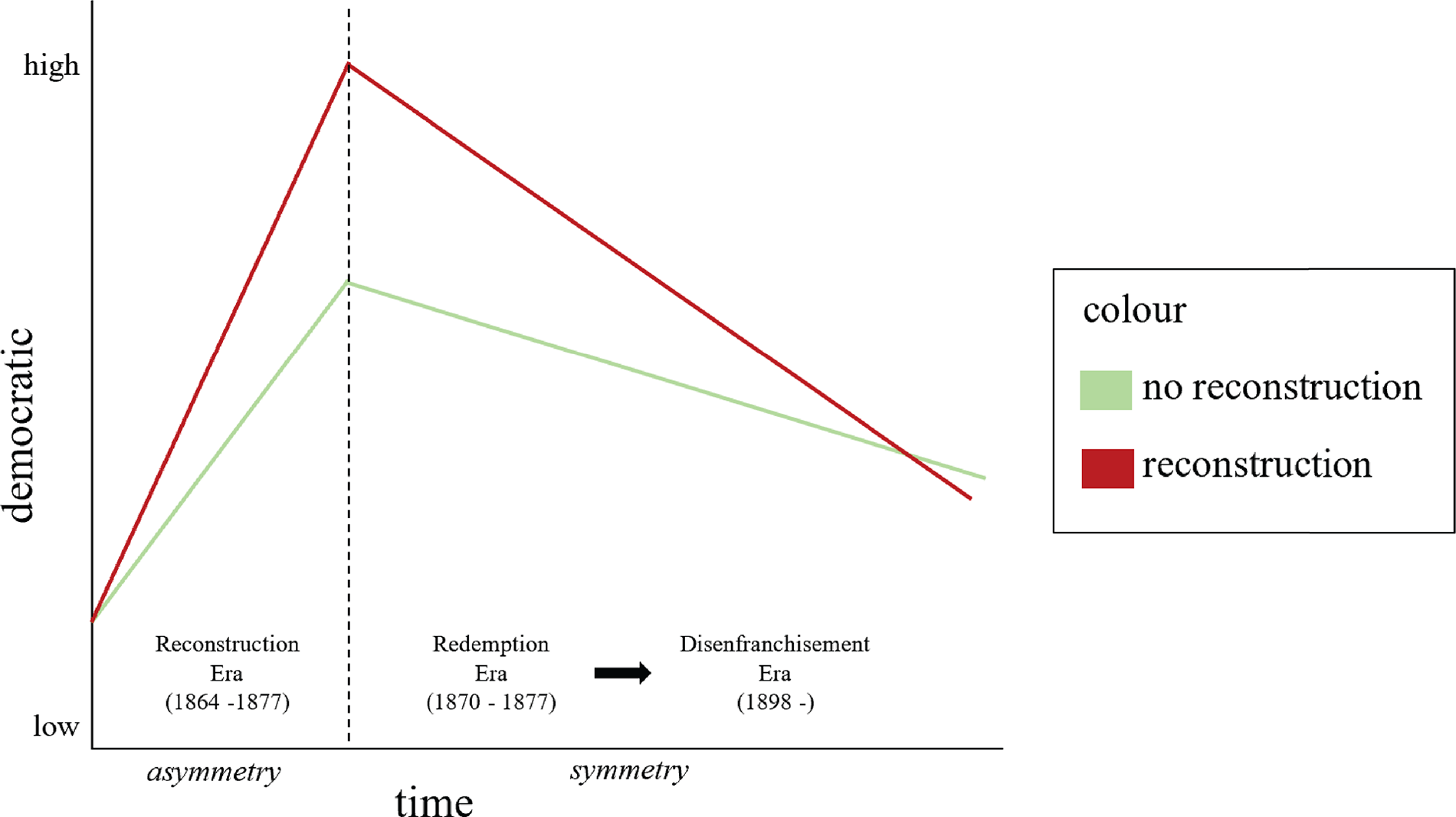
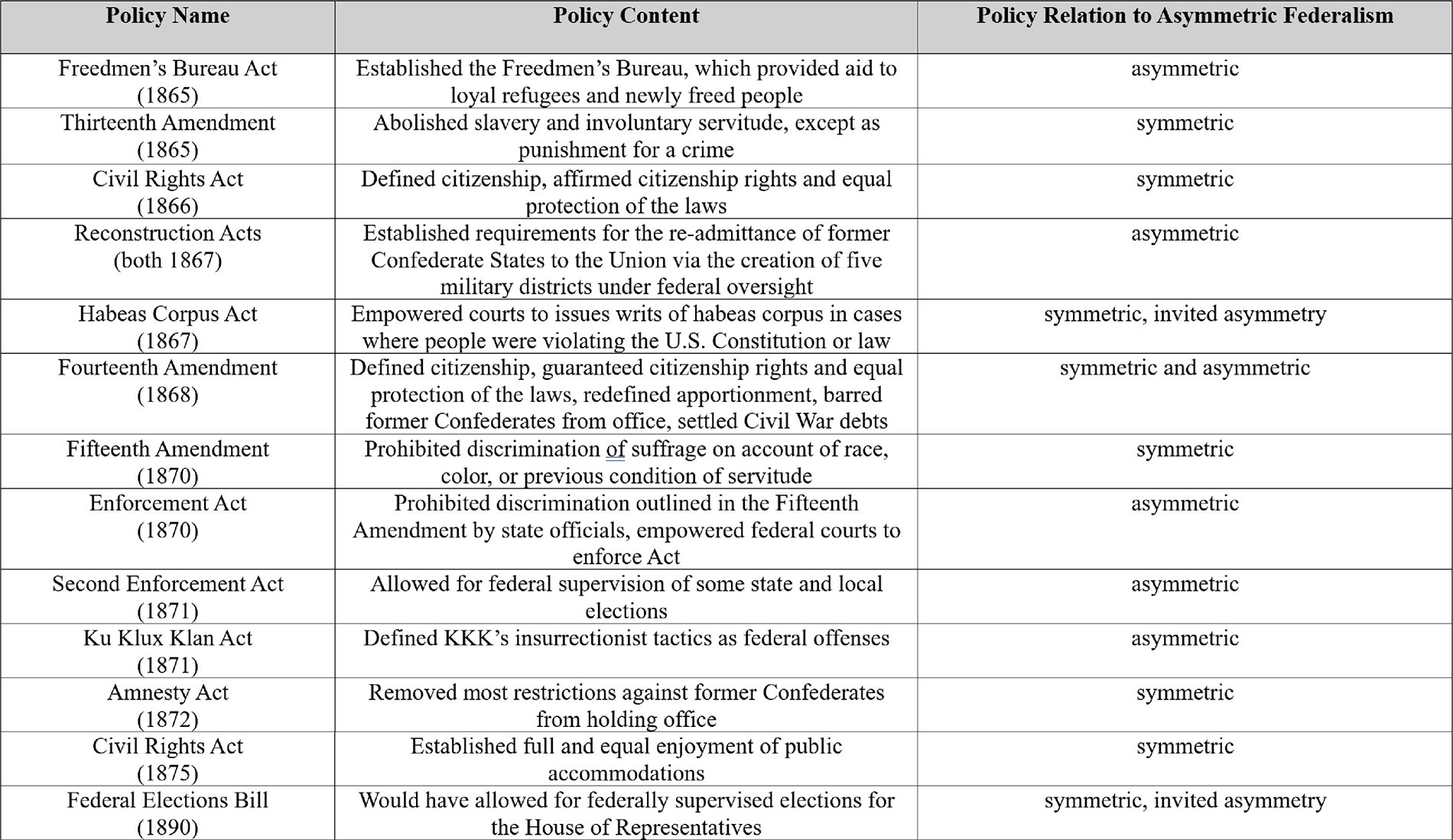
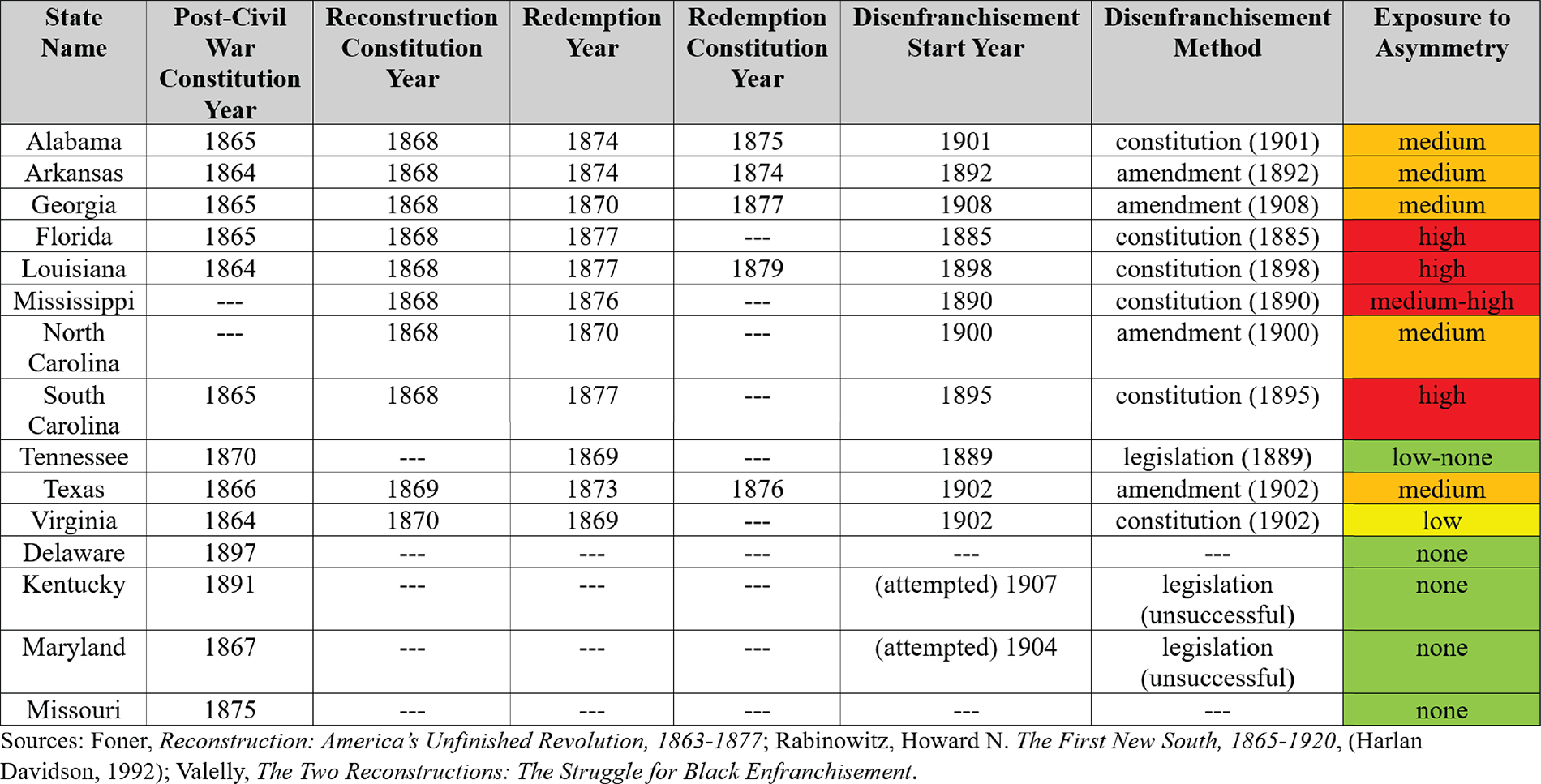
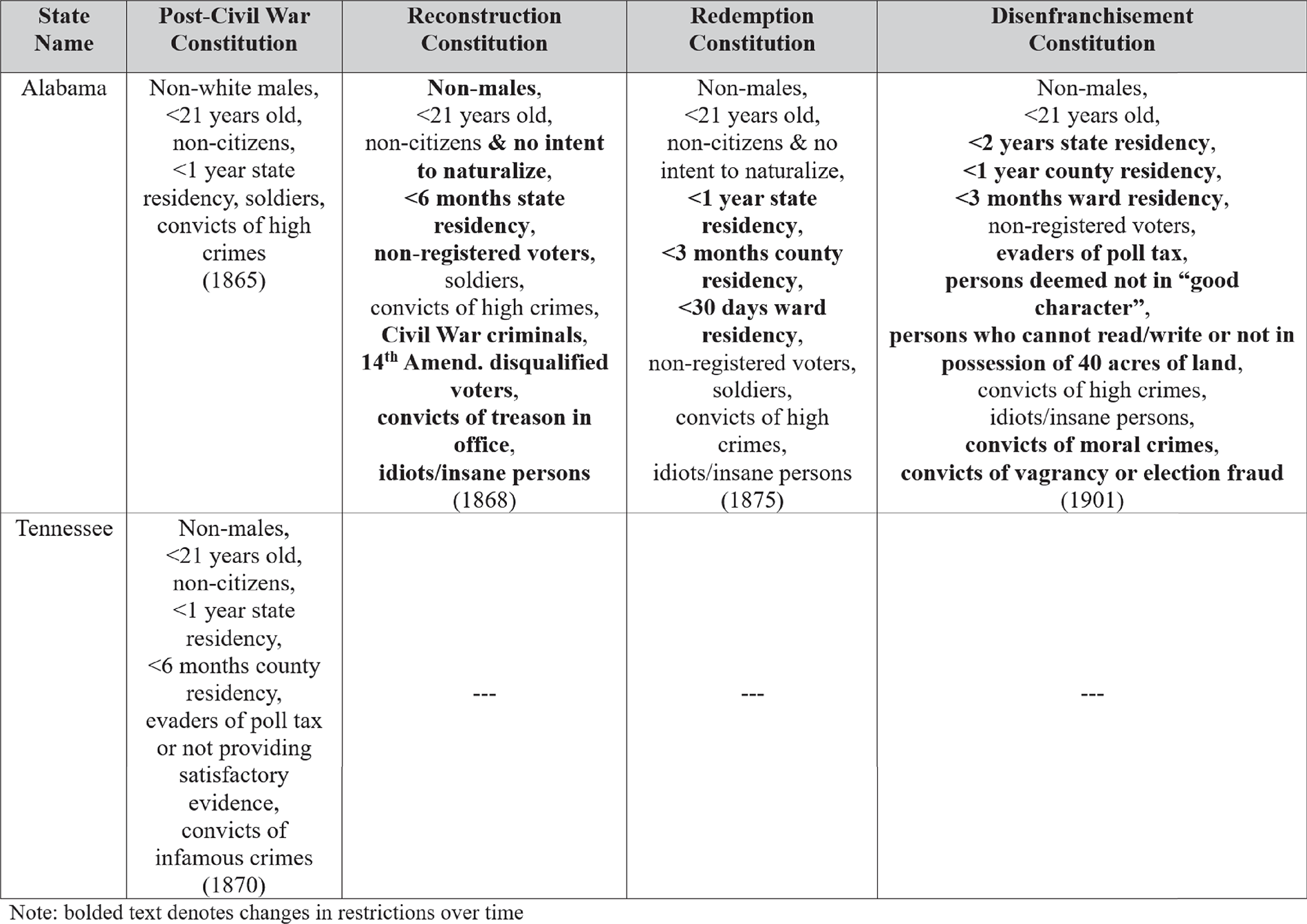
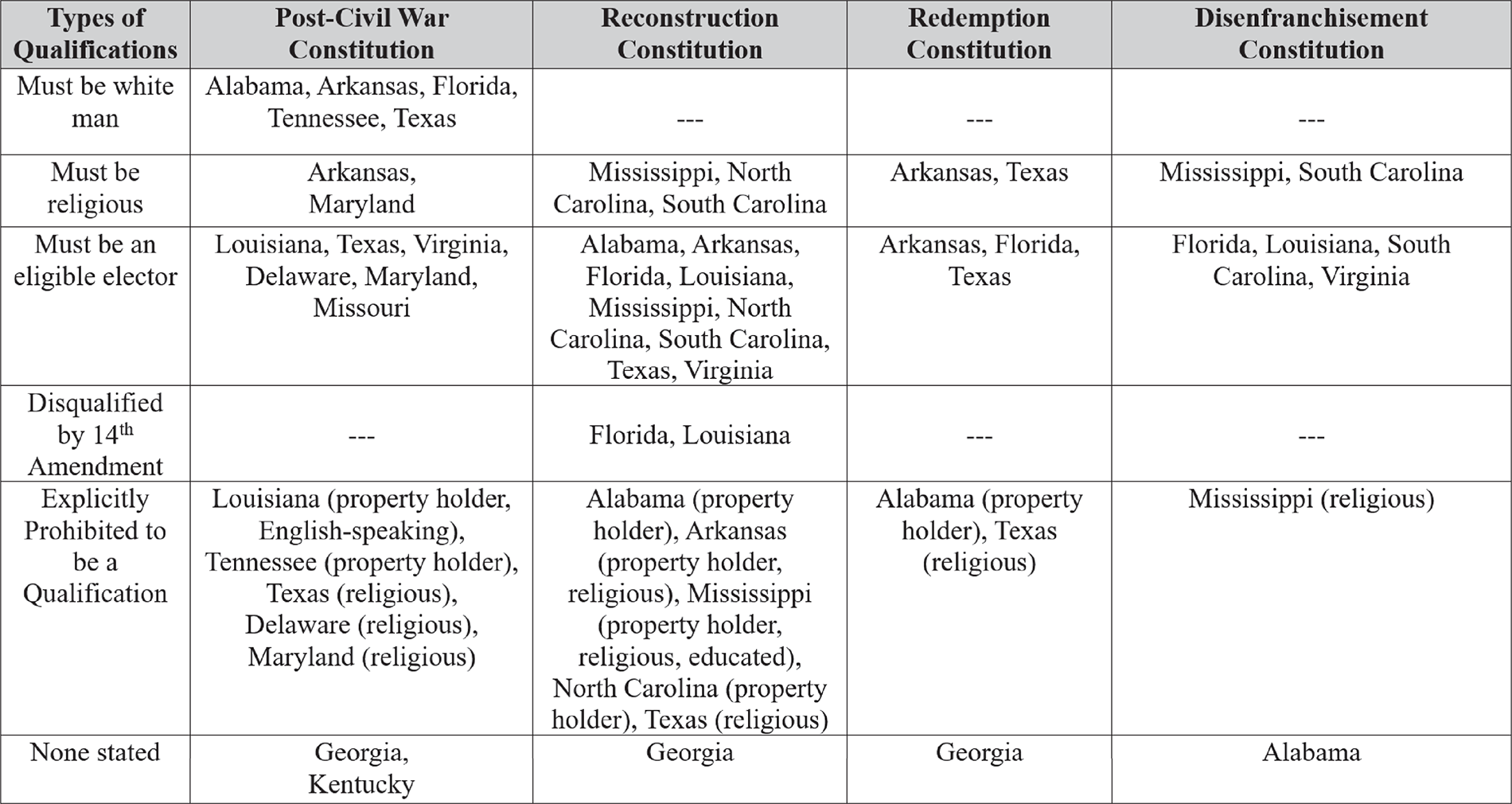
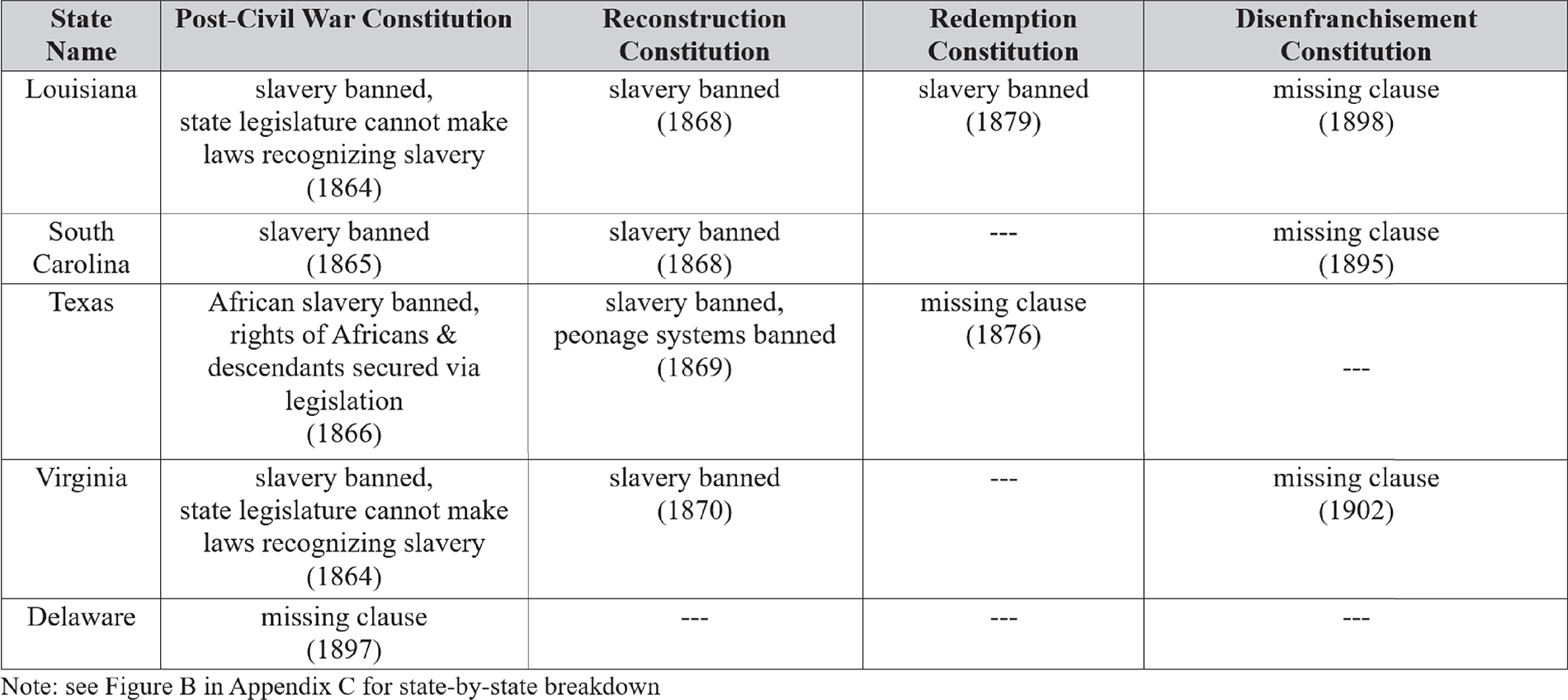
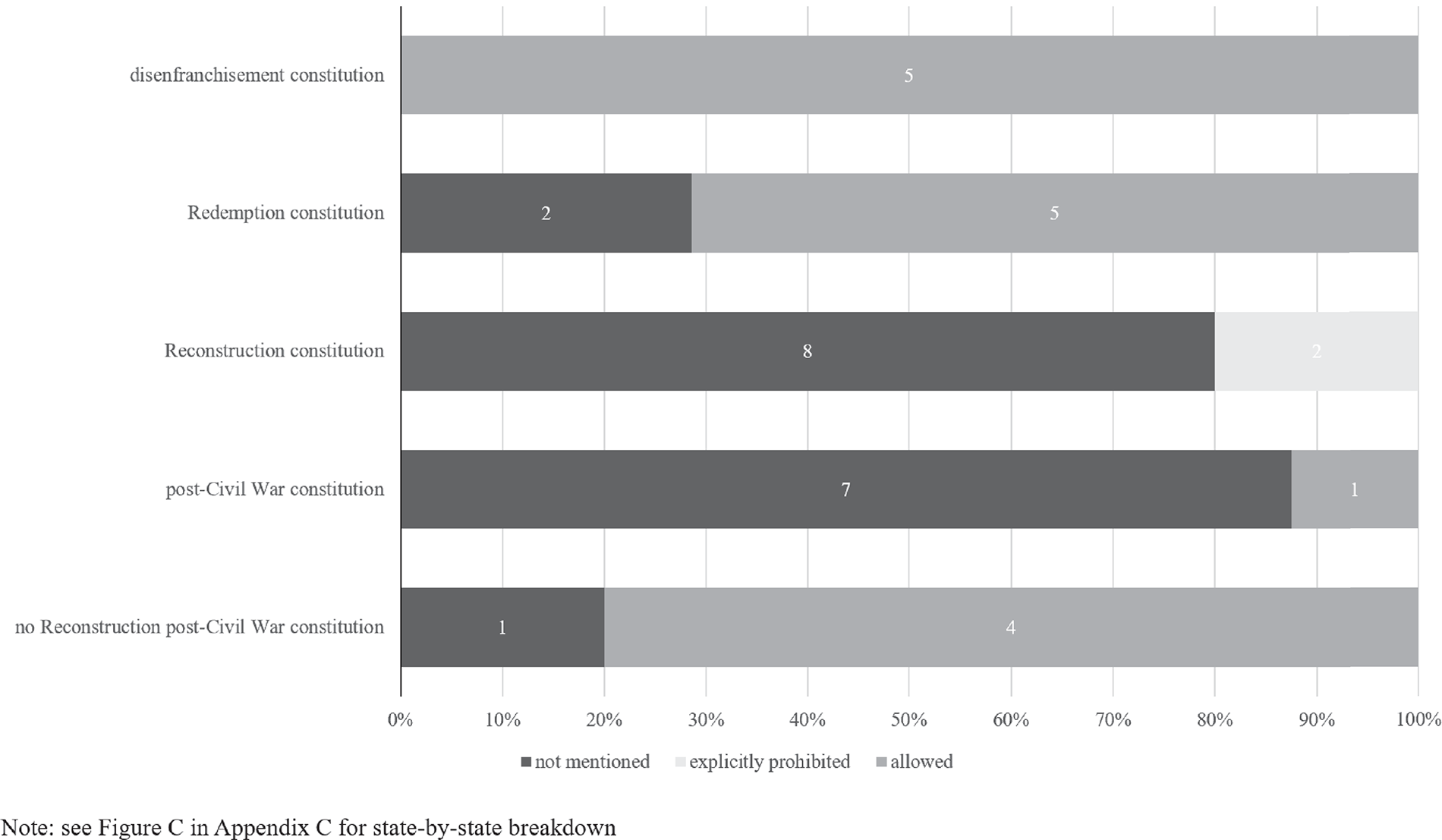
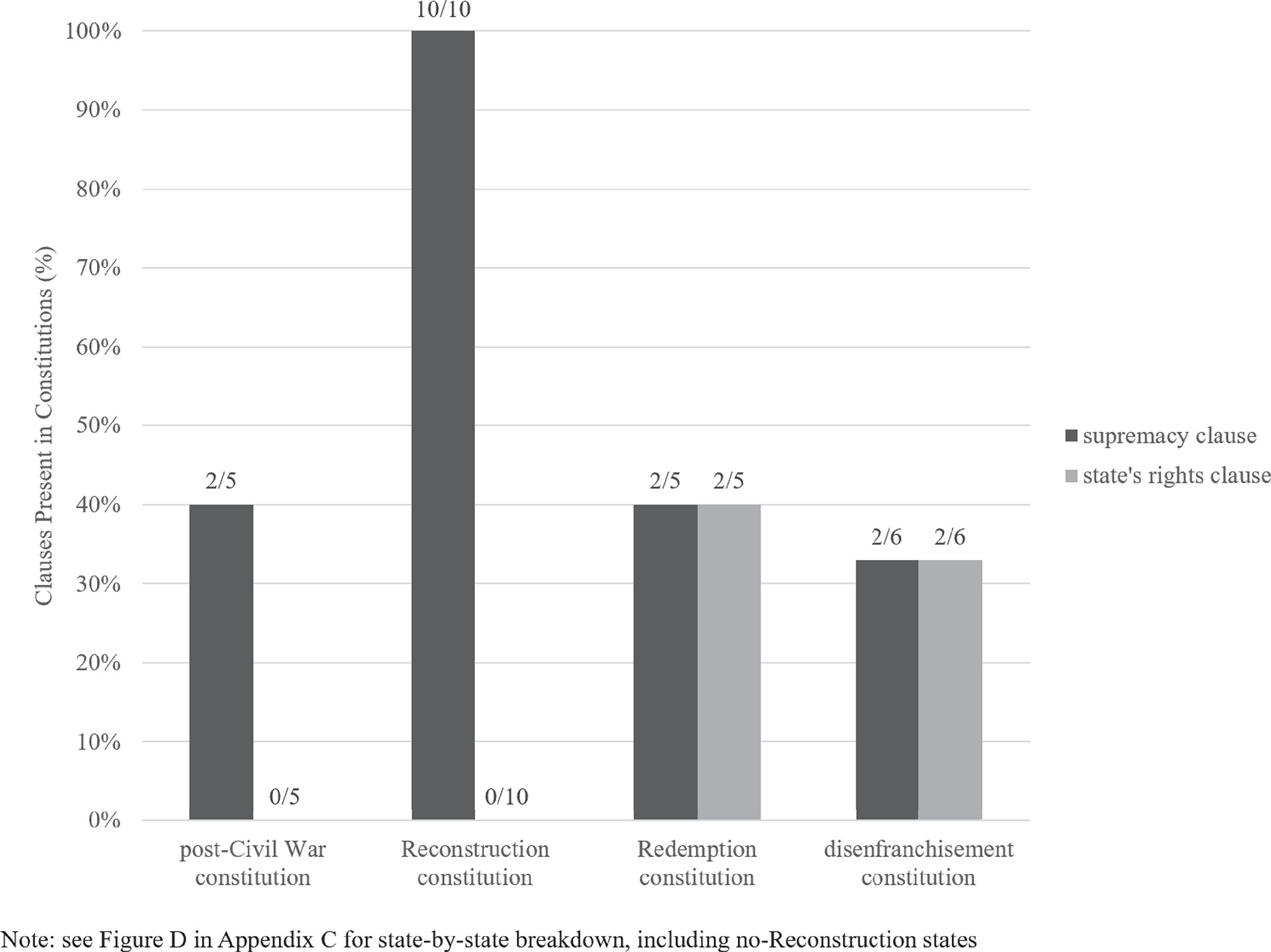
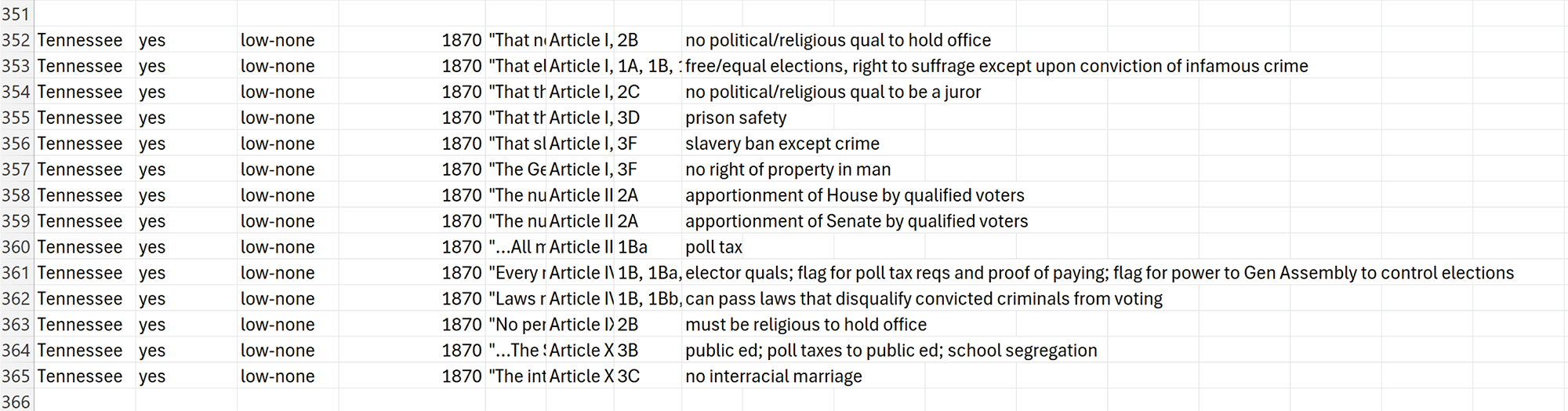
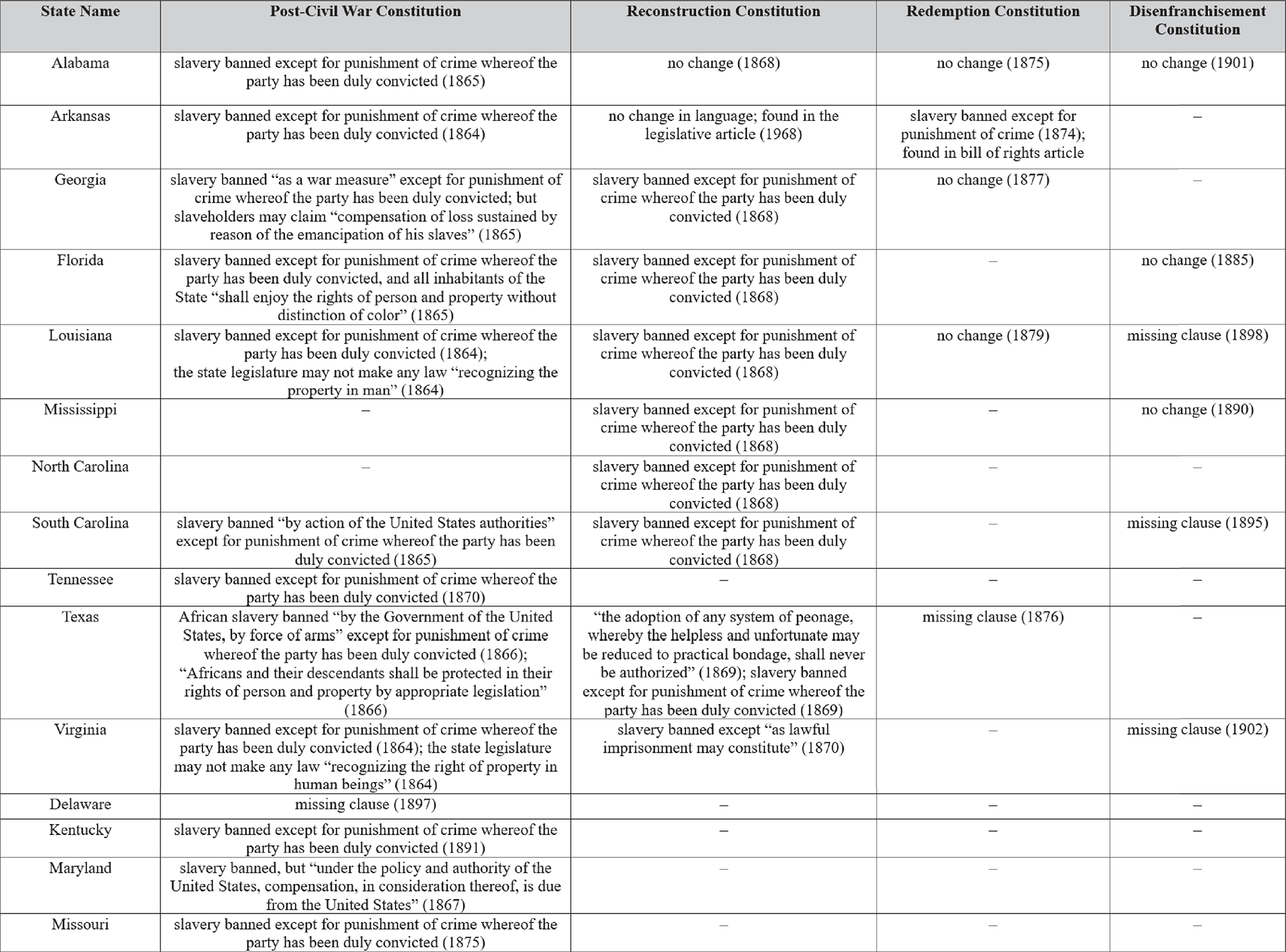
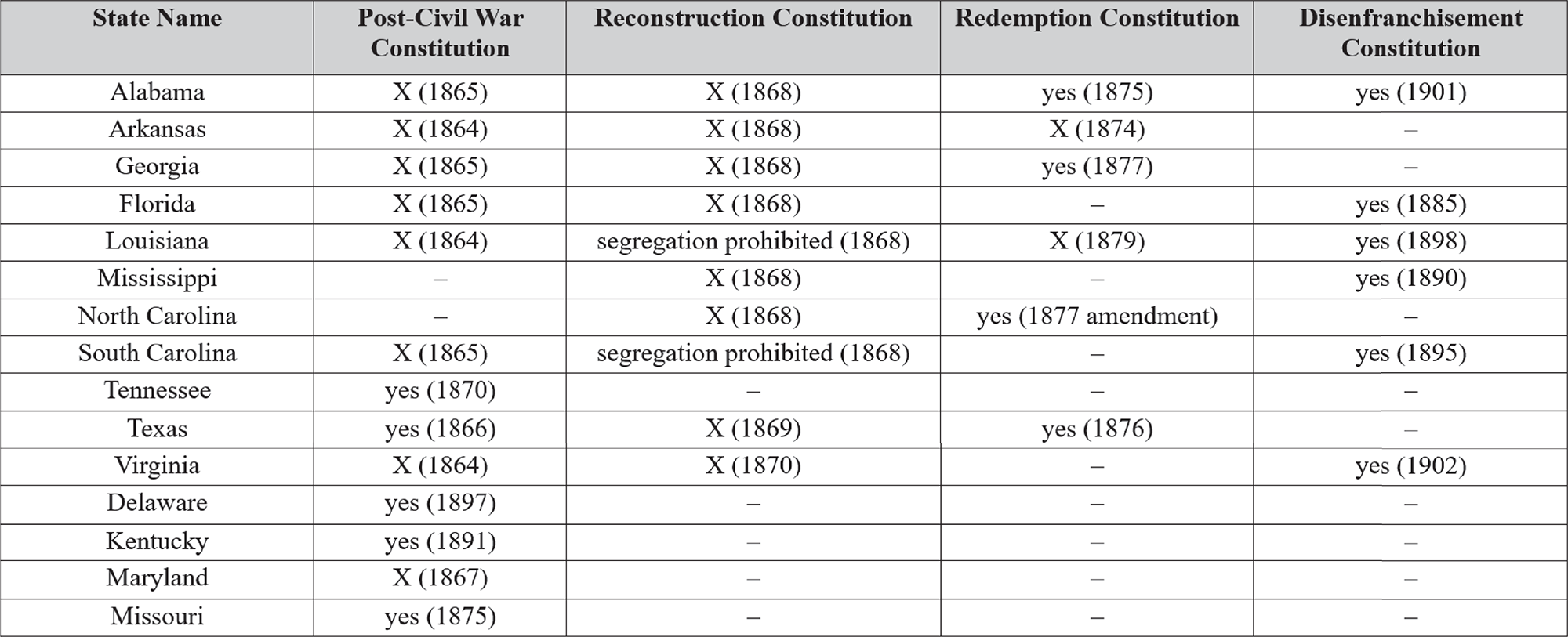
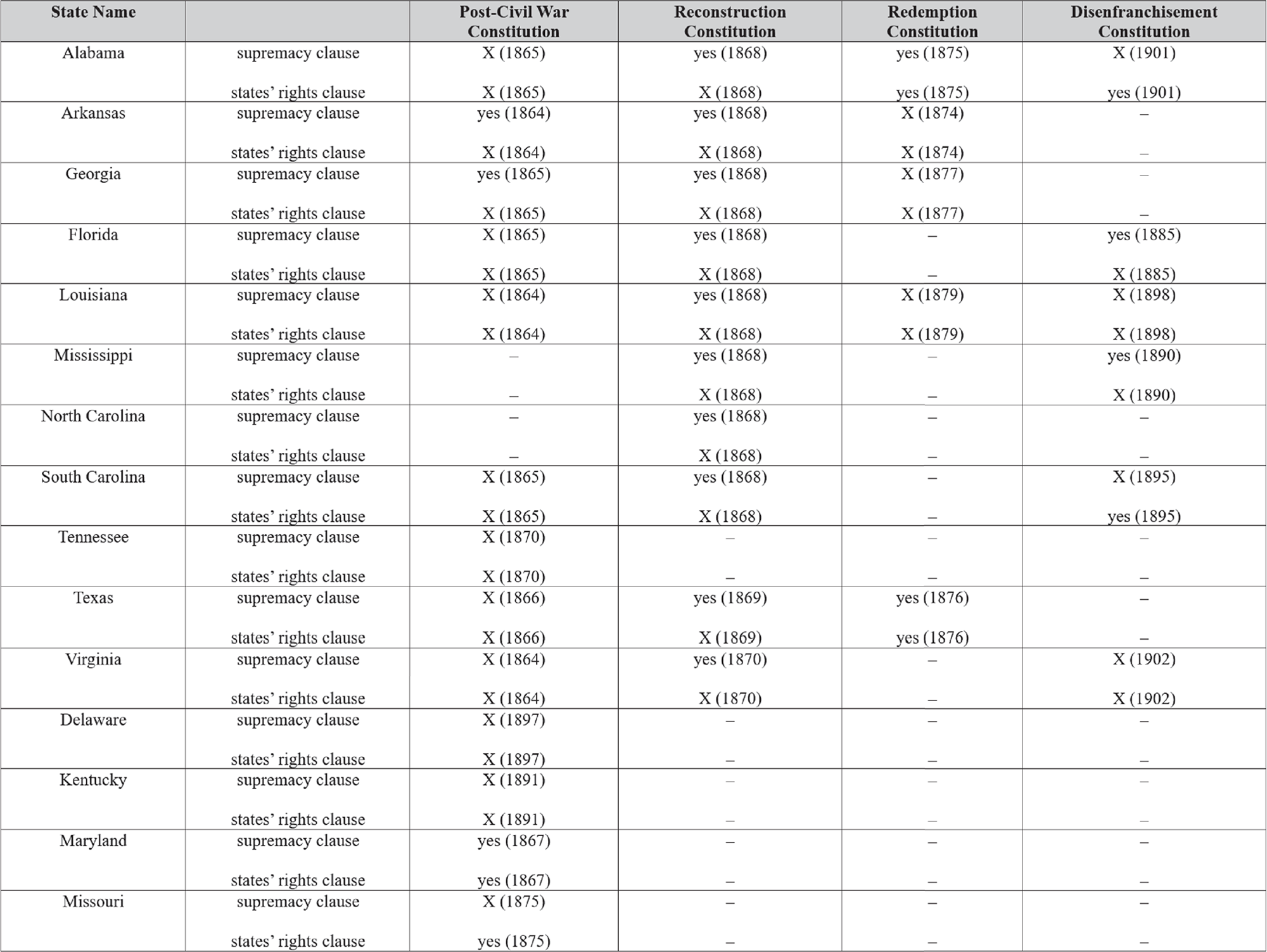

 Open access

