



1. Introduction
Massive stars ( $M \gt 8\,M_\odot$) dominate the feedback processes in galaxies, contributing to chemical enrichment, ionizing radiation, and mechanical energy injection. Their short lifetimes and violent deaths as supernovae or gamma-ray bursts make them critical for understanding cosmic evolution. However, their evolution is far from simple: binarity, rotation, and magnetic fields introduce complex interactions that alter lifetimes, nucleosynthesis, and end states. Historically, multiplicity studies relied on photometry and spectroscopy, which are sensitive to short-period systems but blind to wider binaries. Adaptive optics and speckle interferometry have extended the reach to separations of several 100 au. Yet in the early 2000s, a gap remained for intermediate separations of a few astronomical units (Mason et al. Reference Mason, Gies and Hartkopf1998). Long-baseline, near-infrared and optical interferometry now bridges this gap, providing milli-arcsecond resolution and revealing itself as a discovery machine for new binaries and multiple systems (Sana et al. Reference Sana, Le Bouquin and Lacour2014; Lanthermann et al. Reference Lanthermann, Le Bouquin and Sana2023; Frost et al. Reference Frost, Sana and Mahy2024).
The probability of most techniques to successfully detect a binary system depends on temporal or spatial coverage, sensitivity to various flux or mass ratios, and/or the orbital phase and orbital configuration of the binary system itself. In the broad parameter space covered by binary systems (Sana and Vrancken Reference Sana and Vrancken2026), interferometry complements spectroscopy and photometry: spectroscopy excels at short periods ( $\lesssim 1~$year), interferometry probes intermediate regimes (
 $10^2$ days-
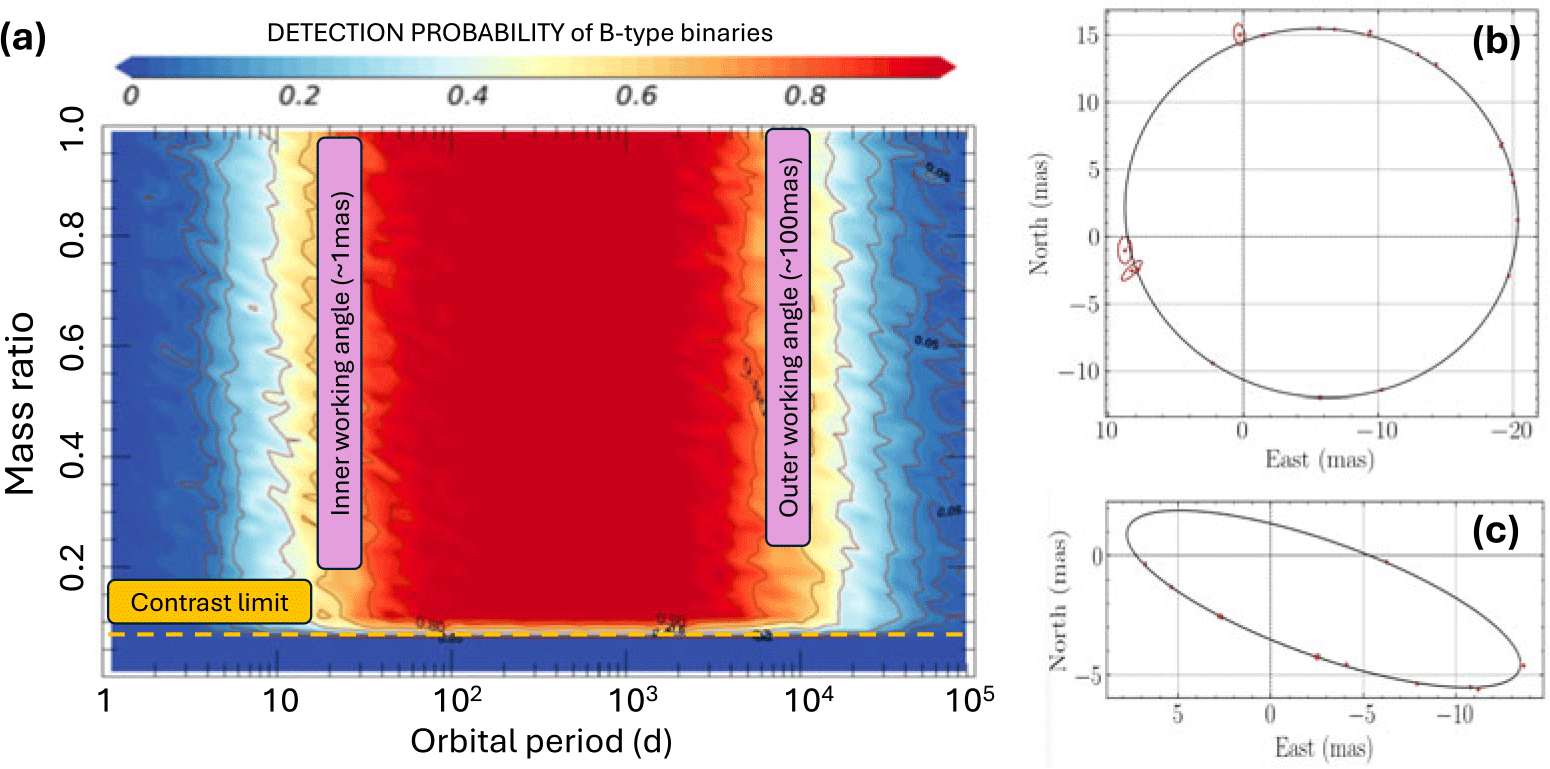
 $10^3$ years) and adoptive-optics and other high-angular imaging techniques cover the widest separations (Sana and Evans Reference Sana and Evans2011). This synergy is essential for mapping the full multiplicity parameter space. The large degree of homogeneity of interferometric surveys within the sensitivity range of the instrument is particularly noteworthy in the context of the present focus on interferometry (Fig. 1a).
(a) Binary detection probability of an interferometric campaign towards galactic early B-type stars (average distance 0.5 kpc); adapted from Frost et al. (Reference Frost, Sana and Le Bouquin2025). (b) and (c) Relative astrometric orbits of  $\delta$ Cir and MY Ser (adapted from Sana+, in prep.)

2. Multiplicity of Massive Stars
Ten years ago, the SMaSH+ survey increased the number of resolved companions from 64 to 260, confirming that the average O star hosts  $ N_\mathrm{comp} = 2.2 \pm 0.3 $ companions (Sana et al. Reference Sana, Le Bouquin and Lacour2014). Recent efforts have transformed the observational measurements, in physical units, confirming an almost uniform mass-function in the interferometric range, but a lack of (similar)mass companions beyond about 500 to 1000 au (Tramper et al. Reference Tramper, Sana, de Koter and Pauwels2026). A recent study of early-B stars revealed a fraction of multiple systems of
 $96 \pm 4\%$ and a companion frequency of
 $2.4 \pm 0.3$, questioning whether the accepted drop of multiplicity with lower stellar mass already starts occurring in the early B-star regime (Offner et al. Reference Offner, Moe and Kratter2023).
3. Compact Massive Triples
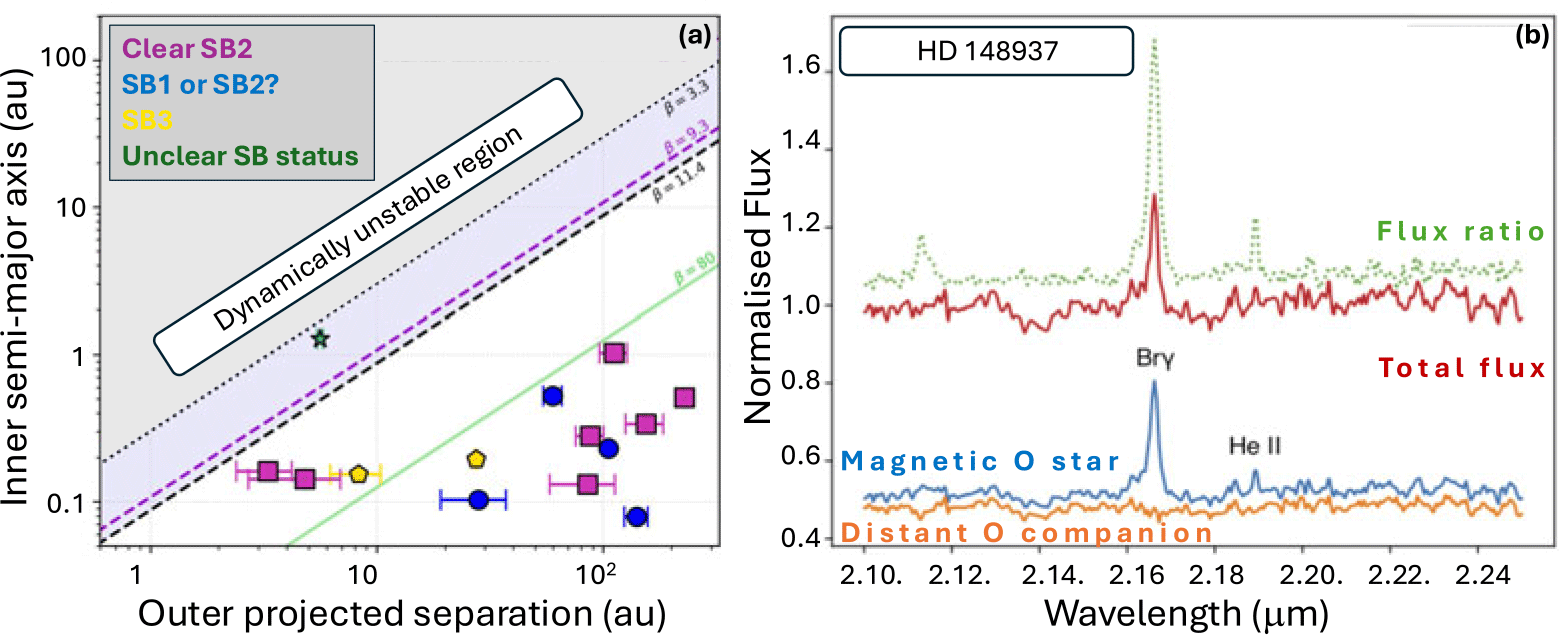
Within the 106 stars observed in the main sample of SMASH+, 51 have a resolved, interferometric companion. 21 of these also have an unresolved, closer companion, making them hierarchical triple systems. Triples architectures influence mass transfer and merger rates, shaping populations of compact objects and gravitational-wave sources. Bordier et al. (Reference Bordier, Sana and Frost2026) has showed that the triples are very hierarchical, with an outer to inner semi-major axis ratio in the range of 20-80, i.e. well beyond classical stability criteria (Fig. 2a). This pile up at short period may results from dynamical processing through Kozai-Lidov cycle. Of interest, no additional correlation between separation, masses and mass ratio were found. While this may result from the small sample size, the sample is large enough for any strong correlation to be detectable.
(a) Inner vs. outer (projected) separation diagram of triple systems in the SMaSH+ sample. (b) Resolved K-band VLTI/GRAVITY spectra of the magnetic binary system HD 148937. Panels (a) and (b) are adapted from Bordier et al. (Reference Bordier, Sana and Frost2026) and Frost et al. (Reference Frost, Sana and Mahy2024).

Long-term follow up is producing the first orbits of the outer companions (Figs. 1b and c). Direct measurements of the mutual inclination  $i_\mathrm{mut}$ between the orbital planes of the inner and outer orbit is given by
 \begin{equation}\cos i_\mathrm{mut}= \cos i_\mathrm{in} \cos i_\mathrm{out} + \sin i_\mathrm{in} \sin i_\mathrm{out} \cos(\Omega_\mathrm{in}-\Omega_\mathrm{out})\end{equation}
Unfortunately, the longitude of the ascending node  $\Omega_\mathrm{in}$ remains inaccessible without resolving the inner orbit. Given the high compactness of the inner orbits (
 $P_\mathrm{in} \lt30$ days), this will require the next generation of interferometric facilities with km-baselines. Despite the incomplete set of constraints, strong constraints on
 $|i_\mathrm{out}-i_\mathrm{in}|\lt1^o$ for
 $\delta$ Cir leaves this systems as a candidate coplanar system, while coplanarity is excluded for MY Ser given
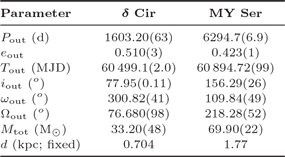
 $|i_\mathrm{out}-i_\mathrm{in}|= 82.4\pm0.3^o$. Table 1 provides the interferometric orbital solution of both systems, and illustrates the extreme precision on total masses that relative astrometry provides.
Astrometric orbital solution of the outer companion of the  $\delta$ Cir and MY Ser triple systems.

Table 1 Long description
A table comparing astrometric orbital parameters of two triple systems, δ Cir and MY Ser. The table has 8 rows and 10 columns. Column headers are Parameter, δ Cir, and MY Ser. Row labels include P_out (d), e_out, T_out (MJD), i_out (°), Ω_out (°), M_tot (M_⊙), and d (kpc/fixed). Row 1: P_out (d), 1603.20(63), 6294.7(6.9). Row 2: e_out, 0.510(2), 0.423(1). Row 3: T_out (MJD), 60499.1(2.0), 60894.72(99). Row 4: i_out (°), 77.95(11), 1562.9(26). Row 5: Ω_out (°), 300.82(41), 109.8(4.9). Row 6: Ω_out (°), 76.680(98), 218.28(52). Row 7: M_tot (M_⊙), 33.20(48), 69.90(22). Row 8: d (kpc/fixed), 0.704, 1.77.
4. Magnetism and Binary Interaction
Magnetic fields add another layer of complexity. About 7% of massive stars exhibit strong ( $\gt1$ kG) fossil magnetic fields (Fossati et al. Reference Fossati, Castro and Scholler2015; Wade et al. Reference Wade, Neiner and Alecian2016). These fields are stable, dipolar, and not generated by active dynamos, suggesting a primordial or merger origin. Simulations indicate that merger products rotate slowly and may evolve into magnetars (Schneider et al. Reference Schneider, Ohlmann and Podsiadlowski2019). Observationally, magnetic stars are rarely found in close binaries, supporting the hypothesis that mergers create magnetic fields. Case studies illustrate this link: HD 148937 is a magnetic O+O binary with a long-period (
 $P \sim 26$ yr) and a bipolar nebula (Frost et al. Reference Frost, Sana and Mahy2024). Interferometry with VLTI/PIONIER and GRAVITY played a crucial role in identifying the magnetic star in the pair (Fig. 2b), and in obtaining strong constraints on the total mass (
 $e\approx0.78$,
 $M_\mathrm{ tot}=56.5 \pm 0.8$ M
 $_\odot$). Combined with the semi-amplitude of the non-magnetic massive star, total mass constraints can be converted in individual dynamical mass measurements. Together with spectral analysis, the physical characterization of the system components reveal a significant age discrepancy, where the magnetic merger product has been rejuvenated compared to its outer companion.
HD 45166 is recently identified as a helium-rich star with a strong magnetic field, suggested to be a magnetar progenitor (Shenar et al. Reference Shenar, Wade and Marchant2023). Deshmukh et al. (Reference Deshmukh, Shenar and Mérand2025) used VLTI to resolved the system, providing assumption free mass-measurements, henceforth confirming the results of Shenar et al. (Reference Shenar, Wade and Marchant2023).
These two examples not only highlight the likely role of binarity in shaping magnetic phenomena and exotic remnants, but also the crucial constraints that have been obtained from interferometry. In this context, interferometry also played a key role in confirming the Be-star + bloated stripped star nature of the HR 6819 system proposed by Bodensteiner et al. (Reference Bodensteiner, Shenar and Mahy2020). Using VLTI, Frost et al. (Reference Frost, Bodensteiner and Rivinius2022) resolved the system for the first time while Klement et al. (Reference Klement, Rivinius and Baade2025) obtained the first 3D orbital solutions. The precision of the obtained masses ( $M_\mathrm {Be}=4.03 \pm0.34$ M
 $_\odot$,
 $M_\mathrm{stripped}=0.27 \pm0.06 $ M
 $_\odot$) and corresponding mass-ratio (
 $M_\mathrm{Be}/M_\mathrm{stripped}=15.6\pm3.0$) are challenging our ability to model this post-mass transfer system (Picco et al. Reference Picco, Marchant and Sana2026).
5. Wolf-Rayet stars
Wolf-Rayet stars are massive stars with strong, optically-thick winds which give rise to emission-line-dominated spectra and strongly influence the feedback and final fate of massive stars. (A subset of) Wolf-Rayet binary systems with a distant O star companion are expected to be the outcome of Case B Roche-Lobe overflow (Langer et al. Reference Langer, Schürmann and Stoll2020), and an immediate evolutionary stage before the formation of single-degenerate binaries with a BH companion. An interferometric survey of 39 WRs accessible with the VLTI/GRAVITY however failed to reveal a significant number of companions in that range (Deshmukh et al. Reference Deshmukh, Sana and Mérand2024).
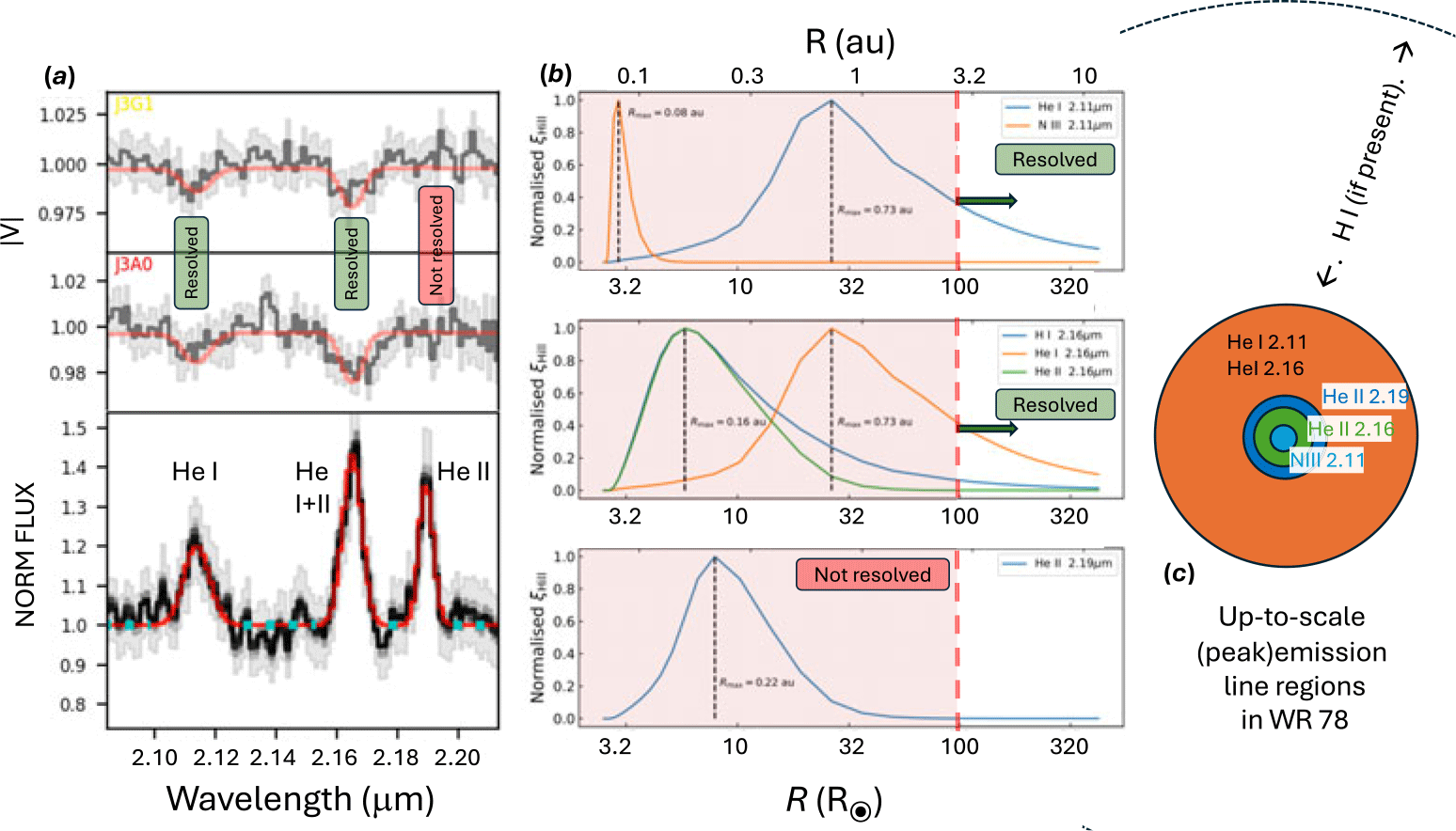
As a serendipitous results of VLTI/GRAVITY observation, Deshmukh et al. (Reference Deshmukh, Sana and Mérand2024) showed that current interferometric capabilities start to resolve wind emission regions of several Wolf-Rayet stars, constraining the outer edge of line formation zones of He I (resolved), and He II (unresolved) lines (see Fig. 3).
Resolving wind line emission regions in WR 78. (a) Interferometric observables of VLTI/Gravity observations. Bottom: normalized flux, revealing the presence of strong He I and He II lines. Top: closure phase spectra along two baselines, revealing a drop at the location of the He I 2.11-2.16 $\mu$m lines, but not at that of the He II 2.19
 $\mu$m line, suggesting that the latter is unresolved while the former are (at least partially) resolved. (b) Predicted line formation strengths of various lines (see legend) in the wind of the WR78, computed with the PoWR atmospheric model (Sander et al. Reference Sander, Shenar and Hainich2015; Gräfener et al. Reference Gräfener, Koesterke and Hamann2002; Hamann and Gräfener Reference Hamann and Gräfener2003). The approximate inner working angle limit of the Gravity observation is indicated by the vertical dashed line. (c) Up-to-scale sketch of the relative size of the peak emission radii of the different lines in panel (b). Panels (a) and (b) are adapted from Deshmukh et al. (Reference Deshmukh, Sana and Mérand2024).

6. Conclusions
The synergy of interferometry with other techniques enables full coverage of the parameter space relevant for massive binaries. These observations reveal that multiplicity is nearly universal, providing exquisite total mass constraints given enough orbital coverage. Similarly, interferometry has been providing unique constraints to identify the nature of binary products, such a merger or post-mass transfer objects. Interferometry was also crucial in confirming the link between (some) magnetic massive stars and a merger history. Looking to the future, kilometer-baseline arrays would bring another set of constraints, including critically resolving the inner binaries of triple systems and probing the winds of massive stars to an unprecedented level of accuracy.
Acknowledgments
The research leading to these results has received funding from the European Research Council (ERC) (grant agreement numbers 772225: MULTIPLES) and from the Flemish Government under the long-term structural Methusalem funding program, project SOUL: Stellar evolution in full glory, grant METH/24/012 at KU Leuven.
 δ
 δ
 μ
 μ


