INTRODUCTION
Optimization models of feeding and predator avoidance behaviours predict that there are trade-offs necessary to maximize fitness, such that the stronger the motivation to feed, the more risky the animal's behaviour (Krebs & Davies, Reference Krebs and Davies1993). Rocky intertidal hermit crabs make an ideal model animal for motivational studies (Elwood, Reference Elwood1995) because of their need to acquire both food and shell resources. In nature, shells are often limiting, so that most hermit crabs occupy suboptimal shells (Elwood & Neil, Reference Elwood and Neil1992; Halpern, Reference Halpern2004) and will readily investigate and switch to new shells when encountered (Abrams, Reference Abrams1987). Most hermit crab species are omnivorous detritivores that occasionally feed on macroscopic animal and plant material (Hazlett, Reference Hazlett1981). Windfall food opportunities in rocky intertidal zones, such as a recently killed gastropods or fish, occur only occasionally but will readily draw hermit crabs to the site (Rittschof, Reference Rittschof1982; Elwood & Neil, Reference Elwood and Neil1992; Hazlett et al., Reference Hazlett, Rittschof and Bach1996).
Hermit crabs have been used in a variety of experiments to elucidate the role of motivation on behaviour. Elwood (Reference Elwood1995) found that the motivational state can be identified by the length of time hermit crabs spend examining a prospective shell and duration of the startle or immobilization response, following cues of predator presence. Other studies have shown that hermit crabs in suboptimal shells showed higher motivation to acquire shells than crabs in preferred shells (Reese, Reference Reese1963; Gherardi & Atema, Reference Gherardi and Atema2005). The readiness to initiate a shell-fight with another hermit crab and the decision to continue fighting are also measures of motivation to acquire a better shell (Elwood et al., Reference Elwood, Wood, Gallagher and Dick1998; Gherardi, Reference Gherardi2006). In addition, the length of time a crab tries to access a shell with a blocked aperture can indicate the motivation to exchange shells (Elwood, Reference Elwood1995). Both the need for a shell and the need for food can be motivations that alter hermit crab behaviour.
Although external cues of resource availability may be perceived equally by conspecifics, the internal state, or motivation, of the receiver can cause individuals to respond quite differently to the same information (Hazlett, Reference Hazlett1996). For instance, Clibanarius vittatus responded with one of three distinct behaviours when presented with cues of shell availability (Katz & Rittschof, Reference Katz and Rittschof1993). Internal factors affect the motivational state of an animal and the motivational state determines the strength (intensity and completeness) with which a behaviour is carried out (Tinbergen, Reference Tinbergen1951; Reese, Reference Reese1963). Tinbergen (Reference Tinbergen1951) suggested three methods of measuring motivation: (1) changes in the intensity or frequency of responses to a constant condition; (2) the minimum intensity of a stimulus necessary to initiate a response; or (3) the minimum intensity of a stimulus required to inhibit a reaction.
While it has been demonstrated that hermit crab motivational level can be measured through persistence in shell or food acquisition behaviours, the interaction between two motivations (the need for food and shells) is not well understood. Some research has been done with hunger and shell inadequacy interactions (Hazlett, Reference Hazlett1996, Reference Hazlett1997; Rittschof & Hazlett, Reference Rittschof and Hazlett1997), but to our knowledge no studies have addressed the issue of hunger and shell-lessness conjointly. The purpose of this research is to determine if hermit crab motivation, based on current physical need, initiates a specific behaviour pattern at the expense of another, and if one motivation can override another. Our experiment utilized the first of Tinbergen's three methods; measuring changes in hermit crab responses to the simultaneous presentation of two resources. We tested the hypothesis that hermit crabs deprived of food, shells, or both will respond differently from control hermit crabs when presented with food and shells concurrently. This was measured by time to first contact with the resource, number of contacts, time to initiate behaviour and final behavioural choice.
MATERIALS AND METHODS
Animal collection and maintenance
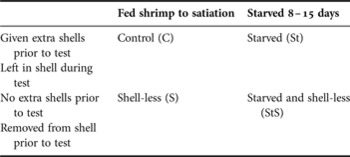
Individuals of the hermit crab, Pagurus samuelis (Stimpson), were collected from Little Corona del Mar, Newport Beach, California (33°35.36′N 117°52.09′W) in November 2007 and maintained in the laboratory at 23–24°C with ambient light. They were divided into four groups of forty animals (N = 160). In the control group (C), crabs were provided with extra shells in the holding aquarium and fed commercial salad shrimp to satiation prior to testing. Control crabs were left in their shells during testing. In the shell-less group (S), crabs were fed shrimp to satiation, but were removed from their shells prior to testing. In the starved group (St), crabs were starved for 8–15 days because tests began on day 8 post-feeding and were spread over a 7 day period. Group St was also provided with extra shells to choose from prior to testing. In the combination starved and shell-less group (StS), crabs were starved for 8–15 days and removed from their shells prior to testing. Individuals were tested only once.
Test protocol
Each hermit crab was measured for shell aperture width and length, and wet weight including shell. After removal from the shell, either prior to, or immediately after testing (see Table 1), we also measured crab body weight and shield length. A stepwise multiple regression revealed that hermit crab weight is the best predictor of aperture width (R2 = 0.751, F1,150 = 458.39, P < 0.001; aperture width = 0.22+0.18 × body weight). In agreement with Vance (Reference Vance1972) we used body weight as a predictor of aperture width when selecting appropriate shells to offer hermit crabs.
Description of the factorial treatment arrangements used to test hermit crab motivation to acquire shell and food resources.

The experimental arena was a 21.5 cm diameter Plexiglas cylinder covered in white Mylar to make it opaque. All hermit crab movements were observed through a video monitor attached to a Nightview digital night vision camera with infrared illuminator (Weaver Optics, Meade Instruments Corporation, California). The only light source during sessions was a Philips brand 40 Watt ‘Natural Light’ bulb suspended 30 cm above the test arena. A dim light was used near the video monitor so notes could be written, while a black curtain surrounded the arena to obscure any researcher movements from test hermit crabs. Between each test, the arena was rinsed with soapy water to ensure that no traces of chemical cues remained in the arena for subsequent test sessions.
During test sessions, 500 ml of seawater was added to the arena and both an appropriately sized Tegula funebralis (A. Adams, 1855) shell (within 1.25 mm of the hermit crab's preferred shell aperture width) and a piece of shrimp tissue (0.20±0.01 g) were placed equidistant apart from the starting position of the hermit crab and 1 cm from the arena wall. Shell and shrimp positions were alternated between tests. In the S and StS treatments, hermit crabs were gently removed from their shells using a table vice. Each hermit crab was placed under a plastic box (2 × 2 × 1.5 cm) until the test began and the box gently lifted by a pulley. When the box was lifted, we measured the time to first contact with the objects, as well as the total time elapsed before either insertion into the shell or initiation of feeding. During each test session we recorded the following measurements: (1) first object touched; (2) time to first contact with both shells and food; (3) number of contacts with each object; and (4) which behaviour was exhibited (feeding or inserting into shell). Sessions ended when crabs decided to feed or insert into shells. If a hermit crab took the maximum time of 15 minutes without choosing to feed or insert, it was scored as ‘neither’ behaviour.
Statistics
All statistical analyses were run using the Statistical Package for the Social Sciences (SPSS) versions 12.0 and 13.0. Pearson's Chi-square tests were used to compare differences between treatment groups in the first object touched (food or shell) and the behaviour exhibited (feed, insert, or neither). To compare the time to first contact, number of contacts, and decision time, 2 × 4 ANOVAs were used, with object (food or shell) treated as a within-subjects factor, and condition treated as a between-subjects factor with four levels (C, S, St, and StS). Scheffé's post-hoc tests were conducted to determine if any treatments were significantly different from each other.
RESULTS
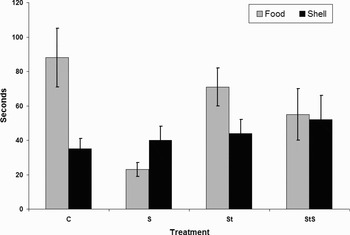
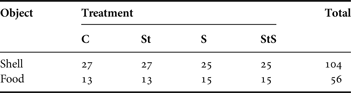
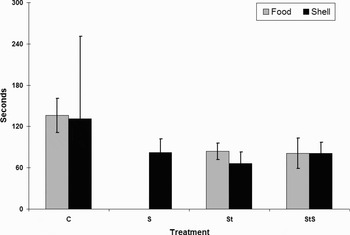
There was no difference among treatments in the first object touched by each hermit crab (χ2 = 0.44, df = 3, P = 0.93; see Table 2). ANOVA results of mean time to initial contact with each object showed no significant main effect for object (F1,225 = 2.80, P = 0.10) or treatment (F3,225 = 1.86, P = 0.14; see Figure 1).
The mean time to initial contact with object (food or shell) based on treatment. C, control; S, shell-less; St, starved; StS, shell-less and starved. Data represented as means±1 SE.

The number of hermit crabs that first made contact with either food or shells based on treatment, P > 0.05.
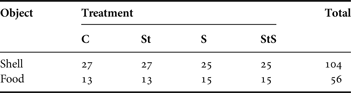
C, control; St, starved; S, shell-less; StS, starved and shell-less.
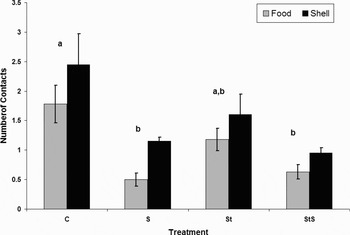
A two-way ANOVA was conducted to investigate differences in the number of contacts made by hermit crabs with shells or food. Three hermit crabs in the C group and one hermit crab in the St group, had contact values that were extreme outliers and were therefore excluded from the analysis. Results of the ANOVA showed that the number of contacts with objects were significantly different among treatments (F3,304 = 9.71, P < 0.001, partial η2 = 0.09). Interactions between factors were not significant (F3,304 = 0.64, P = 0.59). A Scheffé's post-hoc test revealed that group C made significantly more contacts with objects than group S (P < 0.001) and group StS (P < 0.001); see Figure 2. In addition, group St was not significantly different from groups S (P = 0.16) or StS (P = 0.09). The ANOVA results also showed significantly more contacts with shells than with food (F3,304 = 16.01, P < 0.001, partial η2 = 0.05).
The mean number of contacts with objects (food or shell) based on treatment. C, control; S, shell-less; St, starved; StS, shell-less and starved. Data represented as means±1 SE. Significant differences (P < 0.001) between treatments are indicated by the letters a and b.

Two-way ANOVA results of mean time to initiate the chosen behaviour showed no significant main effects for objects (F1,142 = 0.003, P = 0.95) or treatment (F3,142 = 0.41, P = 0.74); see Figure 3.
The mean time to initiate behaviour based on object (food or shell) and treatment. C, control; S, shell-less; St, starved; StS, shell-less and starved. Data represented as means±1 SE.

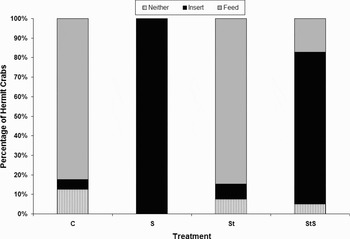
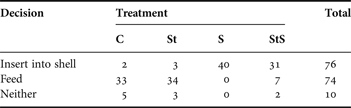
Treatment significantly affected the final behaviour exhibited by hermit crabs (χ2 = 114.67, df = 6, P < 0.001). Hermit crabs in the C and St groups chose to feed while crabs in the S and StS groups chose to insert into shells (see Table 3 and Figure 4). All group S crabs chose to insert into shells and none chose to feed. In group C, 5.0% chose to switch shells (i.e. insert into new shells) and in group St, 8.0% chose to switch shells (see Figure 4). In the StS group, while 77.5% chose to insert into shells, 17.5% chose to feed even without a shell. Overall, 10 of 160 hermit crabs neither fed nor inserted into a shell during the 15 minute sessions.
Proportion of hermit crabs exhibiting behaviours based on treatment during 15 minute test sessions. Treatment significantly affected final behaviour (P < 0.001). C, control; S, shell-less; St, starved; StS, shell-less and starved.

The number of hermit crabs that decided to insert into shells, feed, or take no action during 15 minute sessions based on treatment.
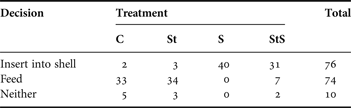
C, control; St, starved; S, shell-less; StS, starved and shell-less.
DISCUSSION
In hermit crabs, motivation by food or shell deprivation significantly affected which behaviour was exhibited. Hermit crabs removed from shells were more likely to insert into shells, while those remaining in their shells were more likely to feed.
Although shells were contacted first more often than food in all four treatments, the difference was not significant within each treatment. Reese (Reference Reese1963) found that shell-less P. samuelis was visually attracted to shells that contrasted in colour with the background. Chiussi et al. (Reference Chiussi, Diaz, Rittschof and Forward2001) found that shell-less hermit crabs were attracted to black shapes presented on the circumference of the test arena. Likewise, even though not significant, the trend was for hermit crabs in our study to be attracted to shells due, perhaps, to the colour contrast with the white background of the arena.
There was a significant difference among treatments in the number of times objects were contacted. Control hermit crabs made significantly more contacts with objects than did hermit crabs removed from their shells (S and StS). Having access to shells and food prior to testing likely lowered the motivation of control hermit crabs to feed or switch shells. Since they were not seeking a specific resource, group C crabs investigated each object with repeated contacts as they moved around the arena. In contrast, we suggest that groups S and StS made significantly fewer contacts because they had stronger motivation to acquire a resource at initial contact.
Hazlett (Reference Hazlett1996) found a correlation between hermit crab shell-fit deficit and shell grasping, with crabs in ill-fitting shells more likely to hang on to a shell. In our study, shell-less crabs made only one contact with the shell while shelled crabs made 1.6±0.35 (St) and 2.45±0.52 (C) contacts and did not hang on to the shell. Elwood (Reference Elwood1995) showed that if the disparity between a current shell and a newly encountered shell was great, crabs made a decision quickly to accept or reject the shell. Since shelled hermit crabs in our study had access to plenty of shells prior to testing, it is unlikely they were experiencing shell-fit deficit, and hence had little motivation to switch shells.
Even though starved hermit crabs (St and StS) had lower mean times to choose feeding than group C, the difference was not significant. In addition, mean time to insert into shells was not different between shell-less crabs that acquired a shell (100% of group S and 77.5% of group StS) and shelled crabs that switched shells (5.0% of group C and 8.0% of group St). Taken together with the differences among treatments in the number of contacts with objects, this implies that increased motivation to acquire food or shells does not necessarily enable hermit crabs to find resources faster, but rather to make the decision to acquire food or shells upon first contact. This conclusion is supported by evidence that hermit crabs in group S generally inserted into the shell upon first contact, but only half of the group made any contact with food. Individual variance in locomotion rates during testing likely masked any differences among treatments in time to initial contact or behaviour, if they exist.
For those treatments in which hermit crabs remained in their shells (C and St), most chose to feed and few switched shells. Hazlett (Reference Hazlett1996) observed behaviour of the hermit crab, Clibanarius vittatus, in an 18 cm circular arena in response to food odour at 1, 4, and 7 days post-feeding while occupying inadequate shells. He found hermit crabs responded to stimuli in an apparent order of importance, such that as motivation from hunger increased, motivation to switch shells decreased; implying that as hunger increases, finding food becomes a higher priority than finding an adequate shell for C. vittatus (Hazlett, Reference Hazlett1996).
Since control crabs (C) had access to both food and shells prior to testing, we expected group C to exhibit equal amounts of feeding and shell-switching behaviour. However, switching shells could be considered a ‘risky’ behaviour due to the increased possibility of predation or conspecific shell-fights (Elwood & Neil, Reference Elwood and Neil1992). Gherardi (Reference Gherardi2006) found that hermit crabs in low-quality shells are more motivated to fight and take risks than crabs in better-fitting shells. In the current study, group C may have chosen feeding over shell-switching because crabs were not motivated by deprivation to choose the high-risk behaviour.
Behaviour exhibited by hermit crabs in groups C and St was unaffected by whether they had been fed or starved, respectively, prior to testing. Although feeding duration was not specifically measured, crabs in the St group continued to feed until separated from the food, while group C hermit crabs generally fed briefly then walked away.
For treatments in which hermit crabs were removed from shells, all of group S and the majority of group StS chose to insert into shells. While StS hermit crabs could have exhibited equal amounts of feeding and shell insertion, as both needs were present, significantly more chose shells than food. Taken together with the results of the C and St groups, we suggest that shell-lessness is a stronger motivator than hunger. In agreement with our conclusion, Reese (Reference Reese1963) found that motivation for gaining a shell in Pagurus samuelis was highest in shell-less hermit crabs, medium in crabs that occupied non-preferred shell species, and lowest in hermit crabs occupying preferred shell species, as measured by hermit crab activity level and tendency to explore pebbles and aperture-sealed shells. The results of the current study concur, in that shell-less hermit crabs (S) had the highest motivation to acquire a shell, while crabs with competing motivations (hunger and shell-lessness, StS) exhibited a combination of shell and food acquisition, and those in preferred-size Tegula shells (C and St) had the lowest motivation to switch shells.
Since hermit crabs in suboptimal shells are at risk of desiccation, predation, reduced growth rate, and lower reproductive success (Reese, Reference Reese1969; Vance, Reference Vance1972; Angel, Reference Angel2000; Yoshino et al., Reference Yoshino, Ozawa and Goshima2004), for hermit crabs occupying inadequate shells, or completely lacking shells, there may be selective pressure to recognize when a shell has the best possible fit. Elwood et al. (Reference Elwood, Wood, Gallagher and Dick1998) found that motivational state at the beginning of shell-contests differed according to the potential gain in resource value and not according to the relative size of the opponent; thus, it was the attacker's motivation to acquire a better shell that influenced the decision to attack. Vance (Reference Vance1972) demonstrated that the adequacy of a hermit crab's shell affects the probability of winning a shell fight, such that the less adequate the shell, the more motivated a hermit crab is, and the more likely to win the contest. In shell contests, defenders rarely give up shells if they would not profit by the exchange, indicating that possessing an optimal shell motivates hermit crabs to incur the energetic costs of keeping it (Hazlett, Reference Hazlett1981). Some studies have linked internal factors, such as blood glucose and oxygen levels, lactate build-up, and hormone levels with hermit crab motivation to acquire and keep adequate shells (Briffa & Elwood, Reference Briffa and Elwood2001, Reference Briffa and Elwood2002, Reference Briffa and Elwood2007).
Most behavioural models incorporate some degree of hierarchy, where the hierarchical interaction may be all-or-nothing or an increase/decrease of one behaviour by another input (Hazlett, Reference Hazlett1996). Stimuli, motivation, and experience may all influence behaviour patterns. In the current study, evidence suggests that hunger and shell-lessness are motivations that stimulate ‘all-or-nothing’ responses. When deprived of a shell, P. samuelis sought an appropriate shell at the expense of acquiring food. When shell security was not an issue, acquiring food took priority. When shells and food were both required, finding shells took priority. When the shell was adequate, the risk of exposure to predators during a shell exchange may have prevented hermit crabs from switching shells, as was seen in group C. In rocky intertidal environments, resources such as food and shells are likely to be ephemeral. Hermit crabs that are motivated to seek and acquire necessary resources may have a distinct advantage over those that are distracted by multiple objects in their environment.
ACKNOWLEDGEMENTS
We wish to thank Elizabeth Cuevas, California Department of Fish and Game, for assistance in obtaining collection permits. Drs Christopher Tudge and Daniel Fong provided invaluable discussions on the role of motivation in hermit crab behaviour. We also thank Dr Ernest Schwab, Melissa Berube, April Sjoboen, and two anonymous referees for suggestions that improved the manuscript. This research was supported by grants from the Crustacean Society, the Southern California Academy of Sciences, and the Marine Research Group (LLU). This is contribution Number 10 of the Marine Research Group (LLU).