Introduction
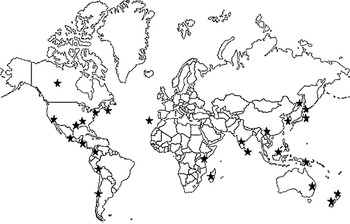
The genus Anzia was described by Stizenberger (Reference Stizenberger1861), the type for the genus being A. colpodes (Ach.) Stizenb. It is included in the family Parmeliaceae (Lumbsch & Huhndorf Reference Lumbsch and Huhndorf2010), and is characterized by the development of a dark-coloured spongiostratum on the lower surface, by atranorin as the major cortical substance and by asci with numerous, curved ascospores (Stizenberger Reference Stizenberger1861). The genus includes c. 34 accepted species worldwide (see Table 1), mainly occurring in subtropical to tropical mountains at altitudes between 1000 to 4000 m in both Northern and Southern Hemispheres (Fig. 1), but also nearly at sea level in Porto Santo (see below).
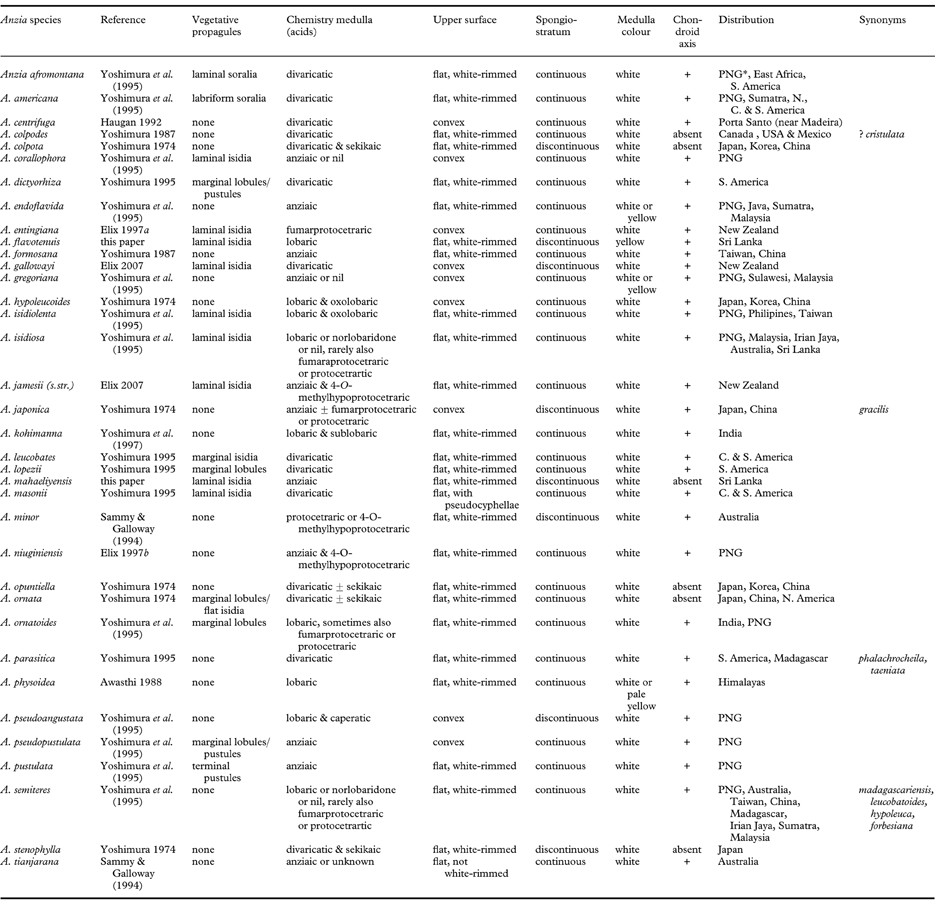
Distribution of character states in species of Anzia.

* Papua New Guinea
Known distribution of the genus Anzia worldwide (Yoshimura Reference Yoshimura1974, Reference Yoshimura1987, Reference Yoshimura, Daniels, Schulz and Peine1995; Awasthi Reference Awasthi1988; Haugan Reference Haugan1992; Sammy & Galloway Reference Sammy, Galloway, Orchard and Grgurinovic1994; Yoshimura et al. Reference Yoshimura, Sipman and Aptroot1995, Reference Yoshimura, Singh and Elix1997; Elix Reference Elix1997a, Reference Elixb, Reference Elix2007; present study).

The only species of Anzia recorded previously from Sri Lanka was collected at Farr Inn in Horton Plains at 2000 m, and reported by Yoshimura (Reference Yoshimura, Daniels, Schulz and Peine1995) as A. isidiosa, a species also known from Papua New Guinea, Irian Jaya, Malaysia and Australia at altitudes ranging from 1100 m to 3600 m (Yoshimura et al. Reference Yoshimura, Sipman and Aptroot1995). Relatively few Anzia species are widespread, suggesting that speciation may be taking place in geographically isolated conditions, especially in tropical regions where high altitudes are climatically very different to lowland areas around them. During research in Horton Plains by the first author, two distinct taxa of Anzia were collected as epiphytes. Horton Plains is an isolated plateau in Sri Lanka at an altitude of 2100–2300 m. The nearest equivalent high land to the north is the Nilgiri Hills at 2623 m in southern India, and the East African mountains in Kenya and Tanzania. To the south there is Mount Mangindrano on Madagascar. Species of Anzia are reported from each of these high altitude sites, including A. afromontana from East African montane sites (Swinscow & Krog Reference Swinscow and Krog1988), A. ornatoides from India and Papua New Guinea, A. physoidea from the Eastern Himalayas, A. kohimanna from North India (Yoshimura et al. Reference Yoshimura, Singh and Elix1997) and A. parasitica and A. madagascarensis from Madagascar (Abbayes Reference Abbayes1956) at c. 2200 m. Yoshimura et al. (Reference Yoshimura, Sipman and Aptroot1995) considered the latter species to be a variant of A. semiteres (Mont. & Bosch) Stizenb. The two taxa from Horton Plains are distinct morphologically and/or chemically and do not resemble other species in neighbouring regions. Both are isidiate and have a discontinuous spongiostratum. They differ in chemistry, colour of the medulla and absence or presence of a chondroid axis. This particular combination of characters is not present in any species described so far (see Table 1), and they are therefore described as new.
In order to assess their phylogenetic relationship to each other and to other species of Anzia, we undertook molecular analyses of both species and constructed a phylogenetic tree using species from other parmelioid genera as outgroups, including Pannoparmelia angustata, formerly included in Anzia. Data for species of Anzia in GenBank do not include specimens from Sri Lanka or India so our new species are compared with specimens collected from China, Korea or Taiwan (A. colpota, A. formosana, A. hypoleucoides and A. opuntiella) and from the USA (A. colpodes).
Material and Methods
Material
For each new species, a specimen was selected from those collected in the same locality as the type and used for molecular work.
Methods for morphology and chemistry
Morphological characters of specimens collected from Horton Plains National Park (HPNP) were examined using an Olympus SZX12 dissecting microscope and anatomical characters were observed using a Zeiss Axioscope 2 plus compound microscope. Specimens were photographed in the Sackler laboratory at the Natural History Museum using a Zeiss Stemi SV11 stereomicroscope coupled with a Canon EOS imaging system. The images were then stacked using the software Helicon Focus (Helicon Soft, Kharkov, Ukraine). HPTLC was performed with solvent systems A and C (Arup et al. Reference Arup, Ekman, Lindblom and Mattsson1993).
Molecular methods
For both species, the melanized lower cortex of a fragment of thallus was removed and transferred to sterile Eppendorf tubes. The tubes were then dipped into liquid nitrogen and the thallus fragments were ground using sterile pestles and sand. The remaining steps of the phenol-chloroform-based extraction followed a protocol described in Gueidan et al. (Reference Gueidan, Roux and Lutzoni2007). The DNA pellets were re-diluted in 50 µl of sterile water and 1 µl of 20 mg ml−1 Bovine Serum Albumin (BSA) was added. The nuclear ribosomal RNA gene region, including the internal transcribed spacers 1 and 2 and the 5.8S subunit (ITS), was amplified using the primers ITS1F (Gardes & Bruns Reference Gardes and Bruns1993) and ITS4 (White et al. Reference White, Bruns, Lee, Taylor, Innis, Gelfand, Sninsky and White1990). One microlitre of a 1/10 and 1/100 dilution of genomic DNA was added to the following mix: 2·5 µl of PCR buffer 10×NH4 (Bioline, London, UK), 0·5 µl of dNTP (100 mM), 1·5 µl of MgCl2 (50 mM), 1 µl of primers (10 µM), 0·5 µl of DNA polymerase Bioline BioTaq (5 U µl−1), and water for a total volume of 25 µl. Amplification was done using a Techne TC-4000 PCR machine (Bibby Scientific Ltd, Stone, UK). One initial cycle of 5 min at 94°C was followed by 35 cycles of the following steps: 1 min at 94°C, 1 min at 53°C and 2 min at 72°C. Amplifications were ended with a final cycle at 72°C for 7 min. PCR products were then sent to the sequencing facilities of the Natural History Museum, London, for cleaning and sequencing. The sequencing was carried out using the fluorescent marker BigDye and an ABI 3730xl sequencing machine (Applied Biosystems, Carlsbad, CA, USA).
Phylogenetic analysis
The two ITS sequences obtained here were edited using Sequencher 4.8 (Gene Codes Corporation, Ann Arbor, MI). Six additional ITS sequences from five different species of Anzia were recovered from GenBank. These sequences had been obtained in previous studies (Thell et al. Reference Thell, Feuerer, Kärnefelt, Myllys and Stenroos2004; Crespo et al. Reference Crespo, Lumbsch, Mattsson, Blanco, Divakar, Articus, Wiklund, Bawingan and Wedin2007; Xiao et al. Reference Xiao, Oh, Wang, Liu, Han, Koh and Hur2007). Alignment was done manually using MacClade 4.08 (Maddison & Maddison Reference Maddison and Maddison2003). Ambiguous regions were delimited according to Lutzoni et al. (Reference Lutzoni, Wagner, Reeb and Zoller2000) and excluded from the alignment. Four species were selected as outgroups based on BLAST comparison in GenBank (Flavocetraria cucullata, Tuckermannopsis chlorophylla, Esslingeriana idahoensis and Pannoparmelia angustata). Phylogenetic relationships between taxa were investigated using a likelihood approach with the software RAxML VI-HPC (Stamatakis et al. Reference Stamatakis, Ludwig and Meier2005, Reference Stamatakis, Hoover and Rougemont2008). This analysis was run on the Cipres Web Portal (http://www.phylo.org). The dataset was analyzed using a GTRMIX model and support values were obtained using a bootstrap analysis of 1000 pseudoreplicates. The most likely and the bootstrap trees were visualized in PAUP (Swofford Reference Swofford1999).
Taxonomy
Anzia mahaeliyensis Jayalal, Wolseley & Aptroot sp. nov.
MycoBank No.: MB 563519
Thallus griseus, albolineatus, isidiatus, spongiostrato interrupto, medulla albo, sine axis chondroideis, acidis anziaicis continens.
Typus: Sri Lanka, Horton Plains, Site A5: c. 2150 m, continuous forest, trunk of dead tree, 06°48′N, 80°50′E, March 2007, U. Jayalal A5-1-7-6 (BM 1088237—holotypus; PDA, ABL—isotypi).
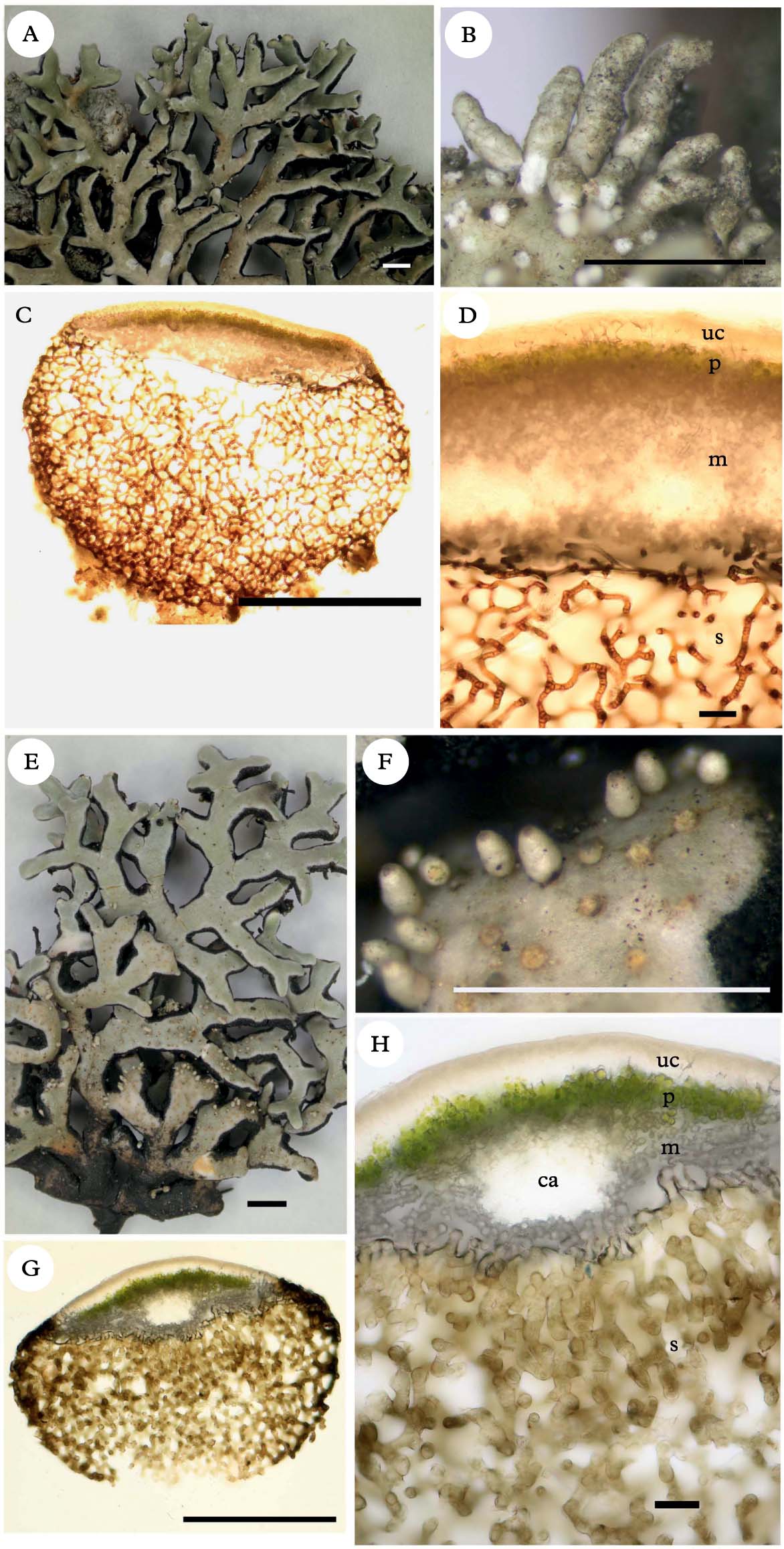
Anzia mahaeliyensis. A, habit; B, isidia, irregular in shape and sometimes branched; C, transverse section (T. S.) of thallus; D, part of T.S. (uc-upper cortex, p-photobiont layer, m-medulla, s-spongiostratum). Anzia flavotenuis. E, habit; F, isidia showing brown tips; G, transverse section of thallus; H, part of T.S. (uc-upper cortex, ca-chondroid axis, p-photobiont layer, m-medulla, s-spongiostratum); Scales: A, B, E & F=1 mm; C=0·5 mm; G=0·4 mm; D & H=25 µm.
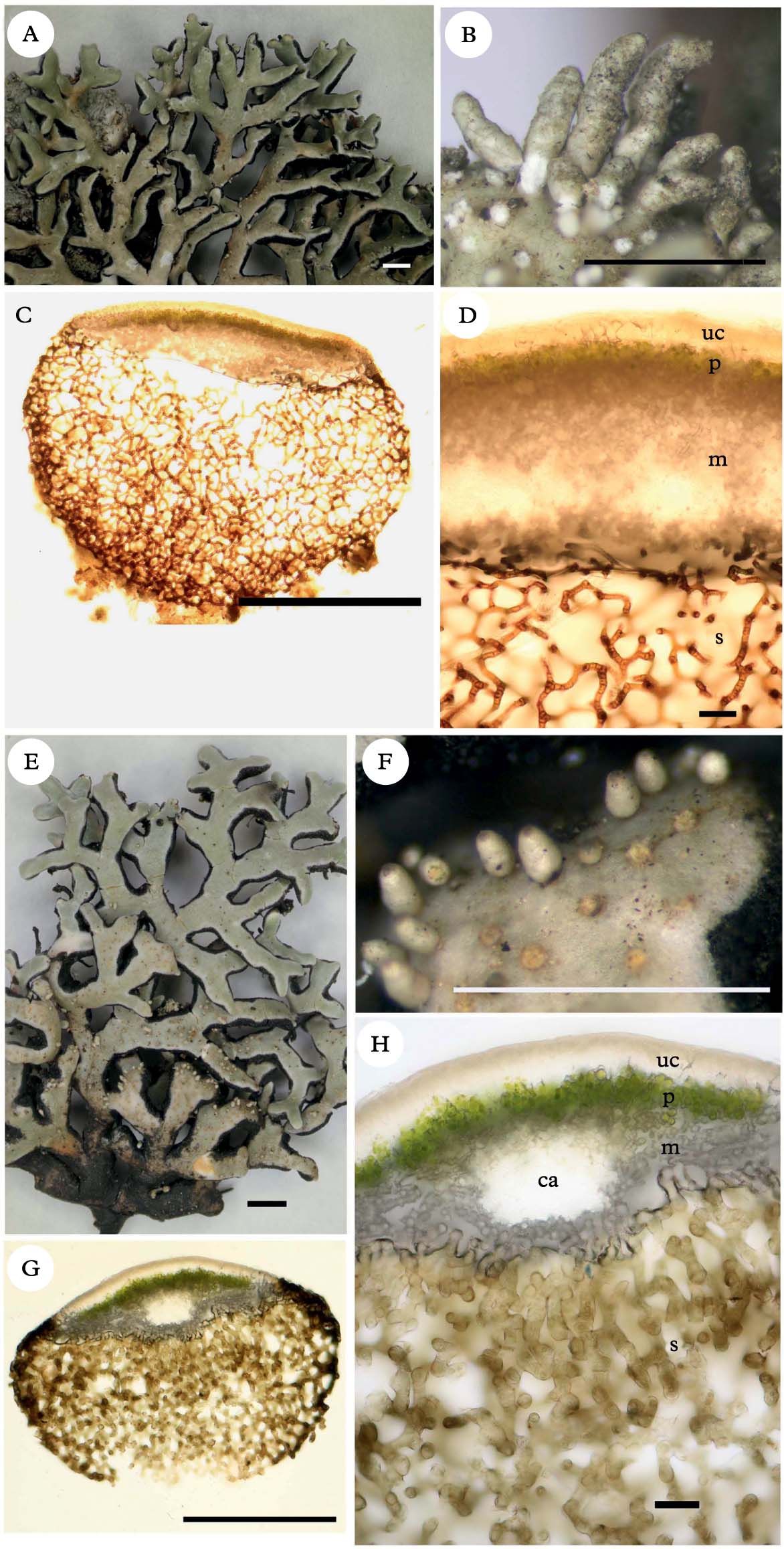
Thallus corticolous, foliose, 1–3 cm diam., loosely adnate. Lobes convex, entire, sublinear, 0·8–1·0 mm wide, apices rounded, dichotomously branched with long internodes. Upper surface corticate, pale grey to bluish grey, becoming brown after storage. Isidia laminal, rarely marginal, cylindrical, sometimes becoming lobulate and occasionally branched, without brown tips, soredia absent. Medulla white, without chondroid axis. Lower surface ecorticate but with a discontinuous thick layer of anastomosing dark-coloured hyphae forming the spongiostratum, with stout black rhizines which are mostly inserted between patches of spongiostratum.
Apothecia not seen.
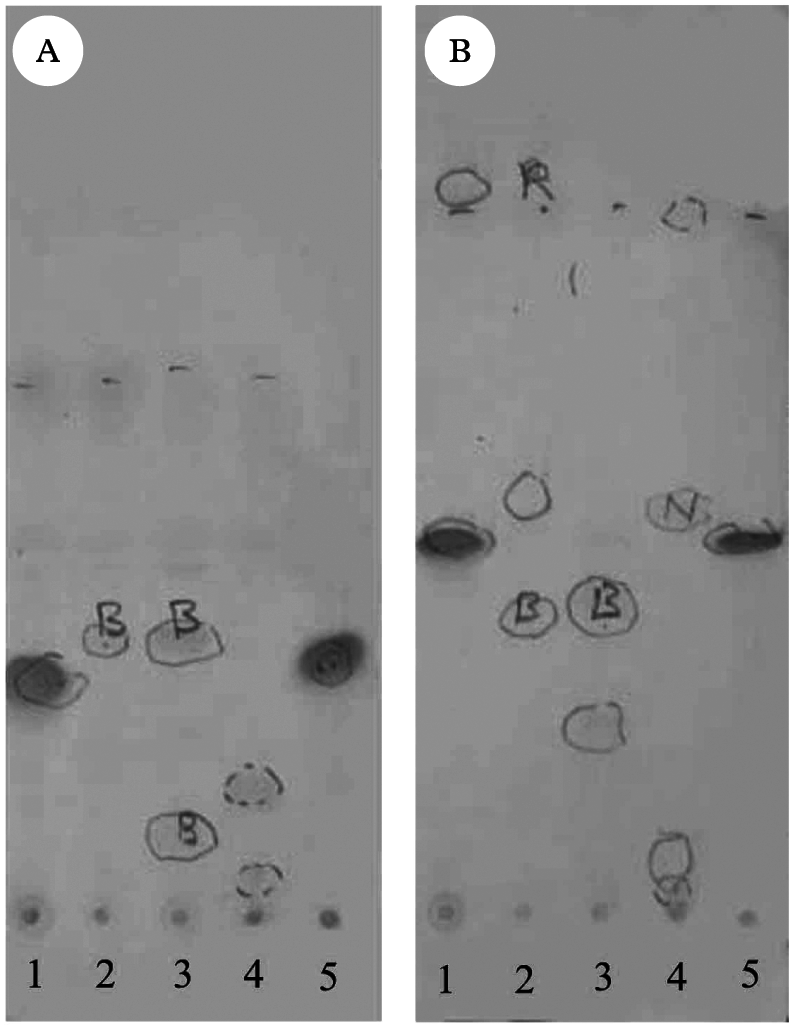
Chemistry. Thallus cortex K+ yellow, C−, KC−, P−. Medulla K−, C+ pink, KC−, P− containing anziaic acid and atranorin (Fig. 3).
HPTLC runs with solvent system A (A) and C (B). 1, Anzia mahaeliyensis (anziaic acid and atranorin); 2, Anzia flavotenuis (lobaric, atranorin, pigment at same Rf as atranorin, and other substance apparent in A but not in B); 3, Anzia semiteres (lobaric acid & atranorin); 4, Anzia semiteres (norlobaridone, caperatic acid, fumarprotocetraric acid, atranorin & chloroatranorin); 5, Anzia pustulata (anziaic acid & atranorin).

Ecology and distribution. Sri Lanka, Horton Plains (Sites A5: c. 2150 m, continuous forest, trunk of dead tree, 06°48′N, 80°50′E; B7: c. 2150 m, forest island tree trunks of Actinodaphne speciosa, Ilex walkeri, Cinnamomum ovalifolium and Neolitsea fuscata, 06°47′N 80°49′E & B8: c. 2175 m, island forest on trunks of Cinnamomum ovalifolium and Symplocos cordifolia, 06°48′N, 80°49′E).
Anzia flavotenuis Jayalal, Wolseley & Aptroot sp. nov.
MycoBank No.: MB 563518
Thallus griseus, albolineatus, isidiatus, spongiostrato interrupto, medulla flavo, axidis chondroideis, acidis lobaricis continens.
Typus: Sri Lanka, Horton Plains, Site B9: c. 2050 m, forest island tree trunk of Neolitsea fuscata, 06°47′N, 80°47′E, March 2007, U. Jayalal B9-5-2-13 (BM 1088238—holotypus; PDA, ABL—isotypi).
Thallus corticolous, foliose, 1–3 cm diam., loosely adnate. Lobes convex, entire, sublinear, 0·8–1·0 mm wide, apices rotund, dichotomously branched with short internodes. Upper surface corticate, pale grey to bluish grey, becoming brown after storage. Isidia laminal, rarely marginal, cylindrical, simple, short, rarely somewhat branched with brown-black tips, soredia absent. Medulla two-layered, upper layer yellow and lower white with a chondroid axis of parallel hyphae. Lower surface with discontinuous prominent dense brown-black spongiostratum, with stout black rhizines which are mostly inserted between patches of spongiostratum.
Apothecia not seen.
Chemistry. Thallus cortex K+ yellow, C−, KC−, P−. Medulla K+ yellow, C−, KC yellow-orange, P−, containing lobaric acid, atranorin and an unidentified pigment (Fig. 3).
Ecology and distribution. Sri Lanka, Horton Plains (Sites B9: c. 2050 m, forest island tree trunk of Neolitsea fuscata, 06°47′N, 80°47′E & B10: c. 2100 m, forest island trunk of dead tree, 06°47′N, 80°47′E).
Results
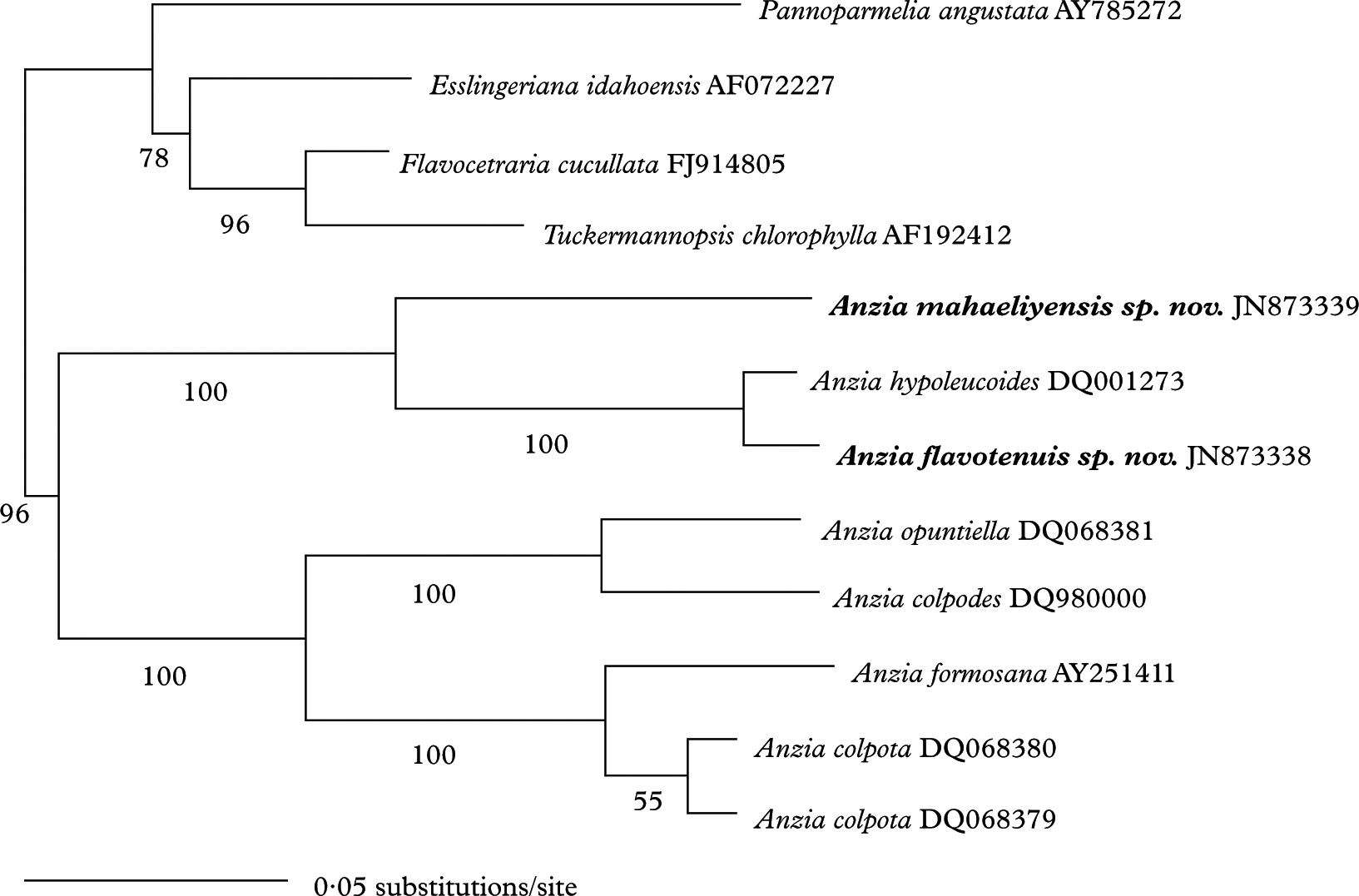
The ITS matrix included 542 characters, 189 of which were variable. The most likely tree (Fig. 4) shows that both new species cluster within the well-supported genus Anzia (bootstrap 96%). Anzia flavotenuis is most closely related to A. hypoleucoides (bootstrap 100%) and A. mahaeliyensis is sister to these two species (bootstrap 100%). Both A. hypoleucoides and A. flavotenuis contain lobaric acid but the former lacks the yellow pigment and does not have isidia. The species in the other well-supported group (bootstrap 100%; A. colpodes, A. colpota, A. formosana and A. opuntiella) contain divaricatic acid except for A. formosana, which contains anziaic which is also present in A. mahaeliyensis. Except for the two new species from Sri Lanka, other taxa included in this tree do not have isidia.
Phylogenetic relationships between species of Anzia for which molecular data are currently available in the public database GenBank. This phylogeny was obtained using the marker ITS and a maximum likelihood criterion using the software RAxML. The tree was rooted using four Parmeliaceae species (Pannoparmelia angustata, Esslingeriana idahoensis, Flavocetraria cucullata and Tuckermannopsis chlorophylla). Support values (bootstrap percentages) are indicated below the branches. Each taxon name is followed by the GenBank accession number.

Discussion
Anzia mahaeliyensis is characterized by the presence of a single-layered medulla, no central chondroid axis, and cylindrical, occasionally lobulate isidia without brown tips. Anzia flavotenuis is characterized by the presence of a two-layered medulla with the upper layer yellow and the lower part white. This species has a central chondroid axis and cylindrical, simple, short and somewhat branched isidia with brown-black tips.
The two new species from Sri Lanka are superficially quite similar, but differ greatly in their internal morphology and chemistry. They are most similar to the seven smaller species in the genus, all of which have a discontinuous spongiostratum (Table 1). Species with a discontinuous spongiostratum are generally not widely distributed, and are known from Australia, New Zealand, Papua New Guinea, Japan, Korea and China, and now Sri Lanka.
The two subgenera that are currently accepted in the genus Anzia, viz. subgen. Anzia and subgen. Nervosae (Yoshimura Reference Yoshimura1987), differ from each other in the presence or absence of a chondroid axis. Interestingly, the two new species would belong to two different subgenera according to this classification, although they are morphologically rather similar and phylogenetically related, suggesting that the concept for these subgenera is not tenable. It is also interesting that all three species reported from Sri Lanka are isidiate whereas no isidiate species are known from India, Africa or Madagascar. Anzia isidiosa is widely distributed in montane tropical regions from Malaysia to northern Australia (Queensland); however all other isidiate species tend to be restricted to a country or region but vary enormously in their secondary metabolites (Table 1). In contrast, the two sorediate species occur more widely in both the Old and New World and both contain divaricatic acid. Preliminary results from molecular analysis of a restricted number of species suggest speciation of these isidiate species has possibly occurred together with changes in secondary compounds.
This study was supported by grants from the National Science Foundation, Sri Lanka (Grant Nos. RG/2004/BM/01 & RG/2008/EB/02), and a travel grant from the British Lichen Society to enable the first author to work on the material at the Natural History Museum (BM), London. Molecular work was supported by BM funds to CG. Authors UJ, SW and VK would like to thank the Wildlife Department, Sri Lanka, for permission to carry out the survey and send the materials to BM. We would also like to thank Jae-Seoun Hur for providing literature and sequence information.