1 Introduction
1.1 The basics of compound pronouns
In this article I will discuss compound pronounsFootnote 2 (henceforth CoPro), a term which refers to indefinite pronouns derived from combining the determinative morphemes every-, some-, any-, no- with nominal ones such as -body, -one, -thing, etc. The notion is proposed in Quirk et al. (Reference Quirk, Greenbaum, Leech and Svartvik1985: 376–7), who also provide a summary of their syntactic behaviour (points ii to iv are illustrated by examples (1)–(3)):
i. CoPros appear in singular form (i.e. there is no *someones or *anythings);
ii. A postmodifier else can be added, making the whole phrase semantically approximate to ‘some/any/no/every + other + person/thing’ (1a, b);
iii. CoPros cannot be premodified by adjectives, but postmodification is allowed (2a, b);
iv. CoPros can be freely modified by normal restrictive NP postmodifiers such as PPs and relative clauses (3a, b).
(1)
(a) someone/something else
(b) some other person/thing
(2)
(a) someone special
(b) #special someoneFootnote 3
(3)
(a) nothing in common
(b) somebody who is dead
The most prominent feature of CoPros is the unavailability of most premodification (usually by adjectives), which distinguishes them from common nouns: while the expression special things is permitted, #special something is often considered colloquial and less common; rather, we would say something special, which is marked for common nouns (#things special). Anyone who wishes to account for the syntax of CoPros must explain these facts. This article explores the syntactic behaviour of CoPros as follows: section 1.2 provides a concise introduction to previous studies; sections 2 and 3 examine some distinctive patterns of coordination and modification, and put forward a theory on the structure of CoPros; section 4 proposes a comprehensive account of the postmodification of CoPros; and the final section before the Conclusion discusses a special use of CoPros, namely nominal CoPros.
1.2 Previous studies
Kishimoto (Reference Kishimoto2000) proposes that CoPros are variations of common noun phrases: the noun bases are raised from the post-adjectival position and join to the determiner bases, as (4b) shows:
(4)


Kishimoto argues that CoPros are hardly true lexical items as they can be modified by certain adverbs (e.g. almost/nearly everyone), which suggests that the determiner base (i.e. every-) and the nominal base (i.e. -one) are separated, and what those adverbs modify is the determiner part. The N-raising analysis is criticised by Larson & Marušič (Reference Larson and Marušič2004), who raise a great deal of evidence against a perceived prerequisite of N-raising, namely that the postmodifiers of CoPros are prenominal attributive adjectives at a ‘deeper’ level. For example, postmodifiers of CoPros cannot freely recur as premodifiers do (*something sensible worthwhile), and attributive-only adjectives are not eligible for postmodification (*nothing mere).
Instead, Larson & Marušič (Reference Larson and Marušič2004) propose two theories of CoPros, one of which assumes the presence of null nouns after CoPros (considered as single determiners). A somewhat similar analysis is from Leu (Reference Leu2005: 149), where the major difference lies in the attitude towards the internal structure of CoPros. Take something as an example. With an empty noun (abbreviated as ec N) occurring after the CoPro (Leu calls it ‘IPR’, short for indefinite pronouns), something is separated into two functional categories [F some] and [IPR-R thing], in which ‘IPR-R’ stands for indefinite pronoun restrictor. Larson & Marušič and Leu's analyses are shown in (5a, b), respectively.
(5)
(a) [DP D (*AP) [NP ∅] AP]
(b) [DP [F] [IPR-R] ec N]
These null noun analyses are criticised in Payne et al. (Reference Payne, Huddleston and Pullum2007: 584), who point out that Larson & Marušič's analysis ‘requires a stipulation that pre-head AdjPs are not permitted when the head is null’. In addition, while Leu criticises Larson & Marušič for not including French and Swiss German data, Payne et al. and Blöhdorn (Reference Blöhdorn2009) argue that some characteristics, which make English CoPros distinctive, may not fit into Leu's unified construction.
Another way of accounting for English CoPros is to claim that they have an inherently different modification pattern from common NPs. For instance, the other theory Larson & Marušič (Reference Larson and Marušič2004: 284) propose is that instead of displaying the basic order (6a), CoPros ‘[represent] a derived order in which the noun head has raised leftward’ (6b). Similarly, Blöhdorn (Reference Blöhdorn2009: 132) asserts that ‘[a]n AP modifying another syntactic category can occur in two basic positions’. Premodification requires the presence of an NP (7a). Since IPR-Ds (Indefinite Pronoun Determiners, Blöhdorn's term for CoPros, presumably echoing Leu) are determiners, they do not fulfil the requirement for premodification. This sends them to the other path (7b), in which determiners are intrinsically postmodified.
(6)
(7)
(a) [DP D AP NP]
(b) [DP D AP]

Although an advantage of these analyses is that they are simple and clear, the immediate problem is to admit that CoPros have a completely different syntax, at least in terms of modification, from other NPs. (6a, b) seem to be an attempt to legitimise N-raising, but this process requires a special stipulation that this kind of N-raising is confined to CoPros, and does not apply to common NPs. (7a, b) require more explanation: should we regard IPR-Ds as a peripheral class of determiners? After all, no other determiner is usually postmodified – in fact, it is arguable whether determiners can be modified at all by adjectives. But if we do this, we could be accused of deliberately complicating the syntax by creating a new class without sufficient evidence.
2 New observations
Although the basic properties of CoPros have been thoroughly discussed in previous studies, there are still some syntactic phenomena that have received less attention. Those special characteristics of CoPros revealed in coordination and modification will shed some new light on the analysis of its structure.
2.1 Coordination
CoPros may be coordinated by the coordinator or with the adjective other, as exemplified in attested sentences (8a, b):
(8)
(a) Almost all our citizens are indicted for something or other. (bit.ly/2Wu9xky)
(b) Iris is off somewhere or other for the next few days. (bit.ly/2Wu9xky)
We may expect noun ellipsis in structures like or other/another. For instance, the non-elliptical form of one way or another is presumably one way or another (way), with the nominal head way of the second immediate constituent deleted for concision. If the same rule is applied to something or other, the element being coordinated and then deleted should not be the whole compound, but part of it, i.e. -thing. The phenomenon of -thing being deleted in coordination is against the ‘expected behaviour’ of compoundingFootnote 4 (Giegerich Reference Giegerich2004). As Giegerich argues:
Neither elements [of a compound] should be allowed to be deleted in coordination – compare phrasal two red and four yellow roses, and lexical *quick- and thoroughly. (Giegerich Reference Giegerich2004: 5)
Therefore, sentences (8a, b) suggest that CoPros are essentially phrasal instead of lexical as this deletion in coordination is allowed, though most instances except no one Footnote 5 are morphologically single words.
A further problem related to this coordination construction is the categorisation of somewhere. In somewhere or other, the deleted part -where in the second constituent takes other as its adjective modifier, which obviously violates the observation that adjectives cannot modify either adverbs or prepositions.Footnote 6 (8b) suggests the possibility that -where can in some circumstances be regarded as a nominal base (cf. some/any/no place) and -where words in these examples are structurally identical to typical CoPros.
2.2 Modification
2.2.1 The function of the determiner and external modifiers
A distinctive feature of CoPros, as Quirk et al. observe, is that they freely take post-head adjectival modifiers. This feature separates them from ordinary pronouns, whose modification is restricted (Huddleston & Pullum et al. Reference Huddleston and Pullum2002: 429–30). It seems that CoPros, contrary to what their name suggests, behave more like nouns in their ability to take adjectives as modifiers. On the other hand, this feature also suggests that CoPros are atypical in the noun class: while most nouns allow premodifiers (e.g. a tall building, long hair), *tall anybody is usually deemed ungrammatical. One reason for this postmodification-only characteristic, as many would argue, is that *tall anybody violates the order of premodifiers in English. I list here two paradigms of the premodification sequence (‘M’ stands for ‘modifier’):
(9)
(a) Det > Precentral M > Central M > Postcentral M > Prehead M > Head (Quirk et al. Reference Quirk, Greenbaum, Leech and Svartvik1985: 1138)
(b) Pre-head external M > Det > Pre-head internal M > Pre-head complement > Head > Post-head internal dependents > Post-head external M (Huddleston & Pullum et al. Reference Huddleston and Pullum2002: 452)
According to paradigm (9a), tall, as an adjective of length, belongs to the class of ‘central modifiers’, whereas the determiner any always occurs in the outmost layer. It is the same for (9b), where the pre-head internal modifier tall appears after the determiner. The possibility of *tall anybody is therefore blocked as tall cannot be positioned further from the head than the determiner. However, the premise of applying the order of modifiers here is to acknowledge that CoPros such as anybody are semantically and syntactically compositional. In other words, we assume that the compound anybody can be divided into two independent parts, with the determinative base any- being the determiner of the noun base -body, and both parts are essentially functional. This is in contrast to non-compositional compounds like inmate or outcast:
(10)
(a) He met his former inmate.
(b) He was treated as an outcast.
(11) *He was treated as an anyone.
The words inmate and outcast are syntactically cohesive; they cannot be analysed as a preposition plus a noun/verb sequence, otherwise the modifier former in (10a) and determiner an in (10b) would inappropriately modify PPs. On the other hand, the fact that an is not allowed in (11) can only be accounted for by positing a determiner (*an + any + one). In this sense, anyone is equivalent to [NP his inmate] and [NP an outcast] in that it is regarded as an NP consisting of D (determiner) + N (noun head).
More evidence on the independence of the determiner part comes from observations concerning ‘external modifiers’, as (12a, b) show.
(12)
(a) [Almost all] (the) students (adapted from Kishimoto (Reference Kishimoto2000: 561))
(b) [Not every] supervisor would agree. (Huddleston & Pullum et al. Reference Huddleston and Pullum2002: 424)
In (12a, b) the pre-head adverbs (almost and not) modify the following determinatives, forming what Huddleston & Pullum et al. (Reference Huddleston and Pullum2002: 431) call determinative phrases. Considering the fact that external adverb modifiers (e.g. not, hardly, almost, nearly) are also permissible for CoPros, analysis (13) is thus proposed by analogy:
(13) [Not/Hardly any-] -one would agree.
Again, analysis (13) strongly indicates that the determinative bases (some/any/no/every-) are syntactically active.
2.2.2 Restrictive relative clauses
Apart from ellipsis in coordination constructions, restrictive relative clauses following certain CoPros justify the independent status of the nominal bases as well. The following examples (14a, b) are taken from Huddleston (Reference Huddleston1984: 394), and (14c) is made up:
(14)
(a) Nobody who knows her could believe her capable of such an act.
(b) Every vehicle which they had tested had some defect.
(c) Everyone I asked said she was not at home.
As Huddleston explains, (14a) clearly does not denote a meaning like ‘nobody believes her capable of such an act’, and in (14b) not every vehicle had been tested. Similarly, I did not ask everyone I was able to talk to, but (14c) merely means those who I asked all gave the same response that she was not at home. Huddleston (Reference Huddleston1984: 395) calls for a ‘more abstract form’ of analysis such that (14a) should be read as ‘No person x such that x knows her could believe her capable of such an act’. However, considering the later proposal by Huddleston & Pullum (Reference Huddleston and Pullum2005: 183) that ‘the antecedent is always the head noun or nominal modified by the relative clause’, I believe a simpler solution is that the antecedents of the relative clause in (14a, c) are the nominal bases -body and -one, just like (14b), where the proper element that the relative clause modifies is vehicle instead of every vehicle. This solution will lead (14c) to denote that ‘I asked some people; every such person said she was not at home’, which is exactly the intended meaning of (14c). This is what McCawley (Reference McCawley1998: 437) has argued, with a structure displayed in (15). Although he does not particularly favour a lexical or phrasal analysis for CoPros, McCawley (Reference McCawley1998: 383) agrees that in structures which involve modifying relative clauses ‘syntactic boundaries . . . clash with word boundaries’.
(15)

A natural deduction of the analysis above is that the scope of modification is within the scope of determination, which is quite plausible if we compare anyone special to its alternative any special person. This leads to the conclusion that modifiers of CoPros modify the noun bases in lieu of the whole constructions.
3 The compound phrase hypothesis
3.1 CoPros and the syntax–lexicon divide
The unusual coordination phenomena in (8a, b) and modification of the determinative bases (13) and the noun bases (14a–c) raise important questions about the status of CoPros. A useful way of addressing this problem, I believe, is to discuss them in the context of the syntax–lexicon debate and to compare them to typical compounds and phrases.
Although there may never be a clear borderline between words and phrases, linguists have proposed many criteria that serve to classify problematic structures. Perhaps the most obvious reason to regard CoPros as compounds is their orthographic unity: CoPros are morphologically words. Although whether there is space or not between the components does not itself constitute an argument for compounding, it is true that those with the parts glued together (e.g. watchmaker) are less open to questions about their status than those with space in between (e.g. olive oil, boy actor). In other words, ‘constructions consisting of sequences of letters which are not interrupted by a space will generally be interpreted as a single lexeme’ (Sanchez-Stockhammer Reference Sanchez-Stockhammer2018: 26). Therefore, while some people is no doubt phrasal, words like somebody or nothing (the only exception is no one) are less distinguishable in terms of their structure from inmate or outside, in which two words from different classes form a new one. Related to orthographic unity is the concept structural integrity (Bauer et al. Reference Bauer, Lieber and Plag2013; Bauer Reference Bauer2017). Bauer (Reference Bauer2017: 7) argues that while ‘the relationship between orthography and word-status is rather more fraught than is generally recognised’, one criterion for structural integrity, namely the test of uninterruptability, could be much stronger. CoPros are uninterruptable just like common compounds (e.g. *baby-student-sitter, but red grammar books), as *any-interesting-body or *no-sensible-thing is generally unacceptable. The only exception in English is a situation called ‘expletive infixation’, e.g. every-bloody-body (see McCarthy Reference McCarthy1982: 576). This, however, has nothing to do with the syntax–lexicon divide, because expletives can also be inserted into non-compounds, e.g. abso-bloody-lutely.
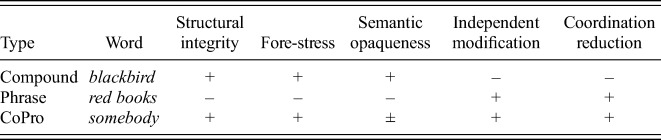
Giegerich (Reference Giegerich, Lieber and Štekauer2009: 184–6; Reference Giegerich2015: 101–10) suggests several other tests (two syntactic, one phonological and one semantic) based on the Lexical Integrity Principle to distinguish words from phrases. A typical compound is fore-stressed (e.g. 'blackbird, not black'bird), semantically opaque (blackbird compared with black bird), unable to be independently modified (*very blackbird), or to undergo coordination using the pro-form one (*a blackbird and a white one), while a typical phrase does the reverse. A close inspection of the application of those criteria to words like somebody yields interesting results that indicate that those words behave neither as typical ‘words’ nor as ‘phrases’.
First of all, all CoPros are fore-stressed, whereas their phrasal counterparts (e.g. some people, any place) tend to receive end-stress or equal stress. This strongly supports the lexical status of CoPros, as Giegerich (Reference Giegerich, Lieber and Štekauer2009: 196) claims that ‘fore-stress is confined to compounds’. Moreover, there is some phonemic change within the words (e.g. /ɒ/ in body becomes a schwa /ə/ in somebody), possibly suggesting a structural cohesion.
On the other hand, CoPros behave rather like phrases on the remaining criteria. They are semantically transparent to some extentFootnote 7 and their subparts can be independently modified (see section 2.2). The pro-one test seems tricky here, as its application requires countability (Giegerich Reference Giegerich, Lieber and Štekauer2009: 194) and presumably specificity. The noun bases are arguably non-countable (as we do not have *somebodies Footnote 8) and generic, which blocks them from occurring in structures like *somebody or other one. However, CoPros can pass a related test called coordination reduction (Giegerich Reference Giegerich2015: 101), whereby redundant nouns are elided in NP coordination. The difference between common NPs and CoPros is that while most NPs have their former noun reduced (red and blue books), CoPros remove their latter nominal element in coordination (something or other; see section 2.1).
The differences between somebody and the typical compound blackbird and the typical phrase red books are summarised in table 1.Footnote 9
The behaviour of somebody as compared to blackbird and red books

It is worth noting that there might be certain mismatches of the above criteria. For example, end-stressed Common Tern is semantically less transparent (Common Terns are not that common in Britain), and fore-stressed man-servant passes the pro-one test (a woman servant and a man one) (Giegerich Reference Giegerich2015: 103). But while Common Tern and man-servant may be finally assigned to the class of either compounds or phrases in accordance with other criteria, the distance between CoPros and both compounds and phrases, as table 1 and the discussion of the following sections reveals, is too great for us to assign CoPros to either class. CoPros are both atypical compounds and atypical phrases. If, as Giegerich (Reference Giegerich, Lieber and Štekauer2009: 197) concludes, lexicalisation is a ‘gradient phenomenon’, then they should be positioned somewhere between the two ends.
3.2 CoPros as compound phrases
Kishimoto (Reference Kishimoto2000), as reviewed in section 1.2.1, has been advocating that CoPros are structurally phrases, yet his theory is opposed by Larson & Marušič (Reference Larson and Marušič2004). A critical problem may be that he makes much reference to ‘deep structure’, ignoring the basic fact that CoPros are single orthographic units. N-raising is implausible if we acknowledge that the compounding of CoPros is essentially a morphological, rather than a syntactic, process. In other words, the shapes of CoPros are pre-established (i.e. listed in the lexicon), and any syntactic operation must be implemented on the basis of this pre-establishment. As we can observe from previous sections, the morphology of CoPros is so powerful that it to some extent separates them from typical phrases and endows them with marked postmodification patterns. Therefore, the analysis of CoPros should take into consideration both morphological and syntactic aspects. That is why I do not regard CoPros simply as phrases, but as compound phrases in which there is an obvious morphology/syntax interplay:
The compound phrase hypothesis:
CoPros are typically compound phrases: they are morphologically compounds but syntactically phrases (more precisely, NPs). The syntax of CoPros is determined by their pre-established morphology.
4 Modification patterns of CoPros
4.1 Postmodifiers
In this section I will discuss the modification of CoPros in more detail. Larson & Marušič (Reference Larson and Marušič2004) have shown that the postmodifiers of CoPros (if they are adjectives) are predicative instead of attributive,Footnote 10 with one of the arguments being that ‘attributive-only’ adjectives are not permissible (16)–(18):
(16)
(a) *someone future
(b) a future scientist
(17)
(a) something tall
(b) a tall building
(18)
(a) anyone alone
(b) ?an alone woman
This phenomenon has been accounted for by Quirk et al. (Reference Quirk, Greenbaum, Leech and Svartvik1985: 1294), who analyse CoPro postmodifiers as reduced relative clauses. However, Blöhdorn (Reference Blöhdorn2009), following Ferris (Reference Ferris1993), criticises this proposal, arguing that although almost all adjectival postmodifiers (with the exception of some ‘postpositive-only’ adjectives such as galore in cards galore) may expand to relative clauses, a huge number of relative clauses which contain predicative adjectives cannot reduce to postmodifiers. He gives the following examples (Blöhdorn Reference Blöhdorn2009: 109):
(19)
(a) That a writer who is gay cannot be serious is a common professional illusion . . .
(b) *That a writer gay cannot be serious is a common professional illusion . . .
It seems that he fails to take CoPros into consideration, yet it is exactly the modification of CoPros that Quirk et al. intend to explain. In the case of CoPros it is easy to establish that the relation between adjectival postmodifiers and relative clauses with predicative adjectives is much closer, as both expansion and reduction are always possible. For example, we can make (19b) grammatical by replacing a writer with someone:
(20)
(a) That someone who is gay cannot be serious is a common professional illusion . . .
(b) That someone gay cannot be serious is a common professional illusion . . .
Then the question becomes more complicated: why does the ‘reduced relative clause’ theory work perfectly well for CoPros, but not for other NPs?
We may begin the discussion by examining the adjectives that are able to freely expand and reduce in both CoPros and common nouns. Such adjectives usually belong to one of the following groups: (i) never-attributive adjectives, e.g. alone, afloat; (ii) some adjectives ending in -able/-ible, e.g. visible, navigable; (iii) a few special adjectives such as present or following (examples (21)–(23) are adapted from Quirk et al. Reference Quirk, Greenbaum, Leech and Svartvik1985: 419).
(21)
(a) the house ablaze
(b) the house which is ablaze
(22)
(a) the rivers navigable
(b) the rivers which are navigable
(23)
(a) the men present
(b) the men who are present
All adjectives in these three groups share a trait that when used as modifiers, they may occur in postposition. Therefore, I argue that the ability to be postpositive is intrinsic for some adjectives, and the ‘reduced relative clause’ theory presupposes this ability, not vice versa. In other words, the ‘reduced relative clause’ theory is not universal, but only applies to some adjectives that are inherently able to appear in postposition (i.e. those in the above three groups). Gay in examples (19a, b), as well as adjectives like tall or old, cannot be explained by this theory.
Examples (20a, b), by contrast, are special: on the surface, the relation between the two examples in (20) looks the same as those in (21)–(23), but the limitation of the ‘reduced relative clause’ theory disproves such a comparison. I propose that postpositive gay in (20b) is not a result of relative clause reduction as gay is not intrinsically able to occur postpositively; instead, it is coerced to postposition. This situation will be discussed in detail in the next section.
4.2 Syntactic coercionFootnote 11
As CoPros are syntactically noun phrases, the attributive modifiers can be arranged in accordance with a paradigm proposed in Larson & Marušič (Reference Larson and Marušič2004: 280), which is cited below with minor changesFootnote 12 as (24a), and exemplified in (24b).
(24)
(a) [DP D α1 [NP β1 N] α2] (α = DP modifier; β = NP modifierFootnote 13)
(b) the delicious house wine available
In paradigm (24a), we can put some-/any-/no-/every in position D, and -body/-one/-thing/-where in position N. However, this causes a problem: if CoPros were true phrases like this book, we should be able to add DP modifiers in position α1 just after the determiner some-, any-, no- or every- which modify the noun phrases [-body], [-one], [-thing] and [-where], and NP modifiers in position β1 just before the nominal heads [-body], [-one], [-thing] and [-where], but this is not possible. In fact, positions α1 and β1 are never available because the pre-established morphology of D and N in CoPros being glued together prohibits the insertion of any extra element, except expletives (see section 3.1). The consequence is that potential candidates for positions α1 or β2 are relocated to nearby positions, either forwards (towards the end of the phrase) or backwards (towards the front of the phrase). In reality, however, only the forwards option is available because of the general constraints on the premodification sequence (i.e. no adjectival modifier can occur before the determiner). Therefore, an alternative modification pattern for CoPros is formed through an operation which I term syntactic coercion. It can be formulated as follows:
(25) [DP D [NP N β2] α2]Footnote 14
As just discussed, syntactic coercion presupposes the status of compound phrase for CoPros: if morphology does not play a primary role and CoPros are nothing more than common NPs, as Kishimoto (Reference Kishimoto2000) proposes, then attributive modifiers permissible for common NPs (e.g. a future scientist) should also fit CoPros. Clearly this is against what has been observed until now.
What are the distinguishing features of syntactic coercion? First, it is triggered by strong stylistic, semantic or morphosyntactic factors which make the default syntactic structure impossible. For CoPros the motivation is their morphology, but in other situations semantic and stylistic reasons may be equally effective as well. For instance, Bolinger (Reference Bolinger1967: 9) proposes that a ‘temporary adjective’ (i.e. an adjective which ‘names a quality that is too fleeting to characterize anything’) is restricted to predicative or postpositive position, with the adjectives having the prefix a- (e.g. afire, asleep, alive) being typical examples. He also noticed that some of them ‘are gradually edging their way into attributive position’ (Bolinger Reference Bolinger1967: 12), like away in away games and aware in aware audience. The author does not discuss the change much, but for me an important motivation lies in semantics: the attributive use of away or aware weakens the application of ‘temporariness’ and enhances its ‘permanentness’ and ‘genericity’ as a modifier. The contrast is shown in the following examples extracted from the British National Corpus (BNC; Davies Reference Davies2004–):
(26)
(a) . . . he's been to the last two or three world cup tournaments, and he goes to all the matches away, you know, European cup matches and everything that English teams are playing in, he's all over the world watching it . . . (BNC: HGH)
(b) Chiefly they are responsible for hiring coaches to away matches and for getting occasional petitions signed. (BNC: ECN)
In (26a) matches away indicates a few specific matches that are played outside England, i.e. ‘European cup matches and everything that English teams are playing in’. But away matches in (26b) has no specific reference; it denotes ‘any match that is played away’, a characteristic that is more generic and intrinsic to the concept ‘match’. Although away is syntactically never-attributive, the need for expressing ‘permanentness’ coerces it to the attributive position so that it could mean something slightly different.
Another attested example is cited in Aarts (Reference Aarts2007: 107):
(27) Snow, who lives in Kentish Town, has an alive presence, an abiding awareness, a serious desire to seek the truth . . .
Here prenominal use of alive in (27) is more obviously driven by stylistic concerns, as Aarts (Reference Aarts2007: 107) reasons that this manipulation serves to ‘create a neat parallelism’ by presenting three NPs with the same ‘numeral + adjective + noun’ structure. On the other hand, it may also have some semantic effect: instead of delivering a sense of ‘temporariness’, alive in (27) is closer to ‘active’ or ‘lively’, a characteristic which is considered intrinsic and persistent.
In terms of CoPros, the reason for coercion is purely morphosyntactic: there is no space for prenominal modification as all CoPros are single orthographic units. As a result, all modifiers must be placed in postposition. A semantic side-effect of the forward coercion is that, while using never-attributive adjectives (e.g. away, alive) in attributive position yields a more ‘permanent’ meaning, the placement of potential attributive adjectives in postposition will restrict them in ‘temporariness’. This is perhaps why Larson & Marušič (Reference Larson and Marušič2004: 275) observe that although visible stars and stars visible are semantically different (‘permanent’ and ‘temporary’), everything visible has only the ‘temporary’ meaning.
Second, syntactic coercion is different from movement: it is a result rather than a process. We cannot say that when coercion occurs an element is ‘moved’ to the target position from elsewhere, simply because the imaginary original state is impossible. For example, an alive presence is not a consequence resulting from the movement of a presence alive, as the latter expression is not permitted for stylistic reasons. Similarly, there is no such structure as *some-old-thing, and the adjective old, when modifying something, is directly placed in postposition. Therefore, I consider the modification pattern (25) independent from the general paradigm (24a) rather than a derivation of it.
4.3 Challenges for the theory of syntactic coercion
The modification pattern in (25) needs more clarification, especially with regard to the relation between DP modifiers and NP modifiers. There are specifically two potential challenges: first, we need to distinguish NP modifiers β2, which are otherwise premodifiers β1, from DP modifiers α2, but Larson & Marušič, by comparing stage-level interpretations with individual-level interpretations,Footnote 15 and also restrictive interpretations with non-restrictive ones, reject the idea that NP modifiers are able to occur postpositively. In other words, according to them, position β2 should not exist (note that β2 is absent in the original pattern (24a)). Second, we would need to deal with the potential ability of recursive postmodification, if position β2 indeed does not exist. I will discuss these issues in the following sections.
4.3.1 Common postpositive modifiers of CoPros
Larson (Reference Larson, Strolovitch and Lawson1998: 145) raises the following example in a discussion of the ambiguity between intersective and non-intersective readings of adjectives:
(28) Olga is a beautiful dancer.
While the intersective reading interprets the above sentence as ‘Olga is beautiful and Olga is a dancer’, the non-intersective reading interprets it as ‘Olga dances beautifully’. Larson & Marušič (Reference Larson and Marušič2004: 281) relate this ambiguity to the difference between DP and NP modification: the adjective beautiful functions as a DP modifier, i.e. α1 in (24a): [DP a beautiful [NP dancer] in the intersective reading, and an NP modifier, i.e. β1 in (24a): [DP a [NP beautiful dancer]) in the non-intersective reading. The analysis of intersective/non-intersective ambiguity can be extended to CoPros:
(29)
(a) Olga is a beautiful dancer.
(b) Olga is someone beautiful
(30)
(a) John is a corporate lawyer.
(b) *John is someone corporate.
There is an obvious restriction of interpretation in CoPros. Sentence (29b) is not ambiguous, allowing only the intersective reading. Sentences (30a, b) show that when the premodifier permits only a non-intersective reading (thereby forbidding ‘*John is corporate and John is a lawyer’), it cannot be coerced to the postposition of CoPros. Both examples suggest that the postmodifiers of CoPros receive an exclusively intersective reading, which means, if the theory of Larson & Marušič is valid, that CoPros can only take DP modifiers. This is in accordance with the non-existence of position β2, and it therefore seems that all postmodifiers should be placed in position α2 in (25).
4.3.2 Else
In the previous section, we saw that β2 cannot be filled. However, we should not simply do away with it: there is at least one word, namely else, which seems to be a true postpositive NP modifier. Its syntactic distinctiveness is summarised below:
i. Else is not an adjective modifier, which means it is not restricted by Larson's distinction between intersective and non-intersective adjectives. Traditionally it is treated as an adverb, although Huddleston & Pullum et al. (Reference Huddleston and Pullum2002: 615, fn. 1) argue that else is ‘arguably a preposition when it postmodifies interrogative heads and compound determinatives’. The reasons for their re-categorisation are that (a) else only occurs after certain nominal structures (e.g. wh-pronouns such as who, CoPros and singular all, much, etc.; see Quirk et al. Reference Quirk, Greenbaum, Leech and Svartvik1985: 454); and (b) internal postmodification is a typical function for PPs rather than AdvPs (e.g. the issues under discussion but not *the issues so remarkably).
ii. Else is inherently a postmodifier which can only occur in postposition.
iii. Else immediately follows the nominal head, whether there is another postmodifier or not. That is why Huddleston & Pullum et al. take it as an internal modifier – a modifier that occurs within the NP.
iv. While else can take than complements, this is impossible if there is another adjective in between. For example, nothing else than this is grammatical, yet *nothing else sensible than this is not.
v. Else plays a role in word-formation with at least one noun base -where, as in elsewhere.
All these characteristics suggest that else has a very close syntactic relation with the nominal structures it modifies. It is unlikely to be either prenominal or expanded to a relative clause. In consequence, position β2 should be retained in the CoPro modification pattern (25). Also, the analysis that else is an NP modifier positioned in β2 reflects the phenomenon that else can and must precede the adjective (which is positioned in α2):
(31)
(a) nothing else sensible
(b) *nothing sensible else
The behaviour of else, to some extent, resembles that of the ‘postpositive-only’ adjectives (e.g. the President elect, the poet laureate), which might also be potential NP modifiers that are located in position β2. Considering the fact that the ‘postpositive-only’ adjectives are semantically selective, i.e. they modify a very limited number of nouns (e.g. *the student elect, *the chef laureate), and are usually incompatible with CoPros, they will not be further explored here. Nevertheless, their status of being intersective-only adjectives (e.g. *He is the president and he is elect) suggests that they are indeed NP modifiers, which may trigger a need to amend the original paradigm (24a).
4.3.3 More
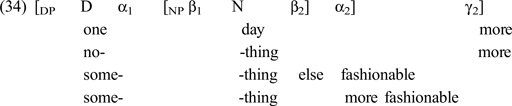
Another interesting case is more, as nothing else and nothing more share more or less the same meaning. Despite the fact that else and more are often used interchangeably after CoPros, the two words are syntactically quite different. First, more does not always appear in postnominal positions. Together with words like less and fewer, it occurs after the head only when there is a determiner (Huddleston & Pullum et al. Reference Huddleston and Pullum2002: 445). Therefore we have one day more but not *days more. Second, the complementation of more is quite restrictive in that it can hardly be followed by an adjective postmodifier: although something more fashionable is possible, it deviates from the meaning of something else fashionable and its internal structure is better analysed as something [more fashionable], in which more is an adverb modifier of fashionable, different from the one in one day more.
The restriction on the following modifier suggests more may be a DP modifier in position α2 in (25), and the fact that it occurs both prenominally and postnominally in common NPs reminds us of adjectives like visible:
(32)
(a) the visible stars
(b) the stars visible
(33)
(a) one more day
(b) one day more
However, the resemblance of visible and more is only superficial: in (33a) the word more does not modify day but the determinative one (i.e. [one more] day), forming a determinative phrase. Also, in (33b), it seems that more is outside the scope of the determiner one (i.e. [one day] more, as *day more is not a constituent), which is not allowed by Larson & Marušič's modification pattern. The fact that the postmodifying more is outside the scope of the determiner is further consolidated by the phrasal structure once more, in which there is no doubt that more modifies once, a special conglomerate of both the determiner and the noun head (see Payne et al. Reference Payne, Huddleston and Pullum2007). We can conclude, therefore, that in neither (33a) nor (33b) is the adjective more a modifier of the head noun day; moreover, the analysis of (33b) suggests that when used postpositively, more is neither an NP modifier situated in β2 or a DP modifier situated in α2. Rather, it should belong to a layer that is further out, i.e. one that is outside the position D. If we were to apply Larson & Marušič's paradigm to (33b), we need to create a new position, like γ, for the modifier more:

4.4 Recursion
4.4.1 The restrictor
An important conclusion drawn from paradigm (25) is that CoPros cannot take more than one adjective modifier, which is consistent with Huddleston & Pullum et al. (Reference Huddleston and Pullum2002: 423), who label CoPro modifier the restrictor:Footnote 16
(35)
(a) nothing sensible
(b) *nothing sensible new
Moreover, we are able to explain why beautiful long hair is possible and *something beautiful long is not: it seems that recursive modifiers are only permitted in position α1 but not α2, and it is impossible for beautiful or long to be in position β2 since they are DP modifiers in postposition. As a result, they cannot coexist but need to compete for one position. The competition may be cancelled by coordination, though, as beautiful and long is considered as a single modifier.
4.4.2 Recursive modifiers
Larson & Marušič (Reference Larson and Marušič2004), contra Huddleston & Pullum et al., are among the few researchers who advocate multiple modifiers under certain conditions. Three patterns of multiple postmodification (36a–c) are workable for them. The conditions of multiple postmodification, as argued by Larson & Marušič (Reference Larson and Marušič2004: 283), are that adjectives can be followed by other ‘heavy’ adjectives (36a), or adjectives which occur both prenominally and postnominally precede ones occurring exclusively postnominally (36b), or both (36c).
(36)
(a) everyone present capable of lifting a horse
(b) everyone tall present
(c) everyone tall present capable of lifting a horse
This notion could be problematic, however: in reality, attested examples are extremely difficult to find even in large corpora such as BNC. With the help of iWeb (Davies Reference Davies2018–), an allegedly 14-billion-word corpus based on the Internet, hundreds of potential candidates are yielded. However, a disproportionate majority of them are not of the types suggested by Larson & Marušič:
(37)
(a) Will you join your old team or do you think it's time for something brand new? (bit.ly/2uAGQ9u)
(b) If you want something super simple, Instagram is the way to go. (bit.ly/2Fzn5Ew)
(c) The reviews include . . . stuff that isn't hard to find if you're a powerhouse school, but may be difficult if you're trying to find information on someone lesser known. (bit.ly/2WAHLDb)
(d) Many of the other settings will be specific to your AWS environment, however there's nothing special required for this function. (bit.ly/2HYofMC)
(e) Even if you don't have anything specific planned, set aside some free time so that you can do something spontaneous. (bit.ly/2Ufn6XK)
(f) I'll need to look for something similar available in the UK. (bit.ly/2Ub65Ok)
Brand new in (37a), as well as old fashioned, should be analysed as lexicalised compounds instead of separate adjective phrases, and there are often hyphens in the alternative forms brand-new and old-fashioned. In (37b), super is used in spoken language as an adverb which modifies simple, making super simple a single AdjP. Similar instances are lesser known in (37c) and real quick in colloquial American English. Examples (37d, e) look qualified on their own, but as they occur in sentences featuring existential there and verbs like have or make, Huddleston & Pullum et al. (Reference Huddleston and Pullum2002) would rather regard required for this function and planned as predicative complements. In fact, the majority of ‘CoPros + Adj. + Adj./past participle’ structures appear in sentences containing there, have, make and keep, ruling out the possibility for the second adjective to be a modifier. What is then left is (37f), a potentially good example. It looks like a combination of (36a, b), because the first adjective similar, as a modifier, is primarily prenominal, and there is a PP complement of available at the end. Those examples are scarce. Also, as noted by Larson & Marušič (Reference Larson and Marušič2004: 283, fn. 15), such recursion is subject to some special conditions. The acceptability of combinations like (36b) varies among sentences, and sometimes it is difficult to determine whether the variations are due to syntactic or semantic constraints. Moreover, the first adjective often bears contrastive stress and there is a break between the two adjectives, which seems to suggest that they have distinctive functions. A possible analysis is that the second adjective might be an adjunct, as breaks are typical between NPs and adjuncts that provide supplementary information. Under this circumstance it is hard to distinguish Everyone present capable of lifting a horse was offered a ticket and Everyone present, capable of lifting a horse, was offered a ticket in spoken language. Another possibility is that the break can serve as a marker of coordination, in the way a comma does in prenominal modifiers (e.g. a hard, boring task). If this is true, then we will not see recursion, but a coordinated set of modifiers in (36a), which is not different from everyone present and capable of lifting a horse.Footnote 17
If we acknowledge Larson & Marušič's stance on recursive modifiers, a possibility is that maybe α1, the position that is being coerced, does not merge with α2 but coexists with it. This explanation directly corresponds to the authors’ observation that if two adjectives coexist postpositively, the first one must be able to occur both prenominally and postnominally (like tall) and the second one must occur exclusively in postposition (like present). Tall is a coerced adjective which would otherwise be located in α1, while present is inherently a postpositive modifier located in position α2: they can coexist because they are of different provenance.
Despite its effectiveness in explaining multiple modification, this analysis may face some new problems. We need to clarify why there is coexistence instead of merging. More importantly, Larson & Marušič's observation is challenged by data that seem problematic, like those I found in (38a, b):
(38)
(a) I am interested in finding out if there is anything new available for migraine treatment. (bit.ly/2FAZQtT)
(b) Wait . . . She is better than anything available new today! (bit.ly/2CHYInn)
Although examples like (38a) are seen more often in formal conversations and articles where the use of language is more casual and examples like (38b) in online forums, I would not dismiss anything available new as ungrammatical because there are a few occurrences. As a result, it may be argued that Larson & Marušič's theory on recursive postmodifiers is simply flawed. Alternatively, we can regard such structures as being part of a grammatical change that is truly happening. In any case, it seems that postmodification patterns for CoPros are far more flexible than previously thought.
5 Compound pronouns as compoundsFootnote 18
Apart from the common usage discussed in previous sections, there are some residual CoPros used in a quite different manner. Typically, they are deprived of the phrasal properties, which earns them more flexibility than their phrasal counterparts.
5.1 Nobody
In previous sections I discussed nobody (henceforth nobody1), which I classified as a compound phrase consisting of a determiner no- and a nominal head -body. There is another nobody2, meaning ‘unimportant person’, that behaves quite differently in syntax ((39)–(41); (40b) is extracted from the Corpus of Contemporary American English (COCA; Davies Reference Davies2008–).
(39)
(a) Nobody1 gives you better value for money. (BNC: CFR)
(b) The autobiography of a nobody2 must have some sales appeal. (BNC: B25)
(c) A certain percentage are nobodies2 who want to become somebodies on my back. (BNC: CH3)
(40)
(a) Mr Stacey was nobody1 important, she tried to convince herself. (BNC: CEY)
(b) For 15 years he was a political nobody2, a nobody who repeatedly tried for elected office. (COCA: 2003_MAG_MotherJones)
(41)
(a) Nobody1 who brings forward biological causes supposes that they replace social causes. (BNC: ECV)
(b) A nobody2 who brings forward biological causes supposes that they replace social causes.
While nobody1 is generally regarded as singular (39a), nobody2 can be both singular (39b) and plural (39c). Nobody1 is only available for postmodification (40a), but its counterpart is eligible for premodification (40b). Moreover, when functioning as the antecedent of a relative clause, nobody1 and nobody2 bring distinctive interpretations to the whole clause: (41a) means ‘no person x such that x brings forward biological causes supposes that they replace social causes’, while (41b) denotes the meaning that ‘a person, who is not important, both brings forward biological causes and supposes that they replace social causes’, which is almost the opposite meaning of (41a).
The syntactic features shown by nobody2 strongly suggest that nobody2 is of a lexical nature. First, while nobody1 does not need an external determinative (because no- is fully functional), nobody2 must either be preceded by a determinative (a in example (39a)) or bear the plural inflection. Second, the possibility of being premodified indicates that no- in nobody2 is not functional, otherwise a political nobody would violate the paradigms of premodification sequences (see section 2.2.1). Third, the distinctive meaning of (41b) shows that the antecedent of the relative clause is nobody, rather than -body in (41a), signifying that the components of nobody2 are inseparable. Therefore, both semantic and syntactic evidence lead to the conclusion that nobody2 is a noun (rather than an NP) and a polysemous lexeme of nobody1.Footnote 19 It is not a compound phrase.
5.2 Compound pronouns as nouns
Some other CoPros, apart from nobody2, may be lexical as well. Consider the following examples (42a–c):
(42)
(a) There was a definite something about her which marked her out from the others. (BNC: AEB)
(b) To do that would be an achievement because at present the unchartable wilderness of trees seemed as unstable a nowhere as a cloudless sky or as fields under a carpet of snow . . . (BNC: BMX)
(c) ‘Let me tell you,’ she yelled, ‘Boyd and I are somebodies in this town, and mostly because I was smart enough to set to and cultivate the right people.’ (BNC: CDN)
The CoPros in example (42a–c) resemble nobody2 syntactically due to their ability to take premodifiers (42a), external determinatives (42b) and plural inflections (42c), which qualify them as nouns. Nonetheless, compared with nobody2, being lexical is a marginal use of CoPros. One reason is that the nominal CoPros cannot be completely discriminated from the phrasal ones semantically, except in some instances. Somebody, for example, means ‘important person’ in (39c), (42c), and nothing can sometimes denote a similar meaning to nobody2 (e.g. You're a nothing!). But there are also many occasions where somebody and nothing are less distinguishable from their phrasal counterparts in semantics (43a, b).
(43)
(a) There's a somebody called Finklehall who's quite interested in understanding the dynamics of abuse which I've quoted from here. (BNC: KGW)
(b) For example, Goethe wrote of electricity that it is a nothing, a zero, a mere point, which, however, dwells in all apparent existences . . . (BNC: FBE)
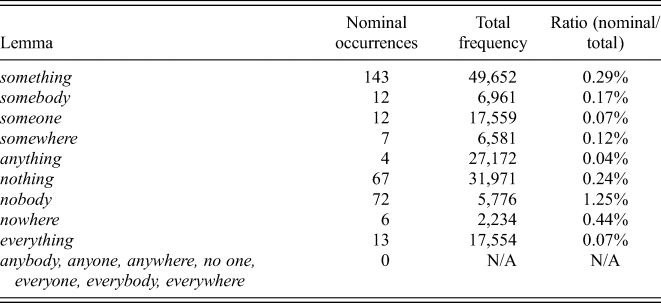
Moreover, these nominal CoPros are much more infrequent than nobody2. Table 2 shows the ratio between the occurrences of nominal use and total frequencies.Footnote 20 While more than 1 per cent of nobody are used as nouns, which helps to establish nobody2 as a polysemous word to nobody1, no other nominal CoPro occurs more frequently than 0.5 per cent. Therefore, despite the recognition of the nominal use, the two observations above suggest that nominal CoPros (apart from nobody2) are marginal in English.
CoPros used as nouns in the BNC

5.3 Reanalysis
Historically, nominal CoPros are a later development.Footnote 21 They exemplify the process of reanalysis, in which the two parts are fossilised or ‘morphologised’ (see Hopper & Traugott Reference Hopper and Traugott2003: 140) and their functions disappear. Despite the retention of basic semantics (except nobody2), reanalysed CoPros have become compounds similar to inmate in (10a), which freely takes premodifiers or determinatives and inflects for number. This may be driven by a series of pragmatic needs. For example, the use of nominal CoPro nothing in (43b) creates another example of neat parallelism (see section 3.3.1). Also, the disappearance of the fully functioning indefinite determinatives weakens the generic readings of CoPros, making them somewhat more specific (44a, b).
(44)
(a) You, Jalal Shamlou, are that very special someone. And you have had the dream. (BNC: CEC)
(b) Almost all his climbs have a certain something: a thinly disguised air of intimidation often allied to a raw brutality. (BNC: ECH)
In (44a, b), someone and something receive a more specific reading, with their meanings closer to ‘one/person’ and ‘thing’. This is further reinforced by the introduction of that in (44a), which adds definiteness to the whole NP.
The most prominent advantage for nominal CoPros, however, may be that they can bypass a number of restrictions on their phrasal counterparts:
(45)
(a) . . . but it was no mere something, void of qualities, but rather a thing which could be grasped . . . (bit.ly/2ZOyzxA)
(b) White boys like you make babies and go away to school to nice places where you find some neat little someone to marry who's still got her cherry. (COCA: 1992_FIC_VirginiaQRev)
While the modifier of a phrasal CoPro is restricted in kind (predicative) and number (one, excluding else), nominal CoPros are not limited in this way. Hence in (45a) something, as a noun, can be modified by an attributive-only adjective (mere), and someone in (45b) freely takes multiple modifiers (cf. *someone neat little).
Nevertheless, it should also be acknowledged that the distinction between phrasal CoPros and nominal CoPros is often not remarkable in the speaker's mind. In (46a) I observe the coexistence of both uses in a single sentence, and (46b) can be trickier: the CoPro something simultaneously takes an external determinative (which is the property of nominal CoPros) and a adjectival postmodifier (which is a typical characteristic of phrasal CoPros), rendering the status of something indeterminable – although we may tentatively interpret this example as an inadvertent confusion of the two uses.
(46)
(a) . . . but the reader attends in tragic wonder, for he understands that Marmeladov has indeed nowhere to go, a nowhere which is the finality of his loose end . . . (BNC: A18)
(b) Coleridge lamenting that . . . there was a something corporeal, a matter-of-fact-ness, a clinging to the palpable, or often to the petty, in his poetry, in consequence. (BNC: B0R)
5.4 The bases -where and -time
Finally, I want to address some issues related to compounds with -where and -time. I argued in section 2.1 that the base -where could on some occasions be considered nominal, making somewhere/anywhere/nowhere equivalent to some place/any place/no place. The situation, however, is far more complicated in (47a–e).
(47)
(a) Instead they find nowhere to live, nothing to eat and poor health and education. (BNC: JNF)
(b) We've had I think forty-five enquiries and definitely one lady wants seventy from Sussex or somewhere . . . (BNC: J9P)
(c) If he was going anywhere I thought he would have come here for Premier League football. (BNC: CH3)
(d) He had seen the lie, but was nowhere near the truth. (BNC: FP7)
(e) Sadly, the game is nowhere near as polished as the films. (BNC: CEK)
Examples (47a–b) strongly suggest the nominal nature -where compounds, because the grammatical functions of object (47a) and prepositional complement (47b) are usually realised by NPs. In (47c), anywhere is better analysed as a locative intransitive preposition or an adverb, depending on different theoretical frameworks. An anonymous viewer argues that in nowhere near/close to the word nowhere is an adverb modifier of near/close, which is plausible in (47d) but not in (47e): nowhere near in the latter case is clearly not an AdjP, but an idiomatic negator equivalent to ‘not’.
The chaos related to the analysis of -where compounds is partly due to the confusing nature of where. There have been arguments that where is intrinsically nominal preceded by empty prepositions (e.g. Caponigro & Pearl Reference Caponigro, Pearl, Asbury, Dotlačil, Gehrke and Nouwen2008; see also Larson Reference Larson1985), and a result of this fuzzy status is that each of (47a–c) are fully acceptable. On the other hand, some/any/no place behave more like NPs as the base place is unquestionably nominal: in the BNC there are 79 attestations of going nowhere but only one of going no place.
Compounds with -time are rarely mentioned in grammars. Nonetheless, the distribution of those words is similar to that of -where compounds, as (48a–c) show:
(48)
(a) Hong Kong remains almost as uncompetitive as it has been at anytime since 1986, and is far less competitive than a year ago. (BNC: CRA)
(b) It started sometime in March, not long after Eric's arrival. (BNC: J1H)
(c) Leon was a stockbroker, a sometime Liberal M.P. for North Bucks, and a part-proprietor of the Daily News. (BNC: AMC)
While anytime, as prepositional complement in (48a), is most likely nominal, the status of sometime in (48b) would be debatable between an NP and an adverb. Again, it might be argued, following Larson (Reference Larson1985), that before sometime there is an empty preposition, but it is beyond the scope of this article. Finally, sometime in (48c) should be considered as polysemous for two reasons: first, it has a different meaning, namely ‘former’; second, unlike the examples in (48a, b), it does not have the form of ‘some time’ (e.g. *a some time Liberal M.P.).
6 Conclusion
This article analyses the syntactic behaviour of compound pronouns by examining their coordination and modification patterns. It concludes that CoPros have a dual identity of being morphological compounds, but syntactic phrases, contra both the traditional view of classifying CoPros as compounds and Kishimoto (Reference Kishimoto2000), who takes them as purely phrases. The dual identity results in distinctive modification patterns, for which a paradigm, based on Larson & Marušič (Reference Larson and Marušič2004), is devised.
An important implication of the proposal of compound phrases is that morphology constantly interacts with syntax and may function as the basis for syntactic operations. The relations between morphology and syntax have been debated for decades (Borer Reference Borer2013) and this study shows that in the case of CoPros, the morphological shapes cannot be overlooked during the analyses of the syntax.
Furthermore, the modification patterns, especially the possible multiple modification of CoPros, deserve more attention. Although the paradigm I propose successfully accounts for common modifiers, there are still some exceptions, such as anything available new. Speakers of English may feel such constructions to be less acceptable, yet data extracted from corpora indicate that they should not be simply ignored.
Finally, I discuss the special nominal CoPros. Despite their marginal use, nominal CoPros enrich the CoPro family both in semantics (e.g. nobody2 has a different denotation) and in syntax (e.g. the ability to take attributive-only modifiers), and it is perhaps this enrichment that continuously motivates grammatical changes.