


What is the impact of international intervention on the rule of law in conflict and postconflict settings? The rule of law is widely considered a necessary condition for peace, good governance, and economic growth, especially in countries recovering from civil war (Rajagopal Reference Rajagopal2008, 1348). Where the rule of law is strong, disputes can be resolved through transparent, publicly promulgated laws enforced by fair and accountable security and justice institutions—police forces, courts, prisons—rather than vigilantism or violence. Perhaps no international organization has embraced these principles more enthusiastically than the United Nations (UN). Rule-of-law promotion is now considered a “core peacekeeping task” (Carlson Reference Carlson2006, 2) and an “integral part of the UN’s approach to peace and security” (Sannerholm et al. Reference Sannerholm, Möller, Simion and Hallonsten2012, 14). A rule-of-law imperative is explicit in numerous UN resolutions and reports and in the mandates of nearly every UN peacekeeping operation on the ground today.Footnote 1
Yet despite “exploding practical interest,” evidence on the efficacy of third-party rule-of-law promotion remains “surprisingly limited” (Haggard and Tiede Reference Haggard and Tiede2014, 406). Most research continues to focus on the effects of international intervention on violence against civilians and civil war recurrence (Doyle and Sambanis Reference Doyle and Sambanis2006; Fortna Reference Fortna2008a; Gilligan and Sergenti Reference Gilligan and Sergenti2008; Hultman, Kathman, and Shannon Reference Hultman, Kathman and Shannon2013; Reference Hultman, Kathman and Shannon2014).Footnote 2 To my knowledge, only one other study has tested the relationship between UN presence and the rule of law cross-nationally, but even the authors characterize their results as “preliminary” (Haggard and Tiede Reference Haggard and Tiede2014, 413–14). Another study tests the relationship sub-nationally in Liberia, but these findings may not generalize to national-level reform processes (Blair Reference Blair2019). The rule of law has been described as one of the “few but fortunate concepts that has universal support” (Sitaraman Reference Sitaraman2012, 183), even the “nearest we are likely to approach to a universal secular religion” (Bingham Reference Bingham2011, 174). Yet we know surprisingly little about how to establish it, especially in the world’s weakest and most war-torn states—arguably the settings in which it is most urgently needed.
In this paper I develop and test a theory to explain the conditions under which UN missions are likely to succeed in restoring the rule of law after conflict. My theory departs from existing quantitative studies, most of which conceptualize UN intervention as a mechanism for mitigating commitment problems and information asymmetries between armed actors, typically through the interposition of UN troops and military observers (Doyle and Sambanis Reference Doyle and Sambanis2006; Hultman, Kathman, and Shannon Reference Hultman, Kathman and Shannon2014; Ruggeri, Dorussen, and Gizelis Reference Ruggeri, Dorussen and Gizelis2017). I draw instead on constructivist accounts emphasizing the UN’s power to shape laws, institutions, and behaviors without the use or threat of physical force, often through the efforts of civilian rather than uniformed personnel (Barnett and Finnemore Reference Barnett and Finnemore1999; Finnemore and Sikkink Reference Finnemore and Sikkink1998; Howard Reference Howard2019; Whalan Reference Whalan2014). These accounts have been highly influential in qualitative peacekeeping research, but have been all but lost in the quantitative literature.
Drawing on constructivist insights, I conceptualize third-party rule-of-law promotion as a form of contested norm diffusion. I argue that UN missions instill norms that are consistent with the rule of law through a combination of four mechanisms—education, inducement, persuasion, and oversight—targeting four links in the “justice chain:” police forces, courts, prisons, and laws. I then identify three sources of variation in the efficacy of the UN’s efforts, related to the personnel deployed to each UN mission, the activities they pursue in the field, and the timing of those activities. I test my theory by combining existing data on the number of uniformed personnel deployed to each UN mission in Africa since the end of the Cold War with three original datasets capturing the number of civilian personnel deployed to each UN mission in Africa, the number of personnel assigned specifically to rule-of-law-related tasks, and the extent and nature of the UN’s actual rule-of-law-related activities on the ground. These datasets are gleaned from sources that have never or only rarely been used for purposes of research. I focus on Africa because it remains the locus of UN peacekeeping worldwide. I focus on the period after the Cold War because this is when the UN has been most active in pursuing rule-of-law reform.
Consistent with my theory, I find that the rule of law improves as the number of personnel deployed to a UN mission increases, but that the magnitude of the correlation is smaller for uniformed personnel than for civilian personnel or personnel assigned specifically to rule-of-law-related tasks. Among uniformed personnel, the correlation is smaller for troops than for UN police officers, who tend to be more intimately involved in rule-of-law promotion; among civilian personnel, the correlation is smaller for national than for international staff, who tend to be better paid and enjoy higher status within UN missions. I also find that the rule of law improves when UN missions actually pursue rule-of-law-related activities in the field, but that the magnitude of the correlation is larger when they engage host states in the process of reform, rather than bypassing them altogether. Finally, I find that the correlation between UN presence and the rule of law is weak or even negative during ongoing civil wars, but strongly and consistently positive after a peace process has begun.
These are correlations, not relationships of cause and effect. Nonetheless, consistent with other recent studies (Doyle and Sambanis Reference Doyle and Sambanis2006; Fortna Reference Fortna2008a; Gilligan and Stedman Reference Gilligan and Stedman2003), I show that UN missions tend to focus on the “hard” cases, expanding in size as threats to the rule of law become more severe and pursuing rule-of-law-related activities at moments when they are least likely to succeed. This suggests that if anything, my results are likely to under- rather than overestimate the efficacy of the UN’s efforts. I use fixed effects to eliminate time-invariant confounders and a variety of controls to mitigate time-varying confounders. In a placebo test I also show that the relationship between UN intervention and the rule of law is not a byproduct of other activities that UN missions pursue in the field.
My theoretical framework and empirical results stand in contrast to the pessimism that pervades much of the academic and policy literature on third-party rule-of-law promotion. Clunan and Trinkunas (Reference Clunan and Trinkunas2010, 288), for example, criticize the international community’s rule of law agenda as “breathtakingly mechanistic.” Ledwidge (Reference Ledwidge2017, 143, 162) argues that third-party rule-of-law reform is at best ineffective and at worst counterproductive. Some of this skepticism is a result of a lack of research. Kavanagh and Jones (Reference Kavanagh and Jones2011, 26) suggest that given the “dearth of knowledge and evidence,” policy makers should lower “rule-of-law expectations in highly complex and volatile settings.” My theory and results suggest that such skepticism may be unwarranted, and that UN intervention can be an effective mechanism for restoring the rule of law even in the world’s weakest and most war-ravaged states.
Threats to the rule of law in conflict and postconflict settings
The UN conceptualizes the rule of law as a set of principles according to which both citizens and the state are held accountable to laws that are “publicly promulgated, equally enforced, and independently adjudicated” and which are “consistent with international human rights norms and standards.” Establishing the rule of law thus requires ensuring “adherence to the principle of supremacy of law, equality before the law, accountability to the law, fairness in the application of the law, separation of powers, participation in decision making, legal certainty, avoidance of arbitrariness, and procedural and legal transparency” (UN Secretary-General 2008, 1). The UN’s conceptualization of the rule of law is grounded in the organization’s charter, as well as the Universal Declaration of Human Rights and other foundational documents developed over the past century. The UN’s definition also encompasses prominent accounts of the rule of law in both legal and political theory (Sannerholm et al. Reference Sannerholm, Möller, Simion and Hallonsten2012). While the UN’s rule-of-law agenda targets both citizens and states, for simplicity I focus in this paper on states alone. For an analysis of the UN’s approach to instilling rule-of-law principles among citizens, see Blair (Reference Blair2019).
Many (though not all) threats to the rule of law can be traced to weaknesses in one of four links in the “justice chain:” police forces, courts, prisons, and laws themselves (HIPPO 2015, xi). When police officers inflict extrajudicial punishments or discriminate against ethnic minorities, they violate the principles of equal enforcement, equality before the law, and fairness in the application of the law. When judges issue rulings that systematically favor incumbent over opposition parties, they violate the principle of separation of powers. When prison officials detain suspects indefinitely, or for capricious or political reasons, they violate the principles of avoidance of arbitrariness and procedural and legal certainty. And when laws themselves are vague, opaque, or contradictory, they violate the principles of public promulgation and legal transparency.
Reforming host state police forces, courts, prisons, and laws is a necessary (if not sufficient) condition for establishing the rule of law, and the UN’s rule-of-law agenda targets all four of these links in the justice chain. Police, court, and prison reform involve efforts to alter the attitudes and behaviors of individual police officers, judges, prosecutors, wardens, and guards and to restructure the institutions within which those individuals operate. Legal reform involves efforts to pass new laws and amend existing ones in accordance with local and international standards. These four categories of reform are interdependent and mutually reinforcing, and UN missions almost always pursue them simultaneously. Indeed, as we will see, the four categories of reform are so highly correlated that it is impossible to disentangle their effects empirically.
Mechanisms for neutralizing threats to the rule of law
Strengthening the justice chain is not merely a technical exercise. It is also a deeply political one. Drawing on the constructivist literature in international relations, I argue that third-party rule-of-law promotion is best understood as a form of contested norm diffusion. The dynamics of norm diffusion have been studied most directly in the context of human rights (e.g., Greenhill Reference Greenhill2015), but they are equally relevant to the rule of law. Like other norms, the rule of law emerges in a “highly contested normative space” where it competes with other norms, rules, habits, and perceptions of interest (Finnemore and Sikkink Reference Finnemore and Sikkink1998, 897). I argue that four features of this normative space are especially problematic for the rule of law. These relate to state actors’ competencies, incentives, beliefs, and accountability. UN missions attempt to overcome these challenges through a combination of education, inducement, persuasion, and oversight.
In this section I describe each of these challenges and mechanisms in turn. I offer brief empirical examples of the mechanisms at work, as well as a more detailed description of the way they were operationalized in the case of Liberia. The mechanisms are not mutually exclusive, and in some cases may be overlapping—for example, when UN-funded infrastructure simultaneously incentivizes and enables civil servants to perform their duties more effectively. I conclude by identifying three sources of variation in the efficacy of the UN’s rule-of-law agenda, related to the personnel deployed to each UN mission, the activities they pursue on the ground, and the timing of those activities. These three sources of theoretical variation generate five empirical hypotheses for me to test.
Competencies and Education
Some state actors violate rule-of-law principles because they do not understand them or lack the skills or resources to adhere to them. In Liberia, for example, where the legal system incorporates elements of US common law, inadequately trained judges have often issued apparently arbitrary rulings because they do not understand the distinction between precedents based on US common law and those based on US statutes that do not apply in Liberia (Lubkemann, Isser, and Banks III Reference Lubkemann, Isser, Banks and Isser2011, 205). This is a problem of competencies, which UN missions attempt to solve through training, technical support, and other forms of education, broadly defined.
Education is one of the UN’s most widely used mechanisms for socializing state actors to align their behavior with rule-of-law (and other) principles (Howard Reference Howard2019). In the Central African Republic (CAR), for example, BINUCA helped the Ministry of Justice revise the Criminal and Criminal Procedure Codes in accordance with international law, then hosted seminars to improve understanding of the Codes among judges, lawyers, law school professors, court clerks, police officers, and gendarmes. The mission also sought to educate both citizens and state actors on their new legal rights and responsibilities by distributing some 3,000 hard copies of the Codes nationwide (UN Criminal Law and Judicial Advisory Service 2013).
Incentives and Inducement
Other state actors have the skills and information necessary to adhere to rule-of-law principles, but violate them because they benefit from doing so. In the Democratic Republic of the Congo (DRC), for example, police officers derive much of their income from institutionalized illicit transfers, including extortion of civilians. This is a problem of incentives, which UN missions attempt to solve through inducement. Like other international organizations, UN missions “have the advantage of resources and leverage over weak or developing states they seek to convert to their normative convictions” (Finnemore and Sikkink Reference Finnemore and Sikkink1998, 900). They use these resources and leverage as mechanisms of inducement.
In particular, UN missions are conduits for funding and other forms of material support from the international community, which are often tied to the implementation of particular reforms. In Côte d’Ivoire, for example, UNOCI raised millions of dollars to rehabilitate the courts and prisons while also creating an office within the Ministry of Justice to vet and monitor judges (UN Department of Peacekeeping Operations 2010, 10). In Côte d’Ivoire and elsewhere, state actors who benefit from the increased capacity that UN missions provide may be willing to undertake other, potentially more controversial reforms in order to secure additional material support. Like education, inducement can also enable state officials to perform their duties more effectively (and potentially more consistently with rule-of-law principles)—for example by paying the salaries of civil servants or by providing police officers with vehicles and computers.
Beliefs and Persuasion
Other state actors violate rule-of-law principles because they do not believe those principles are acceptable, appropriate, or legitimate. In Mali, for example, justice sector personnel often refuse to investigate abuses by state security forces because they believe due process protections should not extend to suspected enemies of the state (Human Rights Watch 2018, 359–62). This is a problem of beliefs, which UN missions attempt to solve through persuasion (Howard Reference Howard2019, 42). International organizations “are rarely able to coerce agreement to a norm—they must persuade” (Finnemore and Sikkink Reference Finnemore and Sikkink1998, 900). In South Sudan, for example, UNMISS established liaison officers in prisons and mobile courts in order to “change the mindset of judges, prosecutors, and prison officials regarding prolonged and arbitrary detention” (UN Department of Peacekeeping Operations 2014, 6, my emphasis). These initiatives are designed to “take what is seen as natural or appropriate and convert it into something perceived as wrong” (Finnemore and Sikkink Reference Finnemore and Sikkink1998, 900).
Accountability and Oversight
Finally, some state actors violate rule-of-law principles because they do not expect to be caught or punished for doing so. In Côte d’Ivoire, for example, a breakdown in civilian control over the police, army, and gendarmerie fostered impunity as “renegade forces” created “pockets of disobedience and insubordination” (Outtara Reference Outtara, Bryden, N’Diaye and Olonisakin2008, 82, 89). This is a problem of accountability, which UN missions attempt to solve through monitoring, surveillance, and other forms of oversight.
Oversight constitutes a mechanism of “accountability politics” whereby “increased attention, followed by changes in discursive positions” make state actors more “vulnerable” to reform (Keck and Sikkink Reference Keck and Sikkink1998, 26). When combined with arm-twisting or naming and shaming, oversight can also serve as a mechanism of coercion that does not rise to the level of physical force (Howard Reference Howard2019, 141). In Namibia, for example, UNTAG police officers trained their local counterparts in “policing by consent” standards, then monitored compliance with those standards by conducting joint foot and vehicle patrols, codeploying in police stations, and reporting acts of misconduct up the chain of command (Howard Reference Howard2008, 75–6).
Empirical example of the UN’s rule-of-law agenda in Liberia
To illustrate, consider the case of UNMIL in Liberia. UNMIL attempted to strengthen all four links in the Liberian justice chain through a combination of all four mechanisms described above. In its efforts to reform the Liberian National Police (LNP), for example, UNMIL required that officers reapply under more stringent eligibility criteria before undergoing a combined nine months of field and academy training. The mission developed similar training regimens for magistrates, judges, court clerks, lawyers, and prison guards. UNMIL combined education with inducement in the form of material support, including rehabilitation of the LNP Training Academy in Monrovia and the reopening of 20 circuit courts, over 150 magistrate courts, and 16 prisons (UN Office of Rule of Law and Security Institutions 2018).
Given the physical destruction wrought by the Liberian civil wars, infrastructure served as an important inducement for state actors to comply with UNMIL’s agenda. UNMIL simultaneously used persuasion to advocate for legal and institutional reforms related to sexual and gender-based violence, judicial independence, jury selection, and pretrial detention, among many other issues (Sannerholm et al. Reference Sannerholm, Möller, Simion and Hallonsten2012, 31). The mission also used persuasion when training security and justice sector personnel, combining “hard” skills like forensics and crowd control with “softer” skills, such as respect for the rights of women and children.
UNMIL monitored adherence to these standards through codeployments in police stations, courts, and prisons, and through the introduction of new oversight and accountability mechanisms, including a Professional Standards Division for police officers, a Grievance and Ethics Committee for judges, and a Case Flow Management Committee for prison wardens (UN Office of Rule of Law and Security Institutions 2018). UNMIL thus pursued police, court, prison, and legal reform simultaneously, through a combination of education, inducement, persuasion, and oversight. Nor was UNMIL unique in this respect. The mission shared many similarities with other peacekeeping operations in Africa (Howard Reference Howard2008, 312), and its approach to rule-of-law promotion is now typical of UN missions throughout the continent and worldwide.
Variation in the efficacy of the UN’s rule-of-law agenda
Nearly all contemporary UN missions are mandated to promote the rule of law by strengthening the four links in the host state’s justice chain. But the efficacy of these efforts varies across time and space. In this paper I focus on three sources of variation in particular. The first relates to capacity and composition, as reflected in the number and type of personnel deployed to each UN mission. The second relates to mandate implementation, as reflected in the nature and extent of actual rule-of-law-related activities in the field. The third relates to the timing of these activities. Each of these theoretical sources of variation generates one or more empirical hypotheses for me to test.
Personnel: Capacity and Composition
UN missions vary in their capacity to pursue rule-of-law reform. While capacity has many dimensions, most scholars proxy for it using personnel numbers (Hultman, Kathman, and Shannon Reference Hultman, Kathman and Shannon2013; Reference Hultman, Kathman and Shannon2014; Kathman et al. Reference Kathman, Beardsley, Gizelis, Olsson, Bove, Ruggeri and Zwetsloot2017). Personnel numbers matter for rule-of-law promotion for at least two reasons. First, efforts to reform the four links in the justice chain are labor intensive, especially when undertaken simultaneously. The larger the mission, the more human resources it can devote to these tasks. Second, reform is more likely to succeed when state actors believe the international community is committed to the process. Personnel numbers are arguably the “strongest observable signal of the UN’s resolve” (Ruggeri, Gizelis, and Dorussen Reference Ruggeri, Gizelis and Dorussen2012, 388).
But not all UN personnel contribute equally to the UN’s rule-of-law agenda. Most quantitative peacekeeping studies focus exclusively on uniformed personnel (Hultman, Kathman, and Shannon Reference Hultman, Kathman and Shannon2013; Reference Hultman, Kathman and Shannon2014; Ruggeri, Gizelis, and Dorussen Reference Ruggeri, Gizelis and Dorussen2012). Uniformed personnel can have important indirect effects on the rule of law by maintaining stability, neutralizing spoilers, and creating the conditions under which more direct attempts at reform can occur. But rule-of-law principles are unlikely to become entrenched through the presence of uniformed personnel alone. Arguably more important are the UN’s civilian personnel, who are almost solely responsible for court, prison, and legal reform, and who share responsibility for police reform with UN police officers.
UN civilian and police contingents perform “critical functions” that cannot be easily outsourced to their military counterparts, including “developing national rule of law plans and strategies, coordinating national and international stakeholders, advising on justice matters, and providing technical expertise” (Sannerholm et al. Reference Sannerholm, Möller, Simion and Hallonsten2012, 8). While UN troops and military observers may be more effective at separating belligerents, UN civilian and police personnel are likely to be more effective at educating, inducing, persuading, and overseeing host state police forces, courts, prisons, and legislatures. As the UN itself has acknowledged, these initiatives require significant “civilian capacity” (HIPPO 2015, 41).
Rule-of-law reform is also more likely to be effective when UN missions assign civilian and police personnel specifically to rule-of-law-related tasks. Rule-of-law reform demands “dedicated capacities” (UN Secretary-General 2006, 1–2, 8) and “specialized expertise” (HIPPO 2015, 41). Assigning personnel specifically to rule-of-law-related tasks is especially important in missions with complex, multidimensional mandates, where potentially competing goals can undermine the mission’s ability to pursue any of them effectively (Blair, di Salvatore, and Smidt Reference Blair, di Salvatore and Smidt2020). By assigning personnel specifically to rule-of-law-related tasks, missions help ensure that rule-of-law promotion remains a priority even as mandated tasks proliferate. My first two hypotheses follow from these observations:
Hypothesis 1 (capacity): The rule of law improves as the number of personnel deployed to a UN mission increases. But:
Hypothesis 2 (composition): The magnitude of the relationship between UN personnel and the rule of law is smaller for uniformed personnel than for (a) civilian personnel or (b) personnel assigned specifically to rule-of-law-related tasks.
Activities: Mandate Implementation and Engagement with Host States
Even UN missions with similar mandates may implement those mandates in different ways (Kathman et al. Reference Kathman, Beardsley, Gizelis, Olsson, Bove, Ruggeri and Zwetsloot2017), and even missions with similar capacities and compositions may vary in the activities they pursue in the field (Smidt Reference Smidt2016). UN missions exercise discretion over these tactical and operational decisions, allowing them to execute their mandates in unintended and unanticipated ways (Barnett and Finnemore Reference Barnett and Finnemore1999, 699). As Blair, di Salvatore, and Smidt (Reference Blair, di Salvatore and Smidt2020) show, the extent to which a given UN mission even attempts to fulfill the tasks assigned to it in its mandate can fluctuate dramatically from one year to the next. These fluctuations constitute an important but understudied source of peacekeeping success or failure (Lipson Reference Lipson2010). I argue that establishing the rule of law requires reforming the four links in the justice chain. Whether peacekeepers succeed in instituting these reforms depends on whether they actually attempt to do so.Footnote 3
Even peacekeeping operations that pursue the same combination of police, court, prison, and legal reform may do so in different ways. I argue that UN missions are most successful when they pursue rule-of-law reform through a combination of education, inducement, persuasion, and oversight. Importantly, all of these mechanisms involve engaging host states in the reform process. But as Dorussen and Gizelis (Reference Dorussen and Gizelis2013, 6) note, the nature of peacekeepers’ “specific involvement” with host states “varies widely from technical assistance and monitoring to direct line authority or even direct implementation”—that is, performing mandated tasks without host state involvement. In CAR, for example, MINUSCA was authorized to use “Urgent Temporary Measures” to maintain law and order in areas where the police and courts were absent or dysfunctional. Other missions have similarly bypassed host states in the process of reform.
But this approach is risky, for at least five reasons. First, UN missions that bypass host states may weaken the capacity of the very same institutions they are ostensibly mandated to strengthen (Lake Reference Lake, Hoddie and Hartzell2010). Second, bypassing host states may provoke backlash from state actors, who may “contest peacekeeping actions that replace rather than improve their regulatory capacity” (Dorussen and Gizelis Reference Dorussen and Gizelis2013, 6). Third and related, bypassing may create incentives for state actors to erect “parallel structures of government” that later pose “serious obstacles” to the rule of law (Beauvais Reference Beauvais2001, 1117).
Fourth, UN missions that bypass host states may forgo opportunities to influence the beliefs and behaviors of government officials and the structure of government institutions. This may prolong the reform process, thus allowing state dysfunction and predation to persist. Fifth, bypassing host states may increase the risk that reforms prove inappropriate or inadequate for the contexts in which they are implemented. For all of these reasons, the UN itself has advocated for “high-level political engagement in support of national [reform] efforts” (HIPPO 2015, x) and has urged peacekeepers to “identify, support, and empower domestic reform constituencies” rather than circumvent them (UN Secretary-General 2004, 8). My third and fourth hypotheses therefore predict the following:
Hypothesis 3 (mandate implementation): The rule of law improves when a UN mission actually pursues rule-of-law-related activities in the field—in particular police, court, prison, and legal reform. But:
Hypothesis 4 (engagement with host states): The magnitude of the relationship between UN activities and the rule of law is larger when a mission engages the host state in the process of reform—in particular through education, inducement, persuasion, and oversight—rather than bypassing it altogether.
Timing
Finally, UN missions vary in the timing of their deployments and the activities they pursue. In particular, peacekeepers are increasingly expected to advance the UN’s rule-of-law agenda even in settings where civil war is ongoing. Indeed, as we will see, UN missions are actually more likely to pursue rule-of-law reform during periods of conflict than periods of peace. But reform is also less likely to succeed amidst ongoing civil war. During periods of conflict, UN missions risk being perceived not as impartial forces but as warring parties, thus exposing themselves to threats of violence (Karlsrud Reference Karlsrud2015). Rule-of-law reform is less likely to be effective when UN personnel are preoccupied with protecting themselves, and civilians, from imminent physical harm.
Moreover, as critics both inside and outside the UN system have warned, UN missions are often “poorly suited to these operating environments,” making their mandates “less achievable” (HIPPO 2015, x, 47). Not coincidentally, previous studies have found that peacekeeping operations are less successful during periods of conflict than periods of peace (Doyle and Sambanis Reference Doyle and Sambanis2006; Gilligan and Sergenti Reference Gilligan and Sergenti2008). Challenges that UN missions struggle to overcome in peacetime become even more intractable in the “fog of war,” including culture clashes, turf battles, and coordination problems both between and within civilian and uniformed contingents (Blair, di Salvatore, and Smidt Reference Blair, di Salvatore and Smidt2020), which comprise personnel from diverse settings, with disparate levels of training and expertise. This is especially problematic for the UN’s rule-of-law agenda, which requires carefully coordinating efforts to reform the four links in the justice chain simultaneously.
Perhaps most important, state actors are unlikely to have the will or capacity to participate in the reform process if they are busy fighting rebel groups. Indeed, state actors may reject some reforms out of hand if they are perceived as impediments to counterinsurgency (Blair, di Salvatore, and Smidt Reference Blair, di Salvatore and Smidt2020)—restrictions on pretrial detention, for example, or on the use of force by police officers. Peace processes create “windows of opportunity” for reform (Call Reference Call2007, 11), and the UN itself has identified the first few years after civil war termination as the most “opportune moment to work for change” (Carlson Reference Carlson2006, 2). This window of opportunity is likely to be narrower when there is no peace to keep, and even reforms that begin during conflict are only likely to become institutionalized after the fighting stops. My fifth hypothesis follows from these propositions:
Hypothesis 5 (timing): The magnitude of the relationship between the rule of law and both (a) personnel and (b) activities is larger during periods of peace than periods of civil war.
Data
Operationalizing UN Personnel and Activities
My theory predicts that the efficacy of UN rule-of-law promotion should vary as a function of UN personnel, activities, and timing. I operationalize UN personnel and activities using four sources of data. First, I use Providing for Peacekeeping (P4P) data on the number of uniformed personnel deployed to each UN mission in Africa since 1990.Footnote 4 While P4P distinguishes between UN troops, police officers, and military observers, different categories of uniformed personnel tend to be highly correlated with one another, and I combine them into a single count. I discuss the issue of multicollinearity in further detail in Appendix G, and in Appendix J I disaggregate military and police personnel, as the latter tend to be more intimately involved in rule-of-law reform than the former. Figure A.1 plots the distribution of uniformed personnel across Africa.
Often it is the UN’s civilian components that are most directly responsible for advancing the UN’s rule-of-law agenda. I use annual budget performance reports prepared by the UN’s Advisory Committee on Administrative and Budgetary Questions (ACABQ) to build what is, to my knowledge, the first dataset of civilian contributions to UN peacekeeping operations. ACABQ reports distinguish four categories of civilian personnel: international staff, national staff, government-provided personnel (GPPs), and UN Volunteers (UNVs). To avoid multicollinearity, I again collapse these categories into a single count. In Appendix K, I disaggregate international and national civilian staff, as the former tend to be better paid and enjoy higher status within UN missions than the latter. Figure A.2 plots the distribution of civilian personnel across the nine African countries for which budget performance reports are available.Footnote 5
Even within the civilian components of UN missions, different personnel play different roles. I use the UN Secretary-General’s annual budget requests to code the number of UN personnel assigned specifically to rule-of-law-related tasks. Budget requests are unique in specifying the number of personnel assigned to each dimension of a mission’s mandate, as the example in Figure A.3 illustrates. But budget requests are also limited in two ways. First, in most cases budget requests only begin drawing distinctions between mandate components in 2003. Second, budget requests only capture the number of personnel approved by the UN General Assembly. As I discuss in Appendix C, however, the correlation between approved and actual personnel numbers is generally very close to 1.00, suggesting that the former is a useful proxy for the latter. I discuss my coding rules and missing data issues in detail in Appendix C. To my knowledge, this is the first dataset to disaggregate UN personnel by mandate component. Figure A.4 plots the distribution of UN personnel assigned specifically to rule-of-law-related tasks across the nine countries for which budget requests are available.
Finally, in collaboration with Hannah Smidt, I use UN Secretary-General progress reports to code the extent to which UN missions actually pursue rule-of-law-related activities on the ground. Progress reports are typically published four to seven times per year. We use them to code 37 different activities from 1989 to 2016, ranging from demining to voter education to humanitarian relief, and encompassing virtually the entire universe of activities that UN missions implemented during these years. Following my theoretical framework, I focus on activities targeting the four links in the justice chain—police forces, courts, prisons, and laws—through four mechanisms of engagement with host states: education, inducement, persuasion, and oversight. I also code implementation of rule-of-law reform without host state involvement. In Appendix D, I discuss coding rules, intercoder reliability, and limitations—in particular, the possibility that progress reports may be selective and may emphasize activities that the UN believes best reflect its achievements. Our Peacekeeping Activities Dataset (PACT) extends earlier efforts by Ruggeri, Gizelis, and Dorussen (Reference Ruggeri, Gizelis and Dorussen2011) and Smidt (Reference Smidt2016). PACT is more comprehensive than its predecessors, substantively, geographically, and temporally. I compare PACT to these other datasets in Appendix D.
Table A.1 summarizes the prevalence of police, court, prison, and legal reform in the PACT dataset. Table A.1 also summarizes the prevalence of rule-of-law-related education, inducement, persuasion, and oversight. The UN typically pursues all four categories of reform simultaneously, using a combination of all four mechanisms of engagement, and the pairwise correlations between rule-of-law-related activities are very high—always between 0.68 and 0.91. These correlations are important in themselves, as they suggest the UN has succeeded in pursuing a relatively “balanced and holistic” approach to rule-of-law reform (Carlson Reference Carlson2006, 2). Simultaneity is, however, disadvantageous for my analysis, as multicollinearity prevents me from estimating the effects of each activity conditional on the others.
Operationalizing the Rule of Law
To operationalize the rule of law, I rely primarily on two widely used indices from the World Bank and Freedom House. Freedom House’s rule-of-law index is based on reports from country and subject matter experts. The World Bank’s index aggregates data from 32 public, private, and nonprofit sources, including Freedom House. The World Bank’s index is available for most countries in the world beginning in 1996. The Freedom House index is available for most countries beginning in 2003. The World Bank’s index is standardized to have 0 mean and unit standard deviation globally. To facilitate comparison to other regions, I do not restandardize to the countries in my sample. Freedom House’s index is scaled from 0 to 16. Table A.2 reports descriptive statistics, and Figures A.5 and A.6 plot trends in the two indices over time.
The World Bank defines the rule of law as “the extent to which agents have confidence in and abide by the rules of society, and in particular the quality of contract enforcement, property rights, the police, and the courts, as well as the likelihood of crime and violence.”Footnote 6 This definition is both broader and narrower than the UN’s, encompassing some secondary dimensions of the rule of law (the incidence of crime, for example) while ignoring some primary ones (for example, the extent to which laws are publicly promulgated). Nonetheless, the World Bank’s definition echoes the UN’s and captures several key components of the rule of law, including the quality of state security and justice provision and the extent to which government officials adhere to legal and constitutional constraints. Among the variables in the World Bank’s index are 16 proxies for the fairness, efficacy, and reputation of the courts; five indicators for the reliability of the police; and four measures of the independence of the judiciary. A list of sources included in the index is in Appendix A.
Freedom House’s definition of the rule of law comprises four parts: independence of the judiciary, respect for due process, protection from the “illegitimate use of physical force and freedom from war and insurgencies,” and equality of access to justice.Footnote 7 While also somewhat broader than the UN’s, Freedom House’s definition incorporates country experts’ responses to a battery of questions that correspond closely to the UN’s understanding of the rule of law. A list of these questions is in Appendix B. Importantly, while Freedom House includes “freedom from war and insurgencies” as one component of the rule of law, scores on the index vary widely even during periods of conflict.Footnote 8
The rule of law is a multidimensional concept, and the World Bank and Freedom House indices are broad enough to capture multiple dimensions simultaneously. As a robustness check, Appendices L through N replicate my analysis using four narrower indices designed to capture more specific rule-of-law principles. One key principle is the extent to which laws constrain the powers of the executive. Appendix L operationalizes this principle using the Polity IV “executive constraints” index, which captures “the extent of institutionalized constraints on the decision-making powers of chief executives.”Footnote 9 Appendix M operationalizes this same principle using the Varieties of Democracy (V-Dem) “judicial constraints on the executive” index, which captures the extent to which the executive respects the constitution and complies with the courts.
A second crucial principle is the extent to which laws are enforced equally and transparently. Appendix M uses V-Dem’s “equality before the law and individual liberty” index to operationalize this principle. A third important principle is the extent to which the judiciary is independent from the other branches of government, especially the executive. Appendix N operationalizes this principle using the Linzer and Staton (Reference Linzer and Staton2015) index of judicial independence. (The V-Dem judicial constraints index partially captures this principle as well.) Results using these four indices are similar to those reported below. Appendix O provides a correlation matrix for the six indices. Not surprisingly, they are all positively correlated, but the correlations are not so high as to suggest they are merely substitutes for one another.
ESTIMATION AND IDENTIFICATION
Changes in UN personnel and activities may be correlated with changing conditions on the ground, which, in turn, may be correlated with the rule of law. It is not clear whether we should expect selection effects of this sort to bias my estimates towards or away from the null. While the UN has failed to intervene in some of the world’s most intractable civil wars—Syria, for example—there is ample quantitative evidence that, in general, peacekeepers are more likely to deploy to the “hardest” cases, attenuating the correlation between UN presence and peace (Doyle and Sambanis Reference Doyle and Sambanis2006; Fortna Reference Fortna2008a; Gilligan and Stedman Reference Gilligan and Stedman2003). By the same logic, if the number of personnel deployed to a UN mission increases during the hardest moments for rule-of-law reform, then we should expect the relationship between UN personnel and the rule of law to be biased towards the null. Similarly, if UN missions are more likely to pursue rule-of-law-related activities in the hardest cases, then we should expect the relationship between UN activities and the rule of law to be biased towards the null as well.
I explore the extent to which UN missions favor the hard cases for rule-of-law reform in two ways. First, following my theoretical framework, rule-of-law reform should be less likely to succeed during periods of conflict than periods of peace. Yet in my sample, I find that UN missions are more rather than less likely to pursue rule-of-law-related activities during periods of conflict. The UN missions in my sample pursue rule-of-law-related activities in 15% of all country-years of conflict, compared with just 9% of all country-years of peace. This discrepancy holds across three of the four categories of rule-of-law reform (police, court, and prison reform, but not legal reform) and across all four mechanisms of engagement with host states (education, inducement, persuasion, and oversight). In other words, peacekeepers appear to be more likely to pursue rule-of-law-related activities at moments when those activities are less likely to succeed. This should attenuate the relationship between rule-of-law-related activities and the rule of law.
UN missions tend to expand in size during periods of conflict as well. The number of uniformed personnel in my sample is 28% larger during country-months of conflict (2,806 on average) than country-months of peace (2,197). Nor is this discrepancy specific to uniformed personnel: the number of civilian personnel is more than twice as large during country-months of conflict (799 on average) than country-months of peace (307). This should attenuate the relationship between UN personnel and the rule of law. While the number of personnel assigned specifically to rule-of-law-related tasks tends to be larger during periods of peace than periods of conflict, the discrepancy is small, with an average of 639 personnel assigned specifically to rule-of-law-related tasks during country-months of conflict, compared with 732 during country-months of peace.
Second, and again following my theoretical framework, rule-of-law reform should be less likely to succeed when threats to the rule of law are more severe. Yet as I show in Appendix I, the UN missions in my sample are equally or more likely to expand in size when threats to the rule of law are more severe and equally or more likely to pursue rule-of-law-related activities.Footnote 10 Again, if anything, this should bias my results towards the null.Footnote 11 This should also help mitigate concerns about trending—that is, the possibility that any positive correlation I observe between UN presence and the rule of law is an artifact of improvements in the rule of law that occur endogenously as peace consolidates and UN missions expand or deterioration that occurs endogenously as missions contract. Trending of this sort does not appear to be a cause for concern, at least in these countries and years.
I address three additional threats to causal inference in the appendix. First, it is possible that the effects of UN personnel and activities may spill over from one country to another, biasing my results. My use of country fixed effects should mitigate this risk, as I discuss in Appendix H. Second, even if UN missions are more likely to pursue rule-of-law-related activities when threats to the rule of law are more severe, those activities may require bypassing rather than engaging the host state—for example, if the local police force is implicated in ongoing human rights violations. In this case, the correlation between bypassing and the rule of law would be biased towards the null, while the correlation between engagement and the rule of law would be biased away from it. In Appendix I, I show that this is unlikely, as UN missions in my sample are actually more likely to engage host states when threats to the rule of law are more severe.
Third and somewhat less plausibly, it is possible that any positive association I observe between UN presence and the rule of law is not a result of police, court, prison, or legal reform but is rather a byproduct of other activities that UN missions pursue at the same time—for example, promotion of public health or economic growth. Empirically assessing this possibility is a challenge, as UN missions typically pursue multiple political, social, and economic reforms simultaneously. Nonetheless, as a placebo test, in Appendix P I use PACT to identify a set of activities that are not likely to affect the rule of law and only weakly correlated with activities that are. I focus in particular on the imposition and enforcement of UN arms embargoes. I find that the correlation between arms embargo-related activities and the rule of law is generally null or negative. This is consistent with the (rather intuitive) proposition that rule-of-law-related activities are more likely than other types of activities to promote the rule of law.
I attempt to minimize any remaining bias by using country fixed effects to eliminate time-invariant confounders and by controlling for some of the most problematic time-varying confounders: population, GDP per capita, foreign aid, infant mortality, quality of democracy, and an indicator for any violence against the regime.Footnote 12 Importantly, my use of country fixed effects implies that I am estimating off of variation that arises within rather than between countries. This is advantageous for causal inference but potentially disadvantageous for the scope of my analysis, as I cannot compare countries that hosted peacekeeping operations with those that did not. (There is no variation in any of my independent variables in countries that did not host at least one peacekeeping operation.) As a robustness check, in Appendix S I report results from a random effects estimator that exploits variation both within and across countries, and which therefore incorporates countries that did not host peacekeeping operations. My results are substantively similar to those reported here.
Ideally I could test the relationship between UN presence and the rule of law both while UN missions are on the ground and after they withdraw. Unfortunately, the length of most UN mandates precludes this option. Instead I run my analyses both during civil war and one, two, and three years after civil war termination, using the Uppsala Conflict Data Program’s (UCDP) armed conflict dataset to code civil war onset and termination. In some countries, these specifications do in fact encompass the period after UN withdrawal. For example, the Burundian civil war ended in 2005, one year after the UN deployed and one year before it withdrew. Similarly, the most recent Chadian civil war ended in 2010, the same year the UN drew down. In these cases my analysis captures the entire trajectory from deployment to implementation to withdrawal. For an approach similar to mine, see Fortna (Reference Fortna, Jarstad and Sisk2008b).
Finally, ideally I could compare UN rule-of-law-related activities with similar activities undertaken by other domestic and international organizations—the World Bank and the Carter Center, for example. While PACT contains data on these activities, UN Secretary-General progress reports usually focus on activities implemented in collaboration with UN missions. As a result, the correlation between UN and non-UN rule-of-law promotion in PACT is close to 1.00. This is not as limiting as it may seem, as many international organizations coordinate with the UN when designing and implementing rule-of-law programs. Many of these programs appear in the UN’s progress reports, and those that do not likely fall under the purview of relatively small domestic NGOs. Still, some ambiguity remains, and my analysis is best interpreted as capturing UN rule-of-law reform with assistance from other international organizations.
Results
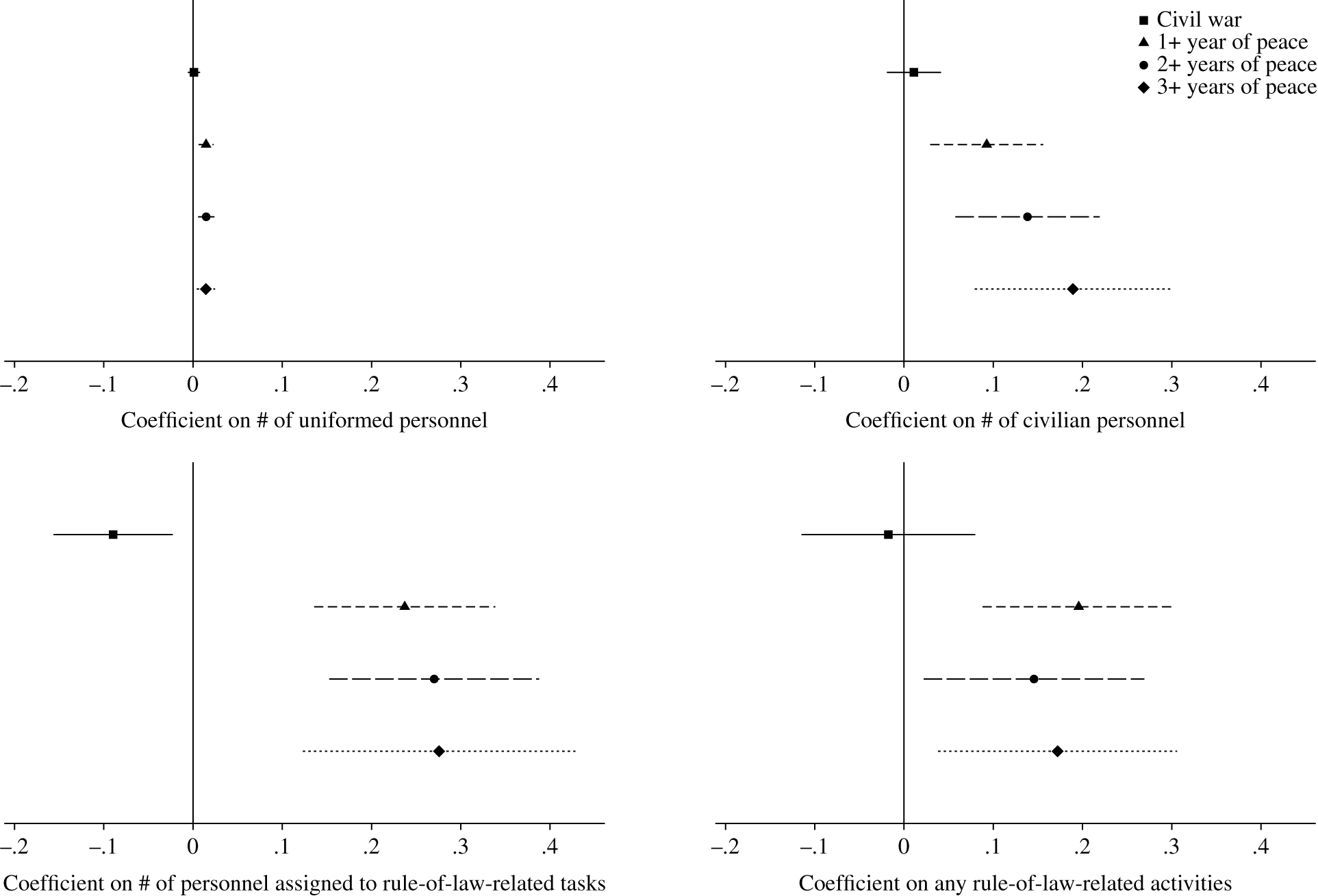
Figures 1 and 2 estimate the relationship between UN personnel and activities and the rule of law. I present my results graphically for ease of interpretation. My unit of analysis is the country-year, and in all specifications I use as many countries and as many years as I have data for both my independent and dependent variables. I operationalize my dependent variable using the World Bank and Freedom House indices in Figures 1 and 2, respectively. I operationalize UN presence as the number of uniformed personnel deployed to each UN mission in Africa since the end of the Cold War (top left panel), the number of civilian personnel deployed to each UN mission in Africa (top right panel), the number of personnel assigned specifically to rule-of-law-related tasks (bottom left panel), and a dummy for any actual rule-of-law-related activities in the field (bottom right panel).
Correlation between World Bank Rule-of-Law Index and UN Personnel and Activities

Correlation between Freedom House Rule-of-Law Index and UN Personnel and Activities
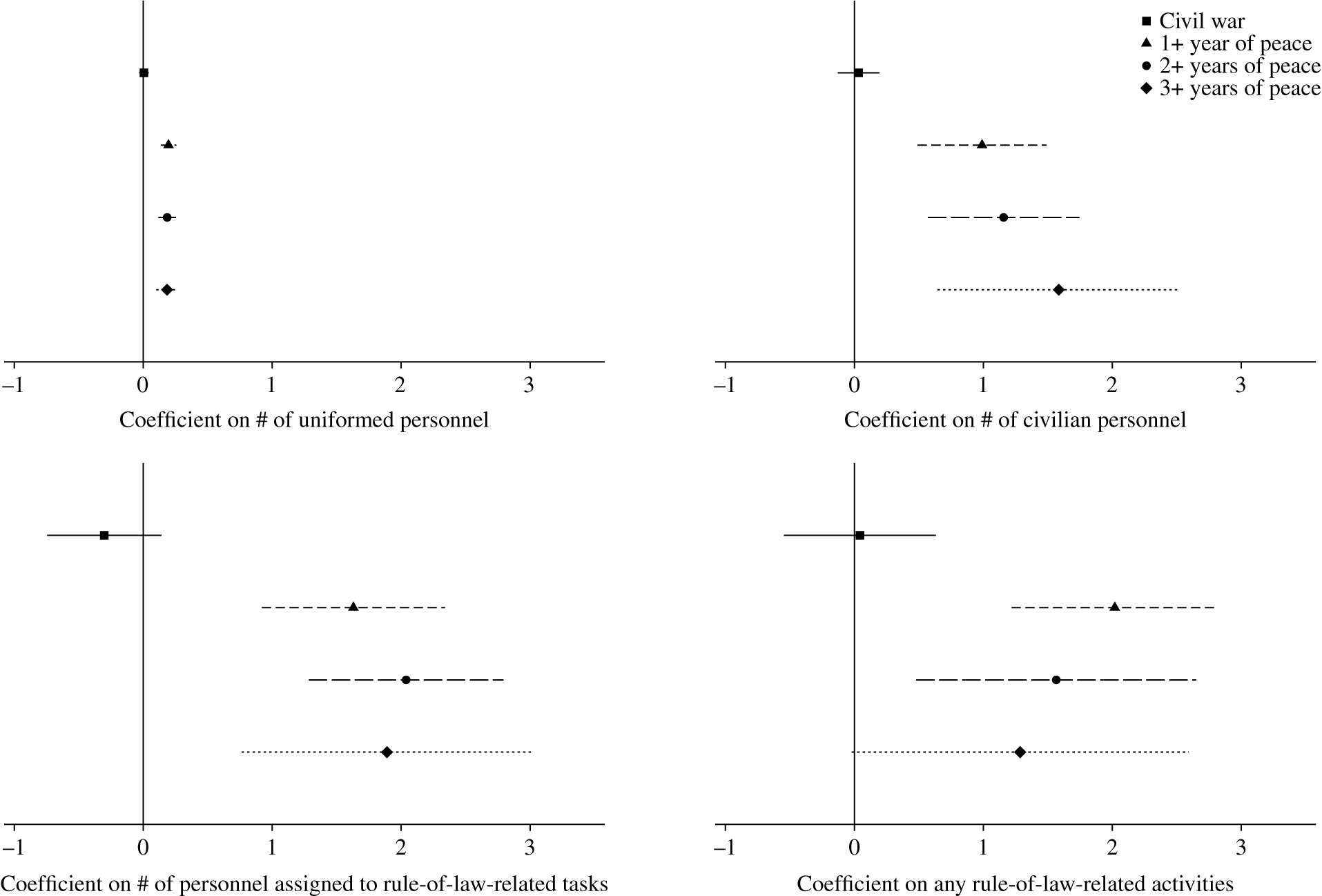
Because the UN records personnel numbers by fiscal rather than calendar year, and because UN Secretary-General progress reports (and the activities described therein) sometimes span two years, I lag my independent variables by two periods to avoid reverse causality, and I lag my controls by three periods to avoid posttreatment bias. I code personnel numbers in units of 1,000. All specifications include country fixed effects and controls for population, GDP, foreign aid, infant mortality, quality of democracy, and violence against the regime. I test the relationship between UN presence and the rule of law in countries with ongoing civil wars (denoted by squares) and in countries that have experienced at least one, two, or three years of peace (denoted by triangles, circles, and diamonds, respectively), as defined by UCDP.Footnote 13 The figures present marginal effects with all controls held at their means. The scale of the x-axes is standardized for ease of comparison.
My theory predicts that the rule of law should improve as the number of personnel deployed to a UN mission increases (Hypothesis 1), but that the magnitude of this relationship should be smaller for uniformed personnel than for civilian personnel or personnel assigned specifically to rule-of-law-related tasks (Hypothesis 2). My theory also predicts that the rule of law should improve when a UN mission pursues rule-of-law-related activities in the field (Hypothesis 3), but that the magnitude of this relationship should be larger when the mission engages the host state in the process of reform (Hypothesis 4). Finally, my theory predicts that the magnitude of the relationship between UN presence and the rule of law should be larger during periods of peace than periods of conflict (Hypothesis 5).
My results in Figure 1 are consistent with these predictions. The correlation between uniformed personnel and the rule of law is positive and statistically significant during periods of peace (Hypothesis 1), but the magnitude of the correlation is between six and 14 times larger for civilian personnel and between 16 and 20 times larger for personnel assigned specifically to rule-of-law-related tasks (Hypothesis 2). Because personnel numbers are so highly correlated, I cannot test the relationship between the rule of law and particular categories of personnel conditional on the others. Nonetheless, the marginal return on uniformed personnel appears to be much smaller than the marginal return on civilian personnel or personnel assigned specifically to rule-of-law-related tasks.Footnote 14
The correlation between the rule of law and rule-of-law-related activities is positive and statistically significant during periods of peace as well (Hypothesis 3). These correlations all vary in size depending on how long the peace process has been ongoing, but the differences between them are not statistically significant at conventional levels. The correlation between UN presence and the rule of law is, however, consistently smaller during periods of conflict than periods of peace (Hypothesis 5). (I test Hypothesis 4 below.) In Appendix J, I show that the magnitude of the correlation between uniformed personnel and the rule of law is smaller for UN troops than for UN police officers, as the latter tend to be more intimately involved in rule-of-law reform. In Appendix K, I also show that the magnitude of the correlation between civilian personnel and the rule of law is smaller for national personnel than for international personnel, as the latter tend to be better paid and enjoy higher status than the former.
To put these correlations in perspective, the average postconflict African country scores a -0.85 on the World Bank index after one year of peace. This falls in the 22nd percentile worldwide and the 60th percentile of all country-years in my sample. My models predict that this score should improve by roughly 0.02 points with 1,000 additional uniformed personnel, 0.09 points with 1,000 additional civilian personnel, 0.24 points with 1,000 additional personnel assigned specifically to rule-of-law-related tasks, and 0.20 points with any actual rule-of-law-related activities on the ground. These correlations are both substantively and statistically significant. For example, an increase of 0.24 points on the World Bank index would place the average postconflict African country in the 32nd percentile worldwide and the 74th percentile in my sample. This improvement is roughly four-fifths the size of the improvement we would expect to observe in a country that transitions from civil war to at least one year of peace and roughly seven times the size of the improvement we would expect to observe from each additional year of peace thereafter. While adding 1,000 personnel assigned specifically to rule-of-law-related tasks may be unrealistic for many UN missions, even smaller additions predict substantively significant improvements in the rule of law.
My results are similar when I use the Freedom House index to operationalize the rule of law. The average score on the Freedom House index is about 5.68 after at least one year of peace. My model predicts that this score should improve by 0.20 points with 1,000 additional uniformed personnel, by 0.99 points with 1,000 additional civilian personnel, by 1.63 points with 1,000 additional personnel assigned specifically to rule-of-law-related tasks, and by 2.02 points with any actual rule-of-law-related activities in the field. This latter correlation is more than seven times the magnitude of the improvement we would expect to observe from each additional year of peace. As I show in Appendix L through N, my results are similar when I use the Polity, V-Dem, or Linzer and Staton (Reference Linzer and Staton2015) indices to operationalize the rule of law instead.
Another way to understand these results is to compare scores on the World Bank and Freedom House indices at the time the UN deployed with those at the time it withdrew (or, for UN missions that were ongoing at the end of my panel, to scores in 2016). While these comparisons are not causally identified, they are nonetheless illuminating. Consider, for example, the case of Côte d’Ivoire. When UNOCI deployed in 2004, Côte d’Ivoire scored a -1.37 on the World Bank index and a 3 on the Freedom House index. Only nine other countries scored a 3 or below on the Freedom House index in 2004, and only 16 other countries scored a -1.37 or below on the World Bank index. By 2016, however, Côte d’Ivoire’s scores had improved to -0.67 on the World Bank index and 6 on the Freedom House index. Only five other countries witnessed larger improvements on the World Bank index over this 12-year period: Haiti, Myanmar, French Guiana, Rwanda, and Georgia. Only one other country—Togo—witnessed an equally large improvement on the Freedom House index, and only one, Liberia, witnessed a larger improvement.
Or consider the case of Liberia. In 2003, the year the civil war ended and UNMIL’s mandate began, Liberia scored a -1.65 on the World Bank index and a 0 on the Freedom House index. The only other countries to score below a -1.65 on the World Bank index that year were DRC, Myanmar, Zimbabwe, Haiti, and Somalia; the only other countries to score a 0 on the Freedom House index were DRC, Cameroon, Equatorial Guinea, and Sudan. By 2016, however, Liberia’s World Bank score had improved to a -0.97, and its Freedom House score had improved to a 7. Only seven countries experienced a more dramatic improvement on the World Bank index over these years: Myanmar, Serbia, Haiti, Cuba, Rwanda, Georgia, and, not coincidentally, Côte d’Ivoire. No other country experienced a similarly dramatic improvement on the Freedom House index.
Again, these trends should not be interpreted causally, and they are not uniform across settings. In general, however, the rule of law improved in African countries that hosted a UN mission over these years, sometimes dramatically so. Trends in African countries that experienced a civil war but did not host a UN mission were more mixed. In Niger, for example, UCDP records episodes of civil war from 2007 to 2008 and 2015 to 2016, the end of my panel.Footnote 15 Niger scored a -0.60 on the World Bank index in 2007, and a 9 on the Freedom House index. Niger’s score on the Freedom House index declined monotonically thereafter, to 8 in 2008, 6 in 2009, and 5 in 2010. Niger’s score on the World Bank index was more idiosyncratic. In Nigeria, UCDP records episodes of civil war in 2004 and 2009 and again from 2011 to 2016. Nigeria’s score on the Freedom House index rose from 4 in 2004 to 5 in 2007 before falling back to 4 in 2012. On the World Bank index, Nigeria’s score increased from 2004 to 2008, decreased from 2008 to 2011, increased again from 2011 to 2015, and decreased again in 2016. Figures A.5 and A.6 in the appendix plot these trends over time.
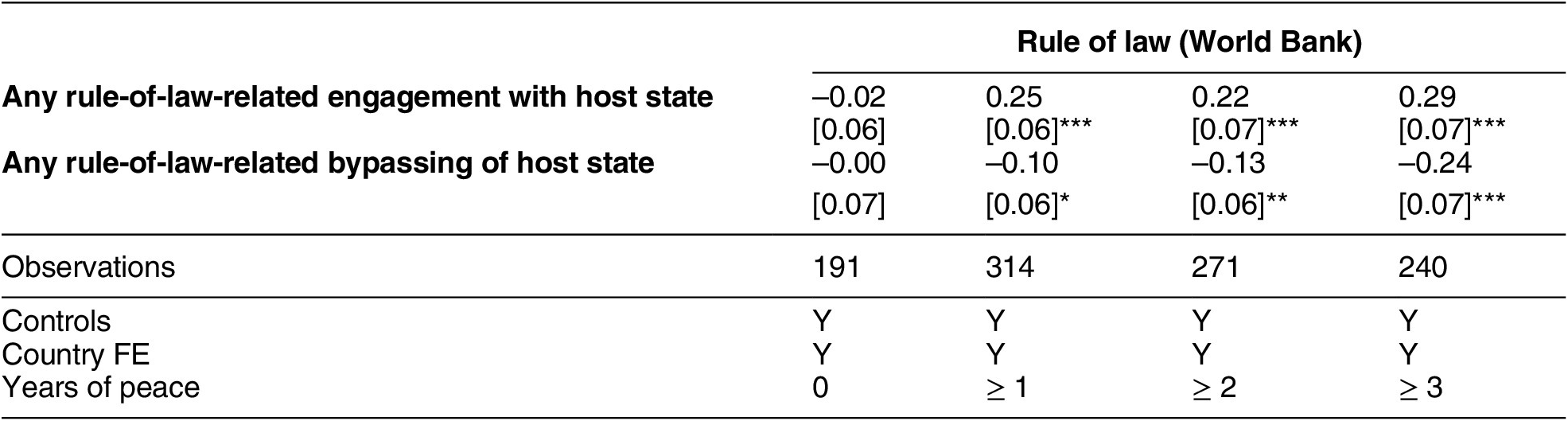
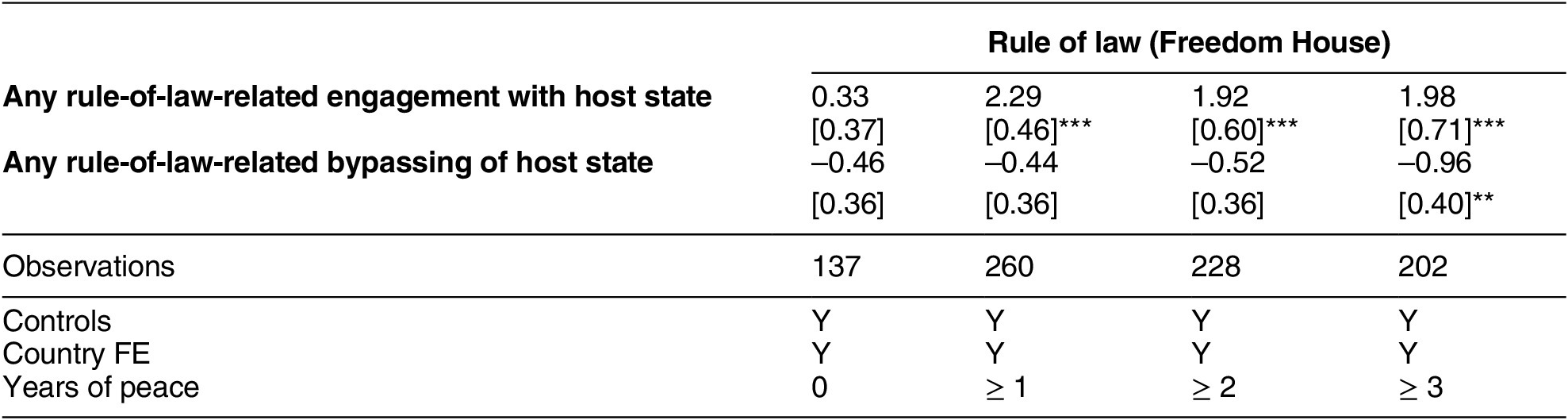
Finally, my theory predicts that the magnitude of the relationship between the rule of law and UN activities should be larger when UN missions engage host states in the process of reform rather than bypassing them altogether (Hypothesis 4). Tables 1 and 2 test this prediction by distinguishing mechanisms that require engagement with the host state—education, inducement, persuasion, and oversight—from those that do not, using the coding rules discussed in Appendix D. Since engagement and bypassing are not highly correlated in my sample, I can include them both in the same models. Tables 1 and 2 report results using the World Bank and Freedom House index, respectively. Consistent with my theory, the correlation between engagement and the rule of law is positive and statistically significant in all periods of peace, while the correlation with bypassing is weak or even negative. The difference between the two coefficients is also statistically significant during all periods of peace.
Correlation between World Bank Rule-of-Law Index and UN Activities Disaggregated by Engagement with Host State

Note: Table reports results from OLS regressions with controls and country fixed effects. UN activities are coded as country-year dummies indicating whether the activity was mentioned at least once in a UN Secretary-General progress report from the corresponding year.
 $$ {}^{\ast \ast \ast } $$
 $$ p<0.01 $$
,
 $$ {}^{\ast \ast } $$
 $$ p<0.05 $$
,
 $$ {}^{\ast } $$
 $$ p<0.1 $$
0.
Correlation between Freedom House Rule-of-Law Index and UN Activities Disaggregated by Engagement with Host State
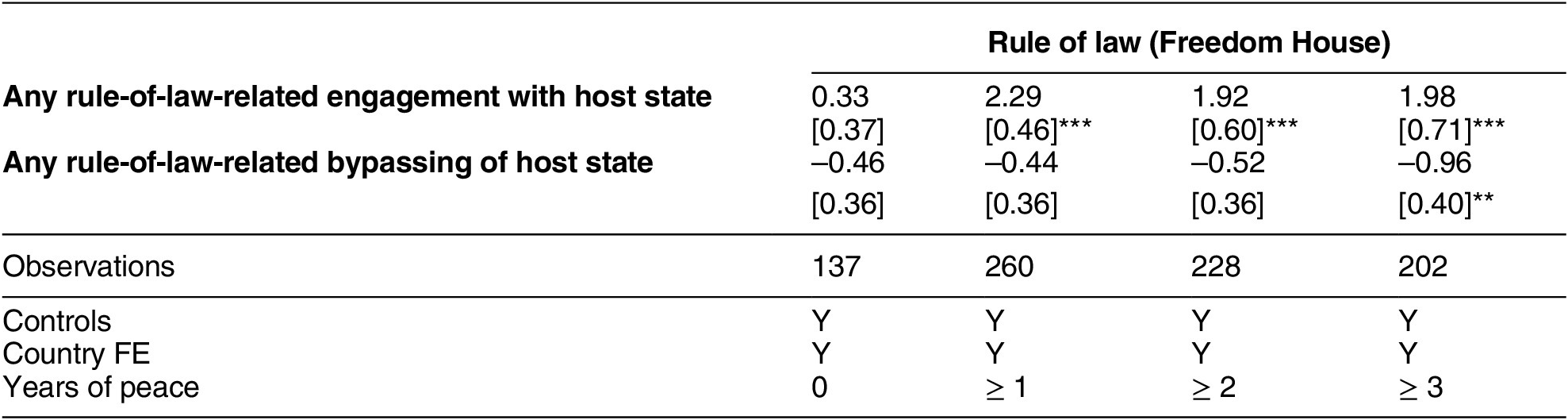
Note: Table reports results from OLS regressions with controls and country fixed effects. UN activities are coded as country-year dummies indicating whether the activity was mentioned at least once in a UN Secretary-General progress report from the corresponding year.
 $$ {}^{\ast \ast \ast } $$
 $$ p<0.01 $$
,
 $$ {}^{\ast \ast } $$
 $$ p<0.05 $$
,
 $$ {}^{\ast } $$
 $$ p<0.1 $$
0.
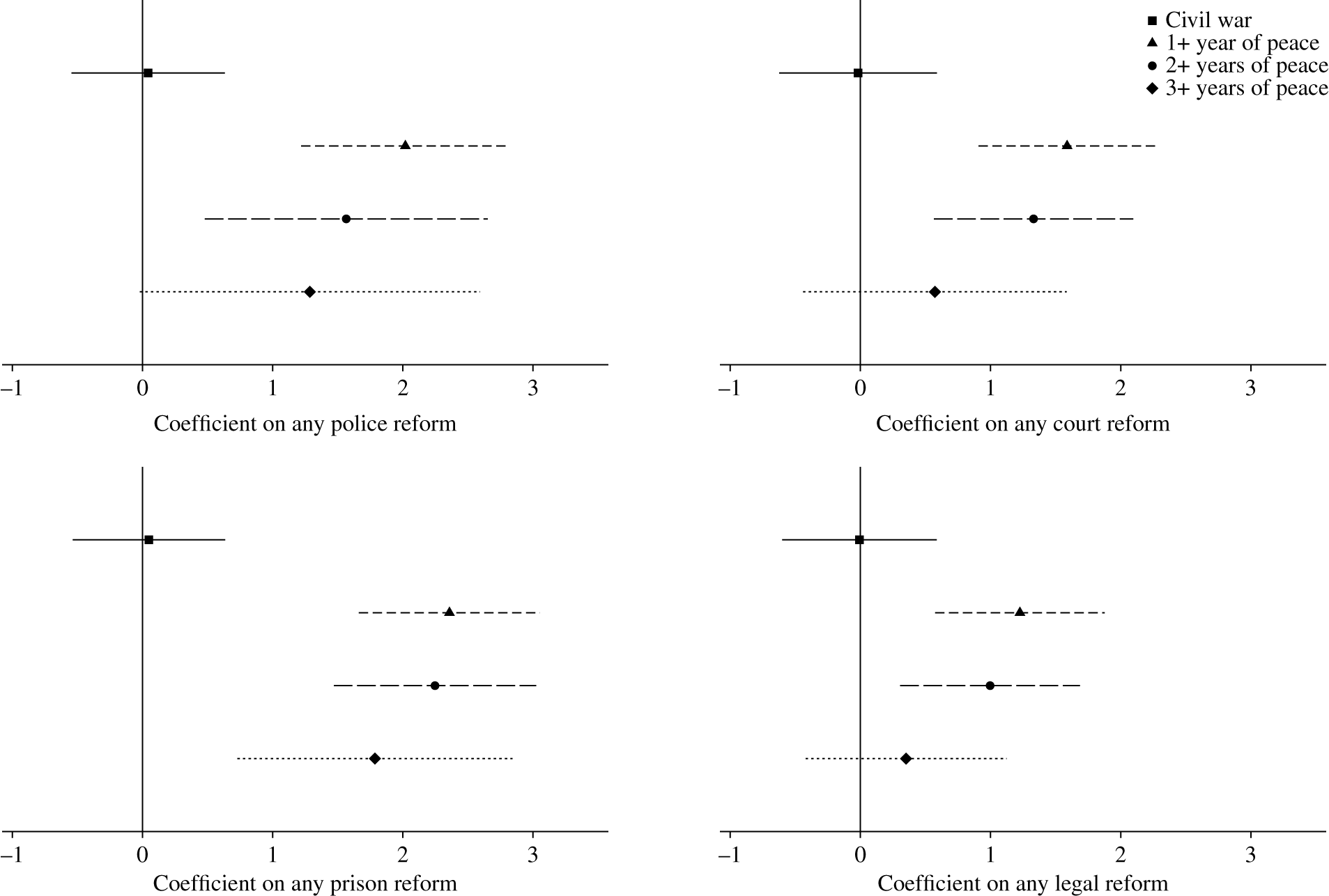
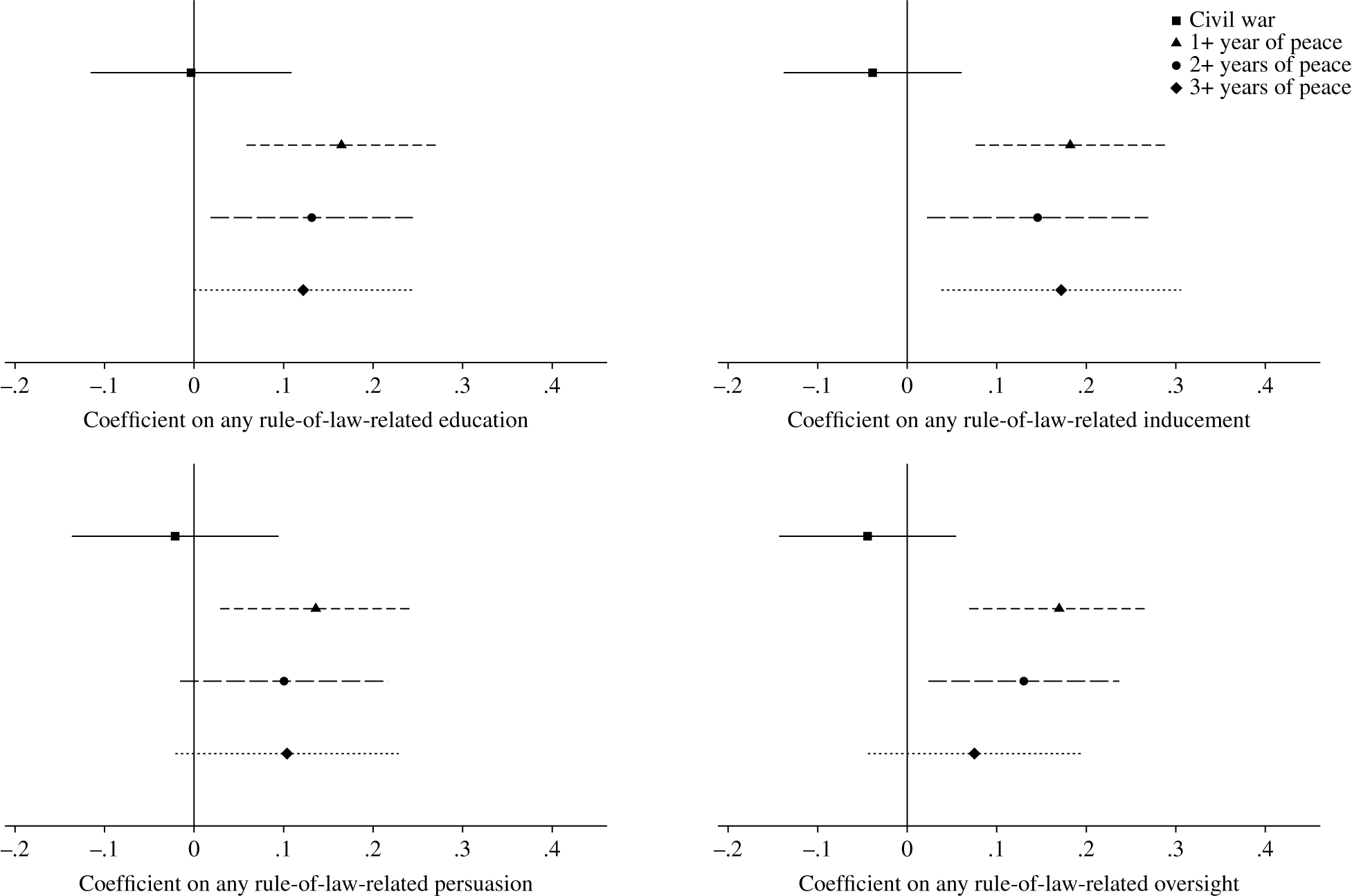
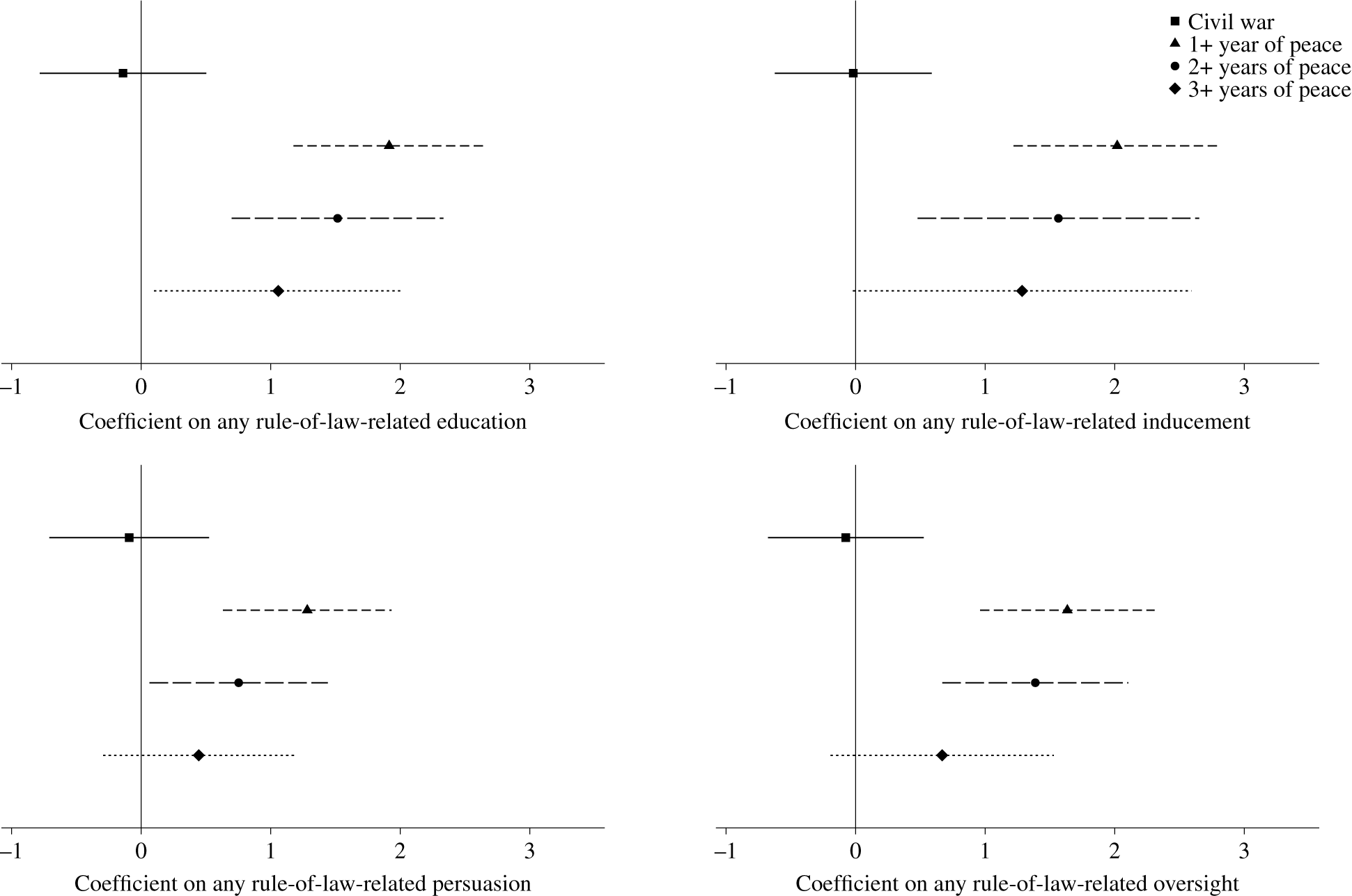
In Figures 3 through 6, I use PACT to explore these correlations between engagement and the rule of law in further detail. In Figures 3 and 4, I disaggregate rule-of-law-related activities by target—police forces, courts, prisons, and laws—using the World Bank and Freedom House indices, respectively. In Figures 5 and 6, I disaggregate by mechanism of engagement with the host state: education, inducement, persuasion, and oversight. My results are again consistent with those above. I do find some evidence of potential diminishing marginal returns: the correlation between UN activities and the Freedom House index is generally null after three years of peace, though it is also statistically indistinguishable from the correlation after one or two years of peace, suggesting that the differences may not be important for practical purposes. In Appendix Q, I show that my results are similar when I use more restrictive coding rules for PACT, and in Appendix R, I show that my results are again similar when I use indices instead of dummies to operationalize rule-of-law-related activities. The robustness of my results to these alternative specifications suggests they are unlikely to be artifacts of particular coding rules.
Correlation between World Bank Rule-of-Law Index and UN Activities Disaggregated by Target

Correlation between Freedom House Rule-of-Law Index and UN Activities Disaggregated by Target

Correlation between World Bank Rule-of-Law Index and UN Activities Disaggregated by Mechanism of Engagement

Correlation between Freedom House Rule-of-Law Index and UN Activities Disaggregated by Mechanism of Engagement

Conclusion
The UN is at the forefront of efforts to restore the rule of law in countries experiencing or recovering from civil war. Research on the impact of these efforts, however, remains limited and speculative. In this paper I develop and test a theory to explain when, where, and how UN rule-of-law promotion is likely to succeed. My theory focuses on reforms targeting the host state’s justice chain: police forces, courts, prisons, and laws. UN missions pursue these reforms through a combination of education, inducement, persuasion, and oversight. I identify three sources of variation in the efficacy of these reforms, related to UN personnel, activities, and timing. I test my theory by combining existing data on the number of uniformed personnel deployed to each UN mission in Africa with three original datasets on the number of civilian personnel, the number of personnel assigned specifically to rule-of-law-related tasks, and the extent to which UN missions actually pursue rule-of-law-related activities on the ground.
Consistent with my theory, I find that the rule of law improves as the number of personnel deployed to a UN mission increases, but the magnitude of the correlation is smaller for uniformed personnel than for civilian personnel or personnel assigned specifically to rule-of-law-related tasks. Among uniformed personnel, the correlation is smaller for UN troops than UN police officers; among civilian personnel, the correlation is smaller for national than international staff. I also find that the rule of law improves when UN missions actually pursue rule-of-law-related activities in the field, but the magnitude of the correlation is larger when they engage host states in the process of reform rather than bypassing them altogether. Finally, I find that the magnitude of all of these correlations is larger during periods of peace than periods of civil war. Importantly, these correlations do not appear to be artifacts of selection into “easy” cases, nor do they appear to be byproducts of other, more “traditional” activities that UN missions pursue on the ground. Taken together, my results suggest that UN intervention may be a more effective mechanism for restoring the rule of law than the prevailing pessimism would lead us to believe (Clunan and Trinkunas Reference Clunan and Trinkunas2010; Janse Reference Janse2013; Lake Reference Lake, Hoddie and Hartzell2010; Ledwidge Reference Ledwidge2017).
My results have at least three important implications for the practice of UN rule-of-law promotion. First, they suggest that the UN should expand the civilian components of most UN missions. While UN troops and military observers may help create the conditions in which the rule of law can emerge, it is the UN’s civilian and police contingents that are most directly responsible for rule-of-law reform—retraining police officers and judges, monitoring prisons, amending laws, etc. While I am unable to estimate the relationship between the rule of law and civilian personnel conditional on uniformed personnel, given the UN’s tendency to underinvest in civilian contingents (UN Security Council 2000), for most UN missions the marginal return on civilian personnel likely exceeds the marginal return on uniformed personnel, at least for purposes of restoring the rule of law.
My results also suggest that UN missions should not expect to fulfill their rule-of-law mandates in settings where there is no peace to keep. Scholars have long argued that the UN is more effective at building peace than fighting wars (Doyle and Sambanis Reference Doyle and Sambanis2006; Fortna Reference Fortna2008a; Gilligan and Sergenti Reference Gilligan and Sergenti2008), and policy makers have criticized the UN’s increasing tendency to deploy complex, multidimensional peacekeeping operations to active conflict zones, such as Mali and South Sudan (HIPPO 2015). My results lend additional credence to these concerns. My results also suggest, however, that UN missions should avoid bypassing host states in the process of reform, even in settings where host states are weak or predatory. While bypassing may sometimes be necessary for practical or normative reasons, it may also have adverse unintended consequences for the rule of law—which, in turn, may undermine the prospects for peace in the long term.
How likely are my results to generalize to other settings or to other types of international intervention? Threats to the rule of law are endemic to many developing (and developed) countries, and restoring the rule of law is integral to the mandates of current and recent UN missions around the world. While no other international organization has pursued rule-of-law reform as aggressively or “holistically” as the UN (Trenkov-Wermuth Reference Trenkov-Wermuth2010), the UN’s approach is not altogether unique. The US government, for example, continues to fund a variety of security and justice sector reform initiatives in Africa, Asia, Eastern Europe, Latin America, and the Middle East. UN missions are atypical in ways that may make them especially likely to succeed. (For example, unlike the US government, the UN is rarely implicated in igniting the civil wars that necessitate international intervention in the first place.) But the elements of my theory are not specific to the UN, and other bilateral or multilateral institutions may prove similarly effective in promoting the rule of law. I view this as a promising possibility for future research to explore.
Supplementary Materials
To view supplementary material for this article, please visit http://dx.doi.org/10.1017/S0003055420000738.
Replication materials can be found on Dataverse at: https://doi.org/10.7910/DVN/NRRVJ3.






Comments
No Comments have been published for this article.