INTRODUCTION
Two species of prawn, Palaemon elegans and P. adspersus were accidentally released from the Mediterranean Sea to the Caspian Sea in 1930–1934 (Grigorovich et al., Reference Grigorovich, Therriault and MacIsaac2003). They could adapt themselves to the new environment so well that they would already have become an important food item for the majority of fish species in the Caspian Sea (Birshtein et al., Reference Birshtein, Vinogradova, Kondakov, Astakhova, Romanova, Delinad and Nazari1968). Palaemon elegans is a euryhaline species that can tolerate a large range of salinity (Berglund, Reference Berglund1982) and, therefore, enjoys a wide range of distribution beside the Caspian Sea, including the Mediterranean, Black, Baltic, Azov, and Aral Seas and also the eastern Atlantic coasts (Birshtein et al., Reference Birshtein, Vinogradova, Kondakov, Astakhova, Romanova, Delinad and Nazari1968; Grabowski, Reference Grabowski2006). The maximum size of this species reportedly reaches 65 mm in Western Europe (Barnes, Reference Barnes1994), 58 mm in the Black Sea (Bascinar et al., Reference Bascinar, Duzgunes, Bascinar and Saglam2002), and 43.4 mm in Anzali port of the Caspian Sea (Abdolmalaki et al., Reference Abdolmalaki, Emadi and Nezami2003). Palaemon elegans mainly inhabits the rocky substrates in the Caspian Sea (Birshtein et al., Reference Birshtein, Vinogradova, Kondakov, Astakhova, Romanova, Delinad and Nazari1968).
Various studies have been conducted on this species, among which are the effect of light periods (Dalley, Reference Dalley1980) and feeding regime (Hartnoll & Salama, Reference Hartnoll and Salama1992; Salama & Hartnoll, Reference Salama and Hartnoll1992) on the growth and survival; feeding and digestion in the larval stages (Kumlu & Jones, Reference Kumlu and Jones1995); the effect of temperature on osmotic and ionic regulation (Ramirez de Isla Hernandez & Taylor, Reference Ramirez de Isla Hernandez and Taylor1985); reproductive biology (Bascinar et al., Reference Bascinar, Duzgunes, Bascinar and Saglam2002); population dynamics and biological characteristics (Abdolmalaki et al., Reference Abdolmalaki, Emadi and Nezami2003). But no separate study on the salinity effect on P. elegans has been conducted. In this study, however, the tolerance, growth and survival of P. elegans in various Caspian salt concentrations have been assessed that can be also used as a basis for future works on this species as live food in aquaculture (Firat et al., Reference Firat, Saka and Coban2005; Metin et al., Reference Metin, Saka, Firat and Coban2006).
MATERIALS AND METHODS
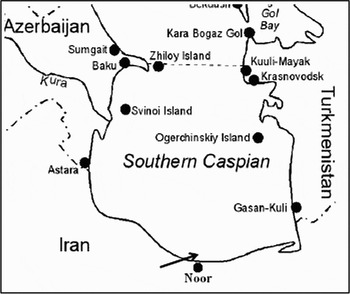
Prawn samples, collected with a hand net (1 mm mesh size) from 0.5–1 m depth of a rocky shore in Noor coast, Mazandaran province (Figure 1) during summer and winter 2005. After transferring to the laboratory, samples of 6–9 mm carapace length range (from eye stalk to the posterior carapace edge) with the average weight of 0.296 g were separated and maintained in a 500 l plastic tank filled with the Caspian Sea water (≈12.5 ppt salinity) for one week before the onset of the experiment. The samples designated to be tested under 1 and 5 ppt salinities were, however, transferred to the respective salinities two hours after the catch. The tank was covered with a small-meshed net to prevent prawns jumping out. They were fed, except the last day, under continuous aeration, light regime (12D:12L) and fixed temperature of 24±1°C with the alga gathered from their natural surroundings. One-third of water in the tank was exchanged once every three days.
Map of the sampling area.

Experiments—conducted in two stages—were carried out in aquaria of 44 × 15 × 15 cm, which were divided into 4 equal parts by nylon net of 1 mm mesh, for putting one prawn in each part (Kirkpatrick & Jones, Reference Kirkpatrick and Jones1985; Campbell & Jones, Reference Campbell and Jones1989b). The prawns were directly transferred from the mother tank (≈12.5 ppt salinity) to the designated experimental salinities in aquaria.
In the first stage, the lethal salinities at 96 hours (LS5096 h) (Taylor & Seneviratna, Reference Taylor and Seneviratna2005; Tsoi et al., Reference Tsoi, Chiu and Chu2005; Janas & Spicer, Reference Janas and Spicer2008) were determined, using various concentrations of 0, 1, 5, 13, 30, 35 and 45 ppt made with the Caspian Sea salt in the laboratory. The experiment was conducted in two replicates (Campbell & Jones, Reference Campbell, Jones and Ros1989a, Reference Campbell and Jonesb) with 4 individuals in each replication. No feeding was done in this stage (Kirkpatrick & Jones, Reference Kirkpatrick and Jones1985; Campbell & Jones, Reference Campbell, Jones and Ros1989a); continuous aeration, light regime (12D:12L) and temperature of 24 ± 1°C were maintained throughout this stage (Kirkpatrick & Jones, Reference Kirkpatrick and Jones1985; Hartnoll & Salama, Reference Hartnoll and Salama1992; Paghe et al., Reference Paghe, Abedian and Marammaazi2003). The designated salinities were fixed using aerated tapwater and the Caspian Sea salt added to the seawater which had been filtered. Salinity was checked by ATAGO, S/Mill-E handheld refractometer/salinometer.
In the second stage, based on the highest survival rate in various experimental salinities in the first stage, salinities 8, 13 and 18 ppt were selected. The prawns were transferred to the designated experimental salinities in aquaria and reared for 28 days.
Feeding was done daily with equal ration of dry pellet food (SFT2 produced by Chineh Co.) for all treatments at the start of the light period and uneaten food of the last day was siphoned off before providing fresh food (Salama & Hartnoll, Reference Salama and Hartnoll1992). As much as 75% of water in each aquarium was exchanged once every three days. This stage of the experiments was conducted in three replications. All other experimental circumstances were similar to the first stage. Growth indices (carapace length increase and specific growth rate (SGR)), moulting (moulting rate, moulting number and intermoult period) and survival (Diaz et al., Reference Diaz, Sousa, Cuartas and Petriella2003; Sang & Fotedar, Reference Sang and Fotedar2004; Bacon et al., Reference Bacon, Gurney, Jones, McLaren and Youngson2005; Romano & Zeng, Reference Romano and Zeng2006; Ticina et al., Reference Ticina, Grubisic, Katavic, Franicevic and Ticina2006), were estimated according to the following relations:
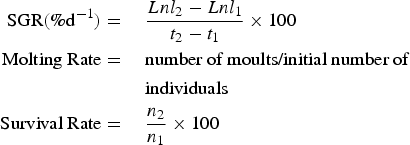

Moulting of each prawn was surveyed 3 times a day and after each moulting, skins were removed and related data were recorded. The first intermoult period (which was followed by the first observed moulting) and the moulting that was followed by mortality were not considered in the estimation of the average intermoult period (Romano & Zeng, Reference Romano and Zeng2006).
Statistical analysis
Data analysis was done using SPSS 12. Complete random block was arranged in this set of experiments. Normality of the data was examined by Shapiro–Wilk test. The difference among different measured factors was studied by one-way ANOVA, if data were normal; otherwise, they were studied by Kruskal–Wallis. Differences were considered significant when *P < 0.05.
RESULTS
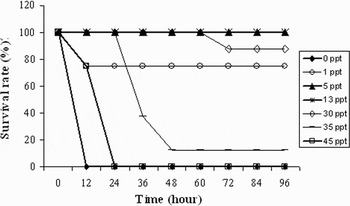
The result of the lethal salinities in 96 hours (LS5096 h) showed that the prawn's survival was above 50% in the salinity range of 1–3 ppt and below 50% in the salinities of 0 (fresh water), 35 and 45 ppt, after 24 hours. In salinities of 5 and 13 ppt, the survival was 100%, while 100% mortality was observed in 0 and 45 ppt, after 96 hours (Figure 2).
Survival of Palaemon elegans after sudden exposure to a range of salinities with the salt proportion of the Caspian Sea in 96 hours (LS5096 h).

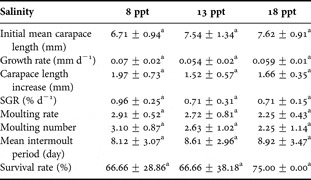
No significant differences were observed (*P > 0.05) in the growth indices (carapace length increase and SGR), moulting (moulting rate, moulting number and intermoult period), and survival rate of prawns reared under 8, 13 and 18 ppt salinity treatments (Table 1).
Initial mean carapace length (mm), carapace length increase, specific growth rate (SGR), moulting rate, moulting number, mean intermoult period and survival rate of Palaemon elegans reared in different salinities for 28 days.

Similar letters show no significant difference between means in each row.
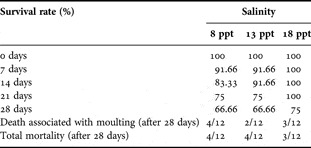
Observation of the prawn's survival during the 4 weeks rearing period showed that in 18 ppt salinity, mortality was seen after 21 days, but mortality in 8 and 13 ppt salinities occurred from the beginning of the rearing period. Higher mortality rate was found to be associated with moulting under the designated salinities (Table 2). The average intermoult periods in 8, 13, and 18 ppt salinities were 8.12±3.07, 8.61±2.96 and 8.92±3.47 days, respectively, which varied from 2 to 18 days.
Survival rate of Palaemo n elegans, number of mortality and death associated with moulting at different salinities for 28 days.

DISCUSSION
Salinity is one of the most important abiotic factors affecting the growth, survival, breeding and distribution of aquatic organisms in various ecosystems (Kumlu et al., Reference Kumlu, Eroldogan and Aktas2000; Anger, Reference Anger2003). The prawn, P. elegans (Palaemonidae), has adapted itself to a wide range of salinities in different water bodies (Birshtein et al., Reference Birshtein, Vinogradova, Kondakov, Astakhova, Romanova, Delinad and Nazari1968; Grabowski, Reference Grabowski2006). In the present study, the salinity tolerance (LS5096 h) of this prawn was found to lie in the 1–30 ppt range, while a range of 5–45 ppt had been reported earlier (Ramirez de Isla He Hernandez & Taylor, 1985). It should be, however, noted that the prawn's survival at 0 ppt in both studies lasted only for a few hours; a 75% survival was observed at 1 ppt in our study, but no test had been conducted at this salinity level in the latter study. Janas & Spicer (Reference Janas and Spicer2008) reported a 100% survival of small prawn specimens at 1 ppt in 90 hours, which could be attributed to lower degree of stress as the result of introducing the samples to the designated salinity within 24–72 hours after the catch, while the samples in our work were transferred to the designated salinity 2 hours after the catch. This species has also been reported in 2 ppt salinity of the Vistula Delta (Baltic Sea), but it was unable to survive in fresh water (Janas et al., Reference Janas, Zarzycki and Kozik2004).
Body size of P. elegans is reported to affect the tolerance of P. elegans to the salinity change, particularly at reduced salinity (Janas & Spicer, Reference Janas and Spicer2008), which could be attributed to higher osmoregulatory capability of the smaller individuals. In our experiment only small individuals (6–9 mm carapace length) were tested, since larger ones reportedly tended to migrate to deeper waters during winter (Janas & Spicer, Reference Janas and Spicer2008). If we had used larger individuals, the result would have been different and probably similar to that of Janas & Spicer (Reference Janas and Spicer2008) where 100% mortality of larger individuals at 1 ppt within 90 hours has been reported.
The highest tolerance for P. elegans in the Caspian salinity of the current work was recorded at 30 ppt and 20°C. Ramirez de Isla Hernandez & Taylor (Reference Ramirez de Isla Hernandez and Taylor1985), who had observed the 45 ppt as the highest threshold of tolerance for P. elegans at 10°C, stated that salinity tolerance decreased with increase in temperature. Besides, the difference in salt composition of the Caspian Sea with open seawaters should not be overlooked.
Janas & Spicer (Reference Janas and Spicer2008) have reported a 100% survival for P. elegans at 35 ppt (local salinity) whereas 12.5% survival rate was recorded at the same salinity (almost 3 times that of salinity of the Caspian Sea) in our experiment. This difference could, probably, be attributed to 75 years of acclimatization of this species (McLusky et al., Reference McLusky, Hagerman and Mitchell1982) to the Caspian Sea.
In the salinity tolerance (LS5096 h), survival rates were obtained 87.5% and 12.5% for 30 ppt and 35 ppt, respectively. The reduced survival at 35 ppt can be attributed to reduced osmoregulation capability (Ramirez de Isla Hernandez & Taylor, Reference Ramirez de Isla Hernandez and Taylor1985) as well as being higher than tolerance threshold for P. elegans.
Finally, different salt composition and low salinity of the Caspian Sea from that of the open sea as well as different reactions of the same species within different populations can also affect the tolerance to salinity.
In this study, no significant differences were observed (*P>0.05) in the growth indices, moulting, and survival rate of the prawn reared for 4 weeks under 8, 13 and 18 ppt salinity treatments (Table 1). This indicates the suitability of the tested salinity range for this species in the studied length range. However, the observation on mortality trend during the 4-week rearing period indicated the occurrence of mortality in 8 ppt salinity from the beginning of the rearing period (Table 2). This could imply that P. elegans was more susceptible to low salinities which corresponds with that of Nugegoda & Rainbow (Reference Nugegoda and Rainbow1989) on the same species. It could somehow be attributed to prawn's excess loss of salt in dilute environment (Mantel & Farmer, Reference Mantel, Farmer and Mantel1983). Despite hyper–hypo osmoregulative capability of P. elegans (Ramirez de Isla Hernandez & Taylor, Reference Ramirez de Isla Hernandez and Taylor1985), production of iso-osmotic urea to the blood (Mantel & Farmer, Reference Mantel, Farmer and Mantel1983) in less saline environments impels it to lose lots of salt along with water.
In the present study, after 21 days, 25% mortality (3/12) was observed at 8 ppt salinity, while a 42% mortality (5/12) under similar salinity and duration has been reported in another study (Nugegoda & Rainbow, Reference Nugegoda and Rainbow1989). Taylor et al. (Reference Taylor, Morris and Bridges1985) demonstrated that calcium concentration in the haemolymph of P. elegans sharply decreased in salinities below 10 ppt. Considering the importance of calcium ion in crustacean exoskeleton (Ingle, Reference Ingle1997) and as an extra-cellular ion as well as its relatively higher proportion in the Caspian Sea (Alizadeh, Reference Alizadeh2004), we can assume the capability of P. elegans to endure the Caspian salinities below 10 ppt increases.
Moulting increased, however not significantly, with decrease in salinity (Table 1), reaching the highest rate at 8 ppt, which corresponds with other studies on P. elegans (Nugegoda & Rainbow, Reference Nugegoda and Rainbow1989) and Upogebia africana (Paula et al., Reference Paula, Mendes, Paci and McLaughlin2001). Also, the little growth at 8 ppt salinity (Table 1) can only be attributed to water absorption as the result of increased moulting and high water penetration in this species at low salinity (Campbell & Jones, Reference Campbell and Jones1990).
In the observation of mortality and moulting in 8–18 ppt salinities, higher mortality rate was associated with moulting (Table 2), which corresponds with that of Nugegoda & Rainbow (Reference Nugegoda and Rainbow1989) on the same species and on Portunus pelagicus, which could be attributed to what is known as ‘moult death syndrome’ (Romano & Zeng, Reference Romano and Zeng2006).
CONCLUSIONS
Based on the results of this study and considering the suitable reproductive characteristics of P. elegans in the Caspian Sea, including the relatively long reproductive period from May to September (Abdolmalaki et al., Reference Abdolmalaki, Emadi and Nezami2003), multiple spawning during each reproduction period (Kudelina, Reference Kudelina1950), short larval stages (Bascinar et al., Reference Bascinar, Duzgunes, Bascinar and Saglam2002) and tolerance to abiotic factors (Berglund & Bengtsson, Reference Berglund and Bengtsson2004), rearing this prawn on the southern coast of the Caspian Sea (≈12.5 ppt) as live food should be considered for future studies.
ACKNOWLEDGEMENTS
The authors would like to thank the staff at Tarbiat Modarres University especially Mr S. Boor for his help in the laboratory. We wish to thank Miss Shima Yazdani for her assistance in translation of this manuscript to the English language. We are also very grateful to Professor D.S. McLusky and A.C. Taylor for providing us with their papers.