


Introduction
Restricted milk feeding is a critical welfare concern in dairy production (Costa et al. Reference Costa, Cantor, Nicola and Neave2019). Commonly used dairy calf milk rations may result in signs of sustained hunger (Rosenberger et al. Reference Rosenberger, Costa, Neave, von Keyserlingk and Weary2017), loss of body condition in early life, delayed growth (Curtis et al. Reference Curtis, McGregor Argo, Jones and Grove-White2018), and poor organ development leading to reduced intestinal absorbing capacity (Koch et al. Reference Koch, Gerbert, Frieten, Dusel, Eder, Zitnan and Hammon2019), impaired gut-associated immune function (Hammon et al. Reference Hammon, Frieten, Gerbert, Koch, Dusel, Weikard and Kühn2018), and reduced first and second lactation milk yield (Gelsinger et al. Reference Gelsinger, Heinrichs and Jones2016; Leal et al. Reference Leal, Daniel, Keppler, Steele and Martin-Tereso2025). To support animal welfare, more biologically relevant milk allowances are advised (Lorenz Reference Lorenz2021; Lorenz et al. Reference Lorenz, Huber and Trefz2021; Gaffari & Hammon Reference Gaffarri and Hammon2026). Calves fed 8 L of whole milk per day exhibited signs of hunger, whereas such signs were rare among calves fed 10 L per day (Rosenberger et al. Reference Rosenberger, Costa, Neave, von Keyserlingk and Weary2017), suggesting that levels equivalent to 10 L or more of whole milk may be a reasonable example of biologically relevant daily milk allowance.
A recent focus group study among Swedish dairy farmers and farm staff (Svensson et al. Reference Svensson, Hegrestad and Lindblom2023) revealed that farms may feed up to 10 L of milk in two feedings; the participants generally questioned the appropriateness of large meals, and they agreed that calves would be able to drink more milk if they had more than two meals per day, assuming meals were spread out over the course of the day. However, although they did not question the benefits for the calves, few of the participants found it practically feasible to provide more than two meals per day, partly because of economic reasons, but mainly because more frequent manual feeding was perceived to interfere with work organisation, family life, and opportunities for recovery outside work. Hence, social factors seem to be important obstacles to achieving recommended biologically relevant amounts of milk for calves (Svensson et al. Reference Svensson, Hegrestad and Lindblom2023).
The social factors most strongly correlated with self-reported overall life satisfaction among Swedish livestock farmers were their financial situation, stressful working conditions, working hours, opportunities for a desirable family situation, meaningfulness of their work, and standard of living (Röös et al. Reference Röös, Fischer, Tidåker and Nordström Källström2019). In Finland and Canada, mental health problems have been reported to occur more commonly among farmers in general than among other occupational groups (Kallioniemi et al. Reference Kallioniemi, Simola, Kaseva and Kymäläinen2016; Jones-Bitton et al. Reference Jones-Bitton, Best, MacTavish, Fleming and Hoy2020). In a recent survey on the mental health of Swedish farmers, workload, time pressure, and economy were among the highest-ranked factors associated with self-reported stress. Dairy farmers were among the groups that experienced the greatest psychological pressure (Lundqvist et al. Reference Lundqvist, Håkansson, Göransson and Hakelius2024).
The heavy workload of farmers is well-described, e.g. Luke (2021) reported that Finnish farmers worked 1.6 “full-time equivalent” jobs. Kallioniemi et al. (Reference Kallioniemi, Kaseva, Kymäläinen and Hakanen2022) found that job demands related to workload were associated with ill health among Finnish dairy farmers, and suggested that they could benefit from reduced workload, particularly in terms of physical loads. Automated milk feeders (AMF) may be a means to achieve this, and to also facilitate feeding calves 10 L or more of whole milk per day, thereby supporting calf health and welfare as well as farmers’ work engagement. Sinnott et al. (Reference Sinnott, Kennedy and Bokkers2021) compared the overall labour input in an AMF system (the system beyond the AMF machine) with that of manual feeding using compartmentalised five-teat feeders on the same research facility and found that the total daily labour input was consistently lower than that of manual feeding. However, the authors reported that more labour was required for health monitoring and training calves to use the AMF system.
Canadian dairy farms using AMF systems were found to serve higher milk allowances than farms with manual feeding (Medrano-Galarza et al. Reference Medrano-Galarza, LeBlanc, DeVries, Jones-Bitton, Rushen, de Passillé and Haley2017a). However, studies have also reported that AMF systems are associated with an increased incidence of respiratory disease (Svensson et al. Reference Svensson, Lundborg, Emanuelson and Olsson2003), and cross-sucking (Fröberg & Lidfors Reference Fröberg and Lidfors2009), and farmers have reported abandoning the AMF system due to negative experiences (Svensson et al. Reference Svensson, Hegrestad and Lindblom2023). Farmer decision-making is complex but ultimately guided by the experiences and perceptions of the farmers themselves rather than solely by external expertise, such as veterinarians and other advisors (Darnhofer et al. Reference Darnhofer, Lamine, Strauss and Navarrete2016; Lindblom et al. Reference Lindblom, Lundström, Ljung and Jonsson2017). To better understand the potential of AMF systems to support the feeding of higher milk allowances to calves and improve work-life balance for dairy farmers and farm staff, more knowledge about farmers’ perspectives is needed. The aim of this study was to understand how the use of AMF affects milk feeding conditions and work practices important for calf welfare, as well as the work and social life of dairy farmers and farm staff in Swedish dairy farming. By examining how AMF is experienced in practice, the study seeks to identify perceived challenges and opportunities for both calves and people.
Material and methods
We first conducted a focus group interview with four farmers or farm staff from three AMF dairy farms, followed by semi-structured telephone interviews with 11 farmers or farm staff from 11 Swedish AMF dairy farms. The three authors jointly developed the open-ended interview guide based on research objectives, relevant literature, and our prior experience with the target group. It was tested within the research team and then pilot-tested on two AMF dairy farmers before the focus group interview, after which it was revised. The focus group and individual interviews were audio-recorded using dictaphones and transcribed using AI-based software (Klang AI AB, Helsingborg, Sweden); CS verified the resulting transcripts. Data were analysed using reflexive thematic analysis (Braun & Clarke Reference Braun and Clarke2006, Reference Braun and Clarke2019). Details for each procedure are described below, beginning with the study team and positionality, followed by participant recruitment, ethical considerations, data collection, and analysis.
Positionality statement
The research team comprises three women with complementary interdisciplinary expertise: a veterinary researcher specialised in cattle medicine (CS), a researcher in cognitive science and human-computer interaction (JL), and a veterinary expert in animal welfare (A-LH). JL also contributes expertise in work practices and human-centred approaches to agricultural systems management. CS and JL hold PhDs and are senior university researchers, and A-LH is employed by Växa Sverige, Sweden’s largest advisory organisation for dairy cattle. CS and JL have substantial experience in qualitative research, including interviews and thematic analysis. Our background was described in the invitation to potential participants as “researchers from their institutions, studying how AMF use and design can contribute to improving milk feeding for dairy calves and support the social work environment for farmers and staff”.
The study is informed by a post-humanist approach to care (Mol et al. Reference Mol, Moser, Pols, Mol, Moser and Pols2010; Puig de la Bellacasa Reference Puig2015), in which care is understood as something enacted through situated, practical engagements rather than as an abstract or exclusively human moral stance. Drawing on perspectives on care and situated work practices, we conceptualise calf-care work as a dual responsibility towards both calves and people, characterised by continuous adjustment, experiential knowledge, and responsiveness to uncertainty (Darnhofer et al. Reference Darnhofer, Lamine, Strauss and Navarrete2016; Krzywoszynska Reference Krzywoszynska2016).
Participant recruitment
Information about potential AMF farms was retrieved from previous research contacts, internet forums, and farmer magazines. We also contacted the sales offices of the leading AMF manufacturers in Sweden (Holm & Laue/Gårdsby Iglu AB, Lely Centre, and DeLaval Sales AB) and asked them to make enquiries with their dairy farm customers about whether they would consider sharing their contact information with us. As the total number of AMF farms in Sweden is low and the distances between them are considerable, we recruited farms for focus group interviews based on location. Farms were eligible if they were situated within a 95-min drive of a conference centre accessible to participants from at least three AMF farms, and if they were willing and able to attend a focus group interview in Swedish at a specified time and share personal experiences, thoughts, and opinions. We identified a cluster of eight AMF farms in southwest Sweden, informed them about the study via email and telephone, and invited them to participate. Two farms that had abandoned or were about to abandon their AMF declined (one citing repeated technical problems unresolved by the distributor’s technicians), and two farms that had helped pilot-test the interview guide were excluded. The pilot interviews were conducted solely to evaluate and refine the interview guide and were not included in the final analysis. Five individuals from four farms agreed to participate, although one later withdrew due to other obligations.
Participants for individual interviews were purposively selected to generate variation in gender, farm roles (owner or staff), farm size, geographic region (accounting for climatic differences between southern and northern Sweden affecting calves and AMF in uninsulated barns), AMF type (whole milk, milk replacer, or both), and AMF manufacturer/distributor. There were also additional selection criteria: having at least one year of experience managing an AMF that is less than 10 years old (based on the substantial technical development during the past decade), and being willing to share their experiences, thoughts, and opinions. Guided by the concept of information power (Malterud et al. Reference Malterud, Siersma and Guassora2016), we deemed our sample size sufficient after six interviews, based on the specificity of the study aim and the richness of the interview material, and continued the recruitment until 11 participants had joined the study. All invited farms agreed to participate in the interviews after being informed by email and telephone. The individuals who suggested potential participants for the study were not informed about which participants ultimately declined or agreed to take part.
Ethical considerations and participant consent
The Swedish Ethical Review Authority evaluated the project and determined that the study did not require an ethical review under current Swedish legislation (File no. 2024-04150-01; The Swedish Parliament 2003). Potentially sensitive personal information collected in the audio recordings was excluded from the transcripts, and only anonymised data were used in the analysis and archived. The study was carried out in accordance with institutional guidelines, with written informed consent from all participants following the Declaration of Helsinki. Participation was voluntary, and participants were assured that they could withdraw from the study at any time. They were informed about the purpose and materials of the study, and that we judged that participation was not associated with any risks or negative effects. Participants were also informed that the collected data would be anonymised during data management and presented in a way that would not disclose their identities.
Procedure and data collection
Participants were informed that interviews would be audio-recorded and that they would receive a summary of the preliminary results by email before the study was submitted. When participants received this summary, we explicitly welcomed comments and feedback in our email. No participant provided any feedback on the findings. Participants were offered compensation for income lost during the interview. Participants in the focus group interview were also offered reimbursement for their travel costs, and their meeting began with coffee and concluded with a free lunch. Before the interviews started, participants — or, for individual interviews, the interviewer (CS) — completed a questionnaire about the participant, the farm, their AMF, AMF use on the farm, and the number of calves per AMF pen. Most questions on the form were multiple-choice.
The focus group interview was conducted in April 2024. Participants met in a meeting room together with all three authors, and no other people were present. CS facilitated the interview, A-LH observed the conversations and took notes, and JL acted as a co-facilitator. Participants were instructed to discuss the questions presented to them amongst themselves. We clarified that we were not looking for right or wrong answers but wished to explore the diversity of perceptions, experiences, and attitudes regarding three prompts: (a) their milk allowance; (b) current opportunities and challenges with AMF systems; and (c) other information technologies being used and future AMF systems. The focus group interview lasted for 2 h, including a short break. After the interview, we summarised the key results for each of the main interview questions in notes. Individual interviews lasted between 47 and 91 (median: 53) min and were conducted from October 2024 to February 2025 by CS, who also took notes during the interviews. Repeat interviews were not conducted. Interviews centred on 16 questions, which are shown in the Supplementary material.
Data analysis
Descriptive statistics for the background data on participants and their farms were calculated using Microsoft Excel® 2504 (Microsoft® Corporation). We calculated medians and 25th and 75th percentiles for continuous variables, and proportions of the different response categories, and used the mean value of the range limits for responses given as ranges. CS imported the transcripts into NVivo 11 (Lumivero, Denver, USA). To avoid revealing participants’ identities, each participant was assigned an alias: numbers 1 to 4 represent the randomly assigned identifiers within the focus group, and numbers 5 to 15 represent the randomly assigned identifiers for participants in individual interviews. The field notes were used to identify each individual participant’s contributions to the focus group transcript. Transcripts were not returned to participants for comments.
Our analysis followed an iterative and reflexive six-step process (Braun & Clarke Reference Braun and Clarke2006, Reference Braun and Clarke2019). In step 1, we deepened our familiarity with the data through repeated readings of the transcripts. Step 2 involved developing a list of codes, each capturing a feature of the data with a specific meaning (ranging from single words to full sentences or parts of paragraphs) relevant to the research question. We used an inductive approach in which CS and A-LH independently read notes and transcripts and then discussed and refined their initial code lists. These codes were subsequently reviewed with the full research team, and their naming was refined through discussion. CS used these codes to code the transcripts in NVivo 11. In step 3, we individually searched for themes in the data by sorting and connecting the codes. We then (step 4) individually, and thereafter jointly, revised these themes until agreement was reached. In step 5, the full research team reviewed, defined, and named the themes. We used the same approach (initial individual review followed by repeated joint discussion until agreement) to explore the relationships among themes. Finally, in step 6, we conceptualised the themes as narratives that reflected patterns of shared meaning across the dataset (both within and across themes) and identified illustrative data extracts to support these narratives. We selected quotes that best exemplified the data, and these were translated from Swedish by CS. Quotes were modified with square brackets indicating replaced or added text and “//” indicating omitted text. Participants in quotes are identified by their identifier number. To avoid revealing a participant’s identity, we use ‘they’, ‘their’, and ‘themself’ as gender-neutral pronouns.
Results
Participant characteristics
In total, we interviewed 15 people representing 14 dairy farms from six counties in both southern and northern Sweden (Table 1). Of the four focus group participants, two identified as women and two as men, whereas among the 11 participants in individual interviews, eight identified as women and three as men. The ages of the 15 interviewees ranged from 20 to 66 (median 44) years. All of them had some form of agricultural education, and all educational levels were represented, from primary school (1/15) and high school (5/15) to post-secondary level (5/15) and university level (4/15). Farms had used AMF for 1–25 (median 16; 25th–75th percentile, 6–20) years. Descriptive statistics for the 14 represented farms are shown in Table 2.
Brief description of the 15 participants from 14 Swedish dairy farms recruited for an interview study on the use of automated milk feeders for calves

Table 1. Long description
There were 10 farm owners and 5 farm workers, and their ages ranged from less than 25 years to more than 60 years. Eight of them had more than 15 years of experience, 5 between 5 and 15 years, and 2 had between 1 and 5 years of experience. Herd sizes ranged from 71-150 up to more than 250 cows.
a Experience with calf management.
b Number of lactating cows in the herd.
c Representing the same farm.
Characteristics of 14 Swedish dairy farms represented by 15 people participating in focus group interviews or individual interviews on the use of automated milk feeders (AMF) for calves

Table 2. Long description
Two of the participating farms were organic and 12 were conventional. The automated milk feeders on six farms were adapted to milk powder solely, two farms used whole milk feeders, and six farms had combination feeders. Six of the participating farms used Holm & Laue feeders and eight used feeders from Förster-Technik GmbH, out of which two were distributed by Lely AB and six by DeLaval AB. The daily milk allowance to 4-week-old calves was less than 8 L on one farm, between 8 and 10 L on five farms, over 10 up to 12 L on six farms and 2 farms provided milk ad libitum. Three of the participating farms introduced their calves into the automated milk feeder system at 7 days of age, four farms at >1–<2 weeks, 5 farms at >2–<3 weeks and 2 farms later than 3 weeks of age. Weaning was completed before the calves reached 10 weeks of age on 2 farms, at >10–12 weeks of age on eight farms and on four farms calves were weaned after 12 weeks of age. Data for the total number of pens in the automated milk feeder system and number of calves per pen were available only for the 11 farms participating in individual interviews. Most of those had 3-4 pens for calves fed by automated milk feeders, two had more than 4 pens and 3 of the farms had only two pens equipped with milk feeders. Five of the farms had more than 12 calves per pen, three had >10–<12, another three had >8–<10, and three farms had less than eight calves per pen.
a Manufactured by Förster Technik GmbH and customised and serviced by DeLaval AB or Lely AB.
b Data collected only for farms participating in individual interviews (n = 11), one AMF unit generally fed calves in 2–4 pens.
c Multiple types of pens, and therefore numbers of calves/pen, were available on some farms
d Refers to age at which weaning was completed.
Analysis of interviews
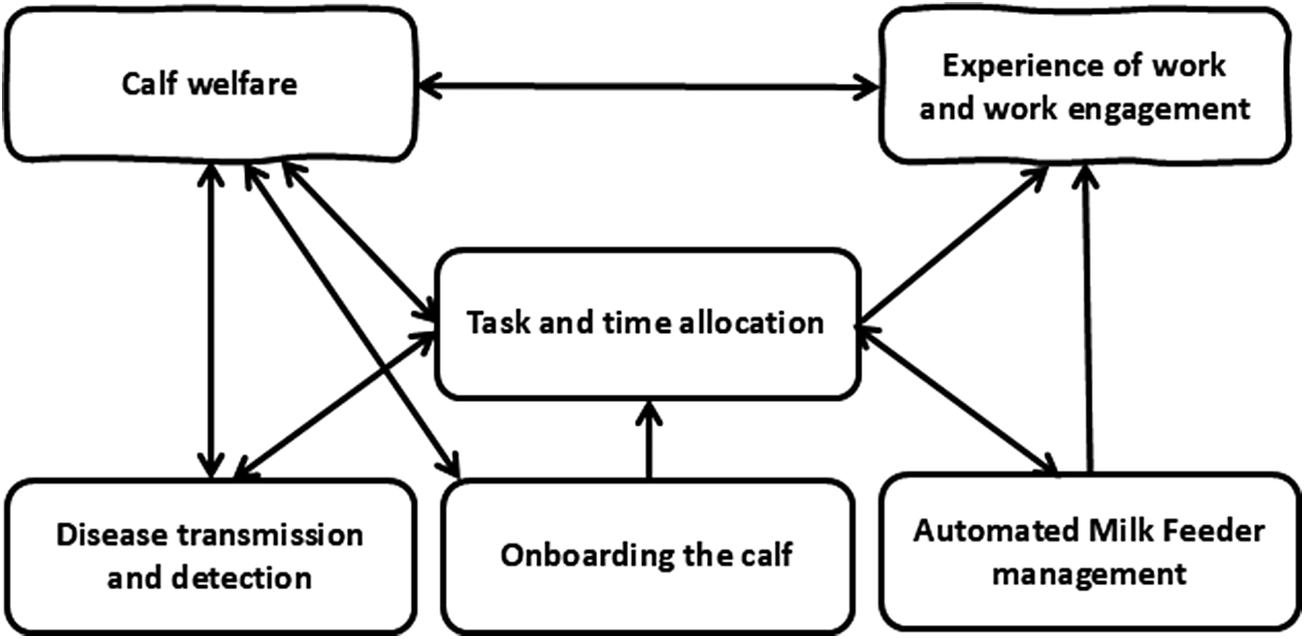
We identified six themes that describe participants’ experiences of using AMF: Calf welfare, Onboarding the calf, Disease transmission and detection, Managing the AMF, Task and time allocation, and Experience of work and work engagement. The relationships between the themes are illustrated in Figure 1, which provides an overview of the thematic structure of the findings. Participants’ narratives revealed interconnections between the theme Calf Welfare and the themes Task and time allocation and Experience of work and work engagement, both of which may have implications for farmer and farm staff well-being. An analytical synthesis of the principal opportunities and challenges associated with AMF use for calves and people, derived from these six themes, is presented in Figure 2 and illustrates that overall, participants perceived their AMFs to be generally reliable despite acknowledging occasional technical problems.
Thematic map illustrating the six themes and their interrelationships identified in interviews with 15 Swedish dairy farmers or farm staff regarding the use of automated milk feeders for calves. Double-headed arrows indicate a bidirectional relationship, while single-headed arrows indicate how one theme influences another.

Analytical synthesis of the principal opportunities (green) and challenges (red) for calves and people associated with automated milk feeding, derived from six themes identified in interviews with 15 Swedish dairy farmers or farm staff. The balance scale illustrates participants’ perception that opportunities associated with automated milk feeding clearly outweighed the challenges.

Across participants’ narratives, the decision to adopt or recommend AMF was consistently framed as a response to practical challenges in calf management while simultaneously creating opportunities to improve calf welfare. Participants described reduced time required for milk feeding and cleaning, improved feeding hygiene, ensuring consistent milk-feeding routines, reduced stress for the calves, difficulties in finding skilled calf-care workers, and more flexible working hours as key reasons for choosing AMF over teat buckets and milk taxis (mobile units for mixing, warming, transporting and dispensing whole milk or milk replacement to the calves). Participant 9 explained their reasoning, saying:
It was both the time, and for the sake of the calves, to make it easier to give them more milk and not be limited by the staff and people who do [feeding routines] differently. To get the same [routines every feeding] for the calves.
These accounts suggest that participants rarely viewed work efficiency and calf welfare as competing goals. Instead, they described AMF as enabling improvements in both domains. Two participants, who had previously used non-computerised milk feeders (which lack electronic calf identification and typically provide acidified milk ad libitum), reported economic reasons related to excessive milk consumption as their reason for choosing AMF. Participants’ narratives revealed that factors such as the construction of a new barn, the need to replace old AMF, and staff members leaving were all important when considering the purchase of a new AMF, as exemplified by Participant 9 saying:
Cause it was in connection with one staff member leaving, and then we said that now we don’t hire anyone new, now we’re buying a feeder. And so, we tested how much time we saved, and we haven’t hired anyone else since.
Participants considered the cost of AMFs to be justified by better-conditioned calves and reduced time spent on milk feeding and cleaning. Others described costs as small compared with those of the milk fed to the calves, salaries, housing facilities and other equipment in dairy production, or in relation to the expected lifespan of the AMF. Taken together, these accounts indicate that investment decisions were evaluated in relation to the long-term organisation of calf care rather than solely on the purchase cost of the technology.
Below, we present the six themes more closely. The principal subthemes within each theme are summarised in Table 3.
Summary of principal subthemes identified in interviews on perceived challenges and opportunities of using automated milk feeders for calves on 14 Swedish dairy farms

Table 3 Long description
Calf welfare subthemes were Milk allowance and intake, Freedom of choice, Clinical and subclinical disease, Cross- and intersucking, Robustness, Weaning, and Peaceful eating.
Onboarding the calf comprises the subthemes Drinking station design, Practices, Calf behaviour and learning, Introduction strategy, and Entry status.
Disease transmission and detection subthemes were Group size, stocking density, age range, Handling of sick calves, Clinical and subclinical disease, Introduction strategy, Entry status, Disease detection practices, and Hygiene.
Managing the automated milk feeder comprises the subthemes Operational reliability and technical failures, Usability and user experience, Technological competence, Monitoring, control and flexibility, Distributors’ service, Disease detection practices, and Feeding hygiene.
Task and time allocation subthemes were Work hours, Work input, Demanding work tasks, and Released time.
Experience of work and work engagement comprises the following subthemes: Flexibility and peace of mind, Sense of control and oversight, Attitudes regarding technical failures, Stress over technical failures, Human-calf relationship, and Ease of care.
a AMF=automated milk feeder.
Calf welfare
Participants consistently described AMF as improving their farms’ ability to provide their calves with more milk from more frequent meals than they would have managed with teat buckets and milk taxis. Their daily milk allowance for four-week-old calves ranged from 5 L to ad libitum, and nine (64%) farms fed their calves at least 10 L per day of milk or milk replacer (or 8 L per day for small breeds, e.g. Jerseys). Participant 14 commented on the opportunities the AMF system created for their calves, saying:
Yes, but it’s simply that they get enough milk. That they get the milk they need.
Several participants believed that the AMF’s standardisation of temperature and concentration, together with the avoidance of the large meal sizes often associated with feeding higher allowances in two daily meals, was beneficial for gut health. One participant who used uninsulated calf housing stated that they perceived the AMF’s “temperature-controlled feeding” feature as particularly advantageous. This function adjusts feeding when ambient temperatures fall below a defined threshold, automatically providing calves with either a larger volume of milk or a higher concentration of milk replacer. Across participants’ narratives, the more biologically adapted feeding regime of the AMF system was closely associated with perceptions of healthier and more robust calves.
The calves are so much more vigorous when we use this system [Participant 12].
Although a few participants identified competition for the feeder as a challenge for the calves, particularly in larger groups of more than 10 calves, the AMF system was generally perceived as less stressful (more peaceful eating) for the calves than manual feeding twice daily, and they perceived the weaning process to be smoother. All participating farms used the step-down protocol administered by their AMF. This generally meant a longer and more gradual weaning process than in their previous manual feeding systems and was perceived to be associated with less stress, as indicated by a lower level of vocalisation by the calves. Participant 6 explained their experiences, saying:
Weaning goes real smooth. Cause you don’t even have to think about it.
Some participants perceived cross-sucking and calves butting each other from behind as challenging for the calves. Reducing the number of meals rather than the meal size during weaning was mentioned as one strategy believed to mitigate the problem. However, most participants believed that cross-sucking occurred less frequently in the AMF system than with manual feeding.
Participant 7 commented on how the AMF could help them become the best version of themself as an animal owner, reflecting on how the freed-up time could be used to support their well-being by providing them more sense of control and oversight, and at the same time improve calf welfare by preventing calf morbidity:
Then you can spend more time watching them and keeping an eye on them. And that’s where a lot of the well-being comes in, anyway. You see things before it has become acute. So there the [automated] milk feeder plays a role.
Across the interviews, participants suggested that the perceived value of AMF extended beyond automated milk delivery. Rather, the technology was described as creating opportunities to combine a biologically appropriate feeding regime with more attentive observation, earlier detection of disease symptoms, and a greater sense of control over calf care.
Onboarding the calf
Most farms introduced their calves to the AMF system at 2–3 weeks of age. The newly introduced calves were a central focus of participants’ daily work routines, and they associated onboarding new groups of calves into the AMF system with a peak in workload. Not finding their way to the feeder was mentioned as a challenge for the calves and providing sufficient attention and support to newly introduced calves were regarded as a crucial factor for successful calf-rearing in AMF systems. According to participants, small and weak calves required additional support during onboarding, as they struggled to compete for access to the feeder. Participant 14 described the most important success factor in AMF calf rearing, saying:
Well, the most important thing is still that they get off to a good start [start eating well], that you make sure they get a good start.
Across participants’ accounts, successful onboarding was described as depending less on the technology itself than on the attention, observation, and support provided during the calves’ first days in the system. However, the technical equipment was perceived to influence the time and effort participants needed to support the calves’ learning process. The position of the nipple in the so called “hygiene pens” (a specialised configuration of the AMF feeding station incorporating an integrated cleaning function for the teat assembly) was perceived to support the learning process, and participants also mentioned that seeing other calves eating helped calves find their way to the feeder. Although participants described calves as teachable and persistent when learning, their narratives revealed that many felt that it was not natural for calves to find their way into and out of the milk feeder station. In the words of Participant 14:
And the problem is not the eating, but the problem is that they have difficulty backing out of the [feeding station].
Participants’ narratives suggest that the calves’ adaptation to the AMF system was perceived as a gradual process, influenced by the design of the technology, calf group size and dynamics, and the support provided by stockpersons. Taken together, participants described onboarding as an intensive but worthwhile investment. Rather than reducing the need for stockperson involvement, the AMF shifted it towards careful introduction, observation, and support during the calves’ adaptation to the system.
Disease transmission and detection
Overall, participants took pride in their calves’ health status and condition. They highlighted the importance of monitoring the calves closely and acting promptly if they showed signs of reduced appetite or other signs of disease, both to support the individual calf and to reduce microbial transmission. For their disease detection, many of the participating farms relied heavily on data output from the AMF or used it as a prompt to examine specific calves more closely. However, many participants also reported that their daily routines of entering the pens to check on the calves were crucial for detecting disease. Some perceived the AMF data output as lagging behind their own observations of their calves’ condition (both when falling ill and recovering). Rather than replacing farmers’ own observations, our findings suggest that AMF data complemented and, in some cases, redirected attention towards calves requiring closer inspection. Several participants mentioned that handling sick calves involved moving them away from the group to an individual isolation pen for treatment and special care, to reduce transmission. They also emphasised the importance of a good start in life for the calves, noting that the calves were strong and healthy when they entered the system. Participant 12 explained how the calves’ start in life and entry status affected their subsequent health, saying:
The most important thing is getting enough colostrum into it for so-and-so many days, and making sure it really gets going with the drinking. And if you put healthy calves into a calf feeder, you’ll have healthy calves coming out — as long as the groups aren’t too big.
Many of the participants commented that their colleagues had abandoned the AMF system, arguing that the AMF itself was not to blame for poor growth rates or clinical disease problems. They pointed out that the technology has now considerably improved; for example, enhanced AMF data outputs provide better support for disease detection, and they perceived that the automatic dishwashing programmes had improved feeding hygiene, making it better than in their previous manual feeding systems using teat buckets. Furthermore, participants described that over the past decade, they had gained extensive knowledge and learned a great deal about reducing microbial transmission among group-housed calves.
To succeed with your calves in AMF systems, I think group size and stuff like that are pretty important” [Participant 4].
I agree with that. // That’s the reason why many have changed or thrown out their milk feeders, as they perhaps started with too high stocking density. And that doesn’t work” [Participant 2].
Others mentioned poor housing facilities or failure to adhere to good calf-management practices as reasons for colleagues abandoning the system. Participant 5 described the success factors influencing AMF calf rearing, saying:
It’s that we bring them in [to the AMF system] in groups and that you´ve got to empty the pen between groups [all-in-all-out on pen level], ‘cause that’s what really made us throw it [the AMF] out in the 90s — that it just went on and on with calves.
Rather than attributing health challenges to the AMF itself, participants described them as arising from interactions between technology, housing conditions, calf-management routines, and the knowledge and practical implementation of biosecurity measures.
Managing the automated milk feeder
Managing the AMF was perceived as a major challenge for people and was addressed by all participants. They described that it took considerable time to learn how the technology functions, and several farms did not use all the features because they lacked the time to familiarise themselves with them. According to participants, older people generally found the technology more challenging than younger ones. All participants had experienced technical failures. While several of them described failures as rare, a few reported recurring problems that the distributor’s service technicians were unable to resolve (e.g. auto-calibration failures or contamination of the milk by detergent). Participant 6 responded to a question about the most common failures in their AMF, saying:
There are no common failures. No, it’s [our AMF is] quite new, and I don’t find that there are any problems; it’s not often.
Failures they reported were related to both the technology itself and to consequences arising from poor management routines or conditions on the farm. Participants described that management-related problems seemed to be more frequent on farms feeding whole milk, where clogging was a well-known cause of stoppages, warranting good cleaning routines. Their narratives revealed the challenging conditions for milk quality and technology in calf facilities, such as freezing, high temperatures, high humidity, exposure to calves and pests, and, during cleaning, exposure to water. They reported that in the event of power or water supply interruptions, or disrupted Wi-Fi connections, AMF data outputs were not automatically updated, which might result in failure to detect sick calves.
Nearly all participants expressed dissatisfaction with the manufacturer’s/distributor’s service support, particularly calling for higher competence and better accessibility among service technicians, as well as improved access to spare parts. Some participants reported that they had perceived the companies to be rather uninterested in even selling AMFs. Participant 4 described their vulnerability related to the accessibility of spare parts, saying:
All parts that had to do with calves weren’t [perceived by the service organisation as] urgent. So, no essential part could break. [Then], if things got bad, I had to feed the calves in buckets for up to a week before I got that part.
Participants reported that calves need a long time to compensate for a stop in milk provision, as it causes considerable loss of condition. To mitigate the shortcomings in service support, participants reported a need to develop farms’ own competence in troubleshooting and repairing equipment, as well as keeping essential spare parts on hand.
However, participants generally reported good usability and user experience. They valued the functionality of AMF data outputs and alarm features, appreciating the ability to monitor and support calves and staff, troubleshoot issues, and solve problems remotely. Tablets, mobile applications, and “hygiene pens” generally received positive reviews. When asked about future perspectives, participants’ wishes included, for example, additional equipment to monitor the calves, improved user manuals, easier ways to change feeding plans for calves, and integrating the AMF system with other systems on the farm and/or to reporting systems. Although the alarm and dishwashing features were generally very popular, some participants called for further improvements.
Participants described successfully managing the AMF as extending beyond operating the technology itself. Rather, it involved developing new routines, practical competence, and the ability to respond to everyday challenges to ensure reliable calf care under everyday farm conditions.
Task and time allocation
Participants described AMF use as reducing both physically demanding and time-consuming, less attractive tasks associated with manual milk feeding. Participant 14 reported the main reason their farm chose AMF, saying:
The main reason was that I was so tired of cleaning teat buckets. That was the simple reason.
The AMF system was perceived to allow better and more flexible working hours for owners and staff, and the time freed up could be spent on, for example, rest, leisure, and other farm tasks, such as monitoring and follow-up, supporting staff, and office duties as well as contact with the calves. Participant 8 commented on aspects important for good working conditions, saying:
They [our employees] don’t work weekends here. ‘Cause we’ve seen that if we can keep regular working hours and work from Monday to Friday and they can be free at weekends, we also get staff who think it’s fun to come on Monday again.
Taken together, participants described the value of AMF use not simply in terms of reducing workload, but also in enabling them to prioritise aspects of calf care that they perceived as adding greater value to both calf welfare and their daily work and to organise their working hours more flexibly.
Experience of work and work engagement
Besides opportunities in terms of task and time allocation, the ease of care and reduced overall workload were highly valued features of the AMF system. Participant 8 commented on the opportunities with the AMF system, saying:
Yes, but it’s 100% the workload. // [If we hadn’t had the feeder] then we would have fed 90 calves with a milk taxi. That would have taken some kind of shift work to remember what each calf should have. And then those teat buckets must be washed. I wouldn’t be a farmer with 90 teat buckets.
Particularly for farm owners, the reduced workload and availability of time for other tasks were perceived to contribute to a sense of keeping up with their work and having time for reflection, as exemplified by Participant 9, saying:
The time saved, it’s a lot about not just running around and doing, doing, doing. You’ve got to stop and look around. And see if you’ve done well or not. That applies to everything.
Farm owners described that the AMF system provided them with a sense of security. It ensured that their calves received sufficient milk at good hygienic standards, regardless of who was feeding them, provided a good overview and control of their calf rearing and allowed them to support but also monitor their employees. However, the AMF was also perceived as a cause of concern due to the additional workload in the event of a technical failure. Participant 5 put their concerns about this into words when asked about important features for work-life balance, saying:
It’s a stressor, this thing that everything has to work all the time. That’s 365 days a year, 24 hours a day.
Participants’ experiences of technical failures varied depending on interest, technological maturity, and attitudes towards technology. Participant 14, who described themself as being interested in technology, discussed different farmers’ attitudes towards technology, saying:
If you can’t handle things going wrong, then you shouldn’t have technology. // It’s something you know from day one. That something is going to fail at some point. That’s just the way it is.
Participants expressed differing opinions on whether the AMF system contributed to the perceived desirability of calf-management tasks, which appeared to be influenced by both personal preferences and farm conditions. Participant 14 commented on how the AMF could contribute to them becoming the best version of themself as an animal owner, saying:
But I think that I have better contact with the calves now. I can say that calves haven’t been my cup of tea in farming, so to speak. But I think so now.
As previously mentioned, participants associated the AMF system with healthy and robust animals. Healthy and happy animals were in turn put forward as an important factor contributing to work engagement, as exemplified by Participant 12, who said:
I could have employees who just hang around there [by the calf feeder] and watch the calves every day. It’s working and it’s great fun. // If you have a happy calf, you have a happy employee, and then you have a good time at work, that’s how it is.
Participants also mentioned that the AMF could contribute to activity balance and allow them to sustain sufficient energy to engage meaningfully in personal activities beyond the work context. More broadly, participants described the value of the AMF system as extending beyond improvements in efficiency alone. Rather, they perceived the system as creating opportunities to organise their work in ways that better reflected what they considered important in calf care.
Discussion
This in-depth qualitative study captured dairy farmers’ and farm staff’s lived experiences with AMF use through both focus group and semi-structured interviews, offering a comprehensive conceptual map of AMF use in practice. Our findings support the idea that AMF use can help overcome the challenges of accommodating more frequent milk meals within daily work routines and life outside work typically associated with feeding calves higher milk allowances in manual feeding systems. Participants’ narratives suggest that it was the reduced workload and decreased organisational barriers associated with frequent feedings that enabled them to feed higher milk rations. Study farms fed higher allowances than would generally be expected among Swedish dairy farms, and 64% fed 10 L per day or more, aligning with findings from Canada by Medrano-Galarza et al. (Reference Medrano-Galarza, LeBlanc, DeVries, Jones-Bitton, Rushen, de Passillé and Haley2017a).
While the study confirms previous reports of farmers abandoning the AMF system, it also provides evidence that farmers and farm staff can be highly satisfied AMF users. Across 14 Swedish dairy farms that had continued to use AMF, farmers and staff consistently perceived AMF as offering substantial benefits that outweighed the challenges. The study offers a nuanced understanding of the challenges related to AMF as perceived by dairy farmers and farm staff. Our analysis identified disease transmission and competition for the feeder, particularly among smaller calves, as the perceived key challenges for the calves. The main challenges for people, as perceived by participants, were technical reliability, limitations in disease detection, and vulnerability due to inadequate service support. The main opportunities that participants perceived the AMF system to offer calves, compared with twice-daily manual feeding in teat buckets, were higher milk allowances, a longer weaning process, and more freedom to choose when and how much milk to drink. The AMF system was also perceived as providing a more peaceful eating experience, standardised feeding, improved feeding hygiene, and increased calf robustness.
Furthermore, our study illustrates the role of AMF in social sustainability by showing how its use can reduce physical workload, enhance flexibility, provide reassurance, increase the sense of control and oversight in calf care work, and strengthen human-calf relationships, thereby supporting farmer and farm staff well-being. Although previous research has identified high workload, long working hours and time pressure as particularly important challenges to farmer and farm staff well-being (Kallioniemi et al. Reference Kallioniemi, Kaseva, Kymäläinen and Hakanen2022; Lundqvist et al. Reference Lundqvist, Håkansson, Göransson and Hakelius2024), it has also highlighted working with animals and experiencing meaningfulness in one’ work as important resources within farmers’ psychosocial work environment (Kallioniemi et al. Reference Kallioniemi, Kaseva, Lunner Kolstrup, Simola and Kymäläinen2018; Lundqvist et al. Reference Lundqvist, Håkansson, Göransson and Hakelius2024). In addition, autonomy and flexibility in organising work have consistently been associated with improved psychological well-being (Clausen et al. Reference Clausen, Pedersen, Andersen, Theorell and Madsen2022). More broadly, our findings illustrate how technology can function as an enabler of mutually reinforcing improvements in animal welfare, everyday care practices, and the well-being of those responsible for animal care. In this sense, the study extends the practical application of the One Welfare concept (Platto et al. Reference Platto, Normando, Serres, Manteca and Temple2025) by showing how thoughtfully implemented automation may strengthen, rather than separate, the interconnected well-being of animals and people.
Our findings suggest that the value of AMF extends beyond labour savings or automation per se. Participants described how the AMF system created new opportunities to organise calf care in ways they perceived as beneficial for not only calf welfare but also the organisation of everyday work on the farm, and their own work experience.
Reasons and driving forces for the adoption of automated milk feeders
Participants described the decision to adopt AMF as being driven by both working conditions and animal health and welfare. Rather than presenting these as competing priorities, our findings suggest that participants perceived them as closely interconnected and mutually reinforcing motivations for adoption. Similar findings were reported by Medrano-Galarza et al. (Reference Medrano-Galarza, LeBlanc, Jones-Bitton, DeVries, Rushen, de Passillé and Haley2017b) for Canadian AMF dairy farms. Studies have shown that economic non-use values, such as feeling pride in one’s animals and how they are kept, may be important drivers for farmers to invest time or resources to improve animal welfare and health (Hansson & Lagerkvist Reference Hansson and Lagerkvist2016). Farmers’ well-being is also linked to the health and welfare of their animals (King et al. Reference King, Matson and DeVries2021; Lind et al. Reference Lind, Hansson, Emanuelson and Lagerkvist2025; Purc-Stephenson & Doctor Reference Purc-Stephenson and Doctor2025), and working with animals reduces workload and improves work experience (Kallioniemi et al. Reference Kallioniemi, Kaseva, Lunner Kolstrup, Simola and Kymäläinen2018; Lundqvist et al. Reference Lundqvist, Håkansson, Göransson and Hakelius2024).
Our previous studies have demonstrated that farmers are highly aware that a high milk allowance supports calves’ health and welfare, and subsequent performance (Svensson et al. Reference Svensson, Hegrestad and Lindblom2023). This knowledge, together with an awareness of the importance of feeding hygiene (cleaning teat buckets), is likely to reinforce farmers’ interest in AMF, particularly as herd sizes increase. Our findings further suggest that participants viewed AMF as a means of putting their existing knowledge and intentions regarding calf care into practice, rather than changing their underlying priorities. In this sense, the technology did not create new welfare ambitions but enabled participants to realise existing ones in everyday practice, although our results suggest that the desire to reduce workload was probably the primary driver behind the installation of AMF on the farms. The participants’ narratives highlight the importance of a reduced physical workload and having a life outside of work, suggesting that a shortage of skilled staff may have intensified these needs. Finding skilled workers is a major challenge for Swedish farmers (Lundström & Lindblom Reference Lundström and Lindblom2021; Lundqvist et al. Reference Lundqvist, Håkansson, Göransson and Hakelius2024). Furthermore, participants acknowledged the value of flexible work hours, and farm owners noted that the AMF made it possible, for example, to avoid scheduling employees on weekends. Rather than simply reducing workload, participants described AMF as making every-day calf management more sustainable and more compatible with maintaining a viable workforce.
Despite these perceived benefits, AMF adoption remains relatively limited internationally, suggesting that barriers to implementation extend beyond the perceived value of the technology itself. Surveys report AMF use on fewer than 20% of Swedish and Canadian farms (Medrano-Galarza et al. Reference Medrano-Galarza, LeBlanc, DeVries, Jones-Bitton, Rushen, de Passillé and Haley2017a; Svensson et al. Reference Svensson, Hegrestad and Lindblom2023; Russell et al. Reference Russell, von Keyserlingk and Weary2025) and fewer than 5% of UK farms (Mahendran et al. Reference Mahendran, Wathes, Booth and Blackie2022). From Germany, where the major manufacturers of AMFs (Förster-Technik GmbH, Urban GmbH & Co KG, and Holm & Laue) are based, higher usage has been reported, although it varies by region – from 6.6% in Bavaria and 31.8% in the north (Lower Saxony and Schleswig-Holstein) to 53.4% in the north-east (Brandenburg, Mecklenburg-Western Pomerania, Saxony-Anhalt, Thuringia; Anonymous 2020). Farms that had abandoned their AMF systems were discussed by participants and cited as a reason for not joining the study. While participants mentioned technical issues, they perceived poor calf health and performance as the most common underlying reason. They emphasised that these problems were not attributed to the AMF system itself, but rather to factors such as excessively high stocking density, inadequate housing, and suboptimal management routines. Our results align with those of Svensson et al. (Reference Svensson, Lundborg, Emanuelson and Olsson2003), Svensson and Liberg (Reference Svensson and Liberg2006), and Jorgensen et al. (Reference Jorgensen, Adams-Progar, de Passillé, Rushen, Godden, Chester-Jones and Endres2017) regarding calf health in AMF systems. For AMF to serve as a means of supporting calves in receiving adequate milk allowances, it is necessary not only to recognise the opportunities but also to identify and address the perceived challenges.
Considerations in automated milk feeding systems
Our participants’ high satisfaction with the AMF system was likely contingent on having largely resolved problems related to clinical and subclinical disease. Their reports reflected pride in their calves’ health and performance, which they regarded as strong indicators of success. Their narratives revealed substantial and systematic efforts to provide calves with high-standard facilities and a good start in life; they stressed the importance of small group sizes, low pen-stocking densities, narrow age ranges as well as good biosecurity and disease-detection routines. Many participants attributed the quality of their facilities and practices to a long-term learning process informed by previous experience with group-housed calves. This suggests that successful AMF use depends not only on the installation of new technology but also on the gradual development of management routines and practical experience over time.
Participants also emphasised the importance of prompt action when calves showed signs of disease. Detecting disease among calves in groups is generally considered more challenging than in single housing. Participants’ narratives suggest these difficulties may be greater in AMF systems than with manual feeding, and that feeding-behaviour data alone may be insufficient for early detection. Several participants stressed the importance of entering the pens to assess calves using visual, auditory, and olfactory cues. Our findings are consistent with those from Canada by Medrano-Galarza et al. (Reference Medrano-Galarza, LeBlanc, Jones-Bitton, DeVries, Rushen, de Passillé and Haley2017b), who reported that easier identification of sick calves was a major advantage of manual milk-feeding systems. These findings suggest that AMF did not reduce the importance of close human observation. Instead, participants described new ways of integrating system-generated information with direct sensory assessments to support attentive calf care.
Attitudes towards technology and technological skills were described as critical for satisfaction with the AMF system and for shaping perceptions of technical failures. Participants emphasised that effective management of the AMF requires both an interest in technology and an understanding that technical failures are an expected part of the system. Rather than viewing technical reliability as the absence of failures, participants appeared to regard successful AMF use as the ability to anticipate, manage, and recover from technical problems, while maintaining high standards of calf care. In contrast, their narratives revealed frustration and dissatisfaction among colleagues with low technological confidence or unrealistic expectations of flawless functioning. We anticipate that the increased use of technology in society and agriculture will likely lead to a rise in technological skills among farmers and farm staff over time (Rizzo et al. Reference Rizzo, Migliore, Schifani and Vecchio2024). Despite technical failures, participants were generally satisfied with the operational reliability of their AMFs and described the everyday handling of the AMF as straightforward. However, their dissatisfaction with the manufacturers’/distributors’ service organisation, and their vulnerability in case of failures, was evident. Hence, we suggest that for AMF systems to become a means of achieving biologically relevant milk allowances for dairy calves, better and more reliable support services are essential. It seems reasonable that the competence and availability of service organisations are influenced by the currently low use of AMFs, and that these can be expected to improve if AMF adoption becomes more common.
Training calves to use the AMF system required considerable work effort. Improved feeding stations, “hygiene pens”, were described as facilitating this process, yet participants’ narratives revealed that calves often struggle to find their way into the feeder and to back out of the station. Participants reported that the training was crucial for calves’ subsequent milk intake. This aligns with findings by Fujiwara et al. (Reference Fujiwara, Rushen and de Passillé2014), who reported that delays in learning to use the AMF were associated with lower milk intake over the following 1–2 weeks. We suggest that further optimisation of AMF station design to better support calves’ natural behaviours would likely reduce training demands and facilitate AMF use. On farms introducing their calves to AMF at a very young age, a delayed introduction may reduce the calves’ need for stockman assistance, as indicated by findings by Jensen (Reference Jensen2007), Fujiwara et al. (Reference Fujiwara, Rushen and de Passillé2014), and Medrano-Galarza et al. (Reference Medrano-Galarza, LeBlanc, DeVries, Jones-Bitton, Rushen, de Passillé, Endres and Haley2018). However, introduction before one week of age was not used nor recommended by the participants in the present study.
To our surprise, participants did not cite AMF investment costs as a major challenge. Costs were perceived as reasonable given the system’s expected lifespan and when compared with labour, milk or milk replacer for the calves, buildings, and other equipment. This result partly contrasts with findings by Medrano-Galarza et al. (Reference Medrano-Galarza, LeBlanc, Jones-Bitton, DeVries, Rushen, de Passillé and Haley2017b), who identified economic investment as the main barrier for Canadian farmers transitioning to AMF systems. The differences may potentially be explained by variations in labour costs. It can be expected that the shortage of competent staff in animal production, stress associated with high workloads, and limited time for life outside of work will be more important considerations than AMF costs for farmers in the future.
Technology as a viable solution for societal challenges and contributing to work engagement
There is an ongoing technological push in agriculture, driven by the broader trend of addressing societal challenges through technological and digital solutions. Substantial investments are being made in the development of smart technologies and automation (e.g. Liu et al. Reference Liu, Ma, Shu, Hancke and Abu-Mahfouz2020; Rizzo et al. Reference Rizzo, Migliore, Schifani and Vecchio2024). Sensor and AI technologies that monitor, for example, animal behaviour and feed intake to improve cow health and milk production (e.g. De Vries et al. Reference De Vries, Bliznyuk and Pinedo2023; Palma et al. Reference Palma, Plà-Aragonés, Mac Cawley and Albornoz2025) are expanding. Compared with technologies applied to adult cows, those designed for calf management are rare, as are studies on farmers’ technological needs and work experiences in calf rearing. Our findings suggest that participants experienced the AMF system as supporting work engagement not simply by reducing workload, but by changing how they could organise and experience their everyday work. Participants consistently described greater flexibility, enhanced competence, and more meaningful interactions with both calves and colleagues. Interestingly, these experiences closely resemble the six themes identified by Doidge et al. (Reference Doidge, Ånestad, Burrell, Frössling, Palczynski, Pardon and Kaler2024) as representing European farmers’ psychological needs for data and technology support to improve herd health (including calf health): autonomy, comfort, competence, community and relatedness, purpose, and security. Building on these findings, our study further suggests that Self-Determination Theory (SDT) offers a useful theoretical lens for understanding how these psychological needs may contribute to work engagement among farmers and farm staff using AMF systems (Gagné & Deci Reference Gagné and Deci2005; Deci et al. Reference Deci, Olafsen and Ryan2017; Van den Broeck et al. Reference Van den Broeck, Howard, Van Vaerenbergh, Leroy and Gagné2021).
Self-Determination Theory highlights three fundamental psychological needs at work: autonomy, competence, and relatedness. Autonomy involves the ability to make self-directed decisions aligned with personal values and to manage one’s workflow effectively. Competence refers to the sense of effectiveness and mastery in work tasks, while relatedness denotes the experience of social connection and belonging through supportive workplace relationships. Self-Determination Theory may help explain the relationships between the well-being of farmers and farm staff and their work engagement on modern dairy farms. Work engagement is defined as “a positive, fulfilling, work-related state of mind characterised by vigour, dedication, and absorption” (Schaufeli et al. Reference Schaufeli, Salanova, Gonzales-Roma and Bakker2002).
Participants’ narratives illustrated the three psychological needs highlighted in SDT. Their autonomy was cultivated through the AMF system’s flexibility in managing daily routines, enabling farmers and farm staff to improve their working hours and allocate time more freely. Delegating monotonous feeding tasks to the AMF system allowed them to engage in other meaningful activities, such as monitoring animal health, supporting colleagues, or simply taking time for rest and reflection. Rather than simply reducing workload, the AMF system enabled participants to redistribute their time towards activities they perceived as adding greater value to both calf care and their own work. This self-directed control over the workflow aligned with personal values and enhanced their sense of ownership. Our participants also reported that their experience of competence was strengthened by the system’s usability and the actionable data it provided, which supported calf health assessments, troubleshooting, and decision-making. These features empowered them to feel more effective and capable in their roles. Our results suggest that the AMF system allowed participants to maintain high standards of feeding hygiene and calf care, reinforcing their sense of mastery and effectiveness. Finally, it was revealed that participants’ relatedness was supported through improved interactions with both calves and colleagues, allowing for more meaningful contact with the calves and emotional connection, which contributed to their sense of purpose and belonging at work on the farm. Hence, our results suggest that, when functioning well, the AMF system contributed to a more engaging and fulfilling work experience. Most participants associated the AMF use with healthier, more robust calves, an outcome that further reinforced their motivation and enhanced work engagement and well-being. Following Krzywoszynska (Reference Krzywoszynska2016), we adopted a care perspective, meaning that care arises from all work practices that enable technology and knowledge work in complex domains (Lundström & Lindblom Reference Lundström and Lindblom2021; Svensson et al. Reference Svensson, Hegrestad and Lindblom2023). This perspective shifts the focus from purely technological solutions to the relational organisation of work activities and the outcomes they jointly produce. Viewed through this perspective, our findings suggest that the contribution of AMF extended beyond automation itself. Applied to calf management, AMF created opportunities for greater attentiveness, flexibility, and professional judgement, fostering care practices that support milk provision aligned with calves’ biological needs, while simultaneously contributing to participants’ work engagement and well-being.
Study limitations
Our choice to use individual interviews was mainly based on the large distances between AMF farms, which limited the feasibility of conducting focus group interviews. To capture diverse perspectives and achieve sufficient information power (Malterud et al. Reference Malterud, Siersma and Guassora2016), we purposively sampled participants to reflect the diversity of AMF farms, manufacturers/distributors, and roles, rather than aiming for a representative subsample of AMF farmers and farm staff in Sweden. While we largely met our selection criteria, additional perspectives, particularly from employed calf-care workers, might have emerged with greater representation from this group or through more focus group interviews. Future studies could therefore explore whether these perspectives differ across occupational roles. Another area for future research could be to explore perspectives of farmers who have discontinued their AMF use, as they may contribute complementary insights. As the study is based on participants’ experiences and perceptions, discrepancies may exist between reported and actual practices (Patton Reference Patton2002), as well as between perceived and actual calf behaviour or experience. Nonetheless, our findings are consistent with ethological research (e.g. Jensen Reference Jensen2004; Nielsen et al. Reference Nielsen, Jensen and Lidfors2008; Fröberg & Lidfors Reference Fröberg and Lidfors2009; Fujiwara et al. Reference Fujiwara, Rushen and de Passillé2014) and AMF work studies (Kung et al. Reference Kung, Demarco, Siebenson, Joyner, Haenlein and Morris1997; Medrano-Galarza et al. Reference Medrano-Galarza, LeBlanc, DeVries, Jones-Bitton, Rushen, de Passillé, Endres and Haley2018; Sinnott et al. Reference Sinnott, Kennedy and Bokkers2021). Although we cannot verify participants’ reports of good calf health, their described efforts, including providing calves with a good start in life, appropriate milk allowances, and maintaining high standards of housing, hygiene, and biosecurity, align with established recommendations for promoting calf health (e.g. Lorenz Reference Lorenz2021).
Animal welfare implications and conclusion
There is growing awareness among dairy farmers and farm staff that calves require higher milk allowances than those traditionally provided, to support adequate development and good animal welfare. Yet restricted milk feeding remains the reality for most dairy calves worldwide. Previous studies have identified reluctance to feed large meals, combined with the practical and organisational challenges of providing more frequent meals in manual milk-feeding systems, as an important barrier to achieving higher milk allowances (Svensson et al. Reference Svensson, Hegrestad and Lindblom2023). The present work suggests that by reducing workload and organisational barriers to frequent feeding, the use of AMF can circumvent these constraints, thereby enabling dairy farmers to provide biologically appropriate milk rations for their calves. Overall, participants perceived that the opportunities afforded by AMF outweighed the challenges because the system enabled improvements in both calf care and their everyday work practice. Although reduced workload was most likely their primary driver for installation, participants also reported improved animal welfare as a motivating factor. They perceived AMF to contribute to reduced stress and more peaceful eating, greater freedom of choice and increased robustness in calves. They also reported an improvement in human-animal relationships. Rather than merely reducing the workload associated with milk feeding, our findings suggest that the significance of AMF lies in its capacity to reshape how calf care is organised and experienced. Participants described benefits that extended beyond efficiency gains, encompassing outcomes perceived to support both calf welfare and the quality of working life on the farm. These findings indicate that the impacts of AMF may be relevant not only to animal welfare and productivity, but also to farmer and farm staff well-being, thereby contributing to the social sustainability of dairy farming. Moreover, the study contributes to the ongoing development of the One Welfare concept by illustrating how technology can influence the ways in which welfare outcomes for animals and humans become interconnected. By positioning technology as an integral part of these relationships, the study broadens current understanding of how improvements in calf welfare and human well-being may become mutually reinforcing in everyday calf-care practices. In this process, participants’ accounts suggest that perceived improvements in calf welfare may contribute to more meaningful and rewarding work experiences for farmers and farm staff, potentially strengthening their capacity and motivation to provide high-quality care.
Based on our results, we suggest that if the perceived key challenges for calves (disease transmission and competition) and for people (technology management and disease detection) are sufficiently addressed, AMF can improve calf welfare and social sustainability in dairy calf care. We further propose that improved technical support, the sharing of farmer and research experiences regarding facilities and routines for a successful calf rearing in AMF systems, and the optimisation of AMF design will increase satisfaction with, and uptake of, AMF systems.
Supplementary material
The supplementary material for this article can be found at http://doi.org/10.1017/awf.2026.10122.
Acknowledgements
The authors thank the participating farmers and farm staff for their time and for sharing their thoughts and opinions. Gårdsby Iglu AB, DeLaval Sales AB and Lely Centre are acknowledged for their support and for suggesting participants. We thank the members of the reference group, Sofia Nilsson and Mathias Jonsson, for their valuable input and support.
Funding statement
This research was financially supported by FORMAS (Grant 2023-02081).
Competing interests
None.




 Open access

