Introduction
Lethariella (Motyka) Krog was elevated to generic level and subdivided into three subgenera (Lethariella, Nipponica, and Chlorea) by Krog (Reference Krog1976). Subgenus Chlorea is characterized mainly by its orange colour (due to the compound canarione), and Chlorea species are used as traditional Tibetan medicines and health-promoting teas in China for reducing blood pressure and inflammation, and as a remedy for hyperlipemia. Local names for all species are ‘luxinxuecha’ and ‘hongxuecha’ in Tibet and the Yunnan Province.
Eight species are accepted in the subgenus Chlorea (Obermayer Reference Obermayer1997, Reference Obermayer2001), including three shrubby species: Lethariella cashmeriana Krog, L. sernanderi (Motyka) Obermayer and L. cladonioides (Nyl.) Krog. These three shrubby species are differentiated mainly by morphological and chemical characters (Krog Reference Krog1976; Obermayer Reference Obermayer1997, Reference Obermayer2001). However, as it is difficult to distinguish them using morphological characteristics alone, chemical investigations (mainly TLC studies) have been used in the past to separate the taxa. Thus some doubts have arisen concerning the separation of the three species. This study attempts to clarify the relationships among them by examining their morphology, chemistry, ecology and distribution.
Materials and Methods
Materials
The field surveys were made in the Chinese provinces of Yunnan, Sichuan and Xizang in August 2007; the habitat, type of substratum and ecological factors were recorded for each specimen. All the specimens collected are deposited in the Cryptogamic Herbarium of Kunming Institute of Botany, Chinese Academy of Sciences (HKAS). Specimens from the Lichenological Laboratory of the Herbarium Mycologicum of the Academiae Sinicae (HMAS–L) were also used. Type specimens from UPS, BM, H, PC, and GZU were examined.
Observation of external morphology and anatomy
Air-dried materials were examined under a stereomicroscope (DONGWON OSM–1) to study the external morphology. For anatomical studies, sections were hand-cut with a razor blade under the stereomicroscope, mounted in GAW (glycerol:alcohol:water = 1:1:1), and observed under a light microscope (Nikon ECLIP SE E200).
Chemistry
Thin-layer chromatography of acetone extracts was performed using standardized procedures (Culberson Reference Culberson1972; Culberson & Johnson Reference Culberson and Johnson1982).
Specimens were also analyzed by high-performance liquid chromatography (HPLC) with a Waters Alliance 2695 liquid chromatograph at 25°C. Chromatographic conditions: column, Zorbax SB–C18 (4·6 × 250 mm, 5µm); mobile phase: aqua bidest containing 1% orthophosphoric acid (solvent A) and methanol (solvent B); the solvents were degassed for 30 min in an ultrasonic vibrator prior to use. After injection of 10 µl of sample, the concentration of solvent B in A was programmed as follows: 30% (0 min) – 70% (15 min) – 100% (35 min) – 100% (48 min) – 30% (53 min) – 30% (63 min). Flow rate: 0·7 ml/min.; PAD: range 210–400 nm (254 nm). Identification of the lichen substances was carried out by HPLC, and by comparison with authentic samples isolated by our group and by published data on UV absorbance (Huneck & Yoshimura Reference Huneck and Yoshimura1996).
Results and Discussion
Chemistry
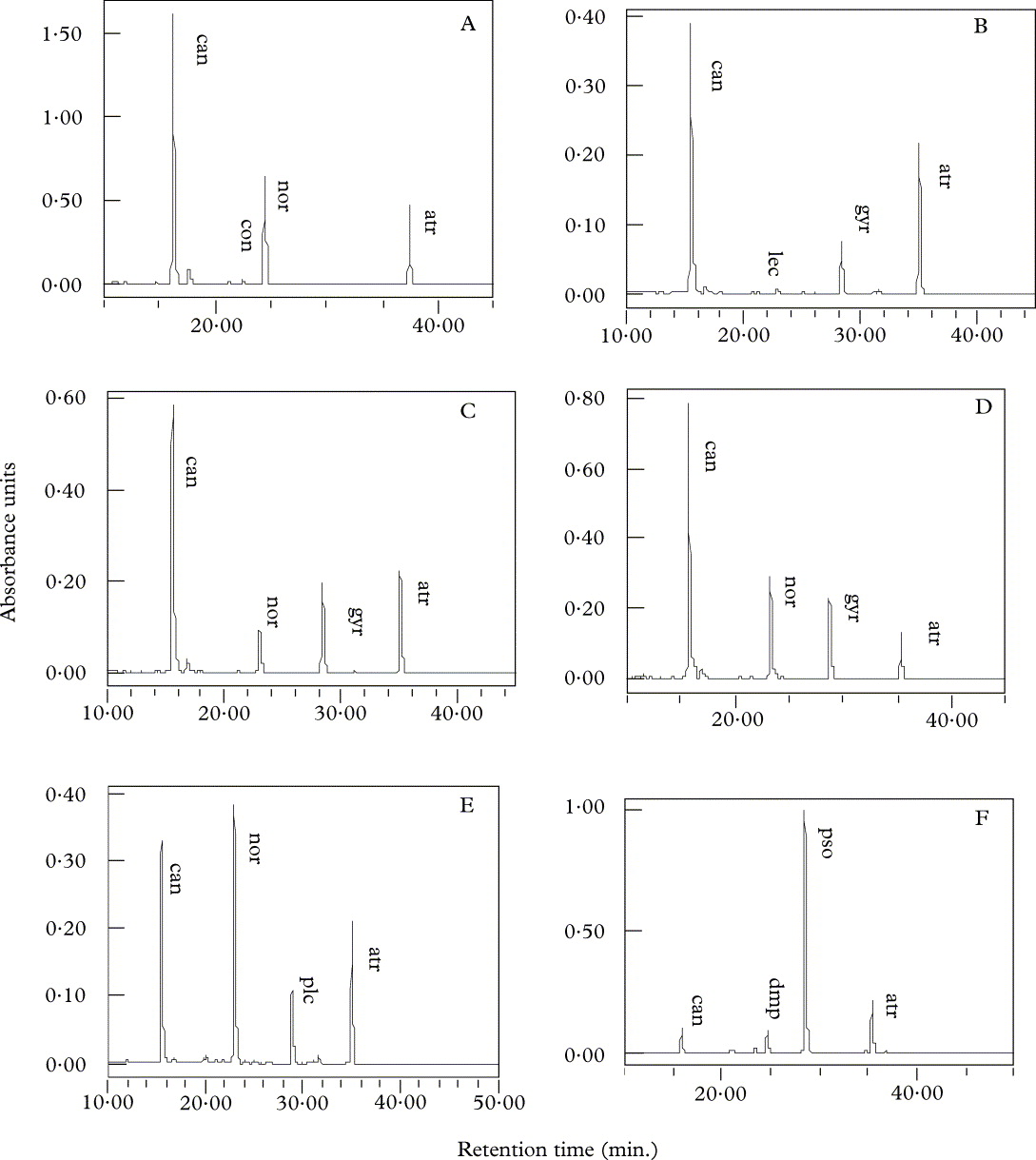
The chemistry of all specimens of the Lethariella cladonioides complex was examined by means of TLC and HPLC (Fig. 1), and five chemical groups were recognized. Group I contains norstictic acid as a major characteristic substance in the medulla, along with traces of connorstictic acid; group II has gyrophoric acid and traces of lecanoric acid; group III has norstictic acid and gyrophoric acid, along with traces of connorstictic acid; group IV has norstictic acid and placodiolic acid; and group V contains psoromic acid, along with traces of 2′-O-demethylpsoromic acid and traces of gyrophoric acid.
The HPLC chromatograms of Lethariella cladonioides complex. A, L. sernanderi (chemical race I), Wang 81–18132b (HKAS); B, L. cashmeriana (chemical race II), Zong 255 (HMAS–L); C & D, chemical race III, C, Zong 477 (HMAS–L); D, Wang 05–24303 (HKAS); E, chemical race IV, Jiang S216, (HMAS–); F, L. cladonioides (chemical race V), Wang 6215 (HKAS) atr. atranorin; can. canarione; plc. placodiolic acid; nor. norstictic acid; gyr. gyrophoric acid; pso. psoromic acid; dmp. 2′-O-demethylpsoromic acid; con. connorstictic acid; lec. lecanoric acid.
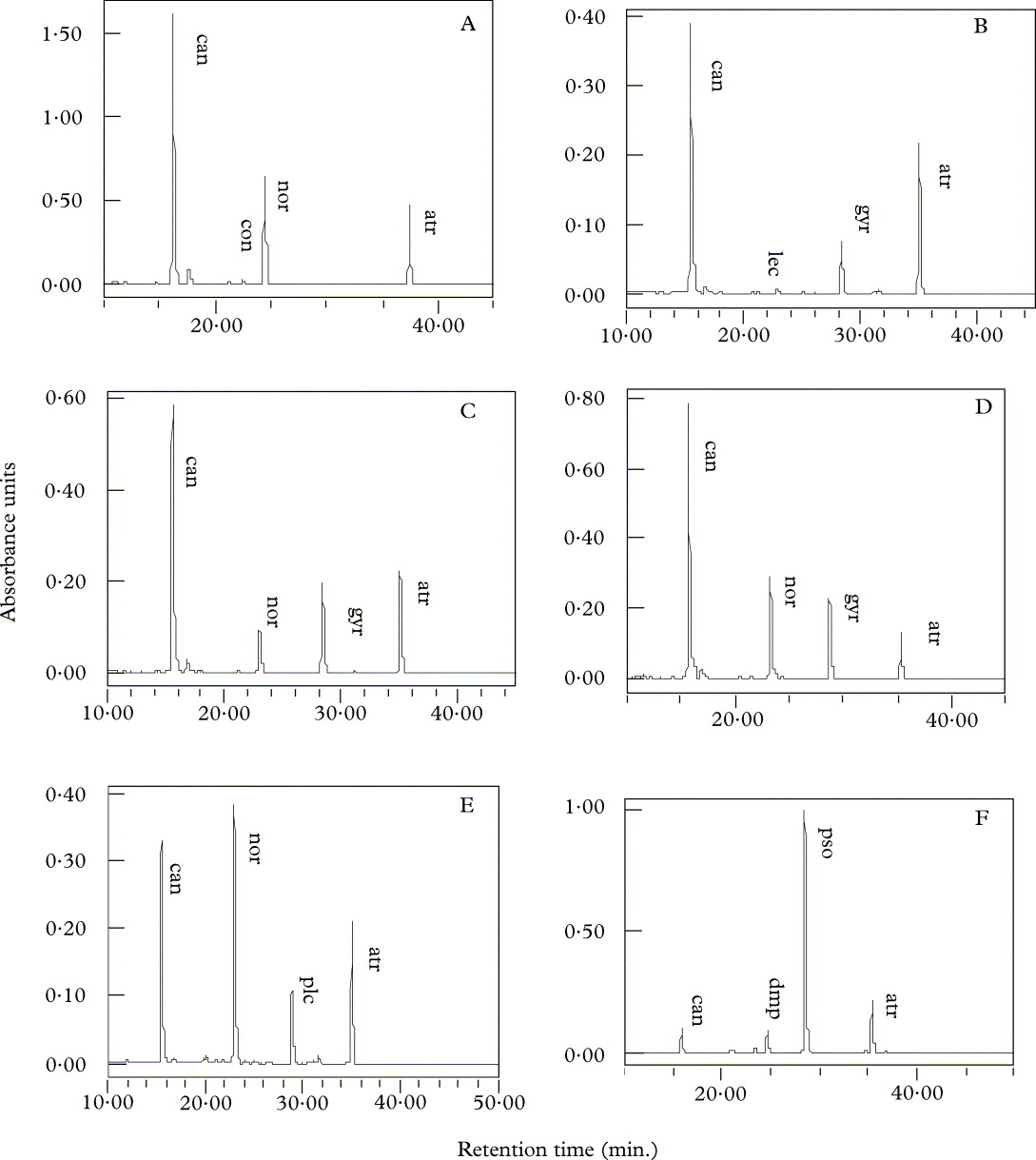
Krog (Reference Krog1976) reported two chemical races of Lethariella cladonioides, with the typical race having psoromic acid and conpsoromic acid, and the other race with norstictic acid. Wei & Jiang (Reference Wei and Jiang1982) regarded L. cladonioides as differing in chemistry from L. flexuosa (Nyl.) J. C. Wei, with norstictic acid in the former and psoromic acid in the latter. Sun et al. (Reference Sun, Niu, Lin, Cao and Li1990) and Jiang et al. (Reference Jiang, Zhao, Yang, Hou, Lin and Sun2001) also reported norstictic acid and other compounds from L. cladonioides. On the other hand, Obermayer (Reference Obermayer1997) detected psoromic acid in the holotype of L. cladonioides which was supported by our own HPLC studies (Fig. 1F).
According to Krog (Reference Krog1976) and Obermayer (Reference Obermayer1997), Lethariella cashmeriana contains gyrophoric acid as the main medullary substance, accompanied by various amounts of norstictic acid, as reported by Obermayer in 1997. On the other hand, Obermayer (Reference Obermayer1995) regarded L. sernanderi as a separate taxon, characterized by having norstictic acid in the medulla. Our analytic results of HPLC revealed that there were intermediates between the chemistry of L. cashmeriana and L. sernanderi. Some specimens contained much more norstictic acid than gyrophoric acid, whereas the opposite was true in other specimens. Other specimens had both norstictic and gyrophoric acids as major substances in the medulla (Fig. 1C & D). In addition, a continuum exists in the chemical contents from specimens containing norstictic acid without gyrophoric acid (Fig. 1A) to those containing gyrophoric acid and much norstictic acid and finally to those containing gyrophoric acid only (Fig. 1B). Obermayer (Reference Obermayer1997) also reported that some specimens of the L. sernanderi / L. cashmeriana complex collected from Nepal, Pakistan and Tibet, contain more or less equal amounts of gyrophoric and norstictic acids.
The results of HPLC analysis of vegetative branches and apothecia of a single thallus (Wang 05–24303), intermediate in chemistry between L. sernanderi and L. cashmeriana, showed that the proportion of gyrophoric acid was higher in apothecia and the proportion of norstictic acid was higher in vegetative branches. In group I, which contains norstictic acid in the medulla, apothecia have the same chemical composition as the vegetative branches. The results showed that gyrophoric acid was not the only compound in the apothecia of the L. cladonioides complex, which differed from the holotype of L. zahlbruckneri (Obermayer Reference Obermayer1997).
Placodiolic acid was also detected in one specimen (Jiang S216) of the L. cladonioides complex collected from Sichuan Province, accompanied by norstictic acid (Fig. 1E). The former substance, which was previously reported in the pendulous species Lethariella zahlbruckneri (Wu Reference Wu1981; Niu et al. Reference Niu, Wang, Zhang and Yang2007) and in a prostrate terricolous specimen of L. smithii (Obermayer Reference Obermayer2001), is reported here for the first time in the shrubby species.
Morphology and anatomy
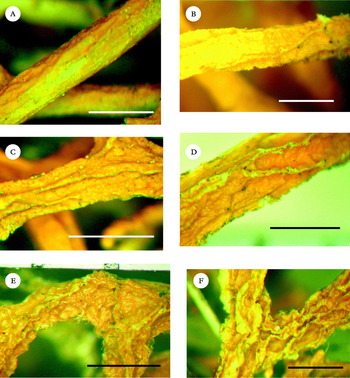
The key morphological characteristics of all five chemical groups were examined. Group I with norstictic acid in the medulla, to which the type of L. sernanderi belongs, is variable in morphology, particularly the thallus surface. The specimens have some degree of ridged surface, but it varies from faint to prominent (Fig. 2). The branch thickness is variable from slender (0·5–0·8 mm) to stout (1·0–2·0 mm). It is also observed that relatively stout branches have generally reticulately ridged surfaces, whereas slender ones tend to be faintly ridged, but there are some exceptions.
Lethariella: different surfaces of thalli in chemical race I. A, faintly ridged surface (Wang 81–2411, HKAS); B, sparsely ridged surface (Zang 76–44, HKAS); C, distinct ridged surface (Wang 81–2219, HKAS); D, sharp ridged surface (Wang 01–20561, HKAS); E, reticular ridged surface (Wang 02–22209, HKAS); F, strongly undulating ridged surface (Wang 83–1816, HKAS). Scale = 1 mm.

Group II with gyrophoric acid, to which the type of L. cashmeriana belongs, shows a uniform morphology, having stout branches with strongly ridged surfaces.
Group III with norstictic and gyrophoric acids, which are chemical intermediates between group I and II, has ridged surfaces similar to group I.
Group IV is known only from a single specimen, which has a strongly ridged surface in the upper branches and a smooth surface at the base.
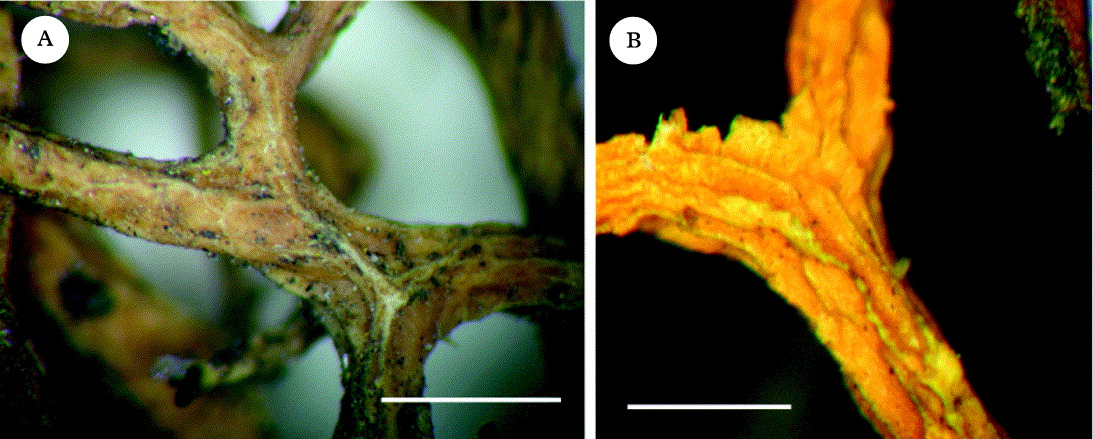
Group V with psoromic acid, to which L. cladonioides s. str. belongs, is also variable in terms of morphology. The holotype of L. cladonioides has a faintly ridged surface (Fig. 3A), but the surfaces of some herbarium specimens have ridges that are strongly reticulate (Fig. 3B). The branch thickness is variable as in L. sernanderi.
Thallus surface of Lethariella cladonioides (chemical race V). A, faintly ridged surface (holotype of L. cladonioides, PC); B, strongly ridged surface (Wang 05–24766, HKAS). Scale = 1 mm.
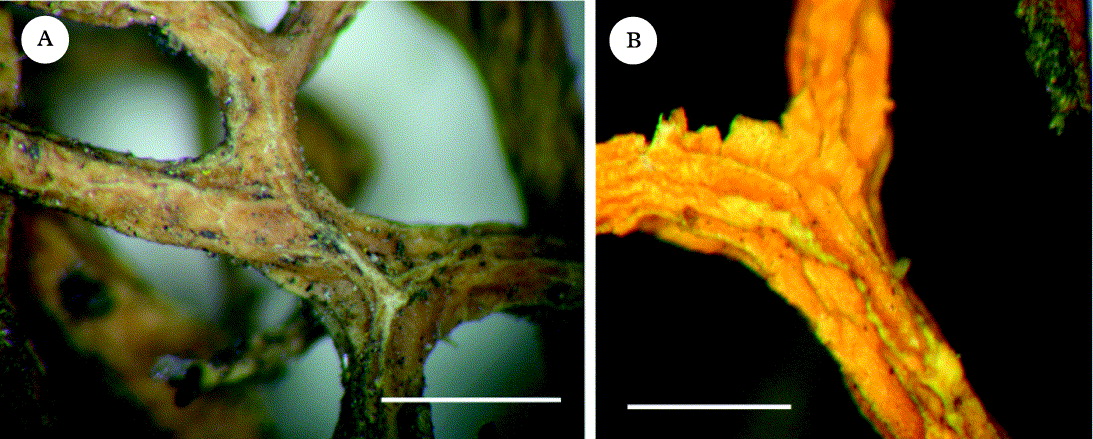
In previous literature, Lethariella sernanderi was described as having a reticulate thallus surface instead of a smooth one, which was believed to be typical for L. cladonioides s. str. (Obermayer Reference Obermayer1997). Lethariella cashmeriana was considered to have a stouter thallus and a more strongly ridged surface than L. sernanderi and L. cladonioides (Krog Reference Krog1976; Obermayer Reference Obermayer1997). The present investigations have shown that these characters cannot distinguish clearly the five chemical groups, including the three named species (groups I, II and V). In our field survey, it became apparent that specimens exposed to direct light have a strongly reticulate surface, in contrast to those growing under diffuse light or in shady conditions, which tend to be faintly reticulate or even smooth. Thus the surface character is probably affected by the intensity of sunlight that reaches the cortex. Furthermore, the surface of branches is smooth in some parts but is reticulately ridged in other parts in the same thallus of some specimens, particularly of group I (= Lethariella sernanderi). The branch thickness shows some correlation with the substratum. Specimens of groups I and V (= L. cladonioides s. str.) growing on rocks are more slender than those on stumps. As these characters are not clear-cut but obviously related to ecological factors and thus unstable, they are of no taxonomic value.
Members of the Lethariella cladonioides complex have variable means of propagation irrespective of their chemistry. Out of 203 individuals 125 (62%) are sorediate; 22 (10%) individuals have apothecia, half of which (5% in total) are sorediate. Whilst apotheciate specimens were collected mainly in the provinces of Tibet, Yunnan and Sichuan, sorediate morphotypes show a wider distribution, reaching as far as Shannxi Province. Some sorediate individuals from Tibet, Yunnan and Sichuan also produced apothecia. Mattsson and Lumbsch (Reference Mattsson and Lumbsch1989) already pointed out that if populations with vegetative propagation and those with sexual propagules have sympatric distributions, they should be treated as modifications of no taxonomic significance. Also, in the present case, sorediate individuals cannot be separated from apotheciate ones at any taxonomic rank.
In the present species complex, no correlation could be established between the chemistry and morphological characters. We found it impossible, therefore, to distinguish any taxa at any rank within the complex. Thus, Lethariella sernanderi and L. cashmeriana are reduced to synonyms of L. cladonioides, including five chemical groups (see below under ‘Taxonomy’). The five chemical groups should be regarded as chemical races within L. cladonioides.
The thallus colour of L. cladonioides is usually orange towards the apices of branches, and off-white towards the base, but there are some exceptions. The entire thallus is sometimes off-white in shady habitats. The pigments (canarione, rubrocashmeriquinone, 7-chlororubrocashmeriquinone or 7-chlorocanarione) (Kinoshita et al. Reference Kinoshita, Togawa, Hiraishi, Nakajima, Koyama, Narui, Wang and Takahashi2010) seem to be lacking in the cortex, and are probably produced in larger quantities under strong light conditions as with usnic acid. As a result, the colour of the thallus has no taxonomic value.
The apothecial morphology and anatomy were mostly uniform for all species in Lethariella, lacking fibrils on the thalloid margin. However, we have observed fibrils on the thalline exciple in some specimens of L. cladonioides. These fibrils varied from being short to relatively long, an observation that has also been made regarding the pendulous species Lethariella zahlbruckneri (Niu et al. Reference Niu, Wang, Zhang and Yang2007). This character, however, appears to be unstable and accidental.
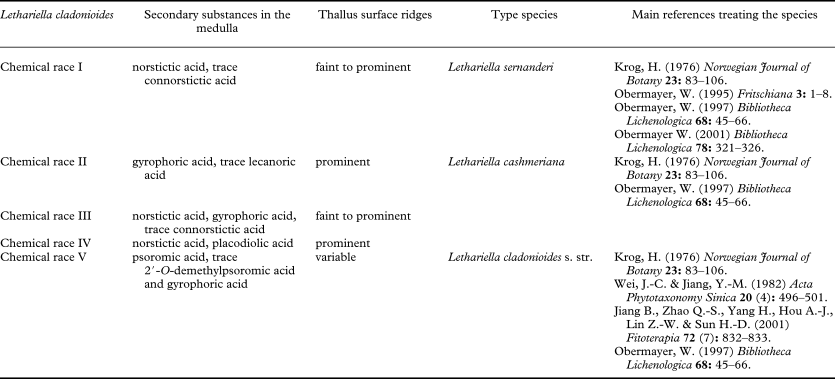
The results of the morphological and chemical analysis of the chemotypes of the Lethariella cladonioides complex are summarized in Table 1.
Summary of the chemical races of Lethariella cladonioides complex

Taxonomy
Lethariella cladonioides (Nyl.) Krog
Norweg. J. Bot. 23: 93 (1976).—Chlorea cladonioides Nyl., Syn. Lich. 1: 276 (1860); type: Himalaya, Sikkim. 12,000 ped., leg. Hooker & Thomson 1731 (PC!—holotype).
=Lethariella cashmeriana Krog, Norweg. J. Bot. 23: 91 (1976); type: Flora of Kashmir, Astor district, above Doyen, Astor valley, 11000–12000 ft, 14 August 1992, J. F. Duthi (BM!—holotype), syn. nov.
=Lethariella sernanderi (Motyka) Obermayer, Fritschiana 3: 7 (1995), syn. nov.—Usnea sernanderi Motyka, Lich. Gen. Usnea Stud. Monogr. Pars Syst.: 46 (1936), nomen novum for Usnea reticulata Du Rietz, Svensk Bot. Tidskr. 20: 91 (1926); type: China Prov. Sze-ch'uan, reg. Bor.-occid., mellan Tsago-gamba och Tamba, 4000 m. sm., 2 October 1922, Harry Smith, Plantae Sinenses No. 5007 (UPS !—holotype).
(Fig. 4).
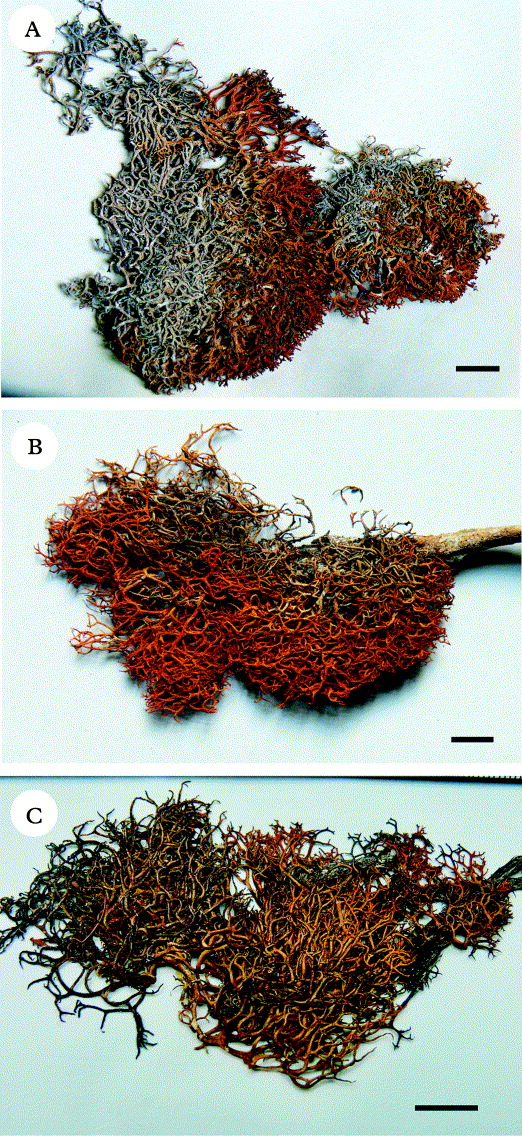
Holotype specimens of Lethariella. A, L. cashmeriana (BM); B, L. sernanderi (UPS), and C, L. cladonioides (PC). Scale = 1 cm.
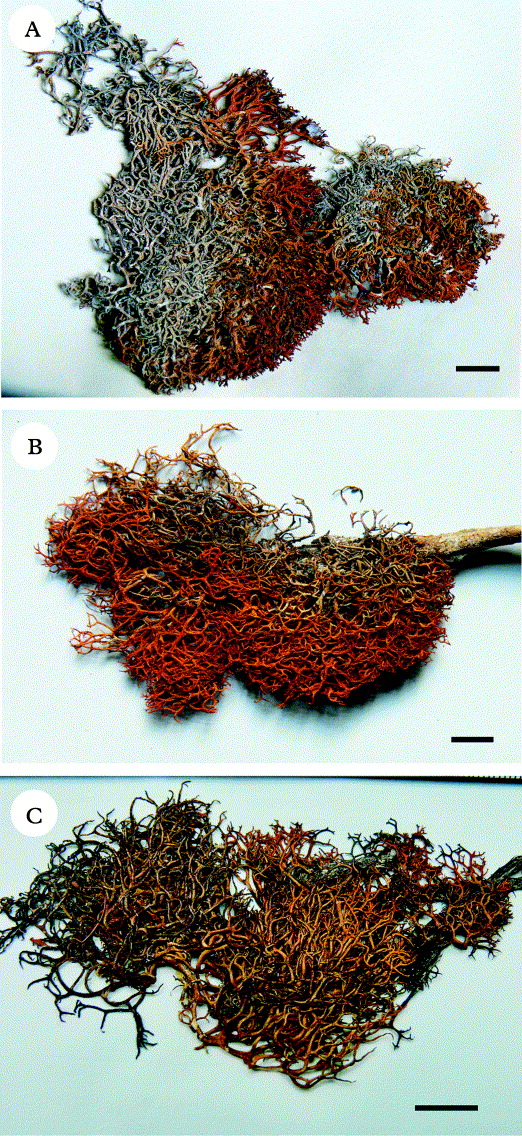
Thallus lignicolous, terricolous or corticolous, shrubby, erect, 1·0–8·0 cm high; dichotomously or irregularly branched; branches 0·5–2·0 mm wide, terete, tapering apically; orange or red-orange on top of the branches, pale or off-white at the base, sometimes the whole thallus off-white; surface smooth or rough, moderately to strongly reticulately ridged; side branches 0·25–1·0 mm, acute to right-angled to the main branches; esorediate or sorediate, soralia commonly in the tip area of the branches, occasionally in the thalline exciple (Fig. 5), irregularly spreading, excavate with raised margins, with orange granulose soredia. Cortex 20–30 µm thick, composed of sclerenchymatous hyphae. Medulla 50–150 µm thick with loosely interwoven or compressed hyphae (1·25–2·0 µm diam.). Central axis circular in cross section 350–550 µm diam., with longitudinally elongated hyphae (0·91–1·36 µm diam.).
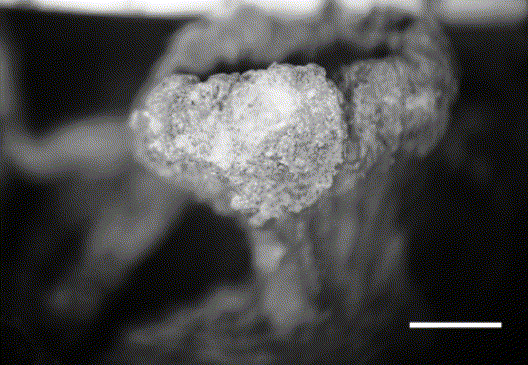
Soralia on thalloid margin (Wang 84–41–a, chemical race I, HKAS). Scale = 1 mm.

Apothecia rare, lateral, orbicular; disc 0·3–15 × 0·5–15 mm, flat but concave when young, grey-brown to dark brown, epruinose; the margin entire when young, becoming undulating and sometimes slightly dissected; thalline exciple reticulately ridged, concolorous with the thallus, occasionally with fibril-like branchlets. Ascospores 8 per ascus, ellipsoid, 7–8 × 5–6 µm, simple, colourless.
Conidiomata laminal, immersed; conidia pleurogenous, bacillariform.
Chemistry. Chemical race I: canarione, atranorin, norstictic acid (along with traces of connorstictic acid). Race II: canarione, atranorin, gyrophoric acid (along with traces of lecanoric acid). Race III: canarione, atranorin, norstictic acid and gyrophoric acid. Race IV: canarione, atranorin, norstictic acid and placodiolic acid. Race V: canarione, atranorin, psoromic acid (along with traces of 2′-O-demethylpsoromic acid and gyrophoric acid).
Habitat. The five chemical races grow mainly on the bark and wood of conifers, including Juniperus sp., Larix sp. and Picea sp. and also on Rhododendron sp. Chemical race I was sometimes found on rock and soil, chemical race V was also found to form populations on rock. All five chemical races were collected at altitudes ranging from 3000 to 4930 m.
Distribution. South-west and north-west China (eastern Tibet, western Sichuan, north-western Yunnan, southern Shannxi, north-western Gansu), India, Nepal, Pakistan, Kashmir.
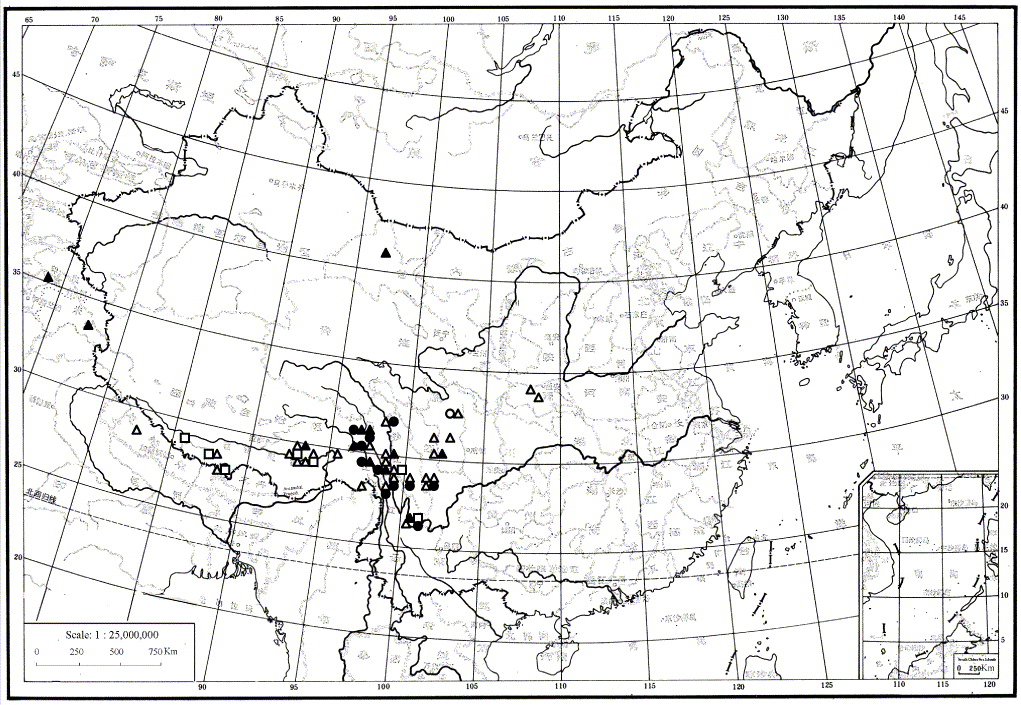
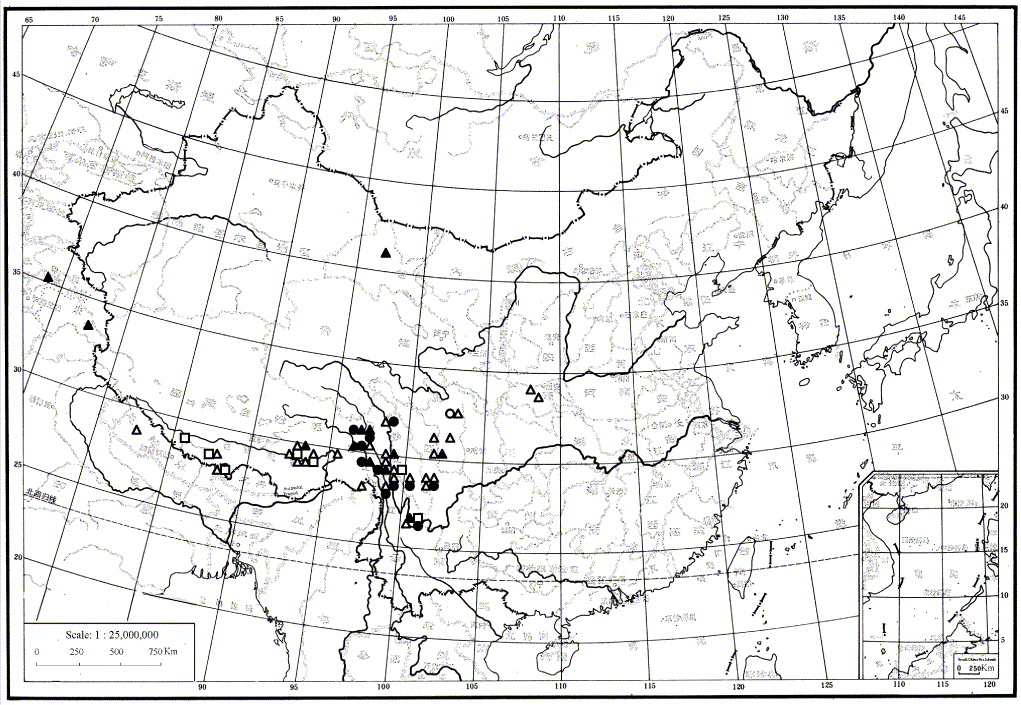
Chemical race I was previously known from Nepal, India, and the Chinese provinces Sichuan (type locality of L. sernanderi), Tibet and Yunnan (Wei & Jiang Reference Wei and Jiang1982; Obermayer Reference Obermayer1997, Reference Obermayer2001), and is reported here for the Shannxi Province for the first time. Chemical race II is distributed in Kashmir (type locality of L. cashmeriana), Pakistan and the Chinese provinces Gansu, Sichuan, Tibet and Yunnan (Krog Reference Krog1976; Wei & Jiang Reference Wei and Jiang1982; Obermayer Reference Obermayer1997, Reference Obermayer2001; Wang et al. Reference Wang, Narui, Harada, Culberson and Culberson2001). Chemical race V, hitherto known from Sikkim (India) (type locality of L. cladonioides) (Krog Reference Krog1976) and Tibet (Obermayer Reference Obermayer1997, Reference Obermayer2001), is reported here from the Yunnan Province for the first time. Chemical races I, II, V have overlapping distributions in Yunnan and Tibet. Chemical race III occurs sympatric with chemical race I and II (Yunnan, Sichuan, Tibet). Chemical race IV, reported here for the first time, was found in Sichuan Province. All localities of five chemical races cited in these papers are shown in Fig. 6.
Locations of studied specimens of the chemical races of Lethariella cladonioides complex. △ chemical race I; ▲ chemical race II; ● chemical race III; ○ chemical race IV; □ chemical race V.
Remarks. Krog (Reference Krog1976) first treated Lethariella cladonioides in a rather broad sense, and regarded Lethariella flexuosa to be synonymous with L. cladonioides. Subsequently L. flexuosa was distinguished from L. cladonioides according to growth habit and morphology (Wei & Jiang Reference Wei and Jiang1982; Obermayer Reference Obermayer1997). However, our recent investigation has revealed it is pendulous rather than shrubby or prostrate. It will be discussed more fully elsewhere.
Additional selected specimens examined (specimens without herbarium indication are deposited in HKAS). Chemical race I (norstictic acid): China: Prov. Tibet: Mangkang county, Honglashan, 3800–3900 m, 1976, Zang 76–44; Yanba village, 4020 m, 2007, Wang 07–27945; Yadong county, 3900 m, 1975, Zang 30; Shulashan, 3600 m, 1982, Zang 8038; Linzhi county, 4400 m, 1974, Li 39–b (HMAS–L); Lulang village, 4163 m, 2004, Wei 952 (HMAS–L); 4260 m, 2007, Wang 07–28359; Sejilashankou, 4260 m, 2007, Wang 07–28365; 4090 m, Wang 07–28620; 4375 m, 2007, Wang 07–28376; Dongzhixueqilashankou, 4700 m, 1975, Zang 588; Qusong county, Budanglashakou, 4930 m, on rocks, Wang 07–28598; Basu county, 4300 m, 1976, Zong Z477(3) (HMAS–L); Bomi county, 4200 m, 1973, Zhang 16954 (HMAS–L); Chayu county, 4100 m, 1983, 21933 (HMAS–L); Milin county, 4200 m, 1972, Vej 2592 (HMAS–L). Prov. Yunnan: Zhongdian county, Daxueshanyakou, 4250 m, on ground, 1981, Wang 24428; 4100 m, 2001, Wang 01–20844; Tianbaoshan, 3900 m, 2007, Wang 07–28935; Bitahai Lake, 3400 m, 2001, Wang 01–20705; Dongwang village, 3900 m, 1976, Yang 6724; Wengshui village, Daxueshan, 4000 m, 2000, Wang 00–19983; Deqin county, Baimaxueshanyakou, 4200 m, 1981, Wang 1950; 4320 m, 2006, Wang 06–26411; 4250 m, 1993, Hu 93–13344; 4300 m, 1981, Wang 81–2219; 4350 m, 1993, Wang 93–13433; Yunling, Taizixueshan, 1976, Wang 8788; 4050 m, 2007, Wang 07–27881; Baimaxueshan, 1981, Wang 3439(6) (HMAS–L); 4500 m, 1981, Wang 2225; 3600 m, 1994, Crig 141; 4000 m, on rocks, 1984, Wang 84–40; 4200 m, 1993, Wang 93–13556; 3980 m, 2003, Wang 03–22746; 4300 m, 1993, Wang 93–-13420; 4807 m, 2007, Niu 07–28749; Meilishi village, Suolayakou, 4550 m, 2000, Wang 00–17749; Lijiang county, Laojunshan, 4100 m, 2000, Wang 00-20265; 4000 m, 1999, Wang 99–18722; 3850 m, 2002, Wang 02–21237; 3900 m, 1981, Wang 81–18132b. Prov. Sichuan: Reg. Bor. –occid., mellan Tsago–gamba och Tamba, 4000 m, 1922, Harry Smith No. 5007 (UPS); Xiangcheng county, Daxueshan, 4450 m, on rocks, 2002, Wang 02–21446; 4050 m, on rocks, 2002, Wang 02–21497; 4400 m, 2002, Wang 02–21432; Daocheng county, Daobanhoushan, 4200 m, 1981, Wang 81–2411; Yading county, 4510 m, 2002, Wang 02–22209; 4200 m, 2002, Wang 02–21517; 4510 m, 2002, Wang 02–21551; Xiaojin county, Changpinggou, 3300 m, 1996, Wang 96–16057; Rilong village, Siguniangshan, 3300 m, 1996, Wang 96–17719; 3800 m, 2001, Wang 01–20561; 3801 m, Wang 06–26069; 3280 m, 2007, Wang 07–29159; Kangding county, Liuba village, 3100 m, 1996, Wang 96–16487; Muli county, 4400 m, on rocks, 1983, Wang 83–2155; Muliyala, 3650 m, 1983, Wang 83–1900; Muliyala, Shaoxiangliangzi, 3800 m, on rocks, 1983, Wang 83–1791; Batang county, Zhongzaiqulipu, 1983, Xuan 83–7222; Lipu, 4000 m, 1983, 5887; Songpan county, Tanggu village, 3000 m, 1996, Wang 96–16928; 3100 m, 1983, Wang 10879; Yanyuan county, Dalin village, Huolushan, 4150 m, 1983, Wang 83–1221; Dege county, 3810 m, 2007, Wang 07–28225; Jiulong county, Wuxuhai, 3600 m, 2007, Wang 07–29214; Prov. Shannxi: Taibaishan, Fuyechi, 1939, Liou 4348 (3) (HMAS–L); Taibaishan, Paomaliang, 3600 m, on soil, 1992, Chen 6473 (HMAS–L); Taibaishan, Yaowangchi, 3080 m, 1963, Ma 377 (HMAS–L); Taibaishan, 3400 m, 1975, Chen 750403 (HMAS–L); Baoji, Wenguan Temple, 1959, Wei 1852 (HMAS–L); Taibaishan, Sanqingchi, 1938, Liu 4229–2 (HMAS–L).
Chemical race II (gyrophoric acid): Kashmir: Astor district, above Doyen, Astor valley, 11000–12000 ft., 14 viii 1992, J. F. Duthi (BM).—China: Prov. Tibet: Mangkang county, Yanba village, 4090 m, 2007, Wang 07–27966; Basu county, Ranwu village, 4080 m, 2007, Wang 07–28096; Changdou county, 4270 m, 2007, Wang 07–28186; 4300 m, 1976, Li 76–95 (HMAS–L); Leiwuqi county, 4300 m, 2007, Wang 07–28146; 4000 m, 1976, Zong 255(6) (HMAS–L); Ranwu county, 4300 m, 1976, Zong Z477(2) (HMAS–L). Prov. Yunnan: Lijiang county, 3900 m, 1981, Wang 81–18132a.
Chemical race III (norstictic acid + gyrophoric acid): China: Prov. Tibet: Mangkang county, Yanba village, 4110 m, 2007, Wang 07–27978; Honglashan, 4010 m, 2007, Wang 07–27899; Basu county, Ranwu village, 4080 m, 2007, Wang 07–28077; Changdou county, 4270 m, 2007, Wang 07–28188; Leiwuqi county, 4300 m, 2007, Wang 07–28200; Zuogong county, 4400 m, 1976, Zong 493 (HMAS–L); 4000 m, 1976, Zong 255(90833) (HMAS–L); 4300 m, 1976, Zong Z477(90841) (HMAS–L). Prov. Sichuan: Daocheng county, 1997, Li 97–17825; Muli county, Mulisanqu, Basongyakou, 4250 m, 1983, Wang 83–2129(c); Xiangcheng county, Balang, 4100 m, 1981, Wang 81–2330; Dege county, 4080 m, 2007, Wang 07–28299. Prov. Yunnan: Deqin county, 4200 m, 1994, Wang 94–15240; Lijiang county, 4200 m, 1997, Wang 97–17897a.
Chemical race IV (norstictic acid + placodiolic acid): China: Prov. Sichuan: Songpan county, 3325 m, 2001, Jiang S216 (HMAS–L).
Chemical race V (psoromic acid): India: Sikkim, Himalaya, 12 000 ped. leg. Hooker & Thomson 1731(PC).—China: Prov. Yunnan: Zhongdian county, Wengshuicun, 4000 m, 2000, Wang 00–19983; 4100 m, 2004, Wang 04–23340; Xiaoxueshan, 1981, Wang 6215; Lijiang county, 4000 m, on rocks, 2005, Wang 05–24766; Laojunshan, on rocks, 2006, Wang 06–26498. Prov. Tibet: Linzhi county, Lulang village, 4260 m, 2007, Wang 07–28395.
We are indebted to the keeper and curators of the following herbaria for the loan of specimens: BM, GZU, H, UPS, and HMAS–L. We thank Dr Walter Obermayer for sending us literature for this study and for his helpful discussion. This work was supported by the National Natural Science Foundation of China (No. 30670011, 30870158).