Introduction
Although Thymus plants have been used since ancient times in traditional cuisine and herbal medicine, the interest in this genus is currently growing due to its potential interest as a source of new phytomedicines and phytocosmetics (Zarzuelo and Crespo, Reference Zarzuelo, Crespo, Stahl-Biskup and Sáez2002).
The genus Thymus includes 214 species and 36 subspecies and is widely disseminated throughout the Mediterranean region. There is particularly high diversity of Thymus in the Iberian Peninsula where 35 taxa belonging to seven sections have been observed (Morales, Reference Morales, Stahl-Biskup and Sáez2002). Five Thymus sections, Mastichina, Micantes, Pseudothymbra, Thymus and Serpyllum, have been identified in continental Portugal, and morphological traits and essential oil content were used to establish their taxonomic relationships (Salgueiro, Reference Salgueiro1994; Salgueiro et al., Reference Salgueiro, Vila, Tomi, Figueiredo, Barroso, Cañigueral, Casanova, Proença da Cunha and Adzet1997; Salgueiro et al., Reference Salgueiro, Vila, Tomàs, Cañigueral, Paiva, Proença da Cunha and Adzet2000a, Reference Salgueiro, Vila, Tomás, Cañigueral, Paiva, Proença da Cunha and Adzetb).
Random amplified polymorphic DNA (RAPD) and inter simple sequence repeat markers (ISSR) have been used in multiple Thymus studies, in particular for assessment of genetic diversity (Echeverrigaray et al., Reference Echeverrigaray, Agostin, Atti-Serfini, Paroul, Pauletti and dos Santos2001; Rahimmalek et al., Reference Rahimmalek, Bahreininejad, Khorrami and Tabatabaei2009; Trindade et al., Reference Trindade, Costa, Lima, Pedro, Figueiredo and Barroso2009; Ben El Hadj Ali et al., Reference Ben El Hadj Ali, Guetat and Boussaid2012a, Reference Ben El Hadj Ali, Guetat and Boussaidb; Rustaiee et al., Reference Rustaiee, Yavari, Nazeri, Shokrpour, Sefidkon and Rasouli2013). Recently, the amplified fragment length polymorphism (AFLP) technique was used by Sostaric et al. (Reference Sostaric, Liber, Grdisa, Marin, Stevanovic and Satovic2012) to evaluate the genetic diversity and genetic relationships among seven species of the section Serpyllum in Serbia.
Herein, we report the assessment, based on AFLP markers, of the genetic relationships among the 12 major Thymus taxa identified in Portugal: T. caespititius, T. pulegioides, T. albicans, T. mastichina, T. lotocephalus, T. villosus L. ssp. lusitanicus, T. villosus L. ssp. villosus, T. camphoratus, T. capitellatus, T. carnosus, T. zygis ssp. sylvestris and T. zygis ssp. zygis.
Except for T. caespititius and T. pulegioides, which exhibit wider dispersal, all the other taxa are endemic to the Iberian Peninsula. Four of them, T. camphoratus, T. capitellatus, T. lotocephalus and T. villosus ssp. villosus, are restricted to Portuguese territory.
Experiments
Samples of the twelve major Thymus taxa were collected in multiple locations in Portugal (Figure S1 and Table S1, available online). Cuttings were collected from three populations of each Thymus taxon except for T. pulegioides, represented by one single population. Thymbra capitata was used as an out-group.
The AFLP analyses were performed using 15 plants per population. Two leaves per plant of each taxon were used for DNA extraction that was performed as described by Elisiário et al. (Reference Elisiário, Justo and Leitão1999) but using 1 M KCl instead of 3 M NaCH3COO. AFLP analyses were performed as described by Cabrita et al. (Reference Cabrita, Akasoy, Hepaksoy and Leitão2001), using six primer combinations: E-AAC/M-CAA, E-AAC/M-CTA, E-AAC/M-CAC, AAG/M-CTA, E-AAG/M-CTG and E-ACG M-CAG.
The autoradiographs were evaluated manually and the presence of a band in at least one replicate or the absence in both replicates was scored as 1 or 0, respectively. The resulting binary matrix was analysed using the NTSYs-pc software (version 2.1): the genetic similarities were computed using the DICE coefficient, and cluster analysis and dendrogram construction were performed using the UPGMA algorithm (Rohlf, Reference Rohlf2000). The confidence limit of each dendrogram fork was determined by bootstrap analysis using the WinBoot software pack (Yap and Nelson, Reference Yap and Nelson1996).
Discussion
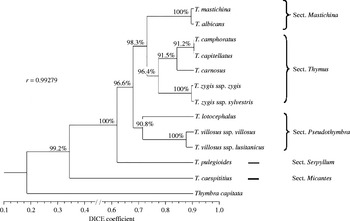
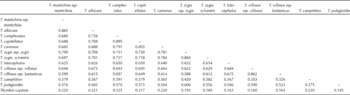
The AFLP amplifications resulted in 329 scored markers, among which 322 (98%) were polymorphic. The very high cophenetic correlation coefficient (r= 0.99 279; Fig. 1) indicated an optimal fit between the effective genetic relationships (Table 1) and their graphical representation (Fig. 1). Thymbra capitata, used as an out-group, was clearly distanced and exhibited low levels of genetic similarity to all Thymus taxa included in the analysis (average DICE coefficient ~0.20).
Dendrogram depicting the genetic similarity relationships among the 12 Thymus taxa. The bootstrap values are given above the branches.

Genetic similarity matrix (DICE coefficient)

T. caespititius (section Micantes), a woody stem prostrate species, exhibited consistent low genetic similarity, ranging between 0.32 and 0.42, to the other Thymus. The results were in accordance with the specificity of the essential oils of this taxon characterized by the presence of trans-dihydroagarofuran, that is not found in other Thymus species (Salgueiro et al., Reference Salgueiro, Vila, Tomi, Figueiredo, Barroso, Cañigueral, Casanova, Proença da Cunha and Adzet1997).
T. pulegioides (section Serpyllum) was also clearly distanced from the other studied Thymus (DICE = 0.52–0.60), and particularly from T. caespititius with which it exhibited the lowest genetic similarity (~0.38).
The other ten thyme taxa were grouped into three main clusters, each corresponding to a different section: Pseudothymbra, Thymus and Mastichina. T. lotocephalus, T. villosus ssp. villosus and T. villosus ssp. lusitanicus were grouped together and provided genetic support for their inclusion in the same section: Pseudothymbra (Morales, Reference Morales, Stahl-Biskup and Sáez2002). The two T. villosus ssp. showed close genetic relatedness (DICE = 0.86; 100% bootstrap value) and further supported their previous classification as the same species (Salgueiro et al., Reference Salgueiro, Vila, Tomi, Figueiredo, Barroso, Cañigueral, Casanova, Proença da Cunha and Adzet1997; Reference Salgueiro, Vila, Tomás, Cañigueral, Paiva, Proença da Cunha and Adzet2000b). It is notable, however, that although the two T. villosus ssp. shared similar morphologies, they were chemically very distinct, since villosus ssp. was rich in p-cymene, myrcene and α-terpineol, while ssp. lusitanicus was characterized by a high percentage of linalool, geranyl acetate, geraniol and terpinen-4-ol (Salgueiro et al., Reference Salgueiro, Vila, Tomás, Cañigueral, Paiva, Proença da Cunha and Adzet2000b).
The five taxa classified under section Thymus were gathered into a common cluster. The two T. zygis ssp. (zygis and sylvestris) clustered tightly (DICE = 0.88; 100% bootstrap value) corroborating the ascribed close taxonomic relatedness based on their morphological features (Salgueiro, Reference Salgueiro1994). The high genetic similarity exhibited by T. camphoratus and T. capitellatus supported the classification of these two taxa in another subsection (Thymastra). However, T. carnosus while genetically closer to T. capitellatus (subsection Thymastra) appeared genetically equidistant to T. camphoratus (subsection Thymastra) and T. zygis (subsection Thymus). These data reinforce the suggestion of Salgueiro (Reference Salgueiro1994) that T. carnosus should constitute a distinct subsection as it combines the morphological traits of subsection Thymus with the presence of essential oils (e.g. borneol) found in some populations of the subsection Thymastra.
The two species of section Mastichina, T. mastichina ssp. mastichina and T. albicans, exhibited very strong genetic similarity (0.88) and formed an independent sub-cluster supported by a bootstrap value of 100% (Fig. 1). The high level of genetic similarity between these two taxa, and their strong similarity in essential oil content and in chemotype variability (Salgueiro, Reference Salgueiro1994; Salgueiro et al., Reference Salgueiro, Vila, Tomi, Figueiredo, Barroso, Cañigueral, Casanova, Proença da Cunha and Adzet1997) seemed to support the hypothesis of Morales (Reference Morales, Stahl-Biskup and Sáez2002) that T. albicans and T. mastichina ssp. donyanae were at the origin of the tetraploid apoendemic T. mastichina ssp. mastichina. However, further work will be required to fully test this hypothesis.
Supplementary material
To view supplementary material for this article, please visit http://dx.doi.org/10.1017/S1479262115000337
Acknowledgements
David V. da Silva was the recipient of a PhD fellowship from the Portuguese Foundation for Science and Technology (FCT). This work was financially supported by the Pluriannual Funding from the same foundation (FCT).