Introduction
Weed control in soybean has become more difficult in recent years with the rise of herbicide resistance in economically important weeds. In Virginia these weeds include Palmer amaranth (Amaranthus palmeri S. Wats.), common ragweed (Ambrosia artemisiifolia L.), and horseweed [Conyza canadensis (L.) Cronq.]. All of these species rank as some of the most troublesome weeds in soybean production in the southeast United States (Schwartz-Lazaro et al. Reference Schwartz-Lazaro, Norsworthy, Steckel, Stephenson, Bish, Bradley and Bond2018; Webster Reference Webster2013). In Virginia each of these species is suspected to be resistant or multiple resistant to glyphosate and acetolactate synthase (ALS)–inhibiting herbicides.
Lack of weed control due to resistance to glyphosate and ALS inhibitors has led to increased use of protoporphyrinogen oxidase (PPO)–inhibiting herbicides POST in soybean, specifically diphenyl ether herbicides such as fomesafen, acifluorfen, and lactofen. Contact herbicides, such as diphenyl ethers and glufosinate, must be applied to small weeds for efficacy (Hager et al. Reference Hager, Wax, Bollero and Stoller2003; Riley and Bradley Reference Riley and Bradley2014). Delays caused by weather, logistics, or equipment breakdowns can lead to suboptimal application timings that result in poor weed control. Weeds not controlled during prior herbicide applications, because of either herbicide resistance or improper application, can result in weeds present late in the season, during soybean reproductive growth. In the mid-Atlantic region of the United States, growers are increasingly making “rescue” treatments, herbicides applications made to control weeds that were not controlled by previous weed management tactics.
Soybean tolerance to fomesafen, and probably acifluorfen and lactofen, is based on the rapid detoxification of the herbicide by glutathione transferase enzymes (Andrews et al. Reference Andrews, Skipsey, Townson, Morris, Jepson and Edwards1997; Evans et al. Reference Evans, Cavell and Highnett1987). However, there is differential soybean tolerance to these herbicides as follows: fomesafen > acifluorfen > lactofen, most to least tolerant based on visible response (Harris et al. Reference Harris, Gossett, Murphy and Toler1991). These herbicides, when applied at numerous rates between growth stages V1 and V5, first to fifth trifoliate, have been reported to cause up to 20% foliar injury to the crop with no loss in yield at the end of the season (Falk et al. Reference Falk, Shoup, Al-Khatib and Peterson2006; Hager et al. Reference Hager, Wax, Bollero and Stoller2003; Horak et al. Reference Horak, Gao, Peterson and Maddux1998; Johnson et al. Reference Johnson, Kollman, Swittenbank and Yih1978; Kapusta et al. Reference Kapusta, Jackson and Mason1986; Riley and Bradley Reference Riley and Bradley2014; Wichert and Talbert Reference Wichert and Talbert1993; Williams and Nelson Reference Williams and Nelson2014; Young et al. Reference Young, Young, Matthews, Owen, Zelaya, Hartzler, Wax, Rorem and Bollero2003). When the diphenyl ether herbicides are applied during reproductive growth (R1 to R5, first flower to start of seed fill), foliar injury between 5% and 28% has been reported (Mangialardi Reference Mangialardi2015; Nelson et al. Reference Nelson, Rottinghaus and Nelso2007).
Even though yield reductions have not been reported from the diphenyl ether herbicides applied during vegetative growth, it is not well documented what effect these herbicides have on developing flowers and pods when applied at reproductive growth stages. If flowers or pods are aborted as a result of herbicide treatment, a yield loss could result in less profitability for the farmer. Nelson et al. (Reference Nelson, Renner and Hammerschmidt2002) reported that lactofen caused variable effects on the number of flowers plant–1 when applied to short-season (maturity groups 1 and 2) soybean. Lactofen applied to group 1 soybean reduced the number of flowers, but in group 2 soybean, lactofen had no effect or increased the number of flowers (Nelson et al. Reference Nelson, Renner and Hammerschmidt2002). Nelson et al. (Reference Nelson, Rottinghaus and Nelso2007) reported yield loss from lactofen applied at R1 and R5, but the response was inconsistent across site-year and no data were collected regarding flowers or pods. In snapbean (Phaseolus vulgaris L.), Ruff (Reference Ruff1993) reported that flowers and developing pods can be negatively affected by fomesafen until pods are more than 5 cm long. There is limited information available on the effect of diphenyl ether herbicides to soybean flowers and pods when applied during reproductive growth or research that compares multiple diphenyl ether herbicides for this effect.
Due to the lack of scientific evidence, the objective of this research was to determine the response of soybean flowers and pods to diphenyl ether herbicides applied at multiple reproductive growth stages.
Materials and Methods
Field studies were conducted at the Eastern Virginia Agricultural Research and Extension Center in Warsaw, VA, in 2015 and Kentland Farm in Blacksburg, VA, in 2016 and 2017. The study in Warsaw (37.991104 N, 76.772453 W) was planted on a Kempsville loam soil (Fine-loamy, siliceous, subactive, thermic Typic Hapludults) with pH 6.4 and 1.8% organic matter. The studies in Blacksburg (37.194215 N, 80.571961 W and 37.193478 N, 80.572327 W in 2016 and 2017, respectively) were planted on a Ross soil (Fine-loamy, mixed, superactive, mesic Cumulic Hapludolls) with pH 6.6 and 3.4% organic matter.
In 2015 and 2016 a Roundup Ready 2 variety of soybean (P46T21R, DuPont Pioneer, Johnston, IA) was planted on May 25 and June 2, respectively. In 2017, a Roundup Ready 2 Xtend variety (AG-48X7, Asgrow Seed Co, LLC, Kalamazoo, MI) was planted on June 9. Soybean were planted at 430,370, 327,275, and 407,550 seeds ha–1 in 2015, 2016, and 2017, respectively. Plots were four rows wide on 76-cm centers with a total plot size of 3 by 7.6 m. Treatments were arranged in a randomized complete block design with a 3 by 3 factorial arrangement of treatments with four replications. The first factor was herbicide: lactofen (Cobra®, Valent U.S.A Corp., Walnut Creek, CA) at 219 g ai ha–1, acifluorfen (Ultra Blazer®, United Phosphorus, Inc., King of Prussia, PA) at 420 g ai ha–1, and fomesafen (Flexstar®, Syngenta Crop Protection, LLC, Greensboro, NC) at 395 g ai ha–1. Adjuvants were selected based on product label recommendations. The second factor was application timing: soybean reproductive stages R1, R3, and R5 as described by Fehr et al. (Reference Fehr, Caviness, Burmood and Pennington1971). A nontreated check was included for comparison, for a total of 10 treatments. The study was maintained weed-free season-long with a preplant burndown application of glyphosate (Roundup Powermax®, Monsanto Co., St. Louis, MO) at 1.54 kg ae ha–1 followed by glyphosate at 0.844 kg ae ha–1 plus S-metolachlor (Dual Magnum®, Syngenta Crop Protection, LLC, Greensboro, NC) at 1.42 kg ai ha–1 4 wk after planting. All herbicide applications were made using a CO2-pressurized backpack sprayer with a four-nozzle boom with 46-cm spacing with TeeJet (Spraying Systems Co., Wheaton, IL) AIXR 11002 nozzles calibrated to apply 147 L ha–1 of spray solution.
Data collected included flower and pod counts, soybean injury 1 wk after treatment (WAT), and soybean yield. Flower and pod counts, taken in 2015 and 2016, were assessed by randomly marking eight soybean plants per plot and counting the number of flowers and developing pods on each plant immediately before and 1 wk after each herbicide application. Visible soybean injury was assessed 1 WAT in each plot for all applications in 2015 and 2017. Ratings were conducted on a 0 to 100% scale, with 0 being no injury and 100 being complete necrosis (Frans et al. Reference Frans, Talbert, Marx and Crowley1986). Soybean yield was harvested from the center two rows of each plot using a plot combine and adjusted to 13% moisture for all site-years.
Data were analyzed in JMP (JMP Pro 13, SAS Institute, Cary, NC). For the flower and pod counts, data were analyzed separately by application timing (i.e., growth stage), as the number of flowers or pods varied by growth stage. The difference in flowers or pods from the initial count to the count 1 WAT was analyzed. These differences were subjected to ANOVA with model effects of treatment, site-year, block, and the interaction of treatment by site-year. The means of the flower and pod count differences from the herbicide treatments were compared to the nontreated check using Dunnett’s method (α=0.05). Visible injury and yield data were also subjected to ANOVA with model effects of treatment, site-year, block, and the interaction of treatment by site-year. When an effect was significant (P<0.05), means were separated using Fisher’s protected LSD (α=0.05).
Results and Discussion
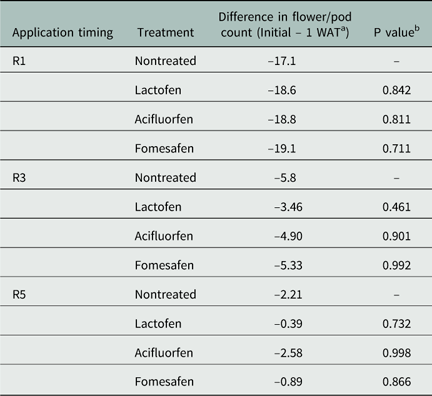
No significant treatment by site-year interaction was detected in the soybean flower and pod counts, so data were pooled across 2015 and 2016. The largest difference between the initial flower or pod count and the count 1 wk after application was found at the R1 application timing (Table 1). At the R1 application timing, the nontreated check had an average difference of –17.1 flowers (Table 1) from the initial count to 1 WAT, indicating there was an increase in the number of flowers on each plant. There were no statistical differences detected in the flower counts in the plots that had been treated with the three herbicides 1 WAT when compared to the nontreated check (P=0.674). At the R3 timing the overall model was significant (P<0.001), with the nontreated having an average difference of –5.8 developing pods (Table 1). Treatment was not significant (P=0.625), but site-year was highly significant (P<0.001). At the R5 timing, the nontreated check had an average difference of –2.21 pods (Table 1). Again, there were no differences in pod counts observed in the plots that received herbicide treatment at each application timing when compared to the nontreated check (P=0.499).
Soybean flower/pod count response to diphenyl ether herbicides when applied at R1, R3, and R5 soybean growth stages in Warsaw, VA in 2015 and in Blacksburg, VA in 2016.

a Abbreviation: WAT, wk after treatment.
b Reflects the P value of the Dunnett’s test between the herbicide treatment and the nontreated check within timing.
There are little published data on the effect of diphenyl ether herbicides on developing soybean flowers and pods. However, Nelson et al. (Reference Nelson, Renner and Hammerschmidt2002) reported that lactofen applied to soybean that were between V5 and V6 and prior to R1 can have differing effects on flower number in soybean based on maturity group. Soybean flower number was reduced when lactofen was applied to group 1 soybean varieties, not affected when applied to mid-group 2 varieties, and increased when applied to late group 2 varieties (Nelson et al. Reference Nelson, Renner and Hammerschmidt2002). It has also been reported that lactofen and fomesafen applied between V1 and V4 had no significant impact on the number of pods that were set per plant (Orlowski Reference Orlowski2015). In snapbean, a related species, it has been found that from the onset of floral buds until developing pods were more than 5 cm long, reproductive tissue was sensitive to fomesafen and could abort flowers and developing pods at fomesafen rates similar to those used in this study (Ruff Reference Ruff1993). However, in pinto bean (Phaseolus vulgaris L.), lactofen at 105 g ai ha–1, fomesafen at 210 g ai ha–1, and acifluorfen at 280 g ai ha–1 did not cause reductions in the number of pods plant–1 or seeds pod–1 when applied at V2 (Ringdahl Reference Ringdahl2001). Some of the difference observed between snapbean, pinto bean, and soybean in response to the diphenyl ether herbicides can be attributed to the location of the flowers and developing pods on the plant. In Phaseolus the flowers are born on short racemes near the top of the plants, whereas soybean flowers are borne along the stem in the leaf axils and therefore may be more protected from herbicide spray than other related species (Lackey Reference Lackey1977).
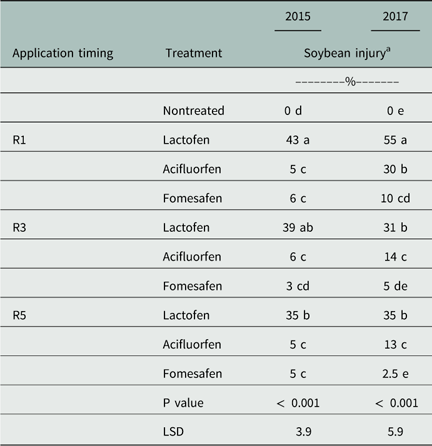
Soybean injury data did have a significant treatment by site-year interaction (P<0.001) and are presented separately by site-year. In 2015, lactofen resulted in the greatest injury at all application timings, with 43%, 39%, and 35% injury 1 WAT (Table 2) at R1, R3, and R5, respectively. Injury was mainly observed as necrosis (bronzing) and overall stunting. Acifluorfen and fomesafen caused less than 6.3% injury across all application timings in 2015 1 WAT. In 2017 a similar trend was observed with lactofen as in 2015. Lactofen caused 55%, 31%, and 35% injury (Table 2) at R1, R3, and R5, respectively. Acifluorfen caused greater injury in 2017 than in 2015, with 30%, 14%, and 13% injury at R1, R3, and R5, respectively. Fomesafen caused 10% injury at R1 and less than 5% injury at R3 and R5 in 2017.
Visible soybean injury from diphenyl ether herbicides 1 wk after treatment in Warsaw, VA in 2015 and Blacksburg, VA in 2017.

a Values within the same column not connected by the same letter are significantly different according to Fisher’s protected LSD (α=0.05).
These data are consistent with soybean injury that has been previously reported. Harris et al. (Reference Harris, Gossett, Murphy and Toler1991) reported differential soybean tolerance to the diphenyl ether herbicides with greatest to least tolerance of fomesafen > acifluorfen > lactofen. Most soybean injury resulting from diphenyl ether herbicides is reported following applications made at early vegetative growth stages (V1 to V3). Soybean injury from fomesafen applied at reproductive growth stages in this study is similar to reported injury when applied at early vegetative growth stages (2% to 12%) (Falk et al. Reference Falk, Shoup, Al-Khatib and Peterson2006; Hager et al. Reference Hager, Wax, Bollero and Stoller2003; Riley and Bradley Reference Riley and Bradley2014; Williams and Nelson Reference Williams and Nelson2014). Injury observed in this study resulting from acifluorfen is greater than what has been reported: 1% to 11% across a range of acifluorfen rates and vegetative application timings (Falk et al. Reference Falk, Shoup, Al-Khatib and Peterson2006; Hager et al. Reference Hager, Wax, Bollero and Stoller2003; Johnson et al. Reference Johnson, Kollman, Swittenbank and Yih1978; Kapusta et al. Reference Kapusta, Jackson and Mason1986; Young et al. Reference Young, Young, Matthews, Owen, Zelaya, Hartzler, Wax, Rorem and Bollero2003). Additionally, soybean injury observed in this study from lactofen is also greater than those reported in the literature: 5% to 28% across both vegetative and reproductive growth stages (Hager et al. Reference Hager, Wax, Bollero and Stoller2003; Horak et al. Reference Horak, Gao, Peterson and Maddux1998; Mangialardi Reference Mangialardi2015; Nelson et al. Reference Nelson, Rottinghaus and Nelso2007; Riley and Bradley Reference Riley and Bradley2014; Wichert and Talbert Reference Wichert and Talbert1993). The differences in soybean injury resulting from acifluorfen and lactofen observed in this study could be attributed to the differences in rating method or personnel following application.
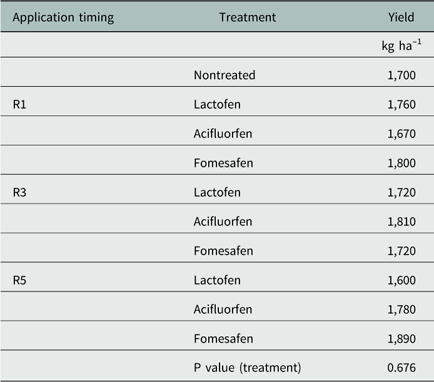
Soybean yield data did not show a significant treatment by site-year interaction (P=0.056) and are presented combined across all 3 site-yrs of the study. No differences in soybean yield were observed between any treatments. Soybean yields from the herbicide-treated plots ranged from 1600 to 1890 kg ha–1, with the nontreated yield being 1700 kg ha−1 (Table 3). The main effect of treatment was not significant (P=0.676); however, site-year was highly significant (P<0.001). Overall, these data are consistent with what has been reported in the literature; diphenyl ether herbicides do not negatively impact soybean yield (Kapusta et al. Reference Kapusta, Jackson and Mason1986; Mangialardi Reference Mangialardi2015; Riley and Bradley Reference Riley and Bradley2014; Ringdahl Reference Ringdahl2001; Wichert and Talbert Reference Wichert and Talbert1993; Young et al. Reference Young, Young, Matthews, Owen, Zelaya, Hartzler, Wax, Rorem and Bollero2003). These findings are nevertheless in contrast to Board and Harville (Reference Board and Harville1998), Chen and Wiatrak (Reference Chen and Wiatrak2010), and Nelson et al. (Reference Nelson, Rottinghaus and Nelso2007), who reported that soybean yield losses can occur if stresses that reduce crop growth rate occur between R1 and R5.
Soybean yield following diphenyl ether herbicides applied at R1, R3, and R5 growth stages in Warsaw, VA in 2015, and Blacksburg, VA in 2016 and 2017.Footnote a

a Soybean yield pooled across 2015 (3,288 kg), 2016 (1,028 kg), and 2017 (914 kg).
These findings indicate that diphenyl ether herbicides applied at reproductive growth stages have no negative impact on developing soybean flowers and pods. As well, even with foliar injury as high as 55%, soybean plants are able to compensate for this injury and produce yields comparable to nontreated soybean plants. Applications made by growers as “rescue” applications late in the season do not lead to soybean yield loss. However, such applications are not recommended, in that prolonged weed competition with the soybean is well documented to result in yield loss (Soltani et al. Reference Soltani, Dille, Burke, Everman, VanGessel, Davis and Sikkema2017). Further research is needed to evaluate the effectiveness of these herbicides on weeds at the soybean growth stages evaluated in this study; control or suppression of weeds at these times may relieve weed competition during critical periods for soybean yield or may decrease the fecundity of these weeds.
Acknowledgments
The authors would like to acknowledge the Virginia Soybean Board, the Virginia Agricultural Experiment Station, and the Hatch Program of the National Institute of Food and Agriculture, US Department of Agriculture for providing funding for this research. No conflicts of interest have been declared.