1. Introduction
It is a primary goal of linguistic theory to explore how natural language expressions are interpreted. All natural language users are able to assign meanings to expressions never encountered before, so it is natural to assume that there is some correlation between form and meaning. However, what is the nature of this correlation? A prevalent view has been to assume that interpretation proceeds in a compositional fashion: The meaning of a natural language expression is derived on the basis of the lexical items and the mode of their combination (The Fregean Principle; see, for example, Heim & Kratzer Reference Heim and Kratzer1998 and Partee Reference Partee2004). A compositional view of language interpretation runs into trouble when language expressions contain semantic components that cannot be traced back to individual lexical items and their combination. An example is the illocutionary force of so-called verbless directives (Jacobs Reference Jacobs2008, Wilder Reference Wilder, Witkos and Fanselow2008). Verbless directives such as in 1 are—as the name suggests—associated with a directive speech act, but as shown in Jacobs Reference Jacobs2008, it is far from clear how this interpretation arises in a compositional fashion (see, however, G. Müller Reference Müller2010 for an alternative view).Footnote 1
(1)


A way to account for examples such as 1 is to assume constructions. A construction is an (arbitrary) association of form and meaning, where the form need not be a lexical item; it can also be a whole syntactic structure, such as a directional particle followed by a PP headed by med ‘with’ in 1 (it is “constructions all the way down” as in Goldberg Reference Goldberg2005: 18). When an interpretation is associated with a whole syntactic structure it is not imperative to state exactly how or why a particular interpretation arises. One can simply state that a directional particle followed by a PP headed by med ‘with’ triggers a directive interpretation.
However, this approach runs the danger of overlooking the fact that the meaning associated with a given form need not be wholly arbitrary, even though some aspects of the interpretation do appear not to follow from the grammatical properties of the expression or from established pragmatic principles. So the linguist should be careful to state exactly what properties of a construction are indeed predictable in a compositional fashion (for example, by compositional inheritance from other constructions; see Goldberg Reference Goldberg2005:224) and what properties are unpredic-table. In this way one can show how certain properties of an expression determine or motivate its interpretation (see also the discussion of motivation in Goldberg Reference Goldberg2005:217ff.), even though the expression may have acquired specialized (unpredictable) meanings or other idiosyncrasies that necessitate positing a particular construction.
In the present article, I illustrate this approach to constructions using Danish wh-optatives as an example. Optatives challenge the compositional view of language interpretation since they express the wishes or hopes of the speaker without containing a lexical item expressing wish, desire, or hope (Scholz Reference Scholz1991, Rosengren Reference Rosengren and Rosengren1993, Grosz Reference Grosz2012). The canonical optative clauses take the form of reduced conditional clauses: They look like the antecedent of an unexpressed consequent, as in the examples in 2.
(2)
A nonconstructional approach would either have to assume that these optatives are elliptical—and thus the consequent is to be reconstructed (Biezma Reference Biezma, Reich, Horch and Pauly2011)—or that they contain a covert expressive/optative operator (Grosz Reference Grosz2012). A constructional approach would assume that the optatives in 2 instantiate a special construction with an optative semantics.
I examine the interaction between predictable and unpredictable semantic components using another optative in Danish shown in 3 and I argue that the constructional approach is better equipped to capture this phenomenon.
(3)
The optative in 3 is a wh-clause consisting of the wh-word hvem ‘who’, the expletive subject der ‘there’, and (canonically) a verb in the past or past perfect. The interpretation is wish I were rich! or wish one were rich! Throughout the paper, I paraphrase wh-optatives like the one in 3 as wish I X since a wh-optative is always speaker-oriented. Note that this paraphrase is only an approximation. The wh-optative also receives a generic interpretation to be discussed in section 5: The wh-word is interpreted as the inclusive impersonal pronoun man ‘one’. However, an English paraphrase with one does not necessarily include the speaker (van der Auwera, Gast, & Vanderbiesen, forthcoming:23). For that reason I use a paraphrase with the 1st person singular pronoun even though this is not quite accurate. The optative in 3 is only near-synonymous with the optatives in 2, and it has specific properties and specific felicity conditions to be uncovered below.
This particular optative construction appears to have received very little attention in the literature. It is frequently mentioned as an optative, (see, among others, Hansen Reference Hansen1967, vol 2:200, Christensen Reference Christensen, Farø, Holsting, Larsen, Mogensen and Vinther2009:124, and Christensen & Heltoft Reference Christensen, Heltoft, Rothstein and Thieroff2010:88), but no analysis is provided; it is not discussed as an optative clause in Hansen & Heltoft Reference Hansen and Heltoft2011 either. Interestingly, this kind of optative is not observed in German or English even though both languages have wh-clauses of this kind as free relatives and embedded interrogatives.Footnote 2 The absence of this kind of optative clause in German and English is unexpected if the optative semantics can be derived in a compositional way. If the wh-optative is a construction specific to Danish, one still should address the question what motivates the use of a wh-clause as an optative.
The article is structured as follows: In section 2, I give a brief survey of optative constructions in Danish since the wh-optative is being compared to other kinds of optative clauses throughout the paper. In section 3, I present the basic properties of wh-optatives given the lack of previous thorough accounts. In section 4, I discuss the syntax of wh-optatives. Specifically, I address the relationship between wh-optatives on the one hand, and free relative clauses and embedded wh-interrogatives on the other. In section 5, I discuss the interpretation of wh-optatives, and in section 6, I present the problems for a compositional account of wh-optatives. I conclude that the interpretation of wh-optatives is determined by the grammatical properties of the construction only to a certain extent, and that not all aspects are predictable. Thus, in section 7, I outline a constructional account of wh-optatives. Under this account, their idiosyncratic properties are inherent to the optative construction, while their predictable properties are inherited from the construction for embedded wh-clauses and the construction for counterfactuals. In section 8, finally, I reach a conclusion.
2. Optatives in Danish
An optative clause is a clause that expresses a wish, a desire, or a hope on the part of the speaker without actually containing a lexical item meaning wish, desire, or hope (Grosz Reference Grosz2012:1). Of course, it is possible to express a wish by embedding a proposition under the matrix verb ønske ‘to wish’ or håbe ‘to hope’ with a 1st person singular subject as in 4, but in a true optative the optative semantics is covert.Footnote 3
(4)
In bona fide optatives, there is no special formal expression of optativity, and this is what makes them intriguing: How does the illocutionary force of optativity come about in the absence of a formal expression of this illocutionary force?
Optatives express the speaker's emotional attitude towards a propositional content. In this sense they are not directed towards the hearer. An assertion is an instruction to the hearer to update the common ground with the relevant proposition, and a directive speech act is an instruction to the hearer to make the world fit the words (Searle Reference Searle1976:3). Optatives do not—in their primary use—require any action on the part of the hearer; they belong to the emotional domain (Rosengren Reference Rosengren and Rosengren1993:39) just like exclamatives.Footnote 4 Thus, optatives and exclamatives could both be subsumed under the heading expressive speech acts. However, there is a crucial difference between this use of expressive speech acts and the one in Searle Reference Searle1976:11. In Searle's taxonomy, expressives presuppose the truth of the expressed proposition. This is obviously not the case for optatives, which implicate either the falsity of the expressed proposition or an unknown truth-value.Footnote 5
On this view, expressives comprise exclamatives, as in 5a, and optatives, as in 5b.
(5)
A common semantic core of expressives (that is, both exclamatives and optatives) is that worlds in which the modified proposition holds are high on an evaluation according to a contextually salient scale (Grosz Reference Grosz2012: 39ff.). In exclamatives, the scale reflects the expectations of the speaker. In optatives, the scale reflects the preferences of the speaker. Exclamatives denote a fact, since an actual state of affairs is evaluated against the expectations of the speaker. In contrast, optatives do not denote a fact: A proposition is evaluated against the preferences of the speaker, but the reality status of the proposition is uncertain. It can be counterfactual, as in 5b, or it can be unknown, as in 6.
(6)
This difference between exclamatives and optatives assumes some importance below.
Optatives, defined as utterances expressing a wish or a hope without containing a lexical item with this semantics, can be expressed in various ways in Danish. The canonical optative is the previously mentioned conditional optative. The conditional optative is a complementizer clause with hvis ‘if’, as in 7a, om ‘if’, as in 7b, or bare ‘if only’, as in 7c.Footnote 6 They show embedded word order with the finite verb within the VP, or they can have a V1-order, as in 7d.Footnote 7
(7)
An optative can also be expressed as a root clause with a full infinitive.Footnote 8 An example is given in 8. As noted for German by Reis (Reference Reis2003:187), the (unexpressed) subject of such optative root infinitives is always the speaker. As I show later, wh-optatives share this property with optative root infinitives even though wh-optatives are finite.
(8)
Danish also avails itself of a complementizer occurring only in optative clauses, namely, gid ‘if only’, a contraction of Gud give det ‘God let it happen’ (Hansen & Heltoft Reference Hansen and Heltoft2011:1162). I refer to this type of optative as a complementizer optative.Footnote 9
(9)
Actually, the optative in 9 does contain a lexical element expressing a wish, namely, the complementizer. Thus, according to the definition of optatives given above, 9 should not be considered an optative clause. I do, however, consider 9 to be an optative clause, given that the lexical item expressing optativity is a grammaticalized element, occurring in C. Three properties of gid ‘if only’ show that it is a complementizer and not an adjunct. First, gid ‘if only’ selects a clause without verb fronting, just like other complementizers: The finite verb in 9 follows the sentential adverb ikke ‘not’, while the finite verb would precede the sentential adverb in a clause with verb fronting. Second, the complementizer gid ‘if only’ allows preposing of sentential negation. As discussed in Ørsnes Reference Ørsnes2012, certain nonveridical clauses without verb fronting allow sentential negation to appear in a position preceding the subject, but only if the clause is headed by a complementizer. Optative clauses with gid ‘if only’ allow preposed sentential negation as expected, if gid ‘if only’ is a complementizer. In 10, aldrig ‘never’ appears between the complementizer and the subject.Footnote 10
(10)
Finally, gid can co-occur with the pleonastic at ‘that’, just like other complementizers (Pedersen Reference Pedersen, Therkelsen and Jensen2009, Hansen & Heltoft Reference Hansen and Heltoft2011).
(11)
The evidence unambiguously points to the conclusion that gid ‘if only’ is a complementizer that selects optative clauses. Complementizer optatives assume some importance in the discussion of the interpretation of wh-optatives in section 5.
The last type of optative clauses is the one under consideration here, namely, wh-optatives: a wh-clause with the wh-word hvem ‘who’, the expletive subject der ‘there’, and no verb fronting. Note that the finite verb in 12 follows sentential negation.Footnote 11
(12)
In the following I concentrate on this last kind of optative, while the other optatives serve as points of comparison in order to highlight specific properties of wh-optatives.
3. The Properties of Wh-Optatives
Before proceeding to an analysis of wh-optatives, I discuss their basic properties in some detail. The discussion focuses on the three core ingredients of wh-optatives: the wh-constituent, the expletive der ‘there’ in subject position, and the past tense of the finite verb.
3.1. The Wh-Constituent
Wh-optatives obligatorily contain a fronted wh-constituent. This wh-constituent proves to be the key to understanding the nature of wh-optatives. The wh-constituent is characterized by the following properties:
1. The wh-constituent is the human-denoting hvem ‘who’.
2. There is only one wh-constituent.
3. The wh-constituent is a subject.
4. The wh-constituent is in the singular.
5. The wh-constituent is stressed.
6. The wh-constituent refers to the speaker.
Wh-constituents can be +wh for example by virtue of being headed by the wh-words hvem ‘who’ or hvad ‘what’, or containing the wh-determiner hvilk- ‘which’. In wh-optatives one only finds the human-denoting hvem ‘who’. A wh-optative with the nonhuman-denoting hvad ‘what’ is completely impossible, as illustrated in 13.
(13)
Wh-determiners are also excluded from wh-optatives. If the relevant constraint were that a wh-optative must contain a fronted human-denoting wh-constituent (and not the particular human-denoting wh-word), one would expect a wh-constituent such as hvilken person ‘which person’ to be possible, but it is not. The example in 14a is not even remotely grammatical. The wh-constituent can only be hvem ‘who’. As I show below, wh-optatives share this property with free relative clauses. Furthermore, wh-optatives can only contain one wh-constituent, as shown in 14b. Again, this is like free relative clauses but unlike embedded wh-interrogatives.
(14)
Not only are wh-optatives limited to exactly one wh-constituent, this wh-constituent must be the subject. In example 15a, the wh-constituent is an object, and the subject is dronningen ‘the queen’. Since the object, and not the subject, is extracted, there is no expletive subject der ‘there’. The example is not even remotely possible. In contrast, when 15a is passivized and the wh-constituent is promoted to subject, as in 15b, the wh-optative is impeccable. Optative semantics can only be associated with a wh-clause where the wh-constituent is the subject.
(15)
The contrast between 15a and 15b clearly shows that this restriction is one of grammatical relation rather than semantic role. In both examples, the wh-constituent is a theme, but the optative is only possible when the theme is the grammatical subject.Footnote 12
The human-denoting hvem ‘who’ can be both singular and plural. Danish has very little number agreement, but predicative adjectives agree with their subjects in number (in addition to gender in the singular). Example 16a and 16b both contain hvem ‘who’ as their subject. In 16a, the adjective has the singular ending Ø, and in 16b it has the plural ending -e. The plural ending appears to be used when the speaker knows that the wh-constituent applies to a plural entity, as in the rhetorical question in 16b.
(16)
‘Who is responsible? Well first and foremost those banks and lending institutions which…’
In wh-optatives, the wh-constituent can only be singular. Thus, I have found no wh-optatives, where a predicative adjective would have the plural ending -e, as in 17.
(17)
I assume that this restriction follows from the fact that the wh-constituent refers to the speaker. Note that all wh-optatives until now have been paraphrased as Wish I were X and not as Wish we were X.
In wh-optatives, the wh-constituent is prosodically emphasized. The wh-constituent is stressed, as indicated with capital letters in the example below.
(18)
If another constituent within the wh-optative is stressed, as in 18b and in B's reply in 19, it is understood as a repetition: The stressed constituent indicates what appears to have been misunderstood by the hearer, or it indicates a contrast with a previously uttered wh-optative.Footnote 13 In 19, A expresses the wish not to be thirty years of age, while B—who is presumably older—contradicts by expressing the wish to be thirty.
(19)
However, such alternative stress placement is only possible if the preceding discourse contains a wh-optative that one of the interlocutors responds to. Out of such contexts, the wh-constituent is stressed. Wh-optatives share this property with echo wh-questions. In echo wh-questions, such as the one in 20, the wh-constituent is always stressed. However, in wh-optatives the wh-constituent is fronted, while in echo wh-questions it is always in-situ. Note that the echo wh-question in 20 contains no expletive der ‘there’ as opposed to the wh-optatives. I return to the discussion of the expletive in section 3.2.
(20)
Finally, the wh-constituent can only refer to the speaker (as also hinted at in Christensen & Heltoft Reference Christensen, Heltoft, Rothstein and Thieroff2010:95).Footnote 14 Recall that all wh-optatives have been paraphrased with the 1st person singular pronoun I. This is a crucial difference between wh-optatives and conditional/complementizer optatives.Footnote 15 Imagine a context where you are in a company with only older or younger people, and you wish that there were someone your age present. In that context, you can utter the conditional optative in 21a, but the wh-optative in 21b would be ridiculous: 21b can only mean that you wish that you were as old as you are, that is, it is an implicature that you are not as old as you are.
(21)
Despite the fact that the wh-word refers to the speaker, it is unambiguously a 3rd person pronoun. A coreferential possessive pronoun must be in the 3rd person, and a coreferential pronoun in a subsequent embedded clause must also be in the 3rd person.
(22)
In section 6, I return to the obligatory speaker-orientation and discuss whether it is a pragmatically derived or inherent property of wh-optatives.
3.2. The Expletive Subject Der ‘There’
Wh-optatives obligatorily have der ‘there’ between the wh-constituent and the finite verb. The Danish der ‘there’ occurs in a variety of contexts, such as subject relative clauses, impersonal passives, embedded interrogatives, and presentational sentences. It is a matter of debate whether these contexts contain a single der ‘there’ or different der ‘there’-elements with distinct properties (see, for example, Erteschik-Shir Reference Erteschik-Shir1984, Vikner Reference Vikner1991, Mikkelsen Reference Mikkelsen, Abraham and Zwart2002 for relevant discussion). I assume that der ‘there’ is an expletive subject pronoun, but it is not possible to do justice to all the intricacies of this word here. For my purposes, it is important to note that wh-optatives, such as in 23a, pattern with free relative clauses and embedded wh-interrogatives, such as in 23b and 23c, respectively: In all three constructions, the expletive der ‘there’ appears in subject position when the subject wh-constituent is extracted.Footnote 16
(23)
The analysis of der ‘there’ in wh-optatives is further complicated by the fact that the syntactic structure of free relatives such as 23b is a matter of debate. The free relative can be analyzed as an NP with the wh-word as the head followed by a subject relative clause. Alternatively, it can be analyzed as a CP with the wh-constituent in SpecCP and the expletive in SpecIP (the subject position). I return to the discussion of the syntactic category of wh-optatives in section 4.3. For the time being it is important to note that examples 23a–c have one property in common: In all three examples, the presence of the expletive subject der ‘there’ shows that the wh-constituent and the finite verb do not form a V2-clause. This conclusion is important for the interpretation of the wh-clause: The wh-clause does not contain instructions to the hearer to provide a value for the wh-constituent (this point is further elaborated on in section 5). I illustrate this disambiguating function of the expletive subject in the following paragraphs.Footnote 17
Danish is a V2-language with a basic distinction between clauses with a fronted finite verb (V1- and V2-clauses) and clauses with the finite verb in its canonical position within the VP. This is illustrated in 24a,b, where the position of the finite verb as either in C or within the VP can be determined relative to the sentential adverb ikke ‘not’.
(24)
Wh-clauses with extracted subjects are (potentially) ambiguous between a clause with verb fronting and a clause without verb fronting, since subject extraction is string-vacuous in a clause without verb fronting. This is illustrated with the two structures in 25, both of which have the same surface string.
(25)
This ambiguity is resolved by the expletive der ‘there’, which must occur in subject position if a wh-clause without verb fronting contains an extracted subject (Vikner Reference Vikner1991, Bjerre Reference Bjerre and Müller2011, Müller & Ørsnes Reference Müller, Ørsnes and Müller2011).
(26)
In 26, the expletive shows that the wh-clause is a clause without verb fronting since there are two constituents before the finite verb (Müller & Ørsnes Reference Müller, Ørsnes and Müller2011).Footnote 18 In free relatives, the presence of the expletive der ‘there’ also supports one of the structures in 27 and not a V2-clause.
(27)
The expletive der ‘there’ shows that the wh-clause is a clause without verb fronting in free relatives, embedded interrogatives, and wh-optatives: The finite verb is in the base position within the VP. In section 4.3, I suggest that the wh-optative is a CP and not an NP.
3.3. The Past Marking on the Finite Verb of a Wh-Optative
Just as in conditional optatives, the finite verb of a wh-optative is canonically in the past—either simple past or past perfect (if combined with a past participle).
(28)
The past tense marking on the finite verb is what Iatridou (Reference Iatridou2000:235) refers to as fake past. A wh-optative with a finite verb in the past tense is not temporally past: In spite of the past tense marking, the wh-optative in 28a makes reference to the present of the speaker. The speaker wishes (s)he were thirty at the present time. In a similar vein, the past perfect in 28b is fake in that it makes reference to the past of the speaker and not to a time preceding a past reference time. The speaker wishes (s)he had been thirty at a time in the past. Thus, the past tense marking in optatives expresses counterfactuality (see also Christensen & Heltoft Reference Christensen, Heltoft, Rothstein and Thieroff2010:88). It describes a world distant from the world of the speaker. The wh-optative does not allow the past future with the modal ville ‘would’ found in the consequent of conditionals. On the analysis in Iatridou Reference Iatridou2000:241, the antecedent of a conditional contains an element of futurity, and this element of futurity is spelled out in the consequent of the conditional.Footnote 19
(29)
Wh-optatives share this property with (most) conditional optatives.Footnote 20
(30)
The past tense marking on the verb only represents the canonical case, though. Occasionally, one does find wh-optatives with a present tense marking on the finite verb, as in 31.Footnote 21
(31)
Present tense is also observed in conditional clauses and in conditional optatives. Iatridou (Reference Iatridou2000) uses the element of futurity inherent to conditional clauses to explain the difference between conditionals with (simple) past tense marking in the antecedent and conditionals with present tense marking. Conditionals with (simple) past tense marking are referred to as future less vivid; they carry the implicature that the speaker considers it unlikely for the antecedent indeed to be the case. Conditionals with present tense marking are referred to as future neutral vivid; they do not carry such an implicature. Under this approach, optatives with past tense marking carry the implicature that the proposition does not hold in the world of the speaker. Optatives with present tense, in contrast, are neutral as to whether or not the proposition holds in the world of the speaker. Wh-optatives with present tense marking appear to be possible if an element of futurity is explicitly stated. In 31, the infinitive clause specifies a future event (to get such a thing). Note also that 32a is infelicitous, while 32b specifying the future event is impeccable.
(32)
For the remainder of this article, I assume (simplifying somewhat) that canonical wh-optatives carry past tense marking, that is, that they are counterfactual. The semantic properties of optatives with present tense marking appear to be different from the semantic properties of counterfactual optatives. This is not relevant for the point I wish to make, namely, that the interpretation of wh-optatives is only partly determined by the grammatical properties of the construction.
4. The Syntax of Wh-Optatives
I have shown above that wh-optatives take the form of an “embedded” clause, that is, a clause without verb fronting. Thus, wh-optatives pattern with free relative clauses as in 33a and embedded wh-interrogatives as in 33b.
(33)
If free relatives and embedded wh-interrogatives have the same syntactic structure, one can expect wh-optatives also to have this structure. As previously mentioned, this is by no means clear, though. Vikner (Reference Vikner1991) and Müller & Ørsnes (Reference Müller, Ørsnes and Müller2011, in preparation) argue that wh-interrogatives are indeed sentential structures (CPs) with the wh-constituent in SpecCP. For free relatives the picture is less clear: A free relative can be either an NP or a CP as shown in the representations in 34 (see also the extensive discussion in Riemsdijk Reference Riemsdijk, Everaert, van Riemsdijk, Goedemans and Hollebrandse2006 for other structures for free relatives).Footnote 23
(34)
I am not able to address the syntactic analysis of free relatives in Danish here. Instead, I address two questions. First, to what extent do wh-optatives pattern with free relatives and/or embedded wh-interrogatives? Second, is there any evidence for the syntactic structure of wh-optatives? I conclude that wh-optatives resemble free relatives in many respects, but that they appear to be CPs like embedded wh-interrogatives. I do not claim, however, that this carries over straightforwardly to bona fide free relatives since I also show that wh-optatives cannot be analyzed as elliptical free relatives.
4.1. Wh-Optatives versus Free Relatives and Embedded Wh-Questions
Scholz (Reference Scholz1991:108) gives some examples of German wh-clauses with an optative interpretation. Rosengren (Reference Rosengren and Rosengren1993:42) suggests that they should be interpreted as (reduced) free relative clauses. However, apart from the structural similarity she does not supply any arguments in favor of this analysis. In this section, I show that with respect to many syntactic properties, Danish wh-optatives do, indeed, pattern with free relatives rather than embedded wh-interrogatives. Still wh-optatives differ from free relatives in crucial respects, and so they cannot be wholly assimilated to free relatives.
I have shown above that the wh-constituent of a wh-optative is obligatorily singular. This is also observed for free relative clauses (Jacobson Reference Jacobson, Bach, Jelinek, Kratzer and Partee1995, note 9) but not for embedded wh-interrogatives. The relevant examples are given in 35.
(35)
Another difference between free relatives and embedded wh-interrogatives is that wh-interrogatives allow clefting, as shown in 36a, while free relative clauses do not, as shown in 36b (Bjerre Reference Bjerre and Müller2011:279, Hansen & Heltoft Reference Hansen and Heltoft2011:1540). Wh-optatives do not allow clefting, as shown in 36c, so again wh-optatives pattern with free relative clauses and not with embedded wh-interrogatives.
(36)
Free relatives can only contain one wh-constituent, as shown in 37a (Grimshaw & Bresnan Reference Grimshaw and Bresnan1978), while wh-interrogatives can contain multiple wh-constituents, as shown in 37b. Wh-optatives only allow one wh-constituent just like free relatives, as noted in section 3.1 and shown again in 37c.
(37)
I have shown in section 3.3 that wh-optatives do not allow the past future with the modal ville ‘would’ (see 38a). Free relatives do not allow the past future with ville ‘would’ either, as shown in 38b, while wh-interrogatives do, as shown in 38c.
(38)
Embedded wh-interrogatives license the question word pokker ‘the hell’, as shown in 39a, while free relatives and wh-optatives do not, as shown in 39b and 39c, respectively.
(39)
Still wh-optatives are not like free relatives in all respects. Free relatives with wh-constituents are marked in modern Danish, and they systematically alternate with the less marked light-headed relatives headed by personal demonstrative pronouns (Citko Reference Citko2004).
(40)
If wh-optatives were (reduced) free relatives, one should expect that a light-headed relative could also be used as an optative (given that a free relative can otherwise always be substituted with a light-headed relative even though the opposite does not hold). This is completely ruled out in Danish.Footnote 24
(41)
Moreover, free relatives allow the particle end ‘-ever’, as shown in 42a, while this particle is impossible in wh-optatives, as shown in 42b. The particle end ‘-ever’ is canonically associated with a universal reading of free relatives (Riemsdijk Reference Riemsdijk, Everaert, van Riemsdijk, Goedemans and Hollebrandse2006:362), and as I show in section 5, wh-optatives are associated with a generic reading. Still they do not license end ‘-ever’, just like embedded wh-interrogatives (see 42c).
(42)
In fact, wh-optatives have certain properties that set them apart from both free relatives and embedded interrogatives. Neither free relatives nor wh-interrogatives allow the discourse-oriented swear word for fanden lit. ‘for the devil’, as shown in 43a,b. Julien (Reference Julien2009:42–46) shows that for fanden lit. ‘for the devil’ is licensed by assertions (embedded or unembedded) and commands. Example 43c shows that wh-optatives (like other optatives) do license for fanden lit. ‘for the devil’.
(43)
Free relatives and wh-interrogatives allow nonlocal extraction of the wh-constituent (extraction across a bridge verb such as sige ‘say’), as shown in 44a,b, while wh-optatives do not, as shown in 44c. They only allow local extraction.Footnote 26
(44)
Finally, wh-optatives are infelicitous with strong Negative Polarity Items (NPIs), as shown in 45a. Such NPIs are perfectly all right in free relatives and embedded interrogatives, as shown in 45b and 45c, respectively.
(45)
Grosz (Reference Grosz2012:78ff.) observes for conditional optatives in German that they do not allow NPIs. Grosz attributes the restriction against NPIs in optatives to the fact that NPIs are not licensed in complements of positive evaluation predicates such as wish or prefer, and under Grosz’ analysis, optatives contain a covert positive evaluation operator EX (to be further discussed in section 6).
This restriction, however, appears to be part of a general restriction against NPIs in clauses with polarity focus. Optatives are associated with polarity focus (Grosz Reference Grosz2012:72), that is, focus on the truth value. Optatives introduce a basic opposition between p and -p. The speaker wishes for a proposition p to be the case, and it follows as an implicature that -p holds in the actual world (Iatridou Reference Iatridou2000:232). As discussed in Ørsnes Reference Ørsnes2012, it is a striking characteristic of different kinds of utterances associated with polarity focus that they do not license NPIs. The exact nature of this restriction is not clear, but it appears to be related to the fact that it is difficult to construct -p from a p containing an NPI. The negation of If only I had not lifted a finger! is not I did lift a finger. In any case, NPIs are not allowed in wh-optatives, and this sets them apart from free relatives and wh-interrogatives.
One can conclude from this section that wh-optatives behave like free relatives in many but not all respects. Moreover, there are properties that wh-optatives share with neither free relatives nor wh-interrogatives. Thus, wh-optatives cannot be treated as free relatives with a special optative interpretation. In the next section, I proceed to show that wh-optatives do not have elliptical structures.
4.2. Why Wh-Optatives Are Not Elliptical
The fact that wh-optatives take the form of embedded clauses and that they share many properties with free relative clauses in the complement position of a matrix verb invite the conclusion that wh-optatives are dependent clauses with a “missing” matrix clause. An analysis to this effect is proposed for conditional optatives in Biezma Reference Biezma, Reich, Horch and Pauly2011. She claims that conditional optatives are antecedents of a missing consequent. Grosz (Reference Grosz2012) provides ample evidence against analyzing conditional optatives as elliptical structures. I also argue that wh-optatives do not have elliptical structures with a missing matrix clause.
First, free relatives with hvem ‘who’ are marked (though grammatical) in modern Danish.Footnote 27 Light-headed relatives with demonstrative pronouns as heads are the unmarked choice.
(46)
However, wh-optatives do not show the markedness effect associated with free relatives with hvem ‘who’. On the contrary, the less marked light-headed relatives are completely impossible as optatives (see 41 above). Moreover, it is not possible to reconstruct the putative source of the wh-optative. In 47, the wh-optative is reconstructed as a subject free relative, that is, the elided part is a VP, and the wh-optative is reconstructed as the subject of this VP.
(47)
These examples are marginal at best since free relatives with hvem ‘who’ are restricted to objects. They do not occur productively as subjects in modern Danish, as shown in 48, where only the version with a light-headed relative is grammatical.
(48)
Subject free relatives are only observed in fossilized proverbs, such as 49a (note that 49a contains the old form hvo instead of hvem ‘who’), and in specificational copular clauses, such as 49b, where the postverbal complement identifies the extension of the property-denoting subject (see Mikkelsen Reference Mikkelsen2005).
(49)
Whatever the reason for these restrictions on subject free relatives is, it appears not to be possible to reconstruct a source for a wh-optative, where the wh-optative is a free relative in an NP position. Moreover, a wh-optative containing one of the optative adverbs bare ‘only’, blot ‘only’, dog ‘only’ or i det mindste ‘in the least’ cannot be embedded at all. The result is even worse than 47.
(50)
If wh-optatives were embedded wh-interrogatives with a missing matrix clause, it is not at all clear what would be elided in that case. It is not possible to reconstruct a suitable predicate that would select an embedded wh-interrogative and preserve optative semantics. As a matter of fact, it is a characteristic of optatives that they cannot be embedded.Footnote 28
(51)
Thus, all the evidence points to the conclusion that wh-optatives do not have elliptical structures with a missing matrix-clause.
4.3. The Syntactic Category of Wh-Optatives
The fact that wh-optatives are not ellipses with a missing matrix clause makes it difficult to determine their syntactic category. One possibility is that they are NPs with the wh-constituent as the head followed by a subject relative clause. This was one of the structures suggested in 34 for free relatives. An argument in favor of this analysis is that NPs can occur as exclamatives, as shown in 52.
(52)
However, there are still two properties of wh-optatives suggesting that they are indeed CPs. If wh-optatives are CPs and not NPs, one has a straightforward explanation why light-headed relatives cannot be inter-preted as optatives: Only wh-constituents are possible in SpecCP in a clause without verb fronting. Demonstrative pronouns are not, so the structure in 53 is illicit.
(53)
The second piece of evidence comes from coordination. If one assumes that only constituents of the same category conjoin, the syntactic category of wh-optatives can be determined by investigating what categories they conjoin with. It appears that wh-optatives can be coordinated with a CP, as in 54a, where a wh-optative is conjoined with a conditional optative. In contrast, a coordination of an NP and a wh-optative, as in 54b, is ungrammatical. This speaks in favor of analyzing the wh-optative as a CP and not as an NP followed by a subject relative clause.
(54)
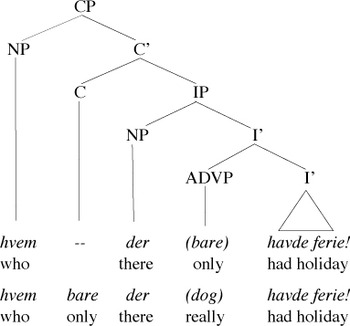
The impossibility of wh-optatives headed by a non-wh-word and the coordination pattern in 54 point to the conclusion that wh-optatives are CPs even though the evidence is not overwhelming. I assume that wh-optatives have the structure in figure 1.
Structure for wh-optatives.

Having argued that wh-optatives are independent CPs I next turn to the interpretation of the wh-optatives.
5. The Interpretation of Wh-Optatives
In this section, I address the question why a wh-clause without verb fronting comes to be associated with optative semantics. The goal is to establish to what extent wh-optatives can be given a compositional analysis. Three properties of wh-optatives are crucial for their interpretation: (i) the root clause is a wh-clause with the finite verb in the base position (signaled by the expletive der ‘there’), (ii) the finite verb is (canonically) in the fake past or fake past perfect, that is, the wh-optative is counterfactual, and (iii) the wh-constituent is obligatorily stressed.
The first property of wh-optatives is that the finite verb is in the base position within the VP (the “embedded” word order). The presence of the expletive subject der ‘there’ unambiguously shows that the clause is not V2. So the question is, what the semantic/pragmatic difference between verb fronting and no verb fronting amounts to. Truckenbrodt (Reference Truckenbrodt2006) suggests for German that verb fronting (V to C) signals an instruction to the hearer: A declarative clause with the verb in second position is a signal to the hearer to update the common ground with the relevant proposition; a wh-question with V2 is a signal to the hearer to supply a value for the wh-constituent for updating the common ground; a polar question is an instruction to the hearer to tell whether the proposition should be included in the common ground or not. Conversely, clauses without verb fronting do not contain an instruction to the hearer, so clauses without verb fronting do not (directly) require an action on the part of the hearer.Footnote 30 This is the reason why wh-optatives are not inter-preted as wh-questions.Footnote 31 Ignoring the optative semantics and the counterfactual marking on the finite verb, the wh-clause in 55 simply denotes the set of individuals that are rich (see also Jacobson Reference Jacobson, Bach, Jelinek, Kratzer and Partee1995:465).
(55)
The expression hvem der VP ‘who there VP’ is an intensional description of a set, and this interpretation arises precisely because the clause contains no instruction to the hearer.
Next I turn to the past tense marking on the finite verb. As noted in section 3.3, Iatridou (Reference Iatridou2000) refers to this kind of past as fake past since the wh-optative is not about the temporal past. On the unified analysis of past tense marking in Iatridou Reference Iatridou2000, the semantic core of past tense marking is distant from the speaker. The meaning of the past tense morpheme is T(x) excludes C(x), where T(x) is the x we are talking about (in 55—a world where the speaker is rich) and C(x) is the x of the speaker (in 55—the actual world where the speaker is not rich) (Iatridou Reference Iatridou2000:246). x can range over worlds as indicated, but it can also range over times. If x ranges over worlds, the topic world excludes the world of the speaker, which gives rise to the counterfactual reading (the topic world excludes the actual world). If x ranges over times, the topic time excludes the time of the speaker, which gives rise to the temporal past reading (the topic time excludes the utterance time).
Combining the analysis of the past tense marking in wh-optatives with the analysis of wh-clauses without verb fronting outlined above, one arrives at the following interpretation of the example in 55: The wh-clause denotes the set of individuals that are rich in a topic world, which excludes the world of the speaker (the context world). This means that the sets of individuals who possess the property expressed by the VP are not identical in the topic world and in the context world. The two sets differ if the set in the topic world contains more (or, possibly, other) members than the set in the context world, that is, if the set in the topic world contains at least one element that is not a member of the set in the context world.Footnote 32 This is the situation found in wh-optatives: The speaker wants to belong to the set with the property denoted by the VP in the topic world without belonging to the set denoted by the VP in the context world.
Finally, wh-optatives focus on the entity belonging to the VP set in the topic world but not in the context world. The syntactic as well as the prosodic structure suggest that wh-optatives have a different information structure from complementizer and conditional optatives. Example 56a shows a complementizer optative, and example 56b shows the near-synonymous wh-optative.
(56)
In 56a, the whole proposition is within the IP domain as a complement of C: No element within the proposition is syntactically distinguished by being in the CP domain (SpecCP), and no element of the proposition is prosodically distinguished by being stressed. In 56a, the whole proposition is backgrounded and the complementizer is stressed as noted by Christensen (Reference Christensen, Farø, Holsting, Larsen, Mogensen and Vinther2009:123).Footnote 33 In 56b, the wh-subject is syntactically distinguished by being fronted into the CP domain, and it is prosodically distinguished by being stressed. Thus, the wh-subject is separated from the rest of the proposition, and the wh-optative has a separate focus-background articulation. The wh-subject is focused just like the stressed wh-constituents of echoquestions, which are always focused constituents (for details see Reis Reference Reis and Rosengren1992:235ff.). The semantic contribution of the IP is only that of a VP since the subject is an expletive. In this way the semantic part corresponding to the VP is backgrounded.
One can interpret 56a such that the speaker expresses a wish that p would hold, and by implicature p holds in the common ground: S wants that p, CG: p. In a similar vein, 56b can be interpreted such that the speaker wishes for some PRO to have the property denoted by the VP, and by implicature the property denoted by the VP does not apply to PRO in the common ground: S wants for PRO to have the property denoted by the VP, CG: VP(PRO). Compared to complementizer optatives, wh-optatives focus on a variable, and it is known about this variable that the property expressed by the VP does not apply to it.
However, there are two differences between conditional/complementizer optatives and wh-optatives related to the interpretation of the wh-word: Wh-optatives are obligatorily speaker-oriented, and they receive a generic interpretation inasmuch as the wish is presupposed to be shared by other people, not just the speaker. The wh-word is interpreted as an inclusive impersonal pronoun, like some uses of the English one or the German man ‘one’ (van der Auwera, Gast, & Vanderbiesen, forthcoming).
The obligatory association of the wh-word with the speaker is unexpected on the analysis so far. A wish is always attributed to the speaker expressing the wish, but the wish does not have to concern the speaker herself, as witnessed by the conditional optative in 57a and the complementizer optative in 57b.
(57)
Wh-optatives are different. They can never be associated with the hearer or another salient individual in the discourse without including the speaker.
(58)
The impossible interpretation in 58 begs the question whether the obligatory speaker orientation is pragmatically derived or whether it is “hard-wired” into wh-optatives. If the speaker orientation is a pragmatic implicature, one should expect it to be cancelable. Thus, one should expect the speaker orientation to be blocked if an association with the speaker is highly implausible or impossible for language-external reasons.
Imagine a situation with only two interlocutors. A wants B to finally stay quiet for a second and may express this by uttering the conditional optative in 59a. However, a wh-optative cannot be used as an (indirect) address to the hearer. Example 59b can only mean that the speaker wishes for herself that she would stay quiet for a second even though this is pragmatically odd. Example 59b invariably implies that the speaker is not in full control of her flow of words.
(59)
Imagine also a man talking to his wife, who is unsure whether she is pregnant or not. If the man utters the wh-optative in 60, the association with the speaker ought to be blocked for language-external reasons, but it is not. It has only the nonsensical reading that the man wishes for himself that he had a pregnancy test.
(60)
So the speaker orientation of wh-optatives is not a pragmatic implicature; it is an indispensable part of their semantics that cannot be overridden.
The second special interpretational property of wh-optatives is that the wish is presupposed to be of a general nature; it should be shared by people in general, not just the speaker. A wh-optative allows the tag hva’? roughly: ‘Don't you agree?’ inviting the hearer to agree with the speaker. These tags are very odd with speaker-oriented conditional or complementizer optatives.
(61)
In example 61a, the speaker implies that the hearer would also wish for herself that she were rich. In contrast, example 61b is only possible in a context where the hearer has a special interest in the speaker's being rich. It does not mean that the hearer would wish that she herself be rich. Thus, an appropriate paraphrase of the wh-optative in 61a is the one with the inclusive, impersonal pronoun man ‘one’, as in 62.
(62)
If one further examines the kind of properties expressed by VPs in wh-optatives, one finds properties such as to be rich, to be thirty, to have a holiday, to have a beautiful garden and to be famous. These are all properties that are considered attractive by most people. These properties are not characterized by the distinction between stage-level and individual-level predicates (see, for example, Kratzer Reference Kratzer, Carlson and Pelletier1995). Wh-optatives can contain both stage-level and individual-level predicates. Still if a wh-optative contains a stage-level predicate, it carries the presupposition that in that context anyone would want to have this property. For example, the episodic property in 63 carries this presupposition: Anyone in my situation would hold the same wish. In this sense, the interpretation of wh-optatives is generic.
(63)
Otherwise, wh-optatives tend to be awkward with very particular properties, such as not to have tilted a glass of wine onto the tablecloth, as in 64.
(64)
The example in 64 is odd since it is difficult to conceive of this as a generic wish. Note that a paraphrase with man ‘one’ is also odd.
(65)
Conditional optatives or complementizer optatives show no such restrictions.
(66)
The generic interpretation of wh-optatives also has ramifications for the felicity of Presupposition Accommodation (Lewis Reference Lewis1979, Stalnaker Reference Stalnaker2002, von Fintel Reference von Fintel2008). Consider the example in 67 with a conditional optative.
(67)
On the basis of the optative in 67, the hearer will accommodate the (perhaps somewhat surprising) presupposition that the speaker is in the possession of a camel. Consider next the wh-optative in 68 that expresses the very same wish.
(68)
The optative in 68 also carries the presupposition that the speaker is in the possession of a camel, but at the same time it suggests that it is a fairly common property to be the owner of a camel since the generic interpretation implies that this wish ought to be shared by more people than just the speaker. This additional meaning component makes a wh-optative rather odd in the context that involves a camel, while it is perfectly all right in the context that involves a car.
(69)
Presumably, this is also the reason why wh-optatives with proper names are marginal, while conditional and complementizer optatives with proper names are impeccable.
(70)
The wh-optative in 70a suggests that it is a fairly common property to know someone by the name of Louise, while this is presumably a rather particular property.
6. ThProblems for a Compositional Analysis of Wh-Optatives
The previous discussion has shown that the interpretation of wh-optatives follows from grammatical properties of the clause to a large extent. Still there are three properties of wh-optatives hampering a compositional analysis: (i) the wh-word must be hvem ‘who’, (ii) the wh-constituent must be a (locally extracted) subject, and (iii) the wh-word must refer to the speaker. Of the examples in 71, only 71a can be interpreted as an optative clause.
(71)
A structurally similar wh-clause embedded under an interrogative predicate shows no such restrictions.
(72)
So how can one explain why only 71a is an optative in a compositional way? The wh-clause in 71a is an incomplete utterance in that it shows the embedded word order: It appears to require a main clause, which is missing (just like conditional optatives). On the face of it, there is no illocutionary force associated with the wh-clause. It simply denotes a set in a world different from the world of the speaker. Rosengren (Reference Rosengren and Rosengren1993) suggests that complete utterances interact with the cognitive domain, while incomplete utterances interact with the emotional domain. Complete sentences are related to manipulations of the common ground, the updating of information. Incomplete utterances, such as conditional optatives and wh-optatives, are associated with expressive speech acts. Rosengren does not actually explain this connection between incomplete utterances and expressive speech acts, but still the connection is striking, which suggests that the association is not arbitrary. However, if incompleteness is associated with expressive speech acts, optativity requires something more, namely, a contrast between an actual state and a desired state. Therefore, optatives are counterfactual, or they relate to a future state where a future world is compared with the actual world. In contrast, exclamatives denote facts (Ginzburg & Sag Reference Ginzburg and Sag2001:223). Though incomplete, the following example cannot be understood as an optative.
(73)
If comprehensible at all, this example inevitably triggers the question: What about him or her?
Thus, optative semantics could be seen as a (pragmatic) association between incomplete counterfactual/future utterances and the emotional domain. This could explain why the wh-clauses in 72 are not optatives: They are part of complete utterances. However, it does not explain why 71b and 71c are not possible as optatives despite the fact that they are incomplete counterfactual utterances with an initial wh-constituent. Incompleteness in itself does not explain why optative semantics must be associated with the wh-word hvem ‘who’ as an extracted subject, nor why hvem ‘who’ must refer to the speaker.
A way to maintain a compositional analysis is to analyze problematic cases as local ambiguity resolved through its incompatibility with other lexical choices (Partee Reference Partee2004:159) or, perhaps, contextually. To account for the wh-optative in 71a and the wh-interrogative in 72a, one could assume two kinds of hvem ‘who’: an optative and an interrogative hvem ‘who’. The optative hvem ‘who’ has the interpretation of an inclusive impersonal pronoun, while the interrogative hvem ‘who’ does not have to include the speaker. Thus, by itself this wh-clause would be ambiguous between an optative and an interrogative reading, but in 72a it is disambiguated by the embedding predicate spørge ‘ask’. The independent wh-optative would need some contextual mechanism to eliminate the interrogative reading.
Still one is not out of the woods: The wh-clause is ambiguous between an optative and an interrogative reading only if hvem ‘who’ is a (extracted) subject, as witnessed by 71b. To derive the optative reading, one has to make sure that the optative hvem ‘who’ appears in a clause with an extracted subject and the expletive subject der ‘there’. A way to achieve this would be to have the optative hvem ‘who’ select a clause with the mentioned properties. However, hvem ‘who’ is not a selecting head; moreover, hvem ‘who’ would have to select a clause with a subject headed by a particular lexical item in violation of locality. Alternatively, one could posit an expletive subject der ‘there’ used only in optative clauses. In that case, the optative semantics would have to come from the (non-head) subject, and one would need a mechanism to ensure that the optative der ‘there’ is only associated with the optative hvem ‘who’. It is unclear how this can be done in a principled way.
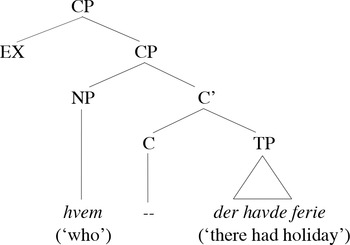
Grosz (Reference Grosz2012:39ff.), finally, suggests a compositional analysis of conditional optatives. On his analysis, optative and exclamative clauses have a common syntactically-represented semantic core. He proposes that they contain a covert operator EX that takes a proposition as its complement and expresses an emotional attitude towards the selected proposition: Worlds in which the proposition selected by EX holds are high on a contextually supplied scale (see section 2). If the context supplies the speaker's preference scale, the utterance is interpreted as an optative. The fact that the expressive clause is interpreted as the complement of an (covert) operator explains why it takes the form of an embedded clause, that is, a clause without verb fronting in Danish. On the analysis in Grosz Reference Grosz2012, a wh-optative would have the structure in figure 2 below.Footnote 34
The difference between languages that have wh-optatives and those that do not would boil down to a difference in subcategorization properties of the covert operator EX. EX selects a conditional clause in German, while it selects a conditional clause, a complementizer clause, or a wh-clause in Danish. In Swedish, EX selects either a conditional clause or an NP, that is, a light-headed relative. Still this analysis does not answer the basic question: How does the speaker know that the clause contains a covert operator EX?
Wh-optative with EX-operator.

Moreover, this analysis predicts that expressives always take the form of an embedded clause by virtue of being selected by an (covert) EX operator. However, this is not the case. One also finds exclamatives that take the form of V2-clauses, as in 74.
(74)
Some predicates do allow embedded V2-clauses (Vikner Reference Vikner1995, Julien Reference Julien2009, Wiklund et al. Reference Wiklund, Bentzen, Hrafnbjargarson and Hróarsdóttir2009), but embedded V2 is not observed in wh-clauses (Vikner Reference Vikner1995:77). Example 74 with V2 would be completely unexpected as a complement of an operator EX.
Finally, an analysis in terms of a covert operator does not allow one to state that the wh-constituent has to be the wh-word hvem ‘who’ (and not any kind of wh-phrase), and that it has to refer to the speaker. A selecting head cannot impose restrictions on the internal structure of its complement. EX would have to impose restrictions on the lexical head of the first daughter of the CP. For the very same reason one cannot state that the wh-constituent has to be an extracted subject, and that the TP embedded under the CP has to contain the expletive subject der ‘there’.
In conclusion, I have established that wh-optatives exhibit a combination of compositional and noncompositional features. On the one hand, the fact that wh-optatives contain no instruction to the hearer (they have no V to C) and that they describe a set in a topic world that excludes the world of the speaker motivate an optative interpretation. On the other hand, the fact that the wh-constituent has to be hvem ‘who’ as an extracted subject referring to the speaker appears to be an idio-syncratic property of wh-optatives that invites a constructional analysis in the conservative sense: familiar pieces, familiarly arranged, but with idiomatic interpretations (Fillmore, Kay, & O'Connor Reference Fillmore, Kay and O'Connor1988:508). However, even though it is an arbitrary association of form and meaning, the association is well motivated. It is no coincidence that a wh-clause without V2 becomes an optative clause, even though not all of its properties can be derived in a compositional way. This, in turn, may explain why wh-optatives are not observed in languages that otherwise do have wh-clauses occurring as free relatives and embedded interrogatives, such as German and English. The wh-optative is a potentially possible construction in these languages as well, but it has not acquired the specific idiosyncratic features that make it an optative in Danish. If the use of a wh-clause as an optative were completely predictable from its grammatical properties, the lack of wh-optatives in German and English would be quite unexpected. This may also help to explain the uses of wh-clauses as optatives attested in German (Scholz Reference Scholz1991:108). Such use of wh-clauses is compatible with their properties even though it is not established as a separate optative construction (at least, not for all speakers).
7. A Constructional Analysis of Wh-Optatives
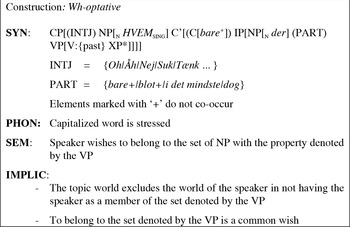
The outcome of the preceding discussion is that the use of a wh-clause without verb fronting and with counterfactual marking on the verb as an optative is highly motivated. Still, that only hvem ‘who’ as an extracted subject triggers the optative interpretation with obligatory speaker orientation cannot be predicted. For that reason, it does not seem to be possible to derive the optative reading of these wh-clauses in a strictly compositional way, by looking only at local trees. One must be able to look into subtrees to make sure a wh-optative contains the appropriate lexical heads, namely, hvem ‘who’ as the wh-constituent and der ‘there’ as the subject. These unpredictable features speak in favor of analyzing the wh-optative as a construction in the conservative sense: an idiosyn-cratic pairing of form and meaning with nonlocal dependencies among specific lexical items (Fillmore Reference Fillmore, Niepokuj, VanClay, Nikiforidou and Feder1985, Fillmore, Kay, & O'Connor Reference Fillmore, Kay and O'Connor1988, Goldberg Reference Goldberg1995). Figure 3 gives the fully-fledged construction for canonical wh-optatives in Danish.
Construction for wh-optatives.

The construction for wh-optatives specifies that it is a CP consisting (minimally) of hvem ‘who’, der ‘there’, and a VP containing the past tense form of a verb followed by zero or more complements (ignoring adjuncts). A wh-optative can contain three optional elements: an interjection (nonexhaustively) enumerated as Oh, Åh, Nej, Suk, Tænk, the complementizer bare ‘if only’, and a particle restricted to one of the particles observed in optative constructions, namely, bare ‘only’, blot ‘only’, dog ‘only’ or i det mindste ‘at least’. Thus, a minimal wh-optative looks like 75a. Concomitantly, a maximal wh-optative looks like 75b.
(75)
Note that the optative semantics is present also in the minimal version in 75a; thus, none of the elements associated with optative or exclamative clauses (the interjection, a special complementizer, or one of the special adverbs) are necessary to convey the optative semantics.
The semantics of the construction is as follows: The speaker wishes that he or she had the property denoted by the VP. The implicatures are that the speaker does not have this property and that the wish to belong to the set denoted by the VP is shared by other people, not just the speaker.
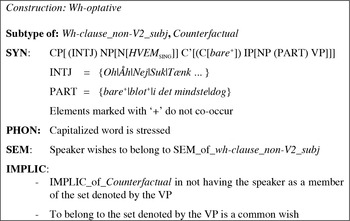
The proposed construction (trivially) accounts for the observed properties of wh-optatives. The problem with the analysis is that all the properties of the construction appear to be arbitrary. It is, however, possible to separate the compositional aspects of the construction from the noncompositional ones in a hierarchy of constructions where more specific constructions inherit the properties of less specific constructions. A full constructional hierarchy of wh-constructions and optative constructions is beyond the scope of this paper. Figures 4, 5, and 6 provide a fragment of such a hierarchy that serves simply as an illustration (it could be further simplified by having constructions for optatives and clauses with interjections). In the proposed fragment, the idiosyncratic properties of the construction are listed under the construction for wh-optatives, while the predictable properties are inherited from less specific constructions, in this case—a construction for wh-clauses with an extracted subject and no verb fronting, as shown in figure 4, and a construction for counterfactual clauses, as shown in figure 5.
Construction for wh-clauses without verb fronting and with an extracted subject.

The construction for wh-clauses with an extracted subject is independently needed for embedded wh-clauses with an extracted subject that also contain the expletive der ‘there’ (Müller & Ørsnes Reference Müller, Ørsnes and Müller2011). The construction type describes a clause with an extracted wh-constituent and the expletive subject der ‘there’. Semantically, the construction denotes a set of individuals with the property denoted by the VP, following the analysis in Jacobson Reference Jacobson, Bach, Jelinek, Kratzer and Partee1995:465.
The construction for a counterfactual clause specifies the past tense marking on the verb. I follow the analysis in Iatridou Reference Iatridou2000 as detailed above and assume that the construction introduces a counterfactual implicature.
Construction for counterfactual clauses.

The construction for wh-optatives is a subtype of the two constructions above, and it inherits their properties. The idiosyncratic properties of wh-optatives are accounted for by treating the optative construction as a subtype of a wh-clause with an extracted subject only. In this way, no other wh-clause counts as an optative. The optative construction further re-stricts the wh-constituent to the singular hvem ‘who’. The requirement that an optative be speaker-oriented is part of the semantic contribution, while the genericness of the wish is part of the implicature.
Construction for wh-optatives.

By positing a hierarchy of constructions in which more specific constructions inherit the properties of less specific constructions, it is possible to separate the idiosyncratic properties from the predictable properties. In this way the constructional hierarchy captures the compositional as well as the noncompositional aspects of the construction.
8. Conclusion
In this article, I have provided a detailed description of the somewhat neglected wh-optatives in Danish. I have argued that they should be treated as a construction in the conservative sense: an idiosyncratic association of form and meaning. However, I have also shown that this association is not wholly arbitrary: The interpretation of wh-optatives is to some degree predictable from the grammatical and semantic properties of wh-clauses without verb fronting and with a counterfactual (or future) interpretation. The point has been to argue that a crucial aspect of analyzing and positing constructions should consist in specifying exactly what parts are predictable and what parts are not predictable from the grammatical properties of the construction. This can ultimately help to understand why certain constructions are found in some languages and not in others. That is, the presence of a construction in a given language should—as far as possible—be motivated by the properties of its components and the mode of their combination. However, there is still a possibility for an expression to acquire certain features in a given language and thus develop into a specific construction in that language but not in others.