


1. INTRODUCTION
This article studies public opinion about labor unions, a topic that has found surprisingly little traction in the traditional literature on labor politics. Instead, one of the prominent subjects in the literature is the fate of organized labor in the age of economic globalization. Whether optimistic (Ross Reference Ross2000), pessimistic (Thelen Reference Thelen2003), or mixed (The Economist 2015), contributions to this debate share an ontological premise of the instrumental understanding of labor unions: unions are social institutions mobilizing (potential) members to channel their demands through political and business elites. Starting from the assumption that the performance of unions determines their viability (Fiorito Reference Fiorito1987; Chacko and Greer Reference Chacko and Greer1982), labor research has traditionally revolved around topics focused on unions’ organizational capacity (e.g., unionization rates) and legislative and bargaining successes.
Despite their significant contribution to our understanding of labor unions, the theoretical and empirical purview of these discussions is intrinsically narrow. The focus on organizational capacity and legislative outcomes confines the scope of the research on labor politics to the trilateral relationship between corporatist actors—state, labor, and business (Kochan Reference Kochan1979; Groot and van den Berg Reference Groot and van den Berg1994). This relegates one important actor in modern democracy—the public—to the role of mere spectators in labor politics. Indeed, outside of the empirical realm of North America (e.g., Chang Reference Chang2003; Kane and Newman Reference Kane and Newman2019; Panagopoulos and Francia Reference Panagopoulos and Francia2008), analysis of public attitudes toward labor unions has been “downplayed” in the literature (Frangi and Hennebert Reference Frangi and Hennebert2015, 131). This lack of research on public opinion regarding unions marks a glaring lacuna in the literature, given the critical effects of public opinion on public policy-making in general, and labor policies in particular (Burstein Reference Burstein2003; Hobolt and Klemmemsen Reference Hobolt and Klemmemsen2005), as well as the transformative roles of unions as major actors in contemporary popular politics (Botz Reference Botz2008).
This article aims to begin to fill this lacuna by examining public opinion regarding labor unions in South Korea. I put forth an argument with two, mutually conditioning, aspects. First, consistent with the well-established social capital literature (e.g., Putnam Reference Putnam2000), I contend that public attitude towards labor unions is a function of individuals’ interpersonal trust. In societies where unionization rates are low and the working class is politically and culturally marginalized (Koo Reference Koo2001), individuals lacking interpersonal trust view unions as a group of social activists that demand redistribution of resources to their own advantage at the expense of the rest of the society. High-trust individuals, on the other hand, cast less suspicious eyes on unions, and are much less likely to see these redistributive demands as free-riding.
Second, I propose that this relationship between trust and confidence in unions is strongly conditioned by individuals’ perception of the political landscape, namely, the extent to which the public see labor interests as being represented in formal politics. Given that unions are perceived primarily as an agent for redistribution, when there is a feasible political representation of organized labor, the public views unions as redundant and their demands as excessive. Such a perception reinforces low-trust individuals’ skepticism of unions. By contrast, when there is no visible political representation of labor, unions might be understood to be the sole voice for labor, which has otherwise little means to make its demands heard in the policy-making processes. In such cases, low-trust individuals tend to be less suspicious of organized labor and their demands. The marginal effect of trust in such cases would be weak.
This perceived degree of labor's political representation is captured by the partisanship of the presidential party in this article. The public understanding of government partisanship (liberal–conservative) maps onto the public perception of pro- and anti-labor policy orientations reasonably well (Kane and Newman Reference Kane and Newman2019; Choi and Kim Reference Choi and Kim2010; Lee Reference Lee2015), even when actual labor policies might not necessarily so. Therefore, the difference between high- and low-trust individuals in terms of their confidence in unions is expected to be much less pronounced when conservative governments are in power: the public believes that labor interests are not effectively represented in formal political processes, and unions indeed stand on a relatively legitimate ground to claim their interests. When liberal governments are in power, the necessity of unions will be questioned and the public will grow more suspicious of the nature of their redistributive demands accordingly.
Using public opinion data, I present empirical evidence supportive of this conditional argument in the context of South Korea. South Korea offers several analytical advantages in testing this argument. The country is one of the few emerging democracies where the survey data are available for an extended period time, enabling researchers to exploit the rich national-level variations. More importantly, the country makes a particularly suitable case for using government ideologies as an indicator of public perception of labor representation in politics. Despite research pointing otherwise regarding actual policies (e.g., Kim Reference Kim2009), the Korean public seems to believe that liberal and conservative governments advance socioeconomic policies generally consistent with their publicly recognized ideological orientations. In addition, union activities are a fairly salient social subject in the country (Koo Reference Koo2001), which helps to avoid the possibility of the public simply forming “no opinion” on unions due to lack of attention (Sturgis, Roberts, and Smith Reference Sturgis, Roberts and Smith2014).
The article contributes to the existing comparative political economy literature by offering insights into public attitudes towards labor unions in emerging democracies. Traditional research has been limited either to the trilateral relations of labor, business, and state actors in their analytical framing or to established democracies in their empirical space. Approaching labor politics in terms of public opinion in South Korea, this article attempts to overcome these two limitations simultaneously.
The article also pushes the boundaries of “social capital” research theoretically and empirically. Theoretically, the article offers a novel framework that illuminates the strong conditioning effect of government partisanship. The traditional social capital literature maintains that public opinion is shaped by personal and historical attributes and therefore does not vary dramatically over time (Putnam Reference Putnam2000; Lipset and Schneider Reference Lipset and Schneider1987). The current article identifies the ways in which low-trust individuals’ perceptions of unions do indeed drastically change with government partisanship.
Likewise, the current study extends the scope of inquiry of social capital research to relatively uncharted empirical terrain by studying a non-governmental institution, namely, labor unions. Although the seemingly apparent association between interpersonal trust and institutional confidence has been extensively studied in the literature,Footnote 1 the empirical purview of this research has almost exclusively been confined to governmental institutions.
The article consists of five sections. Following this introduction is a brief survey of existing studies on the determinants of public confidence in labor unions. Testable hypotheses are formulated building on this survey. The third and fourth sections present the research design for testing the hypotheses and the result of the statistical analyses. The last section summarizes the major findings of the article and discusses their implications.
2. INTERPERSONAL TRUST AND CONFIDENCE IN LABOR UNIONS
2.1. EXISTING STUDIES (OR THE LACK THEREOF)
Studies of public opinion ofn labor unions are rare in the traditional labor politics literature. This is due in large part to the ontology of labor unions in social science research. Organized labor has long been construed as a social group actively seeking interests that are intrinsically at odds with those of the social elites, be they the state or business (McIlroy Reference McIlroy2014). These conflicting interests inspired at least two avenues of research: one highlights organized labor's external relationships with social elites (e.g., Rueschemeyer, Stephens, and Stephens Reference Rueschemeyer, Stephens and Stephens1992; Wallerstein, Golden, and Lange Reference Wallerstein, Golden and Lange1997), and the other has focused on the internal workings of unions (e.g., Murillo Reference Murillo2001; Groot and van den Berg Reference Groot and van den Berg1994; Korpi Reference Korpi2006; Collier and Mahoney Reference Collier, Mahoney and Anderson1999) that strongly shape the nature of this relationship.
Not surprisingly, the empirical domain of opinion surveys on labor unions has been limited to those with (potential) union membership (Kochan Reference Kochan1979; Chacko and Greer Reference Chacko and Greer1982). Factors driving positive opinion about unions are thus found to be related to their instrumental role of advancing union members’ economic interests—such as job security and wage increases (Fiorito Reference Fiorito1987; Scruggs and Lange Reference Scruggs and Lange2002)—which would not necessarily affect the general public's opinion of unions. The opinions of ordinary people, in other words, have rarely been subject to a systematic analysis in the studies of labor unions. The public was essentially treated as a bystander in the extant labor politics literature.
This lack of attention to ordinary citizens is puzzling, given that the public, through popular politics, often plays a pivotal role in determining union performance. The bargaining between political elites and unions, in particular, is directly determined by public opinion. Broad-based public support is often a necessary, though not sufficient, condition for channeling labor's demands through policy-making processes (Rueda Reference Rueda2007). In times of structural reforms the role played by the public is particularly pronounced, as popular sentiment affects whether and how labor interests are protected amid welfare retrenchment (Levitsky and Way Reference Levitsky and Way1998).
Favorable public opinion plays an even greater role in unions’ long-term political goals, such inserting themselves into the formal political arena (Robertson Reference Robertson2004), usually by forging an alliance with left-leaning parties. Political parties might not be incentivized to seek an alliance with organized labor if unions do not command a certain level of public support beyond the existing social cleavages, which would in turn add to parties’ strength significantly (Lee Reference Lee2011, 75–77). Indeed, contemporary unions are increasingly conscious of the importance of “civic engagement,” portraying themselves as seeking public good to garner broad public support (Nissen Reference Nissen2010).
There are exceptions to this dearth of attention to public opinion of unions, but they have palpable limitations. Several studies have emerged recently that illuminate how the general public reacts to social cues about labor unions. Kane and Newman (Reference Kane and Newman2019), for instance, demonstrate that “class-based anti-union rhetoric” employed by the mass media turns public opinion of labor unions effectively negative in the United States. Frangi and Hennebert (Reference Frangi and Hennebert2015) highlight the difference between Quebec and the rest of Canada in terms of how individual-level trust contributes to the formation of public confidence in labor unions. Not only are these studies exceptional, they are confined exclusively to the North American context, where unions play a unique role in the society. In short, individuals’ perception of labor unions is under-theorized, and suffers from limited empirical breadth. A systematic analysis of public opinion data in a non-American context can help fill this glaring lacuna in the labor politics literature.
2.2. ARGUMENT
This article studies public confidence in labor unions. Focusing on public confidence in, rather than the generic favorability of, unions offers an important analytical advantage in terms of conceptual clarity. Confidence in unions indicates the belief that unions exercise their own self-interest within their own mandate and without any ill-intended aspirations (Lipset and Schneider Reference Lipset and Schneider1987). In other words, confidence in unions is the perceived legitimacy of unions as a social institution operating in good faith. Expressing confidence thus requires individuals to draw on their direct and indirect observations of unions (Norris Reference Norris2011, 19). Favorability, on the other hand, is a more noisy and inclusive concept, as it could include mere representations of individuals’ general social preferences. One could find unions (un)favorable simply by resorting to cognitive short cuts such as their ideological leanings (Dalton and Wattenberg Reference Dalton, Wattenberg and Finifter1993), without thinking about the actual unions of their society. By tapping into public confidence instead of favorability, therefore, one can more effectively highlight people's “intrinsic” opinion of unions.Footnote 2
Synthesizing the political sociology and the welfare politics literatures, the article proposes that two factors—one individual, the other national—help us construct a framework in which the determinants of public confidence in labor unions can be delineated. These two factors are closely interconnected, with the national factor strongly conditioning the effect of the individual one.
2.2.1. Individual Attribute: Interpersonal Trust
Following the contemporary political sociology literature (e.g, Brehm and Rahn Reference Brehm and Rahn1997), I start with the Hobbesian assumption that a society is composed of individuals whose interests can be incompatible. For those who believe that their interests are strictly in conflict with one another, pursuing resource gains for one's own good should lead to others’ loss. For the individuals who maintain otherwise, interests are reconcilable.
The literature has long explained this difference with interpersonal trust. Interpersonal trust is in essence a belief in “social reciprocity” (Putnam Reference Putnam2000, 135). When lacking trust, individuals are concerned primarily about being cheated by others. With trust, by contrast, they are motivated to take on actions that might benefit others as they expect that others would return their favor. Trusting people tend to assume that others’ actions are “at least not detrimental” to their interests (Gambetta Reference Gambetta and Gambetta1988, 217).
The impact of trust is particularly pronounced in the way public perceives socially marginalized groups. These groups are often depicted as subversive actors that attempt to alter the social status quo (Kane and Newman Reference Kane and Newman2019). If a change is seen as an unfair reallocation of resources away from the rest of the society, as low-trust individuals would believe, these groups’ perceived legitimacy stands on a precarious ground. Interpersonal trust negates this negative perception. Trusting individuals tend to assume a certain level of justifiability for the demands these groups make and, therefore, discount the expected cost associated tolerating such demands (Uslaner Reference Uslaner2002).
Thus, interpersonal trust as an indicator of individuals’ perception on others’ intentions has direct implications on public confidence in unions. Unions are by and large considered by the public as “others.” Despite the evolving roles and identities of unions (Koo Reference Koo2001), the general public in most societies perceive them as relatively minority-groupFootnote 3 social agents, whose mandate is to make redistributive demands to the government and business (Jones Reference Jones2011). For instance, in a recent survey in the United States, almost 70 percent of the respondents answered that labor unions are groups that aim to redistribute the collective wealth toward themselves (Yglesias Reference Yglesias2012).
Consequently, low-trust individuals would see unions as an illegitimate social group only interested in claiming their own resources. Without trust, it is likely that union activities are viewed as at odds with the welfare of the rest of the society. The lack of trust leads them to believe that those making redistributive demands are “free-riders” going after public goods to their exclusive advantages (Lee Reference Lee2013). The public would have little confidence in such a “distributional coalition” (Olson Reference Olson1982). When individuals do indeed trust others, on the other hand, the redistributive demands of unions might not be seen as infringing on the public interests. Instead of casting suspicious eyes on labor demands, high-trust individuals are likely to assume there are justifiable reasons behind such demands (Bergh and Bjørnskov Reference Bergh and Bjørnskov2014) or, at least, they may not read malicious intentions into the actions (Lipset and Schneider Reference Lipset and Schneider1987). The benefit of a doubt that high-trust individuals’ give unions leads to greater public confidence in organized labor.
In short, ceteris paribus, it is plausible to posit that interpersonal trust increases individuals’ confidence in labor unions. Low-trust individuals are more likely to cast skeptical eyes on unions, concluding their demands as illegitimate. Individuals with strong interpersonal trust, on the other hand, would be much less inclined to assume ill-intentions in union demands.
2.2.2. The Perception of Over-Representation as a Conditioning Factor
While interpersonal trust is expected to be associated with individuals’ confidence in labor unions, this relationship is undergirded by the “all-else-equal” assumption. Such an assumption might be untenable, as institutions like unions rarely exist in a sociopolitical vacuum. Instead, public opinion regarding these institutions even within a single society is strongly affected by the structural landscape in which they are situated (Norris Reference Norris2011; Panagopoulos and Francia Reference Panagopoulos and Francia2008). In delineating the effect of trust, therefore, it is important to identify the contextual factor that would strongly shape its size and significance. I contend that the perceived level of the political representation of labor interests is such a conditioning variable.
Representation has distributional implications. Political representation of a certain social group signifies the feasibility of its interests realized into public policies (Herrera, Herrera, and Smith Reference Herrera, Herrera and Smith1992). In this sense, social groups are in competition with each other for political representation, a situation that brews up potential tensions between political minorities and the rest of a society, particularly low-trust individuals. As the post-conflict power-sharing literature establishes (e.g., Krook and O'Brien Reference Krook and O'Brien2010), when social trust is scarce, growing political representation of political minorities in governments amplifies public skepticism that their narrow interests are over-served at the expense of those of the society. This implies that when low-trust individuals perceive that labor interests are already substantively represented in formal politics, they grow more skeptical of the legitimacy of labor unions than when they believe that labor interests are still not effectively represented. Formal political representation of organized labor indicates to the low-trust individuals that labor unions, as another agent for the same kind of interests, are redundant and thus excessive. Excessive demands are viewed as illegitimate, reinforcing low-trust individuals’ suspicion of the social legitimacy of unions. When labor representation in politics appears weak, by contrast, unions may be seen as a sole agent for the redistributive labor interests. The low-trust individuals in such a situation might be less wary of the “hidden” intentions of unions.
High-trust individuals’ confidence in unions, on the contrary, is less affected by their sense of the extent of labor's political representation. Interpersonal trust negates the Hobbseian zero-sum worldview that others’ gains result in one's loss, even in an otherwise hostile situation (Bahry et al. Reference Bahry, Kosolapov, Kozyreva and Wilson2005), which leaves little room for contextual factors to operate. To these high-trust individuals, an increase in representation of a political minority does not pose a threat to their interests.
The idea that the degree of political representation conditions individuals’ confidence in a marginalized social group is widely resonated in public opinion studies, particularly those on redistribution and minority politics. For instance, otherwise anti-egalitarian people are found to be much less skeptical of redistribution when informed that government support for the poor decreases dramatically (Slothuus Reference Slothuus2007). By contrast, Kaiser et al. (Reference Kaiser, Drury, Spalding, Cheryan and O'Brien2009) report that after the election of Obama, Americans’ overall support for social justice declined due to the presumption that a substantive degree of social progress had now been achieved. Similarly, Georgeac and Rattan (Reference Georgeac and Rattan2019) demonstrate that the public's concern about the gender pay gap declines with female representation in top corporate leadership.
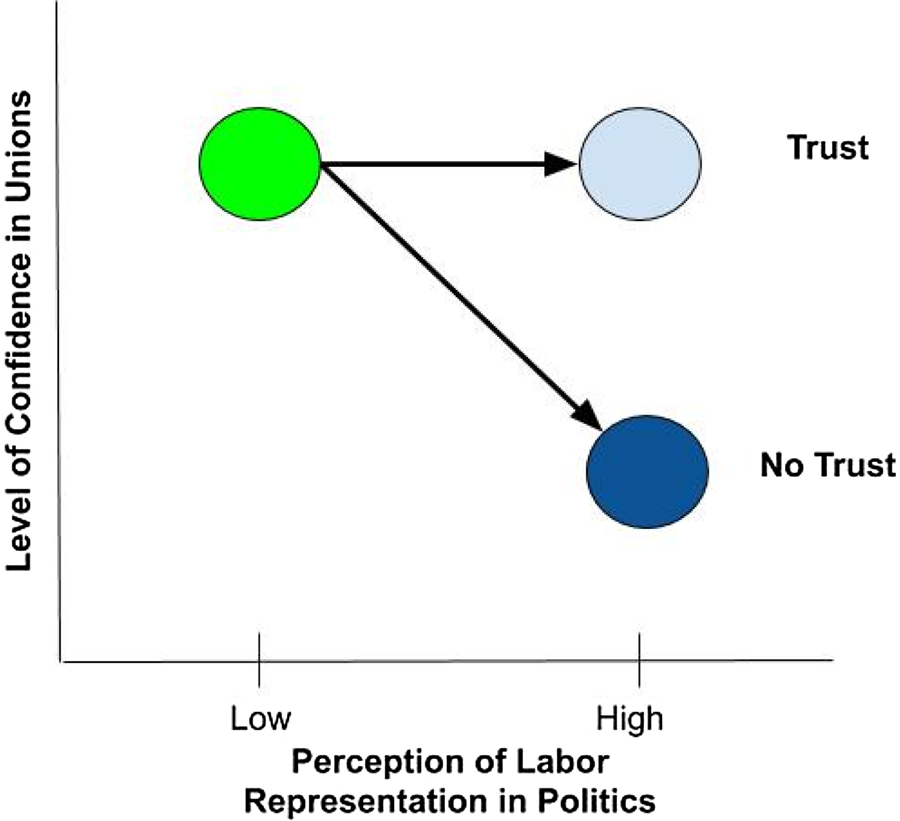
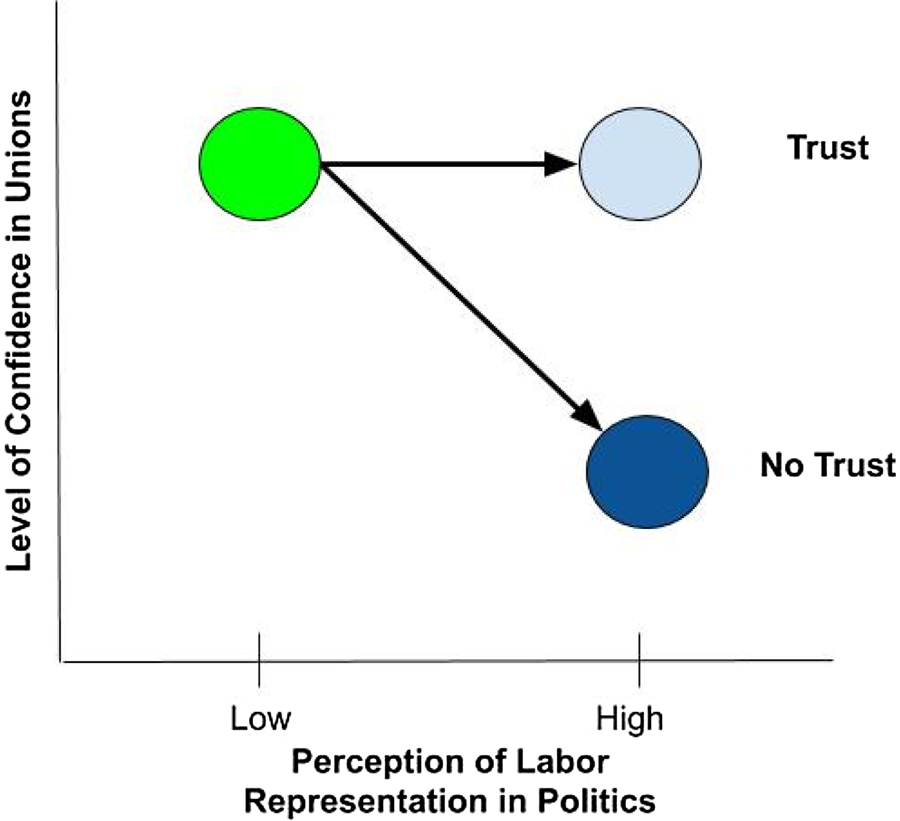
Interpersonal trust thus determines individuals’ acontextual confidence in labor unions as it reflects the level of their skepticism about redistributive demands made by social groups. But this relationship does not exist on its own, and it is significantly conditioned by contextual factors indicative of the degree to which labor interests are represented in formal political processes, as illustrated in Figure 1. In particular, while high-trust individuals’ confidence in unions stays relatively stable, low-trust individuals’ is malleable depending on their perception of the labor representation in formal political processes. That is, where labor interests are viewed as well-represented in formal politics, the positive effect of trust on popular confidence in unions is strong (Hypothesis 1) because low-trust individuals would find unions to be redundant and unnecessary political agents for labor. By contrast, where labor interests are viewed as under-represented in formal politics, the positive effect of trust on popular confidence in unions is weak (Hypothesis 2) as low-trust citizens perceive unions as the sole voice for labor and their skepticism towards organized labor is abated.
Conditioning Effect of Representation
2.3. SOUTH KOREA
South Korea stands out as an interesting testing ground for the hypotheses put forth here for a number of reasons. First, the Korean public views labor unions primarily as an agent for redistribution that is not institutionalized into the mainstream social fabric. This view is strongly consistent with one of the core assumptions upon which the hypotheses are developed. In a multi-year survey conducted in South Korea, a great majority of respondents answered that employment protection and wage increases are unions’ primary roles (Choi and Kim Reference Choi and Kim2010, 30–35). Despite the evolving class identities and diversifying union activities in the post-democratization era, the Korean public still perceives unions as a social group primarily focused on redistribution. Likewise, labor is seen as an under-served, marginalized social group in Korea. As Koo (Reference Koo2001, 127) poignantly points out, the public image of factory workers, who constitute the great majority of the Korean unions, has traditionally been “a low-status, menial, and contemptible occupation.” This marks a stark contrast with the public perceptions of labor in other countries (Lee Reference Lee2016; Wallerstein, Golden, and Lange Reference Wallerstein, Golden and Lange1997), where a sizeable number of citizens consider unions a part of a broader sociopolitical institution.
Second, the country is a less-likely case for the hypotheses to be supported given that the public confidence in labor unions is conspicuously stable over time. As shown in Appendix Figure A4, the country's level of public confidence in unions is consistently high, though moderately declining. Since the conditional hypotheses point to changing public confidence of low-trust individuals, it is plausible to expect that they are more likely to be supported in a society where the level of confidence fluctuates quite drastically upon political changes, such as Argentina, than in South Korea. The result we obtain from this unlikely case, therefore, has more generalizable implications than those produced on “more-likely” cases.
Third, the country is a case where several structural variables are naturally controlled for, rendering the empirical test relatively parsimonious. For instance, although generally more militant than comparable countries such as Taiwan (Lee Reference Lee2011), union militancy in South Korea has hardly increased since the mid-1990s. The number of labor disputes reported to the government agency—the Labor Committee—had mildly decreased from the 1990s to early 2000s and stayed nearly constantly ever since (Lee Reference Lee2008). More important, according to the Korean General Social Survey (Kim et al. Reference Kim, Kang, Kim, Kim, Park, Lee and Choi2019), public perception of labor militancy has indeed decreased, albeit very marginally, since 2003 (see Appendix Figure A3). Had the unions grown significantly militant over the years, it would have been plausible to argue that the public confidence in the unions waned in reaction, regardless of the effect of interpersonal trust. In addition, the Korean democratic regime has remained fairly stable since the initial democratization in 1987, without any major authoritarian disruptions. The changes in governments through elections have been peaceful, and the Sixth Constitution that embodies the current regime has remained intact since 1987. Major disruptions such as coups and autocratic reversals dramatically redefine the roles of the labor unions. Had such factors been present, it would have been much harder to isolate the effect of trust on the public confidence in unions in a single-country study.
Fourth, the country's unionization level has traditionally been low, with about 12 percent being the upper bound. Given that union membership tends to be strongly correlated with individuals’ confidence in unions (Palley and LaJeunesse Reference Palley and LaJeunesse2007), the low unionization rates imply that one potential confounding variable is already controlled for.
Finally, the country is one of the few cases where the survey data are available for an extended period of time. This enables researchers to utilize rich contextual variations over time. Outside of North America and Northern Europe, public opinion data on labor unions of democratic countries that allow for such variations are rare.
3. RESEARCH DESIGN
3.1. VARIABLES
The data for all individual-level variables used in this article come from five waves of the World Value Survey (WVS 2015). It would best serve our purpose of testing the hypotheses if longitudinal survey data administered on same individuals over a long time series were available. Unfortunately, such a data set does not exist. WVS is a reasonably viable alternative, given that the variables central to this research have been surveyed consistently over a relatively long time period—from 1990 to 2010.Footnote 4 To compensate for the temporally fragmented observations in this primary data source—only five waves over twenty-year period—I use the Korean General Social Survey (KGSS) data where available. KGSS offers a much less fragmented, through narrower, temporal coverage of the Korean public opinion, effectively complementing the sparseness of WVS. One apparent shortcoming of KGSS is that its earliest observation for the variables of interests in the current research is in 2004, substantially limiting the contextual variation that this article highlights: government partisanship.
The dependent variable capturing ordinary South Korean citizens’ confidence in labor unions is “Confidence in Labor Unions,”Footnote 5 which is a four-indicator ordinal item ranging from 1 (“a great deal”) to 4 (“not at all”). This original variable is re-coded such that higher numbers represent stronger confidence.
One of the primary independent variables, Interpersonal Trust, comes directly from the WVS questionnaire, which asks respondents if they believe that “most people can be trusted.” This is a dummy variable with two possible answers: 1) “most people can be trusted” and 2) “can't be too careful.” Again, the variable is re-coded such that one indicates a high-trust individual and zero, otherwise.
The other independent variable that captures the perceived political representation of labor is government partisanship. The public understanding of government partisanship (liberal–conservative) maps aptly into their perception of pro- and anti-labor policy orientations even when actual labor policies might not necessarily do so (Kane and Newman Reference Kane and Newman2019; Bagashka and Stone Reference Bagashka and Stone2013). In fact, Choi and Kim (Reference Choi and Kim2010) report a marked difference between public opinion of the government–labor relationship between the liberal and conservative governments in South Korea. While about 63.7 percent of respondents in 2007 noted that the government “takes side with employers” in its labor policies, the number climbed up by about 10 percent points in a 2010 survey. Choi and Kim (Reference Choi and Kim2010, 20) attribute this to the public understanding of the pro- and anti-labor stances of the liberal Roh Moohyun and conservative Lee Myungbak governments, respectively. In addition, researchers conclude that the labor policies of the conservative governments, particularly those of Lee Myungbak government, appear repressive in the eyes of civil society groups compared to those of its two liberal predecessors (e.g., Kim Reference Kim2015).
This perceived tie between organized labor and liberal governments serves as a cognitive benchmark for the public regarding the representation of labor interests in formal political processes. In a political landscape where there is no established labor party and labor unions have no “institutionalized methods of interest articulation” (Lee Reference Lee2011, 6), it is plausible to assume that the public believes that labor interests are better represented in liberal governments than in conservative governments. Given this reasoning, a dummy variable, Liberal Government, is coded one for the years where the incumbent president was Kim Daejung (Wave 4) or Roh Moohyun (Wave 5) and zero, otherwise.
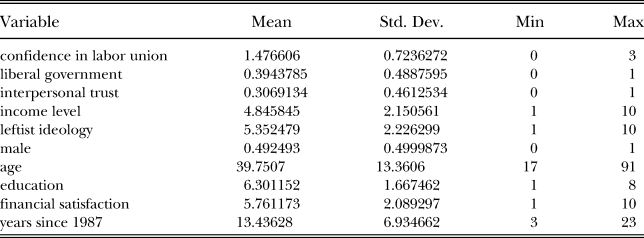
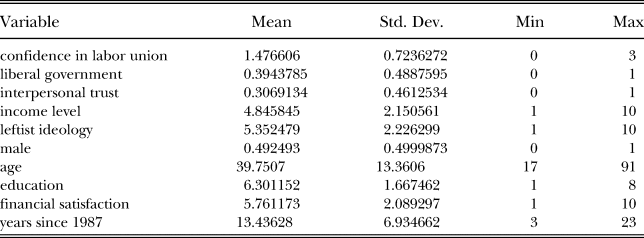
A host of control variables capturing each individual's level of income, self-reported political ideology, gender, age, household financial satisfaction, and educational attainment are also used. Given that three of the four conservative governments temporally proceeded the liberal ones, it is possible that the government partisanship variable simply reflects the maturity of democracy within the time frame of the data. To ward off this possibility, an additional level-1 control variable, Year since 1987, is employed. This is a count variable of years that have elapsed since the 1987 democratization in each year of survey. The summary statistics for the variables used in the benchmark specification are presented in Table 1.
Summary Statistics
3.2. Model
Given that the dependent variable is ordinal, an ordered logit model would be best suited for testing our hypotheses. However, as the structure of the data is hierarchical, simply pooling all observations across the waves would assume that wave-specific components of the error term are the same for all individuals. This can be a source of bias (Wells and Krieckhaus Reference Wells and Krieckhaus2006). Consequently, a multilevel ordered logit model with random intercepts is employed to estimate the benchmark model. A latent form of the benchmark model can be written formally as:
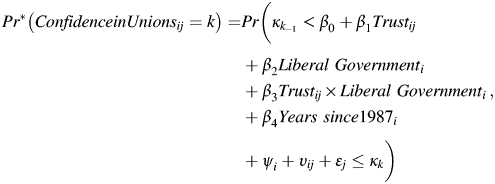 $$\eqalign{Pr^{*}\left({Confidence in Unions_{ij} = k} \right) = & Pr \bigg(\kappa_{k_{-1}} \lt \beta_0 + \beta _1 {Trust_{ij}} \cr & + \beta _2 {Liberal \ Government}_i \cr & + \beta_3 {Trust_{ij}} \times {Liberal\ Government}_i \cr & + \beta_4 {Years\ since 1987}_i \cr & + {\psi}_i + \upsilon_{ij} + \varepsilon_j \le \kappa _k \bigg)},$$
where βs are coefficients for each variable, i indicates each wave of the survey (level-1), j identifies individuals (level-2), and k is each indicator of the dependent variable. υ and ε are level-1 and level-2 error terms, respectively. ψ is a vector of individual level control variables. A significant β 3 is a necessary, but not sufficient, condition for the hypotheses to be supported.
While I argue that obtaining the multilevel estimates to gauge how large the marginal effect of interpersonal trust across different governments is important, a methodological issue based on the small number of waves—five—deserves some discussions here. Recent studies suggest that using multilevel models when the number of clusters (“waves” in this article) is too small, especially along with a cross-level interaction term, risks underestimating confidence intervals (Stegmueller Reference Stegmueller2013, 758). That is, when using hierarchical data with a small number of clusters, the significance of multilevel estimates can be exaggerated. I address this concern in two ways. First, I set the minimum threshold for statistical significance for multilevel estimates in this article at 95 percent, as opposed to 90 percent. In addition, I complement the multilevel estimates with a set of single-level ordered logit models where the data in each wave are analyzed separately. In this set of models, by definition, the country-level variables are excluded. For the hypotheses to be supported in this individual wave-level analysis, the trust variable should be positively significant only in the years of the liberal governments.
4. EMPIRICAL ANALYSES
4.1. PRIMARY RESULT
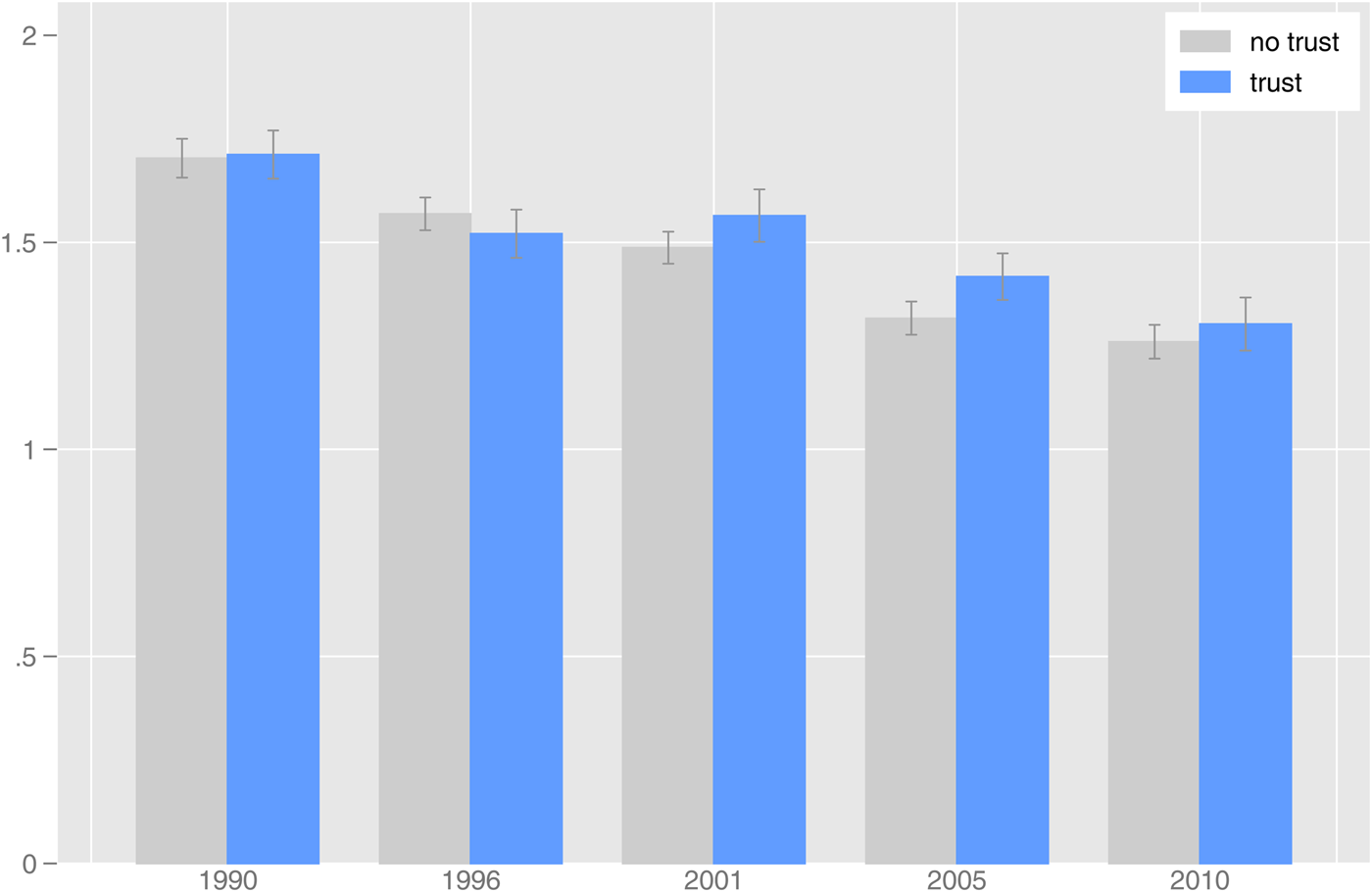
Y-axis indicates the mean level of confidence in labor unions. X-axis represents the year of the survey where 2001 and 2005 are the liberal Kim Daejung and Roh Moohyun governments, respectively.
Figure 2 plots the level of public confidence in labor unions across different governments of South Korea (2001 and 2005 are liberal governments). Albeit limited and irrespective of the effects of other covariates, the figure lends intuitive support to the conditional hypotheses. Under conservative governments (1990, 1996, and 2010), the level of confidence in labor unions between low-trust individuals and that of high-trust ones do not exhibit discernible differences. On the other hand, as the confidence interval bars indicate, the difference during the reign of liberal governments (2001 and 2005) is statistically significant at a traditional threshold. That is, the level of confidence in unions was significantly higher among the high-trust individuals than among their low-trust counterpart when the two liberal governments were in power.
Confidence in Unions by Interpersonal Trust with 90% Confidence Intervals
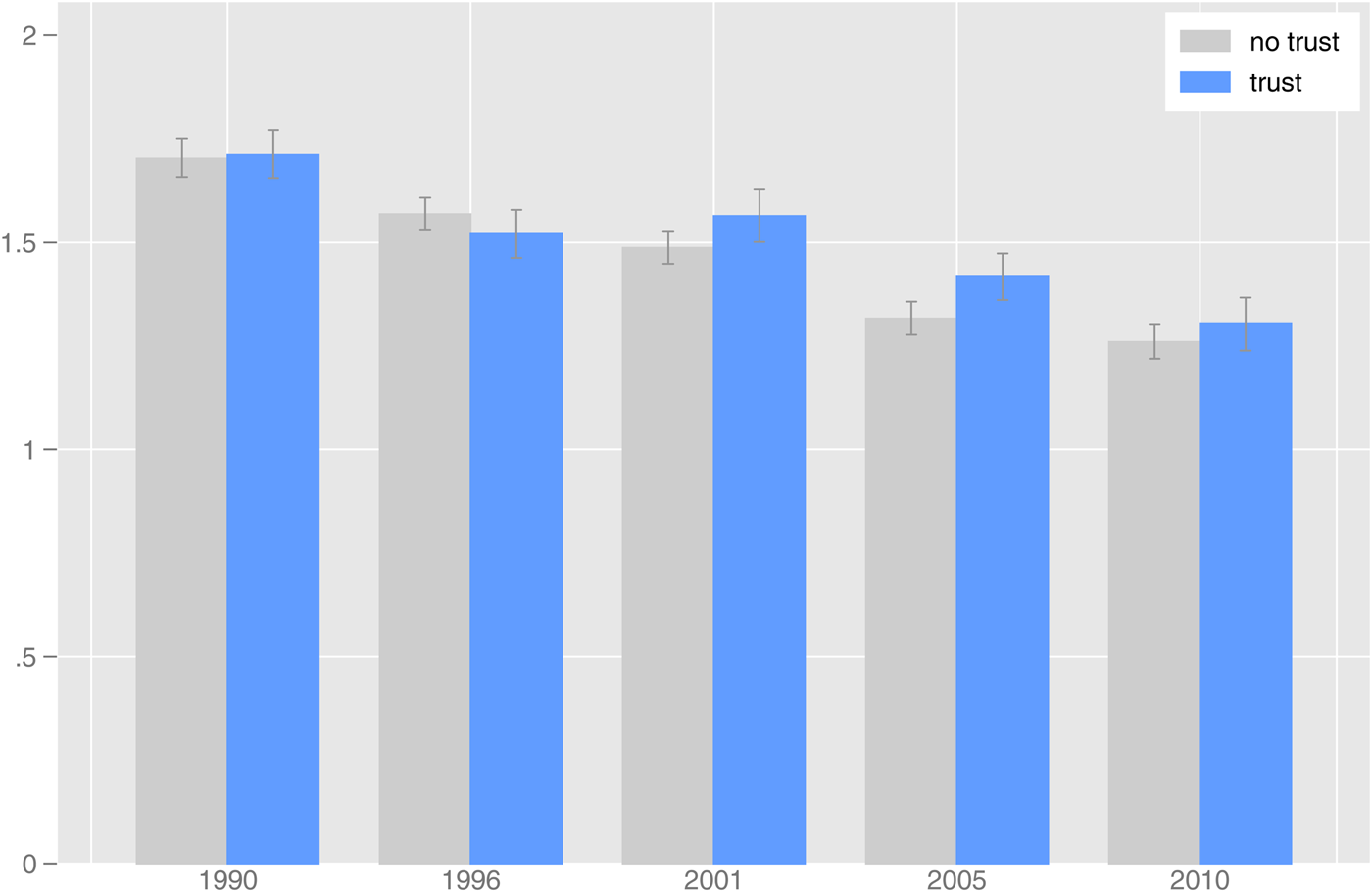
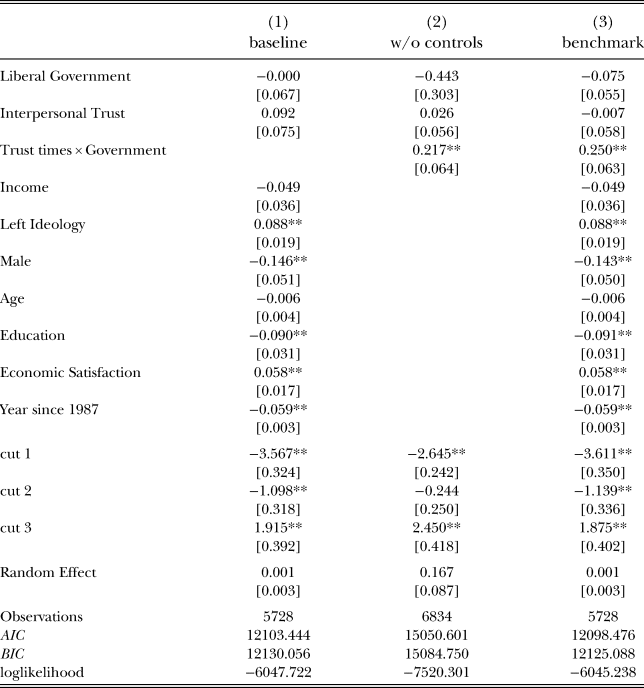
Table 2 presents the multilevel ordered logit estimates for the baseline and benchmark models. The first column reveals that without the interaction term, neither government partisanship nor interpersonal trust on its own has any notable monotonic effect on public confidence in labor unions. This is contrasted with the benchmark result reported in the third column, where the multiplicative interaction term for these two variables retains strong statistical significance. The second column indicates that the significance of the interaction term in the benchmark model is not a statistical artifact of including the control variables in the model: the benchmark result holds even when all the covariates are excluded.
Baseline and Benchmark Models
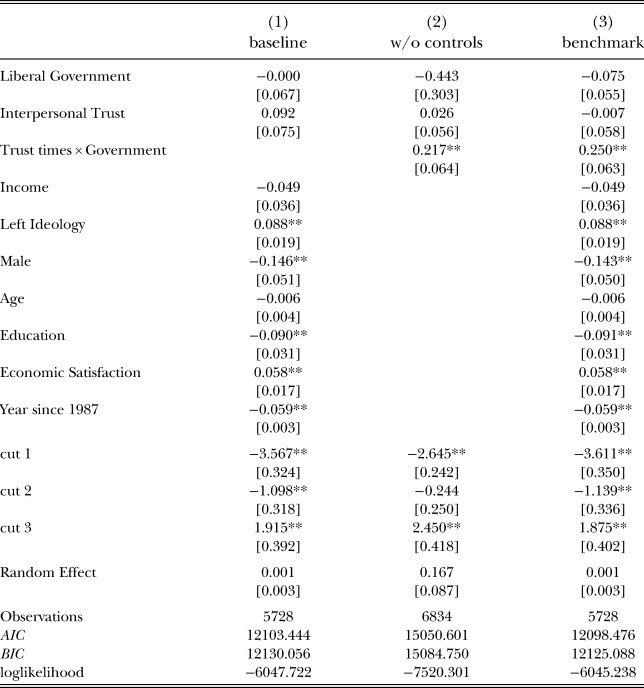
*p < 0.05, **p < 0.01. Multilevel mixed effect ordered logit estimates with robust standard errors in brackets.
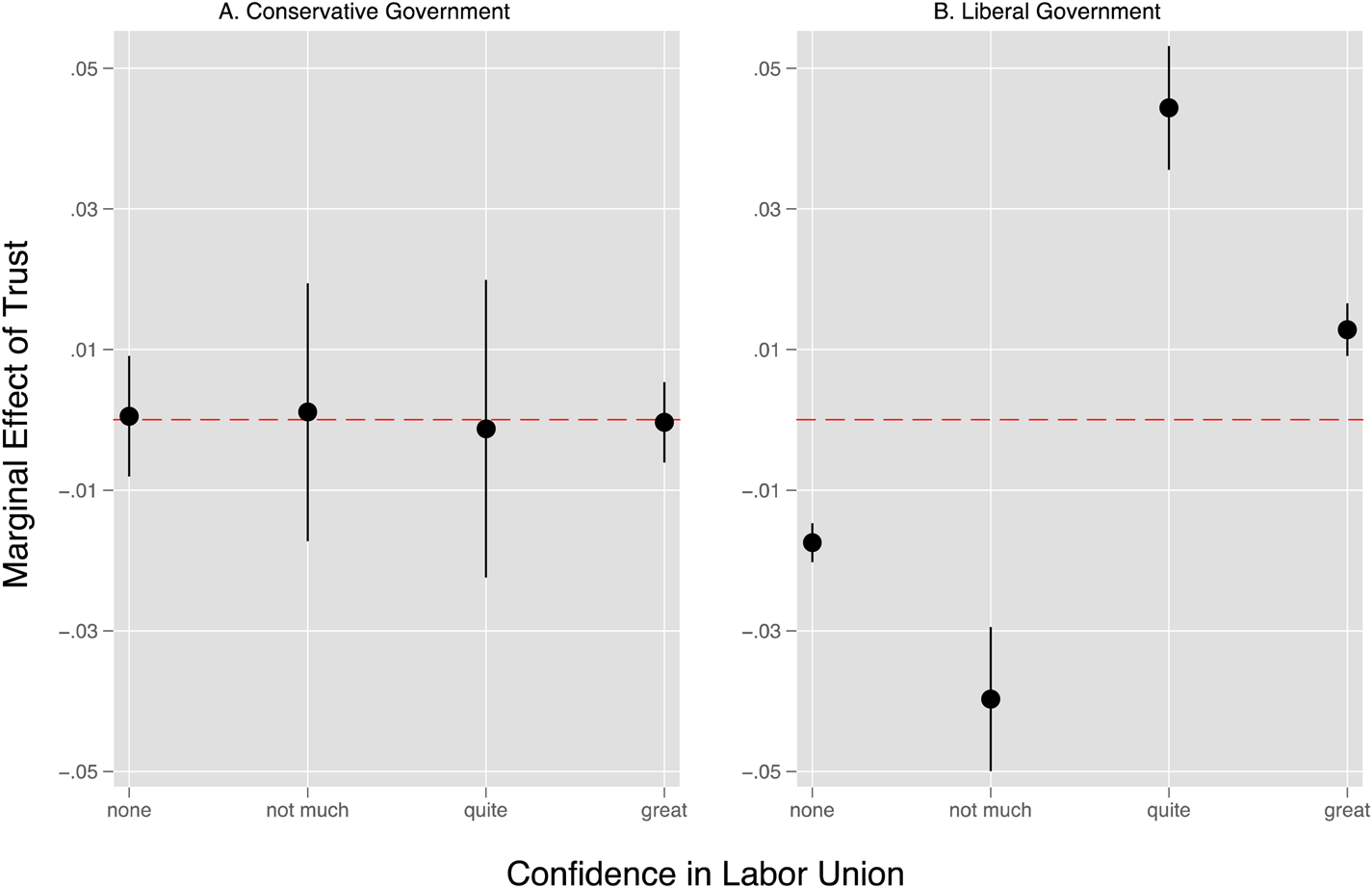
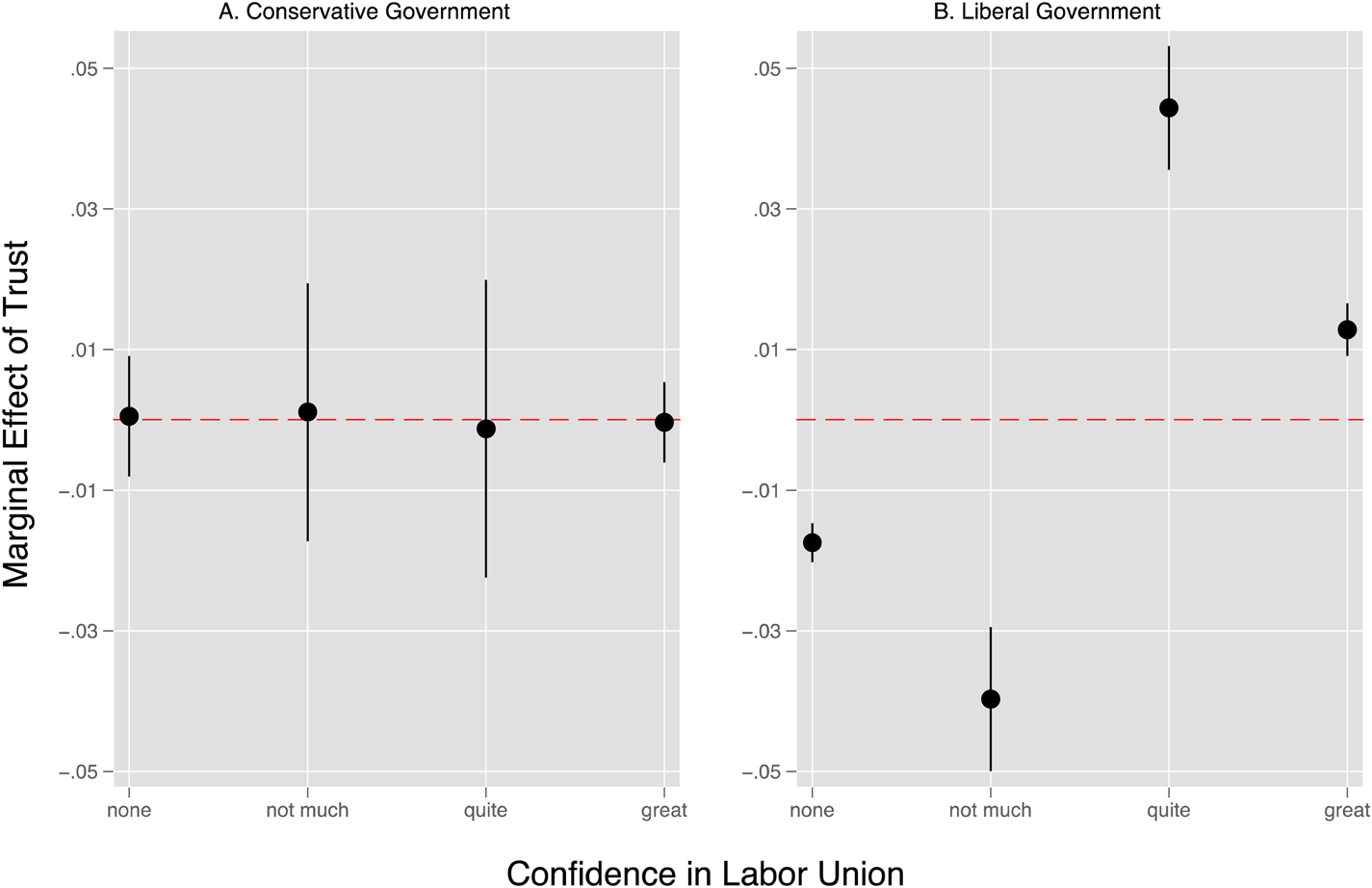
Each dot indicates a point estimate of the marginal probability effect of interpersonal trust on each indicator (none, not much, quite, or great) of confidence in labor unions based on the benchmark result. The bars indicate 95 percent confidence intervals.
Since the information presented in the regression table alone is not readily interpretable, the marginal effect of interpersonal trust on public confidence in labor when the incumbent government is conservative (A) and when it is liberal (B) is visualized in Figure 3. The marginal effect figure offers evidence strongly supportive of the hypotheses. In the left panel, under conservative governments, the marginal effect of interpersonal trust—i.e. the difference in the probability of each indicator in the dependent variable (none, not much, quite, or great) between when Trust is zero and when it is one—is not distinguishable from zero. In other words, whether an individual is of high- or low-trust does not make any difference in terms of her or his confidence in labor unions at any level when the government is conservative. The result lends a strong support to Hypothesis 2. A diametrically different result is illustrated in the right panel of Figure 3. Under liberal governments, interpersonal trust increases the probability that an individual has “quite a lot” or “a great deal” of confidence in unions by about 6 percent (= 4.5 + 1.5). Similarly, trust reduces the probability that an individual has weak confidence in unions (“none” or “not much”) by about 5 percent (= (−1.5) + (−3.5)). This result is strongly consistent with Hypothesis 1. Compared to the size of the marginal effects of other significant covariates (see Appendix Figure A1), these effects are in fact substantial.
Marginal Effect of Trust on Confidence
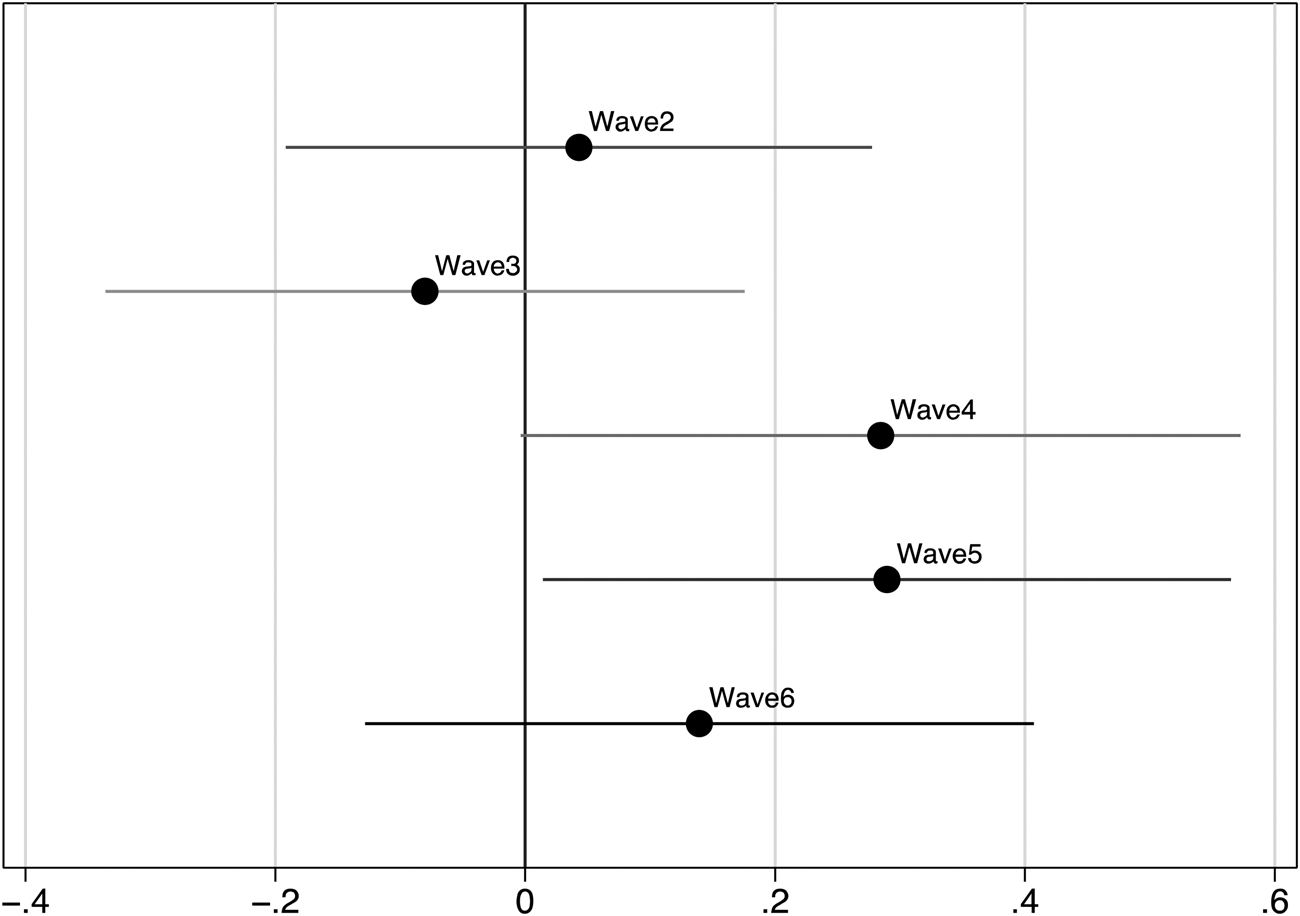
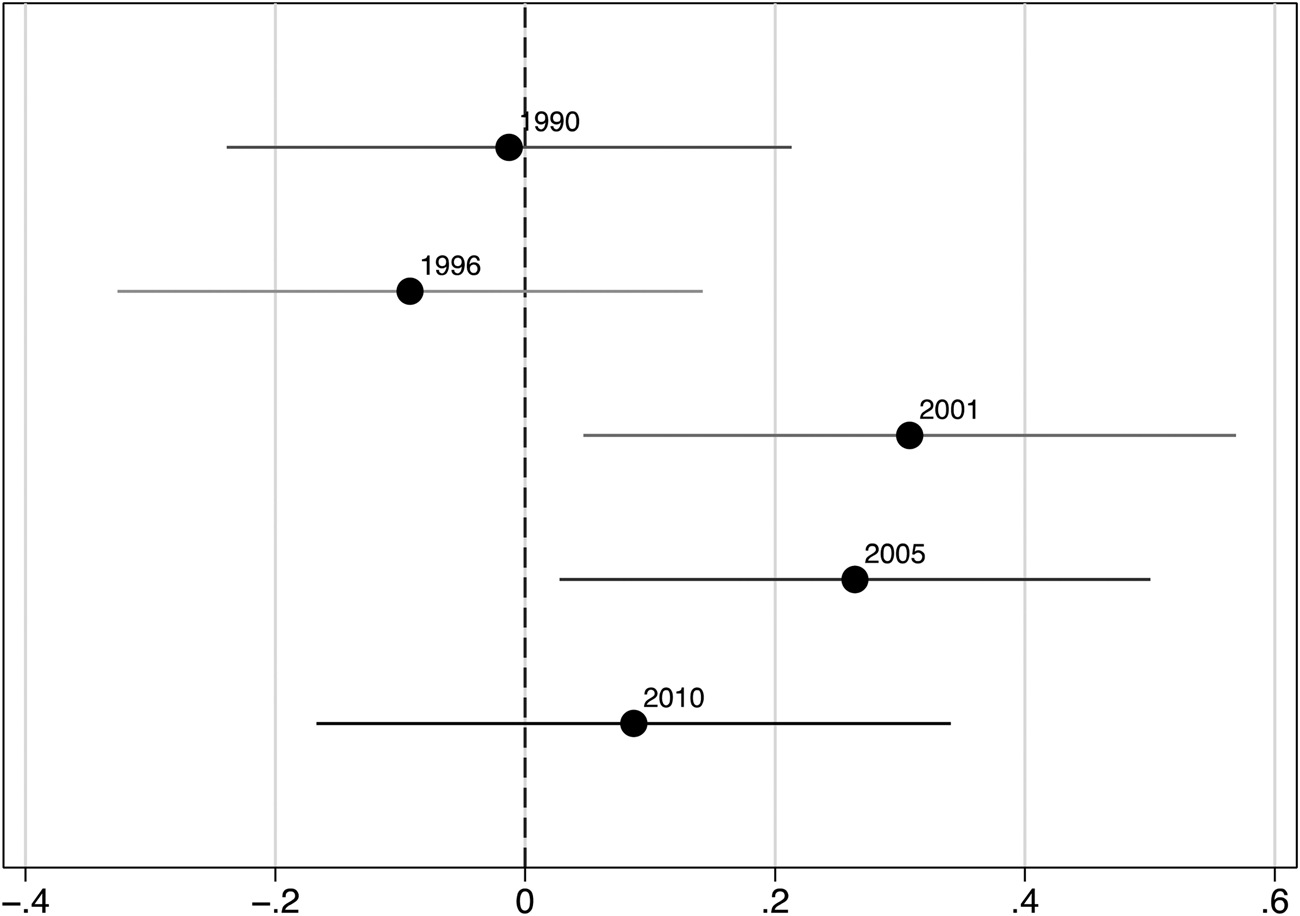
Each dot represents the coefficient of the interpersonal variable while each bar indicates the 95 percent confidence interval. For the full regression results, see Table A1.
The results of single-level ordered logit models offer evidence corroborative of this finding. As depicted in Figure 4, the effect of interpersonal trust (expressed as coefficients) is significantly positive only in the years where liberal governments were in power.
The Effect of Trust: wave-level
4.2. ROBUSTNESS OF THE BENCHMARK RESULT TO ALTERNATIVE EMPIRICAL SCENARIOS
4.2.1. Alternative Data: Korean General Social Survey
As noted above, one shortcoming of using the WVS data is its temporal sparseness. Each wave captures simply one year of each of the post-democratization Korean presidencies up to the Lee Myungbak government. Hence, it is certainly possible that the data did not really reflect the overall context of each presidency, or the public perception about political representation of labor interests in particular. It is certainly possible that the years WVS data covered were simply outliers of each presidency.
Using an alternative survey data set, KGSS, can address this concern as it provides near-complete annual observations from 2004 through 2012 as well as 2018 for the variables of interest in this study.Footnote 6 It should be noted again here that the national-level variation using this data is limited, given that the cases of the Kim Youngsam and Kim Daejung governments are not included. The government partisanship variable is indeed merely the difference between Roh Moohyun and the following two conservative governments. Nonetheless, if we obtain results using this data that is consistent with the benchmark, it adds strong confidence to the latter.
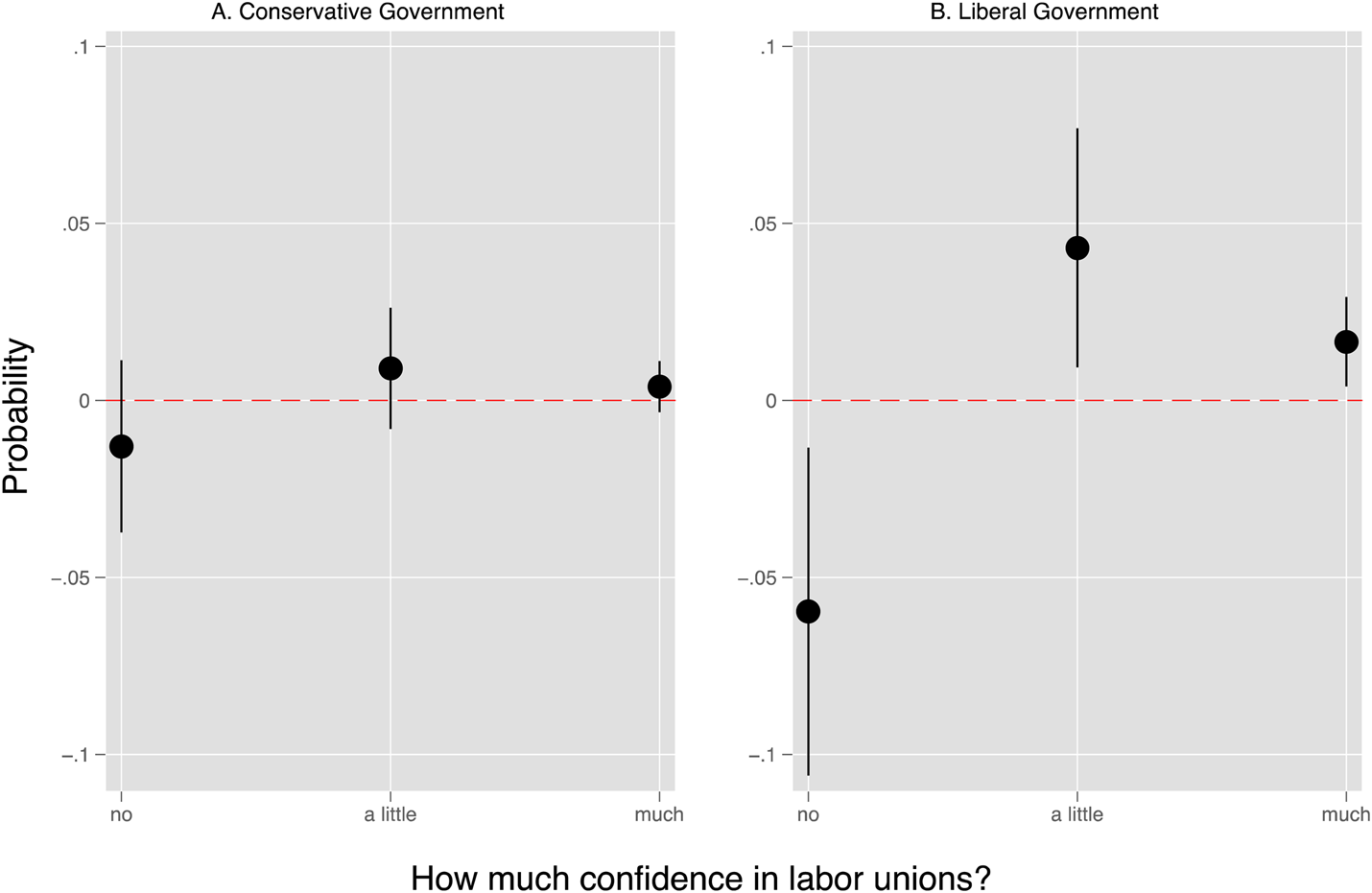
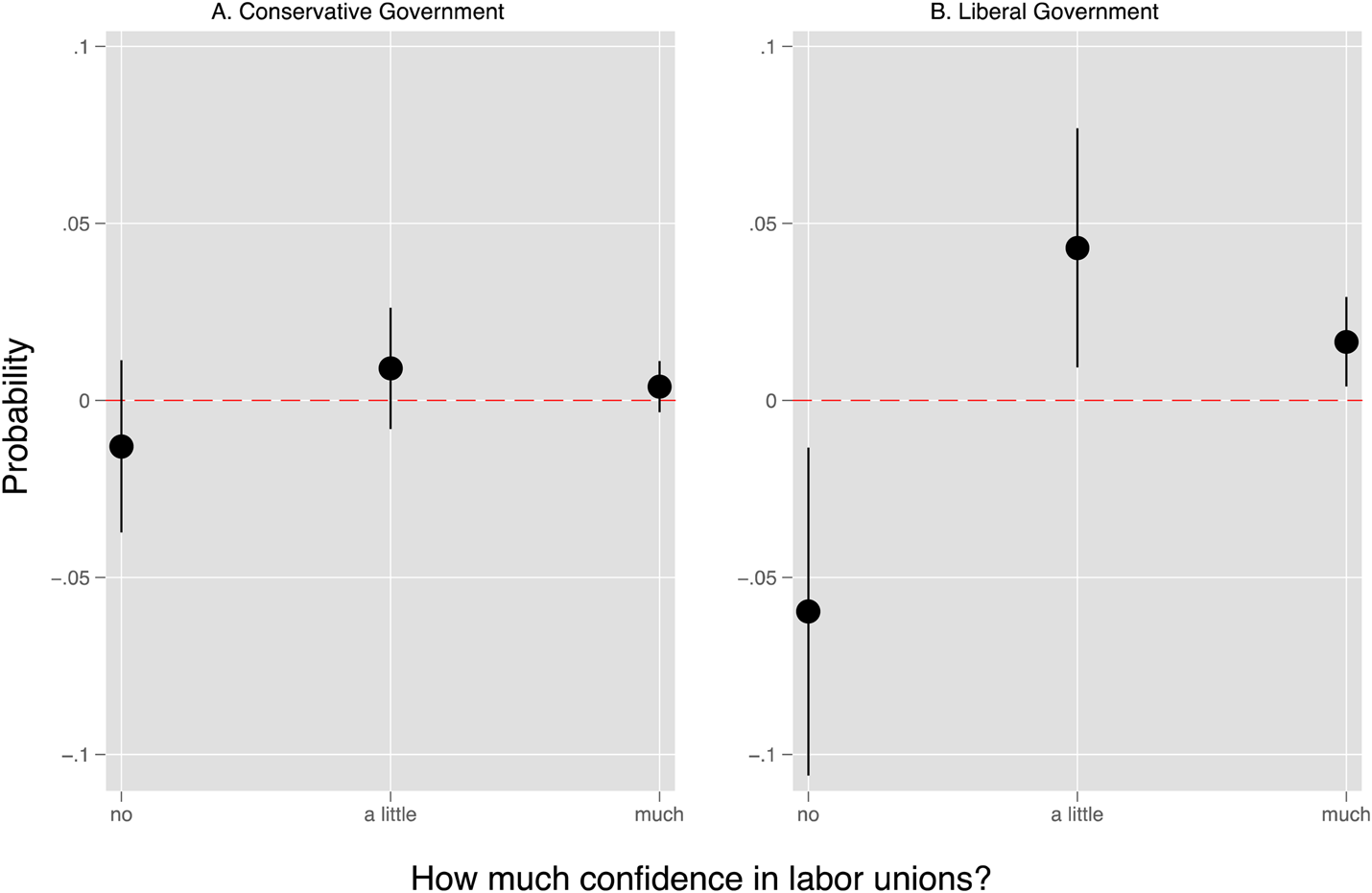
When the same model specification is applied, using the KGSS data produced results highly consistent with the benchmark estimates (see Appendix Table A4). The result is reported in Figure 5. As implied in the figure, the dependent variable, Confidence in Labor Unions, in the KGSS data is three-level: “no”; “a little”; and “much.” The result is reasonably comparable to the benchmark result (Figure 3): in conservative governments (left panel), the effect of trust is simply insignificant while in liberal governments (right panel), trust significantly increases the probability of “a little” and “much” confidence in unions and reduces the possibility of “no” confidence.
Korean General Social Survey, Marginal Effect using Multilevel estimates
Since KGSS offers a near-annual series—though only up to 2012, one can also apply an alternative causal inference by implementing a difference-in-difference (DiD) model a là Acemoglu and Angrist (Reference Acemoglu and Angrist2001) who use a data set structured similarly as KGSS. In this case, the beginning of a conservative government in 2008 is taken as a “shock” that should make difference between the “treated” and “control” groups, or low- and high-trust individuals, in terms of their perception of labor representation in politics. If the hypotheses are to be supported, the interaction term between trust and the year dummy should be positively significant after the shock (post-2008 period). The result reported in Appendix Table A3 and Figure A2 indicates that this is indeed the case. The effect of trust, with the exception of 2009, switches the direction as the Lee government embarks. This result adds confidence in the benchmark finding, therefore.
4.3. ALTERNATIVE MODEL: MATCHING
One oft-cited hurdle for causal inferences using observational data is that the assignment of treatment is not necessarily random (Cattaneo, Idrobo, and Titiunik Reference Cattaneo, Idrobo and TitiunikForthcoming). Studies on matching methods extensively document the possible ways in which this concern can be addressed, most of which boil down to the balance of covariates between the treated and the control groups in order to foster their comparability. I use “coarsened exact matching” (CEM) method (Blackwell et al. Reference Blackwell, Iacus, King and Porro2009; Iacus, King and Porro Reference Iacus, King and Porro2012) to generate balance-achieving weights for the high- and low-trust individuals. As opposed to other alternatives such as propensity-score matching, CEM does not risk deviating too much from the original sample data (i.e., “congruence principle”), enabling a more robust causal inference (King and Nielsen Reference King and Nielsen2019).
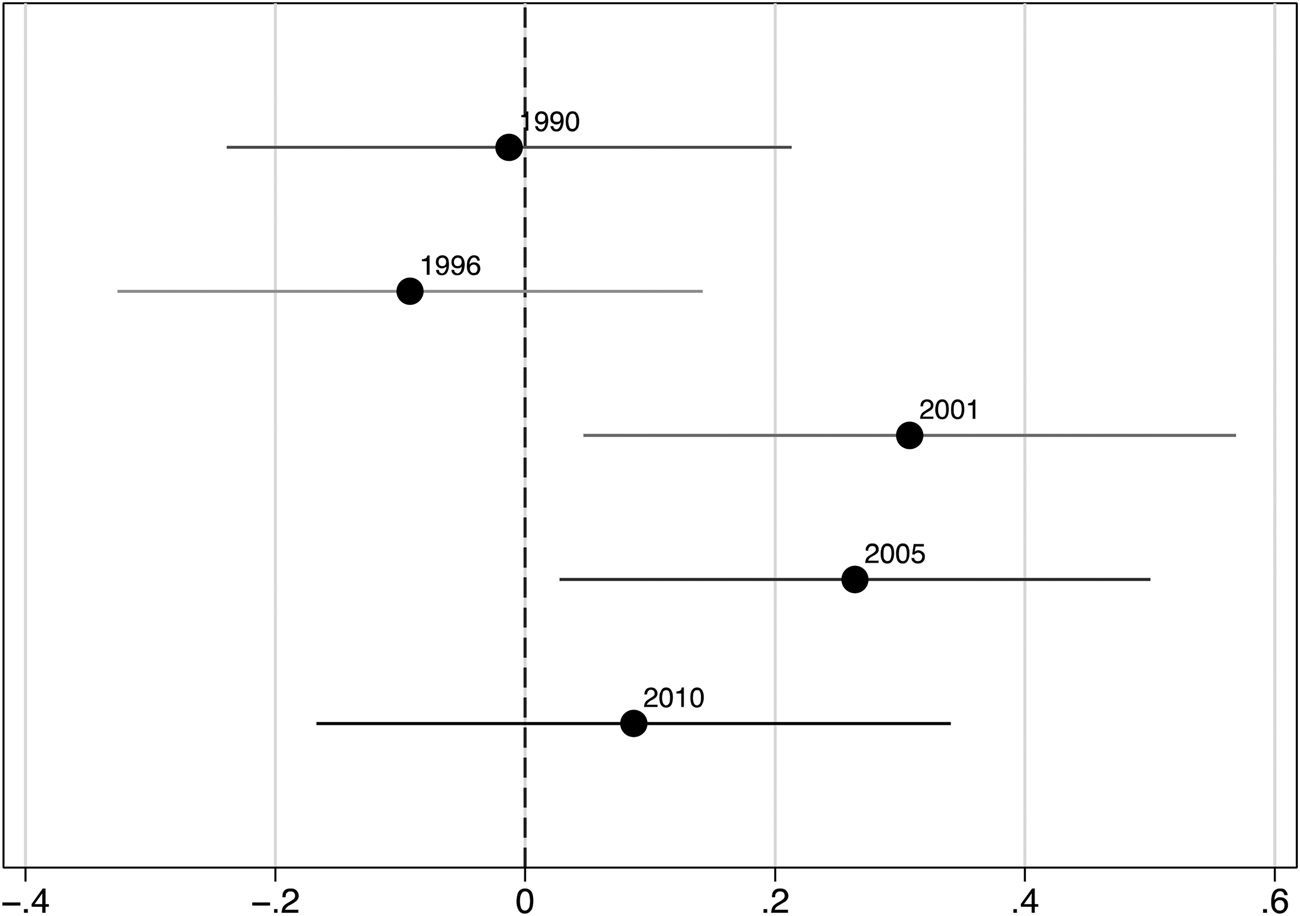
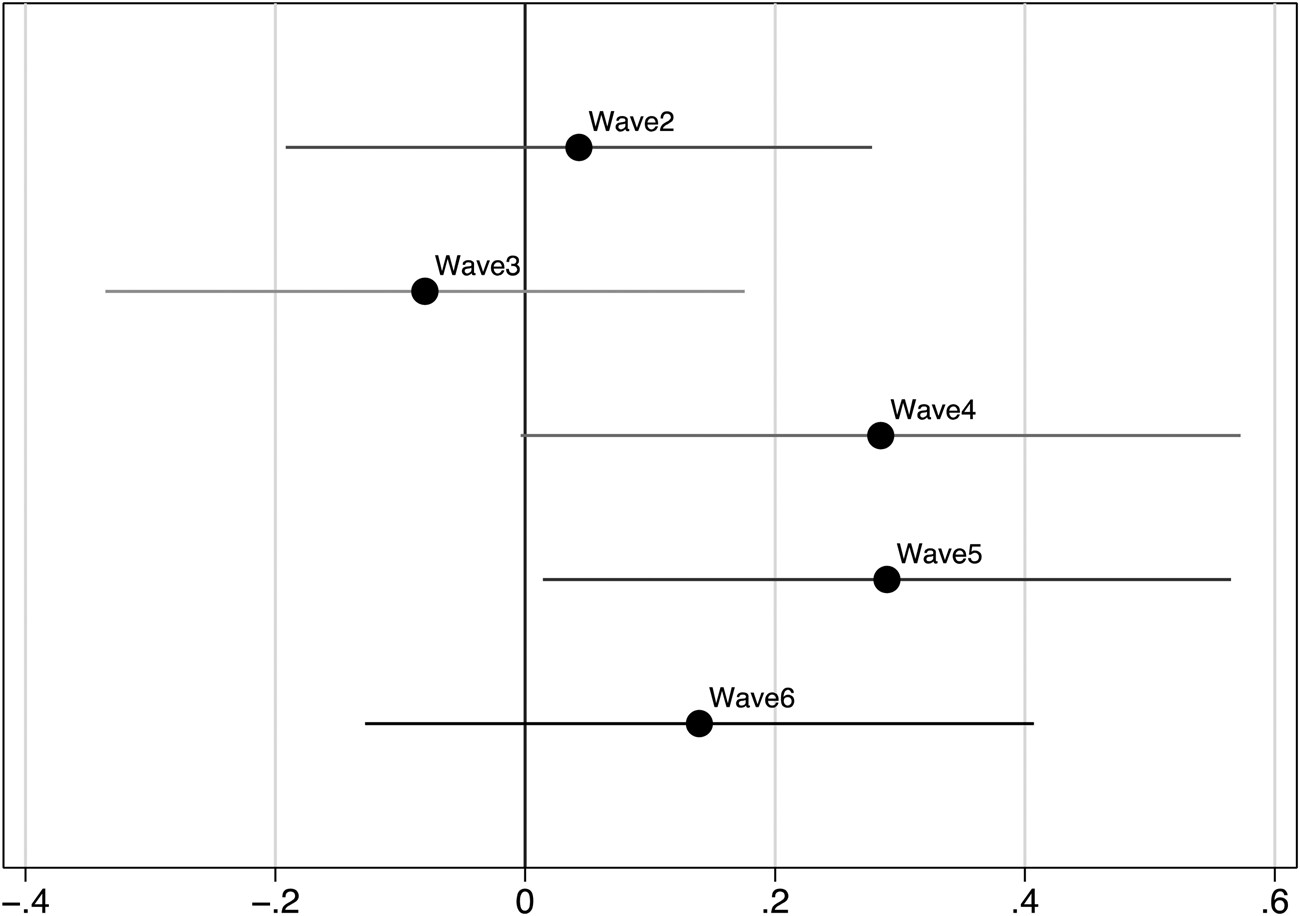
Figure 6 reports the result of the coefficients of Interpersonal Trust on Confidence in Unions in wave-level regressions with the weights generated by CEM. The covariates used for CEM are Income, Economic Satisfaction, and Education, all of which appear to be highly correlated with the trust variable. The result is nearly identical to that without matching (Figure 4), suggesting that the benchmark model does not suffer from biases caused by non-random treatment assignments in relation with the covariates.
Robustness Check: Matching
4.4. ALTERNATIVE SPECIFICATION: THE EFFECT OF INDIVIDUAL-LEVEL IDEOLOGY
The benchmark specification demonstrates that the significant marginal effect of trust conditional on government partisanship is robust to the inclusion of individual-level ideology as a covariate. However, given the palpable ideological orientation of most unions, one might not rule out other ways in which ideology affects confidence in unions. For example, ideology might have a similar conditioning effect as government partisanship. Ideology can also further condition the relationship between trust and government partisanship. That is, a right-leaning high-trust individual might have a lower level of confidence in unions than a left-leaning high-trust individual does when liberal governments are in power.
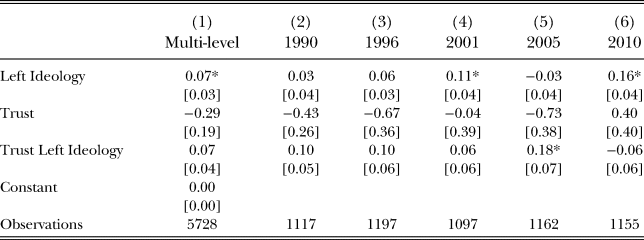
To see if such is the case, I use an alternative multilevel-model where the government partisanship variable is replaced with individuals’ ideological leaning (the higher the value, the more left-leaning the person is). If ideology affects confidence in unions in a similar way that government partisanship does, the marginal effect of trust should be significant conditional on ideology. In addition, I include an interaction term for ideology and trust for wave-level models to see if the conditioning effect of government partisanship can be further conditioned by ideology.
Table 3 reports the result of these alternative specifications. The result of the multi-level model (first column) implies that the conditioning effect of ideology is very weak, if any (p = 0.085). Likewise, the result of the year-by-year analysis presented in the rest of the table indicates that the ideology's conditioning effect on the benchmark result is weak as such an effect is significant in only one liberal presidency (Column 5). When marginal effect of trust is computed, even this significance is found to be driven solely by a handful of observations at extreme values of the ideology variable. Ideology should still be an important predictor of individuals’ confidence in labor unions as evidenced by the significant coefficient of the variable in almost all the models presented in this article, but not in a way that erodes the robustness of the benchmark result.
Interaction with Ideology
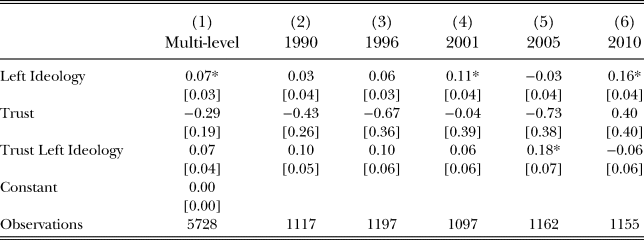
*p < 0.05. The result for cuts and covariates is not reported to save space. (It is available on request.) Multilevel ordered logit estimates with robust standard errors in brackets in the first column and ordered logit estimates with robust standard errors in brackets in the rest of the table.
4.5. ALTERNATIVE ARGUMENT: THE EFFECT OF THE 1997 FINANCIAL CRISIS
The observational nature of the data does not preclude the possibilities of a misleading causal identification. Granted, a reverse causality—decrease in confidence in labor unions leads to loss of interpersonal trust—does not seem plausible in the context of this study. There is, however, one avenue in which much of the result of the empirical analysis can be explained irrespective of the argument proposed.
One such scenario lies in the seismic effect of |the 1997 Asian Financial Crisis on Korean society. The crisis is believed to have upended the existing social order, thereby taking tangible and intangible tolls on the society. The tangible economic costs are found to have led to significantly negative public attitudes toward the existing social orders and institutions (Son Reference Son2016).
This context poses a potential challenge to the benchmark model, because the two liberal governments temporally overlap with the post-crisis period. That is, one could explain the benchmark result by highlighting that the crisis eroded interpersonal trust which in turn reduced confidence in unions. The ten years of the two liberal governments, the story goes, simply happened to be in this devastating period. Since individuals’ economic well-being (Catterberg and Moreno Reference Catterberg and Moreno2006; Rahn and Transue Reference Rahn and Transue1998) significantly influence their interpersonal trust, one could plausibly posit that in the period following the crisis, these factors contributed to the diminishing public confidence in labor through interpersonal trust. The trust's true independent effect on public confidence in labor, in turn, could be much smaller than reported in the benchmark result.
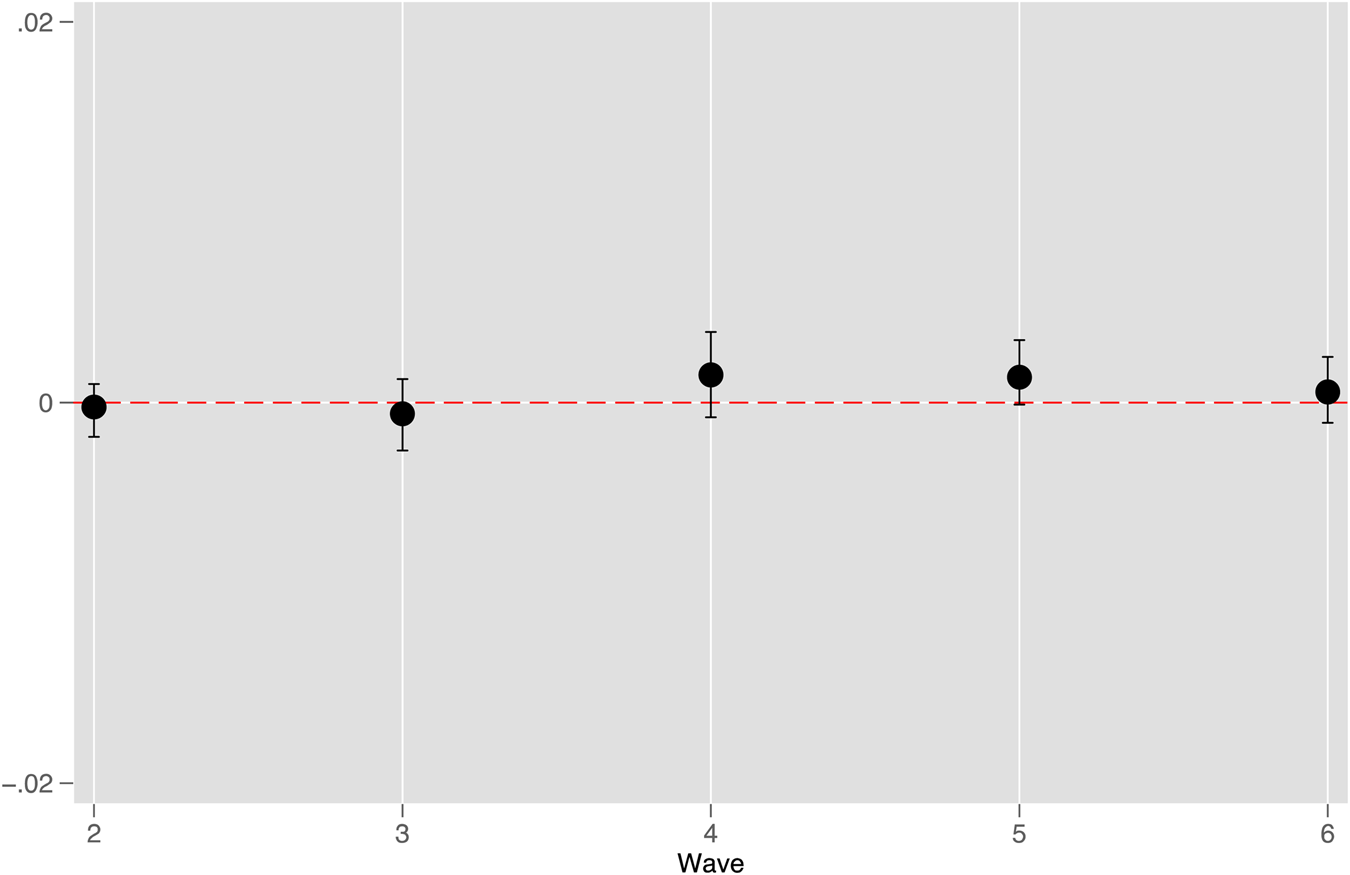
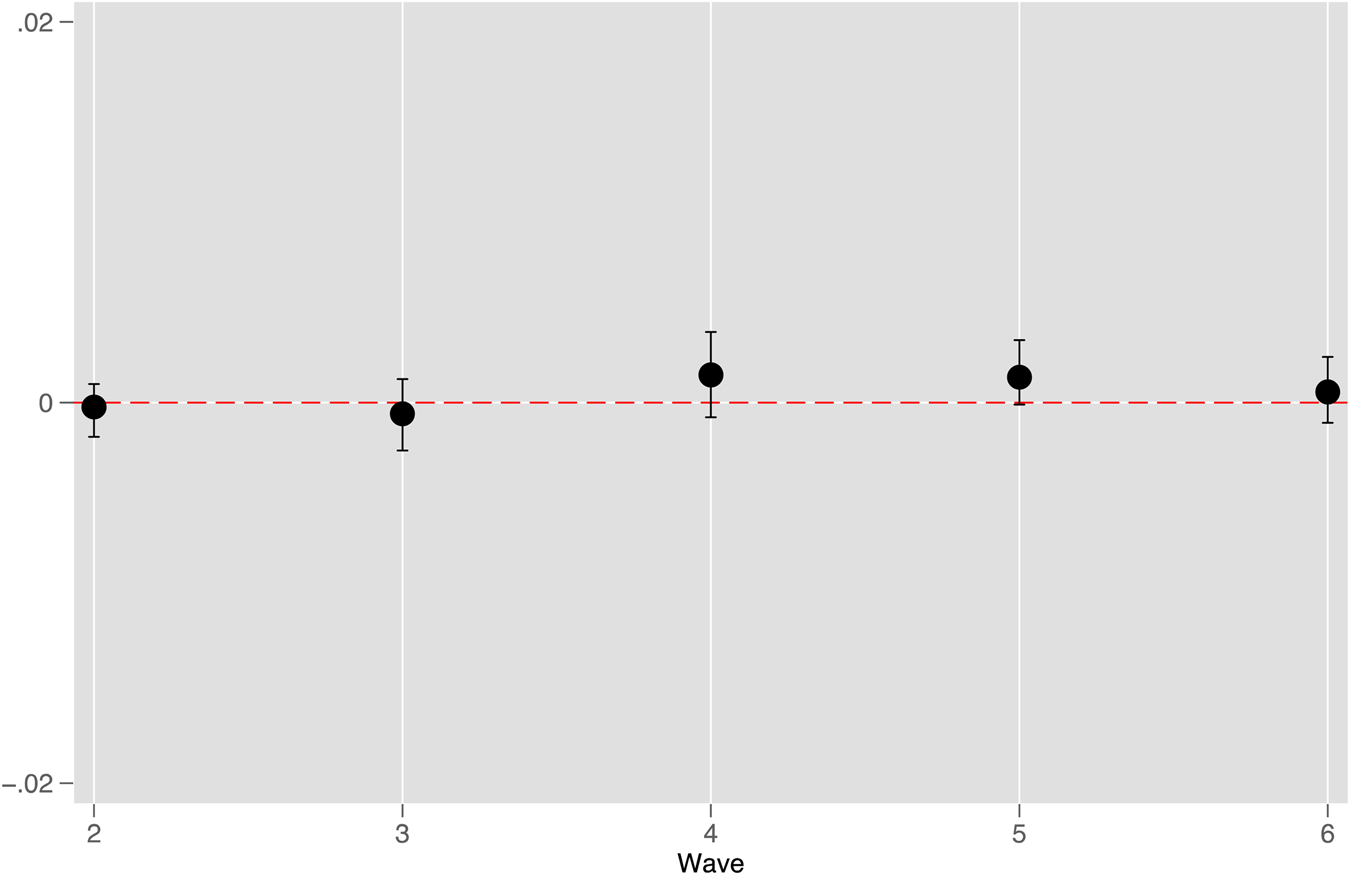
One way to investigate whether this concern is warranted is using “causal mediation analysis” following (Imai et al. Reference Imai, Keele, Tingley and Yamamoto2011). Drawing on the extant literature on welfare policies (e.g., Blekesaune Reference Blekesaune2007), I assume that the “household financial satisfaction” variable (Economic Satisfaction), which is used as a control variable in the benchmark, is an effective proxy variable for individuals’ economic insecurity/well-being. As implied in Appendix Figure A5, the benchmark result reports only the direct effect of trust (β) along with the direct effect of economic satisfaction (λ). If the benchmark model is robust to the alternative empirical scenario that the effect of the 1997 crisis operates through interpersonal trust, its average causal mediation effect (ACME, α × β, conceptually), should be insignificant, or at least small, in the two surveys conducted during the two liberal governments which overlapped with the post-crisis period.
Figure 7 presents a summary of the ACMEs for all five waves, confirming the insignificance of the indirect effect of Economic Satisfaction and, thus, the robustness of the benchmark result. In all cases, the indirect effect of Economic Satisfaction on confidence in unions through interpersonal trust is weak, if not at all absent, as they do not obtain statistical significance. Not only are they insignificant, the size of the effect mediated is also considerably small with their coefficients generally less than about ten percent of that of Interpersonal Trust. This does not preclude the possibility that the crisis had an impact on public confidence on its own at all. In fact, the direct effect of Economic Satisfaction is highly significant in 2001, implying that the post-crisis hardship might have undermined public confidence in unions. The indirect analysis implemented here simply indicates that such an effect did not operate through the primary independent variable, Interpersonal Trust. The relationship between trust and confidence in unions, in other words, is a causal process independent of the 1997 crisis.
Indirect Effect of the 1997 Crisis
5. Conclusion
What explains ordinary people's confidence in labor unions? Despite extensive research on labor unions, the public perceptions on organized labor have received little attention beyond the North American context. By utilizing public opinion data from South Korea, the current research fills this lacuna. It proposes that, ceteris paribus, public confidence in unions is significantly affected by their interpersonal trust while liberal governments are in power. Unlike high-trust individuals, those lacking interpersonal trust tend to cast skeptical eyes on unions given that they perceive them as agents seeking their exclusive interests at the expense of the rest of the society. This difference is very weak when conservative governments are in power, a political landscape that signifies to the public an under-representation of labor interests regardless of actual labor policies. In such circumstances, unions are viewed as the sole, and thus necessary, voice for the working class. The low-trust individuals’ skeptical views on unions are abated, consequently.
The article contributes to our understanding of contentious labor politics in several ways. First, the article is one of the rare attempts to investigate ordinary citizens’ attitudes toward labor unions. While recurrent economic turmoil and its dire consequences on ordinary people in the past decades rendered studies of organized labor particularly important, the theoretical purview of such studies has been confined mostly to the corporatist framework (e.g., Avdagic Reference Avdagic2010), where public opinion hardly plays a role. Given that government policies are affected heavily by public opinion, this line of research overlooked a very consequential microfoundation of labor-government interactions. The article fills this gap by identifying an attitudinal determinant for public confidence in labor unions, interpersonal trust. In order to do so, it proposes a novel theoretical framework which introduces a strong conditioning effect of government partisanship.
Second, the article extends the scope of the existing “social capital” literature. While it has long helped develop our understanding of the effect of interpersonal trust on the declining public confidence in democratic institutions (see Newton and Norris Reference Newton and Norris1999 for an extensive review), the literature rarely included non-governmental and social institutions in the analysis. The article offers a theoretical framework where public confidence in a prominent social institution, labor unions, can be affected by interpersonal trust. The empirical regularity found between trust and confidence in unions also indicates the possible application of this framework on other types of social institutions such as philanthropic organizations or social movement groups.
I acknowledge, however, the limitation of the generalizability of this article. The central argument of the article builds on the epistemological assumption that the general public considers unions a minority social group that is an agent of redistribution. The conclusion drawn here, therefore, might not be aptly applicable to the societies where unions are well institutionalized into mainstream politics.
CONFLICTS OF INTEREST
The author declares none.
SUPPLEMENTARY MATERIAL
The supplementary material for this article can be found at https://doi.org/10.1017/jea.2020.5.