Introduction
Palms (family Arecaceae) are one of the most important plants in tropical rainforests (Baker and Dransfield Reference Baker and Dransfield2016) but are threatened with extinction (Bellot et al. Reference Bellot, Lu, Baker, Dransfield, Forest, Kissling, Leitch, Nic Lughadha, Ondo, Pironon, Walker, Cámara-Leret and Bachman2022). Ecologically, palms are regarded as keystone species that provide food sources and shelter for animals (Macedo-Santana et al. Reference Macedo-Santana, Flores-Tolentino and Hernández-Guzmán2021, Onstein et al. Reference Onstein, Baker, Couvreur, Faurby, Svenning and Kissling2017), as resources for pollinator and frugivore communities with benefits of securing the dispersal of canopy species that store most of the carbon in the forests (Bello et al. Reference Bello, Galetti, Pizo, Magnago, Rocha, Lima, Peres, Ovaskainen and Jordano2015, Eiserhardt et al. Reference Eiserhardt, Svenning, Kissling and Balslev2011), and act as good indicators for forest physical structures (Rodrigues et al. Reference Rodrigues, Cintra, Castilho, de Sousa Pereira and Pimentel2014). Palms are highly valued for their socio-economic importance, and their uses range from food sources, construction, fabric, fuel, medicine and as ornamentals (Bellot et al. Reference Bellot, Odufuwa, Dransfield, Eiserhardt, Perez-Escobar and Petoe2020, Dransfield et al. Reference Dransfield, Uhl, Asmussen, Baker, Harley and Lewis2008). Despite their importance both ecologically and economically and their increasing risk of extinction, palms remain understudied in tropical rainforests in comparison to tree communities (Ley-López and Avalos Reference Ley-López and Avalos2017).
Of the 183 genera of palms, the palm genus Pinanga is one of the most diverse, comprising over 145 species occurring from the Himalayas to New Guinea (Govaerts et al. Reference Govaerts, Nic Lughadha, Black, Turner and Paton2021, POWO 2024). Southeast Asia houses the highest diversity of Pinanga globally, and Borneo alone records 41 species, of which 38 are endemic to the island (Abdullah et al. Reference Abdullah, Jaafar, Ahmad and Sukri2024, Dransfield et al. Reference Dransfield, Uhl, Asmussen, Baker, Harley and Lewis2008, Kuhnhäuser et al. Reference Kuhnhäuser, Randi, Petoe, Chai, Bellot and Baker2023, Odufuwa Reference Odufuwa2019). Pinanga is an ideal plant group to investigate palm diversity in the forest understorey as co-existing species, and species unique to different forest types can provide key insights into their habitat specialization and ecology. Although Pinanga distributions, like other palms, are influenced by environmental variation, ecological studies on Pinanga in Borneo and in Southeast Asia remain limited. A range of environmental variables, including litter depth (LD) and thickness, canopy openness (CO) and crown cover, topographic variables, light intensity, humidity and air temperature, have been attributed as factors influencing Pinanga distributions (reviewed in Abdullah et al. Reference Abdullah, Jaafar, Ahmad and Sukri2024).
Although Brunei Darussalam, located in Northwest Borneo, is home to over half of Borneo’s known Pinanga species (23 species), little is known of the ecology of Pinanga in the country’s different forest types. Pinanga species occupy a range of habitats covering gentle to steep slopes, sandy and clay soils, lower to higher elevations and are often found near water sources (Coode et al. Reference Coode, Kirkup, Dransfield, Forman and Said1996), indicating that different Pinanga species may have specific preferences for soil and environmental conditions. However, only two published studies to date have been conducted, focusing on population genetics and dynamics of selected Pinanga species at Kuala Belalong, Brunei (Shapcott Reference Shapcott1999, Shapcott et al. Reference Shapcott, Slik, Rosli and Sukri2022). Initial findings from two MDF sites in Brunei, Kuala Belalong and Bukit Teraja, have shown that Pinanga species respond to microhabitat variation resulting from topographic differences (Mooney Reference Mooney2020) and gradients in soil nutrients, organic matter (OM), pH and gravimetric water content (GWC) (Haji Ramlan Reference Haji Ramlan2020).
Our study focused on Pinanga species assemblages in two contrasting lowland forest types in Brunei Darussalam: Heath forests (HF) and mixed Dipterocarp forests (MDF). Bornean heath (Kerangas) forests exist on dry, highly acidic, nutrient-poor sandy soils (Ikbal et al. Reference Ikbal, Din, Tuah, Jaafar, Ahmad and Sukri2023) while MDF typically occur on nutrient-rich, water-retaining clay soils (Jaafar et al. Reference Jaafar, Sukri and Procheş2016). These contrasting forest types are known to support different tree communities (Davies and Becker Reference Davies and Becker1996) due to gradients in soil and environmental properties, but no study has been attempted to ascertain the influence of these factors on Pinanga diversity and species assemblages. We, therefore, hypothesized that differences in soil physicochemical properties (soil pH, GWC and OM content, total soil nitrogen [N] and phosphorus [P] content) and environmental variables (LD, canopy openness [CO], relative humidity and elevation) between the resource-rich MDF and resource-poor HF will translate to differences in Pinanga abundance, species richness and species assemblages between the two forest types.
Materials and methods
Study area
The study was conducted in six sites representing two contrasting forest types in Brunei Darussalam. HF sites comprised Badas (4° 34″ N, 114° 25″ E), Bukit Sawat (4° 57″ N, 114° 51″ E) and Sungai Kargu (4° 59″ N, 114° 51″ E) and were all located in the Belait District, while MDF sites included Andulau (4° 38″ N, 114° 30″ E) and Bukit Teraja (4° 34″ N, 114° 44″ E) in the Belait District, and Kuala Belalong Field Studies Centre (henceforth referred to as Belalong; 4° 55″ N, 115° 15″ E) in the Temburong District (Figure 1). Although all our study sites are located in protected forest reserves, some sites have experienced anthropogenic disturbance. Records from the Forestry Department (pers comm.) indicate that selective logging was conducted in Andulau MDF in the 1950s to early 90s, and Bukit Sawat HF in the 1960s, although our survey sites were located within unlogged forests. Belalong MDF, Bukit Teraja MDF and Badas HF are located within pristine, unlogged forests while Sungai Kargu HF is in a small area of intact HF within the Andulau Forest Reserve (Jaafar et al. Reference Jaafar, Metali, Nafiah, Supri, Ahmad, Burslem and Sukri2022b). Study sites were selected based on previous work on Pinanga surveys in Brunei Darussalam (Abdullah Reference Abdullah2021, Haji Ramlan Reference Haji Ramlan2020, Shapcott Reference Shapcott1999, Shapcott et al. Reference Shapcott, Slik, Rosli and Sukri2022) as these studies have shown preliminary findings of variation in Pinanga communities. At each study site, Pinanga surveys were conducted along accessible and existing smaller forest trails that were previously used by the Brunei National Herbarium (BRUN) during their own herbarium collection trips (Azlan Pandai, pers comm.).
Six study sites located within two lowland forest types in Brunei Darussalam. Heath forest sites were located in Badas, Bukit Sawat and Sungai Kargu, and mixed Dipterocarp forest sites were located in Andulau, Bukit Teraja and Belalong. At each study location, Pinanga surveys were conducted within accessible and existing forest trails, with a total sampling area of 3 ha per site.

Pinanga census and measurements of soil properties and environmental variables
Census of Pinanga species, collection of soil samples and measurements of environmental variables were conducted over a three-month period from May to July 2022. At each study site, a random starting point located at least 700 m away from the forest edge was identified on the forest trail. From this starting point, we then conducted Pinanga surveys for distances of 1.5 km along the trail and within an area of 10 m on both sides of the trail, moving in a random direction. For each site, this effectively resulted in a belt transect of 20 m by 1.5 km (equivalent to 3 ha area per site, totalling up to 9 ha sampling area for each forest type), which was subdivided into ten sub-plots (each of size 20 m × 150 m). All Pinanga individuals greater than 10 cm in height that occurred within the sub-plots were tagged and mapped for their GPS coordinates (Garmin, GSPMAP 64S, Kansas, USA); the height chosen was based on our observation where it may be past the most vulnerable growing stages, which have greater survivability. Hence, tagging these individuals might allow them to track those palms for continuing research in the future. Field identification of the censused Pinanga was conducted with botanist assistance from the Brunei National Herbarium (BRUN). Voucher specimens were also collected for further taxonomic identification via cross-matching with BRUN records. All Pinanga individuals surveyed were identified to species level.
At each study site, we collected soil samples and measured selected environmental parameters from all sub-plots. Within each sub-plot, five random sampling points, each of which was located around a Pinanga cluster, were selected. At each sampling point, four environmental parameters were measured: LD, CO, relative humidity and elevation. Each measurement was repeated five times. Relative humidity was measured using a whirling hygrometer (Elcometer 116A Whirling Hygrometer, Elcometer Ltd., UK), while the percentage of CO was calculated using a convex spherical densiometer (Convex Model A, Forestry Suppliers Spherical Crown Densiometer, USA). LD (in cm) was determined from the top of the soil surface up to the top surface of the leaf litter using a ruler (Dent et al. Reference Dent, Bagchi, Robinson, Majalap-Lee and Burslem2006, Nafiah et al. Reference Nafiah, Sukri, Ya’akub, Jaafar and Metali2022).
At the same five sampling points for environmental parameters in each sub-plot, soil samples were collected using a 10 cm diameter soil auger at a depth of 0 – 15 cm (Jaafar et al. Reference Jaafar, Sukri and Procheş2016), and then bulked. Soil samples were further analysed to determine selected soil physicochemical properties: soil pH, gravimetric and OM content, total soil N and P content). Fresh soil samples were measured for soil pH and GWC in the laboratory on the day of collection, following Allen et al. (Reference Allen, Grimshaw, Parkinson and Quarmby1989). For soil pH measurements, 10 g of fresh soil was dissolved in distilled water and shaken at 200 rpm for five minutes and measured for pH using a bench top pH meter (Orion Star™ A211l, ThermoFisher, USA). For soil GWC, 10 g of fresh soil sample was oven-dried at 105°C for 24 hours prior to the measurement of soil GWC. The remaining fresh soil samples were left to air-dry at room temperature (approximately 25°C) for at least three weeks. Air-dried soil samples were sieved through a 2 mm sieve to remove leaf litter, roots and stones and then ground into a fine powder using a ball mill (Mixer Mill MM400, Retch, Germany). Finely ground samples were then used for measuring soil OM and analysis of total N and P concentrations. Soil OM content was determined by combusting 10 g of soil samples in a muffle furnace at 550°C for two hours. Soil digestions utilized the Kjeldahl method (Allen et al. Reference Allen, Grimshaw, Parkinson and Quarmby1989) by digesting approximately 0.1 g of air-dried, finely ground and sieved soil samples in concentrated sulphuric acid (H2SO4) with one Kjeltab CU 1.5 catalyst tablet, using a block digester (Kjeldatherm, C. Gerhardt, Germany). Total N and P concentrations were determined using Flow Injector Analyser (FIAstar 5000, Hoganas, Sweden), following the procedures in FIAstar 5000’s user manual.
Statistical analysis
All statistical analyses were conducted using R version 4.3.3 (R Core Team 2025). Differences in the five selected soil properties (total N and P concentrations, pH, GWC and OM) and four selected environmental variables (LD, humidity, CO and elevation) between the two forest types were tested separately using multivariate analysis of variance (MANOVA). Assumptions of normality and homogeneity of variances were checked. Soil pH was log10-transformed to address non-normality while percentage data (soil GWC and OM content) were arcsine-transformed prior to MANOVA.
Abundance (calculated as a total number of Pinanga individuals) and species richness (calculated as the total number of Pinanga species) were determined for each sub-plot per site using the R vegan package version 2.5-7 (Oksanen et al. Reference Oksanen, Blanchet, Friendly, Kindt, Legendre, McGlinn, Minchin, O’Hara, Simpson, Solymos, Henry, Stevens, Szoecs and Wagner2020). The effects of forest types (HF vs. MDF) and sites (Badas, Bukit Sawat, Sungai Kargu, Andulau, Bukit Teraja and Belalong) on Pinanga abundance and species richness were tested separately using linear mixed effect (LME) models built with the lme4 package (Bates et al. Reference Bates, Mächler, Ben and Walker2015) in R 4.3.3. Pinanga abundance and species richness were modelled as response variables, forest type and sites as fixed effects with sub-plots included as random effects to control for non-independence between sub-plots at each site (Harrison et al. Reference Harrison, Donaldson, Correa-Cano, Evans, Fisher, Goodwin, Robinson, Hodgson and Inger2018). The study used LME model selection protocols by Pinheiro and Bates (Reference Pinheiro and Bates2004) and Zuur et al. (Reference Zuur, Ieno, Walker, Savaliev and Smith2009). Alternative models with different variance-covariates and correlation structures were fitted via restricted maximum likelihood (REML) and compared using log-likelihood tests and the Aikake Information Criterion. Models were then fitted using maximum likelihood (ML) and non-significant terms sequentially deleted from the model to obtain the optimum fixed effects structure, until all remaining in the model were significant. The final LME model was then re-fit using REML. For each LME model, pair-wise comparisons between sites were performed by obtaining the least-square means using the R library lsmeans version 2.3 package (Lenth Reference Lenth2018).
Non-metric multidimensional scaling (NMDS) ordination was conducted using abundance data to explore variations in Pinanga species assemblages within the two forest types in relation to environmental and soil properties, using the R vegan package version 2.5-7 (Oksanen et al. Reference Oksanen, Blanchet, Friendly, Kindt, Legendre, McGlinn, Minchin, O’Hara, Simpson, Solymos, Henry, Stevens, Szoecs and Wagner2020). Following Draper et al. (Reference Draper, Asner, Honorio Coronado, Baker, García-Villacorta, Pitman, Fine, Phillips, Gómez, Amasifuén Guerra, Arévalo, Martínez, Brienen, Monteagudo-Mendoza, Torres Montenegro, Sandoval, Roucoux, Ramírez Arévalo, Acuy, Aguila Pasquel, Casapia, Llampazo, Medina, Huaymacari and Baraloto2019), to assess the statistical significance of floristic similarity between HF and MDF, we conducted PERMANOVA (Anderson Reference Anderson2001) using the adonis function for presence-absence data in the R vegan package version 2.5-7 followed by the function of pairwise.adonis to conduct pairwise comparisons after PERMANOVA (Martinez Arbizu Reference Martinez Arbizu2020). To further examine between-site differences in Pinanga species assemblages, we performed cluster analysis based on Bray–Curtis dissimilarity using the vegan package, this measured the difference between HF and MDF based on species composition.
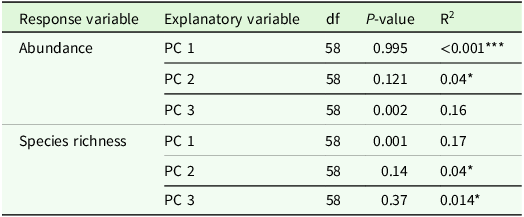
To examine the relationship between soil and environment variables and Pinanga abundance and species richness, we conducted principal component analysis (PCA) to extract soil and environment variables that explained the most variation between the two forest types. We then used the principal component scores in separate linear regressions with Pinanga abundance and species richness as the response variables, and the principal component scores as the explanatory variables.
Results
Differences in soil properties and environmental variables between forest types
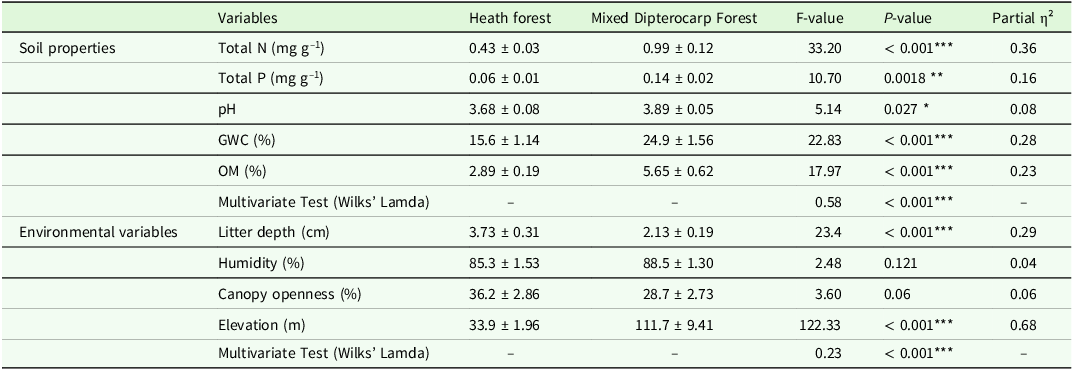
Our MANOVA results showed significant differences between forest types for several soil and environment variables (F = 0.58, P < 0.001***, Table 1; F = 0.23, P < 0.001***, Table 2). All soil properties (total N, total P, pH, soil GWC and soil OM) were significantly higher in MDF than in HF (Table 1). For environmental variables, LD was significantly higher in HF than in MDF (η2 = 0.29, P < 0.001; Table 2) while elevation was significantly higher in MDF than MF (η² = 0.68, P < 0.001; Table 2). No other environmental variables recorded significant differences between the two forest types.
Differences in mean values of soil properties (total N and P concentrations, pH, gravimetric water content [GWC] and organic matter [OM]) and environmental variables (litter depth, humidity, canopy openness and elevation) in heath forest and mixed Dipterocarp forest. Values are means ± SE, calculated over the total number of soil samples collected per forest type (n = 30). *, ** and *** indicate a significant difference at P < 0.05, P < 0.01 and P < 0.001, respectively, as analysed using multivariate analysis of variance

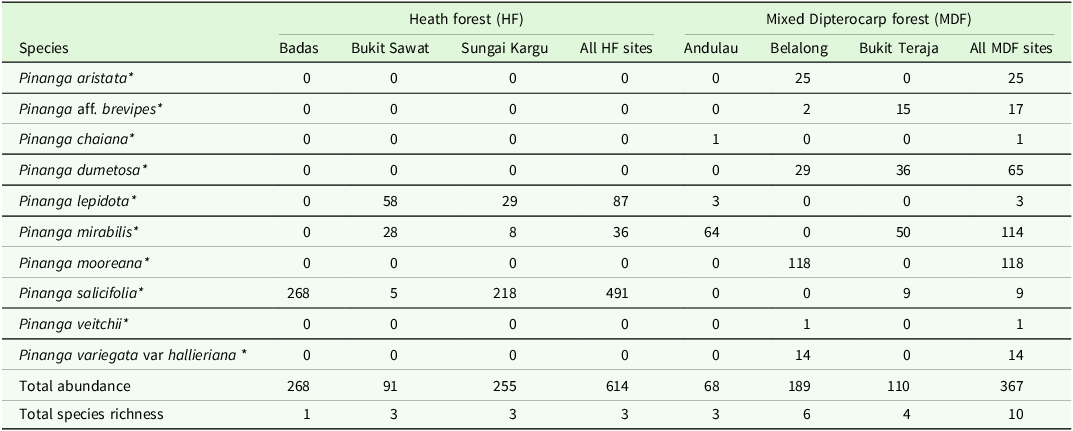
Full checklist of censused Pinanga species across heath forest and mixed Dipterocarp forest: heath forest (n = 3 locations) and mixed Dipterocarp forest (n = 3 locations). Values are total palm abundance for each species recorded per location and forest type. Asterisk (*) label indicates the species is a Bornean endemic

PCA of all soil and environmental variables across HF and MDF sub-plots at all sites showed that the first three axes accounted for 78% of the variation in the dataset (Supplementary Table 1). The first principal component (PC1) showed the highest positive loadings of soil total N, total P and OM content, and elevation, while PC2 showed the highest positive loadings of soil pH and humidity. The final PC axis, PC3 showed the highest positive loadings of CO, LD and soil GWC (Table 3).
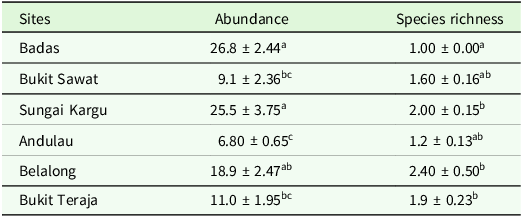
Variation in Pinanga abundance (total number of individuals) and species richness (total number of species) at six study sites in heath (Badas, Bukit Sawat and Sungai Kargu) and mixed Dipterocarp (Andulau, Belalong, Bukit Teraja) forests of Brunei Darussalam. Values are means ± standard error, SE. Significant differences between sites were detected after a linear mixed effects analysis followed by a lsmeans pairwise comparisons test at α = 0.05 level. The same letters within a column represent no significant differences between sites, while different letters represent significant difference at α = 0.05

Differences in abundance and species richness of Pinanga palms between forest types and forest sites
Overall, a total of 981 Pinanga individuals were recorded in the six study sites (n = 614 in HF and n = 367 in MDF, Table 2), comprising 10 Pinanga species (Supplementary Figure 1). Amongst these, Pinanga chaiana and Pinanga veitchii were each recorded as singletons (n = 1 individual) at Andulau MDF site and Belalong MDF site, respectively. High abundance of P. salicifolia in Badas (n = 268 individuals) and Sungai Kargu (n = 218 individuals) accounted for the higher overall Pinanga abundance in HF sites than in MDF sites (Table 2). For MDF sites, Belalong recorded the highest Pinanga abundance, due to the high abundance of P. mooreana (n = 118).
We found that MDF sites were richer in species (n = 10 species) than HF sites (n = three species; Table 2). Species richness varied across sites within each forest type, with the highest species richness recorded for Belalong MDF site (n = six species) and the least species-rich site was Badas HF site, which recorded only one species (P. salicifolia). In total, three (P. lepidota, P. salicifolia and P. mirabilis) were recorded from HF sites, while all ten Pinanga species were recorded from MDF sites. Notably, seven species (P. mooreana, P. aristata, P. veitchii, P. aff brevipes, P. chaiana, P. variegata var hallieriana and P. dumetosa) were found exclusive to MDF, while only three species (Pinanga lepidota Rendle, Pinanga salicifolia Blume and Pinanga mirabilis Becc) were recorded in both forest types. No Pinanga species were found exclusive to HF sites.
The LME analyses revealed that Pinanga abundance was significantly different both between forest types and between sites, but species richness only differed significantly between sites (Supplementary Table 2). Pinanga abundance at Badas and Kargu was significantly higher than at Bukit Sawat, Andulau and Bukit Teraja and was similarly significantly higher at Belalong than Andulau (Table 3). In contrast, Pinanga species richness was significantly lower at Badas compared to Sungai Kargu, Belalong and Bukit Teraja but was significantly higher at Belalong than Badas (Table 3).
Variations in Pinanga assemblages between forest types
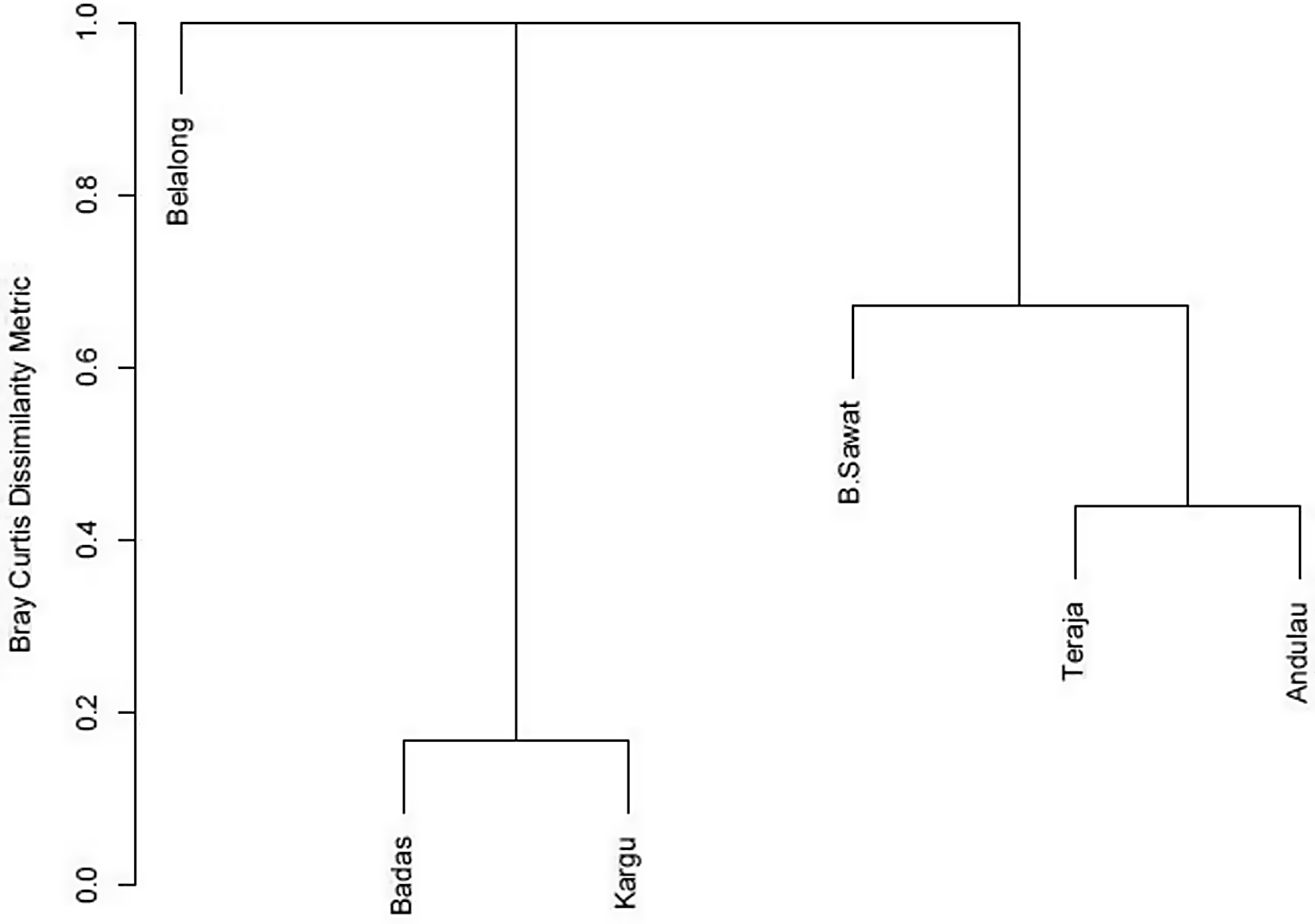
The non-metric multidimensional scaling (NMDS) ordination based on abundance data revealed a distinct clustering of Pinanga species between the HF and MDF sites (Figure 2). All HF sub-plots were clustered together and appeared to be strongly influenced by CO and LD. Similarly, MDF sub-plots were clustered together and appeared to be strongly influenced by soil total P and total N concentrations, soil GWC, soil OM and elevation (Figure 2, Supplementary Table 3). PERMANOVA results showed that Pinanga species assemblages differed significantly between forest types (F = 25.1, df = 1, R2 = 0.30, P < 0.001). Further examination of the cluster analysis results (Figure 3) indicated three distinct groupings, that is, two separate groups, comprising Belalong (Group 1 – MDF), Badas and Sungai Kargu (Group 2 – HF) and Bukit Sawat, Bukit Teraja and Andulau (Group 3 – HF and MDF).
Nonmetric multidimensional scaling (NMDS) ordination for Pinanga palms species at heath forest sites (Badas, Bukit Sawat and Sungai Kargu) and mixed Dipterocarp forest (sites (Andulau, Bukit Teraja and Belalong) using abundance data in relation to soil total N (Total.N) and total P (Total.P) concentrations, soil pH, soil gravimetric water content, soil organic matter, litter depth, relative humidity, percentage canopy openness and elevation . The NMDS ordination displays sub-plots per forest type (n = 10 sub-plots per site), with some sub-plots overlapping within the ordination space. The direction of the arrow indicates the most rapid change of that variable while the length of the arrow is proportional to the strength of the correlation. The ellipses represent 95% confidence levels.

Dendrogram showing the hierarchical clustering of six study sites (n = 10 sub-plots per site) based on Bray–Curtis dissimilarity of Pinanga species composition using complete linkage. Sites that are more similar cluster together at lower metrics.

Linear regressions between the three principal components (PC1, PC2 and PC3) against Pinanga abundance revealed a significant positive relationship only with PC3 (P = 0.002, R2 = 0.16; Table 4), while Pinanga species richness was significantly and positively associated only with PC1 (P = 0.001***, R2 = 0.17; Table 4).
Linear regressions between soil and environmental principal components (PC1, PC2 and PC3) with Pinanga abundance and species richness, conducted at α = 0.05 level. *, ** and *** indicate a significant difference at P < 0.05, P < 0.01 and P < 0.001, respectively. PC1 showed the highest positive loadings of soil total N, total P and organic matter content and elevation, PC2 showed the highest positive loadings of soil pH and humidity, and PC3 showed the highest positive loadings of canopy openness, litter depth and soil gravimetric water content

Discussion
Forest type variation in soil properties and environmental variables
All soil properties and environmental variables showed significant differences between HF and MDF, except humidity and CO. This is consistent with known habitat differences in these contrasting forest types (Dent et al. Reference Dent, Bagchi, Robinson, Majalap-Lee and Burslem2006, Jaafar et al. Reference Jaafar, Sukri and Procheş2016, Jaafar et al. Reference Jaafar, Metali and Sukri2022a, Moran et al. Reference Moran, Barker, Moran, Becker and Ross2000, Sellan et al. Reference Sellan, Thompson, Majalap and Brearley2019). Our HF sites show a typical characteristic of HF, where it has low soil pH, low nutrient and higher LD (Sellan et al. Reference Sellan, Thompson, Majalap, Robert and Brearley2020). Our results were aligned with Jaafar et al. (Reference Jaafar, Sukri and Procheş2016), except for OM content which was significantly lower in HF than in MDF in our study. We recorded significantly lower total N and P concentrations in HF than in MDF soils, consistent with HF soils being more nutrient-limited than MDF soils and consistent with most of study on HF soils that have similarly recorded low levels of soil total N (Jaafar et al. Reference Jaafar, Sukri and Procheş2016, Moran et al. Reference Moran, Barker, Moran, Becker and Ross2000). Low soil total N and P concentrations in HF than in MDF also have been recorded in Jaafar et al. (Reference Jaafar, Sukri and Procheş2016) and Jaafar and Sukri (Reference Jaafar and Sukri2023).
The HF soils in our study recorded slightly higher mean soil total N and P concentrations compared to HF soils in other studies in Brunei (Jaafar et al. Reference Jaafar, Sukri and Procheş2016, Moran et al. Reference Moran, Barker, Moran, Becker and Ross2000) while Metali et al. (Reference Metali, Abu Salim, Tennakoon and Burslem2015) and Nafiah et al. (Reference Nafiah, Sukri, Ya’akub, Jaafar and Metali2022) both recorded higher levels of N in their HF soils than we did. In contrast, our MDF soils recorded higher total N and P concentrations, soil GWC and OM content but lower soil pH compared to Jaafar et al. (Reference Jaafar, Sukri and Procheş2016), although soil total N and total P concentrations were consistent with those of Metali et al. (Reference Metali, Abu Salim, Tennakoon and Burslem2015) and Sukri et al. (Reference Sukri, Wahab, Salim and Burslem2012). HF often records lower LD than MDF due to slower litter decomposition rates (Sellan et al. Reference Sellan, Thompson, Majalap, Robert and Brearley2020).
Site-specific patterns in Pinanga abundance and species richness
Overall, our study detected significantly higher Pinanga abundance in HF than in MDF. This was primarily due to the dominance of P. salicifolia at the HF sites in Badas (n = 268 individuals) and Sungai Kargu (n = 218 individuals). Pinanga salicifolia is widespread in Borneo (Dransfield Reference Dransfield1991, Petoe et al. Reference Petoe, Kuhnhäuser, Geri and Baker2020), particularly in lowland forests on well-drained semi-podsolized or sandy soils and is regularly observed in HF (Dransfield Reference Dransfield1980). This species also can occur far from water sources and rarely seen in waterlogged soils (Dransfield Reference Dransfield1992, Dransfield Reference Dransfield1980), and their habitat preferences are consistent with our findings.
Despite the considerably higher total species richness recorded for MDF than HF in our study (n = 10 vs. n = 3 species), no significant difference between forest types was detected. This indicates that at the sub-plot level (20 × 150 m), the average number of Pinanga species recorded appeared similar in both forest types. The lower species richness in HF than in MDF is also consistent with overall patterns for lower tree diversity in HF than in MDF that are well-documented (Davies and Becker Reference Davies and Becker1996, Wong et al. Reference Wong, Ahmad, Low and Kalat2015) due to the nutrient-poor and water-limited conditions in HFs (Ikbal et al. Reference Ikbal, Din, Tuah, Jaafar, Ahmad and Sukri2023, Maimunah et al. Reference Maimunah, Capilla and Harrison2019, Sellan et al. Reference Sellan, Thompson, Majalap and Brearley2019). Total ground herb species richness was higher within 1-ha plots located in the Andulau MDF site than Bukit Sawat HF site (n = 37 vs. 29 species; Zaini and Sukri Reference Zaini and Sukri2014) but similarly showed no significant difference at the sub-plot level. Our findings are the first to demonstrate higher Pinanga species richness in MDF than in HF sites, and further studies on the palm communities are needed to provide a complete understanding of the forest plant community differences at these contrasting forest types.
In contrast to the patterns between forest types, variations in Pinanga abundance and species richness were observed across the six study sites in HF and MDF. Patterns in Pinanga abundance and species richness thus appeared to be strongly site-specific. Badas HF recorded the highest Pinanga abundance but the lowest diversity of our six study sites due to dominance by a single species, P. salicifolia. In contrast, Belalong recorded the highest Pinanga diversity of our study sites. These results potentially indicate that nutrient-poor HF such as Badas may only be able to support lower Pinanga diversity which are dominated by a single or a few species, whereas nutrient-rich MDF such as Belalong may have more resources to support a higher number of species albeit mostly with lower abundance.
Out of 10 species recorded in our study, only three Pinanga species were found in both forest types: P. lepidota (Bukit Sawat, Sungai Kargu and Andulau), P. mirabilis (Bukit Sawat, Sungai Kargu, Andulau and Bukit Teraja) and P. salicifolia (Badas, Bukit Sawat, Sungai Kargu and Bukit Teraja). A commonality between these sites is their sandy soils (Anderson and Marsden Reference Anderson and Marsden1984, Jaafar et al. Reference Jaafar, Sukri and Procheş2016, Sukri et al. Reference Sukri, Wahab, Salim and Burslem2012). This indicates that P. lepidota, P. mirabilis and P. salicifolia appear to be habitat-specific and may be better adapted to the drier, acidic and nutrient-poor sandy soils. In contrast, most Pinanga species observed in MDF habitats tend to be located near water sources such as rivers (Coode et al. Reference Coode, Kirkup, Dransfield, Forman and Said1996), indicating a dependence on higher water availability. Palms are often found in higher abundance in wet sites (Viana et al. Reference Viana, Turner and Dalling2021), and palm species are often habitat-specific and show variation across a gradient of soil nutrient availability (Ruokolainen and Vormisto Reference Ruokolainen and Vormisto2000, Viana et al. Reference Viana, Turner and Dalling2021).
Pinanga assemblages were influenced by soil properties and environmental variables
Pinanga species assemblages significantly differed between forest types, as seen by the distinct clustering of HF and MDF sites in our NMDS ordination, and the highly significant difference recorded by our PERMANOVA results. Pinanga species assemblages in our MDF sites were significantly influenced by soil properties (total N and total P concentrations, soil GWC, soil OM) and elevation. The NMDS ordination also clearly delineated five Pinanga species (P. aristata, P. chaiana, P. mooreana, P. variegata var hallieriana and P. veitchii) as being more closely associated with MDF sites. Of these, P. aristata, P. mooreana and P. veitchii are typically found in MDFs, often near water sources (Coode et al. Reference Coode, Kirkup, Dransfield, Forman and Said1996, Shapcott Reference Shapcott1999). Notably, P. aristata, P. chaiana, P. mooreana and P. veitchii possess large leaves, indicative of a positive association with fertile soils (Truijillo et al. Reference Trujillo, Rivera-Rondon and Balslev2021). The significant influence of elevation could also indicate that other measures of topography, such as slope and aspect, may be important in influencing palm communities (Eiserhardt et al. Reference Eiserhardt, Svenning, Kissling and Balslev2011) though these were not determined in our study. At landscape and regional scales, topography is credited as one of the most important drivers of vascular plant diversity (Moeslund et al. Reference Moeslund, Arge, Bøcher, Dalgaard and Svenning2013), and topography is known to significantly influence tree communities at two of our study sites, Andulau and Belalong (Sukri et al. Reference Sukri, Wahab, Salim and Burslem2012). Future studies must therefore incorporate other measures of topography, coupled with the investigation of different topographic habitats such as ridges, slopes and valleys (Mooney Reference Mooney2020) to determine the responses of Pinanga species to topographic gradients.
Conversely, Pinanga communities in our HF sites were significantly influenced only by environmental properties (% CO and LD). The influence of CO has also been observed for Pinanga arinasae on Bali Island (Yudaputra et al. Reference Yudaputra, Witono, Astuti, Munawaroh, Fijridiyanto, Zulkarnaen, Robiansyah, Raharjo and Cropper2021). Our own observation of P. salicifolia is that it appears to be clustered together and prefers a dry habitat with high forest gaps or CO, indicating a preference for higher light availability that is characteristic of HF (Ikbal et al. Reference Ikbal, Din, Tuah, Jaafar, Ahmad and Sukri2023). The NMDS ordination also clearly delineated two Pinanga species (P. lepidota and P. salicifolia) as being more closely associated with the HF sites. The influence of LD on P. salicifolia may reflect its lower efficiency in litter-trapping ability compared to other Pinanga palms that are often able to trap fallen leaf litter in the spaces between petioles and forming a layer of organic mulch at the base of the palm (Edwards et al. Reference Edwards, Fleischer-Dogley and Kaiser-Bunbury2015, Zona and Christenhusz Reference Zona and Christenhusz2015). The thin narrow leaves and longer petioles P. salicifolia appear to reduce its efficiency in litter trapping resulting in the accumulation of litter on the ground surface at the base of the palm.
While the cluster analysis supported our findings of distinct Pinanga species assemblages between HF and MDF sites, it also revealed further site-specific clustering, corresponding to three groups. Two of the HF sites (Badas and Sungai Kargu) were clustered together, while the third HF site at Bukit Sawat was grouped with the sandy MDF sites at Teraja and Andulau. In contrast, the clay soil MDF site at Belalong was isolated from all other sites into a distinct group of its own, highlighting its Pinanga species assemblage. We suggest that these differences are likely primarily driven by gradients in soil and environmental variables between the six sites, perhaps more so compared to the influence of soil and environmental variation between forest types. Similar patterns of palm community differentiation driven by soil and environmental variation have been observed in other tropical forests (Eiserhardt et al. Reference Eiserhardt, Svenning, Kissling and Balslev2011, Trujillo et al. Reference Trujillo, Rivera-Rondon and Balslev2021, Abdullah et al. Reference Abdullah, Jaafar, Ahmad and Sukri2024).
Our linear regressions provided additional insights into Pinanga species diversity and abundance across forest types. Pinanga species richness was significantly associated with PC1, which comprised soil nutrients, soil OM, soil GWC and elevation. This supports our explanation that soil fertility and topography appear to be significant drivers of Pinanga diversity in our MDF sites, consistent with previous findings that soil properties strongly structure palm diversity in tropical forests (Svenning Reference Svenning2001, Eiserhardt et al. Reference Eiserhardt, Svenning, Kissling and Balslev2011, Trujillo et al. Reference Trujillo, Rivera-Rondon and Balslev2021). Pinanga abundance was significantly associated with PC3, which comprised CO and LD. This may support our findings for P. salicifolia and P. lepidota which were influenced by environmental variables (LD and CO) in the NMDS, indicating these species prefer habitats with greater CO and deeper litter layers that are characteristic of HF (Sellan et al. Reference Sellan, Thompson, Majalap, Robert and Brearley2020, Ikbal et al. Reference Ikbal, Din, Tuah, Jaafar, Ahmad and Sukri2023). Higher light availability and altered litter dynamics are known to favour certain palm species in open-canopy forests (Yudaputra et al. Reference Yudaputra, Witono, Astuti, Munawaroh, Fijridiyanto, Zulkarnaen, Robiansyah, Raharjo and Cropper2021). Taken together, the linear regressions highlight that soil properties drive variation in species richness across sites, whereas environmental variables may be more influential in shaping Pinanga densities, especially favouring the dominant species.
Overall, our findings suggest that Pinanga species in our study exhibited habitat specificity, with soil properties and elevation appearing more critical for Pinanga species in MDF sites, while environmental variables may be more significant for those in HF sites. Notably, Pinanga species assemblages also appear to be site-specific. Nutrient-rich soils in MDFs are known to support higher plant species richness (Davies and Becker Reference Davies and Becker1996, Lee et al. Reference Lee, Davies, LaFrankie, Tan, Yamakura, Itoh, Ohkubo and Ashton2002), while soil OM and GWC often show a positive relationship with soil nutrients (Jaafar et al. Reference Jaafar, Sukri and Procheş2016), potentially further enhancing palm diversity (Eiserhardt et al. Reference Eiserhardt, Svenning, Kissling and Balslev2011, Muscarella et al. Reference Muscarella, Emilio, Phillips, Lewis, Slik, Baker, Couvreur, Eiserhardt, Svenning, Affum-Baffoe, Aiba, de Almeida, de Almeida, de Oliveira, Álvarez-Dávila, Alves, Alvez-Valles, Carvalho, Guarin, Andrade, Aragão, Murakami, Arroyo, Ashton, Aymard Corredor, Baker, Camargo, Barlow, Bastin, Bengone, Berenguer, Berry, Blanc, Böhning-Gaese, Bonal, Bongers, Bradford, Brambach, Brearley, Brewer, Camargo, Campbell, Castilho, Castro, Catchpole, Cerón Martínez, Chen, Chhang, Cho, Chutipong, Clark, Collins, Comiskey, Corrales Medina, Costa, Culmsee, David-Higuita, Davidar, del Aguila-Pasquel, Derroire, Fiore, Do, Doucet, Dourdain, Drake, Ensslin, Erwin, Ewango, Ewers, Fauset, Feldpausch, Ferreira, Ferreira, Fischer, Franklin, Fredriksson, Gillespie, Gilpin, Gonmadje, Gunatilleke, Hakeem, Hall, Hamer, Harris, Harrison, Hector, Hemp, Herault, Pizango, Coronado, Hubau, Hussain, Ibrahim, Imai, Joly, Joseph, Anitha, Kartawinata, Kassi, Killeen, Kitayama, Klitgård, Kooyman, Labrière, Larney, Laumonier, Laurance, Laurance, Lawes, Levesley, Lisingo, Lovejoy, Lovett, Lu, Lykke, Magnusson, Mahayani, Malhi, Mansor, Marcelo Peña, Marimon-Junior, Marshall, Melgaco, Bautista, Mihindou, Millet, Milliken, Mohandass, Monteagudo Mendoza, Mugerwa, Nagamasu, Nagy, Seuaturien, Nascimento, Neill, Neto, Nilus, Núñez Vargas, Nurtjahya, de Araújo, Onrizal, Palacios, Palacios-Ramos, Parren, Paudel, Morandi, Pennington, Pickavance, Pipoly, Pitman, Poedjirahajoe, Poorter, Poulsen, Rama Chandra Prasad, Prieto, Puyravaud, Qie, Quesada, Ramírez-Angulo, Razafimahaimodison, Reitsma, Requena-Rojas, Correa, Rodriguez, Roopsind, Rovero, Rozak, Lleras, Rutishauser, Rutten, Punchi-Manage, Salomão, Van Sam, Sarker, Satdichanh, Schietti, Schmitt, Marimon, Senbeta, Nath Sharma, Sheil, Sierra, Silva-Espejo, Silveira, Sonké, Steininger, Steinmetz, Stévart, Sukumar, Sultana, Sunderland, Suresh, Tang, Tanner, Ter Steege, Terborgh, Theilade, Timberlake, Torres-Lezama, Umunay, Uriarte, Gamarra, van de Bult, van der Hout, Martinez, Vieira, Vieira, Vilanova, Cayo, Wang, Webb, Webb, White, Whitfeld, Wich, Willcock, Wiser, Young, Zakaria, Zang, Zartman, Zo-Bi and Balslev2020, Trujilo et al. Reference Trujillo, Rivera-Rondon and Balslev2021). Interestingly, humidity was recorded as a significant variable in our NMDS ordination, although its influence was not specific to any of the surveyed Pinanga species. We suggest that this is indicative of a common influence of humidity upon all Pinanga species as these palms are found only in humid rain forests (Zulkarnaen et al. Reference Zulkarnaen, Nisyawati and Witono2019).
Our findings support the importance of investigating additional soil and environmental variables, including topographic variables that were not quantified in our study but may be driving some of the variation we have recorded. A more comprehensive study that includes additional soil variables, such as soil texture and cation concentrations (Jaafar et al. Reference Jaafar, Sukri and Procheş2016), climatic parameters such as temperature and rainfall (Jaafar et al. Reference Jaafar, Metali, Nafiah, Supri, Ahmad, Burslem and Sukri2022b), and variables such as leaf area index (LAI; Sukri et al. Reference Sukri, Wahab, Salim and Burslem2012), will likely provide a better understanding of the drivers of Pinanga species assemblages. Additionally, our measured variables were instantaneous, representing the soil and environmental conditions at one point in time. Including temporal measurements of these variables and other variables which were unmeasured in our study will enable us to better understand the ecology of Pinanga species in these forests, particularly in the context of a changing climate.
Our study focused on Pinanga species assemblages but did not include a detailed investigation of the effects of soil and environmental variables on Pinanga population structure and life stages. For example, although we used plant height to select Pinanga individuals for our census, we neglected to record individual plant heights which could have enabled us to investigate juvenile versus adult Pinanga responses to soil and environmental variation. We suggest that future work should carefully consider Pinanga life stages, through measurements of variables such as diameter, plant height and trunk height (Shapcott et al., Reference Shapcott, Slik, Rosli and Sukri2022), as well as including juveniles and seedling stages, in addition to adult life stages. This would enable a complete understanding of Pinanga diversity and population structures, to better inform management decisions and conservation action for these species.
Implications on conservation of Pinanga palms
Of the 145 known Pinanga species worldwide, only seven species are listed as critically endangered (CR) and one species is listed as endangered in the IUCN Red List (Bellot et al. Reference Bellot, Odufuwa, Dransfield, Eiserhardt, Perez-Escobar and Petoe2020, IUCN 2024). All Pinanga species recorded in our study are Bornean endemics, with distribution ranges that are restricted to Borneo Island. However, only two species appear to be officially assessed by the IUCN Red List: P. chaiana assessed as Near Threatened (NT) and P. mooreana assessed as Least Concern (LC; IUCN 2024). Pinanga palms are valued by local communities as food sources and to make tools such as fish traps (Abdullah et al. Reference Abdullah, Jaafar, Ahmad and Sukri2024) but increasingly face threats from deforestation and forest fragmentation. These species are in demand for horticultural collections because of their size and showy appearance (Shapcott et al. Reference Shapcott, Slik, Rosli and Sukri2022) and face threats from illegal collectors who prize these palms for their ornamental values (Bellot et al. Reference Bellot, Lu, Baker, Dransfield, Forest, Kissling, Leitch, Nic Lughadha, Ondo, Pironon, Walker, Cámara-Leret and Bachman2022). Several species such as P. aristata, P. veitchii, P. aff brevipes and P. chaiana can be seen in local markets in Brunei (Farid Abdullah, pers obs.), increasing pressure on native populations from illegal collections and elevating the risk of local extinction. We specifically highlight two species, P. chaiana and P. veitchii, as being at highest risk for local extinction as these species were recorded as singletons at only one site each during our study (P. chaiana in Andulau and P. veitchii in Belalong). Further, the NT status for P. chaiana (IUCN 2024) points to a continuing decline of its population, particularly those found outside protected areas due to forest degradation and land conversion.
Despite pressures on Pinanga populations in the wild, their protection remains limited. Although our study sites are in protected forest reserves, several other sites in Brunei where Pinanga species are known to occur, such as in, Bukit Bahak, Melilas, Rambai, Sukang and Seria (Coode et al. Reference Coode, Kirkup, Dransfield, Forman and Said1996), are in currently unprotected areas. Concerted efforts to include these species in protected species lists, combined with regular monitoring of illegal collections of native Pinanga populations by the Forestry Department, should therefore be implemented. We recommend an urgent need to conduct a Red List assessment of these Pinanga species as a first step towards their inclusion as protected flora in Brunei, especially for Pinanga species that were recorded at lower abundance such as P. aristata, P. veitchii, P. aff brevipes and P. chaiana.
Long-term studies of Pinanga populations in Brunei are also needed for more effective conservation, as several species (P. aristata and P. aff brevipes) have shown declines in abundance (Shapcott et al. Reference Shapcott, Slik, Rosli and Sukri2022). Our study provides baseline data that can be utilized for these long-term investigations, and as a basis for more comprehensive investigations on palm communities in other lowland forest types, such as peat swamp forests and Kerapah forests (Nafiah et al. Reference Nafiah, Sukri, Ya’akub, Jaafar and Metali2022). Further studies of co-occurring palm species, as well as tree and herbaceous species, would also enable investigations of species associations as potential indicators of suitable sites for conservation and restoration. The apparent habitat specificity of Pinanga species, coupled with their small distribution ranges (Shapcott et al. Reference Shapcott, Slik, Rosli and Sukri2022), highlights the need to protect different forest types for effective conservation of these Pinanga species in Brunei, and potentially throughout Borneo.
Conclusions
In conclusion, this study highlights distinct assemblages of Pinanga palms in HF and MDF of Brunei Darussalam. Most of the Pinanga species recorded were habitat-specific to either the HF or MDF but also exhibited site-specificity, and this habitat specificity appeared to be related to influences of CO and LD (for HFs) and soil properties and elevation (for MDFs). All Pinanga species recorded in our study are Bornean endemics, but none are currently listed in the IUCN Red List. Their habitat specificity and endemicity, limited distribution ranges, increasing pressure from illegal extraction of these palms in the wild and lack of official protection status potentially increase their risk to local extinctions, and our findings are a crucial first step towards formally protecting these palm species in Brunei Darussalam.
Supplementary material
The supplementary material for this article can be found at https://doi.org/10.1017/S0266467425100114
Acknowledgements
The authors would like to thank the Forestry Department, Ministry of Primary Resources and Tourism, for granting forest entry permit and collection permit (JPH/UND/17) and the Brunei National Herbarium (BRUN) for assistance in site identification, field collections and identification of voucher specimens. We thank Alison Shapcott and Sidonie Bellot for advice on Pinanga identification. The authors would also like to thank Ahmad Faizul, Asyraf Aditya, Mateen Sofian and Irsalina Syakirah for their assistance during census and soil samplings.
Financial support
This work was funded by Universiti Brunei Darussalam (grant reference number: UBD/RSCH/1.13/FICBF(b)/2022/033).
Competing interests
The authors declare none.