


Introduction
According to the WHO World Mental Health (WMH) Surveys (Kessler et al. Reference Kessler, Sampson, Berglund, Gruber, Al-Hamzawi, Andrade, Bunting, Demyttenaere, Florescu, de Girolamo, Gureje, He, Hu, Huang, Karam, Kovess-Masfety, Lee, Levinson, Medina Mora, Moskalewicz, Nakamura, Navarro-Mateu, Browne, Piazza, Posada-Villa, Slade, Ten Have, Torres, Vilagut, Xavier, Zarkov, Shahly and Wilcox2015) involving 24 countries, approximately half of the individuals with major depressive disorder (MDD) had previously anxiety disorders. Women and formerly married people were the groups most at risk for elevated rates of MDD associated with anxiety disorders.
It is well recognized that during women's life pregnancy and postpartum are very sensitive periods, predisposing them to mental disorders like anxiety and depression (Howard et al. Reference Howard, Molyneaux, Dennis, Rochat, Stein and Milgrom2014). Mental disorders in pregnancy have been associated with prematurity and low birth weight (Rondó et al. Reference Rondó, Ferreira, Nogueira, Ribeiro, Lobert and Artes2003; Rondó, Reference Rondó2007; Grote et al. Reference Grote, Bridge, Gavin, Melville, Iyengar and Katon2010). When present in the postpartum period, these disorders can have a negative impact on the mental health of the children (Buss et al. Reference Buss, Davis, Hobel and Sandman2011; Davis & Sandman, Reference Davis and Sandman2012; Loomans et al. Reference Loomans, van der Stelt, van Eijsden, Gemke, Vrijkotte and Van den Bergh2012; Ali et al. Reference Ali, Mahmud, Khan and Ali2013; Rouse & Goodman, Reference Rouse and Goodman2014), and even a few years later in life, they may interfere in the nutritional status of the children (Dunkel Schetter, Reference Dunkel Schetter2011; Ali et al. Reference Ali, Mahmud, Khan and Ali2013; Rondó et al. Reference Rondó, Rezende, Lemos and Pereira2013).
Mental disorders, if firstly observed in pregnancy and in the postpartum periods, may be transitional, but can also persist throughout life (Kim et al. Reference Kim, Hur, Kim, Oh and Shin2008; Mora et al. Reference Mora, Bennett, Elo, Mathew, Coyne and Culhane2009; Sutter-Dallay et al. Reference Sutter-Dallay, Cosnefroy, Glatigny-Dallay, Verdoux and Rascle2012; Kuo et al. Reference Kuo, Chen and Tzeng2014), bringing several problems for the women and the whole family.
Even though mental disorders represent a major public health problem for women and respective children, there remains a lack of epidemiological longitudinal studies to assess the psychological status of women throughout pregnancy and later in life. Most studies emphasized the pregnancy and/or the immediate post-partum periods (Haim et al. Reference Haim, Sherer and Leuner2014; Radoš et al. Reference Radoš, Herman and Tadinac2015), but did not follow women years after delivery.
Therefore, the objective of this study was to follow women throughout pregnancy up to 5–8 years after delivery to assess the relationship between mental disorders in the three trimesters of pregnancy and later in life.
Methods
This epidemiological cohort study involved 409 women in Jundiai city, São Paulo state, Brazil. It is derived from a cohort, carried out between 1997 and 2000, initially composed of 865 low-income pregnant women from Jundiai, to evaluate stress and distress as predictors of low birth weight, prematurity and intrauterine growth retardation. The women were recruited from all health units and hospitals in the city and were followed before the 16th week of pregnancy to the birth of their babies. All women were insured by the National Health Service (SUS) and were apparently healthy, considering that those who present any problem in pregnancy are usually reported to specialized antenatal services. Women with chronic infectious diseases, metabolic diseases, cardiopathy, mental diseases, hypertension/pre-eclampsia/eclampsia, vaginal bleeding and multiple deliveries were excluded from the study. Details of the cohort have been published previously (Rondó et al. Reference Rondó, Ferreira, Nogueira, Ribeiro, Lobert and Artes2003; Rondó & Souza, Reference Rondó and Souza2007).
The second prospective cohort study was carried out between November 2004 and December 2006 to assess mental disorders 5–8 years after delivery, and consisted of two phases. In the first phase, information from the questionnaire of the first cohort study was taken into account, and the women who at that time were living in Jundiai and nearby municipalities were located. The women were invited to participate in the present study through telephone contact or by visiting their homes if they did not have a telephone. Next, a home visit was made, during which the objective of the study was explained, and the ethical consent form was signed by the women. At the time of this home visit, a general questionnaire was applied in order to assess demographic and socioeconomic factors. In the second phase of the study, the participants were contacted again by telephone to arrange to collect anthropometric measurements and data on mental disorders.
Out of the 865 women from the previous cohort, 745 women were located and invited to participate in the study, resulting in a sample of 649 women who signed a free informed consent form and answered a general questionnaire. However, 240 of them had incomplete data or did not participate in the second phase of the study, resulting in a final sample of 409 women.
Demographic and socioeconomic characteristics of the women were evaluated by the same general questionnaire used in the original cohort study. Their nutritional status was determined by the body mass index (BMI) and classified according to WHO recommendations (WHO, 2000). The women were weighed on a portable Sohnle® electronic scale (Sohnle, model 7500, Murrhardt, Germany), with a precision of 100 g. Height was measured with a SECA® wall-mounted stadiometer (Leicester Portable Height measure model, Hamburg, Germany), with a precision of 0.1 cm. The anthropometric measurements were performed according to the recommendations of Jelliffe & Jelliffe (Reference Jelliffe and Jelliffe1989).
Mental disorders were assessed by four psychologists who interviewed the women 3 times in pregnancy (at a gestational age <16 weeks, from 20 to 26 weeks and from 30 to 36 weeks) and 5–8 years after delivery, using versions of the Perceived Stress Scale (PSS), the General Health Questionnaire (GHQ) and the State-Trait Anxiety Inventories (STAI) validated in Brazil, respectively, by Luft et al. (Reference Luft, Sanches, Mazo and Andrade2007), Mari & Williams (Reference Mari and Williams1985) and Biaggio et al. (Reference Biaggio, Natalicio and Spielberger1977). The PSS (Cohen et al. Reference Cohen, Kamarck and Mermelstein1983) determined the degree to which situations in the last month had been considered as stressful, on a five-point scale ranging from ‘never’ to ‘very often’. A 12-item version of the GHQ (Mari & Williams, Reference Mari and Williams1985) assessed mental disorders in general, and classified the individuals in two groups: with low, 0–3 and high, ⩾4 scores. The STAI (Spielberger et al. Reference Spielberger, Gorsuch and Lushene1970) assessed anxiety by a well standardized, 40 item, self-report instrument designed to measure both state and trait anxiety. For State Anxiety (SA), subjects were asked how they felt at the time of being questioned, and for Trait Anxiety (TA), subjects were asked how they felt generally. A cut-off point greater than 40 was selected for both SAI and TAI.
The Stata version 10 software (College Station, TX, USA) was used for storage and statistical analysis of the data. The relationship between scores of the PSS, GHQ and STAI 5–8 years postpartum (dependent variables) and in the three trimesters of pregnancy (independent variables) was assessed by multivariate linear regression analysis, using the backward stepwise selection method. The relationship between scores of the PSS, GHQ and STAI in the 3rd trimester of pregnancy (dependent variables) and in the 1st and 2nd trimesters (independent variables) was also assessed. The following confounding factors were included in the models: maternal age, education, per capita income, family size, work, marital status and BMI. A p value ⩽0.05 was considered as statistically significant.
Results
There were losses of 33.6% and 42.7% of the sample, respectively, considering all the mothers who were located (n = 745) in the first phase of the study, and the ones who participated in the original cohort (n = 865). Comparison of the characteristics between the mothers included in the cohort and those who did not conclude the study showed no significant differences.
Table 1 presents the characteristics of the women included in the study. Considering that there is no clear cut-off point for the scores of the PSS, they are presented in tertiles. High scores of the GHQ, SAI and TAI in the three trimesters of pregnancy and 5–8 years after delivery varied from 23.3% to 58.4%.
Characteristics of the women included in the study (n = 409)

a n = 406.
b Minimum Brazilian Wage – MBW (1 MBW = R$350.00 = approx. US$77).
PSS, Perceived Stress Scale; GHQ, General Health Questionnaire; STAI, State-Trait Anxiety Inventories (SAI, State Anxiety Inventory; TAI-Trait Anxiety Inventory).
Table 2 shows four linear regression models considering scores of the PSS, GHQ, SAI and TAI 5–8 years after delivery as outcomes, and scores of the PSS, GHQ, SAI e TAI in the three trimesters of pregnancy as independent variables, controlling for confounders. Scores of the PSS 5–8 years after delivery were positively associated with scores of the PSS in the 1st and 3rd trimesters of pregnancy, and inversely associated with maternal age and per capita income (adj. R 2 = 0.21). Scores of the GHQ 5–8 years after delivery were positively associated with scores of the GHQ in the three trimesters of pregnancy, and inversely associated with maternal age and per capita income (adj. R 2 = 0.18). Scores of the SAI 5–8 years after delivery were positively associated with scores of the SAI in the 2nd and 3rd trimesters of pregnancy, and inversely associated with per capita income (adj. R 2 = 0.15). Scores of the TAI 5–8 years after delivery were positively associated with scores of the TAI in the 1st and 2nd trimesters of pregnancy, and inversely associated with maternal age and per capita income (adj. R 2 = 0.37).
Linear regression models considering scores of the PSS, GHQ, SAI and TAI 5–8 years after delivery as outcomes
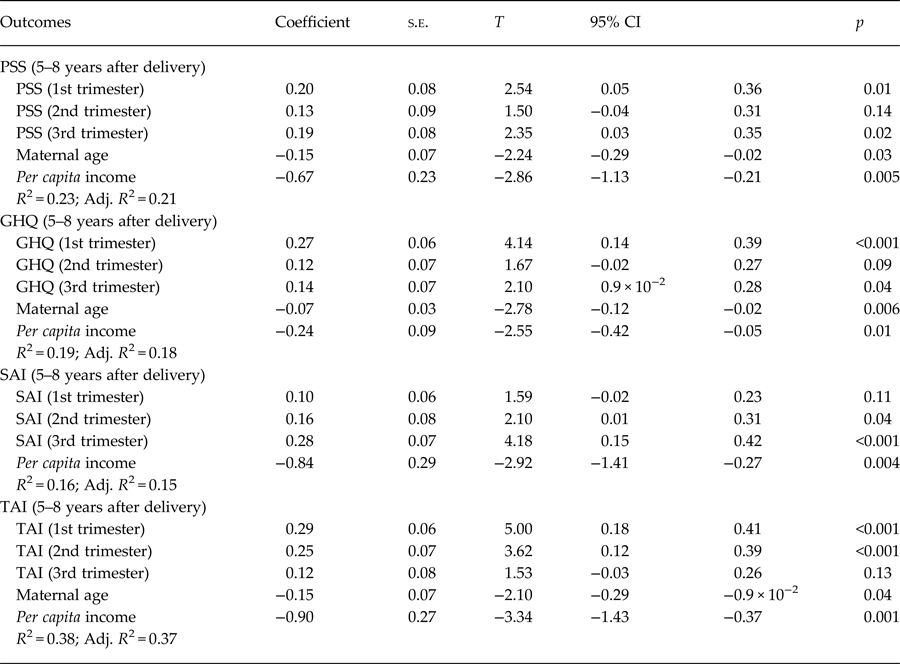
PSS, Perceived Stress Scale; GHQ, General Health Questionnaire; SAI, State Anxiety Inventory; TAI-Trait Anxiety Inventory.
Table 3 shows four linear regression models considering scores of the PSS, GHQ, SAI and TAI in the 3rd trimester of pregnancy as outcomes, and scores of the PSS, GHQ, SAI e TAI in the 1st and 2nd trimesters of pregnancy as independent variables, controlling for confounders. Scores of the PSS, GHQ, SAI and TAI in the 3rd trimester of pregnancy were positively associated with scores of the PSS, GHQ, SAI and TAI in the 1st and 2nd trimesters of pregnancy (adj. R 2 varied from 0.31 to 0.65).
Linear regression models considering scores of the PSS, GHQ, SAI and TAI in the 3rd trimester of pregnancy as outcomes
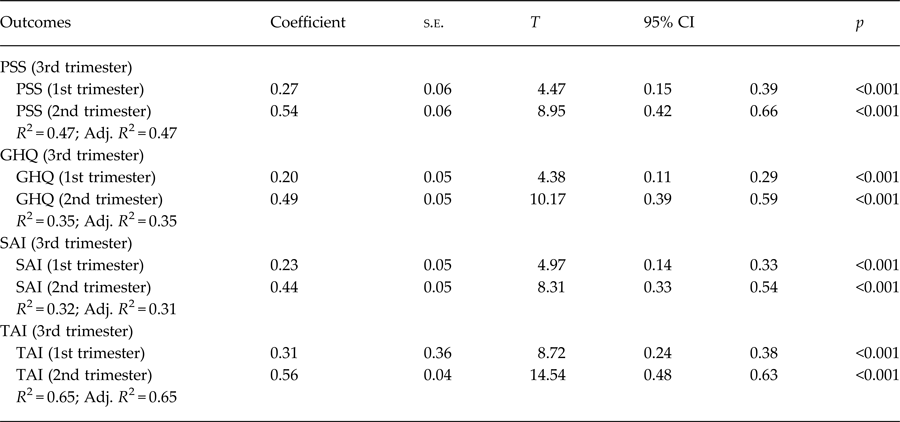
PSS, Perceived Stress Scale; GHQ, General Health Questionnaire; SAI, State Anxiety Inventory; TAI-Trait Anxiety Inventory.
Discussion
According to the results of this study, there were statistically significant associations between mental disorders (assessed by the PSS, GHQ and STAI scores) in the three trimesters of pregnancy, lower age and per capita income and mental disorders 5–8 years after delivery. The other socioeconomic and demographic factors investigated did not show statistically significant results. BMI, an indicator of the nutritional status of the women, was not associated with mental disorders; though Nagl et al. (Reference Nagl, Linde, Stepan and Kersting2015) and Molyneaux et al. (Reference Molyneaux, Poston, Khondoker and Howard2016) had referred that obese pregnant women might constitute a group vulnerable for anxiety and depression, respectively.
Apparently, women have a higher risk of mental disorders in the postpartum period if they have shown these disorders before (Bilszta et al. Reference Bilszta, Gu, Meyer and Buist2008; Witt et al. Reference Witt, Wisk, Cheng, Hampton, Creswell, Hagen, Spear, Maddox and Deleire2011; Kirkan et al. Reference Kirkan, Aydin, Yazici, Aslan, Acemoglu and Daloglu2015; Patton et al. Reference Patton, Romaniuk, Spry, Coffey, Olsson, Doyle, Oats, Hearps, Carlin and Brown2015) or during pregnancy (Onoye et al. Reference Onoye, Shafer, Goebert, Morland, Matsu and Hamagami2013; Yazici et al. Reference Yazici, Kirkan, Aslan, Aydin and Yazici2015). Bilszla et al. (Reference Bilszta, Gu, Meyer and Buist2008) observed an association between history of psychopathology in the antenatal period and depression at 6–8 weeks postnatally in Australian women. Patton et al. (Reference Patton, Romaniuk, Spry, Coffey, Olsson, Doyle, Oats, Hearps, Carlin and Brown2015) observed that perinatal depressive symptoms were mostly preceded by mental health problems that began before pregnancy, in adolescence or young adulthood. Onoye et al. (Reference Onoye, Shafer, Goebert, Morland, Matsu and Hamagami2013) confirmed the associations between stress, depression and anxiety in the three trimesters of pregnancy and in early (<6 weeks after delivery) and late (⩾6 weeks after delivery) postpartum in women from Hawaii. Kirkan et al. (Reference Kirkan, Aydin, Yazici, Aslan, Acemoglu and Daloglu2015) and Yazici et al. (Reference Yazici, Kirkan, Aslan, Aydin and Yazici2015) reported that a previous mental disorder or an untreated depressive disorder in the 1st trimester of pregnancy was an important predictor of depression in the sixth postpartum week.
Comparing the mean scores of the women in the highest PSS tertile with the mean scores of the whole population, and the mean scores of the populations studied by Cohen et al. (Reference Cohen, Kamarck and Mermelstein1983), we concluded that the women included in our study had perceived stress in pregnancy and 5–8 years after delivery. Interestingly, PSS mean scores increased significantly (t test, P < 0.001; data not shown) 5–8 years after delivery compared with the mean scores in pregnancy, while the GHQ, SAI and TAI scores maintained the mean values in the four different periods investigated, indicating higher levels of perceived stress 5–8 years after delivery than in pregnancy. Schmied et al. (Reference Schmied, Johnson, Naidoo, Austin, Matthey, Kemp, Mills, Meade and Yeo2013) observed that women's mood appears to be better in the first year after birth, when compared with a specific moment in pregnancy and 5 years later. The proportion of women reporting depressive symptoms in the first year postpartum was between 10% and 20% and this remained stable over 25 years. However, the studies included in the metanalysis carried out by Schmied et al. (Reference Schmied, Johnson, Naidoo, Austin, Matthey, Kemp, Mills, Meade and Yeo2013) did not assess mental health in the three trimesters of pregnancy. Agrati et al. (Reference Agrati, Browne, Jonas, Meaney, Atkinson, Steiner and Fleming2015) found that anxiety followed a U-shaped pattern from pregnancy to 2 years postpartum, which was modified by early life experience of the women. Greater early adversity was associated with higher anxiety in pregnancy, followed by a marked decrease once the baby was born, and a subsequent increase during the later postpartum period.
Similar to other studies in the literature, lower age (Bottino et al. Reference Bottino, Nadanovsky, Moraes, Reichenheim and Lobato2012; Räisänen et al. Reference Räisänen, Lehto, Nielsen, Gissler, Kramer and Heinonen2014; Siegel & Brandon, Reference Siegel and Brandon2014) and inferior per capita income (Abdollahi et al. Reference Abdollahi, Zarghami, Azhar, Sazlina and Lye2014; Hein et al. Reference Hein, Rauh, Engel, Häberle, Dammer, Voigt, Fasching, Faschingbauer, Burger, Beckmann, Kornhuber and Goecke2014; Alfayumi-Zeadna et al. Reference Alfayumi-Zeadna, Kaufman-Shriqui, Zeadna, Lauden and Shoham-Vardi2015) were associated with mental disorders in the postpartum period. According to Bottino et al. (Reference Bottino, Nadanovsky, Moraes, Reichenheim and Lobato2012), maternal age was significantly associated with PPD. For each additional year, a reduction of 4% in the chance of developing PPD was anticipated, effect that was not modified by confounders. Räisänen et al. (Reference Räisänen, Lehto, Nielsen, Gissler, Kramer and Heinonen2014) referred that one of the risk profiles of major depression included adolescence or advanced maternal age. Primarily focusing upon depressive symptoms, findings from a large literature review showed that rates of depression in pregnant and postpartum adolescents are comparable with non-pregnant adolescents, but higher than those reported among pregnant adults (Siegel & Brandon, Reference Siegel and Brandon2014). In fact, Aras et al. (Reference Aras, Oral, Aydin and Gulec2013) showed that early maternal age is one of the risk factors for depressive disorders even in non-perinatal reproductive age.
Abdollahi et al. (Reference Abdollahi, Zarghami, Azhar, Sazlina and Lye2014) identified low household income as the predictive factor with the highest risk (OR 3.57, 95% CI 1.49–8.5) for PPD. Hein et al. (Reference Hein, Rauh, Engel, Häberle, Dammer, Voigt, Fasching, Faschingbauer, Burger, Beckmann, Kornhuber and Goecke2014) concluded that socioeconomic factors, including monthly income, define subgroups that have different depression scores during and after pregnancy. Alfayumi-Zeadna et al. (Reference Alfayumi-Zeadna, Kaufman-Shriqui, Zeadna, Lauden and Shoham-Vardi2015), using a validated Arabic translation of the ‘Edinburgh Postnatal Depression Scale’ found that low income was one of the socio-demographic factors associated with PPD, among Arab-Bedouin women.
A limitation of this study was the lack of assessment of mental disorders in the immediate post-partum period. Even though mental disorders had not been investigated in the immediate postpartum period, it was probably a problem for those pregnant women considering the associations of the PSS, GHQ and STAI scores between the 3rd and 1st and 2nd trimesters of pregnancy. Witt et al. (Reference Witt, Wisk, Cheng, Hampton, Creswell, Hagen, Spear, Maddox and Deleire2011) referred that poor pre-pregnancy mental health and poor antepartum mental health, both independently, increased the risk of postpartum mental health problems in North American women. However, the authors did not use specific questionnaires to assess mental disorders. They used self-reports and symptoms of mental health conditions or global mental health ratings of ‘fair’ or ‘poor’.
Conclusion
Mental disorders in the three trimesters of pregnancy, lower age and per capita income are associated with mental disorders 5–8 years after delivery.
Referral of young, low-income pregnant women with mental disorders, particularly anxiety and depression, should be encouraged to psychological or psychiatric treatment. Finally, we reinforce the urgency to integrate mental health screening into routine primary care for pregnant and postpartum women.
Acknowledgements
The authors acknowledge the field workers, particularly Alessandra L Santos and Josimara F Moura, and Fundação de Amparo à Pesquisa do Estado de São Paulo – FAPESP, Brazil (grants no. 1998/00321-0, no. 2004/04109-8).
Declaration of interest
All the authors declare no conflict of interest.
Ethical standards
The study was approved by the Ethics Committee of the School of Public Health, University of Sao Paulo. It was carried out in accordance with the Declaration of Helsinki of 1975, as revised in 2008.


 Open access

