





Introduction
Single-ventricle CHD, one of the most severe forms of CHD, requires intensive medical care and has a significant psychosocial impact on both patients and their families. Reference DeMaso, Lauretti and Spieth1–Reference Hancock, Pituch and Uzark5 Single-ventricle CHD carries a lifelong risk of morbidity, mortality, and re-intervention. The nature of single-ventricle CHD creates a qualitatively different exposure for siblings compared to less surgically intensive forms of CHD, including extended separations from parents, repeated disruptions to family routines, and ongoing vigilance around the affected child’s health. Reference Hancock, Pituch and Uzark5
The reported impact of growing up with a chronically ill sibling, including CHD, includes both negative and positive effects across behavioural, emotional, and social domains such as stress, emotional difficulties, and increased medical needs, as well as resilience, emotional maturity, and deeply satisfying sibling bonds. Reference Loup, von Weissenfluh and Gahl6–Reference Amaro, Alderfer and Wawrzynski25 These findings underscore the complexity and multi-layered nature of sibling experiences in the context of serious chronic illness parallel to single-ventricle CHD. Reference Tan, Chan and Shorey26
Despite valuable contributions, much of the existing literature on the experience of siblings of individuals with CHD relies on parent-reported outcomes, which may be discordant with the siblings’ own perspectives, thus limiting the depth and generalizability of findings. Reference Bichard, McKeever, Bench and Wray20,Reference Guite, Lobato, Kao and Plante27–Reference Wray and Maynard29 Recent qualitative work has begun to address this gap. Reference Schamong, Seven and Folkerts22 However, no studies have focused specifically on self-reported experiences of siblings of individuals with single-ventricle CHD, and none have captured the perspective of adult siblings using group-based methodology. Obtaining direct sibling perspective is essential, as they are observing, adjusting, and adapting to familial needs in ways that shape their development and psychosocial well-being. Reference Lummer-Aikey and Goldstein14,Reference Hilário30,Reference Kelada, Wakefield and Drew31
The goal of this study was to explore the experiences of siblings of individuals with single-ventricle CHD through qualitative analysis of self-reported narratives.
Materials and methods
This cross-sectional study employed a phenomenological approach to explore and describe the experiences of siblings of individuals with single-ventricle CHD. This study was part of a broader initiative exploring the journey of individuals and families affected by single-ventricle CHD and was approved by the University of Texas at Austin Institutional Review Board (protocol 2019080031). Reference Mery, Well and Taylor4
The study was conducted through a unique interdisciplinary collaboration between three entities within the University of Texas at Austin: (1) Texas Center for Paediatric and Congenital Heart Disease, (2) Design Institute for Health, and (3) Value Institute for Health and Care.
Study population
Recruitment of individuals and families affected by single-ventricle CHD has been described in detail by Mery et al. Reference Mery, Well and Taylor4 Eligible participants were siblings of individuals living with single-ventricle CHD, aged 9 years or older, who spoke English. For siblings less than 18 years, parents or legal guardians provided written consent; adult siblings aged 18 years and older consented directly. Siblings or their parents or legal guardians were given the option to complete a socio-demographic survey. Siblings of individuals who were at the end of life or who had died were not included.
Data collection
Experience Group methodology, developed by the Value Institute for Health and Care, was used to capture participants’ experiences using a grounded theory approach. Reference Chapman, Hadfield and Chapman32 In this methodology, a small group of people are brought together to discuss their experiences. Sessions are semi-structured with open-ended prompts such as, “What does a good day look like?” directed towards the group by trained facilitators from the research team. This methodology allows themes to emerge organically without relying on predefined hypotheses, positioning participants as experts of their own experiences. Reference Guzik, McKinney and Ulack33
Experience Group sessions were organised based on similarities in age and consisted of 2 to 5 participants each. A total of 5 Experience Groups were conducted: one each for participants aged 9–12, 13–17, and 18–27 years, and 2 for those aged 28 years and older, due to higher availability of participants in this older age group. Due to the COVID-19 pandemic, all sessions were conducted virtually via a secure Health Insurance Portability and Accountability Act-compliant platform. Each group session lasted approximately 90 minutes. Sessions were audio-recorded, de-identified, and transcribed verbatim for qualitative thematic analysis.
Data analysis
Qualitative data were coded using NVivo and analysed using thematic analysis informed by an inductive approach. Reference Braun and Clarke34 Codes were developed inductively from the data without use of an a priori codebook. Multiple trained coders from the research team independently reviewed the transcripts, generating initial codes based on participant responses. Coding discrepancies were discussed and resolved by consensus, and a third coder reviewed all transcripts to finalise the code list. Drawing from the Delphi approach, an iterative process was used to identify and refine salient themes through multiple rounds of discussion. Themes were finalised by the larger research team based on frequency of appearance and richness of content, defined as depth, emotional nuance, and variation in participant experiences.
Results
Eighteen siblings participated in this study. Participants ranged in age from 9 to 59 years with a median age of 22 years; half were female (n = 9). Most participants (72%, n = 13) were older than their CHD-affected sibling. All sessions were conducted in English.
Age group distribution across the 5 Experience Groups was as follows: Experience Group 1 (aged 18–27 years): n = 5 (aged 19, 19, 21, 23, 23); Experience Group 2 (aged 9–12 years): n = 2 (aged 9, 12); Experience Group 3 (aged 28 years and older): n = 5 (aged 31, 36, 39, 53, 59); Experience Group 4 (aged 13–17): n = 4 (14, 16, N/A, N/A) with age data missing for 2 participants; Experience Group 5 (aged 28 years and older): n = 2 (aged 29, 38).
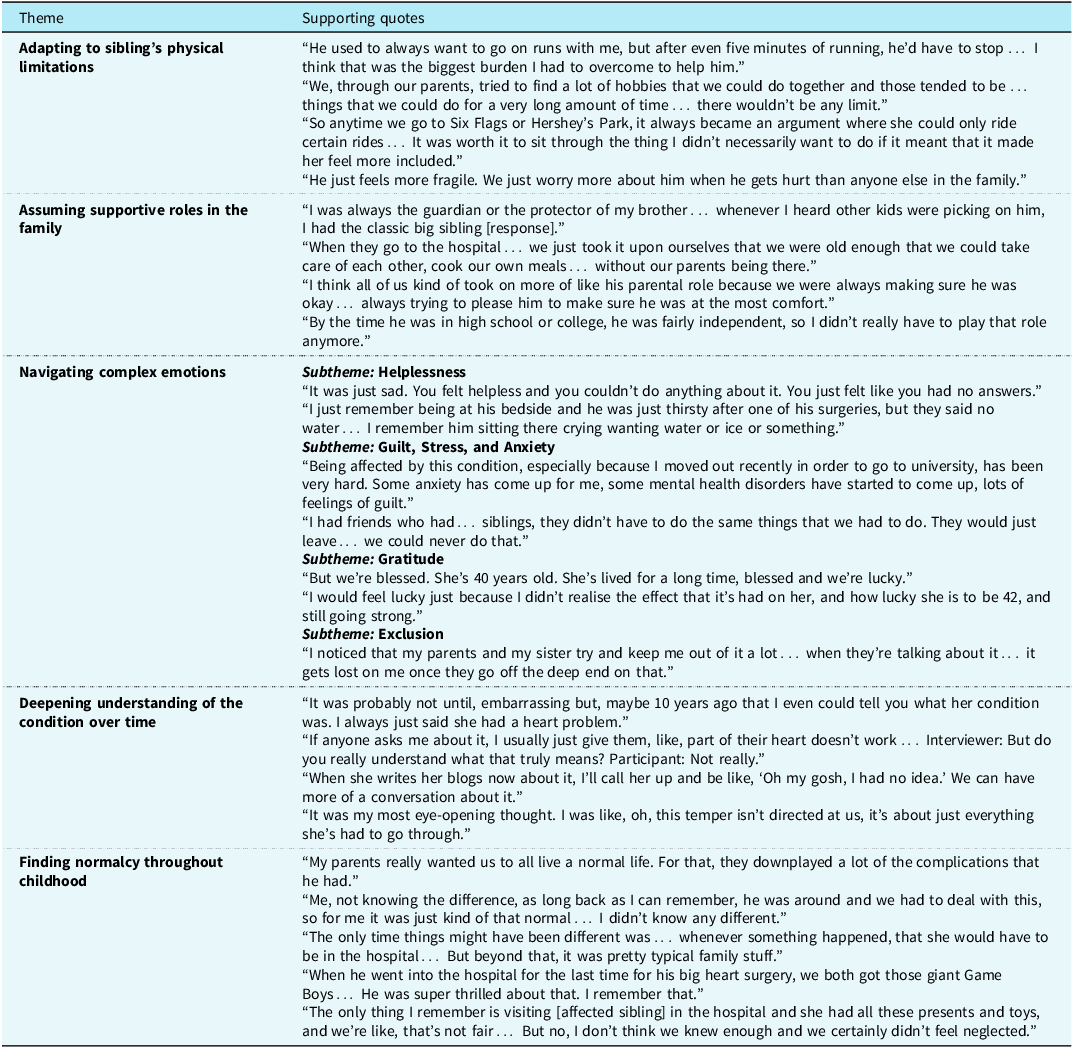
The themes that emerged from the Experience Group sessions reflect both childhood experiences and the lasting impact of growing up with a sibling with single-ventricle CHD. Illustrative quotes are presented in Table 1. Five themes were identified.
Experience group themes and illustrative quotes

Table 1. Long description
The table has five rows and two columns. The columns are labeled ‘Theme’ and ‘Supporting quotes’. The themes and corresponding quotes are as follows: Row 1: Theme: Adapting to sibling’s physical limitations. Supporting quotes: ‘He used to always want to go on runs with me, but after even five minutes of running, he’d have to stop … I think that was the biggest burden I had to overcome to help him.’, ‘We, through our parents, tried to find a lot of hobbies that we could do together and those tended to be … things that we could do for a very long amount of time … there wouldn’t be any limit.’, ‘So anytime we go to Six Flags or Hershey’s Park, it always became an argument where she could only ride certain rides … It was worth it to sit through the thing I didn’t necessarily want to do if it meant that it made her feel more included.’, ‘He just feels more fragile. We just worry more about him when he gets hurt than anyone else in the family.’. Row 2: Theme: Assuming supportive roles in the family. Supporting quotes: ‘I was always the guardian or the protector of my brother … whenever I heard other kids were picking on him, I had the classic big sibling [response].’, ‘When they go to the hospital … we just took it upon ourselves that we were old enough that we could take care of each other, cook our own meals … without our parents being there.’, ‘I think all of us kind of took on more of like his parental role because we were always making sure he was okay … always trying to please him to make sure he was at the most comfort.’, ‘By the time he was in high school or college, he was fairly independent, so I didn’t really have to play that role anymore.’. Row 3: Theme: Navigating complex emotions. Supporting quotes: Subtheme: Helplessness: ‘It was just sad. You felt helpless and you couldn’t do anything about it. You just felt like you had no answers.’, ‘I just remember being at his bedside and he was just thirsty after one of his surgeries, but they said no water … I remember him sitting there crying wanting water or ice or something.’. Subtheme: Guilt, Stress, and Anxiety: ‘Being affected by this condition, especially because I moved out recently in order to go to university, has been very hard. Some anxiety has come up for me, some mental health disorders have started to come up, lots of feelings of guilt.’, ‘I had friends who had … siblings, they didn’t have to do the same things that we had to do. They would just leave … we could never do that.’. Subtheme: Gratitude: ‘But we’re blessed. She’s 40 years old. She’s lived for a long time, blessed and we’re lucky.’, ‘I would feel lucky just because I didn’t realize the effect that it’s had on her, and how lucky she is to be 42, and still going strong.’. Subtheme: Exclusion: ‘I noticed that my parents and my sister try and keep me out of it a lot … when they’re talking about it … it gets lost on me once they go off the deep end on that.’. Row 4: Theme: Deepening understanding of the condition over time. Supporting quotes: ‘It was probably not until, embarrassing, but, maybe 10 years ago that I even could tell you what her condition was. I always just said she had a heart problem.’, ‘If anyone asks me about it, I usually just give them, like, part of their heart doesn’t work. Interviewer: But do you really understand what that truly means? Participant: Not really.’, ‘When she writes her blogs now about it, I’ll call her up and be like, ‘Oh my gosh, I had no idea.’ We can have more of a conversation about it.’, ‘It was my most eye-opening thought. I was like, oh, this temper isn’t directed at us, it’s about just everything she’s had to go through.’. Row 5: Theme: Finding normalcy throughout childhood. Supporting quotes: ‘My parents really wanted us to all live a normal life. For that, they downplayed a lot of the complications that he had.’, ‘Me, not knowing the difference, as long back as I can remember, he was around and we had to deal with this, so for me it was just kind of that normal … I didn’t know any different.’, ‘The only time things might have been different was … whenever something happened, that she would have to be in the hospital … But beyond that, it was pretty typical family stuff.’, ‘When he went into the hospital for the last time for his big heart surgery, we both got those giant Game Boys … He was super thrilled about that. I remember that.’, ‘The only thing I remember is visiting [affected sibling] in the hospital and she had all these presents and toys, and we’re like, that’s not fair … But no, I don’t think we knew enough and we certainly didn’t feel neglected.’
Adapting to their sibling’s physical limitations
Participants reflected on the physical limitations experienced by their sibling, which shaped the nature of their shared activities. Visible symptoms, such as cyanosis or hives following physical exertion, served as constant reminders of their sibling’s condition. Many participants described adapting by selecting less physically demanding activities to ensure inclusion. Younger participants (aged 9–17 years) described these adaptations in the present tense with choices being made now, whereas adult participants (aged 28 years and older) reflected retrospectively on how the adaptations had shaped their childhood. Both groups demonstrated a consistent pattern of prioritising the affected sibling’s participation over their own preferences.
Assuming supportive roles in the family
Participants recounted taking on a range of caregiving and supportive roles, including acting as protectors, providing emotional support, and acting as companions in adapted activities. Some reported monitoring their sibling’s health, reminding them to take medications, or providing care for younger siblings when parents were occupied with medical responsibilities. Notably, the nature of these roles shifted across the lifespan; younger participants described more physically protective and behaviourally compensatory roles (e.g., adapting activities), whereas adult participants described roles that were primarily emotional in nature. Consistent with prior literature on sibling caring roles in chronic illness, Reference Hilário30,Reference Kelada, Wakefield and Drew31 role intensity appeared to decrease as the affected sibling gained independence, as illustrated by one participant who noted that his brother had become largely self-sufficient by early adulthood.
Navigating complex emotions
Participants described a wide range of emotions including helplessness during medical crises, guilt for leaving home, anxiety about separation from their sibling, and exclusion from family medical discussions. These challenging emotions were frequently accompanied by gratitude, particularly that their sibling had survived and reached developmental milestones. This juxtaposition of isolation and appreciation characterises the nuanced nature of sibling emotions.
A notable developmental pattern emerged across age groups. Younger participants (aged 9–17 years) expressed more present-tense anxiety and uncertainty; they were less likely to employ retrospective reframing and described ongoing worry about their sibling’s future. Adult participants (aged 28 years and older) more frequently described a process of cognitive and emotional reframing over time, in which negative emotions were reconsidered through a lens of gratitude and enduring concern. This developmental contrast reflects a shift from acute, unprocessed distress towards integrated emotional meaning-making.
Notably, participants did not directly articulate fear of their sibling’s death as a concern. However, anxiety about hospitalisations, future health uncertainty, and the sibling’s ongoing fragility was expressed across all age groups, perhaps highlighting an implicit rather than explicit framing of mortality-related worry.
Deepening understanding of the condition over time
Many participants reported a limited understanding of single-ventricle CHD during childhood, influenced by their developmental stage, parental efforts to shield them, and limited involvement in medical discussions. Younger participants (aged 9–12 years) in this study described understanding as partial and ongoing, with medical information often exceeding their comprehension. Adult participants described a process of gradually deepening comprehension over time, often precipitated by their affected sibling becoming more open about their experiences. Several expressed retrospective guilt at not having understood more earlier. This developmental arc—from incomplete to increasingly nuanced understanding—was consistent across all age groups, but the pace and precipitants differed by life stage.
Finding normalcy throughout childhood
Despite disruptions caused by their sibling’s condition, many participants described their childhoods as “normal.” This sense of normalcy was frequently attributed to growing up with the condition as part of daily life and parental efforts to maintain routine. Participants generally did not report feeling secondary or receiving less attention. Hospital visits, although disruptive, often became ritualised experiences marked by sleepovers, special treats, or time with extended family. Notably, younger participants (aged 9–12 years) described normalcy as a current reality while adult participants more often described normalcy as a retrospective construction, something that, in hindsight, they recognised as having been shaped by parental framing and their developmental incapacity to fully understand the situation.
Discussion
This study explored the experiences of siblings of individuals with single-ventricle CHD. While most participants characterised their upbringing as “normal,” this perception often coexisted with specific disruptions and adaptations related to their sibling’s condition. This normalisation, shaped by developmental stage, established routines, and parental framing, has been noted in prior research on siblings of individuals with chronic illness. Reference Hanvey, Malovic and Ntontis35 However, what participants identified as “normal” may more accurately reflect an absence of overtly negative impact rather than a lack of impact altogether.
From an early age, siblings assumed informal yet essential roles, serving as protectors, emotional supporters, and facilitators of normalcy. They frequently helped manage their sibling’s physical limitations, provided emotional support, and monitored their sibling’s health, all of which carried implications for their own development. Although these roles were seldom explicitly acknowledged at the time, they reflected emotional maturity and responsibility that exceeded age-based expectations. These findings are consistent with existing literature on caregiving roles adopted by siblings of children with chronic illness. Reference Havill, Fleming and Knafl36–Reference Hallion, Taylor and Roberts40 Adolescent siblings of solid organ transplant recipients have described similar patterns of protective role assumption experienced as simultaneously burdensome and meaningful, Reference Knoebl, Polfuss and McAndrew24 suggesting that this pattern may be common across serious paediatric conditions involving repeated hospitalisations.
Participants recalled vivid memories of helplessness and emotional distress during childhood, consistent with prior research examining the impact of growing up with a chronically ill or CHD-affected sibling. Reference Pinquart8–Reference Martinez, Pechlivanoglou and Meng12,Reference Parker, Houghton, Bichard and McKeever19,Reference Bichard, McKeever, Bench and Wray20 Feelings of guilt, anxiety, and persistent concern extended into adulthood for many participants, consistent with one longitudinal study of adult siblings of individuals with a chronic illness or disability which found elevated mental illness risk extending into adulthood. Reference Hallion, Taylor and Roberts40 Siblings in this study also reported suppressing their own emotional needs to avoid burdening their parents, consistent with prior literature. Reference Havill, Fleming and Knafl36–Reference Hallion, Taylor and Roberts40 These findings highlight the importance of early psychosocial screening and support for siblings, who may internalise emotional distress without outward expression. Reference Vermaes, van Susante and van Bakel9,Reference Deavin, Greasley and Dixon16
A meaningful developmental contrast emerged across age groups. Adult participants (aged 28 years and older) described their experiences through a retrospective integration lens: hospitalisations had become family rituals, fear had been reframed as gratitude, and caregiving roles were named as sources of growth. Younger participants (aged 9–17 years) described more immediate and ongoing uncertainty, with less capacity for retrospective reframing. This pattern is consistent with findings from sibling dialogue studies, in which school-aged siblings articulated challenges in real time such as concerns about the future, family life, and relationships, reflecting immediate rather than integrated distress. Reference Schumann, Vatne and Fjermestad41 The retrospective nature of adult participants’ accounts also raises the possibility of recall bias and memory decay across decades of recollection, a limitation addressed below.
Despite these challenges, many participants exhibited notable resilience. Family rituals, such as sleepovers or special treats during difficult times, helped reframe disruptions as shared family experiences, fostering continuity and belonging. Participants often described their siblings as sources of inspiration and expressed pride in both their family’s collective strength and their own adaptability. These findings align with prior research highlighting post-traumatic growth and prosocial development among siblings of individuals with chronic illness, Reference Pinquart8,Reference Knecht, Hellmers and Metzing13–Reference Burbidge and Minnes18,Reference Boettcher, Kröger and Reinsberg23 and with the broader serious illness literature that describes strength amid deep challenges.
Most participants noted that their understanding of the condition evolved over time. During childhood, many lacked the cognitive capacity to comprehend single-ventricle CHD or were shielded from medical discussions. As they aged, they developed greater awareness through open communication with their affected sibling, facilitating deeper emotional processing. Having age-appropriate understanding of the condition may alleviate some adverse impacts of having a sibling with CHD.
Fear of sibling death, which Bernardino et al. identified as central among adolescent siblings of children with complex CHD, and which Schamong et al. Reference Schamong, Seven and Folkerts22 documented as a dominant concern in a broader CHD sibling sample, appeared more implicitly in our data—embedded in expressions of hospitalisation anxiety and future uncertainty rather than being voiced as a direct concern. This may reflect the survivorship context of our sample, the retrospective reframing of adult narrators, and possible normalisation dynamics within the Experience Group format.
The narratives in this study offer a developmental perspective, bridging early childhood impressions with more complex adult understandings, providing insights into how meaning is constructed and reconstructed over time. Unlike prior research, which relies on parent-reported outcomes or individual interviews with adolescent siblings, this study positioned siblings as experts of their own experiences and captured group-level meaning-making dynamics across five decades of the lifespan.
Limitations
This study has several limitations. This was a cross-sectional study with a small English-speaking sample, limiting generalizability and sociocultural representation. Virtual delivery of Experience Group sessions reduced burden and enabled broader geographic participation but may have excluded those without access to technology. Only half of participants completed the optional sociodemographic survey, limiting assessment of sociodemographic influences on the findings. Participant narratives were based on recollections spanning, in some cases, several decades and may be subject to memory decay and recall bias.
Importantly, this study did not include siblings of individuals who had died or were at the end of life. This exclusion creates a form of survivorship bias: the participants’ affected siblings all survived to the time of the study, which likely contributes to the Finding Normalcy theme and the relative absence of explicit mortality fear in the narratives. Siblings of non-survivors would represent a more severe illness exposure and potentially more traumatic sibling experience. Reference Schamong, Seven and Folkerts22 Additionally, younger individuals currently living with single-ventricle CHD may have more medically severe disease than adult survivors, who represent an earlier surgical era in which only those with less severe disease or more favourable anatomy survived to adulthood. This may mean that the sibling experience differs meaningfully across cohorts defined by the age and illness era of the affected sibling.
Future directions
Future studies should consider larger, more diverse samples and longitudinal designs to track how sibling experiences evolve over time and identify opportunities for developmentally appropriate, targeted interventions. Research should also investigate specific areas in which unaffected siblings both struggle and thrive, as well as the types of support they perceive as beneficial.
Clinical implications
These findings have direct implications for clinical practice. Siblings should be systematically included in comprehensive, family-centred psychosocial assessment and intervention throughout the CHD journey. Embedded psychosocial care teams—including child life specialists, social workers, and psychologists—are well-positioned to provide this support in the paediatric setting, where sibling support infrastructure already exists in many centres. Reference Schamong, Seven and Folkerts22,Reference Amaro, Alderfer and Wawrzynski25
Critically, this study’s sample included participants up to age 59—the oldest reported in any qualitative sibling study to date—underscoring that sibling support needs do not resolve at the transition to adulthood. Adult siblings of individuals with single-ventricle CHD transition out of the paediatric care system alongside their affected sibling. However, unlike the patient, they typically have no formal care structure awaiting them in adult care system. Three independent studies have documented the consistent absence of formal psychosocial support for siblings across all ages and settings. Reference Schamong, Seven and Folkerts22,Reference Amaro, Alderfer and Wawrzynski25 Future sibling support programming should therefore be embedded in adult CHD transition planning, in addition to paediatric cardiology.
Conclusion
These findings provide valuable insights into the complex and evolving experiences of siblings of individuals with single-ventricle CHD. Recognising siblings as vital participants in the CHD journey, providing emotional support, maintaining family routines, and contributing to the normalisation of medical disruptions, is essential. These insights can inform tailored, family-centred care models that intentionally include siblings in psychosocial assessment, support interventions, and age-appropriate medically related education and communication. By broadening clinical attention beyond the patient and their parents, healthcare systems can better address the psychosocial needs of the entire family, ultimately improving well-being for all.
Supplementary material
The supplementary material for this article can be found at https://doi.org/10.1017/S1047951126124524.
Acknowledgements
The authors would like to thank the siblings who participated in this study and shared their experiences, as well as their families. The authors would also like to thank the entire CORAGE Project team for their contributions and support. Finally, the authors would like to acknowledge Brittany Barnhill, who passed away prior to publication, for her contributions to the conception and design of this study and her passion for supporting siblings.
Financial support
All phases of this study were funded internally by Dell Medical School at The University of Texas at Austin and the Texas Center for Pediatric and Congenital Heart Disease at UT Health Austin and Dell Children’s Medical Center.
Competing interests
The authors declare none.
Ethical standard
The authors assert that all procedures contributing to this work comply with the ethical standards of the relevant national guidelines on human experimentation and with the Helsinki Declaration of 1975, as revised in 2008, and has been approved by the institutional review board of the University of Texas at Austin (protocol 2019080031). The study was registered at ClinicalTrials.gov (NCT04613934).


 Open access

