Introduction
Throughout the decades, scholars in various fields devote themselves to the motivations, determinants, and economic consequences of corporate philanthropic giving, an important dimension of corporate social responsibility (CSR). Specifically, extant studies have recognized four major motivations of corporate philanthropy: (1) strategic motivation, (2) political motivation, (3) altruistic motivation, and (4) managerial self-interest motivation (Campbell, Moore, & Metzger, Reference Campbell, Moore and Metzger2002; Seifert, Morris, & Bartkus, Reference Seifert, Morris and Bartkus2003; Zhang, Zhu, Yue, & Zhu, Reference Zhang, Zhu, Yue and Zhu2010). In addition, previous literature finds that corporate philanthropy is associated with lower costs of debts, higher shareholders value, and better corporate financial performance (Ullmann, Reference Ullmann1985; Margolis & Walsh, Reference Margolis and Walsh2003; Orlitzky, Schmidt, & Rynes, Reference Orlitzky, Schmidt and Rynes2003; Goss & Roberts, Reference Goss and Roberts2011; Ye & Zhang, Reference Ye and Zhang2011). Furthermore, for a long time, the majority of the existing literature addresses the influence of corporate governance, firm-specific financial characteristics, the nature of the ultimate owners, and gender diversity on corporate philanthropy (Ullmann, Reference Ullmann1985; McGuire, Sundgren, & Schneeweis, Reference McGuire, Sundgren and Schneeweis1988; Roberts, Reference Roberts1992; Wang & Coffey, Reference Wang and Coffey1992; Meznar & Nigh, Reference Meznar and Nigh1995; Williams, Reference Williams2003; Brammer & Millington, Reference Brammer and Millington2006; Brown, Helland, & Smith, Reference Brown, Helland and Smith2006; Amato & Amato, Reference Amato and Amato2007, Reference Amato and Amato2012; Huang, Reference Huang2010; Galbreath, Reference Galbreath2011), but pays less attention to the impacts of informal systems such as media coverage on corporate philanthropy.
Recently, a branch of very thin but growing literature argues the roles of media coverage, a specific informal system, in affecting corporate behavior in general (Henriques & Sadorsky, Reference Henriques and Sadorsky1999; Baron, Reference Baron2005; Miller, Reference Miller2006; Dyck, Volchkova, & Zingales, Reference Dyck, Volchkova and Zingales2008; Fang & Peress, Reference Fang and Peress2009; Joe, Louis, & Robinson, Reference Joe, Louis and Robinson2009; Bushee, Core, Guay, & Hamm, Reference Bushee, Core, Guay and Hamm2010; Wang & Ye, Reference Wang and Ye2015, and so on). In developed markets, mature business ethics and better CSR consciousness motivate firms to actively engage in corporate philanthropy (Zhang et al., Reference Zhang, Zhu, Yue and Zhu2010). However, it is an under-researched issue about whether some informal systems can serve as an alternative to inspire firms to carry out corporate philanthropy in emerging markets like China, where business ethics are immature, CSR consciousness is not well cultivated, and corporate governance mechanisms are incomplete (Du, Reference Du2013). Above gap in the existing literature motivates us to address the concerns about whether and how media coverage influences corporate philanthropy in an emerging economy.
In China, for a very long time, the media (press) has been highly controlled by (local and central) governments and thus the independence of media has come under question. In recent years, to upgrade the circulation and further attract readers and audiences of all ages, media has imitated and introduced quasi-western media styles, and thus the world has witnessed the increasing independence and freedom of Chinese media. Nevertheless, when governments or state-owned enterprises are involved, media operates cautiously and dares not go one step beyond the prescribed limit, and even keeps silent (Wang & Ye, Reference Wang and Ye2015). Moreover, the public, investors, and stakeholders may cast doubt on the integrity of journalists who are inclined to portray state-owned enterprises too favorably (Li, Reference Li2013). However, for Chinese family firms, the media can play an important role because government interventions are trivial or insignificant. In other words, the independence and freedom of Chinese media are qualitatively similar to those of Western media when the media or press covers Chinese family firms. As a result, we choose a sample of Chinese family firms to conduct our empirical analyses.
In this study, we argue that media coverage, as an important informal system (Miller, Reference Miller2006; Dyck, Volchkova, & Zingales, Reference Dyck, Volchkova and Zingales2008; Bushee et al., Reference Bushee, Core, Guay and Hamm2010), can play an important role in strengthening business ethics and motivating firms to engage in corporate philanthropy. To address above issue, this study examines how media coverage influences corporate philanthropic giving and further the moderating role of family ownership. For empirical tests, we construct a sample of Chinese family firms for the period of 2004–2010. In brief, our findings reveal the following aspects. First, media coverage is significantly positively associated with corporate philanthropic giving. Second, family ownership attenuates the positive association between media coverage and corporate philanthropic giving. Finally, above conclusions are still valid after controlling for the endogeneity between media coverage and corporate philanthropy. Our study is one of very few studies to examine the association between media coverage and corporate philanthropy, and thus contributes to two branches of exiting literature: (1) the benefits and costs of media coverage; and (2) the determinants of corporate philanthropy.
The remainder of this paper is organized as below. In the second section, we review prior literature and develop research hypotheses based on institutional theory and instrumental stakeholder theory. The third section describes sample, data source, and variables. The fourth section includes descriptive statistics and correlation analyses. The fifth section reports empirical results, conducts robustness checks, discusses the endogeneity between media coverage and corporate philanthropy, and carries out additional tests. The sixth section discusses theoretical contribution, managerial implications, limitations and future research. Finally, we summarize conclusions.
Literature Review, Theory, and Hypotheses Development
Literature review
As an important topic in business ethics, extant studies have documented a great deal of evidence on the motivations, determinants, and economic consequences of corporate philanthropy (Ullmann, Reference Ullmann1985; McGuire, Sundgren, & Schneeweis, Reference McGuire, Sundgren and Schneeweis1988; Useem, Reference Useem1988; Roberts, Reference Roberts1992; Meznar & Nigh, Reference Meznar and Nigh1995; Johnson & Greening, Reference Johnson and Greening1999; Campbell, Moore, & Metzger, Reference Campbell, Moore and Metzger2002; Margolis & Walsh, Reference Margolis and Walsh2003; Orlitzky, Schmidt, & Rynes, Reference Orlitzky, Schmidt and Rynes2003; Seifert, Morris, & Bartkus, Reference Seifert, Morris and Bartkus2003; Williams, Reference Williams2003; Brammer & Millington, Reference Brammer and Millington2006; Brown, Helland, & Smith, Reference Brown, Helland and Smith2006; Goss & Roberts, Reference Goss and Roberts2011; Amato & Amato, Reference Amato and Amato2012). Nevertheless, scholars are still devoting substantive efforts to exploring the impacts of a rapidly changing environment on corporate philanthropy. Moreover, the multi-disciplinary study on corporate philanthropy and other CSR dimensions is another remarkable tendency. In this regard, drawing on theories in the fields of management, religion, and psychology, scholars explore other determinants of corporate philanthropy (Brammer, Williams, & Zinkin, Reference Brammer, Williams and Zinkin2007; Mazereeuw-van der Duijn Schouten, Graafland, & Kaptein, Reference Mazereeuw-van der Duijn Schouten, Graafland and Kaptein2013; Du, Jian, Du, Feng, & Zeng, Reference Du, Jian, Du, Feng and Zeng2014).
Relevant to our study, we focus on the influence of media coverage as an important informal system on corporate philanthropy. Borrowing support from findings in the fields of communication, management, and finance (Meznar & Nigh, Reference Meznar and Nigh1995; Chyi & McCombs, Reference Chyi and McCombs2004; Fiss & Zajac, Reference Fiss and Zajac2006; Bryant & Oliver, Reference Bryant and Oliver2008), extant studies have examined the impacts of media coverage on corporate behavior in general (Henriques & Sadorsky, Reference Henriques and Sadorsky1999; Baron, Reference Baron2005; Miller, Reference Miller2006; Siegel & Vitaliano, Reference Siegel and Vitaliano2007; Tetlock, Reference Tetlock2007, Reference Tetlock2011; Dyck, Volchkova, & Zingales, Reference Dyck, Volchkova and Zingales2008; Fang & Peress, Reference Fang and Peress2009; Hirshleifer, Lim, & Teoh, Reference Hirshleifer, Lim and Teoh2009; Joe, Louis, & Robinson, Reference Joe, Louis and Robinson2009; Bushee et al., Reference Bushee, Core, Guay and Hamm2010; Wang & Ye, Reference Wang and Ye2015). In the field of communication, Kiousis (Reference Kiousis2004: 74) defines media coverage as the awareness of a specific object by the media, accompanying with ‘the sheer volume of stories or space dedicated to topics in newspapers, television news and so on.’ Winter and Eyal (Reference Winter and Eyal1981) find that the media affects public opinions and the concerns about particular events are significantly positively associated with the volume of news coverage.
Moreover, in the field of management and finance, scholars find the roles of corporate governance and information intermediary played by the media or press in influencing corporate decisions (Djankov, Mcliesh, Nenova, & Shleifer, Reference Djankov, Mcliesh, Nenova and Shleifer2003; Miller, Reference Miller2006; Dyck, Volchkova, & Zingales, Reference Dyck, Volchkova and Zingales2008). A branch of extant studies document that the media always serves as a monitor or ‘watchdog’ (Miller, Reference Miller2006; Tetlock, Reference Tetlock2007, Reference Tetlock2011; Dyck, Volchkova, & Zingales, Reference Dyck, Volchkova and Zingales2008; Joe, Louis, & Robinson, Reference Joe, Louis and Robinson2009; Hirshleifer, Lim, & Teoh, Reference Hirshleifer, Lim and Teoh2009). Specifically, the watchdog process is often described as ‘combining public and non-public information with an analysis that highlights potential problems,’ and especially, as the first or the original information analyzer and provider, the press serves as a monitor or ‘watchdog’ better (Miller, Reference Miller2006). For example, Miller (Reference Miller2006) finds that ‘the press fulfills the role as a monitor or “watchdog” by rebroadcasting information from other intermediaries (analysts, auditors, and lawsuits) and by undertaking original investigation and analysis.’ Joe, Louis, and Robinson (Reference Joe, Louis and Robinson2009) find that media exposure of board ineffectiveness forces the targeted agents to take corrective actions to enhance shareholder wealth. Hirshleifer, Lim, & Teoh (Reference Hirshleifer, Lim and Teoh2009) and Tetlock (Reference Tetlock2007, Reference Tetlock2011) find that the media may play the role of external disciplining mechanism that can reverse corporate governance violations. Based on the context of Russia, Dyck, Volchkova, and Zingales (Reference Dyck, Volchkova and Zingales2008) empirically recognize the role that the media plays in corporate governance, that is, media coverage is significantly associated with the probability of a firm’s governance violation.
Another branch of the existing literature argues and finds that media coverage can help reduce information asymmetry between managers and stakeholders and thus can play its important role of information intermediary in influencing corporate decisions and investor behavior (Deephouse, Reference Deephouse2000; Baker, Nofsinger, & Weaver, Reference Baker, Nofsinger and Weaver2002; Dyck & Zingales, Reference Dyck and Zingales2002; Tetlock, Reference Tetlock2007; Dyck, Volchkova, & Zingales, Reference Dyck, Volchkova and Zingales2008; Fang & Peress, Reference Fang and Peress2009; Bushee et al., Reference Bushee, Core, Guay and Hamm2010; Wang & Ye, Reference Wang and Ye2015). For example, Dyck and Zingales (Reference Dyck and Zingales2002) and Dyck, Volchkova, and Zingales (Reference Dyck, Volchkova and Zingales2008) argue that information is aggregated and credibly communicated to the public and investor via media to a great extent. The media, especially new media in the internet age and information society, circulates within the business community as well as throughout the whole population, and thus media can provide useful information and predictive signals to reduce information asymmetry among managers, diverse shareholders, and other stakeholders (Tetlock, Reference Tetlock2007). Deephouse (Reference Deephouse2000) and Baker, Nofsinger, and Weaver (Reference Baker, Nofsinger and Weaver2002) argue that media coverage helps investors mitigate uncertainty about a firm’s operation. Fang and Peress (Reference Fang and Peress2009) argue that mass media can alleviate informational frictions and affect security pricing even if it does not supply genuine news, and further find the positive association between media coverage and expected stock returns. Bushee et al. (Reference Bushee, Core, Guay and Hamm2010) note that ‘the business press as an information intermediary potentially shapes information environments by packaging and disseminating information and creating new information through journalism activities,’ and thus greater press coverage mitigates information asymmetry around earnings announcements. Wang and Ye (2015) find that firms whose controlling shareholders receive negative media coverage have lower valuations.
Although extant studies have validated the impacts of media coverage on corporate behavior in general, to our knowledge, very rare previous literature investigates the influence of media coverage on corporate philanthropy. Nevertheless, several extant studies address the impacts of media coverage on CSR in general. Mahdavi (Reference Mahdavi2011) examines how well the print media performed this function in relation to CSR following the BP Gulf of Mexico oil disaster, but finds no significant association between media coverage and CSR. Zyglidopoulos, Georgiadis, Carroll, and Siegel (Reference Zyglidopoulos, Georgiadis, Carroll and Siegel2012) find that increases in media attention are related to increases in CSR-strengths. However, different CSR dimensions may be inherently inconsistent (Zyglidopoulos et al., Reference Zyglidopoulos, Georgiadis, Carroll and Siegel2012), so the existing conclusions on the relation between media coverage and CSR may not be automatically applied to the association between media coverage and corporate philanthropy;Footnote 1 and it is necessary to separately investigate the association between media coverage and corporate philanthropic giving, a particular dimension of CSR.
In this study, motivated by the gap in extant literature, using a sample of Chinese family firms, we address the influence of media coverage on corporate philanthropy, a specific CSR dimension.
Institutional theory
Meyer and Rowan (Reference Meyer and Rowan1977) argue that a firm can be driven to incorporate ‘the practices and procedures defined by prevailing rationalized concepts of organizational work and institutionalized in society’ so as to increase its legitimacy and survival prospect. In some cases, opinions from the public and stakeholders influence and even dominate some policies, programs, procedures, and corporate behavior in contemporary enterprises (Meyer & Rowan, Reference Meyer and Rowan1977). As the response, a firm is inclined to incorporate a variety of institutionalized elements that provide the rationale of its activities, and thus a firm becomes legitimate and owns the possibility of employing its legitimacy to secure its survival (Scott & Lyman, Reference Scott and Lyman1968; Scott, Reference Scott1987). Marquis, Glynn, and Davis (Reference Marquis, Glynn and Davis2007) indicate that institutional pressures at the community level shape corporate social activities beyond immediate profit maximization goals. Specifically, Marquis, Glynn, and Davis (Reference Marquis, Glynn and Davis2007) argue corporate social activities through an institutional lens. That is, contemporary enterprises should actively respond to social movement which requires a firm to pay its close attention to environmentalism, global citizenship, or urban problems in order to secure its legitimacy or competitive differentiation (Bansal & Roth, Reference Bansal and Roth2000). Moreover, Jones (Reference Jones1999) and Tan (Reference Tan2009) suggest that institutional contexts such as the social, cultural, economic environment, and industry level competitive environment are important to motivate CSR. Oliver (Reference Oliver1991) argues the influence of institutionalization in organizational environments on organizational conformity to the environment and further suggests that researchers should pay their closer attention to the nature and variety of institutional processes with regard to the treatments of institutionalization.
Based on findings in extant studies, a firm should identify the different strategic responses to the institutional pressures toward conformity. Institutional theory provides researchers with insights into corporate philanthropy through community-based patterns (Marquis, Glynn, & Davis, Reference Marquis, Glynn and Davis2007). Applying the legitimacy isomorphism to community infrastructures, the local geographic community where a firm is located is a source of institutional pressures to motivate corporate philanthropy. In addition, because the legitimacy of a firm is often questioned, Friedman (Reference Friedman1970) and Davis and Greve (Reference Davis and Greve1997) note that a firm is always vulnerable to institutionalized pressures at the community level.
More specifically, Ahlstrom and Bruton (Reference Ahlstrom and Bruton2002) note that private and family firms are relatively new and even opposed by a large proportion of the population in transition and emerging economies. As such, in emerging economies like China, family firms must innovatively respond to their environments including opinions from the public and the media. If not, enterprises will be proved to have difficulty in taking a step or be struggling in a hostile environment. As a result, media coverage reflects the common opinions from the public and the local geographic communities, and thus plays an important and positive role of motivating corporate philanthropy.
Furthermore, Mitchell, Agle, and Wood (Reference Mitchell, Agle and Wood1997) put forth the theory of stakeholder identification and salience, which focuses on three major features of power, legitimacy, and urgency to identify stakeholders and ‘Who or What Really Counts’ in a firm’s stakeholder environment. Actually, the theory of stakeholder identification and salience expands our understanding beyond legitimacy to incorporate stakeholder power and urgency of a claim. As a response, a firm should pay its close attention to the attributes of power, legitimacy, and urgency in a firm’s environment and their dynamism, which influence a firm’s and managers’ ability to meet legitimate claims and protect legitimate interests. Applying the theory of stakeholder identification and salience to our study, we argue that media coverage helps management identify two important attributes of power and urgency, and then guides a firm to attach importance to stakeholder power and urgency of a claim in the media.
Instrumental stakeholder theory
Jones (Reference Jones1995) puts forward an instrumental theory and argues that the cooperative relationship is ‘trusting, trustworthy, and cooperative, not opportunistic,’ which gives a firm the potential competitive advantage. In other words, the instrumental theory can provide some explanation about why altruistic behavior such as corporate philanthropy is proven to be productive, why a firm actively engages in corporate philanthropy to secure its legitimate status and why a firm survives and often thrives.
In essence, the stakeholder theory is also instrumental (Donaldson & Preston, Reference Donaldson and Preston1995) and it establishes a framework for researchers to investigate the practice of stakeholder management and various corporate performance goals including financial performance and corporate social performance. Instrumental stakeholder theory views a firm as an instrument for wealth creation or a strategic tool to promote a firm’s economic objectives (Garriga & Mele, Reference Garriga and Mele2004). The instrumental stakeholder theory argues that a firm should integrate its responsibilities to a variety of stakeholders (Jamali, Reference Jamali2008). As a result, opinions from the communities or the public, always reflected in the media, guide a firm to pay its close attention to corporate philanthropy and thus to balance the demands among various stakeholders. In this regard, media coverage motivates a firm to balance different interest demands to secure its legitimacy and survival prospect.
Media coverage and corporate philanthropy (Hypothesis 1)
Previous literature has recognized that media coverage can play the roles of corporate governance and information intermediary in influencing corporate behavior (Djankov et al., Reference Djankov, Mcliesh, Nenova and Shleifer2003; Miller, Reference Miller2006; Dyck, Volchkova, & Zingales, Reference Dyck, Volchkova and Zingales2008). Drawing on stakeholder theory, media coverage not only impacts corporate behavior in general, but also influences business ethics and thus strengthens the level of corporate philanthropy (McWilliams & Siegel, Reference McWilliams and Siegel2001; Zyglidopoulos et al., Reference Zyglidopoulos, Georgiadis, Carroll and Siegel2012).
Freeman (Reference Freeman1994) argues that a firm’s survival and development closely depend on its interactions with surrounding environment, including satisfying a variety of demands from various and diverse stakeholders. In this regard, CSR based on stakeholder theory becomes one of the most prevalent pressures from stakeholders (Zyglidopoulos et al., Reference Zyglidopoulos, Georgiadis, Carroll and Siegel2012). Furthermore, external stakeholders pay close attention to corporate philanthropy, one of CSR-strengths.Footnote 2 In the internet age and information society, the media (press) is a mirror of reality reflecting a firm’s actions (Fombrun & Shanley, Reference Fombrun and Shanley1990). As a result, as shown in extant communication studies (Benton & Frazier, Reference Benton and Frazier1976; Behr & Iyengar, Reference Behr and Iyengar1985; Dalton, Beck, Huckfeldt, & Koetzle, Reference Dalton, Beck, Huckfeldt and Koetzle1998), the media can exert great influence on the public, investors, and stakeholders, and thus can guide the trend on public opinion. In addition, media coverage can help mitigate information asymmetry between managers and stakeholders, and thus firms with high media coverage may be inclined to receive more stakeholder pressures.
Relevant to our study, corporate philanthropy belongs to a firm’s voluntary behavior and can be identified as one of important CSR-strengths (Siegel & Vitaliano, Reference Siegel and Vitaliano2007; Zyglidopoulos et al., Reference Zyglidopoulos, Georgiadis, Carroll and Siegel2012). Previous studies argue four major motivations of corporate philanthropy: strategic motivation, political motivation, altruistic motivation, and managerial self-interest motivation (Campbell, Moore, & Metzger, Reference Campbell, Moore and Metzger2002; Seifert, Morris, & Bartkus, Reference Seifert, Morris and Bartkus2003; Zhang et al., Reference Zhang, Zhu, Yue and Zhu2010). Nevertheless, the public or stakeholders still positively value a firm with higher level of corporate philanthropy (Margolis & Walsh, Reference Margolis and Walsh2003; Orlitzky, Schmidt, & Rynes, Reference Orlitzky, Schmidt and Rynes2003; Goss & Roberts, Reference Goss and Roberts2011; Ye & Zhang, Reference Ye and Zhang2011), which results in higher firm value, lower costs of debts, and better financial performance. Therefore, in view of media coverage and its influence on corporate image, it is rational and necessary for a firm to carry out a relatively higher level of corporate philanthropic giving to offset stakeholder pressures.Footnote 3
Moreover, a firm that receives more media coverage has a higher likelihood of exposure to risk (Godfrey, Reference Godfrey2005), which is in turn reported by the media. Liebman and Milhaupt (Reference Liebman and Milhaupt2008: 980) argue that the media may be the most effective regulator of corporate wrongdoings or misconducts in China today. Therefore, as the response to higher exposure to risk of negative events and reports, a firm with high media coverage has sufficient incentives to accumulate positive moral capital to offset the potential negative events on the media in the future (Godfrey, Reference Godfrey2005; Zyglidopoulos et al., Reference Zyglidopoulos, Georgiadis, Carroll and Siegel2012). In this regard, Godfrey (Reference Godfrey2005) and Peloza (Reference Peloza2006) find corporate philanthropy can serve as a positive moral capital to offer an important advantage against negative events.
Overall, drawing on institutional theory and instrumental stakeholder theory and based on above discussions, one can rationally draw a conclusion that media coverage, as an important informal system (Miller, Reference Miller2006; Dyck, Volchkova, & Zingales, Reference Dyck, Volchkova and Zingales2008; Bushee et al., Reference Bushee, Core, Guay and Hamm2010), can serve as a driver of corporate philanthropy. That is, media coverage can provide sufficient incentives for a firm to carry out corporate philanthropy to satisfy a variety of demands from various and diverse stakeholders and to offset the potential crises in the future. Therefore, we formulate Hypothesis 1 in an alternative form:
Hypothesis 1: Ceteris paribus, media coverage is positively associated with corporate philanthropic giving.
The moderating role of family ownership (Hypothesis 2)
Hypothesis 1 predicts corporate philanthropy is significantly higher for firms with high media coverage than for firms with low media coverage. Next, extant studies (Chu, Reference Chu2011; Jiang & Peng, Reference Jiang and Peng2011; Deng, Hofman, & Newman, Reference Deng, Hofman and Newman2013) find that family ownership has important impacts on corporate behavior, and thus we further address whether and how family ownership, as a crucial governance characteristic of family firms, moderates the positive association between media coverage and corporate philanthropic giving. Based on agency theory (Jensen & Meckling, Reference Jensen and Meckling1976), CSR runs counter to the interests of shareholders. Owner–manager agency conflicts are associated with managerial self-interested motivation of corporate philanthropy, which considers corporate philanthropy as a channel to strengthen CEO’s self-interests or self-image at the expense of other stakeholders’ interests (Atkinson & Galaskiewicz, Reference Atkinson and Galaskiewicz1988; Haley, Reference Haley1991; Galaskiewicz, Reference Galaskiewicz1997). Therefore, dispersed (concentrated) ownership is inclined to increase (alleviate) the potential owner–manager agency conflicts. Relevant to corporate philanthropy in Chinese family firms, family ownership can mitigate managerial self-interested motivation to some extent and thus may lead to a lower level of corporate philanthropy. For example, a branch of previous literature (Banfield, Reference Banfield1958; Margolis & Walsh, Reference Margolis and Walsh2003; Morck & Yeung, Reference Morck and Yeung2004) argues that family firms with highly concentrated ownership are always irresponsible because their owners tend to protect family benefits at the expense of other stakeholders.
Moreover, according to Fiss and Zajac (Reference Fiss and Zajac2006), highly dispersed (concentrated) ownership means more (less) diverse shareholders and/or stakeholders, and thus will enable a firm to become a more (less) visible corporation. Godfrey (Reference Godfrey2005) finds that more visible family firms with highly dispersed ownership are inclined to come to a crisis accompanying with media attention and thus they need higher level of corporate philanthropy to build positive reputation capital to alleviate unexpected crisis damage. As a result, Chinese family firms with highly dispersed (concentrated) ownership among family members will receive more (less) demands on CSR including corporate philanthropy from their stakeholders because of media coverage.
After recognizing that concentrated family ownership negatively impacts corporate philanthropy, we further address whether and how family ownership moderates the positive association between media coverage and corporate philanthropic giving. Media coverage belongs to one of informal systems (Miller, Reference Miller2006; Dyck, Volchkova, & Zingales, Reference Dyck, Volchkova and Zingales2008; Bushee et al., Reference Bushee, Core, Guay and Hamm2010) and family ownership can be attributed to one of important governance mechanisms and formal institutions. As Du (Reference Du2013) and Du et al. (Reference Du, Jian, Du, Feng and Zeng2014) argue, informal systems and formal institutions complement each other and usually, informal systems can serve as alternative mechanisms to shape business behavior, including corporate philanthropy. As Williamson (Reference Williamson2000) notes, formal institutions can be viewed as ‘partly the product of evolutionary processes’ and informal system plays important roles in shaping corporate behavior under the circumstances of lacking of formal institution. Therefore, the interaction between informal systems and formal institutions is more likely to be substitutive, rather than reciprocally reinforced.
Based on above discussions, we formulate the following Hypothesis 2:
Hypothesis 2: Ceteris paribus, ownership concentration among family members attenuates the positive association between media coverage and corporate philanthropic giving.
Sample, Data, and Variables
Sample
Our initial sample includes all Chinese family firms listed in A-share markets for the period of 2004–2010. The reasons why we choose a sample of Chinese family firms are as below. First, family firms have their increasing importance in driving China’s remarkable economic growth. In addition to state-owned enterprises, family-owned firms have become one of forces driving China’s remarkable economic growth with an average annual growth of about 9% over the past 30 years (Anderson, Li, Harrison, & Robson, Reference Anderson, Li, Harrison and Robson2003; Ding, Zhang, & Zhang, Reference Ding, Zhang and Zhang2008).Footnote 4 Second, Du et al. (Reference Du, Jian, Du, Feng and Zeng2014) and Zhang et al. (Reference Zhang, Rezaee and Zhu2009, Reference Zhang, Zhu, Yue and Zhu2010) find that the level of corporate philanthropy is significantly higher for non-state-owned enterprises than for state-owned enterprises. Third, corporate philanthropy in Chinese family firms is more likely to be a voluntary behavior, but corporate philanthropy in state-owned enterprises may embody statutory government apportionment (Zhang, Rezaee, & Zhu, Reference Zhang, Rezaee and Zhu2009; Du et al., Reference Du, Jian, Du, Feng and Zeng2014). Finally, as Wang and Ye (Reference Wang and Ye2015) and Li (Reference Li2013) note, when governments or state-owned enterprises are involved, Chinese media always keeps silent or is inclined to portray too favorably. However, for family firms, the media can play its relatively neutral role because of less government interventions. As a result, to use a sample of Chinese family firms can better capture the influence of media coverage on corporate philanthropic giving.
We select our sample in the light of the following criteria: First, we exclude firms pertaining to the banking, insurance, and other financial industries. Second, we eliminate observations whose data on corporate philanthropy or/and media coverage are unavailable. Third, we exclude observations whose data required to measure firm-specific control variables are unavailable. Finally, we obtain 3,023 observations covering 733 unique firms. Then we winsorize the top and bottom 1% of each variable to control the influence of some extreme observations.Footnote 5
Theoretically, with regard to corporate philanthropy, we can not exclude sample selection bias ex ante. It is difficult to distinguish one from the other for the following two cases: (1) some family firms do not carry out corporate philanthropy and thus do not disclose information and data of corporate philanthropy; or (2) family firms do not disclose information about corporate philanthropy although they do carry out corporate philanthropy. Therefore, to judge whether sample selection bias exists in our sample, we refer to the study by Hall and Oriani (Reference Hall and Oriani2006) and conduct the sample selection bias test. Untabulated results reveal that industry level philanthropic giving is significantly positively associated with the likelihood that a firm discloses information about corporate philanthropic giving at the 1% level, suggesting no serious selection bias in our sample.
Corporate philanthropic giving (GIVING)
In this study, we collect data on corporate philanthropy with the label of GIVING based on a firm’s financial statements and CSMAR database (China Stock Market and Accounting Research; http://www.gtarsc.com/). In financial statements of Chinese family firms, corporate philanthropy is a sub-item of non-operating expenses, including cash and goods donations (Du et al., Reference Du, Jian, Du, Feng and Zeng2014).Footnote 6
Previous literature uses five methods to measure corporate philanthropic giving as below (ordered by frequency used): (1) the amount of corporate philanthropy deflated by sales revenue (Williams, Reference Williams2003; Chen, Patten, & Roberts, Reference Chen, Patten and Roberts2008); (2) the amount of corporate philanthropy deflated by total assets at the beginning of the year (Brown, Helland, & Smith, Reference Brown, Helland and Smith2006; Du et al., Reference Du, Jian, Du, Feng and Zeng2014); (3) the dummy variable of corporate philanthropy (Zhang et al., Reference Zhang, Zhu, Yue and Zhu2010); (4) the natural logarithm of the amount of corporate philanthropy (Zhang et al., Reference Zhang, Zhu, Yue and Zhu2010); (5) the amount of corporate philanthropy deflated by profit in the year (Ullmann, Reference Ullmann1985; Wang & Coffey, Reference Wang and Coffey1992). In this study, we use the first method to conduct main tests and then adopt the second and third methods for robustness checks.
Media coverage (MEDIA)
The frequently used approach to collect data on media coverage is to use the number of a firm’s name appeared in headlines of news reports in paper media as the proxy for media coverage (e.g., Fang & Peress, Reference Fang and Peress2009). Indeed, this method has its advantages that it can help researcher identify the attitude or the tendentiousness of news reports such as optimism, pessimism, or neutrality. However, this method has its own inherent defects. First, in the global information age, the coverage of paper media is relatively limited, so the method based on paper media may undergo the risk of underestimating the intensity of media coverage. Actually, a lot of people are increasingly inclined to obtain information from electronic media such as the internet. Second, this method fails to measure the number of information dissemination, which embodies the true value of news in the media to a great extent and thus ensures media coverage to play its monitoring role.
The non-government-owned presses per se are market participants, and thus have many aligned interests with the market and investors, meaning that the non-government-owned presses are more likely to ‘cause concern regarding the market or face scrutiny themselves’ (Herman, Reference Herman2002; Miller, Reference Miller2006).Footnote 7 The press always covers firms that a broad set of readers are interested in and situations that are identified and investigated at lower costs (Miller, Reference Miller2006). Therefore, relevant to our study and the context of Chinese family firms, we use another approach to collect data on media coverage. Specifically, based on ‘Baidu News Search Engine’ (http://news.baidu.com), for each family firm, we calculate the total number of annual news reports by identifying whether the headlines of Baidu news cover a firm’s name, stock name, or stock code, respectively.Footnote 8
In this study, we measure media coverage with the label of MEDIA as the natural logarithm of (1+the number of media coverage). Our measure of MEDIA can overcome some defects of the approach in extant studies to some extent. For example, under the context of the global information age, our approach can sufficiently capture and cover media including almost all comprehensive or local news websites, as well as websites of newspapers, magazines, broadcast, and TV, and thus it is less likely for our measure of MEDIA to underestimate the intensity of media coverage. As a result, our study focuses on the momentous influence of the mass media on corporate philanthropy and thus examines the role of media coverage in motivating corporate philanthropy.
Family ownership among family members (FHHI)
To examine the moderating effect of ownership characteristics of Chinese family firms on the association between media coverage and corporate philanthropy, we calculate ownership concentration within family members, labeled as FHHI. We calculate FHHI according to the following procedures: first, we calculate control (voting) rights owned by each family member, equaling the ownership stake at the weakest link along the control chains connecting this family member (Claessens, Djankov, & Lang, Reference Claessens, Djankov and Lang2000; Fan & Wong, Reference Fan and Wong2005); Second, we calculate the Herfindahl–Hirschman Index of control rights owned by all family members (Demsetz & Lehn, Reference Demsetz and Lehn1985; La Porta, Lopez-de-Silane, & Shleifer, Reference La Porta, Lopez-de-Silanes and Shleifer1999), and thus we obtain ownership concentration within family members, that is, FHHI.
Control variables
To isolate the incremental role that media coverage plays in motivating corporate philanthropy, we follow extant studies (Brown, Helland, & Smith, Reference Brown, Helland and Smith2006; Brammer & Millington, Reference Brammer and Millington2008; Zhang et al., Reference Zhang, Zhu, Yue and Zhu2010; Du et al., Reference Du, Jian, Du, Feng and Zeng2014) to specify a set of other determinants. Specifically, we include four sets of control variables. (1) Entrepreneurs’ characteristics of Chinese family firms, including FOUNDER, AGE, and EDU. FOUNDER is a dummy variable, equaling 1 if the founder entrepreneur serves as the chairman and 0 otherwise. AGE denotes the age of a family firm’s chairman. EDU is the ordered variable for educational background of the chairmen of board of directors, specified as 0, 1, 2, 3, 4, 5, and 6 for none, primary school, junior high school, senior high school, college or bachelor, postgraduate, PhD, respectively. (2) Corporate governance characteristics of Chinese family firms, including INDR, DUAL, BOARD, and ANALYST. INDR is the ratio of independent directors, measured as the number of independent directors to the total number of directors in the boardroom. DUAL is an indicator variable, equaling 1 if the CEO and the chairman of the board are the same person, and 0 otherwise. BOARD denotes board size, measured as the natural logarithm of the number of directors in the boardroom. ANALYST denotes the intensity of analyst coverage, measured as the natural logarithm of (1+the number of analyst coverage). (3) Financial characteristics of Chinese family firms, including SIZE, LEV, ROA, CASH, and TOBIN’Q. SIZE denotes firm size, measured by the natural logarithm of total assets. LEV is financial leverage, calculated as the ratio of total liabilities to total assets. ROA denotes returns on total assets, calculated as net income deflated by total assets. CASH is cash ratio, measured as the amount of cash and equivalents deflated by total assets at the beginning of the year (Zhang et al., Reference Zhang, Rezaee and Zhu2009, Reference Zhang, Zhu, Yue and Zhu2010). TOBIN’Q represents growth opportunity, measured as market value of the firm divided by total assets at the end of the year. (4) INDUSTRY and YEAR dummies are included to control for fixed effects of industries and calendar years, respectively.
Descriptive Statistics and Pearson Correlation Analysis
Descriptive statistics
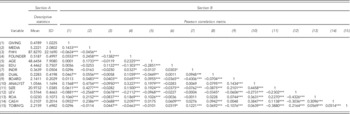
Section A of Table 1 reports descriptive statistics of variables used in our study. As shown in Section A in Table 1, GIVING, the dependent variable, has a mean value of 0.4789, implying that the amount of corporate philanthropy in Chinese family firms equals about 0.048% of sales revenue on average, which is comparable to the 0.04% and 0.06% in Brammer and Millington (Reference Brammer and Millington2008) and Ye and Zhang (Reference Ye and Zhang2011), respectively. The mean value of MEDIA is 5.2221, suggesting that the average number of media coverage is about 184.32 (e5.2221−1) for Chinese family firms. The mean value of FHHI is 87.8270, implying that the average ownership concentration among family members is about 87.83%.
Descriptive statistics and Pearson correlation matrix

Note. ***, **, and * represent the 1%, 5%, and 10% levels of significance, respectively.
For Chinese family firms, descriptive statistics of control variables reveal that about 51.87% founder entrepreneurs (FOUNDER) serve as chairmen, the age of chairmen (AGE) is about 48.6454 on average, the average educational level of chairmen (EDU) is 4.4462, the same person serves as CEO and chairman (DUAL) for 22.83% of Chinese family firms, the average board size (BOARD) includes about 8.51 directors (e2.1411), the average number of analyst coverage (ANALYST) is about 1.87 (e1.0546−1), the average firm size (SIZE) is about 1.28 billion RMB (e20.9732), the average financial leverage ratio (LEV) is about 57.64%, the average accounting performance (ROA) is about 2.30%, the cash ratio (CASH) is 21.07% on average, and the average TOBIN’Q (corporate growth opportunity) is about 2.2159.
Pearson correlation analysis
Section B in Table 1 presents results of Pearson correlation analysis of variables used in our study. The following findings are noteworthy: (1) GIVING is significantly positively correlated with MEDIA at the 1% level, suggesting that media coverage plays an important role in enhancing corporate philanthropy and providing preliminary support for Hypothesis 1. (2) The correlation coefficient between GIVING and FHHI is negative and significant at the 1% level, suggesting that higher ownership concentration among family members results in significantly lower level of corporate philanthropy. (3) MEDIA is significantly negatively correlated with FHHI at the 5% level. Above results, taken together, suggest that we should examine interactions between media coverage and family ownership on corporate philanthropic giving.
As for Pearson correlation between GIVING and control variables, GIVING displays significantly positive correlations with FOUNDER, DUAL, ANALYST, SIZE, ROA, and CASH, and GIVING is significantly negatively correlated with LEV. These results suggest a need to control for these variables when examining the influence of media coverage on corporate philanthropy. Finally, as expected, the coefficients of pair-wise correlation among other control variables are generally low, suggesting no serious multi-collinearity problem exists when they are included together in multivariate regressions.
Empirical Results
Multivariate tests of Hypotheses 1 and 2
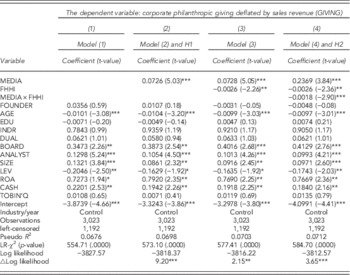
By four step-by-step Tobit regressions, Table 2 provides results of corporate philanthropic giving on media coverage, family ownership, and other determinants. All reported t-statistics are based on standard errors adjusted for clustering at the firm level and the year level (Petersen, Reference Petersen2009). As noted in Table 2, all models are highly significant. Furthermore, four step-by-step Tobit regressions display gradually increasing explanatory power with significantly higher Log likelihood values (see ‘△Log likelihood’).
Regression results of corporate philanthropic giving on media coverage, family ownership, and other determinants

Notes. ***,**, and * represent the 1%, 5%, and 10% levels of significance, respectively, for two-tailed tests. All reported t-statistics are based on standard errors adjusted for clustering at the firm level and the year level (Petersen, Reference Petersen2009).
First, Model (1) addresses the influence of control variables on corporate philanthropy. Tobit regression results in Column (1) reveal the following aspects. (1) The coefficient on AGE is negative and significant at the 1% level (−0.0101 with t=−3.08), suggesting the negative association between the age of chairman and the level of corporate philanthropy. (2) BOARD has a significant positive coefficient (0.3473 with t=2.26), implying that larger board size can enhance corporate philanthropy to a greater extent. (3) The coefficient on ANALYST is positive and significant at the 1% level (0.1298 with t=5.24), meaning that high analyst coverage can result in higher level of corporate philanthropic giving. (4) SIZE has a significant and positive coefficient (0.1321 with t=3.84), indicating that larger-scale enterprises always have higher level of corporate philanthropy than smaller-scale enterprises. This result is consistent with Zhang et al. (Reference Zhang, Zhu, Yue and Zhu2010). (5) The coefficient on LEV is negative and significant (−0.2046 with t=−2.50), implying the negative relation between financial leverage and the level of corporate philanthropy. This result echoes findings in Brammer and Millington (Reference Brammer and Millington2005), Du (Reference Du2013), and Zhang et al. (Reference Zhang, Zhu, Yue and Zhu2010). (6) ROA has a significant and positive coefficient (0.7273 with t=1.94), suggesting that firms with better accounting performance are inclined to carry out corporate philanthropy than firms with worse accounting performance. (7) The coefficient on CASH is positive and significant at the 5% level (0.2201 with t=2.53), consistent with Zhang et al. (Reference Zhang, Zhu, Yue and Zhu2010).
Second, Model (2) displays the influence of media coverage on corporate philanthropy after considering other control variables, and thus tests Hypothesis 1, which predicts that media coverage is positively associated with corporate philanthropic giving. As shown in Column (2), the coefficient on MEDIA is positive and highly significant at the 1% level (0.0726 with t=5.03), providing important and strong support to Hypothesis 1. Moreover, this result also suggests the following aspects. (1) The level of corporate philanthropy is significantly higher for firms with high media coverage than for firms with low media coverage, authenticating the positive association between media coverage and corporate philanthropy. (2) The coefficient estimate on MEDIA suggests that corporate philanthropic giving increases by about 7.26% when the number of media coverage increases by one unit. (3) The coefficient estimate on MEDIA also means that corporate philanthropy increases by about 31.54% of the mean value of GIVING (0.4789) accompanying with one standard deviation increase in MEDIA. Obviously, this coefficient estimate is economically significant, in addition to its statistical significance.
Third, Model (3) addresses the concerns about the influence of media coverage on corporate philanthropy after incorporating the moderating variable of ownership concentration among family members (i.e., FHHI) and all control variables. As shown in Column (3), the coefficient on MEDIA is still highly significantly positive (0.0728 with t=5.05), providing additional support to Hypothesis 1. In addition, FHHI, the moderating variable, has a significant and negative coefficient (−0.0026 with t=−2.26), consistent with theoretical expectation and suggesting that higher ownership concentration among family members will lead to significantly lower level of corporate philanthropy.
Finally, Model (4) provides regression results of corporate philanthropy on media coverage (MEDIA), family ownership (i.e., FHHI), the interaction (MEDIA×FHHI), and other determinants, and thus tests Hypothesis 2, which predicts that ownership concentration among family members attenuates the positive association between media coverage and corporate philanthropic giving. As shown in Column (4), the coefficients on MEDIA and FHHI are significantly positive and significantly negative (0.2369 with t=3.84 and −0.0026 with t=−2.36), providing strong support to Hypothesis 1 again and consistent with finding in Column (3), respectively. More importantly, the coefficient on MEDIA×FHHI is negative and significant at the 1% level (−0.0018 with t=−2.90), providing important support to Hypothesis 2.
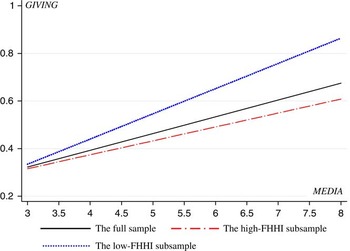
Moreover, Figure 1 shows the interaction between media coverage (MEDIA) and ownership concentration among family members (FHHI) on corporate philanthropy. In Figure 1, the black, red, and blue lines denote the influence of media coverage on corporate philanthropy for the full sample, the high-FHHI sub-sample, and the low-FHHI sub-sample, respectively. Specifically, Figure 1 displays obvious tendencies that the positive association between media coverage and corporate philanthropy is less pronounced for the high-FHHI sub-sample (red line) than for low-FHHI sub-sample (blue line).
The interaction between media coverage (MEDIA) and family ownership (FHHI) on corporate philanthropic giving (GIVING). The black line (——), the red line ( ), and blue line (
 ) denote the influence of media coverage on corporate philanthropic giving for the full sample, the high-FHHI sub-sample, and the low-FHHI sub-sample, respectively

Robustness checks of Hypotheses 1 and 2 using different dependent variables
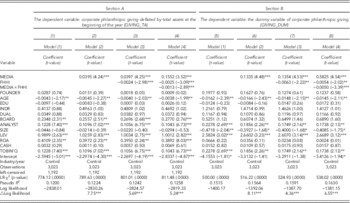
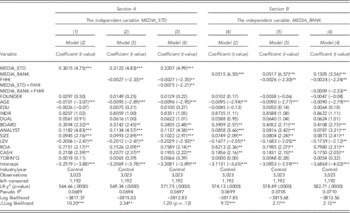
In Table 3, we conduct two sets of four step-by-step Tobit and Logistic regressions to re-examine Hypotheses 1 and 2. In Columns (1)–(4), the dependent variable is the amount of corporate philanthropic giving deflated by total assets at the beginning of the year (GIVING_TA) (Brown, Helland, & Smith, Reference Brown, Helland and Smith2006; Amato & Amato, Reference Amato and Amato2007, Reference Amato and Amato2012). In Columns (5)–(8), the dependent variable is the dummy variable of corporate philanthropy (GIVING_DUM), equaling 1 if the amount of a family firm’s philanthropic giving is greater than the mean value of GIVING (by year and industry) and 0 otherwise.
Robustness checks of Hypotheses 1 and 2 using different dependent variables

Notes. ***,**, and * represent the 1%, 5%, and 10% levels of significance, respectively, for two-tailed tests. All reported t-statistics are based on standard errors adjusted for clustering at the firm level and the year level (Petersen, Reference Petersen2009).
First, results in Columns (1)–(4) display the following aspects. (1) Results of Model (1) in Column (1) show that GIVING_TA is significantly negatively related with AGE and is significantly positively associated with BOARD, ANALYST, LEV, ROA, and TOBIN’Q, respectively. (2) For Model (2) and results in Column (2), the coefficient on MEDIA is positive and significant at the 1% level (0.0395 with t=4.24), providing strong support to Hypothesis 1 again. (3) Results of Model (3) in Column (3) show that MEDIA has still a significantly positive coefficient (0.0397 with t=4.25) after incorporating the moderating variable of FHHI. (4) Results of Model (4) in Column (4) show that the coefficient on MEDIA is positive and significant (0.1552 with t=3.52), consistent with Hypothesis 1. Moreover, FHHI has a significantly negative coefficient, consistent with theoretical expectation and findings in Table 2. More importantly, the coefficient on MEDIA×FHHI is negative and significant at the 1% level (−0.0013 with t=−2.89), providing additional and important support to Hypothesis 2.
Second, results in Columns (5)–(8) reveal the following findings. (1) Results of Model (1) in Column (5) show that GIVING_DUM is significantly negatively associated with AGE and SIZE, and is significantly positively associated with ANALYST, LEV, and TOBIN’Q, respectively. (2) For Model (2) and results in Column (6), there is significantly positive association between GIVING_DUM and MEDIA (0.1335 with t=4.48), providing additional support to Hypothesis 1. (3) Results of Model (3) in Column (7) display the significantly positive relation between GIVING_DUM and MEDIA (0.1354 with t=4.53) after incorporating the moderating variable of FHHI. (4) Results of Model (4) in Column (8) show that the coefficients on MEDIA and MEDIA×FHHI are significantly positive (0.5825 with t=4.54) and significantly negative (−0.0050 with t=−3.39), providing additional support to Hypotheses 1 and 2, respectively. In addition, the coefficient on FHHI is significantly negative (−0.0054 with t=−2.02).
Above results, taken together, suggest that our findings in Table 3 are qualitatively similar to those in Table 2 after using different dependent variables.
Robustness checks of Hypotheses 1 and 2 using different independent variables
In Table 4, we conduct two sets of three step-by-step Tobit regressions to re-examine Hypotheses 1 and 2. In Columns (1)–(3) and Columns (4)–(6), the independent variables are MEDIA_STD and MEDIA_RANK, respectively. MEDIA_STD is the standardized media coverage, measured as (the number of a family firm’s media coverage−the minimum value of MEDIA)/(the maximum value of MEDIA−the minimum value of MEDIA). MEDIA_RANK is the rank of media coverage, measured as 1, 2, 3, …, and 10 for the first 10%, the second 10%, the third 10% …, and the tenth 10%, respectively.
Robustness checks of Hypotheses 1 and 2 using different independent variables

Notes. ***,**, and * represent the 1%, 5%, and 10% levels of significance, respectively, for two-tailed tests. All reported t-statistics are based on standard errors adjusted for clustering at the firm level and the year level (Petersen, Reference Petersen2009).
First, results in Columns (1)–(3) reveal the following aspects:Footnote 9 (1) results of Model (2) in Column (1) show that GIVING is significantly positively related with MEDIA_STD, consistent with Hypothesis 1. (2) For Model (3) and results in Column (2), we find out the significantly positive coefficient on MEDIA_STD after incorporating FHHI, which is significantly negatively associated with GIVING. (3) Results of Model (4) in Column (3) show that the coefficients on MEDIA_STD and MEDIA_STD×FHHI are significantly positive and significantly negative, consistent with Hypotheses 1 and 2, respectively.
Second, results in Columns (4)–(6) indicate: (1) results of Model (2) in Column (4) reveal that GIVING is significantly positively related with MEDIA_RANK, providing additional support to Hypothesis 1. (2) Results of Model (3) in Column (5) display the positive and significant relation between GIVING and MEDIA_RANK after considering the influence of FHHI. (3) Results of Model (4) in Column (6) indicate the coefficients on MEDIA_RANK and MEDIA_RANK×FHHI are significantly positive and significantly negative, providing strong support to Hypotheses 1 and 2, respectively.
Above results, taken together, suggest that our findings in Table 4 are qualitatively similar to those in Table 2 using different independent variables.
Discussion on the potential endogeneity between media coverage and corporate philanthropy
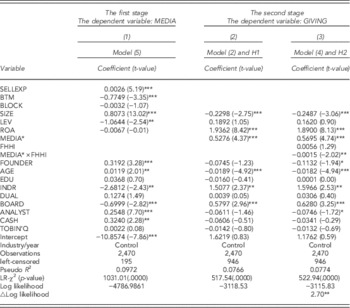
Following Wang and Ye (Reference Wang and Ye2015), we use the two-stage Tobit-Tobit regression procedures to mitigate the potential endogeneity between media coverage and corporate philanthropy. In doing so, we must estimate the relation between corporate philanthropy and media coverage in the simultaneous setting. Specifically, we estimate the first-stage regression (see Model (5) in Table 5) including the following instrument variables:Footnote 10 (1) SELLEXP, advertising expense scaled by sales revenue in the year (Zhang et al., Reference Zhang, Zhu, Yue and Zhu2010; Ye & Zhang, Reference Ye and Zhang2011; Wang & Ye, Reference Wang and Ye2015).Footnote 11 We use SELLEXP as the instrument variable because Miller (Reference Miller2006) finds that media coverage is positively associated with a firm’s advertising expenditure. (2) BTM, calculated as the ratio of book-to-market value of equity. (3) BLOCK, measured as the percentage of shares held by the controlling shareholder. (4) SIZE, the natural logarithm of total assets. (5) LEV, the ratio of total liabilities to total assets. (6) ROA, net income deflated by total assets. As a result of considering the potential endogeneity, the number of observations reduces from 3,023 to 2,470.
Regression results of Hypotheses 1 and 2 considering the potential endogeneity between media coverage and corporate philanthropic giving

Notes. ***,**, and * represent the 1%, 5%, and 10% levels of significance, respectively, for two-tailed tests. All reported t-statistics are based on standard errors adjusted for clustering at the firm level and the year level (Petersen, Reference Petersen2009).
In the first-stage regression [Column (1) and Model (5)], the coefficient on SELLEXP is positive and significant at the 1% level (0.0026 with t=5.19). This result reveals that media coverage is positively associated with advertising expenditure, consistent with Miller (Reference Miller2006), Wang and Ye (Reference Wang and Ye2015), and Ye and Zhang (Reference Ye and Zhang2011). Moreover, the coefficients on BTM, SIZE, and LEV are significantly negative, positive, and negative, respectively, consistent with findings in the study by Wang and Ye (Reference Wang and Ye2015).
In the second-stage regressions [Columns (2) and (3)], we provide results of corporate philanthropy on MEDIA* (the predicted value of MEDIA from the first-stage regression), FHHI, and other determinants, and find that Hypotheses 1 and 2 are still supported after considering the endogeneity between media coverage and corporate philanthropy. Specifically, in Column (2) and Model (2), the coefficient on MEDIA* is positive and significant at the 1% level (0.5276 with t=4.37), consistent with Hypothesis 1. Moreover, in Column (3) and Model (4), the coefficient on MEDIA*×FHHI is significantly negative, providing additional and strong support to Hypothesis 2.
Overall, after controlling for the potential endogeneity between media coverage and corporate philanthropic giving, findings in Table 5 do not alter our findings in Table 2.
Additional tests of the timing sequencing between the nature of media coverage and corporate philanthropy
Next, we further try to differentiate positive media coverage from negative media coverage and examine the timing sequencing between the nature of media coverage and corporate philanthropy.
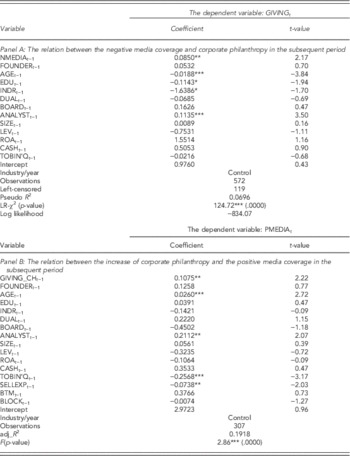
Specifically, in Panel A of Table 6, the dependent variable is corporate philanthropy in year t and the independent variable is negative media coverage in year t−1 with the label of NMEDIA t−1, respectively. As shown in Panel A of Table 6, the coefficient on NMEDIA t−1 is positive and significant at the 5% level (0.0850 with t=2.17), suggesting that negative media coverage in year t−1 leads to the increasing of corporate philanthropy in year t.
The timing sequencing between the nature of media coverage and corporate philanthropy

Notes. ***,**, and * represent the 1%, 5%, and 10% levels of significance, respectively, for two-tailed tests. All reported t-statistics are based on standard errors adjusted for clustering at the firm level and the year level (Petersen, Reference Petersen2009).
In Panel B of Table 6, the dependent variable is positive media coverage with the label of PMEDIA t and the independent variable is the increase of corporate philanthropy between year t−1 and year t−2 with the label of GIVING_CH t−1, respectively. As Panel B of Table 6 shows, the coefficient on GIVING_CH t−1 is positive and significant at the 5% level (0.1075 with t=2.22), implying that the increase of corporate philanthropy in previous years attracts more positive media coverage in this year.
Overall, results in Table 6, taken together, reveal that the nature of media coverage impacts different timing relations between media coverage and corporate philanthropy.
Additional tests using sub-sample tests
To further address the moderating role of family ownership on the positive association between media coverage and corporate philanthropy, we conduct additional sub-sample tests.
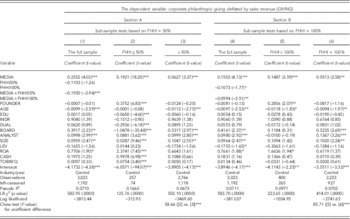
First, we divide our full sample into two sub-samples: the sub-sample with FHHI>50% and the sub-sample with FHHI≤50%. As shown in Columns (2) and (3) of Table 7, the coefficients on MEDIA in both the sub-sample with FHHI≤50% and the sub-sample with FHHI>50% are positive and significant at the 1% level (0.1921 with t=18.20 and 0.0627 with t=3.37), but Chow-test result for difference in coefficients reveals that MEDIA has significantly higher coefficient in the sub-sample with FHHI≤50% than that in the sub-sample with FHHI>50% (F-value=58.66). Moreover, we introduce a dummy variable of FHHI50% and then examine the interactive effects between media coverage and FHHI50% on corporate philanthropy. FHHI50% is a dummy variable, equaling 1 if ownership concentration within family members is >50% and 0 otherwise. Results in Column (1) of Table 7 show that MEDIA×FHHI50% has a significantly negative coefficient (−0.1930 with t=−2.94), validating Hypothesis 2 and echoing results of sub-sample tests.
Additional tests considering different family ownership

Notes. ***,**, and * represent the 1%, 5%, and 10% levels of significance, respectively, for two-tailed tests. All reported t-statistics are based on standard errors adjusted for clustering at the firm level and the year level (Petersen, Reference Petersen2009).
Second, we divide our full sample into two sub-samples: the sub-sample with FHHI<100% and the sub-sample with FHHI=100%. As shown in Columns (5) and (6) of Table 7, the coefficients on MEDIA in both the sub-sample with FHHI<100% and the sub-sample with FHHI=100% are significantly positive (0.1487 with t=3.59 and 0.0513 with t=2.58, respectively), but Chow-test result for difference in coefficients reveals that MEDIA has significantly higher coefficient in the sub-sample with FHHI<100% than that in the sub-sample with FHHI=100% (F-value=85.71). In addition, an additional dummy variable of FHHI100% is constructed to examine the interactive effects between media coverage and FHHI100% on corporate philanthropy. FHHI100% is a dummy variable, equaling 1 if ownership concentration within family members is 100% and 0 otherwise. Results in Column (4) of Table 7 show that the coefficient on MEDIA×FHHI100% is negative and significant at the 5% level (−0.0994 with t=−2.51), consistent with Hypothesis 2 again.
Discussions
Using a sample of Chinese family firms, this study addresses the influence of media coverage as an important informal system on corporate philanthropy and further examines the moderating role of family ownership. Next, we summarize theoretical contributions, managerial implications, limitations of our study as below.
Theoretical contributions
Our study contributes to the existing literature in several ways. First, to our knowledge and literature in hand, this study is one of very few studies, if it is not the first one, to empirically investigate the influence of media coverage on corporate philanthropy in an emerging market. Extant studies have recognized the roles of monitoring (watchdog) and information intermediary played by the media and their respective influence on a variety of corporate behavior such as cross-section stock returns and firm valuation (Miller, Reference Miller2006; Dyck, Volchkova, & Zingales, Reference Dyck, Volchkova and Zingales2008; Fang & Peress, Reference Fang and Peress2009; Joe, Louis, & Robinson, Reference Joe, Louis and Robinson2009; Bushee et al., Reference Bushee, Core, Guay and Hamm2010; Wang & Ye, Reference Wang and Ye2015), but provide insufficient evidence on the influence of media coverage on specific CSR dimensions such as corporate philanthropy and environmental performance. In this study, we extend previous literature about the impacts of media coverage on corporate behavior in general by examining whether and how media coverage influences corporate philanthropy. The findings support our prediction that media coverage positively impacts corporate philanthropy.
Second, our study adds to the existing literature (Baron, Reference Baron2005; Miller, Reference Miller2006; Dyck, Volchkova, & Zingales, Reference Dyck, Volchkova and Zingales2008; Joe, Louis, & Robinson, Reference Joe, Louis and Robinson2009; Bushee et al., Reference Bushee, Core, Guay and Hamm2010; Wang & Ye, Reference Wang and Ye2015) by providing systematic evidence on the important role of media coverage in strengthening business ethics and motivating corporate philanthropy. Previous studies focus mainly on the impacts of formal institutions such as corporate governance, firm-specific financial characteristics, and manager-specific characteristics on corporate philanthropic giving (e.g., McGuire, Sundgren, & Schneeweis, Reference McGuire, Sundgren and Schneeweis1988; Johnson & Greening, Reference Johnson and Greening1999; Brammer & Millington, Reference Brammer and Millington2006, and so on), but very rare literature addresses the concerns about whether and how media coverage influences corporate philanthropy. In this regard, our study provides additional and important evidence to show that media coverage can evoke a firm’s philanthropic consciousness and thus upgrade the level of corporate philanthropy. Moreover, our study can lend important support to arguments in extant studies that some informal systems can serve as alternative mechanisms to formal institutions and play their important roles in corporate philanthropy and other corporate behavior (North, Reference North1990; Williamson, Reference Williamson2000; Allen, Qian, & Qian, Reference Allen, Qian and Qian2005; Du, Reference Du2013).
Third, our findings can lend support to the arguments in extant literature (Oliver, Reference Oliver1991; Mitchell, Agle, & Wood, Reference Mitchell, Agle and Wood1997; Marquis, Glynn, & Davis, Reference Marquis, Glynn and Davis2007; Jamali, Reference Jamali2008), the institutional theory, and the instrumental stakeholder theory to some extent. For example, Marquis, Glynn, and Davis (Reference Marquis, Glynn and Davis2007) argue the influence of institutional pressures at the community level on corporate social activities. Our findings support Marquis, Glynn, and Davis’s (Reference Marquis, Glynn and Davis2007) argument because media coverage shapes philanthropic atmosphere or common knowledge within a community, which can serve as a cultural cognition to motivate corporate philanthropy for firms located in the same community. Oliver (Reference Oliver1991) indicates the impacts of institutionalization in organizational environment on corporate social behavior. Considering media coverage as an important change of organizational environment, our study provides supporting evidence to Oliver’s (Reference Oliver1991) argument by validating the positive influence of media coverage on corporate philanthropy. The media strengthens stakeholder power and the urgency of a claim, which urges a firm to address the concerns from stakeholder including accumulating positive moral capital by corporate philanthropy in order to offset the potential negative events. In this regard, our study can lend some support to Mitchell, Agle, and Wood’s (Reference Mitchell, Agle and Wood1997) theory of stakeholder identification and salience. Moreover, instrumental stakeholder theory attaches the importance to identify a variety of stakeholders (Jamali, Reference Jamali2008). The media includes various opinions from a variety of stakeholders and thus media coverage compels a firm to respect different demands from various stakeholders. Therefore, our findings about the positive association between media coverage and corporate philanthropy echo Jamali’s (Reference Jamali2008) argument and the instrumental stakeholder theory.
Fourth, our study finds the moderating role of family ownership in the association between media coverage and corporate philanthropic giving. In previous studies, ownership concentration has been recognized as an important determinant of corporate philanthropy (e.g., Roberts, Reference Roberts1992; Wang & Coffey, Reference Wang and Coffey1992; Johnson & Greening, Reference Johnson and Greening1999; Baskin, Reference Baskin2006; Chu, Reference Chu2011, and so on), but few studies further address its moderating effects. Drawing on the institutional theory and the instrumental stakeholder theory, we predict the positive association between media coverage and corporate philanthropy, but agency theory suggests that corporate philanthropy runs counter to the interests of shareholders (Jensen & Meckling, Reference Jensen and Meckling1976). Therefore, it is necessary to further investigate the interactive effects between stakeholder theory and agency theory on corporate philanthropic giving. Our study examines the moderating role of family ownership and finds that family ownership attenuates the positive association between media coverage and corporate philanthropy.
Fifth, a branch of very thin previous literature has addressed the media’s impacts on CSR, but our study uses a sample of Chinese family firms to examine the impact of media coverage on corporate philanthropy. CSR is a multi-dimensional concept and includes corporate philanthropy, employee relation, product quality, environmental responsibility, and so forth. Although some prior studies employ corporate philanthropy as the proxy for CSR, recent studies (McWilliams & Siegel, Reference McWilliams and Siegel2000; Caulkin, Reference Caulkin2002; Godfrey, Reference Godfrey2005; Chen, Patten, & Roberts, Reference Chen, Patten and Roberts2008; Koehn & Ueng, Reference Koehn and Ueng2010; Du, Reference Du2015) find that different CSR dimensions may be inherently inconsistent and even contradict in some cases. For example, Chen, Patten, and Roberts (Reference Chen, Patten and Roberts2008) find the positive association between corporate charitable contributions and its worse social performance such as low production quality and worse employee relation. Du (Reference Du2015) shows that corporate philanthropy is always used by Chinese family firms to cover the negative influence of their environmental violations that are fined. Moreover, Zyglidopoulos et al. (Reference Zyglidopoulos, Georgiadis, Carroll and Siegel2012) find a firm is inclined to carry out corporate philanthropy (a CSR-strength) rather than reduce its CSR-weakness such as environmental pollution. In this regard, findings between media coverage and CSR as a whole may not fit in well with specific CSR dimensions, and thus it is necessary to investigate the influence of media coverage on a variety of CSR dimensions. Our study focuses on corporate philanthropy, a specific CSR dimension, and finds the positive influence of media coverage on corporate philanthropy, and thus makes incremental contributions to the existing literature.
Moreover, based on the context of western countries, a branch of extant studies have recognized the media’s influence on corporate behavior (Djankov et al., Reference Djankov, Mcliesh, Nenova and Shleifer2003; Miller, Reference Miller2006; Tetlock, Reference Tetlock2007; Dyck, Volchkova, & Zingales, Reference Dyck, Volchkova and Zingales2008; Fang & Peress, Reference Fang and Peress2009). However, it is well-known that the media has been highly regulated for a long time in China (Wang and Ye, 2015). Therefore, it is an under-researched topic about whether and how the role played by the media in contemporary China is similar to that in western countries. As a result, our study finds that media coverage does exert positive influence on corporate philanthropy, which can inspire future research to further explore other economic consequence of media coverage.
Finally, we find that negative media coverage leads to the increasing of corporate philanthropy in the subsequent year, but the increase of corporate philanthropy in previous year attracts more positive media coverage in the year. These findings not only echo the argument about the inherent inconsistency among different CSR dimensions documented in extant studies (Godfrey, Reference Godfrey2005; Chen, Patten, & Roberts, Reference Chen, Patten and Roberts2008; Koehn & Ueng, Reference Koehn and Ueng2010; Du, Reference Du2015), but also contribute an additional and incremental motivation to interpret why firms carry out corporate philanthropy in emerging markets like China.
Managerial implications
Our findings have several managerial implications. First, our study provides systematical evidence to show that media coverage can strengthen the level of corporate philanthropy. This finding suggests that media coverage can serve as an alternative mechanism to positively impact corporate philanthropy, especially under the context of developing countries like China where the consciousness of CSR is weak, business ethics are under construction, and formal institutions are incomplete.
Second, using a sample of Chinese family firms, our study authenticates that media coverage can play its important roles in strengthening corporate philanthropy in emerging markets like China where media has been highly controlled by central and local governments. This finding can reverse unfavorable impression on freedom of the media in China to some extent, which is held by some Western scholars. Admittedly, the freedom of the media in China is far from optimistic, but our findings display at least that media coverage is playing its gradually increasing roles of corporate governance and information intermediary, and thus the influence of media coverage on corporate philanthropic giving as well as corporate behavior in general is worth expecting.
Third, we find that family ownership attenuates the positive association between media coverage and corporate philanthropy, which implies that internal corporate governance mechanisms and informal systems (media coverage in our study) may have interactive effects on corporate philanthropy. Therefore, our study reveals that formal institutions and informal systems should be considered equally, and they jointly impact corporate philanthropic giving.
Finally, we further find the chronological order between the nature of media coverage and corporate philanthropy. Specifically, the increase of corporate philanthropy in previous year attracts more positive media coverage in the year but negative media coverage leads to the increasing of corporate philanthropy in the subsequent year. These findings have important managerial implications as below: (1) these findings help the public, scholars, and investors to differentiate the potential causal relation between the nature of media coverage and corporate philanthropy. (2) These findings further imply that corporate philanthropy is not always an altruistic motivation and some firms carry out corporate philanthropy just for the purpose of counteracting the unfavorable influence from negative media coverage. In this regard, our study inspires investors and regulators to pay their close attention to the real motivation underlying corporate philanthropy.
Limitations and directions for future research
Our study, of course, has its limitations that may be addressed in future research. First, this study examines the influence of media coverage on corporate philanthropy using data collected based on ‘Baidu News Search Engine.’ Although our measure of media coverage has a lower likelihood of underestimating the intensity of media coverage, it may bring out a difficulty of exactly and clearly judging the attitude, tones or/and the tendentiousness of news reports. In this regard, we call on future research to jointly employ data on media coverage derived from two sources: (1) data on the strength of media coverage, measured as the number of media coverage; and (2) data on media coverage including tones, attitude, and tendentiousness. Second, in this study, we only investigate the impact of media coverage on corporate philanthropy, a particular CSR dimension, but we do not examine whether media coverage can influence other CSR dimensions such as corporate environmental performance, employee relations, production quality, and so on. Therefore, future research can further address whether and how media coverage asymmetrically influences different CSR dimensions using different contexts. Moreover, as Zyglidopoulos et al. (Reference Zyglidopoulos, Georgiadis, Carroll and Siegel2012) argue, CSR can be classified as CSR-strengths and CSR-weaknesses. In this regard, future research should differentiate CSR-strengths from CSR-weaknesses and further examine whether they can be influenced by media coverage. Finally, this study is conducted in the context of Chinese family firms, and thus findings in this study may not fit in well with other markets. As the response, future research can further examine the impacts of media coverage on corporate philanthropy in an international setting.
Conclusions
The main objective of this study is to explore whether and how media coverage, as an informal system, influences corporate philanthropy. Using a sample of Chinese family firms over the period of 2004–2010, we examine the impacts of media coverage on corporate philanthropy and then investigate the moderating effect of family ownership on the association between media coverage and corporate philanthropy. Our findings show that media coverage is significantly positively associated with corporate philanthropic giving, suggesting that media coverage plays an important role in motivating Chinese family firms to actively engage in corporate philanthropy. Moreover, our findings reveal that family ownership attenuates the positive association between media coverage and corporate philanthropic giving. After controlling for the potential endogeneity between media coverage and corporate philanthropy, above conclusions are still valid.
Acknowledgement
The authors appreciate constructive comments and valuable suggestion from Professor Peter Galvin (the Associate Editor) and anonymous reviewers. In addition, the authors thank Professors Jinhui Luo and Di Cai for generously providing the original data on media coverage. This article is sponsored by the National Natural Science Foundation of China (approval number: 71072053), the Key Project of Key Research Institute of Humanities and Social Science in Ministry of Education (approval number: 13JJD790027) and the Specialized Research Fund for the Doctoral Program of Higher Education of China (approval number: 20120121110007). Professor Yingjie Du acknowledges financial support from the Youth Project of Humanities and Social Science Research in Ministry of Education (13YJC790022).