How should political scientists assess government performance? One common benchmark is democratic accountability. Scholars evaluate the outcomes of the policy process by examining the correspondence between what governments do and what citizens say they want (Gilens Reference Gilens2012). A second approach is problem-solving. The question is whether government can respond to an evolving flow of societal challenges like poverty and climate change (Adler and Wilkerson 2012). Over the past three decades, Frank R. Baumgartner and Bryan D. Jones have made seminal contributions to the problem-solving perspective. Their research, grounded in their remarkable Policy Agendas database on government activity—a tremendous contribution to collective scholarship—has spawned a large number of studies of policy stability and change and rendered concepts like “policy punctuation” staples of the literature.
In their excellent book, The Politics of Information: Problem Definition and the Course of Public Policy in America, Baumgartner and Jones turn to the critical role of information in the detection and prioritization of problems. Information is defined broadly to refer not merely to statistical evidence, but also to qualitative information, beliefs that motivate professionals and indicators of constituent opinion. Information may relate to the existence and severity of problems or to the cost and feasibility of solutions. The book is a typical Baumgartner and Jones product: theoretically-engaging, deeply-researched, rich in insight. It encompasses a wide range of topics, from the rise and decline of policy analysis in the federal government, to changes in the jurisdictional structure of the congressional committee system, to the expansion and contraction of the issue agenda. Students of American politics, public policy, and public administration will all find much food for thought here. While every page is illuminating, the book does not resolve every important question about the use of information in American policymaking that could be posed. The book touches upon three fascinating issues that deserve to receive deeper attention: the barriers to evidence-based policymaking, the influence of partisan competition on the search process, and the politics of information suppression. By probing how institutions, polarization, and vested interests mediate the politics of problem-solving, the next generation of research can examine how information not only shapes cognitive processes, but also reflects and refracts power relations.
Baumgartner and Jones make three nice moves in the book. First, they distinguish between expert information and entropic information (“information as diversity”), each of which is applicable to different stages of the decision-making process. Expert information helps officials (1) determine whether particular solutions fit problems, and (2) break apart problems to understand their component parts. Entropic information—the perspectives generated by the diversity of actors in society—helps leaders determine which of the many potential problems facing the country warrant attention. Second, Baumgartner and Jones differentiate between “engineering” problems like providing clean water (which are well understood and have known solutions) and “complex” problems like poverty (where policymakers may not even understand the nature of the problem, much less know of an effective solution). Finally, the authors distinguish between the growth of government as “thickening” (when government adds new elements to existing programs) and as “broadening” (when government takes on new tasks).
Of course, the messy real world of U.S. policymaking does not admit of such clean dichotomies. Expertise (such as microeconomic research on the magnitude of the deadweight losses associated with a market failure, a good proxy for the amount of harm a problem is causing society) is useful not only for problem detection, but also for priority setting. And the distinction between “complex” and “engineering” problems frequently reflects political considerations as much as underlying differences in knowledge and information. (Many experts would argue that climate change—seemingly a “complex” problem—has well-understood solutions, such as imposing a tax on carbon and using transfer payments or cuts in other taxes to mitigate the distributional effects). Nonetheless, these distinctions generate real insight. The analysis of the broadening and thickening dimensions of government growth—which is supported by a review of empirical trends in government activity—is particularly fresh and illuminating.
While The Politics of Information is not a polemic, it packs a punch. The core argument is that there is a tradeoff between too little and too much information in government. The better the performance of the government’s information-processing mechanisms, the greater the diversity of views government absorbs, the more likely public policy problems will be detected. Yet the more problems are discovered, the more government programs expand—and the more difficulty administrators will have implementing solutions. Too little information allows problems to fester, but too much may generate cognitive overload. Policymakers thus need to manage the tension between the benefits of information and the benefits of clarity and control. Baumgartner and Jones call this tension the paradox of search. How this tension plays out is shown to vary over time. Between the late 1950s and the late 1970s, the capacity of American national government to detect problems expanded. Congressional committees became more active and the policy analysis capability of government was bolstered. As these search processes improved, government became more likely to enact new programs. Since the 1980s, the general growth in the size of government and the strengthening of the government’s information-processing mechanisms have stagnated or reserved.
For the most part, Baumgartner and Jones investigate macropolitcial trends, yet they recognize that developments at the micro and meso levels also require examination: “By taking on such a broad set of observations, the patterns we observe as well as the explanations we develop for them will be very general. It will fall to us in other projects and to others in the future to delve into some of these arguments in greater detail, exploring how they manifest themselves in detail during the day-to-day or year-to-year functioning of individual policy domains, agencies, and policy communities, and to understanding the role of individual leaders in pushing the system in this or that direction” (p. xi). I would nominate three topics for additional study.
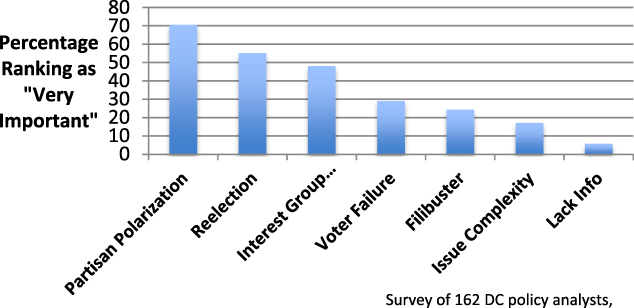
First, scholars should probe the conditions under which different actors will not just receive good information, but actually use it. Justin Peck and I surveyed more than 150 Washington-based professional policy analysts about the performance of Congress. Overwhelmingly—and consistent with Baumgartner and Jones’s central finding—these experts told us that Congress is awash in information. Asked what factors impede congressional performance, only six percent of survey respondents said that lack of information is a very important reason for Congress’s failure as a problem-solving institution. Experts were far more likely to point to partisan polarization (71%), lawmakers focused on their own reelections (55%), and interest group pressure (48%) as reasons for Congress’s poor performance (Figure 1).
Factors Impeding Congressional Performance
Source: Patashnik and Peck (Reference Patashnik, Peck, Gerber and Schickler2016).

Yet this does not mean—and Baumgartner and Jones certainly do not suggest otherwise—that Congress always acts on information or even that it weighs higher-quality or more systematic information more heavily than lower-quality or more impressionistic information. 65 percent of the policy analysts in our survey said that Congress has done a poor job over the past ten years in making policy decisions on the basis of objective evidence. To make our inquiry more concrete, we asked the policy analysts to reflect on the following scenario: What if a prestigious academic journal published a research study showing that a federal transportation program is highly cost-ineffective, meaning that it would be possible to achieve the same transportation benefits at much lower cost, or to spend the same amount of money while generating much larger transportation benefits. How likely is it that the chairs of the congressional committees with jurisdiction over the program would become aware of the study? About half of the experts (46%) were very or somewhat confident that committee chairs would indeed become aware the study. Just 4 percent of experts were very or somewhat confident that Congress would makes a serious attempt to replace the transportation program with a more cost-effective approach, however. While we did not pose a follow-up question as to why respondents believed that Congress would fail to act on the information, we suspect the most likely answer is that powerful interests groups have a stake in the preservation of existing policy arrangements (see Moe Reference Moe2015), which Congress would be reluctant to upset.
A second topic for study is whether problem search is partisan. One strategy available to Republicans who are opposed to government growth is to gum up the search process; as the authors write, “if government does not search for problems, it cannot propose government solutions to them” (p. 171). In tracing the rise and decline of the federal government’s search mechanisms since the 1980s, Baumgartner and Jones note that Ronald Reagan’s ideological presidency weakened the bipartisan commitment to systematic analysis in the executive branch. In the mid 1990s, the new Republican congressional majority under Speaker Newt Gingrich took steps (including the elimination of the Office of Technology Assessment) to scale back policy analysis capability in Congress. Yet it would be too blunt to say that facilitating (constraining) the overall search process is only of interest to Democrats (Republicans). The authors note that some conservative Republicans have called for rebuilding the capacity for policy analysis in the legislative branch, recognizing that it is impossible to identify government waste without good information about how programs are working. And Democrats have now always welcomed better information about foreign threats or the costs of regulation on business. Conflicts over whether an agency, congressional committee, or government agency should conduct a study or release a report are rooted not only in sincere disagreement over the proper role of the state, but also in the strategic competition for power. As Frances E. Lee observes, legislators are well aware that “information is a powerful weapon” (2009, p. 121). Information can favor one side or the other in a partisan debate and influence media narratives and policy agendas. Hence congressional votes on the release of information tend to be either noncontroversial (when party interests are not at stake) or highly contentious on partisan lines (Lee 2009).
A final issue concerns the politics of information suppression. Good information can expose the weaknesses of politicians’ positions and activate diffuse interests, but for this very reason, information is not neutral. The powerful economic actors who benefit from the status quo can use their political resources (campaign money, prestige, connections to officeholders) to deny or distort information that threatens their interests. Baumgartner and Jones recognize this possibility, but they argue that it is “unlikely that the system is that crass” (p. 196). I am less sanguine. To be sure, there are limits on the extent to which actors can censor information. For example, during the 1970s, the airline industry (which at the time was sheltered from free market competition) was powerless to stop the dissemination of microeconomic research showing that consumers were paying higher prices than they would under a deregulated system (Derthick and Quirk Reference Detrick and Quirk1985). The central finding from Baumgartner and Jones’s overall body of work is that policy subsystems are often more vulnerable to change than they appear. Yet the scope and durability of this change is bounded (Patashnik Reference Patashnik2008), and powerful organizational actors may have the capacity to constrain the generation and use of information harmful to their interests.
My current research on efforts to promote evidence-based medicine as a way to improve healthcare quality and curb wasteful spending, for example, shows that medical societies and drug companies frequently seek to discredit peer-reviewed medical studies that challenge the efficacy of profitable treatments. These actors actively lobby the federal government to prevent Medicare officials from incorporating this information in their coverage and payment decisions (Gerber and Patashnik Reference Gerber and Patashnik2006; Gerber, Patashnik and Dowling, n.d.). To be sure, the need for objective information about the relative benefits, costs and risks of treatment alternatives—a public good that the market will not supply at the socially optimal level—has not gone unrecognized. The Agency for Health Care Policy and Research was created in 1989 to coordinate such health services research. But after the agency issued a report concluding that there was no evidence to support the routine use of spinal-fusion surgery, strong opposition from back surgeons led Congress to slash the agency’s funding and curb its authority. The Affordable Care Act tries to fill this information gap by creating a new independent, nonprofit, nongovernmental organization (the Patient-Centered Outcomes Research Institute) to investigate what really works in health care, but as a result of special interest group lobbying and public fears of “rationing,” Congress rejected the use of cost-effectiveness analysis to aid Medicare coverage and reimbursement decisions (Gerber and Patashnik Reference Gerber and Patashnik2011). In sum, information is central not just to learning and discovery but also to the exercise of political power (Pierson Reference Pierson1994).