





Food insecurity is a complex determinant of health where structural and systemic factors create inequitable access to nutritious food, including by income, gender, disability, geographic region and race/ethnicity, among others(Reference Bowen, Elliott and Hardison-Moody1–Reference Hake, Dewey and Engelhard3). Across the US, rates of household food insecurity increased from 10·2 % in 2021 to 13·5 % in 2023(Reference Rabbitt, Hales and Burke4,Reference Rabbitt, Reed-Jones and Hales5) . For households with children, 17·9 %, or 6·5 million, were food insecure(Reference Rabbitt, Reed-Jones and Hales5). People experiencing food insecurity are likely to have nutritional insecurity or lower diet quality too(Reference Guenther, Juan and Lino6,Reference Tucker, Bresnahan and John7) .
Household food insecurity is associated with poor physical(Reference Mangini, Hayward and Zhu8,Reference Simonovich, Pineros-Leano and Ali9) and mental health(Reference Burke, Martini and Cayir10,Reference Gallegos, Eivers and Sondergeld11) for children and increases healthcare utilisation and costs for families(Reference Palakshappa, Garg and Peltz12). Indirect impacts, such as parental financial stress and worry about food access, may contribute to stressful home environments that impact psychological distress and childhood development(Reference Leung, Stewart and Portela-Parra13,Reference Pryor, Melchior and Avendano14) . Parents may need to choose between medical or other expenses and having enough food to feed their families(Reference Seligman, Levi and Adebiyi15,Reference Herman, Afulani and Coleman-Jensen16) . With increasing rates of food insecurity and negative associated outcomes, this is a significant public health concern(17).
Interventions to address food insecurity
While federal policy changes may alter long-standing food support systems, the US Government offers food assistance programs, including the Women, Infants and Children program and the Supplemental Nutrition Assistance Program(Reference Bleich and Dean18). Community-based programs also offer support with 7·1 % of households (including 9·5 % of children) receiving free food from food pantries and other programs, including backpack programs that distribute bags of donated food (e.g. mixed dishes such as macaroni and cheese; packaged snacks and fruits and vegetables) to students to increase food access(Reference Poole, Tucker and Adams19,Reference Rabbitt, Reed-Jones and Hales20) . About half of US public schools participated in weekend backpack programs in 2022(Reference Poole, Tucker and Adams19). Programs vary by local context, but all seek to address gaps in school food program reach during weekends and school breaks(Reference Burke, Cabili and Berman21–Reference Shanks and Harden23). Students are referred from school staff and have signs of food insecurity and/or hunger(Reference Poole, Tucker and Adams19). Backpack programs typically involve partnerships between schools, food banks and a local organisation (often faith-based)(Reference Burke, Cabili and Berman21).
Backpack program evaluations are often cross-sectional, descriptive or small-scale and show mixed results(Reference Burke, Cabili and Berman21,Reference Shanks and Harden23–Reference Kurtz, Conway and Mohr25) . One randomised controlled trial of school-based food support including backpacks reported a small decrease in the rate of very low food security and a small increase in food insecurity(Reference Burke, Cabili and Berman21). For other outcomes, an observational difference-in-difference study reported positive academic scores at schools providing backpacks(Reference Kurtz, Conway and Mohr25); another observational study reported better attendance on distribution days for participants compared with a waitlist(Reference Fiese, Gundersen and Koester24). Nutritional quality assessment of distributed food is limited. Two cross-sectional studies assessing food provided report Healthy Eating Index scores of 58·4(Reference Byker and Smith26) and 58·7 (on a scale of 1 to 100) that aligned with children’s average diets but were lower than average compared with food provided through National School Lunch Programs(Reference Poole, Tucker and Adams19). Charitable food organisations may struggle to offer fresh fruits, vegetables and other nutritious foods due to logistical barriers(Reference Bazerghi, McKay and Dunn27,Reference Schwartz and Caspi28) . With persistent household food insecurity and an opportunity to improve nutritional quality, alternative solutions are needed.
The Helping Hands Ending Hunger program
As part of our 2023 practice-based evidence project to identify promising programs emerging from the community as opposed to academe, the Helping Hands Ending Hunger (HHEH) program, a network of school-based food pantries in Georgia, was nominated and selected for an evaluability assessment and evaluation. Established in 2016, HHEH provides a school-based solution focused on the whole family to improve food access. In 2023, an average of one in five children in Georgia experienced hunger, and in some rural areas, this increases to one in three(Reference Dewey, Hilvers and Dawes29). To improve food security, HHEH developed a food rescue and distribution model for families of school-aged children. HHEH’s model reduces waste by encouraging students to rescue (i.e. triage) uneaten food, such as milk, juice, fruit and other unopened packaged items, from school meals. Students donate the food, instead of discarding, by placing it in designated cold and dry storage bins during breakfast and lunch periods. Following safety protocols approved by the Georgia Departments of Public Health and Education/School Nutrition, the food is inspected and stored in a school pantry. It is redistributed in reusable, food-safe, insulated bags to participating families, typically on Fridays, like backpack programs.
HHEH staff disseminate the model by providing schools with training, related educational resources and implementation support and management. In some cases, HHEH coordinates school pantry stocking with supplemental food from food banks and community vendors. Programming is flexible to permit adaptation to fit local needs. Initial program activities include raising funds to support start-up (e.g. by purchasing shelves and refrigerators) and program sustainability; identifying eligible families; recruiting school staff and student volunteers to coordinate the program and reporting school program data (e.g. number of families served; amount of food rescued and distributed) to HHEH staff.
In 2023, HHEH received multi-year funding from the American Heart Association to support these efforts with upgraded school pantry refrigeration, supplemental fresh produce and additional healthy living resources and education. Beyond American Heart Association support, schools purchase or receive donations of more supplemental food, including whole grains, dairy and proteins for complete meals. The rescued food, supplemental FV and other foods purchased and donated help create complete meals distributed in HHEH bags (see supplemental figure for logic model).
Being a practice-based intervention developed to fill a need within a local community suggests that the intervention is relevant and acceptable(Reference Ammerman, Smith and Calancie30). Over the years, it has expanded its reach and operations, with over 150 participating Georgia primary and secondary schools over time. As HHEH grows, understanding implementation experiences can inform sustainability and increase effectiveness of a practical, grassroots option for addressing nutritional food access. By using implementation science and evaluation approaches, we can develop practice-based evidence to guide future intervention development and testing(Reference Leeman, Rohweder and Lee31,Reference Green32) . The RE-AIM framework, which informed this evaluation, facilitates assessing implementation and focuses on five factors: reach, efficacy/effectiveness, adoption, implementation and maintenance(Reference Glasgow, Harden and Gaglio33). The overarching evaluation questions sought to answer: What are schools’ experiences implementing HHEH and how does implementing HHEH benefit families and schools? With a short-term evaluation period and supplemental American Heart Association support for fresh produce, we focused the analysis on implementation decisions, school-level impacts and family access to FV.
Methods
Study design and participants
We conducted a convergent parallel mixed-methods evaluation where we collected and analysed quantitative and qualitative data separately and integrated findings(Reference Crewsell and Plano Clark34). The quantitative data gathered feedback from families at two timepoints, whereas the qualitative data gathered detailed insights from program implementors. HHEH provided insight into data collection methods and materials. The evaluators were external to the program.
Schools and families eligible for the evaluation participated in HHEH’s American Heart Association pilot program aimed at increasing access to fresh FV by partnering with multiple vendors, including a local area food bank. All schools were Title 1 schools meaning they serve a high proportion of economically disadvantaged children(Reference Rubio, Grineski and Morales35), with a minimum 40 % of students eligible for free- or reduced-priced (FRP) school meals. Participating schools included nine elementary schools, one middle school and one high school.
Data collection
We administered a survey to learn about the families participating in the program and access to fresh FV. We collected survey data at the start of the pilot program (Winter 2023/2024, November–January) and at the end of the school year (Spring 2024, May–June). We invited all HHEH participating families at each school to respond to paper surveys. Schools coordinated survey dissemination to reach all participating families through multiple means, including placing them into food bags, hand delivering to parents and/or mailing. Participants returned completed surveys directly to program evaluators via pre-addressed, prepaid envelope. By return mail, they received a $15 gift card. We de-identified and entered all data into a secure Qualtrics database. For each school, we downloaded data about the number of students eligible for FRP school meals from Georgia’s Department of Early Care and Learning(36).
Two trained interviewers (RM and AH) conducted semi-structured interviews with key informants (KIs) about their experiences with the program (February and March 2024). KIs were defined as school representatives familiar with the program, which included school principals and teachers or school personnel who coordinated delivery of the program at the schools. With support from HHEH, we invited KIs from all eleven participating pilot schools for an interview; three schools did not participate. At three schools, two KIs participated in a joint interview, and at five schools one KI participated. Interviews lasted about 1 hour, occurred and were transcribed verbatim for analysis.
Data collection instruments
Family survey
A twenty-six-item family survey included a mix of closed- and open-ended questions. Topics included demographics, food security, health status and food access (details below). Two open-ended questions asked for HHEH-specific feedback. Most closed-ended questions were derived from previously used scales or instruments. Surveys were administered in English and Spanish.
Demographics
We asked about respondents’ age, sex, race or ethnicity, education-level, employment status, receipt of benefits and financial strain(37–39).
Food insecurity
Household food insecurity was assessed with an adapted two-item validated measure(Reference Hager, Quigg and Black40,Reference Gundersen, Engelhard and Crumbaugh41) . We adapted the measure to use a 6-month rather than 12-month time frame to account for the evaluation data collection period. Items asked whether respondents were worried about their food running out before getting money to buy more and whether the food they bought did not last and they did not have money to get more. Response options were ‘Never,’ ‘Sometimes’ and ‘Often.’ Respondents who answered sometimes or often to either item were categorised as food insecure. We added an adapted item with the same response options to ask specifically about their desire to buy more FV but not having money to get them. Lastly, we asked whether they ever had to choose between buying food and any of the following: paying for utilities, transportation, medical care or medication, housing or education(Reference Caspi, Davey and Barsness42).
Health status
We used a question from another evaluation to ask respondents to indicate yes or no to five items about whether a doctor had told anyone in their household that they have type 2 diabetes or high blood sugar; hypertension or high blood pressure; high cholesterol; heart disease or CVD or whether they should lose weight(Reference Caspi, Davey and Barsness42). We used one validated question to assess general health status that asked respondents to indicate whether their health is ‘excellent,’ ‘very good,’ ‘good,’ ‘fair’ or ‘poor(37).’ Responses were dichotomised into poor/fair and good/very good/excellent. We included a question asking about the health of the child receiving the HHEH bags, using the same response options and dichotomisation.
Fruit and vegetable inventory
We used a home food inventory assessment that has been previously administered and adapted from validated indices(Reference Kegler, Bundy and Hartman43,Reference Kegler, Howard and Bundy44) . For thirteen fruits and seventeen vegetables, respondents selected yes or no if they had them available (fresh or frozen) in their home in the past week(Reference Kegler, Howard and Bundy44). Respondents were asked about how much of the FV their family eats comes from HHEH with response options being None, Some, Most and All.
Helping Hands Ending Hunger experience
The follow-up survey included questions about their experiences with the HHEH program, including quality and satisfaction. Surveys at both timepoints included two open-ended questions, one to solicit feedback for program improvement and one for reporting why the program is important to them.
Key informant interview guide
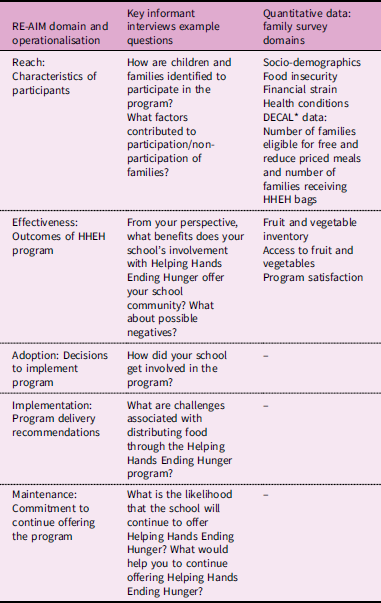
We used a semi-structured interview guide to learn about KIs’ experiences with the program. The RE-AIM(Reference Glasgow, Harden and Gaglio33,Reference Shelton, Chambers and Glasgow45) framework informed construction of the guide (Table 1). Questions asked about school leadership decisions to offer HHEH; preparations to implement the program and weekly operations. We asked about impacts on the school and participating families. Lastly, we asked for their advice to others considering implementing the program and recommendations to help sustain it.
Evaluation application of the RE-AIM framework by data source

Table 1. Long description
The table has three columns: RE-AIM domain and operationalisation, Key informant interviews example questions, and Quantitative data: family survey domains. It has five rows with grouped headings: Reach, Effectiveness, Adoption, Implementation, and Maintenance. Row 1: Reach: Characteristics of participants, How are children and families identified to participate in the program? What factors contributed to participation/non-participation of families?, Socio-demographics, Food insecurity, Financial strain, Health conditions, D EC A L data: Number of families eligible for free and reduce priced meals and number of families receiving H H E H bags. Row 2: Effectiveness: Outcomes of H H E H program, From your perspective, what benefits does your school’s involvement with Helping Hands Ending Hunger offer your school community? What about possible negatives?, Fruit and vegetable inventory, Access to fruit and vegetables, Program satisfaction. Row 3: Adoption: Decisions to implement program, How did your school get involved in the program?, (empty). Row 4: Implementation: Program delivery recommendations, What are challenges associated with distributing food through the Helping Hands Ending Hunger program?, (empty). Row 5: Maintenance: Commitment to continue offering the program, What is the likelihood that the school will continue to offer Helping Hands Ending Hunger? What would help you to continue offering Helping Hands Ending Hunger?, (empty).
* Department of Early Care and Learning.
Analysis
Family survey data
Using a similar methodology as Poole et al.,(Reference Poole, Tucker and Adams19) we estimated reach of HHEH in pilot schools by comparing the number of participating families to the number of students eligible for FRP meals from Georgia DECAL data(36). We computed frequencies, percentages and means for all survey items with SPPS. We reviewed and grouped by content open-ended responses to identify re-occurring themes and unique experiences.
Key informant interview data
With an evaluation-frame, we used a qualitative descriptive approach of directed content analysis for the interview data(Reference Hsieh and Shannon46). We developed a deductive codebook informed by the theory-based interview guide and evaluation questions. Example codes include adoption decisions and program outcomes. Two coders with experience and training in qualitative research (RM and AH) applied codes to the transcripts and used MAXQDA 2022 to manage the process. We used a primary and secondary coder for each transcript. The primary coder read the transcript and applied codes from the codebook; the secondary coder critically reviewed application of codes, applied additional codes and noted opportunities to refine coding. We discussed the coding process and emerging themes. After coding, we reviewed the segments by code and wrote summaries. We generated inductive themes in response to the evaluation question. We added relevant anonymised quotes to the summaries to illustrate findings, which we synthesised into the results presented below.
Data triangulation
After analysing each data source, we compared and synthesised the findings by overarching RE-AIM construct. We developed a triangulation matrix to explore similarities and differences between data sources(Reference Crewsell and Plano Clark34).
Results
The results presented below integrate findings from both data sources by RE-AIM construct. Table 2 presents key findings and example quotes. The Winter survey was sent to 264 participating families; ninety-five completed it (36·0 % response rate). On average, we received nine surveys per school (sd = 6·2; range: 1–22) with an average school-level response rate of 37·2 % (sd = 18·1; range: 9·1 %–70·0 %). The Spring survey was sent to 316 participating families; thirty-five completed it (11·1 % response rate). In Spring, the average number of surveys received per school was 3 (sd = 2·5; range: 0–9), and the average school-level response rate was 17·1 % (sd = 16·7; range: 0·0 %–60·0 %). Survey respondents were mostly female and White or Hispanic, Latino or Spanish (Table 3). The qualitative KIs included principals (n 3), an assistant principal, teachers (n 3), an instructional coach, a media specialist, a social worker and a school counselor involved with implementing the program.
Results by RE-AIM dimension: themes and example quotes with summary of key findings

Table 2. Long description
The table has two main columns: Themes and example quotes, and Summary of key findings. The Themes and example quotes column lists various themes such as Filling a need, Providing good access for families, Benefiting multiple groups and building connections, Adoption, Building a team and engaging others, Dedication time, Designating space and testing protocols, and Maintenance. Each theme includes example quotes from participants. The Summary of key findings column lists key insights related to each theme, such as challenges accessing food due to job loss, the importance of providing access to whole, nutritious meals, and the positive impact on families and communities. The table includes detailed quotes and findings from both surveys and key informant interviews, highlighting the program’s effectiveness and areas for improvement.
KI, key informant.
Socio-demographic characteristics and health status of survey respondents

Table 3. Long description
A table comparing socio-demographic characteristics and health status of survey respondents in Winter and Spring. The table has 35 rows and 7 columns. Column headers are: Characteristic, Winter, N, Spring, N. Row labels include Age, Sex, Race/Ethnicity, Education level, Employment status, Benefits received, Financial strain, Food insecurity, Wanted to buy more fruit and vegetables but didn’t have the money, Choosing between food and other expenses, Health conditions in household, Health status, adult respondent, Health status, child. Each row provides specific data for Winter and Spring surveys. For example, Row 1: Age, Mean (SD), Winter, 35.6 (9.1), Range: 20-65, Spring, 39.7 (12.8), Range: 27-87.
* Respondents could choose all that apply from among various sources of financial-related support, including local and federal governmental benefits determined based on income eligibility.
Reach
Both data sources indicated that HHEH is reaching people in need at participating schools; yet more families may benefit. Based on Georgia DECAL data, HHEH bags in pilot schools are distributed to about 16 % of families eligible for FRP meals (range by school: 5 % to 47 %). KIs felt they were reaching families with the most need and shared several reasons families need help with food access, including job loss, health issues, transportation challenges and other circumstances impacting basic needs. For some, families indicated no longer needing support because their situation changed. KIs discussed community-level issues heightening the need for the program, including COVID-19, business closures and environmental events like flooding.
The survey data reflected that families with high needs received HHEH bags (Table 3). Despite working full-time, many families received low-income-related benefits, such as FRP meals and Medicaid. About 11 % of families indicated they ‘cannot make ends meet.’ Over three-quarters were food insecure, and many indicated they choose between buying food and paying bills. At both timepoints, large majorities of respondents shared that within the past 6 months they ‘often’ or ‘sometimes’ wanted to buy more FV, but they did not have the money to do so. Additionally, families reported having health conditions associated with dietary nutritional quality. Over a quarter of households had someone with hypertension or high blood pressure.
Effectiveness
Three effectiveness-related themes included: providing food access for families, families satisfied with HHEH and benefiting multiple groups and building connections.
Providing food access for families
Nearly all KIs expressed that HHEH was helping meet basic food needs of students and families by providing nutritious food every week. While some local resources support food needs, KIs mentioned the rising costs of food and shared that HHEH provides meals and nutritional choices rather than snacks. Compared with other programs, KIs noted that HHEH includes planned meals and recipe cards, as well as fresh produce, meat and other components to make complete family meals. With the weekly cadence during the school year, it is seen as a consistent food source. KIs thought students receiving the food were excited, with one person stating that students have shared what they make with food provided in the bags. One KI noted that it reduced hard choices for families deciding between paying for food and other necessities.
Several KIs shared that they did not hear as many students or teachers saying students were hungry, which supported students focusing on learning, completing tasks and achieving their potential. KIs noted that the program may help with attendance, especially on distribution days. One KI noted that they would need more time to understand the impact of the program on attendance, achievement data and other potential longer-term outcomes.
KIs shared favourable feedback about the quality of the food, especially the produce, with only minor suggestions for improvement. First, they recommended establishing a school bank account to acquire extra items to help make meals more complete (e.g. seasonings, oils, meat). Some expressed interest in aligning with community preferences by including culturally relevant food. When asking for food donations, KIs indicated that they plan to specify needs, including asking for wholesome food. They wanted to involve local organisations (i.e. hunters, family farms) in donating food. They mentioned interest in more canned proteins; whole wheat, whole grain food; healthier cereals; meat and fresh and frozen produce options and options for foods not requiring cooking. A few KIs commented on needing to monitor expiration dates and discarding some spoiled foods they received.
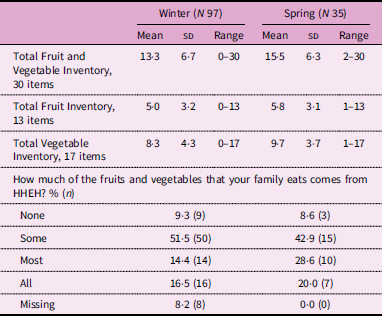
Family survey data highlight that HHEH provides access to FV. Families had FV at home with an average of 13·3 (Winter survey) and 15·5 (Spring survey) different types (Table 4). About 31 % in the Winter and 48·6 % in the Spring indicated that all or most of the FV that they eat comes from HHEH.
Home food environment and fruit and vegetable consumption

Table 4. Long description
The table compares fruit and vegetable inventory and family consumption from HHEH in winter and spring. It has 10 rows and 9 columns. The columns are labeled as Winter (N 97) and Spring (N 35), with sub-columns for Mean, SD, and Range. The rows are labeled as Total Fruit and Vegetable Inventory, 30 items; Total Fruit Inventory, 13 items; Total Vegetable Inventory, 17 items; and How much of the fruits and vegetables that your family eats comes from HHEH? % (n) with sub-rows for None, Some, Most, All, and Missing. Row 1: Total Fruit and Vegetable Inventory, 30 items, Winter Mean 13.3, SD 6.7, Range 0-30, Spring Mean 15.5, SD 6.3, Range 2-30. Row 2: Total Fruit Inventory, 13 items, Winter Mean 5.0, SD 3.2, Range 0-13, Spring Mean 5.8, SD 3.1, Range 1-13. Row 3: Total Vegetable Inventory, 17 items, Winter Mean 8.3, SD 4.3, Range 0-17, Spring Mean 9.7, SD 3.7, Range 1-17. Row 4: None, Winter 9.3 (9), Spring 8.6 (3). Row 5: Some, Winter 51.5 (50), Spring 42.9 (15). Row 6: Most, Winter 14.4 (14), Spring 28.6 (10). Row 7: All, Winter 16.5 (16), Spring 20.0 (7). Row 8: Missing, Winter 8.2 (8), Spring 0.0 (0).
HHEH, Helping Hands Ending Hunger.
Families satisfied with Helping Hands Ending Hunger
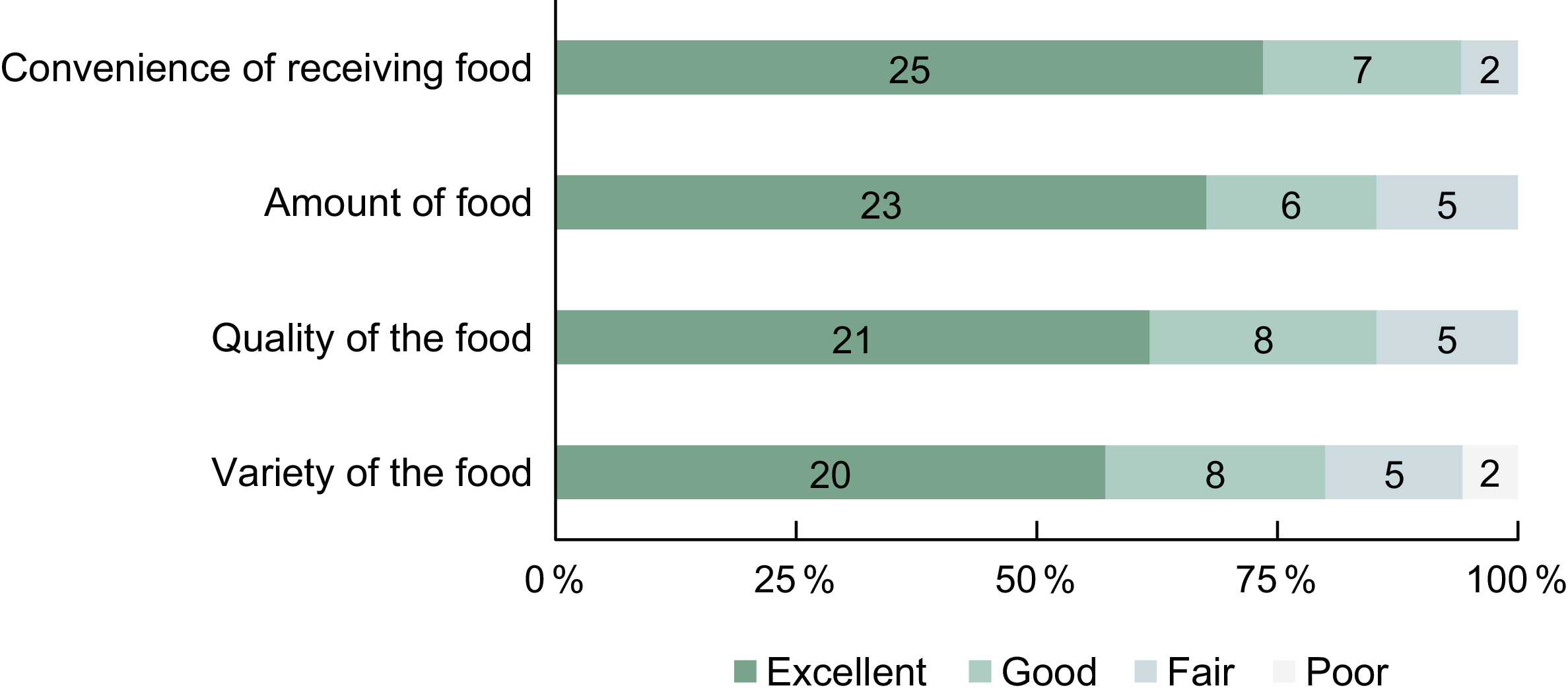
Several KIs commented that families shared appreciation for the program, and some even became emotional. The post-survey data (n 35) reflected high satisfaction and appreciation. Overall, 95 % of respondents were ‘very’ (78 %) or ‘mostly’ (17 %) satisfied with their experience receiving HHEH bags. Respondents were satisfied with the food received, especially the convenience. More than 75 % responded that the amount, variety and quality of food was Excellent or Good (Figure 1). In open-ended responses, a few indicated desire for more variety in food provided, including more FV.
Family survey respondents’ perceptions of Helping Hands Ending Hunger, n = 35.

Many survey respondents expressed appreciation for and benefits of the program in open-ended responses (83 written responses, Winter and Spring combined). Overwhelmingly, responses included ‘Thank you’ and it ‘Helps.’ Additional comments highlighted the extra food and named the ‘FV’/ ‘frutas y verduras’ or ‘food for the weekend.’ Other comments highlighted help with food costs (e.g. ‘helps feed my family when I can’t afford to buy much;’ how it helped during ‘this difficult time in the economy;’ and ‘fill[s] in the gaps between paychecks’). One person shared ‘It has saved us from going hungry. Thank you.’
Benefiting multiple groups and building connections
KIs identified additional benefits for students and staff implementing the program, participating families, schools and the wider community. Benefits noted included perceptions in changes related to knowledge, skills and attitudes and building relationships.
Knowledge, skills and attitudes
For elementary students, KIs shared how they learned about nutrition and food rescue. KIs described students working together and developing leadership skills, including taking responsibility for parts of the program. Awareness that people may experience hunger seemed to increase among students according to KIs. In part, KIs thought that coupling the program with education about how people may need help for varied reasons may have shifted attitudes, such as stigma associated with food insecurity, compassion and empathy. One KI (School 2) shared, ‘The more they’re involved, the more that they’re not seeing this as a big deal.’ Additionally, a KI noted that students may feel empowered by gaining experience engaging in a hands-on opportunity to give back to their communities.
Several KIs described how the program raised awareness among teachers about filling a need among students. One KI (School 6) shared how it affected her personally, ‘It’s just been really engaging for the kids. It’s been a blessing in my life, personally, to see the families who come every week to pick up the food and how thankful that they are for it. It’s just been a great experience overall.’
Building relationships with families and community
Most KIs highlighted how HHEH contributes to building relationships with families and caregivers by demonstrating they can help, increasing trust with families and establishing positive school connections. Several KIs described how the program helped parents see the school as a partner in ensuring their child’s wellbeing. As one KI (School 6) noted, ‘Being able to come in and provide something that’s for them and just to let them know, ‘We’re on your side,’ it’s really good. It’s a game-changer.’
Beyond family connections, some KIs reflected on building relationships with community partners. For instance, KIs shared that local churches and Lion’s Clubs donate food to enhance provisions in weekly bags. In instances of surplus food, schools share food with community organisations or staff members in need.
Adoption
KIs shared that once they became aware of HHEH, the decision to offer it was mostly easy and aligned with school priorities. KIs described the challenges children have learning when hungry. They hoped to help address student and family needs and strengthen relationships with families. KIs noted that school leaders and staff had worried about the students and their need for supplemental resources. For instance, one KI (School 7) shared staff concern about students during school breaks and how providing food offers support: ‘I think just over the years, worrying about kids on the weekend and kids over breaks and feeling like, ‘Well if nothing else, now at least they have some food if they need it.’ I think that this is a solution that they’ve been looking for for years.’
At one school, however, it was not until a staff member who ‘wasn’t super on board with’ the program due to concerns about following food storage practices left their job that other staff were able to implement the program.
Implementation
In reflecting on implementation experiences, KIs shared recommendations to help other schools adopting and implementing HHEH.
Building a team and engaging others
KIs highlighted that it is crucial to involve other staff in the program. This can include creating an implementation team that includes different professionals (e.g. social workers, teachers, administrators). KIs spoke of delegating tasks to others as well as shared decision-making and planning among those involved. They highlighted that engaging students and giving them responsibilities is rewarding and helpful. A few KIs specifically suggested trusting students, resisting the urge to micromanage and seeking out their ideas. Beyond the school, engaging community partners is part of starting the program, especially with donations. KIs indicted that they continue to cultivate relationships to sustain the program, and they reflected on the benefits of sharing successes with the wider community.
Dedicating time
The time devoted to HHEH requires staff and leadership commitment. The dedicated support provided by HHEH contributed to KIs’ ability to offer it. KIs highlighted that the school staff person leading the program needs to have the ‘extra go,’ including the energy, commitment and drive. A few KIs commented on their surprise at the time they committed to the program. However, KIs noted the time commitment decreases once the school establishes the program with one KI (School 4) sharing, ‘It really does kind of run itself. It’s a smooth, little machine now that it’s got going.’
Designating space and testing program implementation protocols
When implementing HHEH, identifying a central location with enough space for food storage and bag preparation supports success. KIs noted that locating the pantry in a central location helps with bag distribution. KIs shared that they benefited by starting small to establish protocols, which set a foundation for growth.
Maintenance
Committing to continuing the program
Almost all KIs indicated certainty about continuing the program with many responding ‘100 %.’ Several indicated that continued funding, community outreach and advocacy are important for maintenance. KIs described fundraising efforts such as hosting charity events and seeking community grants. For donations, they directly outreached to local businesses, community organisations and others. Food drives to support pantries were common, KIs shared. One KI discussed the importance of advocating for the program at various levels (e.g. central office, community and high school).
KIs thought that involving the community more would continue to increase awareness and support. Some schools have shared information about program impacts through social and traditional media. One school received local media attention from a charity event which resulted in additional, unsolicited monetary donations. Others suggested sharing testimonials through various formats (videos, flyers, etc.).
Feeling supported by Helping Hands Ending Hunger
KIs discussed the help that HHEH provides, who were instrumental in supporting schools and simplified their involvement. The HHEH organisation has provided grant funding, free food and equipment and supplies (e.g. reusable food bags) to the participating schools. HHEH staff place food orders, help with deliveries and provide logistical support (e.g. forms and implementation ideas from other schools).
Discussion
School-based interventions to address food insecurity strive to increase food availability and, for some, nutritional security. Findings from this evaluation of HHEH using RE-AIM align with another implementation study of a backpack program in Montana(Reference Shanks and Harden23). HHEH appears to reach people in need (e.g. 78 % (Winter) and 77 % (Spring) were food insecure). KIs and family respondents reflected on the potential effectiveness with HHEH providing access to FV. Experiences adopting and implementing the program suggest communities support and intend to maintain the program.
While the HHEH program reaches families needing increased food access, among students eligible for FRP meals only 16 % receive bags. These findings suggest a potential expansion opportunity. A cross-sectional study of backpack programs that assessed nutritional quality from a random sample of U.S. public schools (K-12) reported similar findings with fewer than 20 % of those eligible for FRP meals receiving bags(Reference Poole, Tucker and Adams19). Although school personnel can identify families most likely experiencing inadequate food access, schools with high rates of FRP meals have families navigating a spectrum of food insecurity(Reference Fiese, Gundersen and Koester24). While levels of financial strain varied, food insecurity was high with many choosing to pay for other expenses over food. Universal screening offers one tool to identify and engage potential participants and align support strategies with needs, including alternative interventions to navigate feelings of stigma(Reference Fram and Frongillo22). With consistent links between food insecurity and poor physical(Reference Mangini, Hayward and Zhu8,Reference Simonovich, Pineros-Leano and Ali9) and mental health(Reference Burke, Martini and Cayir10,Reference Gallegos, Eivers and Sondergeld11) , universal screening may provide opportunity to refer families to other services. With federal policy changes constricting food support systems(Reference Bleich and Dean18), the need for programs like HHEH will likely grow. Like backpack programs(Reference Cotugna and Forbes47), in challenging economic times, the food provided through HHEH bridges gaps. Continuing to develop local community-based partnerships to garner donations and support could facilitate sustainable implementation.
The perceived nutritional quality of food provided through HHEH is notable. Evaluations of backpack programs have identified an opportunity to increase the consistency of providing nutritious food(Reference Shanks and Harden23). HHEH families, despite elevated levels of food insecurity, reported having FV in their home with at least some coming from HHEH. The average variety of FV reported by survey respondents aligns with national-level data, where an average of 14·3 varieties of FV were reported homes(Reference Kegler, Hermstad and Haardorfer48). It is possible this program creates an opportunity to improve nutritional quality and security among families(Reference Guenther, Juan and Lino6,Reference Tucker, Bresnahan and John7) . However, additional, more rigorous research could assess changes resulting from the program. While backpack program evaluations have mostly found positive changes including in access to food and academic outcomes(Reference Burke, Cabili and Berman21,Reference Fiese, Gundersen and Koester24,Reference Kurtz, Conway and Mohr25) , additional supports, like employment and housing assistance, may be required to impact food insecurity rates(Reference Fram and Frongillo49). Among family respondents, many were eligible for low-income-based benefits suggesting that policy interventions like raising the minimum wage may offer additional support(Reference Winkler, Clohan and Komro50).
Strengths and limitations
This evaluation used multiple forms of data to explore implementation experiences with the HHEH program. Findings were consistent across data sources, which increases validity. We included Spanish-language materials, and family survey respondents reflect similar racial/ethnic backgrounds compared with the local population. Despite strengths, several limitations warrant consideration when interpreting the findings. First, the evaluation data are based on a small sample of respondents to the surveys and interviews, which could contribute to response bias where respondents favour the intervention. Future evaluations may consider additional measures, such as dietary recall to assess consumption. Considering nutritional security and other nutritional measures might provide more comprehensive understanding of impacts. Despite trying to assess for change with data collection at two different timepoints, the low survey response rates, especially the follow-up, precluded matching a large enough sample of participants. In-person or telephone data collection methods may increase response rates. In addition to low response rates, the short evaluation period limits the ability to see change in outcomes. A longer evaluation period with consistent participation in HHEH and longitudinal follow-up with participants will help to show changes and assess outcomes, including changes to food insecurity. This study focused on schools in one geographic region and included mostly elementary schools. Including more schools across more diverse geographic regions and more middle/high schools could provide an opportunity to assess contextual factors that may influence implementation. Lastly, group or stepped-wedge RCT could provide evidence of causal inference.
Research and practice implications
This evaluation provides pragmatic insight into the implementation experiences of a program that school leaders and families support and appreciate. KIs reflected that HHEH is highly valued, and most schools plan to continue offering it. By generating practice-based evidence informed by implementation science, we can support wider adoption and data-informed dissemination and implementation practices(Reference Ammerman, Smith and Calancie30,Reference Leeman, Rohweder and Lee31) . For instance, the schools participating in this evaluation had partnerships that supported the provision of fresh FV. Continuing to develop and sustain partnerships may help more schools provide access to FV to more families. Furthermore, identifying additional opportunities to share how schools are helping their communities may continue to garner support for the program.
Conclusion
Continued evaluation of the program will allow for more conclusive findings regarding the outcomes, especially quantitatively. The HHEH program is a valuable resource for schools implementing the program. Continuing to refine program efforts and evaluate the program will help HHEH as it grows, which may provide more support to families who could benefit from it.
Supplementary material
To view supplementary material for this article, please visit https://doi.org/10.1017/S1368980026103437
Acknowledgements
The authors would like to thank the school administrators and families who participated in the study. We are grateful to Pedro Avila for translation support and for coordinating data collection activities.
Author contributions
RM: conceptualisation, methodology, data analysis, investigation, writing – original draft, project administration. AH: conceptualisation, methodology, data analysis, investigation, writing – original draft, review, and editing, project administration. CH: conceptualisation, writing – review and editing. MK: conceptualisation, funding acquisition, supervision, writing – review and editing.
Financial support
All authors were at least partially supported for this work by Health Promotion and Disease Prevention Research Center Cooperative Agreement Numbers U48DP006377 and U48DP006877 from the Centers for Disease Control and Prevention. The findings and conclusions in this report are those of the authors and do not necessarily represent the official position of the Centers for Disease Control and Prevention. The sponsor had no influence on study design; in the collection, analysis and interpretation of data; in the writing of the report or the decision to submit the article for publication.
Competing interests
The authors report no conflicts of interest
Ethical standards
As an evaluation of a specific practice-based intervention, the study was not considered human subjects research by the Emory Institutional Review Board. All participants were informed of the purpose of the evaluation that their participation was voluntary, and the information they shared would be confidential. All data were de-identified and stored in password-protected folders.




 Open access

