Staphylococcus aureus is among the most common pathogens causing human skin and soft-tissue infections (SSTIs), bloodstream infections, bone and joint infections, and others.Reference Lowy 1 Methicillin-resistant Staphylococcus aureus (MRSA) strains of S. aureus are resistant to nearly all β-lactam antibiotics.
Before the late 1990s, MRSA caused disease in individuals with healthcare exposure.Reference David and Daum 2 However, the epidemiology of MRSA and S. aureus changed dramatically in the first decade of the 2000s with the emergence of genotypically novel community-associated (CA) MRSA strains.Reference Klein, Smith and Laxminarayan 3 – Reference Kennedy, Gill, Schultz, Irmler and Gordin 12 A study from the University of Chicago Medicine (UCM) demonstrated an increase in methicillin resistance among S. aureus clinical isolates from 13% to 28% between 1986 and 2000.Reference Seal, Moreira, Bethel and Daum 13 CA MRSA first had an epidemiological impact in previously healthy children and later, in adults.Reference Dukic, Lauderdale, Wilder, Daum and David 7 , Reference David, Crawford, Boyle-Vavra, Hostetler, Kim and Daum 14 The older, genotypically distinct MRSA strains identified in hospitals that rarely cause infections in healthy people are known as healthcare-associated (HA) MRSA. Since 2004, CA and HA MRSA strains have caused infections originating in both community and healthcare settings.Reference David, Glikman and Crawford 15 – Reference Popovich, Weinstein and Hota 17 At UCM, the prevalence of CA MRSA infections among all MRSA infections increased from 36.5% to 62.2% between 2004–2005 and 2008.Reference David, Cadilla, Boyle-Vavra and Daum 8 As the incidence of MRSA infections increased, CA MRSA did not simply replace CA methicillin-susceptible S. aureus (MSSA), but instead added to the overall S. aureus disease burden.Reference Tracy, Furuno, Harris, Singer, Langenberg and Roghmann 18 , Reference Casey, Cosgrove, Stewart, Pollak and Schwartz 19
Multiple studies have demonstrated an epidemic of CA MRSA infections from the late 1990s to the early 2000sReference Klein, Smith and Laxminarayan 3 , Reference McCaig, McDonald, Mandal and Jernigan 5 , Reference Kaplan, Hulten and Gonzalez 10 , Reference Kennedy, Gill, Schultz, Irmler and Gordin 12 , Reference McMullen, Warren and Woeltje 20 – Reference Gupta, Macintyre, Vanasse and Dembry 29 in children Reference Kaplan, Hulten and Gonzalez 10 , Reference Braun, Craft, Williams, Tuamokumo and Ottolini 21 , Reference Purcell and Fergie 24 , Reference Gerber, Coffin, Smathers and Zaoutis 28 and adults.Reference Kennedy, Gill, Schultz, Irmler and Gordin 12 , Reference McMullen, Warren and Woeltje 20 , Reference Braun, Craft, Williams, Tuamokumo and Ottolini 21 CA MRSA is most likely to cause SSTIs,Reference Como-Sabetti, Harriman, Buck, Glennen, Boxrud and Lynfield 4 , Reference McCaig, McDonald, Mandal and Jernigan 5 , Reference Kaplan, Hulten and Gonzalez 10 , Reference Frei, Makos, Daniels and Oramasionwu 22 , Reference Pallin, Egan, Pelletier, Espinola, Hooper and Camargo 27 , Reference Gupta, Macintyre, Vanasse and Dembry 29 particularly in children,Reference McCaig, McDonald, Mandal and Jernigan 5 but an increase in CA MRSA invasive infections in the United States was also recorded in the early 2000s.Reference Schramm, Johnson, Doherty, Micek and Kollef 9
Many US hospitals isolate patients with MRSA colonization or infection and practice active surveillance of patients for MRSA colonization in intensive care units. However, the same practices are not typically in place for MSSA, which may reflect a general belief that in-hospital transmission of MSSA is rarer than MRSA transmission.
After 2005, there was a decline in certain US populations in MRSA incidence,Reference Sutter, Milburn, Chukwuma, Dzialowy, Maranich and Hospenthal 30 including SSTIsReference Landrum, Neumann and Cook 6 and invasive MRSA infections,Reference Kallen, Mu and Bulens 31 , Reference Burton, Edwards, Horan, Jernigan and Fridkin 32 as a few studies showed. In this study, we examined the epidemiology of S. aureus infections, contrasting adults and children at a single center between January 2006 and March 2014. Our goal was to determine whether population strata or anatomic sites of infection drove changes in the incidence of MRSA or MSSA infections.
METHODS
We hypothesized that, during the study period, children, compared with adults, had a greater proportion of total S. aureus infections that were SSTIs, both for MRSA and MSSA. We further hypothesized that the incidence of MSSA infections during the study period did not change for adults or children. The Institutional Review Board of the University of Chicago Biological Sciences Division approved this study.
University of Chicago Medicine is an academic medical center with 161 pediatric and 456 adult hospital beds and an emergency department (ED) that serves 71,000 patients and outpatient clinics with 700,000 visits each year. Data were obtained from the UCM Clinical Data Research Warehouse, a repository of clinical, microbiological, and administrative data that were derived from the electronic medical record (EMR), hospital billing records, and the UCM Clinical Microbiology Laboratory. The retrospective cohort for this study included adult and pediatric patients for whom a culture obtained from any anatomic site was sent to the UCM Clinical Microbiology Laboratory and grew S. aureus between January 1, 2006, and March 31, 2014. Only the first such encounter per year was included for each patient. The cohort included those treated at UCM at 3 sites of care: as an inpatient, in an outpatient clinic, or as an ED patient. Emergency department encounters were only counted if a patient was treated in the ED and not hospitalized.
Variables collected for each encounter included (1) demographics; (2) site of care; (3) dates of encounter and culture collection; (4) surgeries; (5) associated International Classification of Disease, Ninth Revision (ICD-9) codes; (6) ICD-9 code for end-stage renal disease; (7) presence of a central venous catheter; and (8) antimicrobial susceptibility data and ordering information for all cultures yielding S. aureus.
For each S. aureus isolate, a clinical syndrome was classified by a single physician (M.E.A.) using data on the anatomic site of culture from physician orders. If the syndrome was not classifiable from the culture order, additional information was obtained from the EMR. In total, 8 clinical syndrome categories were assigned: blood, SSTI, respiratory, joint/bone, central nervous system, urinary, other, and unknown. A 25% sample of the 1,926 cultures labeled with only the word ‘drainage’ by the ordering clinician were assessed in the EMR; all were SSTIs. Therefore, we assumed that all 1,926 cultures labeled with only the word ‘drainage’ in the EMR culture order were from an SSTI. Infections were classified as ‘other’ if the culture was obtained from the eye, ear, sinus, or an intra-abdominal source. Isolates explicitly obtained to assess for MRSA colonization were excluded. An infection was classified as an ‘unknown’ clinical syndrome when no available information enabled a syndrome assignment. Invasive infections were defined as isolation of MRSA or MSSA from blood, joint/bone, or central nervous system. Review of the medical record to distinguish true infection from contamination or colonization was not performed.
Each MRSA and MSSA infection was classified as CA, HA, or healthcare-associated community-onset (HACO). An infection was classified as HACO when the culture was obtained in the outpatient setting or <48 hours after hospital admission from patients with 1 or more previous healthcare exposures. These exposures included surgery at UCM and/or hospital admission at UCM within the previous year, an ICD-9 code for end-stage renal disease (ESRD) at UCM during the previous year, or the presence of a central vascular catheter at the time the culture was obtained. A S. aureus infection was considered HA if the culture was obtained >48 hours after hospital admission. A S. aureus infection was considered CA if the culture was obtained in the outpatient setting or <48 hours after hospital admission from a patient without any of the above-listed healthcare exposures.
Susceptibility data determined using Vitek 2 (Biomérieux, Durham, NC) were obtained for each isolate for the following antibiotics: erythromycin, gentamicin, rifampin, tetracycline, ciprofloxacin, and clindamycin. We report clindamycin as resistant if the D-test for inducible clindamycin resistance was positive or based on single-agent testing because the distinction was not made in the Clinical Data Research Warehouse data. Before December 2008, the D-test was performed manually. After December 2008, the D-test was performed using Vitek.
The number of MSSA and MRSA infections were tabulated for each quarter year, and these totals were stratified into clinical syndromes, CA, HACO, and HA S. aureus, and pediatric and adult infection categories. From administrative data, we determined the total number of adult and pediatric patients treated at UCM in the ED, inpatient setting, and outpatient clinics in each quarter year. We calculated the incidence density of S. aureus, MSSA, and MRSA infections (and stratified these results into the categories noted above) in each quarter year per 1,000 patients admitted to the inpatient setting or per 1,000 patients treated in the ED or outpatient clinics, respectively. Poisson regression was used to assess for statistically significant change in incidence density in annual data. All analyses were performed in STATA version 11 software (StataCorp, College Station, TX).
RESULTS
Characteristics of S. aureus Patients
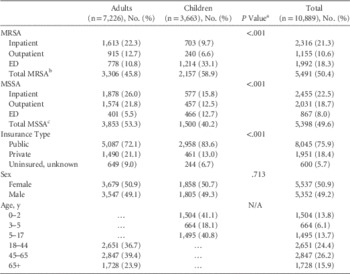
In total, 5,491 MRSA (50.4%) and 5,398 MSSA isolates (49.6%) were obtained by the UCM Clinical Microbiology Laboratory during the study period from cultures not intended to assess for colonization. The distribution among adults and children and demographic characteristics of patients are shown in Table 1. Adult MRSA and MSSA infections more often occurred in the inpatient setting than did those in children. Children were more likely to have public insurance than adults. Approximately 41% of children with S. aureus infections were <2 years of age (Table 1).
Culture-Confirmed S. aureus (MRSA and MSSA) Infections in Adults and Children, Stratified by Site of Care and Demographic Characteristics, University of Chicago Medicine, January 2006 through March 2014 (n=10,889)

NOTE. ED, emergency department; MSSA, methicillin-susceptible Staphylococcus aureus; MRSA, methicillin-resistant Staphylococcus aureus; N/A not applicable.
a Comparing adults and children.
b No encounter type recorded for 28 MRSA isolates.
c No encounter type recorded for 45 MSSA isolates.
Clinical Syndromes
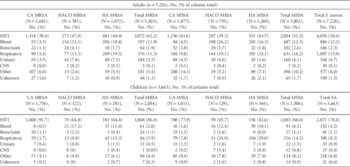
The most common clinical syndrome caused by MRSA and MSSA in both adults and children was SSTI in 2006–2014. 86.6% of children and 62.2% of adults with MRSA infections had SSTIs, while 66.6% of children and 51.5% of adults with MSSA infections had SSTIs. The next most common clinical syndrome was respiratory, accounting for 13.9% and 8.2% of S. aureus infections in adults and children, respectively (Table 2).
Culture-Confirmed MRSA and MSSA Infections in Adults and Children, Classified as Community-Associated (CA), Healthcare-Associated (HA) and Healthcare-Associated, Community-Onset (HACO) and Stratified by Clinical Syndrome, University of Chicago Medicine, January 2006 through March 2014 (n=10,889)

NOTE. CNS, central nervous system; MSSA, methicillin-susceptible Staphylococcus aureus; MRSA, methicillin-resistant Staphylococcus aureus; SSTI, skin and soft-tissue infection.
Total MRSA and MSSA Incidence
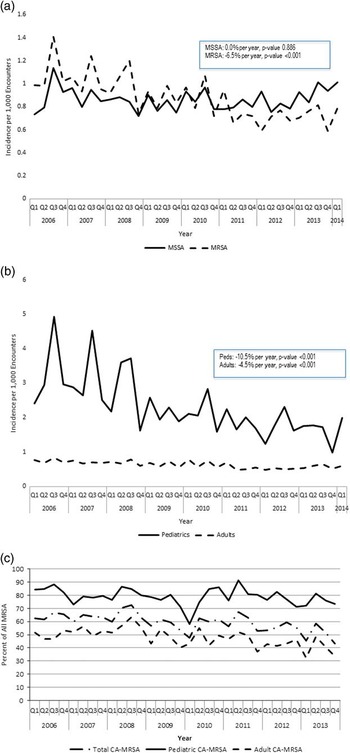
For children and adults combined in 2006–2013, the cumulative incidence of MRSA infections declined by an average of 5.2% per year (P<.001), and MSSA infections did not change significantly overall (Figure 1a). Among children, all MRSA infections decreased on average by 10.5% per year (P<.001). Adult MRSA infections decreased to a lesser extent (−4.5% on average per year; P<.001) (Figure 1b). In contrast to MRSA, the change in MSSA cumulative incidence was quite different in children and adults. For adults in all care settings combined, MSSA infections increased by an average of 1.9% per year (P=.007) while for children they decreased by an average of 5.1% per year (P<.001).
Epidemiology at University of Chicago Medicine of MSSA overall, MRSA overall, and MRSA, stratified. (a) For all patients, cumulative incidence of MRSA and MSSA infection per 1,000 patients at all sites of care, each quarter year, 2006–2014. The average annual percent change in incidence density for MSSA for 2006–2013 was 0.0% (P=.90); for MRSA the average annual percent change was –6.5% (P<.001). (b) MRSA infection incidence per 1,000 patients each quarter year, all sites of care, 2006–2014, separately for children and adults. For children, the average annual percent change in infection incidence in 2006–2013 was –10.5% (P<.001); for adults, the percent change was –4.5% (P<.001). (c) CA MRSA as a percentage of all MRSA by quarter year, 2006–2013, indicating total (dots and dashed line), pediatric (solid line), and adult (dashed line) data. CA MRSA as a percentage of all MRSA decreased significantly (–2.8% on average per year; P<.001).

There was also a significant decline in CA MRSA as a percent of all MRSA by year (−2.8% on average per year; P<.001) (Figure 1c).
Staphylococcus aureus SSTIs
In children, a significant decrease in S. aureus SSTI cumulative incidence was observed in 2006–2013 (−6.8% per year on average, P<.001). In contrast, no significant change was observed in adults. When examined by site of care at UCM, a significant decrease in outpatient (−7.4%; P=.01), inpatient (−4.3%; P=.002), and ED (−5.1%; P<.001) settings was observed in children. In adults, no significant change was observed at any site of care.
MRSA SSTIs
MRSA SSTI incidence density decreased in adults overall (−3.5% per year on average; P<.001) and in the outpatient (−5.3%; P=.02) and inpatient (−2.6%; P=.04) settings, but not in the ED. In children, there was a significant decline in MRSA SSTI incidence overall (−2.9%; P =.004) although not at any of the 3 sites of care.
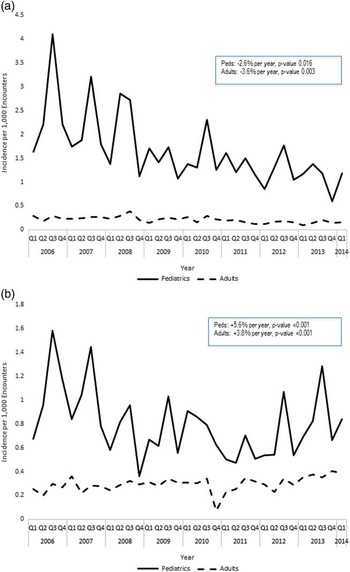
CA MRSA SSTI decreased significantly in incidence density in both children (−2.6% per year on average; P=.016) and adults (−3.6%; P=.003) (Figure 2a). In children, a decrease in CA MRSA SSTIs in outpatient (−7.8%; P=.02) and inpatient (−4.5%; P=.04) settings was observed, but not in the ED. In adults, CA MRSA SSTI incidence density significantly decreased only in the outpatient setting (−7.0%; P<.001).
Epidemiology of CA MRSA SSTIs and MSSA SSTIs at University of Chicago Medicine. (a) CA MRSA SSTI incidence per 1,000 patients each quarter year, children and adults, 2006–2014. For children, the average annual percent change in incidence density in 2006–2013 was –2.6% (P=.016); for adults, the percent change was –3.6% (P=.003). (b) MSSA SSTI incidence per 1,000 patients each quarter year, children and adults, 2006–2014. For children, the average annual percent change in 2006–2013 was +5.6% (P<.001); for adults the percent change was +3.8% (P<.001).

In all sites of care, HA MRSA (combining HA and HACO MRSA) SSTI incidence density did not change significantly among adults overall, children overall, and in adults and children combined. In children, no significant changes at any of the 3 sites of care were observed. In adults, HA MRSA SSTIs did not change significantly in outpatient or inpatient incidence density, but ED incidence density decreased (−10.7%; P=.035).
MSSA SSTIs
MSSA SSTI incidence density increased significantly in both adults (+3.8% per year on average, P<.001) and children (+5.6%; P<.001) (Figure 2b). Among pediatric MSSA SSTIs, the only site of care with a significant increase in incidence density was among inpatients (+9.4%; P=.001). However, in adults, an increase in MSSA SSTI incidence density was observed in both outpatient (+4.6%; P=.001) and ED (+7.4%; P=.005) settings, but not in the inpatient setting.
CA MSSA SSTI incidence density increased in both adults (+4.6% per year on average, P=.001) and children (+6.1%; P<0.001). In adults, an increase in CA MSSA SSTIs among outpatients was observed (+7.4% per year on average; P=.008). In contrast, no significant change was observed in adult CA MSSA SSTIs in the inpatient or ED setting. In children, however, a significant increase in CA MSSA SSTI incidence density was observed in inpatients (+10.7%; P=.003) but not in the outpatient clinic or the ED.
HA MSSA (including both HA and HACO MSSA) SSTIs increased in incidence density among adults (+3.6% per year on average; P=.01); however, no significant change was observed in children. In adults, an increase in the inpatient (+3.3%; P=.03) and ED (+18.7%; P =.048) settings was observed for HA MSSA SSTIs. There was no significant change in adult outpatient HA MSSA SSTI incidence density. In children, no significant change was observed at any site of care.
Invasive MRSA Incidence
Invasive MRSA infection incidence density did not significantly change in adults or children overall or in any site of care, except for outpatient pediatric invasive MRSA infections, for which no calculation could be performed due to the small number of cases. In quarter 3 of 2007, a relatively high incidence density of invasive MRSA infections in children was detected. Because this quarter represented an outlier, analyses performed for this quarter were excluded. Even with this quarter excluded, however, no significant change in pediatric invasive MRSA infections was observed.
Invasive MSSA Incidence
The incidence density of invasive MSSA infections did not significantly change among adults or children overall nor for adults or children at any specific site of care.
Antimicrobial Susceptibilities of MSSA and MRSA
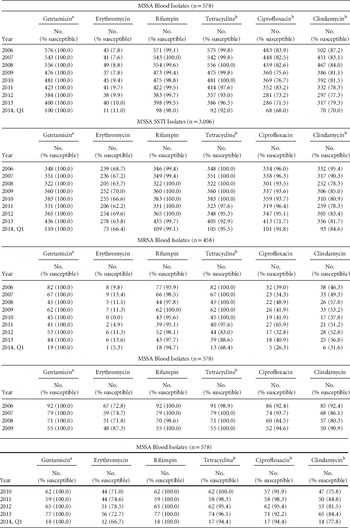
Table 3 shows susceptibility results for MRSA and MSSA SSTIs and bloodstream infections. Overall, MRSA blood isolates were more likely to be drug resistant than MRSA SSTI isolates. In contrast, MSSA isolates from blood and SSTIs exhibited similar resistance patterns. Table 3 also shows any significant changes in susceptibility to each of the tested non–β-lactam antibiotics. Erythromycin susceptibility was available for a subset of isolates. For MRSA SSTI isolates, there was a significant decrease in susceptibility to tetracycline, ciprofloxacin, and clindamycin from 2006 to 2014. For MRSA and MSSA blood isolates, there was a significant decrease in susceptibility only to tetracycline during this period. For MSSA SSTI isolates, there was a significant decrease in susceptibility to tetracycline and clindamycin.
Susceptibility to Tested Antimicrobial Agents, MRSA and MSSA Isolates From SSTIs and Blood, Combining Pediatric and Adult Isolates, by Year, University of Chicago Medicine, 2006–2014

NOTE. MSSA, methicillin-susceptible Staphylococcus aureus; MRSA, methicillin-resistant Staphylococcus aureus; Q1, first quarter of the year; SSTI, skin and soft tissue infection.
a No resistant isolates were observed for gentamicin.
b Significant decrease (P<0.05).
DISCUSSION
At UCM in 2006–2014, while the incidence density of all MRSA infections decreased, overall MSSA incidence density did not change significantly in adults and children combined, which is consistent with our hypothesis. However, we found that the incidence of all MSSA infections in adults increased, yet it declined in children. Furthermore, in both children and adults, an increase in incidence of MSSA SSTIs was observed. As hypothesized, for children, compared with adults, a greater proportion of total S. aureus infections were SSTIs, both for MRSA and MSSA.
Our study reports an increase in the incidence of MSSA infections in adults, which calls into question current approaches to preventing MSSA infections. Previous studies utilizing genotyping of MSSA showed that in-hospital MSSA transmission is unusual.Reference Burton, Edwards, Horan, Jernigan and Fridkin 32 However, an increase in MSSA infections may prompt a re-evaluation of the importance of horizontal infection control practices rather than vertical measures directed specifically toward MRSA control. Alternatively, if horizontal transmission is not responsible for an increase in MSSA infections, perhaps the increase is due to a change in MSSA strain virulence. Improvement in hand hygiene adherence is a strategy that may reduce MSSA transmission in healthcare facilities, particularly when patients with an MSSA infection are frequently present.
CA MRSA SSTIs decreased in incidence among children and adults, as did MRSA infections overall. These trends may reflect changes in the molecular epidemiology of MRSA or perhaps population-wide herd immunity to USA300 MRSA or another strain. Changes in HA MRSA incidence may reflect the efficacy of infection control procedures at UCM.
Previous literature suggested that the 15-year-long wave of CA MRSA activity in the United StatesReference Dukic, Lauderdale, Wilder, Daum and David 7 peaked and started to decline by 2010.Reference Landrum, Neumann and Cook 6 , Reference Sutter, Milburn, Chukwuma, Dzialowy, Maranich and Hospenthal 30 In both children and adults, an observational study of the Department of Defense TRICARE beneficiaries showed that the proportion of community-onset SSTIs caused by MRSA decreased from 62% in 2006 to 52% in 2010 (P<.001).Reference Landrum, Neumann and Cook 6 Our study shows a similar trend continuing up to early 2014; as a proportion of MRSA, infections that were CA MRSA decreased significantly from 2006 to 2013, suggesting a reversal of the massive increase in CA MRSA proportion in the previous decade.Reference Dukic, Lauderdale, Wilder, Daum and David 7
In adults, MSSA and MRSA incidence densities exhibited opposing trends at UCM from 2006 to 2013. While MRSA infection incidence density decreased, MSSA infection incidence density in adults increased on average by nearly 2% per year, which had not been demonstrated previously.
In both adults and children, CA MRSA SSTIs significantly declined during the study period, which is congruent with previous findings.Reference Landrum, Neumann and Cook 6 In contrast, MSSA SSTI incidence density rose in both children and adults at UCM. This finding may have important implications for empiric SSTI treatment because MSSA infections are preferably treated with a β-lactam antibiotic.
Our results suggest that effective empiric antibiotic choices may continue to narrow because both MRSA and MSSA SSTI and blood isolates are following a trend toward increasing resistance to orally available agents.
Our study has certain limitations. We did not account for changes that may have occurred in the practice of sending bacterial cultures from sites of infection at UCM during 2006–2014. Additionally, data were not available on patient stays in long-term-care facilities; therefore, our criteria differed from CDC criteria for HA, HACO, and CA S. aureus infections. However, individuals who stayed in a long-term-care facility within the previous year likely had another risk factor that would classify them as being healthcare-exposed. Also, the automated D-test after December 2008 was performed on clindamycin-susceptible isolates with erythromycin resistance or intermediate erythromycin susceptibility. In contrast, the earlier-used, manual D-test was only performed only on erythromycin-resistant isolates. Therefore, inducible clindamycin resistance may have been more frequently detected after the change to the automated D-test. Finally, without medical record reviews, we were unable to exclude all S. aureus cultures obtained from sites of colonization. However, we did exclude S. aureus isolates that were explicitly obtained to assess for colonization.
In conclusion, at UCM in 2006–2013, MRSA infection incidence decreased. However, we demonstrated an unanticipated increase in MSSA infection incidence in adults overall and specifically in CA MSSA SSTIs in both adults and children. These findings may inform future choices for empiric antibiotic selection. The increased incidence of MSSA infections in adults may support the enhancement of horizontal infection control practices to prevent MSSA transmission or infection resulting from auto inoculation. Future surveillance for trends in MRSA and MSSA infections is needed to develop infection control policies and to optimize choices for empiric therapy for pediatric and adult S. aureus infections.
ACKNOWLEDGMENTS
Financial support: M.Z.D. received grant support from the National Institute of Allergy and Infectious Diseases at the National Institutes of Health (grant no. K23 AI095361).
Potential conflicts of interest: All authors report no conflicts of interest relevant to this article.