Introduction
Palliative care professionals frequently face ethical dilemmas, “situation[s] in which a difficult choice has to be made between two courses of action, either of which entails transgressing a moral principle” (Oxford University, 2019). Such situations can occur in palliative care settings when healthcare professionals are facing ethical problems including: whether, how, and when to disclose sensitive information to patients and relatives (Ranganathan et al., Reference Ranganathan, Gunnarsson and Casarett2014; Hernandez-Marrero et al., Reference Hernandez-Marrero, Pereira and Carvalho2016; Hemberg and Bergdahl, Reference Hemberg and Bergdahl2019), problems or demands regarding the place of care (Chiu et al., Reference Chiu, Hu and Huang2009; Karlsson et al., Reference Karlsson, Roxberg and da Silva2010), decisions about treatment initiation, non-initiation, or withdrawal (Ong et al., Reference Ong, Yee and Lee2012; Daher, Reference Daher2013; Piot et al., Reference Piot, Leheup and Goetz2015), disagreements among healthcare professionals, the patient, and their relatives, or any combination of same (Legault, Reference Legault1999; Ong et al., Reference Ong, Yee and Lee2012), and scarcity of resources (Ong et al., Reference Ong, Yee and Lee2012; Bollig et al., Reference Bollig, Schmidt and Rosland2015; Close et al., Reference Close, White and Willmott2019).
Ethical problems generally require a deliberative process that structures the reflection and the discussion (Irvine et al., Reference Irvine, Kerridge and McPhee2004; Hermsen and ten Have, Reference Hermsen and ten Have2005; Ong et al., Reference Ong, Yee and Lee2012) as they involve feelings, values, and beliefs (Gracia, Reference Gracia2003). In such a process, “everyone concerned by the decision is considered a valid moral agent, obliged to give reasons for their own points of view and to listen to the reasons of others” (Gracia, Reference Gracia2003). A team discussion enables the healthcare professionals to arrive at the most ethically reasonable, acceptable, or prudent course of action under the circumstances (Legault, Reference Legault1999; Gracia, Reference Gracia2003). When ethical issues arise in palliative care settings, suboptimal communication or deliberation among the healthcare professionals involved and the patients and their families may lead to care, treatment or place of death incompatible with patient preferences or wishes (The National Academies of Sciences Engineering Medicine-Health and Medicine Division, 2014), to a situation not in keeping with the patient's personal conception of a “good death” (Granda-Cameron and Houldin, Reference Granda-Cameron and Houldin2012), and to pain and suffering that could have been avoided (Heyland et al., Reference Heyland, Tranmer and O'Callaghan2003). A lack of involvement in end-of-life decisions and of ethical deliberation may also lead healthcare professionals to experience moral distress (Piers et al., Reference Piers, Van den Eynde and Steeman2012; Mehlis et al., Reference Mehlis, Bierwirth and Laryionava2018; Steiner et al., Reference Steiner, Patton and Prutkin2018), frustration (Eriksson et al., Reference Eriksson, Andersson and Olsson2014), a sense of futility (Piers et al., Reference Piers, Van den Eynde and Steeman2012; Eriksson et al., Reference Eriksson, Andersson and Olsson2014), and powerlessness over ethical decisions (Mehlis et al., Reference Mehlis, Bierwirth and Laryionava2018). Such situations can give rise to burnout and increased time off work (Piers et al., Reference Piers, Van den Eynde and Steeman2012; Teixeira et al., Reference Teixeira, Ribeiro and Fonseca2014).
Earlier studies revealed that optimal involvement of healthcare professionals in the ethical decision-making process regarding end-of-life care may shield them from experiencing burnout (Teixeira et al., Reference Teixeira, Ribeiro and Fonseca2014; Hernandez-Marrero et al., Reference Hernandez-Marrero, Pereira and Carvalho2016), despite the stress that can be generated by complex and challenging ethical decisions (Hernandez-Marrero et al., Reference Hernandez-Marrero, Pereira and Carvalho2016). This finding highlights the need to optimize interprofessional ethical deliberation processes in palliative care settings.
This descriptive study undertook to examine ethical deliberation processes in interprofessional teams in five palliative care settings, and based on this knowledge, to identify priority education needs for future and current palliative care professionals. A further aim was to identify organizational factors that constrain optimal interprofessional ethical deliberation processes in such environments so as to tailor education to the realities the healthcare professionals face.
Methods
Research design
This descriptive study took place in five palliative care settings in Quebec City, Canada, each with their own culture of care and interprofessional decision-making process: an interdisciplinary team that provides community-based palliative care; a hospital palliative care unit where an interdisciplinary team provides care to a dozen patients; a palliative care consultant team in a tertiary care hospital; a 280-bed nursing home unit team; and a 15-bed palliative care hospice team.
Data collection
Participants were asked to take part in three data collection phases: (1) simulated interprofessional ethical deliberations using validated clinical scenarios; (2) individual semi-structured interviews; and (3) deliberative dialogues. Participants could take part in more than one activity.
Phase 1: Simulated interprofessional ethical deliberations
To avoid possible bias, six palliative care physicians with extensive experience and expertise from organizations comparable to, but not targeted by the study, were asked to describe the top four of five clinical situations involving an ethical problem they met in their practice. They suggested a total of 32 typical clinical situations. Twelve other palliative care professionals, including physicians, nurses, and social workers, were then asked to rank the situations according to two criteria, namely frequency and degree of ethical difficulty. Based on their ranking, the most frequent and challenging ethical problems were retained. These ethical problems then enabled the research teams to develop two plausible clinical scenarios involving a fictional palliative care patient for each setting, for a total of ten scenarios. Each scenario was tailored to the particularities of the care environment based on the critical incident approach of Mucchielli (Reference Mucchielli1996). It included details on the patient's medical history, a description of the patient and his relations with his loved ones, and the patient's and family members’ perspectives regarding the options discussed by the healthcare team. One example scenario is available in Supplementary Appendix 1. Six other palliative care experts, including two physicians, two nurses, and two social workers, then validated these scenarios for veracity, representativeness, and completeness.
Each participating healthcare team was asked to take part in a simulated team meeting to resolve the two scenarios assigned to their care setting. Exposing participants to two scenarios in this way reduces the likelihood that the results observed will relate more to the nature of the scenario presented rather than reflecting the team's usual practice when faced with an ethical problem. Therefore, participants were instructed to deliberate on the scenarios just as they would usually. These teams of professionals from all relevant disciplines engaged in the ethical deliberation processes for approximately 1 h.
Phase 2: Individual semi-structured interviews
At the end of the ethical deliberation activities, the lead investigator invited those interested in sharing their experience regarding ethical deliberations to participate in a semi-structured individual interview. Interview guiding questions covered competencies extracted from the ethical deliberation theoretical framework of Boisvert et al. (Reference Boisvert, Jutras and Legault2003) and the interprofessional collaborator assessment rubric (ICAR) of Curran et al. (Reference Curran, Casimiro and Banfield2010). Three broad themes were explored: (1) participants’ training in interprofessional collaboration and ethics; (2) their experience of the ethical deliberation process in an interprofessional team; and (3) organizational issues. The research coordinator conducted and audiotaped the interviews and a professional transcriber transcribed them verbatim. Interviews were conducted until analysis revealed a data saturation.
Phase 3: Deliberative dialogues
Once video data and interview transcripts were analyzed, one deliberative dialogue based on key features of the conceptual model of Boyko et al. (Reference Boyko, Lavis and Abelson2012) took place in each participating setting, led by the lead investigator. The purpose was to gather participant feedback on salient results from Phases 1 and 2 and to determine with participants which educational needs should be prioritized to optimize interprofessional collaboration and ethical deliberation in palliative care settings. Specifically, participants were invited to comment on the most important results for each overall theme: educational needs regarding interprofessional collaboration based on ICAR competencies (Reference Curran, Casimiro and Banfield2010), educational needs for each phase of the ethical deliberation process outlined by Boisvert et al. (Reference Boisvert, Jutras and Legault2003), and organizational constraints. The lead investigator followed the flow of the dialogue and encouraged mutual understanding and shared thinking within the group. Deliberative dialogues lasted 1–2 h and were audiotaped.
Sampling
Researchers recruited a purposive sample of informants. To participate in the study (Phases 1, 2, and 3), professionals had to practice in medicine, nursing, social work, psychology, occupational therapy, physiotherapy, nutrition, pharmacy, or spiritual care, in one of the targeted palliative care settings. They also had to understand and speak French. To gather a wealth of information from clinical-based experience and to gain insights for analysis enrichment purposes, participants in Phase 2 had also to have at least 3 years of professional palliative care experience. Phases 2 and 3 participants had to have participated in Phase 1. Following management authorization, the lead investigator was invited to meet the five palliative care teams during one of their usual team meetings where he explained the project and sought their voluntary participation. Interested professionals provided written consent for each data collection activity. Ethical approval was obtained from the four institutional Ethics Review Boards of the study settings.
Data analysis
To analyze the videos of the ethical deliberation activities, two observational rating grids were designed: one to observe the ethical deliberation process based on the framework of Boisvert et al. (Reference Boisvert, Jutras and Legault2003) and another to observe interprofessional collaboration based on the Observed Interprofessional Collaboration (OIPC) tool of Careau et al. (Reference Careau, Vincent and Swaine2014) (see Supplementary Appendix 2). The lead investigator, co-investigators, and the research coordinator individually analyzed each recorded video and then discussed their observations. They viewed and reviewed the recordings until consensus for each grid criteria. Participants’ behavior was analyzed within the sociocultural and organizational context in which it occurred. This analysis led to a first list of strengths and shortcomings in the ethical deliberation process in interprofessional palliative care teams and the identification of disparities between observed practices and optimal practices, based on the framework of Boisvert et al. (Reference Boisvert, Jutras and Legault2003) and the tool of Careau et al. (Reference Careau, Vincent and Swaine2014).
The research coordinator performed a thematic analysis of the individual semi-structured interviews aided by NVivo 11 software. A deductive approach was adopted based on theoretical categories extracted from the framework of Boisvert et al. (Reference Boisvert, Jutras and Legault2003), the ICAR of Curran et al. (Reference Curran, Casimiro and Banfield2010), and the Giddens (Reference Giddens1986) social structuration approach, plus an inductive approach, based on recurring themes emerging from the data. The research team discussed and validated the interpretation of data and categorization of emergent themes at regular intervals during the analysis. Iterative data analysis led to a list of factors that challenge ethical deliberation processes in palliative care settings, and a list of potential educational needs in interprofessional collaboration and ethical deliberation.
The research coordinator produced in-depth data summaries of the deliberative dialogues recordings. The research team then read and reread the deliberative dialogues data summaries to identify any other relevant content. To map out potential priority education themes, the data from all three data collection activities were triangulated by intersecting the strengths and shortcomings observed in the videos, with the organizational factors that constrain the interprofessional collaboration and ethical deliberation processes identified by the healthcare professionals in the interviews and deliberative dialogues.
Results
Participants
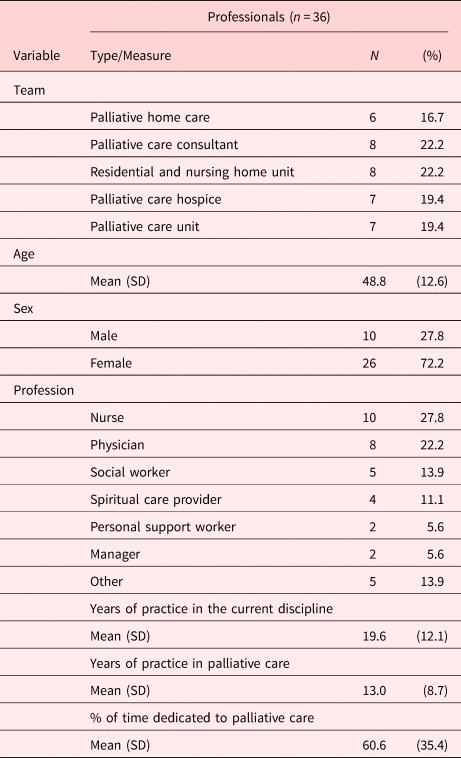
Overall, six to eight healthcare professionals from each setting took part in the ethical deliberation activities (Phase 1) (see Table 1). The majority were female, with a mean age of 48.8 years. Of these, 28% were nurses, 22% physicians, 14% social workers, and 36% were from other professional groups. Participants had an average of 13 years experience in palliative care, and they devoted around 60% of their time to it. Of the 36 participants in the ethical deliberation activities, 13 also took part in an individual interview (Phase 2). They included one physician, three nurses, one occupational therapist, three spiritual care providers, two managers, and three social workers. One to three healthcare professionals at each setting were met in individual interviews. Finally, the same 36 healthcare professionals in Phase 1 also participated in Phase 3.
Characteristics of professionals who participated in the ethical deliberation activities

What follows is a synthesis of the triangulated data from all three study phases. First, are detailed the specific challenges of interprofessional collaboration and ethical deliberation in palliative care settings and priority educational needs. Second, participants’ perceived organizational constraints are described, since they provide insight into the clinical context that influenced practices.
Challenges of interprofessional collaboration and ethical deliberation in palliative care settings and priority educational needs
This section presents key results structured according to the four-step ethical deliberation process framework of Boisvert et al. (Reference Boisvert, Jutras and Legault2003): (1) awareness of the ethical issue; (2) clarification of conflicting values; (3) reasonable decision making; and (4) implementation planning. As this study was intended to highlight priority educational needs, it focused mainly on shortcomings in ethical deliberation rather than on the competencies participants had already acquired. The data revealed a high level of participant competency and expertise, in addition to a strong desire to do right by the patients and their relatives. It also revealed mutual respect among participants, and a commitment to achieve a common goal through open communication.
Step 1: Awareness of the ethical issue
According to the data, the teams struggled to discern the actual presence of an ethical issue in a situation and also to recognize the need to engage in a reflexive and collaborative approach with other professionals. Some healthcare professionals were confused as to who should be responsible for bringing the team together and mobilizing them around a potential ethical problem, as this social worker mentioned: “At other times, we wonder whose first reaction it should have been to report a situation to the others. Who's responsible for calling in the team? […]” (SW2).
Once engaged in the ethical deliberation process, some professionals found it difficult to maintain a thoughtful position and before long would try to sway decisions toward their preferred solution. Despite their best intentions, an ethical problem was sometimes discussed only superficially, or even concealed by concentrating on the comparative effectiveness of various care options or by shifting full responsibility for the decision onto the family. Most participants had trouble leading a structured ethical deliberation process that would result in interprofessional decision making. With no team member designated to facilitate a structured team discussion, important dimensions of the ethical problem were either omitted or poorly discussed, and participants considered that the time available was not used efficiently. Also, some participants indicated that it was hard to integrate the patient's perspective, or the family's, if either one was in denial, had limited cognitive capacity, or was exhausted or experiencing intense suffering. Finally, participants reported that because of confidentiality concerns, they sometimes hesitated to disclose to their team sensitive information shared by patients or their family members.
Step 2: Clarification of conflicting values
Participants tended to quickly discuss what actions to take without first sufficiently identifying and clarifying the ethical issues and underlying values. Only rarely did participants reach a common understanding of the ethical issues or share a clear statement of the ethical problem. They reported difficulties in considering a large number of values and in recognizing opposing points of view. A certain tension was observed between their desire to respect patient's needs and the necessity to deliberate freely without patient pressure. On certain occasions, participants also found it difficult to distinguish between their own values and those of patients and their families. A manager reported:
I find that personal values can intrude on ethical reflection. So I don't know if something could be put in place right away so that the students would become aware of this and then identify their values ahead of time and understand how they can suddenly come into play in a context of ethical deliberation in a complex case. (MAN1)
Step 3: Reasonable decision making
The study data showed that the decision-making point was the moment when interprofessional tensions ran highest. A limited understanding of the roles and complementary expertise of others curbed several participants’ contribution to the decision-making process. Some found it difficult to solicit the views of other team members while asserting their own opinions within their field. Some had a preconceived opinion about professional roles, as this spiritual care provider shared:
Having a preconceived image of the other person's role can make a difference, which means that when they intervene, there's already a small filter that makes it likely the person is taken less seriously, or as in the case of a doctor, too seriously. (SCP1)
Other participants were prone to self-censorship when a team member was being overly assertive within their field of clinical or ethical expertise. When the final decision was made, rarely was there any systematic verification that everyone agreed with the decision. Certain participants said that it was hard to deal with opposing opinions between team members and to adhere to a decision that was not a consensus. One manager reported that the clash of each member's personal values makes it difficult to reach consensus:
Each person's personal values, in the end, that's what holds us back, we're not able to … we just can't agree on a decision. But there are people who'll get angry anyway and then say, “Well, that doesn't make any sense.”. So this really has a whole lot to do with personal values. What's more, it's like a damper because it's not up to me to judge the personal value of one or the other. (MAN2)
Step 4: Implementation planning
Data showed that participants in the ethical deliberation activities generally omitted this step. Also, they rarely discussed how to assign responsibilities following a decision at the end of deliberation. When interviewed, some participants reported that their real-life teams had trouble sharing responsibilities and tasks equitably. They also failed to see other participant's expertise as complementary, or they overlooked aspects of the patients’ needs. Participants added that quite often one team member just assigned the tasks rather than being agreed on collectively and it led to frustration. A social worker expressed it this way:
But the thing that always blocks communication a bit is being pressured, or sometimes it's more of a command. “He needs this. Could you go do this?”… you know, when it's more like an order. (SW4)
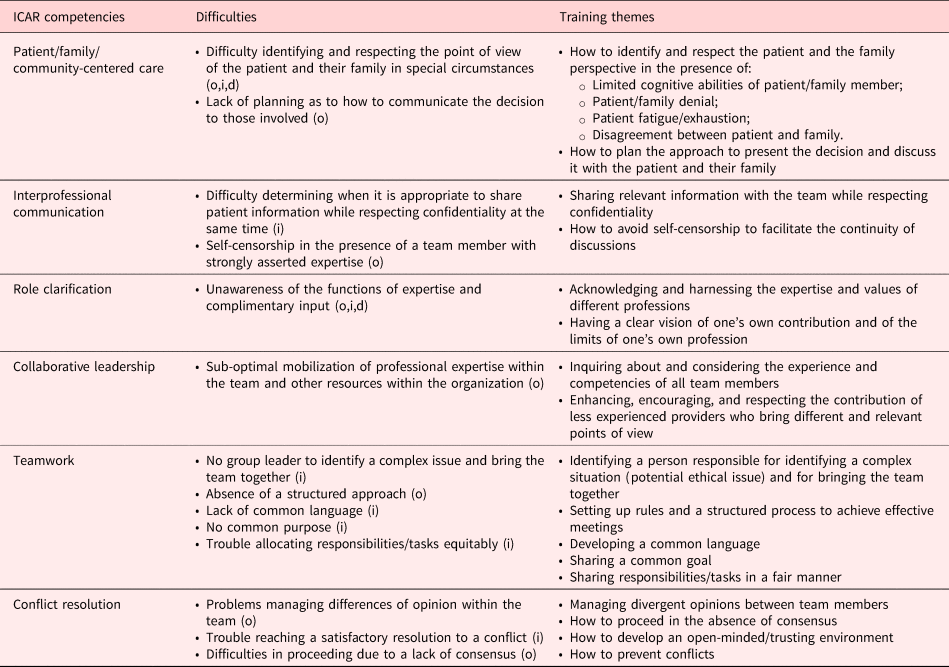
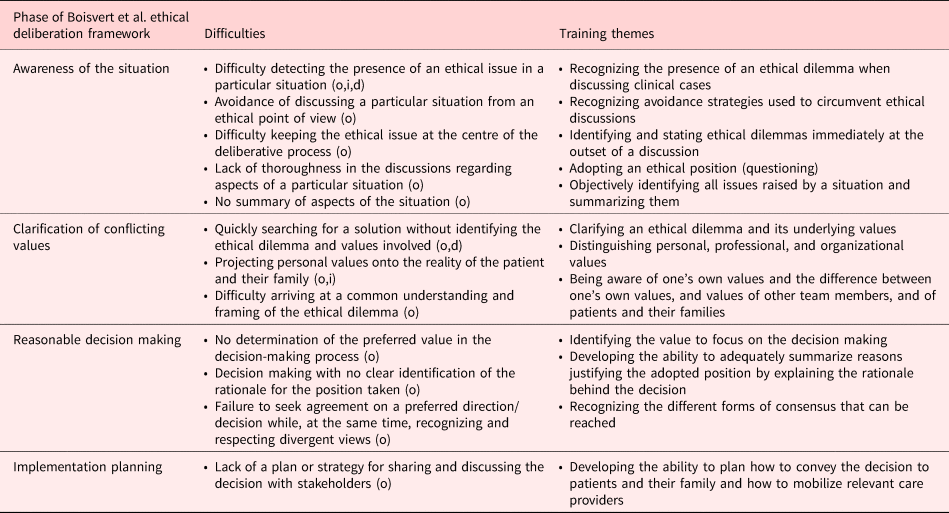
Study results suggested a number of priority educational needs for improving interprofessional collaboration and ethical deliberation processes in palliative care settings. The research team grouped these needs into two interrelated sets of competencies: (1) development of interprofessional collaborative practice competencies and (2) development of ethical deliberation competencies. Both have to be fully integrated into any pedagogical design. These priority educational needs and the related difficulties are summarized in Tables 2 and 3.
Priority training needs in interprofessional collaboration based on the interprofessional collaborator assessment rubric (ICAR) of Curran et al. (Reference Curran, Casimiro and Banfield2010)

o: observation of ethical deliberations.
i: interviews.
d: deliberative dialogues.
Priority training needs in ethical deliberation based on the framework of Boisvert et al. (Reference Boisvert, Jutras and Legault2003)

o: observation of ethical deliberations.
i: interviews.
d: deliberative dialogues.
Organizational constraints
Participants shared many organizational factors that stymie interprofessional collaboration and ethical deliberation in their clinical settings (see Table 4).
Organizational constraints

i: individual interviews.
d: deliberative dialogues.
They believed that many of the ethical issues they faced in their daily practice were directly related to insufficient human and financial resources. The service cuts stemming from severe budgetary restrictions provoked a sense of injustice and helplessness. They could not offer the level of care they considered necessary for their palliative care patients and this situation generally brought them moral distress. Participants also reported a gradual reduction in time dedicated to interprofessional team meetings and consequently, to ethical deliberation. They compensated by seeking quick solutions or reframing clinical situations to avoid discussion of complex ethical issues that necessitate more time. Occasionally, this had undesirable effects on patients and families. For example, sometimes families were not fully prepared for their relative's admission to palliative care. Participants saw these tactics as desperate measures and would have preferred alternative strategies. They also revealed that some patients died before the team even had time to identify, analyze, and properly discuss the ethical issues related to the patient's situation. Delayed admission of patients to palliative care and high patient turnover rates exacerbated the problem. Although everyone knew team decision making was recommended, they mentioned it was difficult to implement. Another difficulty arises when not all team members are available to attend interdisciplinary team meetings or when the presence of healthcare workers in certain disciplines is unpredictable. A difficulty also came about when not all team members shared the same degree of professional liability. Participants wished their institutions would produce clear guidelines that reflect a willingness to encourage interprofessional team decision making and best practices in ethical deliberation.
Discussion
To ascertain what educational needs could improve ethical deliberation processes in palliative care settings, current practices in five palliative care settings were first examined and described. By identifying disparities between optimal practices and the practices observed, the research team was able to identify priority educational needs that could improve interprofessional ethical deliberation processes in palliative care settings. In addition, they identified many organizational constraints that inhibit optimal practices in such environments. These must be taken into consideration in an unavoidable way in order to tailor the interprofessional ethical deliberation processes to the realities experienced by the palliative care professionals.
The study participants were especially aware and mindful of the experiences of patients and their loved ones. However, while many were familiar with the main principles of ethics, an increase in their knowledge and competencies in interprofessional collaboration and ethical deliberation would benefit all parties when they face a complex ethical problem. In particular, participants revealed certain shortcomings in their ethical deliberation process in complex ethical situations and felt it could be improved. One of the most important difficulties they encountered was prompt identification of an ethical issue in a specific situation, and effective engagement in a structured team deliberation process. Participants tended to quickly discuss what actions to take, without first sufficiently identifying and clarifying the ethical issues and underlying values. As reported by Gracia (Reference Gracia2003), some professionals tend to make decisions as a reflex reaction, that is often justified by the “good clinical eye” or a good moral instinct; they do not perceive the need for team deliberation. In the current study, the healthcare professionals also showed a limited understanding of their mutual roles and their complementary expertise. At the same time, their contribution as regards their own expertise was suboptimal, which may affect the efficiency of the decision-making process when it comes to an ethically complex situation. When the final decision was made, only rarely was there any systematic verification that all agreed with the decision, which raises doubts about the level of consensus. As reported in a study by Hernandez-Marrero et al. (Reference Hernandez-Marrero, Pereira and Carvalho2016), optimal interprofessional collaboration and team deliberation favor a sense of shared decision and properness, together with a feeling that consensus is achieved and the best decisions made. In the current study, the healthcare professionals were also seen to rarely discuss how to assign responsibilities among themselves following the decision. However, the artificial nature of the ethical deliberation activities may have led participants to omit this step.
Interestingly, the study participants had a clear understanding of their educational needs. Their respective inputs and rich experiences made a significant contribution to the identification of priority educational needs in interprofessional collaboration and ethical deliberation. Although some issues differed from one setting to another, educational needs were similar in all five palliative care settings.
The study data led to further observations. First, many organizational constraints were a major hindrance to improvement in the ethical culture within the clinical practice. Some participants also noted a recent deterioration in the quality of both interprofessional collaboration and ethical deliberation in their practice. Healthcare professionals were being asked to demonstrate performance with increased productivity, while still devoting enough time to complex ethical situations. Deep cuts to service triggered a sense of injustice and helplessness as healthcare professionals could not offer the level of care that they considered necessary to their palliative care patients, and this situation appears to cause them moral distress. These findings are similar to those of Piers et al. (Reference Piers, Van den Eynde and Steeman2012) in which nurses’ perception of cost-saving as unjust was an important contributing factor to their moral distress.
Participants also explained that truly interprofessional decision making in complex ethical situations is somewhat problematic so long as liability is not the same for all professionals on the team. This situation can also contribute to moral distress and is clearly a disincentive for interprofessional collaboration. A German study found that physicians in particular, felt burdened due to challenging end-of-life decision-making while sole liability lay with them (Mehlis et al., Reference Mehlis, Bierwirth and Laryionava2018). A report released by an expert panel of the Canadian Academy of Health Sciences comprehensively addressed legal and regulatory factors around scopes of practice where governing bodies ensure the safety of the patient and the responsibility of the healthcare professional (Nelson et al., Reference Nelson, Turnbull and Bainbridge2014). In the report, these factors were commonly considered to be inhibiting areas for advancing the flexibility of professional roles. However, as the authors reported: “…some existing case law reveals that courts are beginning to interpret standards of care, scopes of practice, and liability in ways that demonstrate an understanding of the goals of collaborative care and expanded scopes of practice” (p. 57). In so doing, the authors suggest that “based on case law review, there may be disproportionate concern around the extent to which liability impedes collaborative practice” (p. 60). They also recommend expanding the adoption of more flexible legislative frameworks to facilitate improvement in this area.
This study has some limitations. Although it focused on five different palliative care settings and brought together healthcare professionals from a variety of disciplines, the study findings may not be widely generalizable. First, all participants were recruited in an urban francophone community in one regional healthcare jurisdiction in the province of Quebec, Canada. Second, the healthcare system was undergoing a period of profound structural change which may have influenced the healthcare professionals’ practices. Third, the study was performed when medical aid in dying was legalized and this may have created new ethical challenges for palliative care professionals. Finally, although observing clinical scenarios is a widely acknowledged valid data collection strategy in qualitative research, behaviors observed could be subject to bias because of the fictive nature of the scenarios.
Conclusion
This study highlights the main deficiencies in interprofessional collaboration and ethical deliberation in palliative care settings and led to the identification of priority educational needs that should be met to improve palliative care in a context of complex ethical problems. The difficulties for the participants mostly concerned awareness of the ethical issues under consideration, clarification of conflicting values, reasonable decision making, and implementation planning. They also reported facing serious organizational constraints that challenged interprofessional collaboration and ethical deliberation processes. These results confirmed the relevance of developing educational opportunities in these areas. Future research should identify and develop relevant educational activities, assess their effectiveness and measure their impact on patient and family experience and the quality of palliative care, and address potential differences between disciplines. The knowledge and competencies required for optimizing interprofessional collaboration and ethical deliberation in palliative care identified in this study may also be relevant for other clinical contexts involving complex ethical issues and interprofessional collaboration.
Supplementary material
The supplementary material for this article can be found at https://doi.org/10.1017/S1478951521000729.
Acknowledgments
Results presented in this paper were drawn from a study funded by the Canadian Institutes for Health Research [126777]. We gratefully thank the healthcare professionals who took the time to participate in the study and Joanne Vidal, the professional translator who reviewed the paper and translated the quotes from French to English.
Conflict of interest
The authors declare that they have no conflicts of interest.