1 Introduction
Aronoff (Reference Aronoff1994) proposes that all mappings between form and meaning in inflectional morphology are mediated by an autonomous morphological component of the grammar – the morphomic level. In Aronoff’s model, these mappings are defined at the morphomic level, and the resulting patterns of morphological distribution (notably, inflectional class systems and patterns of paradigmatic allomorphy, termed rhizomorphomes and metamorphomes respectively by Round Reference Round, Corbett, Brown and Baerman2015) may correlate exactly, partially, or not at all with extramorphological features.
Morphomic patterns – abstract, but systematic and recurrent – are of value to speakers as a means of organising arbitrary paradigmatic allomorphy in a predictable way (see Maiden Reference Maiden2013). Diachronic evidence from Romance (see e.g. Maiden Reference Maiden2001, Reference Maiden2004, Reference Maiden2005, Reference Maiden2009a, Reference Maidenb, Reference Maiden2011a, Reference Maidenb, Reference Maidenc) has demonstrated that these patterns have psychological reality for speakers, and are exploited as templates for novel sets of alternants in cases of morphological analogy, incursive suppletion and defectiveness.
Maiden identifies four major Romance metamorphomes: the N-pattern, Footnote [2] ‘a pattern of alternation, recurrent across Romance, such that the present tense first, second and third persons singular, the second person singular imperative, and the third person plural share a root distinct from that of the remainder of the paradigm’ (Reference Maiden2011b: 241); the L-pattern, ‘in which a distinctive root is shared uniquely by the present subjunctive and the first person singular present indicative (Reference Maiden2011b: 223); the U-pattern, which ‘is the same [as the L-pattern], except that the distinctive root also appears in the third person plural present indicative’ (Reference Maiden2011b: 223); and PYTA, ‘the set of forms continuing Latin perfective roots’ (Reference Maiden2011a: 180). Strikingly, all these patterns are much less well represented in modern French than in most other Romance varieties; the only exception is a fifth morphome, Fuèc (Esher Reference Esher2013), comprising the Romance synthetic future (SF) and synthetic conditional (SC).
French is known to differ substantially from other Romance varieties in many respects; the absence or scarcity of many familiar Romance metamorphomes is one more such. The patterns of stem distribution found in modern French are described in synchrony by Bonami & Boyé (e.g. Reference Bonami, Boyé, Van Eynde, Hellan and Beerman2002, Reference Bonami and Boyé2003); the present study provides a diachronic perspective on how the current patterns arose, by examining the loss of the original Romance metamorphomes. Such loss is sometimes termed morphome death, but, as I will show, it more often resembles one of transfiguration: rather than a catastrophic and definitive disappearance, it generally involves a change in the shape of an existing morphomic distribution, and thus the emergence of a novel morphomic template. I begin by consideration of the N-pattern (Section 2), which, strongly correlated with stress placement, is of particular relevance to the issue of how autonomous morphology interacts with other components of the grammar. I will argue that the loss of the N-pattern in French is chiefly due to segmental sound changes which promote a novel morphomic pattern of stem distribution. The same changes eradicate the L-pattern (the U-pattern was never present), but create an innovative dark L-pattern (Section 3). By contrast, the loss of PYTA (Section 4) and the conservation – thus far – of Fuèc (Section 5) are accidents of historical syntax. Examination of the changes observed in French provides evidence for the mechanism of change to morphomic patterns themselves, complementing the extensive existing documentation (see e.g. Maiden Reference Maiden2001, Reference Maiden2004, Reference Maiden2005, Reference Maiden2009a, Reference Maiden2011a) of how metamorphomic patterns act as templates for other morphological changes such as incursive suppletion or the redistribution of existing or new allomorphy.
2 The N-pattern
2.1 The N-pattern and root stress in a general Romance context
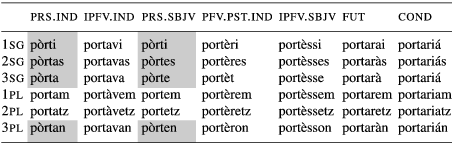
The major source of N-pattern stem allomorphy in Romance is the differential action of regular sound changes on stressed and unstressed vowels (Maiden Reference Maiden2011a: 242). In modern Romance, as a direct consequence, distinctive N-pattern alternants are strongly correlated with root-stressed forms, as in the illustrative Occitan example in Table 1, where, entirely as a result of regular sound change, the root-stressed N-pattern forms present a stem vowel /ɔ/ (written <ò>) while all other forms, stressed on the desinence (inflectional ending), present a stem vowel /u/ (written <o>). As in most Romance languages (see Maiden Reference Maiden2009a: 72; Loporcaro Reference Loporcaro2011: 90), stress in (most varieties of)Footnote [3] Occitan is lexically specified at the level of the word; thus, in Table 1, it is an inherent property of the form portatz ‘carry.prs.ind.2pl’ that it receives stress on the final syllable, and of the form pòrtas ‘carry.prs.ind.2sg’ that it receives stress on the penult.
Synthetic forms of portar ‘carry’ (after Alibèrt Reference Alibèrt1976: 92, 116–21). Root-stressed forms are shaded.

There is extensive diachronic evidence (see Maiden Reference Maiden2011a: 246–258) that speakers have generalised across the diverse phonological alternations with an N-pattern distribution, inferring an abstract pattern of morphological alternation. For instance, where two lexemes are conflated into one, the N-pattern is often used as a template defining the paradigmatic domain of each etymon (Maiden Reference Maiden2011a: 254–256, 258). In many Romance varieties, the N-pattern likewise serves as a template for distributing morphological objects such as the augment (Maiden Reference Maiden2004, Reference Maiden2011a: 248), a meaninglessFootnote
[4]
formative continuing the Latin ingressive infixes  Moreover, N-pattern alternations can be productively extended by analogy to lexemes in which regular sound change would not have produced an N-pattern distribution (Maiden Reference Maiden2011a: 246). The fact that N-pattern alternations can include morphological and (originally) lexical as well as phonological contrasts constitutes strong evidence for the psychological reality of this pattern as an abstract morphological template.
There is also some evidence that stem alternations characteristic of the N-pattern are not invariably coextensive with stress. Stems originally confined to N-pattern cells can be spread to other cells without inducing a stress shift, while stress shifts can occur in cells outside the N-pattern without triggering the extension of the N-pattern alternant to the newly root-stressed forms (Maiden Reference Maiden2011a: 258–260). Although there is evidently a strong implicational relationship between the presence of an N-pattern alternant and the presence of root stress, this is not sufficient evidence to claim that either conditions the other. Maiden (Reference Maiden2011a: 260) suggests that ‘the N-pattern alternants are not “conditioned by stress”, but rather directly associated with an array of paradigm cells’, and that root stress is likewise associated with this array of cells.
The implication of Maiden’s view is that root stress is among the exponents of the abstract, morphomic distribution. Although root stress is a phonological property associated with the paradigm cells forming the N-pattern, there is no independent phonological principle which can predict which paradigm cells receive root stress and which do not. In this respect, Romance languages contrast with Latin, where stress placement was computed algorithmically. Romance stress placement is, at least to some extent, lexically specified and phonologically arbitrary, since there is no stress assignment algorithm or fixed stress rule which exhaustively determines stress placement (though there may be constraints delimiting a ‘window’ for primary stress). It is therefore legitimate to consider the arbitrary distributions of rhizotony and arrhizotony within the Romance verb paradigm as autonomously morphological. In the case of the N-pattern, it so happens that a metamorphome characterised by stress placement develops significant overlap with a metamorphome characterised by a distinctive stem alternant.
In the literature on autonomous morphology, the correlation between rhizotony and the distinctive N-pattern alternant has sparked extensive discussion of the degree to which the N-pattern is amenable to a phonological analysis (see e.g. Anderson (Reference Anderson2008, Reference Anderson2011, Reference Anderson2013) and Maiden (Reference Maiden2011c) for Romansh varieties, particularly that of Savognin). Anderson claims that stress in Romansh is phonologically predictable, and that the majority of N-pattern alternations can be accounted for by phonology; Maiden (Reference Maiden2011c) proposes an analysis of the same data in terms of autonomous morphology, on the grounds that this can capture N-pattern distributions which are not motivated by phonology. Among the interesting points of this discussion is Maiden’s observation that ‘[a] purely morphological account obscures a major, but not exceptionless, phonological generalization, while a purely phonological account obscures a morphological one’ (Reference Maiden2011c: 49). Recalling Aronoff’s (Reference Aronoff1994: 25) view that morphomes may be partially correlated with phonological features, Maiden (Reference Maiden2011c: 49) suggests that:

This proposal is also compatible with a view of root stress as an exponent of the N-pattern.
The history of the N-pattern in French is of particular interest for the relationship between morphomes and phonological properties, due to two important contrasts with most other Romance varieties: firstly, primary stress in French is no longer lexically determined, and secondly, the N-pattern in French is no longer robust. In this section I describe the types of N-pattern stem alternation originally found in French, and discuss the subsequent phonological and analogical changes which affect the paradigm categories in which N-pattern cells are found. These changes differentiate between subsets of the cells originally forming the N-pattern, and align some originally N-pattern cells with cells outside the N-pattern. As a result, the number of lexemes in which the observed distribution of allomorphy is compatible with an N-pattern template reduces; at the same time, the fact that the patterns of differentiation and realignment are consistent across lexemes allows speakers to deduce a novel metamorphomic template. This template comprises the set of cells {1sg.prs.ind, 2sg.prs.ind, 3sg.prs.ind}, which share a unique stem distinct from that found elsewhere in the paradigm.
2.2 N-pattern stem alternations in early French
The majority of N-pattern stem alternations in early French, as in other Romance varieties, are due to regular sound change. Differential development of stressed and unstressed vowels results in a difference either in the number of syllables in the root or in the quality of the root vowel, between the N-pattern cells and the N-pattern complement cells (i.e. all cells of the paradigm external to the N-pattern).
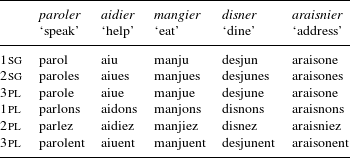
In a small group of polysyllabic verbs with a root-final long syllable (Pope Reference Pope1934: 348), phonological changes sensitive to stress assignment lead to alternation between a disyllabic root in the 1sg, 2sg, 3sg and 3pl forms of both the prs.ind and prs.sbjv, and a monosyllabic root elsewhere (Pope Reference Pope1934: 349; Buridant Reference Buridant2000: 242). Regular syncope of unstressed vowels in word-internal open syllables (Zink Reference Zink1986: 40–42) applies in the N-pattern complement cells, thus manducámus > manjons ‘eat.prs.ind.1pl’, *paraulámus > parlons ‘speak.prs.ind.1pl’; in N-pattern forms, the equivalent vowel bears stress and is not subject to syncope, thus mandúcat > manju ‘eat.prs.ind.1sg’, *paráulo > parol ‘speak.prs.ind.1sg’. Present indicative paradigms for the most common imparisyllabic lexemes are given in Table 2.
Imparisyllabic verbs in mediaeval French (after Buridant Reference Buridant2000: 242).

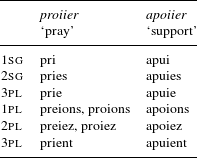
More commonly, N-pattern alternations involve a contrast in vowel quality due to changes which differentiate between stressed and unstressed vowels. The changes are diverse; illustrative examples are reproduced in Tables 3–6, and a full list is given by Pope (Reference Pope1934: 350).
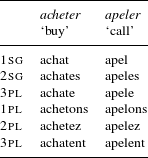
Where syncope is blocked by consonant cluster restrictions, the intertonic vowel reduces to schwa. In tonic closed syllables /a/ and /e/ are maintained, with /e/ subsequently lowering to /ɛ/ (Pope Reference Pope1934: 209); intertonic /a/ and /e/ are reduced to schwa (Pope Reference Pope1934: 112, 114). Examples of the resulting alternations are shown in Table 3.
prs.ind forms for mediaeval French verbs with N-pattern stem alternation due to differential development of /a/ and /e/ in tonic closed syllables and intertonic syllables (Buridant Reference Buridant2000: 241).

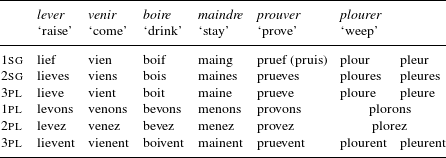
Many N-pattern alternations, such as those shown in Table 4, result from the diphthongisation of stressed mid vowels in open syllables (while unstressed mid vowels are unaffected), which leads to alternation between /ɛ/ and /iɛ/, /ɔ/ and /uɔ/, /e/ and /ei/, /o/ and /ou/ respectively; of the resulting diphthongs, all except /iɛ/ subsequently undergo dissimilation: /uɔ/ > /uɛ/, /ei/ > /oi/, /ou/ > /eu/.
prs.ind forms for mediaeval French verbs with N-pattern stem alternation due to diphthongisation of mid vowels (after Buridant Reference Buridant2000: 238–241).

In the case of verbs with a stem-final yod, the diphthongs resulting from the above change undergo additional raising (Pope Reference Pope1934: 163), resulting in alternations of the type shown in Table 5.
prs.ind forms for mediaeval French verbs with N-pattern stem alternation due to diphthongisation and raising of mid vowels (examples from Buridant Reference Buridant2000: 239–240).

The vowel /a/ in tonic open syllables undergoes raising, except before a nasal, where it diphthongises to /ai/ (Pope Reference Pope1934: 168), as in the examples in Table 6.
prs.ind forms for mediaeval French verbs showing N-pattern stem alternation due to raising of tonic free /a/ (examples from Buridant Reference Buridant2000: 238–239).

The examples in Tables 2–6 are exclusively of present indicative forms. In the present subjunctive, rhizotonic forms can often share the characteristic N-pattern root, but do not systematically do so. For many lexemes, the present subjunctive forms develop distinctive allomorphy due to palatalisation before yod; this sound change predates the rise of the N-pattern and in some cases bleeds the changes which create N-pattern stem alternation (Maiden forthcoming Reference Maiden, Luís and Bermúdez-Otero2016). Walker (Reference Walker1987: 115) cites doner ‘give’, prendre ‘take’, repondre ‘reply’, semondre ‘summon’, tolir ‘remove’, valeir ‘be worth’, gesir ‘lie’, doleir ‘be painful’, estoveir ‘be necessary’, hair ‘hate’, mener ‘lead’, moldre ‘grind’, paroir ‘seem’ and rover ‘ask for’ as examples of verbs which present the same stem in all present subjunctive forms, whether rhizotonic or arrhizotonic. In other lexemes (e.g. morir ‘die’, poeir ‘be able’, prover ‘prove’, tenir ‘hold’, trover ‘find’, venir ‘come’, voleir ‘want’, Walker Reference Walker1987: 115), the rhizotonic and arrhizotonic forms of the present subjunctive are differentiated, while their stems still remain distinct from those found in the present indicative (e.g. for trover ‘find’, prs.sbjv truiss-/troiss- vs. prs.ind trueve/trovons, Walker Reference Walker1987: 115).
It is important to note that the domain of the N-pattern and that of rhizotonic (primary) stress are not coextensive in Old French. Instead, the domain of the N-pattern (singular and third person present indicative forms, singular imperative forms, in some lexemes also singular and third person present subjunctive forms) and its distinctive root is a proper subset of the domain of rhizotonic stress. Rhizotonic forms outside the N-pattern can occur in the infinitive, preterite (1sg, 3sg and 3pl forms) and past participleFootnote [5] – a crucial difference between Old French and the modern Surmiran Romansh forms discussed by Anderson (Reference Anderson2008, Reference Anderson2011, Reference Anderson2013). Romansh varietiesFootnote [6] have generally lost the preterite altogether, and have few strong past participles, with the result that, in the varieties with which Anderson is concerned, the domains of rhizotony and of the N-pattern are exactly coextensive in the vast majority of verbs. In Old French, by contrast, the fact that a given form bears root stress does not in isolation predict that that form will present the distinctive N-pattern stem alternant.
2.3 Loss of N-pattern stem alternations due to analogical levelling
The extent and variety of N-pattern alternations has gradually reduced throughout the history of French, and few of the alternations described in Section 2.2 now survive. The process of levelling N-pattern alternations lasts several centuries, but begins early, and certain alternations, notably those involving imparisyllabic alternations, are only regularly found in the earliest texts (see e.g. Buridant Reference Buridant2000: 242–243).
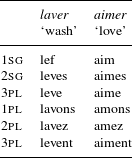
In the first conjugation, reduction of N-pattern alternations is due to analogical levelling, which becomes increasingly frequent during the twelfth century (Pope Reference Pope1934: 351), and can evict either the stressed or unstressed root from the entire inflectional paradigm, in favour of the other. Most commonly, it is the originally unstressed root which is generalised, as in laver ‘wash’, prouver ‘prove’, trouver ‘find’. This is unsurprising, since the unstressed root has higher overall type frequency, which Albright (Reference Albright, Blevins and Blevins2009) shows to be a crucial property of models for analogical levelling. In some cases, however, it is the originally stressed root which is generalised, as in aimer ‘love’, pleurer ‘weep’ and arraisonner, today restricted to the meaning ‘board and search a ship’; this root can be favoured when it occurs in a set expression (Pope Reference Pope1934: 351) or coincides with a formally and semantically similar lexeme (e.g. esmer ‘esteem’ for aimer, Orr Reference Orr1951, Robson Reference Robson1954; also pleuvoir ‘rain’ for pleurer, J. C. Smith, p.c.). Occasionally, both variants are concurrently generalised throughout the paradigm; in the case of disner ‘dine’, the development of concurrent paradigms which subsequently become separate lexemes is argued to be the origin of the contrast between déjeuner ‘have breakfast/lunch’ and dîner ‘dine’ (Buridant Reference Buridant2000: 242), though Pope (Reference Pope1934: 349) attributes déjeuner to derivation from the noun jeûne ‘fast’.
Analogical levelling progressively reduces the variety of vocalic stem alternations with an N-pattern distribution, until by the seventeenth century only /ɛ/ vs. /ə/ (e.g. j’achète, nous achetons ‘I, we buy’, j’appelle, nous appelons ‘I, we call’) is retained in this conjugation (Pope Reference Pope1934: 351). This pattern is preserved in modern standard French, but there is evidence for it having undergone levelling in some eighteenth-century varieties. Brunot (Reference Brunot1933: 1445; Reference Brunot1939: 322) notes that several eighteenth-century grammarians explicitly condemned forms such as j’achte ‘I buy’, j’épousste ‘I dust’, j’empacte ‘I wrap’, il furte ‘he ferrets’, je cachete ‘I seal’, in which the variant ə > Ø originally found in the N-pattern complement cells has been analogically extended to the N-pattern cells, replacing original /ɛ/.Footnote [7] The fact that such forms attracted explicit criticism indicates that they must have been not uncommon in use.
In the second and third conjugations, the N-pattern is disrupted by regular sound changes which differentiate between word-final and word-medial consonants, and between coda and onset consonants. These developments, which lead to the establishment of a new metamorphome, are discussed in Section 2.4 below.
2.4 Segmental sound change and new metamorphomes for old
Analogical levelling in the first conjugation reduces both the diversity of N-pattern alternations and the lexical type frequency of the N-pattern (i.e. the proportion of lexemes in the lexicon which present N-pattern alternation). In the second and third conjugations, meanwhile, regular sound changes affecting coda or word-final consonants create a novel template for morphological stem alternation, in which the cells {1sg.prs.ind, 2sg.prs.ind, 3sg.prs.ind} share a unique stem distinct from that found elsewhere in the paradigm, including the 3pl.prs.ind. I will here refer to this new template as Pattern 3.Footnote [8]
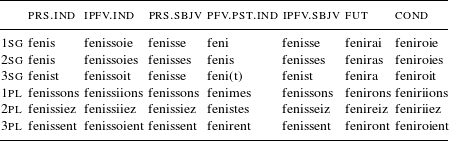
Among the important loci of Pattern 3 is the second conjugation, most members of which present a meaningless augment (Maiden Reference Maiden2004) derived from the Latin ingressive infix  The paradigmatic distribution of this augment, originally found in infectum forms, varies widely across the Romance languages (Maiden Reference Maiden2004, Meul Reference Meul2013). In early French, it is found in second-conjugation verbs, throughout the present indicative, present subjunctive and imperfect indicative, and also in the imperative and present participle (Pope Reference Pope1934: 336; Buridant Reference Buridant2000: 245), as shown in Table 7.Footnote
[9]
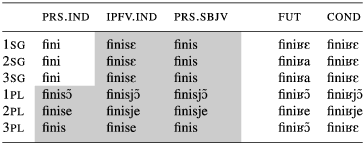
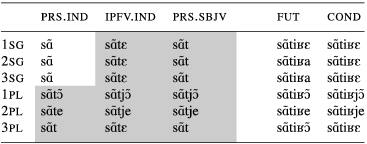
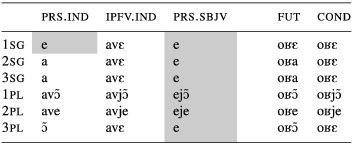
In the paradigm of regular second-conjugation verbs, the loss of almost all unstressed vowels in final syllables (the exceptions being /a/, which reduces to /ə/, and what Pope (Reference Pope1934: 113–114) terms supporting vowels Footnote [10] ) means that in all and only all the singular forms of the prs.ind, the /s/ of the augment occurs word-finally, where, like the final /t/ of the 3sg.prs.ind, it subsequently undergoes deletion (Pope Reference Pope1934: 219–223). The outcome is the modern French pattern (Table 8 Footnote [11] ), in which singular prs.ind forms display an element /i/, while plural prs.ind forms, all prs.sbjv forms and all ipfv.ind forms display an element which is recognisable as the augment /is/. As Meul (Reference Meul2013: 100) points out, the contrast between e.g. finir ‘finish’ (/i/ in singular present indicative forms; Table 8) and e.g. sentir ‘feel’ (neither /i/ nor /is/ in singular present indicative forms; Table 9) is strong evidence for the /i/ of singular present indicative forms in e.g. finir continuing the augment. In synchrony, however, the /i/ may be perceived as falling together with the second-conjugation theme vowel /i/ present in other parts of the paradigm (notably the synthetic future and conditional).
Illustrative paradigm for mediaeval French fenir ‘finish’ (Bragantini-Maillard & Denoyelle Reference Bragantini-Maillard and Denoyelle2012: 152–153).

Modern French finir ‘finish’. Wordforms presenting the element /is/ are shaded.

Modern French sentir ‘feel’. Wordforms in which stem-final /t/ is preserved are shaded.

Second-conjugation verbs of the finir-type (Table 8) would not themselves have presented overt N-pattern stem alternation, but are significant to the rise of the new pattern due to their type frequency in the lexicon. The finir-type represents a large class of verbs, with at least marginal productivity;Footnote [12] thus the single sound change introducing the new pattern into this class, introduces the pattern into many lexical items.
The overall type frequency of the novel pattern within the lexicon is likewise increased by another sound change: the deletion of final plosives and final /s/ (see Pope Reference Pope1934: 219–223), which affects singular prs.ind forms in second-conjugation verbs of the sentir-type (Table 9), and in third-conjugation verbs. For instance, in a verb such as battre ‘beat’, the deletion of final /t/ and /s/ reduces all singular forms of the prs.ind (je bats, tu bats, il bat) to /ba/, but does not apply to the root-final /t/ of the 3pl.prs.ind, which was followed by an unstressed vowel (later deleted). The result is an opposition between the wordforms /ba/ in the singular forms of the prs.ind and /bat/ in the 3pl form (also found as a stem in the 1pl.prs.ind and 2pl.prs.ind, and in all ipfv.ind and prs.sbjv forms, i.e. in all of zones 1, 2, 4 and 5 in Bonami & Boyé’s (Reference Bonami, Boyé, Van Eynde, Hellan and Beerman2002, Reference Bonami and Boyé2003) stem space analysis).
Many of the verbs affected by this change did not initially present overt N-pattern stem alternation. However, prior to the change, the sg.prs.ind and the 3pl.prs.ind would have formed part of a larger block of cells all sharing a stem: in such a case, the N-pattern is not uniquely identified by a distinctive stem, but the generalisation that all N-pattern cells share a stem remains valid. Following the deletion of final consonants, this generalisation is no longer applicable to second- and third-conjugation verbs. The subset of lexemes from which speakers can infer the N-pattern implicational relationship of cells is thus reduced, while the subset of lexemes displaying the novel pattern (distinct stem for the 1sg.prs.ind, 2sg.prs.ind, and 3sg.prs.ind forms) increases in size.
In verbs with a stem-final nasal consonant, the differentiation between sg.prs.ind and other forms is greater still, since the stem vowel is ultimately implicated. In mediaeval French, all vowels preceding a nasal consonant become first phonetically nasalised due to context, and then phonemically nasalised due to the interpretation of this contextual feature as inherent (a case of hypocorrection discussed by Ohala Reference Ohala, Egil Breivik and Jahr1989: 184–187). Where the following nasal consonant is syllable-final, it is then deleted, and the vowel remains nasal: thus bonu(m)
Footnote
[13]
 ‘good.m.sg’. By contrast, where the following nasal consonant can be syllabified as the onset of a following syllable, the nasal consonant remains, and the inherent nasality on the preceding vowel is reanalysed as contextual (a case of hypercorrection in Ohala’s terms). In such cases, the vowel undergoes denasalisation: thus
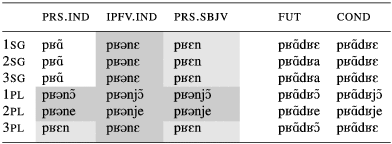
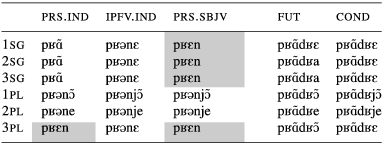
 ‘good.f.sg’. Those vowels which remain nasal are lowered (Pope Reference Pope1934: 170; Ohala Reference Ohala, Egil Breivik and Jahr1989: 187 suggests that this too occurs for perceptual reasons). The combination of these changes produces alternations such as that observed in prendre ‘take’ (see Table 10) between the singular stem
 (originally tautosyllabic nasal consonant; vowel remains nasal and lowers) and 3pl.prs.ind stem /pʁɛn/ (nasal consonant originally in onset of following syllable; vowel denasalises and remains high).
Modern French prendre ‘take’. Wordforms in which stem-final /n/ is preserved are shaded (in darker grey where the root vowel is /ə/, in lighter grey where the root vowel is /ɛ/).

In the pattern of stem distribution observed in prendre ‘take’, the cells {3pl.prs.ind, 1sg.prs.sbjv, 2sg.prs.sbjv, 3sg.prs.sbjv, 3pl.prs.sbjv} continue to share a distinctive root – indeed, as the entire wordform is shared, they display syncretism. The sg.prs.ind cells are likewise syncretic, but display a different distinctive wordform. Finally, the stem found throughout the ipfv.ind is shared with the 1pl and 2pl prs.ind and prs.sbjv forms. Diachronically, one can discern that this pattern results from the spread of an N-pattern complement alternant into the 1pl/2pl.prs.sbjv, followed by the sound changes described above setting the sg.prs.ind cells apart from all others.Footnote [14] Synchronically, it is difficult to argue for the continued presence of an N-pattern template in French.
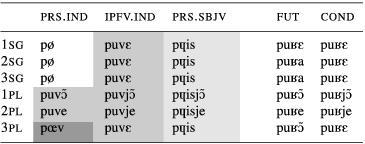
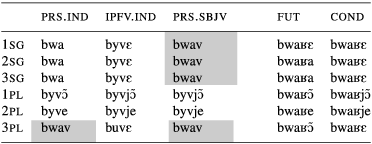
The loss of final non-nasal consonants can also create a differentiation between the root vowel quality of the sg.prs.ind forms and the 3pl.prs.ind form, in verbs which have mid vowels in the root. In some varieties of modern French (such as Midi French, see e.g. Coquillon & Turcsan Reference Coquillon, Turcsan, Gess, Lyche and Meisenburg2012), the mid vowels ø/œ, e/ɛ and o/ɔ are subject to allophonic variation such that the mid-high member of each pair occurs in open syllables, and the mid-low member occurs in closed syllables: thus je mets /me/ ‘I put’ vs. ils mettent /mɛt/ ‘they put’. In their analysis of French conjugational types, Stump & Finkel (Reference Stump and Finkel2013: 184–220) treat this as a purely phonological matter and thus not of import to morphological stem distribution.Footnote [15] Smith (Reference Smith2011: 319), implicitly working from the same assumption, suggests that verbs such as pouvoir ‘be able’ (Table 11) present a ‘hybrid’ pattern, since the 3pl.prs.ind shares both a stem-final consonant with the 1pl/2pl.prs.ind (as in the novel distributional pattern produced by deletion of final consonants) and a mid vowel with the sg.prs.ind forms (as in the N-pattern).
Modern French pouvoir ‘be able’. The unique 3pl.prs.ind form /pœv/ is highlighted in dark grey; other wordforms with stem-final /v/ are shaded in mid grey. Forms with the stem /pɥis/ are shaded in light grey.

But if the stem, again corresponding to an entire wordform, is taken as a whole, ‘surface’ /pœv/ (or ‘underlying’ /pøv/) is nevertheless unique within the paradigm. In this respect, pouvoir (like vouloir ‘want’) is more reminiscent of verbs such as faire ‘do’ or avoir ‘have’, in which the 3pl.prs.ind form is completely isolated (see also Bonami & Boyé’s (Reference Bonami, Boyé, Van Eynde, Hellan and Beerman2002, Reference Bonami and Boyé2003) stem space analysis, in which the 3pl.prs.ind form constitutes a zone separate from other parts of the paradigm, as this form is not perfectly interpredictable across all lexemes with the forms realising any other cell).
Smith (Reference Smith2011: 320–321) describes how both the N-pattern and the ‘hybrid’ pattern have been analogically eliminated in some varieties of Acadian French, in favour either of a single stem throughout the prs.ind or of one stem in all sg.prs.ind cells and another in all pl.prs.ind cells;Footnote [16] thus e.g. ils buvont ‘they drink’, ils voulont ‘they want’, ils pouvont ‘they can’, ils avont ‘they have’, ils allont ‘they go’. Smith attributes such forms to take-over of the 3pl.prs.ind form by the 1pl.prs.ind form, since with the loss of lexical word stress in French (see Section 2.4 below), the spread of an originally stressed desinence -ont into the 3pl forms would not be sufficient in isolation to trigger replacement of the originally stressed stems boiv-, veul-, peuv- by their originally unstressed counterparts buv-, voul-, pouv-.
Historically, there is extensive evidence for the spread of originally stressed desinences into 3pl forms, initially of the ipfv.sbjv, and later of the prs.ind, prs.sbjv and ipfv.ind (Pope Reference Pope1934: 385), including in the first conjugation. Chaurand (Reference Chaurand1972: 115) dates the extension of such desinences into the prs.ind from the thirteenth century onward, with a corresponding change in the choice of stem; whether lexical stress is still in play or whether this is an early case of take-over, the result is the extension of the originally unstressed root, creating yet more instances of the novel pattern differentiating the sg.prs.ind from the pl.prs.ind and all ipfv.ind forms (as in the sample prs.ind paradigm given for appeler ‘call’ by Chaurand, ‘j’appelle, tu appelles, il appelle’ vs. ‘nous appelons, vous appelez, ils “appelont”’).
Directly or indirectly, the sound changes discussed in this section all promote a novel pattern which eliminates the N-pattern in verbs such as prendre ‘take’, eliminates (or at the very least severely disrupts) it in verbs such as pouvoir ‘be able’, and excludes the possibility of a tacit N-pattern analysis in still others, such as battre ‘beat’, mettre ‘put’ and the finir-type. The result is very low lexical type frequency of N-pattern stem distributions, and thus a reduced likelihood of speakers making a generalisation about the existence of an N-pattern morphomic template, much less applying it productively. Indeed, to the contrary, analogical change appears to favour extension of the novel pattern into new lexemes, to the direct detriment of the N-pattern.
2.5 The loss of root stress
The segmental changes discussed above set French apart from most other Romance varieties. A further difference can be observed at the prosodic level, since in modern French stress assignment is not lexically specified. Primary stress in French falls on the final syllable of a phonological phrase:

Because a word in isolation will consequently receive stress on its final syllable, it has been claimed that French words have underlying stress on the final syllable and can undergo deaccentuation when realised within a phonological phrase (e.g. Delattre Reference Delattre1939). However, word-initial and word-medial syllables within a phonological phrase may receive secondary stress, which suggests that stress assignment is instead postlexical (see Rainsford Reference Rainsford2011: 13–28 for an overview). Studies of perception similarly indicate that stress in French is not lexically determined. As Dupoux et al. (Reference Dupoux, Sebastián-Gallés, Navarrete and Peperkamp2008) report, native French speakers have impaired ability to discriminate between minimal pairs distinguished only by stress placement, compared to native speakers of Spanish, a language in which stress is lexically specified.
Stress assignment in French has been phrasal, without underlying lexical stress, since early mediaeval times. Rainsford dates the emergence of such group stress to between the mid-twelfth and mid-thirteenth centuries (Reference Rainsford2011: 240), which broadly concords with previous estimates (Pope Reference Pope1934: 380; Marchello-Nizia Reference Marchello-Nizia1995: 189; Rainsford Reference Rainsford2011: 7), and also with the period in which many N-pattern and strong perfect alternations undergo analogical levelling (Pope Reference Pope1934: 380; Fouché Reference Fouché1967: 292).
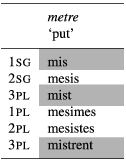
The loss of lexical stress is potentially implicated in the analogical levelling of strong perfects. In mediaeval French verbs which present a stem alternation in the preterite, this alternation is coextensive with a stress alternation between rhizotonic and arrhizotonic forms, as exemplified in Table 12 for metre ‘put’. Such alternations are systematically eradicated by analogical levelling, which occurs during the same period as the emergence of group stress.
Strong (shaded) and weak (unshaded) preterite alternants in mediaeval French metre ‘put’.

Although the simultaneity of these developments indicates that they may be linked, comparative evidence shows that the analogical levelling of strong perfects in French is not necessarily driven by the loss of lexical stress (Esher Reference Esher2015b): in mediaeval Occitan and mediaeval Catalan, equivalent alternations in the preterite undergo levelling despite the fact that both Occitan and Catalan retain lexical stress to this day. It is interesting to note, however, that there is a difference as to which root is generalised by levelling: in French, either the originally rhizotonic root or the originally arrhizotonic root may be generalised, whereas in Occitan and Catalan there is an overwhelming preference for generalisation of the arrhizotonic root. This difference indicates that stress assignment may guide the choice of root. In Occitan and Catalan, where lexical stress is retained, an arrhizotonic root is generalised across the new set of consistently arrhizotonic preterite forms. By contrast, in French, where there is no perceptually salient difference between originally rhizotonic and arrhizotonic forms, either root can be generalised to all preterite forms. At most, therefore, the loss of lexical stress may be a supplementary motivation favouring a process of analogical levelling of strong preterites, and influencing the direction of levelling.
In the case of the N-pattern, however, the comparative evidence is rather different, as N-pattern stem alternations are in general more resilient in Occitan than in French. The contrast between most Occitan varieties, which retain both lexical stress and the N-pattern, and French, which eliminates both, indicates that the presence of N-pattern stress alternation is of importance for the permanence of N-pattern stem alternation. But it is implausible to consider stress placement a direct cause of N-pattern alternation; as Smith (Reference Smith2011: 317) reiterates, the phonological rules which create N-pattern vowel alternations have not been ‘synchronically valid’ since mediaeval times. Instead, stress is more accurately considered an exponent of the N-pattern (see also Section 2.1 above).
The loss of this prosodic exponent, coupled with the loss of most segmental exponence, leaves speakers with little if any evidence of inflectional material following an N-pattern distribution. As a result, there are few grounds for inferring an abstract N-pattern template at the morphomic level: the template is valid for so few verbs that it is neither particularly salient from input nor of great predictive value in filling the paradigms of other lexemes. It is unsurprising in these circumstances that speakers do not reassert the N-pattern, or analogically extend it.
2.6 Summary
The N-pattern is strikingly less robust in modern French than in most other Romance varieties, and the present study proposes two reasons for this contrast.
One is the loss of lexical stress, which occurs at approximately the same period in which N-pattern alternations begin to undergo extensive analogical levelling, generalising either the N-pattern root or the N-pattern-complement root (i.e. the originally unstressed root associated with cells external to the N-pattern). The loss of lexical stress cannot be invoked as directly causing the loss of the N-pattern: the pattern is not directly motivated by stress placement, and indeed it is not immediately obliterated, surviving to this day in standard French acheter- and appeler-type verbs (continuants of the patterns shown in Table 2), as well as mourir ‘die’. However, the loss of lexical stress does remove a salient exponent of the N-pattern (see Esher Reference Esher2015b for the importance of prosodic features as exponents of metamorphomes), thereby reducing the overall salience of the pattern for speakers, and thus the likelihood that speakers will deduce a metamorphomic template. A pattern which is not clearly discernible is both less likely to be deduced and of lower predictive value.
The other is segmental sound change, which modifies the distribution of segmental exponents in the paradigm, creating new alternation patterns, from which new metamorphomic templates can be deduced. The history of the N-pattern, and of the novel patterns which replace it, provides a further example of the key role of segmental sound change in modifying the distributional templates defined at the morphomic level. Segmental sound change is the initial source of the N-, L- and U- pattern distributions (Maiden Reference Maiden2009a), and is also implicated in the fracture of the morphome Fuèc in Occitan varieties of the Languedoc (Esher Reference Esher2015a), where metaphony and the loss of -r- in certain contexts differentiate the synthetic future from the synthetic conditional, resulting in a novel morphomic template. In the case of the N-pattern in French, loss of final vowels, deletion of final consonants and ensuing changes in vowel quality together differentiate between the constituent cells of the N-pattern, splitting the 3pl.prs.ind form from the sg.prs.ind forms; furthermore, in many lexemes these changes align the 3pl.prs.ind form (zone 2 in Bonami & Boyé’s (Reference Bonami, Boyé, Van Eynde, Hellan and Beerman2002, Reference Bonami and Boyé2003) analysis) with the 1pl.prs.ind, 2pl.prs.ind and all ipfv.ind cells (zone 1), and commonly also the prs.sbjv cells (zones 4 and 5). The new alignment (of 3pl.prs.ind with zone 1 rather than the sg.prs.ind cells) directly conflicts with the N-pattern. A further element favouring change in the metamorphomic templates is lexical type frequency: since the new alignment applies to many lexemes, a morphomic generalisation can readily be made on the basis of the patterns created by sound change, and is of significant predictive value to speakers.
The processes which diminish the incidence of the N-pattern in French can thus be seen to promote new metamorphomic patterns: the loss of one metamorphomic generalisation is synonymous with the rise of others.
3 The L-pattern, U-pattern and dark L-pattern
L-pattern alternations in Romance arise from regular, segmental sound changes: the palatalisation and affrication of consonants before /j/, from approximately 200 ad, and the palatalisation and affrication of velar consonants before front vowels, from approximately 500 ad (Maiden Reference Maiden2009a: 47). These changes are independent of each other, but both affect the same set of cells – all prs.sbjv forms, together with the 1sg.prs.ind, in verbs outside the first conjugation – and thus both produce L-pattern alternations. In Italo-Romance and Daco-Romance varieties, the 3pl.prs.ind also presented a context susceptible to these changes, resulting in U-pattern alternation. As is the case for the N-pattern, the Romance L- and U-patterns are subsequently morphologised, and serve as templates for redistributing existing allomorphy (see e.g. Maiden Reference Maiden2009a: 53).
In French, the U-pattern is entirely absent. This is as expected, given the distribution of /j/ in early Gallo-Romance. In most cases, stem-final /j/ occurred throughout the 1sg.prs.ind and prs.sbjv, but not in the 3pl.prs.ind forms; the few 3pl.prs.ind forms in which /j/ would have occurred underwent analogical remodelling resulting in the loss of this segment (Pope Reference Pope1934: 357–358). Early French thus had an L-pattern (of which Walker Reference Walker1987 gives many examples), but no U-pattern. Subsequent sound changes reduce the L-pattern to the set of prs.sbjv cells. However, certain of the sound changes which compromise the N-pattern and L-pattern produce an innovative distribution, possibly unique to French – the dark L-pattern, comprising the 3pl.prs.ind and all prs.sbjv forms.
3.1 The L-pattern in French
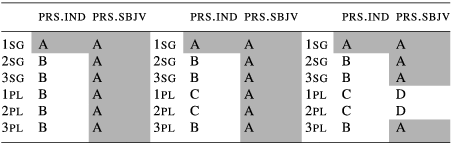
Walker’s (Reference Walker1987) survey of stem distribution types in mediaeval French includes three featuring L-pattern allomorphy, schematised in Table 13. The first (Walker’s ‘Type 3’) occurs in such verbs as doner ‘give’ (B don- vs. A doign-), prendre ‘take’ (B  vs. A preign-) and valeir ‘be worth’ (B val- vs. A vaill-). Walker’s ‘Type 4’ involves L-pattern allomorphy in a verb which also presents N-pattern stem alternation in the prs.ind, as in mener ‘lead’ (A meign- vs. B mein- vs. C men-), moldre ‘grind’ (A mueill- vs. B mueu- vs. C mol-) or estoveir ‘be necessary’ (A estuis- vs. B estuet vs. C estov-). In Walker’s ‘Type 5’, N-pattern stem alternation also affects the prs.sbjv, resulting in two allomorphs of the distinctive L-pattern alternant. This is the case for verbs such as poeir ‘be able’ (A puiss- vs. D poiss-), tenir ‘hold’ (A tiegn- vs. D teign-), trover ‘find’ (A truiss- vs. D troiss-) and voleir ‘want’ (A vueill- vs. D voill-).
Stem distributions involving the L-pattern, after Walker (Reference Walker1987: 116).

However, none of the distributions identified by Walker survive into modern French in precisely this form. As a morphomic template, the L-pattern is clearly defunct, and I am aware of only two possible candidates (one of which is at best very dubious) for a survival of allomorphy following an L-pattern distribution. Both are fossils, since the distribution of allomorphy is preserved without speakers inferring a productive metamorphomic template.
The verb pouvoir ‘be able’ has two forms for the 1sg.prs.ind, je puis and je peux (compare prs.sbjv je puisse, etc., as in Table 11 above). The form puis evidently continues an L-pattern alternant, but has been subject to the same final consonant deletion processes as discussed above for the N-pattern, and thus no longer presents identity of stem with the prs.sbjv forms. Though je puis and je peux occupy the same paradigm cell – a case of overabundance (Thornton Reference Thornton2011) – they are differentiated in usage by register and syntax: je puis is typical of more formal language, and, unlike je peux, allows inversion (Leeman Reference Leeman2006: 887). A heuristic Google Ngram comparison (25 October 2014) of the sequences “je puis” and “je peux” indicates that je peux is now much more frequent that je puis. The syntactic and stylistic distinctions between the two forms make this a case of non-canonical overabundance in Thornton’s terms.
The only other candidate is avoir ‘have’ (Table 14), which appears to present a perfect L-pattern distribution. It is probable that the high token frequency of this verb has prevented it from undergoing analogical levelling eradicating the L-pattern (see e.g. Bybee Reference Bybee1985: 57–58 for the lower susceptibility of high token frequency irregular lexemes to analogical change). A single verb, however, is insufficient to act as a productive model for analogy (see e.g. Bybee Reference Bybee2001: 123–125) since such models are typically of high type, rather than token, frequency within the lexicon (Albright Reference Albright, Blevins and Blevins2009). The distribution found in avoir is not indicative of an abstract morphomic template; it is simply a fossil.
Modern French avoir ‘have’. L-pattern cells are shaded.

Walker (Reference Walker1987) argues that the connection between 1sg.prs.ind and the prs.sbjv forms is lost due to analogical changes favouring alignment of stem allomorphy with paradigm categories (i.e. prs.ind, prs.sbjv). But this argument fails to explain the stability of the L-pattern outside Gallo-Romance, and, in any case, it is not at all clear that the patterns observed in modern French (e.g. stem identity between ipfv.ind and 1pl/2pl.prs.ind cells; or stem identity between all ipfv.ind cells, all pl.prs.ind cells, and some or all prs.sbjv cells) are any more closely aligned with paradigm categories than the N-, L- and U-patterns which foreran them. As in the case of the N-pattern, it is more likely that the L-pattern in French is compromised by sound change (as argued by Maiden forthcoming Reference Maiden, Luís and Bermúdez-Otero2016).
In mediaeval French, for L-pattern alternants with a stem-final palatal nasal (e.g. in prendre ‘take’, repondre ‘reply’, semondre ‘summon’, ceindre ‘gird’, tenir ‘hold’, venir ‘come’ and their compounds), /ɲ/ occurs word-finally in the 1sg.prs.ind form, unlike in all prs.sbjv forms, where it is followed by a vowel. The 1sg.prs.ind form is thus subject to the changes by which word-final nasals are neutralised to /n/, and subsequently deleted in the nasalisation process described under Section 2.4 above (Pope Reference Pope1934: 169; Fouché Reference Fouché1967: 85); whereas the prs.sbjv forms are not. Similarly, the stem-final palatal lateral (e.g. in valeir ‘be worth’, voleir ‘want’) is subject to vocalisation and deletion (Pope Reference Pope1934: 169) in the 1sg.prs.ind, where it occurs word-finally, but not in the prs.sbjv, where it occurs word-medially: thus vaille, veuille, etc. are retained in the prs.sbjv, whereas 1sg.prs.ind vail, vueil come to share a stem with 2sg.prs.ind vaux, veux and 3sg.prs.ind vaut, veut (which ultimately fall together in another instance of syncretism between all sg.prs.ind forms).
Another factor in the loss of the L-pattern is analogical change based on conjugational type. Most verbs displaying distinctive L-pattern alternants are third-conjugation lexemes, but a few, such as trouver ‘find’, prouver ‘prove’, doner ‘give’ and mener ‘lead’ are first-conjugation instead. In these lexemes, a different development is found: the L-pattern alternant is not merely lost from the 1sg.prs.ind, but is entirely eliminated from the verb. This can be explained by the very low type frequency of L-pattern distributions in first-conjugation verbs, in comparison to the much more prevalent first-conjugation pattern of the prs.sbjv and prs.ind sharing a stem.
Finally, Fouché (Reference Fouché1967: 84–85, 172–174, 178) notes a tendency for the 1sg.prs.ind form to be analogically remodelled on the 2sg.prs.ind form in verbs such as boire ‘drink’, recevoir ‘receive’ and escrivre ‘write’, where je boif, je rec¸oif, j’escrif are replaced by je bois, je rec¸ois, j’écris (compare the etymological 2sg.prs.ind forms tu bois, tu rec¸ois, tu écris). This remodelling may be favoured by the general pattern of syncretism or stem identity between 1sg.prs.ind and 2sg.prs.ind.
In summary, the same sound changes which produce the novel pattern of identity between all and only all sg.prs.ind forms, compromising the N-pattern, also compromise or eradicate the L-pattern. The L-pattern distribution of allomorphy is conserved in at least one irregular verb of high token frequency, but is lost from lexemes of lower token frequency (notably in the first conjugation, where the prevailing model is one of no allomorphy at all). Even more than for the N-pattern, the salience and the predictive power of the L-pattern are reduced. There is no evidence that this morphome is still active or productive in modern French.
3.2 The dark L-pattern
Stump & Finkel’s (Reference Stump and Finkel2013: 182–224) analysis of stem distribution in 72 French conjugational types shows that in all verbs except être ‘be’, avoir ‘have’, savoir ‘know’, pouvoir ‘be able’, valoir ‘be worth’, vouloir ‘want’, faire ‘do’ (all high-frequency irregulars) and their compounds, there is a systematic identity of stem between the 3pl.prs.ind form (Bonami & Boyé’s (Reference Bonami, Boyé, Van Eynde, Hellan and Beerman2002, Reference Bonami and Boyé2003) zone 2) and the 1sg/2sg/3sg/3pl.prs.sbjv forms (zone 5). The same stem, followed by an additional /j/, is also found in the 1pl/2pl.prs.sbjv forms (zone 4) of the vast majority of these lexemes.Footnote [17] In some lexemes, of course, such identity is trivial and tacit: in verbs such as aimer ‘love’, finir ‘finish’, or battre ‘beat’, the stem found in the 3pl.prs.ind and 1sg/2sg/3sg/3pl.prs.sbjv forms is also shared with many other paradigm cells. But in verbs of the types represented by tenir ‘hold’, mourir ‘die’, recevoir ‘receive’, devoir ‘owe’, mouvoir ‘move’, prendre ‘take’ and boire ‘drink’, there is a distinctive stem involved. This pattern is illustrated for boire in Table 15.
Modern French boire ‘drink’. Dark L-pattern cells are shaded.

This pattern, etymological in boire ‘drink’, arises, like the ‘hybrid’ pattern discussed in Section 2.4, due to the differential development of word-final and word-medial consonants, combined with the differential development of stressed and unstressed vowels. It is not clear that it is productive in modern French, but it does appear to have constituted a metamorphome at an earlier stage of the language, since it has been used as a template for analogical remodelling in a number of irregular verbs including prendre ‘take’, venir ‘come’, tenir ‘hold’, vouloir ‘want’ and valoir ‘be worth’.
The expected prs.sbjv forms of prendre ‘take’, for example, have a palatal nasal stem-finally (je preigne ‘take.1sg.prs.sbjv’, etc.), but, though attested in mediaeval French, these forms do not survive into modern French: instead, as shown in Table 16, they have been replaced by forms with the stem /pʁɛn/. Fouché (Reference Fouché1967: 108) dates this change to the sixteenth and seventeenth centuries. The only cell in which the stem /pʁɛn/ is etymological, and thus the only possible source for it, is the 3pl.prs.ind (Fouché Reference Fouché1967: 74). In prendre and its compounds, speakers have evidently exploited the morphomic pattern comprising 3pl.prs.ind and 1sg/2sg/3sg/3pl.prs.sbjv as a template for the redistribution of allomorphy. When represented in a table, this metamorphome appears as a partial, inverted image of the L-pattern identified by Maiden and widespread outside Gallo-Romance. For the pattern in Table 16, I propose the label dark L-pattern.Footnote [18]
Modern French prendre ‘take’. Dark L-pattern cells are shaded.

The verbs tenir ‘hold’ and venir ‘come’ also show replacement of original prs.sbjv forms with a palatal nasal by forms analogically remodelled on the 3pl.prs.ind form: je tieigne ‘hold.1sg.prs.sbjv’, etc. and je vieigne ‘come .1sg.prs.sbjv’, etc. are supplanted by je tienne, etc. and je vienne, etc. respectively. The new forms cannot be explained by analogy with the sg.prs.ind forms, which have a nasal vowel in the stem, or with the 1pl.prs.sbjv and 2pl.prs.sbjv forms, which have /ə/:Footnote [19] the only possible source for the new stem is, again, the 3pl.prs.ind form tienent. The productivity of the dark L-pattern as a live metamorphomic template is shown by the fact that the new stem is spread only to dark L-pattern cells. This change too occurs around the 17th century (Fouché Reference Fouché1967: 179; see also Streicher Reference Streicher1936: 135).
For some verbs, the new prs.sbjv forms introduced by analogy do not survive into the modern language. This is the case for valoir ‘be worth’ and vouloir ‘want’. For both these lexemes, the etymological stem of the prs.sbjv has a final palatal lateral: je vaille  etc., je veuille ‘want.1sg.prs.sbjv’, etc. (Fouché Reference Fouché1967: 172–173). However, concurrent forms je vale
 etc., je veule‘want.1sg.prs.sbjv’, etc., are created by analogy with the 3pl.prs.ind forms (valent, veulent respectively). Both vale and veule are condemned by seventeenth-century grammarians (Streicher Reference Streicher1936: 74–76; Fouché Reference Fouché1967: 173–174), a condemnation indicating that these forms were not uncommon in use, as otherwise there would have been no need to comment on them explicitly. Interestingly, though, the same condemnation does not apply to all lexemes derived from valoir: in the case of prévaloir ‘prevail’, the subjunctive form prévale ‘prevail.3sg.prs.sbjv’ is preferred over prévaille, and one grammarian also advocates for équivale
 as opposed to équivaille for équivaloir ‘be equivalent’ (Streicher Reference Streicher1936: 75, 77; Fouché Reference Fouché1967: 173).
A further possible case of a form due to dark-L-shaped analogy is suggested by Boiste’s (Reference Boiste1820: 459) comments on the verb pouvoir ‘be able’, to the effect that prs.sbjv forms such as je peuve  il peuve
 are not unheard of; the only form in which a stem peuv- is etymological is the 3pl.prs.ind. The Académie Franc¸aise pronouncement that ‘pouvoir ne fait pas je peuve’ (Streicher Reference Streicher1936: 134) is, however, ambiguous as to whether the form je peuve is condemned or simply inexistent. Somewhat ironically, the justification given by the Académie for the impossibility or undesirability of je peuve (a form created by application of the dark L-pattern template) is apparently based on the clear L-pattern template: the prs.sbjv of pouvoir should be je puisse, etc., since the 1sg.prs.ind is je puis rather than je peux (Streicher Reference Streicher1936: 134).
Finally, the dark L-pattern may also constitute an additional factor motivating the loss of distinctive clear L-pattern alternants from first-conjugation verbs such as trouver ‘find’, prouver ‘prove’, doner ‘give’ and mener ‘lead’ (discussed in Section 3.1 above). The dark L-pattern would, as today, have been tacitly present in the majority of first-conjugation verbs, but the contrast between 3pl.prs.ind forms truevent, pruevent, donent, menent and prs.sbjv stems truiss-, pruiss-, doign- and meign- directly conflicts with the dark L-pattern template. For mener and its compounds, at least (and also trouver and prouver prior to the elimination of N-pattern root vowel alternation), the 3pl.prs.ind form is the only paradigm form which displays the exact stem introduced into the prs.sbjv. In the case of doner (also trouver and prouver following the elimination of N-pattern root vowel alternation), the evidence for influence of the dark L-pattern in these lexemes is less compelling, since the stem introduced into the prs.sbjv was also present in prs.ind forms outside the 3pl.prs.ind. Nevertheless, even in this case the possibility of influence from the dark L-pattern cannot be definitively excluded, as a supplementary motivation favouring the analogical levelling of distinctive prs.sbjv allomorphs in the first conjugation.
4 PYTA
The Romance morphome PYTAFootnote [20] consists of the surviving reflexes of Latin perfectum forms in Romance. In most Romance varieties,Footnote [21] the paradigmatic distribution of the PYTA root does not result from sound changes, but from conservation of a root continuing the perfectum stem in all paradigm categories which continue perfectum forms. In contemporary spoken French, however, the reflexes of finite perfectum forms have been almost totally eradicated.Footnote [22] The loss of PYTA from French illustrates a process of change quite different from that discussed above for the N-pattern and L-pattern. The loss of the N- and L-patterns involves the reassignment of existing paradigm cells to metamorphomic templates (e.g. there is still a 3pl.prs.ind cell in modern French but it does not systematically pattern with the sg.prs.ind cells; there is still a 1sg.prs.ind cell in modern French but it does not systematically share a form with the prs.sbjv cells), whereas the loss of PYTA involves the disappearance of paradigm cells from the inflectional paradigm (e.g. native speakers no longer spontaneously acquire pst.pfv.ind or ipfv.sbjv forms).
The reflex of the Latin pluperfect indicative (with pluperfect value) is not attested beyond the twelfth century (Pope Reference Pope1934: 333), while both the reflex of the Latin perfect (the French simple past) and that of the Latin pluperfect subjunctive (the French imperfect subjunctive) are now confined to particular registers of formal written French,Footnote [23] and are only acquired by modern French speakers via formal education. This restriction on the use of the simple past and the imperfect subjunctive has been established for well over a century; it is an accepted state of affairs for early twentieth-century authors such as Meillet (Reference Meillet and Meillet1921 [1909]), Foulet (Reference Foulet1920) and Broussard (Reference Broussard1922), the latter protesting vigorously against L2 students of French being drilled to active competence in ‘tenses that are dead to all practical purposes’ (Broussard Reference Broussard1922: 38). The diachronic reduction in use of the simple past is charted in detail by Foulet (Reference Foulet1920), who finds that by at least the eighteenth century the simple past expresses no temporal function which cannot be expressed by the compound past (prs.ind of avoir ‘have’ + pst.ptcp); Foulet ascribes the loss of the simple past to its replacement as preterite by the compound past, an analysis which is likewise proposed by Squartini & Bertinetto (Reference Squartini, Bertinetto and Dahl2000). Barral (Reference Barral1980) provides an account of the history of the imperfect subjunctive, identifying as key factors in its decline the introduction of indicative forms into conditional sentences (in place of the imperfect subjunctive and its compounds), and the restriction of subjunctive forms to subordinate clauses, which occur with much lower frequency than main clauses.
It has been claimed (see e.g. Harris Reference Harris1978: 151; Reference Harris, Vincent and Harris1982: 56–57) that the simple past survives to some extent in regional French. The veracity of this claim is difficult to establish, as the sources adduced do not unambiguously refer to regional French as opposed to  varieties other than French (such as Normand, Wallon, etc.), or in some cases Occitan. For instance, Meillet (Reference Meillet and Meillet1921: 150–151) contrasts his own experience of a total absence of simple past forms in the French of Paris and of the département Allier, with earlier data from the Atlas Linguistique de la France (ALF) indicating use of the simple past in Allier and in ‘les parlers du Midi de la France’ (Meillet Reference Meillet and Meillet1921: 151). However, the ALF data typically concern local Gallo-Romance varieties rather than regional French: in the ALF context, ‘les parlers du Midi de la France’ must refer to varieties of Occitan (many of which do retain a cognate of the simple past) rather than of French, while the varieties spoken within the département Allier include both
 varieties and transitional varieties between oc and
 (the so-called ‘croissant linguistique’). Thus Meillet’s comparison may be between different varieties at different times, rather than the ‘same’ variety at different times. Foulet (Reference Foulet1920) does give examples of simple past forms used in Midi French, but points out that only third-person forms are readily used.
Some years later, Chaurand (Reference Chaurand1960) for north-eastern France, and Barral (Reference Barral1980: 359, though his example is dated Reference Chaurand1960) for the Midi, provide attestations of (mainly older) speakers using simple past or imperfect subjunctive forms in French; Wilmet (Reference Wilmet1970: 318) asserts that these forms are progressively falling out of use in the Midi. Anecdotally, my own experience of speakers in the Midi, including with native Occitan/French bilinguals who regularly use the simple past in Occitan, is that in spontaneous speech in French the simple past and the imperfect subjunctive are no longer used.Footnote [24]
Even in written standard French, the use of these forms is limited. It is far beyond the scope of this study to provide a full survey of the extensive literature on the contexts in which they remain and the possible reasons for this; for present purposes, it is sufficient to note the significant limitation of these contexts. For example, Waugh & Monville-Burston (Reference Waugh and Monville-Burston1986: 848) note that the simple past, while common in some written genres (typically literary or historical narrative) is ‘systematically absent in other types of written narrative, e.g. personal letters, diaries, memoirs’, and is never used for direct speech within a narrative. These authors’ corpus study of newspaper articles finds that the simple past is relatively infrequent: for example, only 14% of articles in Le Monde of 5–6 May 1985 contained any simple past forms at all, and overall the simple past accounted for only 1.229% of finite verb forms (Waugh & Monville-Burston Reference Waugh and Monville-Burston1986: 849). The use of the simple past as a narrative tense restricts it in practice to third-person forms, and the imperfect subjunctive appears to have undergone a similar restriction, now being confined to 3sg (a form syncretic with the 3sg simple past) and occasionally 3pl: even for written narrative, Imbs (Reference Imbs1960: 144) observes that it would be much easier to extract full paradigms from nineteenth-century texts than from twentieth-century literary works, an analysis consistent with a progressive loss of the imperfect subjunctive from the few contexts in which it persists.
The suggestion that the simple past was lost because it was formally too difficult for speakers is clearly absurd (Harris Reference Harris, Vincent and Harris1982: 63). The distinctive PYTA root is no more irregular than the past participle, and, as Foulet (Reference Foulet1920) and Fouché (Reference Fouché1967) show, the inflectional desinences of the simple past, differentiated for conjugational class, undergo extensive analogical levelling from the sixteenth century in favour of the -i conjugation, a development which considerably reduces the morphological complexity of the simple past in non-standard varieties. Van Vliet’s (Reference Van Vliet1983) claim that the imperfect subjunctive was dispreferred for essentially aesthetic reasons is similarly implausible, and most probably a post hoc rationalisation. But Van Vliet also raises the interesting possibility that the loss of one category prompted the loss of others for purely morphological reasons: essentially, if the simple past becomes less frequent, the related forms will become less familiar and less readily used by speakers. This argument is consonant with work by Bybee (Reference Bybee2001) demonstrating the importance of frequency and repeated exposure in reinforcing speakers’ mental representation of wordforms.
Could the loss of PYTA in French thus be treated as a morphomic phenomenon, with the reduction in use of the simple past favouring a similar reduction in the imperfect subjunctive due to their formal similarity? This line of argument may seem appealing if one compares the paradigms given by standard grammars of French with the set of forms commonly used in spoken French, the difference between the two consisting precisely in the loss of all finite PYTA forms; but comparative evidence suggests that such an analysis would be over-simplistic. Several varieties of Romansh, eastern Occitan and northern Italo-Romance have lost the simple past, while retaining the imperfect subjunctive; in other, indeed most, Occitan and Italo-Romance varieties, the reflex of the Latin pluperfect indicative is lost in the mediaeval period without any effect on the vitality of the simple past or imperfect subjunctive, which remain in frequent use to this day. Moreover, within French, the loss of PYTA affects all verbs, rather than being confined to verbs with distinctive PYTA roots (whereas Van Vliet’s account, based on distinctive formal similarity between the simple past and imperfect subjunctive, might appear to predict that verbs without a distinctive PYTA root would not be so affectedFootnote [25] ).
In conclusion, the processes implicated in the loss of PYTA are qualitatively different from those discussed above for the N-pattern and L-pattern: PYTA recedes due to syntactic and semantic changes which diminish the frequency of use of the constituent cells of this metamorphome. Progressively, the functions originally associated with the simple past are assumed by the compound past, and the contexts in which the imperfect subjunctive could potentially occur are limited. Phonological change has no part in these developments, and comparative evidence indicates that neither does metamorphomic structure. Today, while vestiges of PYTA forms are perpetuated by formal education, writing, and the reading aloud of written texts, there is no evidence for continued psychological reality of a metamorphome PYTA. The history of PYTA illustrates an alternative source of change to metamorphomes, culminating in a case of morphome death.
5 Fuèc
The morphome FuècFootnote [26] comprises reflexes of the Latin periphrases cantare habeo, etc. ‘I have to sing’, cantare habebam, etc. ‘I had to sing’ and/or cantare habui, etc. ‘I had to sing’. In modern French, Fuèc consists of the synthetic future (SF) and synthetic conditional (SC), which systematically share a stem (see Bonami & Boyé Reference Bonami and Boyé2003), and also share a number of semantic values: ulteriority, possibility, attenuation and conjecture (Dendale Reference Dendale2001, Vet & Kampers-Manhe Reference Vet and Kampers-Manhe2001, Esher Reference Esher2013). The current shape of the morphome Fuèc in French results from two processes: the grammaticalisation of two parallel constructions, which adds two categories with formally similar exponents to the paradigm, and the differentiation of these categories’ exponents from the infinitive by sound change.
The distinctive Fuèc stem results from a number of sound changes acting differentially on the infinitive and the SF/SC. The first of these is the deletion, or reduction to schwa, of unstressed intertonic vowels. In the first conjugation, for example, the etymological theme vowel /a/ in the infinitive occurs in an open, stressed syllable, and raises to /e/, whereas in the SF and SC the same theme vowel /a/ is intertonic and reduces to schwa (subsequently deleted). This differential development leads to the contrast in modern French first-conjugation verbs between infinitives in -/e/ and Fuèc stems without a theme vowel, e.g. chanter  ‘sing’ vs. chanterai

 ‘I will sing’.
The reduction or deletion of intertonic theme vowels creates consonant clusters which are subject to assimilation or epenthesis (Pope Reference Pope1934: 366–367): for instance, the etymological velar in clusters -nkr-, -skr- assimilates to the surrounding dentals (e.g. veintrai ‘I will conquer’, naistrai ‘I will be born’), and a homorganic stop /d/ or /b/ is inserted in clusters such as -nr- and -mr- (e.g. tendrai ‘I will hold’, crembrai ‘I will fear’). The consonants in these clusters may be syllabified differently to their counterparts in the infinitive: the reflex of -l- in infinitives such as voleir and valeir occurs in the onset and remains /l/, whereas in the corresponding Fuèc forms, /l/ occurs in the coda and undergoes vocalisation (e.g. voudrai ‘I will want’, vaudrai ‘I will be worth’).
The contexts to which these changes are sensitive set the SF and SC apart from other forms, but do not differentiate between the SF and the SC; the result is a novel metamorphome Fuèc. Subsequently, the theme vowel /i/ is reintroduced into the SF and SC of second-conjugation verbs, and several distinctive Fuèc stems are evicted in the second conjugation as well as the first: e.g. donnerai replaces dorrai ‘I will give’, cueillirai or cueillerai replaces cueudrai ‘I will gather’ (Pope Reference Pope1934: 368). What these developments have in common is that they all affect the SF and SC equally: Fuèc behaves as a single, metamorphomic block. A further example is that of the lexemes avoir ‘have’ and savoir ‘know’, which acquire novel SF and SC forms aurai, saurai etc.; while the origin of these forms is unknown (see e.g. Maiden Reference Maiden1992: 295–296), the distribution which they assume is a familiar one in which all Fuèc cells share a stem.
Synchronic analyses of the SF and SC in French commonly link their formal resemblance to their strong semantic parallelism (see e.g. Touratier Reference Touratier1996, Iatridou Reference Iatridou2000). However, there is reason to doubt that semantic commonality is in itself sufficient motivation for the continued formal similarity between the constituent cells of Fuèc. Comparison of Fuèc across Romance varieties indicates no strong correlation between degree of functional motivation and diachronic resilience (Esher Reference Esher2014): within Occitan, for instance, those varieties which present the highest proportion of stem differentiation between the SF and SC are not those which present the greatest functional difference between the SF and SC, and vice versa, while in Italian, where the SC cannot express futurity, the formal similarity of SF and SC stems is no less than in French, where the functions of the SF and SC are parallel. It would thus be unfounded to assume that Fuèc survives better than other morphomes in French because it is most strongly correlated with ‘functional’ (in this case, semantic) properties external to morphology. Rather, it is an accident of historical development that both the SF and SC persist into modern French,Footnote [27] and that regular sound changes have not differentiated between the constituent cells of Fuèc.
The history of Fuèc is in a sense complementary to that of PYTA, since in the case of Fuèc morphosyntactic changes result in cells being added to the inflectional paradigm, whereas in the case of PYTA morphosyntactic changes remove cells from the paradigm: both illustrate developments in which the metamorphomic templates available change due to overall changes in the shape of the inflectional paradigm. The history of Fuèc additionally provides a further example of the importance of segmental sound change in assigning existing paradigm cells to metamorphomic templates.
6 Conclusions
The morphomic signature of modern French differs significantly from that of other Romance languages, principally in the shape of morphomic distributions within the verb paradigm, but also in the morphological objects which follow those distributions. By identifying the specific changes which have led to such differences, this study provides evidence for the nature of the processes responsible for change in the shape of metamorphomic templates.
The majority of differences between the set of metamorphomes found in French and that found in other Romance languages are due to regular segmental sound change, confirming the view of Maiden (forthcoming Reference Maiden, Luís and Bermúdez-Otero2016) and Esher (Reference Esher2014, Reference Esher2015a) that sound change is the central factor actuating change in the shape of metamorphomic distributions. An existing metamorphome may be merged with another, split into multiple metamorphomes, or have a subset of its constituent cells aligned with another metamorphome. Such changes in the grouping of paradigm cells into metamorphomes equate to the loss of existing metamorphomes, and the creation of new ones.
In French, the loss of final consonants reduces the L-pattern to prs.sbjv cells only, and compromises the N-pattern by differentiating between singular and plural forms. The loss of lexically specified, morphologically arbitrary root stress does not directly cause the loss of the N-pattern, but contributes to its decline, since the change to phonologically determined group stress removes a salient exponent of the N-pattern, namely distinctive root stress.
Segmental sound changes also promote novel metamorphomic distributions. In one (Pattern 3), only the singular forms of the prs.ind share a distinct stem. The plural forms of the prs.ind share a stem with all ipfv.ind forms (and often the prs.sbjv); this distribution is a slightly extended form of the set 1pl/2pl.prs.ind + ipfv.ind (in other words, reflexes of infectum forms outside the N-pattern and L-pattern). In another, the dark L-pattern, the 3pl.prs.ind and some or all prs.sbjv forms share a stem. Due to their high lexical type frequency, both these patterns are retained and used as templates for morphological analogy. Like the sound changes which create them, they are unique to northern Gallo-Romance.
A further consequence of the loss of final consonants and vowels is an increased incidence of syncretism within the paradigm. Whereas in most other Romance languages morphomes such as the N-pattern are manifest in the distribution of inflectional formatives (usually stems, but sometimes also desinences, see Maiden Reference Maiden2009b), morphomic patterns in French commonly manipulate entire wordforms.
However, sound change is not the only source of change in metamorphomic templates. As this study shows, another important source of change to metamorphomes is change in the overall shape of the inflectional paradigm, either by the addition of new paradigm cells or by the deletion of existing cells. Such changes are due to morphosyntactic developments, such as the grammaticalisation of periphrases into synthetic forms, or the replacement of existing forms by new forms as exponents of given functional content. In the history of French, changes to the inflectional paradigm are exemplified by the metamorphomes PYTA and Fuèc. In the case of PYTA, morphosyntactic and syntactic changes diminish the frequency of occurrence of the morphome’s constituent parts, to such a degree that these are no longer spontaneously acquired by native speakers: the categories ‘simple past’ and ‘imperfect subjunctive’ have effectively disappeared from the inflectional paradigm, and their constituent cells are thus no longer available to participate in metamorphomic distributions. In the case of Fuèc, the grammaticalisation of periphrases adds new categories ‘synthetic future’ and ‘synthetic conditional’ to the paradigm, creating new cells to be assigned to a metamorphome.
A final point to be made concerns factors which are not important to metamorphome change and continuity. Fuèc, comprising the synthetic future and conditional, is the only familiar Romance metamorphome to survive into modern French in its characteristic shape. While, in French, the metamorphome Fuèc is correlated with semantic content, comparative data show that such correlation is unlikely to be a major factor in the diachronic persistence of this metamorphome (see Esher Reference Esher2014). The persistence of Fuèc is largely due to the chance fact that no subset of this metamorphome’s constituent cells has been differentiated from the others or reassigned to another metamorphome following sound change (as in the case of the N- and L-patterns), and that neither the synthetic future nor the synthetic conditional has yet been supplanted by an alternative form, leading to elimination of these cells from the inflectional paradigm as in the case of PYTA.
The contributions of this study are thus twofold. With specific relevance to Romance, and specifically French, linguistics, the study provides a diachronic account of metamorphomic templates in French, in a comparative Romance perspective, identifying how and why the shape and range of metamorphomic templates have changed between early and modern French. More generally, and thus with relevance to morphological theory independent of language family, the study identifies processes which can account for change in metamorphomic distributions: chiefly segmental sound change (supported by lexical type frequency and salience of exponents), which affects how existing paradigm cells are distributed among metamorphomes, and morphosyntactic change, which affects the shape of the inflectional paradigm and thus the range of cells available for distribution.