In mainland China today, America and Americans are both nowhere and everywhere at the same time. Separated by the vast Pacific Ocean, most mainland Chinese have almost no direct contact with either America or Americans. In the 2008 China General Social Survey (CGSS, questions GI 1 & 2) just three-tenths of 1 per cent of the nationally representative sample reported having travelled to North America, while less than 1 per cent (0.8%) claimed to have even met (renshi 认识) a North American.
Yet, American celebrities and popular culture – movies, music and sports – are everywhere in mainland China today. Despite Chinese government restrictions, which allow just 20 foreign-produced films to be screened each year, Hollywood has flourished on the mainland. For instance, the American films Transformers, 2012, Avatar, Transformers 3 and Titanic 3D were the top-grossing films in China in 2007, 2009, 2010, 2011 and 2012, respectively.Footnote 1 Indeed, in 2010, James Cameron's Avatar was so popular that the Film Bureau of the State Administration of Radio, Film and Television (Guojia guangbo dianying dianshi zongju 国家广播电影电视总局, hereafter SARFT) restricted the number of cinemas in which it could be screened to aid the Chinese film Confucius (Kongzi 孔子).Footnote 2
North American hip-hop, rock and pop musicians have also looked to China in search of new fans. In 2007 alone, the Yeah Yeah Yeahs, Talib Kweli, Linkin Park, Beyoncé, Eric Clapton, Avril Lavigne, the Nine Inch Nails, and Sonic Youth included China in their world tours.Footnote 3 In recent years, Avril Lavigne and Celine Dion have performed on televised Chinese New Year galas, which were broadcast nationwide by CCTV. Dion even performed a popped-up version of the Chinese folk song, “The Jasmine Flower” (Molihua 茉莉花), in Mandarin.Footnote 4
As suggested by its response to Avatar, the Chinese government's reaction to the rising tide of North American popular culture in China has often been defensive. In 2011, citing “national cultural security” (guojia wenhua anquan 国家文化安全), the Ministry of Culture blacklisted several American artists including the Backstreet Boys, Lady Gaga and Katy Perry.Footnote 5
Despite such censorship, contemporary American pop stars are everywhere in China today. For instance, Taylor Swift boasts 112 official music videos and 100 pages (nearly 2,000 videos) of live performance and fan-made videos uploaded to YouKu, China's equivalent of YouTube. One video has had over two million views. Swift is hardly alone among American celebrities breaking into the Chinese mainstream. Actor Tom Cruise maintains a Weibo account which has over three million followers, “pop-punk” singer Avril Lavigne has signed an endorsement deal with a Chinese brand of iced tea, while the actor Bradley Cooper, star of The Hangover series of films, has appeared in Chinese advertisements for Häagen-Dazs ice cream.Footnote 6
American popular culture is also transmitted through sports. Since 2002, when China's Yao Ming 姚明 was chosen as the number one overall draft pick by the Houston Rockets, Chinese interest in the National Basketball Association (NBA) has soared. NBA stars have become among the most recognized and popular foreign celebrities in China. Kobe Bryant, LeBron James, Kevin Durant and Dwight Howard grace Chinese magazine covers, billboard advertisements and shopping mall storefronts. The NBA's Sina Weibo micro-blog has over 41 million followers, making it the most followed professional sports league in China; its China-based website (nba.com.cn) registered over 4.5 billion page views during the 2012–2013 season. Demand for NBA brand merchandise, now available at over 25,000 retail locations, continues to rise in China.
American Popular Culture and Chinese Views of America
What impact does all this indirect exposure to America and Americans via globalized American popular culture have on popular Chinese attitudes towards the United States? This question is of theoretic interest, contributing to a growing body of scholarship on the social psychology of globalization.Footnote 7 It is also, however, of substantive policy consequence: China's relationship with the US is the most important bilateral state-to-state relationship of the 21st century. In our view, the most likely scenarios leading to another US–China conflict will not be driven by objective conflicts of interest, the subject of mainstream IR theory. Given the extensive US–China economic and security interdependence, both cooperative and competitive outcomes are possible. Status competitions, however, are inherently zero-sum. And globalized American popular culture is one potential cause of Chinese dis/trust of the United States. A better understanding of the sources of mis/perception and dis/trust in US–China relations today is urgently needed.
Communications theory suggests that the impact of American popular culture on Chinese views of America should be largely positive. Scholars began exploring the effects of new mass media in the 1950s, arguing that “parasocial” interactions occur between viewers and performers, creating the “illusion of face-to-face relationships.”Footnote 8 Building on social psychologist Gordon Allport's influential “contact hypothesis,” which contends that increased direct contacts between groups increase mutual knowledge and reduce anxiety and prejudice, communications scholars have more recently proposed a “parasocial contact hypothesis,” which holds that indirect media exposure to stigmatized groups like gays can also reduce prejudices like homophobia.Footnote 9
Do such theories and findings travel beyond the relations among different social groups within nations to the relations between nations? Specifically, does the parasocial contact hypothesis apply to US–China relations? Based on a large convenience sample of Americans, one group of scholars has recently demonstrated that greater knowledge of China played the expected mediating roles between both direct contacts with Chinese and indirect contacts via media exposure on the one hand, and prejudice against the Chinese people on the other. However, greater knowledge of China was associated with greater negativity towards the Chinese government, which in turn contributed to desires for tougher China policies. Knowledge about China is thus a “double edged sword,” cutting both ways when it comes to the China policy preferences of the American people.Footnote 10
However, that research did not explore the flip side of the coin: how contacts with Americans shape Chinese views of America. A large 2011 convenience sample survey of Chinese netizens included a rating scale of ten celebrities on a 1–7 scale, from “really dislike” (hen buxihuan 很不喜欢) to “really like” (hen xihuan 很喜欢). Four of the celebrities were Americans, balanced on gender and profession (actors and musicians): Eminem, Brad Pitt, Jennifer Aniston and Lady Gaga. The mean score on the resulting four-item scale (α = 0.80) was neutral (M = 3.94, SD = 1.0). However, when pit against a three-item scale of Chinese nationalism (α = 0.71; sample item: “China is the best country in the world” (Zhongguo shi shijieshang zuihao de guojia 中国是世界上最好的国家)) to account for a composite three-item scale (α = 0.84) of feelings towards America (Meiguo 美国), Americans (Meiguoren 美国人), and the American government (Meiguo zhengfu 美国政府), the American celebrities' scale (β = 0.28, p < 0.001) was a much more powerful predictor than nationalism (β = –0.10, p = 0.002).Footnote 11 This is encouraging: warmth towards American celebrities increased warmth towards America much more than Chinese nationalism decreased it. But, this evidence is purely correlational. Is there a causal relationship? Does Hollywood promote positive Chinese views of America? We designed a pair of experiments to find out.
Study One
Participants
A convenience sample of 129 mainland Chinese took a ten-minute survey online in the first week of September 2013; 107 completed the survey.Footnote 12 The mean age of the respondents was 23 (SD = 3.8); 86 per cent were college students recruited to take part in the survey by their professors; 57 per cent were male. A plurality (33 per cent) of respondents were from Zhejiang; 40 per cent came equally from either Beijing, Shanghai, Jilin or Hubei; and 57 per cent described themselves as having a rural (nongcun 农村, as opposed to urban, chengshi 城市) upbringing (chushen beijing 出身背景). Participation was voluntary and unpaid.
Because the sample was not representative, we cannot generalize mean levels on any variable to the full Chinese population. Our purpose instead is to utilize the random assignment of an experimental design to explore any causal effect of indirect exposure to American celebrities on attitudes towards America.
Experimental primes
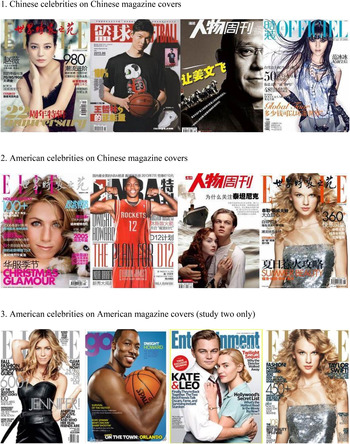
After gathering basic demographic information about the participants, they were randomly assigned to one of two experimental conditions. In the control, “Chinese celebrities” condition, participants were asked to judge the attractiveness of four Chinese magazine covers, featuring model/actress Zhao Wei 赵薇, basketball star Wang Zhelin 王哲林, actor/director Jiang Wen 姜文, and model/actress Fan Bingbing 范冰冰. In the experimental “American celebrities” condition, participants were asked to evaluate Chinese magazine covers featuring actress Jennifer Anniston, actors Leonardo DiCaprio and Kate Winslet, basketball star Dwight Howard, and singer Taylor Swift. The Chinese magazine covers themselves (see the first two rows of Figure 1) were kept as similar as possible so that the only noteworthy difference between the two conditions would be the nationality of the celebrities.
Experimental Conditions

The webpage was entitled “Magazine covers” (zazhi fengmian 杂志封面), and the question beneath the photos was, “What kind of artistic design do you like? Please evaluate the four magazine covers above” (Ni xihuan shenmeyang de yishu sheji? Qing pingjia yishang de sige zazhi fengmian 你喜欢什么样的艺术设计? 请评价以上的四个杂志封面). Participants rated each cover on a seven-point Likert scale from “extremely unattractive” (feichang buhaokan 非常不好看) to “extremely attractive” (feichang haokan 非常好看). In this way, participants were asked to engage in an aesthetic judgment task and focus their attention on the artistic designs of the magazine covers rather than the nationality of the celebrities who happened to be pictured.
Why the deception? First, social psychologists have found that explicit measures of sensitive topics such as prejudice often suffer from self-presentation biases, whereby individuals seek to present a socially desirable image of themselves to others. They have therefore developed implicit measures to avoid this methodological problem.Footnote 13 For instance, two of the authors found that, when explicitly primed to think about communism, American liberals are motivated to avoid letting anti-communist prejudices cool their feelings towards China. However, when the communism prime is subconscious, they cool to China.Footnote 14 Second, a subconscious prime of American popular culture increases the mundane realism of our experiment: while urban Chinese may not explicitly think about American celebrities very often, they are routinely but indirectly exposed to them in their daily lives.
Measures
Respondents were asked to complete 11-point 0° to 100° feeling thermometers (qinggan wenduji 情感温度计) for America, Americans, and the American government. These were our dependent measures. Their sequence was randomized.
Participants were then asked to complete a series of rating scales of possible moderators, including “national narcissism” as a Chinese. Building on recent work on grandiosity and entitlement as distinct internal dimensions of narcissism at the individual level,Footnote 15 and on collective narcissism as a group-level phenomenon,Footnote 16 two of the authors have recently developed a scale to measure “national narcissism” specifically, defined as “an inflated view of one's own nation's importance and deservedness.”Footnote 17 We used three items (α = 0.79) from their scale:
-
1. I think that China should receive the respect that it is due.
(Wo renwei Zhongguo li ying huode yingde de zunzhong 我认为中国理应获得应得的尊重.)
-
2. I wish other countries would more readily recognise Chinese authority.
(Wo xiwang biede guojia neng jinzao di renshidao Zhongguo de quanwei 我希望别的国家能尽早地认识到中国的权威.)
-
3. If China had a bigger say in the world, the world would be a much better place.
(Ruguo Zhongguo zai shijieshang neng fahui gengda de zuoyong, shijie jianghui biande genghao 如果中国在世界上能发挥更大的作用, 世界将会变得更好.)
Participants agreed or disagreed with each item on a seven-point Likert scale.
Results
Overall, the Chinese magazine covers with American celebrities on them (M = 4.56) were rated as very slightly more attractive than the Chinese magazine covers displaying Chinese celebrities (M = 4.23).Footnote 18 Magazine attractiveness was therefore entered as a covariate in further analyses to control for any possible effects of differences in aesthetic judgment.
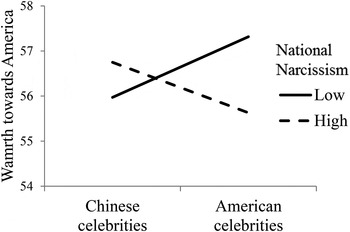
There was no main effect of the prime on a three-item “warmth towards America” scale (α = 0.77) that averaged together feelings towards America, Americans and the American government. However, further analysis revealed that national narcissism moderated the impact of the experimental prime on the warmth towards America scale (see Figure 2). Specifically, exposure to Chinese magazine covers with American (versus Chinese) celebrities on them increased warmth towards America – but only among more cosmopolitan Chinese low on national narcissism (see the rising solid line in Figure 2). However, for those Chinese participants who ranked highly on national narcissism (the falling dashed line), indirect exposure to the American celebrities prime led to greater coolness towards America. This finding replicates recent research demonstrating that the broader construct of collective narcissism also moderates how individuals react to outgroups.Footnote 19
The “Beautiful Imperialist”: National Narcissists Cool to American Celebrities on Chinese Magazine Covers

Discussion: the “beautiful imperialist”
In the 2011 survey discussed above, how much a Chinese netizen said they liked four American celebrities predicted warmth towards America. But, in our 2013 experiment, indirect exposure to American (versus Chinese) celebrities on Chinese magazine covers led national narcissists to feel greater coolness towards America. How should we interpret this seemingly contradictory pattern of results?
It seems likely that the indirect American celebrities prime elicited the Sino-American intergroup context, a context that was not salient in the 2011 survey. For those Chinese participants who ranked highly on national narcissism, our American celebrities on Chinese magazine covers prime may have activated a pre-existing Chinese national image of America as an “imperialist.” International Image Theory suggests that individuals hold images of foreign countries that are akin to schemas or stereotypes that operate as cognitive simplification devices, organizing information into meaningful and integrated schema, such as “enemy,” “ally,” “colony/dependent” and “imperialist.”Footnote 20 In our experiment, implicit exposure to American celebrities on Chinese magazine covers may have elicited a malign “beautiful imperialist” (meidi 美帝) national image – but only for Chinese who ranked highly on national narcissism. For those low on national narcissism, indirect exposure to American celebrities may have elicited a more benign “beautiful country” (meiguo 美国) schema.
Study Two
Did Chinese who rated highly on national narcissism reflexively react against the American celebrities themselves, or against their depiction on Chinese magazine covers? In experiment 1, both the Chinese and American celebrities primes depicted them on Chinese magazine covers. This was done to reduce the differences between the two experimental conditions (and thus minimize alternate explanations for any differences found). But, could it have been the placement of American celebrities on Chinese magazine covers that was experienced as threatening by Chinese high on national narcissism, leading to an exclusionary reaction?
Cross-cultural psychologist C.Y. Chiu has proposed a “bicultural exposure effect” whereby the simultaneous exposure to multiple cultures makes cultural boundaries more salient. Under certain circumstances, such exposure can be perceived as a contaminating cultural intrusion, promoting an exclusionary reaction to the foreign other.Footnote 21
Perhaps our Chinese participants high on national narcissism were reacting not against American celebrities per se but to the perceived cultural intrusion of American celebrities on Chinese magazine covers. We designed a follow-up experiment to find out.
Participants
A convenience sample of 339 Chinese participants, who were largely recruited by university professors, completed the study online at surveymonkey.com in late October and early November 2013. They were not paid. Of this sample, 74 per cent were college students; 21 per cent were male; 49 per cent were from Guangdong, 30 per cent from Beijing, and the rest from 33 other provinces; and the mean age was 22 (SD = 3.2). They were evenly divided between those describing themselves as having had a rural or an urban upbringing.
Experimental primes
Study two added a third experimental condition to the two used in the first study: American celebrities on American magazine covers. As can be seen at the bottom of Figure 1, the four American magazine covers chosen for condition three displayed the exact same American celebrities that were used in condition two, only on comparable American rather than Chinese magazine covers.
Measures
The same dependent measures (feelings towards America, Americans and the American government) and moderators (national narcissism) used in study one were replicated in study two.
Results
A one-way ANOVA revealed that the Chinese participants in study two also rated the artistic designs of American (M = 4.48) and Chinese (M = 4.54) magazine covers with American celebrities on them as slightly more attractive than those showing Chinese celebrities (M = 4.22).Footnote 22 Therefore, magazine cover attractiveness ratings were again entered as a covariate in all subsequent statistical analyses.
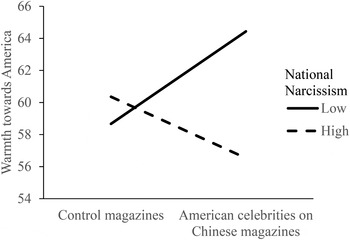
To test for a cultural intrusion effect, the two sets of Chinese magazine covers (conditions one and two) were compared against the new American magazine covers (condition three). Our three-item warmth towards America scale was regressed onto this experimental condition variable, national narcissism (mean centred), and their interaction. The resulting model was significant but there was no main effect of condition.
Once again, however, there was a significant interaction between the experimental condition and national narcissism. As can be seen in Figure 3, high and low national narcissists responded to the experimental primes in opposing fashions. Specifically, low national narcissists (or “cosmopolitans,” the rising solid line) responded to the bicultural exposure of American celebrities on Chinese magazine covers with greater warmth towards America, an inclusionary response. By contrast, high national narcissists (the falling dashed line) felt somewhat cooler towards America following bicultural exposure, an exclusionary response.
Bicultural Exposure: Inclusive and Exclusionary Reactions to American Celebrities on Chinese Magazine Covers

Discussion: inclusive and exclusionary reactions to cultural intrusion?
Indirect parasocial contact with American celebrities via magazines covers again shaped feelings towards America among Chinese participants, replicating study one with a larger sample. However, in study two, the cooling exclusionary effect specifically occurred only when national narcissists saw American celebrities on Chinese magazine covers. This bicultural context shaped how Chinese high and low on national narcissism differentially responded to the experimental primes.
Conclusion: The Kung Fu Panda Effect
Dreamwork's 2008 animated movie, Kung Fu Panda, was a hit in China. Jack Black was the voice for protagonist Po, an overweight panda with dreams of becoming a martial arts hero. Po begins the movie trapped working in his father's noodle restaurant but, with some good luck and hard work, he learns kung fu and saves China. Kung Fu Panda set China's box office record for an animated film, earning 180 million yuan (US$27.7 million). Kung Fu Panda 2 met with similar success among Chinese audiences three years later.
Not all Chinese were pleased, however. Zhao Bandi 赵半狄, an artist known for his own use of panda motifs, urged a national boycott of the first film in 2008. Kung Fu Panda, he insisted, was exploiting China's “national treasures”: pandas and the martial arts. He persisted in 2011, arguing that Children's Day – the date Kung Fu Panda 2 was released – “should be pure. Don't turn it into a money-making day for Hollywood and don't fool our next generation with American ‘fast food’.”Footnote 23 Zhao was not alone. Kong Qingdong 孔庆东, a professor of Chinese at Peking University, claimed that the Kung Fu Panda movies were “a cultural invasion.” The panda, Kong complained, should be a symbol of China. Instead, Po is depicted as indolent and fat – a typical American.
Other Chinese disagreed. “I wouldn't call it a cultural invasion,” said Li Jiayi, a Beijing university student. “I see nothing bad with others using our culture in a movie.”Footnote 24 Given the box office success of the Kung Fu Panda movies, Li was clearly not alone in his more welcoming attitude.
The experimental findings presented in this paper suggest that the Kung Fu Panda controversy may generalize to the broader issue of how, in a rapidly globalizing world, different groups of Chinese respond to increasing parasocial contacts with American celebrities and popular culture. Not all Chinese are alike. Across two studies, more cosmopolitan Chinese participants – those low on national narcissism – showed increased warmth towards America following implicit exposure to American celebrities on magazine covers. Participants high on national narcissism responded very differently. In study one, they felt cooler towards Americans following exposure to American celebrities on Chinese magazine covers. In study two, this effect was replicated, but only in the specific context of American celebrities on Chinese magazine covers; it did not hold when the American celebrities were on American magazine covers. Context matters. High national narcissists appear to react against what they experience as cultural intrusion – a threat to China's cultural purity that leads to an exclusionary reaction against America. This finding replicates research demonstrating that other psychological predispositions also shape whether individuals respond to bicultural exposure with inclusionary or exclusionary responses.Footnote 25
So, does Hollywood improve Chinese perceptions of America? This paper suggests a highly contingent answer: it depends upon the specific persons and situations involved. Chinese high on national narcissism are more predisposed to react defensively than those more cosmopolitan Chinese lower on national narcissism. But, context matters too: are Hollywood celebrities seen as intruding upon Chinese cultural spaces or not? As psychologist Kurt Lewin famously argued in 1935, most human attitudes and behaviours are the product of both personal and environmental factors.Footnote 26 To gain a better understanding of US–China relations and decrease the likelihood of another US–China conflict in the 21st century, social scientists must engage with the complexity of the lived experiences of Chinese and Americans today.