Blood culture is a critical high-volume laboratory test which, due to contamination, is increasingly associated with issues of cost, patient safety, and antibiotic stewardship on a national scale.
Because there is no standard definition for contamination, we hypothesized that institution contamination rates would differ significantly for 2 different contamination definitions, a clinical episode definitionReference Richter, Beekmann and Croco 1 and a single-blood-draw definition.Reference Bekeris, Tworek, Walsh and Valenstein 2 Moreover, there is a need for both a national standard definition of contamination and a new standard for institution contamination rate performance.
METHODS
The blood cultures assessed in this retrospective study were obtained from adults (18 years or older) suspected of having sepsis who were hospitalized, evaluated in the emergency department, or seen as outpatients in a not-for-profit university-affiliated hospital in the Seattle, Washington, area. A blood culture consisted of a 20-mL specimen divided into equal parts that were inoculated into aerobic and anaerobic media. Incubation was conducted using an automated computer-monitored system (bioMérieux SA, Durham, NC) and was continued for 5 days if there was no growth.
The institution contamination rate (R) was calculated using 2 different definitions. First, for the clinical episode definition , a false positive (contamination) was defined as ≥1 skin-residing organism (SRO) isolated in 1 culture in a 48-hour clinical episode. SROs include coagulase-negative Staphylococcus spp., Proprionbacterium acnes, Micrococcus spp., “viridans” group streptococci, Corynebacterium spp., and Bacillus spp. Culture results were considered as a unit. If either the aerobic or anaerobic media or both showed an SRO, the culture was counted as a contamination. If antibiotic sensitivity testing was ordered for an otherwise false positive, the culture was reclassified as a true positive.Reference Richter, Beekmann and Croco 1
Second, for the single-blood-draw definition, each culture was considered separately, and contamination was the growth of an SRO in either the aerobic or anaerobic media, but not both. Clinical episodes were not considered in association with the single-blood-draw definition; this definition regards laboratory data only and is not intended for clinical interpretation.Reference Bekeris, Tworek, Walsh and Valenstein 2
RESULTS
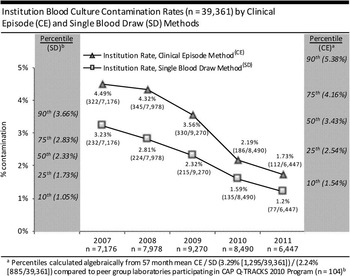
Using retrospective data for a 57-month period (January 1, 2007 through September 30, 2011), we determined our institution’s rate of contamination for both clinical episode and single-blood-draw definitions of contamination. Among 39,361 total cultures, we identified 1,295 contaminations using the clinical episode definition and 885 contaminations using the single-blood-draw definition. Thus, the clinical episode definition identified 46.3% more incidents of contamination (P=.0469, significance <0.05, χ2 test with Yates correction), which validates our hypothesis. Using the single-blood-draw definition in the year 2010, the contamination rate of our peer group, ie, the “non-neonatal contamination rate” for 106 institutions, was 2.33% according to a College of American Pathologists (CAP) quality management program.Reference Alcorn and Meier 3 A calibrated 50th percentile contamination rate (using the clinical episode definition) by frequency distribution was 3.43% for our institution (Figure 1).
CE (clinical episode definition), a false positive or contamination with coagulase-negative Staphylococcus species, Proprionbacterium acnes, Micrococcus species, “viridans” group streptococci, Corynebacterium species, and Bacillus species isolated in 1 culture in a 48-hour period. Culture results were considered as a unit. If either the aerobic or anaerobic media or both had growth of a SRO the culture was counted as a contamination. If antibiotic sensitivity testing was ordered for an otherwise false positive, the culture was reclassified as a true positive.Reference Richter, Beekmann and Croco 1 SD (single-blood-draw definition), each culture was considered separately. Contamination was growth of a SRO in either the aerobic or anaerobic media, but not both, and without clinical correlation.

The impact of contamination rate variance due to differing contamination definitions can be quantified at the national level. For the year 2013, there were 8,045 blood cultures at our institution. The national annual tally of blood cultures is scalable, so we estimated that it was 23,500,000 in 2013 using the following calculation. First, we considered the number of cultures in our laboratory (n=8,045) divided by the proportion of Washington state cases that occurred in our hospital (0.0155). (Source: Intellimed is a private data analysis company which defines cases as a tally of institution discharges.) We multiplied this number by the US population (316,000,000) and divided by the Washington state population (6,970,000). Thus, we estimated that for each 1% increment of contamination, there were 235,000 blood cultures nationally.
Using the clinical episode definition, we estimate the national annual tally of contaminations for 2013 to be 806,000 (ie, 3.43%×235,000) (Figure 1). In addition, we estimate the annual national charges due to contamination to be $6.64 billion (806,000×$8,238 in charges due to each contamination adjusted for the year 2013).Reference Bates, Goldman and Lee 4 , Reference Surdulescu, Utarnsingh and Shukar 5 Importantly, the estimates of annual total contaminations and related charges were 46.3% greater using the clinical episode definition than using the single-blood-draw definition.
DISCUSSION
Beyond the magnitude of contamination and increased charges, other issues related to blood culture contamination rates include increased length of stay and increased use of vancomycin.Reference Bates, Goldman and Lee 4 , Reference Souvenir, Anderson and Palpant 6 , 7 Increased morbidity and mortality are directly associated with length of stay, and increased use of antibiotics is an antibiotic stewardship matter. All of these considerations indicate the need for a national effort to further minimize contamination.
To measure and improve the national status of blood culture contamination rates, a standard definition for contamination is necessary. A standard definition would enable institutions to measure their contamination rate compared to their peers. Beyond the comparison to peers, a national quality management program with a frequency distribution database could be developed that would show clinical microbiology laboratories their progress or lack thereof over time at the national level.Reference Dunne, Nolte and Wilson 8 The overall goal is to measure and document improved performance for this high-volume, important medical test with regard to expense, patient safety, and antibiotic stewardship issues.
After 20 years, the current standard for satisfactory contamination performance, a contamination rate less than 3%, is not justifiable.Reference Snyder, Favoretto and Baetz 9 , 10 This 3% rate is an arbitrary number with no data analysis to support it. Furthermore, this current standard provides no incentive to minimize contamination. Has there been no progress in performance in the past 20 years? The long-standing axiom of satisfactory performance, <3%, must be discarded.
A limitation of this study was the retrospective determination of contamination rate using the single-blood-draw definition from a log of contaminations according to the clinical episode definition; the contamination rate using the single-blood-draw definition may have been underestimated. Another limitation of this study was the history of quality management participation by 104 peer institutions; over the long term, involvement in quality management shows sustained improvement.Reference Alcorn and Meier 3 Hence, the clinical episode definition (50th percentile) of 3.43% may have been an underestimate of national contamination (Figure 1).
ACKNOWLEDGMENTS
I would like to thank Eunice Lee, BSMT (CAP) for data analysis and Gregory J. Bullington, BA, for CPI assistance and graph construction. This study and publication were approved by a hospital institution oversight committee. The Western Institutional Review Board granted this study a HIPPA exemption. RGP was the responsible Laboratory Director during the time data were acquired for this study.
Financial support: CellNetix Pathology and Magnolia Medical Technologies.
Potential conflicts of interest: R.G.P. and G.J.B. are shareholders in Magnolia Medical Technologies.