INTRODUCTION
The myriad collateral consequences of an arrest or conviction have been well documented. Criminal records lead to both formal and informal exclusion from employment, housing, and education, and adversely affect immigration, mobility, professional licensing, voting, and an array of other rights and opportunities. In turn, these barriers can increase recidivism by inhibiting successful re-entry and one's ability to reintegrate into society (Reference Mauer and Chesney-LindMauer & Chesney-Lind, 2002). For Black Americans in particular, who are disproportionately represented in the criminal justice system, the dual barriers of racial bias and a criminal record result in greater exclusion from the housing and labor market (Reference PagerPager, 2008) and a “second class citizenship” in the United States (Reference Lerman and WeaverLerman & Weaver, 2014).
Recognizing the long-term harms of a criminal record, as well as the deep racial disparities that are endemic to law enforcement in America, a majority of states have passed laws that allow for some types of criminal record relief (Reference Love and SchlusselLove & Schlussel, 2021a). This reflects broad public support for relief for people convicted of low-level offenses, or for those who have not been convicted of new crimes in the past 7–10 years (Reference Burton, Cullen, Pickett, Burton and ThieloBurton et al., 2020). Yet under most state policies, record relief is provided only for the small minority of people who successfully petition courts—a process that can be difficult to navigate. Recognizing this barrier, states have begun to explore automatic relief for eligible criminal records, especially for marijuana convictions and other low-level offenses. In 2018, California was the second state (following Pennsylvania) to pass automatic criminal record relief legislation.
Despite the promise of automatic relief for reducing the collateral consequences of criminal justice involvement, the scope of eligibility is not yet known. We suspect, however, that eligibility might ultimately differ across racial groups due to systematic differences in arrest and conviction histories that disproportionately exclude Black people from criminal record relief. As theories of racial liberalism suggest—and historical examples bear out—facially race-neutral policies can have racially disparate effects that perpetuate inequality (Reference GuinierGuinier, 2004).
In this paper, we use criminal history data from the California Department of Justice (CA DOJ) to assess equity in eligibility for criminal record relief. In the first part of this study, we assess the share of people with criminal records who are eligible for relief under current laws, and how this varies across racial/ethnic groups. Second, we evaluate how specific changes to the eligibility requirements and implementation of criminal record relief laws could alter their impacts across groups. Finally, we estimate the share of California's population by race/ethnicity that currently has a criminal record, and how this would be altered by each potential change to existing laws.
We conclude with a discussion of how our findings can shed light on the persistent role of race in criminal justice reform, even in cases where the explicit intent is to reduce the harms of mass incarceration. New policies are not adopted in a vacuum; rather, they are layered onto existing institutional structures and histories of stratification. Going forward, we suggest that equity impact analyses like the one we have undertaken here might be employed to inform future policy efforts, potentially helping policymakers to avoid the unintended consequences that can result from even well-intentioned efforts at reform.
COLLATERAL CONSEQUENCES OF A CRIMINAL RECORD
In the United States, an estimated one-third of the adult population has a criminal record (Reference FriedmanFriedman, 2015), the consequences of which can be far-reaching (Reference Mauer and Chesney-LindMauer & Chesney-Lind, 2002). Legal restrictions bar access to professional licensing and certification, and many employers are unwilling to hire candidates with criminal records (Reference Holzer, Raphael and StollHolzer et al., 2001). Moreover, criminal records carry a strong social stigma, which can affect health, well-being, social relationships, and civic engagement (Reference LagesonLageson, 2016; Reference Lerman and WeaverLerman & Weaver, 2014; Reference Mauer and Chesney-LindMauer & Chesney-Lind, 2002).
Black Americans hold a disproportionate share of criminal records, and many of the associated collateral consequences for this group are more severe. Despite using marijuana at similar rates, for example, Black people are four times more likely than other groups to be arrested for marijuana offenses (Reference AlexanderAlexander, 2011; Reference Bunting, Garcia and EdwardsBunting et al., 2013; Reference Mitchell and CaudyMitchell & Caudy, 2015). Half of Black men have been arrested by the age of 23 (Reference Brame, Bushway, Paternoster and TurnerBrame et al., 2014), and 33% of Black men have felony convictions, compared to 13% of all men (Reference Shannon, Uggen, Schnittker, Thompson, Wakefield and MassogliaShannon et al., 2017). Likewise, while employer callbacks are lower for all job seekers with criminal records, the negative effect of a record is twice as large among Black applicants compared to White applicants with matching resumes (Reference Pager, Bonikowski and WesternPager et al., 2009).
Recognizing this inequity, advocates and policymakers have advanced action nationwide to reduce the negative effects of criminal records. In 2020 alone, 20 states enacted 35 bills and two ballot measures creating or expanding laws for criminal record relief (Reference Love and SchlusselLove & Schlussel, 2021b). Most states have at least some provision for criminal record relief, but the specifics of design and implementation vary. Criminal record relief laws are primarily designed to remove the restrictions on rights associated with a conviction after a sentence is served, and following a pre-specified time period. Yet in most states, key barriers to obtaining relief include the burdensome, costly, intimidating judicial process, as well as unawareness of eligibility (Reference ChienChien, 2020). As a result, uptake is extremely low. For instance, while Michigan allowed first-time convictions to be set aside, only 6.5% of eligible people sought this relief (Reference Prescott and StarrPrescott & Starr, 2019). Likewise, an estimated 10% of eligible people applied for conviction relief for drug and property offenses that were reclassified to misdemeanors under California's Proposition 47, or marijuana offenses that were legalized under Proposition 64 (Reference ChienChien, 2020).
In recent years, states have begun to address this “second chance gap” (Reference ChienChien, 2020) by enacting automatic criminal record relief laws. Under these new laws, the burden of criminal record relief no longer falls on the person with a record. Rather, states periodically assess eligibility in their data systems, and provide relief accordingly. Pennsylvania's 2018 “Clean Slate Act” was the first to enact automatic relief, followed by California, Utah, and New Jersey in 2019, and Michigan in 2020. Another six states provide automatic relief for specific offenses and dispositions, and 21 states now automatically clear nonconviction records (Reference Love and SchlusselLove & Schlussel, 2021a, Reference Love and Schlussel2021b). Laws have continued to expand coverage over time; Pennsylvania no longer excludes people with outstanding fines and fees, and Michigan's 2020 law qualifies the broadest range of misdemeanor and felony convictions.
California, the nation's most populous state and with the highest number of people incarcerated, has enacted several measures for automatic criminal record relief. In 2016, Proposition 64 legalized marijuana and allowed individuals to petition the courts for the reduction, dismissal, and sealing of prior marijuana convictions. Assembly Bill (AB) 1793, signed into law in 2018, eliminated the need to petition, and instead required automatic relief for convictions eligible under Prop 64. A second bill, AB 1076, was passed in late 2019 to extend automatic relief beyond marijuana convictions to arrests and convictions eligible under several existing criminal record relief laws, beginning with new cases in 2021. A subsequent bill, passed in 2021 (AB 145), expanded eligibility to prior cases since 1973.
Figure 1 summarizes the forms of conviction relief available in California, the majority of which are now provided automatically under AB 1076. Broadly, arrests that did not lead to conviction are eligible to be sealed, and most misdemeanors and low-level felony convictions are eligible for dismissal.Footnote 1 With regard to conviction dismissal, California's laws apply to people who have served their sentences, completed post-conviction waiting periods in certain cases, have no pending charges, and were not sentenced to prison. Under PC 1203.4, felonies and misdemeanors sentenced to probation are eligible for dismissal after completion of probation or if discharged prior to termination. Under PC 1203.4a, misdemeanors and infractions that did not receive probation are eligible for dismissal 1 year following conviction. Under PC 1203.41 and 1203.42, felonies that were eligible for 1170(h) sentencing under California's Public Safety Realignment are eligible for dismissal after the sentence and a 1–2 years waiting period is complete. Importantly, felony convictions eligible under PC 1203.41/1203.42 were amended out of AB 1076 before it passed, so are not eligible for automatic dismissal. Finally, marijuana convictions for offenses that became legal under Proposition 64 are eligible to be sealed, and low-level property and drug convictions that were reduced to misdemeanors under Proposition 47 are eligible to be reclassified as such in criminal records.
California criminal record clearance mechanisms

Certain convictions are never eligible for dismissal. These include misdemeanor sex offenses involving minors, vehicle code 42002.1 (failure of commercial driver to stop for inspection), and felonies sentenced to prison. There is one caveat to the prison sentence exclusion, which hinges on the severity of the current offense in combination with one's criminal history. In 2011, low-level felonies became eligible for sentencing to county supervision rather than prison under California's Public Safety Realignment (PC 1170(h)), if neither current nor prior convictions were classified as serious, violent, or sexual offenses. Felony convictions sentenced to prison prior to 2011, which would have been eligible for community supervision under Realignment, are thus also eligible for dismissal. Conversely, when a defendant's criminal history precludes their eligibility for PC 1170(h) sentencing to community supervision, their new conviction is rendered ineligible for later dismissal, and the severity of their criminal record is compounded.
Criminal record relief laws have been proposed as a way to significantly reduce the collateral consequences of a record, and to reduce the racial disparities that result. Yet it is not clear in practice how benefits are distributed across racial groups. As history has shown, even seemingly progressive reform efforts can inadvertently widen the racial inequities they are designed to diminish (Reference BushwayBushway, 2004; Reference Doleac and HansenDoleac & Hansen, 2020; Reference HirashimaHirashima, 2016; Reference RaphaelRaphael, 2020; Reference Solinas-Saunders and StacerSolinas-Saunders & Stacer, 2015). For instance, “Ban the Box” policies, which restrict employers from asking about criminal histories on job applications, have been touted by advocates as a way to decrease collateral consequences for employment. Yet a growing body of research shows that restricting employer access to applicants' criminal history information can actually increase the Black–White gap in callbacks, because employers make assumptions about criminal records based on an applicant's race (Reference Agan and StarrAgan & Starr, 2018; Reference Doleac and HansenDoleac & Hansen, 2020; Reference RaphaelRaphael, 2020). The result is an increasing gap between Black and White applicants. In his recent review of the past 15 years of research on Ban the Box policies, Raphael found little indication that employment prospects for people with criminal records improves at private-sector employers (Reference RaphaelRaphael, 2020).
More broadly, there are countless examples of how public policies have not always performed as intended by those who championed them. As research on Ban the Box makes clear, policies that appear to be race neutral—and even those that explicitly aim to reduce racial disparities—can have inequitable results. Lani Guinier describes how “racial liberalism,” which focuses attention on fair processes rather than fair outcomes, can have racially disparate results (Reference GuinierGuinier, 2004). Racial liberalism is a powerful ideology that became central in the pursuit of the civil rights agenda, especially through the courts; it provided a robust framework for pursuing formal equality in treatment, on the assumption that formalizing fair procedures would ensure equitable treatment across racial groups. Ultimately, though, this procedural equity framework left structural barriers and unequal outcomes largely intact. While it “emphasized the corrosive effect of individual prejudice and the importance of interracial contact in promoting tolerance,” this way of thinking helped to “redefine equality, not as a fair and just distribution of resources, but as the absence of formal, legal barriers that separated the races” (Reference GuinierGuinier, 2004).
By narrowing the definition of racism to anti-Black attitudes, racial liberalism ignored the many ways that political institutions can bolster racial hierarchies, even when there is no explicit bias on the part of actors within them. Policymakers proclaiming themselves race-blind can readily ignore racial disproportionalities as long as they are not explicitly tied to race. Indeed, one of the enduring consequences of racial liberalism is that it allowed for the construction of policies that are systematically biased in their effects, despite appearing neutral in design. As Cedric Powell writes, “The ‘similarly situated’ must be treated the same, so the rhetoric of neutrality becomes especially appealing. Because everyone is the ‘same,’ or similarly situated, history can be ignored (or submerged) in the name of colorblindness” (Reference PowellPowell, 2008).
Given disproportionate arrest, incarceration, and conviction rates among Black people, automatic criminal record relief laws have the potential to reduce the racialized harms of a criminal record. Furthermore, due to the unequal access to resources required to navigate the judicial system, automatic relief might further reduce racial disparities by removing the substantial barriers posed by a petition-based process. However, there are several ways in which automatic processes, in combination with existing eligibility criteria, may amplify or attenuate racial disparities in criminal records. In particular, disqualifying criteria in criminal histories might be unequally distributed across racial groups. By adopting a “race blind” approach to criminal record relief that does not account for historical patterns of disparate treatment, efforts at reform can fail to ameliorate racial disproportionality.
The transfer of discretionary decisions from petition-based to automatic relief
The few people who do successfully petition courts for relief under petition-based systems are likely to have greater access to resources. Considering associations between race, access, and discrimination in the criminal justice system, it is probable that petition-based relief favors White applicants and compounds disproportionality in collateral consequences. Automatic relief for all eligible records has the potential to grant relief in a more complete and equitable fashion.
However, the effectiveness of this approach in reducing racial inequities will be determined by the ways in which states transfer discretionary decision-making from petition-based to automatic relief laws. Under petition-based laws, the decision to grant relief is at the discretion of a judge in the county where the person was convicted. Automatic relief moves this locus of decision-making. Michigan essentially eliminated the judge's discretion by automatically qualifying all eligible cases. Under California's automatic relief laws, AB 1793 (marijuana convictions) and AB 1076, discretionary decisions were transferred from judges to district attorneys' offices and the California Department of Justice (CA DOJ), respectively, who determine eligibility from their administrative records.
How eligibility determinations are made under AB 1076 warrants further explanation, as the process is somewhat complex. California's petition-based laws categorized convictions as eligible for mandatory or discretionary relief based on the characteristics of the case (see Appendix S1: Appendices 1 and 2), and discretionary convictions are currently excluded from automatic relief by the state under AB 1076. Specifically, dismissal is discretionary in the following instances: (1) convictions sentenced to probation and the conditions of probation were violated (PC 1203.4); (2) a new conviction occurred during the one-year waiting period for misdemeanors and infractions that did not receive probation (PC 1203.4a); and (3) all felony convictions eligible for 1170(h) sentencing (PC 1203.41/1203.42). As AB 1076 is currently written, these exclusions mean that none of these cases will be provided automatic relief, despite being eligible for petition-based relief.
Discretionary dismissals can be difficult to obtain, as the person may need to convince the judge that they are deserving. Judges review factors in the case record, such as performance on probation and the seriousness of a person's offense and criminal history, when making this determination. Advocates working in this space often recommend individuals appear in front of the judge and provide additional evidence to demonstrate that they are deserving of relief, such as proof of rehabilitation, ties to the community, and employment prospects (Root and Rebound, 2018). Furthermore, discretionary relief may be much more difficult if the person still owes restitution or other criminal justice legal fees. The judge may require proof that the person is making efforts to pay these debts, if they are still outstanding.
It is easy to see how racial disparities in criminal record relief might emerge, as a range of discretionary decisions by criminal justice actors from the time of arrest through to sentence completion can affect subsequent eligibility. For example, in the case of a probation violation, probation officers decide whether to issue a warning or require a hearing, and this decision later determines whether the conviction is eligible for mandatory or discretionary dismissal. In a case where probation revocation results in the imposition of a suspended prison sentence, that prison time would render the conviction ineligible altogether. A person on formal probation in California waives the right to protection from warrantless searches by police officers. Racial disparities in police stops and differences in community surveillance by neighborhood racial composition could therefore translate to a higher likelihood that a person of color is found in violation of probation, even in the absence of any true differences in behavior. In these ways, discrimination could affect both the likelihood that a case is classified as discretionary in the first place, as well as whether a person benefits from automatic relief.
Disqualifying convictions
Secondly, more severe offenses or criminal histories can disqualify a person from relief or reduce their likelihood of receiving a clean slate. For example, although Pennsylvania's Clean Slate Act has sealed 35 million records in its first year of implementation, the law applies only to dropped charges or misdemeanor convictions, and only after a 10-year waiting period (Reference CusickCusick, 2020). Michigan's law covers felony convictions, but excludes offenses classified as violent, and people with more than one broadly defined “assaultive” conviction are ineligible. In California, felonies sentenced to probation are eligible for relief, but the law excludes convictions sentenced to prison.
Racial disparities often emerge when looking at the prevalence of serious charges and sentences, as well as the length of criminal history, across groups. For instance, Black Americans are more likely than their White counterparts to be arrested and convicted of robbery, which is considered a serious and violent crime in most jurisdictions (Federal Bureau of Investigation, 2019). If this crime type is excluded from eligibility, disparities in criminal records could increase. Yet whether a person gets arrested, the arrest charge, whether charges are filed by the prosecutor, and the severity of charges filed are all discretionary decisions influenced by characteristics of the defendant, victim, and the case; prior convictions; sentencing policies that differentially impact people of color; county resources; and the attitudes and political beliefs of DAs, charging deputies, jurors, and constituents (Reference Berwick, Lindenberg and Van RooBerwick et al., 2010; Reference Frederick and StemenFrederick & Stemen, 2012; Reference HowellHowell, 2014; Reference MartinMartin, 2014; Reference Ulmer, Painter-Davis and TinikUlmer et al., 2016). In other words, there are numerous decision points and factors influencing what someone is convicted of, or if they are charged at all.
Similarly, Black people are more likely to be sent back to prison on a parole violation (Reference Ho, Breaux, Jannetta and LambHo et al., 2014; Reference PhelpsPhelps, 2017). People with prior convictions are more likely to be monitored by the criminal justice system, either because they are under supervision or returning to communities with a higher concentration of police presence (Reference AhrensAhrens, 2020). This can increase the chance of a new arrest or violation and, due to their prior conviction, prosecutors may be more likely to pursue charges in these cases (Reference AhrensAhrens, 2020). In states where a violation excludes a person from eligibility for conviction relief, as is the case in California, racial disparities will result.
Importantly, the elements of automatic relief laws that have the potential to reduce racial disparities are often excluded in order for bills to pass. Certain low level felony convictions sentenced to prison, classified as discretionary cases under California's petition-based relief laws (PC 1203.41/1203.42), were eligible for automatic relief in initial iterations of AB 1076 but were removed when the bill was amended. The pattern of excluding more severe offenses from recent criminal justice reforms will continue to constrain their capacity to reduce mass incarceration and reverse historic harms (Reference PhelpsPhelps, 2016).
ASSESSING ELIGIBILITY FOR RELIEF UNDER CALIFORNIA'S EXPUNGEMENT LAWS
Taken together, criminal record relief laws may inadvertently provide the greatest benefit for people least impacted by historically punitive policies. Despite being designed as an ostensibly race neutral policy, intended by reformers to reduce the collateral consequences of mass incarceration, it might have disparate benefits in practice. To the best of our knowledge, though, there has not yet been a systematic attempt to assess how criminal record relief policies shape outcomes across racial groups.
In the following sections, we use criminal history data from CA DOJ to assess whether individuals are eligible for full conviction relief under existing laws. We focus on full conviction relief because a person who clears some but not all convictions is likely to continue to be hindered by the convictions that remain on their record. We first estimate the proportion of people with criminal records who are eligible for but have not received mandatory conviction relief under existing laws, and we compare differences in eligibility across race/ethnicity. We then project the equity impacts of criminal record relief under different hypothetical policy scenarios, and how population-wide racial disparities in criminal records would be altered.
With regard to hypothetical policy scenarios, we first estimate the effects of relief for discretionary cases. This scenario assumes relief will be granted for all cases eligible under existing laws, including those in which judges currently have discretion. This would be an expansion of automatic relief eligibility criteria under AB 1076, which excludes discretionary cases. We hypothesize that the characteristics of cases that render them discretionary, such as probation violations or AB 109 felonies sentenced to prison, will be associated with race, and therefore, automatically granting relief in these cases will reduce disparities.
Second, we estimate effects under a seven-year sunset rule, where we assume relief will automatically be granted to any person for whom more than 7 years has passed since the date of their conviction. This aligns with California's Seven-year Rule, which states that commercial background checks should only include convictions that occurred within the past 7 years, but it does not apply to background checks by government agencies (CA Civil Code 1785.13). There is an empirical basis for providing relief for convictions after a specified period. Analyses of criminal history data have found that among people arrested at the age of 18, the risk of a new arrest declined to that of same-aged people in the general population roughly 7.7 years after a robbery arrest, 3.8 years after a burglary arrest, and 4.3 years after an aggravated assault arrest (Reference Blumstein and NakamuraBlumstein & Nakamura, 2009). We hypothesize that more extensive criminal histories will correspond with race, and therefore relief for older convictions will reduce disparities.
Data and methods
To estimate the racial impacts of criminal record relief policies, we use deidentified data from CA DOJ's Automated Criminal History System (ACHS), which includes information on individual-level arrests, charges, and case dispositions, with offense and status (infraction, misdemeanor, felony); sentence duration and location; date and county of arrests and dispositions; and the person's age, sex, and race/ethnicity. Arresting agencies, district attorneys' offices, and courts are expected to report case dispositions to CA DOJ within 30 days of disposition. This may include arrests that were not referred to prosecutors; cases the prosecutor reviewed and rejected; charges that were filed and dismissed, acquitted, convicted, or for which proceedings were suspended; or subsequent court actions such as a probation revocation.
Our analysis of eligibility for criminal record relief includes all adults ages 18 and over who were arrested in the state between 2000 and 2016 (N = 2,246,101). These records include prior cases (earliest dated 1942) and subsequent cases through May 2018. Each case was reviewed to determine whether it met the criteria for relief under any current relief law in California, and whether any characteristics of the case, subsequent court actions, or criminal history would deem a case either discretionary or ineligible for relief.
Key requirements for criminal record relief are that the person has completed all sentences and has no pending charges. CA DOJ data indicate only the length of sentence handed down, not time served or dates of release from custody. Although serving a full sentence is rare, we conservatively estimate whether someone had completed their sentence based on the date of disposition and full length of sentence. Sentences with multiple components were summed, including any probation term. Multiple prison sentences on an individual case were assumed to have been served concurrently rather than consecutively, so the longest prison sentence was used to calculate sentence completion date. Suspended sentences (e.g., a prison sentence that must only be served if probation is revoked) were included if the arrest cycle indicated a jail or prison term as a subsequent court action, which indicates the sentence was imposed. A case was considered pending if there was no final disposition and less than 1 year had elapsed since the date of arrest.
To estimate the share of California's population with convictions, and the shares eligible for full relief under each hypothetical policy scenario, we use age-race-gender population denominator data from the 2000 census and annual estimates from the 2010 to 2018 American Community Survey. We use linear interpolation to estimate populations during intercensus years. For each person with a conviction, we identify the last year they appeared in our data. For the remainder of years between last seen date and 2018, we estimate the share of people with convictions likely to have died or migrated out of California.
For estimated deaths, we use mortality rates from CDC Wonder, available for 2000–2016, with 2016 rates carried forward for 2017–2018. Rates are multiplied by 1.46 to account for higher mortality rates among people who have been incarcerated (Reference Shannon, Uggen, Schnittker, Thompson, Wakefield and MassogliaShannon et al., 2017). Corrected annual age-race-gender specific mortality rates are applied to corresponding populations with convictions from CA DOJ's ACHS for each year from their last date of criminal justice contact to 2018. For a given year, the estimated number of deaths is subtracted from the number of people with convictions. We then add 1 year to each remaining person's age, and apply the subsequent year's age-race-gender specific mortality rates.
The same procedure is used to estimate the number of people with convictions who migrated out of California each year, which we exclude from estimates of the percent of people in California with convictions in 2018. Outmigration rates are calculated using annual ACS estimates (2005–2019) of the number of people living in other states or Puerto Rico who were living in California the previous year, divided by the total population of California from census data. Since ACS outmigration estimates were not available for 2000–2004, we apply estimates of the outmigration rate from 2005.
Estimates of outmigration and mortality are calculated for all people with convictions, and the sub-groups eligible for full conviction relief under each hypothetical scenario. We also exclude people whose criminal records indicate they were deported (n = 6434), because we assume they no longer reside in California. The number of people remaining with convictions in 2018 is then divided by age-race-gender-specific 2018 state populations to estimate the percent of Californians with criminal records overall, and under each hypothetical reform scenario. See Appendix S1 (Appendix 3) for a more detailed explanation of this method.
Missing data
The CA DOJ relies upon agencies in 58 counties to report arrests through disposition, and missing data are common. Of the 21,219,096 arrest events among the 2,230,215 people with any criminal record that had not been sealed, dismissed or vacated, 35.4% of events (N = 7,501,077) had no disposition. A total of 74.8% of people (N = 1,668,171) had at least one event without disposition, but just 6.3% (139,973) had exclusively events without disposition.
This presents a challenge to assessing eligibility, as arrests with no disposition could be cases where no charges were filed, which are eligible to be sealed, or they may have resulted in convictions that were never reported to CA DOJ. For the purposes of conviction eligibility assessment, we evaluate arrest events with any recorded conviction, and assume that arrest events with no disposition did not result in conviction. Although this approach aligns with Judicial Council reports on conviction dispositions (Judicial Council of California, 2019), how states deal with missing data in the context of automatic criminal record relief eligibility determinations is a central question, and data quality has enormous implications for the potential benefits and burdens of reforms. We will return to this issue in the discussion section following presentation of our results.
Although much less common than missing dispositions, some cases with convictions had missing data as well, including the offense for which charges were filed, conviction status (infraction, misdemeanor, felony), or sentence. A total of 11.1% of conviction cases in our dataset contained any missingness. The most common gap was the offense for which charges were filed, because charges were specified in a comments section unavailable in our de-identified ACHS extract (8.7% of cases with convictions, or 7.7% of all conviction counts). Given the additional data visible to CA DOJ in the complete ACHS, we estimate actual missingness is approximately 3.9% of conviction cases. We assessed eligibility for convictions that had sufficient nonmissing data in our de-identified extract to determine whether they met the criteria, and report the effect of cases with missing data in results tables.
RESULTS
From 2000 to 2016, a total of 2,246,101 adults in California were arrested at least once. As of May 2018, 81.0% had a conviction record, and of those, just 2.7% had been granted dismissals for all convictions on their record. Table 1 summarizes criminal histories among those who remained with arrests or convictions (N = 2,230,215). Arrests that did not result in conviction are eligible to be sealed by petition (PC 851.91) and excluded from any background check. This means that the one in five (20.6%) people with criminal records who were never convicted were eligible for a fully clean slate.
Types of convictions among Californians arrested 2000–2016, by racial group

However, racial differences in conviction histories are likely to produce inequities in eligibility for relief. Arrests without a conviction and misdemeanor convictions are largely eligible for relief, yet Black people were more likely to have been convicted (87.3%, vs. 79.4% of total), and of those convicted, more likely to have a felony record (73.3%, vs. 58.1% of total). Moreover, this group had a higher median number of felony convictions (three vs. two among the total population with felonies).Footnote 2 Focusing on people with convictions, in the following sections we quantify eligibility for full relief by race/ethnicity under current laws, as well as how eligibility would be altered under hypothetical changes to existing policy.
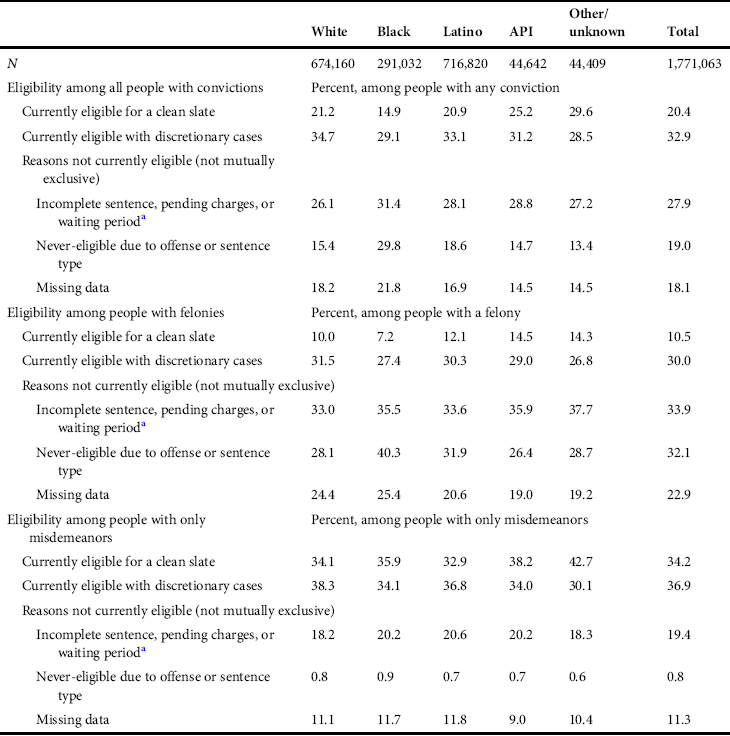
Under existing laws, one in five people with convictions (20.4%) were currently eligible for full relief and met criteria for mandatory relief, and an additional 32.9% met criteria for discretionary relief, for a total of 53.3% (Table 2). Eligibility was lowest among Black people (14.9% and 29.1% eligible for mandatory and discretionary full relief, respectively) for two reasons. In addition to having a far higher proportion of people with a felony conviction record, as opposed to only misdemeanors (as shown in Table 1), Black people with a felony were less likely to meet criteria for mandatory or discretionary full conviction relief compared to other racial/ethnic groups with felony convictions (7.2% and 27.4% eligible for mandatory and discretionary full relief, respectively, among Black men and women with felonies vs. 10.5% and 30.0% of all people with felonies; see Table 2).
Percent of people with convictions eligible for full conviction relief under current laws

a Waiting periods include 1 year post-conviction for misdemeanors without probation (1203.4a), and 1 or 2 years (depending on sentence) after sentence completion for AB 109 felonies (1203.41/1203.42).
This racial disparity in eligibility for relief among people with felony convictions was primarily driven by never-eligible convictions (40.3% of Black defendants, vs. 26.4%, 28.1%, and 31.9% of API, White, and Latino defendants, respectively). By never-eligible convictions, we mean a characteristic of the offense type or sentence rendered the case ineligible for relief, even when the sentence is complete. Never-eligible convictions were primarily a result of prison sentence exclusions, often for offenses that are eligible if sentenced to felony probation without revocation (e.g., robbery). Prison sentence exclusions comprised the highest share of never-eligible convictions among Black defendants (92.2%, vs. 87.5%, 86.6%, and 85.7% among Latino, White, and API defendants, respectively). In comparison, offense type exclusions (primarily sex offenses involving minors) were a small minority of never-eligible convictions, and were most common among White defendants (5.2% of never-eligible convictions among White defendants, vs. 4.5%, 4.2%, and 2.9% among API, Latino, and Black defendants, respectively).
Racial/ethnic differences in the proportion of people with temporary disqualifiers were narrower—although consistently highest among Black Californians. These included people who were still serving sentences, post-conviction waiting periods, or had pending charges (35.5% among Black defendants, vs. 33.9% overall). Proportions with missing case information were also relatively similar across groups (25.4% among Black defendants, vs. 22.9% overall).
Time elapsed on ineligible cases
In the previous section, we found that the racial disparity in eligibility for full relief was driven by never-eligible felony convictions—meaning the offense or sentence type disqualified the conviction, even if the sentence was complete. This raises the question of how long ago these convictions occurred, and the extent to which cases from many years ago are precluding full relief. Under California civil code (1786.18), background checks by consumer reporting agencies exclude any convictions older than 7 years. This would apply to background checks run by most private employers, although the fingerprint-based background checks run by state licensing boards or for employment with government agencies retain records of older convictions. If a large share of the Black population with never-eligible convictions acquired those records more than 7 years ago, a seven-year sunset reform that aligns state policy with the practice of most background checks might reduce disparities in conviction relief. Among people with never-eligible convictions, 57.5% were convicted at least 7 years ago (Table 3). Black and White people were most likely to meet this criterion (62.2% and 59.6%, respectively), compared to 53.4% of Latino and 51.6% of API.
Time elapsed on never-eligible convictions

Although this suggests a seven-year sunset would substantially reduce the shares of people disqualified by never-eligible convictions, they may still be ineligible for full relief if they have recent discretionary convictions, are still serving sentences or waiting periods on mandatory or discretionary cases, or have pending charges. We take these possibilities into account in the next section, where we estimate the proportion of all people with convictions eligible for full relief under three hypothetical criminal record clearance reform scenarios: (1) clearing discretionary cases, (2) a seven-year sunset, and (3) both.
Hypothetical criminal record relief reform scenarios: Eligibility among people with convictions
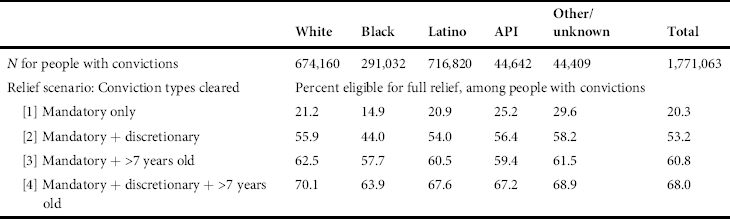
In Table 4, we estimate the proportion of people with convictions who would be eligible for full relief under each hypothetical reform, if these additional changes were incorporated into the current law for mandatory conviction relief. We review eligibility among people with convictions briefly below, and then examine more closely how each reform scenario would alter (1) the proportion of all people in California with convictions, for each racial/ethnic group, and (2) racial disparities in criminal records.
Percent eligible for full conviction relief, under hypothetical relief scenarios

When comparing the effect of incorporating discretionary convictions [2] versus a seven-year sunset [3], the latter would provide the greatest relief for people with convictions overall (60.8% eligible for full relief, vs. 53.2% for discretionary convictions). A seven-year sunset would also more substantially reduce disparities for Black Californians, as this group was most likely to have never-eligible cases. For example, if discretionary convictions were cleared, 44.0% of Black Californians versus 55.9% of their White counterparts would be eligible for full relief—a nearly 12 percentage point difference. Whereas under a seven-year sunset, these proportions were 57.7% and 62.5%, respectively. Even under a seven-year sunset, Black Californians had a lower share of people eligible for full relief than any other group, while Whites received the greatest benefit. Finally, if both policy reforms were adopted [4], more than two thirds of people with convictions would be eligible for full relief (68.0%), as compared to just 20.3% under current policy. Again, Black Californians had the lowest proportion eligible for full relief (63.9%) and White Californians the highest (70.1%).
Hypothetical criminal record relief reform scenarios: Effects on the proportion of California's population with criminal records
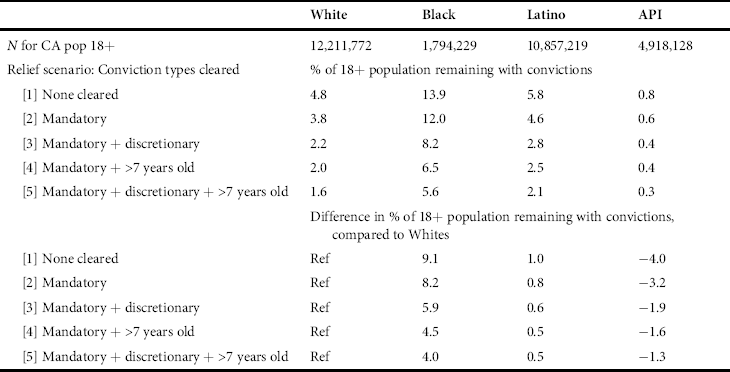
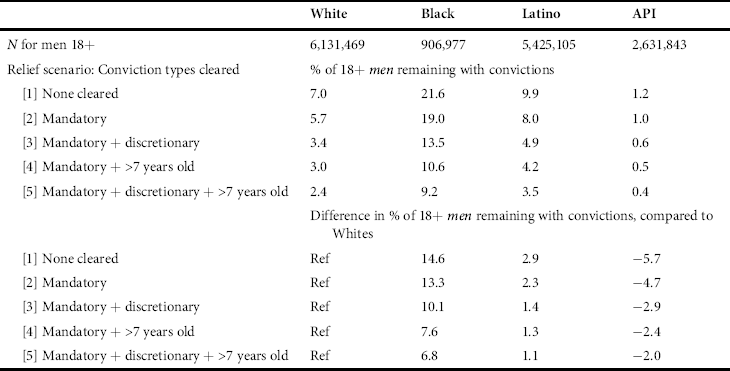
The data show that lower shares of Black Californians with convictions were eligible for a clean slate. However, if a higher proportion of the total Black population has convictions compared to other groups, relief for eligible convictions could still reduce population-level disparities in criminal records. In the following section, we review the estimated population-level impacts of criminal record relief under each hypothetical reform scenario. The proportion of all adults remaining with convictions under each hypothetical reform is shown in Table 5, and Table 6 shows results when we restrict to men only.
Percent of CA population with convictions, under hypothetical relief scenarios

Percent of men in CA with convictions, under hypothetical relief scenarios

Accounting for annual migration, mortality, and deportation, we estimate that at least 13.9% of Black adults in California had a conviction record in 2018 (Table 5, [1]). Other groups had less than half that prevalence of conviction records: 5.8% among Latino, 4.8% among White, and 0.8% among API adults. The estimated prevalence of convictions was much higher among men (Table 6, [1]), and again, more than two-fold higher among Black men than other groups: 21.6%, versus 9.9% Latino, 7.0% White, and 1.2% API men. Since our data were comprised of arrests between 2000 and 2016, these estimates would exclude anyone who was only arrested prior to 2000 or whose first arrest was after 2016.
If only convictions eligible for mandatory relief under current law were cleared (Tables 5 and 6, [2]), the proportion of each racial/ethnic group with convictions would decline from 13.9% to 12.0% among Black adults, 5.8% to 4.6% among Latino adults, 4.8% to 3.8% among White adults, and 0.8% to 0.6% among API. The change in racial disparities would be minimal. The percentage point difference in the share of Black adults with convictions, compared to Whites, would decline from 9.1 to 8.2, and for Latino adults compared to Whites, from 1.0 to 0.8 percentage points. Restricting to men, the Black–White difference would decline from 14.6 to 13.3, and the Latino-White difference from 2.9 to 2.3.
Relief for discretionary cases
Incorporating discretionary convictions would more substantially reduce the proportion of people with convictions in every racial/ethnic group, as well as disparities across groups (Tables 5 and 6, [3]). However, White and API adults would continue to have a lower prevalence of conviction records than Black and Latino adults. Specifically, if discretionary convictions were cleared, the share of Black adults remaining with convictions would decline to 8.2%, compared to 12.0% if only mandatory convictions were cleared. This would narrow the Black–White difference from 8.2 to 5.9 percentage points. Latino adults remaining with convictions would decline to 2.8%, compared to 4.6% if only mandatory convictions were granted relief, narrowing the Latino-White difference from 0.8 to 0.6 percentage points.
Next, we restrict to men only, as this group comprises the vast majority of people with convictions (79.2%). The share of Black Californians with convictions would decline from 19.0% if only mandatory convictions were granted relief, to 13.5% if discretionary convictions were included, and from 8.0% to 4.9% among Latino men. Although White men would still have a lower prevalence of conviction records, the Black–White difference would decline to 10.1, and the Latino-White difference to 1.4 percentage points, compared to 13.3 and 2.3, respectively, if only mandatory convictions were granted relief.
Seven-year sunset
Next, we compare the effect of incorporating discretionary convictions to a second hypothetical reform: a seven-year sunset, which would provide relief for any conviction 7 years after the sentence is complete. In Table 4, we found greater reductions in racial disparities under the seven-year sunset scenario, compared to relief for discretionary convictions. This can be seen at the population level as well (Table 5). A total of 6.5% of Black adults would remain with convictions under the seven-year sunset [4], versus 8.2% if discretionary convictions were granted relief [3]. Although the difference appears minimal, this translates to an additional 28,700 people with conviction relief. These differences in eligibility would result in a more sizable narrowing of the Black–White disparity, to 4.5 percentage points, compared to 5.9 if discretionary convictions were granted relief.
The same pattern in eligibility can be seen across racial/ethnic groups in the male population (Table 6). Specifically, compared to relief for discretionary convictions, the seven-year sunset resulted in larger reductions in the proportion of Black men with convictions (to 13.5% vs. 10.6%, respectively), as well as the Black–White disparity (to 10.1 vs. 7.6 percentage point difference, respectively).
Incorporating both hypothetical reform scenarios
Finally, we assess population outcomes if both reforms were adopted. Incorporating a seven-year sunset as well as relief for discretionary convictions would reduce the population with convictions to 5.6% of Black adults, 1.6% of White adults, 2.1% of Latino adults, and 0.3% of API adults (Table 5, [5]), and among men, 9.2%, 2.4%, 3.5%, and 0.4%, respectively. Black–White and Latino-White disparities would be cut approximately in half, but would persist at 4.0 and 0.5 percentage points, respectively, among all adults, and 6.8 and 1.1 among men. Put another way, an additional one in 11 Black adults and one in seven Black men currently has a conviction record, compared to their White counterparts. This would decline to an additional one in 25 Black adults and one in 14 Black men, compared to Whites, if mandatory convictions were granted relief and both hypothetical reforms were adopted.
The persistent disparities in conviction records when both hypothetical reforms were incorporated suggest that Black people were more likely to have charges pending and/or incomplete sentences on a conviction. If we restrict to people who completed their sentences seven or more years ago, then applying both reforms would reduce the proportion of people with convictions to nearly zero: 0.2% of Black adults, 0.1% of White and Latino adults, and 0.0% of API adults. The share would be slightly higher for Black adults if we restrict to men (0.3%), but is the same for all other groups. Those remaining with convictions were ineligible based on pending charges, even though they had no convictions in over 7 years. However, under an automatic relief system where convictions are cleared as soon as they become eligible, these seven-year sunset convictions would likely have been granted relief years before the current pending charges arose.
DISCUSSION AND CONCLUSION
In this study, we find that approximately one in five people with convictions met criteria for mandatory full conviction relief under current laws in California, and this would increase to approximately half of people with convictions if discretionary convictions were granted relief as well. Yet we also find that lower shares of Black Californians with convictions were eligible for a clean slate. This resulted from a higher likelihood of felony convictions and, among those, a higher likelihood of cases that were not eligible under current laws, even if the sentence is complete.
For this reason, the seven-year sunset rule would have a greater impact on reducing conviction records in this group, compared to only incorporating relief for discretionary cases. Despite racial differences in eligibility among people with convictions, though, our analysis suggests population-level racial disparities would be minimized under any clearance scenario. Granting relief for discretionary convictions and convictions older than 7 years, in addition to those eligible for mandatory relief, would reduce the share of Black men with convictions from 22% to 9%, and the Black-White difference from 15 to seven percentage points. In other words, an additional one in 11 Black adults and one in seven Black men currently has a conviction record, compared to their White counterparts. This would decline to an additional one in 25 Black adults and one in 14 Black men, compared to Whites, if mandatory convictions were granted relief and both hypothetical reforms were incorporated.
Amendments like these could substantially alter the racial impacts of criminal record relief policies. At present, however, the inequitable eligibility we find in California is likely to be replicated in other states where policies are similarly structured. In particular, if the racial disproportionality in felony convictions found in California is comparable, then states that restrict eligibility for felony convictions (e.g., automatic relief laws in Pennsylvania and Utah currently apply only to misdemeanors) may see substantial progress in reducing the number of people with a record, but also experience increasing racial disparities.
In addition, several challenges confronting the move towards automatic relief warrant further attention. When bills specify that eligibility will be assessed at the state level, it presents both a strength and limitation for equity. On the one hand, it reduces geographic inequity that would result from county variation in implementation. However, missing data become particularly problematic, as states rely upon county agencies to report case dispositions – and counties surely differ in their data quality and reporting tendencies. Our analyses revealed that 35% of cases had no disposition, and 75% of people had at least one such case on their record. Missing data may severely limit the potential benefits of automatic relief legislation, and leave a persistent “second chance gap” (Reference ChienChien, 2020). If cases with missing dispositions are excluded from dismissal, few people will receive a clean slate. States are likely to vary in their approaches to eligibility determinations for cases with missing data, and concerningly, may exclude them altogether from relief. As an example, California's AB 1076 states: “[CA DOJ] shall grant relief, including dismissal of a conviction…if the relevant information is present in the department's records.”
Poor criminal record data quality and its implications have been flagged in prior scholarship. For example, McElhattan's work (2021) highlights that “The pursuit of harshly punitive policies has often come without commensurate investment in administrative infrastructure, thereby intensifying the pains of punishment for criminalized subjects” (Reference McElhattanMcElhattan, 2021). Without improving data and reporting systems, automatic relief reforms may exclude many people eligible for relief or delay the process (Reference ChienChien, 2020). The burden will fall on either state and county agencies to investigate missing data, or on people with criminal records to navigate the time-consuming, bureaucratic procedures to correct their record, defeating the purpose of automatic relief (Reference Lageson, Webster and SandovalLageson et al., 2021). Furthermore, there is enormous variation in criminal record data quality across states, with more severe missing data in states with higher proportions of Black residents (Reference McElhattanMcElhattan, 2021). This would suggest that criminal history data quality presents a key challenge to equity in criminal record relief reforms nationwide.
The data quality problem is amplified by the rise of digitized criminal records publicly available online. Annually, an estimated 10 million arrests, 4.5 million mugshots, and 14.7 million court proceedings are digitally released (Reference Lageson, Webster and SandovalLageson et al., 2021). Once released, these data create an online footprint that remains even after a record is sealed. Herein lies a central limitation of “clean slate” laws. As Reference CapuderCapuder (2020) writes: “any admissions counselor, manager, or landlord can run a quick search on the internet, discover this information, and continue to discriminate.” Through qualitative interviews with people seeking criminal record relief, Reference LagesonLageson (2016) likewise shows how inaccurate and outdated criminal records accessible online can pervade social lives and family relationships (Reference LagesonLageson, 2016). Fearing the stigma and embarrassment of exposure, people self-select out of activities that might include online background checks, such as volunteering at their children's schools (Reference LagesonLageson, 2016).
The digitization of criminal records has also led to an explosion in commercial online background screening companies, which, although regulated by the Fair Credit Reporting Act, routinely fail to update their databases and continue to report convictions that were sealed or expunged (Reference Yu and DietrichYu & Dietrich, 2012). Although consumers have the right to view copies of their background check and to contest inaccurate information,Footnote 3 the multitude of background check companies makes this impractical. There is no centralized entity that individuals can contact to update their records, nor would this eliminate the entirety of records that continue to float around online.
Finally, criminal record relief has the potential to produce statistical discrimination similar to that seen in the context of Ban the Box policies. As already described, several studies have suggested that Ban the Box policies can harm the employment prospects of Black Americans (Reference Agan and StarrAgan & Starr, 2018; Reference Doleac and HansenDoleac & Hansen, 2020; Reference RaphaelRaphael, 2020). In the absence of information about criminal history, prospective employers were more likely to assume that Black applicants had a record (irrespective of whether or not they do) and that White applicants did not (again, irrespective of their actual history). In addition to racial disparities in eligibility for relief, relief itself is essentially a different mechanism of suppressing a record from the employer's view. Going forward, the impact of criminal record relief policies on employment and housing outcomes should be evaluated with special attention to whether a rise in statistical discrimination occurs.
Racial liberalism and predicting equity impacts
In addition to the specific issues our study raises, our findings help shed light on broader questions related to the persistence of racial inequalities following legal reforms. In recent years, states across the country have passed significant legislation designed to scale back the scope of punishment, especially as it pertains to nonviolent drug offenses, and to undo the damage of more than a half-century of mass incarceration. As our findings make clear, however, new policies interact with historical patterns, as their effects are overlaid onto a pre-existing landscape of segregated geographies, economic stratifications, cultural patterns, and structural inequalities. As theories of racial liberalism predict, and as we show in the case of criminal record relief, an approach that focuses on equal treatment without accounting for disparate outcomes can inadvertently help to maintain a racially inequitable status quo. As Haney-Lopez points out, “in the law enforcement context, colorblindness serves as more of a shield than a sword” (Reference LópezLópez, 2010).
To address persistent racial discrimination within new policies, drawing on examples such as redistricting, residential segregation, and travel bans, Reference MurrayMurray (2021) advocates for the explicit examination of “discriminatory taint” as a detectable relationship between an earlier discriminatory policy and its continuity within a subsequent facially neutral policy. Operationally, “courts first ask whether the state can show that the contemporary policy has eliminated any meaningful disparate impact. Second—if the state cannot so show—it must make a heightened showing of why it cannot eliminate the disparate impact and why the legitimate need for this means of pursuing a nondiscriminatory government interest outweighs the harm of shielding the disparate impact of a tainted rule” (Reference MurrayMurray, 2021). In the case of criminal record relief, hinging eligibility on criminal records produced by historical racial discrimination in policing and prosecution, such as the prison sentence exclusion, confers disproportionate benefits of automatic relief to Whites and must be examined and justified as an exclusionary criterion.
This suggests some important implications for policymakers and advocates seeking ways to undo the widespread negative collateral consequences of a criminal record. Policies that are facially race-neutral, like automatic criminal record relief, are likely to be politically popular precisely because they do not require wading into contentious debates over structural racism, “preferential treatment,” or reparations. While current record relief policies do not account for how eligibility rules will disproportionately benefit White Californians, potential amendments could substantially alter the law's racial impacts. Critically, these racial effects can be “anticipated by legislators prior to enactment” (Reference MauerMauer, 2007). To do this requires a conscious acknowledgment of existing structural inequalities and a careful assessment of how policies differentially affect racial groups.
In this sense, the results we present here provide a roadmap for how scholars, practitioners, and policymakers might use existing data to examine how different implementation choices could meaningfully alter a policy's racial effects. Along these lines, our study is an example of how the results from projected equity analyses could be utilized in a racial equity impact statement. Racial equity impact statements (REIs) provide a “systematic examination of how different racial and ethnic groups will likely be affected by a proposed action or decision. REIs are used to minimize unanticipated adverse consequences in a variety of contexts, including the analysis of proposed policies, institutional practices, programs, plans and budgetary decisions” (Reference Keleher and RaceKeleher & Forward, 2014). In this way, REIs are similar to environmental or fiscal impact statements, which are designed to anticipate outcomes in advance of a new policy's adoption. Instead of estimating the likely environmental or financial consequences, REIs focus on the types of racial inequities that different policies are likely to produce.
It is important to explore policies aimed at ameliorating the inequalities that have resulted from mass incarceration. The legacy of these policies is both broad and deep, and policy interventions must be designed to undo harms to individuals, families, and communities. However, the type of projected equity analysis included in an REI—and that we have presented here—can go further, by assisting policymakers in creating more equitable policy in the first place. As Lerman and Weaver point out, “Considering racial impact in the construction of a policy will make it easier to confront and avoid harm…It is easier to avert adverse racial effects before a policy is enacted, funded, and put into practice” (Reference Lerman and WeaverLerman & Weaver, 2014). This is especially critical in criminal justice, given both the severity of the consequences these laws can have—which include deprivation of liberty, life-long disadvantage, and even a state-imposed death sentence—as well as the particular difficulty of undoing crime policies once they are adopted (Reference MauerMauer, 2008). Policymakers may never be able to completely avoid the unintended consequences that stem from the policies they produce. However, they have a responsibility to understand the foreseeable implications of the policies they pass, and to use empirical evidence to craft policies that do not create or exacerbate racial disparities that might have been preventable.
ACKNOWLEDGMENTS
This work was supported by a grant from the W.E.B. Du Bois Program of the National Institute of Justice (2017-IJ-CX-0033). We would also like to acknowledge Emily Kohlheim, Research Fellow at the California Policy Lab, for her invaluable and meticulous work cataloguing California's criminal record clearance laws and interpreting eligibility definitions. We also thank Johanna Lacoe, Research Director at the California Policy Lab, for her detailed reviews of eligibility code.
Funding information
National Institute of Justice, Grant/Award Number: 2017-IJ-CX-0033
CONFLICT OF INTEREST
The authors have no conflicts of interest to declare.
SUPPORTING INFORMATION
Additional supporting information can be found online in the Supporting Information section at the end of this article.