




No CrossRef data available.
Article contents
Dopamine and semantic activation: An investigation of masked direct and indirect priming
Published online by Cambridge University Press: 06 February 2004
Abstract
To investigate the effects of dopamine on the dynamics of semantic activation, 39 healthy volunteers were randomly assigned to ingest either a placebo (n = 24) or a levodopa (n = 16) capsule. Participants then performed a lexical decision task that implemented a masked priming paradigm. Direct and indirect semantic priming was measured across stimulus onset asynchronies (SOAs) of 250, 500 and 1200 ms. The results revealed significant direct and indirect semantic priming effects for the placebo group at SOAs of 250 ms and 500 ms, but no significant direct or indirect priming effects at the 1200 ms SOA. In contrast, the levodopa group showed significant direct and indirect semantic priming effects at the 250 ms SOA, while no significant direct or indirect priming effects were evident at the SOAs of 500 ms or 1200 ms. These results suggest that dopamine has a role in modulating both automatic and attentional aspects of semantic activation according to a specific time course. The implications of these results for current theories of dopaminergic modulation of semantic activation are discussed. (JINS, 2004, 10, 15–25.)
Information
- Type
- Research Article
- Information
- Journal of the International Neuropsychological Society , Volume 10 , Issue 1 , January 2004 , pp. 15 - 25
- Copyright
- © 2004 The International Neuropsychological Society
INTRODUCTION
For decades, the role of the frontal lobes and subcortical areas of the brain in language processing have formed the basis of many research efforts. The frontal lobes have been well established as an area of the brain involved in both semantic and language processing, by investigations using both positron emission tomography and functional magnetic resonance imaging (see Cabeza & Nyberg, 2000, for a review). Robin and Schienberg (1990) and Crosson (1999) have also cited evidence to support the role of subcortical areas of the brain in language processing. In light of this research, the specific role of the striatum (a subcortical area of the brain with extensive neuronal connections to the frontal cortex) in language processing has begun to attract increasing attention.
As illustrated by Crosson (1992), dopaminergic neurons (neurons that respond preferentially to the action of dopamine) are associated with the striatum. Consequently, the function of dopaminergic neurons must be considered when investigating the striatal control of language processing. LeMoal and Simon (1991) and Morrison and Hof (1992) have suggested that dopaminergic neurons do not specifically process information themselves; instead, via the mesocortical dopaminergic circuitry these neurons modulate other neurons that process and integrate specific information. Furthermore, Servan-Schreiber et al. (1990) proposed that the function of dopaminergic modulating systems is to dampen weak signals (noise) while at the same time amplifying stronger signals (excitatory or inhibitory) in neural areas. This modulatory effect is particularly well illustrated by Cepeda and Levine (1998), who suggested that dopamine is able to increase the signal-to-noise ratio in the neostriatum by integrating relevant information and screening out less relevant information. It could be expected from this research, therefore, that changes to dopaminergic functioning could change the signal-to-noise ratio of information to be processed and indeed, both Grace (1991) and Sealfon and Olanow (2000) have cited evidence to suggest that dopamine depletion may lead to altered signaling patterns in the brain.
Further support for dopamine's neuromodulatory effect can be drawn from research on measures of sensory gating such as P50 suppression and measures of sensorimotor gating such as prepulse inhibition of the startle reflex. Light et al. (1999) found that amphetamine, a dopamine agonist, disrupted P50 suppression in human subjects. Similarly, Hutchinson and Swift (1999) found that amphetamine also disrupted prepulse inhibition in human subjects. Therefore, the recent literature on the role of dopamine, dopamine agonists, and dopaminergic neurons in information processing provides evidence to suggest that dopaminergic systems may indirectly modulate how information, and consequently language, is processed.
Central to research into the area of semantic processing and its potential neuromodulation by dopamine are studies of semantic priming (e.g., Kischka et al., 1996). The basic premise behind semantic priming is that recognition of a target word during a lexical decision task occurs more quickly if it is preceded by a related word (the prime). Collins and Loftus (1975) proposed a spreading activation theory of language processing, which suggested that concepts (represented as nodes) form an interconnected semantic network, with the relationship between concepts being expressed as the distance between nodes. The spreading activation theory predicts that during the processing of a word (e.g., the prime), a spreading of activation to nearby nodes occurs that partially activates other related words (e.g., the target).
Semantic priming effects can be investigated by measuring in milliseconds (ms) a subject's reaction times (RTs) to target words during a lexical decision task. Measures of both direct and indirect semantic priming can be made. Direct semantic priming involves the presentation of word pairs that are directly related (e.g., tiger–stripes). In contrast, indirect semantic priming involves the presentation of word pairs that are only related via a mediating word (e.g., summer–snow are only related via the mediating word, winter). Reaction times, therefore, should be slower during indirect semantic priming compared to direct semantic priming, because the spreading of activation that occurs from prime to target must travel via the mediating word. Similarly, reaction times should be slower again for unrelated word pair presentations since no spreading of activation should occur from prime to target.
In recent years, however, a crucial debate has arisen within the literature as to whether semantic priming is a product of conscious or unconscious processes. According to Posner and Snyder's (1975) dual process theory, semantic priming can occur either automatically or be induced via attentional processes. Milberg et al. (1995) demonstrated that a significant portion of the semantic facilitation effect could be attributed to automatic activation of semantic representations. There is also evidence, however, that under certain conditions semantic facilitation is under the control of the subject and can be affected by attentional demands.
To facilitate automatic semantic activation and to reduce any attentional confounds arising in semantic priming experiments, a technique termed masked priming, initially developed by Forster and Davis (1984), can be implemented. Forward masking involves the presentation of the prime word for a very short period of time, often only between 50–60 ms, and for this prime word to be preceded by a pattern mask (e.g., a series of X's—“XXXXXXXX”). By using this strategy, a subject may be unaware of the existence of the prime word and so, is unable to apply conscious strategies towards the lexical decision task. Since its development, masked priming has been used in many studies (e.g., Bowers et al., 1998; Deacon et al., 2000; Grainger & Segui, 1990; Rajaram & Neely, 1992) and has been shown to result in significant semantic priming effects.
Strong evidence for the proposed role of the striatum, dopamine and dopaminergic systems in language processing has been provided by analyzing the performance of Parkinson's disease (PD) patients (e.g., Arnott et al., 2001; Grossman, 1999; Murdoch et al., 2000). As stated by Cepeda and Levine (1998), PD is caused by loss of the dopaminergic substantia nigra neurons, which produces depletion of dopamine in the neostriatum. It is not unexpected, therefore, that numerous studies (e.g., Bayles et al., 1993; Bondi et al., 1993; Randolph et al., 1993) have illustrated that the integrity of semantic processing in PD patients may be compromised. More importantly, researchers have also found that the performance of PD patients on various language tasks (e.g., sentence comprehension, naming tasks) declined when they were off their medication (e.g., Gotham et al., 1988; Grossman, 1999; McNamara et al., 1996; Murdoch et al., 2000). Given the fact that this medication (i.e., levodopa) increases the amount of available dopamine in the patient's brain, these studies provide significant support for a dopaminergic role in language/semantic processing. In contrast, however, Skeel et al. (2001) found evidence to suggest that sentence comprehension deficits in PD patients are related to dysfunction caused by intrinsic cortical pathology as opposed to isolated basal ganglia dysfunction. Consequently, degradation of the striatum can not be assumed to be the sole factor responsible for language deficits in PD.
Further evidence in the literature that supports a link between dopamine and alterations in semantic processing was provided by Kischka et al. (1996). Kischka et al. (1996) postulated that dopaminergic modulation of the signal-to-noise ratio in the frontal cortex could be related to the spreading activation model of lexical access. Specifically, they suggested that an increased signal-to-noise ratio in semantic networks is equivalent to focussed activation, reducing the spread of activation through the network. Kischka et al. (1996) examined the effects of dopamine on semantic processing by asking healthy volunteers to ingest either a capsule containing 100 mg levodopa (L-dopa) and 25 mg of benserazide (a peripheral decarboxylase blocker) or an identical capsule of placebo. Measures of both direct (e.g., black–white) and indirect (e.g., summer–snow) priming were used to investigate whether the signal-to-noise ratio in semantic networks was being altered by dopamine.
Kischka et al. (1996) found that while there were significant direct priming effects for both groups at a short (250 ms) and long (700 ms) SOA, indirect priming effects were only significant for the placebo group at the longer 700 ms SOA. On interpreting the reduced indirect semantic priming for the L-dopa group, it was postulated that the L-dopa was increasing the signal-to-noise ratio of information processing in cortical networks. The researchers suggested that this increased signal-to-noise ratio was associated with a reduced spreading of activation within a semantic network, thereby reducing the accessibility of indirect associations, rather than direct associations. The reduced priming effects evident in Kischka et al.'s (1996) study, however, appeared to result from RTs to unrelated targets becoming faster, rather than RTs to related targets becoming slower. Furthermore, Kischka et al. (1996) failed to implement a neutral prime condition in their experiment. It has been well established by Neely (1977), that while automatic semantic priming results in facilitation (defined as significantly faster RTs to related target words relative to neutral target words), strategic or controlled processing can result in both facilitation and inhibition (defined as significantly slower RTs to unrelated target words relative to neutral target words). Consequently, the inclusion of a neutral prime is necessary before strong conclusions can be drawn on the effects of dopamine on semantic priming and semantic/spreading activation.
The aim of the present research was based upon the proposal emerging in recent literature that dopamine modulates automatic semantic activation. Specifically, this research aimed to chart the time course and peak levels of automatic semantic activation in healthy volunteers who had ingested levodopa and compare this with those volunteers who had not. Furthermore, this research aimed to extend Kischka et al.'s (1996) research by implementing a masked priming paradigm, using related, neutral, and unrelated prime conditions and implementing three SOAs (250, 500, and 1200 ms), extending Kischka et al.'s (1996) time course by an additional 500 ms. While the authors acknowledge that any priming effects observed at the SOAs of 500 and 1200 ms could reflect the influence of attentional components on semantic priming, the addition of these longer SOAs was deemed necessary since this research aimed to specifically examine changes in the time course of semantic activation. The hypothesis to be tested was that dopamine alters automatic semantic activation via its role as a neuromodulator, through which it increases the signal-to-noise ratio within semantic networks. This increased signal-to-noise ratio would be indicated by a reduction in indirect priming effects for the levodopa group across a specific time course, especially at the shorter SOAs.
METHODS
Research Participants
Thirty-nine healthy female volunteers (M age 21.2 years; range 19–27 years; average education 16 years) participated in the study. Consistent with the contraindications of levodopa, none of the subjects was taking any psychotropic, anti-depressive or anti-hypertensive medications, was pregnant or had a history of psychiatric illness or melanoma. Approval by the Medical Research Ethics Committee of the University of Queensland was obtained. All subjects received thirty dollars (AUS) recompense for their participation in the study.
Design and Stimuli
The experiment was a 2 × 3 × 4 (Group × SOA × Prime) mixed factor design with group (levodopa/placebo) as a between-subjects factor and SOA (250, 500, 1200 ms) and prime (direct/indirect/unrelated/neutral) as within-subjects factors. Subjects were randomly assigned to ingest either a capsule containing 100 mg levodopa and 25 mg benserazide or an identical placebo capsule. A single blind design was implemented, which ensured that none of the subjects was informed of the capsule's content.
To avoid repetition of stimulus words across the three SOAs, three stimulus sets consisting of 96 prime–target word pairs were assembled. All prime stimuli were real English words, however, half of the target stimuli consisted of real English words and half consisted of pronounceable nonwords. Of the word pairs containing real word targets, four types of prime were represented. Examples of each of these prime conditions and the number of items per stimulus set were as follows:
- Direct semantic relation: e.g., Tiger–Stripes (12)
- Indirect semantic relation: e.g., Lion–Stripes (12)
- Neutral relation: e.g., Blank–Pills (12)
- Unrelated: e.g., Organ–Swamp (12)
The order of presentation of all word pairs was randomized and the order of presentation of the related word pair items was counterbalanced. The directly related and indirectly related word pairs were derived mainly from the stimulus materials used by Balota and Lorch (1986) and DeGroot (1983), which were derived from association norms. Care was taken in the present experiment, to ensure that all stimulus materials selected held an obvious semantic relationship (e.g., tiger–stripes), and did not form compound words (e.g., maple–syrup, bus–stop) or reflect associatively related words without semantic relatedness (e.g., cottage–cheese). In addition to these stimulus materials, an additional seven direct/indirect word pairs were created. To validate these additional word pairs, 20 undergraduate students (13 females, 7 males) were asked to produce seven associates to the direct and indirect prime words. The results from this task indicated that for each stimulus item, subjects produced the target word as an associate to the direct prime but did not produce the target word as an associate to the indirect prime.
The majority of words used were nouns, however, some verbs, adverbs, and adjectives were also used. The neutral prime word was always the word blank. All primes for the unrelated and nonword targets were matched to the average frequency and syllable length of the related word primes. For example, the direct semantic relation prime word tiger had a frequency of 17 and the indirect semantic relation prime word lion had a frequency of 7. As a result, the word organ, which had a frequency of 12, was used for the unrelated condition prime word.
To avoid repetition of target words across all four prime conditions, different target words (matched to the average frequency and length of the related target words) were used for the neutral and unrelated conditions. To validate the use of these different target words, a pretest was performed on 19 non-neurologically impaired staff and students from the University of Queensland (average age 22.9 years). Target words, along with an equal number of nonwords, were presented in a random order to each subject in a lexical decision task, with RT as the measure of interest. Univariate statistical analyses revealed no significant main effect of target word type (direct/indirect, unrelated or neutral target words) on reaction time [F(2,34) = 0.59, p > .05]. Finally, all nonword targets were developed by changing one to three phonemes in an existing English word, which was matched in frequency and syllable length to the real target words. Half of the nonwords were preceded by the neutral prime blank and half by a word prime.
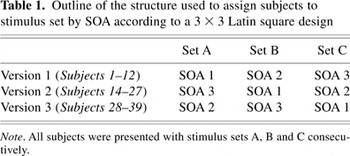
Subjects were assigned to stimulus set (3) by SOA (3) on a random basis according to a 3 × 3 Latin square design, resulting in three separate versions of the experiment (see Table 1). The Latin square ensured that each subject was presented with a different stimulus set for each SOA and that each stimulus set appeared at each level of SOA over the entire experiment. Furthermore, although all subjects saw the stimulus sets in the same order, the order of SOAs was varied (see Table 1). The average length of stimulus items in the experiment was 5 characters (range 3–10). All stimuli were presented using Superlab experimental software (Version 2.0; Cedrus, 1996), which measured subject's RTs via a Microsoft serial mouse (accurate to within 1 ms) and collected all error and RT data automatically.
Outline of the structure used to assign subjects to stimulus set by SOA according to a 3 × 3 Latin square design

Procedure
Subjects were informed that a word, which they may or may not recognize, would appear very quickly in the center of the screen. This word would be followed by a second word. They were asked to make a lexical decision on the second word, by clicking on the left mouse button if it was a real word or the right mouse button if it was a nonword. A practice block, consisting of 12 word pair trials similar to those in the experiment proper, was given to each subject to allow familiarization with the procedure prior to testing. Testing began 45 min after ingestion of the levodopa/placebo capsule. Each subject was tested individually in a single session, which lasted approximately 15 min. All testing was conducted in a quiet lab room using a standard personal computer, with the subject seated approximately 50 cm from the computer monitor.
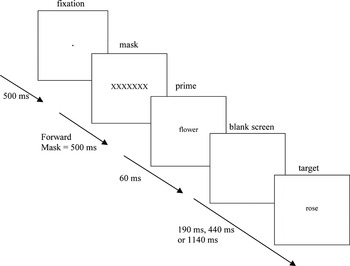
All prime and target words were written in lower case letters of 34-point Arial font. The sequence of events during both the practice and experimental trials was as follows: (1) a fixation point appeared in the center of the screen for 500 ms; (2) a forward mask consisting of 10 uppercase X's was then presented in the center of the screen for 500 ms; (3) immediately following this, the prime word was presented in the center of the screen for 60 ms; (4) a blank screen was then presented for either 190 ms (for SOA 1), 440 ms (SOA 2) or 1140 ms (SOA 3); (5) the target word was then presented in the center of the screen until the subject either gave a response, or until 3000 ms had passed with no response; (6) the screen then remained blank for 500 ms prior to the initiation of the next trial. Figure 1 illustrates the procedure used for a typical trial.

An illustration of the procedure used for a typical trial during the lexical decision tasks.
RESULTS
Reaction Time Analyses
All subject errors were removed, resulting in the removal of 4.2% of the levodopa group's data and 4.3% of the placebo group's data. Due to the low percentage of errors, no further analyses were conducted on the error data. All RTs less than 200 ms and greater than 1000 ms were considered outliers and were subsequently removed.
As indicated by Levene's Test of Equality of Error Variances, assumptions of homogeneity of variance on the RT data were violated. Consequently, mean RTs were stabilized by log transformation, upon which all subsequent analyses were based. Prior to analysis, the validity of using the three separate Latin square versions had to be certified, to ensure that the use of separate versions was not confounding the results. Therefore, logged RTs for the placebo group were entered into a mixed linear model analysis, with subject as a random factor and version, SOA and prime as fixed factors. The analysis revealed a significant Version × SOA × Prime interaction [F(12,3196) = 3.06, p < .01].
In order to delineate why version was having a significant impact upon the data, direct priming effects were calculated (as differences between the logged RT data for the unrelated minus the directly related conditions) for the placebo group as a function of version and SOA. A repeated measures ANOVA analysis was then performed on this data with version as a between-subjects factor and SOA as a within-subjects factor. This analysis revealed no main effect of version (p > .05) but a significant Version × SOA interaction [F(4,42) = 2.78, p < .05]. This Version × SOA interaction did not reach significance, however, following removal of Version 1 from the analysis (p > .05).
The precise reason for the effect produced by Version 1 is difficult to ascertain. Version 1 was the only version used in this experiment that resulted in the presentation of stimulus sets from SOA 1 to SOA 3 in that order, resulting in a consistent gradual increase in SOA. This gradual increase in SOA as opposed to Versions 2 and 3, which presented variable changes in SOA (see Table 1), may be responsible for this significant Version × SOA interaction.
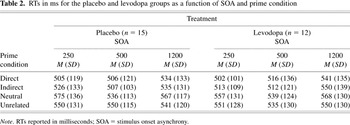
Given the above results, Version 1 was excluded from further analyses, resulting in the removal of 12 participants data from the study (placebo, n = 9; levodopa, n = 3). All subsequent analyses were performed on the logged RTs for Versions 2 and 3 only (placebo, n = 15; levodopa, n = 12). Table 2 displays the mean RTs (prior to log transformation) for both the levodopa and placebo groups, as a function of SOA and Prime. The logged RTs were entered into a mixed linear model analysis with subject as a random factor and group, SOA and prime as fixed factors. The analysis revealed significant main effects for SOA [F(2,3628) = 16.14, p < .001] and prime [F(3,3628) = 35.07, p < .001] and a significant interaction effect for SOA × Prime [F(6,3628) = 2.39, p = .05]. All other interaction effects were nonsignificant.
RTs in ms for the placebo and levodopa groups as a function of SOA and prime condition

In order to determine precisely where these main effects existed, further ANOVA analyses were performed with logged RT as the dependent variable and all subsequent post-hoc analyses were conducted using Bonferroni comparisons (p < .05). A one-way ANOVA, with SOA as the independent variable revealed a significant effect for SOA [F(2,3674) = 11.01, p < .001]. Post-hoc analyses on this data revealed that RTs at SOA 1 and SOA 2 were both significantly faster than RTs at SOA 3 (p < .05 and p < .001, respectively). A one-way ANOVA, with prime as the independent variable also indicated a significant effect for prime [F(3,3673) = 24.04, p < .001]. Post-hoc analyses on this data revealed that RTs to the directly related target words were significantly faster than the RTs to the unrelated target words (p < .001) and neutral target words (p < .001), and RTs to the indirectly related target words were also significantly faster than the RTs to the unrelated target words (p < .001) and neutral target words (p < .001).
In order to investigate the SOA × Prime interaction, three separate one way ANOVAs were performed, one for each SOA, with logged RT as the dependent variable and prime as the independent variable. All post-hoc analyses were performed using Bonferroni comparisons (p < .05). The ANOVAs revealed significant effects for prime at SOA 1, SOA 2, and SOA 3 [F(3,1221) = 15.76, p < .001; F(3,1215) = 7.34, p < .001; and F(3,1229) = 4.23, p < .05 respectively]. Post-hoc analyses indicated that at both SOA 1 and SOA 2, the RTs to the directly related target words were significantly faster than RTs to the unrelated target words (SOA 1, p < .001; SOA 2, p < .05) and neutral target words (SOA 1, p < .001; SOA 2, p < .05). RTs to the indirectly related target words were also significantly faster than RTs to the unrelated target words (SOA 1, p < .001; SOA 2, p < .05) and neutral target words (SOA 1, p < .05; SOA 2, p < .05). In contrast, the post-hoc analyses on the SOA 3 data indicated that RTs to the directly related and indirectly related target words were only significantly faster than RTs to the neutral target words (p < .05 for both conditions).
Priming and Facilitation Effects
While the main and interaction effects are provided for descriptive purposes, the data provided therein do not test explicitly the a priori comparisons made specific in the aims. In particular, the present study aimed to investigate whether modulation of semantic activation by levodopa could be charted as changes to the levels of activation of different word pairs across time. Consequently, of particular interest in this experiment was the magnitude of priming effects evident at each SOA for each group, rather than absolute RTs. Direct and indirect priming effects were, therefore, tested by way of planned pairwise comparisons using a second mixed linear model analysis between related (both direct and indirect) and unrelated prime conditions, with logged RT as the dependent variable and prime as the independent variable. Pairwise comparisons were also made between related and neutral prime conditions for the analysis of direct and indirect facilitation effects, and between unrelated and neutral prime conditions for the analysis of inhibition effects, with logged RT as the dependent variable and prime as the independent variable for each analysis. Separate comparisons were made for each group, at each SOA.
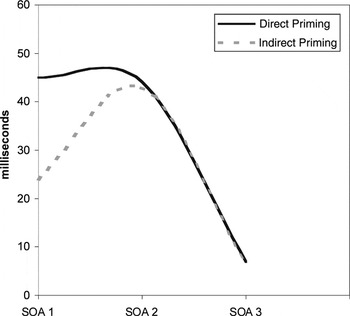
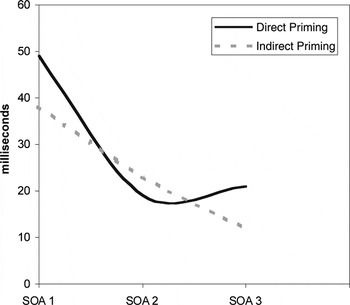
Analysis of the placebo group revealed significant direct and indirect semantic priming effects at 250 ms [F(1,320) = 19.75, p < .001; and F(1,323) = 5.92, p < .05, respectively] and 500 ms [F(1,322) = 19.02, p < .001; and F(1,321) = 17.38, p < .001, respectively], but no significant priming effects at 1200 ms. In contrast, while the levodopa group revealed significant direct and indirect priming effects at 250 ms [F(1,262) = 1.22, p < .001; and F(1,262) = 9.35, p < .01, respectively], priming effects were not significant at either 500 ms or 1200 ms. Figures 2a and 2b illustrate the magnitude of direct and indirect priming effects for the placebo and levodopa groups respectively (calculated by subtracting related from unrelated RTs) across the three SOAs.

Direct and indirect semantic priming effects (calculated by subtracting related from unrelated RTs) as a function of SOA for the placebo group.

Direct and indirect semantic priming effects (calculated by subtracting related from unrelated RTs) as a function of SOA for the levodopa group.
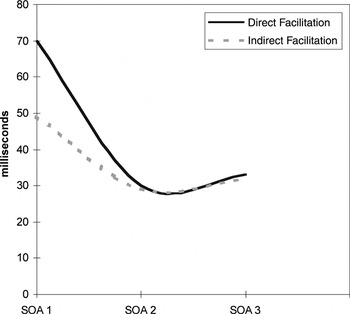
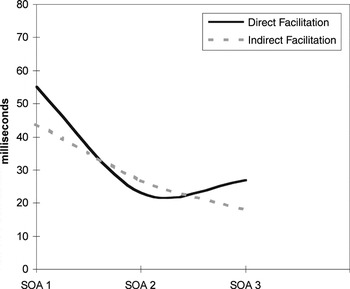
Tests for facilitation effects revealed significant direct and indirect facilitation for the placebo group at 250 ms [F(1,317) = 40.6, p < .001; and F(1,321) = 19.34, p < .001, respectively], 500 ms [F(1,319) = 9.54, p < .01; and F(1,318) = 8.28, p < .01, respectively] and 1200 ms [F(1,325) = 15.04, p < .001; and F(1,326) = 13.18, p < .001, respectively], while analyses of the levodopa group revealed significant direct and indirect facilitation effects only at 250 ms [F(1,262) = 20.2, p < .001; and F(1,262) = 13.85, p < .001, respectively]. Figures 3a and 3b illustrate the magnitude of direct and indirect facilitation effects for the placebo and levodopa groups respectively (calculated by subtracting related from neutral RTs) across the three SOAs. Comparisons between unrelated and neutral conditions for the analysis of inhibition effects, revealed that the RTs for the unrelated target words were significantly faster than RTs to the neutral target words for the placebo group at 250 ms [F(1,312) = 4.2, p < .05] and 1200 ms [F(1,315) = 8.05, p < .01]. There were no other significant effects and therefore, there was no evidence of inhibition.

Direct and indirect facilitation effects (calculated by subtracting related from neutral RTs) as a function of SOA for the placebo group.

Direct and indirect facilitation effects (calculated by subtracting related from neutral RTs) as a function of SOA for the levodopa group.
Since the present study was also interested in changes to the semantic activation of word pairs of differing associative strength across time, it was also important to examine the differences in RTs between direct and indirect target words for each group at each SOA. As such, pairwise comparisons were also made between the RTs for the directly and indirectly related target words for each group using a mixed linear model analysis with logged RT as the dependent variable and prime as the independent variable. Separate pairwise comparisons were performed for data at the 250 ms and 500 ms SOAs, however, the 1200 ms SOA was excluded from analysis since no significant priming effects were obtained for either group at this SOA. Analyses revealed no significant differences between the related prime conditions for the levodopa group at 250 ms or 500 ms SOA (p = .461 and p = .983, respectively) or for the placebo group at 500 ms SOA (p = .676). Reference to Table 2, however, indicates that the RTs to indirectly related target words for the placebo group at 250 ms SOA were slower than RTs to the directly related target words, although this difference was just outside significance (p = .07). Figure 2a also illustrates the smaller magnitude of indirect priming effects for the placebo group at 250 ms SOA compared to direct priming effects.
In summary, the results revealed significantly different patterns of priming and facilitation for the levodopa and placebo groups. Specifically, while the placebo group revealed significant direct and indirect priming effects at both 250 ms and 500 ms SOA, the levodopa group revealed significant direct and indirect priming effects only at the 250 ms SOA. Similarly, while the placebo group revealed significant direct and indirect facilitation effects at the 250 ms, 500 ms and 1200 ms SOAs, the levodopa group revealed significant direct and indirect facilitation effects only at the 250 ms SOA. No inhibition effects were evident for either group. Furthermore, the slower RTs to indirectly related target words for the placebo group at 250 ms SOA were just outside significance.
DISCUSSION
The present study hypothesized that levodopa would modulate automatic semantic activation by increasing the signal to noise ratio, which would be evident through a reduction in indirect semantic priming effects for the levodopa group as a function of time. The results of the present study partially supported this hypothesis, providing evidence that dopamine does modulate semantic activation according to a specific time course. As discussed below, however, it is inconclusive as to whether this modulation of semantic activation is due to an increased signal-to-noise ratio, or rather to alterations in the time course of semantic activation. Furthermore, there is evidence for the possible modulation of both automatic semantic activation and semantic processing under attentional control.
Loss of Priming Effects and Signal-to-Noise Ratio Modulation
The results of the present study support the proposal that dopamine has a modulatory influence over semantic activation. While the placebo group produced both direct and indirect semantic priming at SOAs of 250 ms and 500 ms, the levodopa group produced direct and indirect semantic priming only at the 250 ms SOA. This result suggests that the effects of dopamine are responsible for the reduced levels of both direct and indirect priming evident in the levodopa group at 500 ms SOA. Kischka et al. (1996) postulated that in terms of spreading activation theories of semantic processing, an increased signal-to-noise ratio would lead to a focusing of activation within the semantic network, reducing the spread of semantic activation to adjacent nodes. Hence, Kischka et al. (1996) interpreted the absence of indirect semantic priming in their levodopa group as evidence to suggest that dopamine causes an increased signal-to-noise ratio in semantic networks. Similarly, the loss of priming effects for the levodopa group at 500 ms SOA in the present study could suggest that dopamine causes an increased signal-to-noise ratio within semantic networks. Furthermore, in contrast to Kischka et al.'s results, both direct and indirect priming effects were lost for the levodopa group in the present study, suggesting a robust focussing of activation that reduces the spread of activation to directly related words. The results of the present study, however, may also be interpreted in terms of an alternative framework for dopaminergic modulation of semantic activation.
If dopamine modulates semantic activation by reducing the spread of activation through a semantic network, then it could be expected that no indirect priming effects would become apparent at any SOA for the levodopa group. Kischka et al.'s (1996) finding of no indirect priming for their levodopa group, therefore, was consistent with a reduced spread of activation. In the present study, however, although priming effects were lost for the levodopa group at 500 ms SOA, there was significant evidence of both direct and indirect priming at the 250 ms SOA. The presence of these priming effects at 250 ms SOA is not consistent with decreased spreading of activation through semantic networks, and suggests that dopaminergic modulation of semantic activation may occur via an alternative process.
Another result evident in the present study is that the facilitation effects differed between the two groups. While the placebo group displayed significant direct and indirect facilitation effects at all three SOAs, the levodopa group displayed significant direct and indirect facilitation effects only at 250 ms SOA. The presence of this facilitation for the levodopa group at 250 ms SOA provides further evidence against a reduced spread of activation through semantic networks for the levodopa group. Furthermore, the absence of facilitation for the levodopa group at both 500 ms and 1200 ms SOA suggests that the modulation of semantic activation by levodopa is robust, persisting at long SOAs up to 1200 ms, well beyond the effects noted by Kischka et al. (1996) at 700 ms.
Facilitation Effects
As illustrated in Table 2, the loss of priming effects at the 500 ms SOA for the levodopa group is partly a result of RTs to the unrelated targets becoming faster. These faster RTs to the unrelated targets are consistent with the RTs reported by Kischka et al. (1996), which also showed the unrelated targets becoming faster. Kischka et al. (1996), however, failed to implement a neutral prime condition in their study, and so were unable to make contrasts between priming and facilitation effects.
In the present study, significant priming and facilitation effects were evident for the levodopa group only at the 250 ms SOA. In contrast to the levodopa group, the placebo group revealed significant priming effects at the 250 ms and 500 ms SOAs, but significant facilitation effects at all three SOAs.
The question can be asked, therefore, as to how facilitation effects could be obtained at the 1200 ms SOA for the placebo group, without comparative priming effects. One explanation could be related to the proportion of nonwords that followed a neutral prime. In the present study, half of the nonword targets were preceded by a neutral prime word. As a result, when a neutral prime word appeared, there was a much greater chance that the target would be a nonword (66.6%) than a real word (33.3%). Thus, the participants may have been encouraged to expect a nonword target following a neutral prime, resulting in a nonword bias for the neutral prime conditions. If this nonword bias were the case, longer RTs would be expected for words that followed a neutral prime, since a word target would be unexpected.
It is interesting to note, however, that despite the biasing neutral/nonword ratio, the levodopa group did not display facilitation effects at either the 500 ms or 1200 ms SOA. This result may suggest that the hyperdopaminergic neurological state induced in the levodopa group may have prevented them from utilizing the neutral/nonword ratio to create response expectancies, as did the placebo group. One possible explanation may be that dopamine focuses activation to such an extent, that participants only consciously process the target words themselves, and that background information or noise (i.e., neutral/nonword ratio) becomes more difficult to distinguish or detect. Further research is certainly necessary, however, to delineate the precise mechanism by which dopamine may reduce a person's ability to utilize information effectively in this manner.
Any nonword bias induced in the present experiment, however, would not be expected to influence the results at the short 250 ms SOA for either group, since it is unlikely that participants would have sufficient time to generate the necessary expectancies (Neely, 1977). Therefore, the presence of both direct and indirect priming and facilitation effects for the levodopa group at the 250 ms SOA provides evidence that spreading activation is occurring within semantic networks, despite a hyperdopaminergic state. Consequently, although dopamine may induce changes to the signal-to-noise ratio of information processing in neural networks, it would appear that spreading activation persists.
Altered Time Course of Semantic Activation
In consideration of the fact that alterations to the signal-to-noise ratio may not comprehensively explain the present results, an alternative explanation can be made. Milberg et al. (1999) elaborated upon spreading activation theories of automatic semantic activation by forming the gain/decay hypothesis. Milberg et al.'s (1999) hypothesis states that the size and even the direction (i.e., positive or negative) of semantic priming effects will be a reflection of the interaction of two variables, the time constant and the strength of association. Milberg et al. (1999) classed the time constant as a unit of measurement that controls the rate of increase and decrease of activation over time and the strength of association as a variable that changes as a function of the semantic relatedness among different representations. The gain/decay hypothesis predicts that if the time constant of semantic activation is reduced, then activation will increase and decrease more quickly, for a given level of associative strength. It would appear from the change in the pattern of direct and indirect priming effects across time depicted in Figures 2a and 2b, that levodopa may have altered the time course of semantic activation. Specifically, the data suggest that the decay of semantic activation from 250 ms to 500 ms SOA is faster for the levodopa group, as compared to the placebo group (see Figures 2a and 2b).
Further support for an alteration to the time course of semantic activation is derived from the pairwise comparisons between the directly and indirectly related target word RTs for each group and SOA. Although these comparisons revealed no significant differences between the related RTs, the slower RTs to the indirect target words for the placebo group at 250 ms SOA were just outside significance. This result suggests that the spreading of activation to indirectly related words may not have fully occurred by 250 ms for the placebo group, but as Figure 2a indicates, had fully occurred at approximately 500 ms. In contrast, the similar RTs to the related word pairs for the levodopa group at the 250 ms SOA suggests that the spreading of activation to both direct and indirect target words had completely occurred by 250 ms (see Figure 2b). These results suggest that semantic activation may be occurring earlier in the levodopa group.
Cepeda and Levine (1998) have proposed that dopamine is capable of increasing the signal to noise ratio by integrating relevant/salient information while screening out less relevant information. Relating this proposal to the lexical decision task in the present study, if dopamine were to improve the participant's ability to process and integrate the information associated with the prime word, then semantic activation may occur more quickly. An earlier onset of semantic activation would consequently also lead to an earlier decay of semantic activation. As discussed earlier, there is evidence in the present study to suggest that semantic activation is both emerging and decaying more quickly in the levodopa group.
A change in the time course of semantic activation for the levodopa group is consistent with an alteration to the “time constant” of Milberg et al.'s (1999) gain/decay hypothesis. An alteration to this time constant would result in a change to the temporal course of semantic activation and decay over time. As discussed earlier, the results of the present study are consistent with an earlier onset and decay of semantic activation for the levodopa group, and so are consistent with a change to Milberg et al.'s (1999) time constant of activation. If our assumptions on this altered time course of semantic activation for the levodopa group are correct, then it could be expected that the levodopa group would exhibit priming effects at a shorter SOA (e.g., 150 ms) than the placebo group. Obviously, speculation on this altered time course of semantic activation in the present study is limited by the absence of a shorter SOA in the experimental procedure. Hence, further research into dopaminergic modulation of semantic activation at shorter SOAs is required, to further our understanding of the influence of dopamine on the time course of semantic activation.
The Time Course of Indirect Semantic Priming
In a study comparing schizophrenic patients and healthy controls, Spitzer et al. (1993) found indirect semantic priming effects were small and not significant at a short 200 ms SOA for the control group. Kischka et al. (1996) argued that the absence of indirect priming effects at the short SOA was an indication of the time it takes for spreading activation to reach related nodes, which are more distant. In contrast, however, Moritz et al. (1999) found significant indirect semantic priming effects in healthy individuals at 200 ms SOA, which suggests that spreading activation to indirectly related words may occur as quickly as 200 ms. The results of the present study also revealed significant indirect priming at a short 250 ms SOA for the placebo group. These results, therefore, provide evidence contrary to Kischka et al.'s (1996) interpretation, suggesting that the spread of semantic activation to indirectly related words can indeed occur as quickly as 250 ms. Furthermore, the present results also suggest that both direct and indirect semantic priming may be sensitive measures of semantic activation for future studies, including those examining the modulation of automatic semantic activation at short SOAs.
Attentional Influences on Semantic Processing
It was important in the present study to ensure that strategic or controlled processes, which can result in inhibition and confound the results, were minimized. Although the present results were not consistent with the effects of strategic or controlled processing, evident through a lack of inhibition effects, it is unlikely that the semantic priming effects that were observed at the 500 ms and 1200 ms SOAs, reflected the influence of automatic semantic activation alone. Consequently, the altered time course of semantic priming that is evident in the present study may partially reflect the influence of attentional factors. Kischka et al.'s (1996) finding of direct priming effects at 700 ms SOA for both the levodopa and placebo groups, therefore, may reflect attentional or strategic processes. In contrast, our results at the 250 ms SOA are more likely to reflect the effects of automatic semantic activation, thus supporting the role of dopamine in these processes.
Conclusions
The results of the present investigation suggest that dopamine modulates aspects of both automatic semantic activation, as well as semantic processing that is influenced by attentional and/or strategic processes. These results are also consistent with Callaway and Naghdi's (1982) discussion of information processing, which illustrated that aspects of both automatic and controlled information processing were altered in schizophrenic patients (a neurological population with associated dopaminergic pathology) compared to non-neurologically impaired individuals. The results do not, however, provide evidence to suggest that this modulation occurs due to an increased signal-to-noise ratio within semantic networks that reduces the spread of activation and eliminates semantic priming. Instead, the results suggest that the time course of semantic processing may be altered by dopamine, resulting in an earlier onset and decay of semantic activation. These results have implications for the study of semantic processing in PD patients both on and off medication and neurologically impaired patients with disturbed striatal output, to further our understanding of the role of dopamine in semantic processing. Furthermore, the results also have significant implications for the effects of dopamine and dopamine agonists (e.g., amphetamine) on measures of sensory gating such as P50 suppression and measures of sensorimotor gating such as prepulse inhibition of the startle reflex.
ACKNOWLEDGMENTS
This research was funded in part by an Australian Research Council large grants scheme #A00105401 to H.J. Chenery and B.E. Murdoch.
References
REFERENCES
Arnott, W.L.,
Chenery, H.J.,
Murdoch, B.E., &
Silburn, P.A.
(2001).
Semantic priming in Parkinson's disease: Evidence for delayed
spreading activation.
Journal of Clinical and Experimental Neuropsychology,
23,
502–519.Google Scholar
Balota, D.A. &
Lorch, R.F.
(1986).
Depth of automatic spreading activation: Mediated priming effects
in pronunciation but not in lexical decision.
Journal of Experimental Psychology: Learning, Memory and Cognition,
12,
336–345.Google Scholar
Bayles, K.A.,
Trosset, M.W.,
Tomoeda, C.K.,
Montgomery, E.B., &
Wilson, J.
(1993).
Generative naming in Parkinson's disease patients.
Journal of Clinical and Experimental Neuropsychology,
15,
547–562.Google Scholar
Bondi, M.W.,
Kaszniak, A.W.,
Bayles, K.A., &
Vance, K.T.
(1993).
Contributions of frontal system dysfunction to memory and
perceptual abilities in Parkinson's disease.
Neuropsychology,
7,
89–102.Google Scholar
Bowers, J.S.,
Vigliocco, G., &
Haan, R.
(1998).
Orthographic, phonological, and articulatory contributions to
masked letter and word priming.
Journal of Experimental Psychology: Human Perception and
Performance,
24,
1705–1719.Google Scholar
Cabeza, R. &
Nyberg, L.
(2000).
Imaging Cognition II: An empirical review of 275 PET and fMRI
studies.
Journal of Cognitive Neuroscience,
12,
1–47.Google Scholar
Callaway, E. &
Naghdi, S.
(1982).
An information processing model for schizophrenia.
Archives of General Psychiatry,
39,
339–347.Google Scholar
Cedrus.
(1996).
Superlab Experimental Laboratory
[Computer software].
Phoenix, AZ:
Cedrus Corporation.
Cepeda, C. &
Levine, M.S.
(1998).
Dopamine and N-Methyl-D-Aspartate receptor interactions in the
neostriatum.
Developmental Neuroscience,
20,
1–18.Google Scholar
Collins, A.M. &
Loftus, E.F.
(1975).
A spreading activation theory of semantic processing.
Psychological Review,
82,
407–428.Google Scholar
Crosson, B.
(1992).
Subcortical functions in language and memory.
New York:
Guilford Press.
Crosson, B.
(1999).
Subcortical mechanisms in language: Lexical–semantic
mechanisms and the thalamus.
Brain and Cognition,
40,
414–438.Google Scholar
DeGroot, A.M.B.
(1983).
The range of automatic spreading activation in word priming.
Journal of Verbal Learning and Verbal Behavior,
22,
417–436.Google Scholar
Deacon, D.,
Hewitt, S.,
Yang, C., &
Nagata, M.
(2000).
Event-related potential indices of semantic priming using masked
and unmasked words: Evidence that the N400 does not reflect a
post-lexical process.
Cognitive Brain Research,
9,
137–146.Google Scholar
Forster, K.I. &
Davis, C.
(1984).
Repetition priming and frequency attenuation in lexical access.
Journal of Experimental Psychology: Learning, Memory and Cognition,
10,
680–698.Google Scholar
Gotham, A.M.,
Brown, R.G., &
Marsden, C.D.
(1988).
‘Frontal’ cognitive function in patients with
Parkinson's disease ‘on’ and ‘off’
levodopa.
Brain,
111,
299–321.Google Scholar
Grace, A.A.
(1991).
Phasic versus tonic dopamine release and the modulation of dopamine
system responsivity: A hypothesis for the etiology of
schizophrenia.
Neuroscience,
41,
1–24.Google Scholar
Grainger, J. &
Segui, J.
(1990).
Neighborhood frequency effects in visual word recognition: A
comparison of lexical decision and masked identification latencies.
Perception and Psychophysics,
47,
191–198.Google Scholar
Grossman, M.
(1999).
Sentence processing in Parkinson's disease.
Brain and Cognition,
40,
387–413.Google Scholar
Hutchinson, K.E. &
Swift, R.
(1999).
Effect of d-amphetamine on prepulse inhibition of the startle
reflex in humans.
Psychopharmacology,
143,
394–400.Google Scholar
Kischka, U.,
Kammer, Th.,
Maier, S.,
Weisbrod, M.,
Thimm, M., &
Spitzer, M.
(1996).
Dopaminergic modulation of semantic network activation.
Neuropsychologia,
34,
1107–1113.Google Scholar
LeMoal, M. &
Simon, H.
(1991).
Mesocorticolimbic dopaminergic network: Functional and regulatory
roles.
Psychological Review,
71,
155–234.Google Scholar
Light, G.A.,
Malaspina, D.,
Geyer, M.A.,
Luber, B.M.,
Coleman, E.A.,
Sackeim, H.A., &
Braff, D.L.
(1999).
Amphetamine disrupts P50 suppression in normal subjects.
Biological Psychiatry,
46,
990–996.Google Scholar
McNamara, P.,
Krueger, M.,
O'Quin, K.,
Clark, J., &
Durso, R.
(1996).
Grammaticality judgements and sentence comprehension in
Parkinson's disease: A comparison with Broca's aphasia.
International Journal of Neuroscience,
86,
151–166.Google Scholar
Milberg, W.,
Blumstein, S.E.,
Katz, D.,
Gershberg, F., &
Brown, T.
(1995).
Semantic facilitation in aphasia: Effects of time and expectancy.
Journal of Cognitive Neuroscience,
7,
33–50.Google Scholar
Milberg, W.,
McGlinchey-Berroth, R.,
Duncan, K.M., &
Higgins, J.A.
(1999).
Alterations in the dynamics of semantic activation in
Alzheimer's disease: Evidence for the gain/decay hypothesis of
a disorder of semantic memory.
Journal of the International Neuropsychological Society,
5,
641–658.Google Scholar
Moritz, S.,
Andersen, B.,
Domin, F.,
Martin, T.,
Probsthein, E.,
Kretschmer, G.,
Krausz, M.,
Naber, D., &
Spitzer, M.
(1999).
Increased automatic spreading activation in healthy subjects with
elevated scores in a scale assessing schizophrenic language
disturbances.
Psychological Medicine,
29,
161–170.CrossRefGoogle Scholar
Morrison, J.H. &
Hof, P.R.
(1992).
The organisation of the cerebral cortex: From molecules to circuits.
Discussions in Neuroscience,
9,
7–79.Google Scholar
Murdoch, B.E.,
Arnott, W.L.,
Chenery, H.J., &
Silburn, P.A.
(2000).
Dopaminergic modulation of semantic activation: Evidence from
Parkinson's disease.
Brain and Language,
74,
356–359.Google Scholar
Neely, J.H.
(1977).
Semantic priming and retrieval from lexical memory: Roles of
inhibitionless spreading activation and limited-capacity attention.
Journal of Experimental Psychology: General,
106,
226–254.Google Scholar
Posner, M.L. &
Snyder, C.R.R.
(1975).
Attention and cognitive control. In
R.L. Solso (Ed.),
Information processing and cognition: The Loyola symposium (pp.
55–85).
Hillsdale, NJ:
Erlbaum.
Rajaram, S. &
Neely, J.H.
(1992).
Dissociative masked repetition priming and word frequency effects
in lexical decision and episodic recognition tasks.
Journal of Memory and Language,
31,
152–182.Google Scholar
Randolph, C.,
Braun, A.R.,
Goldberg, T.E., &
Chase, T.N.
(1993).
Semantic fluency in Alzheimer's, Parkinson's, and
Huntington's disease: Dissociation of storage and retrieval
failures.
Neuropsychology,
7,
82–88.Google Scholar
Robin, D.A. &
Schienberg, S.
(1990).
Subcortical lesions and aphasia.
Journal of Speech and Hearing Disorders,
55,
90–100.Google Scholar
Sealfon, S.C. &
Olanow, C.W.
(2000).
Dopamine receptors: From structure to behaviour.
Trends in Neuroscience,
23,
534–540.Google Scholar
Servan-Schreiber, D.,
Printz, H., &
Cohen, J.D.
(1990).
A network model of catecholamine effects: Gain, signal-to-noise
ratio, and behaviour.
Science,
249,
892–896.Google Scholar
Skeel, R.L.,
Crosson, B.,
Nadeau, S.E.,
Algina, J.,
Bauer, R.M., &
Fennell, E.B.
(2001).
Basal ganglia dysfunction, working memory, and sentence
comprehension in patients with Parkinson's disease.
Neuropsychologia,
39,
962–971.Google Scholar
Spitzer, M.,
Braun, U.,
Maier, S.,
Hermle, L., &
Maher, B.A.
(1993).
Indirect semantic priming in schizophrenic patients.
Schizophrenia Research,
11,
71–80.Google Scholar
Outline of the structure used to assign subjects to stimulus set by SOA according to a 3 × 3 Latin square design
An illustration of the procedure used for a typical trial during the lexical decision tasks.
RTs in ms for the placebo and levodopa groups as a function of SOA and prime condition
Direct and indirect semantic priming effects (calculated by subtracting related from unrelated RTs) as a function of SOA for the placebo group.
Direct and indirect semantic priming effects (calculated by subtracting related from unrelated RTs) as a function of SOA for the levodopa group.
Direct and indirect facilitation effects (calculated by subtracting related from neutral RTs) as a function of SOA for the placebo group.
Direct and indirect facilitation effects (calculated by subtracting related from neutral RTs) as a function of SOA for the levodopa group.
 You have
Access
- 43
- Cited by