INTRODUCTION
Conservation of species with home ranges that span several countries faces special challenges. Differences in intention and means of conservation between countries have been handled by bilateral agreements, such as on national parks (Agrawal Reference Agrawal2000; Zimmerer et al. Reference Zimmerer, Galt and Buck2004) or on the conservation and management of particular species, such as grey seals (Bruckmeier et al. Reference Bruckmeier, Westerberg, Varjopuro, Klenke, Ring, Kranz, Jepsen, Rauschmayer and Henle2008). Issues involving more than two countries require more coordination and are addressed by international treaties, such as the Convention on Migratory Species (CMS or ‘Bonn Convention’), the African-Eurasian Waterbird Agreement (AEWA), or the Convention for the Regulation of Whaling. For some species, such as geese, wolves and bears, the protection has been so successful that new problems have arisen, including conflicts about damage caused. The great cormorant (Phalacrocorax carbo) is a prime example of such ‘problem’ species.
The great cormorant is a highly mobile bird that crosses different borders when in autumn it migrates several hundreds of kilometres from its breeding colonies in northern Europe towards the south, migrating back in spring. The cormorant may cause significant damage to fish stocks according to human fishers, who ask for its management. The large-scale movements call for coordinated management of the increasing cormorant population in Europe, but the different stakeholder groups and countries have yet to agree upon a joint management scheme. The countries involved have dealt with population and damage management in different ways (Carss Reference Carss2003). Uncoordinated actions taken in the different European countries could endanger the cormorant population (Klenke et al. Reference Klenke, Ring, Kranz, Jepsen, Rauschmayer and Henle2008).
In the 1960s, through persecution, the destruction of habitats and environmental pollution, the cormorant population had declined dramatically throughout Europe. Conventions aimed at protecting migrating and threatened animals (for example the European Communities Birds Directive, Bern Convention, Bonn Convention and Habitats Directive) have since come into force. These and other measures led to increasing cormorant numbers in the 1980s and their stabilization in the 1990s (van Eerden Reference van Eerden, Schönherr and Ottenberg2002). The great cormorant population is now variously estimated to be between 250 000 and one million birds (Bregnballe et al. Reference Bregnballe, Engström, Knief, Van Eerden, Van Rijn, Kieckbusch and Eskildsen2003; BirdLife International 2005).
Tagging of fish smolts indicates that large cormorant populations can significantly impact local fish populations, this predation being the main factor regulating population (N. Jepsen, P. Sonnesen, R. Klenke & T. Bregnballe, unpublished data 2007). This makes cormorants a major concern to inland and coastal fisheries and aquaculture. As cormorants injure other fish in addition to what they eat, indirect effects can also be of major importance, as can occasional aesthetic effects such as dying roosting trees.
Some stakeholders, mainly fishers and anglers, argue that only the implementation of a pan-European management plan to control the population of the cormorant could protect fish stocks for economic and recreational reasons (EAA [European Anglers Alliance] 2002). Others, mainly conservationists, understand internationally coordinated management as large-scale culling and oppose it, favouring local conflict management (Carss Reference Carss2003). This type of conflict occurs all over Europe and concerns different countries in various ways. Consequently, stakeholders differ in the level at which they believe action should be taken. Modelling suggests that uncoordinated management actions, such as the legal annual culling of some 40 000 birds (excluding illegal shooting) in France (Frederiksen et al. Reference Frederiksen, Lebreton and Bregnballe2001) might endanger the species, and coordination of measures is needed (Alberti & Frank Reference Alberti and Frank2005), indicating the appropriateness of pan-European cormorant management.
The CMS drafted a pan-European cormorant management plan, but this was never endorsed. We aimed to understand why this plan failed and identify possible solutions.
We therefore investigated the perspectives of the involved parties concerning pan-European great cormorant management using stakeholder analysis. We interviewed different stakeholders to identify opinions on cormorant-related conflict, and on the benefits or difficulties of a European-level action plan. We analysed these interviews to identify the reasons for the failure of initial attempts to establish a European management plan and outline steps to a possible solution.
METHODS
We used an open inductive approach to assess the conflict because we had little detailed prior knowledge about it. Stakeholder analysis can help to comprehensively describe conflict. It aims to identify key actors, understand their respective views and interests, identify potential conflicts and illustrate power relations, with a view to overcoming conflicts and building possibilities for cooperation (Grimble & Wellard Reference Grimble and Wellard1997). To explore reasons for the failure of pan-European cormorant management, we focused on the different views and interests of the main stakeholders rather than on their power relations or representativity.
Our analytical approach included three steps: document analysis, semi-structured interviews and building up categories by inductive coding of the interviews. This enabled us to compose a picture of the conflict.
We reviewed available documents in order to assess the history and scale of the conflict. We focused on scientific literature, material produced to inform the general public or stakeholders, press releases, project reports (for example Carss Reference Carss2003) and CMS meeting minutes. We thus investigated the first attempt towards the implementation of pan-European cormorant management. We also thereby identified key actors for interviews.
With the background knowledge from the document analysis, we developed guidelines covering thematic issues (such as the development of a pan-European management plan) for interviewing governmental officials, scientists and representatives of stakeholder groups like fishery associations or conservationists on different institutional levels. We selected the interviewees according to their political role or their scientific standing in order to cross-cut the different levels involved and identified further key informants as part of the interviews. Twenty-two semi-structured interviews with key informants were carried out in different European countries between April 2004 and October 2005. Interviews lasted 60–90 minutes each, and were mostly conducted in English, excepting three in German and one in French. We guaranteed the interviewees anonymity.
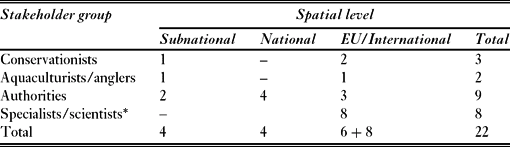
Stakeholder groups were distributed at different spatial levels (Table 1). Assignment of scientists and specialists to a spatial level was ambiguous as they often work on both national and international levels, however their statements usually referred to the national situation within the international context.
Interviewed stakeholder groups and their spatial level.
*Scientists and specialists work on both the international and national scale, so these groups could not be assigned to only one level.

The aim of the interviews was to understand the interviewees' perceptions of the issue and to validate results from the document analysis. We asked for their views and interests concerning the increasing numbers of cormorants, the development of the issue, the country-specific management options, which changes concerning policies they desired and the efforts undertaken to achieve a pan-European management plan. We then addressed the important question as to why the process towards European coordination had failed. We conducted interviews until no fundamentally new arguments with respect to the aim of our analysis were raised.
We structured the transcribed interview texts by inductive coding. We followed an open coding paradigm by coding the main statements and issues directly from the empirical material without a previously designed coding scheme. With reference to our research questions, we collected reasons for the failure of the attempt to draw up a management plan, and grouped them together. In doing so, we created a system of categories and basic storylines, which were grounded in the statements of the interviewees. These categories illustrate factors which have led to the failure of the attempt to establish a pan-European management plan.
RESULTS
History and scale of the cormorant conflict
The CMS was the first international framework dealing with the increasing cormorant numbers. The aim of the CMS is to protect migratory species and to establish cross-boundary cooperation with regard to their conservation. The CMS debated the topic in its 1994 meeting and made a recommendation aimed at the conservation and a special management of the cormorant population (CMS 1994). The CMS invited Denmark and the Netherlands, as the countries with the largest breeding colonies, to draft a pan-European action plan. Following this invitation, experts gathered scientific information at two meetings, considered the international level appropriate for solving the problem and drafted an action plan, which was largely a compilation of different measures to be used by the countries to lower the damage caused by cormorants but included no clear objectives or explicit obligations (CMS 1997). This loose set of management options was not the expected outcome for some of the affected countries, as they were seeking population control measures to solve the problem (Attendee of 1997 CMS meeting, personal communication). At the same time, the draft plan clearly indicated that a substantial reduction of cormorant numbers would not necessarily lead to a reduction of the extent of conflicts in problem areas, because cormorants killed in these areas would be replaced by cormorants from other areas (CMS 1997; Keller & Lanz Reference Keller and Lanz2003; Marion Reference Marion2003). Nevertheless, Denmark and the Netherlands finalized the plan and sent it to the CMS in 1998. As a CMS official confirmed in an interview, the members of the CMS did not ratify the plan and it became deadlocked, although the majority of the concerned countries had agreed on it.
Protection status of the cormorant population 2007
Until 1997 the cormorant was included in Annex I of the Birds Directive, which meant that the species itself and its habitats had to be strictly protected (Council Directive 79/409/EEC on the conservation of wild birds). However, it was removed from Annex I after this date by the Ornis Committee (a group of national representatives who assist the European Commission with the implementation of the European Birds Directive), owing to the ongoing increase in the cormorant population. Some stakeholder groups pleaded for the cormorant's inclusion in Annex II, the list of huntable species, which the Ornis Committee had denied. Thus a general protection status remains, and culling is only possible by derogation from the Birds Directive, referring to article 9. This derogation, accorded by the European Commission (EC), allows countries to issue permission to hunt a species to prevent serious damage to crops, fisheries, livestock, forests and water (for details on the German situation, see Thum 2005). Derogations can be granted if no other satisfactory solution to preventing damage is available. However, neither ‘damage’ (for example in terms of economic losses), nor ‘satisfactory solution’ are defined. Even with derogations, the rules of the Birds Directive apply (for example no hunting during the rearing season and hunting permissible only with certain methods), and the EC can take legal action against a member state breeching these rules. For example, in Sweden authorities permitted shooting of cormorants and the destruction of their eggs during the rearing season (April–September). As a consequence, the EC sent a final warning to Sweden, stating that alternative solutions were available (EC 2005). Should Sweden fail to respond satisfactorily to this final warning, the EC could take this case to the European Court.
Recent attempts to resume negotiations
In 2002, the European Anglers Alliance (EAA) held a meeting to reconsider the cormorant issue. As a result, a recommendation to resume the work on an action plan was sent to the European Commission (EAA 2002). At the European level, the Ornis Committee could be an adequate body to address the issue, even if it consists predominantly of representatives of nature conservation administrations. However, at their 2003 meeting, the Ornis members stated that no agreement could be reached on the need for international management and did not progress the matter. The cormorant issue was again raised at a further Ornis meeting in 2004, where F. Rauschmayer suggested the development of a European action plan. The French representative tried to convince colleagues to progress this issue, and the Dutch representative in particular denied any such necessity. As Ornis requires unanimity to proceed, the sole recommendation was to raise the issue again in the Scientific Working Group of the committee at a later stage. This occurred at the meeting in November 2006.
Neither the CMS nor the AEWA (‘daughter’ convention of the CMS) were interested in taking this issue up, but rather wanted to focus on endangered species. Some further attempts were made to find a solution to, or at least common ground for a discussion on, the increasing cormorant population. Anglers and conservationists attempted to encourage progress by the respective organizations, but none of these efforts succeeded. The main problem lay in the lack of clarity concerning the responsibility of the different organizations. Unlike the USA's federal management plan for handling the cormorant problem (US Department of Interior Fish and Wildlife Service 2003) where one agency is assigned responsibility, European efforts to create a management plan have been unsuccessful, as different institutions took up the issue but did not devise a solution. To date, the Ornis Committee is the only EC institution to review the issue. An interviewee suggested that the Cormorant Research Group of Wetlands International is a non-governmental organization (NGO) with the appropriate ecological and biological expertise to coordinate actions and exchange of scientific data on an international level. In general, and also because of legal regulations, the handling of the cormorant conflict is currently under the authority of nature protection bodies; fishers mistrust such bodies and the ornithologists that often dominate them. This conflict at the intersection of fishery and species protection remains problematic in several countries (for example Denmark; Jepsen & Olesen Reference Jepsen, Olesen, Klenke, Ring, Kranz, Jepsen, Rauschmayer and Henle2008). Governance structures are unclear at all institutional levels, and different countries have adopted different solutions. The organizational and governance side of creating trust and defining clear authority rules goes beyond the integration of interests. The involvement of actors on different political levels makes it difficult to find a solution that satisfies all interests. Currently, a variety of regulations existed in Europe, which ranged from strictly protecting the species (for example the Netherlands) to shooting large numbers of birds (for example culling with quotas in France) (Carss Reference Carss2003). These varying approaches to handling the cormorant problem demonstrate that the interests of the respective countries are very different and hard to reconcile in a joint management plan.
What prevented pan-European management?
From the coded interviews, we derived a set of factors that were decisive in the failure to install pan-European management. We combined these factors with additional explanatory and illustrative data from other sources.
Several dimensions and characteristics of relevant environmental conflicts can be identified from the literature. Daniels and Walker (Reference Daniels and Walker2001) discerned seven salient characteristics of complex environmental conflicts which are relevant: multiple parties, multiple issues, cultural differences, deeply-held values and world views, scientific and traditional knowledge, legal requirements and well-anchored and active lobby groups. Rijsberman (Reference Rijsberman1999) distinguished the following dimensions of environmental conflicts: data and facts, values, relations and interests. The cormorant management conflict displays all of these dimensions; it has an impact on the environment (Blackburn & Bruce Reference Blackburn and Bruce1995), and it ‘refers to long-term divisions between groups with different beliefs about the proper relationship between human society and the natural environment’ (Burgess & Burgess Reference Burgess, Burgess, Blackburn and Bruce1995, p. 102). Because our categories resemble Rijsberman's (1999) conflict dimensions, we use the same labels.
Data and facts are a source of disagreement
Ornithologists research diet and other ecological features, fishers observe birds and have experience of damage. Disagreements on the amount and size of fish eaten (c. 0.5 kg per bird per day) do not play a major role, but the fish species eaten and the impact of this consumption on the fish population is highly disputed. Anglers and fishers claim the exponential increase in cormorant populations has a high impact on fish quantity and on rare or protected fish species (Intergroup Sustainable Hunting, Biodiversity & Countryside Activities of the European Parliament 2007), but many of these claims have not been scientifically analysed (N. Jepsen, P. Sonnesen, R. Klenke & T. Bregnballe, unpublished data 2007).
According to one interviewee from a fishery organization, there is disagreement on the size of the cormorant population as different stakeholder groups (such as bird protection NGOs jointly with ornithologists on the one hand and fishery organizations on the other) have organized separate bird counts and have come up with different results. The fundamental disagreement on the number of birds leads to different perceptions concerning the range of management options available to different stakeholder groups. As stated by the same interviewee, ornithologists claim that management measures aimed at reducing the population are ineffective (see Hirschfeld Reference Hirschfeld2007), and where populations are to be reduced locally they call for critical thresholds, considered far too high by fishers.
Disagreement on the impact of cormorant hunting on fish populations has led to different perceptions of the necessity of management measures on the different levels. A fishery interviewee stated that foraging cormorants could have a highly negative impact on endangered fish species like the greyling, and claimed there was a report indicating that 80–90% of the greyling population had been predated by cormorants in a single winter
An interviewee confirmed that anglers perceive these fish-eating birds as the greatest problem, and the challenge thus consists in reaching a consensus on a realistic range of population sizes, and establishing a common understanding of what constitutes cormorant damage.
There is also disagreement on the success of available techniques of population management at the European level: the technical and political feasibility and efficacy of measures aimed at restricting the cormorant population are disputed. Damage occurs locally, regionally and nationally, but as one interviewee stated, it is ‘only possible to protect the sites on the local scale’ and ‘enormous input is necessary to reduce cormorant numbers overall’.
Views and values differ
Stakeholders views of how a population should be managed varied, the main differences being those on species protection and ecosystem management in general. Perception of ‘correct’ management also depended on the interpretation of data such as on population size. While some stakeholders have been calling for large-scale culling and overall population reduction via diminution of breeding colonies, a Danish interviewee stated that the policy of the Netherlands was based on the policy that the open access to natural resources is the limiting factor for population development and for that reason the Netherlands ‘would not be willing to take action to control numbers. . .they still follow that policy quite clearly’.
We interpreted this as a value disagreement about the place and rights of animals and humans, respectively. Should humans be allowed to restrict the cormorant population? According to a Dutch interviewee, animal rights activists are strong in the Netherlands, their point of view influences national hunting legislation, and for this reason the Netherlands refused to take action concerning population control. If the ‘natural’ population is assumed to be the ‘correct’ population size, then active population management (Lessard et al. Reference Lessard, Martell, Walters and Essington2005) is unacceptable.
The value difference between the concerned parties and countries, as reflected in the Dutch situation, cannot easily be resolved. Value differences have also influenced the production of scientific data such as on damage. One view, as stated in an interview with a Finnish scientist, is that fish in the sea, lakes and rivers are not the property of anyone and therefore the lack of fish due to cormorant predation should not be considered as damage. In general, fishers have a different understanding of this.
Relations. Maintenance of sovereignty
One aspect reflecting the relation-dimension of the conflict (Rijsberman Reference Rijsberman1999) that was very prominent in the interviews was the wish to maintain sovereignty in the sense of not handing over decision power to the European level. Several of the interviewed authority representatives and scientists claimed to need freedom to act on the state or regional level to balance internal interests, thereby allowing expression of respective identities, and did not want constraints and binding regulations. For example, in Germany every federal state has its own view on the topic and works it out with specific regulations like cormorant enactments (Thum Reference Thum2004). One AEWA interviewee stated that action plans were problematic because issues differed among countries, some having big problems with cormorants and different views being expressed of how to manage that problem.
An Austrian cormorant scientist interviewee stated that anglers and fishers did not want to give up national and local modalities, but were at the same time asking for a European action plan.
In international negotiations, each party concerned remains autonomous. So, if power relations are such that management needs the agreement of a specific actor, and this actor is unwilling to change policy, then no management scheme will be agreed upon. During the meeting to develop the 1997 action plan, the contents of such an action plan and likely adherence of different signatory countries were discussed. Initially the idea had been that the different countries should ratify the plan, but as one interviewee stated, ‘it became quite clear that a lot of countries would not do this because they wanted to be sure that they could be free to act on the national level, so they did not want to become bound by such agreement’.
The Ornis Committee also requires unanimity for decisions and therefore gives a high degree of autonomy to EU member states. Consequently, the challenge is to handle the maintenance of sovereignty in such a way that an action plan leaves freedom to the respective countries to balance different internal interests.
Interests. Can they be integrated on different levels?
One reason for the unclear governance structure lies in the unclear competence of nature-use or nature-protection administrations with regard to conflict resolution. Some administrations currently try to integrate interests from both sides; they are however perceived as being partial to one particular side of the conflict. As a representative of the Dutch Ministry of Agriculture, Nature and Food Quality stated, ‘the fishers department is in the same ministry, and they are not so happy about our conservation approach’.
The existence of different administrative and institutional structures at different levels is characteristic of European environmental governance. Stakeholders have been applying mitigation measures on various levels with a special focus on the local level. The respective regulations have been adapted to the conditions of the conflict and are site-specific (for example see cormorant enactments in Germany; Thum Reference Thum2004). Respecting local conditions is necessary, but difficult to achieve. A UK interviewee stated that culture, politics, poverty level, availability of compensation, overwintering of cormorants, increase or decrease of cormorant abundance and prior occurrence of the birds were factors at the local level that had to be compiled, but while an overall view may be desirable but it was unclear how the mosaic of local pictures could develop into a large-scale picture.
Pan-European management may not be desirable and some favour local handling of the different conflict situations; as one interviewee stated, while European angling associations were pushing for a plan there were equally no instances where a certain country had officially stated that they would like to have a European-wide management plan for this species. There was no agreement on what constituted adequate cormorant management measures.
In summary, most interviewees stressed that the desire to maintain national autonomy was the crucial factor in the failure of the management plan. Governance structures seemed to be perceived as more transparent and flexible at the national than at the EU level. Some respondents highlighted that an international management was too binding and left too little space for national regulations. Economic, social and ecological damages by cormorants were alleged by some and disputed by other interviewees. Some stakeholder groups and countries, mainly those with overwintering birds, did not consider the application of local mitigation measures as a solution and insisted on the need for coordinated international management. However, the CMS proposal seemed unacceptable to practically all concerned countries, albeit for different reasons: some countries were against any kind of management, some were against management at the European level, and other countries felt the plan was not far-reaching enough and would therefore not lead to a significant reduction of the conflict.
Cormorant management in 2007
The main organizations at the European level, namely the Ornis Committee and the CMS/AEWA, see their responsibility mainly in terms of coordination and exchange of scientific data and monitoring.
From the interviews, we conclude that the conflict about cormorant management has reached stalemate. Attempts to find a pan-European solution have been undertaken but failed. The concerned countries have not yet changed their viewpoints, and it would be hard to raise this issue again at the international level. At the same time, the conflicts over cormorants and their management persist and the different countries have been trying to handle them locally, regionally or nationally. Some countries like France have been trying to limit the population of cormorants in their territory by large-scale culling; others like some German states have permitted local scaring or shooting. These ongoing efforts to limit the cormorant population are however uncoordinated, damage persists and management has been unsuccessful. Uncoordinated culling, if accompanied by unfavourable natural conditions, can even endanger the population (Alberti & Frank Reference Alberti and Frank2005). Thus, the current unsatisfactory state of affairs seems set to continue. The age structure of shot individuals is however a good indicator of population status (Alberti & Frank Reference Alberti and Frank2005), so that linked with appropriate management measures monitoring of the age of shot cormorants at the European level could be a reliable mechanism to prevent the population from dropping below safe levels. Thus a European agreement on a common threshold age of shot cormorants, such that a certain extinction probability would not be exceeded in the face of the uncertain environment, could constitute an appropriate solution.
At a European level, no major policy change concerning species protection has taken place and no interviewee anticipated such a change in the near future.
DISCUSSION
Population modelling shows that measures taken in one country may influence the population in other countries (Alberti & Frank Reference Alberti and Frank2005), and therefore the uncoordinated handling of conflicts via culling may endanger the entire European cormorant population. Furthermore, population management measures as a potentially effective means to limit damage are likely appropriate only if coordinated at the European level (Keller & Lanz Reference Keller and Lanz2003; Marion Reference Marion2003). For this reason, the concerned countries should consider the means of international cooperation once more. Often, standard solutions for a problem do not fit the needs of a respective country (Hogl Reference Hogl2002). Given the difficulties that led to the failure of a European-wide coordination of cormorant management, the question arises as to whether there are possibilities left to address the issue at this level. The benefit of pan-European coordination will depend on its design. Two extremes of such management plans determine the range of potential actions: (1) the mere listing of mitigation measures without any common aim or schedule, and (2) a detailed plan obliging parties to take actions under conditions specified in the plan. If the plan is merely a loose set of techniques, which authorities more or less apply anyway, then the benefit will be small. This was one major problem of the drafted CMS action plan. Some parties did not consider it appropriate due to the lack of binding duties and aims. The other extreme is unrealistic and therefore also inappropriate: our interviews indicated that states will not oblige themselves to undertake specific actions to reduce the cormorant population. In every new attempt at drafting an action plan, the reasons for past failure might reoccur and have to be considered carefully, thus narrowing the range of available options. Against this background, we suggest different steps in order to overcome the obstacles identified in the interviews, using tools from the social sciences to assess conflicts and identify the obstacles (for example Tonder & Jurvelius Reference Tonder and Jurvelius2004; Arlinghaus Reference Arlinghaus2006; Mattson et al. Reference Mattson, Byrd, Rutherford, Brown and Clark2006; Togridou et al. Reference Togridou, Hovardas and Pantis2006). We consider results of such studies could be used to derive a set of policy options. Having recognized the sensitivity of the issue, we do not propose performance measures for specific levels of governance (McDaniels et al. Reference McDaniels, Longstaff and Dowlatabadi2006), but rather leave the specification of the steps to further political debate.
Possible steps towards a European management plan
To create a successful European cormorant management plan, it is essential to understand the current European structure of institutions, policies and stakeholder interests. By taking the following steps and integrating all stakeholder groups, it should be possible to create a commonly agreed plan. The first step would ideally be to agree upon common objectives taking into account the interests and values of all parties (Striegnitz Reference Striegnitz2006). The challenge here consists in addressing value differences openly and adequately, especially at the international level, and in translating value differences into specific policy schemes or plans. This could mean for instance agreeing that the survival of the great cormorant in adequate habitats in Europe is to be ensured, while at the same time limiting the damage it inflicts upon fisheries, angling and the probabilities of survival of its prey species. If damage cannot be limited, adequate compensation should be sought. Having identified common objectives, it will be possible to define the set of data to be used and devise more effective methods for producing undisputed facts.
Currently, no appropriate governance structure is in place where all affected groups are present or feel adequately represented. Towards setting up such a structure (for example a forum), building up trust seems essential. There are several possible approaches to building trust among countries and different stakeholder groups. Spreading knowledge of effective local mitigation measures (for example projects like REDCAFE [Reducing the Conflict between Cormorants and Fisheries on a Pan-European Scale] and INTERCAFE [Interdisciplinary Initiative to Reduce Pan-European Cormorant Conflicts]), is one step towards reduced damage and therefore more efficient conflict mitigation and recognition of the interests of the affected parties. Exchange of data between countries seems another useful component of any management plan in order to generate common understanding of the current status of the cormorant population and damage incurred by different parties. Organized international monitoring, including a counting scheme, could then be developed and implemented jointly by the different stakeholder groups involved. These measures could contribute to both building trust and creating a common database, which we consider a first important step towards coordinated action.
Based on these data, current models of the European population could then be improved as the second step. Including analysis of the age structure of shot cormorants would provide important feedback on the status of the population (Alberti & Frank Reference Alberti and Frank2005) and the models could then provide scientific information about the cumulative effect of regional measures on the population.
As a third step, regional-scale modelling of the European cormorant population would incorporate regional distribution of the population and potential effects on fisheries. Combined with a systematic assessment of ecological, economic and social impacts in every country, possible management options at the regional levels could be assessed.
Step four would appropriately link local, regional, national and European policy processes, a considerable task given the different competencies and ways of handling the problem in the different parts of Europe. According to the interviews, conceding decision power to a supranational level is against the interests of several of the countries involved. However, achievement of steps 1–3 would allow individual countries to maintain a high degree of autonomous decision making and retain possibilities of balancing the internal interests at the national or subnational level. We do not propose an exact institutional structure to address the issue at this point; it seems conceivable though that a committee like Ornis could take on the role of bringing together the relevant representatives and stakeholders in an appropriate way. Based on achievement of step 3, these could then exchange information on planned management options in each country and thereby assess probable cumulative effects these measures would have on population viability and impacts (step 4).
Step 5 would be an even more coordinated management plan that would detail who would do what and when, potentially including a common budget for implementing the measures. However, as the interests and values differ within the countries and between them, it will be difficult for the parties to approve such a binding multi-level agreement. Considering the institutional inertia, such a solution might also be inefficient.
The first three steps do not yet constitute management, but would provide the basis for a substantial evaluation of different management options. The components would provide a database of knowledge, which includes the specific views of different countries. If all stakeholder groups provide data to build a comprehensive database, then measures based on such comprehensive knowledge will be less contested.
Until now, countries have been partially undertaking steps 1–3, however without agreement on the objectives or strategies to address the European-wide great cormorant conflict. Based on our assessment of the situation, achieving step 4 might be sufficient for ensuring both a viable population of the great cormorant in Europe and adequate mitigation and compensation for impacts of this species on certain groups in society. In such a case, a binding and centrally coordinated management plan, which our analysis indicates would encounter ample opposition from several countries, would no longer be needed.
The question remains whether the advantages of every new step would be sufficient to surmount the difficulties highlighted, however the current situation is unsatisfactory.
In a recent meeting of the Scientific Working Group to the Ornis Committee, where the findings of the present study were presented, the EC agreed to actively communicate on this issue and parties determined to attempt to establish agreement on counting methods and results (however without any clear engagement). Thus, parts of step 1 were agreed on in principle, but without any clearly defined common objectives that might improve data collection.
This stepwise procedure would comply with at least six of the eight factors identified as important for integrative collaborative ecosystem management by Keough and Blahna (Reference Keough and Blahna2006), namely integrated and balanced goals, inclusive public involvement, stakeholder influence, consensus approach, monitoring and adaptive management, and multidisciplinary data. The remaining factors (namely economic incentives and collaborative stewardship) could be included, but do not seem indispensable.
CONCLUSIONS
Cormorant management in Europe is characterized by a heterogeneous mixture of different measures, with very little, if any, coordination among countries. Pressure from national fishery and angling associations varies, but is growing as the cormorant population expands. A first proposed coordinated management plan failed several years ago, and new attempts have reached stalemate. The most relevant organization, the Ornis Committee, has not reached agreement on the necessity of a management plan. Impacts have grown, management measures aimed at limiting damage and controlling cormorant population have increased, and population modelling shows that this situation could rapidly lead to an endangerment of the cormorant population.
How realistic is it to leave this state of affairs? Only internationally coordinated effort has the potential to sustainably mitigate the conflict. Through analysis of key stakeholders’ interests and views, we identified five impediments to undertaking such an effort and accordingly drafted a stepwise procedure aiming at overcoming them. The proposed steps, namely gathering additional scientific information, modelling of the European cormorant population, regionalized management and damage scenarios, linking policy processes at different levels, and planning responsibilities and actions to be taken by the respective countries in detail, could help coordinate devising of a common management plan. The international effort should build on the proposed steps and be open for negotiation about goals and aims. Data exchange aimed more at building trust between stakeholders than at conflict mitigation itself could be a starting point. The development of relations among stakeholders would then determine which steps followed. It is impossible to foresee at which step a potential process would stop due to lack of consensus on the cost-effectiveness of moving to a subsequent step, on burden sharing or on other issues that might arise.
Considering the current institutional setting however, it is unlikely at present that an organization which could take up the topic and coordinate any of these steps, even the first of gathering scientific data, would be found. Resource-using stakeholders perceive the existing decision bodies, such as the CMS, as biased by conservationist views. The same applies to the conservationists with respect to other bodies. Therefore, an appropriate institution independent of stakeholder groups is needed to ensure that the interests of all the different groups are included.
Reflecting on the objectives of cormorant protection, including consideration of its social, ecological and economic costs, could have led to a different result, had it come earlier. The institutional setting, including the barrier between nature users and nature protectors, has impeded such reflection and caused rather high decision-failure costs (Wittmer et al. Reference Wittmer, Rauschmayer and Klauer2006). Even today, the transaction costs of changing institutions are apparently still higher than the already considerable damage caused by cormorants.
The analysis of stakeholder views has contributed to a better understanding of why a pan-European management plan has not thus far been achieved in spite of considerable efforts. We hope we have shown how such an analysis can be used to derive new strategies in order to overcome the difficulties encountered in the past. It is necessary to sound out the possibilities of institutional change with regard to the challenges of such novel European-wide species management. In spite of there being no current actor who might tackle this endeavour, history has shown repeatedly that policy opportunities do open up occasionally and, in such cases, it is essential that adequate policy options are available (Garrelts et al. Reference Garrelts, Wittmer, Birner, Markussen, Buse, Garrelts, Mánez Costa, Menzel and Marggraf2005).
ACKNOWLEDGEMENTS
This work was funded by the European Commission FRAP project. We especially thank Thomas Olesen and Oliver Zwirner for their cooperation, and two anonymous reviewers for very helpful comments.