Introduction
Obsessive–compulsive disorder (OCD) is a severe psychiatric disorder that affects as many as 1% to 3% of the general population. It is characterized by repetitive, intrusive, and recurrent thoughts (obsessions) causing anxiety, and/or repetitive behaviors (compulsions) aimed at relieving anxiety.Reference Ruscio, Stein and Chiu 1 Antidepressant drugs are the most efficacious pharmacological treatments currently available for patients with OCD. However, clinically, there is considerable variability in drug response in the OCD population, with up to 40% to 60% of patients not showing any significant clinical improvement with these treatments.
Some authors have postulated that symptom heterogeneity in OCD could contribute to this variability in treatment outcome.Reference Landeros-Weisenberger, Bloch and Kelmendi 2 Models of OCD have emphasized its heterogeneous nature, identifying several dimensions of obsessive compulsive (OC) symptoms: contamination/cleaning, aggressive/checking, sexual/religious, symmetry/ordering, and hoarding.Reference Mataix-Cols, Rosario-Campos and Leckman 3 It is important to note that the data suggests that these clinical dimensions could respond differently to drug treatment.Reference Mataix-Cols, Rosario-Campos and Leckman 3 On the other hand, genetic factors could also influence response to drug treatment.
Most genetic studies have focused on the role of the brain-derived neurotrophic factor (BDNF) in the pathophysiology of mental disorders, including OCD.Reference Wang, Xu and Yan 4 BDNF is a member of the neurotrophin family and it plays an important role in neuronal survival, differentiation, synaptic efficiency, neuronal plasticity, and neurotransmitter function.Reference Park and Poo 5 The genetic variation of this gene that has been the most widely studied is 196G/A, which produces a functional change in the Val66Met amino-acid (rs6265). This polymorphism alters intracellular trafficking and activity-dependent secretion of BDNF, and the Met allele is associated with a decrease in the activity-dependent secretion of BDNF compared to the Val allele.Reference Egan, Kojima and Callicott 6 , Reference Chen, Patel and Sant 7 Few studies are available on response to drug treatment in OCD and no association has been suggested between Val66Met polymorphism and response to antidepressant drugs, whether among Japanese,Reference Umehara, Numata and Kinoshita 8 Southern Indian,Reference Taj, Ganesh and Shukla 9 or Iranian patients.Reference Abdolhosseinzadeh, Alizadeh and Shams 10 However, one study reported the involvement of the BDNF gene in the response to antidepressant treatment among Caucasians.Reference Real, Gratacòs and Soria 11 Several reasons could explain the negative results found for the association between Val66Met polymorphism and the efficacy of antidepressant drugs. First, the studies included groups of people from different ethnic backgrounds, which could have increased variability in response. Indeed, a recent meta-analysis showed that the risk for developing OCD associated with the BDNF Val66Met variant differed with ethnicity,Reference Wang, Xu and Yan 4 and suggested that further studies among Caucasian patients are needed, since the frequency of the Met66 allele is lower among Caucasians than among Asians. Second, despite differences between antidepressant drug classes in terms of pharmacological properties and efficacyReference Anderson 12 , 13 and changes in BDNF serum levels,Reference Matrisciano, Bonaccorso and Ricciardi 14 , Reference Molendijk, Bus and Spinhoven 15 most studies evaluated patients treated with a range of different serotonin reuptake inhibitors (SRIs), sometimes associated with antipsychotics. Third, all studies used short-term treatment (12 weeks) or had heterogeneous follow-up durations. Fourth, none of these studies evaluated drug response in relation to the different dimensions of OC symptom.
Considering the potential limitations of past research, the present study aimed to test the association of BDNF Val66Met polymorphism with antidepressant efficacy among Caucasian OCD patients, with durations of 3 and 6 months, using a single selective SRI (SSRI) antidepressant drug (escitalopram) for the first 3 months, and only two different SSRIs (escitalopram or paroxetine) for the next 3 months. We hypothesized that the impact of BDNF Val66Met polymorphism could vary across the different dimensions of OC symptoms.
Methods
Study design
In a 6-month, prospective, real-world setting, treatment study, patients with current OCD were assessed at the beginning of antidepressant treatment, and 3 and 6 months later. This study was coordinated by the Henri Laborit psychiatric hospital in Poitiers (France) and conducted in four hospital centers in France. The study design was approved by the French Regional Ethics Committee (January 26, 2010 n° B91051-20) and the Drug Regulatory Agency (November 13, 2009 n° B91051-20). All experiments were performed in accordance with the relevant guidelines and regulations. All participants in the study gave their written informed consent for study participation and for genetic analyses. Data was collected from March 2010 to November 2016.
Study participants
Caucasian outpatients, over 18 years of age, with current OCD (according to the Diagnostic and Statistical Manual of Mental Disorders DSM-IV criteria, and with a Yale-Brown Obsessive–Compulsive Scale [Y-BOCS] score > 16) and requiring a first or different antidepressant treatment, were included. The exclusion criteria were depression, psychotic disorders, current substance abuse or dependence (except tobacco) evaluated using the Mini-International Neuropsychiatric Interview (MINI),Reference Sheehan, Lecrubier and Sheehan 16 mental retardation, severe organic or neurological pathology, pregnancy, and breastfeeding.
The subjects included in this study were not undergoing any other pharmacological treatments for psychiatric disorders prior to inclusion, but could be treated for other types of mild to moderate conditions, such as cardiovascular diseases.
Procedure
Patients were treated with escitalopram 20 mg/day for 24 weeks or with escitalopram 20 mg/day for 12 weeks followed by paroxetine 40 mg/day for an additional 12 weeks according to the value of the 12-week clinical response. Escitalopram was chosen as the first treatment because it is considered to be the most selective serotonergic inhibitor among available SSRIs. Then we operated a switch to paroxetine, because among SSRIs, in addition to its properties on the serotonergic system, paroxetine also has a dose-dependent action on the noradrenergic system.Reference Nemeroff and Owens 17 This noradrenergic antagonism is believed to contribute to the antidepressant effect of paroxetine in depression.Reference Owens, Krulewicz and Simon 18 The escitalopram–paroxetine switch was standardized for all the patients.
Clinical response was assessed using the Y-BOCS score. Patients were evaluated for OCD symptoms at the start of treatment (M0), and 3 months (M3) and 6 months (M6) later. Clinical assessments were performed blind to genotyping results.
Response was defined by a decrease in the Y-BOCS score of at least 25% from baseline to follow-up (M3 and M6). At M3, if the patient did not respond to escitalopram (defined as a Y-BOCS score not having decreased by at least 25% compared to M0), the investigator discontinued escitalopram and initiated paroxetine. The patient was reviewed 1 week later for an evaluation of adverse events.
The improvement in the Y-BOCS score over time was defined as the percentage of the difference between the Y-BOCS score at follow-up and the Y-BOCS score at baseline divided by the Y-BOCS score at baseline.
The OCD symptom dimensions were determined using the statistical algorithm for the extraction of quantitative specific symptom dimension data from the Y-BOCS checklist developed by Schavitt et al.Reference Shavitt, Requena and Alonso 19 Based on this validated procedure, five groups of patients were created according to the presence of symptoms in one of the following OC symptom dimensions: contamination/cleaning, aggressive/checking, sexual/religious, hoarding, and symmetry/ordering.
The patients who prematurely dropped out of the study between baseline and the third month of treatment and between the third and the sixth month were excluded from the analyses.
Genotyping
After obtaining informed consent, 10 ml of venous blood was drawn from each patient recruited. Genomic DNA was extracted from peripheral EDTA-anticoagulated mononuclear blood cells using an automated nucleic acid extraction system (Magtration System 12GC Bionobis) and was stored at −20°C. Genotyping of BDNF Val66Met (rs6265 SNP) was performed by fragment analysis on an ABI3500 (Applied Biosystem).
The sequence of interest was amplified using the following DNA primers (Eurogentec): BDNF forward 5′-GCCTACCCAGGTGTGCGG-3′ and BDNF reverse 5′-[6FAM]GAGGAGGCTCCAAAGGCAC-3′. PCR was completed using the following protocol: denaturation at 95°C (3 minutes), then 30 cycles of denaturation at 95°C (30 seconds), annealing at 62°C (30 seconds) and extension at 72°C (30 seconds), followed by a final extension at 72°C (3 minutes). Then the amplified PCR fragments were subjected to restriction digestion with NlaIII enzyme (New England Biolabs) at 37°C for 180 minutes. Fragments of interest were viewed using the ABI3500 sequencer, yielding bands at 195 bp for Val/Val homozygote and at 118 bp for Met/Met homozygote.
The BDNF genotypes were evaluated as blind samples. Each analysis included positive and negative controls for quality assurance. Patients were classified into two genotypes: Val/Val and Val/Met or Met/Met.
Statistical analyses
Statistical analyses were performed using Jamovi (The Jamovi project [2020]. jamovi [Version 1.2] [Computer Software] retrieved from https://www.jamovi.org). The demographic and clinical characteristics of the patients and the drugs used were compared between the two genotypes (Val/Val and Val/Met + Met/Met) using two sample t tests (two-tailed) and chi-square tests. Responder status was compared using chi-square tests. All results are presented as means ± SD unless indicated otherwise. A significance threshold of P < .05 was chosen for all tests.
Results
Out of the 79 participants included in the study, 10 patients were excluded. The reasons were as follows: adverse events, patient’s decision or no available Y-BOCS at M3. In all, 69 participants completed the 3-month follow-up and 59 the 6-month follow-up.
Sociodemographic characteristics
The 69 patients were aged 38.2 ± 13.2 years. Fifty-eight percent were female. The average lifetime duration of OCD symptoms before inclusion was 20.3 ± 13.9 years. All subjects were Caucasian. The Y-BOCS score was 28.50 ± 3.95 at baseline, 21.3 ± 7.31 at M3 and 19.5 ± 6.54 at M6.
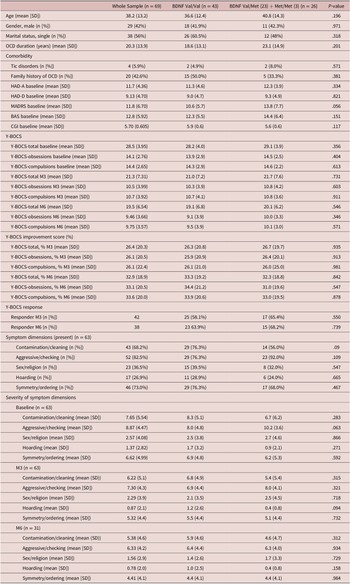
Demographic and clinical characteristics and the statistical comparisons across the sample according to BDNF Val66Met genotype are summarized in Table 1. In this analysis, genotype distributions were in accordance with Hardy–Weinberg’s equilibrium (P = .998). The Val/Val group comprised 43 (62%) patients and the Val/Met and Met/Met group comprised 26 (38%) patients (Val/Met: 23, Met/Met: 3). At baseline, the two groups (Val/Val group vs Val/Met and Met/Met group) did not differ significantly in demographics or clinical ratings.
Demographic and Clinical Characteristics of Patients and Drug’s Effects According to BDNF Val66Met Genotype

Note: P-values are calculated by t test for quantitative data and chi-squared test for qualitative data between the Val/Val group and the Val/Met + Met/Met group.
Abbreviations: BAS, Brief Anxiety Scale; BDNF, Brain-Derived Neurotrophic Factor; CGI, Clinical Global Impression; HAD-A, Hamilton Rating Scale for Anxiety; HAD-D, Hamilton Rating Scale for Depression; MADRS, Montgomery–Asberg depression rating scale; M3, third month of treatment; M6, sixth month of treatment; OCD, Obsessive–Compulsive Disorder; Y-BOCS, Yale-Brown Obsessive–Compulsive Scale.
BDNF Val66Met and response to SSRI antidepressants
Of these 69 patients, 42 were classified as responders to treatment with escitalopram at 3 months and 38 to treatment with escitalopram or paroxetine at 6 months. We did not find any significant association between BDNF Val66Met and response to treatment or improved Y-BOCS scores at 3 and 6 months (Table 1).
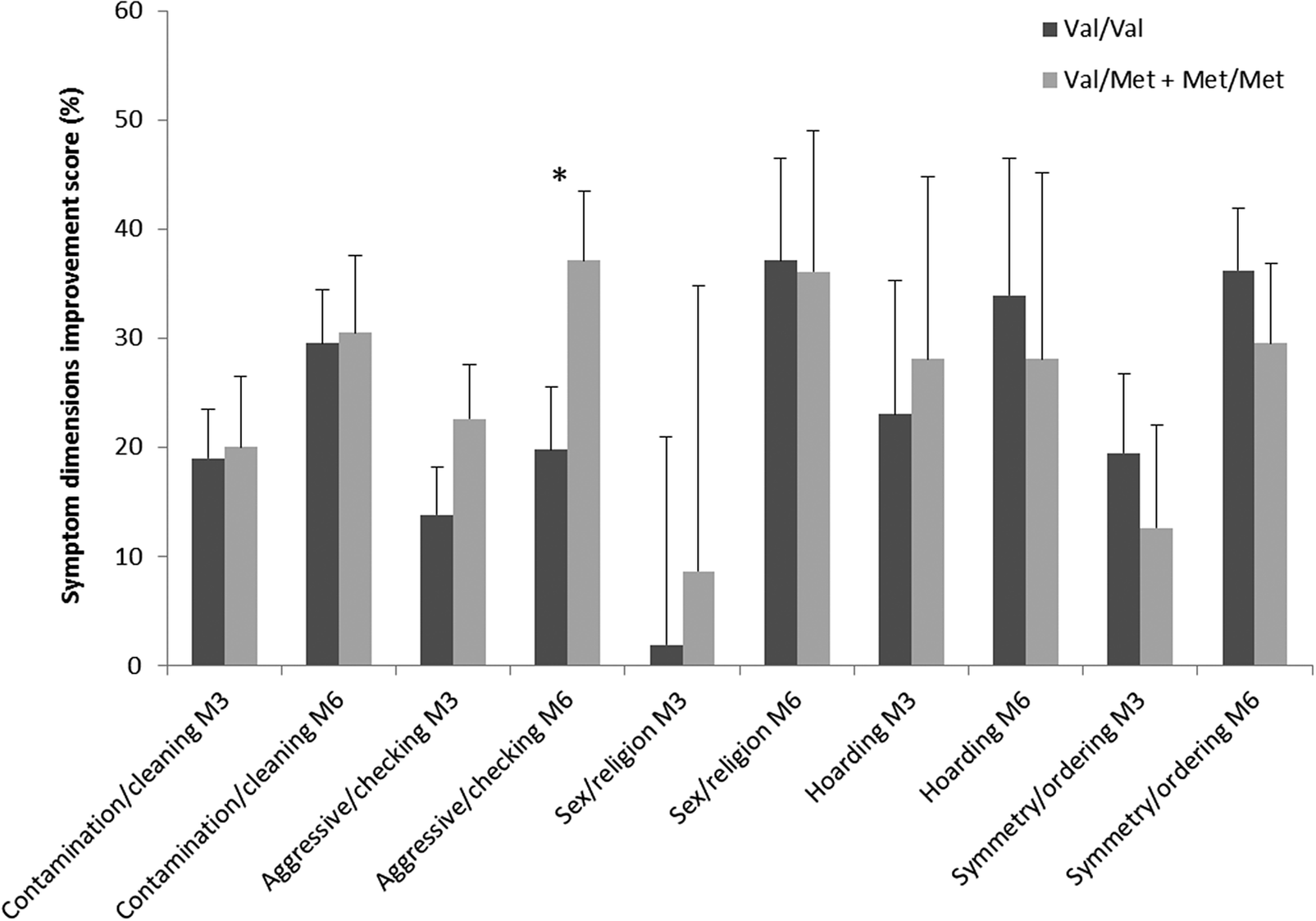
Concerning the OC symptom dimensions, the level of improvement was significantly different in the aggressive/checking group at 6 months (Figure 1) among patients carrying the Met allele, who had higher improvement scores for this symptom than the patients carrying the Val/Val allele (37.1% vs 19.8%, P = .048).
Symptom dimensions improvement score depending on brain-derived neurotrophic factor Val66Met polymorphism. Symptom dimensions improvement score was analyzed by comparing the Val/Met and Met/Met groups to the Val/Val group. M3, third month of treatment; M6, sixth month of treatment; *significant differences (P < .05).

Discussion
This pharmacogenetic study shows that BDNF Val66Met polymorphism (rs6265) is not associated with an overall improved response to 3- or 6-month treatments with SSRI antidepressants among patients with OCD. However, a weak association was detected between BDNF Val66Met and score improvement, specifically in the aggressive/checking subtype of symptoms at 6 months, highlighting complex interactions between genotypes, medications, and heterogeneity of OCD symptoms.
Pharmacogenetic evaluations of BDNF polymorphisms with treatment response in OCD have been scarce. However, our results, which indicate an absence of overall impact on the efficacy of SSRI treatment are in agreement with those of four previous association studies on BDNF variants among patients with OCDReference Umehara, Numata and Kinoshita 8 - Reference Real, Gratacòs and Soria 11 and in a genome-wide association study of treatment response among 804 patients with OCD.Reference Qin, Samuels and Wang 20 Real et alReference Real, Gratacòs and Soria 11 carried out a single-marker and haplotype association study of eight BDNF SNPs on a sample of 123 Spanish Caucasian OCD patients treated with fluoxetine, fluvoxamine, or clomipramine for 12 weeks. They found no significant association with BDNF Val66Met but identified a single SNP (rs1491850) and a composite haplotype (rs1491850-rs908867) associated with an improved therapeutic effect. In a Japanese population, pharmacological responses were compared among 96 patients treated with either SSRIs (fluvoxamine, paroxetine, sertraline, or escitalopram) or SSRIs with an atypical antipsychotic (risperidone, olanzapine, quetiapine, perospirone, or aripiprazole) with a follow-up period of 12.9 ± 8.9 months.Reference Umehara, Numata and Kinoshita 8 The results showed no association between BDNF Val66Met and the three different drug response groups: SSRI responders, responders to SSRIs with atypical antipsychotics, and nonresponders to either SSRIs or SSRIs with an atypical antipsychotics. A recent study on 278 Southern Indian patients with OCD failed to evidence a major role for BDNF Val66Met in therapeutic response to SRIs after 12 weeks of treatment.Reference Taj, Ganesh and Shukla 9 Similarly, among 94 Iranian patients, none of the two BDNF SNPs studied (rs6265, rs2883187) nor their haplotypes were associated with response to fluvoxamine after 12 weeks.Reference Abdolhosseinzadeh, Alizadeh and Shams 10
The importance of clinical OCD symptom subtypes has been underlined in recent years. Thus, not taking these dimensions into account could be a confounding factor in the interpretation of studies. Except for Fullana et alReference Fullana, Alonso and Gratacòs 21 who studied response to cognitive-behavioral therapy (CBT) according to OCD dimensions, no other study has investigated BDNF gene polymorphisms with regard to treatment response and dimensions in OCD. Among 98 Caucasian Spanish outpatients, these authors found that BDNF Val66Met polymorphism was associated with treatment response to CBT, with patients carrying the Met allele (Met/Met and Met/Val) having a lower response to CBT than Val/Val patients. In analyses of the different dimensions of OC symptoms, the association was especially marked among patients exhibiting contamination/cleaning symptoms.Reference Fullana, Alonso and Gratacòs 21 Our findings suggest an association between BDNF Val66Met and another particular OC symptom dimension, the aggressive/checking subtype, with a poorer improvement score for the Val/Val genotype. Genetic data on the association between BDNF Val66Met and susceptibility in certain OCD dimensions has not specifically highlighted this dimension. Only genetic influence on the contamination/cleaning and the hoarding or the sexual/religious dimensions in OCD have been postulated.Reference Taj, Ganesh and Shukla 9 , Reference Abdolhosseinzadeh, Alizadeh and Shams 10 , Reference Timpano, Schmidt and Wheaton 22 , Reference Katerberg, Lochner and Cath 23 Further investigation with larger samples should clarify this issue.
This study presents some strength compared to previous studies. First, this pharmacogenetic study evaluated the effect of BDNF Val66Met polymorphism on treatment response with standardized medication in a homogeneous clinical sample of Caucasian patients with OCD. Except for the study comparing patients treated with fluvoxamine among Iranian patients,Reference Abdolhosseinzadeh, Alizadeh and Shams 10 previous studies investigated the effects on a variety of SRIs, sometimes associated with antipsychotics, suggesting nonresponse to many previous therapies. Second, the duration of our study (24 weeks) was longer than the duration of earlier studies (12 weeks). Neurogenesis, a phenomenon in which new neurons are produced, which depends on BDNF, could require significant treatment durations to become effective in a real-world setting.Reference Yan, Wang and Kuang 24 Thus providing lengthy treatment could be critical to allow the benefits of antidepressant treatment to occur. Third, we assessed compliance with treatment by measuring plasma drug concentrations to make sure that all patients were on medication for the entire duration of the study. Fourth, this is the first study investigating the different dimensions of OC symptoms to evaluate the influence of BDNF polymorphism in the antidepressant treatment of OCD.
The most important limitation of this study was the relatively small sample size. Moreover, treatment response in a heterogeneous disorder such as OCD probably cannot be fully explained by a single gene, but rather by complex gene–gene interactions. We did not explore interactions between the BDNF gene and other gene variants, such as 5-HTTLPR and 5-HT2A rs6311, which have been associated with drug response in OCD.Reference Denys, Van Nieuwerburgh and Deforce 25 , Reference Sina, Ahmadiani and Asadi 26 It is also important to consider the possible role of clinical factors and environment–gene interactions, which could contribute to treatment response. Given these reasons, the interpretation of the results should be cautious and the genetic modulation of pharmacological response according to OC symptom dimensions needs to be further addressed in future studies.
Conclusions
The difference in individual response to antidepressant treatment remains a critical problem in the management of patients suffering from OCD and improvement in understanding the determinants of response to SRIs would be immensely valuable to develop more efficient treatment strategies for this disorder. Our findings do not provide support the usefulness of the BDNF Val66Met genotype to predict response to treatment with escitalopram or paroxetine in OCD overall. However, we found that patients carrying the Met allele at 6 month showed better outcomes in the aggressive/checking symptom dimension. Further investigation is warranted to further assess the genetic contribution to response to OCD treatment according to phenotypic symptom subtypes.
Acknowledgment
The authors would like to thank Sylvie Maillochaud for her help with this research.
Funding
This study was supported by the Programme Hospitalier de Recherche Clinique from the French Ministry of Health, PHRC PPG-TOC. The French Ministry of Health had no role in study design, data collection, data analyses, interpretation of data, writing of the report, or in the decision to submit the study for publication.
Disclosures
The authors do not have any conflicts of interest related to this study.