1. Introduction
Economic development and poverty reduction policies have encouraged the use of modern energy and more efficient biomass to help people engage in productive activities and improve their quality of life (Barnes and Floor, Reference Barnes and Floor1996). Over 1 billion people have no access to electricity and an estimated 2.8 billion people were without clean cooking facilities worldwide in 2016. A third of the world's population (2.5 billion people) relies on traditional use of solid biomass to cook their meals, and a majority of these people live in developing countries (IEA, 2017).
In China, most households deprived of access to modern energy services are located in less-developed rural and remote areas. Based on an 18-province survey conducted in northern China, Zhou et al. (Reference Zhou, Wu, Chen and Chen2008) found that biomass accounted for more than 70 per cent of rural households' fuel consumption as of the late 1990s; the share gradually declined, but was still above 42 per cent in 2015 (Cong et al., Reference Cong, Zhao, Wang and Yao2017; Wang et al., Reference Wang, Li, Li, Bai and Liu2017).Footnote 1 Commercial energy consumed by rural residents, however, accounted for merely 3 per cent of China's total final energy consumption in 2005 (Zhang and Guo, Reference Zhang and Guo2013), but increased rapidly from 2000 onwards. Over one-half (51.7 per cent) of energy consumption in rural China in 2015 was met by commercial fuels, especially coal (33.8 per cent) and electricity (9.4 per cent) (Wang and Jiang, Reference Wang and Jiang2017; NBS, 2019). This implies that the transition from traditional biomass to clean and efficient modern energy is entering into an ascending stage in rural China, as a result of a fundamental shift in rural life styles driven by rapid socioeconomic development in rural China. Moreover, inefficient biomass use can lead to seriously adverse health and environmental consequences (Bruce et al., Reference Bruce, Perez-Padilla and Albalak2000; Edwards et al., Reference Edwards, Smith, Zhang and Ma2004; Zhang and Smith, Reference Zhang and Smith2007). Therefore, a clear understanding on fuel choices and usage, and the underlying drivers of rural energy transition, is of great importance.
A number of empirical studies have investigated the determinants of rural household energy consumption in developing countries, dating back to Hosier and Dowd (Reference Hosier and Dowd1987). A growing body of literature finds that household energy consumption is not solely associated with economic status but also with a variety of socio-demographic and cultural factors (Masera et al., Reference Masera, Saatkamp and Kammen2000; Heltberg, Reference Heltberg2005; Ouedraogo, Reference Ouedraogo2006; Mekonnen and Köhlin, Reference Mekonnen and Köhlin2008). In China, earlier studies are mainly macro-level analyses that rely on aggregate statistics (Zhou et al., Reference Zhou, Wu, Chen and Chen2008; Yao et al., Reference Yao, Chen and Li2012; Zhang and Guo, Reference Zhang and Guo2013) and focus on urban areas (Zhou and Teng, Reference Zhou and Teng2013; Li and Shui, Reference Li and Shui2015; Zhang and Hassen, Reference Zhang and Hassen2017). Recently, an increasing number of empirical studies have investigated residential energy use in rural areas (Chen et al., Reference Chen, Heerink and van den Berg2006; Shi et al., Reference Shi, Heerink and Qu2009; Demurger and Fournier, Reference Demurger and Fournier2011; Zhang and Kotani, Reference Zhang and Kotani2012; Yang et al., Reference Yang, Xu, Xu, Yi and Hyde2017; Han et al., Reference Han, Wu and Zang2018; Song et al., Reference Song, Bilsborrow, Jagger, Zhang, Chen and Huang2018; Ma et al., Reference Ma, Zhou and Renwick2019). However, all these studies have a focus on the Han Chinese population, and little is known about the sociocultural background of fuel choices. In particular, characteristics of energy consumption in regions with a diverse ethnic minority distribution may display systematic differences from the majority group. We will fill this gap, using an original survey dataset from two western Chinese provinces – Gansu and Yunnan – where ethnic minority families are widespread.
We study the pattern of residential energy consumption for cooking and heating in rural households, by examining the differences between the ethnic majority and minority families. Since ethnic minority populations are disadvantaged in accessing job markets and forestland resources (as further discussed in section 2), we also examine the effects of off-farm employment and secure access to forest resources on the differences in fuelwood consumption between the majority and minority ethnic groups.
Household survey data, collected from in-field household surveys in 32 villages in western China, is analyzed using the Heckman two-stage selection model, considering the quantity consumed (second-stage) conditional on the decision to use fuelwood (first-stage). Four main findings stand out. First, the ethnic minority families are more likely to use fuelwood than the majority Han Chinese families. Second, families who own a larger area of forestland are more likely to use fuelwood for cooking and heating.Footnote 2 Further, only a weakly significant association is found between the quantity of fuelwood consumption and the size of household-owned forestland for the Han Chinese families, but not for the ethnic minority families. Third, since more off-farm income implies more time devoted to off-farm work, the quantity of fuelwood that households demand (conditional on using fuelwood) declines when there is a larger proportion of income coming from off-farm: this decline is greater for the ethnic minority families than for the Han Chinese ones. Finally, coal rather than electricity is a substitute for fuelwood for residential cooking and heating use in the study areas.Footnote 3
The rest of the paper is organized as follows. Section 2 briefly surveys the literature and introduces the background of energy consumption in rural China and the importance of studying the ethnic groups. Section 3 describes the data. Section 4 elaborates the empirical model, and section 5 discusses the estimation results. Section 6 concludes.
2. Background
2.1. Energy ladder, fuel stacking and ethnicity
Inspired by the classic energy ladder theory that depicts the progress of energy transition from traditional energy to modern energy when income increases, most of the existing empirical work has found that income is an important determinant of household energy demand (Hosier and Dowd, Reference Hosier and Dowd1987; Leach, Reference Leach1992; Reddy, Reference Reddy1995; Heltberg, Reference Heltberg2005; Song et al., Reference Song, Bilsborrow, Jagger, Zhang, Chen and Huang2018). However, this theory is challenged by some work that did not find evidence in support of the significant role of income in fuelwood consumption (Hyde and Köhlin, Reference Hyde and Köhlin2000; Zhang and Kotani, Reference Zhang and Kotani2012; Yang et al., Reference Yang, Xu, Xu, Yi and Hyde2017). Others even found a positive relationship between fuelwood consumption and income (e.g., Baland et al., Reference Baland, Bardhan, Das, Mookherjee and Sarkar2010).
The energy ladder theory has also been challenged as a simple description of the energy transition as a complete and linear process. As an improvement, the fuel stacking theory developed by Masera et al. (Reference Masera, Saatkamp and Kammen2000) builds on the common observation that households actually use multiple fuels at the same time, and do not abandon traditional fuels completely when adopting modern fuels (Alem et al., Reference Alem, Beyene, Köhlin and Mekonnen2016; Chen et al., Reference Chen, Yang, Liu and Zhang2016; Han et al., Reference Han, Wu and Zang2018). The fuel stacking theory reflects the more complex reality that household energy use patterns are determined by interactions between various factors such as income or wealth (Heltberg, Reference Heltberg2005; Demurger and Fournier, Reference Demurger and Fournier2011), cooking habits and cultural preferences (Masera et al., Reference Masera, Saatkamp and Kammen2000; Ouedraogo, Reference Ouedraogo2006), local institutions (Yang et al., Reference Yang, Xu, Xu, Yi and Hyde2017; Han et al., Reference Han, Wu and Zang2018), location (Wang and Fend, Reference Wang and Fend1996; Pachauri, Reference Pachauri2004), forest policy (Yang et al., Reference Yang, Xu, Xu, Yi and Hyde2017; Song et al., Reference Song, Bilsborrow, Jagger, Zhang, Chen and Huang2018), technologies (Zhang and Kotani, Reference Zhang and Kotani2012), and household demographic characteristics (Jiang and O'Neill, Reference Jiang and O'Neill2004; Zhang and Hassen, Reference Zhang and Hassen2017).
Although socioeconomic and demographic characteristics have been found to be important in determining household energy consumption, ethnicity has been largely neglected in the literature. A strand of the existing literature has found ethnic cultural differences in food consumption patterns (Wallendorf and Reilly, Reference Wallendorf and Reilly1983; Ma, Reference Ma2015; Nurul-Fadhilah et al., Reference Nurul-Fadhilah, Pey and Leng2016), which of course could reveal different cooking habits that demand different energy sources (Masera et al., Reference Masera, Saatkamp and Kammen2000; Heltberg, Reference Heltberg2005). It is thus plausible to infer that ethnicity may have a potentially significant impact on households' decision making in terms of fuel choices and amount of use. Beyond cultural preferences, there may be differences in access to two drivers of rural energy use: off-farm employment and forest resources. We examine these next.
2.2. Rural energy consumption, off-farm employment and forest resource access
China is still a rural country despite rapid economic growth over the past three decades; rural residents account for over 40 per cent of the total population as of 2018 (NBS, 2018). According to Han and Wu (Reference Han and Wu2018), the rural population consumed 33.65 per cent of overall residential energy in 2014. In rural areas, consumption of commercial energy showed an annual increase of 2.15 per cent from 1991 to 2010 (Zhang and Guo, Reference Zhang and Guo2013). Among all the commercial fuels, coal is the primary one (Zhang et al., Reference Zhang, Yang, Chen, Chen and Zhang2009), but 90.11 per cent of the coal consumed is raw coal of poor quality (Tian, Reference Tian2016). In addition, inefficient combustion of solid fuels (including fuelwood and coal) causes indoor air pollution (Fischer, Reference Fischer2001; Zhang and Smith, Reference Zhang and Smith2007; Papineau et al., Reference Papineau, Aunan and Berntsen2009).
Along with the rapid economic growth in recent decades, rural households have greatly increased income from off-farm activities, and this income reduces biomass and coal consumption (Ma et al., Reference Ma, Zhou and Renwick2019; Zou and Luo, Reference Zou and Luo2019) and deforestation (Bluffstone, Reference Bluffstone1995; Araujo et al., Reference Araujo, Combes and Féres2019). Nevertheless, workers of different cultural backgrounds have different patterns of off-farm employment (Zhang et al., Reference Zhang, Dong, Liu and Ba2018). In addition to the Han Chinese, China has a total of 55 ethnic minority groups, who altogether account for less than 10 per cent of the national population. Most of them inhabit the rural frontier regions of western China (Wu and Song, Reference Wu and Song2014). The ethnic minority labor force has been discriminated against, with significant wage differences compared to Han Chinese workers (Gustafsson and Li, Reference Gustafsson and Li2003; Li, Reference Li2003) and disadvantages in accessing job markets (Hannum and Xie, Reference Hannum and Xie1998; Hasmath, Reference Hasmath2011; Maurer-Fazio, Reference Maurer-Fazio2012). Faced by such discrimination, surplus labor in ethnic minority families may be ‘stuck’ at home (less likely to migrate or work off-farm), leading to higher residential energy demand in these households. It is thus intriguing to examine whether differences in off-farm employment have different effects on energy consumption for the majority versus the minority ethnic groups.
Moreover, forest resources with secure tenure rights are important in determining household fuelwood consumption, especially for the rural poor of the developing countries (Cooke et al., Reference Cooke, Hyde and Köhlin2008; Palmer and Macgregor, Reference Palmer and Macgregor2009; Bandyopadhyay et al., Reference Bandyopadhyay, Shyamsundar and Baccini2011; Murphy et al., Reference Murphy, Berazneva and Lee2018). Since 2003, China has implemented the nation-wide Collective Forest Tenure Reform that devolves forestland tenure rights to rural households. Yet, implementation has been relatively slow in western ethnic minority regions, and could be constrained by local ethnic culture or historical tenure rights conflicts (Yang et al., Reference Yang, Xu and Wang2015). In addition, ethnic minority households may be disadvantaged in accessing forestland (or de facto tenure rights). Yang et al. (Reference Yang, Xu, Xu, Yi and Hyde2017) examine the two channels of the impact of the forest tenure reform on household fuelwood consumption: first, the direct resource effect due to the security of access to fuelwood plots; and, second, the indirect income effect from an increase in household income from forestry activities. In this paper, we further investigate how ownership of more forestland is associated with fuelwood consumption between the ethnic majority and minority families.
3. Data
3.1. The survey and village locations
The dataset comes from the rural household survey in Gansu and Yunnan provinces, conducted by Peking University in 2013. The survey was designed to study the Collective Forest Tenure Reform in the ethnic minority regions of Western China. The household samples were selected using a stratified random sampling rule. Firstly, 10 counties were selected from the two provinces. Next, 32 villages were selected, taking county size into account. In each village, 10 households were chosen for face-to-face interviews, for a total of 322 households.Footnote 4 Table A1 and figure A1 in the online appendix present the locations of the villages in the map of China, with satellite-image interpreted vegetation cover (in green), and color-coded features of the village population share of ethnic minority groups. Obviously, the villages have abundant forests and widespread ethnic minority populations: darker orange colors show that more than half of the village population belongs to ethnic minority groups.
The survey consists of questionnaires of household- and village-levels. The household questionnaire includes demographic characteristics, income sources, assets, perceived forest tenure rights and forestland characteristics, energy consumption, and other expenditures. At the village level, a village leader was invited, and data on village characteristics was collected, including population, socioeconomic factors, ethnic composition, geographical conditions, and adoption and implementation of the collective forest tenure reform.Footnote 5
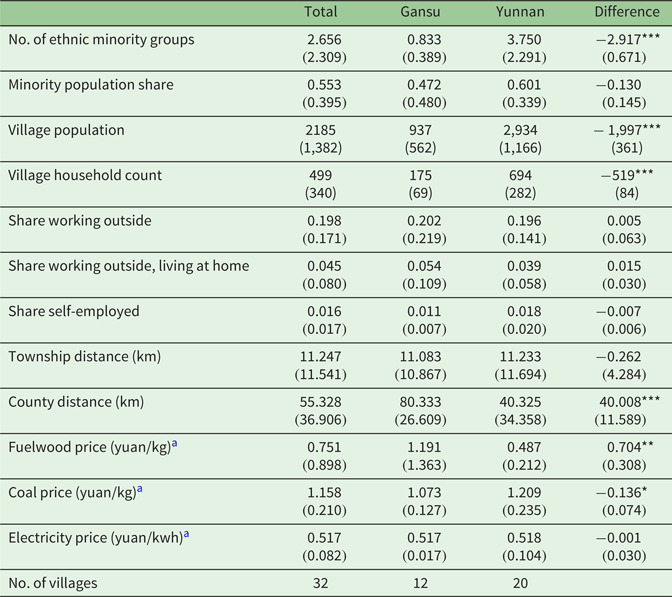
Table 1 presents the village characteristics. On average, the villages have three different minority groups, accounting for 55 per cent of the population. In Yunnan province, 60 per cent of the village population belongs to minority groups; the figure is 47 per cent in Gansu. The villages in Yunnan province are generally larger than those in Gansu province, in terms of both household count (694 versus 175) and population (2,934 versus 937). Overall, about 20 per cent of the village population work and live outside the village, and only 4.5 per cent work outside the village but live at home (so they share residential energy use with the family).Footnote 6 The villages, especially those in Gansu province, are located in remote areas, with long distances to the closest county centers – an average of 80 km. The average price for fuelwood in Gansu (1.2 CNY/kg) is more than double that in Yunnan (0.5 CNY/kg), whereas the former has a lower coal price than the latter. There is no significant difference in electricity prices between the two provinces.
Village characteristics

a The price is average at the village level. Standard deviations are in parentheses in columns 2 to 4, and standard errors are in parentheses. In column 5, asterisks indicate t-test result of differences between the two previous groups.
3.2. Household characteristics and energy usage
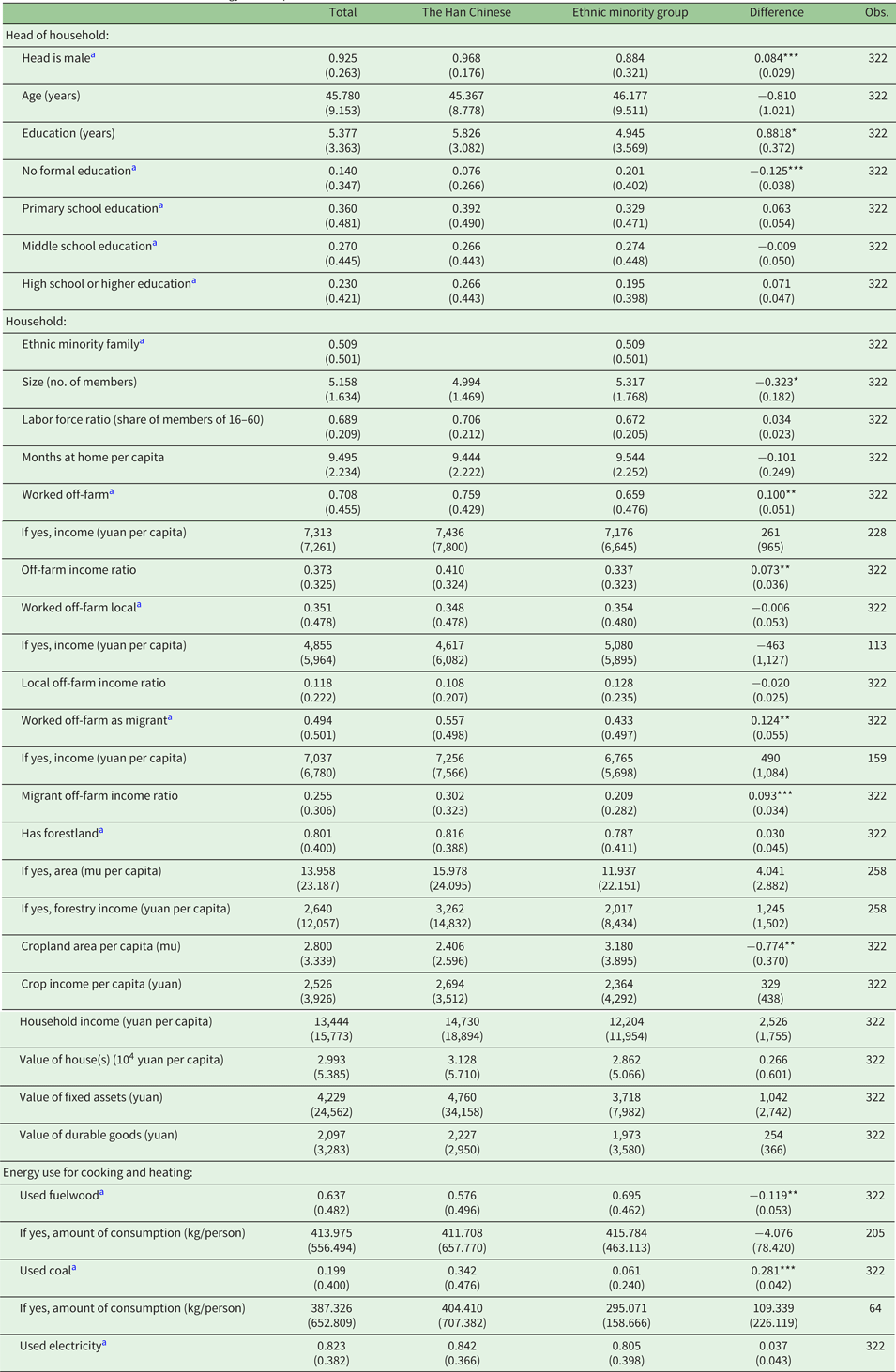
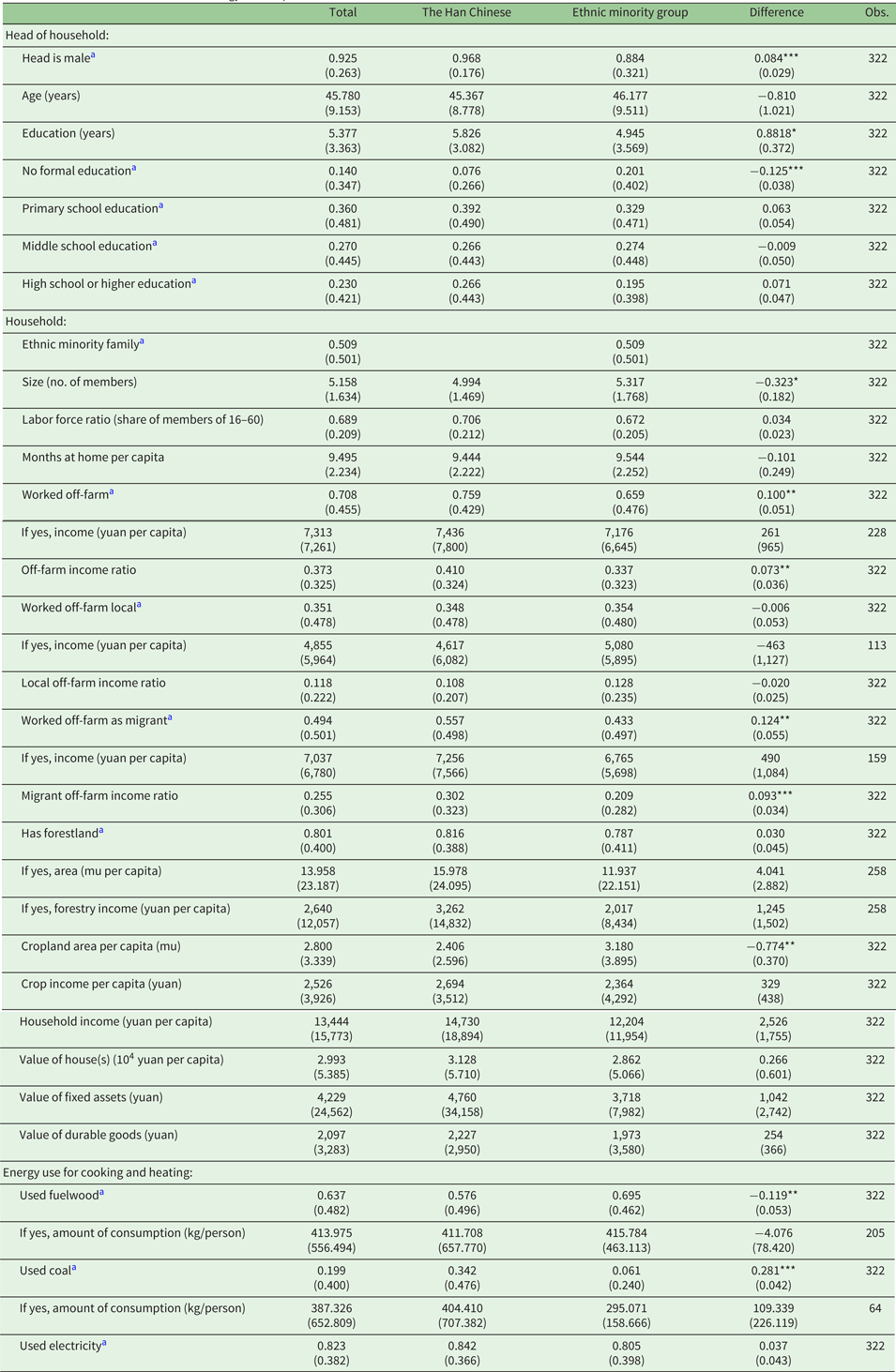
Table 2 summarizes household socioeconomic characteristics and energy use for cooking and heating, and the differences between the ethnic minority and Han Chinese families. Overall, 51 per cent of the surveyed households come from ethnic minority groups. Heads of household are mostly male (93 per cent) and have only completed primary school (5.3 years) on average. There are more illiterate heads among the ethnic minority families than the Han Chinese families (20 per cent versus 7.6 per cent). This suggests that the average education level in western rural China is relatively low, especially in the ethnic minority regions (Hannum, Reference Hannum2002; Ding, Reference Ding2006).
Household characteristics and energy consumption
a Dummy variable with value 1 if yes, and 0 if otherwise.
Notes: Asterisks indicate t-test/proportion-test result of differences between the two groups, with standard deviations in parentheses in columns 2 to 4, and standard errors in parentheses in column 5.
Household size is slightly bigger in the families of ethnic minority groups than in the Han Chinese families. This is expected, as the One Child Policy was imposed only on the Han Chinese population. The Han Chinese families have better economic conditions than the ethnic minority families, in terms of household income and wealth,Footnote 7 although the differences between the two groups are statistically insignificant at the conventional level. The differences still point toward income inequality between the Han Chinese and ethnic minority people (Gustafsson and Li, Reference Gustafsson and Li2003; Li, Reference Li2003; Campos et al., Reference Campos, Ren and Petrick2016).
Interestingly, the proportion of households who have off-farm employment is significantly higher in the Han Chinese families than in the ethnic minority families (76 per cent versus 66 per cent). Also, off-farm income of Han Chinese accounts for a substantially larger share of household income (41 per cent versus 34 per cent in the ethnic minority families). Per-capita income of Han families is 261 CNY higher but statistically insignificant. Furthermore, we disaggregate off-farm income into migrant work income (that comes from employment in counties or cities that are far away) and local work income (that comes from employment in the village or a local township). We find that 35 per cent of families have local off-farm work at local places, and a 13 percentage-point higher share of the Han Chinese families have migrant employment (56 per cent versus 43 per cent of ethnic minority families). Besides, the Han Chinese families have better access to forestland, since more of them have tenure rights to forestland (82 per cent versus 79 per cent in ethnic minority families), and own a larger area of forestland (16 versus 12 mu per capita), although the last difference is statistically insignificant.
The main sources of energy for cooking and heating in the study area are fuelwood, coal and electricity. As shown in the bottom of table 2, fuelwood is still dominant, used by 64 per cent of households. A 12 percentage-point larger share of the ethnic minority families (69.5 per cent versus 57.6 per cent of the Han Chinese families) uses fuelwood. In contrast, the Han Chinese are more likely than ethnic minorities to use alternative sources – coal and electricity – for cooking and heating (34 versus 6 per cent of households use coal and 84 versus 80 per cent use electricity).Footnote 8
4. Estimation model
Descriptive statistics suggest the differences in energy use, forestland access and income between the Han Chinese and ethnic minority families. Together, fuelwood is still the major choice of energy for cooking and heating. We therefore focus on the estimation of household demand for fuelwood, considering that it could be substituted by two other fuels, i.e., coal and electricity. Following the discussion on the determinants of household energy consumption in section 2, we specify the economic model as follows:

where $Q_{ij}^{fw}$ is the total amount of fuelwood consumption by household i in village j and $\;p_j^f$
 , $p_j^c$
 and $p_j^e$
 are prices of fuelwood, coal and electricity, respectively, averaged at village level.$\;{I_{ij}}$
 is total household income; $\;{R_{ij}}$
 is the ratio of off-farm income to total household income, and ${A_{ij}}$
 is area of owned forestland (in mu, that is 1/15 of a hectare). $\;{M_{ij}}$
 is ethnic minority status and ${{\boldsymbol H}_{{\boldsymbol{ij}}}}$
 is a vector of household and village characteristics, as presented in tables 1 and 2.
One empirical issue concerns our data on fuelwood market price. Among the 205 fuelwood-consuming households, only 28 (around 10 per cent) reported expenditures for purchasing fuelwood. Meanwhile, none of the households reported having sold fuelwood in the market. This is consistent with the literature on fuelwood (e.g., Hyde and Köhlin, Reference Hyde and Köhlin2000), where households often reported fuelwood purchases but generally did not report sales. Few households reported having purchased fuelwood from the local market or being aware of the market price. In other words, the majority of households have free (in monetary terms) access to fuelwood resources even though they might be indirectly influenced by the shadow price or opportunity cost of acquiring fuelwood (Amacher et al., Reference Amacher, Hyde and Kanel1996; Heltberg et al., Reference Heltberg, Arndt and Sekhar2000; Chen et al., Reference Chen, Heerink and van den Berg2006; Demurger and Fournier, Reference Demurger and Fournier2011). Considering possible influence of (shadow) prices on fuelwood consumption, we include the village-average fuelwood prices in the model.
Another empirical issue stems from the following. Fuelwood is mostly collected by the households themselves as markets for solid fuels for domestic use are absent or thin in rural China, like in many other developing countries. Data limitations prevent further attempts to simultaneously estimate a structural model that includes both fuelwood supply and demand. Therefore, following Heltberg et al. (Reference Heltberg, Arndt and Sekhar2000), Chen et al. (Reference Chen, Heerink and van den Berg2006), Palmer and Macgregor (Reference Palmer and Macgregor2009), Demurger and Fournier (Reference Demurger and Fournier2011) and Zhang and Kotani (Reference Zhang and Kotani2012), we use a reduced-form equation to estimate the energy demand in a non-separable household model. A non-separable household model is appropriate for our analysis because it is common in the study area that production and consumption decisions are jointly made by families. The empirical specification assumes that energy demand and other endogenous variables are determined by all exogenous factors, irrespective of the relationship to consumption or production decisions. With the focus on off-farm income, ethnic minority status and ownership of forestland, the reduced form of the fuelwood demand equation is specified as:

where the amount of fuelwood consumption and the prices of fuelwood, coal and electricity are in natural logarithm terms, thus the estimated coefficients are interpreted as price elasticities. ${{\boldsymbol I}_{{\boldsymbol ij}}}$ includes (natural log of) household income and its squared term ${\rm ( }{\boldsymbol I}_{{\boldsymbol ij}}^2)$
 , ${R_{ij}}$
 is the income share of off-farm employment, ${A_{ij}}$
 is (log) area of owned forestland, and ${M_{ij}}$
 is a 0/1 indicator of ethnic minority status. $\boldsymbol{\alpha}^{\prime }, \;{\boldsymbol{\varepsilon} _{ij}}^{\prime }$
 are constant and error terms, respectively.
Because 64 per cent (205 out of 322) of the households consumed fuelwood, using simple ordinary least squares (OLS) to estimate equation (2) could be biased due to sample selection: that is, if ${\boldsymbol{\varepsilon} _{ij}}^{\prime } = {{\boldsymbol\Gamma }_{{\boldsymbol{ij}}}}{{\boldsymbol \delta }_{{\boldsymbol{ij}}}} + {\epsilon _{ij}}^{\prime }$ , where ${{\boldsymbol\Gamma }_{{\boldsymbol ij}}} = ( {{{\boldsymbol p}_{\boldsymbol j}}, \;{I_{ij}}, \;\;{R_{ij}}, \;{A_{ij}}, \;{\boldsymbol \;}{M_{ij}}, \;{\boldsymbol \;}{{\boldsymbol H}_{{\boldsymbol{ij}}}}} )$
 , implying that some household characteristics may determine whether a household selects fuelwood as its energy source for cooking and heating. To tackle this, we use the Heckit method developed by Heckman (Reference Heckman1979) to correct for the potential bias. Similar to Couture et al. (Reference Couture, Garcia and Reynaud2012) and Palmer and Macgregor (Reference Palmer and Macgregor2009), firstly a first-stage probit model is regressed on the likelihood of positive fuelwood consumption (i.e., the dependent variable is binary, taking value 1 if a household chooses to use fuelwood), and secondly, the inverse Mills ratio is calculated based on the first-stage result and added into the estimation of equation (2) as an additional control variable (i.e., the second stage). An important advantage of this method is that the estimate of the inverse Mills ratio measures the covariance between the two residuals ${\boldsymbol{\varepsilon} _{ij}}^{\prime }$
 and ${\epsilon _{ij}}^{\prime }$
 , under the null hypothesis that there is no selectivity bias if a conventional t-test on the point estimate cannot reject the null. The Heckit method is presented in equations as follows:


where $Pr( {fw} )$ in equation (3) is the binary variable representing the selection of fuelwood; ${G_{ij}}$
 is the 0/1 indicator of male household head; and ${\rm IMR}$
 in equation (4) is the inverse Mills ratio. Prior studies have shown that female heads are less likely to choose fuelwood (Jiang and O'Neill, Reference Jiang and O'Neill2004; Farsi et al., Reference Farsi, Filippini and Pachauri2007; Zhang and Hassen, Reference Zhang and Hassen2017), although they do not necessarily use a smaller quantity. It is of note that, in Heckit models, to avoid the second-stage suffering from a collinearity problem, we follow Palmer and Macgregor (Reference Palmer and Macgregor2009) and exclude the gender variable of household head from the second-stage estimation. Equation (4) in turn estimates the fuelwood consumption (or demand) conditional on fuelwood use.
To investigate the differences of the impact of off-farm income and forestland ownership, respectively, on the quantity of fuelwood consumption between the Han Chinese and ethnic minority families, we add the interaction terms of each of the two variables with the ethnic minority status in the estimation (see details on the specifications and interpretation in online appendix A). Standard errors are clustered at the village level to correct estimation bias when covariates are correlated within villages (Cameron and Miller, Reference Cameron and Miller2015).
Prices of the alternative sources of energy, $p_j^c$ and $p_j^e$
 , are included in both stages of estimation in order to account for the substitution effect of alternative energy sources, in line with Couture et al. (Reference Couture, Garcia and Reynaud2012) and Zhang and Kotani (Reference Zhang and Kotani2012). We also include in ${{\boldsymbol H}_{{\boldsymbol ij}}}^{\boldsymbol \prime}$
 the distance from the village to the closest county in both models to control for geographical conditions that may be related to energy use. Also, ${{\boldsymbol I}_{{\boldsymbol ij}}}$
 , ${R_{ij}}$
 , ${A_{ij}}$
 and ${M_{ij}}$
 are included in both models.
As discussed in section 2, the impact of household income ${\rm ( }{{\boldsymbol I}_{{\boldsymbol ij}}})$ on energy choice and use is inconclusive. A higher off-farm income share $( {R_{ij}})$
 implies more household labor work for off-farm jobs. This could reduce the amount of fuelwood through two possible channels. One is the increased opportunity cost of fuelwood collection. The other is the possibility that some household members live and work outside the village for a long period every year, which could reduce the amount of fuelwood that is needed for residential use (Shi et al., Reference Shi, Heerink and Qu2009; Zou and Luo, Reference Zou and Luo2019). Conversely, the income effect – due to more off-farm income – may lead to an increase in energy demand (Shi et al., Reference Shi, Heerink and Qu2009). Also, ownership of more forestland $( {A_{ij}})$
 increases fuelwood consumption, plausibly from secure forest resources or from increased income from forestry activities (Yang et al., Reference Yang, Xu, Xu, Yi and Hyde2017; Song et al., Reference Song, Bilsborrow, Jagger, Zhang, Chen and Huang2018). With ${M_{ij}}$
 we also differentiate the patterns between the Han Chinese and the ethnic minority groups.
Additional control variables ${\rm ( }{{\boldsymbol H}_{{\boldsymbol ij}}}^{\bf \prime })$ include household (i.e., labor force, owned areas of agricultural land) and household head's characteristics (i.e., age and education). Households need labor to collect fuelwood (Heltberg et al., Reference Heltberg, Arndt and Sekhar2000; Chen et al., Reference Chen, Heerink and van den Berg2006), and they can also have labor participating in off-farm employment which reduces fuelwood collection and use (Zhang and Kotani, Reference Zhang and Kotani2012). A larger area of own agricultural land can bring higher income from crop production, which could induce an income effect in household energy consumption. Additionally, agricultural land keeps household members in farming activities, as a result, more people at home suggests a higher energy demand for cooking and heating (Chen et al., Reference Chen, Heerink and van den Berg2006). Household size determines energy demand in that a bigger household with more people demand more energy for daily living, although at a decreasing rate if there exist economies of scale (Jiang and O'Neill, Reference Jiang and O'Neill2004; Song et al., Reference Song, Bilsborrow, Jagger, Zhang, Chen and Huang2018). It has been documented that households headed by older people prefer to consume more fuelwood, and that households with better educated heads are less likely to use traditional fuels (Chen et al., Reference Chen, Yang, Liu and Zhang2016; Zhang and Hassen, Reference Zhang and Hassen2017).
5. Regression results
5.1. Baseline results
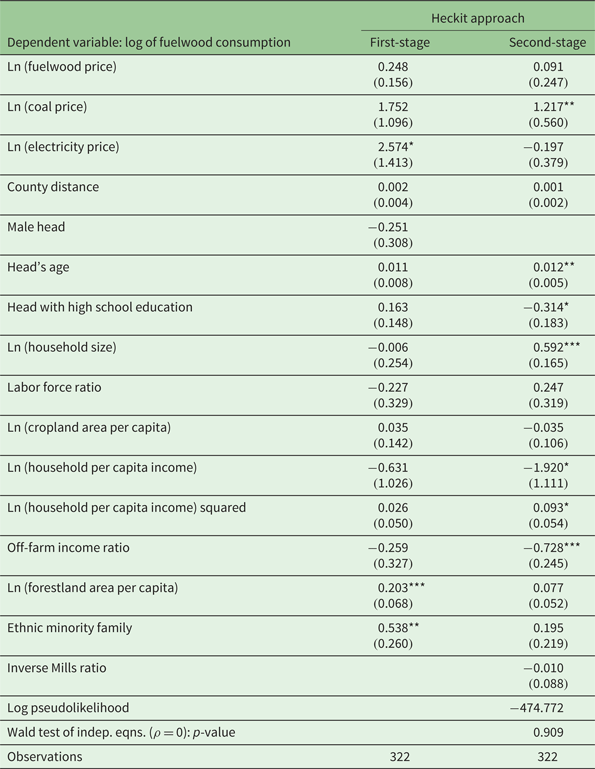
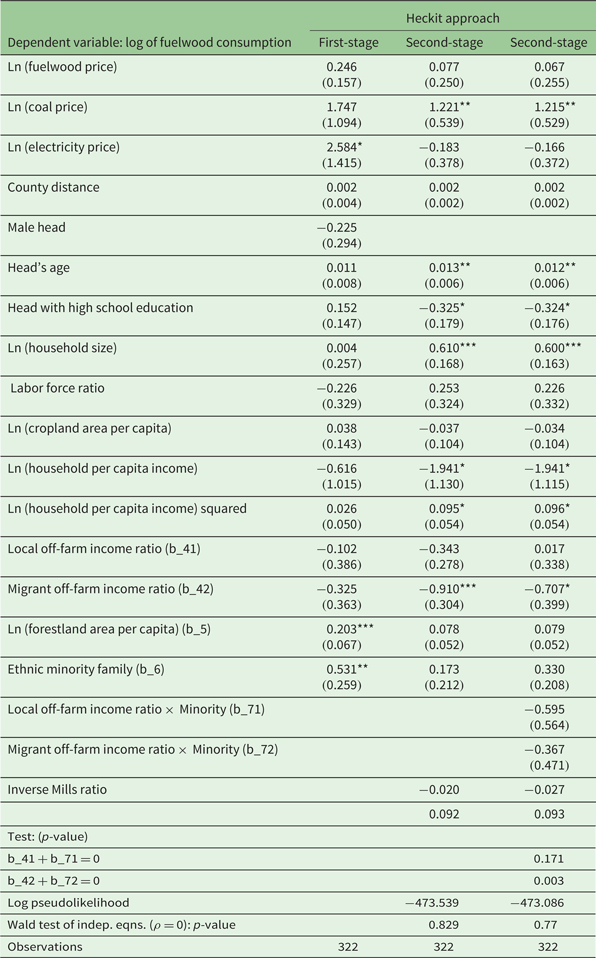
Table 3 presents the regression results on equations (3) and (4). The first-stage results of the selection model are in column 1 and the second-stage on the amount of fuelwood consumption in column 2. We find that an ethnic minority family, or a family who owns a larger area of forestland, ceteris paribus, is more likely to choose fuelwood. The estimated coefficients of the prices of substitute fuels – coal and electricity – are statistically insignificant, though having positive signs. We do not find an average lower likelihood of choosing fuelwood in female-headed households, which is contrary to the findings noted above. The insignificant coefficient of the inverse Mills ratio in the second stage suggests that we cannot reject the null that an OLS estimation on the sample of fuelwood-consuming households is consistent.
The determinants of fuelwood consumption

Notes: Constant is not reported, and standard errors in parentheses are clustered at the village level. Significance is denoted by *** for p < 0.01, ** for p < 0.05, and * for p < 0.1.
The second-stage results (column 2) suggest that the substitution effect between coal and fuelwood is statistically significant at the 5 per cent level. The cross-price elasticity of demand is slightly greater than 1; that is, a 1 per cent increase in coal price will lead to a 1.2 per cent increase in the amount of fuelwood consumption. This finding provides significant evidence that coal is an important substitute energy for fuelwood, which is also found by Chen et al. (Reference Chen, Yang, Liu and Zhang2016) but not by Zhang and Kotani (Reference Zhang and Kotani2012) or Yang et al. (Reference Yang, Xu, Xu, Yi and Hyde2017).
For electricity, the price coefficient is statistically insignificant, implying limited substitution between electricity and fuelwood in the study area. Consumption of electricity, indeed, increases with economic growth, household income and living standard, particularly in developing countries (Shiu and Lam, Reference Shiu and Lam2004; Chen et al., Reference Chen, Kuo and Chen2007; Joyeux and Ripple, Reference Joyeux and Ripple2007). But given that the study area is poor, it is not surprising that electricity is not yet a popular or affordable source of energy for cooking and heating. In addition, we do not find an own-price effect on fuelwood consumption, and this is consistent with earlier studies that also found fuelwood to be generally own-price inelastic (Hyde and Köhlin, Reference Hyde and Köhlin2000; Cooke et al., Reference Cooke, Hyde and Köhlin2008).
Most importantly, we find that a 10 percentage-point increase in the off-farm income share of total household income reduces the amount of fuelwood use by 7.3 percentage points. This finding is statistically significant at the 1 per cent level, which strongly supports the hypothesis that more income from off-farm employment reduces in-house energy needs because a larger amount of time is spent outside home (Shi et al., Reference Shi, Heerink and Qu2009; Zou and Luo, Reference Zou and Luo2019). However, the evidence of the income effect on fuel consumption is weak, given the negative coefficient of household income (which is significant at the 10 per cent level). This is consistent with Cooke et al. (Reference Cooke, Hyde and Köhlin2008) and Hyde and Köhlin (Reference Hyde and Köhlin2000) and contradicts Zhang and Kotani (Reference Zhang and Kotani2012) and Yang et al. (Reference Yang, Xu, Xu, Yi and Hyde2017).
Although households who own a larger area of forestland are more likely to use fuelwood, the amount of use does not significantly increase with the area. This finding differs from the finding by Song et al. (Reference Song, Bilsborrow, Jagger, Zhang, Chen and Huang2018), that households with more forestland area use more fuelwood. Among other household characteristics, we find that the quantity of fuelwood consumption significantly increases with the age of household heads.Footnote 9 Households with heads who attained education higher than middle school consume less fuelwood than do those with less-educated heads. This finding shows the importance of education in reducing the consumption of biomass (Chen et al., Reference Chen, Heerink and van den Berg2006; Demurger and Fournier, Reference Demurger and Fournier2011; Zou and Luo, Reference Zou and Luo2019). Consistent with Demurger and Fournier (Reference Demurger and Fournier2011), we also find that the quantity of fuelwood consumption significantly increases with household size.Footnote 10
5.2. Off-farm employment, ethnic status and fuelwood consumption
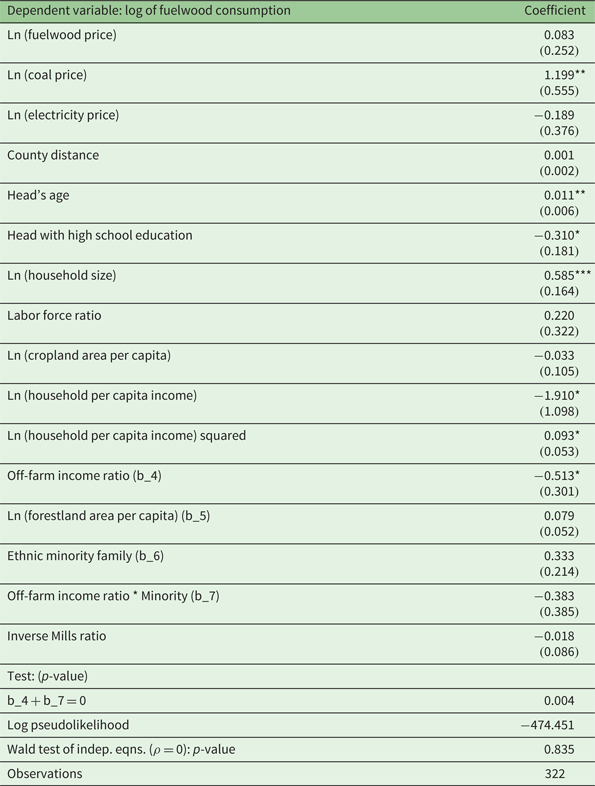
Next we investigate the association between off-farm income and quantity of fuelwood consumption between the ethnic minority and Han Chinese families. We re-run the regressions using the Heckit method and adding the interaction term between the ethnic minority status and the off-farm income share in equation (4) (i.e., the full model is presented as equation (A1) in online appendix A). The first-stage result is the same as that of table 3. We present the second-stage results in table 4.
Fuelwood consumption and off-farm income

Notes: This table presents the second-stage result of the Heckit model; the first-stage result is the same as that of column 1 the village level. Significance is denoted by *** for p < 0.01, ** for p < 0.05, and * for p < 0.1.
There are two main findings here. First, the point estimate of off-farm income share is negative and significant at the 10 per cent level, implying a weak relationship between the quantity of fuelwood consumption and off-farm employment for the Han Chinese families. Second, the coefficient of the interaction term between the off-farm income share and minority status is negative. A joint t-test between the coefficient of the off-farm income share and that of the interaction term is highly significant at the 1 per cent level. Together, the results suggest a stronger association between the quantity of fuelwood consumption and off-farm employment for the ethnic minority families than for the Han Chinese families. A 10 percentage-point increase in off-farm income share is estimated to decrease the quantity of fuelwood consumption by 8.9 percentage points for ethnic minority families, and the magnitude of the effect is significantly larger than that for the Han Chinese families (i.e., 5.1 percentage points).
In table 5, we further disaggregate off-farm employment into local and migrant off-farm work and examine their associations with quantity of fuelwood consumption. That is, we replace ${R_{ij}}$ with $R_{ij}^{{\rm local}}$
 and $R_{ij}^{{\rm migrant}}$
 , respectively, and add the interaction terms between each of the two variables and the minority status (see the full model specified as equation (A2) in online appendix A). Columns 1 and 2 report the first- and second-stage results, respectively, and column 3 shows the second-stage results with the addition of interaction terms.
Fuelwood consumption and local or migrant off-farm income

Notes: Constant is not reported, and standard errors in parentheses are clustered at the village level. Significance is denoted by *** for p < 0.01, ** for p < 0.05, and * for p < 0.1.
Interestingly, a higher share of income from migrant off-farm work is significantly associated with a lower amount of consumed fuelwood. There is no evidence of any income effect of local off-farm employment on quantity of fuelwood consumption as found by Shi et al. (Reference Shi, Heerink and Qu2009). The two findings are in accord with the ‘lost-labor’ effect of migration on fuelwood consumption because of reduced in-house energy needs.
Moreover, the significantly less fuelwood use due to migrant off-farm work is found for both majority and minority families (column 3). However, the joint t-test between coefficient of the migrant off-farm income share and that of the interaction term (i.e., between ${\boldsymbol{\beta} _{42}}$ and ${\boldsymbol{\beta} _{72}}$
 , as in equation (A2) in online appendix A) indicates that the reduction effect of off-farm work on fuelwood use is greater – in both the level of statistical significance and the magnitude of the effect – for the ethnic minority families. As summarized in online appendix table A2, the Han Chinese families have a significantly larger share (by 5 percentage points) of members devoted to migrant off-farm employment than the ethnic minority families. But the ethnic minority families who have migrant worker(s) appear to work for more hours per migrant-working person, though statistically insignificant, than the Han Chinese families. Altogether, this stronger reduction effect of migrant off-farm work on fuelwood consumption for the ethnic minority families could be driven by the longer time working away from home.
5.3. Forestland resource, ethnic status and fuelwood consumption
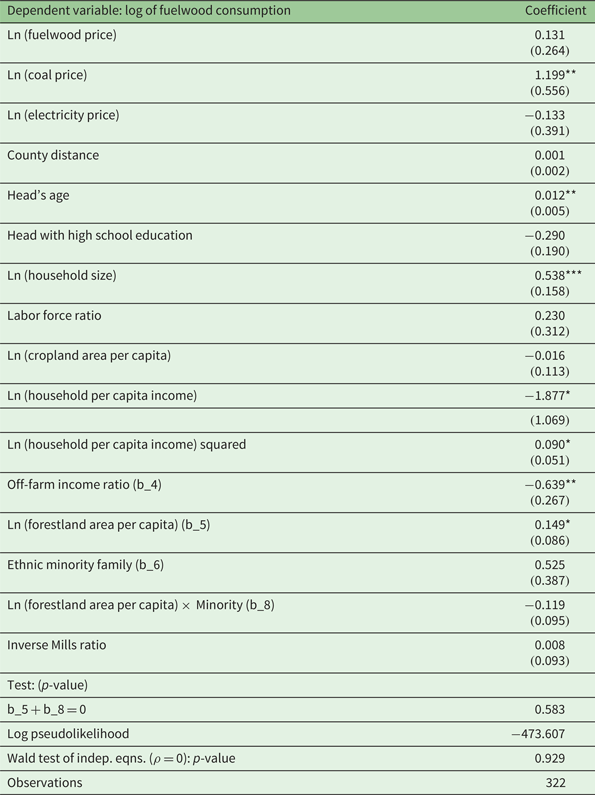
To differentiate the effect of forestland ownership on quantity of fuelwood consumption between the ethnic minority and the Han Chinese families, we re-run the regressions adding the interaction term between ethnic status and forestland area (in logs) (see the full model specification as equation (A3) in online appendix A). The first-stage result is the same as in column 1 of table 3, for the same reason. Table 6 presents the second-stage result.
Fuelwood consumption and forestland ownership

Notes: This table presents the second-stage result of the Heckit model; the first-stage result is the same as that of column 1 in table 3 and not reported here. Constant is not reported, and standard errors in parentheses are clustered at the village level. Significance is denoted by *** for p < 0.01, ** for p < 0.05, and * for p < 0.1.
With weak statistical significance (at the 10 per cent level), we find that owning a larger area of forestland is associated with an increase in quantity of fuelwood consumption, only for the Han Chinese families. The estimated elasticity is small, suggesting that a 10 percentage-point increase in forestland area increases quantity of fuelwood consumption by 1.49 percentage points. The joint t-test between the coefficient of forestland area and that of the interaction term implies that the effect is insignificant for the ethnic minority families.
A plausible explanation for the weak relationship found above may be that forestland ownership and household income are correlated, as forestland ownership can be a source of income. Thus a larger area of forestland owned by a household could affect its energy consumption via an income effect. Therefore, taking into account both the resource and the income effect of forestland, we re-run the Heckit model with the specification using total value of house(s) as a proxy for household wealth and dropping the household income variable, and report the results in table A3 of the online appendix.
Compared to the baseline result (of table 3), the association between forestland area and amount of fuelwood consumption is significant at the 10 per cent level (column 2 of table A3, online appendix). In column 3 with the interaction term between ethnic minority status and log of forestland area, the coefficient of forestland area (0.135, significant at the 5 per cent level) supports a positive impact of household-owned forestland area on amount of fuelwood consumption, but is only statistically significant for the Han Chinese.Footnote 11 Besides, we find that the amount of fuelwood consumption is significantly increasing with total value of house(s), suggesting a significant wealth effect on fuelwood consumption. This finding contradicts Demurger and Fournier (Reference Demurger and Fournier2011), who find that fuelwood consumption decreases with household wealth; this may be explained by the fact that demand for fuelwood is still high in poor areas.
5.4. The determinants of substitute energy consumption – coal and electricity
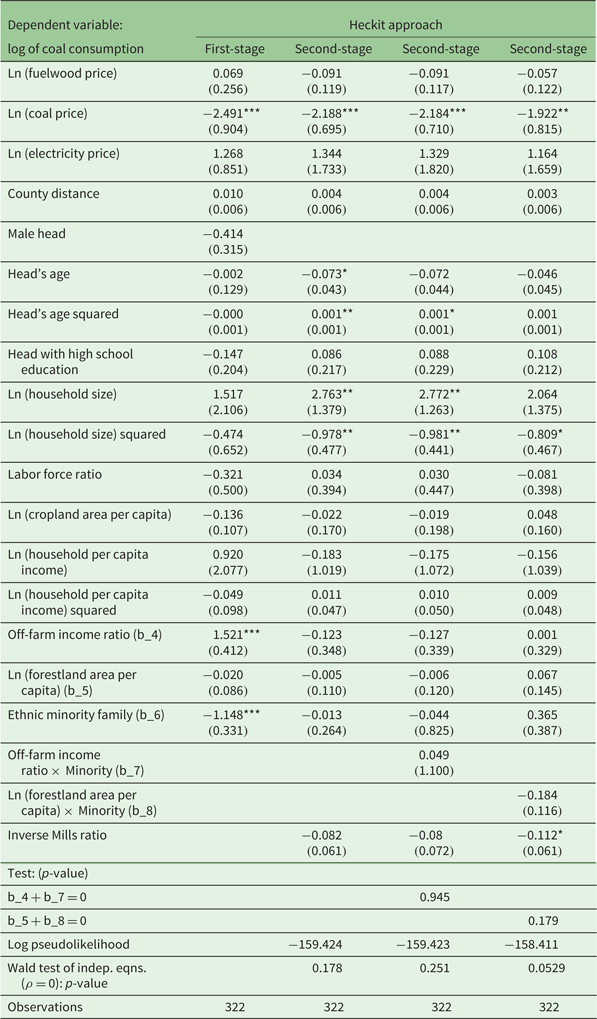
In this section, to further explore how a household substitutes in energy consumption between, e.g., coal and electricity, we replicate the Heckit method with the dependent variable replaced by the coal consumption. Table 7 presents the estimation results.Footnote 12
The determinants of coal consumption

Notes: Constant is not reported, and standard errors in parentheses are clustered at the village level. Significance is denoted by *** for p < 0.01, ** for p < 0.05, and * for p < 0.1.
We find that off-farm income significantly increases the likelihood of households' decisions to use coal and that an ethnic minority family is less likely to use coal. Yet, the amount of coal consumption is not significantly affected by the two factors. The insignificant coefficient of household income indicates that there is no significant income effect on coal consumption. This is different from the studies that find positive income effect on coal consumption in rural China (Demurger and Fournier, Reference Demurger and Fournier2011; Zhang and Kotani, Reference Zhang and Kotani2012). We also find no association between forestland ownership and coal consumption in this context.
Importantly, a significant own-price effect is found on the likelihood of coal use and the amount of use, and the finding is consistent with Chen et al. (Reference Chen, Yang, Liu and Zhang2016) and Zhang and Kotani (Reference Zhang and Kotani2012). The coefficients in columns 2–4 suggest that a 1 percentage-point increase in coal price will lead to a 2 percentage-point decrease in the amount of coal consumption.
Also, we find that the amount of coal consumption decreases with the age of the household head: households with older heads prefer to use fuelwood, one of the traditional sources of biomass energy. We do not find that education plays a significant role in coal consumption, which is consistent with Chen et al. (Reference Chen, Yang, Liu and Zhang2016) but contradicts Han et al. (Reference Han, Wu and Zang2018) and Zhang and Kotani (Reference Zhang and Kotani2012). Finally, the positive coefficient of household size and the negative coefficient of its squared term suggest a significant effect of economies of scale on coal consumption.
Next we use a Probit model to examine the factors determining the likelihood of electricity use. The regression results are presented in online appendix table A5. We do not find any of the determinants to have statistical power in explaining the likelihood of using electricity. This finding is not unexpected because the government's nationwide rural electrification reforms have widely improved access to electricity, as we can see from the fact that over 80 per cent of the households used electricity for cooking and heating in the survey year. Therefore, household characteristics may not dominate in determining the likelihood of electricity use but rather the amount of use. Unfortunately, due to the lack of data, our knowledge about factors that determine the amount of electricity use for daily cooking and heating remains limited.
5.5. Heterogeneity of fuelwood consumption across ethnic groups
Finally, we explore the heterogeneity of fuelwood consumption across the ethnic groups. In the study area, the main ethnic minority groups are Tibetan (22 per cent of the sample households), Yi (14 per cent) and Zhuang (9.3 per cent). Other groups, such as Hani, Lili, Pumi and Miao, account for less than 6 per cent (see table A6, online appendix). We add a set of dummy variables representing each of the minority groups in the model, to be compared with the excluded category – the Han Chinese people. The regression results are presented in the online appendix, table A7.
The results are robust to the earlier findings that fuelwood consumption significantly decreases with off-farm income and increases with forestland area. Speaking of a specific ethnic minority group, Tibetan families have a greater likelihood to use fuelwood, and they also consume more, compared to the Han Chinese families. Interpreting the interaction terms between membership in an ethnic minority group and off-farm income based on the corresponding joint t-tests, we find that a negative association between off-farm income and amount of fuelwood consumption is significant for Tibetan and Yi families, but not for the other groups. Having a larger area of forestland not only increases the amount of fuelwood consumption for the Han Chinese, but also for the Yi families, whereas surprisingly there is an opposite (negative) relationship for the Zhuang families. One plausible reason may be that the substitute effect of income from forestland could play a dominant role in determining fuelwood consumption for the Zhuang families.
6. Conclusion
Understanding fuel choice and consumption among low-income rural families is critical to devising appropriate energy policies targeting poverty reduction and environmental improvement in developing countries. Analyzing an original survey dataset from western rural China with a diverse ethnic minority population, this paper examines the determinants of rural households' demand for fuelwood and its substitute for residential energy services. In particular, we investigate the difference in fuelwood consumption between the Han Chinese and ethnic minority families, and how off-farm employment and forestland ownership are associated with fuelwood consumption for the two groups.
We find that fuelwood is the major energy source for our sample households, and that the ethnic minority families are more likely than the Han Chinese families to consume fuelwood. Coal is an important substitute, but electricity is not. This implies that the energy transition from fuelwood use towards modern energy is still at the early stage in the study area. Different from the ‘energy ladder’ hypothesis, we do not find a significant income effect on fuelwood consumption. While low income households in general still rely on traditional biomass such as fuelwood for their basic residential needs, ethnic minority groups are lagging farther behind. Another important finding is that a larger share of a household's total income coming from off-farm income leads to a lower amount of fuelwood consumption, and the magnitude of the effect is larger for the ethnic minority families. Finally, we find that households that own a larger area of forestland have a higher likelihood of using fuelwood for cooking and heating. Yet, the association between forestland area and quantity of fuelwood consumption is weak and found only for the Han Chinese families.
The findings have important policy implications for forestry management. Biomass will remain as the most important energy to meet the daily needs of households in the rural areas of China for a long time. Rural households, especially the socioeconomically disadvantaged people that belong to ethnic minority groups, are invariably dependent on fuelwood, posing a daunting challenge to sustainable forest and land use. Integrated forest planning, supported by secure tenure rights, can encourage diversification and optimization in forests for fuelwood as well as timber and other forest products. This would allow for efficient and sustainable production of biomass while meeting residential energy needs.
Our findings also imply that policies that aim to increase farmers' income from off-farm employment, especially for ethnic minority groups, can be an effective way to reduce the rural poor's reliance on fuelwood. With higher income, the switch to less labor-intensive and cleaner fuels is more likely (Yao et al., Reference Yao, Chen and Li2012; Tang and Liao, Reference Tang and Liao2014). It is thus important to integrate poverty reduction and energy efficiency into energy policies, by providing ethnic minority people better access to labor markets and to cleaner and efficient energy sources.
A caution stands in that energy transition with income increase may lead to soaring demand for commercial fuels, with implications for energy security and rapid growth of carbon dioxide emissions in rural China (Yao et al., Reference Yao, Chen and Li2012). How to optimize energy structure and improve energy efficiency is crucial for the sustainability of rural energy uses. We also recognize a caveat in this paper: the cross-sectional data limits the potential to study the dynamics of household energy consumption over a longer period. With more data, further investigation of the determinants of changes in household energy use can help inform public policy with better knowledge about the poor and their needs.
Supplementary material
The supplementary material for this article can be found at https://doi.org/10.1017/S1355770X20000200.
Acknowledgements
Financial support from the Rights and Resources Initiative (RRI) and SIDA to the Environmental Economics Unit at the University of Gothenburg is gratefully acknowledged. We also thank the State Forestry Administration, P.R. China (SFA) for the logistic support during the field survey. Jun Li acknowledges the funding support of Guangdong Basic and Applied Basic Research Foundation (2019A1515011624). We are most grateful to the journal's associate editor and the anonymous reviewers for the comments and suggestions that helped immensely to improve the quality of the paper.