Antibiotic use is prevalent in long-term care facilities (LTCFs); however, 75% of this use may be unnecessary or inappropriate.Reference Morrill, Caffrey and Jump 1 , Reference Nicolle, Bentley and Garibaldi 2 Adverse outcomes of inappropriate antibiotic prescribing include increasing antibiotic selective pressure and associated antibiotic resistance, medication side effects and drug interactions, and opportunistic infections including Clostridium difficile.Reference Brown, Jones and Daneman 3 – Reference van Buul, van der Steen and Veenhuizen 8 These adverse outcomes may be exacerbated among LTCF residents given the high prevalence of polypharmacy, multimorbidity, and cognitive impairment in this healthcare population. To reduce inappropriate antibiotic use and associated adverse events, the Centers for Medicare and Medicaid Services (CMS) recently required that LTCFs develop and implement an antimicrobial stewardship program as a condition for reimbursement. 9
More than one-third of LTCF admissions are initially admitted from an acute-care hospital, and LTCF residents frequently transition back to hospitals for acute-care needs.Reference Burke, Whitfield and Hittle 10 – Reference Ouslander, Lamb and Perloe 12 Furthermore, patients requiring subacute care have increased dramatically, due in part to bundled payments that incentivize hospitals to discharge patients earlier.Reference Lapane, Dube and Pakyz 13 As such, many medications in LTCFs are initiated in acute-care facilities. However, available data describing antibiotic prescribing upon discharge from the hospital to LTCFs are limited. Although several previous studies have described antibiotic prescribing practices among hospitals and nursing homes separately, optimal prescribing procedures for patients transitioning from hospitals to nursing homes remain unclear.Reference Carter, Montpetite and Jump 14 – Reference Vasilevskis, Ouslander and Mixon 19
In this study, we quantified the prevalence and characteristics of patients prescribed antibiotics upon discharge from an acute-care hospital to LTCFs. We also quantified the association between receiving an antibiotic prescription upon discharge to an LTCF and healthcare utilization including 30-day hospital readmission, 30-day emergency department (ED) visits, and C. difficile-associated hospital readmission or ED visit within 60 days of discharge. These outcomes result in considerable burden on LTCF residents, their family members, and facility staff. Furthermore, if receiving antibiotics upon discharge to LTCFs is associated with an increased frequency of hospital readmission, this may provide a financial incentive for both hospitals and LTCFs to improve antibiotic prescribing in this patient population.
Methods
Study design and patient population
Prior to study commencement, the Oregon Health & Science University (OHSU) Institutional Review Board approved this study. This was a retrospective cohort study of adult (≥18-year-old) inpatients discharged from OHSU Hospital to an LTCF between February 1, 2012, and June 30, 2016. During the study period, OHSU Hospital was a 576-bed academic, quaternary-care facility in Portland, Oregon. Furthermore, during the study period, there was no formal policy for review and management of antibiotic prescribed upon discharge. Observation patients and those discharged from the ED were excluded.
Data collection and variable definitions
Study data were collected from the Pharmacy Data Repository (PHARR), a longitudinal repository of patient healthcare data created in partnership with the Oregon Clinical and Translational Institute (OCTRI) research data warehouse. These data have been previously used in epidemiologic studies of medication prescribing upon discharge.Reference Furuno, Noble and Horne 20 – Reference Servid, Noble and Fromme 22
Our primary outcome of interest was receiving an outpatient prescription for an antibiotic upon discharge from acute care to an LTCF. In addition, we identified the potential infectious indication for each antibiotic prescription. Given our large sample size and that all infection types are not routinely cultured, we initially used diagnosis codes (ie, International Classification of Diseases, Ninth or Tenth Revision [ICD-9 or ICD-10]) for bacterial infections during the index encounter. Among patients who lacked a diagnosis code for a bacterial infection, we assessed whether patients had a positive clinical culture for a bacterial organism or a positive C. difficile toxin assay or polymerase chain reaction (PCR) test. For patients lacking both a diagnosis code and a positive bacterial culture or C. difficile toxin assay or PCR test, we reviewed a 20% random sample of discharge summaries to discern the possible indication for the antibiotic prescription. Other exposures of interest included patient demographics (eg, age and sex), inpatient encounter diagnosis-related groups, individual (based on ICD-9 or -10 diagnosis code) and aggregate comorbidity burden (defined using the Charlson comorbidity index), and length of stay during the index hospital admission.
We also quantified the association between receiving an antibiotic prescription upon discharge to an LTCF and healthcare utilization. Outcomes of interest for this analysis included having an ED visit or being readmitted to OHSU Hospital within 30 days of discharge. Additionally, we determined the prevalence of a new diagnosis code or positive C. difficile toxin or PCR assay on an ED visit or readmission to OHSU Hospital within 60 days of discharge.
Statistical analysis
We used descriptive statistics including means, standard deviations, frequencies, and percentages to describe the study population and distributions of antibiotic classes prescribed and potential infectious indications. We used logistic regression to examine the unadjusted and adjusted associations between receiving a prescription for antibiotics upon discharge and 30-day hospital readmission, 30-day ED visits at the index facility, and C. difficile infection during a readmission or ED visit at the index within 60 days of discharge. We used best subsets selection with Akaike information criterion (AIC) optimization with forced inclusion of our exposure of interest (ie, receiving a prescription for antibiotics upon discharge) to determine candidate models. We then evaluated the confounding effect of all unselected variables and included them in the final model if their inclusion in the final model changed the measure of association between our exposure of interest and outcome by at least 10%. Results from the logistic regression models are presented as odds ratios (ORs) and 95% confidence intervals (CIs). All analyses were performed using SAS statistical software, version 9.2 (SAS Institute, Cary, NC).
Results
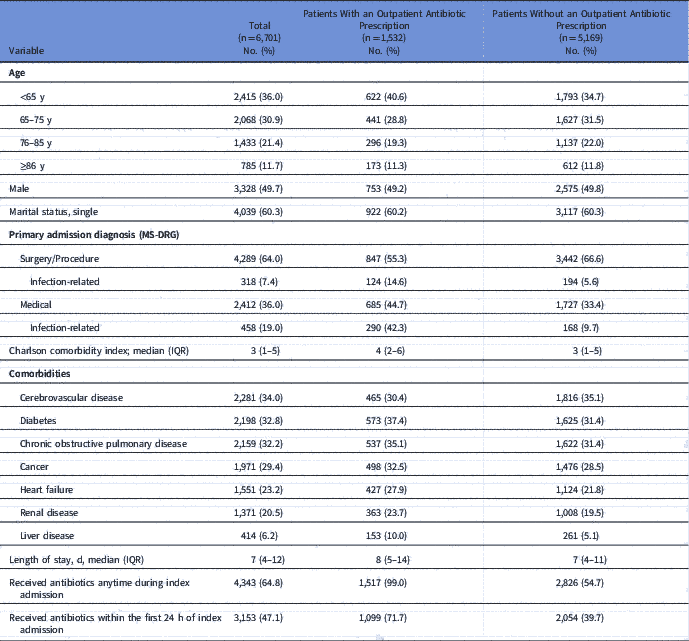
There were 6,701 adult discharges to an LTCF from OHSU Hospital during the study period. Patient characteristics are displayed in Table 1. Approximately 36.0% of the patients discharged were <65 years of age; 11.7% were 86 years or older; and 49.7% were male. The median inpatient length of stay on the index hospital admission was 7 days (interquartile range [IQR], 4–12 days). The primary admission diagnosis (MS-DRG) was most frequently surgery- or procedure-related at 64.0%, and the median Charlson comorbidity index was 3 (IQR, 1–5).
Characterisitcs of Patients Discharged to a Long-Term Care Facilities (n=6,701)

Note. SD, standard deviation; MS-DRG; Medicare severity diagnosis-related group; IQR, interquartile range.
Of the 6,701 patients discharged to an LTCF, 1,532 patients (22.9%) had an outpatient prescription for an antibiotic upon discharge, of whom 24.7% had >1 antibiotic prescription. In addition, of the 1,532 patients who received antibiotics upon discharge, only 160 (10.4%) had an infectious diseases consultation during their index admission (data not shown).
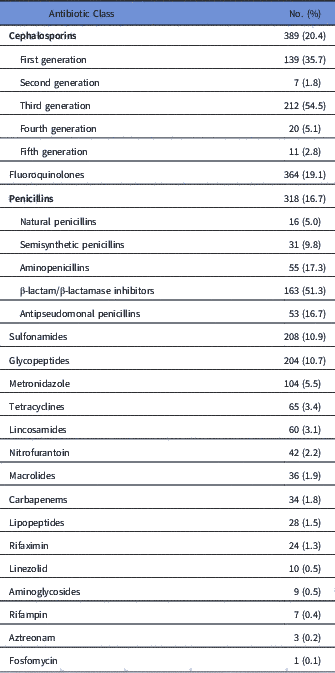
The distribution of antibiotics prescribed upon discharge is displayed in Table 2. The most frequently prescribed antibiotics were cephalosporins (20.4%), fluoroquinolones (19.1%), and penicillins (16.7%). Of the 1,906 antibiotics prescribed upon discharge, 508 (26.7%) were parenteral antibiotics (data not shown).
Distribution of Antibiotic Classes Prescribed on Discharge to a Long-Term Care Facility (n=1,906)

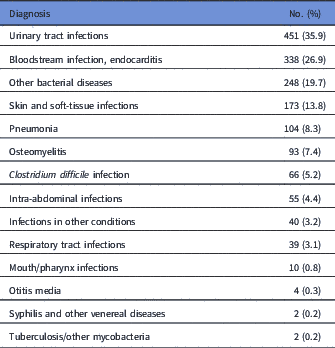
Among 1,532 patients discharged who received an antibiotic prescription upon discharge to an LTCF, 1,334 patient records (87.1%) included evidence of a potential infectious indication using a diagnosis code for a bacterial infection, a positive clinical culture for a bacterial organism, or a positive C. difficile toxin assay or polymerase chain reaction (PCR) test during the index admission. Most records of patients discharged (82.1%) had a diagnosis code for a bacterial infection among which the most prevalent diagnoses were for urinary tract infections (UTIs, 35.9%), bloodstream infection/endocarditis (26.9%), and “other bacterial diseases” (19.7%) (Table 3). Within the “other bacterial diseases” group, 66 patient records (26.7%) had an additional diagnosis code for a C. difficile infection (CDI). An additional 76 patient records (5.0%) lacked a diagnosis code for a bacterial infection and were identified using a positive clinical culture for a bacterial organism or a positive C. difficile toxin assay or PCR test. Among these discharges, 45 of 76 (59.2%) had a positive urine culture indicating a possible UTI, and 25 of 76 (32.9%) had positive cultures indicating a possible skin or soft-tissue infection. Last, 198 patients discharged (12.9%) who received an antibiotic upon discharge to an LTCF had a medical record with neither a diagnosis code for a bacterial infection nor a positive culture during the index admission. In a 20% random sample (n=38) of these discharges, the most prevalent documented indications on patient discharge summaries for receiving antibiotics were prophylaxis (34.2%) and aspiration pneumonia (10.5%).
Distribution of Diagnoses for Bacterial Infections Indications During the Index Hospital Admission Among Patients Receiving Antibiotics upon Discharge to a Long-Term Care Facility (n=1,258)

Note. Diagnosis types are not mutually exclusive, 283 of 1,258 (22%) of discharges had more than one diagnosis code for a bacterial infection.
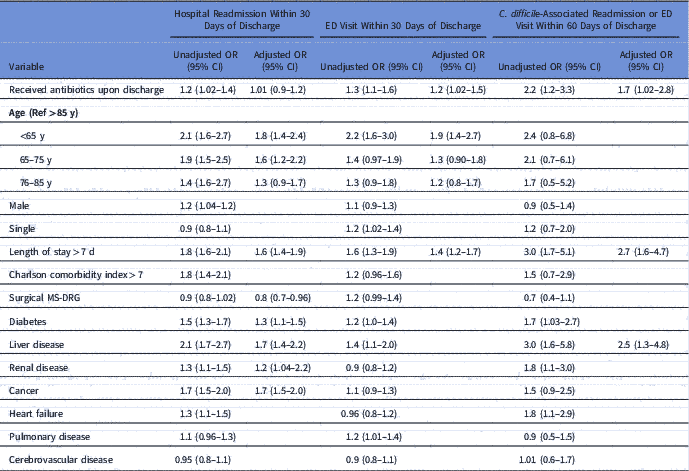
Among all discharges to an LTCF, the incidence of readmission to OHSU Hospital within 30 days of discharge was 957 of 6,701 (14.3%), of whom 350 patients (36.6%) were readmitted within 7 days and 101 patients (10.6%) were readmitted within 2 days. In addition, the incidence of an emergency department (ED) visit within 30 days of discharge was 9.1%, and 1.0% of patients had a C. difficile–positive PCR test or toxin assay during a readmission or ED visit within 60 days of discharge. The incidence of 30-day hospital readmission was significantly higher among patients who received an antibiotic upon discharge compared to patients who did not receive an antibiotic upon discharge to an LTCF (15.9% vs 13.8%; P=.03). Similarly, patients who received an antibiotic prescription upon discharge were significantly more likely to visit the ED within 30 days compared to patients who did not receive an antibiotic upon discharge to an LTCF (11.0% vs 8.6%; P=.003). The incidence of C. difficile-positive PCR test or toxin assay during a readmission or ED visit within 60 days of discharge was 1.6% among patients who received an antibiotic upon discharge compared to 0.8% in patients who did not receive an antibiotic upon discharge (P=.005). Despite these unadjusted results, statistical significance only remained for the associations with 30-day ED visits (adjusted OR, 1.2; 95% CI, 1.02–1.5) and CDI within 60 days (adjusted OR, 1.7; 95% CI, 1.02–2.8) following adjustment for confounding (Table 4).
Unadjusted and Adjusted Odds Ratios (ORs) and 95% Confidence Intervals (CIs) for the Association Between Receiving an Antibiotic Prescription Upon Discharge to a Long-Term Care Facility and 30-Day Hospital Readmission, 30-day Emergency Department (ED) Visits, or Clostridium difficile-Associated Readmission or ED visit at the Index Facility Within 60 Days of Discharge (n=6,701)Footnote a

Note. OR, odds ratio; CI, confidence interval; MS-DRG, Medicare severity diagnosis-related group.
a Potential confounders included in the model for each outcome are indicated by a point estimate in the column providing the adjusted odds ratio.
Discussion
We quantified the frequency and characteristics of patients prescribed antibiotics upon discharge from an acute care hospital to LTCFs. Our major finding was that 23% of patients were prescribed an antibiotic upon discharge, of which 19% were fluoroquinolones. The most prevalent diagnosis code for a bacterial infection during the index admission for patients receiving antibiotics upon discharge was for UTIs. Furthermore, receiving antibiotics upon discharge to an LTCF was significantly associated with 30-day ED visits and CDI within 60 days of discharge, even following adjustment for confounding. These findings may have important implications for further study and successful implementation of antimicrobial stewardship programs in LTCFs.
To our knowledge, no previous study has described antibiotic prescribing upon discharge to LTCFs. Our observation that nearly one-quarter of discharges to LTCFs were prescribed antibiotics upon discharge may inform interventions to improve antibiotic prescribing and stewardship efforts in both acute-care and LTCFs. Similarly, little is known about the proportion of antibiotic use in LTCFs that are hospital initiated. Richards et alReference Richards, Darradji and Weinberg 23 conducted a study among 105 post–acute-care residents across 7 LTCFs in Georgia. In that study, 50% of prescribed antibiotics were initiated in the hospital, and fluoroquinolones were the most commonly prescribed antibiotic class (53%).
Improving antibiotic prescribing upon discharge to LTCFs will likely require a specialized intervention beyond existing stewardship activities. Although this study was not limited to discharges to LTCFs, Scarpato et alReference Scarpato, Timko and Cluzet 24 investigated the appropriateness of antibiotic prescribing upon hospital discharge. Despite maintaining a robust antimicrobial stewardship program, they reported that 70% of antibiotic prescriptions upon discharge were inappropriate based on the drug choice, dose, or duration. Furthermore, 19.4% of patients prescribed antibiotics upon discharge were readmitted to the hospital within 30 days, compared to 13.8% of patients hospital-wide. Based on these results, they recommended medication reconciliation by trained pharmacists, prescriber education, and prospective audit and feedback to improve prescribing practices.Reference Scarpato, Timko and Cluzet 24 Furthermore, a recent systematic review concluded that medication reconciliation upon discharge is unlikely to reduce postdischarge healthcare utilization in the absence of other transitions of care intervention components.Reference Kwan, Lo and Sampson 25
We did not observe a significant association between receiving an antibiotic prescription upon discharge and 30-day hospital readmissions, which would have provided a financial incentive for acute-care hospitals to improve antibiotic prescribing in this patient population. However, our incidence of 30-day readmissions (14.3%) was limited to the index facility and was markedly lower than has been reported nationally among Medicare beneficiaries.Reference Mor, Intrator and Feng 26 Furthermore, despite the lack of an association with 30-day readmissions, we did observe a significant association between receiving an antibiotic prescription upon discharge to an LTCF and 30-day ED visits and CDI within 6 months. These outcomes are burdensome to residents, their family members, and healthcare providers in both hospitals and nursing homes and should provide sufficient rationale to improve prescribing practices upon discharge. Finally, our finding that the most frequent indication for antibiotic prescribing upon discharge was UTI is concerning considering an increasingly robust body of research suggesting that UTI diagnoses frequently lead to overtreatment with antibiotics, particularly among older adults.Reference Finucane 27
This study had several limitations. Our retrospective design utilizing a large cohort of existing clinical data limited our ability to precisely determine indications for antibiotic prescribing and the appropriateness of antibiotic prescribing upon discharge. However, our observation that UTIs were the most prevalent potential antibiotic indication was consistent with the high prevalence of fluoroquinolones prescribed upon discharge. The proportion of antibiotics prescribed upon discharge that were continued following admission to the LTCF is unknown. A previous study reported that half of antibiotics prescribed in 7 LTCFs in Georgia were initiated in the hospital; however, those results require confirmation from both the hospital and LTCF perspective. We were only able to identify ED visits and readmissions to the index discharging facility; which may have underestimated the true frequency of these events.Reference Emerson, Eyzaguirre and Albrecht 28 In addition, associations between receiving an antibiotic prescription upon discharge and readmissions and ED visits may have been affected by confounding by indication. That is, the reason for the readmission or ED visit may have been related to the indication for antibiotics rather than the antibiotics themselves. Lastly, our data may not be generalizable to other settings because this was a single-center study.
Despite these limitations, this study provides novel data on the frequency and characteristics of antibiotics prescribed upon discharge to LTCFs. Future work should address the frequency of inappropriate antibiotic prescribing in this patient population, associations with outcomes beyond the index facility, and outcomes within the LTCF posttransition.
Acknowledgments
Financial support
B.R.W. was supported by a Gateway to Research Scholarship from the American Foundation for Pharmaceutical Education. Access to and infrastructure for study data was provided by the Oregon Clinical and Translational Research Institute supported by National Center for Advancing Translational Sciences (grant number UL1TR000128).
Conflicts of Interest
J.C.M. has received research grants from Merck & Co. J.P.F. has received consulting fees from Merck & Co. and Shionogi, as well as research grants from Merck & Co. All other authors report no conflicts of interest relevant to this article.