Introduction
The introduction of invasive alien species is currently one of the main conservation problems and one of the most important causes of biodiversity loss. The rate at which humans translocate species beyond their native ranges has risen in recent years (Seebens et al., Reference Seebens, Blackburn, Dyer, Genovesi, Hulme, Jeschke, Pagad, Pyšek, Winter, Arianoutsou, Bacher, Blasius, Brundu, Capinha, Celesti-Grapow, Dawson, Dullinger, Fuentes, Jäger, Kartesz, Kenis, Kreft, Kühn, Lenzner, Liebhold, Mosena, Moser, Nishino, Pearman, Pergl, Rabitsch, Rojas-Sandoval, Roques, Rorke, Rosinelli, Roy, Scalera, Schindler, Štajerová, Tokarska-Guzik, van Kleunen, Walker, Weigelt, Yamanaka and Essl2017). As intercontinental movements of goods and people increase, accidental introductions of exotic species become more common. Many successful invaders are responsible for severe economic and ecological damage.
Such is the case of the western conifer seed bug, Leptoglossus occidentalis Heidemann (Heteroptera, Coreidae), a phytophagous true bug considered a major pest of conifer seeds in commercial seed orchards (Lesieur et al., Reference Lesieur, Yart, Guilbon, Lorme, Auger-Rozenberg and Roques2014; Strong, Reference Strong2016). Its native range covers western North America (Allen, Reference Allen1969). Since the 1960s, the species has been documented outside its native range in eastern North America and subsequently in Europe, Asia, northern Africa, and recently, South America (Lesieur et al., Reference Lesieur, Lombaert, Guillemaud, Courtial, Strong, Roques and Auger-Rozenberg2018). Its host spectrum includes 48 plant species (Werner, Reference Werner2011), including numerous conifers and the pistachio tree. Leptoglossus occidentalis is also a serious phytosanitary problem, as it is the vector of the spores of Diplodia sapinea (Fr.), the fungus responsible for Diplodia tip blight of pine trees (Luchi et al., Reference Luchi, Mancini, Feducci, Santini and Capretti2012; Barta, Reference Barta2016).
Within the genus, another species that is similarly expanding its range of distribution is Leptoglossus clypealis (Heidemann). It is native to central and southern United States and northern Mexico (Allen, Reference Allen1969). In recent years, it has been reported outside its native distribution in Canada and other regions of Mexico and USA (McDaniel, Reference McDaniel1989; Swanson and Millan-Hernandez, Reference Swanson and Millan-Hernandez2017; Wheeler, Reference Wheeler2018). It was elevated to pest status in the early 2000s (Wang and Millar, Reference Wang and Millar2000). It has been reported feeding on native shrubs and several economically important crops such as Helianthus sp. (sunflower), Phaseolus vulgaris L. (green bean), Pistacia vera L. (pistachio), Prunus dulcis (Mill.) D. A. Webb (almond) and Solanum tuberosum L. (potato) (Mitchell, Reference Mitchell, Schaefer and Panizzi2000; Joyce et al., Reference Joyce, Higbee, Haviland and Brailovsky2017). Similar to L. occidentalis, it can transmit fungal pathogens, Botryosphaeria dothidea and Eremothecium coryli, causing extensive damage and several diseases in its host plants (Rice et al., Reference Rice, Uyemoto, Ogawa and Pemberton1985; Michailides and Morgan, Reference Michailides and Morgan1990; Reference Michailides and Morgan1991).
Among the alternatives available for managing the problem of biological invasions is preventing species from arriving at new sites via quarantine (Liebhold et al., Reference Liebhold, Brockerhoff, Kalisz, Nuñez, Wardle and Wingfield2017), for which an important first step is to establish which areas are susceptible. Given that climate determines the successful establishment of insects, using ecological niche models (ENMs) to identify climatically suitable areas for invasive species provides an excellent opportunity for preventing or slowing invasions (Peterson, Reference Peterson2003; Zhu et al., Reference Zhu, Rédei, Kment and Bu2014). ENM is an important tool for defining strategies that can be used to contain invasive species, as it enables the invasive potential of a species to be assessed before invasion occurs (Peterson, Reference Peterson2003). It also enables potential future distributions of invasive species to be anticipated, to predict potential environmental impacts and economic costs. This information is essential for early detection and control, and can be used to anticipate critical routes, arrivals sites and starting points for successful invasions (Peterson, Reference Peterson2003; Broennimann et al., Reference Broennimann, Treier, Müller-Schärer, Thuiller, Peterson and Guisan2007).
The aims of the current study were: (a) to investigate the native climatic niches of L. clypealis and L. occidentalis in order to compare them and evaluate whether the two species should be expected to display similar environmental behavior; (b) to determine whether climatic conditions differ between the invaded native ranges of both species, and (c) to generate worldwide ENMs of L. clypealis and L. occidentalis projected according to current and future climates (period 2050).
Materials and methods
Species data
For this study, we compiled 659 georeferenced records of L. clypealis and 14,332 of L. occidentalis from the Global Biodiversity Information Facility online database (GBIF, www.gbif.org), BugGuide (Iowa State University, https://bugguide.net/) and published papers (Heidemann, Reference Heidemann1910; Froeschner, Reference Froeschner1942; Drew and Schaefer, Reference Drew and Schaefer1963; Schaffner, Reference Schaffner1967; Allen, Reference Allen1969; Horning and Barr, Reference Horning and Barr1970; Brailovsky and Sánchez, Reference Brailovsky and Sánchez1983; Katovich and Kulman, Reference Katovich and Kulman1987; McDaniel, Reference McDaniel1989; McPherson et al., Reference McPherson, Packaukas, Taylor and O´Brien1990; Gall, Reference Gall1992; Colombi and Brunetti, Reference Colombi and Brunetti2002; Gogala, Reference Gogala2003; Rabitsch and Heiss, Reference Rabitsch and Heiss2005; Dusoulier et al., Reference Dusoulier, Lupoli, Aberlenc and Streito2007; Wyniger, Reference Wyniger2007; Lis et al., Reference Lis, Lis and Gubernator2008; Simov, Reference Simov2008; Ruicanescu, Reference Ruicanescu2009; Chordas III et al., Reference Chordas, Tumlison, Robison and Kremers2011; Ahn et al., Reference Ahn, Son, Choo and Park2013; Faúndez and Rocca, Reference Faúndez and Rocca2017; Joyce et al., Reference Joyce, Higbee, Haviland and Brailovsky2017; Kulijer and Ibrahimi, Reference Kulijer and Ibrahimi2017; Özgen et al., Reference Özgen, Dioli and Celik2017; Swanson and Millan-Hernandez, Reference Swanson and Millan-Hernandez2017; van der Heyden, Reference van der Heyden2018; Wheeler, Reference Wheeler2018). Prior to data analysis we removed erroneous records by performing some data cleaning tests. As a result of these we removed records with doubtful species identification, records with insufficient spatial accuracy or with badly formatted coordinates and records with longitude and latitude precision with less than three decimal digits.
For each species two datasets were built: one with the native records (referred to hereinafter as the native dataset) and the other with the entire distribution (all the records, hereinafter, and entire distribution dataset). The native dataset was built to evaluate whether the environmental space occupied by the non-native records is similar to the one occupied by the native records. The entire distribution dataset was used to build the ENMs, which were used as final worldwide predictive models. The literature defines the native distribution of both species in terms of USA, Canadian and Mexican states (Heidemann, Reference Heidemann1910; Allen, Reference Allen1969). As this is not a natural division of the landscape, we considered the native range according to the ecoregions occupied by the records. Ecoregions represent land units sharing a large majority of species, physiography and environmental conditions (Olson et al., Reference Olson, Dinerstein, Wikramanayake, Burgess, Powell, Underwood, D´amico, Itoua, Strand, Morrison, Loucks, Allnutt, Ricketts, Kura, Lamoreux, Wettengel, Hedao and Kassem2001). They should therefore accurately represent the areas accessible to the species that inhabit them. We followed the ecoregions proposed by Olson et al. (Reference Olson, Dinerstein, Wikramanayake, Burgess, Powell, Underwood, D´amico, Itoua, Strand, Morrison, Loucks, Allnutt, Ricketts, Kura, Lamoreux, Wettengel, Hedao and Kassem2001).
To avoid overemphasizing, datasets were screened for model calibration using a subsampling regime to reduce spatial autocorrelation. Firstly, Maxent models were generated using all occurrences; the spatial autocorrelation among model pseudoresiduals (1-probability of occurrence generated by model) was evaluated using SAM v4.0 to calculate Moran's I at multiple distance classes (Rangel et al., Reference Rangel, Diniz-Filho and Bini2010). Significance was determined using permutation tests. Moran's I is widely used as a measure of spatial autocorrelation. For L. clypealis, minimum distances were established as 80 km for the native dataset and 110 km for the entire distribution dataset, while for L. occidentalis, they were 140 km and 220 km, respectively.
After reducing the spatial autocorrelation, the L. clypealis native dataset kept 84 records and its entire distribution dataset kept 136 (Supplementary material 1), while L. occidentalis kept 58 and 169 records, respectively (Supplementary material 2).
Variable selection
To build the Maxent models, we used the 19 bioclimatic variables available in the WorldClim database (Hijmans et al., Reference Hijmans, Cameron, Parra, Jones and Jarvis2005). Resolution of the layers was 2.5 arc-min for the models built with the native datasets and 5 arc-min for the models built with the entire distribution datasets. To project to future climate (for the 2040–2069 period, referred to herein as 2050), three global climate models (GCMs) were used, CCSM4, GISS-E2-R and MIROC5 as these are regarded among the most reliable GCMs to obtain future climate projections (Bosso et al., Reference Bosso, Luchi, Maresi, Cristinzio, Smeraldo and Russo2017; Lin and Tung, Reference Lin and Tung2017). Two different representative concentration pathways (RCP), RCP 2.6 and RCP 8.5 were used because, these include a wide range of possible changes in future climates, depending on the amount of greenhouse gases (GHGs) emitted in the years to come. RCP 2.6 predicts milder changes, assuming that global GHG emissions will peak between the years 2010 and 2020 and then decline substantially, while RCP 8.5 predicts the most catastrophic scenario, in which emissions continue to rise throughout the current century (IPCC 2013).
To avoid multi-collinearity, correlation analyses were performed for the 19 bioclimatic variables, across the entire background. The variables that were highly correlated (r ≥ 0.80) were excluded when the models were built. Among correlated variables the ones with lower percentage of contribution to the model were excluded. Nine non-correlated variables were found for the L. clypealis native dataset (Bio2, 3, 8, 9, 11, 12, 15, 18 and 19), eight for the L. clypealis entire distribution dataset (Bio2, 5, 8, 9, 11, 15, 18 and 19), seven for the L. occidentalis native dataset (Bio2, 6, 8, 10, 11, 14 and 19) and seven for the L. occidentalis entire distribution dataset (Bio1, 2, 3, 7, 15, 18 and 19) (table 1).
Bioclimatic variables used to build the Maxent models

Ecological niche models
ENMs were performed using Maxent v3.4.1k (Phillips et al., Reference Phillips, Dudík and Schapire2019). To train the models of each dataset, we considered an area that included the ecoregions where the known records are present. To avoid over-parameterization, the models were tuned by exploring the performance of different beta-regularization multiplier (RM) values (0.5–4) and of different feature classes (L, H, Q, LQ and LQH). These models were tested in ENMTools 1.4 (Warren et al., Reference Warren, Glor and Turelli2010). Models with the lowest Akaike's Information Criteria corrected scores were selected (Warren and Seifert, Reference Warren and Seifert2011).
The models built with the native dataset were projected to the invaded countries. The models built with the entire distribution dataset were projected worldwide to present and future times. Optimal complexity was estimated for the L. clypealis model built with the native dataset using an RM of 3 and L feature class (Supplementary material 3, Table I), and for the model built with the entire distribution dataset using an RM of 4 and a LQH feature class (Supplementary material 3, Table II). Optimal complexity was estimated for the L. occidentalis model built with the native dataset using an RM of 0.5 and LQ features class (Supplementary material 4, Table I), and for the model built with the entire distribution dataset using an RM of 2.5 and LQ feature class (Supplementary material 4, Table II). Model accuracy was calculated using the partial receiver operating characteristic (ROC) procedure (pROC). This method was chosen because it removes emphasis on absence data and it stresses the key role of omission error in evaluating model predictivity. The pROC remedies two problems that the area under the curve (AUC) has when testing model performance. AUC undervalues models which do not provide predictions through the entire spectrum of proportional areas in the study area and it incorrectly weights the two error components equally (omission and commission) (Peterson et al., Reference Peterson, Papes and Soberón2008). To validate each model, 500 random iterations with 50% sub-sampling were performed to evaluate whether the models were statistically better than random (higher than 1.0) (P < 0.2) (Peterson et al., Reference Peterson, Papes and Soberón2008). These analyses were carried out in Niche Toolbox (http://shiny.conabio.gob.mx:3838/nichetoolb2/) (Osorio-Olvera et al., Reference Osorio-Olvera, Barve, Barve, Soberón and Falconi2018). Model discriminatory ability was measured through AUC of the ROC plot (AUC/ROC), which ranges from 0 to 1. Values closer to 1 indicate a prediction better than random, values of 0.5 correspond to a prediction equal to random, and values lower than 0.5 correspond to a prediction worse than random.
Current and future models were converted into binary maps. Values above the ‘minimum training presence logistic threshold’ (MTP) were considered as presences. The MTP indicates values above which the climate conditions are suitable for the survival of the modeled species and guarantees that all possible presences of the target species are predicted as suitable. Consensus maps were built for the future models and the regions where the binary maps of the three GCMs matched were recovered. This procedure was performed for the two RCPs.
In the projected areas and periods, multivariate environmental similarity surface (MESS) analyses were performed to identify any regions with environmental conditions outside the range of the training area (referred to as novel climatic conditions). Cells in which the MESS analysis recovered novel climates were identified on the binary map.
Direct climate comparisons
A direct climate comparison was performed between the native and non-native records. The non-native records included in this analysis had to comply with two criteria: (i) be located in areas that were predicted in the model trained with the native dataset, in unsuitable regions or with novel climatic conditions, (ii) be in localities where the species was recorded for at least 3 years. These criteria enabled us to recognize records that occupy an environmental space different to the native one. The raw environmental data of the 19 bioclimatic variables were extracted for the non-native and native records using QGis 2.18.24 and compared in boxplots using the statistical software package InfoStat (Di Rienzo et al., Reference Di Rienzo, Casanoves, Balzarini, Gonzalez, Tablada and Robledo2018). This analysis was performed for L. clypealis. In the case of L. occidentalis it was not performed because there were no records that met the above criteria.
Niche identity test, background test and niche breadth
We performed a niche identity test and a background test using ENMTools (Warren et al., Reference Warren, Glor and Turelli2008; Reference Warren, Glor and Turelli2010) to determine whether the ENMs built with the L. clypealis and L. occidentalis native datasets were climatically identical or exhibited significant differences. The niche identity test pooled all the actual records and randomized their identities to produce two new samples with the same number of records as the empirical data. This procedure was performed 100 times. Niche similarity of the ENMs generated by the actual occurrence data were then compared to those generated by the empirical data. To measure niche similarity, two scores were calculated: Schoener's D (Warren et al., Reference Warren, Glor and Turelli2008) and Hellinger's-based I (Schoener, Reference Schoener1968), both of which range from 0 (no niche overlap) to 1 (identical niches). Schoener's D assumes that the suitability scores are proportional to species abundance, while Hellinger's-based I measures the probability distributions of two ENMs (Warren et al., Reference Warren, Glor and Turelli2010; Zhang et al., Reference Zhang, Chen, Li, Zhao, Chen and Huang2014). Thus, if ENMs from L. clypealis and L. occidentalis were no more different than pairs of randomly drawn samples, they were diagnosed as effectively identical.
The background test is performed to evaluate whether the ecological niches of two species are similar based on the differences in the environment where they occur (Warren et al., Reference Warren, Glor and Turelli2008). Therefore, in this test we compared the ENM of L. clypealis to another ENM created by choosing a random set of points (with the same number of records as the L. occidentalis real native dataset (58 records)) from the background of the native area of L. occidentalis. This procedure was performed 100 times. The same comparisons were made in the opposite direction: the L. occidentalis ENM with 100 ENMs built with a random set of points (84 as in the L. clypealis real native dataset) from the background of the native area of L. clypealis. Schoener's D and Hellinger's-based I were calculated and compared to the null distribution of pseudoreplicate models overlap values (Warren et al., Reference Warren, Glor and Turelli2008).
We also calculated the niche breadth of the ENMs built with the native dataset through the Levin's concentration metrics. This index ranges from 0 (narrow niche breadth) to 1 (broad niche breadth) (Peers et al., Reference Peers, Thornton and Murray2012). Niche breadth is the suite of resources and environments that a species can inhabit or use (Slatyer et al., Reference Slatyer, Hirst and Sexton2013). This analysis was performed to test whether these species can maintain viable populations within a wide array of resources and conditions.
Results
Leptoglossus clypealis ENM
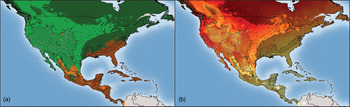
The L. clypealis ENM built with the native dataset was validated by the pROC analysis, yielding predictions significantly better than random (AUC ratio 1.24) and good discriminatory ability (AUC 0.63). The model predicted all the regions where the species is currently known to have suitable climatic conditions except for the records located in three ecoregions in the USA (Piney Woods forests, Southeastern mixed forests and Western Gulf coastal grasslands) and three in Mexico (Sierra Madre Oriental pine-oak forest, Yucatan moist forests and Bajo dry forest) (fig. 1). The species has been recorded in Southeastern mixed forests and Piney Woods forests since 2006 and 2014, respectively. For the Western Gulf coastal grasslands it has been recorded in the years 2014 and 2017. In the Mexican ecoregions, there are single records, some of which are old (1939, 1995 and 2017, respectively) (Supplementary material 5). The MESS analysis determined regions with novel climatic conditions mainly toward the east, south and north of North America.
Leptoglossus clypealis model built with the native dataset (84 records). (a) Binary map, green areas represent suitable conditions, orange areas unsuitable, darker areas represent novel climatic conditions. (b) Continuous map, darker colors indicate higher probabilities, darker areas represent novel climatic conditions. Dotted area is the calibration area (native range). White dots are native records, blue dots non-native records. Cross-hatching indicates the ecoregions with records of L. clypealis that were predicted in unsuitable areas by this model.

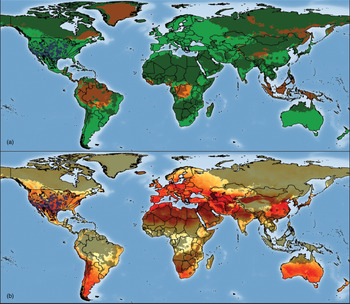
The ENM built with the entire distribution dataset and projected worldwide was validated by the pROC analysis, yielding predictions better than random (AUC ratio 1.28) and good discriminatory ability (AUC 0.65). It predicted broad areas with suitable conditions, mainly most of North America and South America, Europe, Africa, Australia and southern Asia (fig. 2).
Leptoglossus clypealis model built with the entire distribution dataset (135 records). (a) Binary map, green areas represent suitable conditions, orange areas unsuitable, darker areas represent novel climatic conditions. (b) Continuous map, darker colors indicate higher probabilities, darker areas represent novel climatic conditions. Dotted area is the calibration area. Blue dots are the records used to build the model.

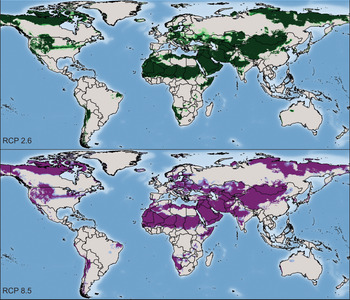
The future models developed with the three GCM and under the two RCP scenarios (2.6 and 8.5) showed similar patterns and agree in most of the areas predicted (fig. 3). For all the continents there will be a loss in suitable areas. The percentage of lost area for Africa will be approximately between 53 and 57%, 67 and 70% for the Americas, 43 and 46% for Asia, 71 and 76% for Europe and 97 and 99% for Australia (Supplementary material 6).
Leptoglossus clypealis consensus map (period 2050).

Leptoglossus occidentalis ENM
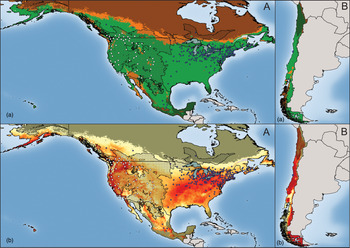
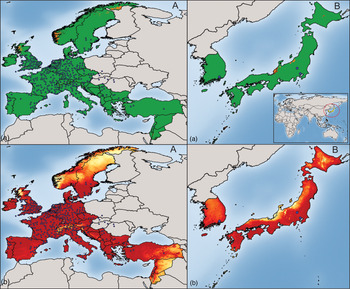
The L. occidentalis ENM built with the native dataset was validated by the pROC analysis, yielding predictions better than random (AUC ratio 1.56) and good discriminatory ability (AUC 0.79). In North America there are records of L. occidentalis in areas predicted as unsuitable by the model in the USA and Canada (fig. 4). These areas occupy three ecoregions in the USA (Central Canadian Shield forests, Northern tall grasslands and Western Great Lakes forests) and one that traverses USA and Canada (Interior Alaska-Yukon lowland taiga). For all of these ecoregions, L. occidentalis has been recorded in a single year except for Western Great Lakes forests ecoregion where it has been recorded during four successive years (Supplementary material 5). In the rest of the invaded countries (Chile, European countries, Japan and South Korea) all records are predicted in suitable areas (figs 4–6). The MESS analysis identified regions with climatic conditions different from those in the native area mainly toward the north and south of North America and in northern and southwestern Chile.
Leptoglossus occidentalis model built with the native dataset (58 records) and projected in invaded countries of America. (a) Binary map, green areas represent suitable conditions, orange areas unsuitable; darker areas represent novel climatic conditions. (b) Continuous map, darker colors indicate higher probabilities, darker areas represent novel climatic conditions. Dotted area is the calibration area (native range). White dots are native records, blue dots not-native records. Cross-hatching indicates the ecoregions with records of L. occidentalis that were predicted in unsuitable areas by this model. A: North America: Canada, USA and Mexico; B: South America: Chile.

Model of L. occidentalis built with the native dataset (58 records) and projected in invaded countries of Europe and Asia. (a) Binary map, green areas represent suitable conditions, orange areas unsuitable; darker areas represent novel climatic conditions. (b) Continuous map, darker colors indicate higher probabilities, darker areas represent novel climatic conditions. Blue dots are not-native records. A: Europe and western Asia; B: eastern Asia.

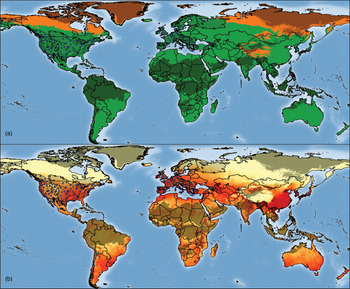
Leptoglossus occidentalis model built with the entire distribution dataset (169 records). (a) Binary map, green areas represent suitable conditions, orange areas unsuitable; darker areas represent novel climatic conditions. (b) Continuous map, darker colors indicate higher probabilities, darker areas represent novel climatic conditions. Dotted area is the calibration area. Blue dots are the records used to build the model.

The ENM built with the entire distribution dataset and projected worldwide was validated by the pROC analysis, yielding predictions better than random (AUC ratio 1.42) and good discriminatory ability (AUC 0.72). It predicted broad areas with suitable conditions in most of the Americas, all Europe, Africa and Australia, and most of Asia except for some regions in the northeast and some areas in China and neighboring countries (fig. 6).
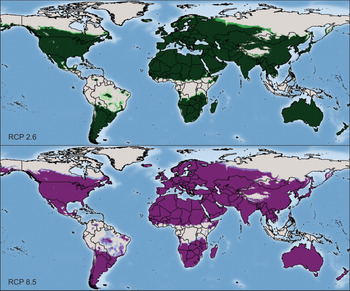
The future consensus maps under the two RCP scenarios (2.6 and 8.5) had similar patterns, with small differences in the extent of the suitable areas (fig. 7). According to all the future models, a retraction in the areas with suitable conditions is expected. For RCP 2.6 and 8.5 this retraction represents losses, respectively, of approximately 18 and 19% of the suitable areas for the Americas; of 15 and 14% for Asia and 28 and 19% for Europe. Potential distributions in Africa and Australia will not differ (Supplementary material 7).
L. occidentalis consensus map (period 2050).

Direct climate comparisons
The climatic variables with high discrepancy are Bio2 and 3 and all the precipitation-related variables Bio12–19 (fig. 8). The records that are in regions that were predicted as unsuitable or with novel climatic conditions by the model built with the native dataset are in areas with climates that tend to be warmer and much more humid.
Boxplots representing the ranges of the climatic variables in the regions occupied by the native records (in yellow) of L. clypealis and by the non-native records (in green) predicted by the model trained with the native dataset, in unsuitable regions or regions with novel climatic conditions. Boxplots for climatic variables with high discrepancy are marked with an asterisk.

Niche identity test, background test and niche breadth
The similarity scores for L. clypealis and L. occidentalis niches according to Schoener's D and Hellinger's-based I metrics were 0.82 and 0.97, respectively. The mean value for observed niche similarity scores for the 100 pseudoreplicates was 0.83 (SD ± 0.03) and 0.96 (SD ± 0.01) for Schoener's D and Hellinger's-based I, respectively. The actual niche overlaps (D and I) were similar to those of the random data (Supplementary material 10). They were within the 95% confidence intervals, and therefore not significant, so we conclude that the L. clypealis and L. occidentalis niches are identical.
For the background test, the observed values of D and I were significantly higher than the null distributions, so the null hypothesis is rejected, the L. clypealis and L. occidentalis niches show no ecological difference (Supplementary material 11).
Niche breadths calculated by Levin's concentration metrics were 0.96 for L. clypealis and 0.82 for L. occidentalis. Therefore, both species have broad niche breadths.
Discussion
The fundamental niche of a species is the set of resources, physical and biological, that would enable the species to exist indefinitely. The realized niche is the part of the fundamental niche to which a species is constrained by biotic interactions (Wiens et al., Reference Wiens, Stralberg, Jongsomjit, Howell and Snyder2009). During biological invasions, the factors that cause invasive species to expand their distributions beyond their native range are a niche differentiation between native and introduced ranges in either the fundamental or the realized niche (Broennimann et al., Reference Broennimann, Treier, Müller-Schärer, Thuiller, Peterson and Guisan2007).
In our results, the ENMs built with the native dataset and projected to regions where there are known records of the species, predicted unsuitable conditions for several of the localities with presences; this occurred mostly for L. clypealis in ecoregions where the species has been present between 3 and 13 years. There were some records that were predicted in regions that we identified through the MESS analysis as having novel climatic conditions; this also occurred mostly for L. clypealis in ecoregions where the species has been present for up to 76 years. These results indicate that the environmental space occupied by these records differs from the one in the native ranges. Thus, during range expansion the species has undergone a process of niche differentiation. Our results for the direct climate comparison between the native and the non-native records predicted in unsuitable regions or regions with novel climatic conditions showed that L. clypealis can establish in more humid areas as the higher quartile of the precipitation-related variable values of the native records were always lower than minimum values of the non-native records.
Our ENMs projected worldwide to the present time predicted a large number of regions with suitable conditions for the establishment of both species, with L. occidentalis already present in several regions of the world, as was predicted by Zhu et al. (Reference Zhu, Rédei, Kment and Bu2014). The ENMs projected to the future showed a retraction in the suitable areas in Africa, America, Europe and Asia for both species and in Europe and Australia for L. clypealis as well. The regions where future ENMs of both species showed these retractions will have higher temperature and humidity. Temperature-related variables will probably be responsible for most constraining the suitability of these regions, because they are the ones that will vary the most and for which, according to our results, both species exhibit less adaptability. However, these results should be interpreted with caution, as we are assuming that L. clypealis and L. occidentalis will not adapt to higher temperatures and humidity, which may not be the case, considering that, according to our direct climate comparison analysis, L. clypealis seems to be adapting well to warmer and wetter climates.
The L. clypealis and L. occidentalis niches are environmentally identical, as shown by the niche identity test and background test. Although individual species may have specific responses to the environment, species that share the same ecological traits are expected to respond similarly to environmental conditions (Thuiller et al., Reference Thuiller, Lavorel and Araujo2005; Yu et al., Reference Yu, Groen, Wang, Skidmore, Huang and Ma2017). Therefore, if it could arrive at new areas, L. clypealis would be expected to exhibit a similar pattern of expansion to that of L. occidentalis.
Our results showed that L. clypealis has a broader niche breadth than L. occidentalis. The niche breadth of a species is the range of conditions that define its niche (Sexton et al., Reference Sexton, Montiel, Shay, Stephens and Slatyer2017). A species with wider niche breadth is more generalist than a species with narrow niche breadth. This is an important topic if we consider the environmental aspects of L. clypealis, demonstrated in this study, which would make it a successful invader.
By using high-speed means of transportation, humans are moving living species around the world, often unintentionally. In view of our results and of the great ecological resemblance between L. clypealis and L. occidentalis, both species should be carefully monitored, in particular L. clypealis, considering its broader niche breadth and its numerous host plants.
Supplementary material
The supplementary material for this article can be found at https://doi.org/10.1017/S0007485320000656.
Acknowledgments
This work was supported by Consejo Nacional de Investigaciones Científicas y Técnicas (CONICET), Argentina, and a grant from ‘Fondo para la Investigación Científica y Tecnológica’ (FONCYT) PICT 2016-0739. We would like to thank Catalina Connon for copy-editing the manuscript.