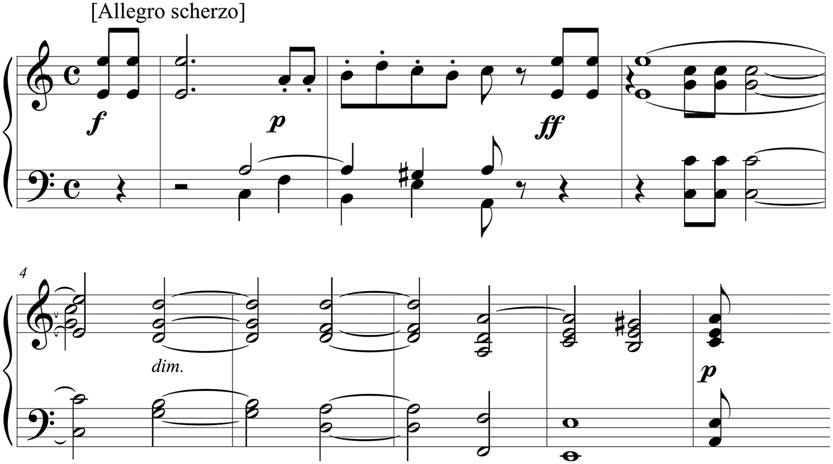
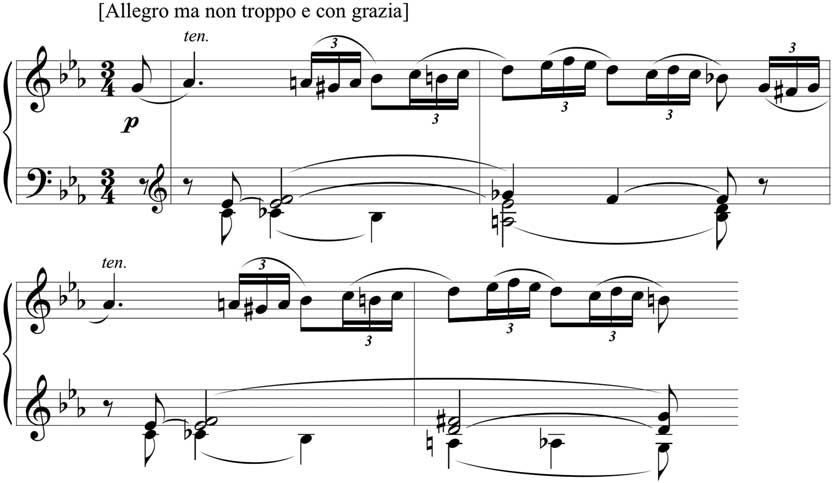
The question of musical influence is very difficult to discuss objectively, because there are no agreed standards to measure it. Unless a composer acknowledges a deliberate borrowing, as Elgar did when he placed quotation marks above the score of the ‘Enigma’ Variations,Footnote 1 the perception of influence will depend on each listener’s set of associations and degree of knowledge of the repertoires concerned. For instance, Larry Todd, whose familiarity with the entire corpus of Mendelssohn’s music is probably unequalled, has found many passages in Sterndale Bennett’s work that he considers close enough to corresponding Mendelssohn passages to justify the assumption of a direct borrowing.Footnote 2 But for ordinary listeners these similarities, if observed at all, are merely perceived as part of a common musical language.
A related, more general difficulty can apply to any of the arts. We generally like what we know, and when we see or hear something for the first time, part of our effort to comprehend it is by likening it to something familiar. When we meet a stranger, we are often struck by their resemblance to someone we know well, perhaps a relative. Only when we get to know them better does the likeness fade from our minds. I have generally found a parallel to this reaction when I have revived forgotten music by early nineteenth-century British composers. When people hear it, they are immediately struck by a resemblance to Beethoven or Schubert or Rossini or Weber or Mendelssohn or Chopin. They are too ready to conclude that the composer was copying one of those great men, when in fact he or she was merely writing in the musical language common to the period, but known today mostly in the work of the few who became part of our permanent repertoire. As Schumann put it when reviewing Bennett’s Suite de Pièces in 1842:
The resemblance of his compositions to those of Mendelssohn has often been remarked; but those who think they have sufficiently designated Bennett’s character by such a remark, do him great injustice, and betray their own want of judgment. Resemblances are common between different masters of the same epoch. In Bach and Handel, in Haydn, Mozart, and Beethoven in his earlier period, we find a similar aim, like a bond of union between them … But this inclination should never be misnamed imitation, and Bennett’s likeness to Mendelssohn is involuntary. Yet Bennett’s works have continued to increase in originality.Footnote 3
That is the main issue that I plan to discuss in this article by means of a close examination of some of his piano music, after disposing of some related questions.
Bennett’s reputation has passed through an unusually large number of phases in the last two hundred years, and in some of these a resemblance to Mendelssohn or other German composers was by no means considered a fault. A recent author, Linda Shaver-Gleason, has identified ‘three stages in Bennett reception: First, a period in which Bennett is described [and admired] as a follower or imitator of Mendelssohn; next, a period in which English historians assert Bennett’s originality; and finally, the period when a consensus forms, stating that Bennett’s resemblance to Mendelssohn was an inherent weakness.’Footnote 4 She convincingly attributes this last view of Bennett as a composer deficient in originality to the desire to establish an ‘English Musical Renaissance’ beginning soon after his death. The leading historian-critics promoting this narrative, including Henry Davey, J. A. Fuller Maitland and Ernest Walker, needed a ‘Dark Age’ to precede the ‘Renaissance’.Footnote 5 They all presented Bennett as a pale version of Mendelssohn, though they often fell short of accusing him of direct imitation. Thus Maitland declared that Bennett ‘found no difficulty in falling in with the Mendelssohn worship of the time, and his own style, which had been developed … long before he had the opportunity of meeting Mendelssohn or knowing much about his music, was so remarkably similar to Mendelssohn’s that he has often been accused of imitating him too closely, or even having been his pupil’.Footnote 6
When, fifty years ago, the late Geoffrey Bush gave a lecture-recital of Bennett’s solo piano works at the Royal Musical Association to mark the 150th anniversary of the composer’s birth, he still felt it necessary to begin by answering at length five ‘main counts on the charge sheet’ against the composer: ‘(a) that he was English, (b) that he was Victorian, (c) that he wrote an oratorio The Woman of Samaria, (d) that he was Professor of Music at Cambridge, (e) that he was an inferior imitator of Mendelssohn’.Footnote 7 In contrast, a book published in 2007 offered learned articles on Bennett’s music by two leading scholars, who felt no need to justify their action, still less to apologize.Footnote 8 The whole climate of opinion had changed in the intervening forty years. Recordings of Bennett’s music are now coming out at a rapid pace.
In fact, when the time had come to fight the general bias against early Victorian music, Bennett enjoyed certain advantages over his contemporaries. First and foremost, he had attracted a type of support that no other British composer of his time could boast: two famous German musicians, Mendelssohn and Schumann, had singled him out for praise and taken powerful steps to promote his music. In an incident famous in Bennett circles, Mendelssohn heard him perform his first piano concerto at the Royal Academy’s midsummer concert in the Hanover Square Rooms on 26 June 1833, and promptly invited the seventeen-year-old boy to Germany. When Bennett asked if he could be his pupil, Mendelssohn replied ‘No, no, you must come to be my friend.’Footnote 9 For the rest of his life Mendelssohn rarely missed an opportunity to encourage Bennett and advance his career, often by personal recommendation. Mendelssohn’s own standing among the British upper classes was second to none at the time, and soared even higher after his death in 1847, so his approval must have been a major factor in Bennett’s brilliantly successful career and high reputation.
Schumann’s fame as a composer was still modest during Bennett’s youth, especially in England, but he was influential in Germany as the chief music critic of the Neue Zeitschrift für Musik. Between 1837 and 1843 he published twelve strongly favourable reviews of Bennett’s work,Footnote 10 sometimes rising to rapture. He gave himself the task of informing his readers about a ‘new star in the West’. In February 1837 he wrote, ‘If only there were many artists working in the same spirit as W. Bennett, no one would need to fear any longer for the future of our art.’Footnote 11 The reviews went far beyond Mendelssohn’s general commendation, analysing the special felicities of Bennett’s style and originality for the benefit of true music-lovers – treating him, in effect, as a leading member of his Davidsbund. Eight of these essays were promptly translated for publication in The Musical World, thereby informing the British musical public that Bennett was admired in the highest artistic circles in Germany. A clear result was that many of his compositions were published first in Germany, or more or less simultaneously in Germany and England.Footnote 12 This was an unusual honour at the time for a British-born composer.Footnote 13
A second advantage Bennett’s legacy would have over those of his contemporaries was that his family would make extraordinary efforts to preserve and enhance his fame. His three children inherited equal shares of his musical library, which included many of his compositions in manuscript form. One of them, James (1847–1928), purchased his elder brother’s share, retired early as headmaster of Derby School, and made it his life’s work to record every available detail of his father’s life. He acquired and organized meticulously whatever related materials he could find, and published what is still the definitive biography.Footnote 14 The third child, Elizabeth, married Thomas Case (1844–1925), son of the composer’s great friend and admirer Robert Case; the son-in-law became almost equally devoted to Bennett’s musical legacy.Footnote 15 James Sterndale Bennett’s son Robert (1880–1963) treasured his inheritance and continued to collect materials relating to the composer. He was director of music at Uppingham School from 1908 to 1945, and in retirement he maintained the family archive and encouraged research on his grandfather’s work.Footnote 16 In 1974 Robert’s grandson, Barry Sterndale-Bennett, took over the care of the composer’s library, and has also assisted several researchers. Eventually this careful work had its fullest expression in Rosemary Williamson’s sumptuous thematic catalogue, which is far more thorough and detailed than the available catalogues of many more famous composers, including Mendelssohn and Schumann.Footnote 17 The bulk of the collection is now housed at the Bodleian Library, Oxford.Footnote 18
An opposite extreme was the case of Edward James Loder (1809–1865). His musical gifts and achievements were comparable to Bennett’s. He too was an accomplished pianist, and a composer of remarkable originality. He too spent time in Germany – as a pupil of Ferdinand Ries, who, however, did nothing to promote his compositions or his career. Loder failed to find a way of making a living in England as a pianist-composer, died in poverty and obscurity without influential friends, relatives, or descendants, and was at once almost forgotten in musical circles. Most of his unpublished music, even some of his published piano pieces, and nearly all his letters and other writings are lost. Of his six string quartets, highly esteemed at the time, the only survivor is a scherzo and trio published in an arrangement for piano duet; of dozens of works for the stage, only two operas survive in full score.Footnote 19
Bennett’s third advantage is the central feature of this study: his individuality as a composer. It was a point emphasized by many of his contemporaries and immediate successors – the generations that were most likely to be intimately familiar with much of his music, and thus able to distinguish it from the general style of the time. Schumann’s view has already been quoted. Henry Heathcote Statham (1839–1924) introduced Bennett in the first edition of Grove’s Dictionary as ‘the only English composer since Purcell who has attained a distinct style and individuality of his own, and whose works can be reckoned among the models or “classics” of his art’.Footnote 20 Sir Frederick Ouseley (1825–1889), professor of music at Oxford, writing in 1886, considered that Bennett’s style ‘is emphatically his own. It has been said by many writers that he was an imitator of Mendelssohn; but it is hardly credible that any competent critic could form such a judgment if he had taken the trouble to examine Bennett’s work at all minutely.’Footnote 21 And indeed, although almost everyone writing about Bennett’s music since that time has mentioned its affinities with Mendelssohn’s, most have also pointed out its original qualities. This even includes Larry Todd, in an essay whose main topic is Mendelssohn’s influence on Bennett. He concludes:
If the many Mendelssohnian allusions in Bennett’s piano music reveal him to have been a particularly close member of the Leipzig circle, they also show him to have possessed a creative imagination, for inevitably the allusions are no more than starting points or brief diversions, not ultimate goals, let alone evidence of stylistic subservience or lack of originality.Footnote 22
How Bennett’s Style Developed
Bennett’s principal composition teacher at the Royal Academy of Music was Cipriani Potter.Footnote 23 According to another of Potter’s pupils, George A. Macfarren, he based his teaching on the Viennese classics, and on Mozart in particular. He was the first teacher in England who
promulgated the principles of plan … in the arrangement of ideas, in the conduct of keys, in the juxtaposition of one musical phrase with another, the distribution of rhythm, and the whole musical structure … Potter showed his pupils the art of continuity in the development of musical ideas – the structure of complete compositions. I believe that this was not known in England before his time, or, if known, it was certainly unpractised … and this advantage has been disseminated by his pupils until now, when, I believe, the structure of the sonata is very generally understood, and, in many instances, very happily practised.Footnote 24
Macfarren also mentioned that Bennett’s devotion to Mozart was known to his schoolmates.Footnote 25 He clearly modelled his early orchestral works, most notably the piano concertos, on Mozart. In a lecture at Cambridge in 1871 he would recommend Mozart as the best model for students of composition; he warned his hearers against imitating some specially fascinating characteristic of a favourite composer, such as Mendelssohn, ‘who has contributed such glorious and finished masterpieces to the art, in all directions’.Footnote 26 Peter Horton has shown that contemporary critics compared Bennett’s early concertos to composers such as Dussek, Cramer, Hummel and Moscheles, whose works were comparatively well known in England.Footnote 27 George Hogarth, writing in 1835, included the nineteen-year-old Bennett among the English composers whose instrumental style was based on the ‘great masters’, passed on by ‘Clementi and Cramer, aided by their younger coadjutor, Moscheles’.Footnote 28
Bennett’s early works show the roots of his individual style. His first published piece for piano solo, Capriccio in D minor Op. 2 (1834), was dedicated to ‘Cipriani Potter Esqre by his Pupil W. S. Bennett’.Footnote 29 It is in strictly Mozartian sonata form, duly returning to the tonic minor in the recapitulation. It does not often recall Mozart in its melodic or harmonic styles (but see Example 11a below). Nor does it resemble Mendelssohn. It is tense where Mendelssohn is more often bland, and highly chromatic, especially in the use of diminished sevenths, for which Weber is a possible model.
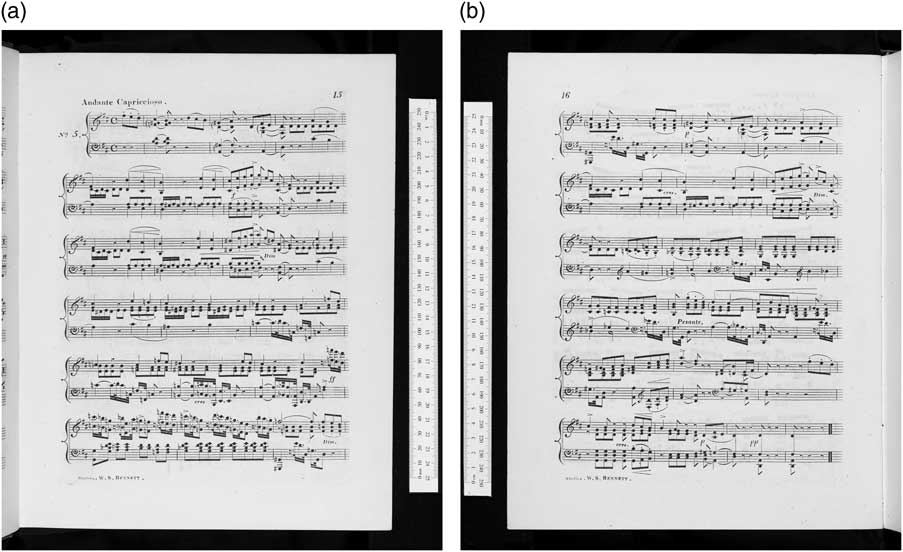
Next came Six Studies in the Form of Capriccios Op. 11, dedicated to Macfarren; not all of them are in sonata form, but all are strictly constructed, despite their generic subtitle ‘in the Form of Capriccios’. They have many novel details. Perhaps No. 5, essentially in modified ternary form, demonstrates its composer’s originality most clearly. It is shown in its entirety in Figure 1.
Bennett, Six Studies in the Form of Capriccios, Op. 11 (London: Coventry & Hollier, [1835]), No. 5. Reproduced by kind permission of the Bodleian Library.

It opens with an introductory three-bar phrase (the first chord is a diminished seventh – with additions), ending in a cadence leading into the main melody in D major, whose lyricism is slightly disturbed by a syncopation. It soon wanders through unexpected modulations to F major, where a new, jerky theme in the left hand introduces a surprising dotted rhythm, suggesting an intrusion by a new male character, ignored at first by the continuing smooth phrases in the right hand. The dotted rhythms are then developed in a fortissimo passage which leads into a return of the opening diminished seventh and, briefly, of the main theme. A new idea based on sliding diminished sevenths incorporates the dotted rhythms again, and the introductory theme is brought back. Suddenly a glistening conventional fanfare of oboes and horns comes out of nowhere, followed by a cadence. After half a bar’s silence,Footnote 30 a reharmonized version of the introduction makes a dreamy coda in which the earlier tensions have been resolved. One could easily imagine a little story behind the music.
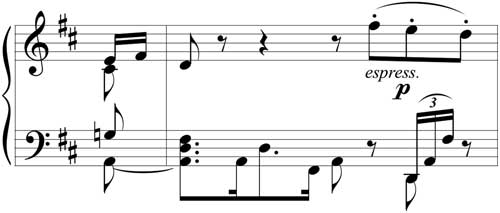
Bennett, Study, Op. 11 No. 5, bars 34–35 in revised form (1851?)

If this is not original, where is its model? One feature probably did come from Mendelssohn. For a piano piece to have a separate introduction and conclusion, like a song, was a new idea, and seems to have originated in the Lieder ohne Worte; it is especially clear in Op. 19 No. 4.Footnote 31 But the further step of incorporating this introduction into the ‘song’ itself and changing its significance at the end seems to have been Bennett’s own idea. In its general style and harmonic unpredictability the piece is more suggestive of Schumann. There the influence may have gone in the opposite direction. The Six Studies were published in London in October 1835, and in Leipzig in December 1836.Footnote 32 Probably Bennett played them to his friend during his visit to Leipzig in the autumn and winter of 1836–1837. Schumann reviewed them in the Neue Zeitschrift für Musik on 11 August 1837. Echoes of No. 5 can be found in his G minor Sonata and C minor Fantasia.Footnote 33
The Six Studies were followed by Three Musical Sketches Op. 10 (1836), dedicated to another friend and contemporary, James W. Davison. They were Bennett’s first essay in illustrative piano music, depicting water in three forms: ‘The Lake’, ‘The Millstream’ and ‘The Fountain’. Perhaps for this reason they were by far the most successful of these early works, in Germany as well as England.Footnote 34 Geoffrey Bush said that he ‘personally … would willingly exchange them all for the first of the Three Impromptus, opus 12, Bennett’s next completed composition’, in which he drew attention to ‘the placing of the second subject in the tenor register, a very characteristic Bennett texture’.Footnote 35
The works considered so far were written primarily for Bennett’s English friends and admirers. By the time he went to Leipzig he had built up a firmly individual style. If there are any reminiscences of Mendelssohn, they are superficial. In his long visits to Leipzig between 1836 and 1842, he entered a much wider and more intense musical circle, with Mendelssohn as its acknowledged leader, and began to produce more ambitious works primarily for German consumption. The piano pieces he wrote in those years include, by general agreement, much of his best work.
The Sonata in F minor Op. 13 (1837), dedicated to Mendelssohn, for whom it was intended as a wedding present, and the Fantasia Op. 16 (also 1837), dedicated to Schumann for his personal delight, were published by Franz Kistner of Leipzig. The English editions a few years later were not authorized by the composer.Footnote 36 Geoffrey Bush chose the sonata as the first of ‘the four works on which his reputation as a composer for solo piano must ultimately depend’, and its first movement as the one to demonstrate Bennett’s particular kind of genius:
Previous works had already revealed Bennett’s understanding of the instrument and grasp of design, though never on so large a scale as in this sonata. But the power and depth of musical thought are altogether new, and so are the sustained concentration and seriousness of purpose.Footnote 37
The sonata has plenty of original ideas, some of which are pointed out by Peter Horton.Footnote 38 One is the cyclic device of recalling the conclusion of the first movement at the end of the last, forging an overall frame that transcends the individual movements, and anticipating Brahms’s Deutsche Requiem by some three decades (I am not suggesting any influence there!). At the same time, this is the first of Bennett’s works that seems profoundly influenced by Mendelssohn, as is generally agreed.Footnote 39 For me this is especially true of the second-subject material in the first movement, marked ‘Cantabile’. It seems possible that he moved in that direction, consciously or otherwise, to show his love and respect for Mendelssohn on the occasion of his marriage.
Larry Todd goes a step further and suggests that the sonata was planned as a conscious tribute to Mendelssohn on his marriage. He points to brief passages in the third movement, suggestively titled ‘Serenata’, where the bass engages in duet-like passages with the treble, an idea that may have been suggested by Mendelssohn’s ‘Duetto’ for piano solo (Lied ohne Worte Op. 38 No. 6).Footnote 40 Todd has found two other passages in the sonata that are indeed similar to phrases in Lieder ohne Worte. Less convincing is his theory that the alternation between F major and minor, found throughout the sonata, is meant to represent ‘masculine and feminine characters’ and hence allows one ‘to read into the sonata a quasi-narrative of Felix’s and Cecile’s relationship’. He suggests that the four major-key principal themes are ‘at once tonally secure, harmonically centred and consonant, as if resolving the melodic, harmonic and rhythmic dissonances of the [three] minor-key counterparts’, and hence characterize a woman. But as regards tonal security, of the three minor-key themes he cites as typically male, one, the theme of the Scherzo (his Example 5.5b), begins with an eight-bar phrase ending on a perfect cadence in the tonic key, F minor, and continues with an extended version of the same phrase leading to a perfect cadence in the dominant key: this could hardly be more ‘tonally secure’.Footnote 41 Another (his Example 5.5c), the opening theme of the Finale, is also in a perfectly conventional form ending with a V–I cadence on the tonic. In support of this doubtful claim of a deliberate tribute, Todd further suggests that Bennett ‘goes to the trouble’ of marking passages ‘Maggiore’ and ‘Minore’, ‘as if to draw our attention to the modal shift’. But this was a common procedure of the time, simply drawing the player’s attention to a change of key signature when the keynote remained the same.Footnote 42
The Fantasia is another sonata in all but name, but is much more melodious: as Schumann said in his review, it is ‘teeming with lovely melodies, and as full of warbling as a bush alive with nightingales’.Footnote 43 Its opening tune may have been the germ of Schumann’s Novelette No. 7 in the same key, composed in 1838.Footnote 44 Its many beauties have been praised and described by Bush, Horton and others, and I will not repeat them here; no one has singled it out as a repository of Mendelssohnian influence.
Bennett’s Three Romances Op. 14, were also published in Leipzig in 1837, but in this case he supervised a simultaneous publication by Coventry & Hollier in London. The differing policy suggests that he considered them more suited his English public than longer, more serious works such as the Sonata and Fantasia, as Peter Horton has suggested.Footnote 45 The Musical World would comment a few years later:
The sonata … appears to be going out of date … A young musician not seldom begins his career with ‘a grand sonata’, with all the four movements unusually long, which, for want of encouragement, he prints at his own expense. Finding that it does not sell, … he … at once sets to work on capriccios, fantasias, romances, sketches, songs without words, and whatever he may consider the most marketable commodity.Footnote 46
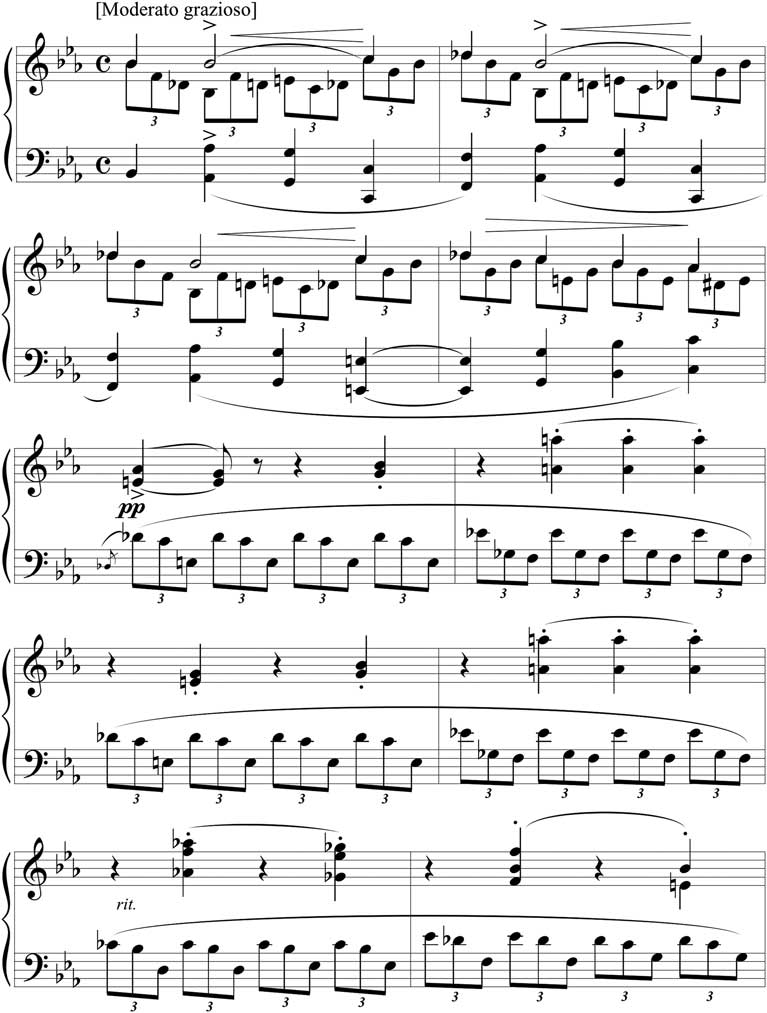
Schumann at this time was a champion of the sonata and other large traditional forms. Whether this was wise in Bennett’s case (or in Chopin’s, or, indeed, in his own) is a debatable point. But the three Romances certainly show Bennett’s gifts at a high level. Schumann called them ‘a great step in advance as regards deep, even strange, harmonic combinations, and a bold, broad construction; resembling the earlier works in a rich flowing melody, and in the predominance of the melody in the upper part, but excelling them in their highly impassioned character.’Footnote 47 Nos 1 and 3 are impassioned indeed, in rapid compound time and in minor mode. No. 2, in E♭, is a peaceful contrast with a general resemblance to the Lieder ohne Worte. Larry Todd has convincingly identified the particular influence of Op. 30 No. 1, on the opening, but, as he adds, ‘such an appraisal would not do justice to the subtle beauties of Bennett’s composition that Schumann detected, “the ever newly harmonized beginning of the melody and the magnificent deep basses”’. Example 2 shows a distinctly un-Mendelssohnian passage from the contrasting middle section of the piece. No. 3 reaches an extraordinarily passionate climax in its coda: as Bush puts it (quoting Mendelssohn), it is ‘Bennett, all Bennett’.Footnote 48
Bennett, Romance Op. 14 No. 2, bars 49–58

His next major work was the Suite de Pièces Op. 24 (1841), dedicated to Lucy Anderson, a leading pianist of the day. The six pieces in various forms and keys not only extend some of the characteristic traits he had already developed, but also add suggestions of a new influence reflecting his recent studies of Bach and Scarlatti, a point noted by Schumann as well as contemporary English critics.Footnote 49 As Bush pointed out, ‘in most of the six movements the composer tackles problems he never attempted before; where he covers old ground there are everywhere immense gains due to greater austerity of style and compression of thought’.Footnote 50 It is generally agreed that the last piece is the finest. In Peter Horton’s words,
From its powerful opening, with the dissonant descending bass line providing a solid foundation for a swirling mass of scales and arpeggios, it exudes an exhilarating strength of purpose, reinforced by its textual vitality and in no way lessened by the gentler second subject (marked ‘molto legato’) of its sonata-form structure.Footnote 51
It has been generally considered that the Suite de Pièces represents the end of Bennett’s most productive period as a composer, and that he was never able to recover the energy and fertility of his youth. Indeed Bush went so far as to ask ‘Why did Bennett give up being a composer at the age of twenty-eight?’Footnote 52 The reasons for the undoubted decline in his productivity have been discussed by many writers, and are beyond the scope of this article. As far as piano pieces are concerned, however, there were several honourable exceptions that do not deserve to be ignored. The Preludes and Lessons Op. 33 (1853) show Bennett at his epigrammatic best. The Toccata Op. 38 (1854) (see Example 6f below) successfully continued his ‘neo-baroque’ idiom and his resistance to the sentimentality that was prevailing in so much English music of the time. His plan to write a series of pieces named after the months of the year in 1856 yielded only two completed pieces, January and February,Footnote 53 but they are original in form and powerful in feeling, coming closer to Brahms than anything else of Bennett’s. They were published only after the composer’s death.
Finally, there is one major work that is isolated in time, character and style: the sonata ‘Die Jungfrau von Orleans’ Op. 46 (1873). ‘A new work by Sir W. Sterndale Bennett – unquestionably the greatest of living English composers – cannot be otherwise than in the highest degree welcome’, announced The Monthly Musical Record,Footnote 54 and it was indeed taken up by several leading pianists of the day.Footnote 55 It was his only serious attempt at programme music.Footnote 56 As the reviewer said,
The subject of Joan of Arc is an admirable one for musical portrayal, though it treats of one of the blackest pages of English history. One may feel some regret that England’s disgrace should thus be perpetuated by music, but the beauty and interest of Bennett’s work fully atone for any such regret.
In fact there is nothing in the four-movement sonata that depicts specific events of Joan’s life or death. Perhaps the subject was too ambitious for a composer with so little experience of music as a dramatic medium. The first movement, ‘In the Fields’, is a charmingly pastoral allusion to Joan’s innocent youth. Only the second movement, ‘In the Field’, in strict sonata form but with bold modulations, comes anywhere near evoking the horror of the story. It suggests the threat of war with trumpet calls and marches, and the pain of battle and death with some of Bennett’s fiercest chromaticisms and his old fondness for diminished sevenths. Nobody has suggested Mendelssohn’s influence here. On the contrary, ‘In the Field’ reminded Newman of the ‘Marche au supplice’ in Berlioz’s Symphonie fantastique, a work Bennett probably never heard.Footnote 57 Newman went on to discuss Bennett’s models more generally:
His style is less like Mendelssohn’s, in spite of frequent statements to the contrary, and more like that of Spohr, whom he met and admired, with some hints, too, of the styles of Mozart, Hummel, and Dussek, whose music had made a deep impression on him, and of Moscheles, who took an understandable liking to Bennett’s music.Footnote 58
Harmonic Traits in the Piano Works
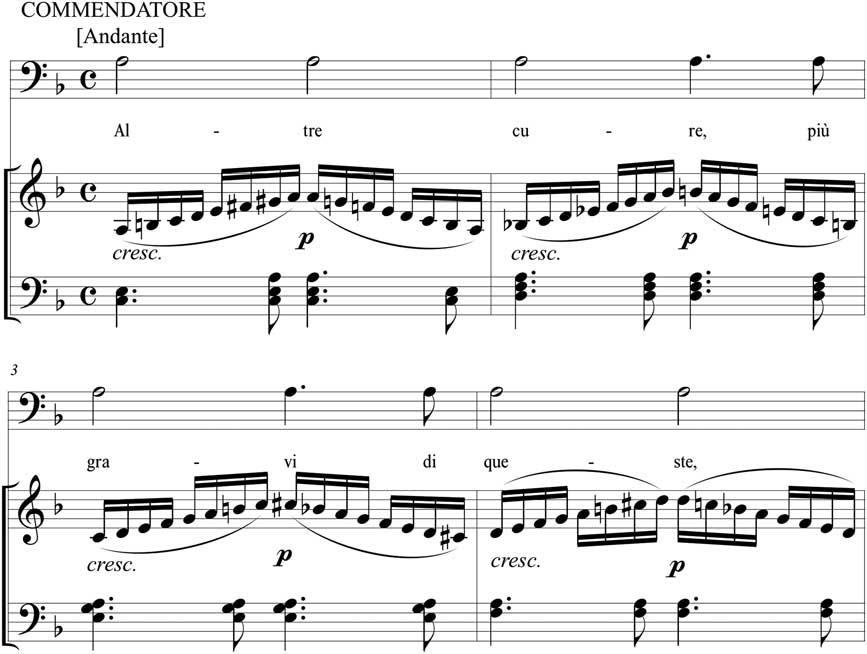
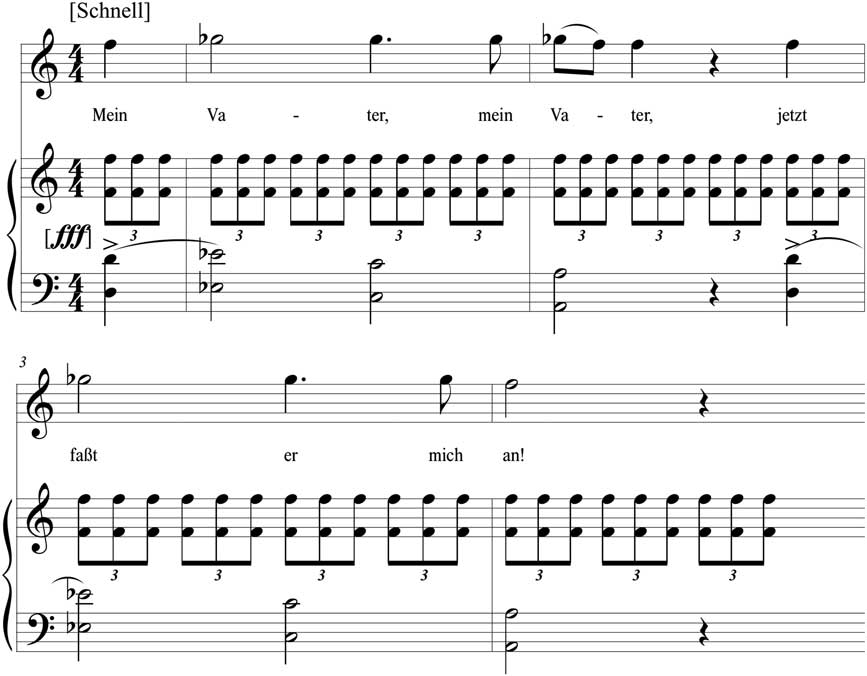
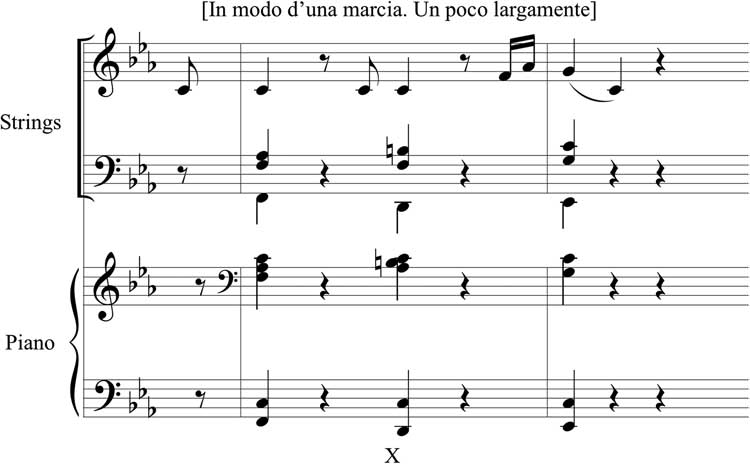
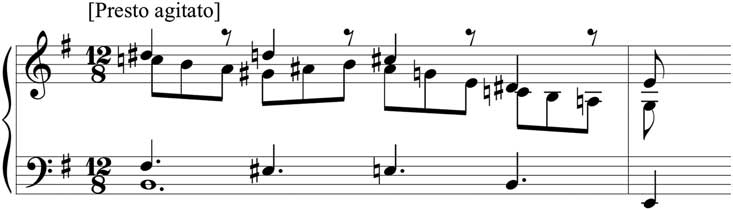
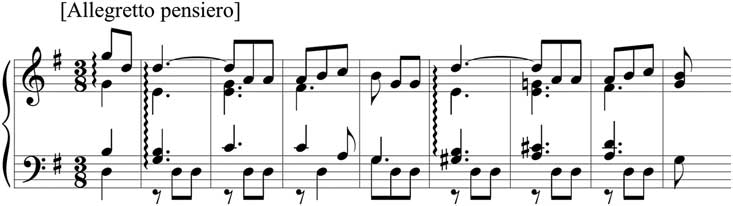
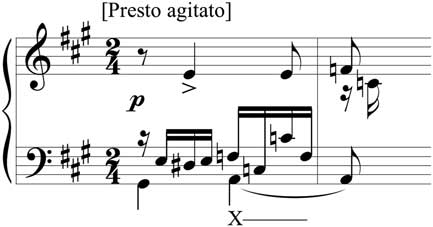
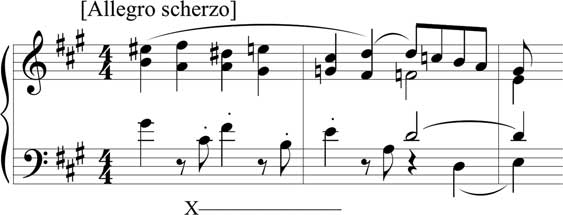
I will now identify some specific harmonic traits that are found in several of Bennett’s piano pieces and that do not appear to derive from Mendelssohn or any other contemporary source.Footnote 59 One of the most striking is the inverted pedal. Of course, he did not invent the device. Two of the most famous instances are shown in Examples 3a and 3b, both depicting terror. In that context the device was employed prominently, as a rhetorical gesture. Schumann would offer another extreme case in his Piano Quintet Op. 44 (1842). Henry Chorley, music critic of The Athenaeum, is said to have walked out of any concert that included the quintet, immediately before the movement concerned, to express his opposition to the chord marked X in Example 4.Footnote 60
Mozart, Don Giovanni, Act II Finale, bars 462–465.

Schubert, Erlkönig, bars 123–126

Schumann, Piano Quintet Op. 44, 2nd movement, bars 7–8

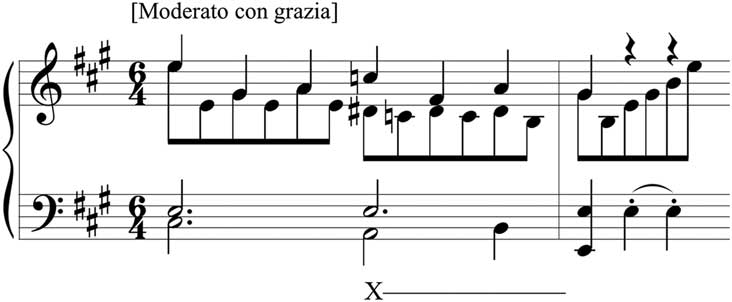
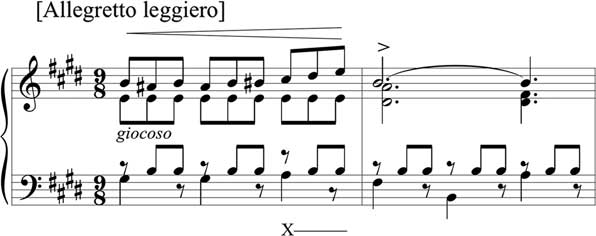
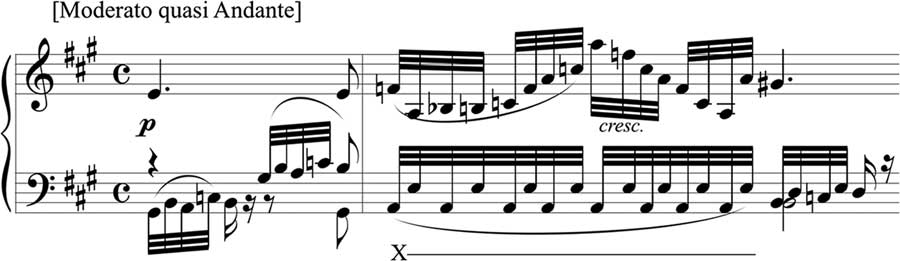
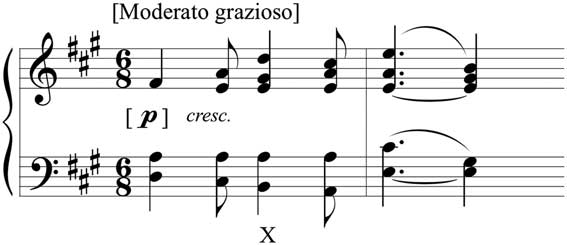
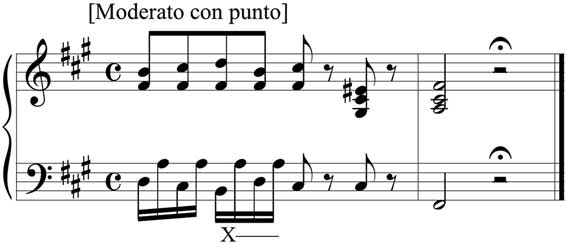
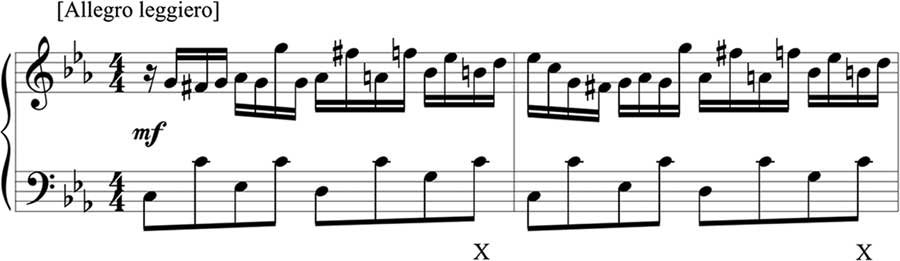
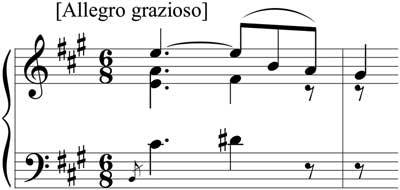
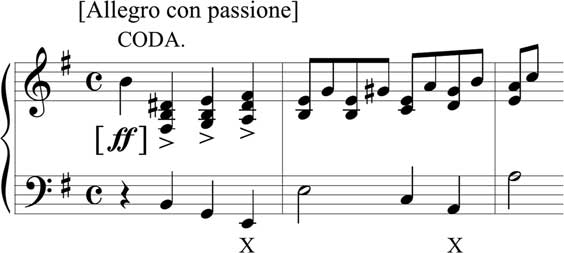
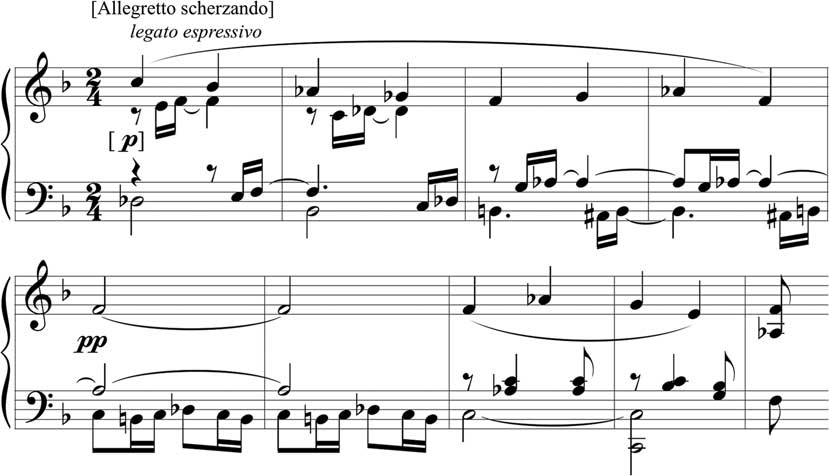
Bennett occasionally wrote a prominent inverted pedal of this type (Example 5). But his more characteristic usage arises in a quietly contrapuntal way, from the tenacious refusal of an inner part to give up its note: see Example 6 (a–f), where the inverted pedal is marked X in each case. It may be a tonic, dominant, or mediant, and is most often in the tenor register. In 6 (f) it is given added pungency by the chromatic counterpoint preceding it. The fleeting but novel effect of these harmonies, which may have no exact parallel in the work of any other composer, probably passed unnoticed at the time except by the keenest musical ear; and those who did notice it may have found it puzzling or unsatisfactory. To our ears it can provide an astringency which is a welcome contrast to the over-sweetness that was beginning to creep into music at this period.
Bennett, Preludes and Lessons Op. 53 (1851–1853) No. 24, ending

Bennett, Fantasia Op. 16 (1837), bars 75–76

Bennett, Suite de Pièces Op. 24 (1841) No. 2, bars 9–10

Bennett, Suite de Pièces, Op. 24 (1841) No. 4, bars 29–30

Bennett, Introduzione e Pastorale, Op. 28 No. 1 (1846), bars 7–8

Bennett, Preludes and Lessons, Lesson 8, ending

Bennett, Toccata Op. 38 (1854), bars 1–2

Such a contrast between original and even startling harmonies and their diffident and unemphatic presentation springs from the depths of Bennett’s character. Throughout his life he scorned to advertise or even emphasize his unusual qualities. He preferred to polish and refine them until they were beyond criticism; the most sensitive of musicians might then appreciate them, but for those whose abilities were on a lower level, he was not prepared to make the slightest concession. Consequently, he was esteemed above his contemporaries by a few gifted musicians, but entirely failed (and hardly even tried) to capture the blunter imagination of the broad public. For instance, he declined, unlike many of his fellows, to write for the theatre, or to boost his income by publishing popular ballads, dances, or arrangements of popular songs.
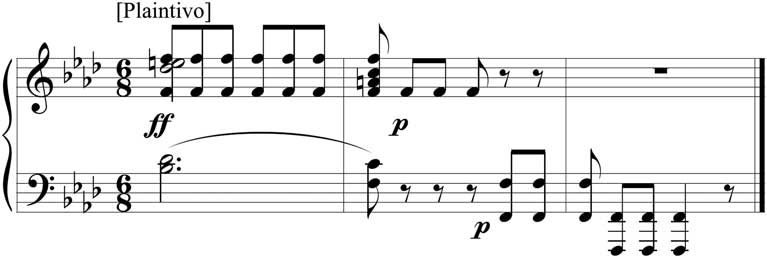
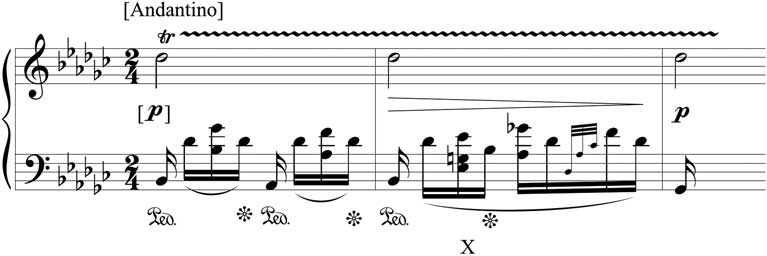
Example 7 is an extension of the inverted pedal principle in which, as a kind of tour de force, a trill on one note is maintained on the right hand until the end. There is an interesting moment (marked X in the example) when the movement of the harmonies has reached a point where a resolution of the D♭ on to a C♮ has become a necessity; but since a C♮ would conflict violently (and, as a resolution, intolerably) with the trill on D♭, Bennett evades it, giving a chord (A♭ and G♭) which sounds as if it might have contained the C♮ we expect, until we find that it has an altogether different significance, but by the time we realize we have been tricked, the harmony has moved smoothly back to the tonic. This is a subtle piece of harmonic manipulation.
Bennett, Preludes and Lessons, Lesson 27, bars 3–5

The evasion of a resolution of the dominant seventh illustrated in Example 7 (and there explained by the inverted pedal) is another typical feature of Bennett’s harmony which his contemporaries found difficult. Example 8 gives examples of this that cannot be so readily explained. Where, for instance, is the resolution of the chord on the third beat of 8a, the E in 8b, or the D (especially the second time) in 8c? The tendency here is to resolve whole chords rather than the individual parts of which they are composed; or, in other words, to treat the piano as the purely harmonic instrument that it basically is. This practice would become commonplace in the music of Brahms and later composers. But to unaccustomed ears it produced a strong feeling of ellipsis.
Bennett, ‘The Millstream’ Op. 10 No. 2, bar 53

Bennett, Allegro grazioso Op. 18 (1838), bar 60

Bennett, Rondeau ‘Pas triste, pas gai’ Op. 34 (1834), bars 71–79

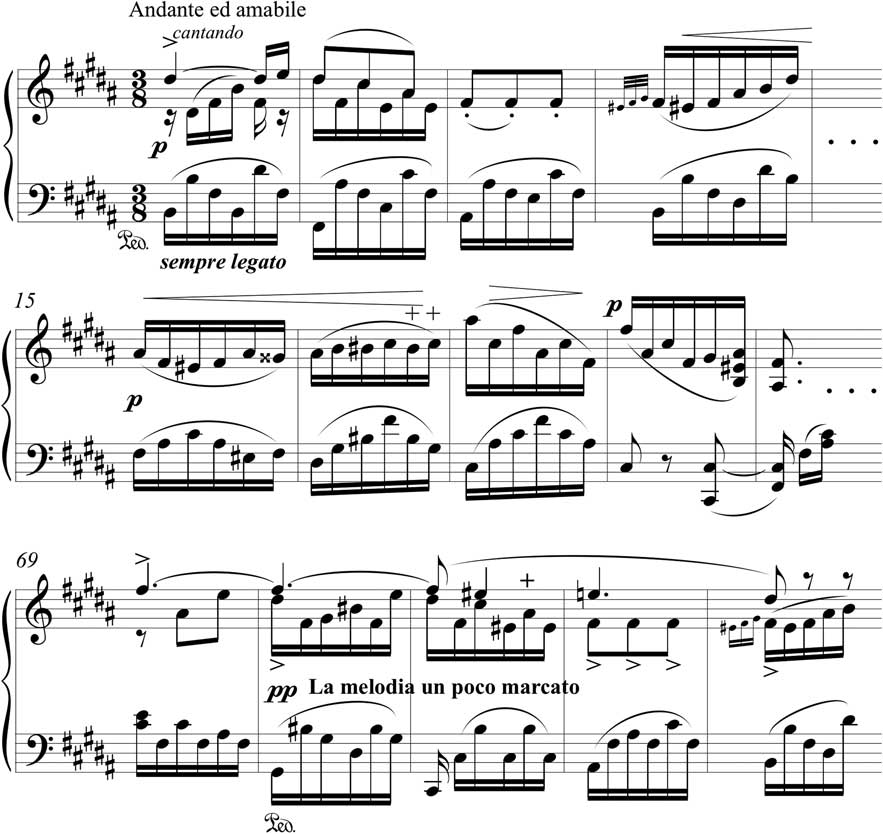
In one case, this kind of writing earned Bennett the rebuke of no less a musician than Charles Gounod. The charming Romance, ‘Genevieve’ (1840),Footnote 61 which in some respects can be likened to a Lied ohne Worte, was one of Bennett’s most popular pieces and one that he frequently performed himself (see Example 9). When in 1873 his friend and champion James W. Davison sent Gounod a copy of the piece, Gounod, in acknowledging the gift, specifically objected to the notes he marked + in bar 16: ‘Aucune théorie de notes de passage ne peut légitimer la 5me et 6me double-croches de cette mesure’.Footnote 62 He thought they should be replaced by A♯, B♯. What to Gounod was forbidden ground may be, for us, a sign of forward-looking originality. Later in the piece, at bar 70, Bennett recapitulated the main tune with a descant, and with varied harmonies of the kind Schumann had pointed out as characteristic of his style. To make quite sure nobody missed it, he drew attention to the presence of the tune in this disguised form. In regard to the A♯ marked + in bar 72, Gounod said, with coy self-deprecation, ‘c’est un peu au dessus de mes facultés, et cela ne me produit pas le soulagement que vous me souhaitez après des études plus sévères.’Footnote 63 All this is clear evidence that Bennett in 1840 had been pushing at the accepted rules of harmony and introducing effects that sounded new to a sophisticated composer more than thirty years later.
Bennett, ‘Genevieve’ (1840), excerpts

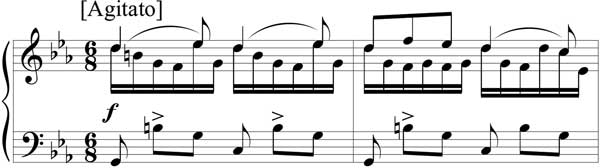
Another characteristic which is often encountered in Bennett’s music is what might be termed harmonic anticipation. Several cases are shown in Example 10. Sometimes a new chord appears before the melody reaches the note which it logically harmonizes (Example 10a); or the bass alone may anticipate, while the inner parts move at the same time as the melody (Example 10b). The player’s hands seem to be out of step, especially when the passages are played quickly. In (Example 10c) it is the bass that seems to lag behind, to the extent of a crotchet. Example 10d shows the complexity, or deliberate ambiguity, of Bennett’s harmonic thinking. The repeated figure (B♮, G) in the left hand looks and sounds like a simple arpeggiated dominant chord, as it is in the first half of each bar, but the shift of the bass to C turns the G into part of a tonic chord – ambiguously in the first bar, more clearly in the second, forming a kind of musical pun.
Bennett, Suite de Pièces Op. 24 (1841) No. 5, bars 56–57

Bennett, Tema e Variazioni, Op. 31 (1850) Finale, bars 38–40

Bennett, Capriccio in A minor Op. 28 No. 3 (1853), bars 37–9

Bennett, Romance Op. 14 No. 3 (1837), bars 11–12

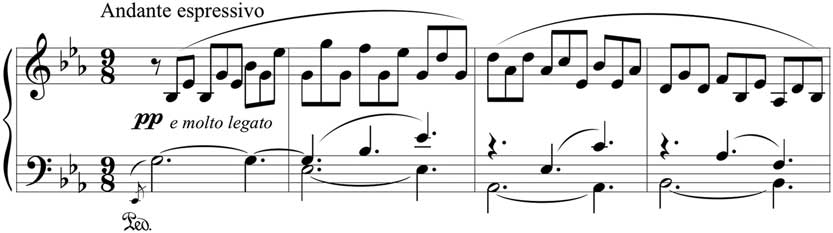
Example 11 gives various further illustrations of the individuality of Bennett’s style. 11a, from his earliest published piano piece, is influenced by Mozart’s pathetic use of chromatic melody and harmony, including the Neapolitan sixth, followed by a Mozartian cadence, but the counterpoint is still unmistakably in Bennett’s own style. The next example is very characteristic of Bennett at his most lyrical and pianistic, with a gentle conflict of rhythm between the melody in crotchets and the accompaniment in six dotted crotchets, divided into two groups of three: in performance the effect is more one of tempo rubato than of syncopation. Example 11c is the opening of an attractive Capriccio in A minor from his later period. The piece is in rondo form, and keeps up a rather fussy quaver movement until the beginning of this example, where a small climax is reached. Then the motion is suddenly arrested with a series of slow descending chords. Instead of the chromatic sequence that might be expected, they are modal in character. Bennett’s restraint here gives just the right degree of surprise and novelty. Example 11d, from another late piece, takes an unexpected turn of a very different kind. The D at the beginning of the second complete bar is a dissonance with a delayed resolution, but when the phrase is almost exactly repeated, the D becomes part of the main harmony. Such small touches makes Bennett’s piano music stand out unmistakably from that of his contemporaries, both English and foreign.
Bennett, Capriccio in D minor Op. 2, bars 55–63

Bennett, L’Amabile e L’Apassionata Op. 29 (1844?), bars 1–4

Bennett, Capriccio in A minor Op. 28 No. 3 (1853), bars 98–105

Bennett, Rondeau à la Polonaise Op. 37 (1855), bars 8–12

In my opinion Schumann, Statham, Ouseley, Bush and Horton are right: Sterndale Bennett was a highly original composer. He was writing at the peak of the piano’s development and popularity in Europe. In the face of unparalleled competition and considerable prejudice, he managed to develop and maintain a distinct and characteristic style, founded on the Austro-German classical tradition and the London pianoforte school headed by Clementi and Cramer. He accepted some ideas from Mendelssohn, but never allowed them to overwhelm his own personality.