INTRODUCTION
The whale shark, Rhincodon typus Smith 1828, inhabits warm temperate and tropical waters (30°N to 35°S) worldwide including coastal, neritic and pelagic habitat (Colman, Reference Colman1997). However, whale sharks are scarce, their geographical distribution and biology is poorly-known and they are susceptible to worldwide exploitation ranging from incidental bycatch in fisheries to directed capture in some regions (Alava et al., Reference Alava, Yaptinchay, Acogido, Dolar, Wood and Leatherwood1997; Colman, Reference Colman1997; Compagno, Reference Compagno2001; Hanfee, Reference Hanfee2001). Consequently, the whale shark is listed as Vulnerable by the International Union for Conservation of Nature and Natural Resources (IUCN, 2007).
Whale shark occurrence has been well-documented in certain geographical regions, for example in Western Australia, the Indian Ocean and the Sea of Cortez, where research has focused primarily on coastal areas where whale sharks aggregate seasonally in response to fish or invertebrate spawning events (Colman, Reference Colman1997). However, their occurrence in oceanic waters worldwide remains poorly documented, and satellite tracking studies are just starting to reveal the extensive migrations taken across ocean basins by some individuals (e.g. Eckert & Stewart, Reference Eckert and Stewart2001).
There are relatively few records of whale sharks in the Atlantic Ocean, particularly off tropical West Africa where little dedicated marine research occurs. An 11.5 m whale shark stranded in Angola during October 1986 (Zhardim et al., Reference Zhardim, Nesterov and Pereira1998), although the location described by the authors (13°46′S 8°52′E) is offshore and must be incorrect. Compagno (Reference Compagno2001) mentions a 15.9 m stranded specimen also from Angola. Zhardim et al. (Reference Zhardim, Nesterov and Pereira1998) noted reports from fishermen of two whale sharks observed close to the Angolan coast during October 1986.
Elsewhere off West Africa the occurrence of whale sharks has been documented in oceanic waters during fishing operations. Cayre et al. (Reference Cayre, Amon Kothias, Diouf, Stretta, Fonteneau and Marcille1988) describe 869 sets made on whale sharks by tuna purse seiners operating from Côte d'Ivoire between 1976 and 1982, and Bard & Herve (Reference Bard and Herve1990) report 48 sets upon whale sharks by French and Spanish purse seiners operating out of Senegal and Côte d'Ivoire during the 1980s. Levenez et al. (Reference Levenez, Fonteneau and Regalado1980) noted that whale sharks were frequently seen during fishing operations in the waters west of Cap Lopez in Gabon. Wolfson (Reference Wolfson1983) describes a juvenile (<1 m length) specimen captured around 700 km south-west of Liberia in 1980 (Wolfson, Reference Wolfson1983; Figure 1) and a further two juvenile specimens are described as being captured in the Gulf of Guinea (although it is probable that they were taken well west of this region as delimited by the IHOFootnote 1). Kukuyev (Reference Kukuyev1996) reports a juvenile specimen captured seaward of the shelf-edge (>2000 m depth) off Sierra Leone, and another found in the stomach of a blue shark Prionace glauca in the mid-Atlantic (approximate catch positions shown in Figure 1). Consequently, although the occurrence of whale sharks has been documented in the West African region, information is at present limited to two strandings in Angola and several accounts of oceanic records originating from tuna-sets and bycatch.
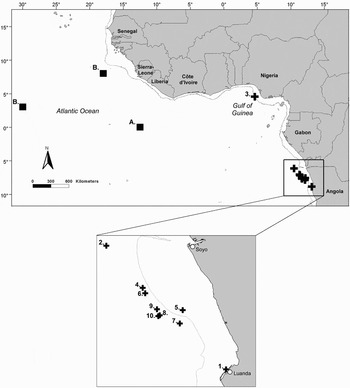
Location of whale shark Rhincodon typus records in tropical West African waters (bathymetry = 1000 m depth): 1–10, West African sighting records reported here; (A) Wolfson (Reference Wolfson1983); (B) Kukuyev (Reference Kukuyev1996).

The lack of verified sighting records of whale sharks off West Africa is surprising since the species is straightforward to identify at sea, being characterized by a large body size (reaching at least 12 m length), a broad and flattened head, three pronounced longitudinal dorsal ridges, a large dorsal fin with concave trailing edge and rounded tip and striking coloration featuring a dark grey body with rows of pale spots and stripes (Colman, Reference Colman1997). This paper describes ten whale shark sightings recorded off West Africa, confirming Nigeria as a range state for the species and providing novel information on their occurrence in Angolan and Nigerian waters.
MATERIALS AND METHODS
Whale shark records were reported incidentally from offshore platforms located in Angolan and Nigerian waters between 2004 and 2008. Nine records were either observed directly by the author, or were identified from photographs and descriptions submitted to the author in response to a general request to offshore installations for information on cetacean and turtle sightings in Angolan waters. A single record (off Nigeria) was reported to the Marine Conservation Society, Seychelles. When not available in the field, water depths were calculated from an electronic nautical chart.
RESULTS
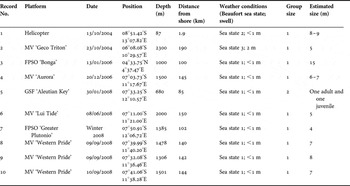
A total of nine whale shark records were reported from Angolan waters, and a single record offshore of Nigeria (Figure 1; Table 1). The records spanned a range of habitat types and water depths from the coast to oceanic areas.
Summary of whale shark Rhincodon typus records off Angola and Nigeria, 2004–2008.

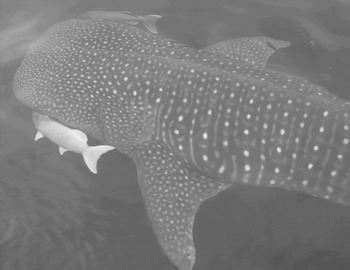
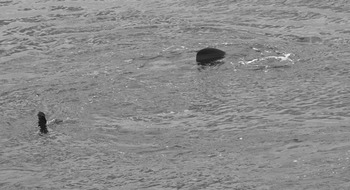
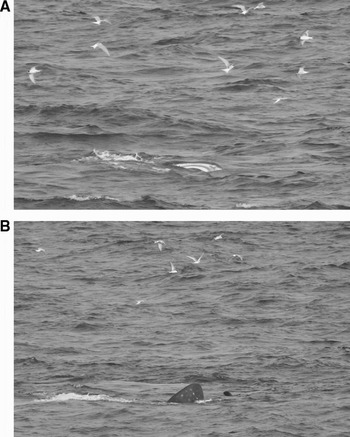
All observers reported key features including a large size, broad and flattened head, spotted coloration pattern, presence of dorsal ridges and a triangular, broad-based dorsal fin with a rounded tip. Most records (N = 7) were from ship or helicopter platforms and consequently were usually brief involving single animals swimming along at, or just below, the water surface past the survey platform. One whale shark, accompanied by remora (Remora spp.) and pilot fish (Naucrates ductor), swam repeatedly around a vessel which was drifting during engine repairs (Record 4; Figure 2). Another shark (Record 8; Figure 3) submerged suddenly in an apparent disturbance reaction to the proximity of a ship. Surface feeding on shoals of small bait fish was exhibited by one whale shark (Record 10) with the animal exhibiting frequent changes of direction and with its open mouth occasionally visible above the water (Figure 4). A large flock of terns (Sterna sp.) and several Sabine's gulls (Larus sabini) accompanied the shark, making shallow plunge-dives in pursuit of prey.
Whale shark (Rhincodon typus) observed off Angola on 20 December 2006 (photograph: crew of the ‘Aurora’).

The dorsal and caudal fins of a large whale shark (Rhincodon typus) recorded off Angola on 9 September 2008 (photograph: C.R. Weir).

A whale shark (Rhincodon typus) surface-feeding off Angola on 10 September 2008 showing (A) the mouth open at the surface, and (B) the characteristic broad rounded triangular dorsal fin with spotted coloration (photograph: C.R. Weir).

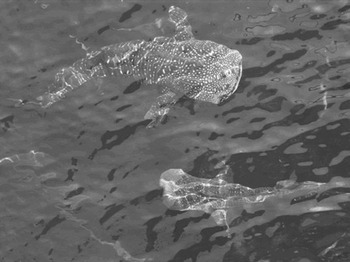
Three records were made from stationary offshore FPSOs (Table 1), allowing longer observation periods. One whale shark (Record 3) appeared from depth and made five passes of a platform, swimming alongside it in one direction and then turning to swim back again before slowly submerging out of sight. The shark had its mouth open and was presumed to be feeding. Two whale sharks (Record 5; Figure 5) spent five days swimming in proximity to a platform, accompanied by remora, pilot fish and large schools of yellowtail kingfish (Seriola lalandi) and presumably feeding. A further shark (Record 7) swam slowly in circles at the surface around an FPSO and then dived underneath the platform and out of sight.
Two whale sharks (Rhincodon typus) observed from the GSF ‘Aleutian Key’ off Angola on 30 January 2008 (photograph: Graham B. Jolly).

DISCUSSION
Despite their distinctive appearance the distribution and biology of whale sharks remains poorly known, particularly in oceanic waters. The ten records presented here provide important information on the occurrence of this species in the eastern Atlantic Ocean, and the first verified at-sea sightings for the West Africa region. In addition to the beach strandings reported by Zhardim et al. (Reference Zhardim, Nesterov and Pereira1998) and Compagno (Reference Compagno2001) these sightings support Angola as a range state for whale sharks, and also verify Nigeria as a range state.
The ten whale shark records were predominantly from shelf-edge and oceanic habitats, with only a single record from the continental shelf. Eight of the records were from oceanic habitat in water depths exceeding 1000 m; however, this more likely represents the location of the observers (on deep-water offshore platforms) rather than necessarily indicating a preference by whale sharks for deep-water habitat. Anecdotal reports of whale sharks observed close to the Angolan coast (Zhardim et al., Reference Zhardim, Nesterov and Pereira1998) and bycatch of juvenile whale sharks from the mid-Atlantic (Wolfson, Reference Wolfson1983) suggest that the species occupies West African waters extending from the immediate coast to deep, oceanic areas.
Whale shark populations often exhibit spatial and seasonal segregation, with animals of similar size and sex occurring in the same areas and along similar migration routes (Norman, Reference Norman1999; Eckert & Stewart, Reference Eckert and Stewart2001). Of the ten records reported here, most sightings (N = 8) were of whale sharks estimated to be in the 5–7 m length-range which is notably smaller than the 12 m length this species is known to attain. It is unclear whether this size-range is particular to the water depth-range examined, but the variable seasonality to the records suggests that it is not the result of seasonal segregation.
The ten records reported originate from at least five different months of the year, although there is some evidence for seasonality since the majority (N = 8) of the records were recorded during the spring and summer months between September and January. However, two records originate from the winter and there were anecdotal sightings from the GSF ‘Aleutian Key’ platform during April and May 2008 (Graham Jolly, personal communication) suggesting that whale sharks also occur off Angola during the autumn and winter months. Zhardim et al. (Reference Zhardim, Nesterov and Pereira1998) describe two records and one stranding for October, citing anecdotal evidence from fishermen that whale sharks show highest occurrence in Angolan coastal waters at this time of year. Seasonal inshore–offshore movements or latitudinal migrations may therefore occur, but the data support a year-round occurrence of whale sharks in the larger region at least in offshore waters.
The distribution and abundance of whale sharks is known to vary with environmental factors such as sea surface temperature, current and primary productivity (Colman, Reference Colman1997; Wilson et al., Reference Wilson, Taylor and Pearce2001; Sleeman et al., Reference Sleeman, Meekan, Wilson, Jenner, Jenner, Boggs, Steinberg and Bradshaw2007). Angola has a complex oceanography dominated by the Benguela and Angolan currents (Hardman-Mountford et al., Reference Hardman-Mountford, Richardson, Agenbag, Hagen, Nykjaer, Shillington and Villacastin2003) which converge between 17°S and 13°S (depending on season) to form an area of high primary productivity at the Angola–Benguela front (Moroshkin et al., Reference Moroshkin, Bubnov and Bulatov1970). Productivity is also high off northern Angola due to freshwater outflow from the Congo River which can cause peaks in primary productivity around 150–200 km from the river mouth during the monsoon season (van Bennekom & Berger, Reference van Bennekom and Berger1984). Whale sharks are filter-feeders, taking a range of planktonic and nektonic prey such as crustaceans, cephalopods and small schooling fish (Nelson & Eckert, Reference Nelson and Eckert2007; Stevens, Reference Stevens2007), and numerous studies have related the occurrence of whale sharks to areas of increased primary productivity and spawning nekton (see reviews by Colman, Reference Colman1997; Compagno, Reference Compagno2001). Since such productive oceanographic features show marked spatio-temporal variation in Angolan waters, it might be expected that whale shark occurrence in the region will vary accordingly. Zhardim et al. (Reference Zhardim, Nesterov and Pereira1998) suggest that a seasonal appearance of whale sharks in Angolan coastal waters may be linked with the occurrence of dense shoals of sardines (Sardinella spp.).
On a smaller-scale, fixed offshore platforms can act as artificial reef systems producing high densities of benthic organisms and fish (Wolfson et al., Reference Wolfson, Van Blaricom, Davis and Lewbel1979; Keenan et al., Reference Keenan, Benfield and Blackburn2007), with a corresponding increase in foraging opportunities for whale sharks which may explain the reports of these animals around offshore platforms in Angolan and Nigerian waters.
To conclude, the scarcity of records of whale sharks from the West Africa region is most likely a result of an absence of observers and reporting schemes. The establishment of regional reporting schemes should be encouraged to increase the number of confirmed West African range states of this vulnerable species and further understanding of whale shark distribution and occurrence in the region. A regional programme of research on whale sharks is particularly desirable for West African waters, because of wide scale slaughter of the species known to occur along the entire coast (Anonymous, Reference Perrin2000).
ACKNOWLEDGEMENTS
Thanks to Terry Hodder (Bonga FPSO), David Rowat (Marine Conservation Society, Seychelles), the crew of the ‘Aurora’, Graham B. Jolly (GSF Aleutian Key), Jack Stephens (Lui Tide) and Daryl Leach (FPSO ‘Greater Plutonio’) for submitting data reported here. My thanks to BP Exploration (Angola) Ltd, their partners and Sonangol for permission to publish shark observations from Block 31, and to Total E&P Angola and their partners for permission to publish sightings from Blocks 17 and 32. Warren Potts and Pete Britz of Rhodes University assisted with identifying fish associated with whale sharks. David Rowat made useful comments on a draft of this manuscript.