Implications
The use of whole cottonseed compared with sunflower seed in the ration of fattening bulls did not affect rumen fermentation, but resulted in a more saturated fatty acid profile in muscle and subcutaneous fat, and lower proportions of CLA. Muscle of Thai Native bulls had a higher proportion of polyunsaturated fatty acids compared with Holstein bulls.
Introduction
The production of beef is an important agricultural activity in Thailand and the economic return of beef production is primarily determined by growth rate and feed conversion ratio. It is well known that the energy density of the ration is of critical importance to obtain maximum growth rates. Therefore, the use of supplemental fat is of great interest. With respect to the source of supplemental fat, research over the last decades has not only focused on animal performances but also on the potential to manipulate the fatty acid (FA) profile of meat because of its interest for consumer’s health (Givens et al., Reference Goering and Van Soest2006; Shingfield et al., Reference Shingfield, Bonnet and Scollan2013; Scollan et al., Reference Schmitz and Ecker2014). Therefore, fat sources rich in polyunsaturated acids (PUFA) were extensively studied in livestock, including beef cattle (Raes et al., Reference Raes, De Smet and Demeyer2004; Scollan et al., Reference Schmitz and Ecker2014).
Sunflower seed (SFS) and whole cottonseed (WCS) are widely used to increase the energy density of beef rations (Moore et al., Reference Moore, Swingle and Hale1986). Both SFS and WCS are rich in linoleic acid and the feeding of these oil seeds is known to increase the PUFA content of meat and adipose tissue (Mir et al., Reference Mir, Dugan, He, Entz and Yip2008). However, Gomez et al. (Reference Herdmann, Martin, Nuernberg, Dannenberger and Nuernberg2003) reported that cottonseed oil contains sterculic acid, which is a potent inhibitor of stearoyl-CoA desaturase (SCD). SCD is the rate-limiting enzyme catalyzing the biosynthesis of monounsaturated fatty acids (MUFA), mainly oleic acid (C18:1) and palmitoleic acid (C16:1), from saturated fatty acids (SFA) that are either synthesized de novo or derived from the diet. Consequently, incorporation of WCS in beef rations may result in lower tissue MUFA contents. In contrast, Archibeque et al. (Reference Archibeque, Lunt, Gilbert, Tume and Smith2005) could not demonstrate a significant effect of WCS on both SCD activity and the oleic acid content of adipose tissue in beef cattle. The lack of effect of WCS is difficult to explain but may be related to the fact that PUFA contents of the experimental rations were not constant thereby complicating interpretation of the data (Archibeque et al., Reference Archibeque, Lunt, Gilbert, Tume and Smith2005). Indeed, PUFA have a down-regulating effect on the activity of SCD (Ntambi, Reference Ntambi1999). Both n-3 and n-6 PUFA may depress SCD activity as shown in vitro in hepatocytes (Velliquette et al., Reference Velliquette, Gillies, Kris-Etherton, Green, Zhao and Vanden Heuvel2009) and adipocytes (Sessler et al., Reference Sessler, Kaur, Palta and Ntambi1996). In beef cattle, SCD gene expression in muscle and SCD protein expression and enzyme activity in muscle and adipose tissue was significantly lower on a diet rich in n-3 PUFA compared with n-6 PUFA (Herdmann et al., Reference Hiller, Herdmann and Nuernberg2010; Hiller et al., Reference Huerta-Leidenz, Savell, Lunt, Baker, Pelton and Smith2011). In general, dietary n-3 PUFA appear to be more potent inhibitors of lipogenesis than n-6 PUFA (Schmitz and Ecker, Reference Scollan, Dannenberger, Nuernberg, Richardson, MacKintosh, Hocquette and Moloney2008). However, the regulation of SCD is complex and affected by several dietary and other factors and hormones (Ntambi and Miyazaki, Reference Ntambi and Miyazakib2004). Knockout mouse models have also revealed that SCD deficiency induces numerous effects on various metabolic pathways, hence SCD is not only involved in lipogenesis (Ntambi and Miyazaki, Reference Ntambi and Miyazakib2004).
Apart from dietary factors, genetic factors are also known to affect the FA metabolism in beef (De Smet et al., Reference De Smet, Raes and Demeyer2004). For instance, Huerta-Leidenz et al. (Reference Givens, Kliem and Gibbs1993) reported that proportions of both MUFA and PUFA in adipose tissue were significantly greater in Bos indicus compared with Bos taurus cattle. Interestingly, Laborde et al. (Reference Laborde, Mandell, Tosh, Wilton and Buchanan-Smith2001) reported that the SFA content in Red Angus is higher than in Simmental because of a difference in SCD activity between the two breeds. Furthermore, De La Torre et al. (Reference De La Torre, Gruffat, Durand, Micol, Peyron, Scislowski and Bauchart2006) suggested that the difference in the proportion of CLA in meat from B. indicus compared with B. taurus cattle is caused by a difference in SCD activity. It might thus be speculated that there are differences in sensitivity between B. indicus and B. taurus breeds to the inhibitory effects of WCS feeding on SCD. It was therefore hypothesized that feeding WCS instead of SFS induces a shift in the FA profile towards lower proportions of MUFA in muscle and adipose tissue, and that this shift in FA profile would be more pronounced in Thai Native (B. indicus) compared with Holstein bulls (B. taurus).
Material and methods
Animals and experimental design
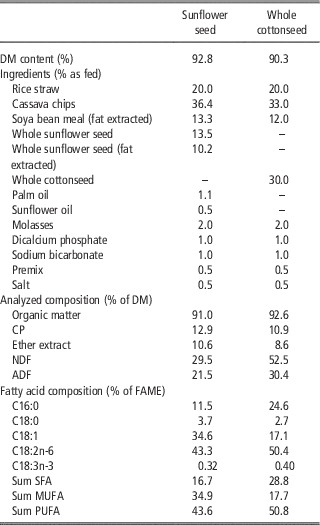
A total of 12 Thai Native and 12 Holstein bulls with mean age of 28.1 and 25.5 months, respectively, at the start of the experiment and mean BW of 147 and 222 kg, respectively, were used. The bulls had all a different sire and dam, and were obtained from the Department of Animal Science, Khon Kaen University, Khon Kaen and Nongpho Dairy Co-operative Ltd, Ratchaburi, Thailand, respectively. Upon arrival, the bulls were dewormed (Ivomec®; Merial Limited, Duluth, GA, USA), injected with a mixture of vitamins A, D and E (Phenix Pharmaceuticals; Antwerp, Belgium) and gradually adapted to the experimental rations for 1 month. The trial had a parallel, 2×2 factorial design and lasted 90 days (March to May 2011). Animals were allocated at random to the two experimental rations. The animals were penned individually and fed a total mixed ration (TMR) ad libitum containing either SFS or WCS (Table 1). The fat contents of the experimental rations ranged from 8.6% to 10.6%, but it was anticipated that the potential adverse effects of the high fat contents on fibre digestibility were limited because of the high concentrate-to-roughage ratio in all experimental rations (Kucuk et al., Reference Kucuk, Hess and Rule2004). The TMR was prepared daily and offered twice daily at 0630 and 1630 h in amounts to obtain ~10% of feed refusals. During the experiment, the animals were weighed monthly on 2 consecutive days. Mean values for the average, the minimum and the maximum daily ambient temperature (°C) in the Khon Kaen region were 25.1, 19.8 and 31.1, respectively for the first month of the trial, 28.6, 23.4 and 34.9 for the second month and 28.6, 24.7 and 34.0 for the third month, according to the Climatological Center of Thai Meteorological Department.
Ingredient and analyzed nutrient composition of the experimental total mixed rations

DM=dry matter; FAME=fatty acid methyl esters; SFA=saturated fatty acids; MUFA=monounsaturated fatty acids; PUFA=polyunsaturated acids.
Collection of samples
From each batch of TMR a sample of ~0.5%/batch was taken and stored at −20°C. Feed refusals were collected daily. Total collection of faeces was performed during the last 5 days of the experimental period for assessing digestibility. Feed and feed refusal samples and faeces were pooled and 10% subsamples were dried at 55°C for 48 h, ground and stored at −20°C until chemical analysis. Another subsample of the feeds, feed refusals and faeces were dried at 100°C for 24 h for dry matter (DM) determination.
Rumen fluid samples were collected, by means of a suction pump, 4 h after the morning feeding 5 days before the end of the experiment. Immediately after collection, pH of rumen fluid was recorded. Then, rumen fluid samples were filtered through four layers of cheesecloth and 5 ml of H2SO4 solution (1 M) was added to 50 ml of the filtered rumen fluid. Thereafter, the acidified rumen fluid was centrifuged at 16 000×g for 15 min and the supernatant was stored at −20°C until the analysis of short chain fatty acids (SCFA).
Blood samples were taken at day 30, 60 and 90 of the experimental period before the morning feeding. Blood was sampled from the jugular vein into evacuated heparinized tubes (Chengdu Rich Science Industry Co., Ltd, Sichuan, China). Blood samples were stored on ice for maximal 9 h. Then, the blood samples were centrifuged for 15 min at 2500×g, and the plasma was collected and stored at −20°C until analysis for FA composition.
The animals were slaughtered in a randomised order within 1 day at the Chiang Yun slaughterhouse, Department of Livestock Development. Animals were fasted for 24 h before slaughter. The transit time to the slaughterhouse was ~45 min. Dressing yield, loin eye area and visceral fat content were determined. A sample of longissimus dorsi (LD) muscle (~3 kg) and subcutaneous fat (~100 g) from the region of the 6th and 12th rib of the left side of the carcass was taken 1 h after slaughter. Tissue samples were freeze dried for FA analysis.
Chemical analysis
Nitrogen contents of feed and faecal samples were determined by the macro-Kjeldahl method (Association of Official Analytical Chemists, 2004); a factor of 6.25 was used to convert N into CP. Ether extracts (EE) of the feeds and faecal samples were prepared according to Association of Official Analytical Chemists (2004), and the crude fat residue was weighed. The crude ash content of the feeds was determined as described by Association of Official Analytical Chemists (2004). The NDF and ADF contents of the feed and faecal samples were determined after pre-treatment with amylase following methods described by Goering and Van Soest (Reference Gomez, Bauman, Ntambi and Fox1970).
Rumen fluid SCFA analysis
SCFA in rumen fluid were determined by means of GC (Shimadzu 2010; Shimadzu Corporation, 's-Hertogenbosch, The Netherlands) with a 30 m×0.25 mm ID×0.25 µm (film thickness) Nukol fused silica capillary column (Supelco; Sigma-Aldrich, Bornem, Belgium). 2-Ethylbutyric acid was used as an internal standard.
FA analyses
Plasma FAs were methylated by direct transesterification, and separated by gas chromatography as described by Tanghe et al. (Reference Tanghe, Millet and De Smet2013), using a flame ionization detector, a Supelco column (fused silica, no. SP-2560, 75 m×0.18 mm ID×0.14 µm (film thickness)) and H2 as carrier gas.
Samples from feed, LD and subcutaneous fat were extracted using chloroform/methanol (2/1; vol/vol) (modified after Folch et al., Reference Folch, Lees and Stanley1957) as described by Raes et al. (Reference Raes, De Smet and Demeyer2001). Samples were methylated with NaOH/MeOH followed by HCl/MeOH according to Raes et al. (Reference Raes, De Smet and Demeyer2001), and separated by gas chromatography (HP6890; Agilent Technologies, Diegem, Belgium) using a SOLGEL-WAX column (30 m×0.25 mm×0.25 µm; Achrom, Zulte, Belgium) and H2 as carrier gas. Peaks were identified based on their retention times, corresponding with standards (NuChek Prep., IL, USA; Sigma, Bornem, Belgium), complemented with literature information and previous experience based on fractionation of methylated samples by thin layer chromatography on silver nitrate impregnated silica gel plates to separate cis FAs from trans and unsaturated FAs, in order to confirm the identification of FAs of interest (Raes et al., Reference Raes, De Smet and Demeyer2004). FAs are expressed as a weight percentage of total FAs, including the unknown ones. The sum of identified peaks was about 90% of total peak area in all samples. Nonadecanoic acid was added as internal standard for quantification of the LD total FA content.
Statistical analysis
Data were statistically analyzed using the GLM procedure (SAS® 9.2, SAS Institute Inc., Cary, NC, USA) with a model containing the fixed effects of breed, ration and the breed×ration interaction term. Animal was the experimental unit. Plasma FA data were first averaged across the three sampling times, because preliminary analyses revealed almost no effect of time of sampling. BW at slaughter, daily gain and dry matter intake (DMI) were statistically analyzed using initial BW as covariate.
Results
Chemical composition of the rations
The nutrient composition of the rations is shown in Table 1. The TMR containing SFS was higher in total fat and protein content but lower in NDF and ADF as compared with the TMR containing WCS. As expected, the SFS ration had lower proportions of SFA and higher proportions of MUFA compared with the WCS ration whereas the proportion of PUFA was unintentionally higher in the WCS ration. However, when the PUFA contents were expressed in g/kg DM, values were similar between the experimental rations (4.4 and 4.2 g/kg DM for the SFS and WCS ration, respectively).
Feed intake, growth performance, digestibility and rumen fermentation
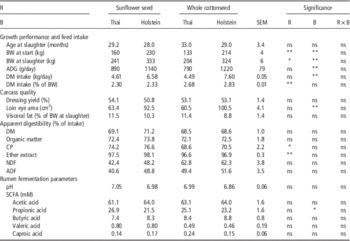
Age at slaughter was higher for the Thai Native bulls than for the Holstein bulls (P<0.08), whereas BW and average daily gain (ADG) were lower (P<0.01) (Table 2). There was also an effect of ration on BW at start and at slaughter (P<0.05), but ADG was not affected by ration (P>0.05). The DM intake was greater in Holstein bulls than in Thai Native bulls (P<0.01), but was not influenced by ration. However, when DMI was expressed as a % of BW, DMI was not influenced by breed but was greater when WCS was fed (P<0.01). Dressing yield, loin eye area and visceral fat content were not affected by ration nor breed (P>0.05), except for a large effect of breed on loin eye area with greater values for Holstein bulls than for Thai Native bulls (P<0.01). It must be mentioned that BW at slaughter of the Thai Native cattle in the present study were lower than commercial slaughter weights in Thailand, which are between 350 and 450 kg at the age of 2 to 3 years. However, since growth rate and feed intake during the experiment were normal for this breed, this had likely no impact on the results.
Growth performance, feed intake, apparent digestibility and rumen fermentation parameters in Thai Native and Holstein bulls fed sunflower seed or whole cottonseed total mixed rations

R=ration; B=breed; ADG=average daily gain; DM=dry matter; SCFA=short chain fatty acids.
n=6 per treatment group.
*P<0.05, **P<0.01.
The apparent digestibility of CP (P<0.05) and EE (P<0.01) was greater when SFS was fed, irrespective of breed. However, CP and EE intakes across breeds were 8.7% and 12.3% lower, respectively, when WCS was fed. Therefore, it cannot be excluded that the observed lower apparent digestibility of CP and EE after feeding WCS is at least partly due to relatively higher contributions of endogenous CP and EE. In contrast to CP and EE, the apparent digestibility of DM, organic matter (OM), NDF and ADF was neither affected by breed nor by ration (P>0.05; Table 2). Furthermore, rumen pH was not different between breeds and rations (P>0.05). With the exception of propionic acid, volatile fatty acid profiles 4 h after feeding did not differ between breeds and rations. The proportion of propionic acid was greater in Thai Native bulls (P<0.05), but the difference between rations did not reach statistical significance (Table 2).
FA profiles of plasma, subcutaneous fat and LD muscle
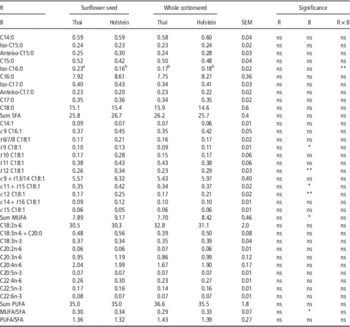
A ration×breed interaction was observed for plasma iso-C16:0 only (P<0.05) (Table 3). On the WCS ration a lower proportion of iso-C16:0 compared with the SFS ration was observed in Thai Native bulls, whereas an increased proportion was observed in Holstein bulls. No main effect of ration was observed on any of the plasma FAs. Breed had an effect on the sum of MUFA, the MUFA/SFA ratio and several minor C18:1 isomers in plasma (P<0.05), with higher values for Holstein bulls compared with Thai Native bulls.
Plasma fatty acid profile (% of FAME) in Thai Native and Holstein bulls fed sunflower seed or whole cottonseed total mixed rations across times of sampling

R=ration; B=breed; FAME=fatty acid methyl esters; SFA=saturated fatty acids; PUFA=polyunsaturated acids; MUFA=monounsaturated fatty acids.
n=6 per treatment group.
In case of a significant R×B interaction, the Tukey test was performed as a post hoc comparison of means test.
a,bMeans with different superscript letters are significantly different at P<0.05.
*P<0.05, **P<0.01.
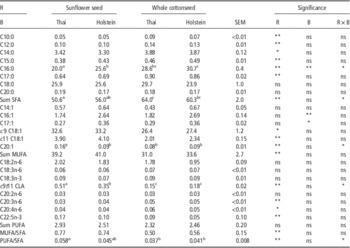
In subcutaneous fat, the proportion of the sum of SFA, C16:0, c9t11 CLA and C20:1, and the PUFA/SFA ratio was influenced by the ration×breed interaction (P<0.05) (Table 4). The higher SFA proportions and PUFA/SFA ratio and the lower c9t11 CLA proportion in subcutaneous fat resulting from the feeding of WCS compared with SFS was more pronounced in Thai native bulls compared with the differences in Holstein bulls. The main effect of ration was significant for the proportion of all individual SFA except C18:0 and C20:0, c9 C18:1, c11 C18:1, c9t11 CLA, C20:1, sum of SFA and sum of MUFA in subcutaneous fat (P<0.05), with higher proportions of SFA and lower proportions of MUFA on the WCS ration compared with the SFS ration. Total PUFA proportions in subcutaneous fat were not influenced by ration (P>0.05), but the proportions of C20:3n-6 and C20:4n-6 were higher (P<0.05), whereas that of C22:5n-3 was lower (P<0.05) on the WCS compared with the SFS ration. Concomitantly, the MUFA/SFA and PUFA/SFA ratio was lower on the WCS ration compared with the SFS ration (P<0.05). Breed had only an effect on the proportion of C16:0, C16:1 and C17:1 in subcutaneous fat (P<0.05), with higher values for the Holstein bulls compared with the Thai Native bulls.
Fatty acid profile (% of FAME) of subcutaneous fat in Thai Native and Holstein bulls fed sunflower seed or whole cottonseed TMR

R=ration; B=breed; TMR=total mixed ration; SFA=saturated fatty acids; PUFA=polyunsaturated acids; MUFA=monounsaturated fatty acids.
n=6 per treatment group.
In case of a significant R×B interaction, the Tukey test was performed as a post hoc comparison of means test.
a,b,cMeans with different superscript letters are significantly different at P<0.05.
*P<0.05, **P<0.01.
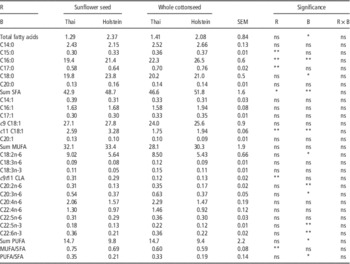
The LD total FA content was higher for the Holstein bulls than for the Thai Native bulls (P<0.05). No ration×breed interaction was observed for any of the FA proportions in LD. The intramuscular FA proportions of C15:0, C16:0, C17:0 and sum of SFA were higher, and the MUFA/SFA ratio was lower when WCS was fed to the animals compared with SFS (P<0.05; Table 5). In contrast, the proportions of c11 C18:1 and c9t11 CLA were lower on the WCS ration (P<0.05). Irrespective of ration, breed had an effect on several LD FA proportions with lower values of C16:0, C18:0, c11 C18:1 and sum of SFA, and higher values of C18:2n-6, C20:2n-6, C22:5n-3, C22:6n-3, sum of PUFA and PUFA/SFA ratio for Thai Native bulls compared with Holstein bulls (P<0.05).
Total fatty acid content (g/100 g) and fatty acid profile (% of FAME) of longissimus dorsi in Thai Native and Holstein bulls fed sunflower seed or whole cottonseed total mixed rations

R=ration; B=breed; SFA=saturated fatty acids; MUFA=monounsaturated fatty acids; PUFA=polyunsaturated acids.
n=6 per treatment group.
*P<0.05, **P<0.01.
Discussion
The use of WCS instead of SFS resulted in significantly lower proportions of c9 C18:1 and C20:1 in subcutaneous fat, and in lower proportions of c9t11 CLA in both subcutaneous fat and LD. The SFS diet contained twofold higher concentrations of C18:1 than the WCS diet, so a direct effect of the FA profile of the ration on the C18:1 proportion in subcutaneous fat cannot be excluded. However, the more than twofold lower proportion of c9t11 CLA on the WCS diet suggests an action of sterculic acid present in WCS. Indeed, Gomez et al. (Reference Herdmann, Martin, Nuernberg, Dannenberger and Nuernberg2003) reported that cottonseed oil contains sterculic acid, which is a potent inhibitor of SCD. Unfortunately, we were not able to determine the sterculic acid content of the feed nor the SCD activity in subcutaneous fat due to unforeseen practical problems. Hence, the current study gives no proof for an inhibitory effect of sterculic acid on SCD, and only allows to make an inference based on tissue FA proportions. We calculated several indices of SCD activity using product to precursor FA ratios. The MUFA/SFA ratio was significantly lower on the WCS diet in both subcutaneous fat and LD, but indices based on C14, C16 and C18 product to precursor ratios did not differ between the two rations. However, it should be kept in mind that these indices do not necessarily reflect actual SCD activity (Archibeque et al., Reference Archibeque, Lunt, Gilbert, Tume and Smith2005).
The current data are in contrast with the outcome of the study of Archibeque et al. (Reference Archibeque, Lunt, Gilbert, Tume and Smith2005). This discrepancy might be explained by the fact that PUFA contents of the experimental rations used by Archibeque et al. (Reference Archibeque, Lunt, Gilbert, Tume and Smith2005) were not constant thereby interfering with proper interpretation of the data. Indeed, PUFA are known to have a down-regulating effect on the activity of SCD (Sessler et al., Reference Sessler, Kaur, Palta and Ntambi1996; Ntambi, Reference Ntambi1999; Velliquette et al., Reference Velliquette, Gillies, Kris-Etherton, Green, Zhao and Vanden Heuvel2009). In beef cattle, it was specifically shown that the SCD activity in muscle and adipose tissue was lower on a diet rich in n-3 PUFA compared with n-6 PUFA (Herdmann et al., Reference Hiller, Herdmann and Nuernberg2010; Hiller et al., Reference Huerta-Leidenz, Savell, Lunt, Baker, Pelton and Smith2011). In the current experiment, the intake of apparently digested C18:2n-6 (calculated as DM intake (kg/day)×EE (g/kg DM)×apparent digestibility (%)×0.95×FA content of total FAME (%)) across breeds was 239 and 241 g/day for the SFS and WCS ration, respectively. Likewise, the intake of apparently digested C18:3n-3 was 1.8 and 1.9 g/day for the SFS and WCS ration, respectively. Consequently, the effect of ration on the FA profile of both subcutaneous fat and LD in the current experiment was not caused by a differential n-3 nor n-6 PUFA intake.
The apparent digestibilities of DM, OM, NDF and ADF were not significantly affected by ration. Furthermore, growth responses were similar between rations. Thus, it can be suggested that the amounts of nutrients available for maintenance and growth were similar between rations. This suggestion is also in line with the observation that rumen pH and SCFA were not significantly affected by ration. The current data do not provide direct information on the extent of biohydrogenation. However, the observation that the plasma FA profile, the rumen fermentation pattern and the PUFA intake were comparable for the two rations, suggests that the extent of biohydrogenation did not differ between the two rations. Hence, differences in the FA profile of subcutaneous fat and muscle are likely due to direct effects of the ration rather than indirect effects as a result of rumen metabolism.
In subcutaneous fat, a significant ration×breed interaction on the proportion of c9t11 CLA and C20:1 was found. The WCS induced response on c9t11 CLA was almost 1.5-fold greater in Thai Native bulls than in Holstein bulls. Likewise, the C20:1 proportions in subcutaneous fat were not affected in Holstein bulls on the WCS diet whereas proportions were 50% lower in Thai Native bulls. The current findings are in line with the suggestion of De La Torre et al. (Reference De La Torre, Gruffat, Durand, Micol, Peyron, Scislowski and Bauchart2006) that SCD activity is more pronounced in B. indicus compared with Bos taurus cattle, and is thus likely also more susceptible to inhibition. In the present study, the ration effect was more outspoken in subcutaneous fat than in the LD. SCD is highly expressed in adipose tissue, and is expressed in several other tissues (Ntambi and Myazakib, Reference Ntambi and Miyazakib2004). In German Holstein bulls, manifold higher SCD activity was measured in subcutaneous adipose tissue than in muscle (Herdmann et al., Reference Hiller, Herdmann and Nuernberg2010). However, a comparative study on the expression and activity of SCD in different tissues and breeds of cattle under different dietary regimes is not available to our knowledge.
The FA profile of LD muscle and to a lesser extent that of subcutaneous fat, was significantly affected by breed. Proportions of C16:0 and C18:0 in intramuscular fat were lower in Thai Native bulls in combination with significantly greater proportions of C18:2n-6, and the longer chain FAs C20:2n-6, C20:3n-6, C22:5n-3 and C22:6n-3. The latter observations are corroborated by Huerta-Leidenz et al. (Reference Givens, Kliem and Gibbs1993) who also reported higher proportions PUFA in adipose tissue of B. indicus v. B. Taurus cattle. The difference in LD FA profile between the two cattle breeds is difficult to explain but an intrinsically higher capacity for deposition of PUFA and conversion to longer chain derivatives in Thai Native cattle compared with Holstein cattle cannot be excluded. The lower LD total FA content may also interfere. It is well known that a lower intramuscular fat content is associated with a higher ratio of phospholipids to triacylglycerols, and thus also with a higher PUFA to SFA ratio (De Smet et al., Reference De Smet, Raes and Demeyer2004). In the present study, the higher PUFA proportions and the lower total FA content in LD of Thai Native bulls compared with the Holstein bulls resulted in comparable PUFA contents on tissue basis (mg/100 g muscle).
Interestingly, ambient temperature also has an impact on the FA profile of body fats. It has been shown by Sevi et al. (Reference Sevi, Rotunno, DiCaterina and Muscio2002) that in heat stressed ewes, the FA profile of milk fat had higher proportions of SFA and lower proportions of oleic acid and PUFA. Moreover, Perry et al. (Reference Perry, Nicholls and Thompson1998) observed an increase in C16:0 and C18:0 and a decrease in C18:1 of subcutaneous fat when steers were exposed to higher ambient temperatures. In this study (Perry et al., Reference Perry, Nicholls and Thompson1998), the shift in FA profile was associated with an increase of melting point of subcutaneous fat. The latter observation is corroborated by the outcome of a study from Marchello et al. (Reference Marchello, Cramer and Miller1967), who found a decrease in iodine number and an increase in melting point of subcutaneous fat of sheep that experienced higher ambient temperatures. Therefore, the difference in susceptibility to heat stress between the two breeds (Beatty et al., Reference Beatty, Barnes, Taylor, Pethick, McCarthy and Maloney2006; Wang et al., Reference Wang, Duangjinda, Vajrabukka and Katawatin2014), can be a factor to explain the difference in FA profile of their body fat. It can speculated that the Holstein bulls in this region with average maximum daily ambient temperatures above 30°C experienced more heat stress than their Thai Native counterparts, and that this caused a shift towards a more SFA profile.
Conclusion
Feeding of WCS compared with SFS resulted in considerably lower levels of c9t11 CLA in the intramuscular fat of both Thai Native and Holstein bulls, and higher levels of SFA and lower levels of MUFA in intramuscular and subcutaneous fat. There were also indications for a greater inhibitory effect of WCS on SCD activity in Thai Native compared with Holstein bulls. On the contrary, Thai Native bulls displayed higher proportions of PUFA in intramuscular fat irrespective of ration.
Acknowledgements
The authors would like to express their most sincere gratitude to the Commission on Higher Education, Department of Animal Science, Faculty of Agriculture, Khon Kaen University, AG-BIO/PERDO-CHE, Khon Kaen University, Thailand for their financial support. The technical assistance of the staff of Laboratory for Animal Nutrition and Animal Product Quality, Ghent University is also greatly acknowledged.