Introduction
Bathyurid trilobites are widespread and diverse in Lower Ordovician strata of Laurentian North America (e.g., Fortey, Reference Fortey1979; Brett and Westrop, Reference Brett and Westrop1996; Adrain and Westrop, Reference Adrain and Westrop2005; Loch, Reference Loch2007; Adrain et al., Reference Adrain, McAdams and Westrop2009; Fortey and Bruton, Reference Fortey and Bruton2013). However, by the Upper Ordovician, the family was reduced to a handful of species (Ludvigsen, Reference Ludvigsen1979a, Reference Ludvigsen1979b; Tremblay and Westrop, Reference Tremblay and Westrop1991) that are assigned to Bathyurus Billings, Reference Billings1859 and Raymondites Sinclair, Reference Sinclair1944, and most of these occurred in shallow water, peritidal settings. Many species of Bathyurus have been documented in detail from silicified sclerites (Ludvigsen, Reference Ludvigsen1979a; Tremblay and Westrop, Reference Tremblay and Westrop1991); however, in comparison, Raymondites remains poorly known. Whittington’s (Reference Whittington1953) review, now 60 years old, is the most recent treatment of the genus to have included study of type material. Species of Raymondites are, however, distinctive, with most bearing long occipital and axial pygidial spines. In this paper, we revise Raymondites using new collections from Missouri and Ontario, undescribed archival material from Ontario and New York, and restudy of type and figured material of all previously named species.
There is little doubt that Bathyurus and Raymondites are closely related. Indeed, Sinclair (Reference Sinclair1944) originally established Raymondites as a subgenus of Bathyurus, although studies published over the past 35 years have considered them to be distinct genera (Ludvigsen, Reference Ludvigsen1979a, Reference Ludvigsen1979b; DeMott, Reference DeMott1987). Here we provide an assessment of monophyly of these genera with a phylogenetic analysis that includes all adequately documented species of Raymondites and nine species of Bathyurus that could be coded from silicified sclerites (Ludvigsen, Reference Ludvigsen1979a; Tremblay and Westrop, Reference Tremblay and Westrop1991). Based on these results, discussed later in the text, we treat Raymondites as a subgenus of Bathyurus and assign a paraphylum of more basal species to Bathyurus sensu lato.
Stratigraphic setting
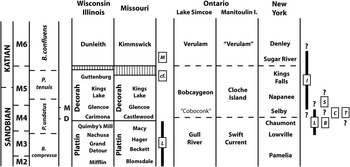
Bathyurus (Raymondites) is restricted to Laurentian North America, and has been reported from Ontario, New York, and the Upper Mississippi Valley. A brief outline of stratigraphic occurrences of the various species treated in systematics section is presented below, along with an assessment of their biostratigraphic significance. Species ranges are summarized in Figure 1.
Species ranges, Mississippi Valley region, Missouri, Illinois and Wisconsin, and Ontario-New York State, plotted against lithostratigraphic units, conodont zones, and major depositional sequences identified by Holland and Patzowsky (Reference Holland and Patzkowsky1997, Reference Holland and Patzkowsky1998). Dashed lines reflect uncertainties in correlation. D, M indicate the positions of the Deicke and Millbrig K-bentonites, respectively. Lithostratigraphy and correlation of the successions of Wisconsin, Illinois and Missouri are modified from Larson (Reference Larson1951), Templeton and Willman (Reference Templeton and Willman1963), Leslie (Reference Leslie2000), and Metzger and Fike (Reference Metzger and Fike2013); ranges of species are based on DeMott (Reference DeMott1987) and unpublished field data. Lithostratigraphy and correlation of the successions of Ontario and New York are modified from Kay (Reference Kay1937), Liberty (Reference Liberty1969), Salad Hersi and Dix (Reference Salad Hersi and Dix1999), Leslie (Reference Leslie2000), Brett and Baird (Reference Brett and Baird2002), Mitchell et al. (Reference Mitchell, Adhya, Bergström, Joy and Delano2004); ranges of species are based on Wilson (Reference Wilson1947) and unpublished field data. Species are identified by the following abbreviations: L, B. (R.) longispinus; cf., B. (R.) cf. B. (R.) ingalli; M, B. (R.) missouriensis; I, B. (R.) ingalli; B, B. (R.) bandifer; S, B. (R.) spiniger; C, B. (R.) clochensis; T, B. (R.) trispinosus.

Illinois and Wisconsin
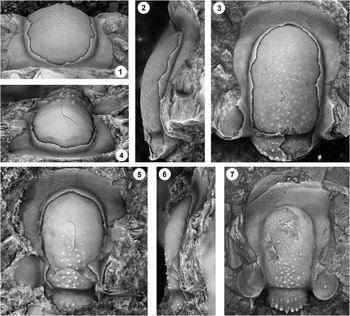
Bathyurus (Raymondites) longispinus (Walcott, Reference Walcott1876) is well documented in Wisconsin and Illinois, and material figured previously by Whittington (Reference Whittington1953) and DeMott (Reference DeMott1987) is illustrated here (Figs. 7–9). This species ranges throughout the Plattin subgroup (DeMott, Reference DeMott1987, fig. 10.3), and figured material comes both from the Quimbys Mill Formation at the top of the subgroup, and the Mifflin Formation at the base. All occurrences in this region are below the Deicke K-bentonite, indicating that they are no younger than the Phragmodus undatus conodont Zone (Leslie, Reference Leslie2000, fig. 2) and the M4 depositional sequence of Holland and Patzkowsky (Reference Holland and Patzkowsky1997, Reference Holland and Patzkowsky1998). In eastern Iowa (Ludvigson et al., Reference Ludvigson, Witzke, González, Carpenter, Schneider and Hasiuk2004, fig. 2), a complex hardground at the base of the Quimbys Mill is a candidate for the base of M4, and similar hardgrounds at the top and base of the Mifflin may represent the lower boundaries of M3 and M2, respectively. Thus, B. (R.) longispinus is a long-ranging species that likely crosses two third-order sequence boundaries.
A second, younger species in Wisconsin and Illinois was originally identified by DeMott (Reference DeMott1987) as B. (R.) spiniger (Hall, Reference Hall1847), but is assigned here to B. (R.) cf. B. (R.) ingalli. It occurs in the Guttenburg Formation of the Decorah Subgroup, which is well above the Millbrig K-bentonite, and correlates with the Plectodina tenuis conodont Zone (Leslie, Reference Leslie2000, fig. 2) and the M5 depositional sequence.
Missouri
Bathyurus (Raymondites) missouriensis n. sp. occurs in coarse bioclastic carbonates of Katian age exposed in a major road cut along Missouri State Highway MM, about 2.8 km east of House Springs, Jefferson County (see Metzger and Fike, Reference Metzger and Fike2013 for additional locality information). We follow Kolata et al. (Reference Kolata, Huff and Bergström1998) and Metzger and Fike (Reference Metzger and Fike2013) in assigning these carbonates to the Kimmswick Formation, rather than the Dunleith Formation of Templeton and Willman (Reference Templeton and Willman1963). Most of the material was collected from a 50 cm interval of bioturbated crinoidal-bryozoan-trilobite grain- and rudstone located 26.1 m above the base of the section (Swisher, unpublished data), and approximately 2 m above the well-known House Springs K-bentonite (Kolata et al., Reference Kolata, Huff and Bergström1998, fig. 8). One specimen was collected from the equivalent horizon approximately 11.5 km east of House Springs on Missouri State Highway M. The presence of the House Springs K-bentonite near the base of the Kimmswick Formation, as well as an unconformable boundary with the underlying King’s Lake Member of the Decorah Formation (M4–M5 depositional sequences), suggest that at least the lower Kimmswick correlates with the M6 depositional sequence of Holland and Patzkowsky (Reference Holland and Patzkowsky1997, Reference Holland and Patzkowsky1998). This interpretation would place the Kimmswick Formation within the Belodina confluens conodont Zone (e.g. Mitchell at al., Reference Mitchell, Adhya, Bergström, Joy and Delano2004, fig. 7).
Ontario
Bathyurus (Raymondites) has been reported from the Lake Simcoe and Ottawa areas (e.g., Wilson, Reference Wilson1947), and Ludvigsen (Reference Ludvigsen1979b) illustrated sclerites from exposures along the Moira River in Belleville. The majority of these occurrences lie in the Bobcaygeon Formation (Liberty, Reference Liberty1969), which is largely assigned to the Plectodina tenuis Zone, but with its lower part extending down into Phragmodus undatus Zone (Leslie, Reference Leslie2000, fig. 2). As such, this formation straddles the M4–M5 sequence boundary, with most of it lying in M5. The Bobcaygeon Formation replaced a tangled nomenclature of various units, including the Coboconk, Kirkfield, Rockland, Leray, and Hull Formations (Liberty, Reference Liberty1969), but many of the earlier reports of the genus (e.g., Wilson, Reference Wilson1947) are expressed in terms of these now obsolete names.
The holotype of B. (R.) ingalli (Raymond, Reference Raymond1913) is from the middle or upper Bobcaygeon (“Hull beds” of Wilson, Reference Wilson1947); however, the species has also been recorded from the lower Bobcaygeon (“Leray-Rockland beds”; Wilson, Reference Wilson1947, p. 20), and the overlying Verulam Formation (Ludvigsen, Reference Ludvigsen1979b, fig. 22C). Raymondites trispinosus (Wilson, Reference Wilson1947) was collected from strata correlative with the lower Bobcaygeon, whereas the only known specimen of B. (R.) bandifer Sinclair, Reference Sinclair1944 is from somewhat older strata (“Leray beds”; Wilson, Reference Wilson1947, p. 19) that are probably equivalent to the upper Gull River Formation.
We collected sclerites of B. (R.) longispinus (Walcott, Reference Walcott1876) and B. (R.) clochensis n. sp., from a single horizon the Cloche Island Formation on Cloche Island. The locality is a road cut along HW 68 that exposes about 10 m of various carbonates, and corresponds to Leslie’s (Reference Leslie2000, p. 1147) section 27. The trilobites were collected 3.75 m above the base of the section, in a heterolithic interval of nodular to planar bedded, bioturbated lime mudstone to wackestone, with centimeter-thick bioclastic packstone to rudstone. The associated fauna includes the trilobites Isotelus Dekay, Reference DeKay1824; Thaleops Conrad, Reference Conrad1843; Bumastoides Whittington, Reference Whittington1954; and an undescribed cheirurid allied with Ceraurinella Cooper, Reference Cooper1953, along with abundant leperditocopid arthropods. From Leslie’s (Reference Leslie2000, fig. 2) correlation chart, this fossiliferous interval likely falls in the upper part of the Phragmodus undatus Zone and correlates with strata that lie between the Deicke and Millbrig K-bentonites in other regions. This means that the record of B. (R.) longispinus in the Cloche Island Formation is somewhat younger than the highest occurrence in Wisconsin and Illinois, although it is still within depositional sequence M4.
An enrolled individual (Fig. 11.1–11.4) and a cranidium (Fig. 13.4–13.6) from St. Joseph Island (Ontario, not Quebec, as stated by Whittington, Reference Whittington1953, p. 673), approximately 160 km west of the Cloche Island locality, appear to be conspecific with B. (R.) cf. B. (R.) ingalli from Wisconsin and Illinois. The collecting locality (northeastern corner of the island) lies in either the Swift Current Formation or the Cloche Island Formation.
New York
DeMott (Reference DeMott1987, p. 68) relocated the old Buck Quarry near Poland, Herkimer County, New York, that yielded Walcott’s type material of B. (R.) longispinus, and showed that it was collected from the Chaumont Formation. We follow Liberty (Reference Liberty1969) and (Salad Hersi and Dix, Reference Salad Hersi and Dix1999) in correlating the Chaumont with the upper Gull River Formation of Ontario, although Mitchell et al. (Reference Mitchell, Adhya, Bergström, Joy and Delano2004, fig. 7) equated the Chaumont with the lower part of the overlying Bobcaygeon Formation. The Chaumont underlies the Selby Formation (Salad Hersi and Dix, Reference Salad Hersi and Dix1999, fig. 2), a unit that includes the Millbrig K-bentonite at the Dexter Quarry, New York (Mitchell et al., Reference Mitchell, Adhya, Bergström, Joy and Delano2004). The Chaumont Formation and its trilobite fauna thus falls into the Phragmodus undatus conodont zone and sequence M4, and records an occurrence of B. (R.) longispinus near the top of the range of the species in Wisconsin and Illinois. One incomplete, flattened exoskeleton (Fig. 8.1; see also Whittington, Reference Whittington1953, pl. 65, fig. 16) is from the Larabee Member of the Glen Falls Formation (see Kay, Reference Kay1937, p. 262, for details of this unit). According to Kay (Reference Kay1937), the Larabee Member correlates with the “Hull Formation” of the Ottawa region (=middle and upper Bobcaygeon). If both the stratigraphic information and correlation are correct, then this occurrence is likely a little younger than the new record from the Cloche Island Formation of Ontario (see above), and may lie in strata of the lower part of the M5 sequence.
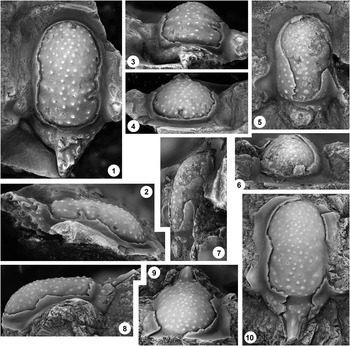
There is little detailed information on the stratigraphic occurrence of the holotype of B. (R.) spiniger, which is from the Mohawk Valley (Kay, Reference Kay1937). Kay (Reference Kay1937, p. 300) considered the lithology of the host limestone to be characteristic of the Rockland Formation (Napanee Formation of the current New York nomenclature; Brett and Baird, Reference Brett and Baird2002). However, an additional cranidium illustrated by Kay (Reference Kay1937, fig. 9) may represent B. (R.) cf. B. (R.) ingalli as it possesses tuberculate sculpture, rather than terrace ridges, on the palpebral area. Two previously undescribed cranidia (Fig. 5.5–5.10) from the “Trenton Limestone,” 1.6 km north of the Mohawk Valley town of Amsterdam (USNM loc 322a), are very similar to Hall’s holotype of B. (R.) spiniger. They almost certainly represent the same species, and are likely from the same general geographic area.
Biostratigraphic significance of B. (Raymondites)
In the Mississippi Valley region of northern Missouri and southern Illinois and Wisconsin, a composite Plattin–Kimmswick succession yields a sequence of three species (Fig. 2) that may have some biostratigraphic utility, albeit limited due to the general rarity of the genus. Bathyurus (Raymondites) longsipinus is the oldest of these; indeed, it is the oldest known species, with all occurrences in strata below the Millbrig K-bentonite. It is confined to the Plattin Subgroup in the Mississippi Valley and, although it likely ranges into slightly younger strata in the Manitoulin Island area of Ontario (Fig. 2), it is entirely Sandbian in age. Bathyurus (Raymondites) cf. B. (R.) ingalli appears in the upper Decorah Subgroup, and is likely Katian in age, probably occupying a position high in sequence M5. As such, it overlaps in age with B. (R.) ingalli in Ontario. The youngest species, B. (R.) missouriensis is known from the basal Kimmswick Formation and is broadly coeval with the youngest occurrences of B. (Raymondites) in southern Ontario.
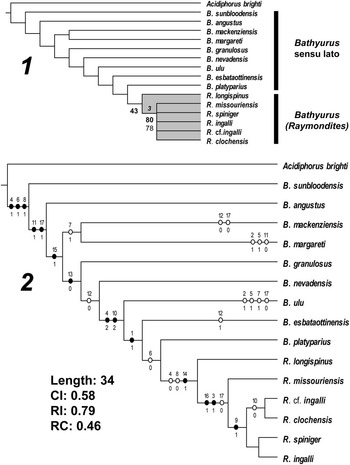
Results of phylogenetic analysis of the matrix (Table 1; see Appendix 1 for list of characters). (1), strict consensus of 14 trees discovered with a branch-and-bound search (implicit enumeration), and showing the suggested classification of Bathyurus and Raymondites. Support metrics shown by numbers are Bremer support (italics; only values greater than 1 are shown), GC bootstrap support (bold face) and conventional bootstrap support (roman type). Raymondites is a recognizable clade that is classified as a subgenus of Bathyurus; Bathyurus itself is paraphyletic and the paraphylum of species occupying successive nodes below B. (Raymondites) is simply assigned to Bathyurus sensu lato. (2), Optimized character distribution plotted on one of the three most parsimonious trees; upper numbers indicate characters, lower numbers indicate particular states (see Appendix 1). Only unambiguous state changes (i.e. show the same transformations at the nodes under the assumptions of ACCTRAN and DELTRAN) are shown. Filled circles show states that originate at a single node; open circles indicate those that show homoplasy.

Setting aside species that are known from limited material and/or are geographically restricted [B. (R.) spiniger, B. (R.) bandifer, B. (R.) trispinosus and B. (R.) clochensis], there is a two-fold division of the Ontario-New York succession (Fig. 2). Bathyurus (R.) longispinus is present in pre-Millbrig strata, with B. (R.) ingalli appearing above, and extending into lower Katian strata.
According to Patzkowsky and Holland (Reference Patzkowsky and Holland1999, p. 318, table 2), B. (Raymondites) is restricted to the M4 sequence boundary in the Nashville Dome region of Tennessee. Our revision shows that the youngest species of the genus range into the M5 and M6 sequences (i.e., well above the Millbrig K-Bentonite) outside of the Appalachian Foreland Basin in the Mississippi Valley of Missouri, Illinois, and Wisconsin, and over the Algonquin Arch of Ontario. Thus, the disappearance of B. (Raymondites) at the M4–M5 sequence boundary in Tennessee records regional extirpation rather than complete extinction.
Phylogenetic analysis
Taxon selection and coding sources
Bathyurus (Raymondites) is widespread but generally rare, and much of this study is based on previously described specimens. We borrowed type and other archival material of as many species as possible, all of which is illustrated and revised in this paper. Bathyurus (Raymondites) spiniger, B. (R.) longispinus and B. (R.) ingalli were included in the analysis, along with two new species, B. (R.) missouriensis and B. (R.) clochensis. Bathyurus (Raymondites) cf. B. (R.) ingalli, although left in open nomenclature, is represented in the analysis by material assigned previously to B. (R.) spiniger by DeMott (Reference DeMott1987) and to B. (R.) ingalli by Whittington (Reference Whittington1953). All of these species were coded from direct examination of specimens and from new, high-resolution digital images (Figs. 3–16). We excluded two species, B. (R.) bandifer and B. (R.) trispinosus, which are known from limited, incomplete material, although both are treated in the systematics section.
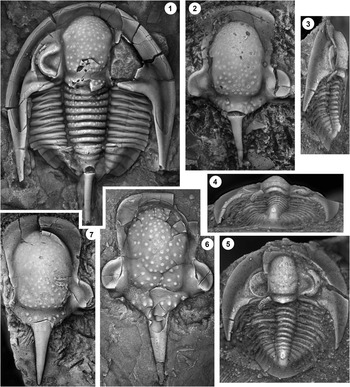
Bathyurus (Raymondites) ingalli (Raymond, Reference Raymond1913), Bobcaygeon Formation, Lake Simcoe region, southern Ontario. (1), complete exoskeleton (ROM 48582), dorsal view, ×4.5, Carden Quarry; (2), cranidium (ROM 54394), dorsal view, ×3.25, Carden Quarry, 9.5 km west of Kirkfield, Victoria County; (3–5), complete exoskeleton (ROM 23962), lateral, posterior, and dorsal views, ×11, Gull River-Bobcaygeon Formations (undifferentiated), Eganville, Renfrew County, approximately 110 km west of Ottawa; (6), cranidium (GSC 4318; holotype), dorsal view, ×2.7, near the lift-lock on the Trent-Severn Waterway, approximately 3 km kilometers north of Kirkfield, Victoria County (illustrated previously by Ludvigsen, Reference Ludvigsen1979b, fig. 22C); (7), cranidium (ROM 34648), dorsal view, ×3, Old Kirkfield Quarry, approximately 3.3 km north of Kirkfield, Victoria County.

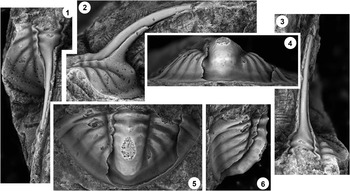
Bathyurus (Raymondites) ingalli (Raymond, Reference Raymond1913), Verulam Formation, right bank of the Moira River, Belleville, Hastings County, southern Ontario. (1–3), incomplete pygidium showing axial spine (ROM 35352), dorsal, lateral and anterior views, ×5; (4–6), pygidium (ROM 35353), posterior, dorsal and lateral views, ×5.

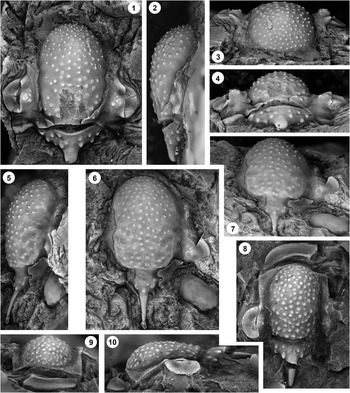
Bathyurus (Raymondites) spiniger (Hall, Reference Hall1847). All from “Trenton Limestone,” 1.6 miles north of Amsterdam, Montgomery County, New York (USNM loc. 322a), except for Figures 1–4 (?Napanee Formation, Mohawk Valley, New York). (1–4), cranidium (AMNH 854; holotype), dorsal, lateral, posterior and anterior views, ×3.75; (5–7), cranidium (USNM 595076), dorsal, anterior and lateral views, ×6; (8–10), cranidium (USNM 595076), lateral, anterior and dorsal views, ×5.

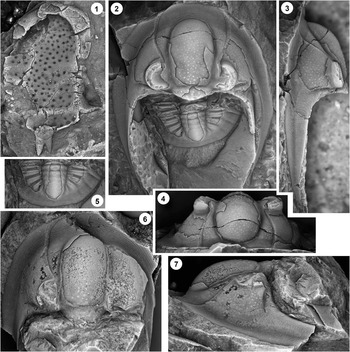
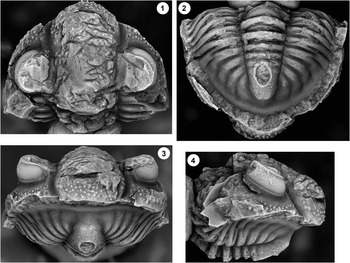
Bathyurus (Raymondites) from Canada and the United States. (1),B. (Raymondites) bandifer Sinclair, Reference Sinclair1944, cranidium (GSC 13249; holotype), ventral view, ×5, “Leray Beds” (= Chaumont Formation; Salad Hersi and Dix, Reference Salad Hersi and Dix1999, fig. 2), 11.25 km west of Cobden, Renfrew County, Ontario (illustrated previously by Wilson, Reference Wilson1947, pl. 2, fig. 7). Bathyurus (Raymondites) longispinus (Walcott, Reference Walcott1876). All from the Chaumont Formation, Buck’s Quarry, 0.6 km north Poland, Herkimer County, New York, except Figures 6, 7 (“Black River Limestone” [likely Chaumont Formation], 1.6 km north of Poland). (2–5), nearly complete exoskeleton (MCZ 107237; holotype), cephalon in dorsal view, lateral view, anterior view, dorsal view of pygidium ×2 (illustrated previously by Whittington, Reference Whittington1953, pl. 65, figs. 10, 14, 15); (6, 7), cephalon (USNM 340622), lateral and dorsal views, ×5 (Whittington, Reference Whittington1953, pl. 65, fig. 19, inked in the course of the rostral suture on his photograph, but we could find no trace of this feature on the specimen; there is, however, a fracture in the doublure).

Bathyurus (Raymondites) longispinus (Walcott, Reference Walcott1876) from Wisconsin and Illinois. (1–3), cranidium (MCZ 107241), anterior, lateral, and dorsal views, ×3.5, Mifflin Formation, Dixon North Quarry Section, Lee County, Illinois (illustrated previously by DeMott, Reference DeMott1987, pl. 7, figs. 12, 13; see his fig. 10.1 and table 10.1 for locality information). (4–6), cranidium (MCZ 107243), anterior, dorsal and lateral views, ×4, Quimbys Mill Formation, Quimbys Mill Quarry section, Lafayette County, Wisconsin (illustrated previously by DeMott, Reference DeMott1987, pl. 7, fig. 17; see his fig. 10.1 and table 10.1 for locality information). (7), cranidium (USNM 340624), dorsal view, ×4, “Upper Black River” (likely Quimbys Mill Formation from the implied stratigraphic position), Phelan and Jordon quarries, Dixon, Lee County, Illinois (note that Whittington [Reference Whittington1953, pl. 69, fig. 22]) inadvertently cropped out the anterior part of the frontal area).

Bathyurus (Raymondites) longispinus (Walcott, Reference Walcott1876), New York, Illinois, and Wisconsin. (1), nearly complete exoskeleton (USNM 379365), dorsal view, ×4, Larabee Member, Glens Fall Formation (see Kay, Reference Kay1937, p. 262 for stratigraphic nomenclature), Rowland’s Mill, 6.4 km west of Saratoga Springs, Saratoga County, New York (illustrated previously by Whittington, Reference Whittington1953, pl. 65, fig. 16). (2), cephalon (MCZ 107240), dorsal view of latex cast from external mold, ×5, Quimbys Mill Formation, Quimbys Mill Quarry section, Lafayette County, Wisconsin (illustrated previously by DeMott, Reference DeMott1987, pl. 7, fig. 8–11; see his fig. 10.1 and table 10.1 for locality information). (3), cephalon (MCZ 107238), dorsal view of latex cast of external mold, ×4, Quimbys Mill Formation, Quimbys Mill Quarry section, Lafayette County, Wisconsin (illustrated previously by DeMott, Reference DeMott1987, pl. 7, figs. 1, 2; see his fig. 10.1 and table 10.1 for locality information). (4, 5), pygidium (MCZ 107239), dorsal and posterior views of latex cast of external mold, ×8, Mifflin Formation, Dixon North Quarry Section, Lee County, Illinois (illustrated previously by DeMott, Reference DeMott1987, pl. 7, fig. 8; see his fig. 10.1 and table 10.1 for locality information).

Bathyurus (Raymondites) longispinus (Walcott, Reference Walcott1876), Cloche Island Formation, road cut on HW 68, Cloche Island, about 9 km south of Birch Island (section 27 of Leslie, Reference Leslie2000, p. 1147), Manitoulin District, Ontario. (1), librigena (ROM 63007), dorsal view, ×4; (2–5), cranidium, dorsal, anterior, and lateral views of latex cast from mold (ROM 63006a), and dorsal view of counterpart (ROM 63006a) showing frontal area, ×8.

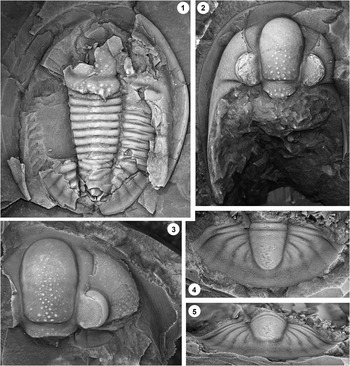
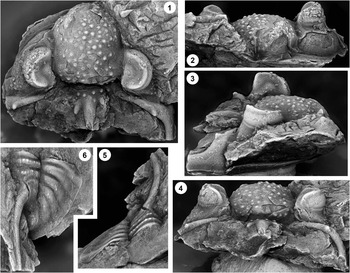
Bathyurus (Raymondites) trispinosus (Wilson, Reference Wilson1947), “Leray-Rockland Beds” (lower Bobcaygeon Formation), east of Packenham, Lanark County, approximately 47 km east of Ottawa, Ontario (sclerites illustrated previously by Wilson, Reference Wilson1947, pl. 2, figs. 8–9). (1–4), cephalon (GSC 11304; holotype), dorsal, anterior, lateral, and posterior views, ×5.5; (4, 5), pygidium (GSC 11304a; paratype), lateral and dorsal views, ×6.5.

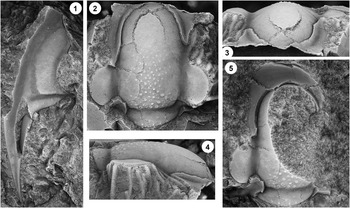
Bathyurus (Raymondites) cf. B. (R.) ingalli (Raymond, Reference Raymond1913), Upper Ordovician strata (Gull River Formation or Cloche Island Formation), northeast corner of St. Joseph Island, Algoma District, northwestern Lake Huron, Ontario (1–4), enrolled exoskeleton (USNM 166731), dorsal (cephalon), dorsal (pygidium), anterior and lateral views, ×6 (illustrated previously by Whittington, Reference Whittington1953, pl. 69, figs. 16, 17, 19–21).

Bathyurus (Raymondites) cf. B. (R.) ingalli (Raymond, Reference Raymond1913), Guttenberg Formation, Fennimore West road cut, Grant County, Wisconsin (sclerites illustrated previously by DeMott, Reference DeMott1987, pl. 8, figs. 1–3, 7–9; see his fig. 10.1 and table 10.1 for locality information). (1–4), cranidium (MCZ 107427), dorsal, lateral, anterior, and posterior views, ×3.5; (5–7), cranidium, MCZ 107244, ×3.5; (8–10), cranidium (MCZ, 107246), dorsal, anterior and lateral views, ×6.5.

Bathyurus (Raymondites) cf. B. (R.) ingalli (Raymond, Reference Raymond1913), Wisconsin and Ontario. (1–3), pygidium (MCZ 107245), dorsal, posterior and lateral views, ×5, Guttenberg Formation, Fennimore West road cut, Grant County, Wisconsin (illustrated previously by DeMott, Reference DeMott1987, pl. 8, figs. 4–6; see his fig. 10.1 and table 10.1 for locality information); (4–6), cranidium (USNM 166732), dorsal, lateral and anterior views, Upper Ordovician strata (Gull River Formation or Cloche Island Formation), northeast corner of St. Joseph Island, Algoma District, northwestern Lake Huron, Ontario (note that Whittington’s [Reference Whittington1953, pl. 69, fig. 18] original photograph of this specimen crops out the left palpebral lobe, the occipital spine and gives a misleading impression of the shape of the anterior cranidial margin).

Bathyurus (Raymondites) clochensis n. sp., Cloche Island Formation, road cut on HW 68, Cloche Island, approximately 9 km south of Birch Island (section 27 of Leslie, Reference Leslie2000, p. 1147), Manitoulin District, Ontario. (1–6), cranidium (holotype), dorsal, lateral and anterior views (ROM 61465a); and dorsal, lateral, and posterior views of latex cast of counterpart external mold (ROM 61465b); (7–9), cranidium (ROM 61466), lateral, dorsal and anterior views of latex cast from external mold, ×7.

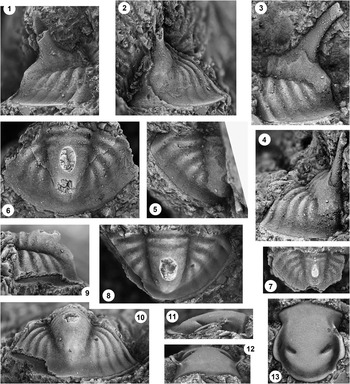
Bathyurus (Raymondites) missouriensis, Kimmswick Formation, Jefferson County, Missouri. All from 26.1 to 26.6 m above the base of section MM, road cut on Missouri State Highway MM, 2.7 km southeast of House Springs, except 15.9 (5–6 m above the base of section M, road cut on Missouri State Highway M, 10.8 km southeast of House Springs. (1–3), cranidium (OU 12653), dorsal, anterior, and lateral views, ×7; (4), cranidium (OU 12654), dorsal view, ×6; (5), cranidium (OU 12655), dorsal view, ×6; (6–8), cranidium (OU 12656; holotype), dorsal, anterior, and lateral views, ×6; (9), cranidium (OU 12657), dorsal view of latex cast of external mold, ×4.5; (10), cranidium (OU 12658), dorsal view, ×4.5; (11–12), librigena (OU 12659), dorsal and lateral views, ×5.

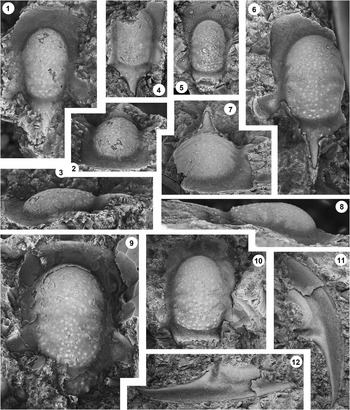
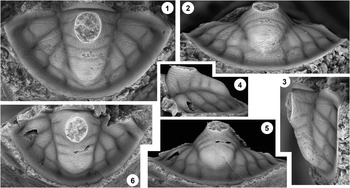
Bathyurus (Raymondites) missouriensis, Kimmswick Formation, 26.1–26.6 m above the base of section MM, road cut on Missouri State Highway MM, 2.7 km southeast of House Springs, Jefferson County. (1–2), pygidium (OU 12660), lateral and posterior views, ×7; (3–5), pygidium (OU 12661), lateral, dorsal, and posterior views, left half of specimen unprepared to preserve occipital spine, ×6; (6), pygidium (OU 12662), dorsal view, ×6; (7), pygidium (OU 12664), dorsal view, ×8; (8–10), pygidium (OU 12663), dorsal, lateral, and posterior views, ×7; (11–13), hypostome (OU 12665), lateral, anterior and dorsal views, ×11.

Many species of Bathyurus sensu lato from the eastern United States Ontario, and Québec, including the type species, Bathyurus extans (Hall, Reference Hall1847), remain poorly known and are in need of revision. However, such a revision is beyond the scope of this study, and questions of monophyly of Bathyurus and Raymondites will be addressed with a representative sample of species of the former genus. We selected nine species from northern Canada that are well documented from silicified sclerites and could be coded adequately from photographs published by Ludvigsen (Reference Ludvigsen1979a) and Tremblay and Westrop (Reference Tremblay and Westrop1991): B. nevadensis Ross, Reference Ross1967; B. angustus Ross, Reference Ross1970; B. ulu Ludvigsen, Reference Ludvigsen1979a, B. esbataottinensis Ludvigsen, Reference Ludvigsen1979a; B. granulosus Ludvigsen, Reference Ludvigsen1979a; B. platyparius Ludvigsen, Reference Ludvigsen1979a; B. mackenziensis Tremblay and Westrop, Reference Tremblay and Westrop1991; B. sunbloodensis Tremblay and Westrop, Reference Tremblay and Westrop1991; and B. margareti Tremblay and Westrop, Reference Tremblay and Westrop1991. Acidiphorus brighti (Hintze, Reference Hintze1953), also based on silicified material, was used as the outgroup.
Characters
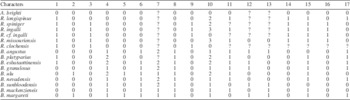
The data matrix (Table 1) includes 15 ingroup species, 14 binary characters, and 3 unordered multistate characters; all characters are described in detail in Appendix 1. Parsimony uninformative characters (autapomorphies of individual species and states that are shared by all ingroup species) were excluded.
Data matrix used in the phylogenetic analysis (Fig. 2).

Ludvigsen (Reference Ludvigsen1979a, p. 13) considered rostral plate morphology to be diagnostic of Bathyurus. Unfortunately, this sclerite is known only for one species of Raymondites (Fig. 8.1) and is unknown for the outgroup. The narrow (tr.) anterior portion in species of Bathyurus (e.g., Ludvigsen, Reference Ludvigsen1979a, pl. 1, fig. 36; pl. 2, figs. 10, 28; pl. 4, fig. 12) contrasts with the much wider (relative to the width of the medial “waist” of sclerite) anterior portion in Raymondites. Because rostral plate morphology can be coded to all intents and purposes only for Bathyurus, inclusion of a character that describes the narrow anterior portion has no impact on the outcome of the analysis (14 trees are retrieved, as described below). Consequently, we did not include this character in the final analysis, but it is conceivable that rostral plate morphology might play a more decisive role when known for more species of Raymondites, Acidiphorus, and other related species.
Results
Parsimony analysis was performed in PAUP* (Swofford, Reference Swofford2001) and the results were checked with TNT (Golobloff et al., Reference Goloboff, Farris and Nixon2008). Tree support metrics were calculated with TNT, and character optimization was performed with both PAUP* and Winclada (Nixon, Reference Nixon2002). A branch-and-bound search (implicit enumeration; branch-collapsing rules were not enforced) discovered 14 equally parsimonious trees (length, 34; CI, 0.61; RI, 0.81; RC, 0.49); the strict consensus is shown in shown in Figure 2.1, and character optimization (unambiguous transformations that optimize to the same node under the assumptions of ACCTRAN and DELTRAN) is shown in Figure 2.2. Support indices are generally low, with only one node with Bremer support greater than 1, and one node with GC and/or conventional bootstrap values of 50% or higher.
The results confirm monophyly of (B.) Raymondites, but recognition of this genus renders Bathyurus paraphyletic. Species assigned traditionally to “Bathyurus” form a pectinate array that is basal to Raymondites (Fig. 2.1). One approach to classification of the ingroup would simply treat Raymondites as a junior synonym of Bathyurus. The latter would be diagnosed by loss of the anterior border of cranidium, a state that is parsimony uninformative for the ingroup and was not included in the phylogenetic analysis. However, the traditional concept of Raymondites represents a derived group of species that is, as discussed below, readily diagnosed. As an alternative, we suggest that it be treated as a subgenus of Bathyurus, with the paraphylum of species at lower nodes simply labeled as Bathyurus sensu lato. We view this as a more appropriate action than synonymy, given that there are characters, such as rostral plate morphology (see above) that could eventually support monophyly of Bathyurus.
Bathyurus (Raymondites) is diagnosed by tuberculate sculpture on the glabella (character 4, state 0; see Appendix 1), a relatively short palpebral lobe that is equal to less than half of preoccipital glabellar length (character 8, state 0), and a pygidium that is well rounded posteriorly (character 14, state 1); all but one species (R. longispinus) has an axial spine on the pygidium and possesses an occipital spine.
All species assigned to Bathyurus by previous workers are characterized by relatively long palpebral lobes (character 8, state 1). In addition, they share a roughly triangular pygidial outline (character 14, state 0), although in the context of this analysis it is interpreted as a conserved plesiomorphic state. However, B. (s.l.) platyparius is more closely related to species of Raymondites than it is to other Bathyurus (s.l.) species on the basis of the long frontal area (character 6. State 0) and, along with B. (s.l.) esbataottinesis, also shares a relatively narrow glabella (character 1, state 1) with (B.) Raymondites species. Two species, B. sunbloodensis and B. angustus retain a marginal pygidial spine (character 15, state 0), and occupy basal positions within “Bathyurus.”
Systematic paleontology
Repositories for figured material are indicated by the following acronyms: AMNH, American Museum of Natural History, New York; GSC, Geological Survey of Canada, Ottawa; MCZ, Museum of Comparative Zoology, Harvard University, Cambridge, MA; OU, Oklahoma Museum of Natural History, Norman; ROM, Royal Ontario Museum, Toronto; USNM, National Museum of Natural History, Washington DC.
Morphological terminology follows Whittington et al. (Reference Whittington, Chatterton, Speyer, Fortey and Owens1997); however, the occipital ring and is designated LO (lobus occipitalis) and the occipital furrow is designated SO (sulcus occipitalis). Proportions expressed as percentages in the descriptions and diagnoses are means, with numbers in parentheses indicating the range of values. All measurements were made on digital images to the nearest tenth of a millimeter using the Measure Tool of Adobe Photoshop™.
To maximize depth of field, all digital images were rendered from stacks of images focused at 100–500 micron intervals using Helicon Focus 4.0 for the Macintosh (http://www.heliconsoft.com). All specimens were coated with a sublimate of ammonium chloride prior to photography.
Family Bathyuridae Walcott, Reference Walcott1886
Remarks
Fortey and Bruton (Reference Fortey and Bruton2013) split Bathyuridae into the two traditionally recognized subfamilies, Bathyurinae and Bathyurellinae, even though they realized that one of these is almost certainly paraphyletic. We prefer to leave the family undivided.
Genus Bathyurus Billings, Reference Billings1859
Type species
Asaphus? extans Hall, Reference Hall1847 from the Black River Group of New York State (by original designation).
Remarks
Although Bathyurus as defined by all recent authors (e.g., Ludvigsen, Reference Ludvigsen1979a; Tremblay and Westrop, Reference Tremblay and Westrop1991) is paraphyletic in our analysis (Fig. 2), when rostral plate morphology is known more widely among species of Bathyuridae, it could perhaps support monophyly of the genus (see discussion earlier in text). The large palpebral lobe that is equal to more than half of preoccipital glabellar length (character 8, state 1) is also characteristic of Bathyurus species, but originates at the basal node in our analysis. It is possible that it could play a more decisive role in a more comprehensive analysis of Bathyuridae. The classification that we use in this paper, with Raymondites treated as a subgenus of Bathyurus, and species of the traditional concept of the latter simply assigned to Bathyurus sensu lato, is best viewed as an interim step. Species of Bathyurus (Raymondites) and Bathyurus sensu lato are united by the loss of the anterior border on the frontal area [with a reversal in B. (R.) clochensis].
Subgenus Raymondites Sinclair, Reference Sinclair1944
Type species
Bathyurus ingalli Raymond, Reference Raymond1913 from the Bobcaygeon Formation near Kirkfield, Ontario, Canada (by original designation).
Diagnosis
Glabella with tuberculate sculpture on glabella [4(0)]; palpebral lobe length less than half of preoccipital glabellar length [8(0)]; pygidium with well-rounded posterior margin [14(1)]. Aside from most basal species, R. longispinus, occipital spine present [3(1)] and, where known, pygidium with long, stout axial spine [16(1)].
Remarks
Sinclair (Reference Sinclair1944) established Raymondites as a subgenus of Bathyurus whose species were characterized by the presence of a stout occipital spine, tuberculate sculpture on the cranidium, and an axial spine on the pygidium. Whittington (Reference Whittington1953; Whittington, in Moore, Reference Whittington1959) subsequently developed the modern concept of Raymondites (e.g., Ludvigsen, Reference Ludvigsen1979b; DeMott, Reference DeMott1987) as a distinct genus that included nonspinose species. He placed emphasis on such features as the shorter palpebral lobe that does not extend as far forward on the cranidium, and the broad cephalic border as separating B. (Raymondites) from Bathyrurus s.l.
Our analysis (Fig. 2.2) identifies several synapomorphies of B. (Raymondites) as defined by Whittington (Reference Whittington1953), including tuberculate sculpture on the glabella, a comparatively short (exsag.) palpebral lobe, and a well-rounded posterior pygidial margin that contrasts with the strongly triangular, often spinose margins of Bathyrus sensu lato. Some characters thought to diagnostic by Whittington, particularly the broad cephalic borders, appear in derived species of Bathyurus sensu lato (e.g., Ludvigsen, Reference Ludvigsen1979a, pl. 2, figs. 20, 30, 32, 33). The occipital and pygidial axial spines emphasized by Sinclair (Reference Sinclair1944) occur in all but the oldest, most basal (Fig. 1) species, B. (R.) longispinus. It is also clear that species of B. (Raymondites) are nested within Bathyurus s.l., so that there is some degree of vindication for Sinclair’s (Reference Sinclair1944) original classification.
Bathyurus (Raymondites) ingalli (Raymond, Reference Raymond1913)
1913 Bathyurus ingalli Raymond, p. 57, pl. 7, fig. 7.
1921 Bathyurus ingalli; Raymond, p. 31, pl. 9, figs. 3–5;
1947 Bathyurus ingalli; Wilson, p. 19, pl. 2, figs. 15–18.
1944 Bathyurus (Raymondites) ingalli; Sinclair, p. 16, pl. 1, figs. 9–11.
1953 Raymondites ingalli; Whittington, p. 654, pl. 69, figs. 16–21.
1979b Raymondites spiniger (Hall); Ludvigsen, p. 39, fig. 22B, 22C.
Diagnosis
Occipital and axial pygidial spines present. Frontal area equal to 21% (18%–23%) of preoccipital glabellar length. Palpebral area of fixigena smooth or with scattered, barely perceptible low tubercles. Pygidium with sculpture of terraces ridges; may include barely perceptible tubercles on axial rings in front of axial spine.
Holotype
A cranidium (GSC 4318; Fig. 3.6) from the Bobcaygeon Formation near the lift-lock on the Trent-Severn Waterway, about three kilometers north of Kirkfield, Victoria County, Ontario.
Other material
One exoskeleton and two cranidia from the middle and upper Bobcaygeon Formation, from the Kirkfield area, Victoria County, Ontario; one exoskeleton from the middle or upper Bobcaygeon Formation, Eganville, Renfrew County, Ontario; two pygidia from the Verulam Formation, Belleville, Hastings County, Ontario.
Description
Cephalon exclusive of genal spines semielliptical in outline with strongly curved lateral margins. Cranidium subrectangular to subovate in outline, maximum width (tr.) at palpebral lobes equal to 91% (86%–93%) of length. Axial and preglabellar furrows are shallow grooves. Glabella convex, elevated well above fixgenae and comprises 86% (84%–87%) of cranidial length; well-rounded anteriorly. Glabellar width at LO 63% (57%–67%) of preoccipital glabella length, but expands slightly forward, reaching maximum width in front of palpebral lobe. LO represents 16% (14%–18%) of glabella length; stout occipital spine with broad base, tapering evenly toward tip, length slightly less than preoccipital glabellar length. Spine broken off on smallest specimen (Fig. 3.5), but apparently with a narrower base, and presumably shorter, than on larger cranidia. SO moderately impressed, transverse medially, gently curves anteriorly toward glabellar margin. Glabellar furrows faintly impressed and often expressed only by absence of glabellar sculpture. S1 furrow angled obliquely backward; S2 barely identifiable on most cranidia, nearly transverse. Frontal area lacks border furrow, slopes slightly forward, length equal to 21% (18%–23%) of preoccipital glabellar length; anterior margin gently curved forward. Palpebral lobe upturned arcuate band, length 37% (31%–45%) of preoccipital glabellar length; strongly developed palpebral furrow separates lobe from weakly arched palpebral area. Anterior branch of facial suture directed gently outward anteriorly along relatively straight course before curving inward toward anterior margin; curved portion begins at point just behind level of anterior tip of glabella. Preocular area narrow (tr.), expands slightly forward. Posterior branch of suture initially nearly transverse but curves toward posterior margin distally. Posterolateral projection of fixigena very short (exsag.) and narrow (tr.), extending only slightly beyond level of abaxial tip of palpebral lobe; posterior border furrow is shallow groove. Sculpture of rounded tubercles, moderately developed across glabella, except for occipital spine. Palpebral area may have a few low, indistinct tubercles on otherwise smooth surface.
Librigena with long genal spine equal to 50% of librigenal field. Lateral border broad anteriorly but narrows progressively backward on spine. Border furrow expressed largely as change in slope between border and librigenal field or between border and inner (adaxial) portion of spine. Librigenal field narrow (tr.), weakly inflated, rises steeply from border. Circumocular suture arcuate. External surface smooth aside from scattered indistinct tubercles on librigenal field.
Thorax with nine segments. Axial furrows strongly impressed, outlining convex axis that narrows backward so that width (tr.) at ninth segment is 77% of width at first segment. Axial rings transversely subrectangular in outline. Pleura curved downward at fulcrum located at midpoint between axial furrow and small, backwardly directed, hook-shaped pleural spine; broad (tr.) articulating facet present. Deep interpleural furrow extends abaxially from axial furrow to point just beyond fulcrum. Convex posterior pleural band about twice the length (exsag.) of anterior band. Coarse turberculate sculpture on axial ring, with pair of conspicuous tubercles present medially. Pleurae smooth.
Pygidium subovate in outline, strongly arched in both lateral and posterior profiles. Pygidium moderately wide, length is approximately 54% of maximum width. Axial furrows distinct grooves anteriorly, becoming faint toward posterior tip of axis. Axis distinctly vaulted, width approximately 30% of pygidial width at anterior; narrows backward with four axial rings, three expressed over the crest of the axis, with fourth evident on flanks of axis below spine, and a long, posteriorly narrowing unfurrowed region behind spine. Ring furrows moderately impressed and reach axial furrows. Axial spine with circular to subovate base extending from third axial ring to anterior third of unfurrowed rear portion of axis; spine longer than axis, curving upward and backward, and tapers gradually toward pointed terminus. Pleural field steeply arched with narrow pygidial border defined by change in slope near pygidial margin. Anterior pleural segment defined over distal half of width (tr.) by distinct interpleural furrow, which becomes faint abaxially; interpleural furrow firmly impressed groove. Behind first segment, pleural furrows merge with distal part of interpleural furrows, forming three composite furrows that terminate short of pygidial margin; faint, oblique abaxial portion of interpleural furrow recognizable on external surface of well-preserved specimens (e.g., left pleural field of Fig. 4.6). Sculpture of fine terrace ridges on pleural field may be augmented by indistinct tubercles on axial rings.
Remarks
Bathyurus (Raymondites) ingalli is similar to B. (R.) spiniger (Fig. 5) and recent studies (e.g., Ludvigsen, Reference Ludvigsen1979b) have either treated them as synonyms or restricted the former to the holotype (DeMott, Reference DeMott1987). In our view, these actions are premature because B. (R.) spiniger in particular is poorly known, and there are clear differences between it and B. (R.) ingalli. Our new images of the holotype of B. (R.) spiniger (Fig. 5.1–5.4) show that it has a relatively long and narrow glabella, and a weakly inflated, upsloping palpebral area of the fixigena that carries sculpture of very fine terrace ridges. Two additional, previously unfigured cranidia (Fig. 5.5–5.10) from “Trenton Limestone,” 1.6 km north of Amsterdam, New York (USNM loc. 322a), share these features, which contrast with the relatively shorter and narrower glabella and more inflated, nearly smooth palpebral area of B. (R.) ingalli. Other characters used to separate B. (R.) ingalli and B. (R.) spiniger in earlier studies are of doubtful value. For example, Raymond (Reference Raymond1921), Kay (Reference Kay1937, p. 300) and Wilson (Reference Wilson1947) emphasized the presence of a larger occipital spine in the former. However, comparisons are difficult because all cranidia that can be attributed to B. (R.) spiniger with any confidence (Fig. 5), including the holotype, have incompletely preserved spines. The holotype of B. (R.) ingalli (Fig. 3.6) has a long, stout occipital spine, although it is also a large sclerite, but the basal portions of the spines of other, smaller specimens (e.g., Fig. 3.1) are not appreciably larger than the preserved portions of those of B. (R.) spiniger. Similarly, we can discern no difference in the lengths of the frontal areas of these species (compare Figs. 3 and 5), although Raymond (Reference Raymond1921) believed that the two species could be separated on this basis.
As discussed later, material from St Joseph Island, Lake Huron that was assigned to B. (R.) ingalli by Whittington (Reference Whittington1953), and sclerites from Wisconsin identified as B. (R.) spiniger by DeMott (Reference DeMott1987) show persistent sculptural differences from B. (R.) ingalli, and are placed in open nomenclature. Bathyurus (Raymondites) trispinosus (Fig. 10) has smooth palpebral areas of the fixigenae that resemble those of B. (R.) ingalli. However, the former has a distinctive trifid occipital spine that is composed of a long central element and two lateral subsidiary spines; large, spinose tubercles are present at the distal tips of the posterolateral projection. In contrast, B. (R.) ingalli has a conventional occipital spine (Fig. 3.2, 3.6, 3.7) and lacks the spinose tubercles on the posterolateral projection (Fig. 3.1, 3.5).
Bathyurus (Raymondites) spiniger (Hall, Reference Hall1847)
1847 Acidaspis spiniger Hall, p. 241, pl. 64, fig. 5.
?1894 Bathyurus spiniger; Clarke, p. 723, figs. 38–40.
?1902 Bathyurus spiniger; Raymond, p. 35, pl. 19, fig. 1.
?1910 Bathyurus spiniger; Raymond and Narraway, p. 48, Pl. 15, figs. 4–6.
?1920 Bathyurus spiniger; Foerste, p. 222, pl. 22, fig. 20
?1937 Bathyurus spiniger; Shrock and Raasch, p. 577, pl. 10, fig. 14.
non 1937 Bathyrus spiniger; Kay, p. 300, pl. 9 [?=B. (R.) cf. B. (R.) ingalli].
1953 Raymondites spiniger; Whittington, Reference Whittington1953, p. 655.
non 1979b Raymondites spiniger; Ludvigsen, p. 39, fig. 22B, C [=B. (R.) ingalli].
non 1987 Raymondites spiniger; DeMott, p. 76, pl. 8, figs. 1–9 [=B. (R.) cf. B. (R.) ingalli].
Diagnosis
Long, narrow glabella, with width at SO equal to approximately 60% of preoccipital length. Weakly inflated, upsloping palpebral area of fixigena with sculpture of very fine terrace ridges.
Holotype
A cranidium (AMNH 854; Fig. 5.1–5.4) from “building stone” (probably the “Rockland Formation” [=Napanee Formation] according to Kay, Reference Kay1937), Mohawk Valley, New York.
Other material
Two cranidia from “Trenton Limestone,” 1.6 km north of Amsterdam, Mohawk Valley, Montgomery County, New York.
Remarks
Although numerous sclerites have been identified as B. (R.) spiniger for more than a century (e.g., Raymond, Reference Raymond1902, p. 288, 289, pl. 19, figs. 1–2; Raymond and Narraway, Reference Raymond and Narraway1910, p. 48, pl. 15, figs. 4–6; Ludvigsen, Reference Ludvigsen1979a, fig. 22B, 22C), among those that we have been able to examine, only the holotype and two similar cranidia from the Mohawk Valley (Fig. 5) are assigned to this species. Some other occurrences are misidentifications but most are so poorly documented as to questionable at best (see synonomy), As noted earlier, B. (R.) spiniger is differentiated from the otherwise similar B. (R.) ingalli by a somewhat longer and narrower glabella and a weakly inflated, upsloping palpebral area that carries very fine terrace ridges that may be barely perceptible without a microscope.
Kay (Reference Kay1937, p. 300) suggested that the lithology of the matrix surrounding the holotype of B. (R.) spiniger is indicative of the “Rockland Formation” (Napanee Formation of current nomenclature). However, the cranidium (Kay, Reference Kay1937, pl. 9) that he attributed to this species has tuberculate sculpture on the palpebral area and may in fact represent B. (R.) cf. B. (R.) ingalli. Interestingly, Kay (Reference Kay1937, p. 300) also noted that R. spiniger “is most similar to a species in the lower Decorah (Guttenberg) limestone of the Upper Mississippi Valley”, and given the morphology of his specimen, this unnamed species may well be represented by sclerites from Wisconsin that we assign to B. (R.) cf. B. (R.) ingalli (Fig. 12).
Bathyurus (Raymondites) longispinus (Walcott, Reference Walcott1876)
1876 Bathyurus longispinus; Walcott, p. 94.
1910 Bathyurus longispinus; Raymond and Narraway, p. 47, pl. 16, figs. 12–14.
1953 Raymondites longispinus; Whittington, p. 625, pl. 65, figs. 10, 14–16, 19, pl. 69, fig. 29.
1987 Raymondites longispinus; DeMott, p. 75, pl. 7, figs. 1–17.
Diagnosis
Axial pygidial spine and occipital spine absent; array of large, pointed tubercles along posterior margin of LO. Faint anterior border furrow expressed on preocular area, defined most clearly by change in sculpture from tubercles on preocular field (often weak on external surface of exoskeleton; Fig. 7.3) to mostly terrace ridges on the border (e.g., Fig. 6.2). Anterior branches of facial sutures curved outwards, with maximum width of preocular area behind border furrow. Palpebral area of fixgena with sculpture of coarse terrace ridges. Pygidium transversely subelliptical in outline, length equal to approximately 45% of width. Only one well defined axial ring on external surface of axis (Fig. 8.4).
Holotype
A nearly complete exoskeleton (MCZ 107237, Fig. 6.1–6.4) from the Chaumont Formation, Buck’s Quarry, Poland, Herkimer County, New York (DeMott, Reference DeMott1987, p. 68).
Other material
One nearly complete exoskeleton and a cephalon from the Chaumont Formation, New York; a nearly complete, compacted exoskeleton from the Larabee Member, Glen Falls Formation, New York; one cranidium and one librigena from the Cloche Island Formation, Cloche Island, Ontario; one cranidium and one pygidium from the Mifflin Formation and one cranidium possibly from the Quimbys Mill Formation, Illinois; two cephala and one cranidium from the Quimbys Mill Formation, Wisconsin.
Description
Cephalon (excluding genal spines) semielliptical in outline and strongly vaulted. Cranidium subrectangular in outline with anterior margin bowed gently forward; maximum width across the palpebral lobes approximately 95% of length. Axial and preglabellar furrows narrow, relatively shallow but clearly defined. Glabella occupies 84% of cranidial length, parallel sided posteriorly but slightly expanded and well-rounded anteriorly. LO long, accounts for 17% of glabellar length, with posterior margin curved strongly backward. Occipital spine absent but array of large, pointed tubercles present along posterior margin of LO. SO firmly impressed, nearly transverse medially but curved gently forward near axial furrow. Glabellar furrows largely obsolete. S1 identifiable as smooth patch of exoskeleton opposite anterior end of palpebral furrow but lacks appreciable incision even on internal mold. Faint anterior border furrow expressed on preocular area, defined most clearly by change in sculpture from tubercles on preocular field (often weak on external surface of exoskeleton; Fig. 7.3) to mostly terrace ridges on the border (e.g., Fig. 6.2, 6.3). Border distinctly concave anteriorly. Palpebral lobe forms narrow rim (Fig. 7.7) around margin of upsloping (Fig. 6.4) palpebral area of fixgena; extends from LO to S1 and equal (exsag.) to 38% of preoccipital glabellar length. Palpebral furrows obsolete. Anterior branches of facial sutures curved outward, with maximum width of preocular area behind border furrow, then curve inward along anterior cranidial margin. Posterior branches strongly divergent; posterolateral projection very short (exsag.) and narrow (tr.), extending only slightly beyond outer edge of palpebral lobe, apparently lacks border furrow. Connective sutures (Fig. 8.1) converge obliquely backward before turning abruptly to become roughly parallel near posterior margin of doublure. Rostral plate broad anteriorly, subtriangular in outline, with short (sag.), narrow (tr.) rectangular projection posteriorly. Glabella and preocular field with scattered tubercles, augmented with fine terrace ridges on glabella; palpebral area of fixgena carries coarser terrace ridges. Anterior border with terrace ridges and scattered coarse granules.
Librigena with conspicuous genal spine longer than cranidium. Wide, flattened lateral border defined largely by sharp reduction in slope and change from tuberculate sculpture of librigenal field to mostly terrace ridges; narrows backward along genal spine and disappears near tip. Posterior border furrow distinct groove adaxially but terminates short of lateral border. Librigenal field tall and steeply sloping; visual surface of eye mounted on vertical eye socle (Fig. 6.4); eye socle furrow absent.
Thorax with nine segments. Axial furrows well defined grooves; axis moderately convex, occupying 40% of total thoracic width at anterior but narrowing backward, with posterior width approximately 79% of anterior width. Axial rings subrectangular to subovate in outline. Pleura elongate, flexed down distally; pleural tips, including articulating facet not preserved on available material. Strongly impressed pleural furrows extend across at least half of pleural width; incision decreases abaxially. Sculpture of terrace ridges, with small, faint tubercles on axial ring.
Pygidium transversely subelliptical in outline, length equal to approximately 45% of width, and arched in posterior view. Axis moderately convex, gently tapered and well-rounded posteriorly; width at anterior 28% (26%–31%) of maximum pygidial width. Only one well-defined axial ring on external surface of axis (Fig. 8.4); single axial ring furrow transverse and reaches axial furrow. Articulating furrow also transverse and firmly impressed; articulating half-ring semielliptical and short, length (sag.) a little less than half of first axial ring. Pleural field moderately arched, nearly flat and wide adaxially, but flexed gently downward toward narrow, weakly concave border. Anterior pleural rib with well-incised pleural furrow separating subequal anterior and posterior pleural bands; interpleural furrow well defined distally but becomes increasingly faint adaxially. Behind the anterior rib, pleural and interpleural furrows merge, connected by short, sigmoid segment. Entire surface with sculpture of terrace ridge; three pairs of smooth oval patches of exoskeleton along flanks of axis (Fig. 6.5) apparently mark vestigial axial rings.
Remarks
Bathyurus (Raymondites) longispinus differs from all other members of the subgenus in lacking both an occipital spine on the cranidium and an axial spine on the pygidium, and occupies a basal position in the clade in the phylogenetic analysis (Fig. 2). Other diagnostic features include outwardly bowed anterior branches of the facial sutures (Figs. 6.2, 7.1), conspicuous sculpture of terrace ridges on the palpebral area (internal molds are smooth; Figs. 6.2, 7.1), and a broad, semielliptical pygidium that has only one well defined axial ring anteriorly (Fig. 8.4). The figured material encompasses a broad stratigraphic range that crosses at least one, and likely two, third order sequence boundaries. However, the diagnostic character states listed above are evident in specimens from the lower (Figs. 7.1–7.4, 8.4) and upper (Figs. 6.2–6.5, 8.2, 8.3) parts of this range, and we assign them all to B. (R.) longispinus without hesitation.
Bathyurus (s.l.) platyparius Ludvigsen (Reference Ludvigsen1979a, pl. 2, figs. 20–43) is most closely related to B. (Raymondites) among Bathyurus (s.l.) species, and sits one node down-tree from B. (R.) longispinus (Fig. 2). Like other Bathyurus (s.l.) species, it resembles B. (R.) longispinus in lacking both an occipital spine and a pygidial axial spine. It is also unique among Bathyurus (s.l.) in possessing a relatively long frontal area on the cranidium that approaches the morphology of B. (R.) longispinus. However, the latter differs in having tuberculate sculpture on the glabella, including large, pointed tubercles along the posterior margin of LO (e.g., Fig. 7.7), proportionately shorter palpebral lobes, and a faint anterior border furrow on the anterior areas of the fixigenae. The pygidium of B. (s.l.) platyparius is dramatically different in being triangular in outline with a bluntly pointed posterior terminus (Ludvigsen, Reference Ludvigsen1979a, pl. 2, figs. 24, 25, 31).
Bathyurus (Raymondites) bandifer Sinclair, Reference Sinclair1944
1944 Bathyurus (Raymondites) bandifer Sinclair, p. 17, pl. 1, figs. 12–13.
1947 Bathyurus bandifer; Wilson, p. 19, pl. 2, fig. 7.
Diagnosis
Short, bifurcate occipital spine on LO. Frontal area relatively short, roughly equal in length to LO (excluding spine).
Holotype
A cranidium (GSC 13249; Fig. 6.1) from the “Leray Beds” (=Chaumont Formation; Salad Hersi and Dix, Reference Salad Hersi and Dix1999, fig. 2), 11.25 km west of Cobden, Renfrew County, Ontario.
Remarks
The species is currently only known from the holotype, an incomplete ventral surface of a cranidium (Fig. 6.1). It possesses a distinctive, short, stout, bifurcate occipital spine. As far as can be determined, glabellar outline, density of tuberculation, and the morphology of the frontal area are comparable to B. (R.) ingalli (Fig. 3). Although the cephalic doublure is visible, it is crumpled and broken medially, so that the rostral plate and rostral sutures cannot be indentified with any confidence.
Bathyurus (Raymondites) trispinosus (Wilson, Reference Wilson1947)
1947 Bathyurus trispinosus Wilson, p. 21, pl. 2, figs. 8–9.
Diagnosis
Cranidium with trifid occipital spine comprising long central element and smaller lateral spines. Large, spinose tubercle at tip of posterolateral projection. External surface of palpebral area of fixigena smooth. Palpebral lobe strongly elevated, rising well above crest of glabella. Pygidium with long axial spine.
Holotype
A cephalon (GSC 11304; Fig. 10.1–10.4) from the “Leray-Rockland Beds” (lower Bobcaygeon Formation), east of Packenham, Lanark County, about 47 km east of Ottawa, Ontario.
Other material
A pygidium (GSC 11304a; paratype) from the same locality as the holotype.
Remarks
The unique holotype cephalon of B. (R.) trispinosus is closest to B. (R.) ingalli, with which it shares a smooth palpebral area and a long axial pygidial spine. It differs most noticeably from B. (R.) ingalli, and all other species of B. (Raymondites), in having a trifid occipital spine and a conspicuous spinose tubercle on the distal tip of the posterolateral projection. The palpebral lobes of B. (R.) trispinous rise well above the level of the crest of the glabella, contrasting with the lower elevation of the lobes in other species (e.g., Figs. 6.4, 11.2). The associated pygidium (Fig. 10.5–10.7) is distorted by differential compaction, and we cannot entirely rule out some degree of compaction of the cephalon as there appears to be a fracture along the left axial furrow (Fig. 10.1, 10.4). However, the right side appears to be intact and we interpret the cephalon as faithfully recording the elevation of the palpebral lobe.
Bathyurus (Raymondites) cf. B. (R.) ingalli (Raymond, Reference Raymond1913)
?1937 Bathyurus spiniger (Hall); Kay, p. 300, pl. 9.
1987 Raymondites spiniger; DeMott, p. 76, pl. 8, figs. 1–9.
Material
One enrolled exoskeleton and one cranidium from Upper Ordovician strata (Gull River Formation or Cloche Island Formation), northeast corner of St. Joseph Island, Algoma District, northwestern Lake Huron, Ontario. Three cranidia and a pygidium from the Guttenberg Formation, Fennimore West road cut, Grant County, Wisconsin (DeMott, Reference DeMott1987).
Remarks
Material assigned here to B. (R.) cf. B. (R.) ingalli includes specimens that were identified as B. (R.) ingalli by Whittington (Reference Whittington1953; Figs. 11.1–11.4,13.4–13.6) and as B. (R.) spiniger by DeMott (Reference DeMott1987; Figs. 12, 13.1–13.3). These specimens are united by details of the sculpture, particularly on the cephalon. The external surface of the palpebral area of the fixigena has large, closely spaced tubercles (e.g., Figs. 12.1, 13.4) that are subdued on internal molds (e.g., Fig. 12.6); the librigenal field also carries numerous conspicuous tubercles anteriorly (Fig. 11.1, 11.3). In contrast, these regions of the cephalon of B. (R.) ingalli are virtually smooth (Fig. 3). These sculptural differences extend to the pygidia, which are tuberculate in B. (R.) cf. ingalli (Fig. 13.1–13.3) but smooth in B. (R.) ingalli.
Bathyurus (Raymondites) clochensis new species
Diagnosis
Frontal area subequally divided into gently convex anterior border and slightly longer preglabellar field; anterior border furrow poorly defined. Palpebral area of fixgena with sculpture of fine tubercles, best defined on smaller specimen. Occipital spine present.
Holotype
A cranidium (part and counterpart, ROM 61465a, b; Fig. 14.1–14.6) from the Cloche Island Formation, road cut on HW 68, Cloche Island, approximately 9 km south of Birch Island (section 27 of Leslie, Reference Leslie2000, p. 1147), Manitoulin District, Ontario, 3.5 m above the base of the section.
Other material
One cranidium (ROM 61466; paratype) associated with holotype.
Description
Cranidial outline (excluding palpebral lobes) generally subrectangular, with forwardly curved anterior margin; maximum width at palpebral lobes equal to 88% (87%–90%) of cranidial length (sag.). Axial and preglabellar furrows shallow grooves. Glabella convex, standing above level of palpebral lobe; expands slightly forward, well rounded anteriorly, occupies 86% (85%–87%) of cranidial length. SO curved backward, firmly impressed on external surface, more so on internal mold. LO with long occipital spine; excluding spine, LO accounts for 14% (13%–15%) of glabellar length. S1 and S2 expressed as oblique smooth bands on external surface; S1 weakly impressed on internal mold. Frontal area subequally divided into gently convex anterior border and slightly longer preglabellar field; anterior border furrow poorly defined. Palpebral lobe strongly upturned, arcuate band extending from SO to S1; anterior tip close to axial furrow but posterior tip separated from glabella by narrow strip of fixigena. Palpebral area inflated, bounded abaxially by shallow, strongly curved palpebral furrow. Anterior branches of the facial suture diverge gently forward along straight paths, then curve sharply inward along the anterior cranidial margin. Preocular field of fixigena narrow posteriorly but expands forward, largely due to curvature of anterior end of glabella. Posterior branches of sutures diverge obliquely backward. Posterolateral projection very short (exsag.) and narrow, extending only a little beyond outer tip of palpebral lobe. Posterior border narrow (exsag.), convex rim. Posterior border furrow firmly impressed, truncated abaxially by sutural margin short of tip of posterolateral projection. Evenly distributed tuberculate sculpture on glabella and palpebral area; tubercles becomes slightly larger and more spinose on LO. Preglabellar, preocular, and posterior fields smooth; anterior border with fine terrace ridges.
Remarks
Bathyurus (Raymondites) clochensis is unique in possessing a frontal area that is divided into a distinct anterior border and preglabellar field, and although the material available is limited, we are confident that it represents a new species. The sculpture of tubercles on the palpebral area is shared with B. (R.) cf. B. (R.) ingalli but the frontal area, aside from being undifferentiated, appears to be relatively shorter (e.g., Figs. 12.8, 13.4).
Bathyurus (Raymondites) longispinus has a weak border furrow that is defined in part by a sharp change in sculpture from tubercles on the preocular field to terrace ridges on the border; it merges adaxially with the preglabellar furrow (e.g., Fig. 6.1–6.4). As such, it differs from B. (R.) clochensis through backward expansion of the border and concomitant loss of the preglabellar field. Other species of B. (Raymondites) lack any trace of the border furrow or sculptural differentiation between the frontal area and preocular field, so it is unclear whether their uniform morphology originated from effacement of a configuration resembling that of B. (R.) clochensis or of B. (R.) longispinus.
Bathyurus (Raymondites) missouriensis new species
Diagnosis
Occipital and axial pygidial spine present. Long frontal area, length equal to 28% (22%–32%; lower values in largest specimens) of preoccipital glabellar length; anterior border furrow obsolete. Glabella well rounded anteriorly and with conspicuous taper in front of S2. Palpebral area of fixigena smooth. Anterior branches of facial suture nearly straight, slightly divergent.
Holotype
A cranidium (OU 12656; Fig. 15.6–15.8), Kimmswick Formation, Section MM, road cut on Missouri State Highway MM, 2.7 km southeast of House Springs, Jefferson County, Missouri, collection MM 26.1-26.6.
Other material
One paratype cranidium (OU 12657) from section M, 10.8 km southeast of House Springs. Five paratype cranidia (OU 12653–12656, 12658), one paratype hypostome (OU 12665), one paratype librigena (OU 12659), and five paratype pygidia (OU12660–12664) from section MM. Additional, non–type material includes four cranidia and three pygidia from section MM.
Description
Cranidium subrectangular in outline, with maximum width (across palpebral lobes) equal to 79% of length. Strongly convex glabella outlined by shallow axial and preglabellar furrows and occupies 77% of cranidium; nearly parallel-sided posteriorly, but tapered and well rounded in front of S2, with both taper and rounding best expressed in smaller specimens (e.g., Fig. 15.5). LO (excluding spine) accounts for 15% of glabellar length; long, stout occipital spine equal to at least 23% of preoccipital glabellar length. SO firmly impressed, curved gently backward. Oblique S1 and S2 barely expressed as smooth areas that interrupt sculpture. Frontal area long, length equal to 28% (22%–32%; lower values in largest specimens) of preoccipital glabellar length, and flat (Fig. 15.5) to gently concave (Fig. 15.9); border furrow and border obsolete. Palpebral lobe arcuate in outline and slopes upward; centered opposite L1 and extends from LO to S1, length equal to 39 % of preoccipital glabellar length; anterior and posterior tips located close to axial furrow. Palpebral area gently inflated and separated from palpebral lobe by shallow, arcuate palpebral furrow. Anterior branches of facial sutures diverge gently forward along nearly straight course before curving inward along anterior cranidial margin; posterior branches and posterolateral projection not preserved. Preocular fixigena narrow (tr.) posteriorly but expands anteriorly to more than double width; postoccular fixigena very short (exsag.), limited to posterior border and border furrow. On internal mold, tubercles evenly distributed over preoccipital glabella, except for lateral furrows; LO with scattered large tubercles, including four along posterior margin. Palpebral area of fixgena smooth.
Librigena with elongate genal spine and strongly curved lateral margin; genal spine length approximately 140% of length (exsag.) of librigenal field. Lateral border flattened, broad (tr.) anteriorly but narrows backward along genal spine, terminating just short of spine tip.
Hypostome excluding anterior wings semicircular in outline; bases of a pair of spines preserved on posterior corners. Median body outlined posteriorly and laterally by firmly impressed border furrows, but ill-defined anterior and not differentiated from anterior border. Middle furrows deep abaxially but not connected across median body; maculae indistinct. Posterior lobe of median body semicircular in outline. Posterior border convex, maintains even width (sag., exsag.) between spines; lateral border constricted in front of spines, forming concave embayment of lateral margin, then expands, reaching maximum width (tr.) just behind level of middle furrow.
Pygidium subovate in outline, with strongly curved lateral and posterior margins, length approximately 55% of maximum width. Axis strongly convex, long accounting for 85% of pygidial length, and wide, occupying approximately 36% of pygidial width. Axial furrows lightly impressed, more clearly defined anteriorly. Semielliptical articulating half-ring and two axial rings expressed in front of axial spine; remainder of axis unfurrowed. Ring furrows transverse, weakly impressed. Base of axial spine ovate in outline with anterior end on third axial ring; spine long (at least equal to pygidial height), directed steeply upward and slightly curved posteriorly, originating in the third axial ring and continues onto unfurrowed rear portion of axis. Pleural field flexed downward with a steep slope to narrow border. Anteriormost pleural and interpleural furrows separated; pleural furrow developed adaxially and interpleural furrow expressed distally, extending onto border. Three additional pleural and interpleural furrows confluent, with narrowing (exsag.) and shallowing at junction (Fig. 16.8, 16.9). External surface of exoskeleton and internal mold smooth.
Remarks
The long frontal area separates B. (R.) missouriensis from all other members of the genus. In other respects, including the smooth palpebral area and tuberculate glabellar sculpture, it is most like B. (R.) ingalli, from which it also differs in having a relatively narrower, elongate glabella (e.g., Fig. 15.1, 15.4–15.6). In addition to a clearly shorter frontal area (compare Fig. 5.1 and 5.5 with Fig. 15.1 and Fig. 15.6), B. (R.) spiniger has a steeply upsloping palpebral area (Fig. 5.3, 5.4) that contrasts with the inflated, but nearly horizontal, palpebral area (Fig. 15.7). Unlike B. (R.) clochensis (Fig. 14), (B.) (R.) lacks any trace of a border or border furrow.
Bathyurid genus and species indeterminate
1974 Raymondites? sp. Shaw, p. 21, pl. 5, figs. 9–11, 13, 15, 16.
Material
Two well-preserved pygidia from the Oil Creek Formation, Highway 77 section, Carter County, southern Oklahoma (Shaw, Reference Shaw1974). This locality is essentially the same as the section that yielded the conodonts studied by Bauer (Reference Bauer2010). The range of bathyurid gen. and sp. indet. (161–171 m above the base of the Joins Formation) likely falls in Bauer’s (Reference Bauer2010) Histiodella labiosa Zone (Whiterockian; Darriwilian). Two incomplete pygidia from the same formation at the Washita River section, Murray County, (Shaw, Reference Shaw1974, p. 48, pl. 5, figs. 9, 13) may also represent this species.
Remarks
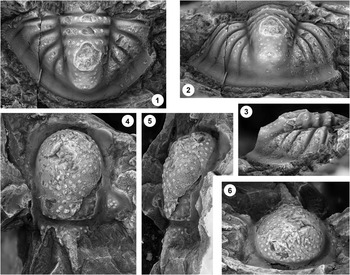
Pygidia from the Middle Ordovician (Darriwilian) Oil Creek Formation resemble B. (Raymondites) in possessing what must be, judging from the preserved bases, long, stout axial spines. However, the spine is centered on the second axial ring (Fig. 17.1, 17.6), with forward and backward deflection of the ring furrows, so that this ring is subhexagonal in outline. This contrasts with the more posterior position in B. (Raymondites), where the anterior end is at the third ring (Figs. 4, 10.5–10.7, 11.4, 13.1–13.3), and the spine extends backward across at least three segments (rings 3–5; Fig. 4.5). The Oil Creek pygidia also differ from B. (Raymondites) in having a narrow rim-like border and a border furrow that forms a shallow gutter (e.g., Fig. 17.2, 17.3). The border in B. (Raymondites) is expressed by a distal change in slope of the pleural field (Figs. 4.5, 13.3).
Bathyurid genus and species indeterminate. All from the Oil Creek Formation, Highway 77 section, Carter County, southern Oklahoma (illustrated previously by Shaw, Reference Shaw1974, pl. 5, figs. 10, 11, 15, 16). (1–3), pygidium (OU 8010), dorsal, posterior, and lateral views, ×10, collection SP-1-68, 171 m (561 feet) above the base of the Joins Formation; (4–6), pygidium (OU 8008), lateral, posterior, and dorsal views, ×12, collection SP-1-65, 161 m (528 feet) above the base of the Joins Formation.

As recognized by Shaw (Reference Shaw1974, p. 22), many bathyurid trilobites have interpleural furrows that are expressed distally, but become progressively effaced toward the axis. Behind a well-defined anterior pleural segment, the pleural and interpleural furrows merge, and each composite furrow has a faintly sigmoid course (e.g., Fig. 8.4). The Oil Creek specimens possess this type of composite furrow on a relatively narrow pleural field. However, these furrows are also connected by additional furrows, presumably paradoublural in nature, that run roughly parallel to the pygidial margin (Fig. 17.1, 17.6); a feature that is unknown in B. (Raymondites). Given the various differences in the Oil Creek pygidia, we agree with Shaw that an assignment to B. (Raymondites) is at best questionable, and they may represent an undescribed bathyurid genus.
Acknowledgments
This research was supported by NSF grant EAR 0819715. Loans of type and other material were provided by J. Cundiff (Museum of Comparative Zoology, Harvard University), M. Coyne (Geological Survey of Canada, Ottawa), J. Waddington and D.M. Rudkin (Royal Ontario Museum, Toronto), B. Hussaini (American Museum of Natural History, New York), and C. Labandiera and D. Levin (National Museum of Natural History, Washington, DC). We appreciate capable field assistance by D.K. Moss and A. Thomas in Missouri, and by J.P. Westrop on Manitoulin Island. R. Burkhalter provided his usual, invaluable help in the field and the lab. R. Ludvigsen collected the type material of R. clochensis. R.A. Fortey and J.D. Loch provided helpful reviews of the manuscript.
Appendix 1. Characters used in the phylogenetic analysis
1. Glabellar width. 0, wide (glabellar length/glabellar width at SO ≥ 0.65; e.g., Fig. 5.1; Ludvigsen, 1979a, pl. 2, fig. 20) 1, narrow (glabellar length/glabellar width at SO < 0.60; e.g., Ludvigsen, 1979, pl. 2, figs. 5, 18).
2. S1 lateral glabellar furrow. 0, absent (e.g., Hintze, 1953, pl. 26, fig. 4a; Fig. 7.1, 7.4); 1, present (e.g., Ludvigsen, 1979a, pl. 4, fig. 21).
3. Occipital spine. 0, absent (e.g., Hintze, 1953, pl. 26, fig. 4a; Fig. 7.1); 1, present (e.g., Fig. 3.2).
4. Glabellar sculpture. 0, tuberculate (e.g., Hintze, 1953, pl. 26, fig. 4a; Fig. 3.2); 1, granulose (e.g., Ludvigsen, 1979a, pl. 2, fig. 2); 2, terrace ridges in the form of "scales" (e.g., Ludvigsen, 1979a, pl. 6, fig. 2).
5. Expansion of glabella at 2L. 0, absent (e.g., Hintze, 1953, pl. 26, fig. 4a); 1, present (e.g., Ludvigsen, 1979a, pl. 4, figs. 1, 21).
6. Frontal area length. 0, long (at minimum, roughly equal to LO; e.g., Fig. 7); 1, short (much shorter than LO; e.g., Ludvigsen, 1979a, pl. 5, figs. 1, 6, 7).
7. Variability of short frontal area ([state 6(1)]. 1, preglabellar area narrows medially (sag.) relative to width (tr.) of preocular area (e.g., Tremblay and Westrop, 1991, fig. 14.1, 14.4); 2, preglabellar area continuous with preocular area (e.g., Ludvigsen, 1979a, pl. 1, figs. 6, 7). The condition in Raymondites and some species of Bathyurus (e.g., B. platyparius) involves expansion of the border relative to the preocular area. As this state essentially duplicates state 6(0), it was not coded (i.e., entered into the matrix as an inapplicable state).
8. Palpebral lobe length. 0, less than half of preoccipital glabellar length (e.g., Fig. 7); 1, more than half of preoccipital glabellar length (e.g., Ludvigsen, 1979a, pl. 1, figs. 1, 4).
9. Palpebral lobe configuration. 0, flat to gently convex (e.g., Ludvigsen, 1979a, pl. 1, figs. 1-3); 1, strongly upturned (e.g., Fig. 5.3.).
10. Sculpture of palpebral area. 0, tubercles (e.g., Fig. 12.1); 1, granules (e.g., Ludvigsen, 1979a, pl. 2, figs. 2, 4, 5); 2, terrace ridges (e.g., Fig. 7.6; Ludvigsen, 1979a, pl. 6, fig. 2); 3, smooth (e.g., Fig. 3.1). Sculpture of the palepbral area may differ from glabellar sculpture in species of Raymondites (e.g., Fig. 7) and was coded separately.
11. Librigenal border furrow. 0, little or on extension onto genal spine (e.g., Tremblay and Westrop, 1991, fig. 13.41, 13.42); extends along most or all of genal spine (e.g., Figs. 3.6, 6.1-6.4).
12. Spines on posterior corners of hypostomal border. 0, present (e.g., Tremblay and Westrop, 1991, fig. 12.14); 1, absent (e.g., Ludvigsen, 1979a, pl. 6, figs. 9, 14). This character was polarized using ontogeny, as spines may be lost in larger holaspids in some species (e.g., Tremblay and Westrop, 1991, fig. 11.10, 11.20, 11.26, 11.33). Coding was based on the condition in the largest available hypostome.
13. Configuration of hypostomal borders. 0, posterior and lateral borders separated by a zone of narrowing (indentation of margin), and with some expansion of the lateral border (e.g., Ludvigsen, 1979a, pl. 5, figs. 27, 29); 1, borders continuous with little variation in width (e.g., Tremblay and Westrop, 1991, fig. 9.35, 9.46).
14. Pygidial outline. 0, subtriangular (e.g., Ludvigsen, 1979a, pl. 2, figs. 25, 31, 35); 1, well-rounded posteriorly (e.g., Fig. 13.1).
15. Marginal pygidial spine. 0, present (e.g., Hintze, 1953, pl. 26, figs. 1, 2a); 1, absent (e.g., Fig. 13.1). Some Bathyurus species lose the spine during ontogeny (e.g., Tremblay and Westrop, 1991, fig. 14.9-14.23), so this character is not simply a restatement of character 14.
16. Axial pygidial spine. 0, absent (e.g., Hintze, 1953, pl. 26, figs. 1, 2a; Fig. 8.4); 1, present (e.g., Fig. 4.1-4.3).
17. Pygidial axial rings (larger holaspids). 0, at least two rings well defined anteriorly (e.g., Hintze, 1953, pl. 26, figs. 1, 2a; Ludvigsen, 1979a, pl. 4, figs. 4, 7, 33; Fig. 4.6); 1, no more than one, and may be mostly to entirely effaced (e.g., Ludvigsen, 1979a, pl. 1, figs. 17-20).