Introduction
The white-spotted sawyer, Monochamus scutellatus (Say) (Coleoptera: Cerambycidae), is widely distributed in North America and damage forest resources in several ways. The larvae mine in the cambium, phloem, and xylem of host trees, causing substantial saw-log degradation and economic loss due to the large, deep holes in the xylem and the introduction of wood-staining fungi. For example, cerambycids, including Monochamus Dejean species, cause degradation losses that total $1.8–4.8 million United States of America dollars (USD) in the province of British Columbia, Canada alone (Allison et al. Reference Allison, Borden, Mcintosh, DeGroot and Gries2001). If these values were extrapolated to encompass all interior mills, annual losses would be $293 million USD, $43.6 million USD of which would be attributable to large wood-borers (Allison et al. Reference Allison, Borden, Mcintosh, DeGroot and Gries2001). Monochamus species are considered forest pests in other countries where they vector the pinewood nematode, Bursaphelenchus xylophilus (Aphelenchida: Parasitaphelenchidae); the causal agent of pine-wilt disease (Linit Reference Linit1989; Vallentgoed Reference Vallentgoed1991). Bursaphelenchus xylophilus is indigenous to the United States of America and causes little damage to native North American pine species but has devastated pine forests in eastern Asia (Cram and Hanson Reference Cram and Hanson2004) and killed 90% of planted Scots pine, Pinus sylvestris Linnaeus (Pinaceae), in the mid-western United States of America (Gleason et al. Reference Gleason, Linit, Narjess, Donald, Tisserat and Giesler2000). Due to the economic significance of Monochamus species in countries that receive North American softwood products, significant resources have been dedicated to monitoring and controlling these insects in order to protect North American softwood exports. Monitoring strategies based on chemical attractants are generally efficient and cost-effective, but have not yet been developed for M. scutellatus.
Semiochemicals in the cuticular wax layer of insects have important roles communicating information about species, sex, and kinship (Blomquist et al. Reference Blomquist, Tillman-Wal, Guo, Quilici, Gu and Schal1996; Howard and Blomquist Reference Howard and Blomquist2005). Cuticular waxes are composed of complex mixtures that may include long-chain fatty acids, methyl esters, aliphatic alcohols, aldehydes, ketones, and hydrocarbons, which also protect the organism from desiccation (Edney Reference Edney1967; Neville Reference Neville1975; Jackson and Blomquist Reference Jackson and Blomquist1976; Gibbs Reference Gibbs1998). The hydrocarbon composition of the insect cuticle is not constant throughout the lifespan of an insect and can change due to the environment or physiological factors, including but not limited to age, ovarian activity, or nutritional condition and habitat (Dillwith et al. Reference Dillwith, Adams and Blomquist1983; Wakonigg et al. Reference Wakonigg, Eveleigh, Arnold and Crailsheim2000; D'Ettorre et al. Reference D'Ettorre, Wenseleers, Dawson, Hutchinson, Boswell and Ratnieks2006). Males of many species increase their probability of successfully mating by choosing mates based on the females’ reproductive status (Thomas Reference Thomas2011).
Behavioural studies of cerambycid beetles showed that contact cuticular hydrocarbons play an important role in mate recognition (Hanks et al. Reference Hanks, Millar and Paine1996; Ginzel and Hanks Reference Ginzel and Hanks2003). Male longhorn beetles locate females on bark or foliage of host trees using other cues, and then use cuticular hydrocarbons and contact chemoreception to recognise the female as a potential mate. This behavioural mechanism has been documented in the subfamilies Prioninae (Barbour et al. Reference Barbour, Lacey and Hanks2007; Spikes et al. Reference Spikes, Paschen, Millar, Moreira, Hamel and Schiff2010), Cerambycinae (Ginzel and Hanks Reference Ginzel and Hanks2003), and Lamiinae (Wang Reference Wang1998; Ginzel and Hanks Reference Ginzel and Hanks2003; Zhang et al. Reference Zhang, Oliver, Chauhan, Zhao, Xia and Xu2003). Components of the contact sex pheromones may be unique to the wax layer of females (Ginzel et al. Reference Ginzel, Blomquist, Millar and Hanks2003a, Reference Ginzel, Millar and Hanks2003b; Lacey et al. Reference Lacey, Ginzel, Millar and Hanks2008), or alternatively, the uniqueness may be encoded as sexual dimorphism in the relative abundance of a subset of the cuticular hydrocarbons (Howard and Blomquist Reference Howard and Blomquist2005).
Here, we test the hypothesis that cuticular hydrocarbons encode information about sex and maturation status of females in M. scutellatus. Specifically, our objectives were: (1) to determine if information about sex and maturation is encoded as unique components in the hydrocarbon blends and (2) to determine if information about sex and maturation is encoded in the relative proportions of cuticular hydrocarbons.
Materials and methods
Collection and rearing
Red pine, Pinus resinosa Soland (Pinaceae), infested with M. scutellatus larvae were felled at Pratts Falls County Park in Pompey, New York, United States of America in September 2005 and logs were transported to the State University of New York College of Environmental Science and Forestry (SUNY-ESF) and stored at 4.5°C for 2 months to force larvae into diapause. Logs were then placed in emergence chambers at ∼23°C.
Adult beetles emerged after 2–4 weeks and were placed in environmental chambers at 20–24°C with a 16:8 light/dark photoperiod. The date and sex of each beetle were recorded upon emergence. Beetles were allowed to feed on white pine, Pinus strobus Linnaeus (Pinaceae), shoots for ∼1 week in environmental chambers before they were extracted.
Extraction of cuticular hydrocarbons
Cuticular hydrocarbons were individually extracted in pentane by the method of Ginzel et al. (Reference Ginzel, Millar and Hanks2003b). Unfed females were separately extracted within 1 day of emergence with no access to food. We individually extracted cuticular hydrocarbons of three groups of virgin beetles: maturation-fed females (n = 20), unfed females (n = 18), and maturation-fed males (n = 20) of M. scutellatus.
Hydrocarbon identification
Cuticular hydrocarbon samples were analysed with a gas chromatography mass spectrometry (Series II 5890 gas chromatograph and HP 5971 MSD, Hewlett Packard, Palo Alto, California, United States of America) with the temperature program at 40°C for 1 minute, then 10°C/minute to 300°C for 10 minutes. Injector and quadrupole mass spectrometer detector temperatures were 300°C and 280°C, respectively. Electron impact (70 eV) mass spectra were obtained with a scan range of 40–500 m/z. For each sample analysis, a 1.0 μl aliquot was injected. Samples were also analysed using chemical ionisation mass spectrometry with isobutene (Hewlett Packard Model 5989B GC/MS, Agilent, Santa Clara, California, United States of America) under the same temperature program as described above. In comparing the ratio of both maturation-fed females and unfed females an internal standard of heptadecane was used to quantify hydrocarbons.
Data analyses
The relative quantities of cuticular hydrocarbons of maturation-fed males, fed females, and unfed females were analysed using discriminant analysis to determine if the hydrocarbon signatures of the three treatment groups were distinct. Statistical analyses were performed using program Statistica (Statsoft, Inc., Tulsa, Oklahoma, United States of America). Structure coefficients (correlations between the discriminating variables and the discriminate groups) were used to assess the importance of individual compounds in the different groups. To avoid limitations inherent to the analysis of compositional data, peak areas were transformed prior to the analysis using the formula of Aitchinson (Reference Aitchinson1986):
 $${{Z}_{ij}}\, = \,\ln \left[ {\frac{{{{Y}_{ij}}}}{{g({{Y}_j})}}} \right],$$
where Zij is the transformed area of peak i for beetle j; Yij is the area of peak i for beetle j; and g(Yj) is the geometric mean of the areas of all peaks for beetle j (Aitchinson Reference Aitchinson1986; Steiner et al. Reference Steiner, Peschke, Francke and Muller2007). Peeters et al. (Reference Peeters, Monnin and Malosse1999) reduced the number of compounds by excluding peaks with small relative amounts. However, relative peak sizes may not be an appropriate selection criterion as small peaks have the potential to encode information. Rather, peaks with the highest variation between treatment groups should be identified and included. Selection of peaks for this analysis was based on the Kruskal–Wallis test statistic H (Zar Reference Zar1996). H-values were calculated for each compound and compounds with the highest H-values, those exhibiting the highest inter-group variability, were chosen and included (Steiner et al. Reference Steiner, Peschke, Francke and Muller2007) in the discriminant analysis. Eighteen compounds were selected based on the H-values from the original 33 peaks that occurred regularly in the samples of all three groups (totalling 58 individuals). Four additional compounds were also included as univariate t-test comparisons of peak areas for these compounds from maturation-fed male and female beetles were significantly different (P < 0.05).
Results
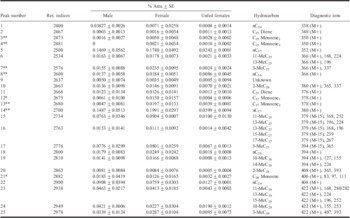
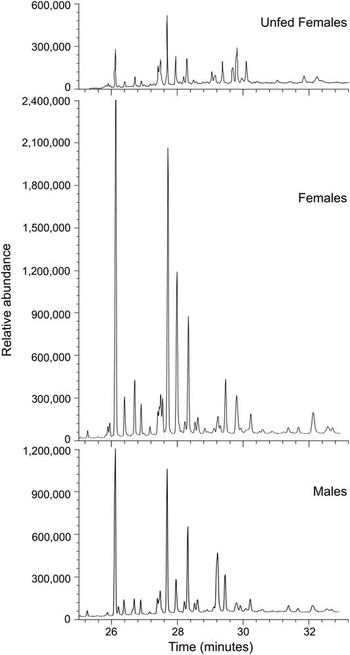
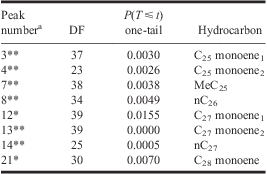
Hexane extracts of female and male M. scutellatus consisted principally of saturated and unsaturated hydrocarbons, and there were consistent, sex-specific differences in male and female hydrocarbon total ion chromatograms (Table 1, Fig. 1). While the same compounds appeared in both male and female extracts, there were significant differences in relative quantity between the two sexes (one-tailed t-test, P < 0.05) in the two C25 monoenes, the methyl-branched C25, nC26, the two C27 monoenes, and nC27 (Table 2). C28 monoene was a dominant compound in males, and there were no compounds that were specific to males or females (Table 1, Fig. 1).
Relative quantities of cuticular hydrocarbons from female and male Monochamus scutellatus after 14 days of maturation feeding.

*P < 0.05 and **P < 0.005 for sexually dimorphic compounds.
Peak numbers correspond to those in Figure 1. Molecular weights were confirmed by chemical ionisation with isobutene.
Representative total ion chromatograms of hexane extracts of representative virgin, maturation fed, and unfed adult females, and virgin, maturation fed, adult male Monochamus scutellatus. Numbered peaks are sexually dimorphic compounds found in Table 1. Females are of varying ages: unfed are <1 day, 2 days and fed are aged 2 weeks and 1 month.

Degrees of freedom and test value for one-tailed t-test of hydrocarbons Z9:C25, Z7:C25, 3-MeC25, nC26, Z9:C27, Z7:C27, nC27, Z9:C28, and (P = 0.05).
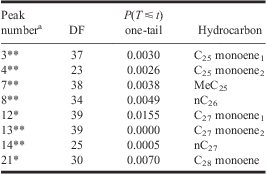
aPeak numbers correspond to those in Figure 1.
*P<0.05 and **P<0.005 for sexually dimorphic compounds.
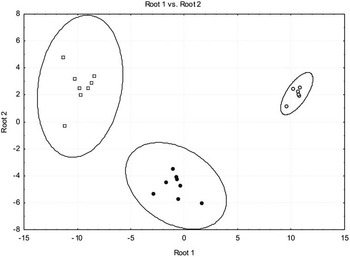
There were significantly different relative amounts of 20 hydrocarbons in the cuticular extracts of M. scutellatus of different sex and feeding status (Wilks’ λ = 0.062, F 34,78 = 196.943; P < 0.00001). Discriminant analysis showed that the first root separates all three groups, while the second root separates fed females from the other two groups (Fig. 2). Although the majority of hydrocarbons are present in both groups of females, the quantity is approximately four times greater in maturation-fed females than in unfed females (Table 1, Fig. 1). During maturation, some cuticular hydrocarbons may be produced in a high quantity, and it is very possible that new cuticular hydrocarbons are produced.
Monochamus scutellatus males (open squares), females (solid diamonds), and newly emerged females (open circles) clustered in distinct groups based on discriminate analysis of 18 cuticular hydrocarbons isolated from 58 beetles. Ellipses represent 95% confidence limits.

Discussion
Chemical communication a very old and widespread form of communication (Wyatt Reference Wyatt2003). Males of many species increase their probability of successfully mating by choosing mates based on the females’ reproductive status (Thomas Reference Thomas2011). One of the ways males discriminate is by using female reproduction status cues, such as female age, as a proxy. For example, male bushcrickets (Requena verticalis Walker; Orthoptera: Tettigoniidae), can differentiate females based on their age and preferentially mates with younger females (Simmons et al. Reference Simmons, Llorens, Schinzig, Hosken and Craig1994). By choosing young females, males reduce the probability of copulating with mated females, thereby increasing the likelihood that they will sire offspring. However, it is not clear if odour is used as the cue to discriminate female ages in this species. An example where age-dependent chemical signals have been demonstrated and, most likely, used by males is in Drosophila virilis (Sturtevant) (Diptera: Drosophilidae). In this case, the average chain length of hydrocarbons decreases with age (Jackson and Bartelt Reference Jackson and Bartelt1986).
Our analysis of M. scutellatus male and female cuticular hydrocarbons indicates that hydrocarbons are sexually dimorphic (Table 2 and Fig. 1). Some or all of these compounds may be contact pheromones used for mate recognition, as in other cerambycids (Hanks Reference Hanks1999; Ginzel and Hanks Reference Ginzel and Hanks2003; Ginzel et al. Reference Ginzel, Blomquist, Millar and Hanks2003a, Reference Ginzel, Millar and Hanks2003b; Barbour et al. Reference Barbour, Lacey and Hanks2007).
This investigation demonstrates that in M. scutellatus, maturation feeding is associated with a change in the relative proportion of cuticular hydrocarbons in females. The majority of compounds found were the same in maturation-fed females compared with unfed females; however, there were significant differences in the quantities and ratios of these compounds (Fig. 1). These beetles have a required maturation-feeding period of 7 days (Rose Reference Rose1957) prior to mating, and our observations indicate that beetles do not discriminate the sexes until maturation feeding has occurred.
The sexually dimorphic compounds that show highly significant differences between males and females (Table 2) are likely contact pheromones for M. scutellatus. Due to their molecular weight they may have potential to be somewhat volatile and thus, may act as close range pheromones. Additionally, some of these same compounds have also been identified as contact sex pheromones in other cerambycid species. For example, (Z)-9-pentacosene has been identified as a contact pheromone in both the locust borer, Megacyllene robiniae (Ginzel et al. Reference Ginzel and Hanks2003), and the Asian longhorn beetle, Anoplophora glabripennis (Motschulsky) (Coleoptera: Cerambycidae) (Zhang et al. Reference Zhang, Oliver, Chauhan, Zhao, Xia and Xu2003). One of the known contact pheromones of the rustic borer, Xylotrechus colonus (Fabricius) (Coleoptera: Cerambycidae), is 3-methylpentacosane (Ginzel et al. Reference Ginzel, Blomquist, Millar and Hanks2003a).
The ontogenetic changes in cuticular hydrocarbons in social insects have been widely studied. In these insects, factors such as habitat and nutritional conditioning induce changes in cuticular hydrocarbon composition. A few examples include the arrangement of hydrocarbons revealing age-related changes in honey-bee drones (Wakonigg et al. Reference Wakonigg, Eveleigh, Arnold and Crailsheim2000), vespid wasps (Panek et al. Reference Panek, Gamboa and Espelie2001), and ants (Cuvillier-Hot et al. Reference Cuvillier-Hot, Cobb, Malosse and Peeters2001). However, similar changes in ontogenic variation in cuticular hydrocarbon compositions in non-social organisms have yet to be addressed and are currently poorly understood. Investigating these mechanisms may provide important information regarding non-social insects’ ecology and communication pathways.
Acknowledgements
The authors thank Francis Webster and Dave Kiemle for their advice in developing the experiment and chemistry expertise. They also thank Melissa Fierke for her support, guidance, and helpful comments on an early version of the manuscript. This work was supported, in part, by a grant from the Alphawood Foundation to S.A.T.