Introduction
Efficient forage production is the biggest challenge for animal production in arid and semi-arid regions of the world. In the dry period, the limited water supply in these regions causes a decline in the production of plant biomass (Voltolini et al., Reference Voltolini, Belem, Araújo, Moraes, Gois and Campos2019). Due to this seasonality, tropical forages do not provide the necessary nutritional input to maintain adequate levels of animal performance. Therefore, alternatives are necessary to meet the demand for forage in this period. Thus, the storage of surplus forage as silage, during the rainy period for use in the dry period, is a viable strategy to guarantee the supply of high-quality feed to animals during the period of food shortage (Amorim et al., Reference Amorim, Edvan, Nascimento, Bezerra, Araújo, Silva, Mielezrski and Nascimento2020).
Tropical forages of Manihot genus are considered an alternative to increase economic viability and livestock productivity in a semi-arid region, due to their productive potential and high nutritional value. Pornunça (Manihot spp.) is a forage plant originating from the cross between cassava (Manihot esculenta) and maniçoba (Manihot pseudoglaziovii), being considered a hybrid. With this crossing, pornunça acquired productive and nutritional characteristics of these two forage species, in addition to presenting better productivity and lower content of cyanogenic glycosides than maniçoba and cassava, providing certain security in its administration in the face of possible poisoning risks. However, studies on the potential of pornunça (hay or silage) in feeding small ruminants are incipient.
Pornunça is characterized by the high production of aerial phytomass (1.4–1.6 kg dry matter (DM)/ha; Nascimento et al., Reference Nascimento, Menezes, Queiroz and Melo2016) and by the high levels of crude protein (CP) in its aerial parts (14–28% DM; Nascimento et al., Reference Nascimento, Menezes, Queiroz and Melo2016) and neutral detergent fibre (NDF; 552 g/kg DM; Silva et al., Reference Silva, Araujo, Santos, Oliveira, Campos, Godoi, Gois, Perazzo, Ribeiro and Turco2021), with high drought tolerance. The DM content (239.4 g/kg natural matter; Voltolini et al., Reference Voltolini, Belem, Araújo, Moraes, Gois and Campos2019) below the recommended limit for the preparation of good quality silages (between 300 and 350 g/kg natural matter; McDonald et al., Reference McDonald, Henderson and Heron1991) may favour secondary fermentation during ensiling by reducing the nutritional value of silage. Proteolysis can directly affect the animals' intake due to the presence of unpleasant odours or causing pathologies in the presence of pathogenic bacteria, such as Clostridium and enteric bacteria (Nascimento et al., Reference Nascimento, Bezerra, Menezes, Lucena, Queiroz, Trajano and Oliveira2017).
The ensiling of protein-rich forages presents drawbacks such as the rapid degradation of proteins in non-protein nitrogen, which can negatively influence the intake and use of forage N by ruminants (Salawu et al., Reference Salawu, Acamovica, Stewart, Hvelplund and Weisbjerg1999). In addition, the formation of ammonia reduces the pH drop in the ensiling process, which is essential to produce deterioration-resistant silage (Jayanegara et al., Reference Jayanegara, Sujarnoko, Ridla, Kondo and Kreuzer2018). Condensed tannins (CT) appear to have potential as protein protective agents during ensiling of forage plants due to their great affinity for amino acids, proteins and polysaccharides, which can slow down the decomposition of protein during ensiling (Martens et al., Reference Martens, Korn, Roscher, Pieper, Schafft and Steinhöfel2019), and lead the reduction of losses by effluent and gases (Nascimento et al., Reference Nascimento, Bezerra, Menezes, Lucena, Queiroz, Trajano and Oliveira2017; Syahniar et al., Reference Syahniar, Ridla, Jayanegara and Samsudin2018). CT are inexpensive and easy to obtain, as they are widely distributed in forage plants adapted to the semi-arid (Silanikove et al., Reference Silanikove, Perevolotsky and Provenza2001).
The addition of CT levels above 5% DM can inhibit the animal's intake and reduce the digestibility of the silage (Martens et al., Reference Martens, Korn, Roscher, Pieper, Schafft and Steinhöfel2019), which will directly affect animal performance. However, Nascimento et al. (Reference Nascimento, Bezerra, Menezes, Lucena, Queiroz, Trajano and Oliveira2017) observed that the addition of 7.5% CT in silages of plants of the Manihot genus at 28 and 56 days of opening the silos did not affect the silage quality, promoting increases in the DM content and in the concentration of organic acids. Thus, the limit of addition of CT so that it can provide beneficial effects in silages of plants of the Manihot genus, especially pornunça silages, is not fully elucidated, as well it is not clear whether the amount added to the silages is sufficient to affect the chemical composition and the fermentative profile of silages at different opening times of silos.
Thus, we hypothesize that the use of CT at levels of up to 12% as an additive in pornunça silage opened at 56 days of storage accelerates the rate of pH decline, promotes greater recovery of DM and increases the DM content of silages in addition to improving the fermentation profile of the silage and reducing fermentative losses.
The objective was to evaluate the fermentation profile, in vitro gas production and nutritional quality of pornunça silage with levels of CT.
Material and methods
Location of the experiment
The experiment was conducted at the Agricultural Sciences Campus of the Universidade Federal do Vale do São Francisco (CCA/UNIVASF), Petrolina, State of Pernambuco, Brazil (9°19′28″ South latitude, 40°33′34″ West longitude, 393 m altitude). The climate, according to the classification of Köppen and Geiger (Reference Köppen and Geiger1928), is hot semi-arid, with rainy season (BSh), with an average annual rainfall of 376 mm and maximum and minimum temperatures of 38.8 and 14.7°C, respectively.
This study was approved and certified by the Ethics Committee on Animal Use of UNIVASF (protocol 0002/120514).
Experimental design, pornunça planting and silage making
Four levels of inclusion of CT (Quebracho – Schinopsis brasiliensis; Weibull® Tanac, Montenegro, RS, Brazil) on the levels 0, 4, 8 and 12% on a DM basis were evaluated in pornunça silage at five opening times of silos (3, 7, 14, 28 and 56 days), with four experimental silos for treatments, totalling 80 experimental silos.
Pornunça used for making silages came from an experimental area of UNIVASF (Petrolina, State of Pernambuco, Brazil). Initially, cuttings were harvested 30 cm long, with three nodes (buds) and bevel cut at the bottom, for pornunça seedling production. Cuttings were placed in black polyethylene bags (23 × 13 cm) with organic substrate (sand/clay/manure 1:1:1) and transferred to a covered shed, kept under irrigation. Seedlings remained in the shed for approximately 2 months and, after this period, were transplanted to the field.
Before transplanting, the experimental area (0.7 ha) was fertilized with aged cattle and sheep manure. Transplanting was carried out in pits with 1.0 m spacing between plants and 1.0 m between rows. In the field, seedlings were irrigated daily by conventional spraying, to guarantee the complete establishment of seedlings in the field. Weeding was carried out regularly to control invasive plants.
The material was harvested 6 months after transplanting the seedlings to the field, by collecting the upper third of the plants. The harvest was carried out manually and the collected material was processed in a stationary forage harvester (PP-35, Pinheiro Máquinas, Itapira, São Paulo, Brazil), to particles of average size of 2.0 cm.
The material was mixed manually. During homogenization, treatments were formulated by adding CT (Quebracho – Schinopsis brasiliensis; Weibull® Tanac), to the material to be ensiled, according to experimental treatments. After mixing, the material was ensiled in experimental silos (10 cm in diameter, 50 cm in height) made of polyvinyl chloride, equipped with a Bunsen valve to allow the escape of gases from fermentation. At the bottom of the experimental silos, 2 kg dry sand were deposited, protected by a cotton cloth, preventing the ensiled material from coming into contact with the sand, allowing the effluent to drain.
The material was compacted with a wooden plunger, aiming to reach a density of 600 kg/m3 natural material. Samples of the material before ensiling (original material) were collected for further laboratory analysis (Table 1). Silos were weighed before and after filling. Once closed, silos were kept in a covered shed.
Chemical composition of ingredients used in making experimental silages

FM, fresh matter; DM, dry matter.
a According to the manufacturer.
Determination of pH and NH3-N of silages
For the determination of these variables, silage samples were taken in each period of silo opening in a factorial arrangement 4 (tannin inclusion levels) × 5 (opening times). The analyses were performed in triplicate. Silage samples were taken in each period of silo opening, with the top layer (10 cm) discarded from each silo. The silage was manually removed and collected in plastic containers at each opening time.
The pH of the samples was measured immediately after opening the silos. Samples of 25 g were taken at the time after cutting and during mini-silo openings, placed in containers with 100 ml of distilled water, and mixed. These samples were left to stand for 1 h, and the pH values were read using a portable digital pH meter (Marconi® MA-552, Piracicaba, State of São Paulo, Brazil, 0–14 scale, with accurate to 0.01 pH) according to Bolsen et al. (Reference Bolsen, Lin, Brent and Gadeken1992). The pH of the silages at time 0 were: 6.29 (Control – 0% CT); 4.37 (4% CT, on a DM basis); 4.14 (8% CT, on a DM basis); 4.17 (12% CT, on a DM basis).
The content of ammonia N (NH3-N) was determined according to Bolsen et al. (Reference Bolsen, Lin, Brent and Gadeken1992). An aliquot of 25 g of wet silage was placed in a vessel containing 200 ml H2SO4 (0.2 N), stirred, and allowed to stand for 48 h under refrigeration. Afterwards, the material was filtrated through a fine mesh plastic sieve, lined with gauze. Then, an aliquot of 5 ml of the filtrate +10 ml of potassium hydroxide (2N) was filtered and titrated with an HCl solution, and the readings were noted. The ratio between NH3-N and total N was calculated using the equation:

The total nitrogen values were obtained according to Silva and Queiroz (Reference Silva and Queiroz2006), dividing the CP values by the factor 6.25.
For the other analyses, only silage samples collected after 56 days of opening were considered. A completely randomized design was adopted with four levels of tannin inclusion in the silages and four repetitions
Determination of organic acids of silages
Organic acids were determined according to Kung Junior and Ranjit (Reference Kung and Ranjit2001). Samples were prepared by the addition of 1 ml of 20% metaphosphoric acid v/v in 2 ml of the silage filtrate, being then centrifuged. Analyses of concentrations of organic acids: acetic (AA), propionic (PA) and butyric (BA) were determined by gas chromatography (Thermo Scientific TRACE 1300, Waltham, MA, USA) equipped with a flame ionization detector and automated sample injection. The lactic acid (LA) content was determined by high-performance liquid chromatography.
Determination of fermentation losses of silages
The gas losses (GL) were obtained by the following equation (Mota et al., Reference Mota, Rocha Júnior, Souza, Reis, Tomich, Caldeira, Menezes and Costa2011):

where, SWC = total silo weight at closure; SWO = total silo weight at opening; FMC = forage mass at closure; and DMCC = forage DM concentration at closure.
Effluent losses (EL) were calculated using the equation proposed by Amorim et al. (Reference Amorim, Edvan, Nascimento, Bezerra, Araújo, Silva, Mielezrski and Nascimento2020), based on the sand weight difference and the green matter mass at the closure:

where, ESWO = empty silo weight + sand weight + screen at opening; SW = empty silo weight; ESWC = empty silo weight + sand weight + screen at closure; and FMC = forage mass at closure.
Dry matter recovery (DMR) was determined by the equation (Amorim et al., Reference Amorim, Edvan, Nascimento, Bezerra, Araújo, Silva, Mielezrski and Nascimento2020):

where, DMR = dry matter recovery rate; FMO = forage mass at opening; DMO = dry matter at the opening; FMC = forage mass at closure; and DMC = dry matter at closure.
Chemical composition
Samples taken during pre-ensiling and at 56 days of opening the silos were pre-dried in a forced ventilation oven at 55 °C for 72 h. The samples were individually processed in a knife mill (Wiley, Marconi, MA 580, Piracicaba, Brazil) at 3 mm mesh sieve to determine the gas production and in vitro degradability test, and at 1 mm mesh sieve to determine the chemical composition. The analyses were carried out at the Laboratory of Bromatology and Gas Production belonging to the Universidade Federal do Vale do São Francisco.
Chemical analyses were performed using the procedures described by the Association of Analytical Chemists (AOAC, Reference Latimer2016) to determine DM (method 967.03), mineral matter (MM; method 942.05), organic matter (OM; OM = 100 – MM), CP (method 981.10) and acid detergent fibre (ADF; method 973.18). NDF was determined according to Van Soest et al. (Reference Van Soest, Robertson and Lewis1991). Hemicellulose (HEM) was calculated using the following equation: HEM = NDF – ADF. The NDF content corrected for ash and protein (NDFap) was determined according to Mertens (Reference Mertens2002) and Licitra et al. (Reference Licitra, Hernandez and Van Soest1996). The contents of neutral detergent insoluble nitrogen (NDIN), acid detergent insoluble nitrogen (ADIN), neutral detergent insoluble protein (NDIP) and acid detergent insoluble protein (ADIP) were determined according to Licitra et al. (Reference Licitra, Hernandez and Van Soest1996).
In vitro gas production
The in vitro semi-automated gas production technique was proposed by Mauricio et al. (Reference Mauricio, Pereira, Gonçalves and Rodriguez2003) and adapted by Menezes et al. (Reference Menezes, Costa, Araújo, Pereira, Nunes, Henrique and Rodrigues2015). One gram of the samples was added in glass vials (160 ml), and added with 90 ml nutrient medium composed of buffer solution, pH indicator solution, macro and micro mineral solution, sodium hydroxide solution (1 m) and reducing solution, prepared according to Theodorou et al. (Reference Theodorou, Williams, Dhanoa, McAllan and Franc1994). Subsequently, 10 ml ruminal fluid was added to each vial, which was kept under a spray of CO2. Two vials containing only ruminal fluid and culture medium (buffer) were used as controls. The ruminal fluid used as inoculum was a combined sample, from two fistulated sheep kept on a diet consisting of elephant grass (Pennisetum purpureum), concentrate based on corn and soybean, and mineral salt (Ovinofós, Tortura, Porto Alegre, Brazil). Vials were sealed with rubber stoppers and kept at 4 °C overnight.
The pressure (P; in psi – pound per square inch), originated from gases accumulated in the upper part of the vials, was measured by means of a portable pressure transducer (GE Druck Series DPI 705) connected at its end to a needle (0.6 mm). Pressure was read more frequently during the initial fermentation period and subsequently reduced (2, 4, 6, 8, 9, 11, 12, 14, 17, 20, 24, 28, 34, 48, 72, 96 and 120 h of incubation).
Pressure data were converted to gas volume (1 psi = 4.859 ml gas). From each pressure reading, the total produced by the vials without substrate (blank) was subtracted for each sample. Cumulative gas production data were analysed using the Gompertz two-compartment model, cited by Schofield et al. (Reference Schofield, Pitt and Pell1994):

where, V(t) = total maximum volume of gas produced; Vf 1 = maximum volume of gas for the fast digesting fraction (non-fibre carbohydrates; NFC); Vf 2 = maximum volume of gas for the slow digesting fraction (fibrous carbohydrates; FC); m 1 = specific growth rate for the rapid degradation fraction; m 2 = specific growth rate for the slow degradation fraction; L = duration of initial digestion events (latency phase), common to both phases; and T = fermentation time.
In vitro dry matter degradability
The in vitro DM degradability was estimated from the insertion of nylon bags (20 mg/cm2 weight and 50 microns porosity) containing 600 mg sample in flasks with 60 ml buffer solution (combination of solutions A + B with pH 6.8) and 15 ml inoculum (rumen fluid). The rumen content was filtered through a gauze, constantly injecting CO2 to maintain the anaerobic environment and stored at 39 °C. Samples were incubated for 2, 6, 12, 24, 48, 96 and 120 h. After in vitro fermentation, bags were washed and dried in an oven at 105 °C for 12 h, and weighed. The samples at time 0 were just washed with distilled water at 39 °C for 5 min, and then dried and weighed (Tilley and Terry, Reference Tilley and Terry1963).
The model of Ørskov and McDonald (Reference Ørskov and Mcdonald1979) was used to determine potential degradability (PD):

where, A = fraction soluble in water; B = fraction insoluble in water, but potentially degradable; c = degradation rate of fraction ‘B’; and t = incubation time in hours. The letter ‘e’ is the natural log of (−ct).
The effective degradability (ED) was calculated using the formula:

where, k = rate of passage.
The gas production rate obtained by the semi-automated gas production technique (m 1 + m 2) was used to estimate the rate of passage (k) used in the degradability test (Menezes et al., Reference Menezes, Costa, Araújo, Pereira, Nunes, Henrique and Rodrigues2015).
Statistical analysis
Data were initially analysed using the UNIVARIATE procedure to check the normal distribution of data. Thereafter, as the fermentation periods were not equidistant, it was also necessary to use the SAS IML procedure for formulating the vector. Analysis of variance was determined and regression with orthogonal contrasts and by means was determined using PROC GLM and PROC MIXED using the Statistical Analysis System (SAS, version 9.1).
For the variables pH and NH3-N, a 4 × 5 factorial arrangement was adopted, using the statistical model:

where, Yij = value observed in silages subjected to different levels of CT (i) and opening times (j); μ = overall mean for all observations; Si = effect of the i-th levels of CT, where i = 1–4; Ej = effect of the j-th opening time on silage, where j = 1–5; SiEj = effect of the interaction between the i-th additive and the j-th opening time; ɛijk = random error associated with each observation.
Organic acids, fermentation profile, chemical composition, gas production and in vitro degradability of silages from silos opened at 56 days were estimated using the non-linear regression procedure (PROC NLIN) in SAS (SAS, version 9.1). The following statistical model was adopted:

where, Yij = observed value for the study variable referring to the i-th treatment in the j-th repetition; μ = general constant; Ti = effect of the level of CT on pornunça silage; Eij = random error associated with the Eij observation. Probability values below 5% were considered significant (P < 0.05).
Results
pH and NH3-N at different silo opening times
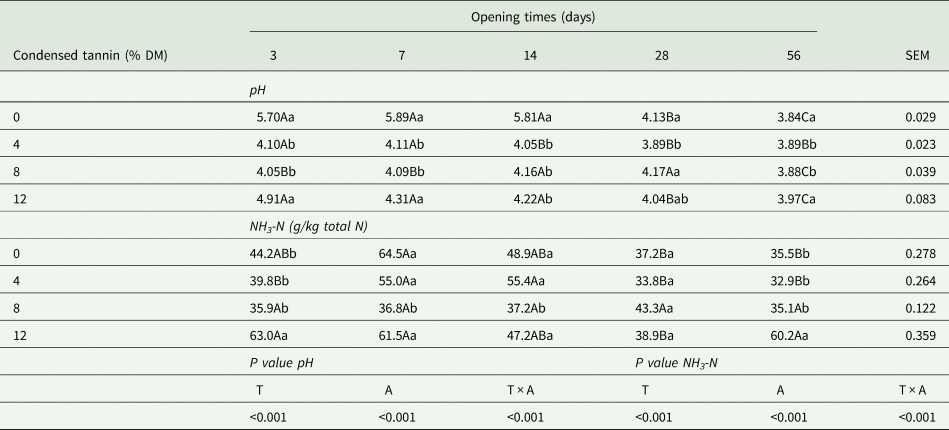
There was an interaction effect between tannin levels and silo opening times for pH and NH3-N (P < 0.001; Table 2). Silages without the addition of tannin (Control) reduced their pH according to the increase in ensiling time (P < 0.001; Table 2; Fig. 1). Silages containing 4% tannin showed pH stabilization at 28 days after opening the silos (P < 0.001; Table 2; Fig. 1). Silages containing 8% tannin increased their pH at 14 and 28 days of opening the silos, compared to days 3, 7 and 56 (P < 0.001; Table 2; Fig. 1). Silages containing 12% tannin showed higher pH at days 3, 7 and 14 compared to the control treatment (0% tannin; 0 days of opening) and at 28 and 56 days after opening the silos (P < 0.001; Table 2; Fig. 1).
Variation in the pH of pornunça silages associated with different levels of condensed tannin (0, 4, 8 and 12% on dry matter basis) in five opening times (3, 7, 14, 28 and 56 days) (n = 4), P < 0.001.

pH and ammonia nitrogen (NH3-N) of pornunça silages associated with different levels of condensed tannin at different opening times (n = 4)

DM, dry matter; T, condensed tannin; A, opening times; T × A, interaction effect between the condensed tannin levels and the opening times; SEM, standard error of the mean.
Averages followed by different capital letters on the line indicate statistical difference between the opening times.
Averages followed by different lowercase letters on the line indicate statistical difference between condensed tannin levels.
Significant at the 5% probability level by the Tukey test.
The highest content of NH3-N was observed for the control treatment (0% tannin) at 7 days of opening (P < 0.001; Table 2; Fig. 2). For the level of 4% tannin addition to silages, the highest levels of NH3-N were observed at 7 and 14 days of opening the silos (P < 0.001; Table 2; Fig. 2). The addition of 8% tannin to the silages promoted a gradual increase in the content of NH3-N until day 28 (P < 0.001; Table 2; Fig. 2). For 12% addition of tannin to pornunça silage, the highest NH3-N levels were observed at 3, 7 and 56 days of silo opening (P < 0.001; Table 2; Fig. 2). Except for the level of inclusion of 12% tannin in the silages, the other levels showed the lowest values of NH3-N at 56 days of silo opening (P < 0.001; Table 2; Fig. 2).
Variation in the NH3-N of pornunça silages associated with different levels of condensed tannin (0, 4, 8 and 12% on dry matter basis) in five opening times (3, 7, 14, 28 and 56 days) (n = 4), P < 0.001.

pH, NH3-N, organic acids, fermentation profile and chemical composition of silages at 56 days of silo opening
The increasing levels of CT promoted a linear increase in the pH, with increases of 0.01 for each 1% inclusion of CT in pornunça silages (P = 0.013; Table 3). A quadratic effect was verified for the NH3-N (P < 0.001), acetic acid (P = 0.001), butyric acid (P = 0.009) contents, and for GL (P < 0.001) and DMR (P = 0.040) (Table 3). There was no effect of CT levels on LA and propionic acid concentrations and on EL in pornunça silages (P > 0.05; Table 3).
pH and ammonia nitrogen (NH3-N), organic acids concentration, and fermentative profile of pornunça silages associated with different levels of condensed tannin (n = 4)

DM, dry matter; N, nitrogen; NM, natural matter; SEM, standard error of the mean; L, significant for linear effect; Q, significant for quadratic effect; significant at the 5% probability level.
Equations: Y a = 3.84 + 0.001x, R 2 = 0.38; Y b = 3.64 − 0.33x + 0.0433x 2, R 2 = 0.84; Y c = 143.48 − 31.825x + 4.647x 2, R 2 = 0.65; Y d = 397.99 − 169.739x + 27.170x 2, R 2 = 0.52; Y e = 37.25 − 23.96x + 5.3x 2; R 2 = 0.98; Y f = 846.4 + 81.59x − 16.95x 2; R 2 = 0.39.
The addition of tannin levels in pornunça silages increased in DM (P < 0.001), ADIN (P = 0.003), NDIP (in g/kg CP; P = 0.030) and ADIP (in g/kg CP; P < 0.001) contents. The opposite was found for the CP (P < 0.001) and NDF (P < 0.001) contents, which decreased linearly with increasing CT levels in pornunça silages (Table 4).
Chemical composition of pornunça silages associated with different levels of condensed tannin (n = 4)

FM, fresh matter; DM, dry matter; NDFap, neutral detergent fibre corrected for ash and protein; NDF, neutral detergent fibre; ADF, acid detergent fibre; CP, crude protein; NDIN, neutral detergent insoluble nitrogen; ADIN, acid detergent insoluble nitrogen; NDIP, neutral detergent insoluble protein; ADIP, acid detergent insoluble protein; SEM, standard error of the mean; L, significant for linear effect; Q, significant for quadratic effect; significant at the 5% probability level.
Equations: Y a = 241.8 + 12.73x, R 2 = 0.99; Y b = 132.05 − 6.86x, R 2 = 0.97; Y c = 129.3 + 57.13x − 16.55x 2, R 2 = 0,99; Y d = 661.45 − 22.96x, R 2 = 0.87; Y e = 484.15 − 32.07x + 6.95x 2, R 2 = 0.99; Y f = 35.5 + 8.7x, R 2 = 0.91; Y g = 52.05 + 2.12x, R 2 = 0.85; Y h = 11.225 + 16.915x − 2.325x 2, R 2 = 0.95; Y i = 15.8 + 6.42x, R 2 = 0.92.
Increases in CT levels in pornunça silages provided a quadratic effect for HEM (P < 0.001), ADF (P = 0.002) and ADIP (in g/kg ADF; P = 0.002) (Table 4). There was no effect of CT levels for MM, NDFap, NDIN (in g/kg NDF) and NDIP (in g/kg NDF) (P > 0.05; Table 4).
Gas production and in vitro degradability of silages at 56 days of opening
The increase in CT levels in pornunça silages reduced Vf 1 (P < 0.001), Vf 2 (P < 0.001), Vt (P < 0.001) and L (P < 0.001) contents and provided a quadratic effect for m 2 (P < 0.001) (Table 5). There was no effect of CT levels for the content of m 1 and Mt on pornunça silages (P > 0.05; Table 5).
In vitro gas production of pornunça silages associated with different levels of condensed tannin (n = 4)

Vf 1, maximum volume of gas for the fast digesting fraction; Vf 2, maximum volume of gas for the slow digesting fraction; m 1, specific growth rate for the rapid degradation fraction; m 2, specific growth rate for the slow degradation fraction; Vt, total maximum volume of gas produced; M, total gas production rate; L, latency phase; DM, dry matter; h, hour; SEM, standard error of the mean; L, significant for linear effect; Q, significant for quadratic effect; significant at the 5% probability level.
Equations: Y a = 39.25 − 3.14x, R 2 = 0.96; Y b = 31.2 − 2.78x, R 2 = 0.93; Y c = 0.014 + 0.0017x − 0.0005x 2, R 2 = 0.84; Y d = 70.45 − 5.92x, R 2 = 0.99; Y e = y = 5.5 − 0.22x, R 2 = 0.90.
Higher cumulative gas production rates were observed in the initial incubation times, and after 72 h of incubation, the average values of cumulative gas production were proximate between treatments. Silages containing 4, 8 and 12% CT stabilized the cumulative gas production for 96 and 120 h of incubation times, while the control treatment (0% CT) continued to increase gas production (Fig. 3).
Cumulative gas production (ml/g dry matter) in the different incubation times of the pornunça silages associated with condensed tannin levels (0, 4, 8 and 12% on dry matter basis).

There was an effect of CT levels for the degradability of fractions A (P = 0.001) and B (P = 0.009) of pornunça silages, with a quadratic effect. An increasing linear effect was found for ED (P = 0.001) as increased CT levels in the silages (Table 6). There was no effect of CT levels on the degradability of fraction C and the PD of silages (P > 0.05; Table 6).
In vitro degradability of pornunça silages associated with different levels of condensed tannin (n = 4)

A, fraction soluble in water; B, fraction insoluble in water, but potentially degradable; C, degradation rate of fraction ‘B’; SEM, standard error of the mean; L, significant for linear effect; Q, significant for quadratic effect; significant at the 5% probability level.
Equations: Y a = 144 + 74.6x − 11x 2, R 2 = 0.81; Y b = 333.63 − 29.345x + 3.475x 2, R 2 = 0.85; Y c = 301.55 + 9.5x, R 2 = 0.81.
Discussion
The drop in pH during the ensiling process preserves the ensiled material as the activity of proteolytic enzymes of the plant is reduced and the growth of undesirable microorganisms, such as enterobacteria and Clostridia ceases (Driehuis et al., Reference Driehuis, Wilkinson, Jiang, Ogunade and Adesogan2018). Additions of 4 and 8% CT in pornunça silage promoted a drop in pH in the first days of ensiling, presenting values within the range considered acceptable for adequate fermentation (3.8–4.2; Amorim et al., Reference Amorim, Edvan, Nascimento, Bezerra, Araújo, Silva, Mielezrski and Nascimento2020) at 3 days of ensiling. This was not observed for silages with 12% CT addition, which raised the pH at 3 days of ensiling, reducing it in sequence and reaching the pH value within the ideal range only after 14 days of ensiling. The reduced drop in pH for silages with 12% CT may have favoured the development of undesirable microorganisms and, consequently, promoted an increase in the proteolysis process. This fact may justify the greater amount of NH3-N (60.2 g/kg total N) in silages with 12% CT.
The faster the pH drop and the stability of the silage fermentation, the smaller the losses of DM and nutrients resulting from undesirable fermentation (Kung Jr., Reference Kung2018a). Although the low pH is a critical parameter to achieve a good silage, the acidic environment is also conducive to the dissociation of the tannin–protein complex. The dissociation of this complex during ensiling reduces the bacteriostatic action of tannins and allows the proliferation of homofermentative bacteria, increasing the production of LA (Adamczyk et al., Reference Adamczyk, Simon, Kitunen, Adamczyk and Smolander2017).
Unlike the other treatments, silages with 8% tannin in their composition showed an increase in NH3-N according to the opening of the silos. However, these increases were not enough to compromise the quality of the silage, since silages in this treatment, as well as the other silages tested, had NH3-N content below 10%, indicating adequate fermentation (McDonald et al., Reference McDonald, Henderson and Heron1991). Higher values of this variable for silages containing 12% tannin in their composition, at 3, 7 and 56 days reflected in the higher GL (26.6 g/kg DM; Table 3) and lower CP (104.7 g/kg DM; Table 4) content that the silages with 12% TC presented after 56 days ensiling. Higher degradation rates of nitrogen compounds alter the course of fermentation by increasing the buffering capacity, which avoids a rapid drop in pH of the ensiled material and compromises the silage quality.
GL are the main factor related to DMR. This fact was observed in the present study in which lower GL and higher DMR were estimated between 5.03 and 5.6% of CT levels, respectively, in pornunça silages, showing that above these levels of CT, there are interferences in the fermentative profile of the silages. Higher GL possibly occurred due to the action of heterofermentative and clostridial bacteria, which promoted butyric acid concentrations (1.4–2.5% DM; Table 3) above the index considered adequate (0.3%; Kung Jr et al., Reference Kung, Shaver, Grant and Schmidt2018b), indicating the occurrence of secondary fermentation in the pornunça silages. The results found for butyric acid differ from the findings by Salawu et al. (Reference Salawu, Acamovica, Stewart, Hvelplund and Weisbjerg1999) who, when testing CT as an additive on silages, found that the use of 50 g/kg of CT inhibited the clostridia action, reducing the concentrations of butyric acid (0.4% DM) at 32 days of opening the silos.
The breakdown of proteins, organic acids and carbohydrates by proteolytic bacteria within the silo causes the production of acetic acid. In the present study, the addition of tannin levels to the silages promoted a reduction in acetic acid concentration. Possibly the antimicrobial activity of tannin, combined with the protein binding effect, reduced the activity of proteolytic bacteria inside the silo (Denek et al., Reference Denek, Aydin and Can2017), causing a reduction in the AA content. With average values of 8.60–11.5 g/kg DM, the content of acetic acid present in all silages is considered acceptable, according to Tomich et al. (Reference Tomich, Pereira, Gonçalves, Tomich and Borges2003).
The ensiled material showed higher DM levels when the CT was included in its composition (Table 4). This can be explained by the participation of tannin as a material with a high content of DM (883 g/kg in natural matter) and moisture-absorbing agent. However, despite the increase in DM levels, the DM values found in silages are below the 30–35% DM recommended by McDonald et al. (Reference McDonald, Henderson and Heron1991), for the preparation of good quality silages. DM values below 30% make the silage susceptible to the action of undesirable microorganisms, promoting losses (McDonald et al., Reference McDonald, Henderson and Heron1991).
The contents of CP and NDF were reduced according to the increase in tannin levels in silages. Despite the dilution in protein levels, all silages showed CP levels above 70 g/kg DM, estimated by Van Soest (Reference Van Soest1994) so that there is a sufficient supply of nitrogen for the effective ruminal microbial fermentation. According to Voltolini et al. (Reference Voltolini, Belem, Araújo, Moraes, Gois and Campos2019), the minimum protein level in the ruminant diet avoids limiting fibre degradation by ruminal microorganisms, thus meeting the minimum requirement for the proper functioning of the ruminal microbiota.
Despite the reduction in the NDF content of pornunça silages with the inclusion of CT, only pornunça silages containing 8 and 12% CT were within the maximum NDF limit recommended by Van Soest (Reference Van Soest1994) for ruminant diets, which is 600 g/kg DM. The NDF reductions can indicate the action of enzymes on carbohydrates in the cell wall and can increase the availability of substrate for bacteria (Araújo et al., Reference Araújo, Santos, Voltolini, Moraes, Pereira, Gois and Campos2018).
The increase in the levels of TC in pornunça silages affected the levels of ADIN, ADIP (in g/kg ADF), NDIP and ADIP (in g/kg CP) contents. These variables are related to the availability of the protein, due to the formation of the tannin–protein complex, which is strongly associated with the constituents of the cell wall, mainly lignin and Maillard compounds, highly resistant to microbial and enzymatic degradation, and ADIP is considered unusable, both in the rumen and in the animal intestine (Magalhães et al., Reference Magalhães, Teodoro, Gois, Campos, Souza, Andrade, Lima, Oliveira and Nascimento2019; Bueno et al., Reference Bueno, Brandi, Fagundes, Benetel and Muir2020).
According to Deaville et al. (Reference Deaville, Givens and Mueller-Harvey2010) and Pathak et al. (Reference Pathak, Dutta, Pattanaik, Chaturvedi and Sharma2017), at levels of 50–60 g CT/kg DM, CT are considered beneficial in the diet of small ruminants by forming tannin–protein complexes in the rumen environment, which limits excessive protein degradation in the rumen, causing a greater absorption of amino acids in the small intestine (duodenum), which improves the use of dietary protein and reduces nitrogen excretion (Orlandi et al., Reference Orlandi, Stefanello, Mezzomo, Pozo and Kozloski2020), in addition to decreasing the internal parasitic load with positive consequences for animal performance and induce improvements in animal production (Lucena et al., Reference Lucena, Menezes, Carvalho, Matos, Antonelli, Moraes, Dias, Queiroz and Rodrigues2018; Frutos et al., Reference Frutos, Hervás, Natalello, Luciano, Fondevila, Priolo and Toral2020). However, there are no studies relating the effect of higher levels of TC (above 60 g/kg DM) on the composition of silages, specifically pornunça silages, on the degradability of nitrogen compounds.
Gas production is an important indicator of degradability and energy density of diets, varying due to the content of proteins, fibres and the content of tannins (Cordova-Torres et al., Reference Cordova-Torres, Mendoza-Mendoza, Bernal-Santos, Gasca, Kawas, Costa, Mondragon Jacobo and Andrade-Montemayor2015). In the present study, the gas production from NFC and FC was influenced by the increase in the levels of CT, reducing 3.1 ml (NFC) and 2.7 ml (FC) of gas/g DM, respectively, for each 4% of inclusion of CT in the silages (Table 5). The reduction in gas production may have occurred through the direct effect of tannin on the population of ruminal microorganisms in vitro, making access to cellular content more difficult, besides forming insoluble complexes with proteins and carbohydrates and inhibiting the activity of microbial enzymes (Vasta et al., Reference Vasta, Daghio, Cappucci, Buccioni, Serra, Viti and Mele2018), which provided a reduction in gas production.
The latency phase represents the time between the onset of incubation and the microbial action on the tested substrate. This characteristic is related to the presence of readily fermentable substrates and to the physical–chemical characteristics of the samples, which can favour microbial fermentation (Bertrand, Reference Bertrand2019; Hamill et al., Reference Hamill, Stevenson, McMullan, Williams, Lewis, Sudharsan, Stevenson, Farnsworth, Khroustalyova, Takemoto, Quinn, Rapoport and Hallsworth2020). The addition of tannin to silages promoted a reduction in the latency phase, with temporal stabilization from the inclusion of 8% tannin to the silages. One of the possible explanations would be the microbial non-specificity of the rumen inoculum in relation to the substrate, since the donor animals were not fed with the silages under study, making colonization and initial fermentation of the substrate difficult.
The cumulative gas production curves of silages with the addition of CT showed a higher gas production rate in the initial incubation times. The energy used by microorganisms during the first hours of incubation comes almost entirely from the fermentation of NFC. They are readily available for degradation and fermentation is faster, resulting in shorter fermentation time. After the reduction in NFC fermentation, the fermentation of FC is continued, since they are fermented more slowly (Xue et al., Reference Xue, Wang, Yang, Li and Zhang2020). These facts explain the reason for the approximation of the cumulative gas production curve between treatments after 72 h incubation.
Fraction A represents the portion of the feed that is readily available to ruminal microorganisms. The addition of tannin to silages allowed an increase in the degradability of this fraction, in relation to the control treatment. According to Goel et al. (Reference Goel, Puniya, Aguilar and Singh2005), tannins exert antimicrobial action on the growth of microorganisms, including cellulolytic bacteria and fungi, which can negatively affect fibre digestibility, causing a probable change in the ruminal microbiota. This was observed for the degradability of fraction B, where tannin levels reduced degradability of this fraction in values of up to 1.2% when comparing pornunça silages with 12% CT and the control treatment. The low degradability of fraction B had a direct influence on the ED rate, in which, for all levels of tannin tested, the ED values were below the 50% recommended by Doorenbos et al. (Reference Doorenbos, Martín-Tereso, Dijkstra and Van Laar2017), which is unsatisfactory.
We can infer that CT can be considered as an additive for pornunça silages due to its strong affinity for proteins, polysaccharides and amino acids (Costa et al., Reference Costa, Ribeiro, Silva, Ribeiro, Vieira, Lima, Barbosa, Silva Junior, Bezerra and Oliveira2020), acting in the reduction of the total nitrogen and ammonia contents of the ensiled mass, in addition to inhibiting growth microbial by increasing the aerobic stability of the silage after opening the silo (Nascimento et al., Reference Nascimento, Oliveira, Menezes, Lucena, Queiroz, Lima, Ribeiro and Bezerra2020), at levels up to 8%. However, the proportion of CT present in diets that will be offered to the ruminant will directly affect the productive performance of the animal, and further studies are needed in order to determine the appropriate level of CT to be used as an alternative additive in pornunça silages, so that do not limit the intake and acceptability of the diet offered.
Conclusion
Inclusion of 4 and 8% CT in pornunça silage promotes a rapid decline in pH, being within the acceptable limit for adequate fermentation at 3 days of ensiling. Silages with 4% CT establish the pH at 28 days of opening the silos, with reduced NH3-N. Silages with 4% CT present higher concentrations of acetic and butyric acids and greater DMR. Inclusion of CT in pornunça silage after 56 days ensiling increases DM and reduces CP and NDF, directly affecting the in vitro degradability and reducing gas production.
Acknowledgements
We thank the Foundation for the Support of Science and Technology of Pernambuco (FACEPE) and the Coordination for the Improvement of Higher Education Personnel (CAPES) for the Master scholarships.
Financial support
None.
Conflict of interest
None.
Ethical standards
This research was evaluated and approved by the Ethics Committee on the Use of Animals (CEUA) of UNIVASF, under protocol number 0002/120514.