Over 88,000 individuals die from alcohol-related causes each year, making it one of the leading lifestyle-related causes of death in the United States (Centers for Disease Control, 2013, 2014). Thus, despite its legality, alcohol use in adulthood represents a serious public health concern. Supporting such a conclusion is evidence documenting the numerous psychosocial and physical health problems experienced by heavy drinkers (Centers for Disease Control, 2014; Foster, Hicks, Iacono, & McGue, Reference Foster, Hicks, Iacono and McGue2014; Hicks, Iacono, & McGue, Reference Hicks, Iacono and McGue2010). Therefore, understanding the origins of variations in alcohol use in adulthood is critical. The challenge to identifying such a path, however, lies in the developmental nature of alcohol use (Haller, Handley, Chassin, & Bountress, Reference Haller, Handley, Chassin and Bountress2010; Jessor & Jessor, Reference Jessor and Jessor1977). Although researchers have successfully identified several key childhood and adolescent antecedents of early drinking (Dishion, Capaldi, & Yoerger, Reference Dishion, Capaldi and Yoerger1999; Siebenbruner, Englund, Egeland, & Hudson, Reference Siebenbruner, Englund, Egeland and Hudson2006), the age-related patterns of risky alcohol usage, which are onset in adolescence, peak during early adulthood (ages 18–25), and taper off in adulthood (Hicks & Zucker, Reference Hicks, Zucker, Lewis and Rudolph2014; Schulenberg & Maggs, Reference Schulenberg and Maggs2002), require taking a wider lens to resolve who will eventually mature out of excessive alcohol use and who will continue to be at risk. Further, even if alcohol use behaviors remain consistent across developmental periods, the underlying function or purpose of these behaviors may change (e.g., drinking for curiosity or to cope with stress).
Perhaps the key to evaluating the riskiness of alcohol use is through examining linkages with critical developmental tasks occurring during the same period that such use is cresting. As to which task is most germane, Erikson's (Reference Erikson1968) psychosocial theory proposes that achieving a committed relationship is the key developmental task in early adulthood. If alcohol use hinders the ability to establish romantic relationships, it can thus be thought to confer risk. Further, given that marriage in turn predicts reduced rates of alcohol use in adulthood (Bachman et al., Reference Bachman, O'Malley, Schulenberg, Johnston, Bryant and Merline2002; Staff et al., Reference Staff, Schulenberg, Maslowsky, Bachman, O'Malley and Maggs2010), understanding how alcohol use and romantic relationships are linked is imperative. The current study therefore uses multiple waves of data on early adult romantic relationships from the longitudinal, prospective Child Development Project (Pettit, Bates, & Dodge, Reference Pettit, Bates and Dodge1997) to discern how the antecedents and consequences of alcohol use beginning in adolescence and continuing into the late 20s are shaped by the developmental and relational contexts in which they occur. By considering these contexts, we hope to evaluate the possibility that alcohol use has different implications for psychosocial risk at different points in development. If the developmental timing of drinking moderates its implications, this could inform the timing and the nature of efforts to prevent adult alcohol problems.
Alcohol and Romantic Relationships: From Adolescence to Adulthood
The potential risks of adolescent substance use have been a public health concern for decades (Bachman, Wadsworth, O'Malley, Johnston, & Schulenberg, Reference Bachman, Wadsworth, O'Malley, Johnston and Schulenberg1997; Dodge et al., Reference Dodge, Malone, Lansford, Miller, Pettit and Bates2009). This is partially attributable to the robust associations found between early adolescent substance use and myriad problem outcomes, including lower educational attainment, involvement with the criminal justice system, and later substance use disorders (Haller et al., Reference Haller, Handley, Chassin and Bountress2010; Lynne-Landsman, Bradshaw, & Ialongo, Reference Lynne-Landsman, Bradshaw and Ialongo2010; Windle & Weisner, Reference Windle and Wiesner2004). However, comparatively little research has investigated how adolescent substance use relates to an individual's later ability to establish and maintain romantic relationships. This represents an important research deficit, because establishing romantic relationships is thought to be key for evaluating young adults’ developmental success (Conger, Cui, Bryant, & Elder, Reference Conger, Cui, Bryant and Elder2000; Erikson, Reference Erikson1968; Rauer, Pettit, Lansford, Bates, & Dodge, Reference Rauer, Pettit, Lansford, Bates and Dodge2013). The most suitable to examine as a predictor of young adult relational outcomes is alcohol because it typically precedes illicit substance use and its prevalence in adolescence has been cited as problematic for later psychosocial development (Johnston, O'Malley, & Bachman, Reference Johnston, O'Malley and Bachman2003; Schulenberg & Maslowsky, Reference Schulenberg and Maslowsky2009; Windle, Reference Windle2003).
If alcohol use hinders one's ability to achieve romantic success, this is especially concerning given that failure to establish a committed romantic relationship in early adulthood may cause individuals, particularly those at risk, to miss an unprecedented opportunity to reshape their life trajectories (Roisman, Aguilar, & Egeland, Reference Roisman, Aguilar and Egeland2004). Supporting this concern is work documenting the important role romantic relationships play in the desistance of antisocial behaviors (Barr & Simons, Reference Barr and Simons2015; Burt et al., Reference Burt, Donnellan, Humbad, Hicks, McGue and Iacono2010; Jaffeee, Lombardi, & Coley, Reference Jaffee, Lombardi and Coley2013; Laub, Nagin, & Sampson, Reference Laub, Nagin and Sampson1998; Sampson & Laub, Reference Sampson and Laub1990). Even some high-risk individuals alter their behaviors upon entering committed relationships (Quinton, Pickles, Maughan, & Rutter, Reference Quinton, Pickles, Maughan and Rutter1993). These benefits of romantic relationships also extend to protect individuals from the consequences of alcohol use, with substantial evidence linking committed relationships to less use in adulthood (Bachman et al., Reference Bachman, O'Malley, Schulenberg, Johnston, Bryant and Merline2002; Staff et al., Reference Staff, Schulenberg, Maslowsky, Bachman, O'Malley and Maggs2010). The difficulty in capturing the dynamic interactions between romantic relationships and alcohol use, however, is that both domains are marked by substantial inter- and intraindividual variability across adolescence and early adulthood. With experiences ranging from individuals who abstain across this period to those who experiment briefly with romance and/or alcohol and finally to others who engage in both to high degrees (Meier & Allen, Reference Meier and Allen2009; Rauer et al., Reference Rauer, Pettit, Lansford, Bates and Dodge2013; Siebenbruner et al., Reference Siebenbruner, Englund, Egeland and Hudson2006; Staff et al., Reference Staff, Schulenberg, Maslowsky, Bachman, O'Malley and Maggs2010), variability in and across these domains appears to be the norm, rather than the exception.
Alcohol and Romantic Relationships: The Role of Historical and Developmental Timing
Amplifying this variability are the increasingly diverse expectations regarding what constitutes normative and acceptable behaviors within the romantic and alcohol use domains across different developmental periods. More recent cohorts of young adults now appear to view experimentation and exploration as the norm (Arnett, Reference Arnett2005). For example, Jager, Keyes, and Schulenberg (Reference Jager, Keyes and Schulenberg2015) and Jager, Schulenberg, O'Malley, and Bachman (Reference Jager, Schulenberg, O'Malley and Bachman2013) used three decades of data from the Monitoring the Future Study to document changing trends in alcohol use across multiple cohorts of young adults. Recent cohorts delayed alcohol use until ages 18–22, but during that period, their rates of drinking were both substantially higher than in previous cohorts and slower to decelerate across ages 22 to 26. Part of these shifts was explained by historical variations in social roles, including marked delays in marriage.
Not only are recent cohorts delaying marriage (Cherlin, Reference Cherlin2009; Settersten & Ray, Reference Settersten and Ray2010; US Census Bureau, 2005), but there is now greater fluidity between the various states of romantic relationships (Lichter, Sassler, & Turner, Reference Lichter, Sassler and Turner2014; Meier & Allen, Reference Meier and Allen2009). Rauer et al. (2013) identified five different types of romantic relationship patterns from adolescence (age 18) through early adulthood (age 25). Experiences ranged from young adults in a committed, long-term relationship throughout early adulthood (20.7% of the sample) to those who either only recently entered into a relationship or had yet to report one by age 25 (28.4%). The remaining clusters fell in between, with some engaging in multiple, short-term relationships (16.4%); others with fewer, longer-term relationships (21.9%); and finally those with fewer, short-term relationships (12.5%). A history of high-quality relationships with peers and family was associated with greater romantic participation, regardless of whether involvement was with one or multiple, sequential partners. Rauer et al. (2013) concluded that noninvolvement may be more problematic than instability or partner turnover in early adulthood. This is a contrast to work finding that instability confers greater risk for adults in midlife (Zhang, Reference Zhang2006). However, questions remain regarding which patterns represent normative, healthy romantic development at this stage of life (i.e., how they predict concurrent and subsequent consequences). Therefore, the present study extends this work by evaluating prior, concurrent, and future alcohol use to begin to uncover what may constitute risk in the romantic domain.
The meaning of associations between alcohol and romantic relationships, however, may depend on when in the life span they are experienced (Elder, Reference Elder1998). It is thus important to consider the developmental context when utilizing comparisons of drinking and romantic relationships to evaluate risk within each domain. For example, Furman and Collibee (Reference Furman and Collibee2014) found that romantic commitment in high school predicted poorer concurrent adjustment, including greater substance use and externalizing symptoms. In contrast, romantic commitment when the participants were in their 20s was linked to better concurrent adjustment. Further, Chassin, Pitts, and DeLucia (Reference Chassin, Pitts and DeLucia1999) found that heavy drinking in adolescence was associated with less social engagement and less competence in young adulthood, but heavy drinking in young adulthood was either positively related or unrelated to the outcomes. There may therefore be developmental periods in which certain drinking and relational behaviors confer more or less risk across adolescence and young adulthood. However, whether these represent uniform shifts across these periods or are qualified by characteristics of the individuals (e.g., temperament) or relationship experiences (e.g., having a partner with substance use issues) is unclear.
New Patterns or Old Pathways: A Developmental–Relational Perspective
Though examining connections between alcohol use and romantic relationships across multiple developmental periods and relationship configurations represents an important next step in this literature, it is important to also capture the larger contexts in which alcohol use and romantic relationships occur, because differences in these contexts can alter the nature of associations between alcohol and relationships (Schulenberg & Maggs, Reference Schulenberg and Maggs2002). Of interest here are that developmental and relational contexts may reveal the extent to which the connection between drinking and romantic relationships is explained by characteristics of the individual (selection) and/or by characteristics of the romantic partner or relationship (socialization). Despite repeated calls from scholars to broaden the perspective to account for socialization and selection (Furman & Collibee, Reference Furman and Collibee2014; Staff et al., Reference Staff, Schulenberg, Maslowsky, Bachman, O'Malley and Maggs2010), we know of no study to date that has simultaneously addressed the role of both of these in explaining the link between alcohol use and romantic relationships.
Socialization factors
When examining socialization factors as a potential explanation for the link between drinking and romantic relationships, most studies tend to focus exclusively on the structure of romantic relationships (e.g., relationship status), with far less consideration of their quality. This imbalance represents a serious limitation, because the marriage-health literature reveals not only that these two dimensions operate independently but also that the effects of the structural characteristics on health may be entirely moderated by relationship quality (Barr, Culatta, & Simons, Reference Barr, Culatta and Simons2013; Holt-Lunstad, Uchino, Smith, Olson-Cerny, & Nealey-Moore, Reference Holt-Lunstad, Uchino, Smith, Olson-Cerny and Nealey-Moore2003; Ren, Reference Ren1997; Robles, Slatcher, Trombello, & McGinn, Reference Robles, Slatcher, Trombello and McGinn2014). A notable exception provided initial evidence that individuals who established high-quality romantic relationships with non–substance using partners derived greater protection against their own later drinking from their romantic relationships (Fleming, White, & Catalano, Reference Fleming, White and Catalano2010).
With regard to partner selection, having a partner dealing with substance use issues in adulthood increases the likelihood of having problems oneself (Homish & Leonard, Reference Homish and Leonard2005; Leonard & Homish, Reference Leonard and Homish2008). As to why congruence is found in substance use behaviors, both assortative mating and a contagion effect appear to be operating, whereby individuals seek partners with similar substance use, and partners influence each other (Rhule-Louie & McMahon, Reference Rhule-Louie and McMahon2007). This work suggests there may be direct paths not only between adolescent alcohol use and partner's substance use in early adulthood but also between partner's substance use and later alcohol use. However, partner effects may operate instead as a moderator (Fleming et al., Reference Fleming, White and Catalano2010), such that the protective effects of romantic relationships on alcohol use will be enjoyed only by those whose partners lack substance use issues of their own.
Of comparable importance to partner selection is the quality of the relationship with that partner. Individuals in higher quality relationships report fewer problems with alcohol (Barr et al., Reference Barr, Culatta and Simons2013; Fleming et al., Reference Fleming, White and Catalano2010). In contrast, Marshal's (Reference Marshal2003) meta-analysis found that individuals who drink heavily were more likely to be in less satisfying relationships, although women's alcohol consumption was only problematic for their intimate relationships if they were heavier drinkers, suggesting that gender may be an important moderator of relations in the present study. Similar to partner substance use, there appear to be bidirectional associations, whereby drinking decreases the quality of the relationship (MacDonald, Zanna, & Holmes, Reference MacDonald, Zanna and Holmes2000), and unsatisfying relationships increase the risk for problems with drinking (Halford, Bouma, Kelly, & Young, Reference Halford, Bouma, Kelly and Young1999). It may be that relationship quality interacts with the structural characteristics of the relationships (e.g., involvement) to predict alcohol use patterns (Barr et al., Reference Barr, Culatta and Simons2013), whereby being in a satisfying relationship maximizes the benefits of relationship involvement for later adjustment (Furman & Collibee, Reference Furman and Collibee2014). Together, these studies provide persuasive evidence in support of a socialization factor in alcohol use. Further, they are consistent with work showing that the presence and qualities of romantic relationships (e.g., marital status and satisfaction) strongly predict patterns of future deviance, with only limited evidence for the role of enduring individual differences (e.g., temperament; Laub et al., Reference Laub, Nagin and Sampson1998; Laub & Sampson, Reference Laub and Sampson2001; Uecker, Reference Uecker2012).
Selection factors
Despite evidence in favor of the socialization model of alcohol use, the selection perspective is bolstered by work from Roisman, Masten, Coatsworth, and Tellegen (Reference Masten, Burt, Roisman, Obradovic, Long and Tellegen2004). The authors found that successful adjustment at age 30 was not predicted by a multiple-dimensional, multiple-informant indicator of romantic competence at age 20, but instead by social skills (e.g., social competence) developed earlier in the life span. Previous findings using the same data suggest these critical social skills may have developed as a result of early individual characteristics that were then fostered by supportive family relationships (Masten et al., Reference Masten, Garmezy, Tellegen, Pellegrini, Larkin and Larsen1988, Reference Masten, Hubbard, Gest, Tellegen, Garmezy and Ramirez1999, Reference Roisman, Masten, Coatsworth and Tellegen2004). Such findings are consistent with the developmental cascades model (Masten & Cicchetti, Reference Masten and Cicchetti2010), which suggests that competence in early relationships with family and friends becomes the scaffold on which later competence in newly emerging domains develops.
Cascade models have been successfully utilized in the developmental psychopathology literature to understand maladaptive outcomes as well (Dodge et al., Reference Dodge, Malone, Lansford, Miller, Pettit and Bates2009; Staff et al., Reference Staff, Schulenberg, Maslowsky, Bachman, O'Malley and Maggs2010). Across this work, a complex etiology of alcohol use emerges, with myriad predictors specific to the individual and to his or her relationships with others (Dishion et al., Reference Dishion, Capaldi and Yoerger1999; Siebenbruner et al., Reference Siebenbruner, Englund, Egeland and Hudson2006). Dodge et al. (Reference Dodge, Malone, Lansford, Miller, Pettit and Bates2009) propose that these predictors interact to shape later substance use. More specifically, an individual is born into a specific social ecology that both shapes and is shaped by the specific characteristics of that person. As to the specific characteristics that contribute to this developmental transaction, most substance use scholars focus on behavioral characteristics of the individual (e.g., negative emotionality and impulsivity), and positive and negative interactions with family and peers (e.g., harsh parenting, supportive and involved parenting, and quality of the parental and friend relationships; Baumrind, Reference Baumrind, Jones and Battjes1985; Dodge et al., Reference Dodge, Malone, Lansford, Miller, Pettit and Bates2009; Iacono, Carlson, Taylor, Elkins, & McGue, Reference Iacono, Carlson, Taylor, Elkins and McGue1999; Siebenbruner et al., Reference Siebenbruner, Englund, Egeland and Hudson2006). The selection factors chosen for the current study are designed to be representative but not exhaustive of the factors that may set the stage for later alcohol use. Cascade models, such as the ones considered in the present research, are a way of recognizing that advance markers of alcohol use patterns differ at different stages of development due to changing abilities and developmental tasks.
Behaviorally disinhibited temperament early in childhood and impulsive tendencies in middle childhood predict both the onset of alcohol use and persistent use into adulthood (Iacono et al., Reference Iacono, Carlson, Taylor, Elkins and McGue1999; Quinn & Harden, Reference Quinn and Harden2013). The family and peer domains are also both critical, but at different points in development. In childhood, conflictual, more punitive parent–child relationships predict greater alcohol and substance use later (Baumrind, Reference Baumrind, Jones and Battjes1985), whereas parental monitoring and relationship quality are more salient in relation to alcohol and substance use outcomes later in childhood and into adolescence (Dishion et al., Reference Dishion, Capaldi and Yoerger1999; Dodge et al., Reference Dodge, Malone, Lansford, Miller, Pettit and Bates2009; Siebenbrunner et al., 2006). Competence with peers begins to be critical in middle childhood (Dodge et al., Reference Dodge, Malone, Lansford, Miller, Pettit and Bates2009; Siebenbrunner et al., 2006), whereas the deviance of one's peers and the support an individual derives from his or her friends is critical in adolescence (Dodge et al., Reference Dodge, Malone, Lansford, Miller, Pettit and Bates2009). Recent evidence largely supports a developmental cascade model in explaining alcohol use outcomes, whereby the effects of earlier experiences on later outcomes operate through the more proximal influences (Haller et al., Reference Haller, Handley, Chassin and Bountress2010). It is important to note, however, that some evidence suggests that more distal factors also exert effects independent of the more proximal variables (Maslowsky, Schulenberg, & Zucker, Reference Maslowsky, Schulenberg and Zucker2014).
The same developmental antecedents found to play roles in later alcohol use have also been implicated in romantic relationship development. Rauer et al. (Reference Rauer, Pettit, Lansford, Bates and Dodge2013) found the same parental and peer experiences that predict levels of alcohol use (harsh and proactive parenting, parental monitoring and relationship quality; peer competence, deviance, and support) were also linked to romantic involvement and turnover in early adulthood. For example, romantic involvement was predicted by high-quality relationships with parents and peers in adolescence, whereas romantic turnover was predicted by both friendship support and friends’ deviance. Further, studies have linked early personality (e.g., impulsivity) to romantic relationship formation and competence (Donnellan, Larsen-Rife, & Conger, Reference Donnellan, Larsen-Rife and Conger2005; Zimmer-Gembeck, Siebenbruner, & Collins, Reference Zimmer-Gembeck, Siebenbruner and Collins2004). Together, this work suggests that romantic relationship patterns and alcohol use patterns may have common underpinnings in basic personality and relationships experienced in childhood and adolescence. Thus, the developmental nature of these experiences requires that a study employ a wider, multiple-dimensional perspective to consider the antecedents and consequences of these behaviors in order to draw conclusions regarding their riskiness.
The Current Study
The deleterious effects of high levels of alcohol use on health and well-being make it critical to identify who is at risk for having problems with drinking (Centers for Disease Control, 2014; Foster et al., Reference Foster, Hicks, Iacono and McGue2014; Hicks et al., Reference Hicks, Iacono and McGue2010). The difficulty in doing so is that the risk and protective factors of alcohol use may either be time-limited or change as a result of consequences of alcohol use patterns. Thus, there is a need for “multiwave, contextually sensitive longitudinal research” (Schulenberg & Maggs, Reference Schulenberg and Maggs2002, p. 64). Accordingly, the goal of this study is to identify a cumulative progression of associations predicting adolescent alcohol use (age 15), continuing to drinking and romantic relationships in early adulthood (ages 18–25), and then finally to problematic alcohol use in young adulthood (age 27). This study also aimed to explore how alcohol use across these developmental periods varies based on different characteristics of the romantic relationships and of the individuals within them. To accomplish this goal, we utilize both variable- and person-centered approaches to analyze multiple-dimensional (parents, peers, temperament, romantic relationships, and partners), multiple-informant (participant, parents, teachers, peers, and observers) data spanning 20 years of development starting in early childhood, and progressing through middle childhood, adolescence, and early adulthood (ages 5–25) to reveal the extent to which the associations between alcohol use and romantic relationships are person, partner, and relationship dependent.
Several questions were of interest in the current investigation. First, does adolescent alcohol abuse impede or support a young adult's ability to establish romantic competence and do qualities of relationship competence in turn confer risk for later alcohol problems? In light of previous work linking heavy drinking in adolescence to less social engagement (Chassin et al., Reference Chassin, Pitts and DeLucia1999), we hypothesize that drinking will be linked to less romantic involvement in early adulthood. However, given previous work illustrating that alcohol use is time-limited for most individuals (Bachman et al., Reference Bachman, Wadsworth, O'Malley, Johnston and Schulenberg1997) and that relationship involvement in itself can offset risk for persistence in subsequent problem behavior (Quinton et al., Reference Quinton, Pickles, Maughan and Rutter1993; Rhule-Louie & McMahon, Reference Rhule-Louie and McMahon2007), we hypothesize that any lasting effects of adolescent alcohol use will be mitigated for those who have even low levels of involvement in romantic relationships, even after taking into account the continuity of drinking behaviors from adolescence to young adulthood.
Second, how uniform is the association between alcohol use and romantic relationships? Given that romantic relationships themselves are highly variable during young adulthood (Meier & Allen, Reference Meier and Allen2009; Rauer et al., Reference Rauer, Pettit, Lansford, Bates and Dodge2013), it is necessary to examine whether romantic relationships play a uniformly protective role for later alcohol use or if it depends on the romantic partner, the quality of the romantic relationship, and the nature of the involvement (e.g., involvement across multiple partners vs. same partner). Further, given that previous work has found that the link between alcohol use and intimate relationships differs for men and women (Marshal, Reference Marshal2003), it may be that the pathways of influence are moderated by an individual's gender. If the link between alcohol use and romantic relationships is found to be sensitive to these factors, as we hypothesize, programs designed to leverage relationships for the prevention of excessive adult alcohol use may be most effective to the extent that they are tailored toward enhancing those specific romantic relationship features.
Third and finally, how much are young adults’ abilities to establish romantic relationships determined by earlier individual characteristics and experiences in the family and peer domains from early childhood, into middle childhood, and through adolescence? Are those with better social skills and adjustment merely demonstrating competence in newly emerging domains (selection) rather than being transformed by their experiences within the romantic relationships (socialization)? Consistent with previous work on developmental cascades (Dodge et al., Reference Dodge, Malone, Lansford, Miller, Pettit and Bates2009; Haller et al., Reference Haller, Handley, Chassin and Bountress2010), we hypothesize that both factors may operate, such that the effects of earlier selection factors operate via their effects on the more proximal socialization factors. In answering these questions, the current study sheds light on what constitutes normative and healthy development across both the alcohol use and romantic relationship domains. Using a wider lens that acknowledges individual variability will help scholars identify who is likely to encounter difficulties later in adulthood and who might be able to course correct on their own.
Method
Participants and overview
The participants (N = 585) for this project were drawn from the ongoing, multisite longitudinal Child Development Project (Dodge, Bates, & Pettit, Reference Dodge, Bates and Pettit1990; Pettit et al., Reference Pettit, Bates and Dodge1997). Children entering kindergarten were recruited from two cohorts in 1987 (n = 308) and in 1988 (n = 277) from three sites: Knoxville, Tennessee; Nashville, Tennessee; and Bloomington, Indiana. The sample was representative of the communities from which it was drawn. Males comprised 52% of the sample; 81% of the sample was European American, 17% was African American, and 2% was from other groups. Follow-up assessments were conducted annually through age 27 through a face-to-face interview, telephone interview, or questionnaires sent via mail. By age 27, 12% of the retained sample had less than a high school education, 16% only had a high school education, 28% had some post high school education, and 45% had at least 4 years of education beyond high school.
Eighty-nine percent of the original sample (n = 518) provided data during one or more of the follow-up assessments from ages 18 to 27. Participants providing data were of higher socioeconomic status at kindergarten, t (568) = 2.74, p = .006, and were more likely to be European American, χ2 (2) = 9.18, p = .01, compared to the portion of original sample that did not provide data (follow-up samples did not differ by gender). Further, the Cohen d value comparing adolescent alcohol use at age 15 for those who participated at age 27 revealed only a small to medium effect of attrition (d = 0.27).
Romantic relationship measures
Early adulthood romantic involvement
Interviews were conducted to assess romantic involvement from ages 18 to 25. Participants were asked, “Do you currently have a romantic partner?” Those who responded “yes” were asked a series of questions about their relationship, including its duration and their partner's name. From these answers, two romantic relationship indices were derived: the number of different romantic partners identified across the eight waves (turnover) and the number of waves the participant reported being in a romantic relationship during the study period (involvement; for further details, see Rauer et al., Reference Rauer, Pettit, Lansford, Bates and Dodge2013). Of the 447 participants interviewed at age 18, 212 (47.4%) were in a romantic relationship of 3+ months. This is a cutoff endorsed by Meier and Allen (Reference Meier and Allen2009). Following this, about half the sample reported romantic relationship involvement at age 19 (51.7%) and 20 (52.2 %), with increasing rates from age 21 (58.1%) and on (age 21: 64.7%, age 22: 66.1%, age 23: 71.1%, and age 24: 70.4%).
Romantic partner substance use problems in early adulthood
From ages 22 to 24, participants were asked three questions about their partner's substance use problems that were derived from Winters's (Reference Winters1999) Significant Other Questionnaire (“My boyfriend/girlfriend or spouse/partner needs treatment for alcohol or drug problems”; “I worry about a boyfriend/girlfriend or spouse/partner because he or she drinks or takes drugs”; and “My boyfriend/girlfriend or spouse/partner uses alcohol or drugs soon after getting up in the morning”). Ratings were originally on a 4-point scale, but following prior research (Rauer, Karney, Garvan, & Hou, Reference Rauer, Karney, Garvan and Hou2008; Yamaguchi & Kandel, Reference Yamaguchi and Kandel1993), ratings were dichotomized to assess the deleterious effects of any substance use problems on the romantic relationship and on the individual's own likelihood of using substances. Specifically, responses indicating that the participant strongly disagreed with the statement or that the behavior seldom or never happened were coded a 0, reflecting that the participant did not perceive the romantic partner to have problems with drugs or alcohol. Participants who indicated that they did have at least some concerns were coded a 1. Finally, we created a partner substance use problems scale that assessed whether the participant had ever had a partner from ages 22 to 24 that appeared to have problems with drugs or alcohol. Of those participants who were in relationships during this time and responded, 41.6% reported having at least some concerns about a partner's substance use.
Romantic relationship satisfaction in early adulthood
From ages 22 to 25, participants completed the dyadic satisfaction subscale of the Dyadic Adjustment Scale (Spanier, Reference Spanier1976). Previous work has validated the use of the satisfaction subscale as an adequate short form for the Dyadic Adjustment Scale (Hunsley, Pinsent, Lefebvre, James-Tanner, & Vito, Reference Hunsley, Pinsent, Lefebvre, James-Tanner and Vito1995). Because many participants had not yet married or cohabited, we did not include the item that asked participants to reflect on whether they regretted marrying or living with their partner. This resulted in a nine-item scale that had good reliability across the waves (e.g., “In general, how often do you think that things between you and your partner are going well?”; αs = 0.77–0.86). We averaged across ages 22–25 to reflect the general experience of romantic relationship satisfaction across early adulthood.
Alcohol use measures
Adolescent alcohol use
At ages 15 and 16, participants answered whether and how much they had ever used alcohol on a scale of 1 = never to 5 = very often. We then computed a variable referring to the maximum frequency of adolescent alcohol use that captured the highest value that the respondents reported at either age 15 or 16. To better approximate normality assumptions, the variable was log transformed prior to analysis.
Early adulthood drinking
Participants were asked to report on their drinking from ages 19 to 24. From ages 19 to 21, participants were asked how much they drank alcohol or beer on a 5-point scale (1 = never, 2 = one drink a month or less, 3 = one drink a month to one a week, 4 = one drink a week to one drink a day, and 5 = more than one drink a day). At age 22, participants were asked to indicate the number of days that they were drunk over the past 6 months, and these responses were converted to the 5-point scale used from ages 19 to 21. From ages 23 to 24, participants were asked how many days they drank alcohol or beer over the past year, and these responses were again translated to the 5-point scale used from ages 19 to 21. We then computed a variable referring to the maximum frequency of early adulthood drinking that reflected the highest value that the respondents reported drinking or being drunk at any point during the period spanning from age 19 to 24.
Young adulthood alcohol use
At age 27, participants were asked to report on their excessive alcohol use. Specifically, participants answered two questions regarding their frequency of heavy drinking over the last 30 days: how many days they drank five or more drinks in a row and how many days had they gotten drunk (or “very, very” high on alcohol). We then computed a variable referring to the maximum frequency of young adulthood alcohol use that produced the highest value that the respondents reported on either drinking variable. To better approximate normality assumptions, the variable was log transformed prior to analysis.
Developmental antecedents measures
Early childhood antecedents
Early experiences of parenting and temperament were used to assess influences in the early childhood period. To assess positive parenting at age 5, mothers completed the Concerns and Constraints Questionnaire (Pettit et al., Reference Pettit, Bates and Dodge1997). Specifically, mothers were presented with five hypothetical stories depicting a child misbehaving with peers and asked what they would do if their child behaved in that manner and what they might have done to prevent the misbehavior. Responses were scored as do nothing, after the fact punishment, after the fact guidance and reasoning, before the fact preventive but general, and before the fact preventive and situation specific. Mothers who used either of the latter two approaches received a score of 1; those using any other approach received a score of 0. Scores were summed across the five stories to create a measure of proactive parenting (α = 0.70). To measure early negative parenting, mothers were asked a number of open-ended questions for each era (age 1 to 4 and age 4 to 5) during the initial interview: “Who usually disciplines your child?” “How?” “Was your child ever physically punished?” and “How often?” Based on these answers, the interviewer rated the use of discipline from nonrestrictive, mostly positive guidance (1) to severe, strict, often physical (5). Ratings were averaged across the two eras to produce an overall harsh discipline score. The correlation among independent raters was r = .80, with an α coefficient of 0.61 across eras.
To assess children's early temperament, mothers retrospectively reported at the baseline assessment on their child's temperament during infancy on the Retrospective Infant Characteristics Questionnaire (Bates & Bayles, Reference Bates and Bayles1984; Bates, Pettit, Dodge, & Ridge, Reference Bates, Pettit, Dodge and Ridge1998). We focused here on resistance to control (α = 0.83), which measures very early unmanageability. Mothers were asked to reflect upon how often the child (a) persists in playing with objects when told to leave them alone, (b) continues to go someplace even when told to stop, and (c) gets upset when removed from something he or she is interested in but should not be getting into. Ratings on each item ranged from 1 to 7, with higher scores reflecting children who may be socially unresponsive, dominating, or impulsive in their explorations.
Middle childhood antecedents
Parenting and peer experiences and children's impulsivity were used to assess developmental influences in middle childhood. For the negative aspect of parenting at age 12, mothers were asked about their use of physical discipline when dealing with misbehavior during the last year including (a) slapping or hitting with their hand, (b) spanking, and (c) using a belt or paddle. The frequency of each type of discipline was rated on a 4-point scale (1 = never, 2 = rarely, 3 = sometimes, and 4 = frequently), and the items were averaged to reflect the frequency with which mothers used physical discipline (α = 0.71). For positive parenting, mothers were asked about their monitoring and supervision of their child (Pettit, Bates, Dodge, & Meece, Reference Pettit, Bates, Dodge and Meece1999). Nine items rated on 5-point scales were averaged to reflect parents’ awareness of their children's activities, whereabouts, and friendships (e.g., “When your child is not at home, do you know who he/she is with?”; α = 0.69).
To assess children's peer competence, sociometric measures and teacher ratings in Grades 1, 2, and 3 were used (see Pettit et al., Reference Pettit, Bates, Holtzworth-Munroe, Marshall, Harach, Cleary, Huston and Ripke2006). Sociometric nomination data were used to create three indices of classroom peer experience: average social preference (difference between standardized liked most and liked least nominations); reciprocated friendships (average number of reciprocated 5s on a 5-point liking scale); and mutual disliking (number of reciprocated 1s on the 5-point peer liking scale). Teacher ratings on the Teacher Checklist (Pettit et al., Reference Pettit, Bates and Dodge1997) provided a measure of children's social skill with peers. This checklist contains a set of items that assess teacher judgments of children's social skillfulness on 5-point scales (from very poor to very good) and includes items such as “understands others’ feelings.” The seven-item composite was highly reliable (αs > 0.90 in all grades). The peer-relationship scores were correlated within and across years and were averaged across years (reverse scored as needed) to form a psychometrically reliable index of middle childhood average peer competence (α = 0.73).
To assess children's behavioral tendencies, teachers’ assessments of the child's impulsivity across age 9 to age 13 were derived using seven items from the Achenbach Teacher Report Form (e.g., impulsive or acts without thinking, talks out of turn, or disrupts class discipline). Teachers’ annual reports on this subscale showed strong internal consistency (αs ranged from 0.88 to 0.90). Items were averaged to form an index of impulsivity in each year, and these indices across years were averaged to give the child's mean level of impulsivity (α = 0.85).
Adolescent antecedents
Both peer and parenting experiences were examined as developmental antecedents in adolescence. At age 16, parenting was observationally assessed in a 45-min mother–teen interaction focused on parent–teen communication about rules, roles, and responsibilities, and conflict resolution strategies. Using a modified version of the Melby and Conger (Reference Melby, Conger, Kerig and Lindahl2001) coding protocol, coders rated individual and dyadic behavior on a set of 9-point rating scales. A superordinate 9-point rating summarized overall observed relationship quality. A low score indicated an unhappy, emotionally unsatisfying, or brittle relationship. A high score indicated the relationship was warm, open, and emotionally satisfying. Interrater agreement was computed for 20% of the total cases (average intraclass r = .70, p < .001).
Both positive and negative aspects of peer relationships were assessed at age 16. A measure of friends’ deviance was derived from participants’ reports on the level of antisocial behavior within their peer group (e.g., “get into fights with other kids” and “like to do things that make you scared or uncomfortable”). Each behavior was rated on a 5-point scale ranging from they never do this to they do this very often, and values were then averaged (α = 0.74). An index of friendship support was derived from six items (e.g., “If you have a problem at school or at home you can talk to your friend about it”; Bukowski, Hoza, & Boivin, Reference Bukowski, Hoza and Boivin1994). Items were rated on a 5-point scale from strongly disagree (1) to strongly agree (5) and were then averaged (α = 0.88).
Data analysis plan
A three-stage process tested the links between alcohol use and romantic relationships. First, a path analysis was conducted in Mplus Version 6.0 (Muthén & Muthén, Reference Muthén and Muthén2007) that included the indirect effects of distal influences on alcohol use using the Model Indirect option to explore a cumulative progression of influences starting with adolescent alcohol use, continuing to romantic relationships and drinking in early adulthood, and then to alcohol use in young adulthood. Goodness of model fit was evaluated using the chi-square statistic, the comparative fit index (CFI), and the root mean square error of approximation (RMSEA).
Second, person- and variable-centered approaches were used to explore if the previously found pathways between alcohol use and romantic relationships were altered by characteristics of the romantic relationships. Two sets of analyses were conducted to examine if developmental links between romantic relationships and adolescent and young adult alcohol use were sensitive to characteristics of the romantic partner or relationship. For partners’ substance use problems, a multiple-group analysis compared individuals who reported having a partner with a substance use problem with those who did not. Chi-square difference tests were used to reveal if the models in which paths were allowed to freely vary significantly differed from those in which parameters were fixed across groups, and if they did, moderation was evaluated on a path-by-path basis. Next, to explore whether the paths were moderated by romantic relationship satisfaction, two interaction terms were included in the original model (Romantic Relationship Satisfaction × Romantic Turnover; Romantic Relationship Satisfaction × Romantic Involvement). Then, to examine how alcohol use varied based on configurations of romantic turnover and involvement, a series of analyses of variance were conducted in SPSS Version 21 using previously validated clusters (see Rauer et al., Reference Rauer, Pettit, Lansford, Bates and Dodge2013) derived from continuous measures of (a) amount of relationship involvement (i.e., number of waves in a relationship across ages 18–25) and (b) turnover across relationships (i.e., number of partners during this same period).
Third, a path analysis conducted in Mplus Version 6.0 (Muthén & Muthén, Reference Muthén and Muthén2007) sought to contextualize the pathways between alcohol use and romantic relationships by accounting for the larger developmental and relational circumstances in which these behaviors occurred. Through examining positive and negative qualities of earlier relationships with parents and peers and individual characteristics across three developmental periods and qualities of the romantic partners and relationships in early adulthood, a sequence of distal to proximal influences can be delineated that might reveal the role that adolescent alcohol use plays in forecasting early adult romantic outcomes and later alcohol use in young adulthood.
Results
Preliminary analyses
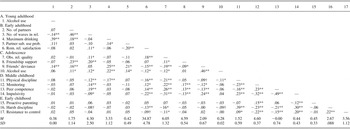
Table 1 presents the means, standard deviations, and intercorrelations for all study variables. Alcohol use in adolescence was positively linked to drinking in early adulthood, which in turn was linked to alcohol use in young adulthood, but adolescent alcohol use and young adult alcohol use were not significantly related. Romantic involvement and turnover were moderately correlated (r = .46, p < .01). Romantic relationship satisfaction was negatively correlated with partner substance use problems (r = –.20, p < .01) and positively correlated with romantic involvement (r = .11, p < .05). Zero-order correlations also showed that adolescent alcohol use was related to all four indicators of romantic relationships in early adulthood (rs magnitude = .12–.14, all ps < .05; see Table 1).
Descriptive statistics and correlations among study variables

Note: Maximum drinking, maximum frequency of drinking; partner sub. use prob., partner substance use problems; rom. rel. satisfaction, romantic relationship satisfaction.
†p ≤ .10. *p ≤ .05. **p ≤ .01.
Linking romantic relationships and alcohol use: A timing perspective
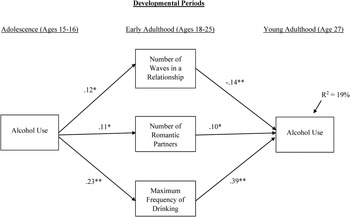
We next explored the cumulative progression of influences from alcohol use from adolescence to young adulthood (see Figure 1). The path model provided an excellent fit to the data, χ2 (1) = 0.03, ns; CFI = 1.00, RMSEA = 0.00, ns, explaining 19% of the variance in alcohol use in young adulthood. To test for potential gender differences in these pathways, we compared two path models: one with free parameters and one with parameters fixed across groups (Muthén & Muthén, Reference Muthén and Muthén2007). A chi-square difference test indicated no difference between these models, Δχ2 (6) = 5.30, p = .51, indicating the path model fit men and women equally well.
Model linking substance use in adolescence to alcohol use in young adulthood. Note: Path coefficients are standardized. **p ≤ .01. *p ≤ .05. χ2 (1) = 0.03, ns; comparative fit index = 1.00, root mean square error of approximation = 0.00, ns.

Analyses showed that, as expected, adolescent alcohol use predicted more drinking in early adulthood, and that this in turn predicted more alcohol use in young adulthood (see Figure 1). Adolescent alcohol use also predicted both greater romantic involvement and more romantic partners during early adulthood (βs = 0.12 and 0.11, respectively, both ps < .05). It is interesting that having more romantic partners in early adulthood (i.e., turnover) was associated with more alcohol use in young adulthood (β = 0.10, p < .05), but more overall relationship involvement during early adulthood was linked to less alcohol use later (β = –0.14, p < .01), even after taking into account drinking in early adulthood. Analyses further revealed that adolescent alcohol use operated as a distal influence on young adult alcohol via its indirect effects on more alcohol influences (total standardized indirect effects = 0.08, p < .01) as follows: adolescent alcohol use to number of waves in a romantic relationship to young adult alcohol use (indirect effect β = –0.02, p = .07), and adolescent alcohol use to early adult drinking to young adult alcohol use (indirect effect β = 0.09, p < .01). Although these analyses indicate that there is some stability in alcohol use, they also draw attention to the role that early adult romantic involvement can play in explaining changing patterns in alcohol use behaviors from adolescence to young adulthood.
Variable- and person-centered approaches to romantic relationships and alcohol use: A relational perspective
We next conducted a set of analyses to determine the extent to which pathways between structural features of romantic relationships and alcohol use were amplified or attenuated by romantic relationship qualities. Looking first at characteristics of the romantic partners (partners’ substance use problems), chi-square differences tests revealed that the path models in which the parameters were estimated to vary freely did not significantly differ from those in which the parameters were constrained to be equal, Δχ2 (6) = 4.65, p = .59, indicating the model was an equally good fit for those who had partners with substance use problems and those who did not.
Turning to the possible moderating role of participants’ satisfaction with their romantic relationships, the model including both interaction terms (Satisfaction × Turnover; Satisfaction × Involvement) was a poor fit, χ2 (10) = 80.75, p < .01; CFI = 0.78, RMSEA = 0.11, p < .01. Further, when we compared models in which the effects of both interaction terms were fixed to zero versus freely estimated, the model in which the effects were freely estimated provided a nonsignificant difference in fit, Δχ2 (4) = 4.07, p = .40, suggesting that the interaction terms did not contribute significantly to the explanation of alcohol use in young adulthood. Finally, not only were the paths between alcohol use and romantic relationship involvement and turnover unchanged by including the interaction terms, the Satisfaction × Turnover and Satisfaction × Involvement interaction terms were unrelated to alcohol use across all developmental periods. For example, adolescent alcohol use did not predict either Satisfaction × Turnover (β = 0.01, p = .81) or Satisfaction × Involvement (β = –0.05, p = .32), nor were these interaction terms in turn predictive of alcohol use in young adulthood (β = –0.06, p = .24; β = –0.04, p = .47 respectively). Analyses suggest, contrary to expectations, that the linkages between alcohol use and the structural characteristics of romantic relationships were not moderated by either the partners’ substance use or by overall satisfaction with the relationships.
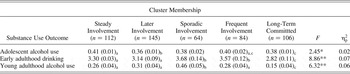
Finally, a series of analyses of variance explored whether there were differences in alcohol use based on configurations of the structural characteristics of romantic relationship involvement (see Table 2). As a reminder, using a combination of both hierarchical and nonhierarchical clustering methods, a five-cluster solution was determined to be most appropriate using the standard criteria (Sarle's cubic clustering criterion, pseudo-F statistic, pseudo-T 2 statistic; for further information, see Rauer et al., Reference Rauer, Pettit, Lansford, Bates and Dodge2013). Participants were grouped into five clusters: steady involvement (two partners, multiple waves of involvement; n = 112); later involvement (fewest partners, least romantic involvement; n = 145); sporadic involvement (few partners, infrequent and intermittent involvement; n = 64); frequent involvement (multiple partners, multiple waves of involvement; n = 84); and long-term committeds (single partner, multiple waves of involvement; n = 106). No significant Gender × Cluster interactions emerged, and so the single group analysis is presented. Across all three developmental periods, significant differences were found based on cluster membership.
Means (standard deviations) of substance use as a function of cluster membership

Note: Means with different subscripts are significantly different from one another (p ≤ .10).
*p ≤ .05. **p ≤ .01.
As shown in Table 2, for alcohol use in adolescence, those in the later involvement cluster reported significantly less adolescent alcohol use than individuals with steady or frequent involvement cluster and the long-term committeds. Those with sporadic involvement fell in the middle. For drinking in early adulthood, those in the steady involvement cluster continued to have higher rates of drinking, but those levels were similar to those for the later involvement cluster. However, individuals in both clusters reported significantly less drinking in early adulthood than did those in either the sporadic or the frequent involvement clusters. Finally, the long-term committeds reported the least drinking. For alcohol use in young adulthood, the long-term committeds again reported the lowest levels of alcohol use, and those with sporadic involvement reported the greatest usage. In contrast to the findings for early adulthood drinking, those with frequent involvement reported less alcohol use at this period than did those in the sporadic involvement cluster. Both those with frequent and those with steady involvement reported similar levels, and neither differed from those with later involvement.
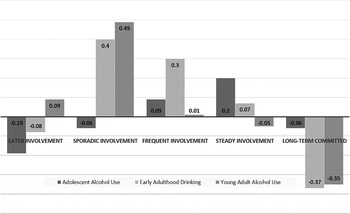
The standardized results are summarized in Figure 2, and capture pictorially the movement within these clusters across these developmental periods. Those in the later and sporadic involvement clusters initially abstained from drinking relative to the other participants, but then reported partaking more as they matured. This pattern particularly characterized the sporadic involvement group. The long-term committeds and those with steady involvement initially drank more, but this tapered off in their 20s, with drinking dropping off sooner and most dramatically for those in the long-term committeds. Finally, for those with frequent involvement, the highest rates of alcohol use occurred during early adulthood. Analyses provide evidence of the unique role that the structural characteristics of romantic relationships play in alcohol use, and suggest that the nature of these links may vary across individuals and over time.
Romantic relationship profiles and alcohol use from adolescence to young adulthood. The bar graph shows the relative mean scores for the alcohol use variables for each of the five romantic relationship types. These scores are shown in z scores, which are standardized to have an overall mean of zero for ease of comparison across romantic relationship types.

Romantic relationships and alcohol use: A developmental–relational perspective
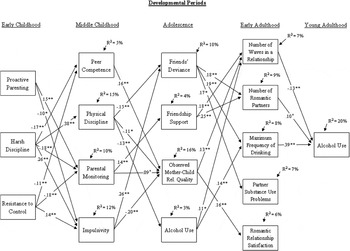
To further explore why alcohol use in adolescence might be linked to later alcohol use via its associations with romantic relationships, we conducted a final path analysis that included theoretically and empirically validated antecedent variables to explore possible selection factors that might explain these links (see Figure 3). We included the additional romantic relationships indicators to examine how multiple dimensions of romantic relationships might operate as socialization factors. Overall, the model provided a good fit to the data, χ2 (58) = 70.47, p = .13; CFI = 0.99, RMSEA = 0.02, ns, explaining 20% of the variance in alcohol use in young adulthood.
Model examining the pathways to young adult alcohol use. Path coefficients are standardized. Significant pathways are presented, while nonsignificant pathways and cross-sectional correlations (which were included in the models) are not shown. †p ≤ .10, *p ≤ .05. **p ≤ .01. χ2 (58) = 70.47, p = .13; comparative fit index = 0.99, root mean square error of approximation = 0.02, ns.

Even after accounting for the larger developmental and relational context in which romantic and alcohol use behaviors occurred, we found evidence for the robustness of the pathway from adolescent alcohol use to young adult alcohol use through its links to romantic involvement and with comparable effect sizes. Adolescent alcohol use was only linked to later alcohol use via this pathway and that of early adult drinking (only significant paths are shown in the figure). In contrast, romantic turnover and early adult drinking were no longer predicted by earlier alcohol use in adolescence in the full model. Both early adult drinking and romantic turnover continued to predict greater alcohol use in young adulthood, whereas greater romantic relationship satisfaction predicted less alcohol use. Most of the variance explained in young adult alcohol use was by drinking in early adulthood. It is interesting that less variance in young adult alcohol use was accounted for by romantic turnover (5%), satisfaction (1%), and partner substance use problems (1%), compared to the benefits of romantic involvement for desistance (8%). Finally, of the romantic indicators, only partner substance use was not associated with one's own prior or subsequent drinking. These findings support the roles of both socialization and selection in explaining the link between alcohol use and romantic relationships, though which one is operating appears to depend on which aspect of the relationship is being considered.
Discussion
Establishing and maintaining a committed romantic relationship is thought to be the crowning achievement of young adulthood (Erikson, Reference Erikson1968), and a large literature documents the benefits of doing so for later health and well-being (Holt-Lunstad et al., Reference Holt-Lunstad, Uchino, Smith, Olson-Cerny and Nealey-Moore2003; Kiecolt-Glaser & Newton, Reference Kiecolt-Glaser and Newton2001; Robles et al., Reference Robles, Slatcher, Trombello and McGinn2014). However, recent evidence suggests that a growing number of young adults are not pursuing serious romantic relationships during this developmental period (Cherlin, Reference Cherlin2009; Rauer et al., Reference Rauer, Pettit, Lansford, Bates and Dodge2013). The current study suggests low levels of involvement in romantic relationships in early adulthood predicted greater alcohol use in young adulthood. Not only did romantic involvement emerge as an inverse predictor of later alcohol use in the full model, but cluster analyses revealed that involvement was linked to a reduction in later risky behaviors regardless of whether young adults had one or multiple romantic partners. However, these findings must be considered in their larger developmental and relational context, because romantic involvement was itself predicted by adolescent alcohol use. Thus, there is evidence of a dynamic association between these two domains, which underscores the need to exercise caution when evaluating the riskiness or benefits of alcohol use and romantic relationships.
Linking romantic relationships and alcohol use: The unique role of romantic relationship involvement in early adulthood
A key finding of this study was that romantic relationship involvement in emerging adulthood predicted less problematic alcohol use in young adulthood, even though it was predicted by problematic adolescent alcohol use. Confidence in this finding is strengthened substantially by the life span approach to the modeling, which controlled for many correlated potential selection factors (e.g., family and peer experiences). Romantic relationship involvement served here as a connecting link between prior and subsequent alcohol use even after accounting for individuals’ earlier social experiences and personal characteristics. To note, however, we did find that the link between adolescent alcohol use and romantic turnover was explained by these selection factors. That is, adolescent drinking no longer predicted early adult romantic turnover once the developmental antecedents were taken into account.
The results suggest normative romantic relationship experiences in early adulthood may act as a protective factor for problematic alcohol use, but it is crucial to reflect on how the definition of normative experience of romantic relationship experience is specific to social and historical context. For example, there is a sizable body of literature suggesting that dating at an early age in adolescence is associated with especially problematic outcomes (Collins, Welsh, & Furman, Reference Collins, Welsh and Furman2009; Connolly, Nguyen, Pepler, Craig, & Jiang, Reference Connolly, Nguyen, Pepler, Craig and Jiang2013; Furman & Collibee, Reference Furman and Collibee2014). Zimmer-Gembeck et al. (2004) found initiating romantic relationships earlier was linked to greater alcohol use in adolescence. Our results further illustrate the unique (and robust) links between romantic relationship involvement and alcohol use. For example, we found that romantic relationship satisfaction did not moderate the links between romantic involvement and alcohol use, nor did partner substance use problems. This lack of moderation contrasts with work from Barr et al. (Reference Barr, Culatta and Simons2013) that found that exits from high-quality relationships were especially problematic for young adults’ health, as well as work suggesting that romantic relationship satisfaction and partner's substance use play a large role in substance use later in adulthood (Leonard & Homish, Reference Leonard and Homish2008; Marshal, Reference Marshal2003). In the current study, however, it appears that early on, simply being involved in relationships may be the most powerful predictor of alcohol use.
Supporting this conclusion were findings from the cluster analyses that suggest that even being involved in multiple relationships during early adulthood can confer later benefits. Although the long-term committeds reported the lowest levels of alcohol use in young adulthood, both those with steady and those with frequent involvement reported lower rates than the cluster defined by minimal, sporadic involvement. As seen in Rauer et al. (Reference Rauer, Pettit, Lansford, Bates and Dodge2013), the long-term committeds and those with steady and frequent involvement were also nearly indistinguishable in their developmental antecedents, with an equally shared history of high-quality relationships with others. These findings suggest romantic involvement relatively early in development may confer later benefits to health regardless of whether it is with one partner or many.
These findings underscore the importance of considering the role of developmental timing when evaluating the riskiness of a behavior or the need for intervention. Given that when something occurs in the life span can alter its effects on the individual (Elder, Reference Elder1998), identifying who is vulnerable may be more challenging than previously thought. For example, later in adulthood, the deleterious effects of romantic turnover are well documented, with those who experience turnover more vulnerable to a host of negative health outcomes (Dupre & Meadows, Reference Dupre and Meadows2007; Sbarra, Law, & Portley, Reference Sbarra, Law and Portley2011; Zhang, Reference Zhang2006). Although these findings focus primarily on marital instability, there is growing evidence to suggest that instability in nonmarital romantic relationships is comparable in its effects in recent cohorts (Kamp Dush, Reference Kamp Dush2013). However, the current findings suggest that turnover in early adulthood may be less pernicious, at least in cases where relationship dissolution does not deter the young adult from recoupling rather quickly. An intriguing addition to this consideration of the effects of romantic relationships comes from recent work by Dahl (Reference Dahl2010) that suggests that there may now be penalties for women who commit too early (marrying in one's teenage years). Using state-specific marriage, schooling, and child labor laws as instruments to reduce selection bias, Dahl found that early marriage was linked to later poverty net of the effects of divorce. This suggests that understanding the consequences of romantic commitment and turnover requires a developmental perspective, because these processes may not confer uniform benefits and risks, respectively, across the life span.
The implications of employing a developmental perspective when interpreting the riskiness of behaviors
Our conclusion about the developmental nature of romantic relationships and alcohol use is consistent with Anna Freud's (Reference Freud, Caplan and Lebovici1969) idea of developmental disturbances. Her theory suggested that development brings not only new gains but also new challenges as internal equilibriums are disrupted by new experiences. Proposing what was seen as a rather radical idea at the time, she suggested that the absence of storm and stress in adolescence is more concerning than its presence.Footnote 1 Per Freud's theory, developmental disturbances are thus highly common throughout the life span and reflect growth. Building on this idea, Schulenberg (Reference Schulenberg2000) suggested that a developmental disturbance can be thought of as reflecting developmentally limited deviance that is statistically normative, culturally sanctioned, and time prescribed. His own work on binge drinking in college is consistent with this definition, which often has only weak linkages to earlier developmental antecedents and later increases in alcohol use. Our findings appear consistent with this notion of developmental disturbances. We find that adolescent alcohol use is linked to problematic experiences earlier in middle childhood (greater physical discipline), but predicts positive experiences, in the form of more extensive romantic involvement.
The difficulty of predicting later alcohol use from early indexes may concern the developmental nature of substance use (Jessor & Jessor, Reference Jessor and Jessor1977; Maggs, Almeida, & Galambos, Reference Maggs, Almeida and Galambos1995). Many adolescents see substance use “as a rite of passage that constitutes a symbolic assertion of maturity” (McGuire, Reference McGuire1991, p. 181), so it is likely to occur alongside other, more positive, indices of development (e.g., autonomy). Further, those who abstain from drinking in adolescence may miss out on the opportunity to connect with peers and romantic partners, as alcohol use has been argued to serve important functions in the social domain (e.g., enhanced sociability and social satisfaction; Murphy, McDevitt-Murphy, & Barnett, Reference Murphy, McDevitt-Murphy and Barnett2005; Park, Reference Park2004; Schulenberg & Maggs, 2004). Alcohol use in adolescence may fit with Chassin, Presson, and Sherman's (Reference Chassin, Presson and Sherman1988) idea of “constructive” deviance, a more positive reconsideration of certain behaviors thought to reflect autonomy and independence rather than anticonformity. In this view, for some adolescents, risk-taking behaviors, which alcohol use could reasonably be considered, reflects an internal locus of control, making adolescents high in constructive deviance less influenced by the opinions of others, including both peers and authority figures.
A further challenge to assigning designations of constructive versus destructive to a behavior is that it appears that such a conceptualization may depend on its timing not only in the life span but also sociohistorically, given that norms regarding alcohol and substance use as well as patterns of use have changed over the past century (Jager, Keyes, & Schulenberg, Reference Jager, Keyes and Schulenberg2015; Jager, Schulenberg, O'Malley, & Backman, Reference Jager, Schulenberg, O'Malley and Bachman2013). Findings from the current study speak to the former, because drinking in adolescence conferred benefits whereas similar behaviors approximately a decade later appeared to reflect risk. Perhaps a given risk factor, such as impulsivity or peer deviance, may predispose an individual to engage in a risky behavior, such as drinking. However, such a behavior may also lead them into an experience, such as a romantic relationship, that transforms the individual in a way that mitigates negative effects of the earlier risk factors.
Such a finding goes against what Staff et al. (2010, p. 928) characterized as a “fundamental truism of developmental psychopathology,” namely, that difficulties accumulate over time, setting individuals up for continued and increasing problems. The authors themselves, however, acknowledge that development is not a closed system, and that there are abundant opportunities for changing course, particularly in young adulthood (Schulenberg & Zarrett, Reference Schulenberg, Zarrett, Arnett and Tanner2006). Perhaps explaining why some problems appear to naturally abate is that not all difficulties are created equally, with some risk factors actually helping individuals course correct. Such a conclusion is consistent with our findings regarding the links between adolescent alcohol use and romantic involvement in early adulthood. From this perspective, it appears that taking both a developmental and a relational perspective is key for interpreting a behavior as risky or not. These findings add support to Schulenberg and Magg's (Reference Schulenberg and Maggs2002) call for young adult alcohol interventions that acknowledge not only the developmental context in which alcohol use is occurring but also the increasing heterogeneity of this population.
Strengths and limitations
Confidence in these findings is bolstered by several strengths in the research design. First, the use of a prospective, longitudinal study enabled analyses that took a wider perspective to understand how the association between alcohol use and romantic relationships may differ across multiple developmental stages. Second, our use of both person- and variable-centered analyses gave important insight into how these associations may depend on the particular configurations of romantic experiences individuals have as well as the pathways that may have largely driven these associations. Third, assessing multiple domains (personality, peers, parents, and partners) via multiple reporters (participants, parents, teachers, peers, and observers) allowed for an exploration of cascading effects from earlier risk and protective factors stretching back over 20 years of development.
Nevertheless, this study does have several limitations. First, the sample-dependent nature of cluster analyses means that findings need to be replicated beyond our community sample of primarily European Americans and African Americans in mostly heterosexual relationships. Future research may consider whether adolescent alcohol use predicts romantic involvement similarly in Hispanics and for same-sex relationships, given that previous research has found weak linkages between substance use and romantic relationships for some Hispanic ethnic groups and for LGBTQ youth (Nielson, Reference Nielson2001; Russell, Driscoll, & Truong, Reference Russell, Driscoll and Truong2002).
Second, although we have taken precautions to ensure conservative estimates by accounting for other potential influences in the links between alcohol use and romantic relationships (e.g., earlier parent and friend relationship context, temperament, and impulsivity), the correlational nature of the study precludes definitive conclusions about causality for these pathways. Further, accounting for other, unmeasured but potentially relevant characteristics of the romantic partner, such as their mental health, employment status, and antisocial behavior (Homish, Leonard, & Kearns-Bodkin, Reference Homish, Leonard and Kearns-Bodkin2006; Jin, Shah, & Svoboda, Reference Jin, Shah and Svoboda1995; Marshal, Reference Marshal2003), would enhance our ability to detect effects of socialization on the associations found here.
Although our findings are consistent with previous work on links between substance use and social relationships and competence (Chassin et al., Reference Chassin, Pitts and DeLucia1999; Staff et al., Reference Staff, Schulenberg, Maslowsky, Bachman, O'Malley and Maggs2010), it is possible that variables unaccounted for here may be responsible for these findings. For example, research has shown that shared additive genetic influences contribute to a liability toward substance use, romantic partner selection, and romantic relationship turnover (McGue, Elkins, & Iacono, Reference McGue, Elkins and Iacono2000; McGue & Lykken, Reference McGue and Lykken1992; Rhule-Louie & McMahon, Reference Rhule-Louie and McMahon2007). Thus, it is likely those who have problems with their drinking select partners similar to themselves on such traits and may be more inclined to break up as a result of genetically influenced traits and interests. Nonetheless, socialization has been shown to still play a role after accounting for such genetically influenced selection effects, in that romantic partner qualities may contribute to either desistence or persistence of such problematic behavior (for a review, see Rhule-Louie & McMahon, Reference Rhule-Louie and McMahon2007).
Third, although we explained significant variance in our outcomes, particularly in young adult alcohol use, the overall modest effect sizes suggest that future work should consider other important predictors of both romantic relationships and alcohol use not currently accounted for in the modeling. For example, although we were able to tap into very early impulsivity, understanding concurrent personality traits, such as negative emotionality (Donnellan, Assad, Robins, & Conger, Reference Donnellan, Assad, Robins and Conger2007; James & Taylor, Reference James and Taylor2007), may provide a more comprehensive picture of how romantic relationships and alcohol use are linked.
Conclusion
These results suggest that adolescents’ use of alcohol can be associated with another adultlike behavior, namely, being in romantic relationships. However, once these relationships are entered into, they may become protective and help reduce the likelihood of engaging in risky behaviors. Adolescents who abstain from drinking, in contrast, may just be delaying these behaviors until later years. These findings caution against equating beliefs about what constitutes normative development with what reflects healthy development, as such determination, and the extent to which they overlap, may only be revealed with a wider lens that acknowledges the dual influences of developmental and historical timing.