

Published online by Cambridge University Press: 10 June 2004
The issue of why productivity growth during the British industrial revolution was slow despite the arrival of famous inventions is revisited using a growth accounting methodology based on an embodied innovation model. The results highlight the relatively small and long-delayed impact of steam on productivity growth even when capital deepening is taken into account. Even so, technological change including embodiment effects accounted entirely for the acceleration in labor productivity growth that allowed the economy to achieve “modern economic growth.”
Nicholas Crafts and Knick Harley have argued from new national income estimates and conventional growth accounting that overall growth was quite slow and that TFP growth was much lower than earlier estimates had indicated.1
Crafts, British Economic Growth; Crafts and Harley, “Output Growth”; and Harley, “Reassessing.”
Mokyr, “Editor's Introduction,” p. 25.
The impact of spectacularly successful microeconomic innovations in several important industries seems to be downplayed by these results. Yet commentators continue to stress the vital role played by steam in particular as a special British achievement that established the breakthrough to modern economic growth.3
Notably, Goldstone, “Efflorescences”; and Wrigley, “Divergence.”
Lipsey et al., “Consequences,” p. 207.
A central avenue of feedback from technological change arises because much technology is embodied in new capital. The feedback can go both ways. An exogenous increase in the rate of investment will increase the rate of growth of productivity as best-practice machinery replaces older vintages. On the other hand, technological breakthroughs present profit opportunities that require new investment and thus induce an increase in capital formation. Recent research on the impact of innovations in information technology in the late twentieth century has emphasized the possible role of embodiment as an important part of the impact of the new technology.5
Jorgenson and Stiroh, “Raising the Speed Limit”; and Oliner and Sichel, “Resurgence.”
As Feinstein put it, “many forms of technological advance … can only take place when ‘embodied’ in new capital goods. The spinning jennies, steam engines, and blast furnaces were the ‘embodiment’ of the industrial revolution.” “Capital Accumulation,” p. 142.
The traditional neoclassical growth accounting methodology captures a contribution to growth from exogenous technological change in the Solow residual estimate of TFP growth. With the standard Cobb-Douglas production function and competitive assumptions

the Solow residual is computed as

where sK and sL are the factor income shares of capital and labor respectively. Variants of this approach, including the price dual method, have been the standard method of estimating the contribution of technological change to growth during the British Industrial Revolution, as was reported in Table 1. Equation 2 can be converted to an expression that accounts for growth of labor productivity as follows

A generalization of this approach to allow in particular for embodiment effects is straightforward.
Thus equation 3 becomes

where the subscript O indicates other sectors, the subscript M indicates modernized sectors, and γ and φ are the gross output shares of these sectors.
7These are so-called Domar weights which sum to greater than one. For an algebraic justification of this procedure see Hulten, “Growth Accounting.”
See the discussion in David and Wright, “Early Twentieth Century.”
If the contribution of steam technology is to be isolated in this manner, then equation 4 can be modified as follows

where the subscript NS indicates sectors other than steam, the subscript Ki indicates steam capital of type i, and φ and η are the gross output shares of the steam sectors and the rest of the economy, respectively.
It should be noted that this type of growth accounting attempts to measure the realized results of investment that has taken place and addresses the question “how much did the new technology contribute?” It does not directly address the (much harder) question “how much more did it contribute than an alternative investment might have yielded?” The upper-bound assumption is that, in the absence of the innovation, the economy would both have a lower TFP growth rate and a quantity of capital lower by the whole amount of the new capital goods in which the technology is embodied.
By contrast, the social saving approach is equivalent to taking only the TFP and not the embodied capital contribution of an innovation. The logic of this is quite clear in terms of Robert Fogel's search for the indispensable element that railroads gave to the economy and his desire to kill the myth of indispensability. Railroad capital earned a normal profit equal to its opportunity cost. If the capital were not invested in railroads, it would be invested in something else that would deliver an equal return.9
Fogel, Railroads.
Fogel, “Notes.”
It seems likely that many economists would instinctively believe in models that would imply answers somewhere between the embodied-innovation growth accounting and social savings methodologies. Thus some would consider at the macro-level that investments of the size typically made in major new technologies could not have been made in alternative projects without depressing the rate of return at least somewhat, whereas others will predict that the adoption of new technologies precipitates the exit of some old capital goods that would have survived. Thus, it will be useful to have both standards of comparison available as benchmarks.
This section seeks to implement an embodied innovation growth accounting framework for the British industrial revolution for steam and for the “modernized sectors” defined by Harley.11
Harley, “Reassessing,” p. 184.
The data on stationary steam engines are incomplete, especially for the period between 1800 when James Watt's patents expired and 1838 when the first returns under the Factory Acts were made. Nevertheless, there is general agreement on the broad picture of the use of steam power. In 1800 there were about 35,000 and in 1830 about 165,000 steam horsepower and even in 1870 only about 1.7 million steam horsepower were in use, representing about 2.5 per cent of the capital stock.12
Kanefsky, “Diffusion,” p. 338, and “Motive Power,” p. 373. Kanefsky distinguishes for 1870 between steam horsepower in use (1,668,000) and capacity installed (2,060,000).
Kanefsky, “Diffusion,” pp. 145–46.
Ibid., pp. 175–76.
Although Watt's steam engine represented an important advance, steam technology took a long time to perfect. The original Watt engines were a low-pressure design whereas it was later realized that much lower coal consumption could be achieved with high pressure. In turn, reliable high-pressure steam engines required big improvements in the design and manufacture of boilers. Although these engines were pioneered by Arthur Woolf in Cornwall, where coal prices were very high and they were used in tin mining, only after the invention of the Lancashire boiler in the early 1840s were they an economic proposition in textile mills.15
von Tunzelmann, Steam Power, pp. 79–91.
Hills, Power, pp. 141–72.
Kanefsky, “Diffusion,” pp. 172–75.
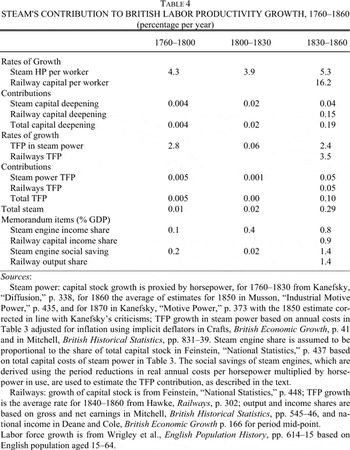
Table 4 reports the results of a growth accounting exercise on the impact of stationary steam engines used in industry and of railways (a sector wholly dependent on steam power) based on a format equivalent to equation 5. Not surprisingly, given the earlier discussion, the capital deepening contribution from stationary steam engines reported in Table 4 is quite small. So also is the contribution from TFP growth in the supply of steam power since not much was used.
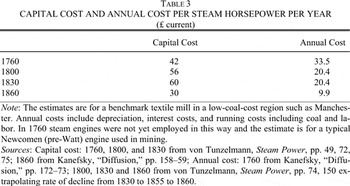
The TFP contributions from steam engines are based on social savings using the annual cost of horsepower reported in Table 3 converted into real terms by the GDP deflator. For example, the social saving in 1860 relative to 1830 is obtained as follows. The annual cost of a horsepower in 1860 in 1900 prices was £9.9 compared with £20.0 in 1830, which implies a rate of TFP growth of 2.4 per cent per year. The resource saving to the economy is calculated as (20.0–9.9)=£10.1 x 1.078 mn hp=£10.89 mn=1.38 percent of 1860 GDP, which implies a growth contribution of 0.05 percent per year during the period 1830 to 1860.18
Table 4 assumes TFP growth of zero for the period 1800–1830 except in Cornwall. Based on the annual costs in Table 3 adjusted for falls in the general price level, TFP growth would actually be estimated as −0.6 per cent per year but the discussions in Hills, Power, pp. 113–15; and von Tunzelmann, Steam Power, p. 73 suggest that zero TFP growth is more reasonable except for the Cornish steam engine. Cornish engineers improved the steam engine to the extent of making savings of coal inputs of £84,000 per year by the early 1830s according to Hills, Power, p. 112; this comprises the TFP contribution in Table 4.
Table 4 shows that steam's impact on labor productivity growth was no more than 0.02 percentage points throughout the period 1760–1830 with a negligible role for TFP growth. An appreciable contribution to growth from steam only came during the railway age, which is conventionally dated from the opening of the Liverpool and Manchester Railway in 1830. A massive investment in railway construction ensued although the profits obtained were quite modest. Railway technology developed rapidly but the social savings estimates of Garry Hawke, whose results are incorporated in Table 4, translate into a TFP contribution to raising overall labor productivity of only 0.05 percentage points per year in the period 1830–1860. Even in 1830 to 1860 the total contribution of steam to labor productivity growth amounts only to 0.29 percentage points per year of which only 0.1 percentage points comes from TFP growth.
Table 4 includes estimates of the contribution from capital deepening and own TFP growth but does not, however, include any estimate of TFP spillovers from steam. With regard to railways, this was considered very explicitly in the social savings calculation made by Hawke who firmly rejected the notion that these were important.19
Hawke, Railways, pp. 381–400.
Where the steam engine is concerned, the situation is more complicated. Nicholas Von Tunzelmann examined the impact of steam power on technological progress in the textile industries where the main effects were most likely to be found. He noted that all the famous advances of the industrial revolution period were originally developed for other forms of power; if there were important technological complementarities, he suggested that they only came late in the day, in the period 1847 to 1860.20
von Tunzelmann, Steam Power, pp. 183, 292.
These results suggest that slow TFP growth during the Industrial Revolution, especially prior to 1830, can be understood to a considerable extent in terms of the weakness of the contribution made by steam. Even during 1830 to 1860 this was only 0.1 percent per year. This should not be a great surprise to anyone familiar with the early cliometrics literature, which highlighted how small were the initial social savings of the steam engine and the railway.21
von Tunzelmann, Steam Power, estimated that, if James Watt had not invented the improved steam engine in 1769, British national income in 1800 would have been reduced by only 0.1 percent. Similarly, Hawke, Railways, found that the social savings of railways in England and Wales in 1850 amounted to £9.7 million when British gross domestic product was £523 million.
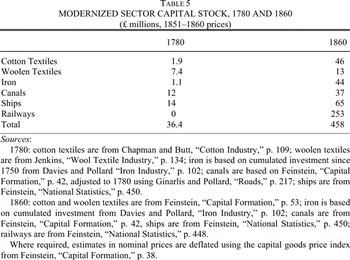
An alternative way to implement embodied innovation growth accounting for the Industrial Revolution is to work with equation 4 using the “modernized sectors” (cottons, woolens, iron, canals, ships, railways) defined by Harley, who provides estimates of their contribution to TFP growth for the period 1780–1860 using gross output weights.22
Harley, “Reassessing,” p. 184.
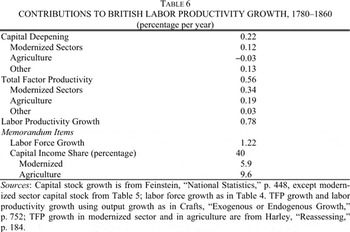
Table 6 displays the results of this new growth accounting exercise. The modernized sectors are found to have contributed 0.46 out of 0.78 percent per year growth in labor productivity with the majority of this, 0.34 compared with 0.12 per cent, coming from TFP growth as opposed to capital deepening. If the contribution of technological change to the growth of labor productivity is taken to be capital deepening in the modernized sectors plus total TFP growth, then this equates to 0.68 out of 0.78 percent. The total contribution of 0.68 percent per year is still well below that implied by exercises based on traditional growth accounting with older national income estimates, such as Donald McCloskey's figure of 1.2 percent.23
McCloskey, “Industrial Revolution,” p. 108.
Based on this embodied innovation approach, the contribution of the modernized sectors to labor productivity growth exceeds that of steam by a considerable margin over the whole period 1780 to 1860. A comparison of the estimates in Tables 4 and 6 reveals that the total steam contribution averaged 0.12 percent per year compared with a total modernized sector contribution of 0.46 percent per year. The relative importance of steam was greater after 1830 but it still only accounts for about a quarter of total labor productivity growth.
In the light of these results, it is now appropriate to review the TFP growth paradox of the Industrial Revolution. The preceding section can help to clarify why famous technological breakthroughs had a relatively limited impact on overall productivity growth. The explicit account taken of the embodiment of new technologies in capital goods also leads to a somewhat revised estimate of the role of technological change in the growth outcomes of the period.
The evidence on the productivity impact of steam reveals both that it was slow to materialize and that, at least prior to 1860, it was weak by comparison with other major technological changes often spoken of in the same breath. The real price of steam power stayed high for many decades and, consequently, the build up of steam horsepower was very gradual with only 165,000 horsepower in use in 1830. At this time, for most of the economy steam was irrelevant. TFP growth attributable to steam, even including railways, through to 1860 was much smaller than would later accrue from electricity or information and communications technology (ICT) at similar stages of their development.24
For electricity, see David and Wright, “Early Twentieth Century”; and for ICT, see Oliner and Sichel, “Resurgence.”
The social savings literature informed us a long time ago that even spectacular innovations such as the railroad have small initial implications for growth. In a growth accounting context the fundamental reason for this becomes apparent. In the first phase of the new technology its output weight relative to GDP is so small that it cannot make a great deal of difference to overall TFP growth. If the capital-deepening contribution of embodied technological progress is also taken into account, this conclusion is modified somewhat but not overturned.
With traditional growth accounting as in Table 1, TFP growth accounts for a little over a quarter of the growth of GDP between 1780 and 1860 (0.56 /2.0 percentage points).25
Using the data and assumptions in Crafts “Exogenous or Endogenous Growth.”
McCloskey, “Industrial Revolution,” p. 108; using the estimate of TFP growth at 1.2 percent per year in table 6.2 of that paper and growth at 2.5 percent per year as implied by Deane and Cole's estimates for 1780–1860.
It is more appropriate, however, to focus on labor productivity growth, as is now widely appreciated. When traditional growth accounting is used the results in Table 6 show that between 1780 and 1860 TFP growth was responsible for over 70 percent of labor productivity growth (0.56 out of 0.78 percentage points). Of this TFP growth in steam itself accounted for 0.04 percentage points per year based on Table 4. If the period is divided, then the contribution of TFP growth is greater after 1830 than before (0.9 out of 1.14 compared with 0.3 out of 0.56 percentage points). If the embodiment hypothesis is adopted, then the contribution of technological change during 1780 to 1860 rises to 0.56+0.12=0.68 out of 0.78 percentage points, i.e., 87 percent.
Or put another way, labor productivity growth after 1780 was a little under 0.5 percentage points per year greater than in the period 1700 to 1780. This is much the same as the contribution of the modernized sectors according to Table 6. It remains perfectly feasible, therefore, to regard technological innovation as responsible for the acceleration in labor productivity growth that marked the importance of the industrial revolution as a historical discontinuity.27
If the Industrial Revolution is taken as the onset of “modern economic growth,” then the hallmark will be sustained increases in labor productivity growth driven by technological advance. This Kuznetsian conception is confirmed.
The method of growth accounting used by applied economists to examine contemporary productivity performance has changed. In the wake of the new growth theory, it seems appropriate to take explicit account of investment reflecting the embodiment of technological change in new varieties of capital goods. This approach meets a need frequently expressed by economic historians and appears quite suitable for analyzing the episode of the Industrial Revolution.
Moving from traditional to new growth accounting raises the estimated contribution of improvements in technology to British economic growth in the period 1780 to 1860 from 0.56 percent per year to 0.68 percent per year. In terms of growth of GDP the estimated share of technological change rises from a little over a quarter to three-eighths whereas in terms of labor productivity the increase is from just over 70 percent to seven-eighths. If labor productivity growth is the hallmark of modern economic growth, these estimates confirm the dominance of invention over abstention in its arrival but on the basis of lower growth in output per worker than used to be asserted.
In their early years even major new technologies are likely to have only modest impacts on aggregate productivity growth. In the case of steam this was especially true because it took a long time for the potential of the technology to be realized. To a considerable extent, unspectacular productivity advance during the Industrial Revolution can be understood in terms of the rather weak impact of steam. This finding contrasts with some recent claims about what made Britain special but is not surprising when the results of early cliometric research into the social savings of steam-based innovations are recalled.
Funding from ESRC grant R000239536 is gratefully acknowledged. I am grateful for helpful suggestions from Bob Allen, Tam Bayoumi, Steve Broadberry, Paul David, Brad de Long, Tim Leunig, and Joachim Voth and by seminar participants at Cambridge, Glasgow, LSE, Southampton, Stanford universities, Federal Reserve Bank of San Francisco, and Universidade Nova de Lisboa. Two anonymous referees and Knick Harley made comments that have substantially improved earlier versions of the article. I am responsible for all errors.
STATIONARY STEAM ENGINES IN THE BRITISH ECONOMY, 1760–1870
CAPITAL COST AND ANNUAL COST PER STEAM HORSEPOWER PER YEAR (£ current)
STEAM'S CONTRIBUTION TO BRITISH LABOR PRODUCTIVITY GROWTH, 1760–1860 (percentage per year)
MODERNIZED SECTOR CAPITAL STOCK, 1780 AND 1860 (£ millions, 1851–1860 prices)
CONTRIBUTIONS TO BRITISH LABOR PRODUCTIVITY GROWTH, 1780–1860 (percentage per year)