Introduction
In herbivorous insects, fecundity and offspring quality are directly influenced by host plant quality (Bell Reference Bell1991; Awmack and Leather Reference Awmack and Leather2002). In many species of bark beetles (Coleoptera: Curculionidae: Scolytinae), females establish oviposition galleries and their offspring undergo larval development and pre-emergence feeding within the phloem of a single tree. An economically important example is the mountain pine beetle, Dendroctonus ponderosae Hopkins, which breeds within the phloem of pine trees, particularly lodgepole pine (Pinus contorta var latifolia Engelmann; Pinaceae) (natural history reviewed in Safranyik and Carroll Reference Safranyik and Carroll2006). Most generations are spent in endemic population phases, but under appropriate conditions beetles can colonise live trees once tree defences are overwhelmed by mass attack.
The attack density of bark beetles is often observed to increase with the diameter of host trees (e.g., Lih and Stephen Reference Lih and Stephen1996; Steed and Wagner Reference Steed and Wagner2004; Safranyik and Carroll Reference Safranyik and Carroll2006). Larger diameter trees tend to have thicker phloem and more vigorous growth than smaller trees (Amman Reference Amman1972; Reid and Robb Reference Reid and Robb1999; Reid and Glubish Reference Reid and Glubish2001), and therefore have a greater quantity of food. For mountain pine beetles, tree diameter is considered a key variable for population dynamics because beetle production per tree increases exponentially with tree diameter (Safranyik and Carroll Reference Safranyik and Carroll2006; Björklund et al. Reference Björklund, Lindgren, Shore and Cudmore2009), likely due to both greater colonisation density (Safranyik and Carroll Reference Safranyik and Carroll2006) and greater success per gallery start (Safranyik et al. Reference Safranyik, Shrimpton and Whitney1975).
Population dynamics depend not only on the number of individuals, but also on their quality (Lomnicki Reference Lomnicki1980; Anderbrant and Schlyter Reference Anderbrant and Schlyter1989). In mountain pine beetles and other bark beetles, body size and energetic condition variously influence flight capacity (Slansky and Haack Reference Slansky and Haack1986; Robertson and Roitberg Reference Robertson and Roitberg1998; Williams and Robertson Reference Williams and Robertson2008), survivorship (Safranyik Reference Safranyik1976; Anderbrant Reference Anderbrant1988), propensity to initiate breeding sites (Wallin and Raffa Reference Wallin and Raffa2000, Reference Wallin and Raffa2004; Latty and Reid Reference Latty and Reid2010; Reid and Baruch Reference Reid and Baruch2010), tolerance of host defences (Anderbrant et al. Reference Anderbrant, Schlyter and Birgersson1985), host choice (Elkin and Reid Reference Elkin and Reid2010), pheromone production (Pureswaran and Borden Reference Pureswaran and Borden2003), and egg size and number (McGhehey Reference McGhehey1971; Elkin and Reid Reference Elkin and Reid2005). The relationships between tree diameter and offspring quality are not obvious because higher densities on larger trees may reflect an ideal free distribution (Fretwell and Lucas Reference Fretwell and Lucas1970), wherein the number of individuals selecting a tree is proportional to its resources such that the same number and quality of offspring are produced by females on all trees. Previous work on mountain pine beetles suggests that the number of offspring per female (Safranyik et al. Reference Safranyik, Shrimpton and Whitney1975) and body size of offspring (Amman and Cole Reference Amman and Cole1983) increase with tree diameter. However, the relationship between tree diameter and energy reserves of emerging beetles is unknown.
In a study of numerous taxa of arthropods, Lease and Wolf (Reference Lease and Wolf2011) concluded that lipid content increases proportionately with body size in insects and that females have relatively higher lipid reserves than males. The body size and lipid reserves of bark beetles have been found to vary across the emergence period within a given tree (Hedden and Billings Reference Hedden and Billings1977; Botterweg Reference Botterweg1982; Anderbrant Reference Anderbrant1988). In mountain pine beetles, individuals caught in pheromone-baited traps during the main within-site emergence period had more lipids than those caught before or after that period (Bentz Reference Bentz2006), possibly because beetles caught before or after local emergence were dispersers from other areas or because beetles emerging at different times had different lipid reserves. Variation in lipid reserves across the season could reflect a developmental strategy or constraints. For example, later emerging beetles may need less energy because there is an abundance of mass-attacked trees with lowered defences (Reid and Purcell Reference Reid and Purcell2011) or late emerging beetles may be unable to obtain large energy reserves because they developed after their natal tree resources were depleted by earlier developing beetles. However, without knowing all the costs and benefits of different developmental strategies, it is difficult to predict the patterns of body size and energy reserves of emerging bark beetles.
The objective of this study was to determine the effect of tree diameter, used as a proxy of host tree quality, on the body size and lipid content of mountain pine beetles across the emergence period for naturally colonised trees. If mountain pine beetles settle on trees in accordance with the ideal free distribution, we expect that colonisation densities will increase with tree diameter but that the number of offspring per female and offspring quality should stay constant across tree diameters. We predicted that later emerging offspring would be smaller and contain less lipid than earlier emerging offspring due to either the constraint of less favourable conditions for development or lower need of lipids because there would be more host trees with reduced defences (due to previous attacks) towards the end of the emergence period.
Materials and methods
To test the effect of tree diameter on offspring quality, we selected lodgepole pine trees containing broods of mountain pine beetles across a range of diameters from 10 to 35 cm at breast height (1.3 m). We obtained the infested trees from three stands from each of the two areas. Stands were separated by a minimum of 500 m, and three trees per diameter class (categorised in 5 cm increments) were chosen from each stand. Trees were selected from two areas because stands with currently colonised lodgepole pine trees in all five diameter classes could not be found in either region. Trees from the middle diameter class (20–25 cm) were selected from both areas. A total of 54 trees were selected, 27 from each of the two areas. Trees from the three smallest diameter classes were selected from the Norman Forest Service Road, west of Prince George, British Columbia (site 1: 53.78°N, 123.46°W, site 2: 53.75°N, 123.44°W, site 3: 53.74°N, 123.47°W), whereas trees from the three largest diameter classes were selected from the Salmon Forest Service Road, north of Prince George (site 1: 54.30°N, 122.91°W, site 2: 54.29°N, 122.90°W, site 3: 54.27°N, 122.87°W). The two areas were 70–73 km apart.
Selected trees were felled in spring 2006 and one 50 cm bolt was cut from each tree at ∼1.0–1.5 m from the ground. Bolts were immediately transported to the lab, where the cut ends were waxed to prevent desiccation. The bolts were then placed in emergence cages constructed from high-density polyethylene screening with a 32 × 32/square inch black polyethylene mesh (Synthetic Industries, Gainesville, Georgia, United States of America). A collection funnel consisting of the bottom funnel from Lindgren funnel traps (Contech International, Inc., Delta, British Columbia, Canada) was fitted to a wooden frame on which the bolts were placed. Emerging beetles were collected daily for the entire period of emergence. Beetles were immediately frozen at −40°C and stored until subsequent lipid extraction. After all beetles had emerged, the colonisation density (number of gallery starts) and number of pupal chambers were recorded within a 15 × 30 cm rectangle placed equidistant from each end and on a haphazardly selected side of each bolt.
Three emergence dates were chosen for lipid extraction, at the beginning, middle, and end of the emergence period for each bolt. Each of these dates was ∼7 days apart. Ten beetles that emerged on each selected date from each bolt were randomly selected for body-size measurements and lipid extraction. Since two bolts from the Norman Lake Road site produced very few brood (nine and five beetles, respectively), they were discarded from the data set. The body size of beetles was measured as pronotum width using a stereo microscope fitted with an ocular micrometre at 20× magnification. Sex was determined following Lyon (Reference Lyon1958). Lipid content was determined through extraction (Atkins Reference Atkins1969; Slansky and Haack Reference Slansky and Haack1986). Beetles were dried for 16 hours at 75°C, weighed individually to the nearest 0.001 mg on a microbalance (Model MC 5, Sartorius AG, Göttingen, Germany), then extracted with petroleum ether in a Soxhlet apparatus for 8 hours. The beetles were then dried again for 16 hours at 75°C and reweighed. Percent lipid was calculated based on the difference between the dry weights for each beetle as a percentage of the initial dry weight.
We analysed colonisation density (gallery starts and pupal chambers/m2) as functions of tree diameter using regression analyses. Beetle body size and lipid content as functions of tree diameter and day of emergence were also analysed with linear regressions, conducted separately for males and females as exploratory data analysis (ANCOVA) revealed that males and females differed in beetle body size and lipid content. We also examined the allometric relationship between lipid content and beetle body size using regression analyses.
All regressions incorporated random effects of trees nested within stands nested within areas, dropping the tree effect from the model when the tree was the unit of replication (e.g., colonisation density as a function of tree diameter). Because mixed effects models utilise maximum likelihood estimates rather than ordinary least squares solutions for parameter estimation, no R 2 values are available. Graphical examination of residual plots was used for model diagnostics for assumptions of normality of errors and homoscedasticity. All analyses were performed in R v.2.4.1 (R Development Core Team 2008). Means are reported with standard errors.
Results
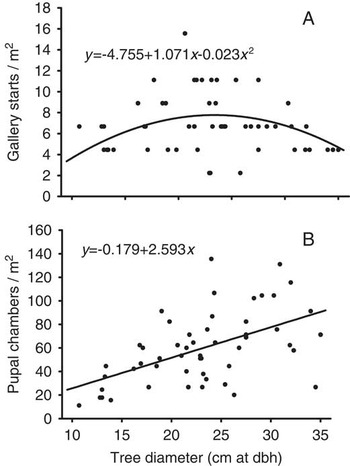
Colonisation densities (number of gallery starts) averaged 68.8 ± 3.9 SE gallery starts/m2 and increased with tree diameter to ∼24 cm in diameter, before declining (Fig. 1A; F 1,44 = 0.03, P = 0.87 for linear term; F 1,44 = 8.25, P = 0.0062 for quadratic term). The density of pupal chambers also increased with increasing diameter (Fig. 1B, F 1,45 = 20.15, P < 0.0001), such that the number of pupal chambers per gallery start did not vary significantly with tree diameter (overall mean 10.34 ± 1.0 SE pupal chambers/gallery start; F 1,45 = 3.20, P = 0.08).
Effect of tree diameter on colonisation density (A) and number of pupal chambers (B). Data reflect a total of 636 females and 404 males from 52 trees in two areas of British Columbia, Canada, 2006.

Of the emerged beetles, 636 females and 404 males were analysed for body size and lipid content. Males and females were analysed separately because they differed in body size and lipid content. Overall, females were larger than males (females 1.954 ± 6.85 × 10⁻³ mm; males 1.768 ± 7.39 × 10⁻³ mm; F 1,1033 = 330.73; P < 0.0001) and had higher absolute lipid content (699 ± 19 and 415 ± 17 μg; F 1,1033 = 114.19, P < 0.0001) and relative lipid contents (16.7 ± 0.4% and 12.8 ± 0.4%; F 1,1033 = 52.66, P < 0.0001).
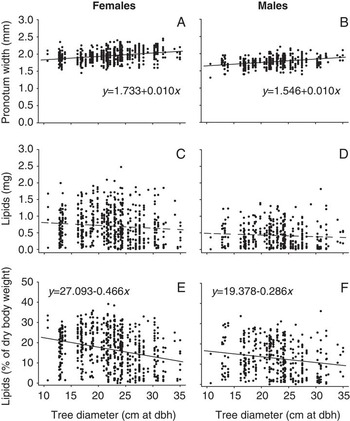
The body size of emerging female and male beetles increased with tree diameter (females: F 1,44 = 35.65, P < 0.0001; males: F 1,351 = 17.32, P < 0.0001). On average, beetles were 0.01 mm larger in size for each increase of 1 cm in tree diameter (Fig. 2A, 2B). There was no effect of tree diameter on the absolute lipid content of either sex (Fig. 2C, 2D; females: F 1,44 = 1.94, P = 0.17; males: F 1,351 = 1.41, P = 0.24). This differed from the effect of tree diameter on relative lipid content when expressed as a percentage of dry body weight. Relative lipid content decreased as the size of tree increased for both sexes (Fig. 2E, 2F; females: F 1,44 = 17.46, P < 0.0001; males: F 1,351 = 8.26, P < 0.0043).
Effect of tree diameter on size of emerging females (A) and males (B), absolute (mg) lipid content of emerging females (C) and males (D), and relative (%) lipid content of emerging females (E) and males (F). Dashed line indicates the relationship is not statistically significant. Data reflect a total of 636 females and 404 males from 52 trees in two areas of British Columbia, Canada, 2006.

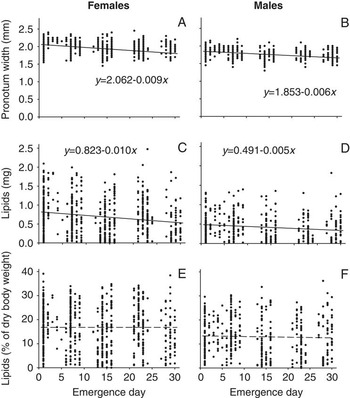
The largest beetles emerged earliest, irrespective of sex (Fig. 3A, 3B; females: F 1,584 = 117.49, P < 0.0001; males: F 1,351 = 69.05, P < 0.0001). These early-emerging beetles also had the highest lipid content on an absolute basis (Fig. 3C, 3D; females: F 1,584 = 17.65, P < 0.0001; males: F 1,351 = 8.42; P = 0.0039). On a relative basis, however, lipid content expressed as a percentage of body weight was constant across the emergence period for both females and males (Fig. 3E, 3F; females: F 1,584 = 0.00, P = 0.99; males: F 1,351 = 0.37, P = 0.5432).
Effect of time of emergence on size of emerging females (A) and males (B), absolute (mg) lipid content of emerging females (C) and males (D), and relative (%) lipid content of emerging females (E) and males (F). Dashed line indicates the relationship is not statistically significant. Data reflect a total of 636 females and 404 males from 52 trees in two areas of British Columbia, Canada, 2006.

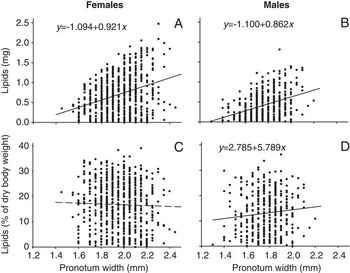
Absolute lipid content increased with body size for both females (Fig. 4A; F 1,584 = 75.88, P < 0.0001) and males (Fig. 4B; F 1,351 = 67.81, P < 0.0001). On average, each increase of 0.1 mm in pronotal width was associated with ∼0.09 mg increase in lipid content for a given adult. However, there was no statistically significant relationship between relative lipid content, expressed as a percentage of dry weight, and body size for females (Fig. 4C; F 1,584 = 0.60, P = 0.44) and only a weak relationship for males (Fig. 4D; F 1,351 = 4.42, P = 0.0362).
Effect of beetle body size on absolute (mg) lipid content of emerging females (A) and males (B) and relative (%) lipid content of emerging females (C) and males (D). Dashed line indicates the relationship is not statistically significant. Data reflect a total of 636 females and 404 males from 52 trees in two areas of British Columbia, Canada, 2006.

Discussion
Tree diameter and emergence date significantly affected both quantitative and qualitative components of mountain pine beetle brood production, albeit with notably high variation. Larger trees generally had higher colonisation densities, as others have observed (Safranyik and Carroll Reference Safranyik and Carroll2006). The decline in colonisation densities for the largest trees has not been previously reported to our knowledge. One possible explanation could be that fast growing trees invest more energy in growth than in defence (Herms and Mattson Reference Herms and Mattson1992), which could lead to lower production of aggregation pheromones by attacking mountain pine beetles (Raffa and Berryman Reference Raffa and Berryman1983). We did not see components of reproductive success decline in the largest trees (see below), suggesting that the quality of the largest trees was not reduced relative to mid-sized trees and so was likely not responsible for the lower densities on the largest trees.
Pupal densities increased monotonically with tree diameter, such that pupal chambers per gallery start were similar across tree diameters. The constant reproductive success across tree diameters contrasts with Safranyik et al. (Reference Safranyik, Shrimpton and Whitney1975) who found that offspring per female increases with tree diameter. A possible explanation for this difference is that our study was done in an area where trees in general have higher suitability for the brood due to a lack of selection pressure from mountain pine beetle epidemics, so that small diameter trees were relatively suitable (Cudmore et al. Reference Cudmore, Björklund, Carroll and Lindgren2010) compared with trees studied by Safranyik et al. (Reference Safranyik, Shrimpton and Whitney1975). Such an explanation, or others, indicates that processes may vary in space or time. Given the importance of per capita increases for population dynamics, it is remarkable that the body of data is so limited, speaking to the need for additional work. Nevertheless, higher colonisation densities of larger trees with constant (or increasing) offspring per gallery will result in those trees contributing more beetles to the population than smaller trees, as has been previously observed (Safranyik and Carroll Reference Safranyik and Carroll2006).
Offspring body size increased with tree diameter (Fig. 2A, 2B), as others have observed (Amman and Pace Reference Amman and Pace1976; Amman and Cole Reference Amman and Cole1983; Safranyik and Carroll Reference Safranyik and Carroll2006). Larger beetles also had higher absolute lipid content (Fig. 4A, 4B), and larger males had proportionately higher lipid content than did smaller males (Fig. 4D). Percent lipids of females remained constant across body sizes (Fig. 4C); a constant lipid proportion of lipids across body size is consistent with observations for insects in general (Lease and Wolf Reference Lease and Wolf2011). However, unlike body size, absolute lipid content did not vary with tree diameter (Fig. 2C, 2D). This suggests that the increase in lipids associated with larger body size was relatively lower than the increase in body size with tree diameter. Consequently, relative lipid content declined with increasing tree diameter (Fig. 2E, 2F). Overall, however, our results indicate the larger beetles with equal or greater lipid reserves emerged from larger trees than those emerging from smaller trees.
On average, the lipid levels (16.7 ± 0.4% and 12.8 ± 0.4%) and difference in size among sexes (1.954 ± 6.85 × 10⁻³ and 1.768 ± 7.39 × 10⁻³ mm) for females and males, respectively, were consistent with levels found for insects in general and representative saproxylous beetle families (Lease and Wolf Reference Lease and Wolf2011). For bark beetles, larger body size and higher lipid content are likely to positively influence dispersal, colonisation, and reproductive success. Larger individuals and those with more lipid reserves can sustain longer dispersal flights (Roff Reference Roff1991; Jactel Reference Jactel1993; Williams and Robertson Reference Williams and Robertson2008). Establishment of breeding sites on uncolonised trees by mountain pine beetles increases with body size (Reid and Baruch Reference Reid and Baruch2010) and energetic condition (Latty and Reid Reference Latty and Reid2010). Egg size and number also increase with body size (McGhehey Reference McGhehey1971) and condition (Elkin and Reid Reference Elkin and Reid2005). Coppedge et al. (Reference Coppedge, Stephen and Felton1994) proposed that because Dendroctonus frontalis Zimmermann eggs are ∼78% lipid, and because females change in lipid composition during egg-laying, females with higher absolute lipid contents, regardless of their percent lipid contents, may have the ability to produce more eggs than those with lower absolute lipid contents. Larger individuals may also have larger flight muscles (Robertson Reference Robertson1998) that are histolysed upon oviposition (Reid Reference Reid1962) as a probable additional source of energy for eggs (Marden Reference Marden2000). Consequently, it is likely that the larger beetles that emerge from larger diameter trees have greater flight and reproductive potential than the smaller beetles from smaller trees, but this needs further investigation.
Larger trees may offer greater food resources per area both in terms of phloem quantity and quality. Phloem thickness tends to increase with tree diameter and growth rate (Cole Reference Cole1973) and these relationships have been observed in our general study area (Graf Reference Graf2009). Thin phloem not only provides less food for developing larvae (Amman and Pasek Reference Amman and Pasek1986) but also is prone to greater dehydration particularly if large beetles in thin phloem break through the bark (Safranyik and Carroll Reference Safranyik and Carroll2006). It has also been suggested that thicker phloem may have a greater nutritional value for developing larvae (Amman Reference Amman1969; Amman Reference Amman1975; Amman and Cole Reference Amman and Cole1983). Given the higher resource quality, we would expect higher colonisation densities in larger trees, as we observed except in the largest trees. However, our finding that larger trees produce beetles of apparently higher quality is not consistent with the ideal free distribution (Fretwell and Lucas Reference Fretwell and Lucas1970) in which reproductive success is predicted to be constant across patches of different quality due to the proportional density of consumers. That is, mountain pine beetles could have settled in even higher densities on larger trees, increasing competition (Reid Reference Reid1963) such that the quality of offspring was consistent among trees of different diameters. However, offspring number per gallery start did remain constant across tree diameters, consistent with the ideal free distribution, so the mismatch between resource availability and colonisation density was not great. The cues used by mountain pine beetles to assess resource quality prior to alighting on trees are not well understood, as volatile pheromones and tree kairomones (Raffa Reference Raffa2001) may not signal phloem quality well.
Our results that beetle body size declined with emergence date was consistent with what has been reported in the literature, both for mountain pine beetles (Safranyik and Jahren Reference Safranyik and Jahren1970; Safranyik Reference Safranyik1976) and other bark beetles (e.g., Anderbrant et al. Reference Anderbrant, Schlyter and Birgersson1985; Sallé and Raffa Reference Sallé and Raffa2007). Larger beetles may emerge before smaller beetles because they have had more access to resources during development; in general, insects have a plastic response to growing conditions in which they develop faster but mature at a larger body size in better conditions (Day and Rowe Reference Day and Rowe2002). Alternatively, it may be adaptive to be large when emerging early if the likelihood of being a pioneer is high. As noted above, larger mountain pine beetles with greater energy reserves can likely disperse farther. They would also be more able to initiate an attack on an uncolonised tree, as they may have to do if emerging earlier than other beetles, e.g., smaller beetles with lower energy reserves.
Larger diameter trees tend to be colonised disproportionately by mountain pine beetles such that the size of available trees decreases over the course of an infestation (Cole and Amman Reference Cole and Amman1969; Mitchell and Preisler Reference Mitchell and Preisler1991; Trzcinski and Reid Reference Trzcinski and Reid2009). The depletion of large diameter trees is thought to contribute to the end of epidemic phases of populations of mountain pine beetles because smaller trees produce much fewer beetles than do larger trees (Safranyik and Carroll Reference Safranyik and Carroll2006; Björklund et al. Reference Björklund, Lindgren, Shore and Cudmore2009). Our study suggests that the body size of beetles will decline as large trees become rarer, which should also contribute to slower population growth because of size-dependent fecundity and colonisation success noted previously. The implications are less clear for the changes in lipid reserves with changes in tree diameter over the course of an epidemic. Although beetles in better energetic condition tend to be more likely to enter trees (Latty and Reid Reference Latty and Reid2010), the abundance of conspecifics may also positively influence an individual's probability of entering a tree (Wallin and Raffa Reference Wallin and Raffa2004). If beetles emerging from large trees are likely to be in an epidemic population phase (Safranyik and Carroll Reference Safranyik and Carroll2006), then the need for high lipid reserves upon emergence may be lower because of an abundance of conspecifics and suitable trees. Our finding that the effect of tree diameter differs for body size and lipid content suggests that mountain pine beetles may be strategically altering their allocation to different body tissues under different conditions. This idea warrants further investigation to better understand reproductive strategies of mountain pine beetles.
The patterns we observed were characterised by high variation. Thus, while tree diameter and emergence date influence offspring quantity and quality, there are clearly other variables that contribute to these outcomes. Tree diameter is merely a correlate of key aspects of phloem quality and quantity, but tree defences may also vary with tree diameter in possibly nonlinear ways (Raffa Reference Raffa2001). Predators and competitors may have their own responses to tree diameter and other tree traits. The amount of variation in our study cautions against undue reliance on tree diameter as a predictor of mountain pine beetle dynamics, although tree diameter is an attractively easy variable to measure.
In summary, larger lodgepole pine contribute disproportionately to mountain pine beetle populations both through higher numbers of offspring (though proportional to the number of gallery starts) and apparent quality of offspring. These results deviate somewhat from that expected by the ideal free distribution. Consideration of offspring quality with respect to tree diameter and timing of emergence may allow better understanding of the population dynamics of mountain pine beetles within and among years, with appropriate consideration of the strength of these relationships.
Acknowledgements
The authors thank D.P.W. Huber and two anonymous reviewers for valuable comments on the manuscript, and E. Carlson and J. Selesnic for assistance in the field and laboratory. This research was funded by the Government of Canada through the Mountain Pine Beetle Initiative Project no. 3.20, administered by Natural Resources Canada, Canadian Forest Service, and a NSERC Discovery Grant to BSL.