Introduction
Onuphidae is one of the dominant benthic polychaete families in soft-sediment communities of the Atlantic Ocean (Gillet & Dauvin, Reference Gillet and Dauvin2000; Paxton & Gillet, Reference Paxton and Gillet2004; Louzao et al., Reference Louzao, Anadón, Arrontes, Álvarez-Claudio, Fuente, Ocharan, Anadón and Acuña2010). However, current knowledge of deep-sea Atlantic onuphids and their distribution is still far from comprehensive and has been the scope of several recent publications, involving the description of new species, formal re-descriptions of conflicting taxa and new species records (Arias & Paxton, Reference Arias and Paxton2014; Reference Arias and Paxton2015, Reference Arias and Paxton2016; Paxton & Arias, Reference Paxton and Arias2014, Reference Paxton and Arias2016; Arias et al., Reference Arias, Núñez and Paxton2017). As part of an extensive project off the Iberian Peninsula and its vicinity, aimed to catalogue the Iberian marine biodiversity, a total of 36 species of Onuphidae in 10 genera were identified. Among them, two different species belonging to the genus Rhamphobrachium Ehlers, 1887 were found in the deep-sea samples from the Avilés submarine Canyon Systems and El Cachucho seamount (=Le Danois Bank), Cantabrian Sea, Bay of Biscay. One of them was R. (Spinigerium) brevibrachiatum (Ehlers, Reference Ehlers1875), a species that has been repeatedly reported from the Iberian continental slope and NE Atlantic deep waters (Fauvel, Reference Fauvel1923; Amoureux, Reference Amoureux1972; Louzao et al., Reference Louzao, Anadón, Arrontes, Álvarez-Claudio, Fuente, Ocharan, Anadón and Acuña2010; Paxton & Arias, Reference Paxton and Arias2014), whilst the other belonged to a different subgenus, R. (Rhamphobrachium), and was consistent with the diagnosis of R. (R.) agassizii Ehlers, 1887. This species constitutes the first record of the taxon from the Iberian Peninsula and the European Atlantic waters. Here, we present a detailed description and illustration of the species, including brief notes on its ecology and distribution at the new locality.
Materials and methods
We have re-examined the polychaete material collected during the COCACE (Oceanographic Cruise of the Central Cantabrian Sea), Fauna Ibérica and BIOCANT oceanographic campaigns. The COCACE cruise took place from April 1987 to February 1988; the benthic fauna was collected with an anchor dredge and/or a Hessler and Sanders epibenthic dredge at 42 sampling stations located in the continental shelf and the upper slope (between 31 and 1400 m depth) of the central Cantabrian Sea, Bay of Biscay (Louzao et al., Reference Louzao, Anadón, Arrontes, Álvarez-Claudio, Fuente, Ocharan, Anadón and Acuña2010; Fernández-Rodríguez et al., Reference Fernández-Rodríguez, Arias, Anadón and Acuña2019). The campaign Fauna Ibérica II was conducted in June 1991 on the Atlantic coast off Galicia and the Cantabrian Sea continental shelf and slope (from 0 to 1025 m depth); benthic samples were taken at 92 sampling stations by an anchor dredge and/or an epibenthic sledge, depending on substrate characteristics and meteorological conditions. The BIOCANT cruise was carried out from March 2012 to May 2013, at 11 sampling stations from a variety of substrates of the slope and abyssal areas (between 1500 and 4700 m depth) of the Avilés Canyons System (ACS), Cantabrian Sea (Romero-Romero et al., Reference Romero-Romero, Molina-Ramírez, Höfer and Acuña2016). In the ‘Material examined’ section of the species description, all stations (localities) with detailed collection data and additional information are fully listed.
The specimens were anaesthetized in 7% MgCl2, fixed in 10% neutral buffered formalin, and later transferred to 70% ethanol. Specimens were examined under a dissecting stereomicroscope. Temporary glycerol slides of parapodia were prepared to examine parapodial structures, chaetal morphology and its distribution, and examined under a compound light microscope. Photomicrographs were taken with a Spot Flex Digital Camera System mounted on a Leica MZ 16 stereo dissection microscope.
The width of the 10th chaetiger (without parapodia) was taken as a measure of the specimen size. Chaetal and prostomial appendages terminology follows Paxton (Reference Paxton1986a, Reference Paxton1998 respectively).
The specimens examined in this study are deposited in the Museo Nacional de Ciencias Naturales, Madrid, Spain (MNCN), the Museum of Comparative Zoology, Cambridge, MA, USA (MCZ) and the National Museum of Natural History, Smithsonian Institution, Washington, DC, USA (USNM).
Results and discussion
Systematics
Family ONUPHIDAE Kinberg, Reference Kinberg1865
Subfamily ONUPHINAE Kinberg, Reference Kinberg1865
Genus Rhamphobrachium Ehlers, 1887
Rhamphobrachium Ehlers, 1887, p. 70. – Paxton, Reference Paxton1986a, p. 44. – Paxton & Budaeva, Reference Paxton and Budaeva2015, p. 622.
Paranorthia Moore, Reference Moore1903, p. 448.
Type species: Rhamphobrachium agassizii Ehlers, Reference Ehlers1887, p. 70, by subsequent designation of Hartman, Reference Hartman1944, p. 47. Gender: neuter.
Diagnosis
Prostomium with short palps and antennae, ceratophores with 2–5 rings; frontal lips and peristomial cirri usually present (except in subgenus Minibrachium); anterior two or three pairs of parapodia prolonged, with three distally recurved hooks each; hooks with two rows of moveable spines, chaetal sacs extending to chaetiger 20–60; branchiae present or absent.
Subgenus Rhamphobrachium Paxton, 1986
Diagnosis
Peristomial cirri inserted close together; all limbate chaetae simple; subacicular hooks reaching a maximum number of 3–6 per parapodium on chaetigers 15–30; maxilla VI present.
Rhamphobrachium (Rhamphobrachium) agassizii Ehlers, Reference Ehlers1887
(Figures 1–3)
Rhamphobrachium agassizii Ehlers, Reference Ehlers1887, p. 70, pl. 17 figs 1–5, pl. 18 figs 1–9 (in part) (Carysfort Reef, Florida, USA, 642 m). – Fauvel, Reference Fauvel1914, p. 126 (Azores and Morocco); Treadwell, Reference Treadwell1939, p. 258, fig. 76 (Puerto Rico); [?] Intes & Le Loeuff, Reference Intes and LeLoeuff1975, p. 312 (Ivory Coast); Paxton, Reference Paxton1986a, p. 44, fig. 27 (definition of genus); Paxton, Reference Paxton1986b, pp. 85–86.
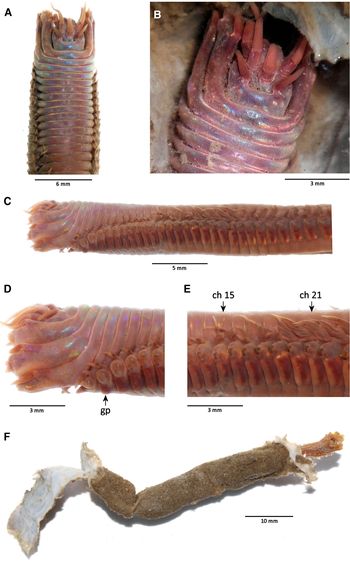
Photographs of Rhamphobrachium (Rhamphobrachium) agassizii: (A) anterior end, dorsal view; (B) detailed view of prostomium, peristomium and modified parapodia, dorsal view; (C) anterior end, lateral view; (D) detailed view of prostomium, peristomium and modified parapodia, lateral view; (E) median parapodia, lateral view; (F) tube. ch: chaetiger; gp: glandular pad.

Material examined
1 specimen (MNCN 16.01/14705), Spain, Cantabrian Sea, COCACE station: Y7A (I4a) 43°55.07′N 5°54.30′W, 1207 m, mud substrate, 4 July 1987; 1 specimen (MNCN 16.01/18729), Spain, Cantabrian Sea, Fauna Ibérica station: F-II (159 A) 43°49.10′–43°49.33′N, 04°52.74′–04°53.47′W), 925–1025 m, 25 June 1991.
Comparative material examined
LECTOTYPE (MCZ 789), USA, Florida: Blake, off Carysfort Reef, 642 m, 23 March 1869; 3 specimens (USNM 20070), Puerto Rico, Johnson-Smithsonian Expedition station 67–354E, 18°32′18″N 65°46′12″W, 549–599 m, 23 February 1933.
Diagnosis
Early unmodified parapodia with well-developed triangular postchaetal lobes; branchiae from chaetiger 15–17. Recurved hooks weakly pseudocompound.
Description
Medium-sized species, up to 90 mm length (for about 90 chaetigers); maximal width of 6 mm through chaetiger 10. Alcohol-stored specimens overall iridescent pinkish coloured with brown pigment on base of dorsal cirri and branchial filaments (Figure 1A–D). Prostomium anteriorly rounded; paired ovoid frontal lips almost twice as long as wide; lower lips with distinct anterior median section. Palps reaching chaetiger 1, lateral antennae on median part of prostomium, reaching chaetiger 2–4, median antenna reaching chaetiger 1–3; ceratophores of palps and antennae with 2–3 proximal rings and longer distal ring (Figure 1A, B). No prostomial eyes visible. Nuchal grooves with small middorsal separation. Peristomium a third longer than first chaetiger (Figure 1B), peristomial cirri subulate, inserted distally on peristomium, very long, to near distal end of frontal palps; inserted close together, lying between median and lateral antennae (Figure 1B, D).
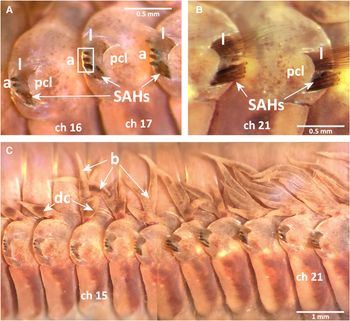
Anterior three pairs of parapodia modified, greatly enlarged, extending beyond anterior margin of prostomium (Figure 1B–D). Each of parapodia with three short papilliform lobes and one longer subulate postchaetal lobe. On chaetiger 4 low prechaetal and triangular postchaetal lobes, latter decreasing in size and absent from chaetiger 10. Dorsal cirri digitiform, long on anterior 3 chaetigers, shorter on chaetiger 4 and 5, remaining constant from chaetiger 6 onwards (Figure 1C, D). Ventral cirri subulate on first 3 chaetigers, fourth transitional, replaced by ventral glandular pads from chaetiger 5 (Figure 1D). Single or bifid branchiae from chaetiger 15–17 (Figures 1E & 2C), reaching maximum of 5 filaments by chaetiger 30 (Figure 2C).
Micrographs of Rhamphobrachium (Rhamphobrachium) agassizii: (A) parapodia from chaetiger 16 and 17, posterolateral view; (B) parapodia from chaetiger 20 and 21, posterolateral view; (C) median parapodia, lateral view. a: aciculae; b: branchiae; ch: chaetiger; dc: dorsal cirrus; l: limbate chaetae; pcl: postchaetal lobe; SAHs: subacicular hooks.

Modified parapodia with weakly pseudocompound, long, recurved hooks; chaetal sacs to chaetiger 55. Pectinate chaetae comb-shaped with 12–25 teeth and limbate chaetae from chaetiger 4; latter longest in upper position, shorter in median, and short spine-like in lower position. Three to four protruding distal ends of aciculae, brown-coloured with blunted tips (Figure 2A, B). One to three subacicular hooks per parapodium from chaetiger 14–16 (Figure 2A), maximum of three to five from chaetiger 15–16 to about chaetiger 20 (Figure 2B), two from there to end of body.
Jaws (Paxton, Reference Paxton1986a: fig. 27k, l) with strongly calcified mandibular shafts and slender, cutting plates distally serrated; maxillae weakly sclerotized, light brown; maxillary formula: Mx I = 1 + 1; Mx II = 8 + 8 (8–9); Mx III = 7 (6–7) + 0; Mx IV = 6 + 8 (7–9); Mx V = 1 + 1; Mx VI toothless plate. Tubes round in transverse section, with parchment-like inner layer and outer layer of mud and sand (Figure 1F); no eggs or developing embryos were found inside or attached to tubes.
Remarks
The Spanish specimens are almost complete and were both collected within their tubes (Figure 1F). The larger of the two specimens measures 89 mm in length for about 90 chaetigers and has a width of 6 mm through 10th chaetiger. The other consists of two fragments, measuring together 51 mm for about 60 chaetigers with a width of 3.5 mm. In general, the studied specimens agree well with the definition of the species given by Paxton (Reference Paxton1986a, Reference Paxton1986b) except for some details, i.e. the early branchiae were reported as single filaments starting on chaetiger 16–17, while in our specimens the branchiae appear on chaetiger 15 as bifid (i.e. with two filaments). Also, the subacicular hooks were reported to start as one to two per parapodium, whilst in our specimens they appear from two to three in number.
Rhamphobrachium (R.) agassizii can be easily distinguished from the other European member of the genus, R. (S.) brevibrachiatum, by the absence of pseudocompound to compound lower limbate chaetae (=spinigers), that are present from chaetiger 4 in the latter; by the more posterior origin of branchiae, from chaetiger 15–17 in R. (R.) agassizii while in R. (S.) brevibrachiatum they first appear from chaetiger 11–13. Furthermore, their tubes are strikingly different; R. (R.) agassizii builds its tubes with scarcely any ornamentation, consisting mostly of silt and fine sand (Figure 1F), while R. (S.) brevibrachiatum tubes are highly ornamented with foreign material, mainly shells, shell fragments and Foraminifera, for most of their length. Two other East Atlantic species of the Rhamphobrachium ‘sensu lato’ complex belong to the genus Longibrachium Paxton, 1986a for having the first four anterior pairs of parapodia prolonged, with more than three distally recurved hooks (with two rows of immoveable spines) each and having chaetal sacs that are extending to at least chaetiger 25. One of these is L. falcigerum Paxton & Gillet, Reference Paxton and Gillet2004 from the Azores seamounts and the second has been reported as L. atlanticum (Day, 1973) by Cantone et al. (Reference Cantone, Lanera and Sordino1997) from shallow waters of the Tyrrhenian Sea (central Mediterranean Sea). We agree with Langeneck et al. (Reference Langeneck, Lezzi, Del Pascua, Musco, Gambi, Castelli and Giangrande2020) that the latter record differs in various salient features from L. atlanticum and, rather than being a non-indigenous species, probably represents an undescribed native species.
Distribution, habitat and ecology
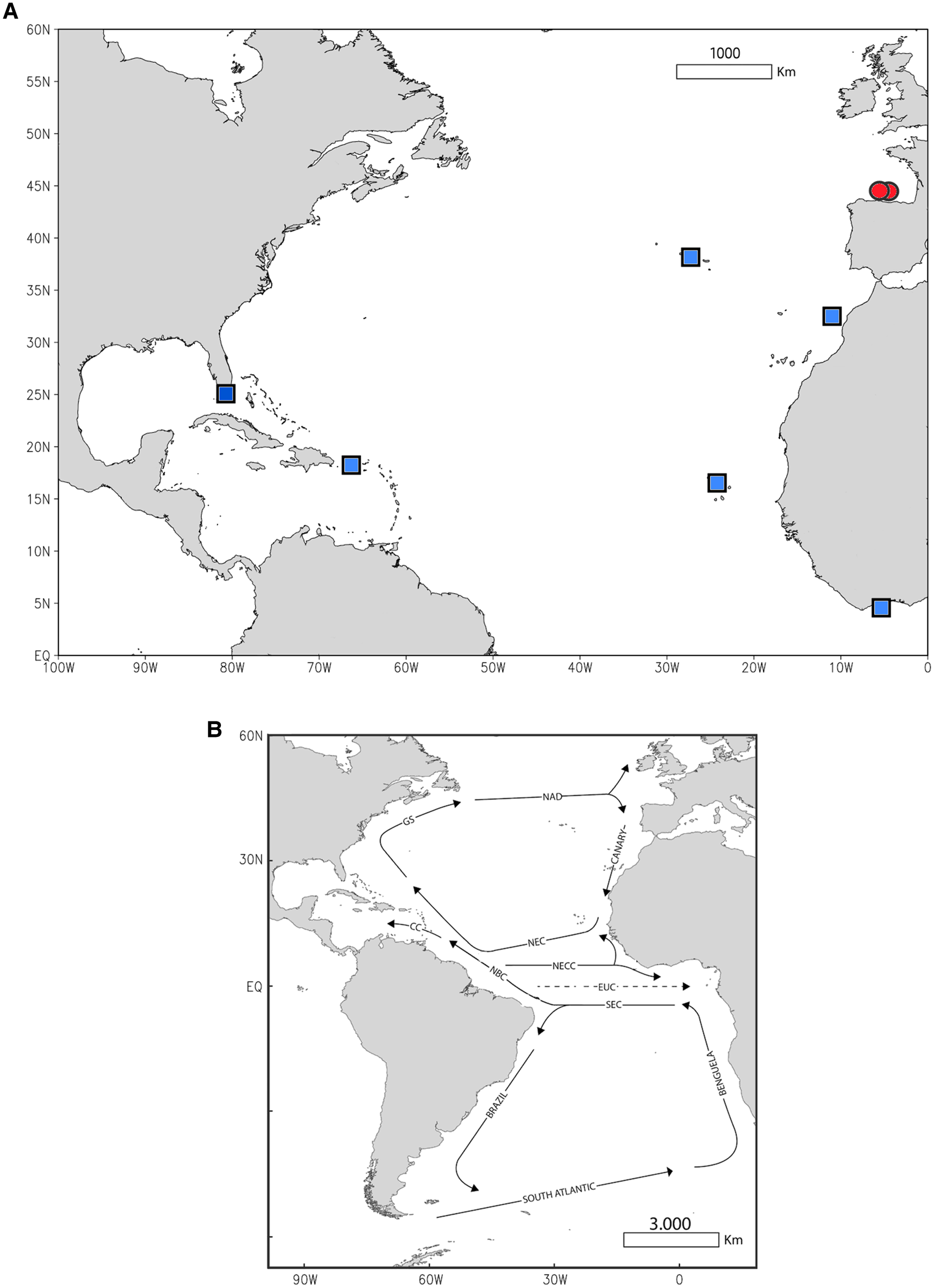
Apparently, R. (R.) agassizii displays an amphi-Atlantic distribution pattern (i.e. species occurring on both eastern and western basins of the Atlantic Ocean) (Figure 3A). The species has been recorded from Florida (off Carysfort Reef: type locality) and Puerto Rico (USA) in the western North Atlantic and from the Azores and Cape Verde archipelagos, Morocco and Ivory Coast in the eastern North Atlantic (Paxton, Reference Paxton1986a, Reference Paxton1986b). This is the first report of R. (R.) agassizii off the Iberian Peninsula and also in European waters, constituting its northernmost distribution in the eastern North Atlantic to date (Figure 3A). However, Ariño (Reference Ariño1987) confusingly included this species in his bibliographic checklist of Iberian polychaetes, because he also included the Azores fauna in his paper, presumably due to the allegiance of this archipelago to Portugal. He based this record on the work of Fauvel (Reference Fauvel1914), in which R. (R.) agassizii is reported from the Azores archipelago (as primary record), Cape Verde and Morocco, neither from the Iberian Peninsula nor Madeira Island (locality also treated by Fauvel in his study).
Maps of the Atlantic realm: (A) global distribution of Rhamphobrachium (Rhamphobrachium) agassizii, circles: localities from the present study, squares: localities from bibliography data; (B) main Atlantic oceanic currents after Sissini et al. (Reference Sissini, De Barros Barreto, Széchy, De Lucena, Oliveira, Gower, Liu, De Oliveira Bastos, Milstein, Gusmão, Martinelli-Filho, Alves-Lima, Colepicolo, Ameka, De Graft-Johnson, Gouvea, Torrano-Silva, Nauer, Marcos de Castro Nunes, Barufi, Rörig, Riosmena-Rodríguez, Mello, Lotufo and Horta2017). CC, Caribbean Current; EUC, Equatorial Undercurrent; GS, Gulf Stream; NAD, North Atlantic Drift; NBC, North Brazil Current; NEC, North Equatorial Current; NECC, North Equatorial Countercurrent; SEC, South Equatorial Current.

Palaeontological, oceanographic and developmental data are commonly proposed to explain amphi-Atlantic distributions in marine invertebrates (Briggs, Reference Briggs2003; Carmona et al., Reference Carmona, Malaquias, Gosliner, Pola and Cervera2011). Trans-Atlantic passive dispersal by ocean currents plays an important role in the distribution of different species with indirect development (Briggs, Reference Briggs2003; Carmona et al., Reference Carmona, Malaquias, Gosliner, Pola and Cervera2011). Regarding R. (R.) agassizii, to date no evidence of direct development was found (i.e. lack of developing eggs or embryos inside or attached to its tube), suggesting that the species undergoes indirect development with planktonic larvae. Thereby, their presumed planktonic larvae may be capable of dispersal or rafting, serving as a vector of gene flow between distant populations and explaining the current amphi-Atlantic distribution of the species (Figure 3A). This distribution seems consistent with the distribution of the main Atlantic currents (Figure 3B).
With regards to the habitat, this is a typical deep-water species, with its deepest record of 2165 m from the Azores archipelago (Fauvel, Reference Fauvel1914). In the Cantabrian Sea, the species was found between 925 and 1207 m depth from the muddy substrates of the boundaries of the Avilés Canyons System (ACS) and the marginal basin of ‘El Cachucho’ seamount. Both locations are highly productive areas that harbour a great biodiversity. The ACS is a Site of Community Importance (SCI) within the Natura 2000 Network (ESZZ12003, Commission Implementing Decision (EU) 2016/2335) and host of vulnerable habitats for such organisms as deep-sea corals, sponges and deep-sea sharks (Cristobo et al., Reference Cristobo, Ríos, Sánchez and Anadón2009; Sánchez et al., Reference Sánchez, González-Pola, Druet, García-Alegre, Acosta, Cristobo, Parra-Descalzo, Ríos, Altuna, Gómez-Ballesteros, Muñoz-Recio, Rivera and Díaz del Río2014). On the other hand, ‘El Cachucho’ seamount is the largest offshore Marine Protected Area (MPA) in Spain. It is well-known that this seamount influences the general circulation pattern of the water masses in the Cantabrian Sea and that it hosts higher values of biodiversity (including vulnerable taxa), and species richness compared with the surrounding open ocean (Sánchez et al., Reference Sánchez, Serrano, Parra, Ballesteros and Cartes2008; Rodríguez-Cabello et al., Reference Rodríguez-Cabello, Sánchez, Ortiz de Zárate and Barreiro2009).
To date, R. (R.) agassizii was only collected singly at two stations of a total of 145 analysed stations (from three different oceanographic campaigns, a great variety of substrates and a wide bathymetric range, from shallow water to 4700 m depth) in the European Atlantic, indicating a very low population density and suggesting that it is apparently a very rare species within this region. The other species records have a similar history, as they are also only based on one or very few specimens (Paxton, Reference Paxton1986b), confirming the rarity of this species throughout its known distribution range. This contrasts with the great abundance of its congener, R. (S.) brevibrachiatum, on Irving and Meteor north-eastern Atlantic seamounts, where 63 and 114 specimens were collected respectively, by the ‘Seamount 2’ expedition (Gillet & Dauvin, Reference Gillet and Dauvin2003). Furthermore, in the Meteor seamount samples, R. (S.) brevibrachiatum was the most dominant polychaete species found, accounting for 61% (Gillet & Dauvin, Reference Gillet and Dauvin2003).
Our results together with previous studies (Paxton, Reference Paxton1986a, Reference Paxton1986b) strongly suggest that R. (R.) agassizii has a restricted bathymetric range with narrow habitat and small population size, making it vulnerable to local extinctions. The provided revision of the biogeography of the species demonstrates its apparent amphi-Atlantic distribution, which appears consistent with the distribution of the main Atlantic currents.
However, our work underlines the need for molecular studies to test the conspecificity of the eastern and western populations in order to support our hypothesis of an amphi-Atlantic distribution or to accept the existence of a cryptic species complex.
Acknowledgements
We thank Javier Sánchez (MNCN) for his curatorial help and the anonymous reviewers for insightful suggestions. This is a contribution from the Fauna Ibérica Project, subproject Annelida-Polychaeta VII: Palpata-Canalipalpata II (ref. PGC2018-095851-B-C64) and the Marine Observatory of Asturias (OMA).