



1. Introduction
As crucial components of the insurance business chain, investment and reinsurance play indispensable roles in fostering the high-quality development of the insurance sector and ensuring the security and stability of the national economy. In recent years, optimization problems with various objectives subject to investment and/or reinsurance control have garnered significant attention and emerged as a prominent topic in actuarial literature. Common objective functions include ruin probability minimization, goal-reaching optimization, and expected utility maximization, as well as the mean–variance criterion (see, e.g., [Reference Bäuerle4, Reference Bayraktar and Young5, Reference Björk and Murgoci7, Reference Brachetta and Ceci8, Reference Browne10, Reference Irgens and Paulsen15, Reference Promislow and Young21, Reference Tan, Wei, Wei and Zhang22, Reference Zeng and Li27] and references therein). In this paper, we study the optimal investment–reinsurance strategy on a goal-reaching problem of an insurer in a dynamic setting.
Most of the existing literature on investment has not taken into account or incorporated natural constraints. In the financial market, short-selling and borrowing constraints are two of the main factors which make models more realistic. On one hand, countries such as China impose restrictions on short-selling. If short-selling is allowed, investors may adopt high-risk investment strategies to gain substantial profits, such as maliciously shorting stocks or other assets, which could undermine market fairness and harm the interests of investors. On the other hand, investors are not allowed to freely borrow without any limitations. If investors borrow freely, they may take on excessive debt for investment, leading to an unsustainable debt burden. Therefore, it is important to study the associated optimal control problems without short-selling opportunities and different borrowing constraints. The problem of optimal investment and reinsurance to minimize the probability of ruin under a limited leverage rate constraint was discussed in [Reference Luo18]. Under a short-selling constraint, [Reference Bai and Guo3] studied the optimal excess-of-loss reinsurance and investment problem with multiple risky assets. Three investment problems related to survival, growth, and goal-reaching maximization were considered in [Reference Yener23] under borrowing prohibition. More research on investment constraints can be found in [Reference Azcue and Muler2, Reference Yener24, Reference Yuan, Liang and Han26] and references therein.
Ambiguity was introduced as a form of uncertainty in [Reference Knight16]. It has been adopted and developed as a way of addressing model uncertainty in stochastic models of financial and insurance markets for the investment–reinsurance problem. In reality, a decision-maker would construct a reference model for probability measures based on data obtained from financial and insurance markets. However, this reference model only approximates the true model and leads to some inevitable biases. Therefore, in recent years some scholars have considered optimal investment–reinsurance strategies under the framework of model uncertainty. For example, [Reference Anderson, Hansen and Sargent1] studied asset pricing problems in a stochastic continuous-time model setup by incorporating the investor’s concerns about model misspecification; [Reference Maenhout20] investigated an optimal asset allocation problem with ambiguity, and derived closed-form expressions of the optimal strategies under so-called homothetic robustness; and [Reference Zhang and Siu29] considered a reinsurance–investment optimization problem with model uncertainty under the expected utility criterion and the survival probability criterion. For further relevant studies, see [Reference Bayraktar and Zhang6, Reference Branger and Larsen9, Reference Chang and Li11, Reference Luo, Wang and Zhu19, Reference Yi, Viens, Li and Zeng25] and so on.
In view of this situation, we consider ambiguity aversion in a two-sided exit objective of minimizing the goal-reaching probability of the insurer’s wealth reaching a low level before a high goal, which covers minimizing the ruin probability as a special case. In our model set-up, the insurer can purchase per-loss reinsurance whose premium is computed according to the mean–variance premium principle. We incorporate two investment constraints into the insurance model: (i) short-selling is prohibited; (ii) the proportion of the borrowed amount to the current wealth level cannot exceed a non-negative constant
 $k\geq0$
. By using the stochastic dynamic programming approach and solving the associated Hamilton–Jacobi–Bellman (HJB) equation, we obtain a robust optimal investment–reinsurance strategy and the value functions in explicit forms. Finally, we provide numerical examples to illustrate our results.
The rest of this paper is organized as follows. In Section 2, we describe the model and problem formulation. In Section 3, we derive closed-form expressions for the robust optimal strategies and the corresponding value functions. In Section 4, we present the optimal control strategies and value functions under two extreme cases. In Section 5, we show numerical illustrations to analyze our results. In Section 6, we conclude this paper.
2. Model and problem formulation
In this section, we introduce the models and some basic assumptions. We assume that trading in the reinsurance and financial markets is continuous, without taxes or transaction costs, and that all assets are infinitely divisible. Let
 $(\Omega,\mathcal{F},\mathbb{F}=\{\mathcal{F}_{t}\}_{t\geq0},\mathbb{P})$
be a filtered complete probability space satisfying the usual conditions of completeness and right continuity, where
 $\mathbb{P}$
is the real-world probability measure and
 $\mathcal{F}_{t}$
represents the information available until time t. All stochastic processes given in the following are assumed to be adapted on this space.
According to the classical Cramér–Lundberg model, the surplus process of the insurer
 $U=\{U_{t}\}_{t\geq0}$
adapted to the filtration
 $\mathbb{F}$
can be described as
 ${\mathrm{d}}U_{t}=c{\mathrm{d}}t-{\mathrm{d}}\sum_{i=1}^{N_{t}}Y_{i}$
, where
 $c \gt 0$
is the premium rate.
 $\{N_{t}\}_{t\geq0}$
is a homogeneous Poisson process with intensity
 $\lambda \gt 0$
and, for each
 $t\geq0$
,
 $N_{t}$
represents the total claims number at interval [0, t]. The claim sizes
 $\{Y_{i},i=1,2,\ldots\}$
are independent and identically distributed positive random variables following a common distribution
 $F_{Y}(y)$
with finite first- and second-order moments.
Consider now an insurer using reinsurance to manage its risk exposure. Without reinsurance, the insurer is fully responsible for all losses arising,
 $Y_{i}$
,
 $i=1,2,\ldots$
In the presence of reinsurance, a portion of each arising loss
 $Y_{i}$
will be ceded to the reinsurer. The precise coverage is dictated by the reinsurance policy
 $l_{t}(y)$
at time
 $t\geq0$
as a function of the (possible) claim
 $Y=y$
at that time. Thus, the reinsurer pays the insurer the amount
 $y-l_{t}(y)$
if there is a claim of size y at time
 $t\geq0$
. The reinsurance premium is computed according to the mean–variance premium principle, i.e.
 \begin{equation} (1+\theta)\lambda{\mathbb{E}}(Y-l_{t}(Y)) + \frac{\eta}{2}\lambda{\mathbb{E}}((Y-l_{t}(Y))^{2}),\end{equation}
in which
 $\theta$
and
 $\eta$
are the non-negative risk-loading parameters. If
 $\theta=0$
then (2.1) reduces to the variance premium principle; similarly, if
 $\eta=0$
then (2.1) reduces to the expected-value premium principle. Thus, the insurer’s surplus process
 $U_{t}^{l}$
in the presence of reinsurance becomes
 \begin{equation*} {\mathrm{d}}U_{t}^{l} = \bigg[c - (1+\theta)\lambda{\mathbb{E}}(Y-l_{t}(Y)) - \frac{\eta}{2}\lambda{\mathbb{E}}((Y-l_{t}(Y))^{2})\bigg]\,\mathrm{d}t-\mathrm{d}\sum_{i=1}^{N_{t}}l_{t}(Y_{i}).\end{equation*}
By [Reference Grandell13],
 $U_{t}^{l}$
can be approximated by the following diffusion processes
 $\hat{U}_{t}^{l}$
:
 \begin{equation*} {\mathrm{d}}\hat{U}_{t}^{l} = \bigg[\theta\lambda{\mathbb{E}}(l_{t}(Y)) + \eta\lambda\mathbb{E}(Yl_{t}(Y)) - \frac{\eta}{2}\lambda\mathbb{E}\big(l_{t}^{2}(Y)\big) - \delta\bigg]\,\mathrm{d}t + \sqrt{\lambda\mathbb{E}\big(l_{t}^{2}(Y)\big)}\,\mathrm{d}W_{t},\end{equation*}
in which
 $\delta=(1+\theta)\lambda{\mathbb{E}}(Y)+\frac12\eta\lambda{\mathbb{E}}\big(Y^{2}\big)-c$
and
 $\{W_{t}\}_{t\geq0}$
is a standard Brownian motion.
Assumption 2.1. The insurer’s premium income rate is greater than the expected value of the claims but less than the premium for full reinsurance, i.e.
 \begin{align*}\lambda{\mathbb{E}}(Y) \lt c \lt (1+\theta)\lambda{\mathbb{E}}(Y)+\frac{\eta}{2}\lambda{\mathbb{E}}\big(Y^{2}\big).\end{align*}
Apart from reinsurance, we impose investment and assume that the price process of the risky asset satisfies a standard geometric Brownian motion,
 ${\mathrm{d}}P_{t}^{1}=P_{t}^{1}[\mu\,{\mathrm{d}}t+\sigma\,{\mathrm{d}}B_{t}]$
, where
 $\mu({ \gt }0)$
is the appreciation rate,
 $\sigma({ \gt }0)$
is the volatility rate, and
 $\{B_{t}\}_{t\geq0}$
is a standard Brownian motion, independent of
 $\{W_{t}\}_{t\geq0}$
.
In this paper, we suppose that the insurer can invest a non-negative amount in a risk-free asset that earns interest at the constant rate r. If the insurer borrows the money then it pays interest at a higher rate
 $\beta \gt r$
. Then, a risk-free asset has the dynamics
 ${\mathrm{d}}P_{t}^{0}=f(P_{t}^{0})\,{\mathrm{d}}t$
, in which the Lipschitz continuous function f is expressed as
 \begin{equation*} f(P_{t}^{0}) = \left\{ \begin{array}{l@{\quad}l} rP_{t}^{0} & \mathrm{if}\ P_{t}^{0} \geq 0, \\[3pt] \beta P_{t}^{0} & \mathrm{if}\ P_{t}^{0} \lt 0. \end{array} \right.\end{equation*}
Here, we assume that
 $\mu \gt \beta \gt r \gt 0$
. The case of
 $\beta \gt \mu \gt r \gt 0$
can be reduced to the special case with no-borrowing.
Denote by
 $\pi_{t}$
the fraction of the wealth invested in the risky asset by the insurer. We can see that
 $0\leq\pi_{t}\leq1$
means investment without short-selling and borrowing; if
 $\pi_{t} \gt 1$
then it means that the insurer has to borrow money from the market and invests all the wealth in the risky asset. We define the control strategy of the insurer as
 $u_{t}=(\pi_{t},l_{t})$
. Thus, the wealth process
 $X^{u}_{t}$
of the insurer is described as
 \begin{equation}\left\{\begin{array}{l}\displaystyle{\mathrm{d}}X_{t}^{u} = \big\{f\big((1-\pi_{t})X_{t}^{u}\big) - \delta + \pi_{t}X_{t}^{u}\mu + \theta\lambda{\mathbb{E}}(l_{t}(Y)) + \eta\lambda{\mathbb{E}}(Yl_{t}(Y)) - \frac12\eta\lambda{\mathbb{E}}\big(l_{t}^{2}(Y)\big)\big\}\,\mathrm{d}t \\[3pt]\quad \qquad + \sigma X_{t}^{u}\pi_{t}{\mathrm{d}}B_{t} + \sqrt{\lambda{\mathbb{E}}\big(l_{t}^{2}(Y)\big)}\,{\mathrm{d}}W_{t}, \\[3pt]X^{u}_{0}=x,\end{array}\right.\end{equation}
in which
 \begin{equation*} f\big((1-\pi_{t})X_{t}^{u}\big) = \left\{ \begin{array}{l@{\quad}l} r(1-\pi_{t})X_{t}^{u} & \mathrm{if}\ \pi_{t}\geq1, \\[4pt] \beta(1-\pi_{t})X_{t}^{u} & \mathrm{if}\ \pi_{t} \lt 1, \end{array} \right.\end{equation*}
and
 $x\ ({ \gt }0)$
is the initial wealth of the insurer.
Definition 2.1.
(Admissible strategy.) A control policy
 $u_{t}=(\pi_{t},l_{t})$
is said to be admissible if:
-
(i) for all
 $t\geq0$
,
$\pi_{t}$
and
$l_{t}$
are
$\mathbb{F}$
-progressively measurable;
-
(ii) for all
$t\geq0$
,
$\pi_{t}\in(0, 1+m]$
and
$l_{t}(y)\in[0,y]$
is a non-decreasing function with respect to y; -
(iii) for all
$(t,x)\in[0,+\infty)\times\mathbb{R}$
, (2.2) has a pathwise unique solution
$X_{t}^{u}$
.




Let
 $\mathcal{U}$
denote the set of all admissible strategies.
Let
 $\tau_{M}^{u}\,:\!=\,\inf\{t\mid t\geq0,X_{t}^{u}\leq M\}$
and
 $\tau_{N}^{u}\,:\!=\,\inf\{t\mid t\geq0,X_{t}^{u}\geq N\}$
be the first times the insurer’s wealth respectively hits a specified ruin level M and a high goal N under the control policy u. The insurer aims at minimizing the probability that ruin happens before the high goal N, i.e.
 $\tau_{M}^{u} \lt \tau_{N}^{u}$
, in a robust sense. More precisely, they suspect that the drifts of the risky asset and the surplus may be misspecified. Define
 $\tau^{u}=\tau_{M}^{u}\wedge\tau_{N}^{u}$
as the first exit time of the interval (M, N), and note that
 $\tau^{u}=\infty$
if
 $\tau_{M}^{u}=\tau_{N}^{u}=\infty$
. So instead of optimizing under the reference measure
 $\mathbb{P}$
, they consider a set
 $\mathscr{Q}$
of candidate measures that are locally equivalent to
 $\mathbb{P}$
, i.e.
 $\mathscr{Q}\,:\!=\,\{\mathbb{Q}\mid\mathbb{Q}\thicksim\mathbb{P}\}$
, and penalizes their deviation from
 $\mathbb{P}$
. To give the precise definition of the set
 $\mathscr{Q}$
of candidate measures, we first define
 $\phi_{t}=(\phi_{1t},\phi_{2t})$
,
 $t\geq0$
, as a so-called probability distortion process and let
 $\Phi$
denote the collection of
 $\phi$
satisfying the Novikov condition
 ${\mathbb{E}}^{\mathbb{P}}\big[\exp\big\{\int_0^{t}\frac{1}{2}\big(\phi_{1s}^{2}+\phi_{2s}^{2}\big)\,{\mathrm{d}}s\big\}\big] \lt \infty$
. So, for each
 $\phi_{t}\in\Phi$
, a probability measure
 $\mathbb{Q}\in\mathscr{Q}$
if
 \begin{align*}\frac{{\mathrm{d}}\mathbb{Q}}{{\mathrm{d}}\mathbb{P}}\bigg|_{\mathcal{F}_{t}} =\exp\bigg\{\int_{0}^{t}\phi_{1s}\,{\mathrm{d}}B_{s} + \int_{0}^{t}\phi_{2s}\,{\mathrm{d}}W_{s} -\frac{1}{2}\int_{0}^{t}\big(\phi_{1s}^{2}+\phi_{2s}^{2}\big)\,{\mathrm{d}}s\bigg\}.\end{align*}
By Girsanov’s theorem, the Brownian motions under
 $\mathbb{Q}\in\mathscr{Q}$
are presented as
 \begin{equation*} \left\{ \begin{array}{l} {\mathrm{d}}B_{t}^{\mathbb{Q}} = {\mathrm{d}}B_{t} - \phi_{1t}\,{\mathrm{d}}t, \\[3pt] {\mathrm{d}}W_{t}^{\mathbb{Q}} = {\mathrm{d}}W_{t} - \phi_{2t}\,{\mathrm{d}}t, \end{array} \right.\end{equation*}
where
 $\{B_{t}^{\mathbb{Q}}\}_{t\geq0}$
and
 $\{W_{t}^{\mathbb{Q}}\}_{t\geq0}$
are two
 $\mathbb{Q}$
-Brownian motions and are mutually independent. Therefore, we rewrite the wealth process
 $X_{t}^{u}$
under the probability measure
 $\mathbb{Q}$
as follows:
 \begin{equation}\begin{cases}{\mathrm{d}}X_{t}^{u} = \big\{f\big((1-\pi_{t})X_{t}^{u}\big) - \delta + \pi_{t}X_{t}^{u}\mu + \theta\lambda{\mathbb{E}}(l_{t}(Y)) + \eta\lambda{\mathbb{E}}(Yl_{t}(Y)) - \frac12\eta\lambda{\mathbb{E}}\big(l_{t}^{2}(Y)\big) \\[3pt]\quad \qquad + \sigma X_{t}^{u}\pi_{t}\phi_{1t} + \sqrt{\lambda{\mathbb{E}}\big(l_{t}^{2}(Y)\big)}\phi_{2t}\big\}\,\mathrm{d}t + \sigma X_{t}^{u}\pi_{t}{\mathrm{d}}B_{t}^{\mathbb{Q}} + \sqrt{\lambda{\mathbb{E}}\big(l_{t}^{2}(Y)\big)}\,{\mathrm{d}}W_{t}^{\mathbb{Q}}, \\[3pt]X^{u}_{0}=x.\end{cases}\end{equation}
The relative entropy between
 $\mathbb{Q}$
and
 $\mathbb{P}$
up to time t is given by
 \begin{align*}{\mathbb{E}}^{\mathbb{Q}}\bigg(\ln\frac{{\mathrm{d}}\mathbb{Q}_{t}}{{\mathrm{d}}\mathbb{P}_{t}}\bigg) ={\mathbb{E}}^{\mathbb{Q}}\bigg(\frac{1}{2}\int_{0}^{t}\big(\phi_{1s}^{2}+\phi_{2s}^{2}\big)\,{\mathrm{d}}s\bigg), \quad t \lt \infty,\end{align*}
where
 $\mathbb{Q}_{t}$
is the probability measure
 $\mathbb{Q}$
restricted to
 $\mathcal{F}_{t}$
and
 $\mathbb{P}_{t}$
is the probability measure
 $\mathbb{P}$
restricted to
 $\mathcal{F}_{t}$
. We define a performance function for any
 $u\in\mathcal{U}$
and
 $\phi\in\Phi$
as
 \begin{equation*} J^{u,\phi}(x) \,:\!=\, \mathbb{Q}^{x}\big(\tau_{M}^{u} \lt \tau_{N}^{u},\tau^{u} \lt \infty\big) - \frac{1}{\epsilon}\mathbb{E}^{\mathbb{Q}}\bigg(\frac{1}{2}\int_{0}^{\tau^{u}}\big(\phi_{1s}^{2}+\phi_{2s}^{2}\big) \,{\mathrm{d}}s\bigg),\end{equation*}
where
 $\mathbb{Q}^{x}(\cdot)=\mathbb{Q}(\cdot\mid X_{0}^{u}=x)$
and
 $\epsilon$
is the ambiguity-aversion coefficient for the insurer. The robust value function is then defined as
 \begin{equation} V(x)\,:\!=\,\inf_{u\in\mathcal{U}}\sup_{\phi\in\Phi}J^{u,\phi}(x).\end{equation}
Note that if the value of the wealth is greater than or equal to
 $x^{\ast}={\delta}/{{\beta}}$
, then the insurer can buy full reinsurance via income from the risk-free asset, and therefore the wealth will never drop below its current value. For this reason, we call
 $x^{\ast}$
the safe level. We generalize from this case in the following remark.
Remark 2.1. As the wealth increases towards
 ${\delta}/{{\beta}}$
, the optimal investment–reinsurance strategy approaches
 $u_{0}=(0,0)$
. It makes sense because when the value of the wealth increases, the insurer invests only in the risk-free asset and transfers all the risk to the reinsurer; from (2.3), the wealth process becomes an ordinary differential equation
 $\mathrm{d}X^{u_{0}}_{t}=\big(rX^{u_{0}}_{t}-\delta\big)\,\mathrm{d}t$
, and thus the wealth will never decrease, so ruin cannot happen. Indeed, on one hand, we have
 \begin{align*} V(x) = \inf_{u\in\mathcal{U}}\sup_{\phi\in\Phi}J^{u,\phi}(x) \leq \sup_{\phi\in\Phi}J^{u_{0},\phi}(x) = \sup_{\phi\in\Phi}\bigg\{0-\frac{1}{\epsilon}{\mathbb{E}}^{\mathbb{Q}} \bigg(\frac{1}{2}\int_{0}^{\tau^{u_{0}}}\big(\phi_{1s}^{2}+\phi_{2s}^{2}\big)\,{\mathrm{d}}s\bigg)\bigg\} \leq 0. \end{align*}
On the other hand, note that
 $\mathbb{P}\in\mathscr{Q}$
with
 $\phi_{0}\equiv(0,0)$
, so
 \begin{align*} V(x) = \inf_{u\in\mathcal{U}}\sup_{\phi\in\Phi}J^{u,\phi}(x) \geq \inf_{u\in\mathcal{U}}J^{u,\phi_{0}}(x) = \inf_{u\in\mathcal{U}}\mathbb{P}^{x}\big(\tau_{M}^{u} \lt \tau_{N}^{u},\tau^{u} \lt \infty\big)\geq0. \end{align*}
Thus, we have
 $V(x)\equiv0$
for any
 $x\geq{\delta}/{{\beta}}$
. As a consequence, we make the following assumption.
Assumption 2.2.
 $0 \lt M \lt N\leq{\delta}/{{\beta}}$
.
Remark 2.2. There are two extreme cases. One case with
 $\epsilon\rightarrow0$
corresponds to the classical non-robust model, also known as the reference model. As a result, the insurer is extremely convinced that the reference model under the measure
 $\mathbb{P}$
is exactly the true model, i.e. the insurer is ambiguity neutral, and any deviation from the reference model will be penalized infinitely heavily. The larger
 $\epsilon$
is, the more confidence the insurer has on the alternative measure
 $\mathbb{Q}$
. While in the case of
 $\epsilon\rightarrow\infty$
, the insurer has no information about the true model and all the alternative models are on an equal footing. The value functions and associated optimal investment and retention strategies for the two extreme cases
 $\epsilon\rightarrow0$
and
 $\epsilon\rightarrow\infty$
are derived explicitly in Section 4.
Let
 $C^{2}[M, N]$
be the space of any function F(x) such that F and its derivatives
 $F_{x}$
,
 $F_{xx}$
are continuous on [M, N]. To solve the above robust problem, we use the dynamic programming approach described in [Reference Fleming and Soner12]. From standard arguments, we see that if
 $V\in C^{2}$
then V satisfies the following HJB equation for
 $x\in[M, N]$
:
 \begin{equation} \inf_{u\in\mathcal{U}}\sup_{\phi\in\Phi}\{\mathcal{A}^{u,\phi}V(x)\}=0,\end{equation}
in which
 \begin{align*} \mathcal{A}^{u,\phi}V(x) & = V_{x}(x)\bigg[f((1-\pi)x) - \delta + \pi x\mu + \theta\lambda{\mathbb{E}}(l(Y)) + \eta\lambda{\mathbb{E}}(Yl(Y)) - \frac{\eta}{2}\lambda{\mathbb{E}}\big(l^{2}(Y)\big) \\[5pt] & \quad + \sigma x\pi\phi_{1} + \sqrt{\lambda{\mathbb{E}}\big(l^{2}(Y)\big)}\phi_{2}\bigg] + \frac{1}{2}V_{xx}(x)\big[\sigma^{2}x^{2}\pi^{2} + \lambda{\mathbb{E}}\big(l^{2}(Y)\big)\big] - \frac{1}{2\epsilon}\big(\phi_{1}^{2}+\phi_{2}^{2}\big),\end{align*}
with the boundary conditions
 \begin{eqnarray} V(M)=1, \qquad V(N)=0.\end{eqnarray}
Obviously, the optimal control strategy u obtained through the dynamic programming approach is time-independent.
Lemma 2.1. For an admissible control
 $u_{t}=(\pi_{t},l_{t})$
with a given constant
 $\varepsilon \gt 0$
satisfying
 $\sigma^{2}x^{2}\pi_{t}^{2}+\lambda{\mathbb{E}}\big(l_{t}^{2}(Y)\big) \gt \varepsilon$
for all
 $t \gt 0$
, we have
 $\mathbb{Q}^{x}(\tau^{u} \lt \infty)=1$
for
 $\mathbb{Q}\in\mathscr{Q}$
and
 $x\in(M, N)$
, where
 $\tau^{u}=\tau_{M}^{u}\wedge\tau_{N}^{u}$
.
Proof. Similar to the proof of [Reference Luo, Wang and Zhu19, Lemma 3.1], so we omit it here.
Theorem 2.1. (Verification theorem.) Suppose that the function
 $F\colon[M, N]\rightarrow[0, 1]$
is bounded and continuous such that:
-
(i)
$F\in C^{2}$
is a non-increasing function and
$F_{x}(x)$
is bounded on (M, N); -
(ii) F(x) solves the HJB equation (2.5) under the boundary conditions (2.6) and, with
$u^{\ast}=(\pi^{\ast},l^{\ast})$
and
$\phi^{\ast}=\big(\phi_{1}^{\ast},\phi_{2}^{\ast}\big)$
, satisfies
\begin{equation*} \mathcal{A}^{u^{\ast},\phi^{\ast}}F(x) = \inf_{u\in\mathcal{U}}\sup_{\phi\in \Phi}\mathcal{A}^{u,\phi}F(x) = \inf_{u\in\mathcal{U}}\mathcal{A}^{u,\phi^{\ast}}F(x) = \sup_{\phi\in\Phi}\mathcal{A}^{u^{\ast},\phi}F(x); \end{equation*}
-
(iii) there exists
$\varepsilon \gt 0$
such that
$\sigma^{2}x^{2}\pi^{\ast2}(x)+\lambda{\mathbb{E}}(l^{\ast2}(x,y)) \gt \varepsilon$
for
$x\in[M, N]$
, in which parameter x is incorporated into the investment and reinsurance strategies to highlight its dependency on this parameter; -
(iv)
$\phi_{1}(x)$
and
$\phi_{2}(x)$
are bounded for
$x\in[M, N]$
.





Then
 $F(x)=V(x)$
for
 $x\in[M, N]$
, which means that F(x) is the robust value function of the problem (2.4),
 $u^{\ast}(x)=(\pi^\ast(x),l^{\ast}(x,y))$
is the robust optimal strategy, and
 $\phi^{\ast}(x)=(\phi_{1}^{\ast}(x),\,\phi_{2}^{\ast}(x))$
is the optimal drift distortion.
Proof. Similar to the proof of [Reference Luo, Wang and Zhu19, Theorem 3.1], so we omit it here.
3. Explicit solution for the problem
In this section, we aim to derive the robust optimal reinsurance–investment strategy for the problem in (2.4). The HJB equation in (2.5) becomes
 \begin{align} \inf_{u\in\mathcal{U}}\sup_{\phi\in\Phi}\bigg\{ & \bigg[f((1-\pi)x) - \delta + \pi x\mu + \theta\lambda{\mathbb{E}}(l(Y)) + \eta\lambda{\mathbb{E}}(Yl(Y)) - \frac{\eta}{2}\lambda{\mathbb{E}}\big(l^{2}(Y)\big) + \sigma x\pi\phi_{1} \nonumber \\ & \ + \sqrt{\lambda{\mathbb{E}}\big(l^{2}(Y)\big)}\phi_{2}\bigg]V_{x}(x) + \frac{1}{2}\big[\sigma^{2}x^{2}\pi^{2} + \lambda{\mathbb{E}}\big(l^{2}(Y)\big)\big]V_{xx}(x) - \frac{1}{2\epsilon}\big(\phi_{1}^{2}+\phi_{2}^{2}\big)\bigg\} = 0.\end{align}
The first-order conditions of
 $\phi_{1}$
and
 $\phi_{2}$
yield
 \begin{equation} \left\{ \begin{array}{l} \hat{\phi}_{1}(x,\pi)=\epsilon\sigma x\pi V_{x}(x), \\[3pt] \hat{\phi}_{2}(x,l)=\epsilon\sqrt{\lambda{\mathbb{E}}\big(l^{2}(Y)\big)}V_{x}(x). \end{array} \right.\end{equation}
Plugging
 $\hat{\phi}_{1}$
and
 $\hat{\phi}_{2}$
into (3.1), we have
 \begin{align} \inf_{u\in\mathcal{U}}\bigg\{ & [f((1-\pi)x) - \delta + \pi x\mu + \theta\lambda{\mathbb{E}}(l(Y)) + \eta\lambda{\mathbb{E}}(Yl(Y))]V_{x}(x) \nonumber \\ & + \frac{1}{2}\sigma^{2}x^{2}\pi^{2}\big[V_{xx}(x) + \epsilon V_{x}^{2}(x)\big] + \frac{1}{2}\lambda{\mathbb{E}}\big(l^{2}(Y)\big)\big[V_{xx}(x) + \epsilon V_{x}^{2}(x) - \eta V_{x}(x)\big]\bigg\} = 0.\end{align}
By using the cumulative distribution function of Y, we define
 $g(x,l,\pi)$
as
 \begin{align} g(x,l,\pi) & = [f((1-\pi)x)-\delta+\pi x\mu]V_{x}(x) + \frac{1}{2}\sigma^{2}x^{2}\pi^{2}\big[V_{xx}(x) + \epsilon V_{x}^{2}(x)\big] \nonumber \\ & \quad + \int_{0}^{\infty}\big\{(\theta\lambda l(y) + \eta\lambda y l(y))V_{x}(x) + \frac{1}{2}\lambda l^{2}(y)\big[V_{xx}(x) + \epsilon V_{x}^{2}(x) - \eta V_{x}(x)\big]\big\}\,\mathrm{d}F_{Y}(y).\end{align}
According to the first-order optimality conditions, the minimizers of the function
 $g(x,l,\pi)$
are obtained at
 \begin{equation} \left\{ \begin{array}{l} \hat{l}(x,y)=\dfrac{\theta+\eta y}{\xi(x)}\wedge y, \\[12pt] \hat{\pi}^{r}(x)=-\dfrac{\mu-r}{\sigma^{2}x}\dfrac{1}{\eta-\xi(x)}, \\[14pt] \hat{\pi}^{\beta}(x)=-\dfrac{\mu-\beta}{\sigma^{2}x}\dfrac{1}{\eta-\xi(x)}, \end{array} \right.\end{equation}
where
 $\xi(x)=\eta-\epsilon V_{x}(x)-({V_{xx}(x)}/{V_{x}(x)})$
. Equation (3.5) holds if
 $\xi(x)\neq\eta$
, and
 $\xi(x)$
is well-defined if
 $V_{x}(x)\neq 0$
. These will be proved in the following lemma.
Lemma 3.1. The robust value function
 $V(\cdot)\in C^{2}[M, N]$
satisfies
 $V_{x}(x) \lt 0$
and
 $\epsilon V_{x}^{2}(x)+V_{xx}(x) \gt 0$
for
 $x\in[M, N]$
.
Proof. Similar to the proof in [Reference Bayraktar and Zhang6], so we omit it here.
From Lemma 3.1, it immediately follows that
 $\hat{\pi}^{r}(x) \gt \hat{\pi}^{\beta}(x) \gt 0$
. Due to the constraint on the investment strategy, we define the following regions:
 \begin{equation*} \left\{ \begin{array}{l} \Gamma_{1}\,:\!=\,\{x\in[M, N]\mid\hat{\pi}^{r}(x) \lt 1\}, \\[2pt] \Gamma_{2}\,:\!=\,\{x\in[M, N]\mid\hat{\pi}^{\beta}(x)\geq1+m\}, \\[2pt] \Gamma_{3}\,:\!=\,\{x\in[M, N]\mid1 \lt \hat{\pi}^{\beta}(x) \lt 1+m\}, \\[2pt] \Gamma_{4}\,:\!=\,\{x\in[M, N]\mid\hat{\pi}^{\beta}(x)\leq1\leq\hat{\pi}^{r}(x)\}. \end{array} \right.\end{equation*}
Based on the above analysis, we have the following cases to deal with. To simplify our analysis, we define the functions
 \begin{align} f_{1}(\xi) = {\mathbb{E}}(\hat{l}(Y)) & = \int_{0}^{{\theta}/({\xi-\eta})}\bar{F}_{Y}(y)\,\mathrm{d}y + \frac{\eta}{\xi}\int_{{\theta}/({\xi-\eta})}^{\infty}\bar{F}_{Y}(y)\,\mathrm{d}y,\qquad\qquad\end{align}
 \begin{align} f_{2}(\xi) = {\mathbb{E}}(Y\hat{l}(Y)) & = 2\int_{0}^{{\theta}/({\xi-\eta})}y\bar{F}_{Y}(y)\,\mathrm{d}y + \frac{1}{\xi}\int_{{\theta}/({\xi-\eta})}^{\infty}(\theta+2\eta y)\bar{F}_{Y}(y)\,\mathrm{d}y,\end{align}
 \begin{align} f_{3}(\xi) = {\mathbb{E}}(\hat{l}^{2}(Y)) & = 2\int_{0}^{{\theta}/({\xi-\eta})}y\bar{F}_{Y}(y)\,\mathrm{d}y + \frac{2\eta}{\xi^{2}}\int_{{\theta}/({\xi-\eta})}^{\infty}(\theta+\eta y)\bar{F}_{Y}(y)\,\mathrm{d}y, \end{align}
where
 $\bar{F}_{Y}(y)=1-F_{Y}(y)$
.
In order to derive robust optimal reinsurance and investment strategies, we first prove the following four lemmas, which are in one-to-one correspondence with the above four regions.
Lemma 3.2. For region
 $\Gamma_{1}$
, let
 $\xi_{1}^{{\ast}} \gt \eta$
be the unique solution of
 \begin{align} \int_{0}^{{\theta}/({\xi-\eta})}[1+(\xi-\eta)y]\bar{F}_{Y}(y)\,\mathrm{d}y & + \int_{{\theta}/({\xi-\eta})}^{+\infty}\bigg[1+\frac{\xi-\eta}{\xi}(\theta+\eta y)\bigg] \bar{F}_{Y}(y)\,\mathrm{d}y \nonumber \\ & = \frac1\lambda\bigg\{rx+c-\frac{(\mu-r)^{2}}{2\sigma^{2}(\eta-\xi)}\bigg\}. \end{align}
Then the optimal investment strategy and retention level are
 \begin{equation*} (\pi^{\ast}(x),l^{\ast}(x,y)) = \bigg({-}\frac{\mu-r}{\sigma^{2}x}\frac{1}{\eta-\xi_{1}^{\ast}(x)}, \frac{\theta+\eta y}{\xi_{1}^{\ast}(x)}\wedge y\bigg), \end{equation*}
and the optimal drift distortion is
 \begin{equation*} \big(\phi_{1}^{\ast}(x),\phi_{2}^{\ast}(x)\big) = \Bigg({-}\frac{\mu-r}{\sigma}\frac{\epsilon V_{x}(x)}{\eta-\xi_{1}^{\ast}(x)}, \epsilon\sqrt{\lambda{\mathbb{E}}\bigg(\bigg( \frac{\theta+\eta Y}{\xi_{1}^{\ast}(x)}\wedge Y\bigg)^{2}\bigg)}V_{x}(x)\Bigg). \end{equation*}
The robust value function is equivalent to
 \begin{equation} V(x) = \frac{1}{\epsilon}\ln\Bigg[{\mathrm{e}}^{\epsilon} + (1-{\mathrm{e}}^{\epsilon})\frac{\int_{M}^{x}\exp\big\{{-}\int_{M}^{y}(\xi_{1}^{\ast}(z)-\eta)\,\mathrm{d}z\big\}\,\mathrm{d}y} {\int_{M}^{N}\exp\big\{{-}\int_{M}^{y}(\xi_{1}^{\ast}(z)-\eta)\,\mathrm{d}z\big\}\,\mathrm{d}y}\Bigg]. \end{equation}
Moreover, we deduce that
 $\Gamma_{1}=\big(x_{1}^{r},+\infty\big)\cap[M, N]$
, where
 $x_{1}^{r}$
satisfies
 \begin{align} \xi_{1}^{\ast}(x)=\eta+\frac{\mu-r}{x\sigma^{2}}. \end{align}
Proof. Note that in this case
 \begin{align*}\xi(x)=\eta-\epsilon V_{x}(x)-\frac{V_{xx}(x)}{V_{x}(x)} \gt \eta.\end{align*}
For
 $x\in\Gamma_{1}$
, the minimum point of the left-hand side of (3.3) is attained at
 $(\pi^{\ast}(x),\,l^{\ast}(x,y))=(\hat{\pi}^{r}(x),\hat{l}(x,y))$
, in which
 $\hat{\pi}^{r}(x)$
and
 $\hat{l}(x,y)$
are defined in (3.5). Plugging these into (3.2) and (3.4), we have
 \begin{equation*} \big(\phi_{1}^{\ast}(x),\phi_{2}^{\ast}(x)\big) = \Bigg({-}\frac{\mu-r}{\sigma}\frac{\epsilon V_{x}(x)}{\eta-\xi(x)}, \epsilon\sqrt{\lambda{\mathbb{E}}\bigg(\bigg( \frac{\theta+\eta Y}{\xi(x)}\wedge Y\bigg)^{2}\bigg)}V_{x}(x)\Bigg), \end{equation*}
and
 $g(x,\xi)=V_{x}(x)h_{1}(x,\xi)$
, where
 \begin{equation*} h_{1}(x,\xi) = rx - \delta + \theta\lambda f_{1}(\xi) + \eta\lambda f_{2}(\xi) - \frac{\xi}{2}\lambda f_{3}(\xi) - \frac{(\mu-r)^{2}}{2\sigma^{2}}\frac{1}{\eta-\xi}, \end{equation*}
and we slightly abuse the notation of g by replacing its arguments
 $(\pi,l)$
with
 $\xi$
. Obviously,
 $g(x,\xi)=0$
is equal to
 $h_{1}(x,\xi)=0$
. Next, we wish to show that
 $h_{1}(x,\xi)=0$
has a unique solution at
 $\xi \gt \eta$
. To this end, we can obtain the following result from (3.6)–(3.8):
 \begin{align*} \lim_{\xi\rightarrow\eta^{+}}rx - \delta + \theta\lambda f_{1}(\xi) + \eta\lambda f_{2}(\xi) - \frac{\xi}{2}\lambda f_{3}(\xi) = rx + c - \lambda E(Y). \end{align*}
Note that
 \begin{align*}\lim_{\xi\rightarrow\eta^{+}}-\frac{(\mu-r)^{2}}{2\sigma^{2}}\frac{1}{\eta-\xi}=+\infty.\end{align*}
Thus, based on the above two conditions, we obtain
 $\lim_{\xi\rightarrow\eta^{+}}h_{1}(x,\xi)=+\infty$
. Also, we have
 $\lim_{\xi\rightarrow\infty}h_{1}(x,\xi)=rx-\delta \lt 0$
. By differentiating
 $h_{1}(x,\xi)$
with respect to
 $\xi$
, we obtain
 \begin{align*} \frac{\partial h_{1}(x,\xi)}{\partial\xi} = -\frac{1}{2}\lambda f_{3}(\xi) - \frac{(\mu-r)^{2}}{2\sigma^{2}}\frac{1}{(\xi-\eta)^{2}} \lt 0, \end{align*}
and then
 $h_{1}(x,\xi)$
is a strictly decreasing function in
 $\xi$
. Thus, according to the analysis above, it follows that
 $h_{1}(x,\xi)$
has a unique zero at
 $\xi_{1}^{{\ast}} \gt \eta$
, i.e.
 $h_{1}(x,\xi_{1}^{{\ast}})=0$
. Since
 $\xi_{1}^{\ast}$
is a function of x, we take derivatives with respect to x and, simplifying the expression, we obtain
 \begin{align*} \frac{r}{(\xi_{1}^{\ast}(x))^{\prime}} = \frac{1}{2}\lambda f_{3}(\xi_{1}^{\ast}(x)) + \frac{(\mu-r)^{2}}{2\sigma^{2}}\frac{1}{(\xi_{1}^{\ast}(x)-\eta)^{2}} \gt 0;\end{align*}
therefore,
 $(\xi_{1}^{\ast}(x))^{\prime} \gt 0$
. There is no doubt that
 $\xi_{1}^{\ast}(x)$
is strictly increasing with respect to x.
 $\hat{\pi}^{r}(x) \lt 1$
implies
 $x \gt x_{1}^{r}$
, where
 $x_{1}^{r}$
satisfies
 $\xi_{1}^{\ast}(x)=\eta+(({\mu-r})/{x\sigma^{2}})$
. Therefore, we have
 $\Gamma_{1}=[x_{1}^{r},+\infty)\cap[M, N]$
.
Under the optimal strategy
 $(\pi^{\ast}(x),l^{\ast}(x,y),\phi_{1}^{\ast}(x),\phi_{2}^{\ast}(x))$
, the corresponding HJB equation becomes
 \begin{equation} (\xi_{1}^{\ast}(x)-\eta)V_{x}(x)+\epsilon V_{x}^{2}(x)+V_{xx}(x)=0. \end{equation}
To find the solution of the above equation, we make the transformation
 $G(x)={\mathrm{e}}^{\epsilon V(x)}$
. Thus, we have
 \begin{equation*} V(x) = \frac{\ln G(x)}{\epsilon}, \qquad V_{x}(x) = \frac{G_{x}(x)}{\epsilon G(x)}, \qquad V_{xx}(x) = \frac{G_{xx}(x)G(x)-(G_{x}(x))^{2}}{\epsilon G^{2}(x)}. \end{equation*}
Substituting the above equations into (3.12) and applying the boundary conditions in (2.6), we have
 \begin{equation} \frac{G_{xx}(x)}{G_{x}(x)}=-(\xi_{1}^{\ast}(x)-\eta), \end{equation}
 \begin{equation} G(M)={\mathrm{e}}^{\epsilon}, \qquad G(N)=1. \end{equation}
Notice that
 $G_{x}(x)=\epsilon V_{x}(x)G(x) \lt 0$
, and (3.13) implies
 $G_{xx}(x) \gt 0$
. Solving (3.13) under the boundary conditions (3.14), we obtain
 \begin{equation*} G(x) = {\mathrm{e}}^{\epsilon} + (1-{\mathrm{e}}^{\epsilon}) \frac{\int_{M}^{x}\exp\big\{{-}\int_{M}^{y}(\xi_{1}^{\ast}(z)-\eta)\,\mathrm{d}z\big\}\,\mathrm{d}y} {\int_{M}^{N}\exp\big\{{-}\int_{M}^{y}(\xi_{1}^{\ast}(z)-\eta)\,\mathrm{d}z\big\}\,\mathrm{d}y}. \end{equation*}
Consequently, we can obtain the expression for V(x) in (3.10).
Lemma 3.3. For
 $x\in\Gamma_{2}$
, which is characterized in Remark 3.1,
 $\xi_{2}^{\ast}(x)$
uniquely solves
 \begin{align} &\int_{0}^{{\theta}/({\xi-\eta})}[1+(\xi-\eta)y]\bar{F}_{Y}(y)\,\mathrm{d}y + \int_{{\theta}/({\xi-\eta})}^{+\infty}\bigg[1+\frac{\xi-\eta}{\xi}(\theta+\eta y)\bigg] \bar{F}_{Y}(y)\,\mathrm{d}y \nonumber \\ & = \frac1\lambda\bigg\{c+\beta x+(\mu-\beta)x(1+m)+\frac{\sigma^{2}x^{2}(1+m)^{2}(\eta-\xi)}{2}\bigg\}. \end{align}
The corresponding optimal investment strategy and retention level are given by
 \begin{equation*} (\pi^{\ast}(x),l^{\ast}(x,y))=\bigg(1+m,\frac{\theta+\eta y}{\xi_{2}^{\ast}(x)}\wedge y\bigg), \end{equation*}
and the optimal drift distortion is
 \begin{equation*} \big(\phi_{1}^{\ast}(x),\phi_{2}^{\ast}(x)\big) = \Bigg(\epsilon\sigma x(1+m)V_{x}(x), \epsilon\sqrt{\lambda{\mathbb{E}}\bigg(\bigg( \frac{\theta+\eta Y}{\xi_{2}^{\ast}(x)}\wedge Y\bigg)^{2}\bigg)}V_{x}(x)\Bigg). \end{equation*}
Moreover, the robust value function V(x) is given in (3.10) with
 $\xi_{1}^{\ast}(x)$
replaced by
 $\xi_{2}^{\ast}(x)$
.
Proof. For
 $x\in\Gamma_{2}$
, we have
 $(\pi^{\ast}(x),l^{\ast}(x,y))=(1+m,\,\hat{l}(x,y))$
and
 \begin{align*} \big(\phi_{1}^{\ast}(x),\phi_{2}^{\ast}(x)\big) = \Bigg(\epsilon\sigma x(1+m)V_{x}(x), \epsilon\sqrt{\lambda{\mathbb{E}}\bigg(\bigg(\frac{\theta+\eta Y}{\xi(x)}\wedge Y\bigg)^{2}\bigg)}V_{x}(x)\Bigg). \end{align*}
Following the same steps as in the proof of Lemma 3.2, we can obtain the results.
Lemma 3.4. For region
 $\Gamma_{3}$
,
 $\xi_{3}^{{\ast}} \gt \eta$
is the unique solution of
 \begin{align} \int_{0}^{{\theta}/({\xi-\eta})}[1+(\xi-\eta)y]\bar{F}_{Y}(y)\,\mathrm{d}y & + \int_{{\theta}/({\xi-\eta})}^{+\infty}\bigg[1+\frac{\xi-\eta}{\xi}(\theta+\eta y)\bigg] \bar{F}_{Y}(y)\,\mathrm{d}y \nonumber \\ & = \frac1\lambda\bigg\{\beta x+c-\frac{(\mu-\beta)^{2}}{2\sigma^{2}(\eta-\xi)}\bigg\}. \end{align}
Then, the optimal investment strategy and retention level are
 \begin{equation*} (\pi^{\ast}(x),l^{\ast}(x,y)) = \bigg({-}\frac{\mu-\beta}{\sigma^{2}x}\frac{1}{\eta-\xi_{3}^{\ast}(x)}, \frac{\theta+\eta y}{\xi_{3}^{\ast}(x)}\wedge y\bigg), \end{equation*}
the optimal drift distortion is
 \begin{equation*} \big(\phi_{1}^{\ast}(x),\phi_{2}^{\ast}(x)\big) = \Bigg({-}\frac{\mu-\beta}{\sigma} \frac{\epsilon V_{x}(x)}{\eta-\xi_{3}^{\ast}(x)}, \epsilon\sqrt{\lambda{\mathbb{E}}\bigg(\bigg(\frac{\theta+\eta Y}{\xi_{3}^{\ast}(x)}\wedge Y\bigg)^{2}\bigg)} V_{x}(x)\Bigg), \end{equation*}
and the robust value function V(x) is given in (3.10) with
 $\xi_{3}^{\ast}(x)$
replaced by
 $\xi_{1}^{\ast}(x)$
. Moreover, we deduce that
 $\Gamma_{3}=\big(x_{2}^{\beta},x_{3}^{\beta}\big)\cap[M, N]$
, where
 $x_{2}^{\beta}$
and
 $x_{3}^{\beta}$
satisfy the following equations respectively:
 \begin{equation} \left\{ \begin{array}{l} \xi_{3}^{\ast}(x)=\eta+\dfrac{\mu-\beta}{x\sigma^{2}(1+m)}, \\[14pt] \xi_{3}^{\ast}(x)=\eta+\dfrac{\mu-\beta}{x\sigma^{2}}. \end{array} \right. \end{equation}
Proof. For
 $x\in\Gamma_{3}$
, we have
 $(\pi^{\ast}(x),l^{\ast}(x,y))=(\hat{\pi}^{\beta}(x),\hat{l}(x,y))$
and
 \begin{align*} \big(\phi_{1}^{\ast}(x),\phi_{2}^{\ast}(x)\big) = \Bigg({-}\frac{\mu-\beta}{\sigma} \frac{\epsilon V_{x}(x)}{\eta-\xi(x)}, \epsilon\sqrt{\lambda{\mathbb{E}}\bigg(\bigg(\frac{\theta+\eta Y}{\xi(x)}\wedge Y\bigg)^{2}\bigg)}V_{x}(x)\Bigg). \end{align*}
Again, the results can be derived in the same way as in the proof of Lemma 3.2.
Lemma 3.5. For
 $x\in\Gamma_{4}$
, which is characterized in Remark 3.1,
 $\xi_{4}^{\ast}(x) \gt \eta$
uniquely solves
 \begin{align} \int_{0}^{{\theta}/({\xi-\eta})}[1+(\xi-\eta)y]\bar{F}_{Y}(y)\,\mathrm{d}y & + \int_{{\theta}/({\xi-\eta})}^{+\infty}\bigg[1+\frac{\xi-\eta}{\xi}(\theta+\eta y)\bigg] \bar{F}_{Y}(y)\,\mathrm{d}y \nonumber \\ & = \frac1\lambda\bigg\{\mu x+c+\frac{\sigma^{2}x^{2}(\eta-\xi)}{2}\bigg\}. \end{align}
The corresponding optimal investment strategy and retention level are given by
 \begin{equation*} (\pi^{\ast}(x),l^{\ast}(x,y))=\bigg(1,\frac{\theta+\eta y}{\xi_{4}^{\ast}(x)}\wedge y\bigg), \end{equation*}
and the optimal drift distortion is
 \begin{equation*} \big(\phi_{1}^{\ast}(x),\phi_{2}^{\ast}(x)\big) = \Bigg(\epsilon\sigma xV_{x}(x), \epsilon\sqrt{\lambda{\mathbb{E}}\bigg(\bigg(\frac{\theta+\eta Y}{\xi_{4}^{\ast}(x)}\wedge Y\bigg)^{2}\bigg)} V_{x}(x)\Bigg). \end{equation*}
Moreover, the robust value function V(x) is given in (3.10) with
 $\xi_{1}^{\ast}(x)$
replaced by
 $\xi_{4}^{\ast}(x)$
.
Proof. For
 $x\in\Gamma_{4}$
, we have
 $l^{\ast}(x,y)=\hat{l}(x,y)$
and
 $\phi^{\ast}(x)=\hat{\phi}(x)=(\hat{\phi}_{1}(x),\hat{\phi}_{2}(x))$
. Substituting these into the HJB equation (2.5), we have
 $\inf_{\pi\in(0, 1+m]}\mathcal{A}^{\pi,\hat{l},\hat{\phi}}V(x)=0$
. Referring to the idea in [Reference Luo18, Lemma 3.5], we can prove that
 $\pi^{\ast}(x)=1$
by contradiction. Suppose that the minimum on the left-hand side of the HJB equation is attained at the minimizer
 $\pi^{\ast}(x) \gt 1$
. Thus, by differentiation we have
 \begin{align*}\frac{\partial\mathcal{A}^{\pi,\hat{l},\hat{\phi}}V(x)}{\partial\pi}\bigg|_{\pi=\pi^{\ast}}=0,\end{align*}
and
 $\pi^{\ast}(x)=\hat{\pi}^{\beta}(x)$
, so
 $\hat{\pi}^{\beta}(x) \gt 1$
, which contradicts the definition of
 $\Gamma_{4}$
. We can prove that
 $\pi^{\ast}(x) \lt 1$
is impossible by using the same method. Hence, the optimal investment strategy is obtained at the point of 1. Then, the results can be derived by the same analysis as in Lemma 3.2.
Remark 3.1. Because
 $\xi_{4}^{\ast}(x)$
is strictly increasing with respect to x, and the equalities
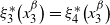 $\xi_{3}^{\ast}\big(x_{3}^{\beta}\big)=\xi_{4}^{\ast}\big(x_{3}^{\beta}\big)$
and
 $\xi_{4}^{\ast}(x_{1}^{r})=\xi_{1}^{\ast}(x_{1}^{r})$
hold, we have
 $x_{3}^{\beta} \lt x_{1}^{r}$
. As a consequence, we find that
 $\Gamma_{2}=\big(0,x_{2}^{\beta}\big]\cap[M, N]$
and
 $\Gamma_{4}=\big[x_{3}^{\beta},x_{1}^{r}\big]\cap[M, N]$
. Note that if the wealth level is above
 $x_{1}^{r}$
, the insurer chooses to invest in the risk-free asset. The insurer chooses to borrow money when the wealth level is no more than
 $x_{3}^{\beta}$
and the leverage ratio has the maximum value
 $1+m$
. Once the wealth level falls below
 $x_{2}^{\beta}$
, the leverage ratio maintains the high level
 $1+m$
. Thus, we call
 $x_{1}^{r}$
,
 $x_{2}^{\beta}$
and
 $x_{3}^{\beta}$
the saving level, the high leverage level, and the borrowing level, respectively.
Based on the results in Lemmas 3.2–3.5, we summarize the optimal strategies in Theorem 3.1.
Theorem 3.1. Let
 $\xi_{1}^{\ast}(x)$
,
 $x_{1}^{r}$
,
 $\xi_{2}^{\ast}(x)$
,
 $\xi_{3}^{\ast}(x)$
,
 $x_{2}^{\beta}$
,
 $x_{3}^{\beta}$
, and
 $\xi_{4}^{\ast}(x)$
be as defined in (3.9), (3.11), (3.15), (3.16), (3.17), and (3.18). The robust value function solution V(x) is
 \begin{equation*} V(x) = \frac{1}{\epsilon}\ln\Bigg[{\mathrm{e}}^{\epsilon} + (1-{\mathrm{e}}^{\epsilon})\frac{\int_{M}^{x}\exp\big\{{-}\int_{M}^{y}(\xi^{\ast}(z)-\eta)\,\mathrm{d}z\big\}\,\mathrm{d}y} {\int_{M}^{N}\exp\big\{{-}\int_{M}^{y}(\xi^{\ast}(z)-\eta)\,\mathrm{d}z\big\}\mathrm{d}y}\Bigg], \end{equation*}
where
 $\xi^{\ast}(x)$
is defined in following form:
 \begin{equation} \xi^{\ast}(x) = \left\{ \begin{array}{l@{\quad}l}\xi_{2}^{\ast}(x), \quad & x\in\big(0,x_{2}^{\beta}\big]\cap[M, N], \\[5pt] \xi_{3}^{\ast}(x), & x\in\big(x_{2}^{\beta},x_{3}^{\beta}\big)\cap[M, N], \\[5pt] \xi_{4}^{\ast}(x), & x\in\big[x_{3}^{\beta},x_{1}^{r}\big]\cap[M, N], \\[5pt] \xi_{1}^{\ast}(x), & x\in\big(x_{1}^{r},+\infty\big)\cap[M, N]. \end{array} \right. \end{equation}
The corresponding optimal investment strategy and retention levels are given by
 \begin{equation} (\pi^{\ast}(x),l^{\ast}(x,y)) = \left\{ \begin{array}{l@{\quad}l} \bigg(1+m,\dfrac{\theta+\eta y}{\xi_{2}^{\ast}(x)}\wedge y\bigg), & x\in\big(0,x_{2}^{\beta}\big]\cap[M, N] \\[4pt] \bigg({-}\dfrac{\mu-\beta}{\sigma^{2}x}\dfrac{1}{\eta-\xi_{3}^{\ast}(x)}, \dfrac{\theta+\eta y}{\xi_{3}^{\ast}(x)}\wedge y\bigg), \quad & x\in\big(x_{2}^{\beta},x_{3}^{\beta}\big)\cap[M, N], \\[4pt] \bigg(1,\dfrac{\theta+\eta y}{\xi_{4}^{\ast}(x)}\wedge y\bigg), & x\in\big[x_{3}^{\beta},x_{1}^{r}\big]\cap[M, N], \\[4pt] \bigg({-}\dfrac{\mu-r}{\sigma^{2}x}\dfrac{1}{\eta-\xi_{1}^{\ast}(x)}, \dfrac{\theta+\eta y}{\xi_{1}^{\ast}(x)}\wedge y\bigg), & x\in\big(x_{1}^{r},+\infty\big)\cap[M, N]. \end{array} \right. \end{equation}
The optimal drift distortions are as follows:
 \begin{equation*} \big(\phi_{1}^{\ast}(x),\phi_{2}^{\ast}(x)\big) = \left\{ \begin{array}{l@{\quad}l} \Bigg(\epsilon\sigma x(1+m)V_{x}(x), \epsilon\sqrt{\lambda{\mathbb{E}} \bigg(\bigg(\dfrac{\theta+\eta Y}{\xi_{2}^{\ast}(x)}\wedge Y\bigg)^{2}\bigg)}V_{x}(x)\Bigg), \quad & x\in\big(0,x_{2}^{\beta}\big]\cap[M, N], \\[15pt] \Bigg({-}\dfrac{\mu-\beta}{\sigma}\dfrac{\epsilon V_{x}(x)}{\eta-\xi_{3}^{\ast}(x)}, \epsilon\sqrt{ \lambda{\mathbb{E}}\bigg(\bigg(\dfrac{\theta+\eta Y}{\xi_{3}^{\ast}(x)}\wedge Y\bigg)^{2}\bigg)} V_{x}(x)\Bigg), & x\in\big(x_{2}^{\beta},x_{3}^{\beta}\big)\cap[M, N], \\[15pt] \Bigg(\epsilon\sigma xV_{x}(x), \epsilon\sqrt{\lambda{\mathbb{E}} \bigg(\bigg(\dfrac{\theta+\eta Y}{\xi_{4}^{\ast}(x)}\wedge Y\bigg)^{2}\bigg)}V_{x}(x)\Bigg), & x\in\big[x_{3}^{\beta},x_{1}^{r}\big]\cap[M, N], \\[15pt] \Bigg({-}\dfrac{\mu-r}{\sigma}\dfrac{\epsilon V_{x}(x)}{\eta-\xi_{1}^{\ast}(x)}, \epsilon\sqrt{ \lambda{\mathbb{E}}\bigg(\bigg(\dfrac{\theta+\eta Y}{\xi_{1}^{\ast}(x)}\wedge Y\bigg)^{2}\bigg)} V_{x}(x)\Bigg), & x\in\big(x_{1}^{r},+\infty\big)\cap[M, N]. \end{array} \right. \end{equation*}
Remark 3.2. From (3.20), we observe that the optimal investment strategy depends only on the value of the wealth x. Furthermore, it is shown that the borrowing constraint is violated when the wealth process decreases to the lower level. In fact, only when the wealth condition keeps deteriorating does the investor choose to gamble on the risky asset in order to avoid the appearance of ruin. When the value of the wealth is close to the upper level, the investor becomes cautious and invests less in the risky asset.
Remark 3.3. All the results in Theorem 3.1 are based on the assumption of
 $\mu \gt \beta \gt r \gt 0$
. If
 $\beta \gt \mu \gt r \gt 0$
, we can see that
 $\hat{\pi}^{\beta}$
will never be the optimal investment strategy since
 $\hat{\pi}^{\beta} \lt 0$
. Under this assumption, the optimal investment strategy
 $\hat{\pi}^{r}$
is either less than or equal to 1, which means that there is no need to borrow money, and thus the optimal results are identical to that in the case without borrowing costs.
Corollary 3.1. Because
 $\xi_{i}^{\ast} \gt \eta$
,
 $i=1,2,3,4$
,
 $l^{\ast}(x,y)$
in (3.20) and
 $y-l^{\ast}(x,y)$
are non-decreasing functions of y.
Remark 3.4. Corollary 3.1 implies that
 $l^{\ast}(x,Y)$
and
 $Y-l^{\ast}(x,Y)$
are comonotonic random variables. The fact that both
 $l^{\ast}(x,y)$
and
 $y-l^{\ast}(x,y)$
are non-decreasing with respect to y helps prevent moral hazard. Indeed, if
 $l^{\ast}(x,y)$
were decreasing with respect to y, then the insurer would have an incentive to create additional loss to thereby reduce its retention. Similarly, if
 $y-l^{\ast}(x,y)$
were decreasing with respect to y, then the insurer would have an incentive to hide a portion of its loss to thereby increase its reimbursement or indemnity. A similar conclusion was also reached in [Reference Han, Liang and Yuen14, Reference Liang, Liang and Young17].
Remark 3.5. Note that
 $\phi_{1}^{\ast}(x)$
and
 $\phi_{2}^{\ast}(x)$
are finite. Taking
 $x_{1}^{r}\leq M$
in Theorem 3.1 as an example, indeed, the integrand in the expression for
 $\int_{M}^{x}\exp\big\{{-}\int_{M}^{y}(\xi_{1}^{\ast}(z)-\eta)\,\mathrm{d}z\big\}\,\mathrm{d}y$
is bounded above by 1 since
 $\xi_{1}^{\ast}(x) \gt \eta$
; thus,
 \begin{align*}\int_{M}^{N}\exp\bigg\{{-}\int_{M}^{y}(\xi_{1}^{\ast}(z)-\eta)\,\mathrm{d}z\bigg\}\,\mathrm{d}y\leq N-M \lt \infty.\end{align*}
Since
 $\xi_{1}^{\ast}(x)$
is an increasing function with respect to x, it is not difficult to obtain that
 $\xi_{1}^{\ast}(M)\leq\xi_{1}^{\ast}(x)\leq\xi_{1}^{\ast}(N)$
for
 $x\in[M, N]$
. According to the analysis above, it follows that
 \begin{equation*} \phi_{1}^{\ast}(x) \leq \frac{\mu-r}{\sigma(\xi_{1}^{\ast}(M)-\eta)} \frac{1-{\mathrm{e}}^{\epsilon}}{(1+{\mathrm{e}}^{\epsilon})(N-M)}, \qquad \phi_{2}^{\ast}(x) \leq \sqrt{\lambda{\mathbb{E}}\big(Y^{2}\big)}\frac{1-{\mathrm{e}}^{\epsilon}}{(1+{\mathrm{e}}^{\epsilon})(N-M)} \end{equation*}
for
 $0 \lt \epsilon \lt \infty$
. So, we set
 \begin{align*} C = \frac{1-{\mathrm{e}}^{\epsilon}}{(1+{\mathrm{e}}^{\epsilon})(N-M)} \max\bigg\{\frac{\mu-r}{\sigma(\xi_{1}^{\ast}(M)-\eta)},\sqrt{\lambda{\mathbb{E}}\big(Y^{2}\big)}\bigg\}, \end{align*}
and then
 $\phi_{1}^{\ast}(x)\leq C$
and
 $\phi_{2}^{\ast}(x)\leq C$
. The other cases are obtained similarly
Corollary 3.2. If
 $\theta=0$
, the robust optimal reinsurance strategy of (3.20) reduces to proportional reinsurance and falls into the interval [0, 1], and then the robust optimal control strategies take the following forms:
 \begin{equation*} (\pi^{\ast}(x),l^{\ast}(x,y)) = \left\{ \begin{array}{l@{\quad}l} \bigg(1+m,\dfrac{\eta}{\hat{\xi}_{2}^{\ast}(x)}y\bigg), & x\in\big(0,\hat{x}_{2}^{\beta}\big]\cap[M, N], \\[9pt] \bigg({-}\dfrac{\mu-\beta}{\sigma^{2}x}\dfrac{1}{\eta-\hat{\xi}_{3}^{\ast}(x)}, \dfrac{\eta}{\hat{\xi}_{3}^{\ast}(x)}y\bigg), \quad & x\in\big(\hat{x}_{2}^{\beta},\hat{x}_{3}^{\beta}\big)\cap[M, N], \\[9pt] \bigg(1,\dfrac{\eta}{\hat{\xi}_{4}^{\ast}(x)}y\bigg), & x\in\big[\hat{x}_{3}^{\beta},\hat{x}_{1}^{r}\big]\cap[M, N], \\[9pt] \bigg({-}\dfrac{\mu-r}{\sigma^{2}x}\dfrac{1}{\eta-\hat{\xi}_{1}^{\ast}(x)}, \dfrac{\eta}{\hat{\xi}_{1}^{\ast}(x)}y\bigg), & x\in\big(\hat{x}_{1}^{r},+\infty\big)\cap[M, N], \end{array} \right. \end{equation*}
where
 $\hat{\xi}_{1}^{\ast}$
,
 $\hat{\xi}_{2}^{\ast}$
,
 $\hat{\xi}_{3}^{\ast}$
, and
 $\hat{\xi}_{4}^{\ast}$
are given by
 \begin{equation*} \begin{cases} \hat{\xi}_{1}^{\ast}(x) = \dfrac{(\hat{\delta}-rx)\eta + \frac12{\lambda\eta^{2}{\mathbb{E}}\big(Y^{2}\big)} + ({(\mu-r)^{2}}/{2\sigma^{2}}) + \sqrt{\bigtriangleup_{1}}}{2(\hat{\delta}-rx)}, \\[9pt] \hat{\xi}_{2}^{\ast}(x) = \dfrac{\beta x - \hat{\delta} + (\mu-\beta)x(1+m) + \frac12{\eta\sigma^{2}x^{2}(1+m)^{2}} + \sqrt{\bigtriangleup_{2}}}{\sigma^{2}x^{2}(1+m)^{2}}, \\[9pt] \hat{\xi}_{3}^{\ast}(x) = \dfrac{(\hat{\delta}-\beta x)\eta + \frac12{\lambda\eta^{2}{\mathbb{E}}\big(Y^{2}\big)} + ({(\mu-\beta)^{2}}/{2\sigma^{2}}) + \sqrt{\bigtriangleup_{3}}}{2(\hat{\delta}-\beta x)}, \\[9pt] \hat{\xi}_{4}^{\ast}(x) = \dfrac{-\hat{\delta} + x\mu + \frac12{\sigma^{2}x^{2}\eta} + \sqrt{\bigtriangleup_{4}}}{\sigma^{2}x^{2}}, \end{cases} \end{equation*}
and
 $\hat{x}_{1}^{r}$
,
 $\hat{x}_{2}^{\beta}$
, and
 $\hat{x}_{3}^{\beta}$
are the same forms as in (3.11) and (3.17), in which
 \begin{equation*} \begin{cases} \bigtriangleup_{1} = \bigg[\dfrac{\lambda\eta^2\mathbb{E}(Y^2)}{2}+\dfrac{(\mu-r)^2}{2\sigma^2}-(\hat{\delta}-rx)\eta\bigg]^2 + 2(\hat{\delta}-rx)\eta\dfrac{(\mu-r)^{2}}{\sigma^{2}}, \\[13pt] \bigtriangleup_{2} = \big[\beta x-\hat{\delta}+(\mu-\beta)x(1+m)+\frac12{\eta\sigma^{2}x^{2}(1+m)^{2}}\big]^{2} + \sigma^{2}x^{2}(1+m)^{2}\lambda\eta^{2}{\mathbb{E}}\big(Y^{2}\big), \\[13pt] \bigtriangleup_{3} = \bigg[\dfrac{\lambda\eta^{2}{\mathbb{E}}\big(Y^{2}\big)}{2} + \dfrac{(\mu-\beta)^{2}}{2\sigma^{2}} - (\hat{\delta}-\beta x)\eta\bigg]^{2}+2(\hat{\delta}-\beta x)\eta\dfrac{(\mu-\beta)^{2}}{\sigma^{2}}, \\[13pt] \bigtriangleup_{4} = \big({-}\hat{\delta}+x\mu+\frac12{\sigma^{2}x^{2}\eta}\big)^{2} + \sigma^{2}x^{2}\lambda\eta^{2}{\mathbb{E}}\big(Y^{2}\big), \end{cases} \end{equation*}
and
 $\hat{\delta}=\lambda{\mathbb{E}}(Y)+\frac12{\eta}\lambda{\mathbb{E}}\big(Y^{2}\big)-c$
.
Corollary 3.3. If
 $\eta=0$
, the optimal reinsurance strategy of (3.20) reduces to excess-of-loss reinsurance. Hence, the robust optimal investment–reinsurance strategy is
 \begin{equation*} (\pi^{\ast}(x),l^{\ast}(x,y)) = \left\{ \begin{array}{l@{\quad}l} \bigg(1+m,\dfrac{\theta}{\tilde{\xi}_{2}^{\ast}(x)}\wedge y\bigg), & x\in\big(0,\tilde{x}_{2}^{\beta}\big]\cap[M, N], \\[13pt] \bigg(\dfrac{\mu-\beta}{\sigma^{2}x}\dfrac{1}{\tilde{\xi}_{3}^{\ast}(x)}, \dfrac{\theta}{\tilde{\xi}_{3}^{\ast}(x)}\wedge y\bigg), \quad & x\in\big(\tilde{x}_{2}^{\beta},\tilde{x}_{3}^{\beta}\big)\cap[M, N], \\[13pt] \bigg(1,\dfrac{\theta}{\tilde{\xi}_{4}^{\ast}(x)}\wedge y\bigg), & x\in\big[\tilde{x}_{3}^{\beta},\tilde{x}_{1}^{r}\big]\cap[M, N] \\[13pt] \bigg(\dfrac{\mu-r}{\sigma^{2}x}\dfrac{1}{\tilde{\xi}_{1}^{\ast}(x)}, \dfrac{\theta}{\tilde{\xi}_{1}^{\ast}(x)}\wedge y\bigg), & x\in\big(\tilde{x}_{1}^{r},+\infty\big)\cap[M, N], \end{array} \right. \end{equation*}
where
 $\tilde{\xi}_{1}^{\ast}(x)$
,
 $\tilde{\xi}_{2}^{\ast}(x)$
,
 $\tilde{\xi}_{3}^{\ast}(x)$
, and
 $\tilde{\xi}_{4}^{\ast}(x)$
satisfy
 \begin{equation*} \begin{cases} \theta\displaystyle\int_{0}^{{\theta}/{\xi}}\bigg(1-\dfrac{y}{{\theta}/{\xi}}\bigg)\bar{F}_{Y}(y)\,\mathrm{d}y = \dfrac1\lambda\bigg\{\tilde{\delta}-rx-\dfrac{(\mu-r)^{2}}{2\sigma^{2}\xi}\bigg\}, \\[10pt] \theta\displaystyle\int_{0}^{{\theta}/{\xi}}\bigg(1-\frac{y}{{\theta}/{\xi}}\bigg)\bar{F}_{Y}(y)\,\mathrm{d}y = \frac1\lambda\bigg\{\tilde{\delta}-\beta x-(\mu-\beta)x(1+m)+ \frac{\sigma^{2}x^{2}(1+m)^{2}\xi}{2}\bigg\},\\[10pt] \theta\displaystyle\int_{0}^{{\theta}/{\xi}}\bigg(1-\frac{y}{{\theta}/{\xi}}\bigg)\bar{F}_{Y}(y)\,\mathrm{d}y = \frac1\lambda\bigg\{\tilde{\delta}-\beta x-\frac{(\mu-\beta)^{2}}{2\sigma^{2}\xi}\bigg\}, \\[10pt] \theta\displaystyle\int_{0}^{{\theta}/{\xi}}\bigg(1-\frac{y}{{\theta}/{\xi}}\bigg)\bar{F}_{Y}(y)\,\mathrm{d}y = \frac1\lambda\bigg\{\tilde{\delta}-\mu x+\frac{\sigma^{2}x^{2}\xi}{2}\bigg\}, \end{cases} \end{equation*}
and
 $\tilde{x}_{1}^{r}$
,
 $\tilde{x}_{2}^{\beta}$
, and
 $\tilde{x}_{3}^{\beta}$
take the same forms as in (3.11) and (3.17), in which
 $\tilde{\delta}=\lambda(1+\theta){\mathbb{E}}(Y)-c$
.
4. Two extreme cases
In this section, we compute V(x) in the two extreme cases
 $\epsilon\rightarrow0$
and
 $\epsilon\rightarrow\infty$
. In the first case, we know that the corresponding results reduce to those in the benchmark case without model ambiguity. In the second case, the insurer has less faith in the reference model and a sequence of alternative measures can be selected.
Let
 $V_{0}(x)$
denote the non-robust (
 $\epsilon\rightarrow0$
) value function. In the benchmark case, the wealth process evolves by (2.2) and the value function is described by
 \begin{equation} V_{0}(x)\,:\!=\,\inf_{u\in\mathcal{U}}\mathbb{P}^{x}\big(\tau_{M}^{u} \lt \tau_{N}^{u},\tau^{u} \lt \infty\big).\end{equation}
Letting
 $\epsilon\rightarrow0$
in Theorem 3.1, we have the following theorem.
Theorem 4.1. Let
 $\xi^{\ast}(x)$
be as given in (3.19). For
 $x\in[M, N]$
, the ambiguity-neutral value function is expressed as follows:
 \begin{equation*} V_{0}(x) = 1 - \frac{\int_{M}^{x}\exp{\big\{{-}\int_{M}^{y}(\xi^{\ast}(z)-\eta)\,\mathrm{d}z\big\}}\,\mathrm{d}y} {\int_{M}^{N}\exp{\big\{{-}\int_{M}^{y}(\xi^{\ast}(z)-\eta)\,\mathrm{d}z\big\}}\,\mathrm{d}y}. \end{equation*}
The corresponding optimal investment strategy and retention level are given by
 \begin{equation*} (\pi^{\ast}(x),l^{\ast}(x,y)) = \left\{ \begin{array}{l@{\quad}l} \bigg(1+m,\dfrac{\theta+\eta y}{\xi_{2}^{\ast}(x)}\wedge y\bigg), & x\in\big(0,x_{2}^{\beta}\big]\cap[M, N], \\[10pt] \bigg({-}\dfrac{\mu-\beta}{\sigma^{2}x}\dfrac{1}{\eta-\xi_{3}^{\ast}(x)}, \dfrac{\theta+\eta y}{\xi_{3}^{\ast}(x)}\wedge y\bigg), \quad & x\in\big(x_{2}^{\beta},x_{3}^{\beta}\big)\cap[M, N], \\[10pt] \bigg(1,\dfrac{\theta+\eta y}{\xi_{4}^{\ast}(x)}\wedge y\bigg), & x\in\big[x_{3}^{\beta},x_{1}^{r}\big]\cap[M, N], \\[10pt] \bigg({-}\dfrac{\mu-r}{\sigma^{2}x}\dfrac{1}{\eta-\xi_{1}^{\ast}(x)}, \dfrac{\theta+\eta y}{\xi_{1}^{\ast}(x)}\wedge y\bigg), & x\in\big(x_{1}^{r},+\infty\big)\cap[M, N]. \end{array} \right. \end{equation*}
Remark 4.1. From Theorems 3.1 and 4.1, we obtain that the robust optimal control strategies are independent of the parameter
 $\epsilon$
, and coincide with that in the benchmark case without model ambiguity. Such independence is totally different from the results in the utility and mean–variance frameworks. A similar conclusion was also reached in [Reference Bayraktar and Zhang6, Reference Luo, Wang and Zhu19]. One explanation of this is that the parameter
 $\epsilon$
gets cancelled by the exponential transformation method, which is an unexpected coincidence. However, the value functions and the selection of the optimal equivalent probability measure
 $\mathbb{Q}$
indeed have a bearing under model ambiguity.
Remark 4.2. If
 $M=0$
and
 $N\rightarrow+\infty$
, the goal-reaching probability minimization problem degenerates to minimize the ruin probability for the fix level 0, and the corresponding optimal results can be derived directly. In addition, we conclude that the optimal control strategy is identical to that when minimizing the probability of ruin. For example, the optimal reinsurance policy is the same as the one obtained in [Reference Liang, Liang and Young17] when the insurer does not invest in the financial market. Besides controlling for reinsurance, [Reference Zhang, Meng and Zeng28] also controlled investment in a risky financial market, and the same conclusion can be reached. It follows from the results of [Reference Browne10, Remark 3.4] that the insurer can minimize the probability in (4.1) with
 $\epsilon\rightarrow0$
by choosing the control policy that pointwise minimizes the ratio of the drift of the value process in (2.2) to its volatility squared. The same control strategy will minimize the expectation of any function that is non-increasing with respect to the minimum portfolio value. Indeed, the differential equation would remain the same; the only change would come in the various boundary conditions.
Let
 $V_{\infty}(x)$
denote the value function in the case
 $\epsilon\rightarrow\infty$
. Under this case, the insurer becomes most ambiguity averse towards the model uncertainty. Then, the value function can be given as follows:
 \begin{equation*} V_{\infty}(x)\,:\!=\,\inf_{u\in\mathcal{U}}\sup_{\phi\in\Phi}\mathbb{Q}^{x}\big(\tau_{M}^{u} \lt \tau_{N}^{u},\tau^{u} \lt \infty\big).\end{equation*}
It follows that the penalty term completely disappears. Letting
 $\epsilon\rightarrow\infty$
in (2.4), we have the following proposition.
Proposition 4.1. For any
 $x\in[M, N]$
, the value function in the most robust case is given by
 $V_{\infty}(x)=\lim_{\epsilon\rightarrow\infty}V(x)=1$
.
Proof. The disappearance of the penalty term will result in the drift coefficients
 $\phi_{1}$
and
 $\phi_{2}$
in (2.3) derived from Girsanov’s theorem being positive or negative, and the previous constraints on
 $\phi_{1}$
and
 $\phi_{2}$
become meaningless. It makes sense that if
 $\phi_{1}$
is negative, the investment term coefficient is negative in (2.3), i.e. the investment does not reach the income target but makes the wealth value less. Similarly, when
 $\phi_{2}$
is negative, improper reinsurance strategies can also cause wealth losses. Therefore, the optimal investment strategy is not to invest at all, while the optimal reinsurance retention level is 0, which means transferring all risks, i.e.
 $u_{0}=(0,0)$
. Furthermore, the wealth process becomes
 $\mathrm{d}X^{u_{0}}(t)=(rX^{u_{0}}(t)-\delta)\,\mathrm{d}t$
. It is not difficult to derive through simple calculation that
 \begin{align*} \tau_{M}^{u_{0}}=\frac{1}{r}\ln\frac{rM-\delta}{rx-\delta}, \qquad \tau_{N}^{u_{0}}=\frac{1}{r}\ln\frac{rN-\delta}{rx-\delta} \end{align*}
for
 $x\in[M, N]$
. Then, for all
 $\mathbb{Q}\in\mathscr{Q}$
, we have
 $\mathbb{Q}^{x}(\tau_{M}^{u_{0}} \lt \tau_{N}^{u_{0}},\tau^{u_{0}} \lt \infty)=1$
. Thus, for all
 $x\in[M, N]$
,
 $V_{\infty}(x)=1$
.
Remark 4.3. Note that
 $\mathbb{P}\in\mathscr{Q}$
with
 $\phi_{0}=(0,0)$
. From (2.4), we have
 \begin{align*} V_{0}(x)=\inf_{u\in\mathcal{U}}J^{u,\phi_{0}}(x)\leq\inf_{u\in\mathcal{U}}\sup_{\phi\in\Phi}J^{u,\phi}(x)=V(x)\leq1=V_{\infty}(x). \end{align*}
This relation is naturally expected since V is non-decreasing with respect to
 $\epsilon$
. And the robust goal-reaching probability V(x) is always a conservative estimate for the non-robust value function
 $V_{0}(x)$
.
Remark 4.4. Let
 $\phi_{1}^{\ast}(x,\epsilon)=\phi_{1}^{\ast}(x)$
and
 $\phi_{1}^{\ast}(x,\epsilon)=\phi_{2}^{\ast}(x)$
. Taking
 $x_{1}^{r}\leq M$
in Theorem 3.1 as an example, when
 $\epsilon\rightarrow\infty$
we can obtain the following results:
 \begin{align*} \lim_{\epsilon\rightarrow\infty}\phi_{1}^{\ast}(x,\epsilon) & = -\frac{\mu-r}{\sigma(\xi_{1}^{\ast}(x)-\eta)} \cdot \frac{\exp{\big\{{-}\int_{M}^{x}(\xi_{1}^{\ast}(z)-\eta)\,\mathrm{d}z\big\}}} {\int_{x}^{N}\exp{\big\{{-}\int_{M}^{y}(\xi_{1}^{\ast}(z)-\eta)\,\mathrm{d}z\big\}}\,\mathrm{d}y}, \\ \lim_{\epsilon\rightarrow\infty}\phi_{2}^{\ast}(x,\epsilon) & = -\sqrt{\lambda{\mathbb{E}}\bigg[\bigg(\frac{\theta+\eta Y}{\xi_{1}^{\ast}(x)}\wedge Y\bigg)^{2}\bigg]}\cdot \frac{\exp{\big\{{-}\int_{M}^{x}(\xi_{1}^{\ast}(z)-\eta)\,\mathrm{d}z\big\}}} {\int_{x}^{N}\exp{\big\{{-}\int_{M}^{y}(\xi_{1}^{\ast}(z)-\eta)\mathrm{d}z\big\}}\,\mathrm{d}y}. \end{align*}
It is easy to derive that the optimal drift distortions
 $\phi_{1}^{\ast}(x)$
and
 $\phi_{2}^{\ast}(x)$
are all negative and decrease to finite limits for any
 $x\in[M, N]$
as
 $\epsilon\rightarrow\infty$
.
5. Numerical analysis
In this section, we investigate the effect of higher borrowing rate and risk loading parameters on the optimal control strategies. In the following context, we assume that the claim size random variable Y is uniformly distributed in the interval [0, 2], and so we have
 $E(Y)=1$
and
 $E\big(Y^{2}\big)=\frac{4}{3}$
. And unless otherwise stated, we set the basic parameters as
 $\lambda=3$
and
 $\mu=0.5$
. The notations
 $\pi^{0}$
and
 $l^{0}$
respectively represent the optimal investment and reinsurance strategies without a higher borrowing rate.
Example 5.1. In this example, we set
 $(\theta,\eta)=(0.6,0)$
for the expected value principle. Also, we set
 $r=0.02$
,
 $\beta=0.08$
,
 $c=3.6$
,
 $\sigma=1$
, and
 $m=1$
. The results are shown in Figure 1.
Figure 1 shows how the higher borrowing rate affects the optimal investment strategy. It is evident from the figure that the optimal investment strategy with a higher borrowing rate is lower than the unconstrained strategy in both the borrowing and full-investment regions. This is to be expected: because of the higher borrowing rate, the insurer becomes more conservative and hesitates to borrow money. Moreover, the optimal investment strategy is a decreasing and continuous function with respect to x. Only if the wealth level falls below the borrowing level will borrowing occur. These results are natural consequences of Remark 3.2.
The influence of higher borrowing rate on the optimal investment strategies.

Example 5.2. In this example, we set
 $\theta=0$
,
 $\eta=0.3$
,
 $r=0.02$
,
 $\beta=0.08$
,
 $c=3.6$
,
 $\sigma=1$
, and
 $m=1$
. The results are shown in Figure 2.
The influence of higher borrowing rate on the optimal reinsurance strategies.

Figure 2 investigates the impact of the higher borrowing rate on the optimal reinsurance strategy according to the variance premium principle. It can be seen that the increase in the wealth of the insurer leads directly to a decrease of the optimal reinsurance strategy. We can also observe that
 $l^{\ast} \gt l^{0}$
in the full-investment and borrowing regions, which means that with the higher borrowing rate the insurer is willing to keep more insurance business. Furthermore, it follows from the figure that the optimal reinsurance strategy is the proportional reinsurance and falls into the interval [0, 1], which is also a natural consequence of Corollary 3.2.
Example 5.3. In this example, we set
 $\eta=0$
,
 $r=0.05$
,
 $c=2.4$
,
 $\sigma=0.7$
, and
 $m=1$
. The results are shown in Figure 3.
The influence of
 $\theta$
on the optimal control strategies.

Figure 3 illustrates that a higher value of
 $\theta$
yields greater values of the optimal investment and reinsurance strategies. An explanation for this phenomenon is that as
 $\theta$
increases, the reinsurance premium becomes more expensive, and hence the insurer would rather retain a larger share of each claim. However, if the reinsurance premium keeps increasing, to avoid ruin the insurer might optimally increase the investment in the risky asset to increase its profit.
Example 5.4. In this example, we set
 $\eta=0$
,
 $r=0.03$
,
 $c=3.2$
,
 $\sigma=1$
, and
 $m=1$
. The results are shown in Figure 4.
The influence of
 $\eta$
on the optimal control strategies.

Figure 4 presents the effects of the parameter
 $\eta$
on the optimal control strategies. We can see that with the increase of the risk loading parameter
 $\eta$
, the corresponding investment proportion and retention level increase. The explanation for this result is similar to that in Figure 3. Since the reinsurance premium and the ruin probability of the insurer would increase with the increase of
 $\eta$
, so its investment proportion and retention level will improve naturally to increase its profit.
6. Conclusion
We have studied the robust optimal investment–reinsurance problem of an ambiguity-averse insurer with borrowing and short-selling constraints on the investment control variable, which make the model more realistic. The insurer seeks to minimize the probability of the value of the wealth process reaching a low barrier before a high goal. We assume that the insurer transfers risks by purchasing per-loss reinsurance, and that the reinsurance premium is computed according to the mean–variance premium principle. By using stochastic control, we characterize the value function as the unique classical solution to the HJB equation, and obtain feedback forms for the robust optimal strategy and the optimal drift distortion. We conclude that when the wealth is lower than the borrowing level, it is optimal to borrow money to invest in the risky asset; when the wealth is higher than the saving level, it is optimal to save more money; while between them, the insurer is willing to invest all the wealth in the risky asset. Finally, through some numerical analysis, the influence of some parameters on the investment–reinsurance strategy was explained. For further research, it would be worthwhile to add transaction cost constraints for investment in the model. Meanwhile, we can focus on other objective functions, such as utility maximization or mean–variance criteria. Moreover, we may consider the optimal reinsurance problem under a more generalized premium principle, such as the exponential premium principle, the mean range value at risk premium principle, or the mean conditional value at risk premium principle. We think these are very challenging problems and the research directions of our future work.
Acknowledgements
We wish to thank the referees and the editor for carefully reading the article and for valuable comments and suggestions.
Funding information
This work is partially supported by the Graduate Research and Innovation Project of Hunan Province (No. CX20230241) and the Graduate Research and Innovation Project of Central South University (No. 1053320222639).
Competing interests
There were no competing interests to declare which arose during the preparation or publication process of this article.



