Introduction
The subphylum Asterozoa Zittle, Reference Zittel1895, is a large and varied group of marine invertebrates that are common in many marine settings. Except perhaps for the late Paleozoic-early Mesozoic transition, overall heterogenenity of asterozoans since their Ordovician first occurrence favors enduring diversity, but the usual rapid post-mortem destruction of the asterozoan skeleton constructed of articulated small and delicate elements appears to be responsible for the scanty fossil record. As a result, specifics of asterozoan history and subphylum phylogeny are at best poorly understood. The overall composition of the early asterozoan fauna was recently reviewed (Blake, Reference Blake2013), and two taxa judged particularly problematic were treated separately (Blake, Reference Blake2014). The arguably basal Somasteroidea (Spencer, Reference Spencer1951; Fell, Reference Fell1963a; Blake, Reference Blake2013) is known only from few, comparatively delicate specimens. Because of the importance of stemward positioning, somasteroid taxa are surveyed, a phylogenetic hypothesis of diverse early asterozoans is developed, and different evolutionary scenarios are offered.
The Asterozoa has been characterized as follows (Blake, Reference Blake2013, p. 355): “Asterozoan body form is more or less flattened and stellate, the near-oral ambulacra of uniform morphology and radiating from a central, ventral mouth; the ambulacral ossicles and the associated tube feet are directed ventrally. The skeleton is of comparatively small (relative to body size) unfused skeletal elements.” Most fossil asterozoans, dating from their Ordovician first appearance, have been assigned to one or the other of the surviving (sub)class groupings, the Asteroidea and Ophiuroidea, although a “root-stock” of “neither true Asteroidea nor true Ophiuroidea … characterised by modifications peculiar to themselves” has been argued (Spencer, Reference Spencer1914, p. 1). Subsequently, a new (sub)class, the Somasteroidea, was described and interpreted as basal within the subphylum (Spencer, Reference Spencer1951). Asterozoan ancestry has been debated; an edrioasteroid ancestry or outgroup has been favored (e.g. Shackleton, Reference Shackleton2005; Jell, Reference Jell2014), although the edrioasteroid interpretation was rejected because of ambulacral construction and other aspects of morphology, as well as because of differences of life mode (Spencer, Reference Spencer1951; Blake, Reference Blake2013). Putative homologies of arm arrangement led to the notion of a crinoid ancestry (Fell, e.g. Reference Fell1963a), an idea retained in some studies (Spencer and Wright, Reference Spencer and Wright1966) and rejected in others (Shackleton, Reference Shackleton2005).
Although notion of a somasteroid clade has been widely accepted since originally proposed, views of group membership and phylogenetic positioning have varied. In the only available comprehensive cladistic analysis of early asterozoans, an edrioasteroid outgroup was selected and two asterozoan clades were recognized, the ophiuroids and associated basal groups, and the asteroids (Shackleton, Reference Shackleton2005). Somasteroids were recognized as an ordinal-level plesion near the base of the ophiuroid branch, but not included within the class Ophiuroidea. Four class-level asterozoan classes later were recognized, the extinct Somasteroidea and Stenuroidea and the surviving Asteroidea and Ophiuroidea (Blake, Reference Blake2013). No outgroup was deemed reliable and computer-based cladistic analysis was not included. Somasteroids were returned to a basal position within the subphylum based on inferred apomorphies of ambulacral column expression.
A single order Goniactinida within the Somasteroidea was recognized (Spencer, Reference Spencer1951; Spencer and Wright, Reference Spencer and Wright1966), but the term has not been universally accepted (Shackleton, Reference Shackleton2005), and it is not used here because not enough is known of somasteroid history as to permit clade recognition between the familial and class levels. The families Chinianasteridae Spencer, Reference Spencer1951; Villebrunasteridae, Fell, Reference Fell1963a; Platasteriidae Caso, Reference Caso1945; Archegonasteridae, Spencer, Reference Spencer1951; and the Archophiactinidae, Spencer, Reference Spencer1927, were cited (Spencer and Wright, Reference Spencer and Wright1966). The extant monogeneric Platasteriidae was assigned to the Somasteroidea (Fell, e.g. Reference Fell1963a; Spencer and Wright, Reference Spencer and Wright1966), but the interpretation later was rejected (Madsen, Reference Madsen1966; Blake, Reference Blake1982). No extant asterozoan approaches somasteroid organization. The three genera assigned to the Archophiactinidae all lack virgal series ossicles; the only Ordovician genus was rejected as a somasteroid (Shackleton, Reference Shackleton2005), and based on literature survey, both the Silurian and the Devonian examples were excluded (Blake, Reference Blake2013). The Archegonasteridae was retained and the remaining somasteroids were assigned to the Chinianasteridae (Shackleton, Reference Shackleton2005).
The two somasteroid genera recognized by Spencer (Reference Spencer1951), Chinianaster Thoral, Reference Thoral1935 (Figs. 1–3) and the then-new Villebrunaster (Figs. 7–9), are from the Gondwanan Montagne Noire of the south of France. Thoralaster Shackleton, Reference Shackleton2005 (Figs. 5, 6), based on a part of the type material of Chinianaster, added a third Montagne Noire genus. The somewhat younger Archegonaster Jaekel, Reference Jaekel1923 (Fig. 4.2) was included among somasteroids (Spencer, Reference Spencer1951), the genus later redescribed (Smith and Jell, Reference Smith and Jell1990). Archegonaster is the youngest-known and the most disparate somasteroid, as based on a number of expressions (Fig. 10). Another Montagne Noire genus, Ampullaster (Fig. 9.3, 9.4), was recognized (Fell, Reference Fell1963b) and later synonymized (Shackleton, Reference Shackleton2005) with Villebrunaster. Ophioxenikos Blake and Guensburg, Reference Blake and Guensburg1993 (Fig. 4.1) from eastern Nevada is the only recognized somasteroid from beyond the western Mediterranean area of Gondwana. A problematic new genus, Catervaparmaster Blake, Reference Blake2000 (Fig. 4.3–4.7) from the Ordovician of Ireland was assigned to the Somasteroidea but it is now left in open nomenclature. Undescribed somasteroid material is known from the Early Ordovician of Morocco. The interpretations of this review are based on reconsideration of all taxa together with field study of critical localities in France and Nevada.
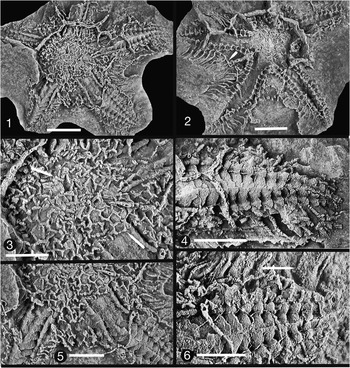
Chinianaster levyi Thoral, Reference Thoral1935, lectotype FSL 168 691. (1, 2) Dorsal and ventral views. The mouth frame was spread apart and proximal intervals of ambulacra opened, but ossicular displacement is limited. Virgal series are pulled away from mouth frame area (2, arrow); (3) dorsal view of disk; abactinals appear tripartite, the central juncture region little thickened, the original reticulate configuration likely regular (right arrow); some abactinals might be rodlike (left arrow); (4) upper right arm of Figure 1.1, abactinals largely lost to reveal ambulacral and disrupted virgal series; some virgals toward tip directed distally as in Figure 3.3, 3.4; (5) dorsal interbrachial, virgal series to right, abactinals largely lost from arm region; (6) lower right arm of Figure 1.1, ambulacral ossicles ossicles overlapping distally, these arched and offset across arm midline; probable tube feet (arrow). Scale for (1, 2): 10 mm; (3–6), 5 mm.

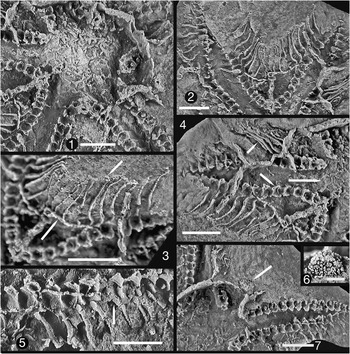
Chinianaster levyi, lectotype FSL 168 691, ventral views. (1, 2) Disk with abactinals exposed through the pulled-apart mouth frame, but ossicles are not significantly displaced relative to each other; (2) radial water vascular channel opened proximally but remains more nearly closed distally; virgal series are displaced from mouth frame, oriented as to show lateral edges; (3) interbrachial arc with virgal series pulled away from mouth frame (lower arrow, arrow base toward MAO pair); necklace series at tips of virgals (upper arrow); (4) abactinals exposed within mouth frame (right arrow), ambulacral series (middle arrow); narrow edges of virgal series, those above directed distally and squeezed together (upper arrow); collapsed necklace series at virgal-series tips above, necklace series less disrupted at virgal-series tips below; (5) arm interval showing virgal and ambulacral form; first virgals are short but otherwise little differentiated (arrow); (6, 7) granular madreporite (arrow) and mouth frame region, mouth angle ossicles poorly preserved. Scale for (1-5, 7): 5 mm; (6): 1 mm.

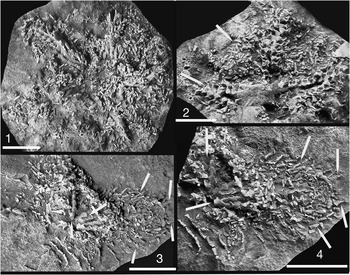
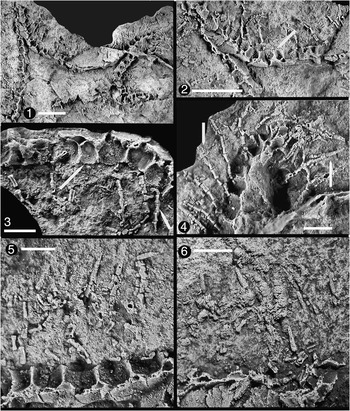
Chinianaster levyi. (1, 2) FSL 711 094, dorsal and ventral views of a smaller specimen; expression of ambulacral column (2, lower arrow) identifies specimen as Chinianaster. Disrupted ossicles appear largely rodlike rather than tripartite indicating that most are virgals rather than abactinals, their distribution outlining a large disk (2, upper arrow); enlarged ambitral framework ossicles are not developed, the scattered fine debris probably including necklace ossicles; (3, 4) FSL 712 003, (3) dorsal view, ambulacral configuration (left arrows) identifying Chinianaster. Some arm tip ossicles suggestive of spines (arrows on far right); more proximal virgal series are less disrupted and deflected distally (middle arrows) as in lectotype (Figs. 1, 2); distal ossicles are disrupted virgals rather than ambital framework ossicles. Some edging debris likely are necklace ossicles. Scale=5 mm.

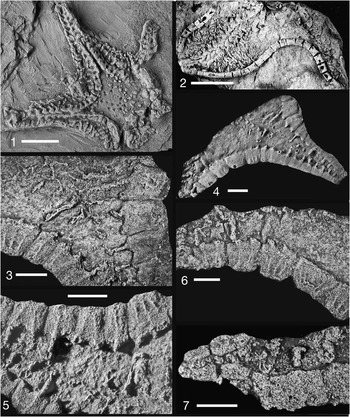
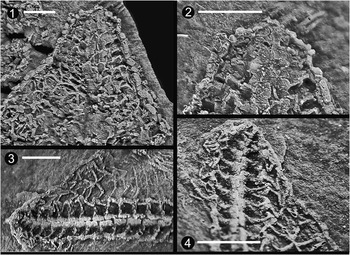
(1) Ophioxenikos langenheimi Blake and Guensburg, Reference Blake and Guensburg1993, UI-X-4751; ventral view, compaction spread the disk but presence of only few virgals indicates a small disk size in life, compare Villebrunaster, Figure 8.1, 8.4; (2) Archegonaster pentagonus Spencer, Reference Spencer1951, holotype NM 10143, ventral view; (3-7) Catervaparmaster pecularis Blake, Reference Blake2000, Ulster Museum BELUM:K25197; photographs taken from different pulls; (3) traces of narrow radial water channel (upper middle), transverse ridges and partial outlines of ambulacrals toward lower right; virgals and other ventral ossicles absent; (4) complete fragment; (5) ambital framework ossicles with transverse ridges, these ossicles perhaps pustulate; ambulacrals with transverse ridges to left; (6, 7) ambulacrals and ambital framework ossicles converge toward the narrowly rounded arm tip. Scale for (1, 4): 5 mm; (2): 10 mm; (3, 5–7): 3 mm.

Terminology
Terminology is based largely on Spencer and Wright (Reference Spencer and Wright1966) and Blake (Reference Blake2013). The term “ambital framework” replaces “marginal” as needed to avoid assumptions of homology. “Necklace” is introduced for irregular series of tiny ambital framework ossicles at the distal tips of virgal series in Chinianaster and Thoralaster. “Intervigal strut” was coined by Shackleton (Reference Shackleton2005) for ossicles of Villebrunaster found toward the adradial end of virgal series. Usages are further discussed below under “morphology and its functional and taxonomic implications.”
Age, stratigraphic position, and ecologic setting
The type and only-known specimen of Ophioxenikos was collected from rocks of the lower Pogonip Group at the Ely Springs Range, Nevada, in a part of the section coined the Yellow Hill Limestone at the time of initial mapping (Westgate and Knopf, Reference Westgate and Knopf1932). The name Yellow Hill subsequently was rejected because no formational contacts are available (Byrd, Reference Byrd1970). The geology of the isolated Ely Springs Range is comparatively little studied, lying approximately 120 km from the better-understood Ibex area of western Utah. The portion of the Ely Springs section containing Ophioxenikos is judged sufficiently similar to the middle Fillmore Formation, or Light-Grey Ledge Forming Member, at Ibex (Hintze, Reference Hintze1973) as to justify correlation. In addition to overall lithologic similarities, markers found both at Ibex and the Ely Springs Range include thin sponge-Calathium algal patch-reefs, these typically case hardened and stained a rusty brown by silicification (Church, Reference Church1974; Datillo, Reference Datillo1993). Associated conodonts do not tightly constrain the age of Ophioxenikos. Acodus Pander and Parycordylodus gracilis span late Tremadocian and Floian Stages of the global standard (Ethington, Reference Ethington2008). Based on similarities of lithology and conodonts, Ophioxenikos is here assigned to trilobite zone G-2, late early to middle Floian; this age is younger than the late Tremadocian somasteroid occurrences in the Gondwanan Montagne Noire region of southern France.
The source interval of the Ophioxenikos specimen consists of finely interbedded calcisiltites alternating with coarser calcarenites and intraformational conglomerates with megaripples, some extended into mounds. The specimen lies on a chip of calcisiltite, demonstrating lower energy deposition than the coarser facies. No other fossils have been collected from the small available outcrop. The three Saint-Chinian somasteroids occur in higher latitude Gondwana and the Pogonip in equatorial Laurentia. The Saint Chinian siliciclastic sequence, interpreted as deep cool water deposition (Vizcaino and Lefebvre, Reference Vizcaïno and Lefebvre1999; Tortello et al., Reference Tortello, Vizcaïno and Álvaro2006), contrasts with the shallow warm carbonate-dominated Pogonip (Datillo, Reference Datillo1993). The differing habitats in widely separated geographic regions do little to constrain possible settings for the origin of the Asterozoa.
The source of the type material of Archegonaster is upper Middle Ordovician in age (Bergström et al. Reference Bergström, Chen, Gutiérez-Marco and Dronov2008); hence, Archegonaster is considerably younger than the Saint-Chinian and the Pogonip intervals, but the occurrence in siliciclastics is much like that of the Saint-Chinian.
Preservation of somasteroids
The distension typical of somasteroid specimens offers a decay scenario. Ambulacral-series ossicles of many specimens are pulled apart for differing distances along the arm midline, separation in some examples extending nearly to the arm tip (Fig. 6.1, 6.3), whereas in a few arms, ambulacral series remain closely abutted at the mouth frame (Fig. 8.1). There are no obvious differences in development of skeletal articular linkages across the arm midline as compared with those along the length of the ambulacral series. Mouth angle ossicular pairs (MAO) of many specimens are separated, unlike the closely fitted arrangements found among living asterozoans, although individual MAO pairs and their immediately associated ossicles approximate likely life arrangement (Figs. 1.2, 4.1, 6.1).
Decay gases inflated, distorted, and variously pulled specimens apart before significant sediment compaction took place. Distension was particularly marked in the enlarged, less heavily skeletonized disk region, and likely explains the aligned offset of the virgal series ossicles from the mouth frame area of the Chinianaster lectotype (Figs. 1.2; 2.3, 2.4). Many small ossicles remain with parent specimens, their localized displacement both documenting decay and encumbering interpretation. The so-called buccal slits of many early asterozoans resulted from distension associated with decay.
Systematic paleontology
Institutional abbreviations are as follows: BELUM, Ulster Museum, Belfast; FSL, FSL, VOMN, Université Claude Bernard, Lyon, France; Collections de Géologie de l’Université Lyon; MNHN, Museum National d’Histoire Naturelle, Paris; NM, Narodní Museum, Prague; UI, University of Illinois, Urbana.
Class Somasteroidea Spencer, Reference Spencer1951
Description
Overall form of most genera pentagonal: arms broad, disks of most genera large, interbrachia narrowly to broadly rounded. Abactinal skeleton of one of three types: Ossicles can be delicate, tripartite and rodlike, with a reticulate arrangement; or abactinal ossicles can be granular and closely spaced; or abactinal skeleton can consist of only small granules implying an original granular-dermal layer but not a primary skeletal layer. Abactinals, if present, not arranged in distinct rows, differentiation of carinals and primary circlet ossicles unknown. Madreporite present or unknown, either dorsal and above any ambital framework or ventral and below the ambital framework. Ambital framework ossicles small to moderate in size; irregular in form, or elongate and rectangular, or cylindrical; successive ossicles overlapping or abutted; series and series number irregular and ill-defined or in a single well-defined series. Ambulacral ossicular arrangement across arm midline irregular, locally clearly offset or less commonly nearly paired. Ambulacral ossicles robust, length and width similar; abradial margin broad, indented or bearing a distal prominence for virgal series articulation. Radial water vascular channel large in most genera; water vascular channel closed or nearly so in life. Transverse ridge sharp, podial basins large, deep in most genera; incomplete podial basin floors evocative of podial pores present in one genus. Plated tube feet recognized in Montagne Noire genera. Each ambulacral bearing a lateral series of generally simple, rod-like virgals, the first virgal enlarged and differentiated in one genus. At rest, ambulacrals and virgals lay in ventral body plane. Ambulacral and virgal faceting subtle. Near-oral ambulacrals little differentiated from more distal ambulacrals but inflected dorsally at mouth frame. Mouth angle ossicles upright and plate-like where known, little enlarged. Accessory spinelets relatively few.
Remarks
No somasteroid outgroup taxon is recognized and therefore apomorphy-based diagnoses are not available; “descriptions” compile criteria deemed useful for taxon recognition.
Family Chinianasteridae Spencer, Reference Spencer1951
Description
Body outline pentagonal or asteroid-like with narrow, triangular, extended arms. Dorsal skeleton reticulated or granular. Accessory granules not present over body surface. Ambital framework ossicles small, irregular in form and arrangement. Madreporite ventral, known only in Chinianaster. Radial water vascular channel small or large; ambulacral podial pores absent; ambulacral abradial margin of most taxa forming broad Y-shaped socket for articulation of virgal series. First virgal weakly differentiated.
Remarks
Assigned genera are Chinianaster Thoral, Reference Thoral1935; Ophioxenikos Blake and Guensburg, Reference Blake and Guensburg1993; Thoralaster Shackleton, Reference Shackleton2005; Villebrunaster Spencer, Reference Spencer1951.
Genus Chinianaster Thoral, Reference Thoral1935
Type species
Chinianaster levyi Thoral, Reference Thoral1935; original designation.
Description
Arms broad, petaloid, converging on narrowly rounded interbrachia. Dorsal skeleton an open, reticulated hexagonal network. Dorsal ossicles spicular, paxilliform, many at least triradiate, midpoint weakly thickened, rodlike ossicles might occur; accessory spines not recognized. Abactinal rods might be locally developed linking central portions of triradiate ossicles (Fig. 1.3). Madreporite ventral surface granular (Fig. 2.6, 2.7). Ambital framework necklace present, ossicles weakly calcified, closely arranged (Fig. 2.2–2.4). As viewed dorsally, ambulacral surfaces featureless, arched, overlapping distally (Fig. 1.4, 1.6). Proximal ambulacrals can be recurved along distal edge, reentrants not uniformly expressed, arrangement can mark a longitudinal depression extending nearly to arm tips (Figs. 1.4, 1.6; 3.3, 3.4). Ambulacral form robust, exposed ventral surface of ambulacrals approximately as wide as long but ambulacrals appearing wider than long in dorsal aspect. Radial channel of water vascular system large. Abradial ossicular margin concave or broadly Y-shaped (Fig. 2.4, 2.5, 2.7). Ossicular boundary obscured by alteration, approximately at mid-basin. Plated podia present. Podial cups, intervirgal struts not known. Virgals (Figs. 1.2; 2.2–2.5; 3.4) simple, more or less flattened and rodlike but varying somewhat from specimen to specimen as preserved; ossicular termini expanded for articular surfaces, surface grooved. First virgal small, nearly equidimensional (Fig. 2.5). Accessory platelets might occur. MAO (Figs. 1.2; 2.1, 2.4, 2.7) small, apparently upright, platelike. Distal ambital frame spines might occur (Fig. 3.3, 3.4).
Material
Lectotype FSL 168 691; FSL 711 093 (=FSL 1879 553, Shackleton, Reference Shackleton2005); FSL 711 094 (=FSL 1879 558 of Shackleton, Reference Shackleton2005); FSL 711 095 (=FSL 1879 563 of Shackleton, Reference Shackleton2005). Three specimens from the Viscaino collection then lacking numbers were identified (Shackleton, Reference Shackleton2005); these are thought to be now designated FSL 712 002, FSL 712 003, and FSL 712 004.
Remarks
Abactinal ossicles are numerous enough as to indicate an arched dorsal surface in life. Some of the disrupted abactinal ossicles could be accessory spines, but shapes are not diagnostic, and no articular spine bases were recognized. The surface texture of the two available madreporite examples is granular rather than marked by typical madreporite ridges and grooves. Localization of reentrants and grooving of the dorsal surfaces of the ambulacral ossicles is distinctive in the lectotype (Fig. 1.4–1.6), but localization implies grooving resulted from compaction of the arched ambulacral surfaces. Reentrants are suggestive of podial pores, but variability and absence of rims for podial passage argue against this interpretation.
Genus Ophioxenikos Blake and Guensburg, Reference Blake and Guensburg1993
Type species
Ophioxenikos langenheimi Blake and Guensburg, Reference Blake and Guensburg1993; original designation.
Remarks
The type is the only known species.
Ophioxenikos langenheimi Blake and Guensburg, Reference Blake and Guensburg1993
Description
Overall construction robust, interbrachia rounded but narrow and deep. Arms pronounced, triangular, straight-sided, sharply tapering distally, not petaloid. Dorsal skeleton of densely arranged enlarged granules, some appearing more angular than spherical, and of varying sizes. Madreporite not recognized in the single available specimen. Ambital framework ossicles quite small, elongate parallel to arm margin, overlapping; probably somewhat varied in length. Ambulacrals weakly offset across arm midline; ossicles robust, approximately equidimensional, abradial margin weakly inflected. Ventral cross-furrow muscle scar expressed on at least some proximal ossicles. Radial water vascular channel small, closed. Transverse edges of ambulacrals abutted or at most weakly overlapping. Ossicular boundary appearing to lie at a mid-basin position. Transverse ridge broad, rounded as preserved. Virgals short, only weakly transversely elongate, termini expanded, virgal grooving not preserved or originally weak. Virgals present on disk, these appear to abut across most or full width of ambulacral, at least some more distal virgals appear to abut near the distal side of the ambulacral. Accessory ossicles not recognized. Ambulacrals converge on mouth frame area without significant morphologic differentiation; MAO small, upright in life, platelike.
Remarks
Preservational styles differ significantly between Ophioxenikos and Montagne Noire specimens. Ossicles of the Nevada specimen were weathered after exposure whereas casts prepared for the Montagne Noire natural molds show surficial details. In spite of preservational differences, Ophioxenikos can be seen to differ from the Montagne Noire genera. The robust, closely arranged subspherical abactinal granules of Ophioxenikos are unlike the open, reticulated network of delicate ossicles of the Montagne Noire genera. The rounded but sharply defined impressions of the Ophioxenikos granules retained in the rock (Fig. 4.1) record original form. The ambulacral ossicles of Ophioxenikos are comparatively robust with a narrow longitudinal radial water channel. Among somasteroids, the stout ambital framework of Ophioxenikos is similar to that of Villebrunaster and different from the skeletal necklaces of the Chinianaster and Thoralaster. The few virgal ossicles of Ophioxenikos outline a small disk whereas the many displaced virgals and abactinals of a small Chinianaster (Fig. 3.1, 3.2) similar in size to the Ophioxenikos holotype indicate a larger disk.
Genus Thoralaster Shackleton, Reference Shackleton2005
Type species
Thoralaster spiculiforms Shackleton, Reference Shackleton2005; original designation.
Remarks
The type is the only known species.
Thoralaster spiculiforms Shackleton, Reference Shackleton2005
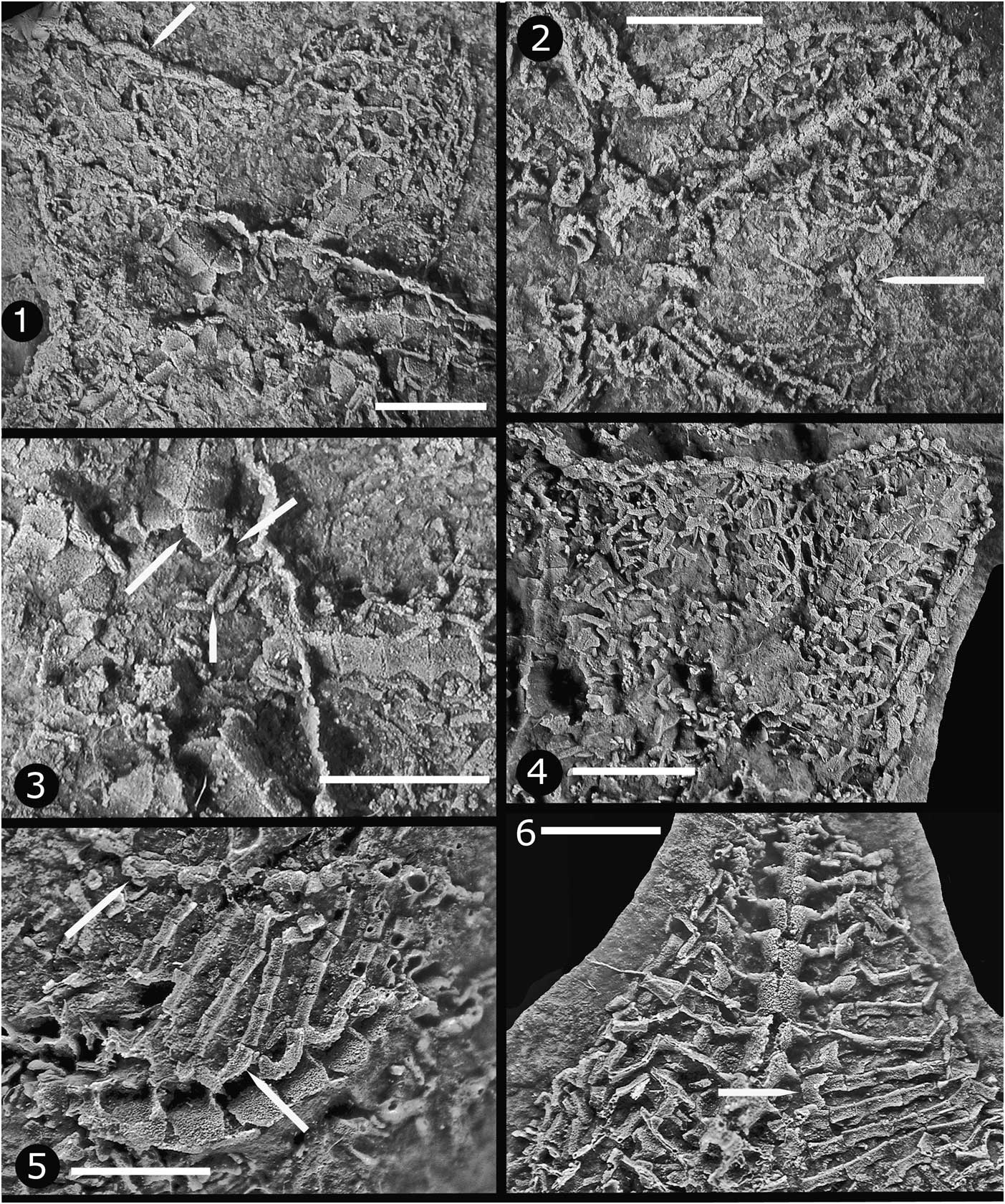
Thoralaster spiculiformis Shackleton, Reference Shackleton2005, holotype FSL 168 697; (1) ventral aspect, entire remaining specimen except for debris beyond image edges, specimen much distended by compaction; (2) upper left arm of (5.1) ambulacral ossicles large, radial water vascular channel broad, virgals small, abradial edge of ambulacrals indented for virgal series articulation (arrow); (3) distal right; form of ambulacral and virgal ossicles; some ambulacrals compound or fused (left arrow), virgals ridged (right arrow); (4) tip of arm with virgals, fragment of plated podium (left arrow), two virgal series abut one of the terminal spines (right arrow); (5) ambulacrals of sequential ossicles appearing both abutted and overlapping proximally, boundary between ossicles in mid-basin position; disrupted virgals are small, disrupted necklace series is present with spines (=radioles) beyond; (6) plated podia and spines; disrupted ambulacral material below. Scale for (1, 2): 10 mm; (3–6): 3 mm.

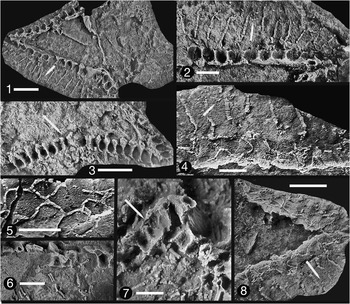
Thoralaster spiculiformis. (1, 2, 4, 5, 8) FSL 712 005, (1) ventral aspect, ambulacral series pulled apart for most of arm length; virgal series with abradial necklace ossicles (arrow); portion of abactinal surface exposed through mouth frame to right; (2) lower left portion of (6.1) inverted; ambulacrals, virgals, necklace series (arrow); (4, 8) dorsal aspect of ambulacral ossicles; ambulacral surfaces flat and featureless; virgal series with necklace ossicles (arrows); (5) relatively well-preserved interval of reticulated abactinals; (3) paratype FSL 711 096, distended ambulacral series show limited differentiation at the mouth framework; (6, 7) holotype FSL 168 697, (6) disrupted jaw frame region to left, fused ambulacral to right, abradial edge recurved for virgal series articulation; virgal ossicles delicate, grooved (below); (7) mouth angle ossicles with podial basin shared by MAO, first ambulacral (arrow). Scale for (1, 8): 5 mm; (2–7): 3 mm.

Description
Body form in life is uncertain because the weakly calcified ossicles of the few available specimens were pulled apart; disk probably large with interbrachia broadly rounded, arms broad basally, tapering sharply to form an extended, narrow distal arm. Dorsal skeleton reticulated (Fig. 6.1, 6.5), at least locally regular; abactinal ossicles delicate, spicular, perhaps tripartite; rod-like elements perhaps present; no accessories recognized. Ambital framework necklace present (Fig. 6.1, 6.2, 6.4, 6.8); conical ambital spines present at tips of virgal series (Fig. 5.4–5.6). Madreporite not recognized. Dorsal surfaces of ambulacrals relatively flat and featureless, successive ossicles appearing abutted rather than overlapping longitudinally (Fig. 6.4, 6.8). In ventral exposure, some ambulacrals compound or fused (Fig. 5.3); radial water vascular channel large, distal edges overlapping proximal edge of next distal ambulacral (Fig. 5.5). Podial basins large, successive ambulacrals abutted, ossicular boundary nearly medial in basin (Fig. 5.5). Podial cups, intervirgal struts not known; large plated podia present (Fig. 5.6). Articular reentrant for virgal series shallow. Virgal ossicles small, virgal series abutting transverse ridge at mid-ossicular position. Virgal ossicles delicate, slender, rodlike, grooved, termini expanded for articular surfaces. First virgals small, not strongly differentiated. Small, irregular plate-like accessories present on virgals. Jaw frame poorly preserved (Fig. 6.3, 6.7), MAO appearing upright, truncated proximally, circumorals enlarged.
Material
Holoype FSL 168 697; paratype 711 096 (FSL 1879 564 of Shackleton, Reference Shackleton2005); FSL 712 005. ES2 (Thoral Collection) of Shackleton (Reference Shackleton2005) is a Silurian crinoid, a specimen “in the Azals Collection” has not been identified.
Remarks
Like Chinianaster, body outline of Thoralaster is not defined by a clearly differentiated ambital framework series, and the outline of the holotype is potentially misleading. Abactinal skeletal elements of Thoralaster are delicate, although it is uncertain whether spicules are simple or tripartite. Madreporite presence is indeterminate in the limited available material. Scattered virgal ossicles and ambulacral shape indicate virgal series accompanied proximal-most ambulacrals.
Genus Villebrunaster Spencer, Reference Spencer1951
Type species
Villebunaster thorali Spencer, Reference Spencer1951; original designation.
Remarks
Ampullaster ubaghsi is a synonym of V. thorali Fell, Reference Fell1963b (Shackleton, Reference Shackleton2005), leaving the type as the only accepted species.
Villebunaster thorali Spencer, Reference Spencer1951
Figures 7.1–7.5, 8.1–8.6, 9.1–9.4
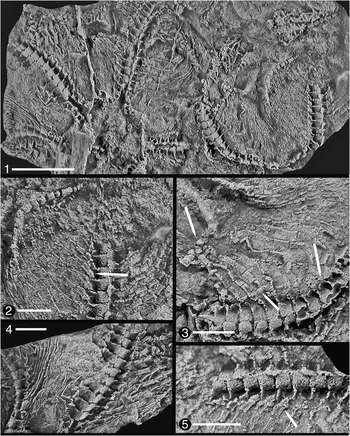
Villebrunaster thorali Spencer, Reference Spencer1951. (1) Holotype FSL 168 692a.1 to left and paratype FSL 168 692a.2 to right, both specimens in ventral view, the mouth frames distended but the ambulacrals not significantly spread apart. Many ossicles of the virgal series are in different orientations but general uniformity within each series argues that the virgal surface flexed as an integrated whole; 2, 3, 5, FSL 168 692a.2, (2) ambital framework ossicles (upper left) are cylindrical and of regular shape. Virgal series mostly expose broader surfaces and many accessories remain, especially near the ambital framework. Spacing to left of ambulacrals seems to indicate only weakly differentiated interval struts (arrow); (3) ambitals and virgals collapsed together (left arrow), intervirgal struts (center, lower, arrow), podial basin cups (right arrow) unevenly developed along the ambulacral series; (5) ambulacrals and adradial virgal series ossicles, intervirgal struts (arrow); (4) FSL 168 692a.1, ambulacral ossicles, virgals showing both narrow edges (ambulacral series to left) and broad surfaces (ambulacral series to right); intervirgal strut series visible on the ambulacrum to right. Scale for (1): 10 mm; (2–5): 3 mm.

Villebrunaster thorali. (1–3) MNHN F.A47188, (1) dorsal view of little distorted small specimen, although the mouth frame is somewhat flattened and abactinals have been lost from the disk; ambital frame (arrow); (2) ventral view, ambitals, virgals, possible abactinals, spines, and possible tube feet complexly juxtaposed on arm to upper right; mouth frame ossicles partially dissociated and rotated out of life position although proximal ossicles of ambulacral series are little disrupted; possible interbrachial radial alignment of body wall ossicles (arrow); (3) center of disk, MAO and oral spines (lower, vertical arrow); circumoral pair (inclined left arrow), these recurved but no buccal slit is developed; probable supernumerary ossicle (inclined right arrow) between circumoral and MAO; (4–6) paratype FSL 711 092, (4) dorsal aspect, specimen appears more flattened than that of Figure 8.1, flattening imposing a more nearly pentagonal shape. Marginal ossicles are locally varied in positioning, ranging from approximately a single series to overlapping and of unclear series number, yet series is aligned, showing little sign of displacement; open abactinal network only partially obscures ambulacrals; no indication of accessories; (5) C-shaped intervirgal struts adjacent to ambulacrals, these appearing to be the first element of the virgal series (arrow below); virgal series extend to ambital framework ossicles (arrow above); podial cups not expressed in this interval; (6) arrangement of ossicles in ventral view; intervirgal struts (arrow), displaced ossicles along arm margin at left contrasts with the little-disrupted ossicles to right. Scale for (1–3, 6): 3 mm; (4, 5): 5 mm.

Villebrunaster thorali. (1, 2) FSL 711 092, distal arm interval in dorsal aspect showing ambital framework and abactinal ossicular form and arrangement; (2) enlargement of arm tip with positioning of distal ossicles; ambulacrals and ambitals reach tip but virgal series and terminal cannot be clearly identified; see text; (3, 4) FSL 168 763 (holotype of Ampullaster Fell), distal arm interval in ventral aspect, (3) arm tip is bluntly rounded with abactinal ossicles to upper left retained probably from specimen splitting; intervirgal struts provide closure to podial basins; (4) arm tip, ambital framework series more or less intact around the tip, distal virgals not visible although absence cannot be verified, see text. Scale=3 mm.

Description
Arms broad, petaloid, interbrachia broadly rounded. Dorsal skeleton an open reticulated network of tripartite paxilliform ossicles and probable connecting rods (Figs. 8.1, 8.2, 8.4; 9.1); ossicular junctions might be thickened, accessories not recognized. Ambital framework ossicles small, more or less rectangular in outline, elongate parallel to body. Lengths varied, some nearly equidimensional; shorter and longer ambital ossicles mixed in sequence, ossicles overlapping or abutted. Locally, ambitals appear either as simple, single series (e.g., Fig. 7.2) or irregular series (Figs. 8.4; 9.1, 9.2). Numbers of ambitals exceeding number of virgal series. Ambital spines possibly present but articular bases not expressed. Madreporite not recognized.
Ambulacrals arched, dorsal surface smooth, outline approximately equidimensional, except for V-shaped reentrant on abradial side that abuts virgal series at its distal corner. Successive ambulacral edges abutted, some locally appearing weakly overlapping. Podial basin large; in some basins only, proximal transverse ridge bowed, opposing an arced ridge within the more distal basin, the two together forming a cup-like receptacle within the basin (Fig. 7.1, 7.3). Plated podia present. Virgal ossicles rectangular, elongate, grooved, expanded terminally, edged by small accessories, the first virgal or two and an intervirgal strut subtly differentiated and appearing to partially close the podial basin. Virgal series reaching mouth frame (Fig. 7.1 right). Ossicles of mouth frame (Fig. 8.1–8.3) not strongly differentiated. MAO plate-like and upright, the circumoral dorsal to MAO, a supernumerary ossicle can be intercalated between MAO and circumoral. Proximal edge of MAO rounded, lacking torus; spines appear to be present.
Material
The type material of Villebrunaster is fragmentary (Spencer, Reference Spencer1951, p. 94) and associations are complex. The largest concretion (Spencer, Reference Spencer1951, fig. 29; Fig. 7.1) shows two individuals, the one on the left with five arms is the holotype, FSL 168 692a.1, the second with two remaining arms is paratype FSL 168 692a.2. FSL 168 693 is a separate fragment of the same concretion, that is of FSL 168 692. FSL 168 693c is the counterpart of paratype FSL 168 692a.2, it illustrated by Spencer (Reference Spencer1951, fig. 30) whereas Spencer’s figure 31 illustrates a separate individual on the opposite side of the same concretion, it labeled FSL 168 693a and FSL 168 693b. FSL 168 692b is a small fragment including multiple individuals thought to be derived from the same original concretion, although the fragment cannot be readily fitted to the other two fragments. The counterpart of the holotype is not available. (B. Lefebvre, personal commun. to DBB, 2014). Other specimens: FSL 168 698, pl. x, fig. 4 of Thoral (Reference Thoral1935); FSL 168 763 (holotype of Ampullaster Fell), FSL 711 092 (=FSL 1879 591 of Shackleton, Reference Shackleton2005); MNHN F.A47188.
Remarks
The varied shapes of the reticulated polygons of the abactinal ossicular array appear similar to those of Chinianaster and more irregular than in Thoralaster. Madreporite presence near the ambital frame in Villebrunaster was noted (p. 43) and coded in Shackleton (Reference Shackleton2005, characters 77–82) but not illustrated or treated in the description of the genus. Ambital framework arrangement is not uniform, appearing well-defined locally (Fig. 7.2) and more irregular elsewhere (Fig. 8.4), with the ossicles overlapping and almost stacked; well-defined marginal series perhaps were not yet present. Some ossicular debris might represent spines, although no articular facets for spines have been recognized. Ambulacral transverse canal linkages between the radial water canal and podial basins are difficult to identify because of incomplete skeletal preservation and subtle ossicular displacement; however, on some ossicles, small openings that might represent water vascular passageways occur at the proximal edges of ambulacrals at the juncture between the roof of the basin and the wall of the channel.
Family Archegonasteridae Spencer, Reference Spencer1951
Genus Archegonaster Jaekel, Reference Jaekel1923
Type species
Archegonaster pentagonus Spencer, Reference Spencer1951
Description
Body outline pentagonal, arms broad, interbrachial arc broadly rounded. Enlarged dorsal primary ossicles lacking; dorsal accessory? granules abundant. Ambital framework ossicles robust, cylindrical, forming a well-defined, continuous series. Madreporite dorsal. Deep reentrants suggestive of podial pores contribute to approximately L-shaped ambulacral ossicles, successive ossicles overlapping. Radial water vascular channel large. First virgal enlarged, broadly T-shaped and spine-bearing.
Remarks
Jaekel’s unpublished manuscript name for the only known species of Archegonaster was later adopted (Spencer, Reference Spencer1951).
Class and order uncertain
Family Catervaparmasteridae Blake, Reference Blake2000
Genus Catervaparmaster Blake, Reference Blake2000
Type species
Catervaparmaster pecularis Blake, Reference Blake2000 by original designation.
Diagnosis
Catervaparmasteridae lacking virgal-series ossicles. Ambital framework ossicles low, angular, abutted, flat except for linear transverse ridges abutting ambulacral ridges and extend to the abradial margin. Accessory ossicles unknown, although ridges of ambital framework ossicles suggest articulation facets for spines.
Description
Asterozoan with asteroid-like body outline: Arms broad, triangular, tapering gradually, distal tip probably narrowly rounded, body profile probably low, interbrachial arc broadly rounded. Neither abactinal skeleton nor madreporite known. Ambital framework ossicles in single series; individual ossicles low, square to rectangular in outline, abutted rather than overlapping longitudinally, interossicular ossicular articular surface approximately perpendicular to arm margin. Ambital framework ossicular surfaces flat except for ridges abutting transverse ridges of ambulacrals; framework ossicle ridges narrow, straight, sharp, more weakly developed medially but expanded abradially, perhaps indicating presence of lateral spines in life. Transverse ridges at adradial edge directed slightly ventrally to form an articular facet to ambulacral. Ossicles appearing pustulose, perhaps reflecting an open stereom.
Ambulacral ossicles rectangular, plate-like; ossicular boundaries approximately medial in podial basins. Transverse ridge sharp, narrow; podial pores lacking; radial water vascular channel narrow. First virgal or equivalent ossicles lacking, at least medially or distally on arm, rather ambital framework ossicles abut ambulacrals. Facets between ambulacrals and ambital framework ossicles small. No evidence of asteroid furrow nor deflection as typically expressed by ophiuran laterals. Oral frame unknown.
Material
Ulster Museum BELUM:K25197; two small fragments considered part and counterpart in Blake (Reference Blake2000) but both surfaces retaining impressions of the ventral surface. Bardahessiagh Formation, Mitchell Siltstone Member, Ordovician, Pomeroy, County Tyrone, Northern Ireland.
Remarks
The monogeneric family was originally assigned to the Somasteroidea based on the form of the ambulacral ossicles (Blake, Reference Blake2000, p. 90). Most striking is the absence of virgal series ossicles; without virgal ossicles, Catervaparmaster cannot be assigned to an asterozoan class, and it is left in open nomenclature. Form and arrangement of ambital framework ossicles and ambulacrals imply a capacity for facultative vaulting comparable to that of somasteroids and stenuroids. The facets at the adradial edge of the ambital framework ossicles appear directed ventrally, implying a ventral flexing of the framework series during vaulting while the ambulacral series were contracted to form the furrow, and flexed upward. The broad, apparently flattened form of the ambital framework argues limited dorsal arching.
Morphology and its functional and taxonomic implications
A new early asterozoan
While the present manuscript was under revision, a new genus and species, Maydena roadsidensis Jell, Reference Jell2014, was described and reported to be the oldest-known asterozoan. Although assigned to the Ophiuroidea, affinities within the Asterozoa were not discussed. The new taxon does not affect interpretations here.
Maydena is a member of the class Stenuroidea sensu Blake (Reference Blake2013). Stenuroids are varied, but Maydena is similar to Eriniceaster tenuispinosus Lehmann, Reference Lehmann1957 (Blake, Reference Blake2013, figs. 2, 3), sharing ambulacral shape including presence of an enlarged ambulacral channel; shield-like first virgals adjacent to the ambulacral and closing the podial basin; form of the mouth angle ossicles, visible to the upper right in Maydena (Jell, Reference Jell2014, fig. 3); and presence of small, uniform body wall ossicles. Outermost virgals are enlarged and varied among stenuroids, and those of Maydena are perhaps most similar to those of Eophiura Jaekel, Reference Jaekel1903 (Spencer and Wright, Reference Spencer and Wright1966, fig. 70.1a; Blake, Reference Blake2013, fig. 7.2). The specimen of Maydena is incompletely preserved, nevertheless small second virgals are locally preserved between the shield-like inner virgals and the outer, robust virgals.
The ambulacral column
In the echinoderm literature, the soft-organ water vascular system is treated as homologous wherever it can be recognized. Skeletal ambulacral ossicles are treated as homologous throughout the Asterozoa and therefore they provide the first guide to identification and interpretation of other ossicular series within the subphylum. If differentiation of the Asterozoa took place after the origin of a skeletal template but prior to the origin of a rigid skeleton (Blake, Reference Blake2013), then robust skeletal ambulacral ossicles need not be strictly homologous between asterozoans and other echinoderm groups.
Ambulacral ossicles arise at the distal tip of the arm of asterozoans and proximal to an unpaired so-called terminal ossicle where this ossicle can be recognized. A terminal could not be definitively recognized in available somasteroids, perhaps only because distal ossicles are small, uniform, and disrupted in most specimens (Fig. 9), but morphology of somasteroid arm tips indicates ambulacral origin positioned as among other asterozoans.
Among somasteroid genera, ambulacral ossicles are approximately equidimensional and not precisely paired across the arm midline. Podial basins mostly are large, as are the plated podia known from Thoralaster (Fig. 5.6). Relatively robust ambulacral articular structures are found in asteroids and ophiuroids, but faceting is limited within somasteroids; nevertheless, in accord with the hypothesis on tissue decay suggested above, tissue linkage was strong enough to hold ambulacral ossicles together longitudinally even as they were pulled apart across the arm midline (Fig. 6.1, 6.8). A facultative ambulacral furrow (Fell, Reference Fell1963a) together with a fan-like rotational ability of virgal series (Blake, Reference Blake2013) and a suggested ability to burrow using musculature comparable to that of an earthworm (Spencer, Reference Spencer1951, p. 90, 93) all argue in support of significant body flexibility in somasteroids, although earthworm-like burrowing appears exaggerated in light of the radial somasteroid shape. The radial skeletal channel of the water vascular system is large in most somasteroids (although not in Ophioxenikos) and it is usually preserved in a more or less dilated state.
Mouth frame construction
The proximal-most member of the ambulacral series is the mouth angle ossicle, and the next-distal ossicle is the circumoral. Clearly preserved somasteroid mouth frames are few, but ossicular differentiation between the mouth frame ossicles and more distal ambulacral-series ossicles appears limited as compared to corresponding series of asteroids and especially ophiuroids. Basic arrangement of the mouth frame as found in Villebrunaster (Fig. 8.1–8.3) is widespread among asteroids, arguing plesiomorphy in the latter.
Modern asteroids have a single ossicle termed the odontophore distal to each mouth angle pair, but because the interior of jaw frames are clearly exposed in few fossils, odontophore history has been difficult to determine. Presence of the odontophore has been thought to separate somasteroids from asteroids (McKnight, Reference McKnight1975). A so-called “T-shaped plate” recognized in Villebrunaster (Fell, Reference Fell1963a, p. 401) is odontophore-like in form and position, although it was not considered to be the odontopore homologue.
A so-called buccal slit, a putative V-shaped divergence of proximal ambulacral-column ossicles, has been widely recognized (Spencer, Reference Spencer1951; Spencer and Wright, Reference Spencer and Wright1966) but the notion was challenged for the somasteroid Archegonaster (Smith and Jell, Reference Smith and Jell1990). Absence of a buccal slit from the best-preserved somasteroids (Fig. 8.1) together with argumentation based on inferred taphonomic alteration led to rejection of the concept of a buccal slit for the Somasteridea and Stenuroidea (Blake, Reference Blake2013).
Madreporite and the water vascular system
The “hydropore” is the external opening of the water vascular system. Hydropores are morphologically varied, many very simple, whereas the madreporite of asterozoans characteristically is a “spongy or sievelike ossicle” (Spencer and Wright, Reference Spencer and Wright1966, p. U29) typically constructed of radiating skeletal ridges and grooves.
Interpretation of the madreporite and the water vascular system of somasteroids begins with expressions among extant asterozoans. Echinoderms are traditionally considered to be “isosmotic,” an evaluation adequate for most ecologic considerations, but not from a physiological perspective (Ferguson, Reference Ferguson1990). In an experimental study, an asteroid species was shown to replenish general body fluid with a slow but steady influx of seawater across the madreporite. The madreporite was thought to contribute some water to the tube feet, although inflation of these structures can be maintained using osmotic mechanisms. Mixing of seawater with fluids present in the asteroid takes place internally, and it is uncertain how much regulatory control the asteroid has over fluid volume (Ferguson, Reference Ferguson1992). Anal venting can be significant in adjusting body volume (Ferguson, Reference Ferguson1988). The nature of madreporic uptake and osmotic transfer was found to differ significantly with habits, habitat, and the nature of the body wall among six Pacific and Florida asteroid species (Ferguson, Reference Ferguson1994). The water vascular system was found to be complex in a species of ophiuroid but influx from the exterior through two small madreporite pores was found to be small, the ophiuroid relying on internal recirculation of fluids (Ferguson, Reference Ferguson1995).
Variability among living asterozoans argues water vascular system functioning need not have been uniform among somasteroids, other early asterozoans, or echinoderms in general. No differentiated asterozoan madreporite has been recognized in Villebrunaster in spite of availability of a number of specimens. Osmotic transfer across the body wall (Ferguson, Reference Ferguson1994) might have limited need for a water pore, or perhaps only a small, as yet unrecognized hydropore was present. Presence of a dorsal madreporite in Archegonaster, a ventral madreporite of distinct texture in Chinianaster, and uncertain presence in Villebrunaster together might favor appearance of the asterozoan madreporite after subphylum origin, with dorsal vs. ventral occurrences indicative of separate lineages.
Many early asterozoan madreporites are similar, although the granular madreporite of Chinianaster (Fig. 2.6, 2.7) is distinct. Chinianaster expression does not appear to reflect alteration because there are no equivalent preservational textures are recognized elsewhere on these specimens. Other expressions potentially indicative of differences in water vascular system function include the markedly enlarged madreporites of some Hunsrück State taxa (Lehmann, Reference Lehmann1957; Blake, Reference Blake2013), the domal expression in Eriniceaster Lehmann, Reference Lehmann1957, and the enlarged radial channel found among somasteroids and stenuroids. The enlarged radial water channel is striking. Somasteroids are thought to have been active animals (Spencer, Reference Spencer1951; Fell, Reference Fell1963a; Blake, Reference Blake2013), an interpretation consistent with the large podial basins with robust, plated podia found in Thoralaster. An enlarged radial water canal with unfused ambulacral series ossicles might have provided both support and flexibilty, allowing active life habits appropriate to Ordovician settings. If indeed stenuroid ambulacrals “must be regarded collectively as forming a stiff bony axis that kept the arm in shape during pulls of the musculature of the body walls” (Spencer, Reference Spencer1940, p. 508), then the function logically was inherited from somasteroids.
Ambital framework
Differentiated ambital framework ossicles occur in divergent early echinoderms, and therefore issues of homology must be considered. Ambital framework series of asterozoans and edrioasteroids have been considered to be homologous and therefore useful to interpretation of asterozoan phylogeny (e.g., Shackleton, Reference Shackleton2005), but this interpretation was rejected in part because the framework series of edrioasteroids can arise away from the distal tip (Blake, Reference Blake2013). The ambital frame of ophiuroids was rejected as homologous with that of asteroids based on similar argumentation (Shackleton, Reference Shackleton2005).
Ambital framework expressions of somasteroids are varied and framework ossicles are not similar among taxa, and as a result, treatment has been inconsistent. The generic concept of Thoralaster was based on a portion of the type suite of Chinianaster (Shackleton, Reference Shackleton2005); prior to her reinterpretation, the ventral surfaces of the “earliest genera” of Somasteroidea (at that time, Chinianaster [+ Thoralaster] and Villebrunaster) were judged to have only two types of ossicles, the ambulacrals and the “interambulacralia,” the latter described as “rod-shaped” ossicles in linear series, i.e., the “virgals” of usage elsewhere (Spencer, Reference Spencer1951, p. 91). Discussion of Villebrunaster (Spencer, Reference Spencer1951, p. 94–96) cited ossicular types, and marginals were not included, although a drawing of this genus (fig. 3) seems to favor their presence. The term “marginal” was not used for Chinianaster whereas discussion and especially illustration clearly do so (fig. 7). Marginal ossicles are shown in later reconstructions of Villebrunaster (Fell, Reference Fell1963a, fig. 6B) and Ampullaster (=Villebrunaster) (fig. 6A). The illustrated specimen of Chinianaster subsequently recognized as the holotype of Thoralaster bears an elongate, spine-like “terminal radiole” at the tips of the virgal series (Fell, Reference Fell1963a, fig. 6E). The Chinianasteridae was described as lacking both superomarginals and inferomarginals (Fell Reference Fell1963a, p. 396-397), and a reconstruction of young Chinianaster did not include marginals (Fell, Reference Fell1963a, fig. 17). The Villebrunasteridae was described as having “No marginal radioles” (Fell, Reference Fell1963a, p. 397). Picking up on the terminology of Fell, Chinianasteridae pinnules (=virgal series) were described as ending in a free marginal radiole, “free” presumably meaning the radioles were not abutted to form a continuous “marginal” series (Spencer and Wright, Reference Spencer and Wright1966, p. U39-U41). Marginals but not radioles were recognized in the Villebrunasteridae.
Well-defined abutted framework series arise at the arm tips of Villebrunaster (Fig. 9), Archegonaster (Fig. 4.2), and Ophioxenikos (Fig. 4.1). Virgal series abut the ambital framework ossicles, and therefore the ossicles traditionally were interpreted as a part of the virgal series (Spencer and Wright, Reference Spencer and Wright1966), an idea later rejected (Shackleton, Reference Shackleton2005, p. 39), the framework ossicles treated as derivatives of the abactinal series based on putative morphologic similarities. Ambital ossicles of all three genera are clearly differentiated and aligned in continuous series whereas abactials are either comparatively delicate and rod-like or granular and not so aligned. No intermediate links the two morphologies, and for this reason, the derivation hypothesis here is considered insufficiently supported. The potential derivation of superomarginals from abactinals in asteroids had been argued earlier (Spencer, Reference Spencer1916, p. 106; Reference Spencer1951, p. 123).
Ambital framework expression in the remaining two somasteroid genera is problematic. For Chinianaster, marginal ossicles were described as “elongate and sub-rectangular, forming slightly petalloid marginal frame” (Shackleton, Reference Shackleton2005, p. 68), these illustrated (fig. 5B, here Fig. 3.3, 3.4). For Thoralaster, each virgal row was seen as having “a single marginal, an elongate spiked ossicle” (p. 70), these of distinct stereom, circular in cross-section, and tapering to a tip. The spiked ossicles are the terminal radioles of Fell and they were coded as marginals equivalent to those of other asterozoans (Shackleton, Reference Shackleton2005, char. 65, p. 113).
In both Chinianaster and Thoralaster, necklaces of tiny, irregular, comparatively lightly calcified ossicles can be found at the outer tips of the virgal series, the necklaces extending between virgal rows (Figs. 2.2, 2.3; 6.1, 6.2, 6.4, 6.8), those in the illustrated Chinianaster now partially collapsed together. Necklace ossicles are smaller and more irregular in form and alignment than the ambital framework ossicles of Villebrunaster, but they form a continuous series where best exposed. Although extending well out onto the arms, necklaces cannot be traced to the arm tip in available material and therefore they cannot be finally treated as marginal homologues, a cautious approach dictated by the ambital framework ossicles of such ophiuroids as Encrinaster that clearly do not reach arm tips.
The only specimen of Chinianaster that can be interpreted as supporting presence of an enlarged marginal series (as opposed to a necklace sequence) is the distal arm interval illustrated by Shackleton (Reference Shackleton2005, fig. 5B; here Fig. 3.3, 3.4). A drawing of Chinianaster was provided (fig. 12B), although no specimen supporting this reconstruction was cited, and no such specimen was recognized here. In the distal arm interval of this fossil, ossicles other than those of the ambulacral series are small, simple, and quite uniform, and they are somewhat dissociated. More proximal virgal series extend toward the arm tip (Fig. 1.1, 1.2), and therefore the parsimonious explanation for the occurrences nearer to the tip (Fig. 3.3, 3.4) is as disrupted virgal series ossicles. Enlarged or variously differentiated distal marginal ossicles occur in certain crown-group asteroids but no asteroid has been described in which marginals only begin to develop later in ontogeny, as would be necessary if the distal ossicles of figure 3.3 and 3.4 represent a marginal framework homologous with marginals of e.g. Villebrunaster. Two ossicles of spine-like appearance abut the distal tips of the arms; these are potentially the equivalents of the spines of Thoralaster at the distal tips of the virgal series, but they also might be displaced virgals. Spine-like ossicles also occur at the distal tip of a specimen of Villebrunaster (Fig. 9.1, 9.2).
Spines (=“radioles”) of Thoralaster are not considered to be marginal homologues because they do not form a continuous, abutted series, because the spine-like ossicles are morphologically unlike other somasteroid ambital framework ossicles, and because a continuous ambital necklace series is present, and therefore treating the spine-like ossicles as marginals would demand two simultaneous homologous series in violation with the rule of conjunction (Patterson, Reference Patterson1988). An alternative interpretation argues that the spines represent terminal ossicles of the virgal series; favoring this interpretation is their broad similarity to virgals together with their arrangement, connoting serial homology with more adradial virgal-series ossicles. Treatment of the spines as a part of the virgal series demands a phylogenetic innovation. Virgal series ossicular sizes diminishes abradially, indicating the series ossicles arose at the abradial series terminus. Virgal number in each series increases proximally on the arm, therefore virgal ossicular addition was ongoing during life. The spines are found distally on the arm and therefore they arose early in Thoralaster life history. Therefore, if the spines were a member of the virgal series, presence would dictate a shifting of a pre-existing ontogenetic sequence from new virgals addition exclusively at the abradial series terminus to insertion within the virgal series.
The strongest argumentation for Thoralaster therefore favors spines as accessories. Spines are elongate and conical rather than straplike, as are true virgals, and they are of a distinctive porous stereom. Thoralaster spines are abradial to the ambital necklace in the position of accessories. In at least one example (Fig. 5.4), a spine occurs as two virgal series come together, unlikely if the spine were a member of a single virgal series. Challenging the interpretation as accessories is the paucity of accessories among most somasteroids, although they do occur (e.g., Fig. 8.3).
The ventral skeleton
A series of small so-called virgal ossicles extends laterally from each ambulacral of somasteroids. Number of ossicles in each series diminishes distally on the arm, and ossicular size in each series diminishes abradially, together arguing series arose at or at least very near to the arm tip, and also indicating ossicular addition at the abradial series terminus. Although most virgals are comparatively simple, rectangular, and strap-like, the first virgals of Archegonaster are enlarged, quite strongly differentiated, and spine-bearing.
The asterozoan phylogenetic hypothesis of Spencer (Reference Spencer1951), further developed by Blake (Reference Blake2013), begins with a basal Somasteroidea and derives the adambulacral and lateral ossicles of stenuroids, asteroids, and ophiuroids from virgal-series ossicles, these variously differentiated to provide partial closure and protection for the podial basin. In time, expression of the differentiated virgal-series ossicles became morphologically varied, with no example more clear than the differences between asteroid adambulacrals and ophiuran laterals. Given apparent usefulness and multiplicity of expression among divergent early asterozoans, virgal differentiation is judged to be homoplastic among lineages.
A related issue is the phylogenetic origin of the ventral ossicles of asteroids, the so-called actinals. Virgals have been coded as actinal ossicles (Shackleton (Reference Shackleton2005) whereas a second interpretation argues virgals are distinctive enough to treat as a separate ossicular system (Blake, Reference Blake2013).
If virgals are not asteroid actinal homologues, then their positioning in life is at issue because superficially similar ossicular series can occur internally in early edrioasteroids (Smith and Jell, Reference Smith and Jell1990, figs. 11, 13). In addition to general similarities with edrioasteroid ossicles, a hypothesis of internal arrangement might be favored by the delicate nature of virgals. Other arguments are not consistent with an internal positioning. The small, granular accessories of Thoralaster and Villebrunaster associated with virgals appear analogous with surficial accessories of other asterozoans. If virgals are the phylogenetic source of adambulacrals and laterals, the interpretation preferred in the literature, then internal virgals would be required to have migrated to the body wall surface. Sequential virgal series swung in a coordinated manner, pivoting at the abradial edges of the ambulacrals. This motion appears reasonable if the series were external, perhaps lifting the arms into the water column for suspension feeding or helping to trap such prey as small crustaceans or worms, but of unknown operation and function if virgal series were within the body and presumably at least partially enclosed by disk organs. Although virgals of the Montagne Noire species are delicate, so are ossicles of the abactinal series; if virgals are internal because of delicacy, then such an interpretation must be considered for the “abactinals.” Finally, no analogous internal ossicular system is known among asteroids or ophiuroids. The preferred interpretation of virgals is as a part of the body-wall.
Expression of certain differentiated virgal series ossicles near to the ambulacrals was treated in “Somasteroid virgals and intervirgals” (Shackleton, Reference Shackleton2005, p. 43, 44), and in a taxonomic section on Villebrunaster (p. 66, 67); reconstruction was provided (p. 36, fig. 2B, this based on FSL 1879 591, now FSL 711 092; here Fig. 8.6). The “intervirgals” of Villebrunaster were described as “Flat, slightly convex C-shaped” ossicles joining the second virgal to the first/second virgal articulation. In evaluation of Ampullaster Fell, Reference Fell1963b, Reference Fella longitudinal ossicular series adjacent to the ambulacrals earlier judged to be true adambulacrals were found to be “undoubtedly intervirgal struts” (Shackleton, Reference Shackleton2005, p. 67, 68, also here Fig. 9.3). In Villebrunaster, expression of ossicles near to the ambulacral series is complex and varied (Figs. 7.2-7.5; 8.5, 8.6; 9.3), including intervals where no intervirgal struts are readily apparent. In some intervals, “C-shaped” ossicles appear to be first virgals themselves (Fig. 8.5) whereas in others, a separate ossicular type seems to occur (Figs. 8.6; 9.3); in the latter two examples, orientation of the “C” differs significantly, perhaps reflecting taphonomic events. Based on differences among these examples and others, the reconstruction of Shackleton (fig. 2B) appears over-interpreted, although correctly emphasizing differentiation of virgals adjacent to the ambulacral among taxa, differences likely indicating absence of simple phylogenetic pathway among lineages.
Among echinoderm taxa, those ossicular series associated with the embryonic hydrocoel have been termed “axial” and separated from the somatocoel-associated series, these termed “extraxial”; recognition of the two skeletal types was used to propose skeletal homologies among echinoderm classes (Mooi et al., Reference Mooi, David and Marchand1994; Mooi and David, Reference Mooi and David1998, Reference Mooi and David2000). Interpretation of aspects of asterozoans provided some uncertainties, although virgal series ossicles were confidently considered to be extraxial (Mooi and David, Reference Mooi and David2000). A reevaluation favored an ossicular classification differing from those of the earlier studies (Hotchkiss, Reference Hotchkiss2009, Reference Hotchkiss2012). Interpretations of homology based on arguments from early ontogeny are not available for somasteroids, and therefore significant contributions cannot be made here. The development of virgal series does argue serial homology, indicating that all virgals are either axial or extraxial, i.e., the significance of the first virgal or its equivalent can not be treated apart from the remainder of the sequence. Development of ambital framework ossicles appears varied enough as to support a hypothesis of extraxial origin.
Body form and the dorsal skeleton
Well-defined ambital framework series define shapes of Ophioxenikos, Villebrunaster, and Archegonaster. All three genera have rounded interbrachial arcs, and both Villebrunaster and Archegonaster have broad arms with large disks whereas Ophioxenikos has narrow arms and a more acute interbrachial arc. The interbrachial axis of Chinianaster was been considered to be unskeletonized (Spencer, Reference Spencer1951, p. 99; Spencer and Wright, Reference Spencer and Wright1966, fig. 39.4), but a fleshy linkage appears reasonable, and abundant virgal series ossicles favors broad, petaloid arms and a large disk similar to that of Villebrunaster. A robust ambital framework is absent from Thoralaster, and the few available specimens provide limited information on shape; based on preserved virgal series (Fig. 6.1), form is tentatively coded as petaloid in the present phylogenetic analysis.
The dorsal skeleton is varied among the few known somasteroid genera. It is reticulated in the three Montagne Noire representatives, although differing in details. No alignment of ossicles indicative of either a carinal series or a primary circlet was recognized. Ossicles appear radially aligned at the interbrachial midline of one somasteroid specimen, however (Fig. 8.2). Ossicular alignment emerged early in the history of asteroids, and the Villebrunaster occurrence might be a precursor. Dorsal interbrachia appear more or less collapsed together in most somasteroids, obscuring the true nature of the interval, but enough ossicles are present as to allow a thickened body form. The dorsal skeleton of Ophioxenikos consists of large, closely spaced granules whereas only relatively small granules have been recognized in Archegonaster, these favoring presence of a granular-dermal body wall but not enlarged primary ossicles.
Accessories
Accessory ossicles are the spines, spinelets, and granules seating on the primary ossicles. As compared to later asterozoans, comparatively few accessories have been recognized among somasteroids.
A phylogenetic hypothesis
Composition of the Asterozoa and character development
The fossil record of early asterozoans is scanty, and therefore recognition of four class-level asterozoan clades (Somasteroidea, Stenuroidea, Asteroidea, Ophiuroidea) together with their evolutionary sequencing has been based on argumentation apart from phylogenetic analysis (Blake, Reference Blake2013). A phylogenetic overview is proposed here. Characters judged fundamental to recognition of early members of the four recognized classes first were developed and coded for a limited number of genera, and four problematic fossil genera were then added.
Taxon selection
All five recognized somasteroid genera are included. For the Ophiuroidea, Asteroidea, and Stenuroidea, taxon selection focused on diversity of expression. Protaster Forbes, Reference Forbes1849, exhibits the long-recognized ophiuran form of a well-defined disk and tapering, columnar arms. Encrinaster Haeckel, Reference Haeckel1866, has clearly differentiated arms and disk, the arms robust and the disk bordered by striking, asteroid-like enlarged ossicles. Phylogenetic relationships of the asteroid-like Stenaster Billings, Reference Billings1858, have been debated, but its ophiuran affinities now have been clarified (Dean, Reference Dean1999). Petraster Billings, Reference Billings1858, is an early asteroid with a large disk and many small dorsal body-wall ossicles. Urasterella McCoy, Reference McCoy1851, and Hudsonaster Stürtz, Reference Stürtz1900, both have small disks, Urasterella especially so. Urasterella also has relatively small body wall ossicles whereas those of Hudsonaster are comparatively large. Among stenuroids, Pradesura Spencer, Reference Spencer1951, and Eophiura Jaekel, Reference Jaekel1903, are both more ophiuroid-like in overall appearance whereas Embolaster Blake, Reference Blake2008, and Rhopalocoma Salter, Reference Salter1857, are asteroid-like. In contrast, Eriniceaster is not superficially readily associated with either surviving clade. Finally, four genera were selected because of variously problematic expressions, these including Catervaparmaster Blake, Reference Blake2000 (originally assigned to the Somasteroidea), Eukrinaster Blake et. al, Reference Blake, Guensburg, Sprinkle and Sumrall2007 (originally assigned to the Asteroidea), Phragmactis Spencer, Reference Spencer1940, and Swataria Blake, Reference Blake2014, both included in the Phragmactinidae, the family unassigned.
Outgroup selection
The ambiguity of the fossil record is such that no non-asterozoan provides an admissible outgroup choice (Blake, Reference Blake2013). Exemplifying difficulties is the edrioasteriod Kailidiscus Zhao et al., Reference Zhao, Sumrall, Parsley and Peng2010 (figs. 6–8), suggested for the evaluation of possible asterozoan ancestry (J. Sprinkle, personal commun., 2013; Jell, Reference Jell2014). Kailidiscus candidacy is based on presence of two rows of ambulacral-series ossicles, including the ambulacrals together with adjacent “abradial floor plates,” the latter argued to be homologues of adambulacrals of asterozoans. Perhaps enhancing this hypothesis, the ambulacrals of Kailidiscus are superficially suggestive of the compound or fused ambulacrals of Thoralaster, with more than one podial position separated by a transverse ridge on a few ossicles (Fig. 5.2, 5.3). Differences between Kailidiscus and asterozoans outweigh the similarities. The morphology of ambulacral and abradial series of Kailidiscus are unlike those of any asterozoan; simple presence of a second series does not close the morphologic gap. In early asterozoans, the ambulacrals and adjacent virgal series ossicles are aligned rather than offset, and sequential members of each series are of uniform morphology, rather than irregular and varied, as in Kailidiscus; Kailidiscus lacks virgal series ossicles. The biserial gaps in the ambulacrals of Kailidiscus are unlike the uniserial full podial basins of somasteroids. The transverse ridges of Thoralaster ambulacrals are parallel rather than Y-shaped as in Kailidiscus. The ambulacral cover plates of the edrioasteroid are not found in asterozoans, although it might be argued these were lost with change of life habits. Kailidiscus ambulacra are fixed in a curved position, unlike the highly flexible somasteroid construction. The irregular, 2-1-2 mouth frame of Kailidiscus is wholly unlike the symmetrical arrangement of asterozoans. The ambital framework ossicles of Kailidiscus are away from the terminal position of the ambulacral series and therefore not homologous with the framework series of asterozoans. The ventral interambulacral surface plating in Kailidiscus is of robust abutted ossicles forming an irregular pavement whereas expressions of the ventral ossicles of early asterozoans, although varied, are never similar to those of Kailidiscus. Although the hydropore and the madreporite are near the mouth frame in Kailidiscus and some asterozoans, they are not of similar form. The thickened pedunculate zone of Kailidiscus is not found among asterozoans. Asterozoans are mobile organisms living with the mouth frame directed toward the substrate whereas edrioasteroids are sessile living with the mouth area directed upward into the water column.
Similarities between Kailidiscus and asterozoans are limited to a skeleton of many discrete elements together with a body form of five radiating ambulacral series. These are basal echinoderm expressions rather than apomorphies of a putative edrioasteroid–asterozoan clade. No edrioasteroid has been identified that approaches a transitional state.
Given absence of a viable non-asterozoan candidate, an outgroup must be selected from the somasteroid genera. Archegonaster is rejected because its adambulacral- or lateral-like first virgal represents a step away from the basal condition of more or less uniform, simple first virgals. Additionally, the “L”-shaped ambulacrals and the apparent absence of abactinal ossicles other than accessory granules are unlike expressions of other early asterozoans. Archegonaster is Middle Ordovician, younger than other somasteroids.
Choice among the remaining genera can be debated, but focuses on the ambital framework because reinforced body fringes are both varied and widely distributed among early echinoderms of relatively low body relief. Ambital frameworks are an apparently a useful supporting device, thereby favoring homoplasy among separate clades. Three somasteroid genera (Archegonaster, Ophioxenikos, Villebrunaster) have well-defined marginal frames broadly similar to those only of asteroids among derived asterozoan classes whereas two (Chinianaster and Thoralaster) have series of irregular, small necklace ossicles, postulating (but not proving) a more basal status. In Thoralaster, terminal spines are present at the distal tips of the virgal series, these taken as a generic apomorphy, and therefore Chinianaster is selected to serve as the outgroup taxon.
Parsimony analysis
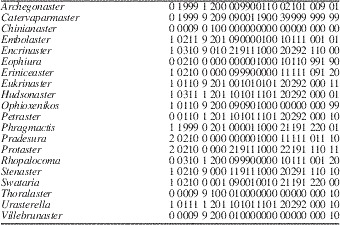
Twenty-eight binary and multistate characters were developed (Appendix, Table 1). Parsimony Analysis used PAUP 4.0b8 (Swofford, Reference Swofford1998). Characters were unordered and they were weighted equally regardless of number of states. In analyses using the branch and bound algorithm, six trees of minimum length of 81 were retained; 27 characters are parsimony-informative. Values in parentheses exclude the uninformative character: consistency index CI=0.5062 (0.5000); homoplasy index HI=0.4938 (0.5000), retention index RI=0.6970.
Data matrix for parsimony analysis.

“9” is unknown.
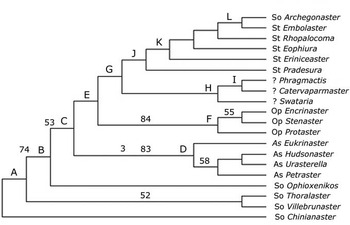
Of the six equally parsimonious trees, three arrangements of the three ophiuroid genera matched with two pairings of Villebrunaster and Thoralaster. No attempt was made to develop characters exploring Paleozoic ophiuroids in detail, and a true sequencing of the three divergent genera was not sought here. The four basal somasteroids were either arranged in sequence, or Villebrunaster and Thoralaster were treated as sister taxa. The arbitrary choices (Fig. 10) are those of the bootstrap analysis diagram.
One of four equally parsimonious cladograms. Key: So=Somasteroidea; St=Stenuroidea; A=Asteroidea; O=Ophiuroidea;?=of uncertain affinities. Bootstrap values above 50% are identified by two-digit numerals, single digit is Bremer support. Select apomorphy listing, nodes are capital letters. A to B: no character transformation. B to C: 1, 3, 4, 27, 0>1; 7, 1>2. C to D: 6, 9, 12, 14, 16, 18, 0>1; 19, 21, 23, 0>2. C to E: 14, 15, 0>1; 19, 21, 0>2. E to F: 3, 1>2; 7, 2>0; 10, 0>2; 11, 13, 23, 24, 25, 0>1. E to G: 3, 1>2; 23, 0>1. G to H: 9, 20, 0>1; 21, 2>1; 24, 25, 0>2; 27, 1>0. H to I: 2, 28, 0>1. G to J: 7, 2>0; 20, 25, 0>1; 21, 2>1. J to K: 14, 1>0; 19, 2>1; 22, 26, 0>1. L to Archegonaster, 2, 6, 16, 17, 28, 0>1; 19, 22, 1>0; 20, 0>2; 27, 2>0.

Two major results emerged from phylogenetic analysis (Fig. 10). First, five major subdivisions can be recognized, consisting of the four classes (Blake, Reference Blake2013) and the problematic Phragmactinidae (Blake, Reference Blake2014). Second, character suites marking the transitions between the clades are weak, likely leading to the weak Bremer support and relatively weak values from bootstrap analysis. Weak values are judged to reflect incomplete available data, the somewhat limited sampling of the varied early fauna, and an early period of rapid skeletal evolution.
Asterozoan evolution
No skeletal asterozoan has been recognized from the Cambrian. All four major asterozoan clades (Blake, Reference Blake2013) first appear through a limited Early Ordovician stratigraphic interval. Every adequately preserved fossil can be assigned either to the Asterozoa or a non-asterozoan group; no fossil has ever been considered to be of uncertain affinities at a higher taxonomic level. Although various morphologic expressions have been posited as linking both crinoids (Fell, Reference Fell1963a; Spencer and Wright, Reference Spencer and Wright1966) and especially edrioasteroids (Shackleton, Reference Shackleton2005; Jell, Reference Jell2014) to asterozoans, clearly delineated synapomorphies of designated genera have not been identified. Because the fossil record is scanty and because all clades appear over a narrow interval, phylogenetic sequencing within the Asterozoa cannot be based on stratigraphic postioning.
The simplest hypothesis of origins is to take the fossil record at face value: The Cambrian-Ordovician boundary interval was a period of rapid evolution in echinoderm history, including differentiation of the Asterozoa from an uncertain ancestry. There are, however, trace fossils as ancient as Early Cambrian that would be treated as of asterozoan derivation were they of the same age or younger than the first body fossils, thereby leading to a second hypothesis, that asterozoan diversification began early in the Cambrian, well before evolution of rigid skeletons. Timing in the two hypotheses can be variously combined, for example, perhaps phylogenetic differentiation of the asterozoan subphylum took place by the time of the earliest trace fossil, and differentiation of the major clades within the subphylum only accompanied appearance of robust skeletons during the earliest Ordovician. The alternatives find an accompaniment in the interpretation of the weakly calcified Burgess Shale Echmatocrinus as a crinoid (Sprinkle and Collins, Reference Sprinkle and Collins2007). These working hypotheses, however, do not preclude eventual recognition of viable skeletal intermediaries between asterozoans and crinoids, or asterozoans and edrioasteroids, or asterozoans and some other group. Review of early asterozoan genera (Blake, Reference Blake2013, herein) supports a stemward positioning of somasteroids among asterozoans (Spencer, Reference Spencer1951; Spencer and Wright, Reference Spencer and Wright1966) thereby providing a starting point for the evaluation of non-asterozoans. The many ambiguities lead to a cautionary perspective: “clear skeletal linkages between asterozoans and a more basal echinoderm group might never be found” (Blake, Reference Blake2013, p. 357).
Weak Bremer and bootstrap support in the present analysis argues that the differentiation of extant clades was too abrupt to be marked by readily retained and recognized apomorphic steps. Morphologic range of fossil asterozoans implies limited functional and ecologic differentiation during the history of the subphylum; enduring life modes evolved with establishment of the class-level clades. Nevertheless, rapidity of the Ordovician diversification was accompanied by some significant changes, including those leading to developmental differences between the extant asterozoan classes. Early diversification yielded two highly successful major clades, the Asteroidea and Ophiuroidea, and also at least one less successful clade, the Stenuroidea. The surviving classes as presently construed (Spencer and Wright, Reference Spencer and Wright1966) might be at least paraphyletic, potentially adding to clade total (Blake, Reference Blake2013). Other potentially separate early clades of brief duration and supporting a complex early subphylum history include the Phragmactinidae and the Catervaparmasteridae. Interpretations are at least partially testable by discovery of new fossils, including intermediaries between early asterozoans and some other echinoderm group; new phragmactinids or catervaparmasterids; or significant stratigraphic range extension of one or more skeletonized clades.
Acknowledgments
B. Lefèbvre, P. Abel, and R. Emmanuel allowed access to collections and provided facilities and materials at the Université Lyon. D. Vizcaïno and B. Lefèbvre guided us to Montagne Noire outcrops. R. L. Langenheim discussed work in the Ely Springs Range. J. F. Miller processed rock samples and R. Ethington identified conodonts and helped with stratigraphic evaluations. F. Hotchkiss and A. Hunter reviewed the manuscript, B. Pratt, C. Sumrall, and K. Huber provided editorial services.
Appendix
Character listing for parsimony analysis.—Many character expressions are intergrading, including those of overall body form, abactinal and ambulacral shape, and ambulacral-column articulation arrangements. Coding defines use.
Overall body form.—
1 0=Pentagonal; 1=stellate; 2=disk subcircular, arms cylindrical.
Abactinals.—The many abactinal ossicular morphologies among early asterozoans suggest rapid diversification from an uncertain basal condition. Primary ossicles, including abactinals, are separated from accessory spines and granules.
2 0=Primary abactinal ossicles present; 1=Primary abactinal ossicles not developed.
3 0=Abactinals delicate, branching, rod- or strap-like; 1=abactinals granular to robust paxilliform; 2=abactinals are small platelets; 3=abactials are large plates.
4 0=Abactinal arrangement reticulated; 1=abactinal arrangement not reticulated.
5 0=Abactinals not aligned in series; 1=abactinals aligned in series.
Madreporite.—In Rhopalocoma, the madreporite is at the ambital frame; in B.M. Palaeont. 46601, the madreporite is preserved rotated onto the dorsal surface, and it is so coded here.
6 0=Madreporite on ventral surface; 1=madreporite on dorsal surface.
Ambital framework.—Ambital framework expressions are varied at lower taxonomic levels providing few characters for recognition of major clades. True “marginals” are separated from necklace and ophiuroid disk frame ossicles, the latter expression (char. 8), although uninformative, is retained here because of the ambiguities surrounding framework ossicles.
7 0=Marginal framework absent; 1=marginal necklace present; 2=marginal framework present.
8 0=Disk frame absent; 1=disk frame present.
9 0=Axillary ossicle absent; 1=axillary present.
Ambulacral series.—
10 0=Positioning of the ambulacrals across the arm midline irregular, i. e., locally paired, locally offset; 1=ambulacrals clearly paired across arm midline; 2=ambulacrals clearly offset.
11 0=In dorsal view, successive ambulacrals overlap; 1=in dorsal view, successive ambulacrals abutted.
12 0=Ambulacrals broad and shield-like, width and length similar; 1=ambulacrals rectangular, wider than long.
13 0=In dorsal view, ambulacrals not spool-like; 1=in dorsal view, ambulacrals spool-like.
14 0=Ambulacral-first virgal facets small, abutted or overlapping; 1=ambulcral-first virgal facets large, ossicles closely fitted.
15 0=Radial water channel large; 1=radial water channel small.
16 0=Radial water channel closed; 1=radial water channel at least weakly opened.
17 0=Podia supported by solid basins; 1=podial openings at least suggestive of podial pores present.
18 0=Arm ambulacrals not vaulted to form furrow; 1=arm ambulacrals vaulted to form furrow.
Virgal series.—
19 0=Virgal-series ossicles multiple, number diminishing distally; 1=two or three virgal-series ossicles; 2=one virgal-series ossicle; 3=no virgal-series ossicle.
20 0=First virgal ossicle directed radially; 1=first virgal ossicle directed proximally; 2=first virgal ossicle directed distally.
Radially directed first virgals are oriented approximately perpendicular to the arm midline on a specimen in the inferred resting position. Among many somasteroids as preserved, sequential series are deflected away from this orientation.
21 0=First virgal-series ossicle delicate, rod-like; 1=first virgal-series ossicle cup- or shield-like; 2=first virgal-series ossicle robust, more or less blocky.
Cup-shaped first virgals form a partial abradial rim to the podial position in a manner similar to the proportionately much shorter adambulacrals of asteroids.
22 0=Neither second nor third virgal paddle- or shoe-shaped; 1=either second or third virgal paddle- or shoe-shaped.
23 0=Successive first virgal ossicles not in contact; 1=subsequent first virgals in limited contact; 2=successive first virgals in contact over broad surfaces.
Mouth frame.—
24 0=Mouth angle ossicles upright, closely appressed; 1=mouth angle ossicles narrowed and extended toward mouth area; 2=mouth angle ossicles flairing.
25 0=Circumorals in dorsal aspect similar to next-distal ambulacrals, forming an A-frame; 1=circumorals in dorsal aspect forming a Y-frame, the juncture distally inclined; 2=circumoral ossicles cylindrical.
26 0=Ossicles of ambulacral series not narrowing as the mouth frame is approached; 1=ossicles of ambulacral series narrowing as the mouth frame is approached.
Accessories.—
27 0=Few or no short spinelets beyond furrow series; 1=shorter spinelets on body wall beyond those of virgal series.
28 0=Accessory granules few or lacking; 1=accessory granules abundant.