Long regarded as a potent form of political critique, satire has often been celebrated for its capacity to provoke thought, expose hypocrisy and empower dissent.Footnote 1 In an age of increasing political polarization, digital overload and expressive culture, satire seems to occupy a privileged space in public discourse: it is sharper than news, safer than protest and more shareable than policy reports.Footnote 2 Yet despite its popularity and critical acclaim, a central question remains unresolved: does political satire enrich political discussion or corrode it?
This enduring debate has triggered a large body of research, with scholars debating whether satire stimulates or suppresses civic engagement. One line of argument suggests that satire promotes political discussion by evoking emotion, lowering entry barriers and enhancing political efficacy.Footnote 3 Others caution, however, that satire may foster cynicism and disengagement, dampening people’s confidence in meaningful political participation and even driving them to withdraw from the public sphere altogether.Footnote 4 Despite their opposing conclusions, both lines of inquiry share a common orientation: they are primarily concerned with whether satire encourages or discourages political engagement. The majority of research to date has focused on whether satire increases or decreases individuals’ willingness to participate in political discussion. However, this line of inquiry may not fully capture the complexity of satire’s influence. Another important dimension, how satire affects the manner in which political discussion unfolds, has received comparatively less attention.
By introducing the concept of discourse quality, this study aims to enrich the understanding of how satire shapes political conversations and online public deliberation, moving beyond the binary of participation versus disengagement. High-quality discourse, as a cornerstone of deliberative democracy, facilitates rational and constructive exchanges and fosters a deeper understanding of public policies.Footnote 5 Moreover, rational and respectful deliberation among informed citizens has long been considered a fundamental condition for healthy democratic practice.Footnote 6 While some empirical research has begun to explore satire’s influence on discursive dynamics, such as dampening controversyFootnote 7 or reducing audiences’ ability to scrutinize arguments,Footnote 8 these effects have not yet been systematically examined through the lens of discourse quality indices (DQI), particularly in non-Western contexts.
This study investigates the relationship between political satire and discourse quality within a non-democratic context, using China as a representative case. Political satire has often been seen as a creative means of countering dominant discursive orders in a constrained political context, with the potential to ease the tensions imposed by censorship.Footnote 9 While previous research has documented the diverse forms of satire in Chinese online spaces, including memes, rhymed homophones (xieyin 谐音) and short jokes (duanzi 段子),Footnote 10 less is known about its actual discursive functions and impacts. Focusing on the widely debated policy to delay retirement, this study uses manual content analysis to examine how political satire influences discourse quality on social media. The analysis is structured around the classical deliberative norms of relevance, reciprocity, rationality and civility. The results suggest that satire may diminish deliberative quality, leading to more off-topic, less reasoned and less reciprocal discussion. Beyond offering empirical evidence, this study provides a complementary perspective to the predominantly optimistic accounts of satire as a vehicle of resistance or empowerment. It raises important questions about satire’s unintended consequences for deliberative robustness and the evolving contours of the public sphere in the Chinese context.
Literature Review
Political satire in China’s cyberspace: concept and manifestation
Political satire generally represents a distinctive mode of critique that lampoons political figures, events and phenomena.Footnote 11 It is “notoriously difficult to define,”Footnote 12 as it encompasses diverse subgenres of humour and elements of social criticism.Footnote 13 In contrast to formal criticism, political satire communicates its messages more indirectly, drawing on four core elements: aggression, play, laughter and judgement.Footnote 14 Building on George Test’s conceptualization,Footnote 15 one of the most frequently cited and widely recognized definitions of political satire is offered by R. Lance Holbert: “Political satire is a pre-generic form of political discourse containing multiple humor elements that are utilized to attack and judge the flawed nature of human political activities.”Footnote 16 As Holbert further underscores, political satire directs its focus towards particular political objects, including policies and characters, human folly, vice or sin, and the judgements they provoke.Footnote 17
Political satire manifests across multiple media platforms, including television programmes, talk shows, theatrical productions and comedy sketches. It seeks to “arouse and awaken the perception of ‘men asleep’ by shining the brightest, most piercing light into the gaps present in dominant discourse.”Footnote 18 As a form of counternarrative, political satire challenges hegemonic discourses by offering alternative perspectives through humour.Footnote 19 Moreover, it often evades censorship by eschewing overtly sensitive language, thereby facilitating alternative discursive strategies and ensuring its widespread circulation.Footnote 20 This critical capacity of satire becomes particularly salient in environments where open political discourse is restricted. By fostering dissent and encouraging political engagement, satire has frequently been viewed as a destabilizing force that undermines regimes.Footnote 21 Reflecting this dynamic, nuanced empirical studies highlight its role as a potent medium for criticizing restrictions and resisting state power in authoritarian settings such as VietnamFootnote 22 and Cambodia.Footnote 23
China presents a particularly rich and complex landscape for examining political satire, both in terms of its creative expressions and its regulatory constraints. This richness is reflected in the wide spectrum of satirical forms documented in prior research, including parodies, jokes, catchy jingles (shunkouliu 顺口溜), verse, songs, flash videos and spoofs (egao 恶搞).Footnote 24 However, this diversity has posed persistent challenges for conceptual clarity, making it difficult to delineate satire from other forms of humorous or critical expression. To address this, our study adopts Li Shao and Dongshu Liu’s operational conceptualization.Footnote 25 They contend that political satire comprises two fundamental components: a critical dimension, which highlights the weaknesses and defects of the targeted issues, and a humorous dimension, which incorporates sarcasm and amusement. This dual-component framework not only captures the essential features of political satire but also provides a precise analytical lens for understanding its specific manifestations in China. By focusing on these underlying components of satire rather than on its varied forms, this definition avoids being misled by surface-level diversity and instead offers a coherent approach to interpreting how satire operates within the Chinese sociopolitical context.
A notable example of Chinese political satire is the “high-speed rail form” (gaotie ti 高铁体) that emerged after the Wenzhou high-speed train accident in 2011.Footnote 26 The official spokesman’ s statement, “Whether or not you believe it, I believe it,” was quickly reappropriated by netizens. Its critical component lay in exposing the credibility crisis and political alienation embedded in the official response, while its humorous component resided in the ironic repetition and playful adaptation of the phrase. A similar political satirical appropriation occurred with the phrase, “My father is Li Gang.” The line originated from a drunk-driving hit-and-run incident, which caused the death of one university student and injured another.Footnote 27 The quote was immediately seized upon by netizens as a symbol of the privilege and lawlessness of the guan’erdai 官二代, or the children of officials, and has since been used widely in jokes and memes to mock official corruption and nepotism. These examples illustrate that even culturally specific forms of Chinese satire can be systematically analysed through the two-component definition, making it possible to integrate them into broader comparative discussions of political satire. Taken together, this conceptualization and its application to the Chinese context establish a solid foundation for the next step of inquiry: understanding the implications of political satire for public discourse. In particular, our research question focuses on how political satire shapes online political discussion in Chinese society.
From whether to how: the multi-effects of satire on political discussion
Existing scholarship on political satire’s influence in the public sphere has predominantly focused on its effects on the willingness of individuals to discuss politics. Findings can largely be grouped into two propositions: facilitation and restraint. On the one hand, scholars contend that satire can stimulate and encourage political discussion. For example, satire may evoke negative emotions towards political authorities, thereby fostering shared experiences and mutual understanding among audiences.Footnote 28 It can also enhance the perceived salience of issues and strengthen individuals’ sense of political efficacy, thereby further motivating them to discuss public affairs.Footnote 29 On the other hand, an opposing strand of research highlights satire’s more corrosive effects, suggesting that it fosters cynicism and alienation. Audiences characterized by cynicism often feel powerless to act politically, which diminishes their motivation to participate in public discussion and may even lead to withdrawal from the public sphere.Footnote 30 In the Chinese context, Shao and Liu demonstrate that exposure to political satire reduces political efficacy and discourages political participation.Footnote 31 Similarly, satire may undermine trust in political institutions, weakening citizens’ sense of belonging to the political community.Footnote 32 Overall, these findings suggest that satire’s impact on political discussion resembles two sides of a coin, simultaneously carrying the potential to encourage or restrain engagement.
Yet the aforementioned dichotomous debate sheds light on whether satire motivates individuals to engage in political discussion, while paying far less attention to how such engagement unfolds – in other words, how satire shapes the quality of public discourse. High-quality discourse, as the cornerstone of deliberative democracy, promotes rational and constructive discussions, facilitating a comprehensive understanding of policies.Footnote 33 Theorists have identified several requirements for the ideal quality of discourse necessary to foster deliberation, including a rational, constructive, reciprocal and respectful exchange of reasons surrounding a specific issue.Footnote 34 In a (semi-)authoritarian context, where formal and institutional methods of political participation (such as voting, protest and petitioning) are absent or malfunctioning, engaging in debates over policy issues becomes the most viable avenue for political engagement. This form of engagement offers citizens the opportunity to comprehend political affairs and public policy, enables the public to detect and form “authentic” preferences in their everyday communication practices,Footnote 35 and exerts pressure on the government to be responsive and accountable. High-quality policy discussions provide an ideal forum for ordinary citizens to engage without the fear of being attacked or harmed by toxic discourse. In this vein, the quality of discourse is an often-overlooked yet crucial aspect of the research area of political satire, for it serves as a foundational element for flourishing and pluralistic online political discussions.Footnote 36
Despite its importance, the question of how satire shapes discourse quality remains largely understudied. While a small number of studies have begun to explore this area, most focus on engagement metrics or are situated within Western democratic contexts. For instance, Mark Boukes and colleagues have demonstrated that satire videos generate more likes and comments but less controversy than regular news, suggesting that satire may attract greater public attention while simultaneously eliciting more homogeneous responses.Footnote 37 Extending this line of research, Boukes further finds that political satire produces lower levels of incivility, both in terms of impoliteness and intolerance, within the public sphere when compared to traditional news.Footnote 38 These findings offer valuable initial insights, yet further work is needed to unpack the deeper dimensions of discourse quality, such as rational argumentation, reciprocity and mutual respect, particularly in non-Western contexts such as China. To address this gap, we propose adopting an integrative framework that combines indices of discourse quality within the Chinese online public sphere, thereby offering a more holistic understanding of the multifaceted effects of political satire.
Normative dimensions of a discourse quality index
This research aims to expand the study of satire not only by incorporating discourse quality into the dimensions of political discussion but also by situating satire within the context of policy discussion in (semi-)authoritarian states. In this study, we primarily adopt the traditional and classical Index of Deliberation Quality (DQI) to assess deliberation, while also incorporating salient and specific aspects relevant to the Chinese context.Footnote 39 These indicators include (a) topic relevance, (b) argument reciprocity, (c) rationality and (d) (in)civility. The significance, measurement and relationship with satire for each indicator are delineated as follows.
Indicator 1: topic relevance
This study posits that relevance to the issue constitutes the foremost factor influencing the quality of discourses within the realm of policy discussion in China. Within China’s online discussions, participants do not invariably adhere to the topic at hand. Rather, a subset of individuals exploits social media platforms as outlets for expressing their discontent, with minimal cognitive engagement concerning the issues under discussion.Footnote 40 Such tangential discourses are apt to detract from the primary focus and objectives of public dialogue, hindering the emergence of serious, focused and constructive deliberation. However, political satire has been found to encourage subsequent public thinking about political issues, as it has the ability to make topics be perceived as relatively important.Footnote 41 Satire packages complex or sensitive policy issues into accessible, entertaining narratives, functioning as an “attention hook” that lowers the threshold for participation. By highlighting the absurdity or salience of a specific policy, satire can increase the perceived importance of the issue, potentially anchoring user discussions more firmly to the topic at hand.Footnote 42 Thus, despite the potential for digression in social media, we posit that the framing power of satire will focus public attention on the specific policy controversy. As a result, we hypothesize that political satire has a positive relationship with topic relevance, thus putting forward Hypothesis 1:
H1: Political satire in policy debates will be positively associated with topic relevance in political discussion.
Indicator 2: argument reciprocity
Reciprocity entails an interactive dynamic wherein participants attentively listen and reply to one another, a process deemed vital for the epistemic functions of deliberation, such as education, tolerance enhancement or opinion modification.Footnote 43 This is owing to its capacity to foster introspection concerning preconceived notions and to cultivate an acceptance of contrary perspectives.Footnote 44 In their evaluation of public opinion quality, Joseph Cappella and colleagues introduce the concept of “argument repertoire,” which they describe as “the range of arguments individuals possess in both support of and opposition to their preferred stance on a specific political issue or towards a political entity.”Footnote 45 Given this study’s focus on digital discourse analysis over traditional face-to-face deliberation, it incorporates the notion of argument repertoire. This indicator is assessed based on the absence or presence of counterarguments.
We propose that political satire will decrease the argument reciprocity of discourse in policy debates. Political satire has been found to attract like-minded citizens and evoke homogeneous public attitudes.Footnote 46 Appreciating satire often requires shared knowledge and implicit agreement with the underlying premise (i.e. the “enthymeme”). As such, it inherently filters out dissenting voices, creating an echo chamber environment. Moreover, the humour in satire can release some of the tension, thereby avoiding an “us-versus-them” response.Footnote 47 By framing political critique as playfulness or a joke, satire signals that the content is intended for amusement rather than serious scrutiny. Hypothesis 2 is thus proposed:
H2: Political satire in policy debates will be negatively associated with argument reciprocity in political discussion.
Indicator 3: rationality
Rationality and argumentation involve providing reasons for one’s claims rather than merely making assertions.Footnote 48 These reasons can be backed up with verifiable information by making sources transparent.Footnote 49 Rational argument has been viewed as one of the cornerstones of deliberative democracy, which considers the “strength” or “solidness” of the expressed viewpoints. We adopt Jennifer Stromer-Galley’s approach to measuring rationality, in which rationality refers to the online comment providing further justification, a reason for supporting the opinion, an example, a story, a statistic, a solution to the problem, further explanation for why the problem is a problem, a consequence to the problem or solution, and so on.Footnote 50 Each comment is measured as the presence or absence of rationality.
Rationality is partly rooted in political knowledge, which requires a deeper understanding of political issues. However, several studies have demonstrated that the effects of political satire on the generation of political knowledge appear to be minimal.Footnote 51 Theoretically, this limitation can be explained by the discounting cue hypothesis.Footnote 52 As satire is framed humorously, audiences tend to process the content heuristically as entertainment rather than as serious information. This framing reduces the motivation to engage in the rigorous scrutiny and evidence-provision that rationality demands, potentially shifting the communicative focus from substantive justification to superficial or emotional expression. In this vein, given the lack of existing literature that clearly explores the relationship between political satire and rationality, we pose the following research question instead of a hypothesis:
RQ1: What is the relationship between political satire and rationality in comments made during political discussion?
Indicator 4: (in)civility
The final indicator of (in)civility deals with the manner in which people participate in online discussions. As an indispensable element of deliberation, civility is usually understood as a social norm and a standard “of behaviour based on widely shared beliefs about how individual group members ought to behave in a given situation.”Footnote 53 When citizens discuss issues of concern civilly, they can learn alternative views, work out differences and find common ground to their mutual benefit.Footnote 54 By contrast, exposure to incivility can undermine deliberative potentials, including weakening political trust, increasing feelings of polarization and decreasing expectations about deliberation.Footnote 55
While satire involves criticism and mockery, it typically operates through indirect irony rather than direct abuse or profanity. This “comedic veil” serves as a protective shield, allowing users to express dissent or frustration within the boundaries of a “playful frame.”Footnote 56 By packaging aggression into witty or absurd narratives, satire may sanitize the discourse, enabling users to be critical without resorting to the vulgarity or direct insults that characterize incivility. As there is no direct research exploring the relationship between political satire and civility, we propose a second research question:
RQ2: What is the relationship between political satire and civility with comments made in political discussion?
Case Study: Delayed Retirement
To examine the quality of online discussions in China’s digital sphere, we selected the public debate surrounding the controversial proposal to raise the statutory retirement age as a case. As a policy proposal with broad societal implications and strong discursive resonance, it provides an ideal entry point for analysing how satire and deliberative engagement interact in a semi-authoritarian context. Introduced in 2022, the proposal aims to gradually raise the official retirement age, which is currently 60 for men and 55 for most women, citing demographic and economic pressures. The online reaction it provoked reflects not only policy concerns but also deeper anxieties about intergenerational equity, labour conditions and institutional trust, thereby creating a fertile terrain for critical and satirical expression.Footnote 57
The public controversy surrounding the policy to delay retirement has triggered one of the most vibrant and sustained online discussions in recent years. Its cross-generational relevance ensures that participants span diverse demographic and ideological backgrounds, allowing for a wide spectrum of perspectives to emerge.Footnote 58 Particularly among younger netizens, the reform has become a flashpoint for expressing anxieties over job insecurity, intergenerational justice and shrinking opportunities in an already strained labour market. These emotional undercurrents have transformed the policy debate into a dynamic site of civic engagement, where satire frequently serves as both a coping mechanism and a form of critique. The discursive intensity, expressive diversity and critical tone that characterize these exchanges make this case especially suitable for examining how political satire influences the quality of digital public discourse.
Method
Platform context
To examine Chinese public debates and discourse quality, we collected user-generated posts from China’s leading “question-and-answer” and knowledge-sharing platform, Zhihu, to conduct manual content analysis. In the Chinese context, platforms such as Zhihu do not function as formal channels for policy deliberation. Yet this does not render their discursive quality normatively insignificant. Rather, these platforms operate as semi-public arenas where political sentiments are articulated, observed and socially negotiated when institutional avenues of participation are limited. Existing research has noted that policy-related discussions on China’s social platforms are frequently monitored by official opinion-detection systems, making them part of a broader repertoire through which authorities gauge social attitudes.Footnote 59 The quality of discourse, therefore, matters – not because users expect to directly influence policymaking but because what is expressed and how it is expressed shapes how “public opinion” becomes visible to the state.
Moreover, political expression on Zhihu fulfils a citizen-to-citizen function: users interact with their broader peers, and the reactions they observe help them infer social attitudes, policy meanings and the contours of shared concerns. Prior research shows that such horizontal exchanges provide important cues for assessing legitimacy, consensus and the normative weight of competing interpretations.Footnote 60 Discursive quality is important because it shapes how these cues are generated and evaluated, affecting the clarity, credibility and interpretive grounding through which users make sense of political issues. As such, platforms like Zhihu function less as channels of policy influence than as communicative environments that structure everyday political meaning-making.Footnote 61
In addition to its substantive and interactional relevance, Zhihu’s platform architecture also makes it particularly suitable for discourse analysis. Its question-and-answer format encourages long-form responses, enabling users to articulate reasoning, provide background information and develop evidence-based arguments – features that are essential for examining discursive quality.Footnote 62 Compared with microblog platforms such as Weibo, where character limits constrain elaboration, Zhihu offers a structurally conducive environment for capturing argumentative nuance, identifying narrative framings and observing how users construct and contest interpretations.
Sampling and data collection
The Zhihu posts analysed in this study were collected in April 2024. Zhihu is organized in a three-tier structure: (1) a user raises a question; (2) other users publish answers under the question; and (3) each answer can then receive subsequent replies (comments), forming a nested discussion thread. Our study focuses on the interaction between answers (2) and their sub-replies (3), which provides a suitable setting to examine the discourse quality of political satire within online political discussion.
Data collection followed a two-step procedure. First, we put the keyword “delayed retirement” (yanchi tuixiu 延迟退休) into Zhihu’s search engine and selected the three questions with the highest number of user answers.Footnote 63 We chose these questions because popular threads are more likely to attract broad participation and will therefore better reflect the diversity of viewpoints on this controversial policy. Second, we scraped all answers under these questions, as well as their corresponding sub-replies, using Python 3.9 with Puppeteer. For each post, we also retrieved metadata, including user ID, number of replies, number of likes and time of publication.
The initial dataset contained 4,512 answer posts and 5,090 subsequent comments. However, because our research interest lies in the interactional dynamics between answers and their sub-replies, we excluded answers that did not receive any replies. The final analytic sample comprised 1,199 answer posts and 2,201 sub-replies, offering sufficient material to examine how political satire shapes the quality of discourse in China’s online public sphere.
Measurements
Independent variable: political satire
As outlined above, political satire is notoriously difficult to define, which poses challenges for operationalization. To address this, we adopted Shao and Liu’s framework, which conceptualizes satire as the co-presence of two core components: (1) a critical component, which highlights the weaknesses, contradictions or deficiencies of political actors, institutions or policies; and (2) a humorous component, which incorporates sarcasm, irony, parody or other forms of amusement.Footnote 64 A post was only coded as political satire when both components were simultaneously present. To make this definition empirically tractable, we further drew on established examples from prior research on Chinese satire, such as parodic slogans,Footnote 65 ironic memes like “grass mud horse” and “river crab”Footnote 66 and satirical adaptations of official statements.Footnote 67 Based on these cases, we constructed a coding scheme that provided specific indicators for identifying the two components. For instance, the critical component could be manifested through explicit questioning of policy legitimacy, exposure of contradictions or mockery of political figures, while the humorous component could be identified through wordplay, puns, exaggeration or absurd imagery. Detailed coding examples are presented in the online Appendix A.
We manually coded all posts using a back-to-back procedure. To establish intercoder reliability, a random subsample of nearly 30 per cent of posts (N = 400) was double-coded, and Krippendorff’s alpha values exceeding 0.70 confirmed the robustness of the coding scheme. The remaining posts were then independently coded, yielding 373 posts (31.1 per cent) identified as satire and 826 posts (68.9 per cent) identified as non-satire.
Dependent variables: discourse quality
Each sub-reply was dichotomously coded across four dimensions of deliberative quality (0 = not present, 1 = present). These dimensions are widely recognized in the deliberation literature as indicators of discourse quality. The operational definitions and coding procedures are summarized below, with additional details and annotated examples provided in the online Appendix A.
To develop the codebook, we reviewed existing frameworks and iteratively refined the definitions through the pilot coding of 200 randomly selected posts.Footnote 68 Through repeated discussions and adjustments, full agreement was reached, and the finalized coding scheme was applied to the entire dataset. In total, 1,199 posts were coded. For reliability, we independently coded a subset (30 per cent) of the data, and intercoder reliability was assessed using Krippendorff’s alpha. The results indicate satisfactory reliability across all dimensions: topic relevance (α = 0.71), argument reciprocity (α = 0.78), rationality (α = 0.73) and (in)civility (α = 0.86).
Topic relevance is measured by whether posts are related to the central topic/issue of the questions.Footnote 69 Argument reciprocity is measured by whether posts are connected to others by referencing a previous commenter or adding other positions to their argument.Footnote 70 Rationality refers to the online comment providing further justification, a reason for supporting the opinion, an example, a story, a statistic, a solution to the problem, further explanation for why the problem is a problem, a consequence to the problem, or a solution, and so on.Footnote 71 (In)civility is adopted from Zizi Papacharissi’s categorization of uncivil discourses, including (1) assigning stereotypes; (2) threatening other individuals’ rights; (3) name-calling; (4) accusing others of lying or using hyperbole; and (5) signalling non-cooperation using vulgarity.Footnote 72
Results
Table 1 presents the descriptive distribution of the four discourse quality indicators across the 2,201 sub-replies analysed. Overall, a little more than half of the replies (51.66 per cent) were topically relevant to the central issue of delayed retirement, while nearly half (48.34 per cent) digressed to other concerns. By contrast, only a very small proportion of replies demonstrated argument reciprocity (0.86 per cent), suggesting that interactive engagement with previous commenters was extremely rare in this debate. A large majority of replies (85.37 per cent) contained at least some degree of rational justification, such as reasons, examples or proposed solutions, indicating that most participants attempted to provide supporting arguments for their views. Finally, civility was overwhelmingly dominant: 94.91 per cent of the replies were coded as civil, whereas only 5.09 per cent contained uncivil expressions such as insults, name-calling or stereotyping.
Proportions of Each Independent Indicator to Describe DQI

Table 1 Long description
The table reports counts and percentages of 2,201 comments rated yes or no on four indicators: topic relevance, argument reciprocity, rationality, and civility. Topic relevance is nearly split, with 1,137 comments yes (51.66%) and 1,064 no (48.34%). Argument reciprocity is rare, with 19 yes (0.86%) and 2,185 no (99.14%). Rationality is common, with 1,879 yes (85.37%) and 275 no (14.63%). Civility is the most prevalent, with 2,089 yes (94.91%) and 112 no (5.09%). Overall, comments are largely civil and rational, but they seldom show reciprocal argument engagement. Percentages are within each indicator and reflect this specific set of comments.
To address RQ1-2 and test H1-2, we employed a robust Bayesian multilevel logistic regression using the R package blme. This analytical approach was specifically selected to address the issue of class imbalance observed in our dependent variables (i.e. the rarity of certain discourse qualities), as standard maximum likelihood estimates can become biased or unstable when modelling rare events. Given the nested structure of the data, we specified a two-level model where comments (Level 1) are nested within posts (Level 2).
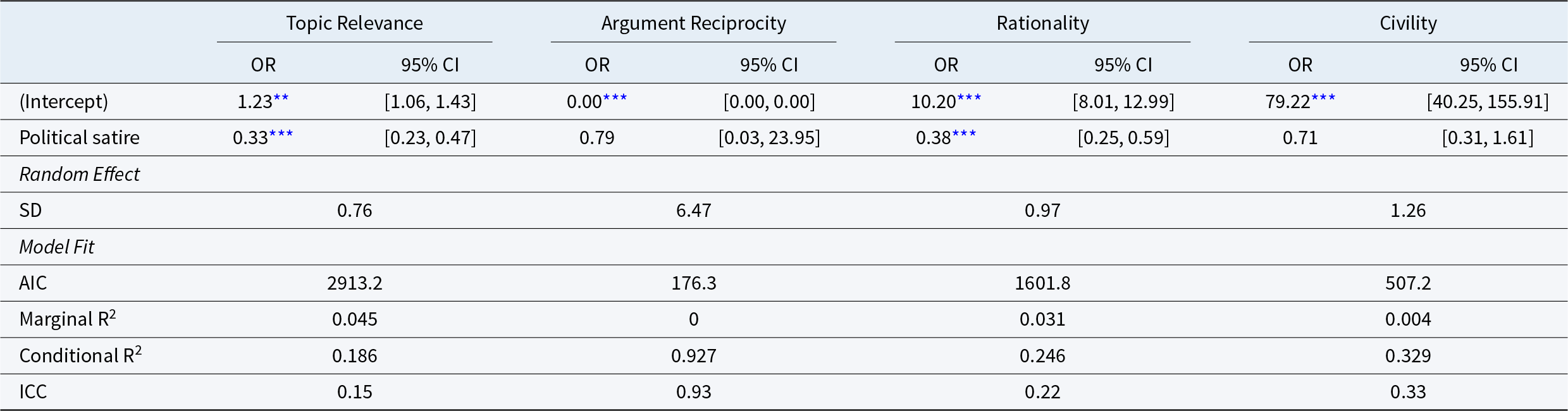
In the modelling process, we initially constructed null models that incorporated only the multilevel structure, which included the random effects of the posts/Level 2 (ICC topic relevance = 0.15, ICC argument reciprocity = 0.93, ICC rationality = 0.22, ICC civility = 0.33). Following this, we integrated the indicators (political satire) of the posts (Level 2) into models. Table 2 presents the results of the robust multilevel logistic regression predicting the four dimensions of discourse quality, reporting odds ratios (OR) and 95 per cent confidence intervals (CI) to assess the magnitude and robustness of the effects.
Multilevel Logistic Regression Results (Robust Bayesian Estimation)

Table 2 Long description
The table reports odds ratios with 95 percent confidence intervals from multilevel logistic models for four outcomes: topic relevance, argument reciprocity, rationality, and civility. Political satire is associated with substantially lower odds of topic relevance (odds ratio 0.33, confidence interval 0.23 to 0.47) and lower odds of rationality (0.38, 0.25 to 0.59). For argument reciprocity, the estimate for political satire is 0.79 with a very wide interval (0.03 to 23.95), indicating high uncertainty and no clear evidence of an association. For civility, political satire has an odds ratio of 0.71 with an interval from 0.31 to 1.61, also not clearly different from no effect. Baseline levels differ strongly across outcomes, with very high baseline odds for civility and rationality and near-zero baseline odds for reciprocity. Model fit and variance measures suggest especially strong between-group clustering for reciprocity (high conditional explained variance and high intra-class correlation), while the other outcomes show more modest clustering and explained variance.
Notes:
*** p < .001, **p < .01. OR = odds ratio; CI = 95 per cent confidence interval. SE: standard error; ICC: intra-class coefficient; AIC: Akaike information criterion. Calculations based on 2,201 comments and 1,199 posts.
Significant negative relationships were observed between political satire and the two primary dimensions of discourse quality. Specifically, political satire significantly reduced the likelihood of topic relevance (OR = 0.33, 95 per cent CI [0.23, 0.47], p < .001) and rationality (OR = 0.38, 95 per cent CI [0.25, 0.59], p < .001). In substantive terms, holding other factors constant, the odds of a reply being topically relevant decrease by approximately 67 per cent, and the odds of a reply being rational decrease by about 62 per cent when appearing under a politically satirical post, compared to a non-satirical one. These findings answer RQ1 and support H2, while H1 was rejected. Regarding the dimension of civility, the analysis showed no significant relationship (OR = 0.71, 95 per cent CI [0.31, 1.61], p > .05). The CI crosses 1, indicating that political satire does not systematically trigger more uncivil replies compared to non-satirical posts, thereby answering RQ2.
Finally, for argument reciprocity, the model estimated an OR of 0.79, but we urge caution in interpreting this result. As shown in Table 2, the 95 per cent CI for this variable is extraordinarily wide [0.03, 23.95] and the conditional R-squared is unusually high (0.93). These diagnostics reflect the severe sparsity of the data (only 0.86 per cent prevalence), suggesting that the estimates for reciprocity are highly unstable and lack the statistical precision observed in the findings for topic relevance and rationality.
Discussion
Often celebrated as a vehicle for critique and resistance, political satire has also been romanticized as an inherently democratizing force, one that is presumed to empower the public and subvert the powerful.Footnote 73 Yet its communicative consequences may be more ambivalent than assumed. Through a content analysis of social media posts and comments, this study examined the impact of political satire on discourse quality in the Chinese digital public sphere. The results demonstrate that satire significantly decreases the deliberative virtues of topic relevance and rationality of subsequent comments, while showing no significant relationship with (in)civility and argument reciprocity. These findings add to current scholarship in two ways, particularly by complementing prior work on political satire and deliberation. First, at the theoretical level, the study extends research on political satire by shifting attention away from participation frequency to the substantive quality of discourse. Rather than examining only whether satire encourages political talk, we scrutinize how it shapes the deliberative attributes of such talk.Footnote 74 Second, while prior work has often portrayed satire as a counter-discursive weapon in (semi-)authoritarian contexts such as China,Footnote 75 our findings reveal its disruptive potential: satire may weaken issue-focused, rational and reciprocal dialogue, raising concerns about its capacity to sustain deliberation and foster consensus.
To gain a better understanding of why satire may undermine deliberative quality, it is essential to examine the communicative dynamics it activates in digital discussions. The mechanisms driving these effects are multifaceted. First, satire tends to divert attention away from concrete policy discussions towards broader systemic or symbolic critiques. Users responding to satirical posts are more likely to contribute tangential remarks and simple assertions rather than issue-focused arguments. One plausible explanation is that satire often shifts attention away from specific policy implementation, encouraging “information discounting” and diminishing the perceived importance of the issue under discussion.Footnote 76 As a result, responses to satirical posts often exhibit tangential or generalized scepticism rather than engagement with the specific issue. For example, some users redirected discussions about raising the retirement age to a broader distrust of governance: “That is why class-action lawsuits are nearly non-existent in China.” These responses, while reflecting scepticism, failed to directly engage with the retirement policy itself and were therefore coded as off topic.
Moreover, satire appears to trivialize policy, diminishing the perceived seriousness of the issues and consequently undermining rational arguments. Consistent with Robin Nabi and colleagues, users often interpreted satire as “just a joke.”Footnote 77 They responded with exaggerated, irrational remarks, such as “Maybe the empowered man can set the retirement age to 100 years old” or “Just let everyone work until death, and the state won’t have to pay pensions.” These statements highlight how satire can encourage emotional venting rather than reasoned exchange, thereby weakening the rationality and robustness of public discourse. Echoing Boukes and colleagues, our study shows that audiences may shift attention from policy substance to implied meanings or symbolic critiques, further undermining deliberative quality.Footnote 78
Regarding argument reciprocity, our robust analysis reveals a phenomenon of extreme scarcity, with reciprocal interactions appearing in only 0.86 per cent of the total sample. This distinct lack of engagement was so pronounced that statistical modelling became unstable, signalling a structural incompatibility between political satire and mutual exchange in this context. Rather than merely “reducing” reciprocity, our findings suggest that the satirical environment effectively precludes the conditions necessary for it. This finding aligns with prior research indicating that political satire fosters cynicism, discourages participation and promotes disengagement.Footnote 79 In our material, users exposed to satire frequently displayed resignation and avoidance of reciprocal exchange, as seen in responses like: “What else can you do besides support it?” or “I want to go home and farm, okay?” Such replies portray a sense of political powerlessness and futility, hallmarks of alienation that obstruct dialogical engagement. One possible mechanism lies in the humorous framing of satire, which decreases sensitivity to argument scrutiny and promotes a communication pattern focused on self-expression and information exposure rather than genuine deliberative exchange.Footnote 80 David Paletz contends that humour can ease the tensions surrounding political issues, thereby discouraging binary interactions (for example, “yes” versus “no”) and reducing incentives for sustained deliberation.Footnote 81 Our evidence extends this line of research by showing how satire in the Chinese digital public sphere not only diminishes political efficacy but also obstructs mutual reasoning and reciprocity.
In summary, these results demonstrate that satire functions less as a catalyst for rational-critical debate and more as a disruptive force that dilutes topical focus, fosters irrational expression and weakens reciprocal engagement. Viewed through the lens of deliberative theory, political satire distracts from substantive issues, encourages expressive or hyperbolic remarks and discourages reciprocal argumentation, ultimately narrowing the possibilities for rational-critical dialogue.Footnote 82 At the same time, from the perspective of political satire studies, our findings respond to Boukes and colleagues’ call to expand the field in two directions.Footnote 83 First, Boukes and colleagues illustrate that the production and effects of satire vary across cultural contexts; our study contributes to this line by examining the dynamics of satire within the constrained Chinese environment. Second, while much existing research relies on online experiments and often overlooks real-life communicative effects, our study addresses this gap by analysing satire in natural discursive settings. Taken together, these insights offer a corrective to overly optimistic portrayals of satire as a straightforward tool of resistance, highlighting instead its potential to fragment, rather than enhance, deliberative engagement in the Chinese digital public sphere.
The results of our analysis raise important concerns about the role of political satire in this context. Although prior studies have emphasized satire as a form of tactical resistance and counter-discourse against state power,Footnote 84 our findings complicate this optimistic narrative. Satire may indeed mobilize publics and stimulate awareness,Footnote 85 but it also risks producing disordered and fragmented discourse in which serious policy debates are overshadowed by humour, sarcasm and cynicism. This distortion weakens the deliberative potential of online spaces by displacing reasoned exchange with ironic detachment, thereby reducing the likelihood of policy-oriented consensus. In this sense, political satire may offer symbolic resistance but simultaneously threatens the integrity and efficacy of the public sphere in China.
These findings suggest the need to critically revisit what might be called the “resistance-priority paradigm” in political communication research. This paradigm tends to overvalue the emancipatory or counter-hegemonic potential of alternative narratives such as satire, granting them a kind of normative “green light” while overlooking their possible negative consequences for the robustness of the public sphere and prospects of democratization. Recent scholarship has already begun to challenge such unqualified optimism. For instance, Gillian Bolsover shows how pro-Modi online discourse facilitated extreme ethnoreligious nationalism and polarizing misinformation.Footnote 86 Similarly, studies of digital resistance practices reveal that initial hopes for political transformation often give way to disappointing outcomes.Footnote 87 In line with these critiques, our study highlights the “dark side” of political satire: rather than strengthening public deliberation, satire can destabilize it by fostering irrational, non-reciprocal and off-topic discussion. This perspective complicates conventional assumptions about the liberatory potential of satire in (semi-)authoritarian settings and calls for a more balanced understanding of its ambivalent functions in shaping political communication.
This study approaches the findings from the perspective that satirical expression is associated with a lower level of discursive quality in online policy discussions. At the same time, an alternative interpretation cannot be ruled out: rather than satire altering users’ reasoning, it is possible that individuals who are already less inclined towards topic-relevant or reason-giving debate are more likely to respond by following satirical threads. Their pre-existing preference for ironic, expressive and low-commitment forms of political talk is simply more compatible with the playful, tongue-in-cheek style of satire than with the norm of justification that governs serious replies. In this view, the observed pattern may reflect differences in participant composition rather than changes in their discursive behaviour. However, acknowledging this possibility does not contradict the current argument but adds nuance to the interpretation of the findings by suggesting that the communicative style of a discussion space may interact with the discursive tendencies of those who enter it.
Practical implication
In the Chinese online environment, where direct criticism is often constrained by censorship, satire has become a common rhetorical device for packaging political and policy-related expression. Citizens frequently employ satirical comments to convey their views and frustrations. However, our findings suggest that satirical expression is not conducive to a high-quality deliberative space, as it tends to dilute seriousness, undermine rationality and divert attention away from substantive policy discussion. As a result, satire hinders the formation of informed public opinion, a finding which has important implications for platform governance.
Platforms cannot expect high-quality deliberation to emerge spontaneously under threads dominated by satirical content. Instead, they need to assume a more proactive role as deliberative architects. Prior research has shown that the design and architecture of platforms directly shape the formation and direction of communication.Footnote 88 If the aim is to cultivate a healthier and more inclusive public sphere, platforms could consider design interventions that counter satire’s natural tendency towards de-rationalization. One possible approach is to introduce deliberation prompts. When algorithms detect that a popular comment is satirical, the platform could experiment with placing an automatic or moderator-generated prompt beneath it, such as: “What specific policy concerns might this joke be pointing to?” Such prompts can gently redirect attention from playful banter back to substantive policy discussion.
Another potential strategy is to move beyond current ranking systems that privilege “likes” or recency. Platforms could instead implement a deliberation quality score that prioritizes comments offering questions, arguments or reflections. Especially in satire-heavy threads, this scoring mechanism could elevate more thoughtful contributions, balancing the dominance of “quip-like” comments. In summary, these measures highlight that building a constructive online public sphere requires more than relying on users’ spontaneous engagement: it requires deliberate platform design that steers discussions towards rational-critical exchange, even in spaces where satire is prevalent.
Limitation and future research
This research is not without limitations. First, our analysis focused on the core dimensions of the discourse quality index, such as topic relevance, argument reciprocity, rationality and civility, which are widely used in deliberative scholarship to assess the structural robustness of public discussion.Footnote 89 While this focus allowed us to capture foundational deliberative features, it did not encompass additional aspects such as solution proposals, sincere questions or personal experiences. Future research could incorporate these supplementary dimensions to provide a more comprehensive and context-sensitive assessment of how satire shapes discursive engagement.
A further limitation concerns the potential influence of censorship. The lower discursive quality observed in the satirical threads may not fully reflect the original range of satirical responses, as some more critical or analytically structured comments may have been removed by the platform. In that case, the data may represent satire after content moderation rather than the full discursive ecology that initially emerged. However, this does not make the analysis less meaningful. In constrained political contexts, what remains publicly visible after censorship constitutes the actual discursive environment through which ordinary users encounter political satire in practice. Examining this “post-moderation space” is therefore analytically relevant in its own right, as it reflects the forms of political expression that are permitted to circulate and that shape public impressions of policy discussions.
Supplementary material
The supplementary material for this article can be found at https://doi.org/10.1017/S0305741026102124.
Competing interests
None.
Xiaotong CHEN is a PhD candidate in the School of Journalism and Communication, Tsinghua University. Her academic interest focuses on political and science communications in China. She has published in Policy and Internet, Journal of Contemporary China, Public Understanding of Science, Social Media and Society and Javnost–The Public.
Tianru GUAN is an associate professor in the School of Journalism and Communication, Wuhan University. Her academic interest lies in political communication and public opinion in various social contexts. She is the author of Understanding China’s Digital Politics (Routledge, 2025). Her work has been published in Policy and Internet, Digital Journalism, Journal of Contemporary China, Social Media and Society, Media, Culture and Society, The Information Society, Feminist Media Studies, International Communication Gazette, Social Science Quarterly, International Political Science Review and Journal of East Asian Studies.